Computer Assisted
Language
Learning
What is CALL?
Computer-assisted language learning (CALL) is a form of
computer-based learning which carries two important
features: bidirectional learning and individualized learning
It is a tool that helps teachers to facilitate language
learning process. CALL can be used to reinforce what has
been learned in the classrooms.
“
”
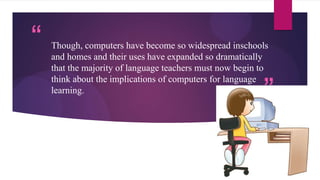
Though, computers have become so widespread inschools
and homes and their uses have expanded so dramatically
that the majority of language teachers must now begin to
think about the implications of computers for language
learning.
Three phases
of CALL
Though CALL has developed
gradually over the last 30 years,
this development can be
categorized in terms of three
somewhat distinct phases which I
will refer to as behavioristic
CALL, communicative CALL,
and integrative CALL
“
”
Behavioristic CALL
CONCEIVED IN THE 1950S AND IMPLEMENTED IN THE
1960S AND '70S, WAS BASED ON THE THEN-
DOMINANT BEHAVIORIST THEORIES OF LEARNING.
PROGRAMS OF THIS PHASE ENTAILED REPETITIVE
LANGUAGE DRILLS AND CAN BE REFERRED TO AS
"DRILL AND PRACTICE" (OR, MORE PEJORATIVELY, AS
"DRILL AND KILL").
Based on these notions, a number of CALL tutoring systems were developed
for the mainframe computers which were used at that time. One of the most
sophisticated of these was the PLATO system, which ran on its own special
PLATO hardware, including central computers and terminals. The PLATO
system included vocabulary drills, brief grammar explanations and drills, and
translations tests at various intervals
Behavioristic CALL characteristics
 Repeated exposure to the same material is beneficial or
even essential to learning
 A computer is ideal for carrying out repeated drills,
since the machine does not get bored with presenting
the same material and since it can provide immediate
non-judgmental feedback
 A computer can present such material on an
individualized basis, allowing students to proceed at
their own pace and freeing up class time for other
activities
“
”
Communicative CALL
THE SECOND PHASE OF CALL WAS BASED ON
THE COMMUNICATIVE APPROACH TO
TEACHING WHICH BECAME PROMINENT IN THE
1970S AND 80S. PROPONENTS OF THIS
APPROACH FELT THAT THE DRILL AND PRACTICE
PROGRAMS OF THE PREVIOUS DECADE DID
NOT ALLOW ENOUGH AUTHENTIC
COMMUNICATION TO BE OF MUCH VALUE.
Communicative CALL
characteristics
• focuses more on using forms rather than on the forms themselves;
• teaches grammar implicitly rather than explicitly;
• allows and encourages students to generate original utterances rather than just manipulate
prefabricated language;
• does not judge and evaluate everything the students not reward them with congratulatory messages,
lights, or bells;
• avoids telling students they are wrong and is flexible to a variety of student responses;
• uses the target language exclusively and creates an environment in which using the target language
feels natural, both on and off the screen; and
• will never try to do anything that a book can do just as well.
Integrative CALL
Multimedia
• CD-ROM which allows a variety of media (text, graphics, sound, animation,
and video) to be accessed on a single machine.
• Multimedia entails hypermedia .
• Multimedia resources are linked together and learners can navigate their
own paths simply by pointing and clicking a mouse.
• Skills are integrated.
• Reading + Writing + Speaking + Listening
• It facilitates a principle focus on the content, without sacrificing a
secondary focus on language form or learning strategies.
• Integrative CALL
Computer-Mediated Communication (CMC)
• Asynchronous (Not Simultaneous
E-mail
• Synchronous (Simultaneous)
Writing environment Aspects
MUD’s ( multi-user domains)
MOO’s ( the above + object-oriented)
By Camilo Junco Suarez

Computer assisted language learning - Tarea

  • 1.
  • 2.
    What is CALL? Computer-assistedlanguage learning (CALL) is a form of computer-based learning which carries two important features: bidirectional learning and individualized learning It is a tool that helps teachers to facilitate language learning process. CALL can be used to reinforce what has been learned in the classrooms.
  • 3.
    “ ” Though, computers havebecome so widespread inschools and homes and their uses have expanded so dramatically that the majority of language teachers must now begin to think about the implications of computers for language learning.
  • 4.
    Three phases of CALL ThoughCALL has developed gradually over the last 30 years, this development can be categorized in terms of three somewhat distinct phases which I will refer to as behavioristic CALL, communicative CALL, and integrative CALL
  • 5.
    “ ” Behavioristic CALL CONCEIVED INTHE 1950S AND IMPLEMENTED IN THE 1960S AND '70S, WAS BASED ON THE THEN- DOMINANT BEHAVIORIST THEORIES OF LEARNING. PROGRAMS OF THIS PHASE ENTAILED REPETITIVE LANGUAGE DRILLS AND CAN BE REFERRED TO AS "DRILL AND PRACTICE" (OR, MORE PEJORATIVELY, AS "DRILL AND KILL"). Based on these notions, a number of CALL tutoring systems were developed for the mainframe computers which were used at that time. One of the most sophisticated of these was the PLATO system, which ran on its own special PLATO hardware, including central computers and terminals. The PLATO system included vocabulary drills, brief grammar explanations and drills, and translations tests at various intervals
  • 6.
    Behavioristic CALL characteristics Repeated exposure to the same material is beneficial or even essential to learning  A computer is ideal for carrying out repeated drills, since the machine does not get bored with presenting the same material and since it can provide immediate non-judgmental feedback  A computer can present such material on an individualized basis, allowing students to proceed at their own pace and freeing up class time for other activities
  • 7.
    “ ” Communicative CALL THE SECONDPHASE OF CALL WAS BASED ON THE COMMUNICATIVE APPROACH TO TEACHING WHICH BECAME PROMINENT IN THE 1970S AND 80S. PROPONENTS OF THIS APPROACH FELT THAT THE DRILL AND PRACTICE PROGRAMS OF THE PREVIOUS DECADE DID NOT ALLOW ENOUGH AUTHENTIC COMMUNICATION TO BE OF MUCH VALUE.
  • 8.
    Communicative CALL characteristics • focusesmore on using forms rather than on the forms themselves; • teaches grammar implicitly rather than explicitly; • allows and encourages students to generate original utterances rather than just manipulate prefabricated language; • does not judge and evaluate everything the students not reward them with congratulatory messages, lights, or bells; • avoids telling students they are wrong and is flexible to a variety of student responses; • uses the target language exclusively and creates an environment in which using the target language feels natural, both on and off the screen; and • will never try to do anything that a book can do just as well.
  • 9.
    Integrative CALL Multimedia • CD-ROMwhich allows a variety of media (text, graphics, sound, animation, and video) to be accessed on a single machine. • Multimedia entails hypermedia . • Multimedia resources are linked together and learners can navigate their own paths simply by pointing and clicking a mouse. • Skills are integrated. • Reading + Writing + Speaking + Listening • It facilitates a principle focus on the content, without sacrificing a secondary focus on language form or learning strategies.
  • 10.
    • Integrative CALL Computer-MediatedCommunication (CMC) • Asynchronous (Not Simultaneous E-mail • Synchronous (Simultaneous) Writing environment Aspects MUD’s ( multi-user domains) MOO’s ( the above + object-oriented) By Camilo Junco Suarez