Artificial Neural Networks
AI, The Brain and
AI, The Brain and
Neural Computing
Neural Computing
Brain Structure
Brain Structure

Contains around 10,000,000,000 neurons
• Approx. the number of raindrops to fill an
Approx. the number of raindrops to fill an
olympic swimming pool

Each of which is connected to around
10,000 others
10,000 others

Neurons communicate through synapses –
effectively a configurable chemical
junction between neurons
Neurons
Neurons
 Neuron systems for signal processing and
memory
 Connectionism was proposed based on the
research outcome in neuron science about how
the information is processed, stored and
communicated among neurons.
1. A brain is composed of trillions of cells which
interact with each other
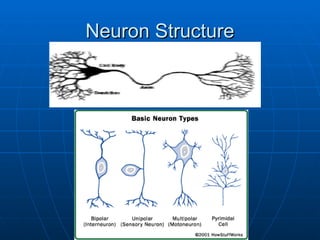
2. A cell is composed of three parts
(a) Dendritic tree: receive signals
(b) Cell body: process signals
(c) Axon: transmit signals
Neuron Structure
Neuron Structure
Neuronal Function
Neuronal Function

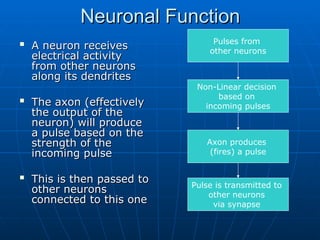
A neuron receives
A neuron receives
electrical activity
electrical activity
from other neurons
from other neurons
along its dendrites
along its dendrites

The axon (effectively
the output of the
the output of the
neuron) will produce
a pulse based on the
strength of the
strength of the
incoming pulse
incoming pulse

This is then passed to
other neurons
other neurons
connected to this one
Pulses from
other neurons
Non-Linear decision
based on
incoming pulses
Axon produces
(fires) a pulse
Pulse is transmitted to
other neurons
via synapse
Creating Learning Machines

There are a number of desirable properties we as
humans possess
humans possess

However, clearly we have very different hardware
to computers
to computers

Some (moderately successful) attempts have
been made to recreate neural architecture in
hardware
hardware

However, the most popular method is to simulate
neural processes on a standard computer –
neural networks
neural networks
The Beginning
The Beginning

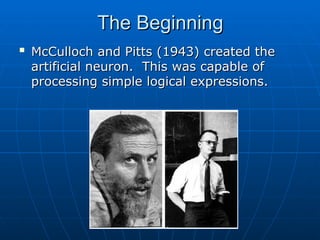
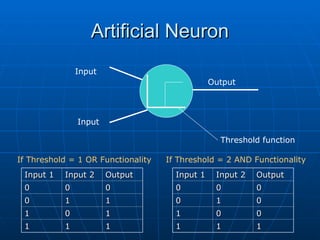
McCulloch and Pitts (1943) created the
artificial neuron. This was capable of
processing simple logical expressions.
Artificial Neuron
Artificial Neuron
Input 1
Input 1 Input 2
Input 2 Output
Output
0
0 0
0 0
0
0
0 1
1 1
1
1
1 0
0 1
1
1
1 1
1 1
1
Input
Input
Threshold function
Output
If Threshold = 1 OR Functionality
Input 1
Input 1 Input 2
Input 2 Output
Output
0
0 0
0 0
0
0
0 1
1 0
0
1
1 0
0 0
0
1
1 1
1 1
1
If Threshold = 2 AND Functionality
Hebbian Learning (1949)
“When an axon of cell A is near enough to excite a
cell B and repeatedly or persistently takes part
in firing it, some growth process or metabolic
change takes place in one or both cells such that
A’s efficiency, as one of the cells firing B, is
increased.”1
Donald Hebb – The Organisation of Behaviour (1949)
 This means:
1. when two neurons fire together the connection between the
neurons is strengthened
2. the activity of firing is one of the fundamental operations
necessary for learning and memory
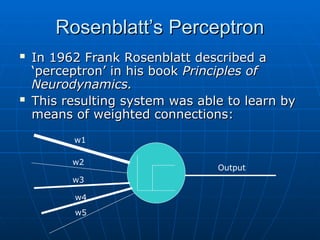
Rosenblatt’s Perceptron
 In 1962 Frank Rosenblatt described a
In 1962 Frank Rosenblatt described a
‘perceptron’ in his book
‘perceptron’ in his book Principles of
Principles of
Neurodynamics.
Neurodynamics.
 This resulting system was able to learn by
This resulting system was able to learn by
means of weighted connections:
Output
w1
w2
w3
w4
w5
Problems with the Perceptron
 Rosenblatt made some rather
Rosenblatt made some rather
outlandish claims for the
perceptron
perceptron
 Minsky and Papert in 1969
Minsky and Papert in 1969
published
published Perceptrons: An
Perceptrons: An
Introduction to Computational
Geometry
Geometry which highlighted
which highlighted
the shortcomings of the
technique
technique
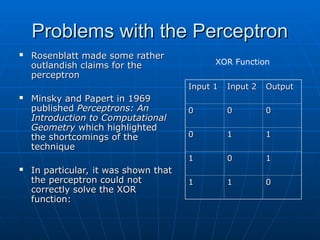
 In particular, it was shown that
In particular, it was shown that
the perceptron could not
correctly solve the XOR
function:
function:
Input 1
Input 1 Input 2
Input 2 Output
Output
0
0 0
0 0
0
0
0 1
1 1
1
1
1 0
0 1
1
1
1 1
1 0
0
XOR Function
Dark Ages for Neural Computing

Two paradigms of AI research presented
themselves:
themselves:
• The classical symbolic method
The classical symbolic method
• The non-classical connectionist (neural)
The non-classical connectionist (neural)
method
method

Due to Minsky and Papert’s arguments,
hardly any research was conducted into
neural computing until the 1980s….
1986 - a Resurgence in
Connectionism
Connectionism

In 1986, Rumelhardt and
McClelland published
their seminal text –
“
“Parallel distributed
Parallel distributed
processing: Explorations
in the microstructure of
cognition”
cognition”

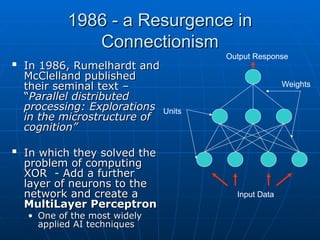
In which they solved the
problem of computing
XOR - Add a further
XOR - Add a further
layer of neurons to the
network and create a
MultiLayer Perceptron
• One of the most widely
One of the most widely
applied AI techniques
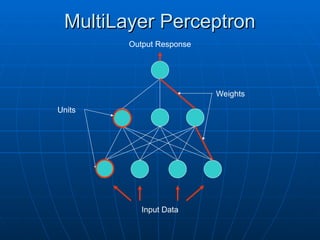
Units
Input Data
Output Response
Weights
Applications of Neural Computing
 Almost too numerous to mention, but the
Almost too numerous to mention, but the
main ones:
main ones:
• Data analysis
Data analysis
• Classification/Prediction
Classification/Prediction
• Pattern Detection
Pattern Detection
• AI Studies – investigating learning in infants
AI Studies – investigating learning in infants
(e.g. language and perception tasks)
• Image Analysis (e.g. face recognition)
Image Analysis (e.g. face recognition)
• Control systems in engineering applications
Control systems in engineering applications
(e.g. power stations and other safety critical
systems)
systems)
 We’ll be concentrating on the first few
We’ll be concentrating on the first few
Variations on the Perceptron

Multi-Layer Perceptrons

Recurrent Neural Networks

Self-Organising Maps

Kohonen Networks
Kohonen Networks

Boltzmann Machines
Boltzmann Machines

Probabilistic Neural Networks

Many more…
Many more…
Neural Computing/Connectionism
Summary
Summary
 Computational paradigm based loosely on the
Computational paradigm based loosely on the
workings of the human brain – not exactly
(temporal effects are ignored)
 Have shown to have human-like qualities, also
Have shown to have human-like qualities, also
making similar mistakes (e.g. optical illusions)
 Have a significantly different method of
Have a significantly different method of
computation than traditional rule-based AI.
 Have been successfully used in a huge number of
Have been successfully used in a huge number of
application areas
application areas
Learning in Neural Networks

Falls broadly into two types:
• Supervised Learning
Supervised Learning
• Unsupervised Learning
Unsupervised Learning

Supervised Learning
Supervised Learning
• Similar to the way children learn
Similar to the way children learn
• The output of the neural network is compared against
The output of the neural network is compared against
the correct output
the correct output
• The network then corrects itself based on that output
The network then corrects itself based on that output

Unsupervised Learning
• The network organises itself according to patterns in the
The network organises itself according to patterns in the
data
data
• No external 'desired output' is provided
No external 'desired output' is provided
The Perceptron
The Perceptron

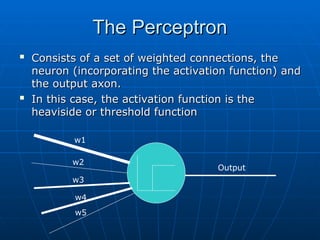
Consists of a set of weighted connections, the
neuron (incorporating the activation function) and
the output axon.
the output axon.

In this case, the activation function is the
heaviside or threshold function
Output
w1
w2
w3
w4
w5
Learning in a Perceptron
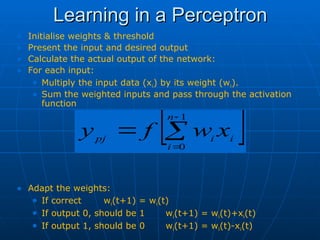
• Initialise weights & threshold
• Present the input and desired output
• Calculate the actual output of the network:
• For each input:
• Multiply the input data (xi) by its weight (wi).
• Sum the weighted inputs and pass through the activation
function
• Adapt the weights:
• If correct wi(t+1) = wi(t)
• If output 0, should be 1 wi(t+1) = wi(t)+xi(t)
• If output 1, should be 0 wi(t+1) = wi(t)-xi(t)
 




1
0
n
i
i
i
pj
x
w
f
y
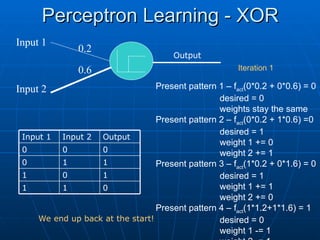
Perceptron Learning - OR
Output
0.2
0.6
Input 1
Input 2
1
1
1
1
0
1
1
1
0
0
0
0
Output
Input 2
Input 1
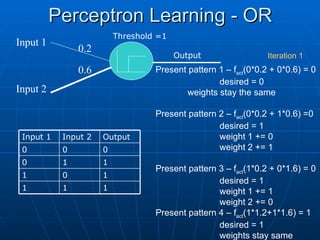
Present pattern 1 – fact(0*0.2 + 0*0.6) = 0
desired = 0
weights stay the same
Present pattern 2 – fact(0*0.2 + 1*0.6) =0
desired = 1
weight 1 += 0
weight 2 += 1
Present pattern 3 – fact(1*0.2 + 0*1.6) = 0
desired = 1
weight 1 += 1
weight 2 += 0
Present pattern 4 – fact(1*1.2+1*1.6) = 1
desired = 1
weights stay same
Iteration 1
Threshold =1
Perceptron Learning Iteration 2
Output
1.2
1.6
Input 1
Input 2
1
1
1
1
0
1
1
1
0
0
0
0
Output
Input 2
Input 1
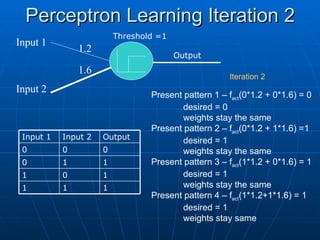
Present pattern 1 – fact(0*1.2 + 0*1.6) = 0
desired = 0
weights stay the same
Present pattern 2 – fact(0*1.2 + 1*1.6) =1
desired = 1
weights stay the same
Present pattern 3 – fact(1*1.2 + 0*1.6) = 1
desired = 1
weights stay the same
Present pattern 4 – fact(1*1.2+1*1.6) = 1
desired = 1
weights stay same
Iteration 2
Threshold =1
Perceptron Learning - XOR
Output
0.2
0.6
Input 1
Input 2
0
1
1
1
0
1
1
1
0
0
0
0
Output
Input 2
Input 1
Present pattern 1 – fact(0*0.2 + 0*0.6) = 0
desired = 0
weights stay the same
Present pattern 2 – fact(0*0.2 + 1*0.6) =0
desired = 1
weight 1 += 0
weight 2 += 1
Present pattern 3 – fact(1*0.2 + 0*1.6) = 0
desired = 1
weight 1 += 1
weight 2 += 0
Present pattern 4 – fact(1*1.2+1*1.6) = 1
desired = 0
weight 1 -= 1
Iteration 1
We end up back at the start!
Modified Versions of Learning

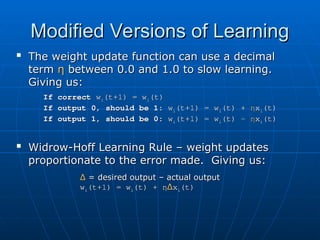
The weight update function can use a decimal
term
term η
η between 0.0 and 1.0 to slow learning.
between 0.0 and 1.0 to slow learning.
Giving us:
Giving us:
If correct
If correct w
wi
i(t+1) = w
(t+1) = wi
i(t)
(t)
If output 0, should be 1:
If output 0, should be 1: w
wi
i(t+1) = w
(t+1) = wi
i(t) +
(t) + η
ηx
xi
i(t)
(t)
If output 1, should be 0:
If output 1, should be 0: w
wi
i(t+1) = w
(t+1) = wi
i(t) -
(t) - η
ηx
xi
i(t)
(t)

Widrow-Hoff Learning Rule – weight updates
proportionate to the error made. Giving us:
Δ
Δ = desired output – actual output
= desired output – actual output
w
wi
i(t+1) = w
(t+1) = wi
i(t) +
(t) + η
ηΔ
Δx
xi
i(t)
(t)
Limitations of the Perceptron

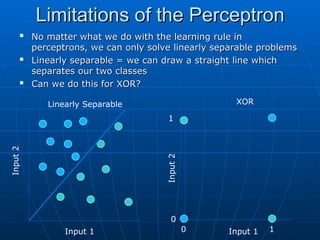
No matter what we do with the learning rule in
perceptrons, we can only solve linearly separable problems

Linearly separable = we can draw a straight line which
separates our two classes

Can we do this for XOR?
Linearly Separable
Input 1
Input
2
0 1
0
1
XOR
Input 1
Input
2
MultiLayer Perceptron

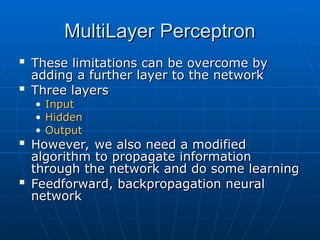
These limitations can be overcome by
adding a further layer to the network

Three layers
Three layers
• Input
Input
• Hidden
Hidden
• Output
Output

However, we also need a modified
algorithm to propagate information
through the network and do some learning

Feedforward, backpropagation neural
network
network
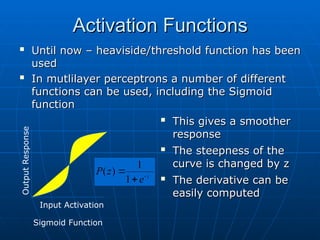
Activation Functions

This gives a smoother
response
response

The steepness of the
curve is changed by z

The derivative can be
easily computed
easily computed
Sigmoid Function
Input Activation
Output
Response

Until now – heaviside/threshold function has been
used
used

In mutlilayer perceptrons a number of different
functions can be used, including the Sigmoid
function
function
z
e
z
P 


1
1
)
(
MultiLayer Perceptron
Weights
Units
Input Data
Output Response
Weights
Weights

Weights are variable strength
connections between units

Propagate signals from one unit to
the next
the next

Main learning component
• Weights are the main component
Weights are the main component
changed during learning
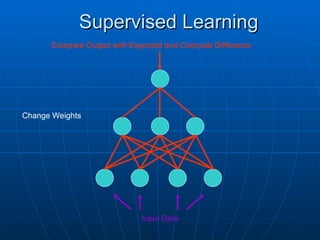
Supervised Learning
Supervised Learning
Input Data
Change Weights
Compare Output with Expected and Compute Difference
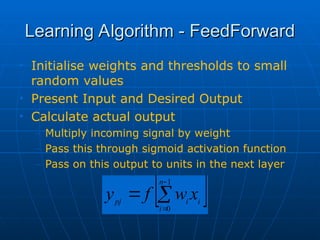
Learning Algorithm - FeedForward
• Initialise weights and thresholds to small
random values
• Present Input and Desired Output
• Calculate actual output
– Multiply incoming signal by weight
– Pass this through sigmoid activation function
– Pass on this output to units in the next layer
 




1
0
n
i
i
i
pj
x
w
f
y
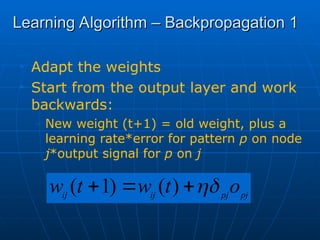
Learning Algorithm – Backpropagation 1
• Adapt the weights
• Start from the output layer and work
backwards:
– New weight (t+1) = old weight, plus a
learning rate*error for pattern p on node
j*output signal for p on j
pj
pj
ij
ij
o
t
w
t
w 


 )
(
)
1
(
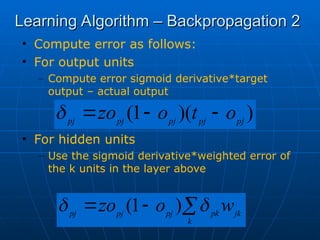
Learning Algorithm – Backpropagation 2
• Compute error as follows:
• For output units
– Compute error sigmoid derivative*target
output – actual output
• For hidden units
– Use the sigmoid derivative*weighted error of
the k units in the layer above
)
)(
1
( pj
pj
pj
pj
pj
o
t
o
zo 






k
jk
pk
pj
pj
pj
w
o
zo 
 )
1
(
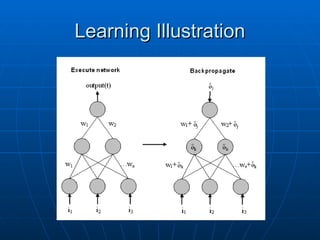
Learning Illustration
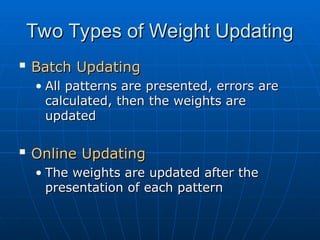
Two Types of Weight Updating

Batch Updating
Batch Updating
• All patterns are presented, errors are
All patterns are presented, errors are
calculated, then the weights are
updated
updated

Online Updating
Online Updating
• The weights are updated after the
The weights are updated after the
presentation of each pattern
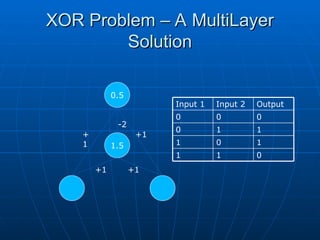
XOR Problem – A MultiLayer
Solution
Solution
1.5
0.5
+1
+
1
+1
+1
-2
0
1
1
1
0
1
1
1
0
0
0
0
Output
Input 2
Input 1
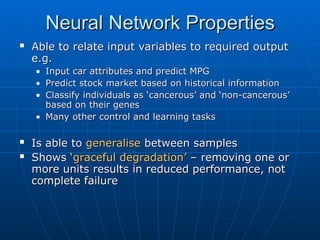
Neural Network Properties
 Able to relate input variables to required output
Able to relate input variables to required output
e.g.
e.g.
• Input car attributes and predict MPG
Input car attributes and predict MPG
• Predict stock market based on historical information
Predict stock market based on historical information
• Classify individuals as ‘cancerous’ and ‘non-cancerous’
Classify individuals as ‘cancerous’ and ‘non-cancerous’
based on their genes
• Many other control and learning tasks
Many other control and learning tasks
 Is able to
Is able to generalise
generalise between samples
between samples
 Shows
Shows ‘graceful degradation’
‘graceful degradation’ – removing one or
– removing one or
more units results in reduced performance, not
complete failure
complete failure

ComputationalIntelligence_Lect2_ANeuralNetworks.ppt

  • 1.
    Artificial Neural Networks ArtificialNeural Networks AI, The Brain and AI, The Brain and Neural Computing Neural Computing
  • 2.
    Brain Structure Brain Structure  Containsaround 10,000,000,000 neurons Contains around 10,000,000,000 neurons • Approx. the number of raindrops to fill an Approx. the number of raindrops to fill an olympic swimming pool olympic swimming pool  Each of which is connected to around Each of which is connected to around 10,000 others 10,000 others  Neurons communicate through synapses – Neurons communicate through synapses – effectively a configurable chemical effectively a configurable chemical junction between neurons junction between neurons
  • 3.
    Neurons Neurons  Neuron systemsfor signal processing and memory  Connectionism was proposed based on the research outcome in neuron science about how the information is processed, stored and communicated among neurons. 1. A brain is composed of trillions of cells which interact with each other 2. A cell is composed of three parts (a) Dendritic tree: receive signals (b) Cell body: process signals (c) Axon: transmit signals
  • 4.
  • 5.
    Neuronal Function Neuronal Function  Aneuron receives A neuron receives electrical activity electrical activity from other neurons from other neurons along its dendrites along its dendrites  The axon (effectively The axon (effectively the output of the the output of the neuron) will produce neuron) will produce a pulse based on the a pulse based on the strength of the strength of the incoming pulse incoming pulse  This is then passed to This is then passed to other neurons other neurons connected to this one connected to this one Pulses from other neurons Non-Linear decision based on incoming pulses Axon produces (fires) a pulse Pulse is transmitted to other neurons via synapse
  • 6.
    Creating Learning Machines CreatingLearning Machines  There are a number of desirable properties we as There are a number of desirable properties we as humans possess humans possess  However, clearly we have very different hardware However, clearly we have very different hardware to computers to computers  Some (moderately successful) attempts have Some (moderately successful) attempts have been made to recreate neural architecture in been made to recreate neural architecture in hardware hardware  However, the most popular method is to simulate However, the most popular method is to simulate neural processes on a standard computer – neural processes on a standard computer – neural networks neural networks
  • 7.
    The Beginning The Beginning  McCullochand Pitts (1943) created the McCulloch and Pitts (1943) created the artificial neuron. This was capable of artificial neuron. This was capable of processing simple logical expressions. processing simple logical expressions.
  • 8.
    Artificial Neuron Artificial Neuron Input1 Input 1 Input 2 Input 2 Output Output 0 0 0 0 0 0 0 0 1 1 1 1 1 1 0 0 1 1 1 1 1 1 1 1 Input Input Threshold function Output If Threshold = 1 OR Functionality Input 1 Input 1 Input 2 Input 2 Output Output 0 0 0 0 0 0 0 0 1 1 0 0 1 1 0 0 0 0 1 1 1 1 1 1 If Threshold = 2 AND Functionality
  • 9.
    Hebbian Learning (1949) HebbianLearning (1949) “When an axon of cell A is near enough to excite a cell B and repeatedly or persistently takes part in firing it, some growth process or metabolic change takes place in one or both cells such that A’s efficiency, as one of the cells firing B, is increased.”1 Donald Hebb – The Organisation of Behaviour (1949)  This means: 1. when two neurons fire together the connection between the neurons is strengthened 2. the activity of firing is one of the fundamental operations necessary for learning and memory
  • 10.
    Rosenblatt’s Perceptron Rosenblatt’s Perceptron In 1962 Frank Rosenblatt described a In 1962 Frank Rosenblatt described a ‘perceptron’ in his book ‘perceptron’ in his book Principles of Principles of Neurodynamics. Neurodynamics.  This resulting system was able to learn by This resulting system was able to learn by means of weighted connections: means of weighted connections: Output w1 w2 w3 w4 w5
  • 11.
    Problems with thePerceptron Problems with the Perceptron  Rosenblatt made some rather Rosenblatt made some rather outlandish claims for the outlandish claims for the perceptron perceptron  Minsky and Papert in 1969 Minsky and Papert in 1969 published published Perceptrons: An Perceptrons: An Introduction to Computational Introduction to Computational Geometry Geometry which highlighted which highlighted the shortcomings of the the shortcomings of the technique technique  In particular, it was shown that In particular, it was shown that the perceptron could not the perceptron could not correctly solve the XOR correctly solve the XOR function: function: Input 1 Input 1 Input 2 Input 2 Output Output 0 0 0 0 0 0 0 0 1 1 1 1 1 1 0 0 1 1 1 1 1 1 0 0 XOR Function
  • 12.
    Dark Ages forNeural Computing Dark Ages for Neural Computing  Two paradigms of AI research presented Two paradigms of AI research presented themselves: themselves: • The classical symbolic method The classical symbolic method • The non-classical connectionist (neural) The non-classical connectionist (neural) method method  Due to Minsky and Papert’s arguments, Due to Minsky and Papert’s arguments, hardly any research was conducted into hardly any research was conducted into neural computing until the 1980s…. neural computing until the 1980s….
  • 13.
    1986 - aResurgence in 1986 - a Resurgence in Connectionism Connectionism  In 1986, Rumelhardt and In 1986, Rumelhardt and McClelland published McClelland published their seminal text – their seminal text – “ “Parallel distributed Parallel distributed processing: Explorations processing: Explorations in the microstructure of in the microstructure of cognition” cognition”  In which they solved the In which they solved the problem of computing problem of computing XOR - Add a further XOR - Add a further layer of neurons to the layer of neurons to the network and create a network and create a MultiLayer Perceptron MultiLayer Perceptron • One of the most widely One of the most widely applied AI techniques applied AI techniques Units Input Data Output Response Weights
  • 14.
    Applications of NeuralComputing Applications of Neural Computing  Almost too numerous to mention, but the Almost too numerous to mention, but the main ones: main ones: • Data analysis Data analysis • Classification/Prediction Classification/Prediction • Pattern Detection Pattern Detection • AI Studies – investigating learning in infants AI Studies – investigating learning in infants (e.g. language and perception tasks) (e.g. language and perception tasks) • Image Analysis (e.g. face recognition) Image Analysis (e.g. face recognition) • Control systems in engineering applications Control systems in engineering applications (e.g. power stations and other safety critical (e.g. power stations and other safety critical systems) systems)  We’ll be concentrating on the first few We’ll be concentrating on the first few
  • 15.
    Variations on thePerceptron Variations on the Perceptron  Multi-Layer Perceptrons Multi-Layer Perceptrons  Recurrent Neural Networks Recurrent Neural Networks  Self-Organising Maps Self-Organising Maps  Kohonen Networks Kohonen Networks  Boltzmann Machines Boltzmann Machines  Probabilistic Neural Networks Probabilistic Neural Networks  Many more… Many more…
  • 16.
    Neural Computing/Connectionism Neural Computing/Connectionism Summary Summary Computational paradigm based loosely on the Computational paradigm based loosely on the workings of the human brain – not exactly workings of the human brain – not exactly (temporal effects are ignored) (temporal effects are ignored)  Have shown to have human-like qualities, also Have shown to have human-like qualities, also making similar mistakes (e.g. optical illusions) making similar mistakes (e.g. optical illusions)  Have a significantly different method of Have a significantly different method of computation than traditional rule-based AI. computation than traditional rule-based AI.  Have been successfully used in a huge number of Have been successfully used in a huge number of application areas application areas
  • 17.
    Learning in NeuralNetworks Learning in Neural Networks  Falls broadly into two types: Falls broadly into two types: • Supervised Learning Supervised Learning • Unsupervised Learning Unsupervised Learning  Supervised Learning Supervised Learning • Similar to the way children learn Similar to the way children learn • The output of the neural network is compared against The output of the neural network is compared against the correct output the correct output • The network then corrects itself based on that output The network then corrects itself based on that output  Unsupervised Learning Unsupervised Learning • The network organises itself according to patterns in the The network organises itself according to patterns in the data data • No external 'desired output' is provided No external 'desired output' is provided
  • 18.
    The Perceptron The Perceptron  Consistsof a set of weighted connections, the Consists of a set of weighted connections, the neuron (incorporating the activation function) and neuron (incorporating the activation function) and the output axon. the output axon.  In this case, the activation function is the In this case, the activation function is the heaviside or threshold function heaviside or threshold function Output w1 w2 w3 w4 w5
  • 19.
    Learning in aPerceptron Learning in a Perceptron • Initialise weights & threshold • Present the input and desired output • Calculate the actual output of the network: • For each input: • Multiply the input data (xi) by its weight (wi). • Sum the weighted inputs and pass through the activation function • Adapt the weights: • If correct wi(t+1) = wi(t) • If output 0, should be 1 wi(t+1) = wi(t)+xi(t) • If output 1, should be 0 wi(t+1) = wi(t)-xi(t)       1 0 n i i i pj x w f y
  • 20.
    Perceptron Learning -OR Perceptron Learning - OR Output 0.2 0.6 Input 1 Input 2 1 1 1 1 0 1 1 1 0 0 0 0 Output Input 2 Input 1 Present pattern 1 – fact(0*0.2 + 0*0.6) = 0 desired = 0 weights stay the same Present pattern 2 – fact(0*0.2 + 1*0.6) =0 desired = 1 weight 1 += 0 weight 2 += 1 Present pattern 3 – fact(1*0.2 + 0*1.6) = 0 desired = 1 weight 1 += 1 weight 2 += 0 Present pattern 4 – fact(1*1.2+1*1.6) = 1 desired = 1 weights stay same Iteration 1 Threshold =1
  • 21.
    Perceptron Learning Iteration2 Perceptron Learning Iteration 2 Output 1.2 1.6 Input 1 Input 2 1 1 1 1 0 1 1 1 0 0 0 0 Output Input 2 Input 1 Present pattern 1 – fact(0*1.2 + 0*1.6) = 0 desired = 0 weights stay the same Present pattern 2 – fact(0*1.2 + 1*1.6) =1 desired = 1 weights stay the same Present pattern 3 – fact(1*1.2 + 0*1.6) = 1 desired = 1 weights stay the same Present pattern 4 – fact(1*1.2+1*1.6) = 1 desired = 1 weights stay same Iteration 2 Threshold =1
  • 22.
    Perceptron Learning -XOR Perceptron Learning - XOR Output 0.2 0.6 Input 1 Input 2 0 1 1 1 0 1 1 1 0 0 0 0 Output Input 2 Input 1 Present pattern 1 – fact(0*0.2 + 0*0.6) = 0 desired = 0 weights stay the same Present pattern 2 – fact(0*0.2 + 1*0.6) =0 desired = 1 weight 1 += 0 weight 2 += 1 Present pattern 3 – fact(1*0.2 + 0*1.6) = 0 desired = 1 weight 1 += 1 weight 2 += 0 Present pattern 4 – fact(1*1.2+1*1.6) = 1 desired = 0 weight 1 -= 1 Iteration 1 We end up back at the start!
  • 23.
    Modified Versions ofLearning Modified Versions of Learning  The weight update function can use a decimal The weight update function can use a decimal term term η η between 0.0 and 1.0 to slow learning. between 0.0 and 1.0 to slow learning. Giving us: Giving us: If correct If correct w wi i(t+1) = w (t+1) = wi i(t) (t) If output 0, should be 1: If output 0, should be 1: w wi i(t+1) = w (t+1) = wi i(t) + (t) + η ηx xi i(t) (t) If output 1, should be 0: If output 1, should be 0: w wi i(t+1) = w (t+1) = wi i(t) - (t) - η ηx xi i(t) (t)  Widrow-Hoff Learning Rule – weight updates Widrow-Hoff Learning Rule – weight updates proportionate to the error made. Giving us: proportionate to the error made. Giving us: Δ Δ = desired output – actual output = desired output – actual output w wi i(t+1) = w (t+1) = wi i(t) + (t) + η ηΔ Δx xi i(t) (t)
  • 24.
    Limitations of thePerceptron Limitations of the Perceptron  No matter what we do with the learning rule in No matter what we do with the learning rule in perceptrons, we can only solve linearly separable problems perceptrons, we can only solve linearly separable problems  Linearly separable = we can draw a straight line which Linearly separable = we can draw a straight line which separates our two classes separates our two classes  Can we do this for XOR? Can we do this for XOR? Linearly Separable Input 1 Input 2 0 1 0 1 XOR Input 1 Input 2
  • 25.
    MultiLayer Perceptron MultiLayer Perceptron  Theselimitations can be overcome by These limitations can be overcome by adding a further layer to the network adding a further layer to the network  Three layers Three layers • Input Input • Hidden Hidden • Output Output  However, we also need a modified However, we also need a modified algorithm to propagate information algorithm to propagate information through the network and do some learning through the network and do some learning  Feedforward, backpropagation neural Feedforward, backpropagation neural network network
  • 26.
    Activation Functions Activation Functions  Thisgives a smoother This gives a smoother response response  The steepness of the The steepness of the curve is changed by z curve is changed by z  The derivative can be The derivative can be easily computed easily computed Sigmoid Function Input Activation Output Response  Until now – heaviside/threshold function has been Until now – heaviside/threshold function has been used used  In mutlilayer perceptrons a number of different In mutlilayer perceptrons a number of different functions can be used, including the Sigmoid functions can be used, including the Sigmoid function function z e z P    1 1 ) (
  • 27.
  • 28.
    Weights Weights  Weights are variablestrength Weights are variable strength connections between units connections between units  Propagate signals from one unit to Propagate signals from one unit to the next the next  Main learning component Main learning component • Weights are the main component Weights are the main component changed during learning changed during learning
  • 29.
    Supervised Learning Supervised Learning InputData Change Weights Compare Output with Expected and Compute Difference
  • 30.
    Learning Algorithm -FeedForward Learning Algorithm - FeedForward • Initialise weights and thresholds to small random values • Present Input and Desired Output • Calculate actual output – Multiply incoming signal by weight – Pass this through sigmoid activation function – Pass on this output to units in the next layer       1 0 n i i i pj x w f y
  • 31.
    Learning Algorithm –Backpropagation 1 Learning Algorithm – Backpropagation 1 • Adapt the weights • Start from the output layer and work backwards: – New weight (t+1) = old weight, plus a learning rate*error for pattern p on node j*output signal for p on j pj pj ij ij o t w t w     ) ( ) 1 (
  • 32.
    Learning Algorithm –Backpropagation 2 Learning Algorithm – Backpropagation 2 • Compute error as follows: • For output units – Compute error sigmoid derivative*target output – actual output • For hidden units – Use the sigmoid derivative*weighted error of the k units in the layer above ) )( 1 ( pj pj pj pj pj o t o zo        k jk pk pj pj pj w o zo   ) 1 (
  • 33.
  • 34.
    Two Types ofWeight Updating Two Types of Weight Updating  Batch Updating Batch Updating • All patterns are presented, errors are All patterns are presented, errors are calculated, then the weights are calculated, then the weights are updated updated  Online Updating Online Updating • The weights are updated after the The weights are updated after the presentation of each pattern presentation of each pattern
  • 35.
    XOR Problem –A MultiLayer XOR Problem – A MultiLayer Solution Solution 1.5 0.5 +1 + 1 +1 +1 -2 0 1 1 1 0 1 1 1 0 0 0 0 Output Input 2 Input 1
  • 36.
    Neural Network Properties NeuralNetwork Properties  Able to relate input variables to required output Able to relate input variables to required output e.g. e.g. • Input car attributes and predict MPG Input car attributes and predict MPG • Predict stock market based on historical information Predict stock market based on historical information • Classify individuals as ‘cancerous’ and ‘non-cancerous’ Classify individuals as ‘cancerous’ and ‘non-cancerous’ based on their genes based on their genes • Many other control and learning tasks Many other control and learning tasks  Is able to Is able to generalise generalise between samples between samples  Shows Shows ‘graceful degradation’ ‘graceful degradation’ – removing one or – removing one or more units results in reduced performance, not more units results in reduced performance, not complete failure complete failure