FULL STACK DEVELOPER COURSE
INTRODUCTION:
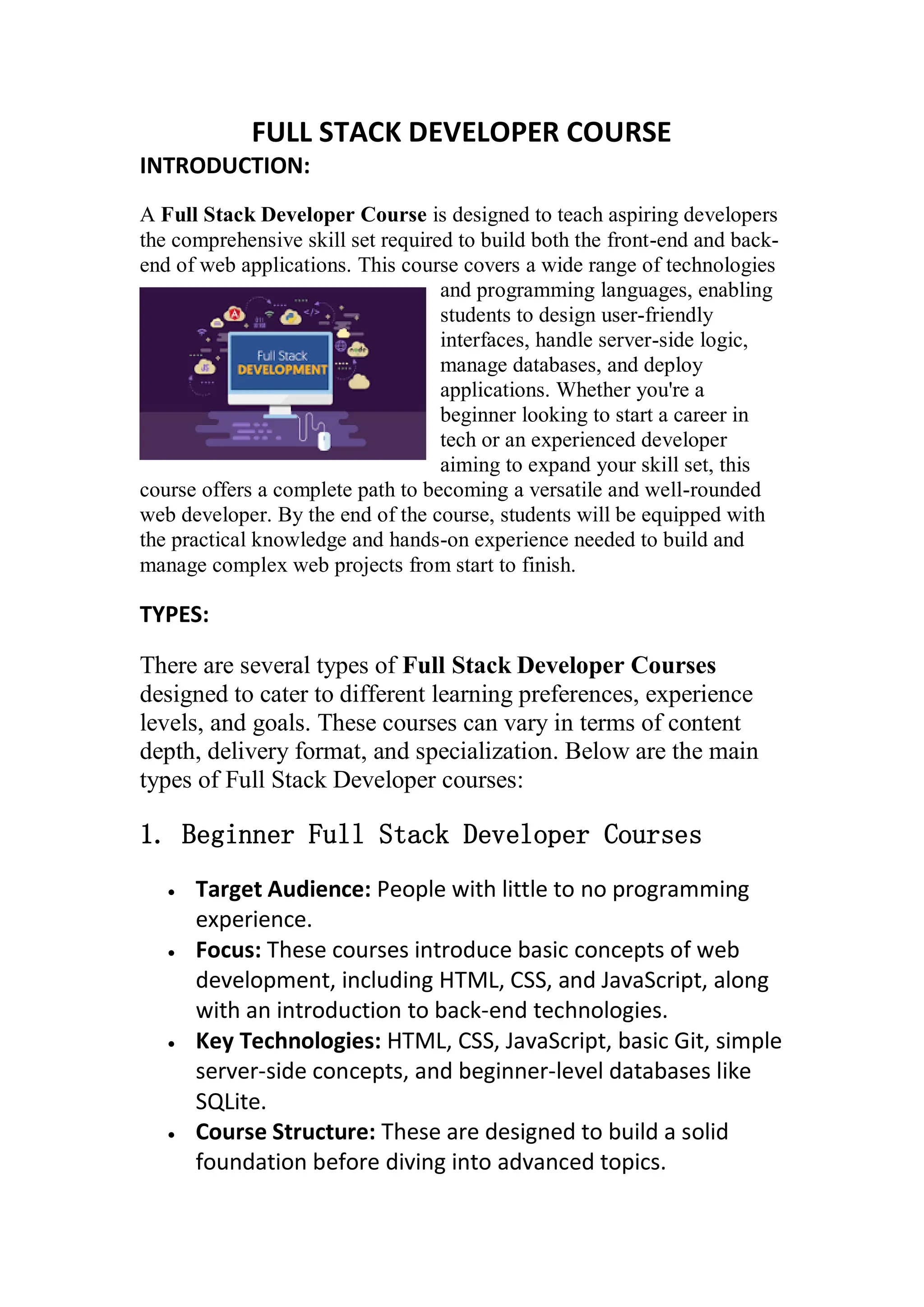
A Full Stack Developer Course is designed to teach aspiring developers
the comprehensive skill set required to build both the front-end and back-
end of web applications. This course covers a wide range of technologies
and programming languages, enabling
students to design user-friendly
interfaces, handle server-side logic,
manage databases, and deploy
applications. Whether you're a
beginner looking to start a career in
tech or an experienced developer
aiming to expand your skill set, this
course offers a complete path to becoming a versatile and well-rounded
web developer. By the end of the course, students will be equipped with
the practical knowledge and hands-on experience needed to build and
manage complex web projects from start to finish.
TYPES:
There are several types of Full Stack Developer Courses
designed to cater to different learning preferences, experience
levels, and goals. These courses can vary in terms of content
depth, delivery format, and specialization. Below are the main
types of Full Stack Developer courses:
1. Beginner Full Stack Developer Courses
 Target Audience: People with little to no programming
experience.
 Focus: These courses introduce basic concepts of web
development, including HTML, CSS, and JavaScript, along
with an introduction to back-end technologies.
 Key Technologies: HTML, CSS, JavaScript, basic Git, simple
server-side concepts, and beginner-level databases like
SQLite.
 Course Structure: These are designed to build a solid
foundation before diving into advanced topics.
 Duration: Usually shorter, ranging from a few weeks to a
couple of months.
2. Intermediate Full Stack Developer
Courses
 Target Audience: Individuals with some prior experience
in programming or web development, but not necessarily
full-stack.
 Focus: These courses dive deeper into both front-end and
back-end development, introducing frameworks, libraries,
and more complex concepts.
 Key Technologies: Front-end frameworks like React or
Angular, back-end frameworks like Node.js or Django,
and databases like MongoDB or PostgreSQL.
 Course Structure: Students are expected to build more
complex projects, often integrating multiple technologies.
 Duration: Usually spans a few months.
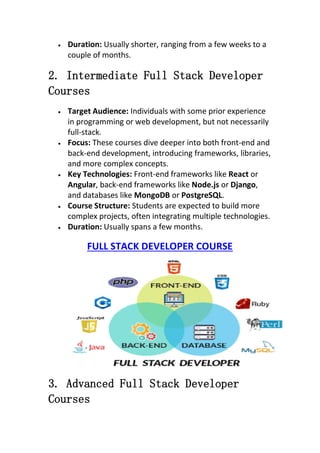
FULL STACK DEVELOPER COURSE
3. Advanced Full Stack Developer
Courses
 Target Audience: Experienced developers looking to
master full-stack development or refine existing skills.
 Focus: These courses cover advanced topics such as
scaling applications, performance optimization, DevOps
practices, and cloud deployment.
 Key Technologies: Advanced topics like microservices,
containerization with Docker, cloud platforms (AWS,
Google Cloud, Azure), CI/CD pipelines, and serverless
architectures.
 Course Structure: Emphasis on creating production-ready
applications and learning about enterprise-level
development practices.
 Duration: These courses are typically more intensive and
can last several months.
4. Self-Paced Online Full Stack
Developer Courses
 Target Audience: Those who prefer flexible learning at
their own pace.
 Focus: These courses typically offer video lectures, coding
exercises, and assessments, allowing students to learn
whenever it suits them.
 Key Technologies: Similar to other full-stack courses,
including HTML, CSS, JavaScript, back-end frameworks
like Node.js or Django, and databases.
 Course Structure: Students progress through the course
independently, often with forums or community support.
 Duration: Flexible and can vary from weeks to months,
depending on the learner's pace.
5. Project-Based Full Stack Developer
Courses
 Target Audience: Individuals who prefer learning by doing
and want to build projects alongside theoretical concepts.
 Focus: Students work on a series of real-world projects,
such as e-commerce sites, blogs, or social media
platforms, while learning the necessary tools and
frameworks.
 Key Technologies: Common full-stack technologies, with
an emphasis on building specific types of applications (e.g.,
web apps, mobile apps).
 Course Structure: The course is designed around practical,
hands-on learning, often with guidance on building a
portfolio of projects.
 Duration: Duration can vary but typically involves a series
of projects completed over several weeks.
ADVANTAGES:
A Full Stack Developer Course offers numerous
advantages, especially for those looking to pursue a
career in web development or expand their existing skill
set. Here are some key advantages of completing a full-
stack development course:
1. Comprehensive Skill Set
 All-in-One Knowledge: A full stack developer course
provides knowledge across both front-end (user interface)
and back-end (server-side) development, giving students
a well-rounded understanding of how web applications
function as a whole.
 Flexibility in Development: Students learn various
programming languages, frameworks, and tools, which
makes them capable of working on all aspects of web
development, from the user-facing part to server
management and database integration.
FULL STACK DEVELOPER COURSE
2. High Demand in the Job Market
 Increased Job Opportunities: Full-stack developers are in
high demand because they can handle a range of tasks,
making them highly valuable to companies. Many
organizations prefer hiring developers who are proficient
in both front-end and back-end technologies.
 Job Versatility: With the ability to work on both ends of a
web application, full-stack developers can apply for
multiple job titles such as Full Stack Developer, Web
Developer, Back-End Developer, and Front-End
Developer, increasing their chances of finding
employment.
3. Higher Earning Potential
 Competitive Salary: Full-stack developers generally earn
higher salaries compared to those who specialize in only
front-end or back-end development. Their versatile skill
set makes them essential to organizations, often leading
to higher-paying opportunities.
 Career Advancement: Having expertise in both front-end
and back-end development positions you as a more
senior or well-rounded developer, which can lead to
quicker promotions and career growth.
4. Ability to Work on End-to-End
Projects
 Complete Control Over Projects: As a full-stack developer,
you have the ability to work on all layers of a project,
from designing the user interface to handling server-side
logic and database management. This ability enables
developers to contribute to every aspect of a project.
 Project Ownership: Full-stack developers are often
trusted with complete ownership of projects, as they can
manage both the visual elements and the technical
architecture of a web application, ensuring seamless
communication and implementation.
5. Better Collaboration Skills
 Cross-Functional Understanding: Full-stack developers
are often better at collaborating with other teams (e.g.,
designers, front-end developers, back-end developers)
because they have a deeper understanding of how
different parts of a project come together. This holistic
view fosters better teamwork and more efficient
problem-solving.
 Faster Problem-Solving: Since full-stack developers can
address issues across the entire stack, they can identify
problems and provide solutions faster, making them more
efficient in troubleshooting and debugging.
FEATURE:
A Full Stack Developer Course typically offers a variety of features that
provide students with the necessary skills and knowledge to become
proficient developers. These features are designed to ensure that the
course is comprehensive, engaging, and relevant to the current demands
of the tech industry. Below are the key features commonly found in Full
Stack Developer courses:
1. Comprehensive Curriculum
 Front-End and Back-End Coverage: The course curriculum
spans both front-end (HTML, CSS, JavaScript, frameworks)
and back-end (server-side languages, databases, APIs)
development, giving students a complete understanding
of how web applications work.
 Modern Technologies: Students learn current and widely-
used programming languages, frameworks, libraries, and
tools, such as React, Angular, Node.js, Express, MongoDB,
SQL, Python, Django, and Git.
 Integration of Technologies: The curriculum includes
topics like how to integrate front-end and back-end
components, build APIs, manage databases, and deploy
applications.
2. Hands-On Projects and Real-World
Application
 Project-Based Learning: The course includes hands-on
projects where students apply what they've learned by
building real-world applications (e.g., a personal blog, e-
commerce site, social network, or a task manager).
 Portfolio Development: Students build a strong portfolio
by completing multiple projects throughout the course.
This portfolio becomes a key asset when seeking
employment or freelance work.
 Capstone Projects: Many courses offer capstone projects
at the end, where students create full-fledged
applications from start to finish, incorporating all of the
skills they've learned.
3. Structured and Interactive
Learning
 Modular Lessons: The course is broken down into
manageable modules that cover specific topics, making it
easier for students to grasp complex concepts in stages.
 Quizzes and Assignments: Interactive quizzes,
assignments, and coding challenges help reinforce the
material and allow students to test their knowledge at
various stages of the course.
 Peer Collaboration: Some courses include collaborative
projects or group discussions, allowing students to work
with peers, learn from each other, and improve their
communication and teamwork skills.
4. Mentor ship and Support
 Industry Experts as Instructors: Many Full Stack
Developer courses feature instructors who are
experienced developers and industry professionals,
offering valuable insights and practical advice.
 One-on-One Mentoring: Some courses offer access to
mentors who provide personalized feedback, guidance,
and support, helping students with coding challenges and
career advice.
 Community Forums: Online discussion forums or Slack
channels allow students to interact with instructors, peers,
and alumni for support, networking, and knowledge
sharing.
5. Flexible Learning Formats
 Self-Paced or Scheduled: Many Full Stack courses are
available in both self-paced and instructor-led formats,
allowing students to choose the pace that best fits their
learning style and schedule.
 Online Accessibility: Most courses are offered online,
allowing students to access lessons, resources, and
assignments from anywhere at any time. Some courses
also offer downloadable content for offline learning.
 Mobile-Friendly: Some platforms provide mobile-
optimized content, enabling students to continue learning
on the go.
SCOPE AND SALARY PACKAGE:
1. Web Development
 Web Applications: Full Stack Developers build and
maintain web applications that are crucial for businesses.
They are responsible for designing user interfaces,
developing server-side logic, managing databases, and
integrating various tools to ensure smooth application
performance.
 E-commerce Platforms: Full Stack Developers play an
important role in creating e-commerce websites, from
building shopping carts to integrating payment systems,
ensuring functionality across devices and browsers.
2. Mobile Application Development
 Cross-Platform Development: Full Stack Developers are
also involved in developing mobile applications using web
technologies (e.g., using frameworks like React Native,
Ionic, or Flutter) to create cross-platform mobile apps
that work on both Android and iOS.
3. Enterprise Software Development
 Internal Tools and Dashboards: Many organizations need
Full Stack Developers to design and implement internal
systems, such as management dashboards, employee
tools, and CRM (Customer Relationship Management)
platforms, that streamline business operations.
4. Freelancing and Startups
 Freelance Development: With versatile skills across the
full stack, many Full Stack Developers work as freelancers,
offering their services to various clients and startups.
Their broad skill set makes them valuable to small
businesses that require a developer capable of handling
all aspects of their web projects.
 Entrepreneurship: Full Stack Developers often create and
launch their own startups, as their skills allow them to
handle everything from designing the product to
developing and scaling it.
5. Tech Industry
Roles
 Startups: Many tech
startups look for Full Stack Developers to quickly build
MVP (Minimum Viable Products) due to their ability to
handle both front-end and back-end needs.
 Large Corporations: Larger tech companies often hire Full
Stack Developers to build complex and scale able systems,
integrate data, and ensure that web services function
effectively across different platforms.
6. Cloud-Based and SaaS (Software as
a Service) Applications
 Cloud Development: Full Stack Developers are involved in
building applications that run on cloud platforms, which is
becoming increasingly popular with businesses seeking
scalability, security, and ease of access.
 SaaS Products: Full Stack Developers help in building SaaS
products that are used for business operations,
communication, or collaboration. These applications
often need complex back-end systems and a user-friendly
front end.
7. Develops and Continuous
Integration/Continuous Deployment
(CI/CD)
 Automation: Full Stack Developers are also becoming
involved in Develops practices to automate testing,
deployment, and delivery of applications, ensuring faster
development cycles and smooth production deployments.
Salary Package for Full Stack Developers
The salary package for Full Stack Developers varies
depending on several factors such as experience, location,
skills, and the industry they work in. Below is an
overview of the salary range for Full Stack Developers
based on different levels of experience:
1. Entry-Level (0-2 Years of Experience)
 Salary Range: $50,000 - $75,000 per year (USD)
 Job Titles: Junior Full Stack Developer, Trainee Full Stack
Developer
 Description: As entry-level developers, individuals
typically focus on mastering the basics of front-end and
back-end development. Their responsibilities may include
assisting in coding, debugging, and testing projects under
supervision.
2. Mid-Level (2-5 Years of Experience)
 Salary Range: $75,000 - $110,000 per year (USD)
 Job Titles: Full Stack Developer, Software Developer
 Description: Developers at this level are expected to
handle more complex tasks and take on more
responsibilities, such as designing application features,
collaborating with cross-functional teams, and
troubleshooting complex issues. They may also begin
leading smaller projects.
3. Senior-Level (5-10+ Years of
Experience)
 Salary Range: $110,000 - $160,000 per year (USD)
 Job Titles: Senior Full Stack Developer, Lead Developer,
Principal Developer
 Description: Senior Full Stack Developers have a wealth of
experience, managing large projects, and making high-
level decisions regarding system architecture,
performance, and scaling. They often mentor junior
developers and play a key role in project leadership.
4. Lead/Architect Roles (10+ Years of
Experience)
 Salary Range: $140,000 - $200,000+ per year (USD)
 Job Titles: Full Stack Development Lead, Full Stack
Architect, Software
Engineering Manager
 Description: At this
level, developers are
responsible for
overseeing teams, setting
technical direction, and
ensuring that applications meet business and technical
requirements. They may also be responsible for managing
the life-cycle of large-scale projects.
5. Freelance Full Stack Developer
 Hourly Rate: $30 - $150+ per hour (USD)
 Description: Freelancers often set their own rates based
on their experience, project complexity, and client budget.
Experienced freelancers can command high rates,
particularly for specialized tasks or projects requiring
complex back-end systems or UI/UX design.
6. Geographical Variation in Salary
 United States: Full Stack Developers in the U.S. can earn
anywhere from $50,000 to $200,000 annually, with
salaries higher in tech hubs like San Francisco, New York,
Seattle, and Austin.
 Europe: In countries like the UK, Germany, and France,
the salaries range from €40,000 to €100,000 annually,
depending on location and experience.
 India: The salary range for Full Stack Developers in India is
approximately ₹4,00,000 to ₹15,00,000 annually, with
variations depending on the company and location (e.g.,
Bangalore, Hyderabad).
 Other Regions: Salaries can vary significantly in different
parts of the world. In Latin America, the Middle East, and
Southeast Asia, Full Stack Developers can expect salaries
ranging from $10,000 to $50,000 annually, though higher
salaries are available in larger cities.
Factors Affecting Salary
1. Skills: Mastery of certain frameworks or technologies can
significantly influence a
developer’s salary.
Knowledge of in-demand
frameworks like React,
Node.js, Angular, Django,
or Vue.js, along with
expertise in databases like MongoDB, PostgreSQL, or
MySQL, can command higher pay.
2. Experience: More experienced developers, particularly
those who have worked on large-scale projects or in
leadership roles, tend to have higher salaries.
3. Industry: Full Stack Developers working in high-demand
industries like finance, healthcare, or technology may
have higher salaries due to the complexity and critical
nature of the work.
4. Location: Developers in large cities or tech hubs tend to
earn more due to the higher cost of living and the
concentration of major tech companies.
5. Company Size: Larger companies or startups with venture
capital funding tend to offer more competitive salaries
and additional benefits, such as equity, bonuses, or
flexible working conditions.

"Comprehensive Full Stack Developer Training: Master Web Development from Front-End to Back-End"

  • 1.
    FULL STACK DEVELOPERCOURSE INTRODUCTION: A Full Stack Developer Course is designed to teach aspiring developers the comprehensive skill set required to build both the front-end and back- end of web applications. This course covers a wide range of technologies and programming languages, enabling students to design user-friendly interfaces, handle server-side logic, manage databases, and deploy applications. Whether you're a beginner looking to start a career in tech or an experienced developer aiming to expand your skill set, this course offers a complete path to becoming a versatile and well-rounded web developer. By the end of the course, students will be equipped with the practical knowledge and hands-on experience needed to build and manage complex web projects from start to finish. TYPES: There are several types of Full Stack Developer Courses designed to cater to different learning preferences, experience levels, and goals. These courses can vary in terms of content depth, delivery format, and specialization. Below are the main types of Full Stack Developer courses: 1. Beginner Full Stack Developer Courses  Target Audience: People with little to no programming experience.  Focus: These courses introduce basic concepts of web development, including HTML, CSS, and JavaScript, along with an introduction to back-end technologies.  Key Technologies: HTML, CSS, JavaScript, basic Git, simple server-side concepts, and beginner-level databases like SQLite.  Course Structure: These are designed to build a solid foundation before diving into advanced topics.
  • 2.
     Duration: Usuallyshorter, ranging from a few weeks to a couple of months. 2. Intermediate Full Stack Developer Courses  Target Audience: Individuals with some prior experience in programming or web development, but not necessarily full-stack.  Focus: These courses dive deeper into both front-end and back-end development, introducing frameworks, libraries, and more complex concepts.  Key Technologies: Front-end frameworks like React or Angular, back-end frameworks like Node.js or Django, and databases like MongoDB or PostgreSQL.  Course Structure: Students are expected to build more complex projects, often integrating multiple technologies.  Duration: Usually spans a few months. FULL STACK DEVELOPER COURSE 3. Advanced Full Stack Developer Courses
  • 3.
     Target Audience:Experienced developers looking to master full-stack development or refine existing skills.  Focus: These courses cover advanced topics such as scaling applications, performance optimization, DevOps practices, and cloud deployment.  Key Technologies: Advanced topics like microservices, containerization with Docker, cloud platforms (AWS, Google Cloud, Azure), CI/CD pipelines, and serverless architectures.  Course Structure: Emphasis on creating production-ready applications and learning about enterprise-level development practices.  Duration: These courses are typically more intensive and can last several months. 4. Self-Paced Online Full Stack Developer Courses  Target Audience: Those who prefer flexible learning at their own pace.  Focus: These courses typically offer video lectures, coding exercises, and assessments, allowing students to learn whenever it suits them.  Key Technologies: Similar to other full-stack courses, including HTML, CSS, JavaScript, back-end frameworks like Node.js or Django, and databases.  Course Structure: Students progress through the course independently, often with forums or community support.  Duration: Flexible and can vary from weeks to months, depending on the learner's pace. 5. Project-Based Full Stack Developer Courses
  • 4.
     Target Audience:Individuals who prefer learning by doing and want to build projects alongside theoretical concepts.  Focus: Students work on a series of real-world projects, such as e-commerce sites, blogs, or social media platforms, while learning the necessary tools and frameworks.  Key Technologies: Common full-stack technologies, with an emphasis on building specific types of applications (e.g., web apps, mobile apps).  Course Structure: The course is designed around practical, hands-on learning, often with guidance on building a portfolio of projects.  Duration: Duration can vary but typically involves a series of projects completed over several weeks. ADVANTAGES: A Full Stack Developer Course offers numerous advantages, especially for those looking to pursue a career in web development or expand their existing skill set. Here are some key advantages of completing a full- stack development course: 1. Comprehensive Skill Set  All-in-One Knowledge: A full stack developer course provides knowledge across both front-end (user interface) and back-end (server-side) development, giving students a well-rounded understanding of how web applications function as a whole.  Flexibility in Development: Students learn various programming languages, frameworks, and tools, which makes them capable of working on all aspects of web development, from the user-facing part to server management and database integration.
  • 5.
    FULL STACK DEVELOPERCOURSE 2. High Demand in the Job Market  Increased Job Opportunities: Full-stack developers are in high demand because they can handle a range of tasks, making them highly valuable to companies. Many organizations prefer hiring developers who are proficient in both front-end and back-end technologies.  Job Versatility: With the ability to work on both ends of a web application, full-stack developers can apply for multiple job titles such as Full Stack Developer, Web Developer, Back-End Developer, and Front-End Developer, increasing their chances of finding employment. 3. Higher Earning Potential  Competitive Salary: Full-stack developers generally earn higher salaries compared to those who specialize in only front-end or back-end development. Their versatile skill set makes them essential to organizations, often leading to higher-paying opportunities.  Career Advancement: Having expertise in both front-end and back-end development positions you as a more senior or well-rounded developer, which can lead to quicker promotions and career growth. 4. Ability to Work on End-to-End Projects  Complete Control Over Projects: As a full-stack developer, you have the ability to work on all layers of a project, from designing the user interface to handling server-side
  • 6.
    logic and databasemanagement. This ability enables developers to contribute to every aspect of a project.  Project Ownership: Full-stack developers are often trusted with complete ownership of projects, as they can manage both the visual elements and the technical architecture of a web application, ensuring seamless communication and implementation. 5. Better Collaboration Skills  Cross-Functional Understanding: Full-stack developers are often better at collaborating with other teams (e.g., designers, front-end developers, back-end developers) because they have a deeper understanding of how different parts of a project come together. This holistic view fosters better teamwork and more efficient problem-solving.  Faster Problem-Solving: Since full-stack developers can address issues across the entire stack, they can identify problems and provide solutions faster, making them more efficient in troubleshooting and debugging. FEATURE: A Full Stack Developer Course typically offers a variety of features that provide students with the necessary skills and knowledge to become proficient developers. These features are designed to ensure that the course is comprehensive, engaging, and relevant to the current demands of the tech industry. Below are the key features commonly found in Full Stack Developer courses: 1. Comprehensive Curriculum  Front-End and Back-End Coverage: The course curriculum spans both front-end (HTML, CSS, JavaScript, frameworks) and back-end (server-side languages, databases, APIs)
  • 7.
    development, giving studentsa complete understanding of how web applications work.  Modern Technologies: Students learn current and widely- used programming languages, frameworks, libraries, and tools, such as React, Angular, Node.js, Express, MongoDB, SQL, Python, Django, and Git.  Integration of Technologies: The curriculum includes topics like how to integrate front-end and back-end components, build APIs, manage databases, and deploy applications. 2. Hands-On Projects and Real-World Application  Project-Based Learning: The course includes hands-on projects where students apply what they've learned by building real-world applications (e.g., a personal blog, e- commerce site, social network, or a task manager).  Portfolio Development: Students build a strong portfolio by completing multiple projects throughout the course. This portfolio becomes a key asset when seeking employment or freelance work.  Capstone Projects: Many courses offer capstone projects at the end, where students create full-fledged applications from start to finish, incorporating all of the skills they've learned. 3. Structured and Interactive Learning  Modular Lessons: The course is broken down into manageable modules that cover specific topics, making it easier for students to grasp complex concepts in stages.  Quizzes and Assignments: Interactive quizzes, assignments, and coding challenges help reinforce the
  • 8.
    material and allowstudents to test their knowledge at various stages of the course.  Peer Collaboration: Some courses include collaborative projects or group discussions, allowing students to work with peers, learn from each other, and improve their communication and teamwork skills. 4. Mentor ship and Support  Industry Experts as Instructors: Many Full Stack Developer courses feature instructors who are experienced developers and industry professionals, offering valuable insights and practical advice.  One-on-One Mentoring: Some courses offer access to mentors who provide personalized feedback, guidance, and support, helping students with coding challenges and career advice.  Community Forums: Online discussion forums or Slack channels allow students to interact with instructors, peers, and alumni for support, networking, and knowledge sharing. 5. Flexible Learning Formats  Self-Paced or Scheduled: Many Full Stack courses are available in both self-paced and instructor-led formats, allowing students to choose the pace that best fits their learning style and schedule.  Online Accessibility: Most courses are offered online, allowing students to access lessons, resources, and assignments from anywhere at any time. Some courses also offer downloadable content for offline learning.  Mobile-Friendly: Some platforms provide mobile- optimized content, enabling students to continue learning on the go.
  • 9.
    SCOPE AND SALARYPACKAGE: 1. Web Development  Web Applications: Full Stack Developers build and maintain web applications that are crucial for businesses. They are responsible for designing user interfaces, developing server-side logic, managing databases, and integrating various tools to ensure smooth application performance.  E-commerce Platforms: Full Stack Developers play an important role in creating e-commerce websites, from building shopping carts to integrating payment systems, ensuring functionality across devices and browsers. 2. Mobile Application Development  Cross-Platform Development: Full Stack Developers are also involved in developing mobile applications using web technologies (e.g., using frameworks like React Native, Ionic, or Flutter) to create cross-platform mobile apps that work on both Android and iOS. 3. Enterprise Software Development  Internal Tools and Dashboards: Many organizations need Full Stack Developers to design and implement internal systems, such as management dashboards, employee tools, and CRM (Customer Relationship Management) platforms, that streamline business operations. 4. Freelancing and Startups  Freelance Development: With versatile skills across the full stack, many Full Stack Developers work as freelancers,
  • 10.
    offering their servicesto various clients and startups. Their broad skill set makes them valuable to small businesses that require a developer capable of handling all aspects of their web projects.  Entrepreneurship: Full Stack Developers often create and launch their own startups, as their skills allow them to handle everything from designing the product to developing and scaling it. 5. Tech Industry Roles  Startups: Many tech startups look for Full Stack Developers to quickly build MVP (Minimum Viable Products) due to their ability to handle both front-end and back-end needs.  Large Corporations: Larger tech companies often hire Full Stack Developers to build complex and scale able systems, integrate data, and ensure that web services function effectively across different platforms. 6. Cloud-Based and SaaS (Software as a Service) Applications  Cloud Development: Full Stack Developers are involved in building applications that run on cloud platforms, which is becoming increasingly popular with businesses seeking scalability, security, and ease of access.  SaaS Products: Full Stack Developers help in building SaaS products that are used for business operations, communication, or collaboration. These applications often need complex back-end systems and a user-friendly front end.
  • 11.
    7. Develops andContinuous Integration/Continuous Deployment (CI/CD)  Automation: Full Stack Developers are also becoming involved in Develops practices to automate testing, deployment, and delivery of applications, ensuring faster development cycles and smooth production deployments. Salary Package for Full Stack Developers The salary package for Full Stack Developers varies depending on several factors such as experience, location, skills, and the industry they work in. Below is an overview of the salary range for Full Stack Developers based on different levels of experience: 1. Entry-Level (0-2 Years of Experience)  Salary Range: $50,000 - $75,000 per year (USD)  Job Titles: Junior Full Stack Developer, Trainee Full Stack Developer  Description: As entry-level developers, individuals typically focus on mastering the basics of front-end and back-end development. Their responsibilities may include assisting in coding, debugging, and testing projects under supervision. 2. Mid-Level (2-5 Years of Experience)  Salary Range: $75,000 - $110,000 per year (USD)  Job Titles: Full Stack Developer, Software Developer  Description: Developers at this level are expected to handle more complex tasks and take on more responsibilities, such as designing application features,
  • 12.
    collaborating with cross-functionalteams, and troubleshooting complex issues. They may also begin leading smaller projects. 3. Senior-Level (5-10+ Years of Experience)  Salary Range: $110,000 - $160,000 per year (USD)  Job Titles: Senior Full Stack Developer, Lead Developer, Principal Developer  Description: Senior Full Stack Developers have a wealth of experience, managing large projects, and making high- level decisions regarding system architecture, performance, and scaling. They often mentor junior developers and play a key role in project leadership. 4. Lead/Architect Roles (10+ Years of Experience)  Salary Range: $140,000 - $200,000+ per year (USD)  Job Titles: Full Stack Development Lead, Full Stack Architect, Software Engineering Manager  Description: At this level, developers are responsible for overseeing teams, setting technical direction, and ensuring that applications meet business and technical requirements. They may also be responsible for managing the life-cycle of large-scale projects. 5. Freelance Full Stack Developer  Hourly Rate: $30 - $150+ per hour (USD)
  • 13.
     Description: Freelancersoften set their own rates based on their experience, project complexity, and client budget. Experienced freelancers can command high rates, particularly for specialized tasks or projects requiring complex back-end systems or UI/UX design. 6. Geographical Variation in Salary  United States: Full Stack Developers in the U.S. can earn anywhere from $50,000 to $200,000 annually, with salaries higher in tech hubs like San Francisco, New York, Seattle, and Austin.  Europe: In countries like the UK, Germany, and France, the salaries range from €40,000 to €100,000 annually, depending on location and experience.  India: The salary range for Full Stack Developers in India is approximately ₹4,00,000 to ₹15,00,000 annually, with variations depending on the company and location (e.g., Bangalore, Hyderabad).  Other Regions: Salaries can vary significantly in different parts of the world. In Latin America, the Middle East, and Southeast Asia, Full Stack Developers can expect salaries ranging from $10,000 to $50,000 annually, though higher salaries are available in larger cities. Factors Affecting Salary 1. Skills: Mastery of certain frameworks or technologies can significantly influence a developer’s salary. Knowledge of in-demand frameworks like React, Node.js, Angular, Django, or Vue.js, along with
  • 14.
    expertise in databaseslike MongoDB, PostgreSQL, or MySQL, can command higher pay. 2. Experience: More experienced developers, particularly those who have worked on large-scale projects or in leadership roles, tend to have higher salaries. 3. Industry: Full Stack Developers working in high-demand industries like finance, healthcare, or technology may have higher salaries due to the complexity and critical nature of the work. 4. Location: Developers in large cities or tech hubs tend to earn more due to the higher cost of living and the concentration of major tech companies. 5. Company Size: Larger companies or startups with venture capital funding tend to offer more competitive salaries and additional benefits, such as equity, bonuses, or flexible working conditions.