1
In nature, nothing is considered as a
waste--- everything is food for
something else
Compost- Methods and
Utilization
2
Introduction-Compost
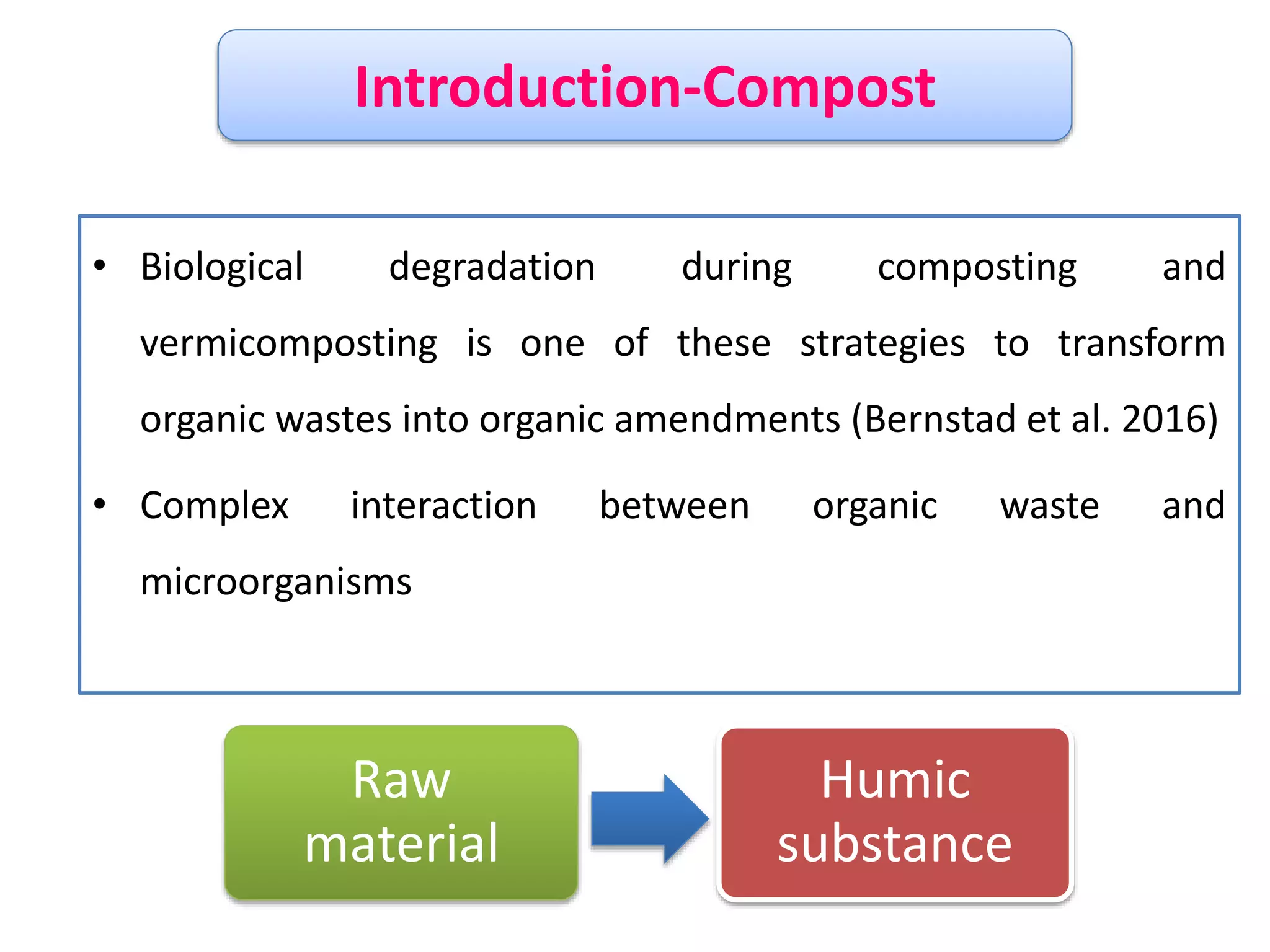
• Biological degradation during composting and
vermicomposting is one of these strategies to transform
organic wastes into organic amendments (Bernstad et al. 2016)
• Complex interaction between organic waste and
microorganisms
3
Raw
material
Humic
substance
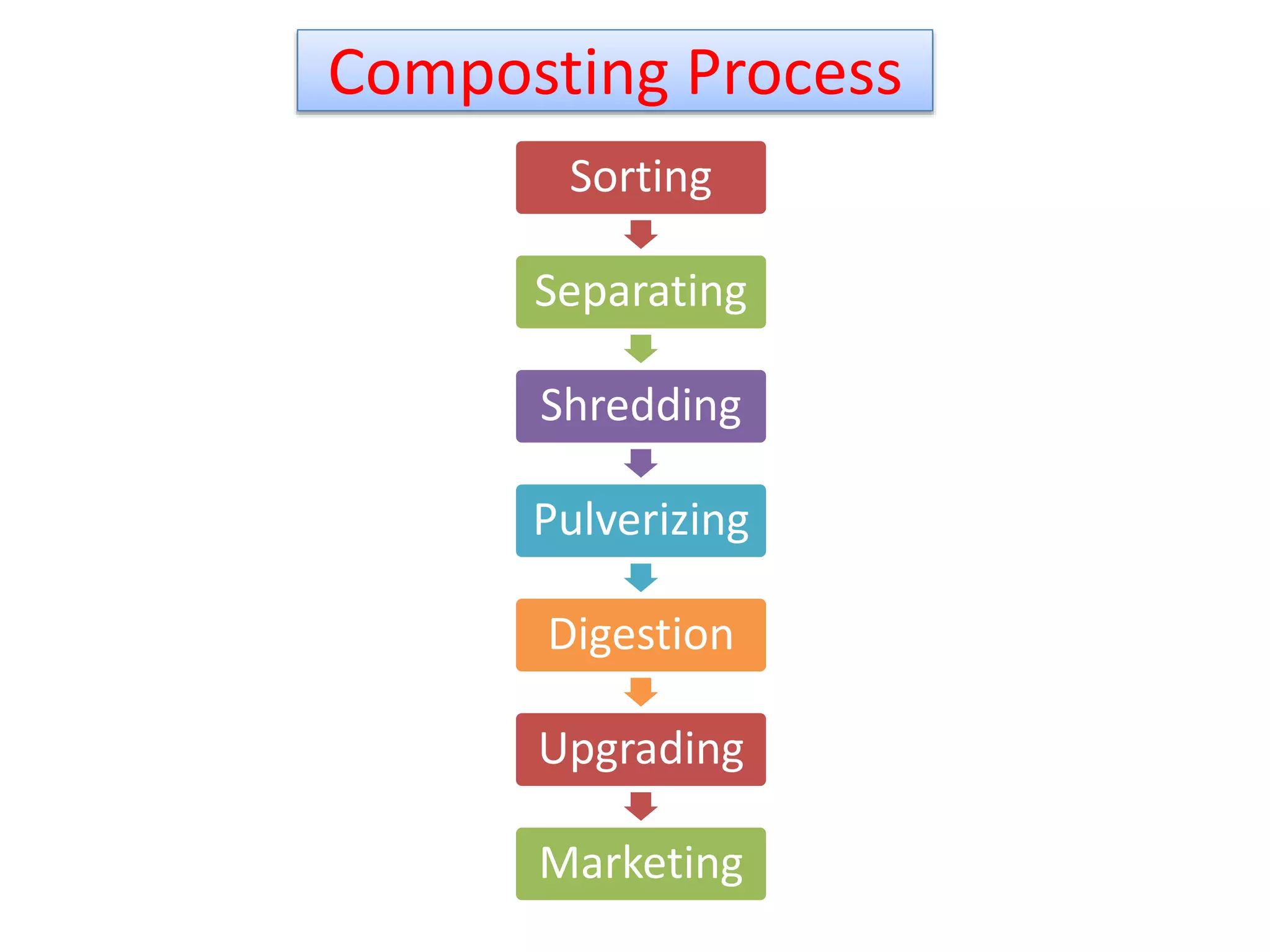
Composting Process
Sorting
Separating
Shredding
Pulverizing
Digestion
Upgrading
Marketing
4
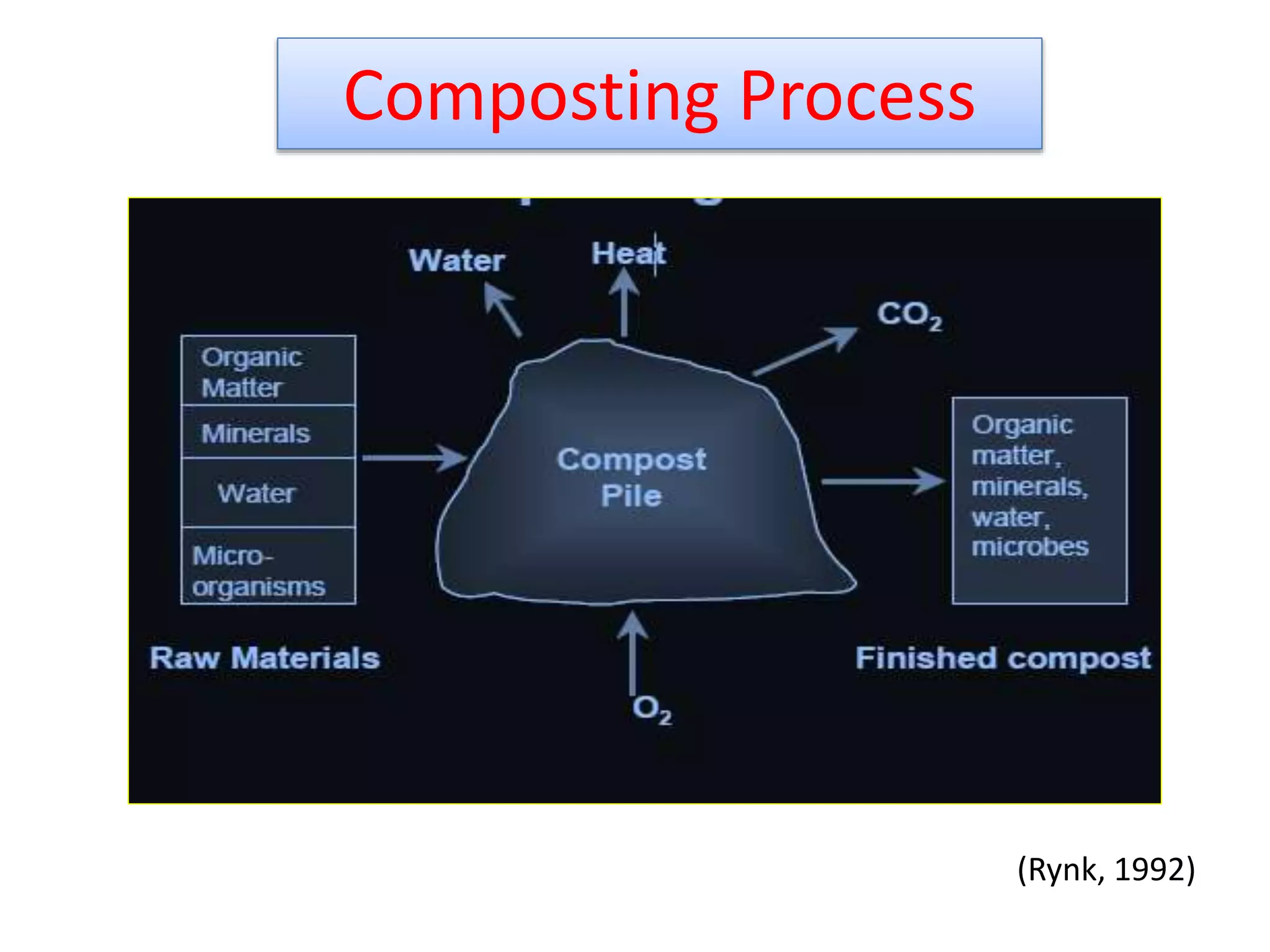
Composting Process
(Rynk, 1992)
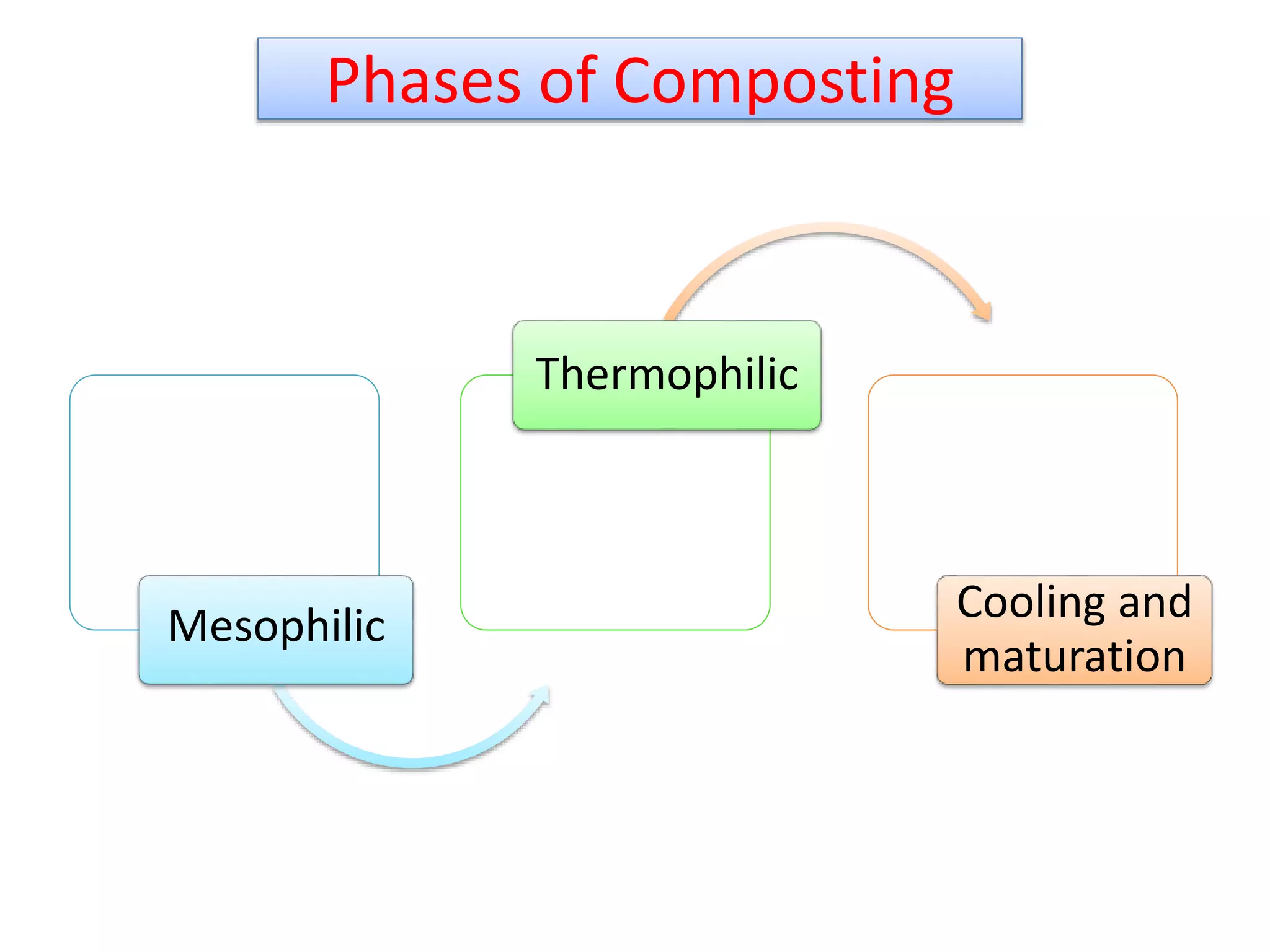
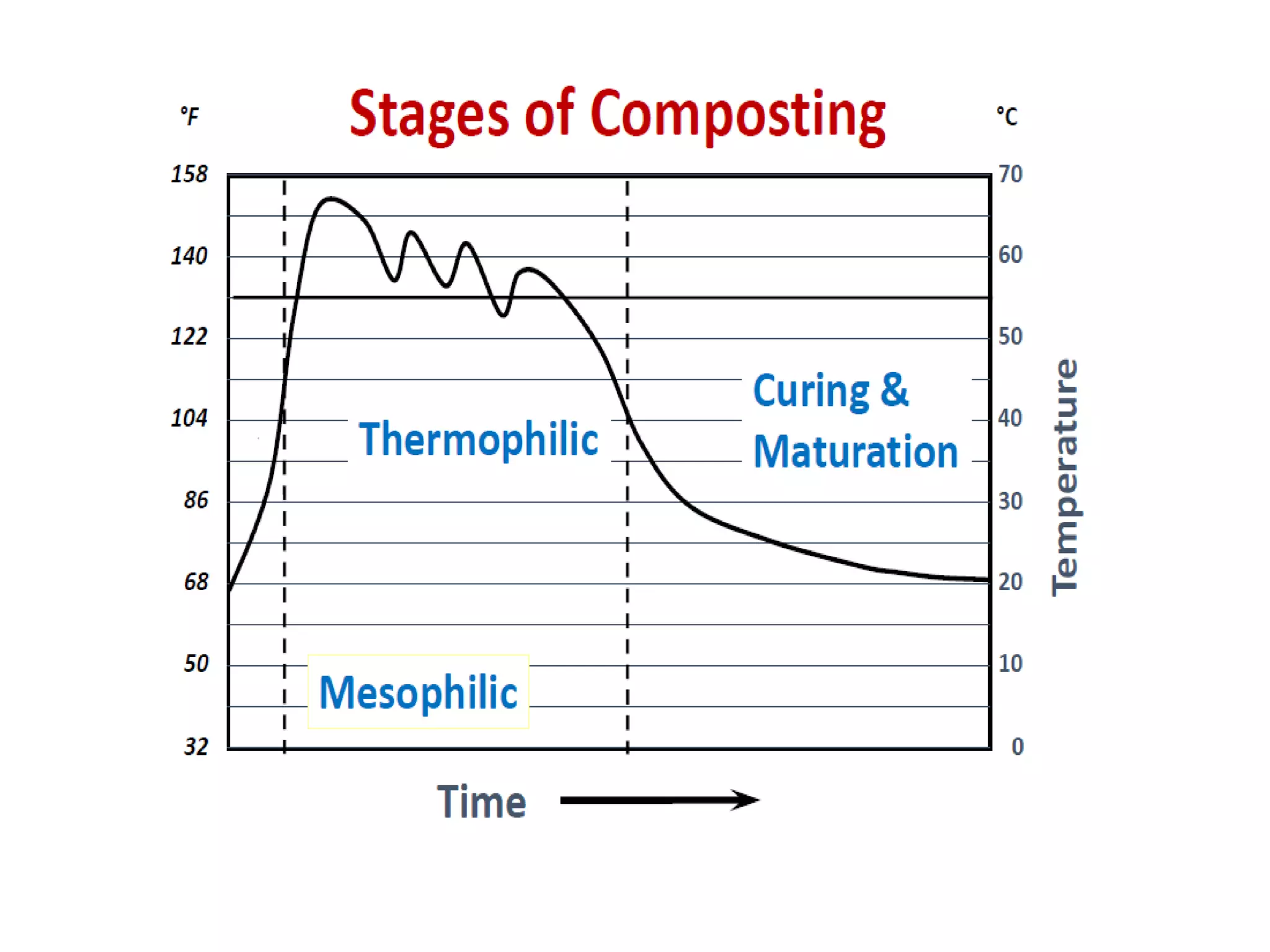
Phases of Composting
Mesophilic
Thermophilic
Cooling and
maturation
6
7
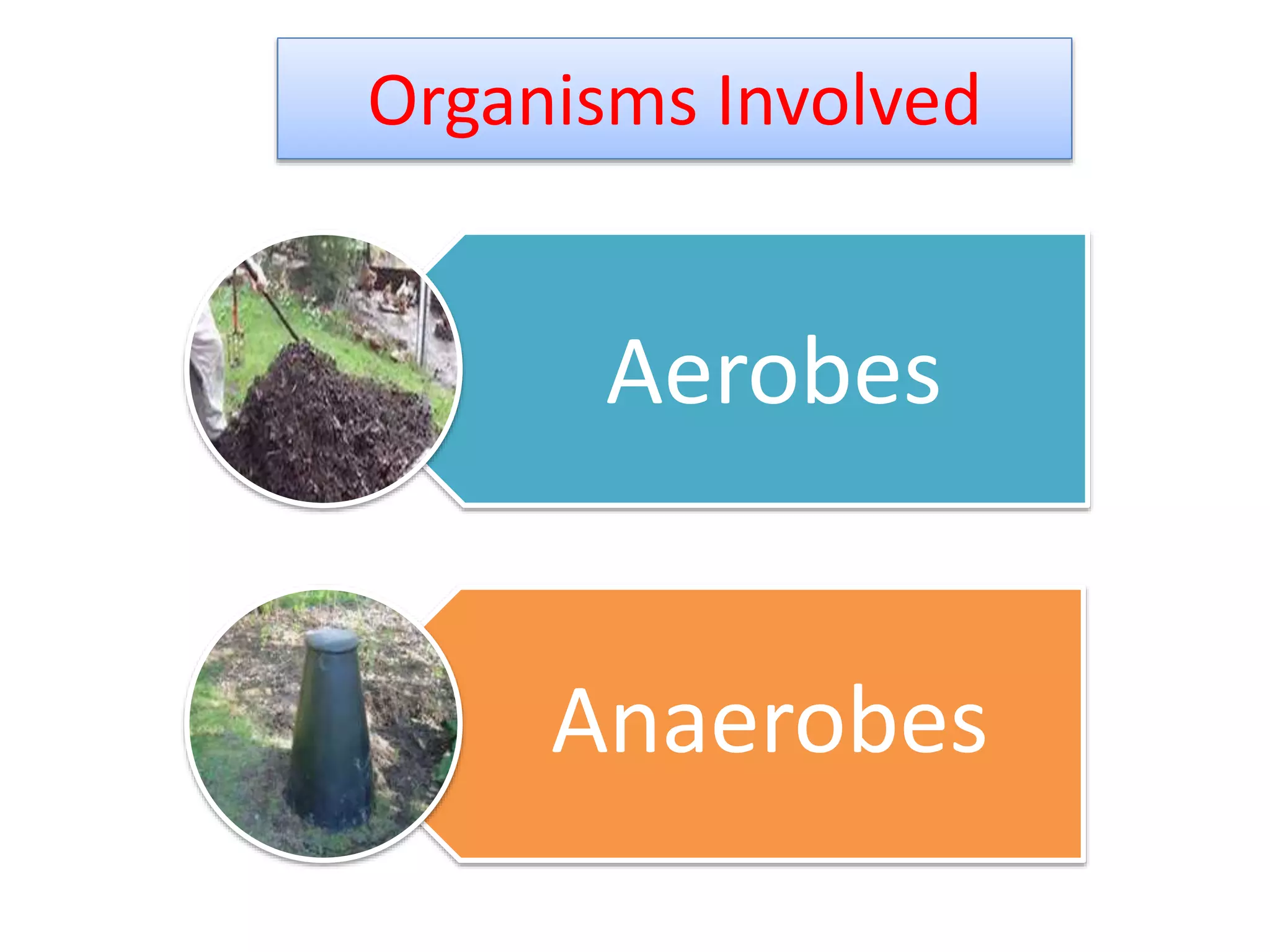
Organisms Involved
Aerobes
Anaerobes
8
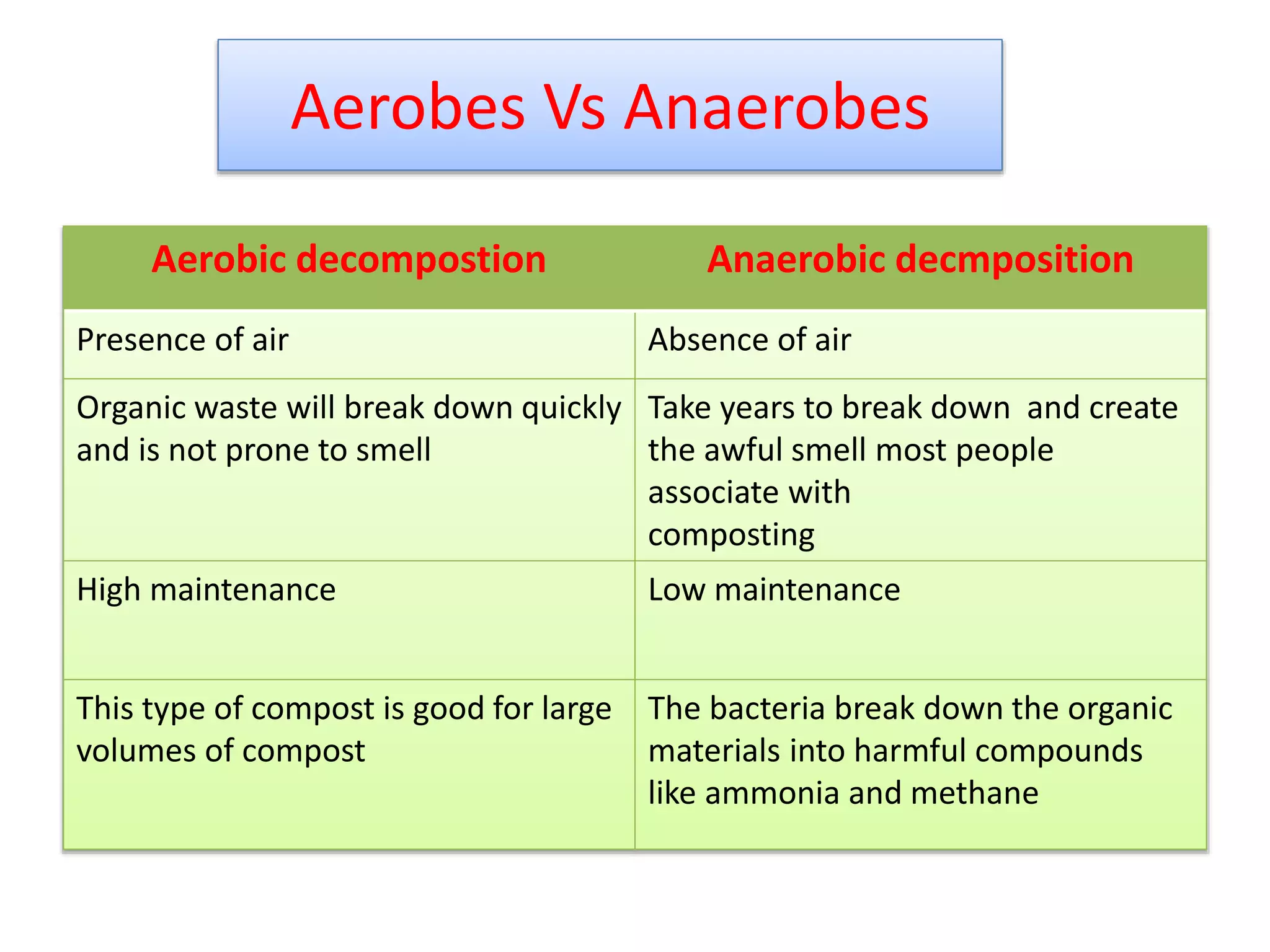
Aerobes Vs Anaerobes
9
Aerobic decompostion Anaerobic decmposition
Presence of air Absence of air
Organic waste will break down quickly
and is not prone to smell
Take years to break down and create
the awful smell most people
associate with
composting
High maintenance Low maintenance
This type of compost is good for large
volumes of compost
The bacteria break down the organic
materials into harmful compounds
like ammonia and methane
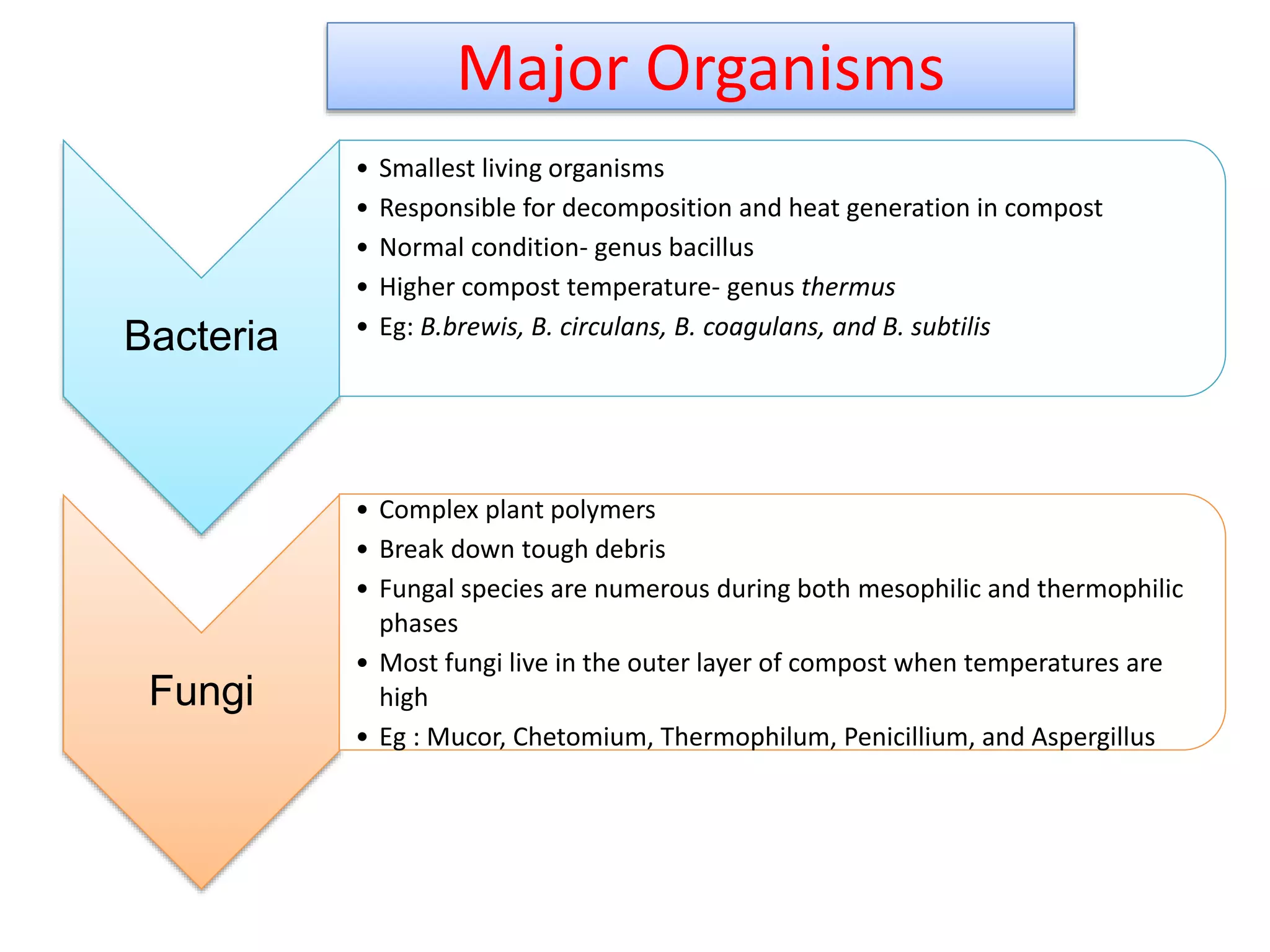
Major Organisms
Bacteria
• Smallest living organisms
• Responsible for decomposition and heat generation in compost
• Normal condition- genus bacillus
• Higher compost temperature- genus thermus
• Eg: B.brewis, B. circulans, B. coagulans, and B. subtilis
Fungi
• Complex plant polymers
• Break down tough debris
• Fungal species are numerous during both mesophilic and thermophilic
phases
• Most fungi live in the outer layer of compost when temperatures are
high
• Eg : Mucor, Chetomium, Thermophilum, Penicillium, and Aspergillus
10
11
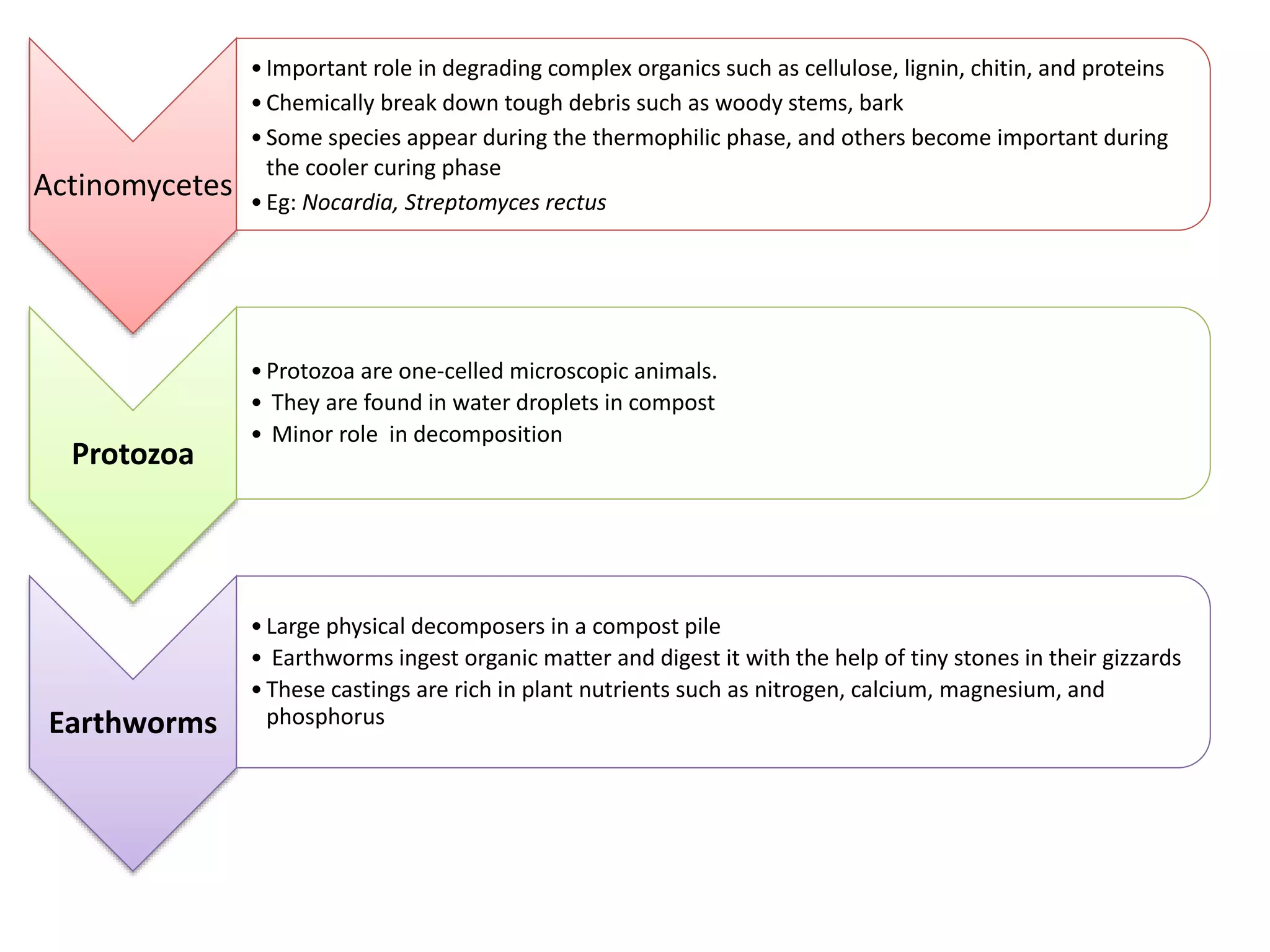
Actinomycetes
•Important role in degrading complex organics such as cellulose, lignin, chitin, and proteins
•Chemically break down tough debris such as woody stems, bark
•Some species appear during the thermophilic phase, and others become important during
the cooler curing phase
•Eg: Nocardia, Streptomyces rectus
Protozoa
•Protozoa are one-celled microscopic animals.
• They are found in water droplets in compost
• Minor role in decomposition
Earthworms
•Large physical decomposers in a compost pile
• Earthworms ingest organic matter and digest it with the help of tiny stones in their gizzards
•These castings are rich in plant nutrients such as nitrogen, calcium, magnesium, and
phosphorus
12
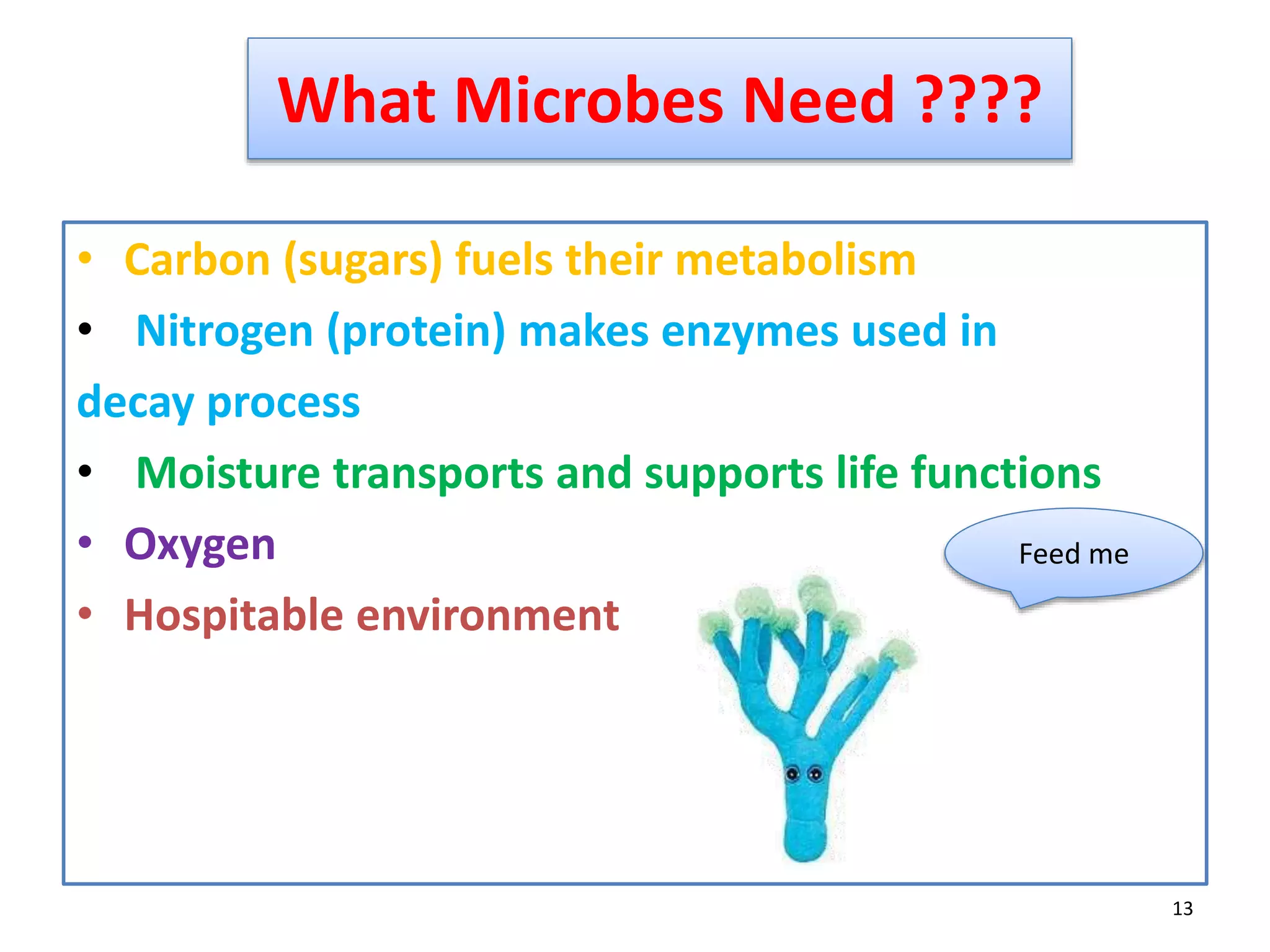
What Microbes Need ????
• Carbon (sugars) fuels their metabolism
• Nitrogen (protein) makes enzymes used in
decay process
• Moisture transports and supports life functions
• Oxygen
• Hospitable environment
13
Feed me
14
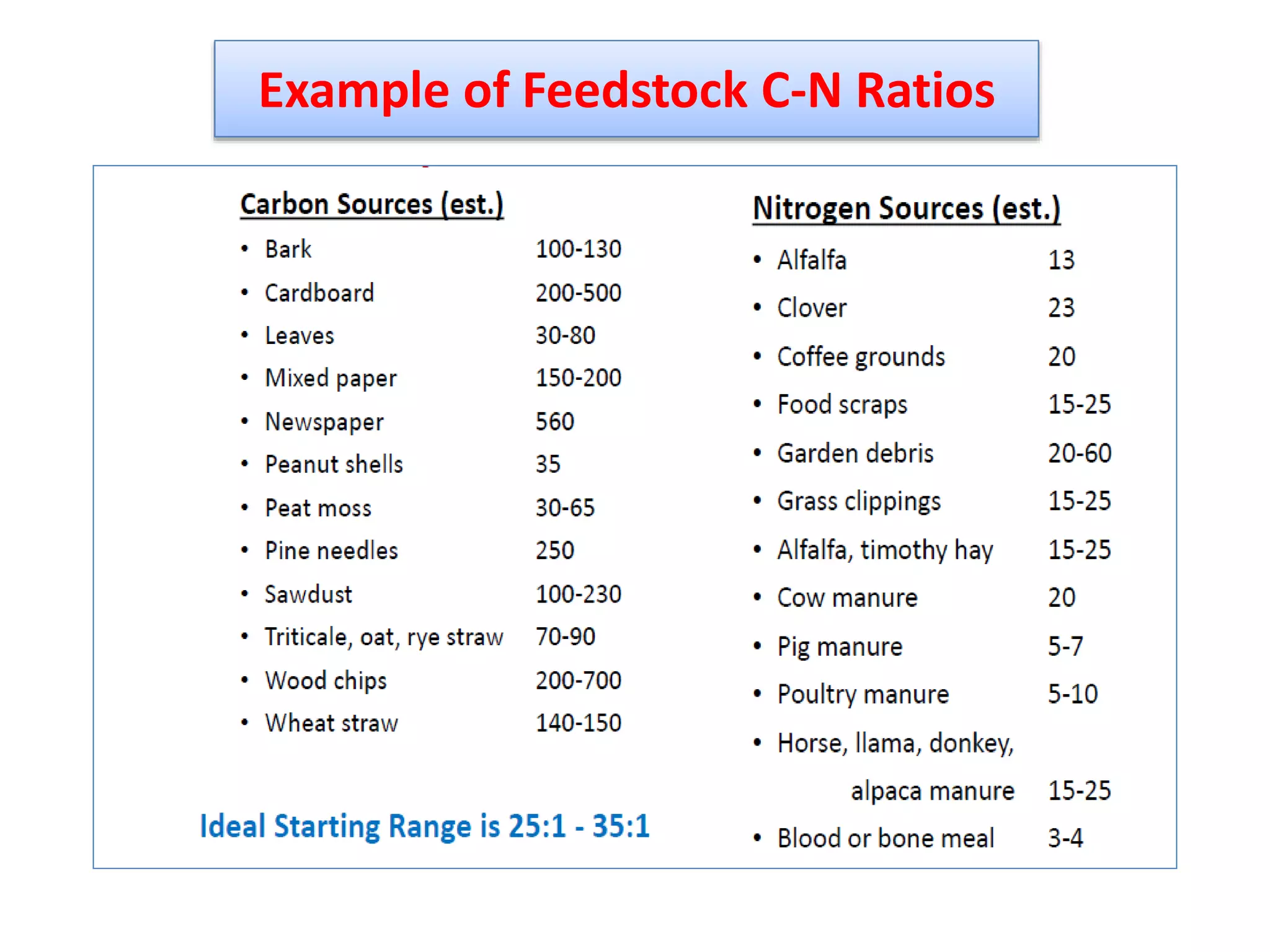
Example of Feedstock C-N Ratios
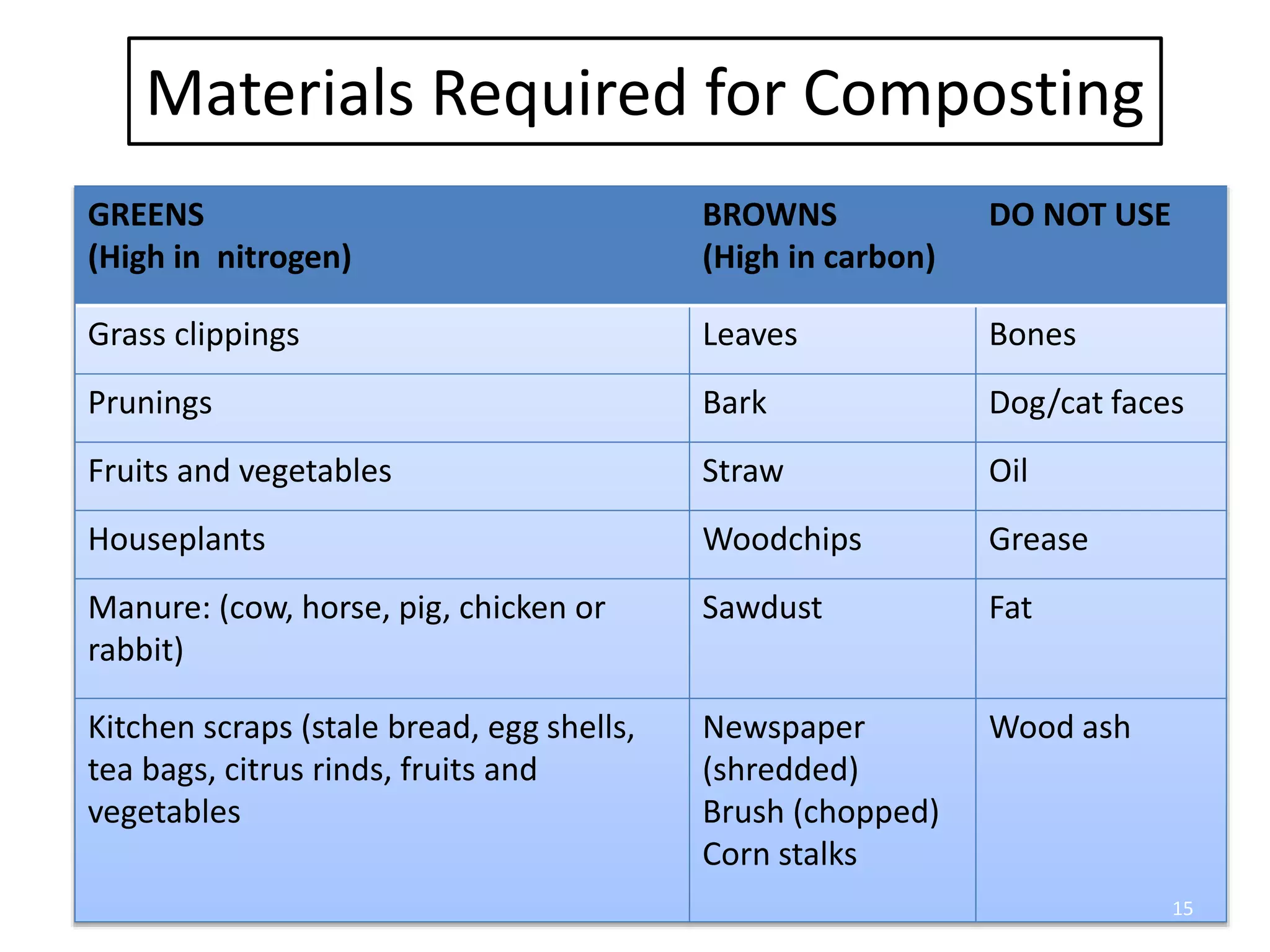
Materials Required for Composting
GREENS
(High in nitrogen)
BROWNS
(High in carbon)
DO NOT USE
Grass clippings Leaves Bones
Prunings Bark Dog/cat faces
Fruits and vegetables Straw Oil
Houseplants Woodchips Grease
Manure: (cow, horse, pig, chicken or
rabbit)
Sawdust Fat
Kitchen scraps (stale bread, egg shells,
tea bags, citrus rinds, fruits and
vegetables
Newspaper
(shredded)
Brush (chopped)
Corn stalks
Wood ash
15
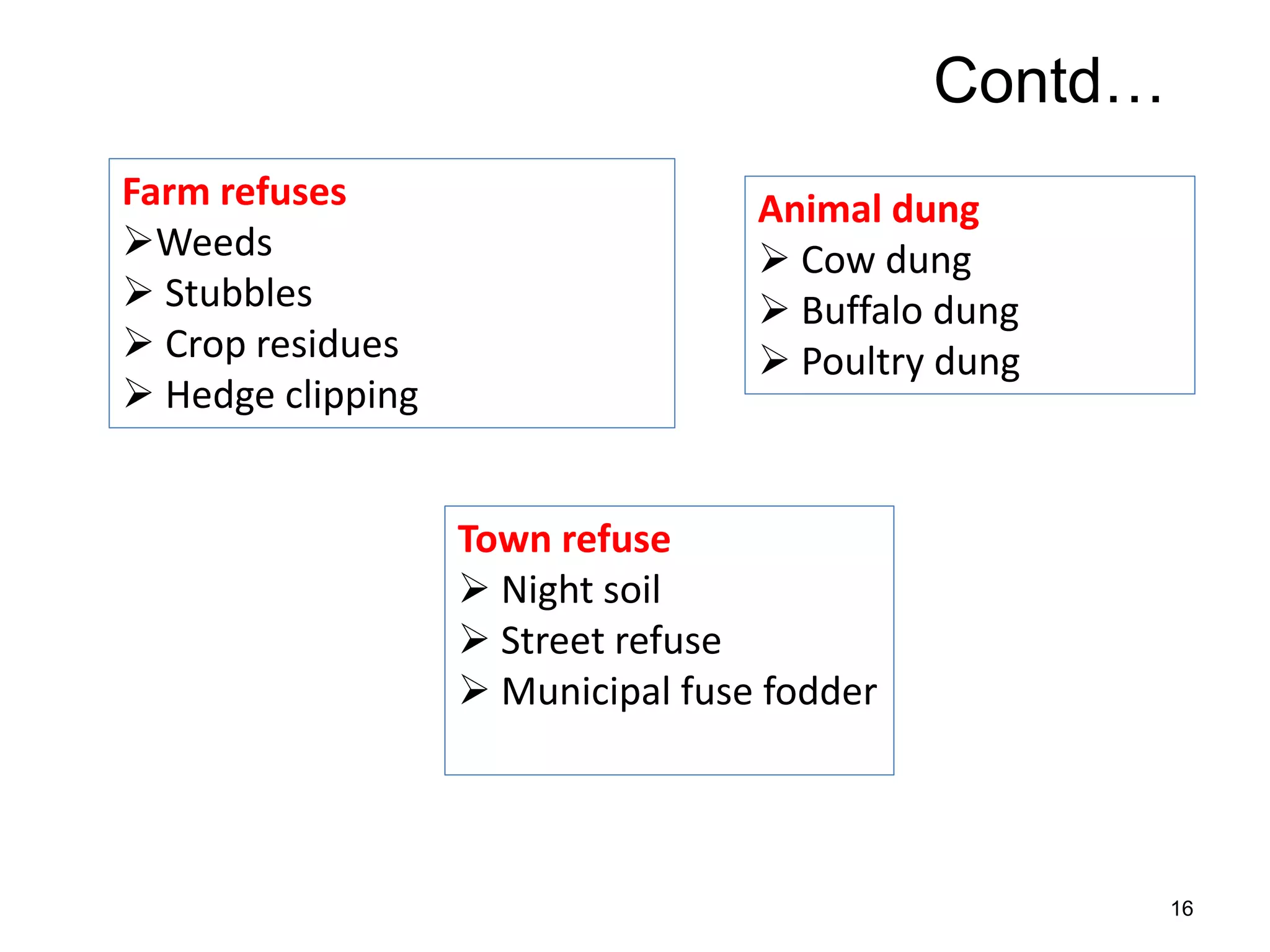
Contd…
16
Farm refuses
Weeds
 Stubbles
 Crop residues
 Hedge clipping
Animal dung
 Cow dung
 Buffalo dung
 Poultry dung
Town refuse
 Night soil
 Street refuse
 Municipal fuse fodder
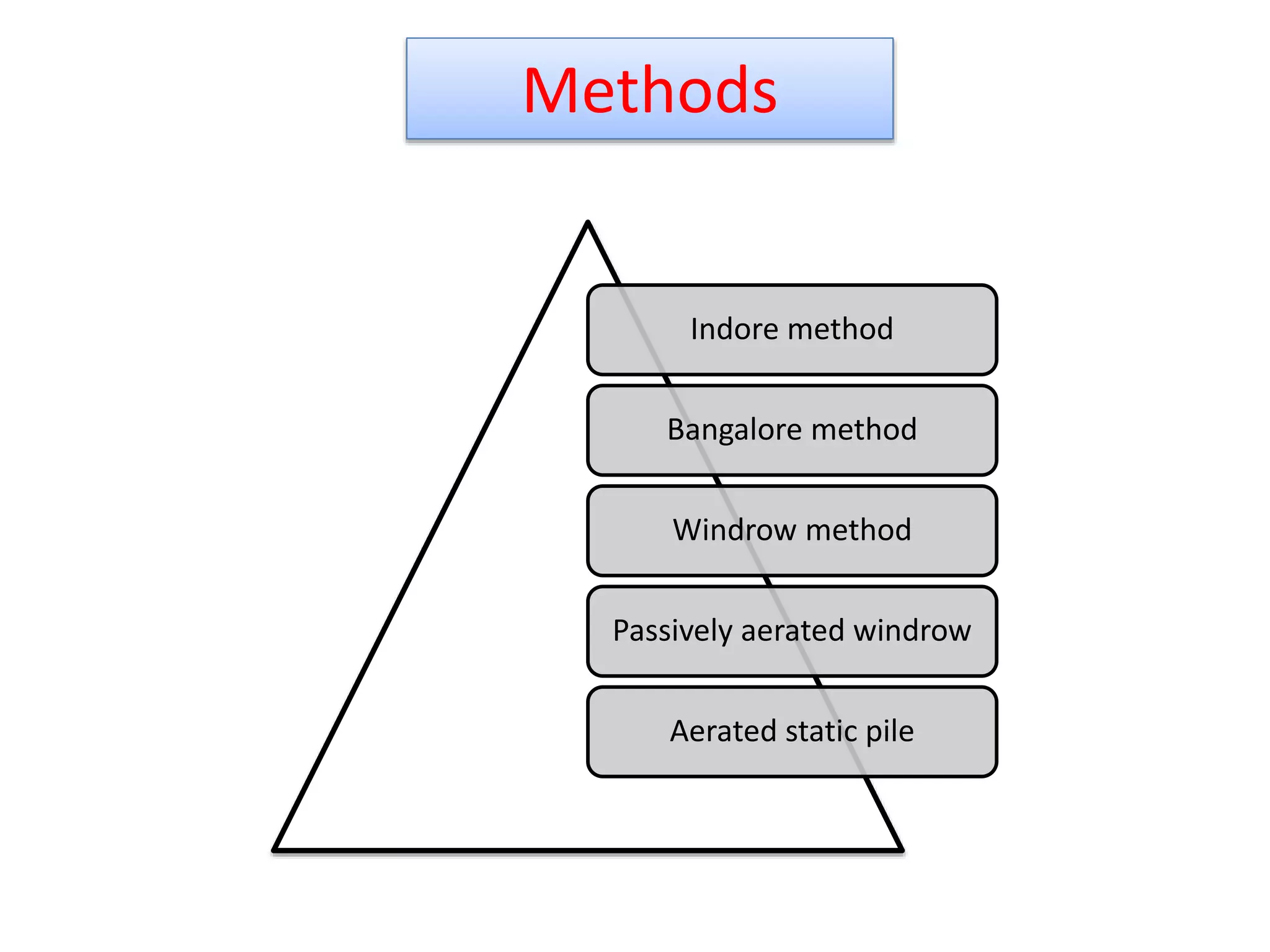
Methods
Indore method
Bangalore method
Windrow method
Passively aerated windrow
Aerated static pile
17
Indore Method
18
• Developed by Howard (1931)
• Trapezoidal cross section
• The heap is about 4 m in length, 1 m in breadth and 1 m in
height
• Alternatively layered with 20 cm of carbon rich and 10 cm
of nitrogen rich
• Covered with soil or hay
• Periodically turning the materials
Bangalore Method
• Acharya (1934) developed the bangalore method
• City refuse and night soil
• Pits of about 1m depth, 1m breadth and 1m length
• City refuse-layer of 15 cm
• Night soil-5 cm
• Dome shaped and covered with soil
• Anaerobic decomposition is comparatively slow
19
Windrow Method
• Traditional and widely practiced method
• long rows of 2 to 4 m width and 1 to 2 m height on a
hard surface in open area
• Periodical turning -equipments
20
Passively Aerated Windrows
• Air- perforated pipes- eliminating turning
• The pipe ends are open, air flows in to the pipes and
through the windrow
• Aeration pipes are placed on top of the heap/compost
base.
• If the composting period is completed, the pipes are
removed, and the composted materials were collected
21
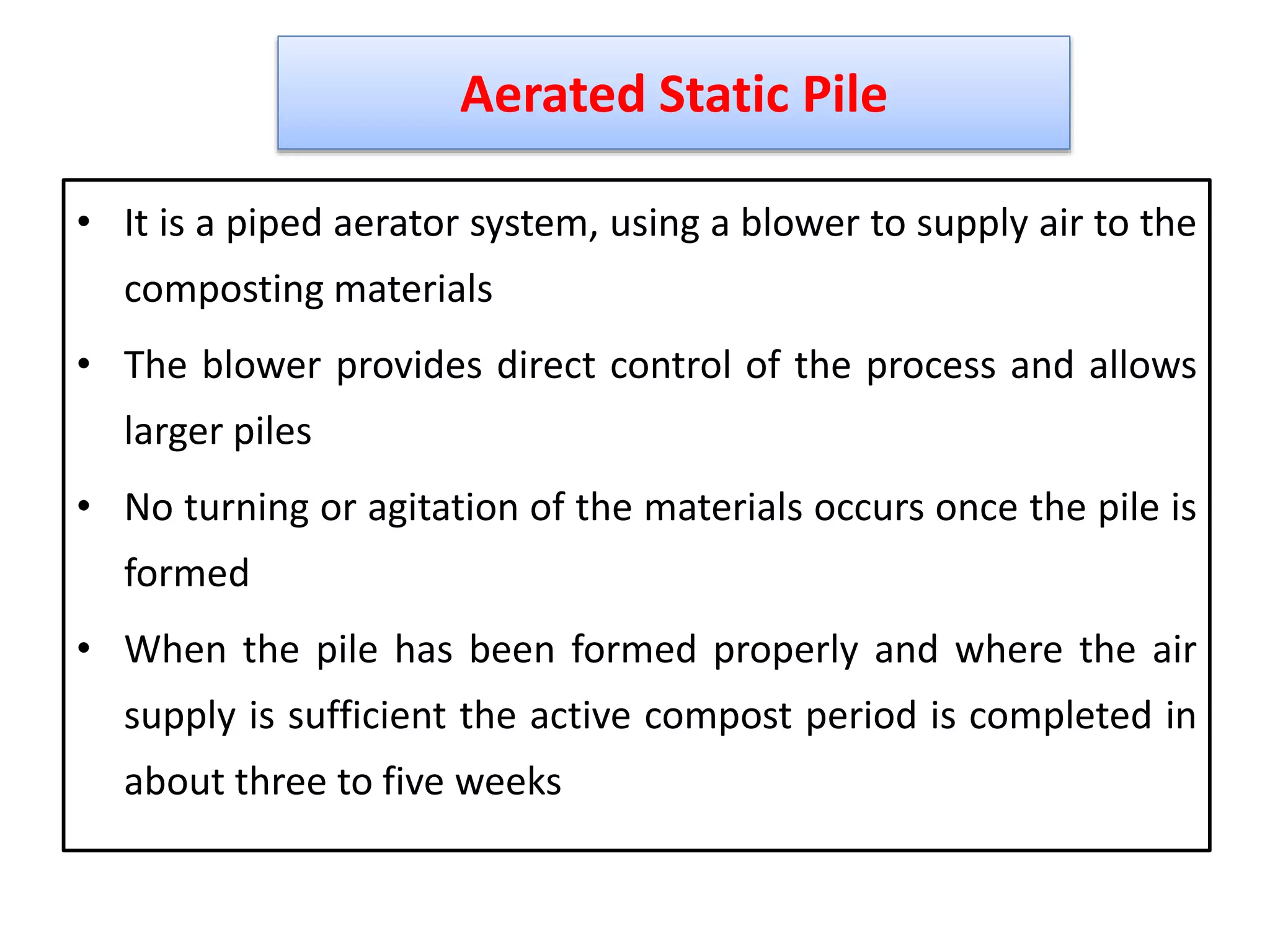
• It is a piped aerator system, using a blower to supply air to the
composting materials
• The blower provides direct control of the process and allows
larger piles
• No turning or agitation of the materials occurs once the pile is
formed
• When the pile has been formed properly and where the air
supply is sufficient the active compost period is completed in
about three to five weeks
22
Aerated Static Pile
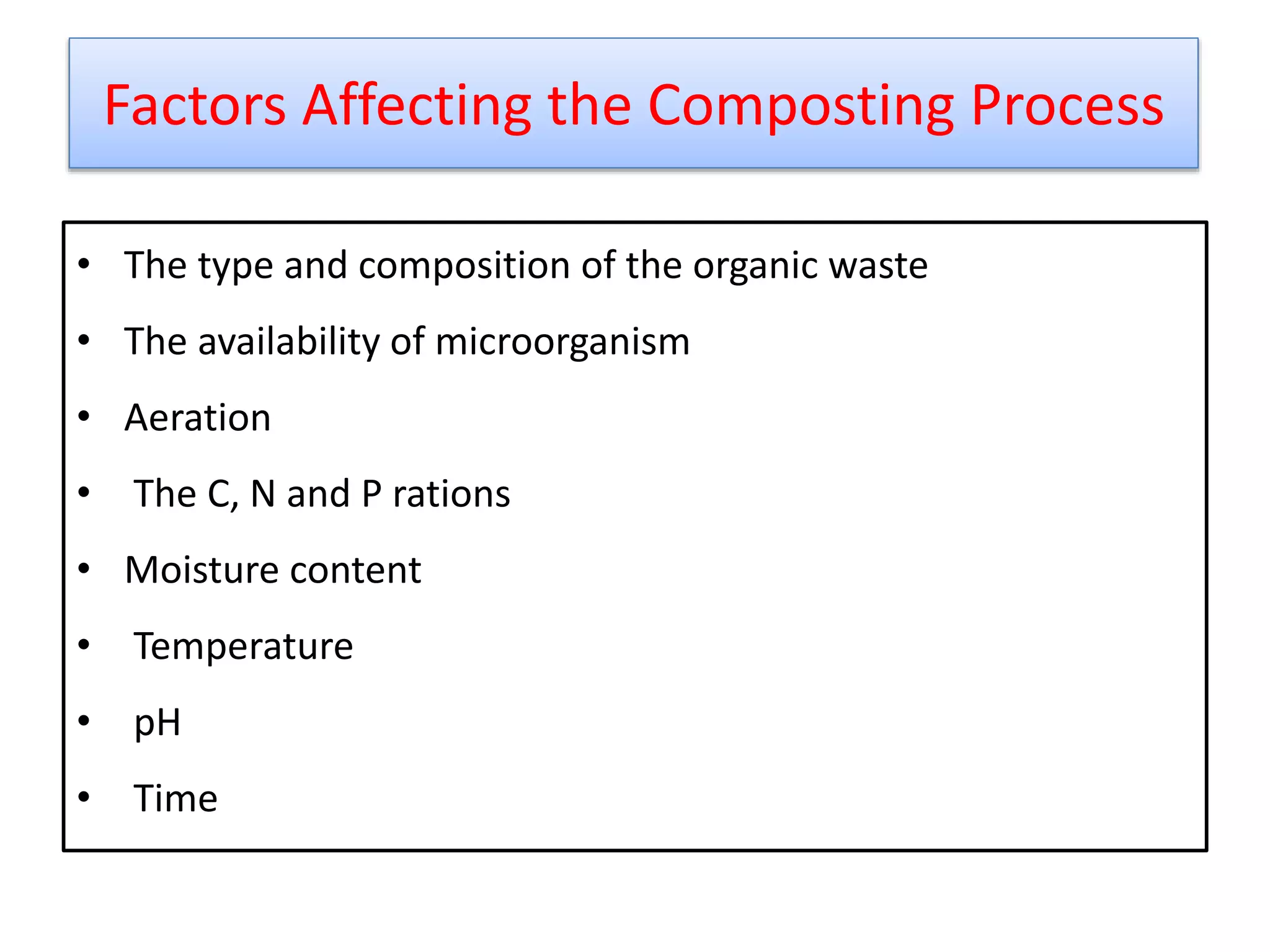
Factors Affecting the Composting Process
• The type and composition of the organic waste
• The availability of microorganism
• Aeration
• The C, N and P rations
• Moisture content
• Temperature
• pH
• Time
23
24
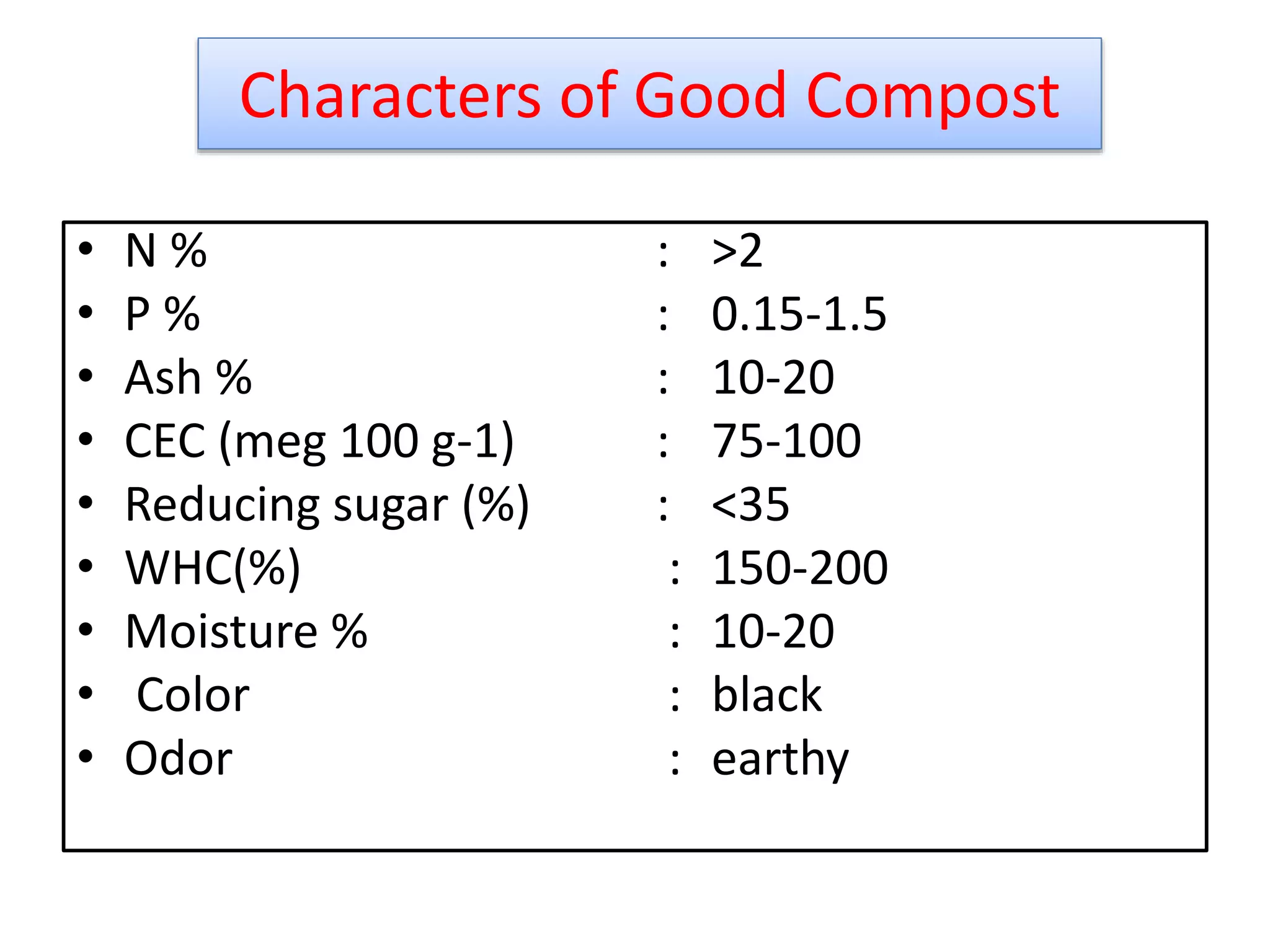
Characters of Good Compost
• N % : >2
• P % : 0.15-1.5
• Ash % : 10-20
• CEC (meg 100 g-1) : 75-100
• Reducing sugar (%) : <35
• WHC(%) : 150-200
• Moisture % : 10-20
• Color : black
• Odor : earthy
25
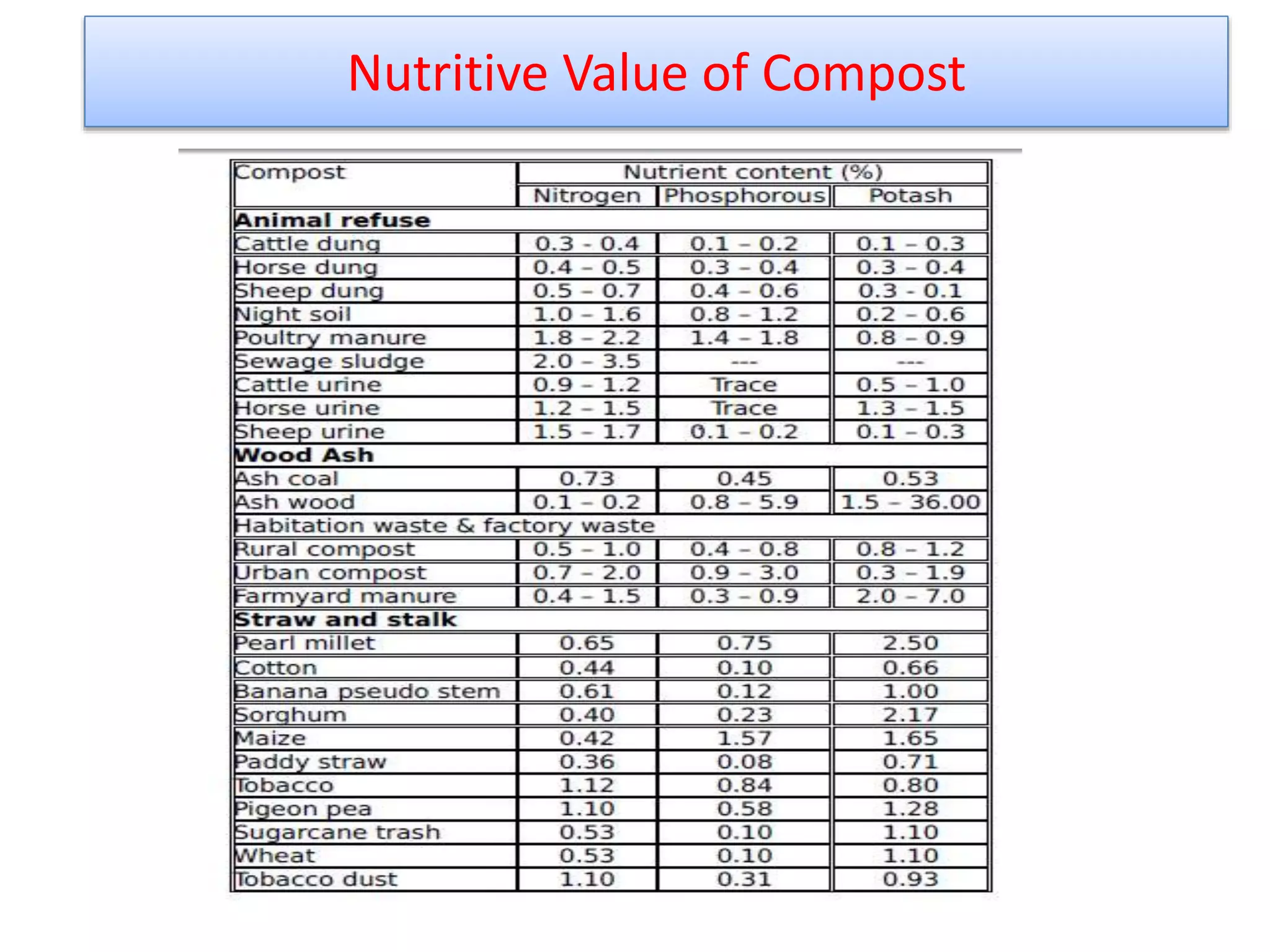
Nutritive Value of Compost
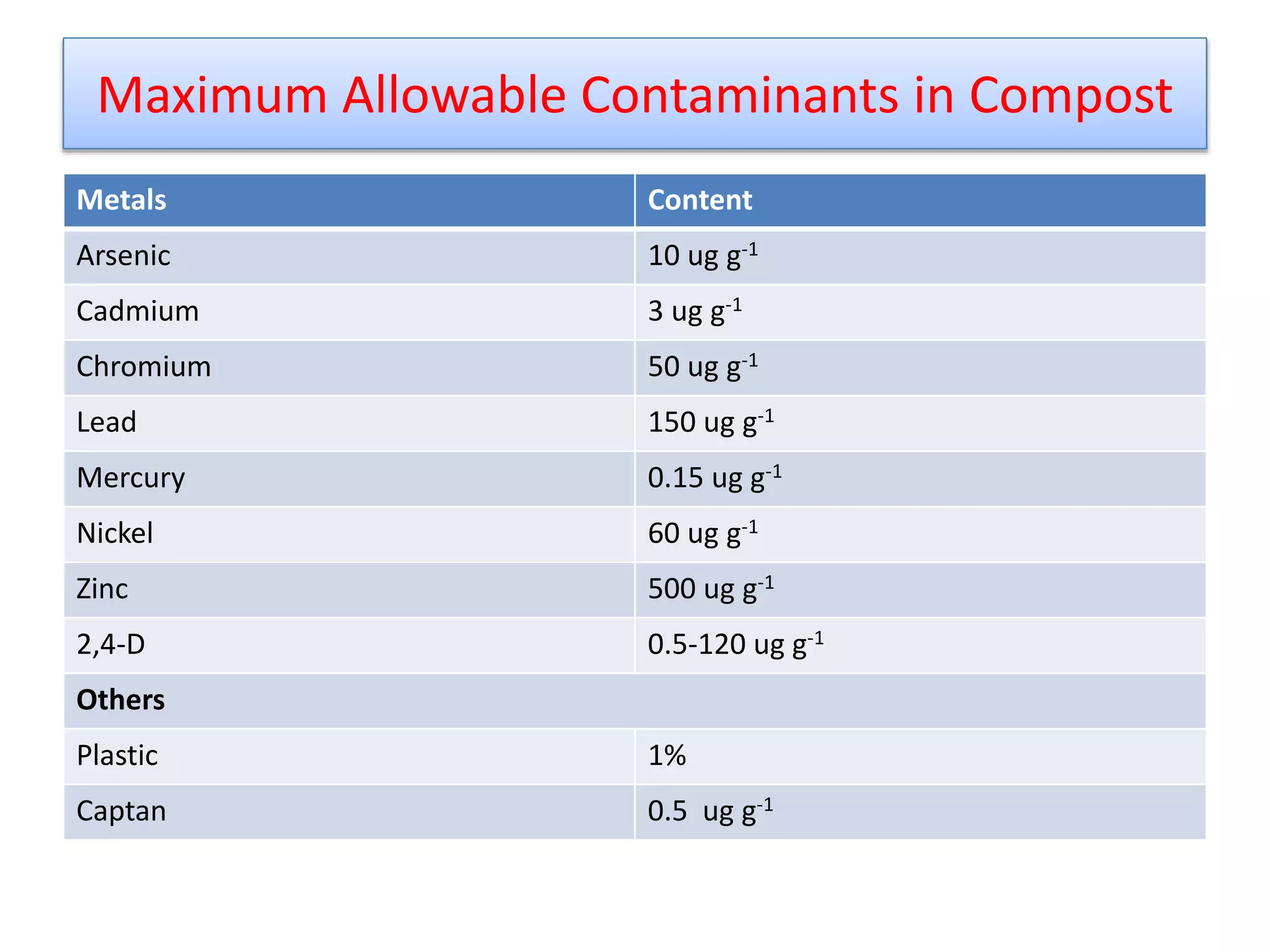
Maximum Allowable Contaminants in Compost
Metals Content
Arsenic 10 ug g-1
Cadmium 3 ug g-1
Chromium 50 ug g-1
Lead 150 ug g-1
Mercury 0.15 ug g-1
Nickel 60 ug g-1
Zinc 500 ug g-1
2,4-D 0.5-120 ug g-1
Others
Plastic 1%
Captan 0.5 ug g-1
27
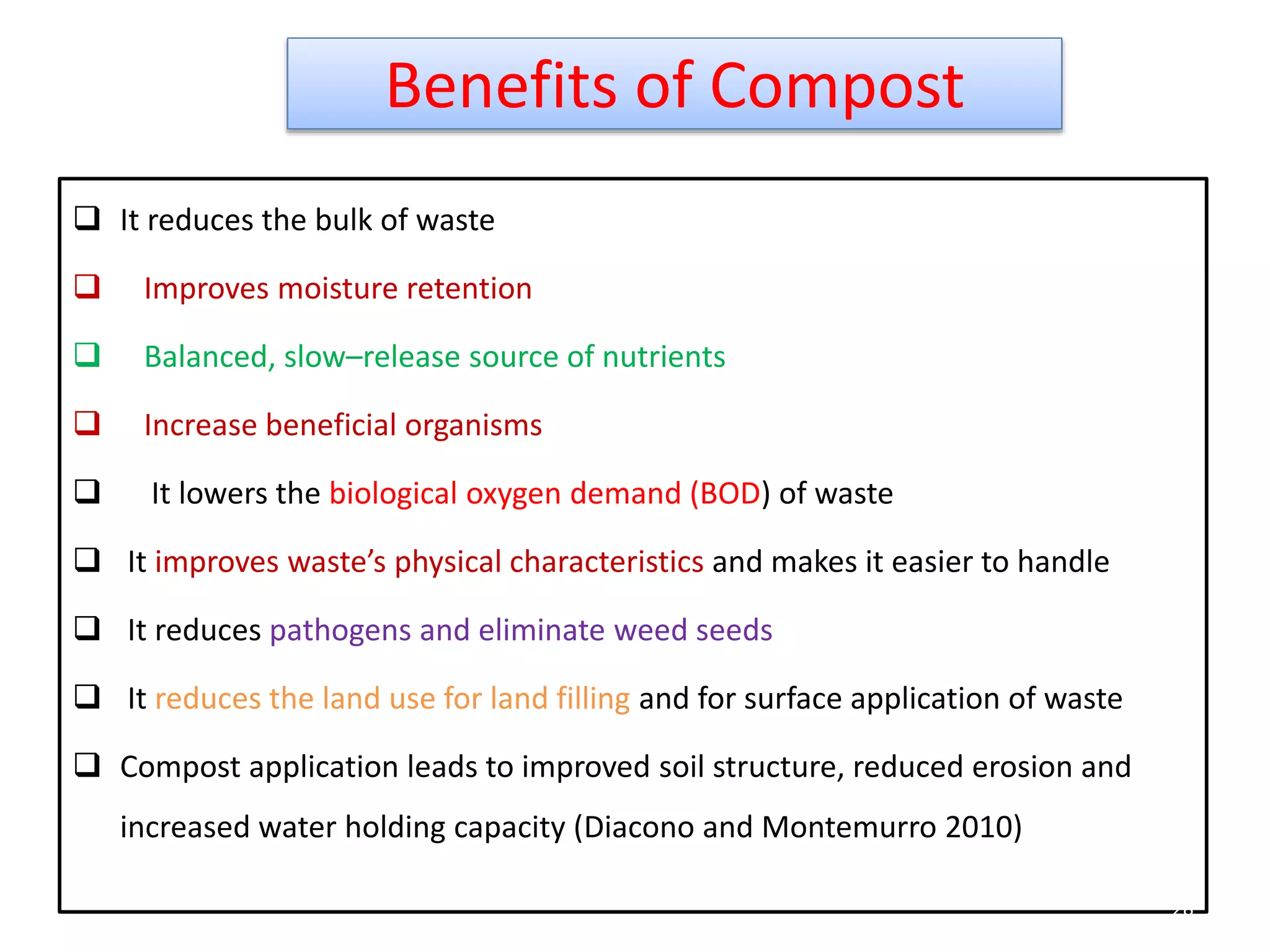
Benefits of Compost
 It reduces the bulk of waste
 Improves moisture retention
 Balanced, slow–release source of nutrients
 Increase beneficial organisms
 It lowers the biological oxygen demand (BOD) of waste
 It improves waste’s physical characteristics and makes it easier to handle
 It reduces pathogens and eliminate weed seeds
 It reduces the land use for land filling and for surface application of waste
 Compost application leads to improved soil structure, reduced erosion and
increased water holding capacity (Diacono and Montemurro 2010)
28
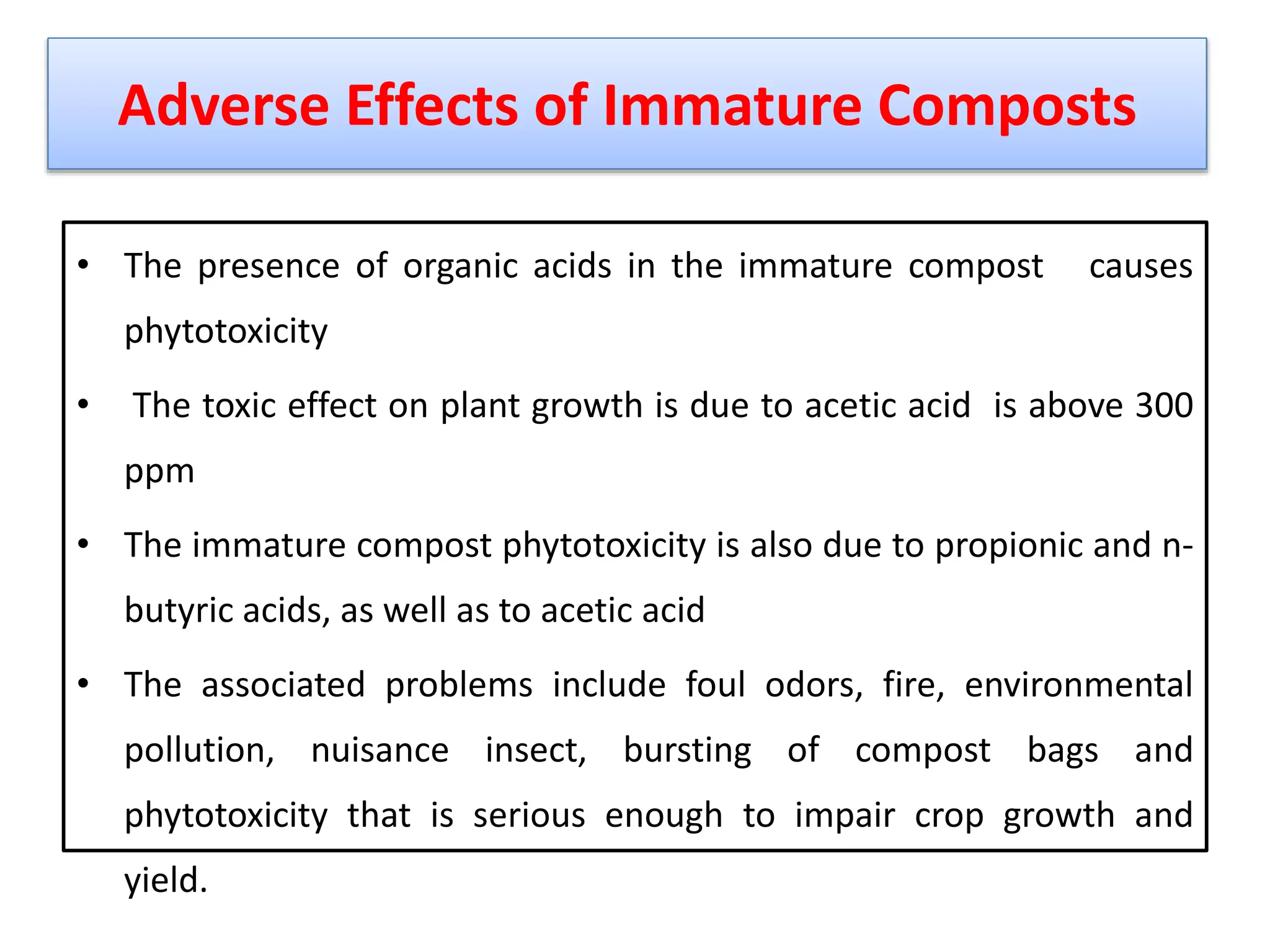
Adverse Effects of Immature Composts
• The presence of organic acids in the immature compost causes
phytotoxicity
• The toxic effect on plant growth is due to acetic acid is above 300
ppm
• The immature compost phytotoxicity is also due to propionic and n-
butyric acids, as well as to acetic acid
• The associated problems include foul odors, fire, environmental
pollution, nuisance insect, bursting of compost bags and
phytotoxicity that is serious enough to impair crop growth and
yield.
29
Contd..
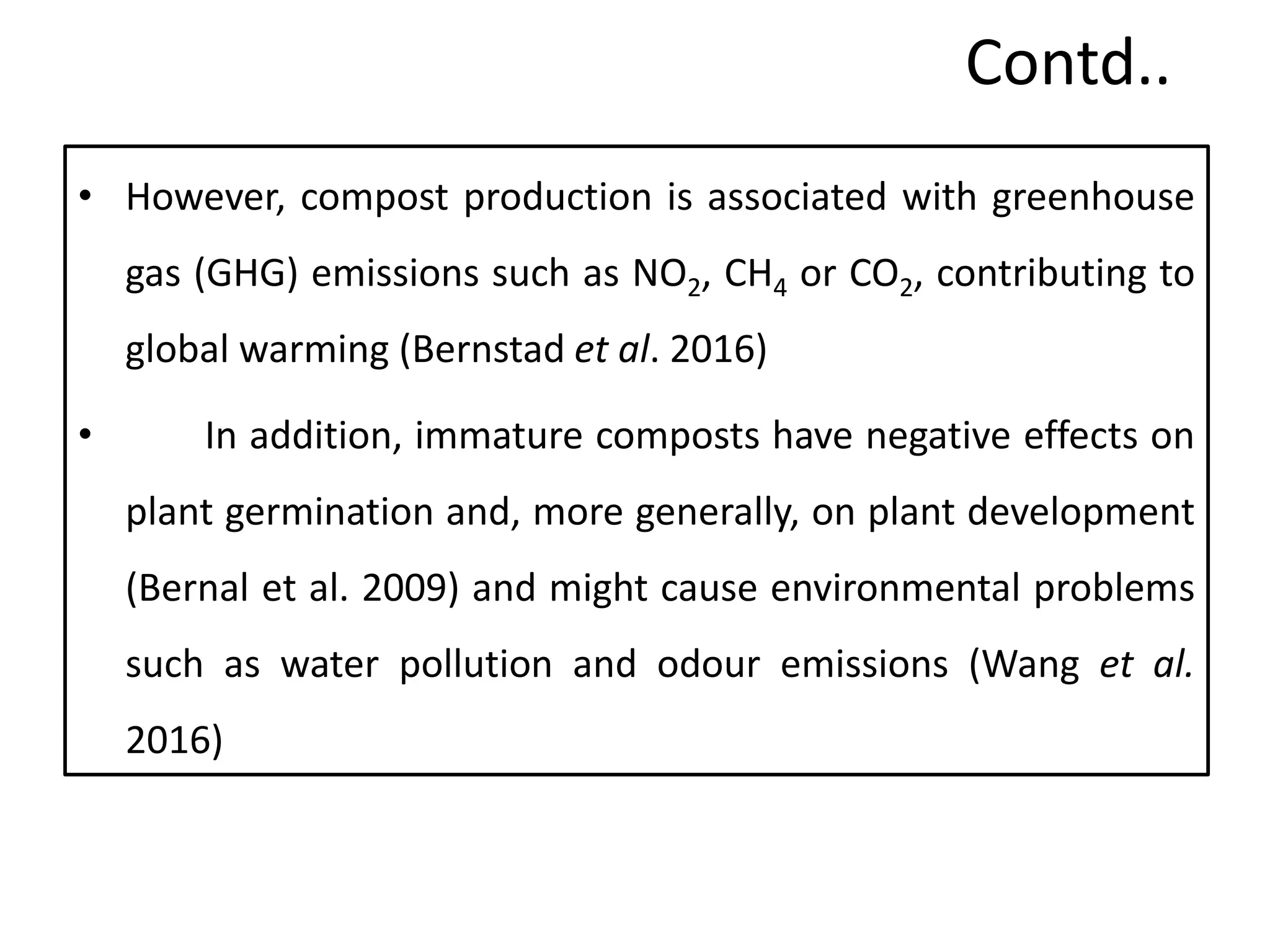
• However, compost production is associated with greenhouse
gas (GHG) emissions such as NO2, CH4 or CO2, contributing to
global warming (Bernstad et al. 2016)
• In addition, immature composts have negative effects on
plant germination and, more generally, on plant development
(Bernal et al. 2009) and might cause environmental problems
such as water pollution and odour emissions (Wang et al.
2016)
30
31
Vermicomposting
• Degradation of organic waste by earthworms
• Ecosystem engineers” because they are
actively redesign the physical structure of the
soil environment.
32
Characters of Earthworm
• Capable of inhabiting in high percentage of organic
material
• Adaptability with respect to environment factors
• High fecundity rate with low incubation period
• Smallest period of interval from hatching to maturity
• High growth rate,consumption,digestion and
assimilation rates
33
Types of Earthworm
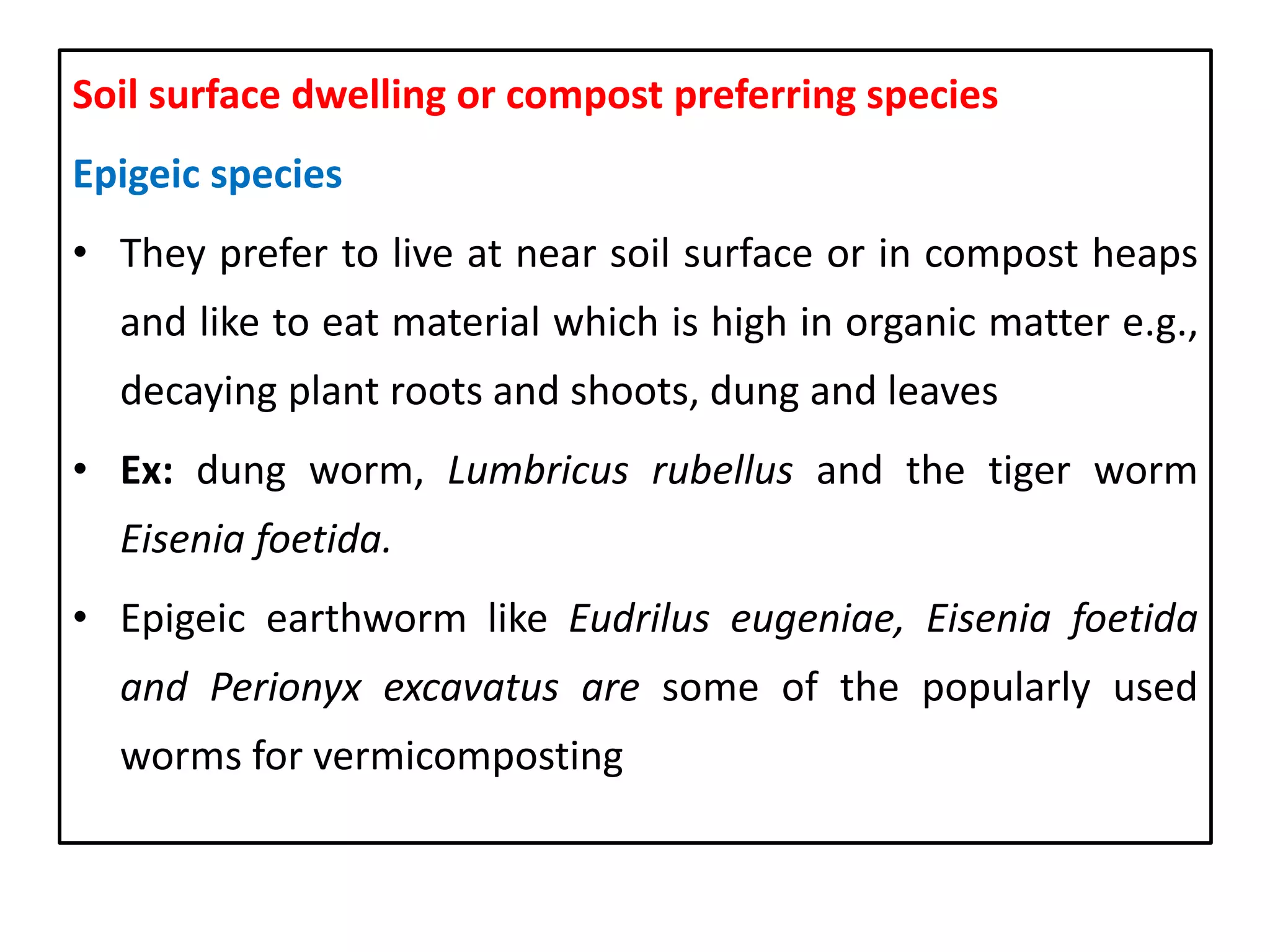
Soil surface dwelling or compost preferring species
Epigeic species
• They prefer to live at near soil surface or in compost heaps
and like to eat material which is high in organic matter e.g.,
decaying plant roots and shoots, dung and leaves
• Ex: dung worm, Lumbricus rubellus and the tiger worm
Eisenia foetida.
• Epigeic earthworm like Eudrilus eugeniae, Eisenia foetida
and Perionyx excavatus are some of the popularly used
worms for vermicomposting
34
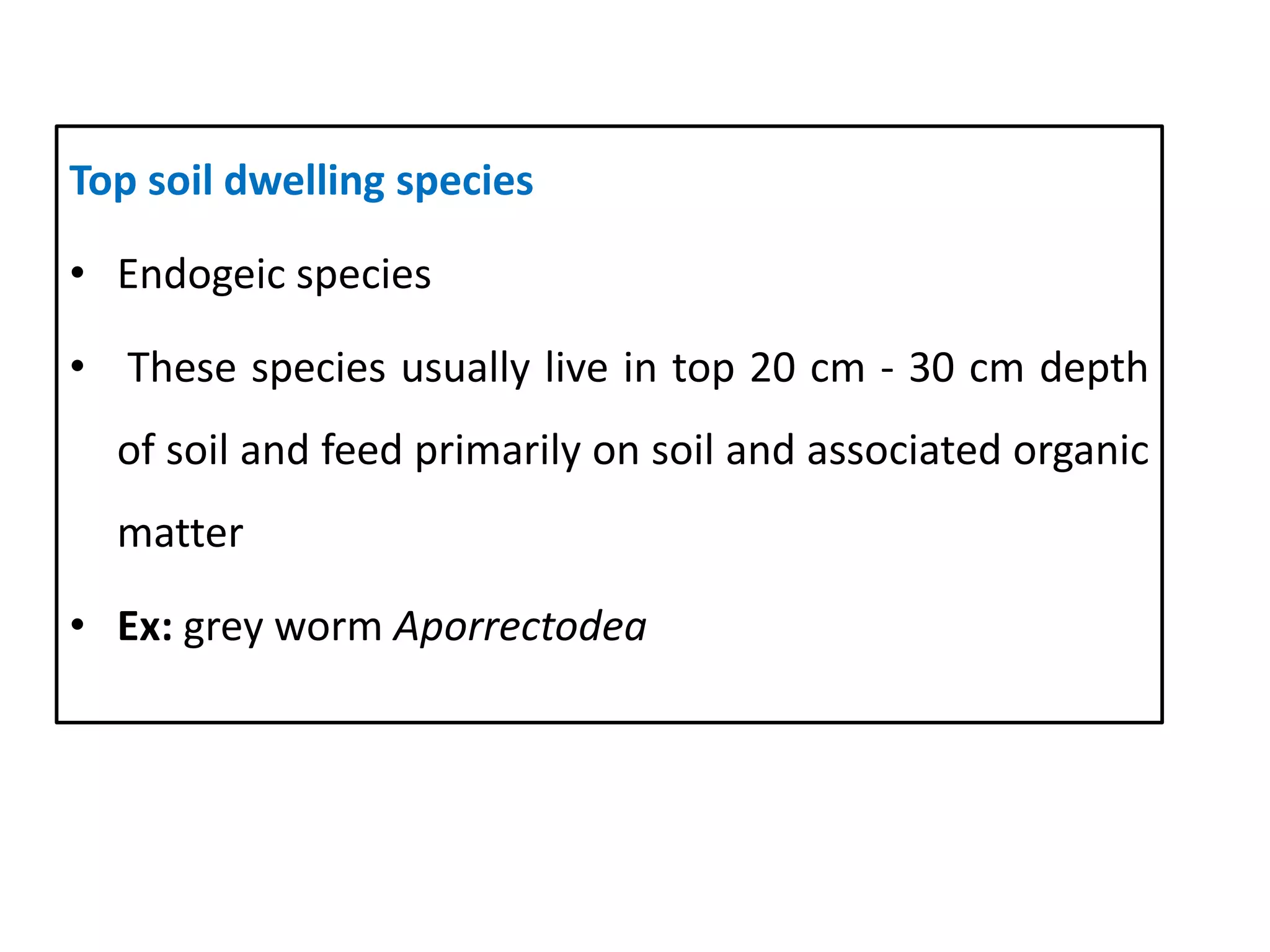
Top soil dwelling species
• Endogeic species
• These species usually live in top 20 cm - 30 cm depth
of soil and feed primarily on soil and associated organic
matter
• Ex: grey worm Aporrectodea
35
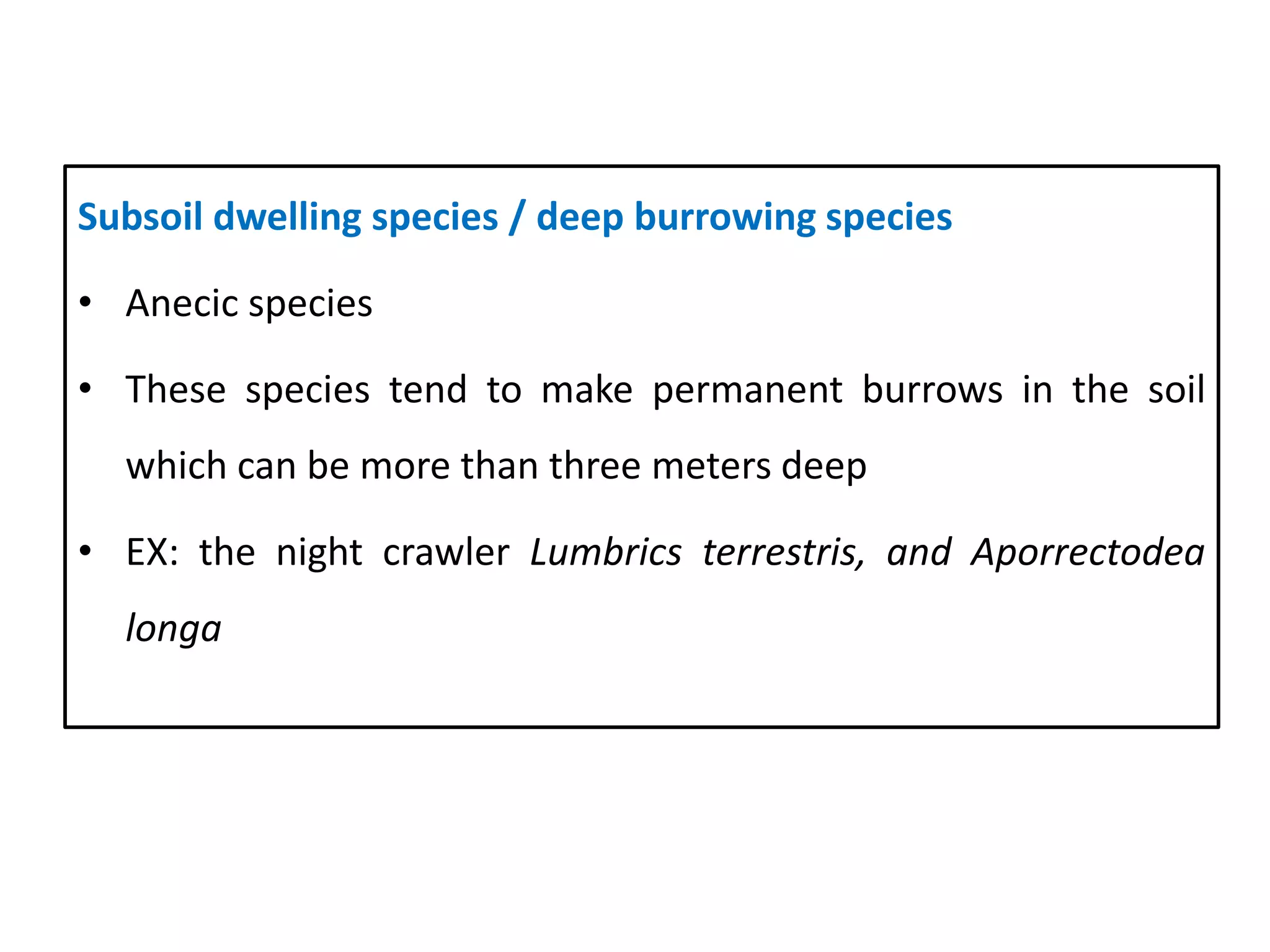
Subsoil dwelling species / deep burrowing species
• Anecic species
• These species tend to make permanent burrows in the soil
which can be more than three meters deep
• EX: the night crawler Lumbrics terrestris, and Aporrectodea
longa
36
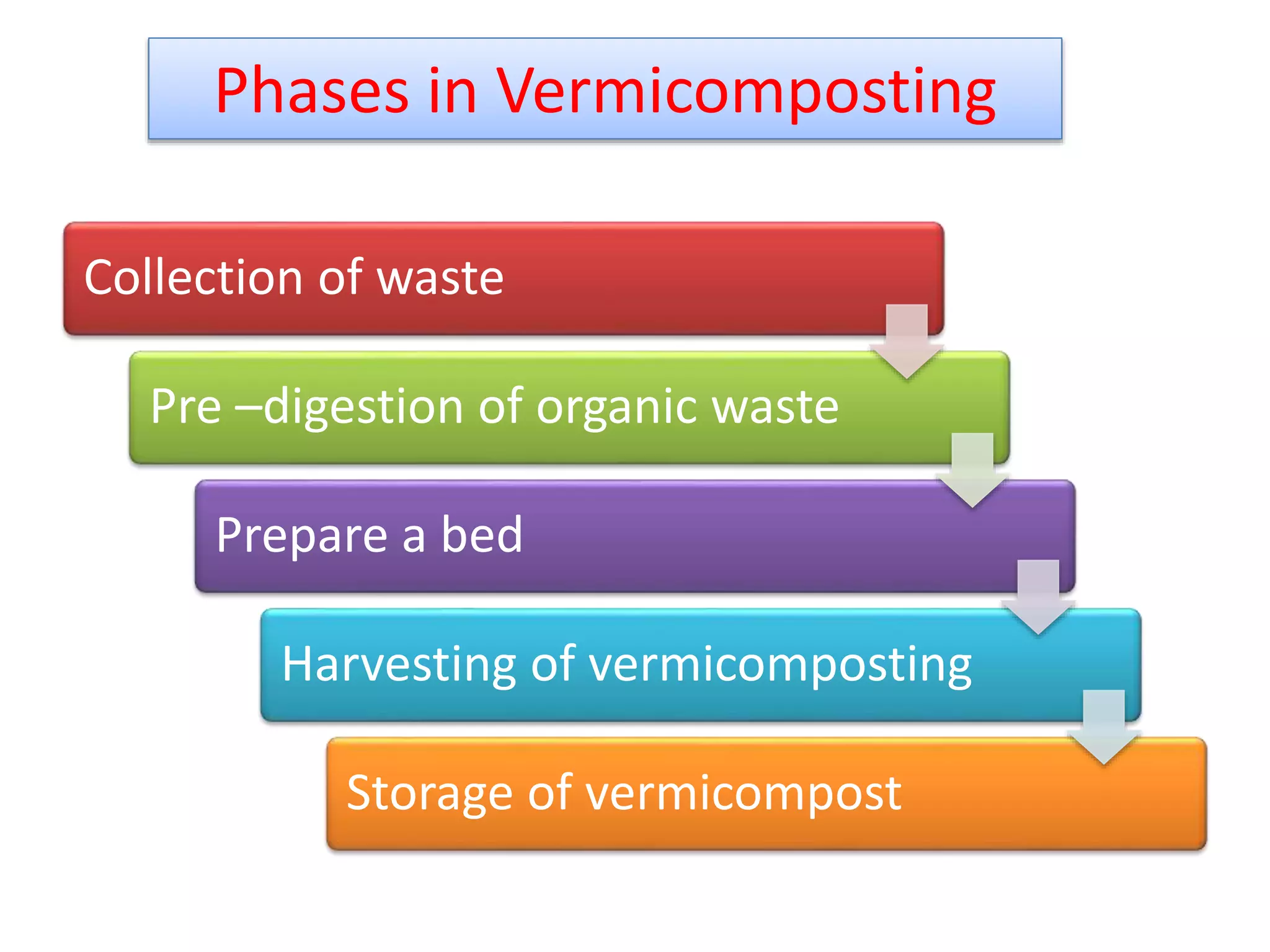
Phases in Vermicomposting
Collection of waste
Pre –digestion of organic waste
Prepare a bed
Harvesting of vermicomposting
Storage of vermicompost
37
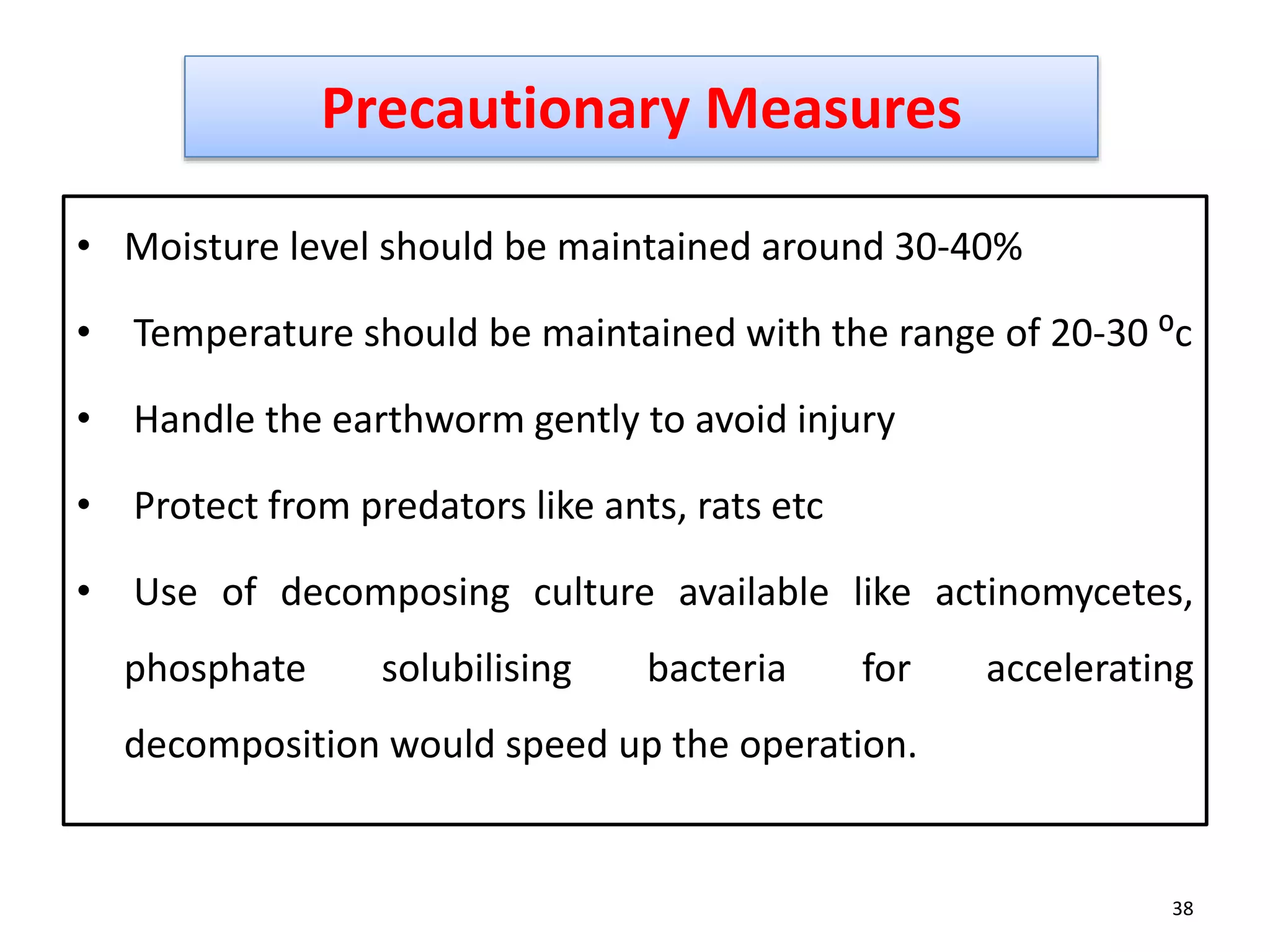
• Moisture level should be maintained around 30-40%
• Temperature should be maintained with the range of 20-30 ⁰c
• Handle the earthworm gently to avoid injury
• Protect from predators like ants, rats etc
• Use of decomposing culture available like actinomycetes,
phosphate solubilising bacteria for accelerating
decomposition would speed up the operation.
38
Precautionary Measures
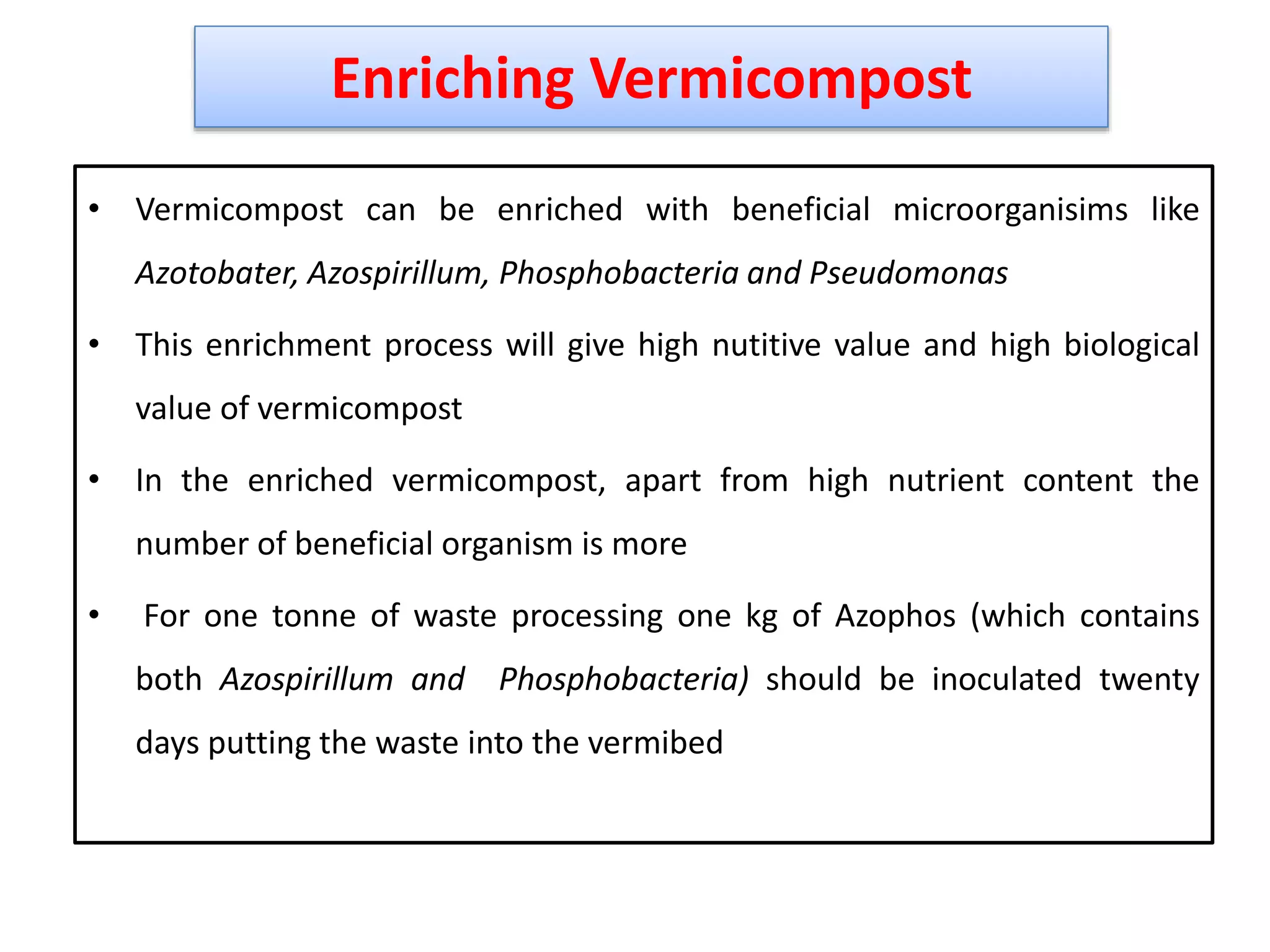
• Vermicompost can be enriched with beneficial microorganisims like
Azotobater, Azospirillum, Phosphobacteria and Pseudomonas
• This enrichment process will give high nutitive value and high biological
value of vermicompost
• In the enriched vermicompost, apart from high nutrient content the
number of beneficial organism is more
• For one tonne of waste processing one kg of Azophos (which contains
both Azospirillum and Phosphobacteria) should be inoculated twenty
days putting the waste into the vermibed
39
Enriching Vermicompost
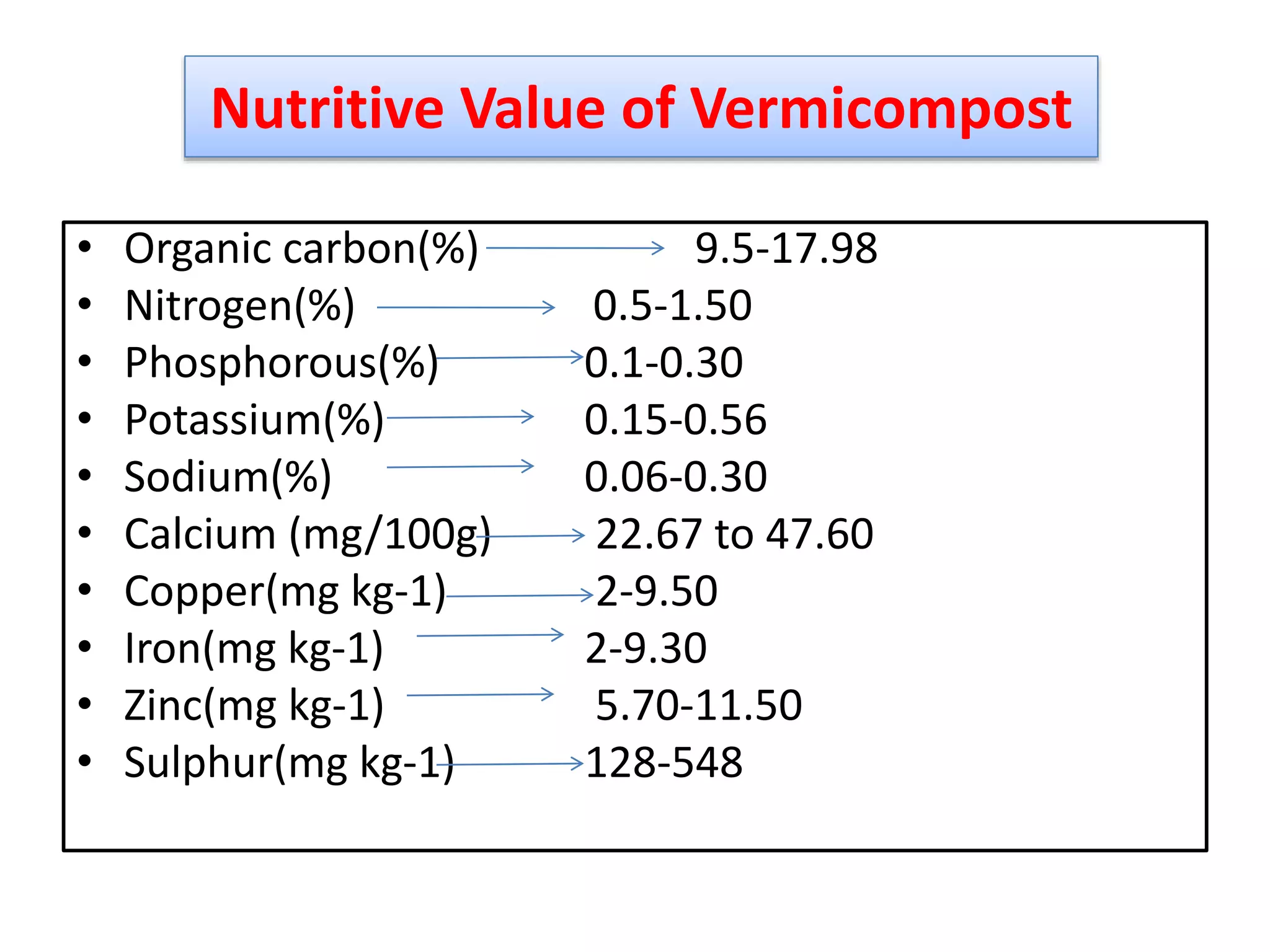
• Organic carbon(%) 9.5-17.98
• Nitrogen(%) 0.5-1.50
• Phosphorous(%) 0.1-0.30
• Potassium(%) 0.15-0.56
• Sodium(%) 0.06-0.30
• Calcium (mg/100g) 22.67 to 47.60
• Copper(mg kg-1) 2-9.50
• Iron(mg kg-1) 2-9.30
• Zinc(mg kg-1) 5.70-11.50
• Sulphur(mg kg-1) 128-548
40
Nutritive Value of Vermicompost
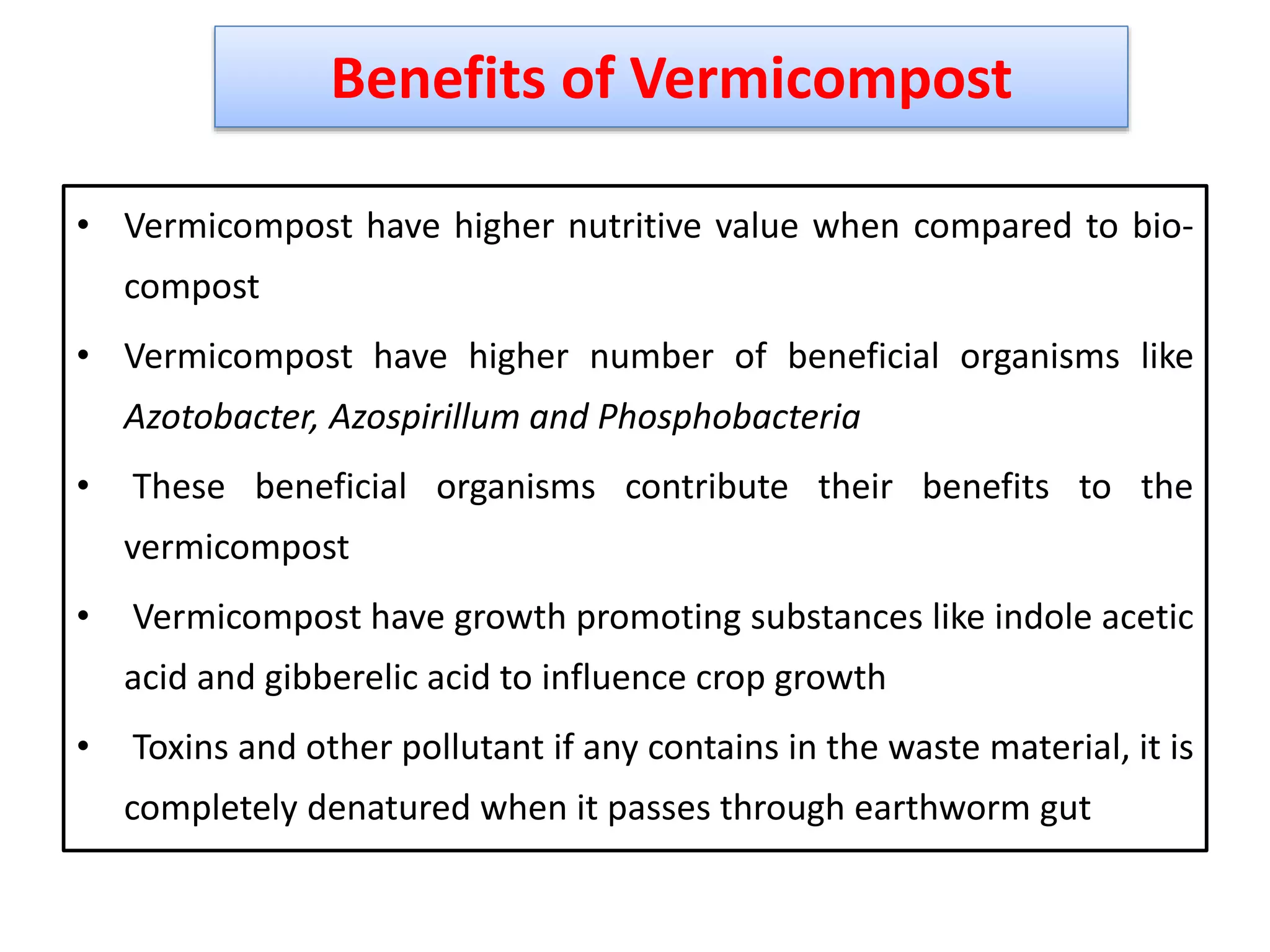
• Vermicompost have higher nutritive value when compared to bio-
compost
• Vermicompost have higher number of beneficial organisms like
Azotobacter, Azospirillum and Phosphobacteria
• These beneficial organisms contribute their benefits to the
vermicompost
• Vermicompost have growth promoting substances like indole acetic
acid and gibberelic acid to influence crop growth
• Toxins and other pollutant if any contains in the waste material, it is
completely denatured when it passes through earthworm gut
41
Benefits of Vermicompost
Thank you...
42

Compost- Methods and Utilization.pptx

  • 1.
    1 In nature, nothingis considered as a waste--- everything is food for something else
  • 2.
  • 3.
    Introduction-Compost • Biological degradationduring composting and vermicomposting is one of these strategies to transform organic wastes into organic amendments (Bernstad et al. 2016) • Complex interaction between organic waste and microorganisms 3 Raw material Humic substance
  • 4.
  • 5.
  • 6.
  • 7.
  • 8.
  • 9.
    Aerobes Vs Anaerobes 9 Aerobicdecompostion Anaerobic decmposition Presence of air Absence of air Organic waste will break down quickly and is not prone to smell Take years to break down and create the awful smell most people associate with composting High maintenance Low maintenance This type of compost is good for large volumes of compost The bacteria break down the organic materials into harmful compounds like ammonia and methane
  • 10.
    Major Organisms Bacteria • Smallestliving organisms • Responsible for decomposition and heat generation in compost • Normal condition- genus bacillus • Higher compost temperature- genus thermus • Eg: B.brewis, B. circulans, B. coagulans, and B. subtilis Fungi • Complex plant polymers • Break down tough debris • Fungal species are numerous during both mesophilic and thermophilic phases • Most fungi live in the outer layer of compost when temperatures are high • Eg : Mucor, Chetomium, Thermophilum, Penicillium, and Aspergillus 10
  • 11.
    11 Actinomycetes •Important role indegrading complex organics such as cellulose, lignin, chitin, and proteins •Chemically break down tough debris such as woody stems, bark •Some species appear during the thermophilic phase, and others become important during the cooler curing phase •Eg: Nocardia, Streptomyces rectus Protozoa •Protozoa are one-celled microscopic animals. • They are found in water droplets in compost • Minor role in decomposition Earthworms •Large physical decomposers in a compost pile • Earthworms ingest organic matter and digest it with the help of tiny stones in their gizzards •These castings are rich in plant nutrients such as nitrogen, calcium, magnesium, and phosphorus
  • 12.
  • 13.
    What Microbes Need???? • Carbon (sugars) fuels their metabolism • Nitrogen (protein) makes enzymes used in decay process • Moisture transports and supports life functions • Oxygen • Hospitable environment 13 Feed me
  • 14.
  • 15.
    Materials Required forComposting GREENS (High in nitrogen) BROWNS (High in carbon) DO NOT USE Grass clippings Leaves Bones Prunings Bark Dog/cat faces Fruits and vegetables Straw Oil Houseplants Woodchips Grease Manure: (cow, horse, pig, chicken or rabbit) Sawdust Fat Kitchen scraps (stale bread, egg shells, tea bags, citrus rinds, fruits and vegetables Newspaper (shredded) Brush (chopped) Corn stalks Wood ash 15
  • 16.
    Contd… 16 Farm refuses Weeds  Stubbles Crop residues  Hedge clipping Animal dung  Cow dung  Buffalo dung  Poultry dung Town refuse  Night soil  Street refuse  Municipal fuse fodder
  • 17.
    Methods Indore method Bangalore method Windrowmethod Passively aerated windrow Aerated static pile 17
  • 18.
    Indore Method 18 • Developedby Howard (1931) • Trapezoidal cross section • The heap is about 4 m in length, 1 m in breadth and 1 m in height • Alternatively layered with 20 cm of carbon rich and 10 cm of nitrogen rich • Covered with soil or hay • Periodically turning the materials
  • 19.
    Bangalore Method • Acharya(1934) developed the bangalore method • City refuse and night soil • Pits of about 1m depth, 1m breadth and 1m length • City refuse-layer of 15 cm • Night soil-5 cm • Dome shaped and covered with soil • Anaerobic decomposition is comparatively slow 19
  • 20.
    Windrow Method • Traditionaland widely practiced method • long rows of 2 to 4 m width and 1 to 2 m height on a hard surface in open area • Periodical turning -equipments 20
  • 21.
    Passively Aerated Windrows •Air- perforated pipes- eliminating turning • The pipe ends are open, air flows in to the pipes and through the windrow • Aeration pipes are placed on top of the heap/compost base. • If the composting period is completed, the pipes are removed, and the composted materials were collected 21
  • 22.
    • It isa piped aerator system, using a blower to supply air to the composting materials • The blower provides direct control of the process and allows larger piles • No turning or agitation of the materials occurs once the pile is formed • When the pile has been formed properly and where the air supply is sufficient the active compost period is completed in about three to five weeks 22 Aerated Static Pile
  • 23.
    Factors Affecting theComposting Process • The type and composition of the organic waste • The availability of microorganism • Aeration • The C, N and P rations • Moisture content • Temperature • pH • Time 23
  • 24.
  • 25.
    Characters of GoodCompost • N % : >2 • P % : 0.15-1.5 • Ash % : 10-20 • CEC (meg 100 g-1) : 75-100 • Reducing sugar (%) : <35 • WHC(%) : 150-200 • Moisture % : 10-20 • Color : black • Odor : earthy 25
  • 26.
  • 27.
    Maximum Allowable Contaminantsin Compost Metals Content Arsenic 10 ug g-1 Cadmium 3 ug g-1 Chromium 50 ug g-1 Lead 150 ug g-1 Mercury 0.15 ug g-1 Nickel 60 ug g-1 Zinc 500 ug g-1 2,4-D 0.5-120 ug g-1 Others Plastic 1% Captan 0.5 ug g-1 27
  • 28.
    Benefits of Compost It reduces the bulk of waste  Improves moisture retention  Balanced, slow–release source of nutrients  Increase beneficial organisms  It lowers the biological oxygen demand (BOD) of waste  It improves waste’s physical characteristics and makes it easier to handle  It reduces pathogens and eliminate weed seeds  It reduces the land use for land filling and for surface application of waste  Compost application leads to improved soil structure, reduced erosion and increased water holding capacity (Diacono and Montemurro 2010) 28
  • 29.
    Adverse Effects ofImmature Composts • The presence of organic acids in the immature compost causes phytotoxicity • The toxic effect on plant growth is due to acetic acid is above 300 ppm • The immature compost phytotoxicity is also due to propionic and n- butyric acids, as well as to acetic acid • The associated problems include foul odors, fire, environmental pollution, nuisance insect, bursting of compost bags and phytotoxicity that is serious enough to impair crop growth and yield. 29
  • 30.
    Contd.. • However, compostproduction is associated with greenhouse gas (GHG) emissions such as NO2, CH4 or CO2, contributing to global warming (Bernstad et al. 2016) • In addition, immature composts have negative effects on plant germination and, more generally, on plant development (Bernal et al. 2009) and might cause environmental problems such as water pollution and odour emissions (Wang et al. 2016) 30
  • 31.
  • 32.
    Vermicomposting • Degradation oforganic waste by earthworms • Ecosystem engineers” because they are actively redesign the physical structure of the soil environment. 32
  • 33.
    Characters of Earthworm •Capable of inhabiting in high percentage of organic material • Adaptability with respect to environment factors • High fecundity rate with low incubation period • Smallest period of interval from hatching to maturity • High growth rate,consumption,digestion and assimilation rates 33
  • 34.
    Types of Earthworm Soilsurface dwelling or compost preferring species Epigeic species • They prefer to live at near soil surface or in compost heaps and like to eat material which is high in organic matter e.g., decaying plant roots and shoots, dung and leaves • Ex: dung worm, Lumbricus rubellus and the tiger worm Eisenia foetida. • Epigeic earthworm like Eudrilus eugeniae, Eisenia foetida and Perionyx excavatus are some of the popularly used worms for vermicomposting 34
  • 35.
    Top soil dwellingspecies • Endogeic species • These species usually live in top 20 cm - 30 cm depth of soil and feed primarily on soil and associated organic matter • Ex: grey worm Aporrectodea 35
  • 36.
    Subsoil dwelling species/ deep burrowing species • Anecic species • These species tend to make permanent burrows in the soil which can be more than three meters deep • EX: the night crawler Lumbrics terrestris, and Aporrectodea longa 36
  • 37.
    Phases in Vermicomposting Collectionof waste Pre –digestion of organic waste Prepare a bed Harvesting of vermicomposting Storage of vermicompost 37
  • 38.
    • Moisture levelshould be maintained around 30-40% • Temperature should be maintained with the range of 20-30 ⁰c • Handle the earthworm gently to avoid injury • Protect from predators like ants, rats etc • Use of decomposing culture available like actinomycetes, phosphate solubilising bacteria for accelerating decomposition would speed up the operation. 38 Precautionary Measures
  • 39.
    • Vermicompost canbe enriched with beneficial microorganisims like Azotobater, Azospirillum, Phosphobacteria and Pseudomonas • This enrichment process will give high nutitive value and high biological value of vermicompost • In the enriched vermicompost, apart from high nutrient content the number of beneficial organism is more • For one tonne of waste processing one kg of Azophos (which contains both Azospirillum and Phosphobacteria) should be inoculated twenty days putting the waste into the vermibed 39 Enriching Vermicompost
  • 40.
    • Organic carbon(%)9.5-17.98 • Nitrogen(%) 0.5-1.50 • Phosphorous(%) 0.1-0.30 • Potassium(%) 0.15-0.56 • Sodium(%) 0.06-0.30 • Calcium (mg/100g) 22.67 to 47.60 • Copper(mg kg-1) 2-9.50 • Iron(mg kg-1) 2-9.30 • Zinc(mg kg-1) 5.70-11.50 • Sulphur(mg kg-1) 128-548 40 Nutritive Value of Vermicompost
  • 41.
    • Vermicompost havehigher nutritive value when compared to bio- compost • Vermicompost have higher number of beneficial organisms like Azotobacter, Azospirillum and Phosphobacteria • These beneficial organisms contribute their benefits to the vermicompost • Vermicompost have growth promoting substances like indole acetic acid and gibberelic acid to influence crop growth • Toxins and other pollutant if any contains in the waste material, it is completely denatured when it passes through earthworm gut 41 Benefits of Vermicompost
  • 42.