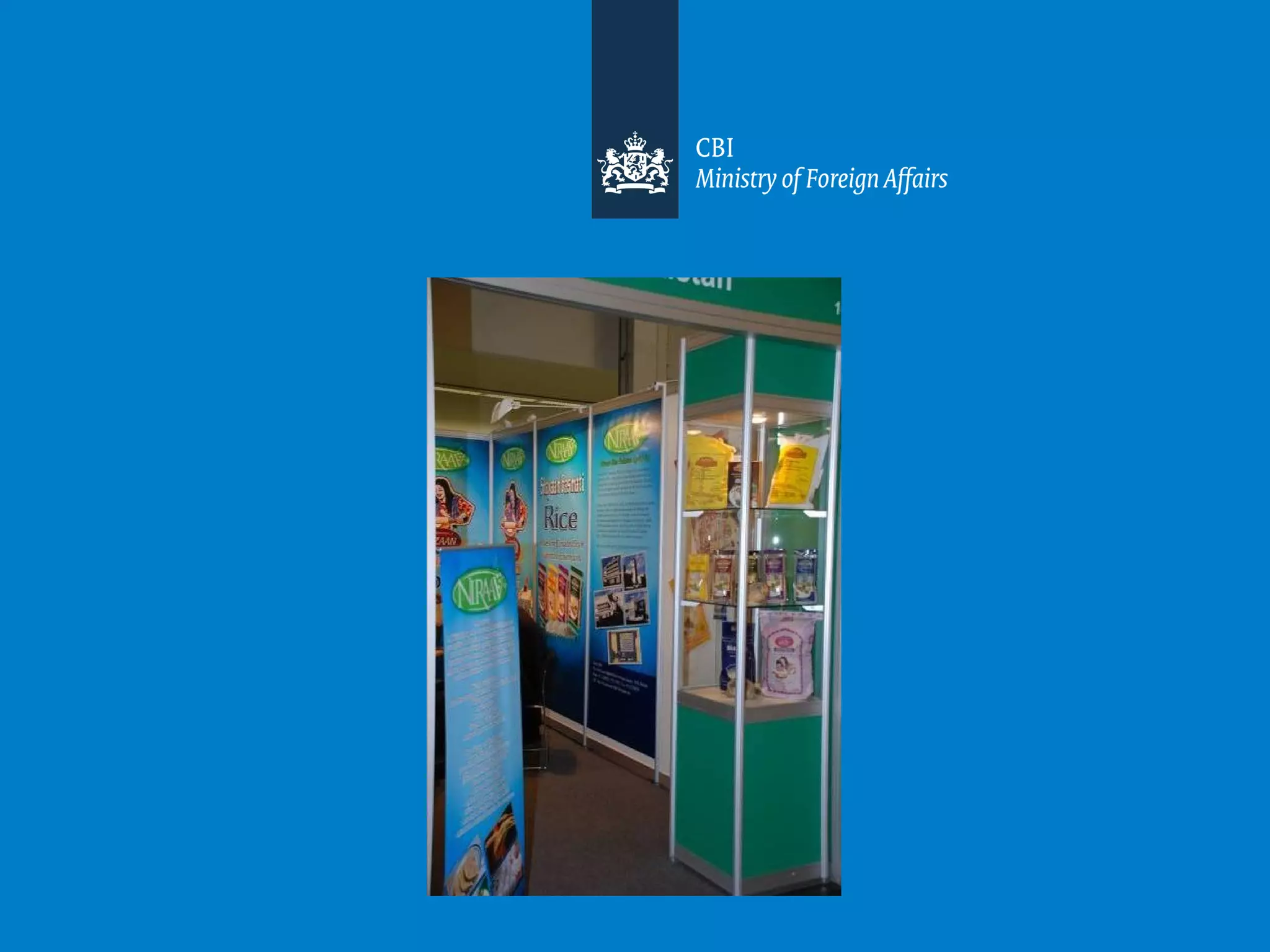
Stand design
& decoration

 Bogota, Colombia
 September 2012


  Joost Pierrot &
 Christophe Landuyt
Stand design & decoration


   Ownership & production matters
   Situation within the halls
   Types of stands
   Sections and functions of stand
   Group stands
Some (very) good & (very) bad examples
Stand design & decoration


EXERCISE:

Make a (draft) sketch
of your (fictional) stand.
Indicate approx. sizes, key elements and limits with
adjacent stands…
Ownership & production matters

As an exhibitor, you have the choice between renting booth
space only ('naked square meters') and renting a fully
equipped stand, - or anything in between.
Further, specialised suppliers offer the choice between tailor-
made booths and 'modular' booths and building systems, - or
anything in between.
Lastly, you as an exhibitor can choose the range of services
that should come with the booth: mounting & dismantling,
storage & disposal, re-use…
Ownership & production matters
Traditional woodwork:
      +      Freedom of forms        - Building Time
             Aesthetics                After-use
             Sturdy                    Reusability
Modular booths:
      +      Fast to build           - Cost (message)
             Reusability               Aesthetics
             Environment               No complex forms
Hybrid stands:        best of both worlds
Most stand contractors offer several
negotiated alternatives:
        Buying:                Ownership &
                     On completion, the exhibitor
has full             ownershipproduction
                               (and responsibility)
of the        stand and its components.
                               matters
       Renting:      On completion, the exhibitor
has the              right to use the stand and its
                     components for the duration
of the               show.
       Leasing:      Construction & dismantling,
transport            and storage for several shows.
      !!      "Designed here, built there" -
networks
Ownership & production matters
    Ideally, the timing for stand design
    and assembly takes 6 to 9 months:

    Register with organizer (D - 9 months)
    Briefing and rough stand design (D - 8 months)
    Planning assembly and disassembly (D - 8 months)
    Construction of booth (D - 6 to 2 months)
    Preparing furniture, equipment and exhibits (D - 2 m.)
    Compiling material (D - 3 to 1 months)
    Transport of material (D - 4 to 3 weeks)
    Assembly of booth (D - 2 – 1 week)
    Handing over of booth (day before trade fair)
    Disassembly of booth
    Transportation to company, repair and storage
Situation within the halls
Most visitors develop typical behaviour as to when
to arrive and how to walk through the halls.

Several parameters determine which sections of
which halls will be busy at what moments:
       -   Origin of visitors (local - national - international)
       -   Interest of visitors (seminars, special events)
       -   Segmentation of halls (horizontal - vertical)
       -   Preparatory matchmaking (e.g. Royal Dutch)


Exhibition targets determine the best site:
       - Existing customers vs. new customers
       - Transaction vs. information
       - Demonstration vs. market research
Types of stands
  Criterion N° 1: Number of open sides

  1    =    Aisle stand

  2    =    Through stand   or Corner stand

  3    =    Head stand      or Corner stand

  4    =    Island stand

  4+   =    Avenue stand
Discover the booth types…
Sections and functions of stands
  In general, a stand has several functions at the same time:

         -   Draw attention
         -   Spread a message/create an image
         -   Place to show / explain something
         -   Host booth staff & visitors (work & 'play')
         -   Front desk & logistical desk
         -   Hospitality point
         -   Information point
Sections and functions of stands
Stand design: some rules of thumb

   Choose the user's perspective

   Answer to "What is in it for me?"

   Have a prominent eye-catcher

   Keep it simple

   Be consequent (targets, identity, promises, behaviour…)

   Use the '4 and 15 yo rules

   Try a zest of humor
Some examples:
Some examples:
Some examples:
Some examples:
Some examples:
Some examples:
Some examples:
Some examples:
Some examples:
Some examples:
Some examples:
Some examples:
Some examples:
Environmental considerations:
Group stands


   A. Preparing a project
   B. Selling a project
   C. Managing a project
Group stands

 A.   Preparing a project


            Finding the right show

            Finding the right participants

            Finding the right place

            Finding the right theme
Group stands


B. Selling a project


     Use visitor motives:
     - Information on new products    48%
     -   General market orientation   41%
     -   Increase knowledge           34%
     -   Exchange of experience       29%
     -   New business contacts        23%
     -   Preparation of decisions     17%
     -   Concluding purchases         7%
Group stands


   B. Selling a project

        Use trade show assets:
        - plenty of contact opportunities
        - 1-to-1 communication
        - business / market community
        - faster buying cycles
        - guaranteed/qualified visitors
        - media concentration
Group stands


    B. Selling a project


         Use group participation assets:
         -   all planning aspects looked after
         -   higher visibility
         -   communication coaching
         -   travel & stay arranged
         -   lower costs
         -   lower risks
Group stands


    C. Implementing a project


               Team management
               Technical management
               Communication management
               Destination management
               Day-by-day management
Group stands


   C. Implementing a project
                      Team management
                      - Create a project team
   Different competences
   Second opinions
   Contact persons
   Ambassadors
Group stand rules of thumb

Say no to:      Techie style exhibits
                Nest builders
                Non-visitor oriented activities
                Irrelevant gimmicks
                Anything far-fetched

     Endorse:   Exhibits respecting '4 rule
                'Open area' concepts
                Involvement of participants
                Booth staff training
Q&A
What did we learn from
this presentation?
1) The best place on the floorplan depends
on my participation targets.
2) Stand design and communication have
to be simple, straightforward and apealing
to visitors.
3) The 4 second / 14 y.o. rules!
For more
information:


WWW.CBI.EU

Comportamiento efectivo del stand

  • 1.
    Stand design & decoration Bogota, Colombia September 2012 Joost Pierrot & Christophe Landuyt
  • 2.
    Stand design &decoration  Ownership & production matters  Situation within the halls  Types of stands  Sections and functions of stand  Group stands Some (very) good & (very) bad examples
  • 3.
    Stand design &decoration EXERCISE: Make a (draft) sketch of your (fictional) stand. Indicate approx. sizes, key elements and limits with adjacent stands…
  • 4.
    Ownership & productionmatters As an exhibitor, you have the choice between renting booth space only ('naked square meters') and renting a fully equipped stand, - or anything in between. Further, specialised suppliers offer the choice between tailor- made booths and 'modular' booths and building systems, - or anything in between. Lastly, you as an exhibitor can choose the range of services that should come with the booth: mounting & dismantling, storage & disposal, re-use…
  • 5.
    Ownership & productionmatters Traditional woodwork: + Freedom of forms - Building Time Aesthetics After-use Sturdy Reusability Modular booths: + Fast to build - Cost (message) Reusability Aesthetics Environment No complex forms Hybrid stands: best of both worlds
  • 6.
    Most stand contractorsoffer several negotiated alternatives: Buying: Ownership & On completion, the exhibitor has full ownershipproduction (and responsibility) of the stand and its components. matters Renting: On completion, the exhibitor has the right to use the stand and its components for the duration of the show. Leasing: Construction & dismantling, transport and storage for several shows. !! "Designed here, built there" - networks
  • 7.
    Ownership & productionmatters Ideally, the timing for stand design and assembly takes 6 to 9 months: Register with organizer (D - 9 months) Briefing and rough stand design (D - 8 months) Planning assembly and disassembly (D - 8 months) Construction of booth (D - 6 to 2 months) Preparing furniture, equipment and exhibits (D - 2 m.) Compiling material (D - 3 to 1 months) Transport of material (D - 4 to 3 weeks) Assembly of booth (D - 2 – 1 week) Handing over of booth (day before trade fair) Disassembly of booth Transportation to company, repair and storage
  • 8.
    Situation within thehalls Most visitors develop typical behaviour as to when to arrive and how to walk through the halls. Several parameters determine which sections of which halls will be busy at what moments: - Origin of visitors (local - national - international) - Interest of visitors (seminars, special events) - Segmentation of halls (horizontal - vertical) - Preparatory matchmaking (e.g. Royal Dutch) Exhibition targets determine the best site: - Existing customers vs. new customers - Transaction vs. information - Demonstration vs. market research
  • 10.
    Types of stands Criterion N° 1: Number of open sides 1 = Aisle stand 2 = Through stand or Corner stand 3 = Head stand or Corner stand 4 = Island stand 4+ = Avenue stand
  • 11.
  • 12.
    Sections and functionsof stands In general, a stand has several functions at the same time: - Draw attention - Spread a message/create an image - Place to show / explain something - Host booth staff & visitors (work & 'play') - Front desk & logistical desk - Hospitality point - Information point
  • 13.
  • 14.
    Stand design: somerules of thumb Choose the user's perspective Answer to "What is in it for me?" Have a prominent eye-catcher Keep it simple Be consequent (targets, identity, promises, behaviour…) Use the '4 and 15 yo rules Try a zest of humor
  • 15.
  • 16.
  • 17.
  • 18.
  • 19.
  • 20.
  • 21.
  • 22.
  • 23.
  • 24.
  • 25.
  • 26.
  • 27.
  • 28.
  • 29.
    Group stands A. Preparing a project B. Selling a project C. Managing a project
  • 30.
    Group stands A. Preparing a project Finding the right show Finding the right participants Finding the right place Finding the right theme
  • 31.
    Group stands B. Sellinga project Use visitor motives: - Information on new products 48% - General market orientation 41% - Increase knowledge 34% - Exchange of experience 29% - New business contacts 23% - Preparation of decisions 17% - Concluding purchases 7%
  • 32.
    Group stands B. Selling a project Use trade show assets: - plenty of contact opportunities - 1-to-1 communication - business / market community - faster buying cycles - guaranteed/qualified visitors - media concentration
  • 33.
    Group stands B. Selling a project Use group participation assets: - all planning aspects looked after - higher visibility - communication coaching - travel & stay arranged - lower costs - lower risks
  • 34.
    Group stands C. Implementing a project Team management Technical management Communication management Destination management Day-by-day management
  • 35.
    Group stands C. Implementing a project Team management - Create a project team Different competences Second opinions Contact persons Ambassadors
  • 36.
    Group stand rulesof thumb Say no to: Techie style exhibits Nest builders Non-visitor oriented activities Irrelevant gimmicks Anything far-fetched Endorse: Exhibits respecting '4 rule 'Open area' concepts Involvement of participants Booth staff training
  • 47.
  • 48.
    What did welearn from this presentation? 1) The best place on the floorplan depends on my participation targets. 2) Stand design and communication have to be simple, straightforward and apealing to visitors. 3) The 4 second / 14 y.o. rules!
  • 49.