Complicati
ons of
Leprosy
Amarendra B Singh
090201263
1) LEPROSY REACTION
2) ADVERSE EFFECT OF ANTI-LEPROTIC DRUGS
3) DISABILITIES & DEFORMITIES
4) PSYCHO-SOCIAL PROBLEMS
COMPLICATION CAN BE
CATEGORISED AS:
SABILITIES &
EFORMITIES
TERMINOLOGY
• `Impairments' are defined as `problems in body function
or body structure such as a significant deviation or loss'.
• A `deformity' is a structural, usually visible, impairment.
• A `defect' could be either a functional or structural
impairment.
• `Disability' is used as an umbrella term for impairments,
activity limitations and participation restrictions.
Risk factors and Types Of
Deformities
• Risk factors are:-
1) Type of Leprosy- more extensive and highly
bacilliferous types carry a high risk if not treated
early.
2) No. of nerve trunk involved- more than three
nerve trunk involvement increases the risk
manifold.
3) Attack of reaction and neuritis increases the risk.
4) Duration of active diseases- longer the disease
remains untreated, greater the risk of disability.
Types of Deformities
1. Specific Deformities:- loss of eyebrows, nasal
deformities.
2. Paralytic Deformities:- claw finger, foot drop,
facial palsy.
3. Anesthetic deformities:- ulceration, mutilation
GRADE HAND & FEET EYES
0 No loss of sensation
No visible deformity or damage
(Muscle power normal)
No eye problem due to
leprosy;
No evidence of visual loss
1 LOSS OF SENSATION is there
No visible deformity or damage
Eye problem due to leprosy
present, but vision not severly
affected as a result of these
(can count fingers at 6m)
2 VISIBLE DAMAGE
[loss of sensation and muscle power
weak/paralysed]
(wounds, ulcer, deformity due to
muscle weakness, loss of tissue such as
foot drop, claw hand, loss or partial
resorption of fingers/toes)
Severe vsual impairment
Vision – cannot count fingers
at 6m
Also includes lagophthalmos,
iridocyclitis and corneal
opacities.
WHO GRADING OF DISABILITIES
IN LEPROSY
Nerve Involvement
• Nerve damage occurs in two settings-
in skin lesion– small dermal sensory and
autonomic nerve fibres supplying dermal and
subcutaneous structures are damaged.
involving Peripheral nerve trunks– usually
those which are superficial or are in fibrocasseous
tunnels leading to dermato sensory loss and
dysfunction of muscles.
Posterior tibial nerve is the most frequently affected nerve
followed by ulnar, median, lateral popliteal and facial.
Stages Charecteristics
1 Parasitization A few leprae found in nerve
2 Tissue response Host tissue response(TT to LL)+, bacilli+
3 Clinical involvement Clinically thickened w or w/o pain. No NFD
4 Nerve damage NFD+, recovery possible
5 Nerve destruction Irreversible NFD, severe wasting +
Nerve Care Practice
• AIM- to prevent permanent damage to nerve trunks
• It involves-
Recognizing acute or subacute “clinical neuritis”
and treating it using steroid or other measures.
Recognizing Nerve function deficit and instituting
appropriate treatment without delay.
‘Clinical neuritis’ is diagnosed when a nerve trunk shows
moderate to severe nerve pain. It may or may not be
associated with NFD and similarly NFD may or may not be
associated with clinical neuritis(Quiet Nerve Paralysis)
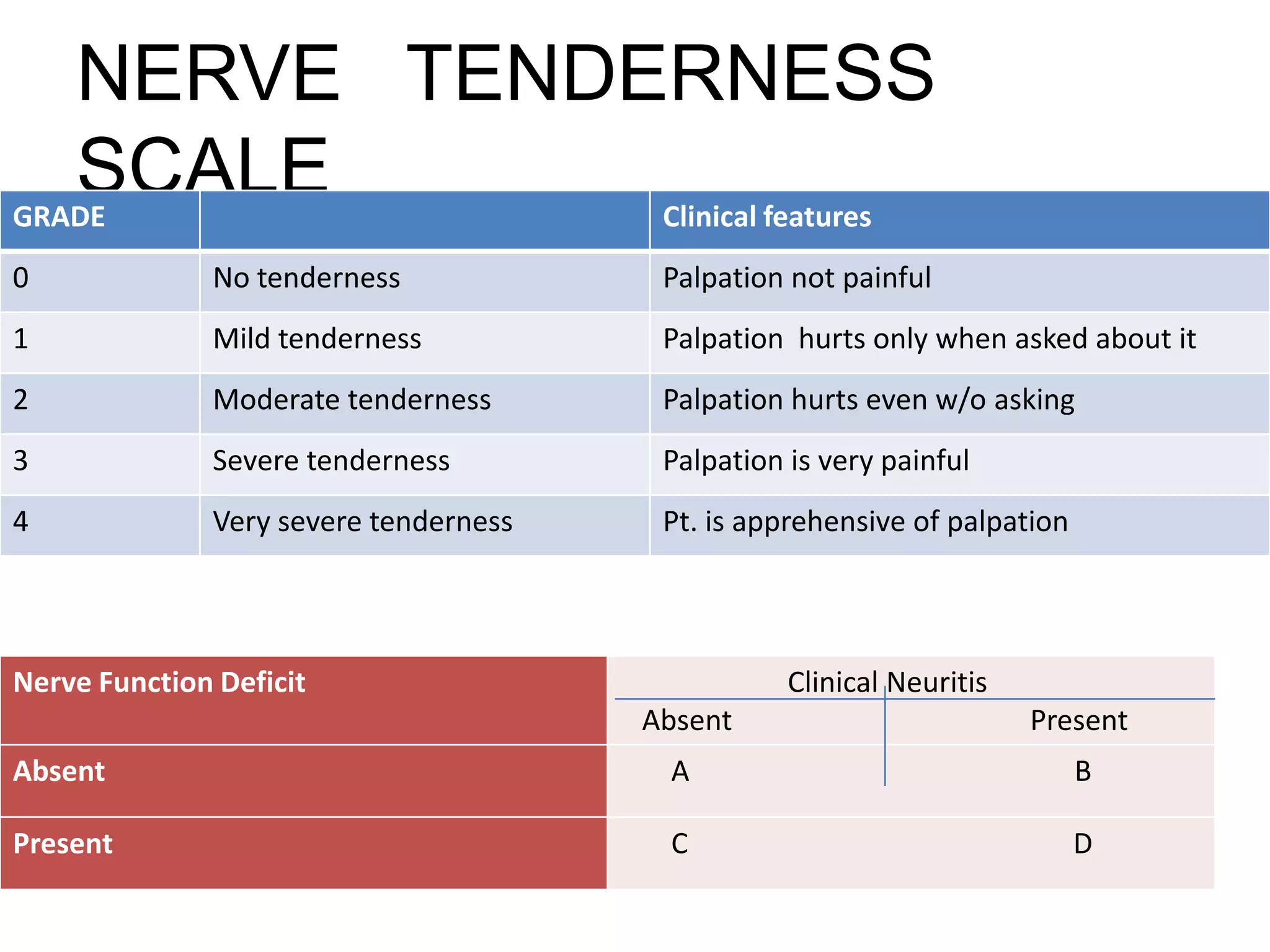
NERVE TENDERNESS
SCALEGRADE Clinical features
0 No tenderness Palpation not painful
1 Mild tenderness Palpation hurts only when asked about it
2 Moderate tenderness Palpation hurts even w/o asking
3 Severe tenderness Palpation is very painful
4 Very severe tenderness Pt. is apprehensive of palpation
Nerve Function Deficit Clinical Neuritis
Absent Present
Absent A B
Present C D
• Category A patients-
pt is taught how to look for signs and symptoms of
neuritis.
• Category B patients-(Neuritis +, no NFD)
Start Prednisolone 40-80 mg daily 4 wks
taper dose 5mg/wk upto 30mg 2-3 wks
and then taper it.
• In BT leprosy cases (neuritis due to RR), if there is no
significant improvement in the clinical condition within 48-
72 hrs then immediate surgical decompression is required so
that haemoperfusion to nerve can occur.
• In BL and LL cases(neuritis due to ENL), one can wait for six
weeks or even longer.
• Category C patients- ( No neuritis, NFD+)
Clinically, one may assume that the nerve trunk
has the potential to recover if NFD is :-
– of recent onset - < 6 months involvement
– incomplete- some sensibility is there
– and if no severe muscle wasting present
If NFD considered reversible:-
prednisolone 30mg 4 wks
then tapered off over 30 days.
If NFD not recent:-
prevent secondary impairment.
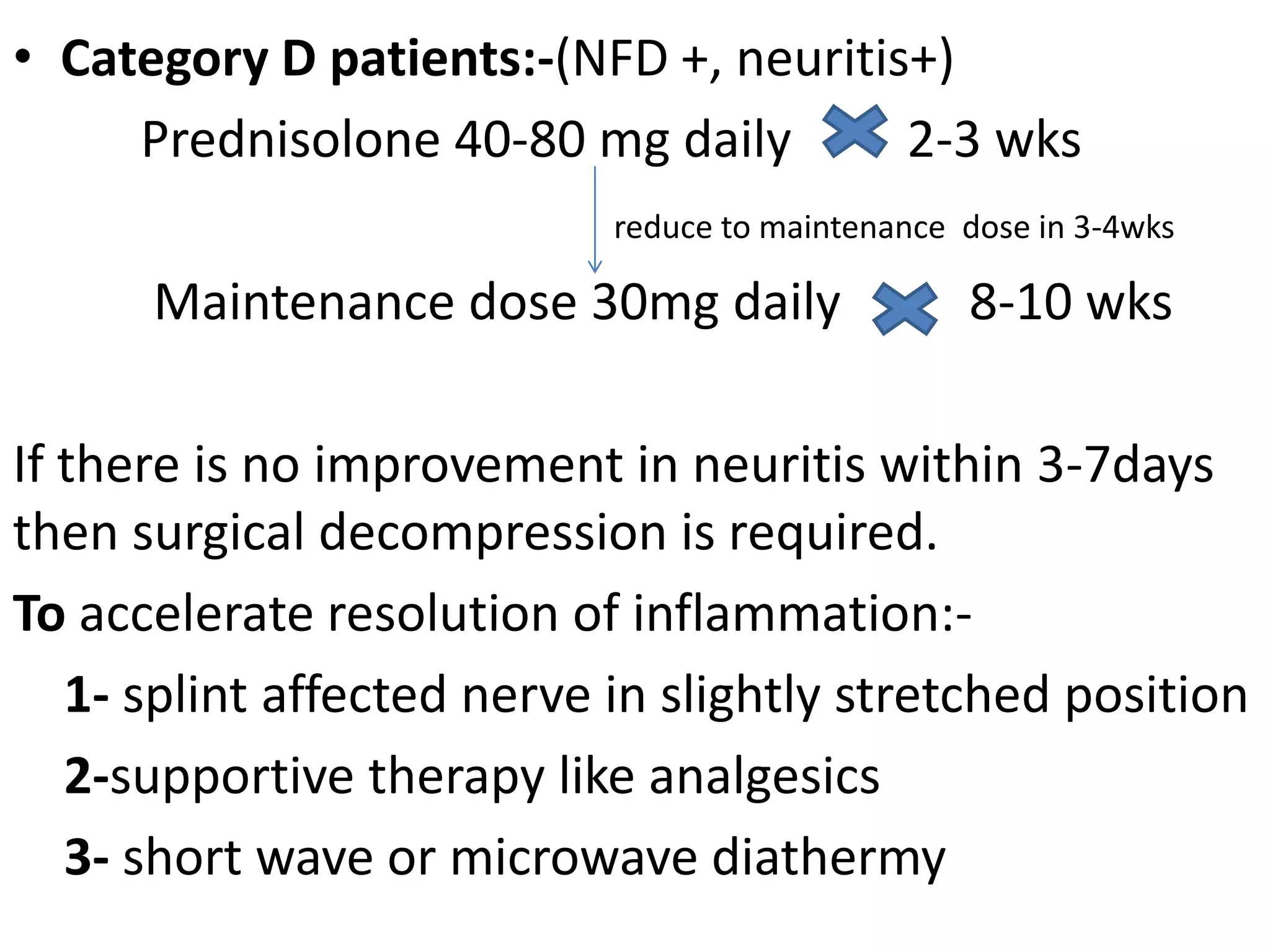
• Category D patients:-(NFD +, neuritis+)
Prednisolone 40-80 mg daily 2-3 wks
reduce to maintenance dose in 3-4wks
Maintenance dose 30mg daily 8-10 wks
If there is no improvement in neuritis within 3-7days
then surgical decompression is required.
To accelerate resolution of inflammation:-
1- splint affected nerve in slightly stretched position
2-supportive therapy like analgesics
3- short wave or microwave diathermy
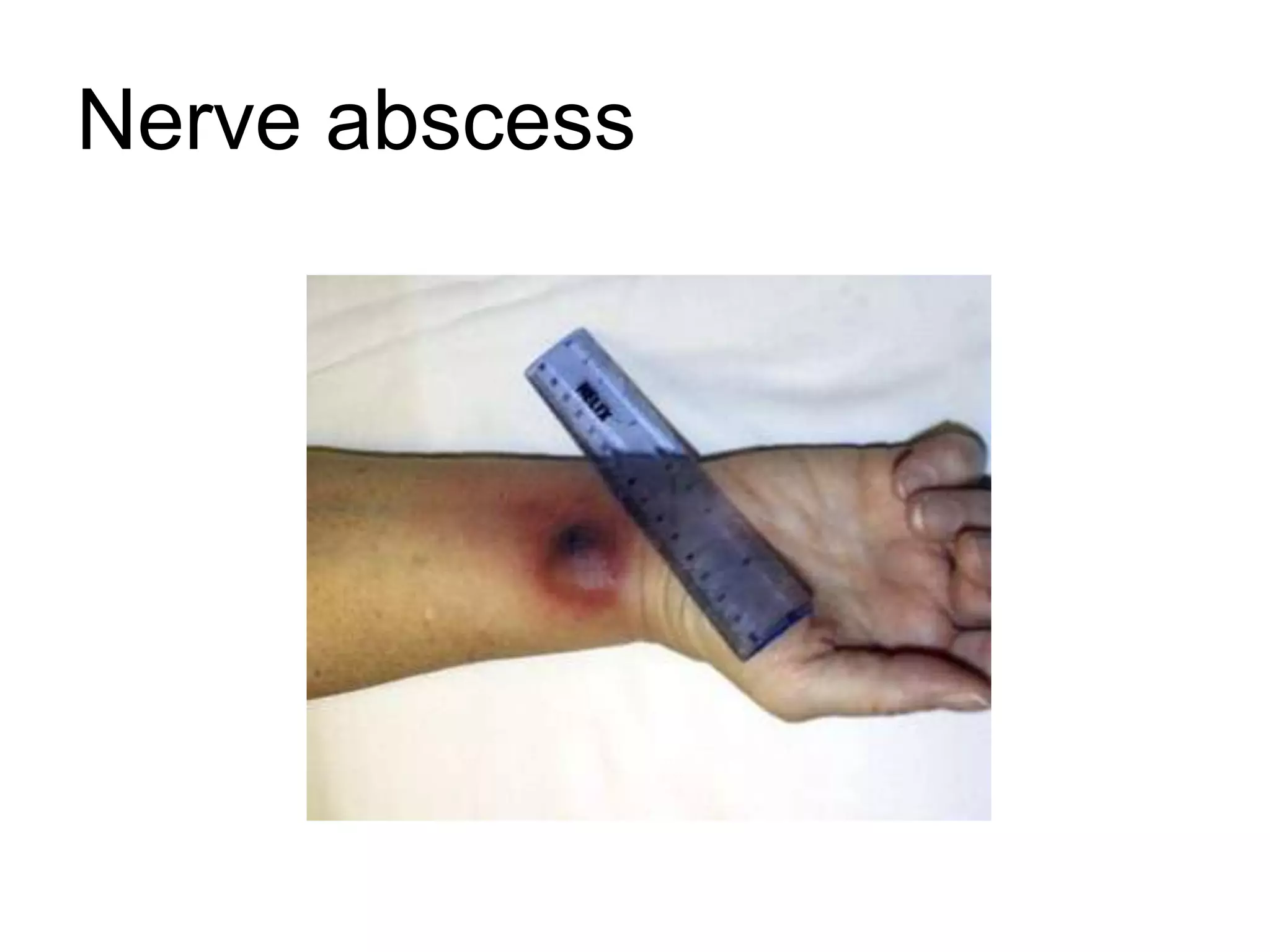
Nerve abscess
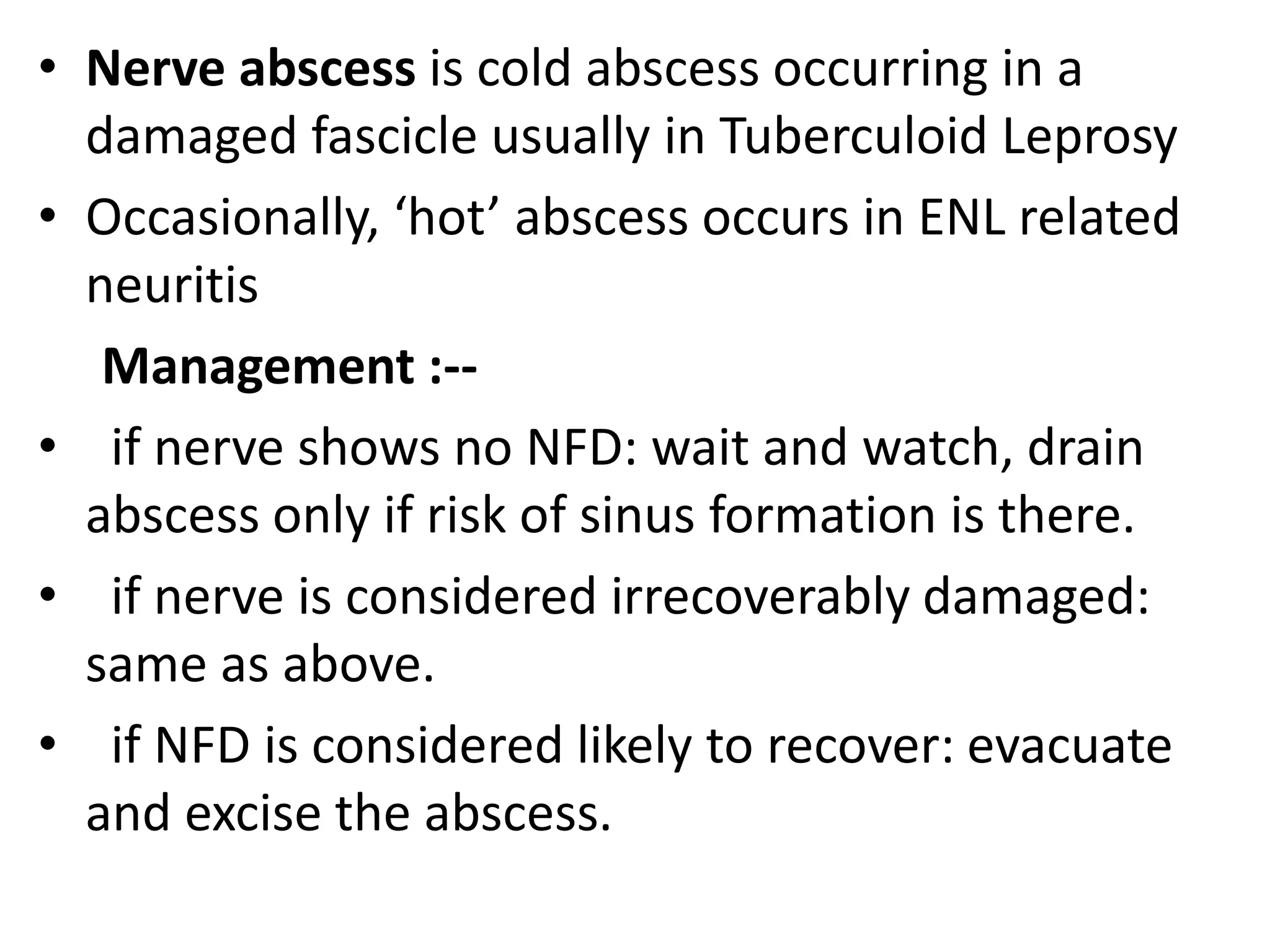
• Nerve abscess is cold abscess occurring in a
damaged fascicle usually in Tuberculoid Leprosy
• Occasionally, ‘hot’ abscess occurs in ENL related
neuritis
Management :--
• if nerve shows no NFD: wait and watch, drain
abscess only if risk of sinus formation is there.
• if nerve is considered irrecoverably damaged:
same as above.
• if NFD is considered likely to recover: evacuate
and excise the abscess.
Hand Problems in Leprosy
Patients
Hand Problems in Leprosy
Patients
• Hands are affected because of damage to nerves
supplying them or directly affected by reaction
process(especially in BL, LL).
• Ulnar nerve is affected most often than others.
(Claw hand)
• In BL,LL cases usually Glove type extensive acral
anesthesia occurs without significant motor
involvement.
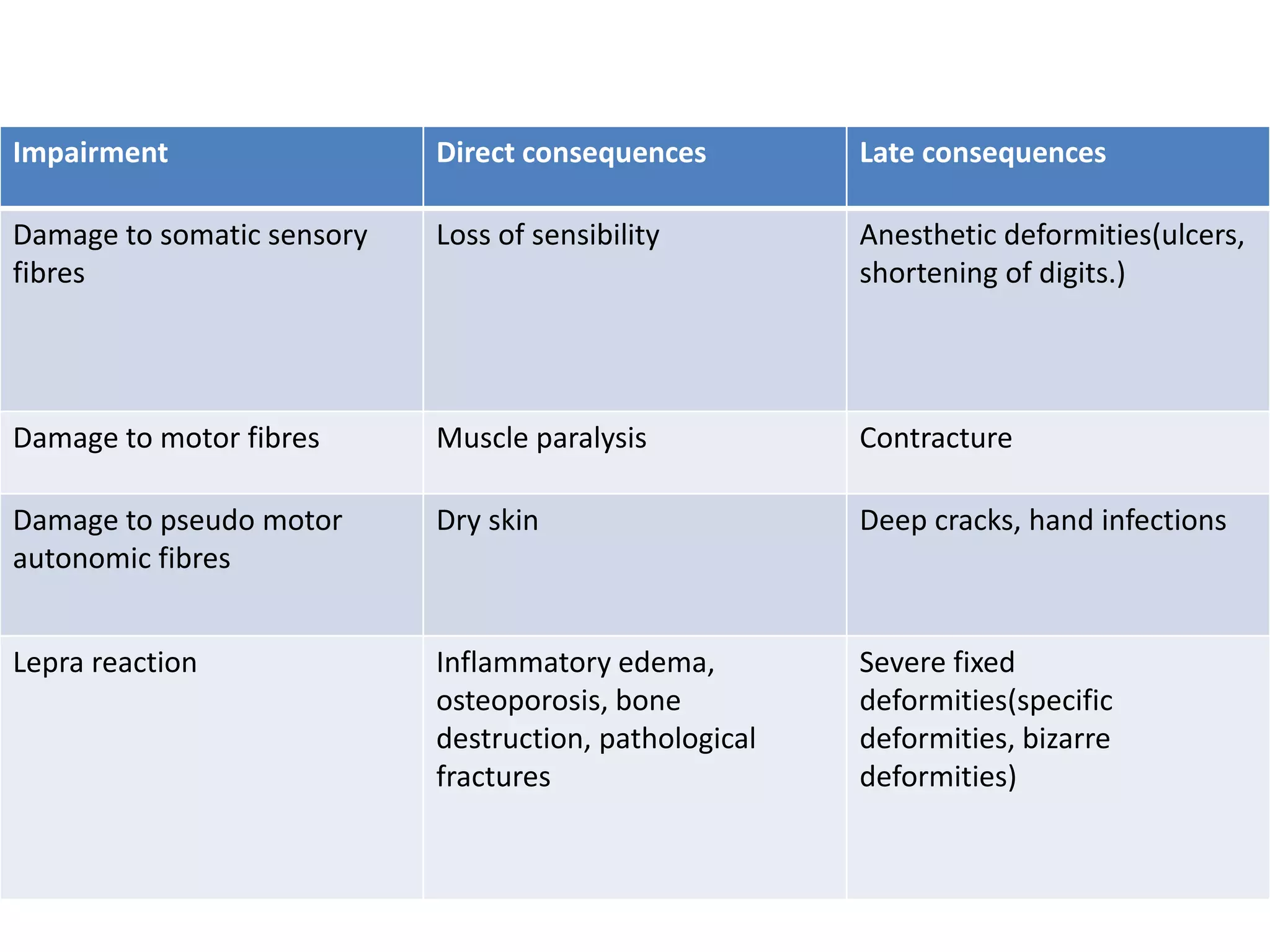
Impairment Direct consequences Late consequences
Damage to somatic sensory
fibres
Loss of sensibility Anesthetic deformities(ulcers,
shortening of digits.)
Damage to motor fibres Muscle paralysis Contracture
Damage to pseudo motor
autonomic fibres
Dry skin Deep cracks, hand infections
Lepra reaction Inflammatory edema,
osteoporosis, bone
destruction, pathological
fractures
Severe fixed
deformities(specific
deformities, bizarre
deformities)
Specific Deformities of hand
Banana Fingers (due to heavy infiltration)
“Reaction Hand” (when hand is involved in reactional states)
Foci of acute Inflammation which eventually resolves with
dense fibrosis.
Contraction of the dermal collagen draws the fingers
dorsally giving rise to swan neck deformity.
Rx.
Start systemic corticosteroids therapy(30 mg),
Initially hand is rested using splint in functional position
Wax baths
Active movements after subsidizing acute phase
Paralytic deformities of hand
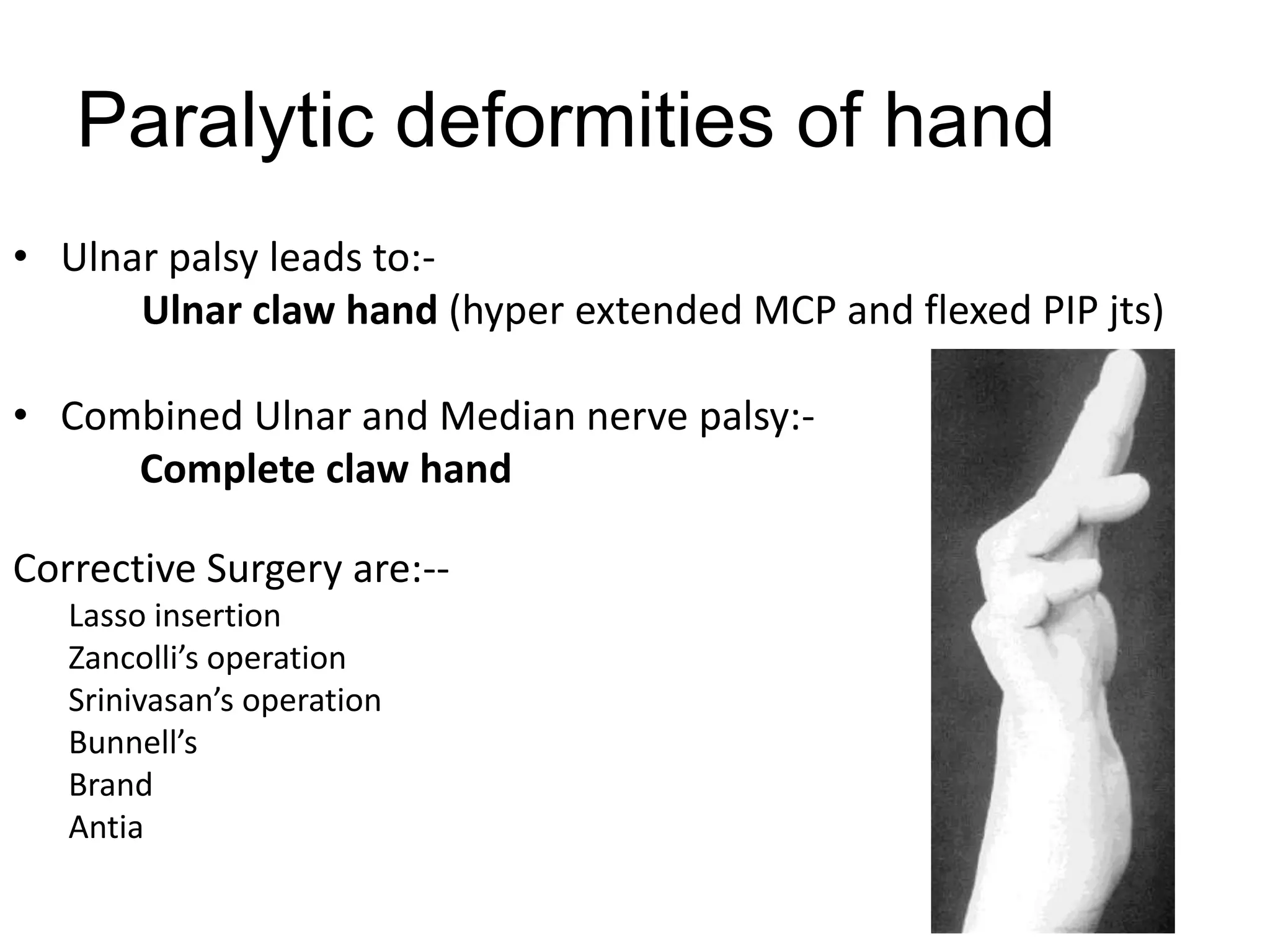
• Ulnar palsy leads to:-
Ulnar claw hand (hyper extended MCP and flexed PIP jts)
• Combined Ulnar and Median nerve palsy:-
Complete claw hand
Corrective Surgery are:--
Lasso insertion
Zancolli’s operation
Srinivasan’s operation
Bunnell’s
Brand
Antia
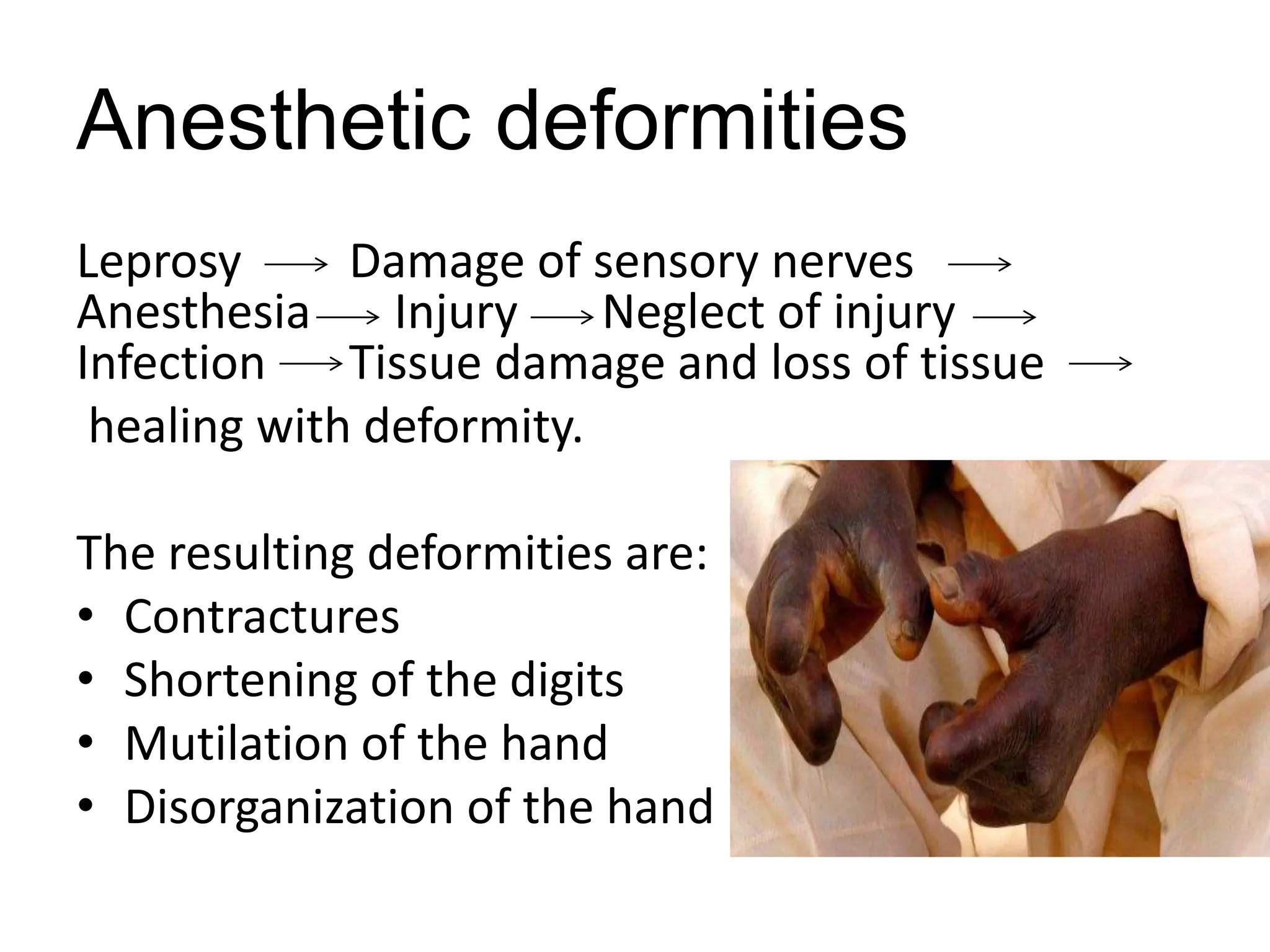
Anesthetic deformities
Leprosy Damage of sensory nerves
Anesthesia Injury Neglect of injury
Infection Tissue damage and loss of tissue
healing with deformity.
The resulting deformities are:
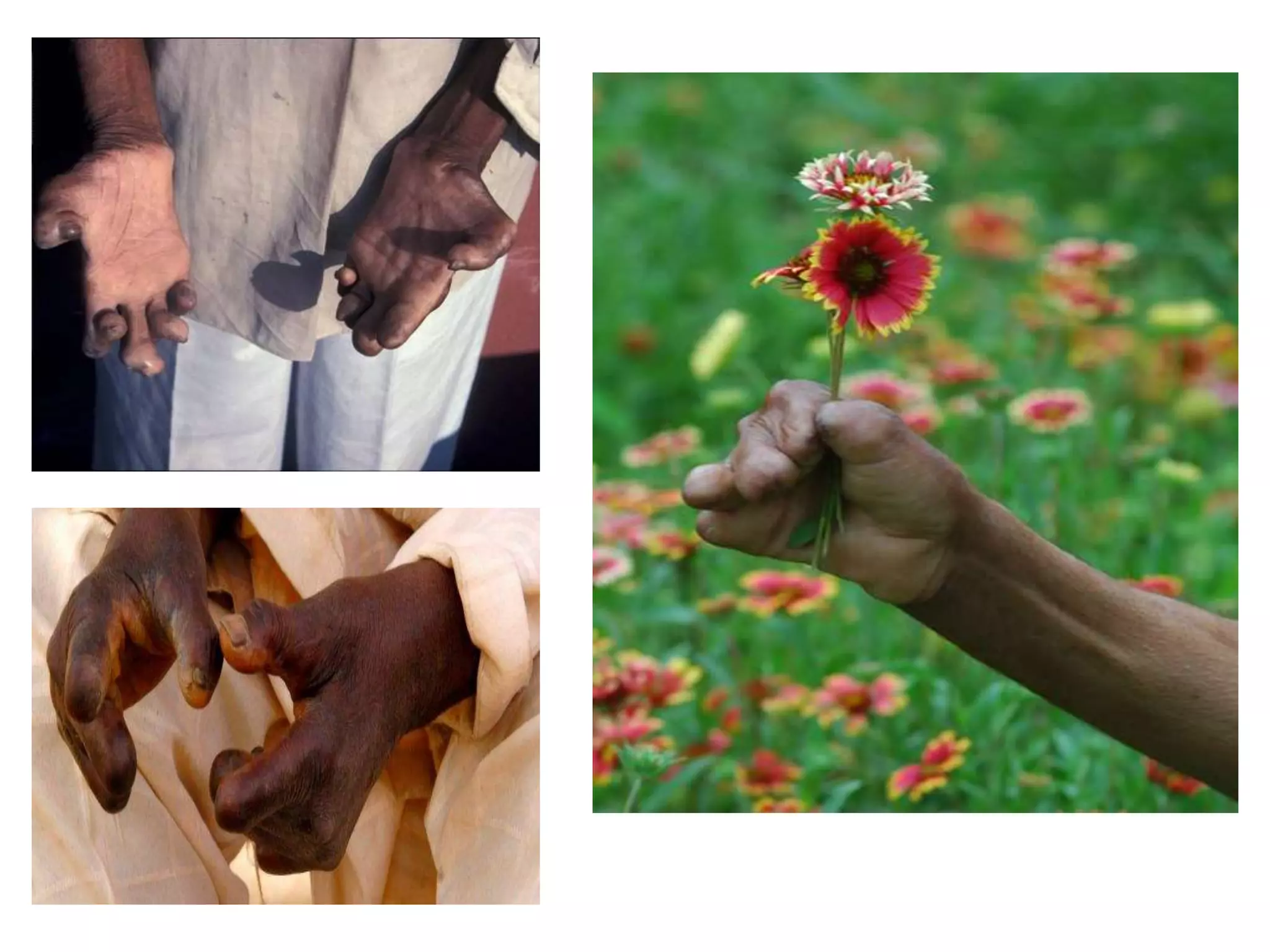
• Contractures
• Shortening of the digits
• Mutilation of the hand
• Disorganization of the hand
Foot Problem In Leprosy Patients
Foot Problem In Leprosy
Patients• Common problems are:-
Plantar ulceration (Trophic ulcers)
Foot drop
Fixed deformities of feet and toes
Tarsal disorganization.
PLANTAR ULCERATION:-
• manifestation of sensory-motor deficit
• mostly in front part of sole in MTP joint
• augmented by infection through fissures and paralysis
of feet muscles (which counter the stress while walking)
Management and Prevention
• Management:--
– Absolute bed rest and elevate foot
– Eusol bath, irrigation, dressing
– Remove slough or other draining procedures
– Start antibiotics
– Protective foot wearing
Protective footwear
• Feet with only sensory
loss (no muscle
paralysis)
• Insensitive feet (with
intrinsic muscle
paralysis)
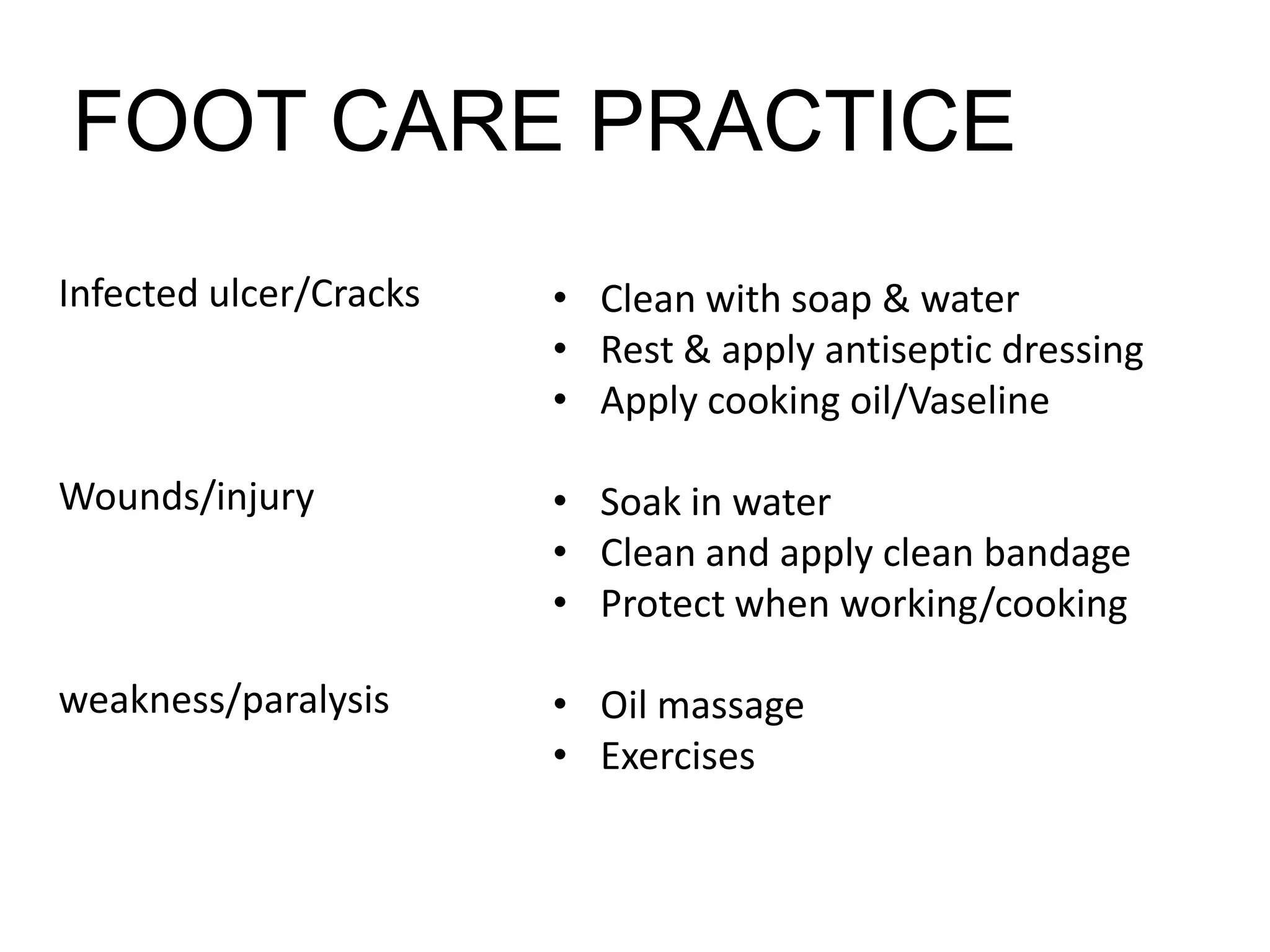
Infected ulcer/Cracks
Wounds/injury
weakness/paralysis
• Clean with soap & water
• Rest & apply antiseptic dressing
• Apply cooking oil/Vaseline
• Soak in water
• Clean and apply clean bandage
• Protect when working/cooking
• Oil massage
• Exercises
FOOT CARE PRACTICE
Foot drop
• Develops due to damage to lateral popliteal nerve.
• Paralysis of anterior muscles give rise to foot drop
• Characteristic ‘High-stepping gait’ occurs in which
• Ball of foot instead of heel hits the ground
• Inversion foot leads to overloading on outer part.
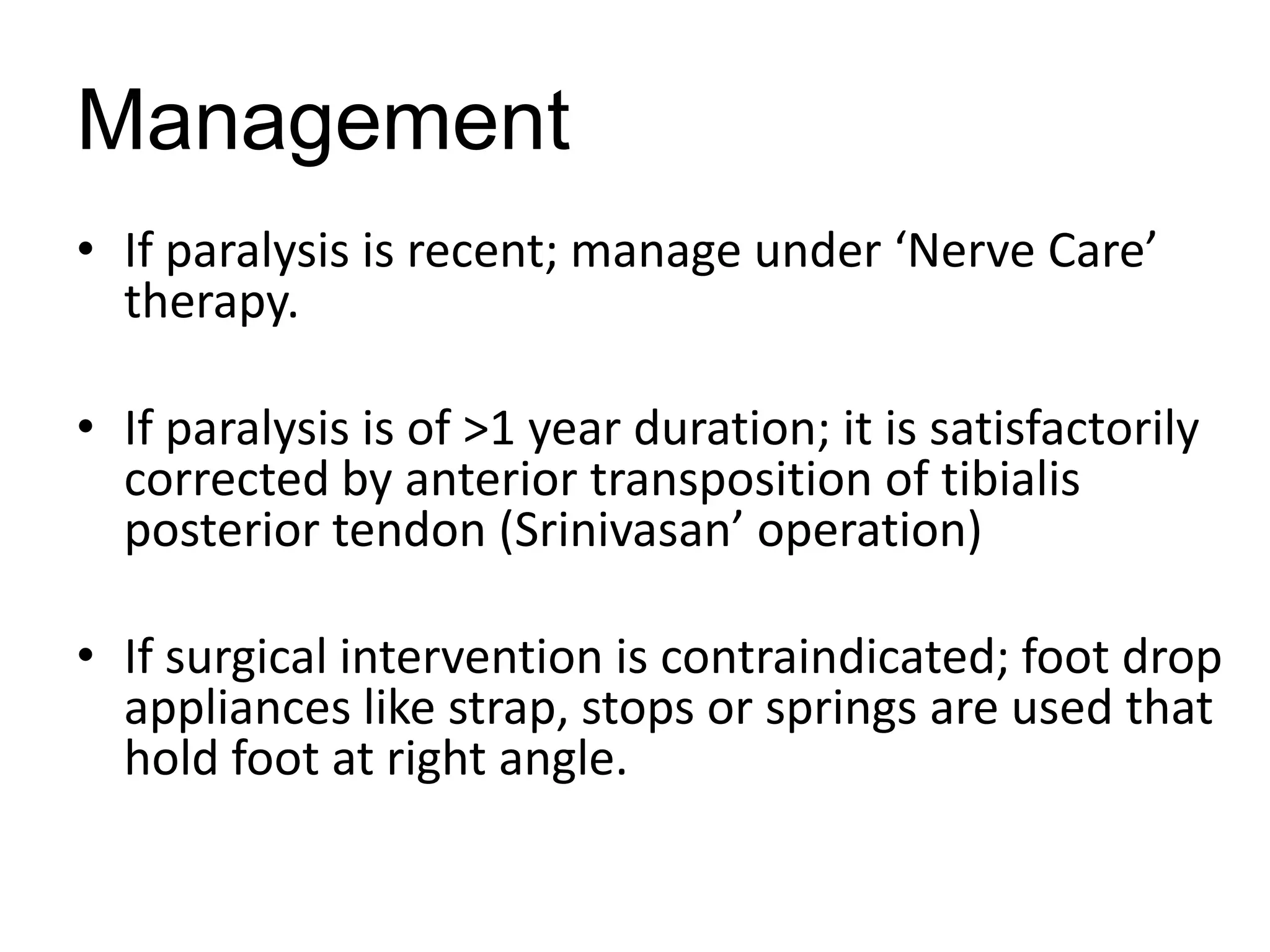
Management
• If paralysis is recent; manage under ‘Nerve Care’
therapy.
• If paralysis is of >1 year duration; it is satisfactorily
corrected by anterior transposition of tibialis
posterior tendon (Srinivasan’ operation)
• If surgical intervention is contraindicated; foot drop
appliances like strap, stops or springs are used that
hold foot at right angle.
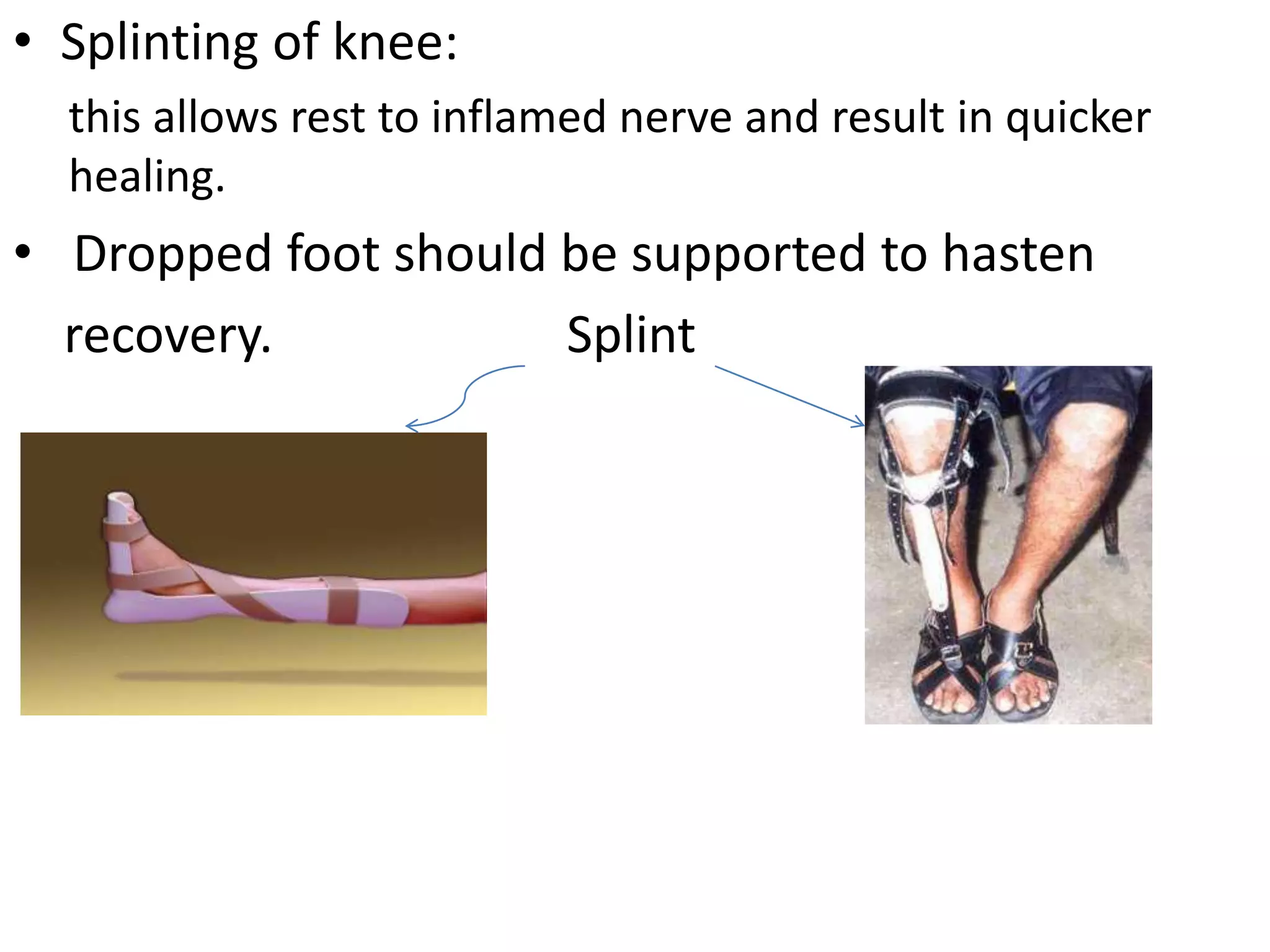
• Splinting of knee:
this allows rest to inflamed nerve and result in quicker
healing.
• Dropped foot should be supported to hasten
recovery. Splint
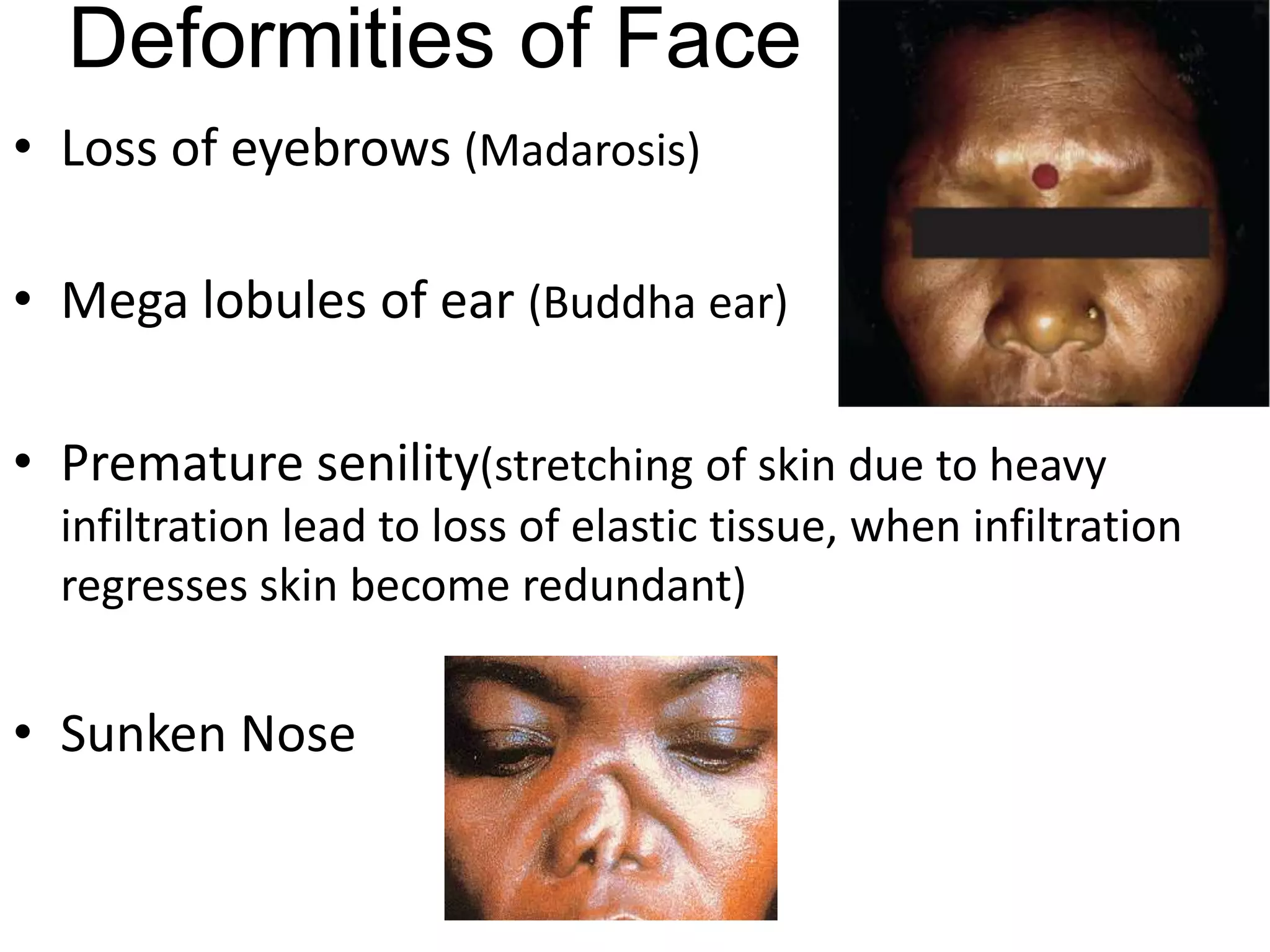
Deformities of Face
Deformities of Face
• Loss of eyebrows (Madarosis)
• Mega lobules of ear (Buddha ear)
• Premature senility(stretching of skin due to heavy
infiltration lead to loss of elastic tissue, when infiltration
regresses skin become redundant)
• Sunken Nose
Eye Problem
• More commonly in BL and LL type
leprosy.
o Direct invasion- leprous
conjunctivitis, scleritis and choroidal
nodule.
o Acute iridocyclitis- due to immune
complex deposition.
o Lagophthalmos - due to damage to
facial nerve.
o Corneal sensation lost - due to
damage to trigeminal nerve, leads
to exposure keratitis and corneal
ulceration
Management
• Using spectacles,gogles or eyeshades.
• Artificial tears and cover eyes during sleep
• Treating acute iridocyclitis using topical
corticosteroids
• Surgical intervention for lagophthalmos or
cataract
Gynecomastia
Embarrassing enlargement of breast in males,
usually bilateral due to hormonal imbalances
because of testicular and liver damage.
Simple mastectomy is the treatment of
choice (WEBSTER’S OPERATION)
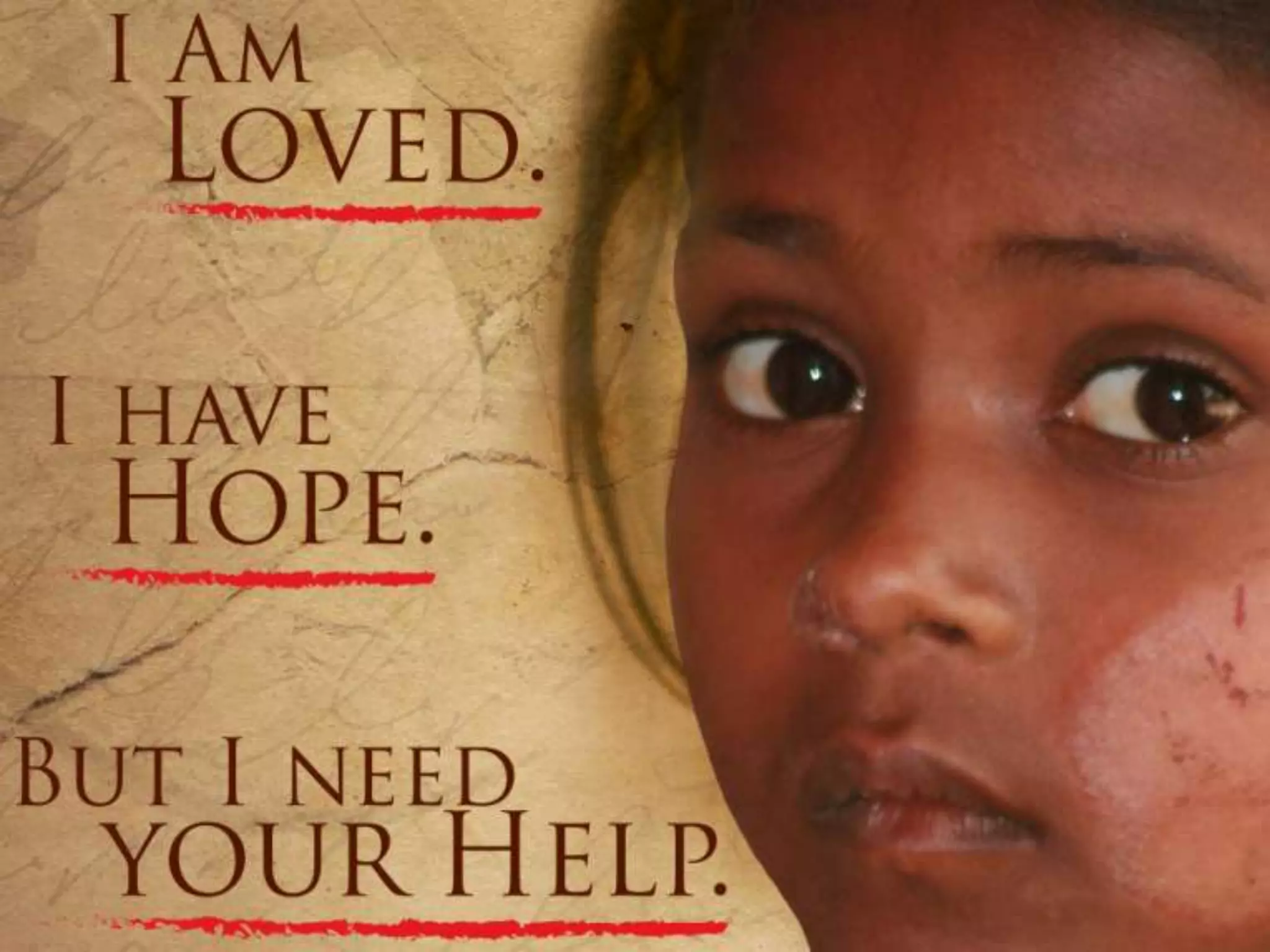
• Are related to widely held beliefs and
prejudices concerning leprosy & its causes.
• They often develop self stigma, low self
esteem & depression as a result of rejection
and hostility.
• Need to be referred for proper counselling.
PSYCHO- SOCIAL
PROBLEMS
• Social banishment is now on decrease
following extensive education about leprosy.
• Appropriate economic rehabilitation is
provided e.g. sewing machines, handcrafts,
carpentry etc.
Sc
REFERENCES:-----
• IADVL
• IAL
• PARK’ Preventive and Social Medicine
• Journals
Complications of leprosy

Complications of leprosy

  • 1.
  • 2.
    1) LEPROSY REACTION 2)ADVERSE EFFECT OF ANTI-LEPROTIC DRUGS 3) DISABILITIES & DEFORMITIES 4) PSYCHO-SOCIAL PROBLEMS COMPLICATION CAN BE CATEGORISED AS:
  • 3.
  • 4.
    TERMINOLOGY • `Impairments' aredefined as `problems in body function or body structure such as a significant deviation or loss'. • A `deformity' is a structural, usually visible, impairment. • A `defect' could be either a functional or structural impairment. • `Disability' is used as an umbrella term for impairments, activity limitations and participation restrictions.
  • 5.
    Risk factors andTypes Of Deformities • Risk factors are:- 1) Type of Leprosy- more extensive and highly bacilliferous types carry a high risk if not treated early. 2) No. of nerve trunk involved- more than three nerve trunk involvement increases the risk manifold. 3) Attack of reaction and neuritis increases the risk. 4) Duration of active diseases- longer the disease remains untreated, greater the risk of disability.
  • 6.
    Types of Deformities 1.Specific Deformities:- loss of eyebrows, nasal deformities. 2. Paralytic Deformities:- claw finger, foot drop, facial palsy. 3. Anesthetic deformities:- ulceration, mutilation
  • 7.
    GRADE HAND &FEET EYES 0 No loss of sensation No visible deformity or damage (Muscle power normal) No eye problem due to leprosy; No evidence of visual loss 1 LOSS OF SENSATION is there No visible deformity or damage Eye problem due to leprosy present, but vision not severly affected as a result of these (can count fingers at 6m) 2 VISIBLE DAMAGE [loss of sensation and muscle power weak/paralysed] (wounds, ulcer, deformity due to muscle weakness, loss of tissue such as foot drop, claw hand, loss or partial resorption of fingers/toes) Severe vsual impairment Vision – cannot count fingers at 6m Also includes lagophthalmos, iridocyclitis and corneal opacities. WHO GRADING OF DISABILITIES IN LEPROSY
  • 8.
    Nerve Involvement • Nervedamage occurs in two settings- in skin lesion– small dermal sensory and autonomic nerve fibres supplying dermal and subcutaneous structures are damaged. involving Peripheral nerve trunks– usually those which are superficial or are in fibrocasseous tunnels leading to dermato sensory loss and dysfunction of muscles.
  • 9.
    Posterior tibial nerveis the most frequently affected nerve followed by ulnar, median, lateral popliteal and facial. Stages Charecteristics 1 Parasitization A few leprae found in nerve 2 Tissue response Host tissue response(TT to LL)+, bacilli+ 3 Clinical involvement Clinically thickened w or w/o pain. No NFD 4 Nerve damage NFD+, recovery possible 5 Nerve destruction Irreversible NFD, severe wasting +
  • 10.
    Nerve Care Practice •AIM- to prevent permanent damage to nerve trunks • It involves- Recognizing acute or subacute “clinical neuritis” and treating it using steroid or other measures. Recognizing Nerve function deficit and instituting appropriate treatment without delay. ‘Clinical neuritis’ is diagnosed when a nerve trunk shows moderate to severe nerve pain. It may or may not be associated with NFD and similarly NFD may or may not be associated with clinical neuritis(Quiet Nerve Paralysis)
  • 11.
    NERVE TENDERNESS SCALEGRADE Clinicalfeatures 0 No tenderness Palpation not painful 1 Mild tenderness Palpation hurts only when asked about it 2 Moderate tenderness Palpation hurts even w/o asking 3 Severe tenderness Palpation is very painful 4 Very severe tenderness Pt. is apprehensive of palpation Nerve Function Deficit Clinical Neuritis Absent Present Absent A B Present C D
  • 12.
    • Category Apatients- pt is taught how to look for signs and symptoms of neuritis. • Category B patients-(Neuritis +, no NFD) Start Prednisolone 40-80 mg daily 4 wks taper dose 5mg/wk upto 30mg 2-3 wks and then taper it. • In BT leprosy cases (neuritis due to RR), if there is no significant improvement in the clinical condition within 48- 72 hrs then immediate surgical decompression is required so that haemoperfusion to nerve can occur. • In BL and LL cases(neuritis due to ENL), one can wait for six weeks or even longer.
  • 13.
    • Category Cpatients- ( No neuritis, NFD+) Clinically, one may assume that the nerve trunk has the potential to recover if NFD is :- – of recent onset - < 6 months involvement – incomplete- some sensibility is there – and if no severe muscle wasting present If NFD considered reversible:- prednisolone 30mg 4 wks then tapered off over 30 days. If NFD not recent:- prevent secondary impairment.
  • 14.
    • Category Dpatients:-(NFD +, neuritis+) Prednisolone 40-80 mg daily 2-3 wks reduce to maintenance dose in 3-4wks Maintenance dose 30mg daily 8-10 wks If there is no improvement in neuritis within 3-7days then surgical decompression is required. To accelerate resolution of inflammation:- 1- splint affected nerve in slightly stretched position 2-supportive therapy like analgesics 3- short wave or microwave diathermy
  • 15.
  • 16.
    • Nerve abscessis cold abscess occurring in a damaged fascicle usually in Tuberculoid Leprosy • Occasionally, ‘hot’ abscess occurs in ENL related neuritis Management :-- • if nerve shows no NFD: wait and watch, drain abscess only if risk of sinus formation is there. • if nerve is considered irrecoverably damaged: same as above. • if NFD is considered likely to recover: evacuate and excise the abscess.
  • 17.
    Hand Problems inLeprosy Patients
  • 18.
    Hand Problems inLeprosy Patients • Hands are affected because of damage to nerves supplying them or directly affected by reaction process(especially in BL, LL). • Ulnar nerve is affected most often than others. (Claw hand) • In BL,LL cases usually Glove type extensive acral anesthesia occurs without significant motor involvement.
  • 19.
    Impairment Direct consequencesLate consequences Damage to somatic sensory fibres Loss of sensibility Anesthetic deformities(ulcers, shortening of digits.) Damage to motor fibres Muscle paralysis Contracture Damage to pseudo motor autonomic fibres Dry skin Deep cracks, hand infections Lepra reaction Inflammatory edema, osteoporosis, bone destruction, pathological fractures Severe fixed deformities(specific deformities, bizarre deformities)
  • 20.
    Specific Deformities ofhand Banana Fingers (due to heavy infiltration) “Reaction Hand” (when hand is involved in reactional states) Foci of acute Inflammation which eventually resolves with dense fibrosis. Contraction of the dermal collagen draws the fingers dorsally giving rise to swan neck deformity. Rx. Start systemic corticosteroids therapy(30 mg), Initially hand is rested using splint in functional position Wax baths Active movements after subsidizing acute phase
  • 22.
    Paralytic deformities ofhand • Ulnar palsy leads to:- Ulnar claw hand (hyper extended MCP and flexed PIP jts) • Combined Ulnar and Median nerve palsy:- Complete claw hand Corrective Surgery are:-- Lasso insertion Zancolli’s operation Srinivasan’s operation Bunnell’s Brand Antia
  • 23.
    Anesthetic deformities Leprosy Damageof sensory nerves Anesthesia Injury Neglect of injury Infection Tissue damage and loss of tissue healing with deformity. The resulting deformities are: • Contractures • Shortening of the digits • Mutilation of the hand • Disorganization of the hand
  • 24.
    Foot Problem InLeprosy Patients
  • 25.
    Foot Problem InLeprosy Patients• Common problems are:- Plantar ulceration (Trophic ulcers) Foot drop Fixed deformities of feet and toes Tarsal disorganization. PLANTAR ULCERATION:- • manifestation of sensory-motor deficit • mostly in front part of sole in MTP joint • augmented by infection through fissures and paralysis of feet muscles (which counter the stress while walking)
  • 26.
    Management and Prevention •Management:-- – Absolute bed rest and elevate foot – Eusol bath, irrigation, dressing – Remove slough or other draining procedures – Start antibiotics – Protective foot wearing
  • 27.
    Protective footwear • Feetwith only sensory loss (no muscle paralysis) • Insensitive feet (with intrinsic muscle paralysis)
  • 28.
    Infected ulcer/Cracks Wounds/injury weakness/paralysis • Cleanwith soap & water • Rest & apply antiseptic dressing • Apply cooking oil/Vaseline • Soak in water • Clean and apply clean bandage • Protect when working/cooking • Oil massage • Exercises FOOT CARE PRACTICE
  • 29.
    Foot drop • Developsdue to damage to lateral popliteal nerve. • Paralysis of anterior muscles give rise to foot drop • Characteristic ‘High-stepping gait’ occurs in which • Ball of foot instead of heel hits the ground • Inversion foot leads to overloading on outer part.
  • 30.
    Management • If paralysisis recent; manage under ‘Nerve Care’ therapy. • If paralysis is of >1 year duration; it is satisfactorily corrected by anterior transposition of tibialis posterior tendon (Srinivasan’ operation) • If surgical intervention is contraindicated; foot drop appliances like strap, stops or springs are used that hold foot at right angle.
  • 31.
    • Splinting ofknee: this allows rest to inflamed nerve and result in quicker healing. • Dropped foot should be supported to hasten recovery. Splint
  • 32.
  • 33.
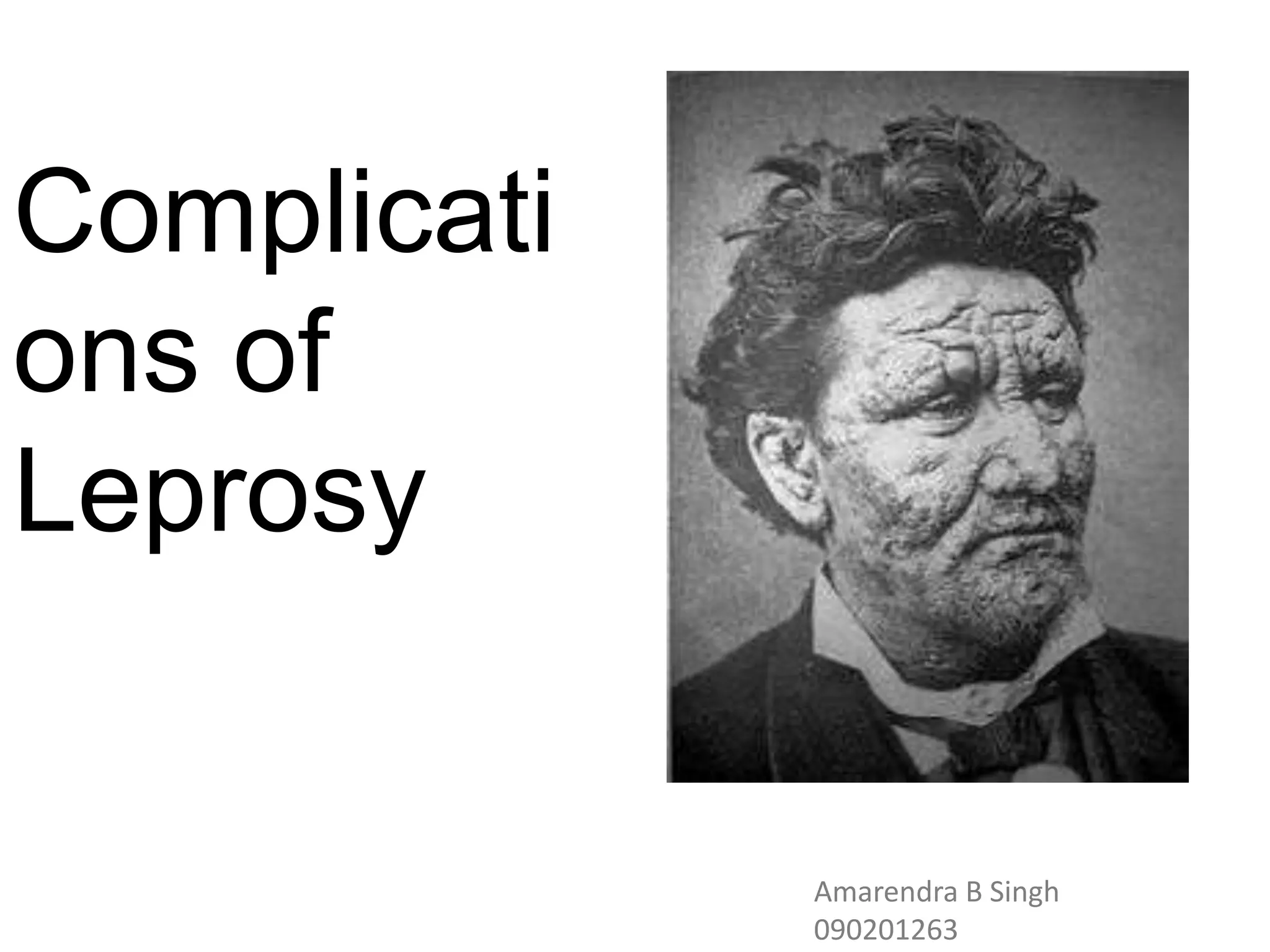
    Deformities of Face •Loss of eyebrows (Madarosis) • Mega lobules of ear (Buddha ear) • Premature senility(stretching of skin due to heavy infiltration lead to loss of elastic tissue, when infiltration regresses skin become redundant) • Sunken Nose
  • 34.
    Eye Problem • Morecommonly in BL and LL type leprosy. o Direct invasion- leprous conjunctivitis, scleritis and choroidal nodule. o Acute iridocyclitis- due to immune complex deposition. o Lagophthalmos - due to damage to facial nerve. o Corneal sensation lost - due to damage to trigeminal nerve, leads to exposure keratitis and corneal ulceration
  • 35.
    Management • Using spectacles,goglesor eyeshades. • Artificial tears and cover eyes during sleep • Treating acute iridocyclitis using topical corticosteroids • Surgical intervention for lagophthalmos or cataract
  • 36.
    Gynecomastia Embarrassing enlargement ofbreast in males, usually bilateral due to hormonal imbalances because of testicular and liver damage. Simple mastectomy is the treatment of choice (WEBSTER’S OPERATION)
  • 37.
    • Are relatedto widely held beliefs and prejudices concerning leprosy & its causes. • They often develop self stigma, low self esteem & depression as a result of rejection and hostility. • Need to be referred for proper counselling. PSYCHO- SOCIAL PROBLEMS
  • 38.
    • Social banishmentis now on decrease following extensive education about leprosy. • Appropriate economic rehabilitation is provided e.g. sewing machines, handcrafts, carpentry etc.
  • 39.
  • 40.
    REFERENCES:----- • IADVL • IAL •PARK’ Preventive and Social Medicine • Journals

Editor's Notes

  • #5 An example of an impairment in body function would be loss of sensation; examples of impairments in body structure would be contractures and absorption.activity limitation  is a difficulty encountered by an individual in executing a task or action.participation means involvement in life situations restriction is a problem experienced by an individual in involvement in life situations.
  • #7 Specific Deformities:-arise due to local infection with M.lepralikeloss of eyebrows, nasal deformities.(face&gt;hands=feet)Paralytic Deformities:-result from damage to motor nerves like clawfinger, foot drop, facial palsy.(hands&gt;feet&gt;face)Anesthetic deformities:-results from insensitivity because of damageto sensory nerves like ulceration, mutilation.(feet&gt;hands&gt;face)
  • #8 0- scars of healed ulcers, when sensation is normal1- scars of healed ulcers, when sensation is impaired; EYE- absence of regular blink2- ulcers, severe cracks, severe atrophy
  • #10 Nerve involvement in leprosy can be said to occur in 5 stages:-- First two are recognized histologically while next three by clinical examination
  • #12 Categorization of pt. acc. To NFD and Clinical Neuritis-
  • #17 A cold abscess is an abscess that commonly accompanies tuberculosis. It develops so slowly that there is little inflammation, and it becomes painful only when there is pressure on the surrounding area
  • #19 Therefore loss of sensibility in palm doesn’t necessarily indicate damage to nerve trunk, as it may also result from destruction of dermal nerve twigs.Muscle weakness is sure sign of damage of nerve trunk.
  • #21 In neglected lepromatous leprosy case, there is very heavy infiltration of the skin of the hand and dorsum of fingers.They become thickened and enlarged giving rise to banana fingers.
  • #23 Combined Ulnar and Median nerve palsy:-all intrinsic muscles are paralysedhandling of objects become very difficult
  • #24 These occur as a result of using insensitive hands without any protection.The chain of events leading to the development of anesthetic deformities are
  • #26 Types- Acute ulcer– frankly infected, purulent, covered with sloughChronic ulcer– indolent ulcer with hyperkeratotic edges, covered with granulation tissueComplicating ulcer– infection spread to deeper structuremay lead to muscle paralysis, gas gangrene,tetanus or septicemia.
  • #28 (type depends on state of foot)Feet with only sensory loss(no muscle paralysis), footwear should have tough outer sole that will resist penetration by thorn, nails, glass. Upper straps and buckle should not rub against the toes.Insensitive feet(with intrinsic muscle paralysis):- these require a resilient, non collapsing, shock absorbinginsole, that will dampen the impact during walking.Microcellular rubber is most suitable.
  • #34 Most of deformities on face occurs due to infiltration of facial skin but paralytic deformities can also occur (in borderline leprosy).Sunken Nose (due to infiltration in nasal mucosa in LL , granuloma formed erodes the supporting bony structure of nose).
  • #35 Lagophthalmos- is the inability to close the eyes voluntarily