Introduction
The rise of cloud computing has revolutionized mobile app
development, offering businesses a fast, scalable, and flexible way
to deploy services. This guide covers key aspects of cloud app
development, from benefits to costs.
What is Cloud App Development?
Cloud app development is the process of creating applications. It leverages cloud
computing technologies to deliver services over the Internet. Unlike the traditional
software that runs on local computers or servers, cloud apps function on remote
servers situated in data centres managed by third-party vendors.
Cloud App Development
Complete Guide 👋
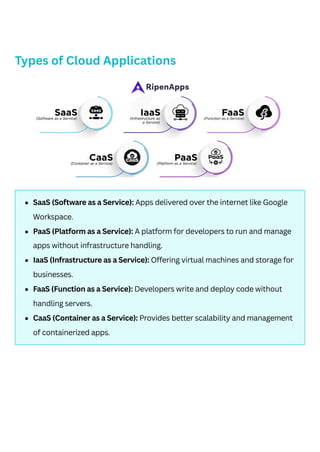
Types of Cloud Applications
SaaS (Software as a Service): Apps delivered over the internet like Google
Workspace.
PaaS (Platform as a Service): A platform for developers to run and manage
apps without infrastructure handling.
IaaS (Infrastructure as a Service): Offering virtual machines and storage for
businesses.
FaaS (Function as a Service): Developers write and deploy code without
handling servers.
CaaS (Container as a Service): Provides better scalability and management
of containerized apps.
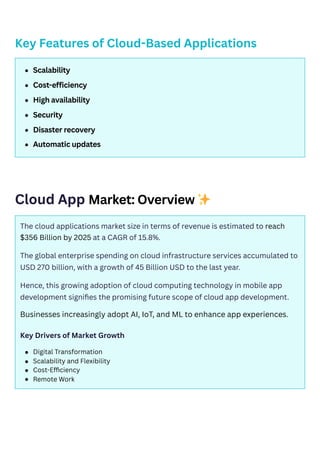
Key Features of Cloud-Based Applications
Cloud App Market: Overview ✨
Scalability
Cost-efficiency
High availability
Security
Disaster recovery
Automatic updates
The cloud applications market size in terms of revenue is estimated to reach
$356 Billion by 2025 at a CAGR of 15.8%.
The global enterprise spending on cloud infrastructure services accumulated to
USD 270 billion, with a growth of 45 Billion USD to the last year.
Hence, this growing adoption of cloud computing technology in mobile app
development signifies the promising future scope of cloud app development.
Businesses increasingly adopt AI, IoT, and ML to enhance app experiences.
Key Drivers of Market Growth
Digital Transformation
Scalability and Flexibility
Cost-Efficiency
Remote Work
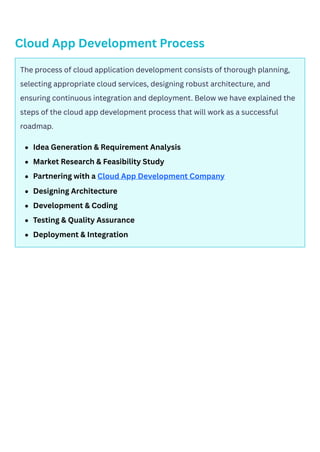
Cloud App Development Process
The process of cloud application development consists of thorough planning,
selecting appropriate cloud services, designing robust architecture, and
ensuring continuous integration and deployment. Below we have explained the
steps of the cloud app development process that will work as a successful
roadmap.
Idea Generation & Requirement Analysis
Market Research & Feasibility Study
Partnering with a Cloud App Development Company
Designing Architecture
Development & Coding
Testing & Quality Assurance
Deployment & Integration
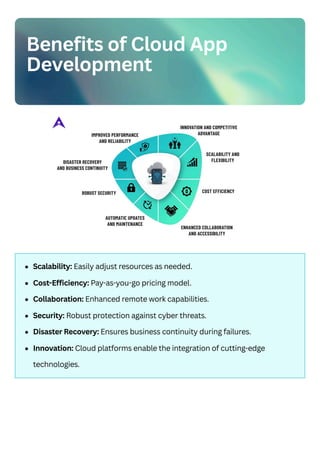
Benefits of Cloud App
Development
Scalability: Easily adjust resources as needed.
Cost-Efficiency: Pay-as-you-go pricing model.
Collaboration: Enhanced remote work capabilities.
Security: Robust protection against cyber threats.
Disaster Recovery: Ensures business continuity during failures.
Innovation: Cloud platforms enable the integration of cutting-edge
technologies.
Cloud App Use Cases
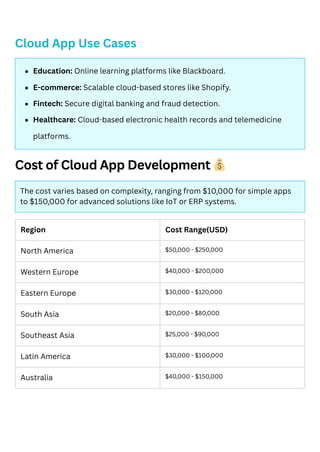
Cost of Cloud App Development 💰
Education: Online learning platforms like Blackboard.
E-commerce: Scalable cloud-based stores like Shopify.
Fintech: Secure digital banking and fraud detection.
Healthcare: Cloud-based electronic health records and telemedicine
platforms.
The cost varies based on complexity, ranging from $10,000 for simple apps
to $150,000 for advanced solutions like IoT or ERP systems.
Region Cost Range(USD)
North America $50,000 - $250,000
Western Europe $40,000 - $200,000
Eastern Europe $30,000 - $120,000
South Asia $20,000 - $80,000
Southeast Asia $25,000 - $90,000
Latin America $30,000 - $100,000
Australia $40,000 - $150,000
Conclusion 🎉
Cloud-based mobile apps are the future, offering scalability, flexibility, and
cost-efficiency. For businesses looking to stay competitive, partnering with a
reliable cloud app development company is key.

Complete Guide To Cloud App Development Key Steps, Benefits, Cost.pdf

  • 1.
    Introduction The rise ofcloud computing has revolutionized mobile app development, offering businesses a fast, scalable, and flexible way to deploy services. This guide covers key aspects of cloud app development, from benefits to costs. What is Cloud App Development? Cloud app development is the process of creating applications. It leverages cloud computing technologies to deliver services over the Internet. Unlike the traditional software that runs on local computers or servers, cloud apps function on remote servers situated in data centres managed by third-party vendors. Cloud App Development Complete Guide 👋
  • 2.
    Types of CloudApplications SaaS (Software as a Service): Apps delivered over the internet like Google Workspace. PaaS (Platform as a Service): A platform for developers to run and manage apps without infrastructure handling. IaaS (Infrastructure as a Service): Offering virtual machines and storage for businesses. FaaS (Function as a Service): Developers write and deploy code without handling servers. CaaS (Container as a Service): Provides better scalability and management of containerized apps.
  • 3.
    Key Features ofCloud-Based Applications Cloud App Market: Overview ✨ Scalability Cost-efficiency High availability Security Disaster recovery Automatic updates The cloud applications market size in terms of revenue is estimated to reach $356 Billion by 2025 at a CAGR of 15.8%. The global enterprise spending on cloud infrastructure services accumulated to USD 270 billion, with a growth of 45 Billion USD to the last year. Hence, this growing adoption of cloud computing technology in mobile app development signifies the promising future scope of cloud app development. Businesses increasingly adopt AI, IoT, and ML to enhance app experiences. Key Drivers of Market Growth Digital Transformation Scalability and Flexibility Cost-Efficiency Remote Work
  • 4.
    Cloud App DevelopmentProcess The process of cloud application development consists of thorough planning, selecting appropriate cloud services, designing robust architecture, and ensuring continuous integration and deployment. Below we have explained the steps of the cloud app development process that will work as a successful roadmap. Idea Generation & Requirement Analysis Market Research & Feasibility Study Partnering with a Cloud App Development Company Designing Architecture Development & Coding Testing & Quality Assurance Deployment & Integration
  • 5.
    Benefits of CloudApp Development Scalability: Easily adjust resources as needed. Cost-Efficiency: Pay-as-you-go pricing model. Collaboration: Enhanced remote work capabilities. Security: Robust protection against cyber threats. Disaster Recovery: Ensures business continuity during failures. Innovation: Cloud platforms enable the integration of cutting-edge technologies.
  • 6.
    Cloud App UseCases Cost of Cloud App Development 💰 Education: Online learning platforms like Blackboard. E-commerce: Scalable cloud-based stores like Shopify. Fintech: Secure digital banking and fraud detection. Healthcare: Cloud-based electronic health records and telemedicine platforms. The cost varies based on complexity, ranging from $10,000 for simple apps to $150,000 for advanced solutions like IoT or ERP systems. Region Cost Range(USD) North America $50,000 - $250,000 Western Europe $40,000 - $200,000 Eastern Europe $30,000 - $120,000 South Asia $20,000 - $80,000 Southeast Asia $25,000 - $90,000 Latin America $30,000 - $100,000 Australia $40,000 - $150,000
  • 7.
    Conclusion 🎉 Cloud-based mobileapps are the future, offering scalability, flexibility, and cost-efficiency. For businesses looking to stay competitive, partnering with a reliable cloud app development company is key.