Mobile App
Development
Essential Guide for
Business 2024
https://techeorsolutions.com/app-development-company/
Introduction
Hello and welcome to the discussion, Mobile App
Development Essential Guide for Business 2024.
We'll discuss important actions and things to
think about in this guide for companies planning
to build a mobile app in 2024. Whatever the size
of your company, a well-thought-out and
functional mobile app can boost consumer
interaction, creating brand awareness. and
promotes business expansion
Understanding Mobile
App Development
The process of developing software
applications, particularly for mobile platforms,
such tablets and smartphones, is known as
mobile app development. It involves several
processes, including ideation, design,
development, testing and deployment. With
increasing dependence on mobile
technology, businesses must understand the
importance of mobile app development in
today's digital landscape.
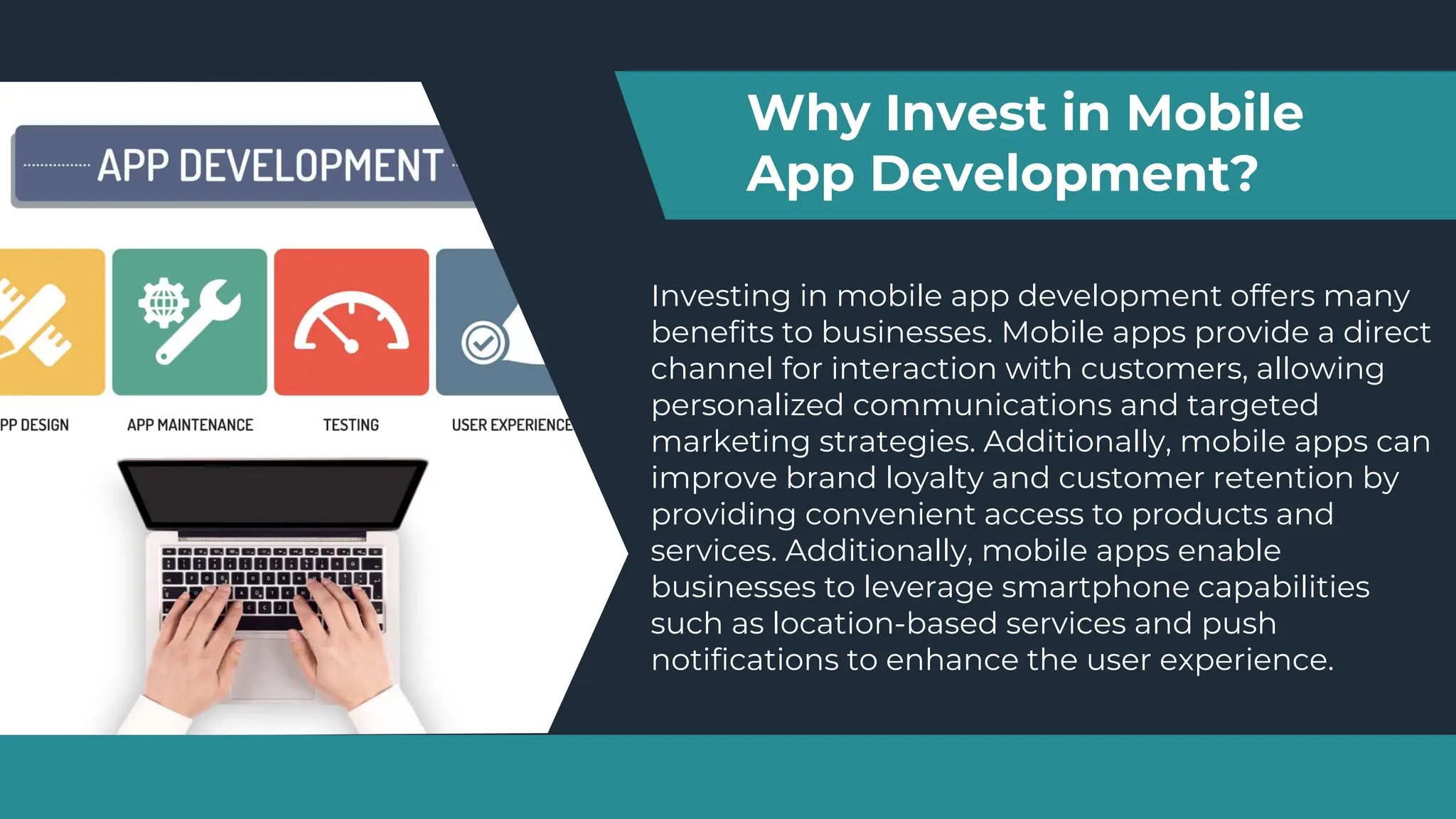
Investing in mobile app development offers many
benefits to businesses. Mobile apps provide a direct
channel for interaction with customers, allowing
personalized communications and targeted
marketing strategies. Additionally, mobile apps can
improve brand loyalty and customer retention by
providing convenient access to products and
services. Additionally, mobile apps enable
businesses to leverage smartphone capabilities
such as location-based services and push
notifications to enhance the user experience.
Why Invest in Mobile
App Development?
Businesses should think about a few important
aspects before starting a mobile app development
project. These include defining the app's purpose
and target audience, choosing the right platform
(iOS, Android, or both), selecting the appropriate
development approach (native, hybrid, or cross-
platform), and establishing a realistic budget and
timeline for the project.
Key Points for Mobile
App Development
Mobile App
Development Process
The mobile app development process typically
consists of several stages, including planning, design,
development, testing, and deployment. During the
planning phase, businesses define the objectives,
features, and functionality of the app. The design
phase includes creating wireframes, user interface (UI)
design, and prototyping. Development involves coding
the frontend and backend components of the app,
while testing ensures its functionality, usability, and
security. Finally, deployment involves launching the
app on the app store and promoting it to users.
When it comes to mobile app development,
businesses have multiple development approaches
to choose from, including native, hybrid, and cross-
platform development. Native development is
creating unique applications utilizing platform-
specific programming languages (Java/Kotlin for
Android, Swift/Objective-C for iOS) for each
platform (iOS and Android). Hybrid development
uses web technologies (HTML, CSS, and JavaScript)
to create a single codebase that can be deployed
on multiple platforms. Cross-platform development
frameworks like React Native and Flutter allow
businesses to build native-like apps using a single
codebase.
Choosing the right
development approach
User experience (UX) design plays a vital role in the
success of a mobile app. Businesses should focus
on creating intuitive, user-friendly interfaces that
prioritize usability and accessibility. This includes
designing clear navigation paths, optimizing screen
layouts for different device sizes, and incorporating
feedback mechanisms to gather user input and
improve the app over time.
Designing User
Experience (UX)
Testing and Quality
Assurance (QA)
Testing is an integral part of the mobile app
development process, ensuring that the app
meets quality standards and performs as
expected on different devices and operating
systems. Businesses should conduct extensive
testing, including functional testing, usability
testing, performance testing, and security
testing, to identify and resolve any bugs or
issues before launching an app to the public.
Once the app is developed and tested, businesses
must prepare it to submit it to app stores (Apple
App Store, Google Play Store) for review and
approval. This includes creating an App Store
listing, including app descriptions, screenshots, and
promotional assets, and adhering to App Store
guidelines and requirements. Upon approval, the
app can be launched to users, and businesses can
begin promoting it through marketing campaigns
and user acquisition strategies.
App Store Submission
and Launch
Launching app
After launching an app, businesses should continue to
monitor its performance and collect feedback from
users to identify areas for improvement. This may
include releasing updates and new features based on
user feedback and market trends, as well as resolving
any technical issues or bugs that arise. Additionally,
businesses should implement strategies to engage
and retain users, such as offering regular updates,
providing customer support, and implementing app
analytics to track user behavior and app performance.
Conclusion
Ultimately, mobile app development provides
significant opportunities for businesses to
connect with customers, increase
engagement, and achieve business objectives.
By following this guide and carefully
considering each step of the mobile app
development process, businesses can develop
successful mobile apps that meet the needs
of their target audience and contribute to
their overall success in 2024 and beyond.
https://techeorsolutions.com/app-development-company/
THANK YOU

Mobile App Development Essential Guide for Business 2024 .pptx

  • 1.
    Mobile App Development Essential Guidefor Business 2024 https://techeorsolutions.com/app-development-company/
  • 2.
    Introduction Hello and welcometo the discussion, Mobile App Development Essential Guide for Business 2024. We'll discuss important actions and things to think about in this guide for companies planning to build a mobile app in 2024. Whatever the size of your company, a well-thought-out and functional mobile app can boost consumer interaction, creating brand awareness. and promotes business expansion
  • 3.
    Understanding Mobile App Development Theprocess of developing software applications, particularly for mobile platforms, such tablets and smartphones, is known as mobile app development. It involves several processes, including ideation, design, development, testing and deployment. With increasing dependence on mobile technology, businesses must understand the importance of mobile app development in today's digital landscape.
  • 4.
    Investing in mobileapp development offers many benefits to businesses. Mobile apps provide a direct channel for interaction with customers, allowing personalized communications and targeted marketing strategies. Additionally, mobile apps can improve brand loyalty and customer retention by providing convenient access to products and services. Additionally, mobile apps enable businesses to leverage smartphone capabilities such as location-based services and push notifications to enhance the user experience. Why Invest in Mobile App Development?
  • 5.
    Businesses should thinkabout a few important aspects before starting a mobile app development project. These include defining the app's purpose and target audience, choosing the right platform (iOS, Android, or both), selecting the appropriate development approach (native, hybrid, or cross- platform), and establishing a realistic budget and timeline for the project. Key Points for Mobile App Development
  • 6.
    Mobile App Development Process Themobile app development process typically consists of several stages, including planning, design, development, testing, and deployment. During the planning phase, businesses define the objectives, features, and functionality of the app. The design phase includes creating wireframes, user interface (UI) design, and prototyping. Development involves coding the frontend and backend components of the app, while testing ensures its functionality, usability, and security. Finally, deployment involves launching the app on the app store and promoting it to users.
  • 7.
    When it comesto mobile app development, businesses have multiple development approaches to choose from, including native, hybrid, and cross- platform development. Native development is creating unique applications utilizing platform- specific programming languages (Java/Kotlin for Android, Swift/Objective-C for iOS) for each platform (iOS and Android). Hybrid development uses web technologies (HTML, CSS, and JavaScript) to create a single codebase that can be deployed on multiple platforms. Cross-platform development frameworks like React Native and Flutter allow businesses to build native-like apps using a single codebase. Choosing the right development approach
  • 8.
    User experience (UX)design plays a vital role in the success of a mobile app. Businesses should focus on creating intuitive, user-friendly interfaces that prioritize usability and accessibility. This includes designing clear navigation paths, optimizing screen layouts for different device sizes, and incorporating feedback mechanisms to gather user input and improve the app over time. Designing User Experience (UX)
  • 9.
    Testing and Quality Assurance(QA) Testing is an integral part of the mobile app development process, ensuring that the app meets quality standards and performs as expected on different devices and operating systems. Businesses should conduct extensive testing, including functional testing, usability testing, performance testing, and security testing, to identify and resolve any bugs or issues before launching an app to the public.
  • 10.
    Once the appis developed and tested, businesses must prepare it to submit it to app stores (Apple App Store, Google Play Store) for review and approval. This includes creating an App Store listing, including app descriptions, screenshots, and promotional assets, and adhering to App Store guidelines and requirements. Upon approval, the app can be launched to users, and businesses can begin promoting it through marketing campaigns and user acquisition strategies. App Store Submission and Launch
  • 11.
    Launching app After launchingan app, businesses should continue to monitor its performance and collect feedback from users to identify areas for improvement. This may include releasing updates and new features based on user feedback and market trends, as well as resolving any technical issues or bugs that arise. Additionally, businesses should implement strategies to engage and retain users, such as offering regular updates, providing customer support, and implementing app analytics to track user behavior and app performance.
  • 12.
    Conclusion Ultimately, mobile appdevelopment provides significant opportunities for businesses to connect with customers, increase engagement, and achieve business objectives. By following this guide and carefully considering each step of the mobile app development process, businesses can develop successful mobile apps that meet the needs of their target audience and contribute to their overall success in 2024 and beyond.
  • 13.