Eelco Visser
CS4200 Compiler Construction
TU Delft
December 2018
Lecture 17: Beyond Compiler Construction
Compiler Components
- What did we study?

Meta-Linguistic Abstraction
- Another perspective

Domain-Specific Languages
- Applying compiler construction in software engineering

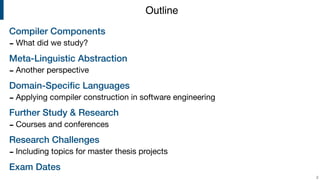
Further Study & Research
- Courses and conferences

Research Challenges
- Including topics for master thesis projects

Exam Dates
!2
Outline
Compiler Components
3
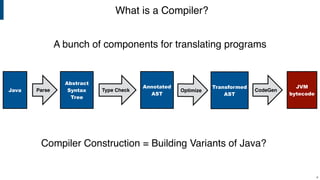
What is a Compiler?
!4
Compiler Construction = Building Variants of Java?
A bunch of components for translating programs
Java Type Check
JVM
bytecode
Parse CodeGenOptimize
Abstract
Syntax
Tree
Annotated
AST
Transformed
AST
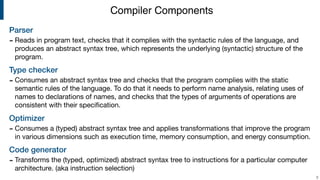
Parser
- Reads in program text, checks that it complies with the syntactic rules of the language, and
produces an abstract syntax tree, which represents the underlying (syntactic) structure of the
program.

Type checker
- Consumes an abstract syntax tree and checks that the program complies with the static
semantic rules of the language. To do that it needs to perform name analysis, relating uses of
names to declarations of names, and checks that the types of arguments of operations are
consistent with their specification.

Optimizer
- Consumes a (typed) abstract syntax tree and applies transformations that improve the program
in various dimensions such as execution time, memory consumption, and energy consumption.

Code generator
- Transforms the (typed, optimized) abstract syntax tree to instructions for a particular computer
architecture. (aka instruction selection)
!5
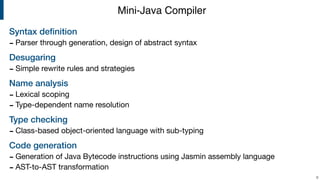
Compiler Components
Syntax definition
- Parser through generation, design of abstract syntax

Desugaring
- Simple rewrite rules and strategies

Name analysis
- Lexical scoping

- Type-dependent name resolution

Type checking
- Class-based object-oriented language with sub-typing

Code generation
- Generation of Java Bytecode instructions using Jasmin assembly language

- AST-to-AST transformation
!6
Mini-Java Compiler
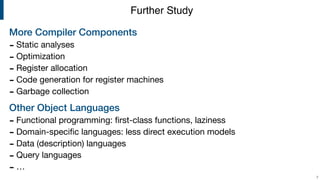
More Compiler Components
- Static analyses

- Optimization

- Register allocation

- Code generation for register machines

- Garbage collection

Other Object Languages
- Functional programming: first-class functions, laziness 

- Domain-specific languages: less direct execution models

- Data (description) languages

- Query languages

- …
!7
Further Study
Meta-Linguistic Abstraction
8
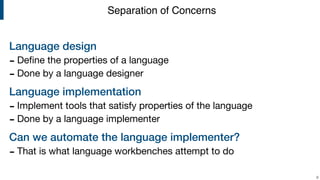
Language design
- Define the properties of a language

- Done by a language designer

Language implementation
- Implement tools that satisfy properties of the language

- Done by a language implementer

Can we automate the language implementer?
- That is what language workbenches attempt to do
!9
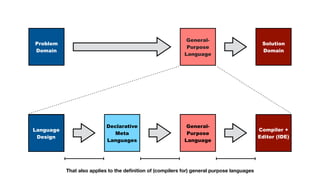
Separation of Concerns
Compiler +
Editor (IDE)
Language
Design
General-
Purpose
Language
Declarative
Meta
Languages
Solution
Domain
Problem
Domain
General-
Purpose
Language
Language
Design
That also applies to the definition of (compilers for) general purpose languages
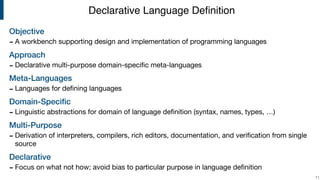
Objective
- A workbench supporting design and implementation of programming languages

Approach
- Declarative multi-purpose domain-specific meta-languages

Meta-Languages
- Languages for defining languages

Domain-Specific
- Linguistic abstractions for domain of language definition (syntax, names, types, …)

Multi-Purpose
- Derivation of interpreters, compilers, rich editors, documentation, and verification from single
source

Declarative
- Focus on what not how; avoid bias to particular purpose in language definition
!11
Declarative Language Definition
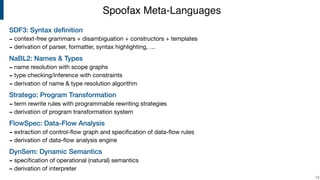
SDF3: Syntax definition
- context-free grammars + disambiguation + constructors + templates

- derivation of parser, formatter, syntax highlighting, …

NaBL2: Names & Types
- name resolution with scope graphs

- type checking/inference with constraints

- derivation of name & type resolution algorithm

Stratego: Program Transformation
- term rewrite rules with programmable rewriting strategies

- derivation of program transformation system

FlowSpec: Data-Flow Analysis
- extraction of control-flow graph and specification of data-flow rules

- derivation of data-flow analysis engine

DynSem: Dynamic Semantics
- specification of operational (natural) semantics 

- derivation of interpreter
!12
Spoofax Meta-Languages
!13
Compiler construction is a lot of fun …
… but when would I ever implement a programming language?
Domain-Specific Languages
14
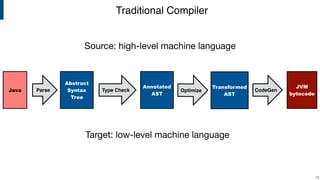
Traditional Compiler
!15
Java Type Check
JVM
bytecode
Parse CodeGenOptimize
Abstract
Syntax
Tree
Annotated
AST
Transformed
AST
Source: high-level machine language
Target: low-level machine language
!16
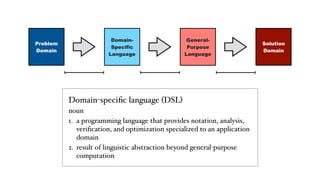
Solution
Domain
Problem
Domain
Domain-specific language (DSL)
noun
1. a programming language that provides notation, analysis,
verification, and optimization specialized to an application
domain
2. result of linguistic abstraction beyond general-purpose
computation
General-
Purpose
Language
Domain-
Specific
Language
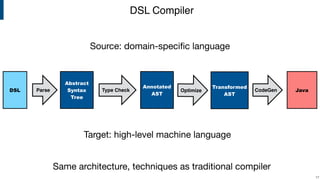
DSL Compiler
!17
DSL Type Check JavaParse CodeGenOptimize
Abstract
Syntax
Tree
Annotated
AST
Transformed
AST
Same architecture, techniques as traditional compiler
Source: domain-specific language
Target: high-level machine language
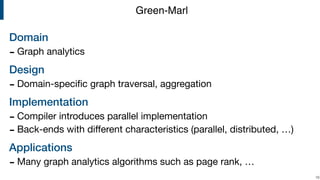
Domain
- Graph analytics

Design
- Domain-specific graph traversal, aggregation

Implementation
- Compiler introduces parallel implementation

- Back-ends with different characteristics (parallel, distributed, …)

Applications
- Many graph analytics algorithms such as page rank, …
!18
Green-Marl
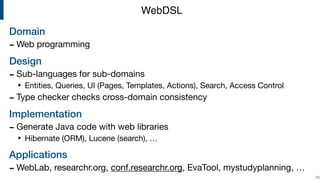
Domain
- Web programming

Design
- Sub-languages for sub-domains

‣ Entities, Queries, UI (Pages, Templates, Actions), Search, Access Control

- Type checker checks cross-domain consistency

Implementation
- Generate Java code with web libraries

‣ Hibernate (ORM), Lucene (search), …

Applications
- WebLab, researchr.org, conf.researchr.org, EvaTool, mystudyplanning, …
!19
WebDSL
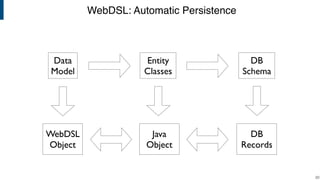
WebDSL: Automatic Persistence
!20
Data
Model
DB
Schema
Entity
Classes
WebDSL
Object
Java
Object
DB
Records
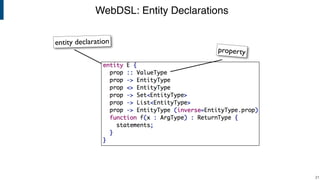
WebDSL: Entity Declarations
!21
entity declaration
property
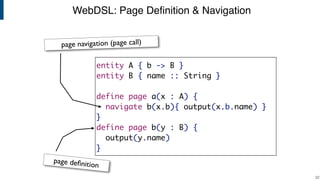
WebDSL: Page Definition & Navigation
!22
entity A { b -> B }
entity B { name :: String }
define page a(x : A) {
navigate b(x.b){ output(x.b.name) }
}
define page b(y : B) {
output(y.name)
}
page definition
page navigation (page call)
WebDSL: Templates (Page Fragments)
!23
define main() {
includeCSS("wiki.css")
top()
block[class="content"] {
elements()
}
}
define span top() {
navigate root() {"Wiki"}
}
parameter
template definition
template call
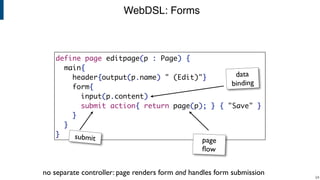
WebDSL: Forms
!24
define page editpage(p : Page) {
main{
header{output(p.name) " (Edit)"}
form{
input(p.content)
submit action{ return page(p); } { "Save" }
}
}
}
data
binding
page
flow
submit
no separate controller: page renders form and handles form submission
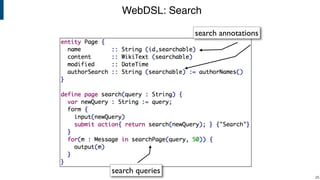
WebDSL: Search
!25
search annotations
search queries
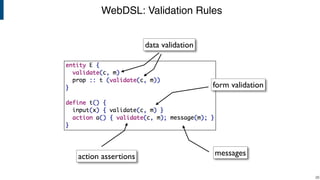
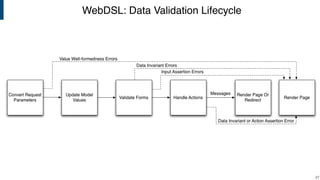
WebDSL: Validation Rules
!26
data validation
form validation
action assertions messages
WebDSL: Data Validation Lifecycle
!27
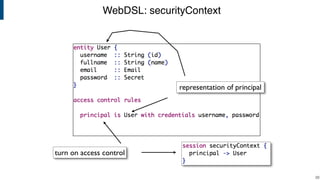
WebDSL: securityContext
!28
turn on access control
representation of principal
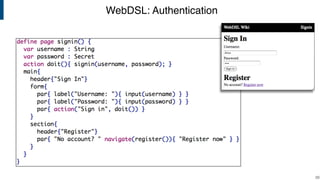
WebDSL: Authentication
!29
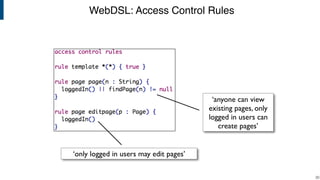
WebDSL: Access Control Rules
!30
‘only logged in users may edit pages’
‘anyone can view
existing pages, only
logged in users can
create pages’
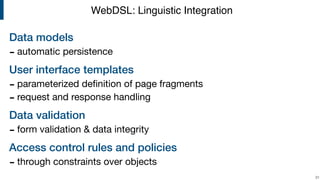
Data models
- automatic persistence

User interface templates
- parameterized definition of page fragments

- request and response handling

Data validation
- form validation & data integrity

Access control rules and policies
- through constraints over objects
!31
WebDSL: Linguistic Integration
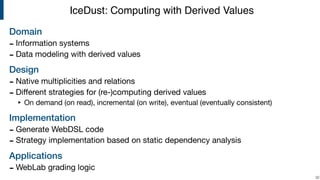
Domain
- Information systems

- Data modeling with derived values

Design
- Native multiplicities and relations

- Different strategies for (re-)computing derived values

‣ On demand (on read), incremental (on write), eventual (eventually consistent)

Implementation
- Generate WebDSL code

- Strategy implementation based on static dependency analysis

Applications
- WebLab grading logic
!32
IceDust: Computing with Derived Values
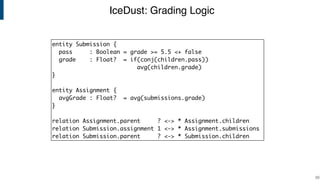
IceDust: Grading Logic
!33
entity Submission {
pass : Boolean = grade >= 5.5 <+ false
grade : Float? = if(conj(children.pass))
avg(children.grade)
}
entity Assignment {
avgGrade : Float? = avg(submissions.grade)
}
relation Assignment.parent ? <-> * Assignment.children
relation Submission.assignment 1 <-> * Assignment.submissions
relation Submission.parent ? <-> * Submission.children
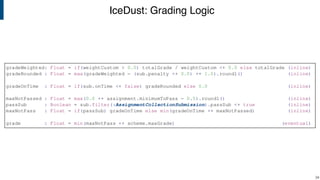
IceDust: Grading Logic
!34
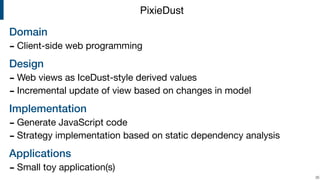
Domain
- Client-side web programming

Design
- Web views as IceDust-style derived values

- Incremental update of view based on changes in model

Implementation
- Generate JavaScript code

- Strategy implementation based on static dependency analysis

Applications
- Small toy application(s)
!35
PixieDust
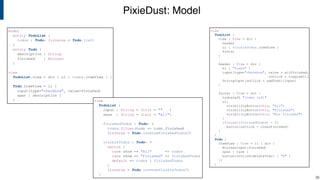
PixieDust: Model
!36
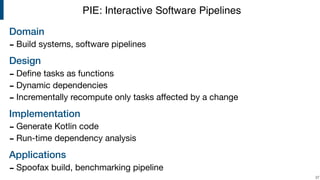
Domain
- Build systems, software pipelines

Design
- Define tasks as functions

- Dynamic dependencies

- Incrementally recompute only tasks affected by a change

Implementation
- Generate Kotlin code

- Run-time dependency analysis

Applications
- Spoofax build, benchmarking pipeline
!37
PIE: Interactive Software Pipelines
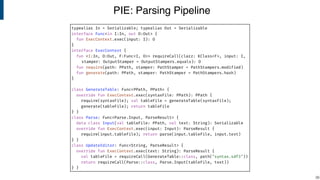
PIE: Parsing Pipeline
!38
Research Challenges in
Compiler Construction
39
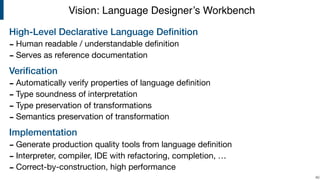
High-Level Declarative Language Definition
- Human readable / understandable definition

- Serves as reference documentation

Verification
- Automatically verify properties of language definition

- Type soundness of interpretation

- Type preservation of transformations

- Semantics preservation of transformation

Implementation
- Generate production quality tools from language definition

- Interpreter, compiler, IDE with refactoring, completion, … 

- Correct-by-construction, high performance
!40
Vision: Language Designer’s Workbench
High-Performance Parsing
- JSGLR2: 2x to 10x speed-up compared to JSGLR

- More speed-up possible?

- Explore effects of different parse table formats (LR, SLR, LALR)

Error Recovery & Error Messages
- Apply error recovery approach of [TOPLAS12] to JSGLR2

- Generate high quality error messages

Incremental Parsing
- Re-parse effort proportional to change of program text

- Approach: adapt Graham/Wagner algorithm to SGLR

Extensible Syntax
- Extend syntax during parsing to support extensible languages
!41
Syntax
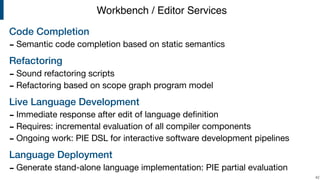
Code Completion
- Semantic code completion based on static semantics

Refactoring
- Sound refactoring scripts

- Refactoring based on scope graph program model 

Live Language Development
- Immediate response after edit of language definition

- Requires: incremental evaluation of all compiler components

- Ongoing work: PIE DSL for interactive software development pipelines

Language Deployment
- Generate stand-alone language implementation: PIE partial evaluation
!42
Workbench / Editor Services
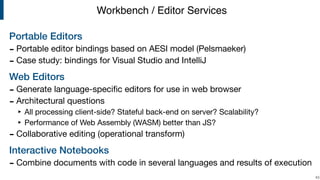
Portable Editors
- Portable editor bindings based on AESI model (Pelsmaeker)

- Case study: bindings for Visual Studio and IntelliJ

Web Editors
- Generate language-specific editors for use in web browser

- Architectural questions

‣ All processing client-side? Stateful back-end on server? Scalability?

‣ Performance of Web Assembly (WASM) better than JS?

- Collaborative editing (operational transform)

Interactive Notebooks
- Combine documents with code in several languages and results of execution
!43
Workbench / Editor Services
Specification of type systems
- Statix: NaBL2 successor

- Support more advanced type systems

- Structural types, polymorphism (generics), sub-typing

- Subset of CHR (Constraint Handling Rules) + domain-specific constraints
for scope graphs and relations

Solver
- Matrix-based name resolution algorithm

- Correctness wrt resolution calculus?

- Scalability: Incremental analysis?

!44
Statics
Program Model
- Extend term data model to incorporate scopes and types

- Persistent storage

- Query: retrieve information based on scope graph model

‣ All methods in class A

- Construction

‣ well-formed wrt static semantics

Random Program Generation
- Generation of programs based on syntax + static semantics for
testing
!45
Syntax + Statics
New Transformation Language
- Operating on richer program model

- Generic (traversal) strategies

- Statically typed

- Type-preserving transformations

‣ intrinsically or extrinsically verified?

- Semantics-preserving transformations

‣ intrinsically or extrinsically verified?

Transformation Algorithms
- Refactorings, Optimizations

Code Generation / Instruction Selection
- BURS: Bottom-up rewrite system: Find cheapest / best mapping to code
!46
Transformation
FlowSpec
- Declarative specification of data-flow analyses

- Increase expressiveness to cover more analyses

- High-performance execution of analyses

- Incremental execution of analyses (during transformation)

Data-flow Dependent Static Semantics
- Definite assignment in Java

- Borrow checking in Rust
!47
Analysis
Interpreters from dynamic semantic specification
- Prototype for DynSem [RTA15] applied to Grace [DLS17], Tiger

Frame-based interpreters
- Scope graph describes memory model [ECOOP16]

- Define in DynSem applied to realistic languages

- Correct-by-construction [POPL18] => dependently-typed DynSem

- Language-independent garbage collection

Partial evaluation
- Specialize DynSem interpreter to language-specific set of semantic rules

- Specialize language-specific rules to specific program

Compiler generation
- Derive compiler from dynamic semantics specification
!48
Dynamics
Intrinsically Typed Definitional Interpreters
- For Middle Weight Java (MJ) in Agda [POPL18]

- Extend to more sophisticated type systems (generics, System F)

- Extend to more sophisticated effect systems (continutations, algebraic effects)

- Extend approach to other operations: transformation, code generation

Extrinsic Proofs
- Generation of extrinsic type soundness proof

- Other properties

Other Verification Challenges
- Semantics preservation of DSL code generators

- Correctness of meta-DSLs
!49
Verification
Studying Programming
Languages
50
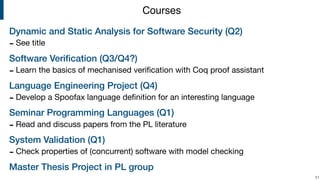
Dynamic and Static Analysis for Software Security (Q2)
- See title

Software Verification (Q3/Q4?)
- Learn the basics of mechanised verification with Coq proof assistant

Language Engineering Project (Q4)
- Develop a Spoofax language definition for an interesting language

Seminar Programming Languages (Q1)
- Read and discuss papers from the PL literature

System Validation (Q1)
- Check properties of (concurrent) software with model checking

Master Thesis Project in PL group
!51
Courses
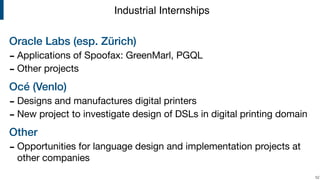
Oracle Labs (esp. Zürich)
- Applications of Spoofax: GreenMarl, PGQL

- Other projects

Océ (Venlo)
- Designs and manufactures digital printers

- New project to investigate design of DSLs in digital printing domain

Other
- Opportunities for language design and implementation projects at
other companies
!52
Industrial Internships
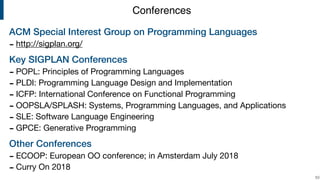
ACM Special Interest Group on Programming Languages
- http://sigplan.org/

Key SIGPLAN Conferences
- POPL: Principles of Programming Languages

- PLDI: Programming Language Design and Implementation

- ICFP: International Conference on Functional Programming

- OOPSLA/SPLASH: Systems, Programming Languages, and Applications

- SLE: Software Language Engineering

- GPCE: Generative Programming 

Other Conferences
- ECOOP: European OO conference; in Amsterdam July 2018

- Curry On 2018
!53
Conferences
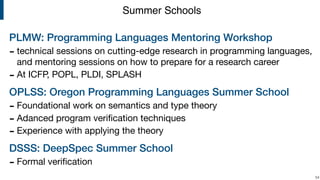
PLMW: Programming Languages Mentoring Workshop
- technical sessions on cutting-edge research in programming languages,
and mentoring sessions on how to prepare for a research career

- At ICFP, POPL, PLDI, SPLASH

OPLSS: Oregon Programming Languages Summer School
- Foundational work on semantics and type theory

- Adanced program verification techniques

- Experience with applying the theory

DSSS: DeepSpec Summer School
- Formal verification
!54
Summer Schools
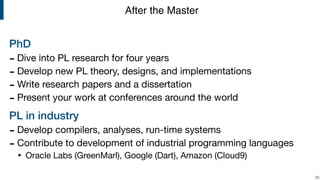
PhD
- Dive into PL research for four years

- Develop new PL theory, designs, and implementations

- Write research papers and a dissertation

- Present your work at conferences around the world

PL in industry
- Develop compilers, analyses, run-time systems

- Contribute to development of industrial programming languages

‣ Oracle Labs (GreenMarl), Google (Dart), Amazon (Cloud9)
!55
After the Master
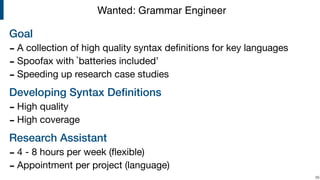
Goal
- A collection of high quality syntax definitions for key languages

- Spoofax with `batteries included’

- Speeding up research case studies

Developing Syntax Definitions
- High quality

- High coverage

Research Assistant
- 4 - 8 hours per week (flexible)

- Appointment per project (language)
!56
Wanted: Grammar Engineer
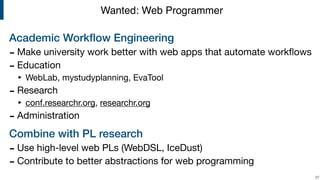
Academic Workflow Engineering
- Make university work better with web apps that automate workflows 

- Education

‣ WebLab, mystudyplanning, EvaTool

- Research

‣ conf.researchr.org, researchr.org 

- Administration

Combine with PL research
- Use high-level web PLs (WebDSL, IceDust)

- Contribute to better abstractions for web programming
!57
Wanted: Web Programmer
Exam
58
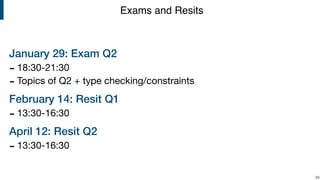
January 29: Exam Q2
- 18:30-21:30

- Topics of Q2 + type checking/constraints

February 14: Resit Q1
- 13:30-16:30

April 12: Resit Q2
- 13:30-16:30
!59
Exams and Resits
!60
Except where otherwise noted, this work is licensed under

Compiler Construction | Lecture 17 | Beyond Compiler Construction

  • 1.
    Eelco Visser CS4200 CompilerConstruction TU Delft December 2018 Lecture 17: Beyond Compiler Construction
  • 2.
    Compiler Components - Whatdid we study? Meta-Linguistic Abstraction - Another perspective Domain-Specific Languages - Applying compiler construction in software engineering Further Study & Research - Courses and conferences Research Challenges - Including topics for master thesis projects Exam Dates !2 Outline
  • 3.
  • 4.
    What is aCompiler? !4 Compiler Construction = Building Variants of Java? A bunch of components for translating programs Java Type Check JVM bytecode Parse CodeGenOptimize Abstract Syntax Tree Annotated AST Transformed AST
  • 5.
    Parser - Reads inprogram text, checks that it complies with the syntactic rules of the language, and produces an abstract syntax tree, which represents the underlying (syntactic) structure of the program. Type checker - Consumes an abstract syntax tree and checks that the program complies with the static semantic rules of the language. To do that it needs to perform name analysis, relating uses of names to declarations of names, and checks that the types of arguments of operations are consistent with their specification. Optimizer - Consumes a (typed) abstract syntax tree and applies transformations that improve the program in various dimensions such as execution time, memory consumption, and energy consumption. Code generator - Transforms the (typed, optimized) abstract syntax tree to instructions for a particular computer architecture. (aka instruction selection) !5 Compiler Components
  • 6.
    Syntax definition - Parserthrough generation, design of abstract syntax Desugaring - Simple rewrite rules and strategies Name analysis - Lexical scoping - Type-dependent name resolution Type checking - Class-based object-oriented language with sub-typing Code generation - Generation of Java Bytecode instructions using Jasmin assembly language - AST-to-AST transformation !6 Mini-Java Compiler
  • 7.
    More Compiler Components -Static analyses - Optimization - Register allocation - Code generation for register machines - Garbage collection Other Object Languages - Functional programming: first-class functions, laziness - Domain-specific languages: less direct execution models - Data (description) languages - Query languages - … !7 Further Study
  • 8.
  • 9.
    Language design - Definethe properties of a language - Done by a language designer Language implementation - Implement tools that satisfy properties of the language - Done by a language implementer Can we automate the language implementer? - That is what language workbenches attempt to do !9 Separation of Concerns
  • 10.
  • 11.
    Objective - A workbenchsupporting design and implementation of programming languages Approach - Declarative multi-purpose domain-specific meta-languages Meta-Languages - Languages for defining languages Domain-Specific - Linguistic abstractions for domain of language definition (syntax, names, types, …) Multi-Purpose - Derivation of interpreters, compilers, rich editors, documentation, and verification from single source Declarative - Focus on what not how; avoid bias to particular purpose in language definition !11 Declarative Language Definition
  • 12.
    SDF3: Syntax definition -context-free grammars + disambiguation + constructors + templates - derivation of parser, formatter, syntax highlighting, … NaBL2: Names & Types - name resolution with scope graphs - type checking/inference with constraints - derivation of name & type resolution algorithm Stratego: Program Transformation - term rewrite rules with programmable rewriting strategies - derivation of program transformation system FlowSpec: Data-Flow Analysis - extraction of control-flow graph and specification of data-flow rules - derivation of data-flow analysis engine DynSem: Dynamic Semantics - specification of operational (natural) semantics - derivation of interpreter !12 Spoofax Meta-Languages
  • 13.
    !13 Compiler construction isa lot of fun … … but when would I ever implement a programming language?
  • 14.
  • 15.
    Traditional Compiler !15 Java TypeCheck JVM bytecode Parse CodeGenOptimize Abstract Syntax Tree Annotated AST Transformed AST Source: high-level machine language Target: low-level machine language
  • 16.
    !16 Solution Domain Problem Domain Domain-specific language (DSL) noun 1.a programming language that provides notation, analysis, verification, and optimization specialized to an application domain 2. result of linguistic abstraction beyond general-purpose computation General- Purpose Language Domain- Specific Language
  • 17.
    DSL Compiler !17 DSL TypeCheck JavaParse CodeGenOptimize Abstract Syntax Tree Annotated AST Transformed AST Same architecture, techniques as traditional compiler Source: domain-specific language Target: high-level machine language
  • 18.
    Domain - Graph analytics Design -Domain-specific graph traversal, aggregation Implementation - Compiler introduces parallel implementation - Back-ends with different characteristics (parallel, distributed, …) Applications - Many graph analytics algorithms such as page rank, … !18 Green-Marl
  • 19.
    Domain - Web programming Design -Sub-languages for sub-domains ‣ Entities, Queries, UI (Pages, Templates, Actions), Search, Access Control - Type checker checks cross-domain consistency Implementation - Generate Java code with web libraries ‣ Hibernate (ORM), Lucene (search), … Applications - WebLab, researchr.org, conf.researchr.org, EvaTool, mystudyplanning, … !19 WebDSL
  • 20.
  • 21.
  • 22.
    WebDSL: Page Definition& Navigation !22 entity A { b -> B } entity B { name :: String } define page a(x : A) { navigate b(x.b){ output(x.b.name) } } define page b(y : B) { output(y.name) } page definition page navigation (page call)
  • 23.
    WebDSL: Templates (PageFragments) !23 define main() { includeCSS("wiki.css") top() block[class="content"] { elements() } } define span top() { navigate root() {"Wiki"} } parameter template definition template call
  • 24.
    WebDSL: Forms !24 define pageeditpage(p : Page) { main{ header{output(p.name) " (Edit)"} form{ input(p.content) submit action{ return page(p); } { "Save" } } } } data binding page flow submit no separate controller: page renders form and handles form submission
  • 25.
  • 26.
    WebDSL: Validation Rules !26 datavalidation form validation action assertions messages
  • 27.
  • 28.
    WebDSL: securityContext !28 turn onaccess control representation of principal
  • 29.
  • 30.
    WebDSL: Access ControlRules !30 ‘only logged in users may edit pages’ ‘anyone can view existing pages, only logged in users can create pages’
  • 31.
    Data models - automaticpersistence User interface templates - parameterized definition of page fragments - request and response handling Data validation - form validation & data integrity Access control rules and policies - through constraints over objects !31 WebDSL: Linguistic Integration
  • 32.
    Domain - Information systems -Data modeling with derived values Design - Native multiplicities and relations - Different strategies for (re-)computing derived values ‣ On demand (on read), incremental (on write), eventual (eventually consistent) Implementation - Generate WebDSL code - Strategy implementation based on static dependency analysis Applications - WebLab grading logic !32 IceDust: Computing with Derived Values
  • 33.
    IceDust: Grading Logic !33 entitySubmission { pass : Boolean = grade >= 5.5 <+ false grade : Float? = if(conj(children.pass)) avg(children.grade) } entity Assignment { avgGrade : Float? = avg(submissions.grade) } relation Assignment.parent ? <-> * Assignment.children relation Submission.assignment 1 <-> * Assignment.submissions relation Submission.parent ? <-> * Submission.children
  • 34.
  • 35.
    Domain - Client-side webprogramming Design - Web views as IceDust-style derived values - Incremental update of view based on changes in model Implementation - Generate JavaScript code - Strategy implementation based on static dependency analysis Applications - Small toy application(s) !35 PixieDust
  • 36.
  • 37.
    Domain - Build systems,software pipelines Design - Define tasks as functions - Dynamic dependencies - Incrementally recompute only tasks affected by a change Implementation - Generate Kotlin code - Run-time dependency analysis Applications - Spoofax build, benchmarking pipeline !37 PIE: Interactive Software Pipelines
  • 38.
  • 39.
  • 40.
    High-Level Declarative LanguageDefinition - Human readable / understandable definition - Serves as reference documentation Verification - Automatically verify properties of language definition - Type soundness of interpretation - Type preservation of transformations - Semantics preservation of transformation Implementation - Generate production quality tools from language definition - Interpreter, compiler, IDE with refactoring, completion, … - Correct-by-construction, high performance !40 Vision: Language Designer’s Workbench
  • 41.
    High-Performance Parsing - JSGLR2:2x to 10x speed-up compared to JSGLR - More speed-up possible? - Explore effects of different parse table formats (LR, SLR, LALR) Error Recovery & Error Messages - Apply error recovery approach of [TOPLAS12] to JSGLR2 - Generate high quality error messages Incremental Parsing - Re-parse effort proportional to change of program text - Approach: adapt Graham/Wagner algorithm to SGLR Extensible Syntax - Extend syntax during parsing to support extensible languages !41 Syntax
  • 42.
    Code Completion - Semanticcode completion based on static semantics Refactoring - Sound refactoring scripts - Refactoring based on scope graph program model Live Language Development - Immediate response after edit of language definition - Requires: incremental evaluation of all compiler components - Ongoing work: PIE DSL for interactive software development pipelines Language Deployment - Generate stand-alone language implementation: PIE partial evaluation !42 Workbench / Editor Services
  • 43.
    Portable Editors - Portableeditor bindings based on AESI model (Pelsmaeker) - Case study: bindings for Visual Studio and IntelliJ Web Editors - Generate language-specific editors for use in web browser - Architectural questions ‣ All processing client-side? Stateful back-end on server? Scalability? ‣ Performance of Web Assembly (WASM) better than JS? - Collaborative editing (operational transform) Interactive Notebooks - Combine documents with code in several languages and results of execution !43 Workbench / Editor Services
  • 44.
    Specification of typesystems - Statix: NaBL2 successor - Support more advanced type systems - Structural types, polymorphism (generics), sub-typing - Subset of CHR (Constraint Handling Rules) + domain-specific constraints for scope graphs and relations Solver - Matrix-based name resolution algorithm - Correctness wrt resolution calculus? - Scalability: Incremental analysis? !44 Statics
  • 45.
    Program Model - Extendterm data model to incorporate scopes and types - Persistent storage - Query: retrieve information based on scope graph model ‣ All methods in class A - Construction ‣ well-formed wrt static semantics Random Program Generation - Generation of programs based on syntax + static semantics for testing !45 Syntax + Statics
  • 46.
    New Transformation Language -Operating on richer program model - Generic (traversal) strategies - Statically typed - Type-preserving transformations ‣ intrinsically or extrinsically verified? - Semantics-preserving transformations ‣ intrinsically or extrinsically verified? Transformation Algorithms - Refactorings, Optimizations Code Generation / Instruction Selection - BURS: Bottom-up rewrite system: Find cheapest / best mapping to code !46 Transformation
  • 47.
    FlowSpec - Declarative specificationof data-flow analyses - Increase expressiveness to cover more analyses - High-performance execution of analyses - Incremental execution of analyses (during transformation) Data-flow Dependent Static Semantics - Definite assignment in Java - Borrow checking in Rust !47 Analysis
  • 48.
    Interpreters from dynamicsemantic specification - Prototype for DynSem [RTA15] applied to Grace [DLS17], Tiger Frame-based interpreters - Scope graph describes memory model [ECOOP16] - Define in DynSem applied to realistic languages - Correct-by-construction [POPL18] => dependently-typed DynSem - Language-independent garbage collection Partial evaluation - Specialize DynSem interpreter to language-specific set of semantic rules - Specialize language-specific rules to specific program Compiler generation - Derive compiler from dynamic semantics specification !48 Dynamics
  • 49.
    Intrinsically Typed DefinitionalInterpreters - For Middle Weight Java (MJ) in Agda [POPL18] - Extend to more sophisticated type systems (generics, System F) - Extend to more sophisticated effect systems (continutations, algebraic effects) - Extend approach to other operations: transformation, code generation Extrinsic Proofs - Generation of extrinsic type soundness proof - Other properties Other Verification Challenges - Semantics preservation of DSL code generators - Correctness of meta-DSLs !49 Verification
  • 50.
  • 51.
    Dynamic and StaticAnalysis for Software Security (Q2) - See title Software Verification (Q3/Q4?) - Learn the basics of mechanised verification with Coq proof assistant Language Engineering Project (Q4) - Develop a Spoofax language definition for an interesting language Seminar Programming Languages (Q1) - Read and discuss papers from the PL literature System Validation (Q1) - Check properties of (concurrent) software with model checking Master Thesis Project in PL group !51 Courses
  • 52.
    Oracle Labs (esp.Zürich) - Applications of Spoofax: GreenMarl, PGQL - Other projects Océ (Venlo) - Designs and manufactures digital printers - New project to investigate design of DSLs in digital printing domain Other - Opportunities for language design and implementation projects at other companies !52 Industrial Internships
  • 53.
    ACM Special InterestGroup on Programming Languages - http://sigplan.org/ Key SIGPLAN Conferences - POPL: Principles of Programming Languages - PLDI: Programming Language Design and Implementation - ICFP: International Conference on Functional Programming - OOPSLA/SPLASH: Systems, Programming Languages, and Applications - SLE: Software Language Engineering - GPCE: Generative Programming Other Conferences - ECOOP: European OO conference; in Amsterdam July 2018 - Curry On 2018 !53 Conferences
  • 54.
    PLMW: Programming LanguagesMentoring Workshop - technical sessions on cutting-edge research in programming languages, and mentoring sessions on how to prepare for a research career - At ICFP, POPL, PLDI, SPLASH OPLSS: Oregon Programming Languages Summer School - Foundational work on semantics and type theory - Adanced program verification techniques - Experience with applying the theory DSSS: DeepSpec Summer School - Formal verification !54 Summer Schools
  • 55.
    PhD - Dive intoPL research for four years - Develop new PL theory, designs, and implementations - Write research papers and a dissertation - Present your work at conferences around the world PL in industry - Develop compilers, analyses, run-time systems - Contribute to development of industrial programming languages ‣ Oracle Labs (GreenMarl), Google (Dart), Amazon (Cloud9) !55 After the Master
  • 56.
    Goal - A collectionof high quality syntax definitions for key languages - Spoofax with `batteries included’ - Speeding up research case studies Developing Syntax Definitions - High quality - High coverage Research Assistant - 4 - 8 hours per week (flexible) - Appointment per project (language) !56 Wanted: Grammar Engineer
  • 57.
    Academic Workflow Engineering -Make university work better with web apps that automate workflows - Education ‣ WebLab, mystudyplanning, EvaTool - Research ‣ conf.researchr.org, researchr.org - Administration Combine with PL research - Use high-level web PLs (WebDSL, IceDust) - Contribute to better abstractions for web programming !57 Wanted: Web Programmer
  • 58.
  • 59.
    January 29: ExamQ2 - 18:30-21:30 - Topics of Q2 + type checking/constraints February 14: Resit Q1 - 13:30-16:30 April 12: Resit Q2 - 13:30-16:30 !59 Exams and Resits
  • 60.
    !60 Except where otherwisenoted, this work is licensed under