1
Competency Based Feedback System
1
2
3
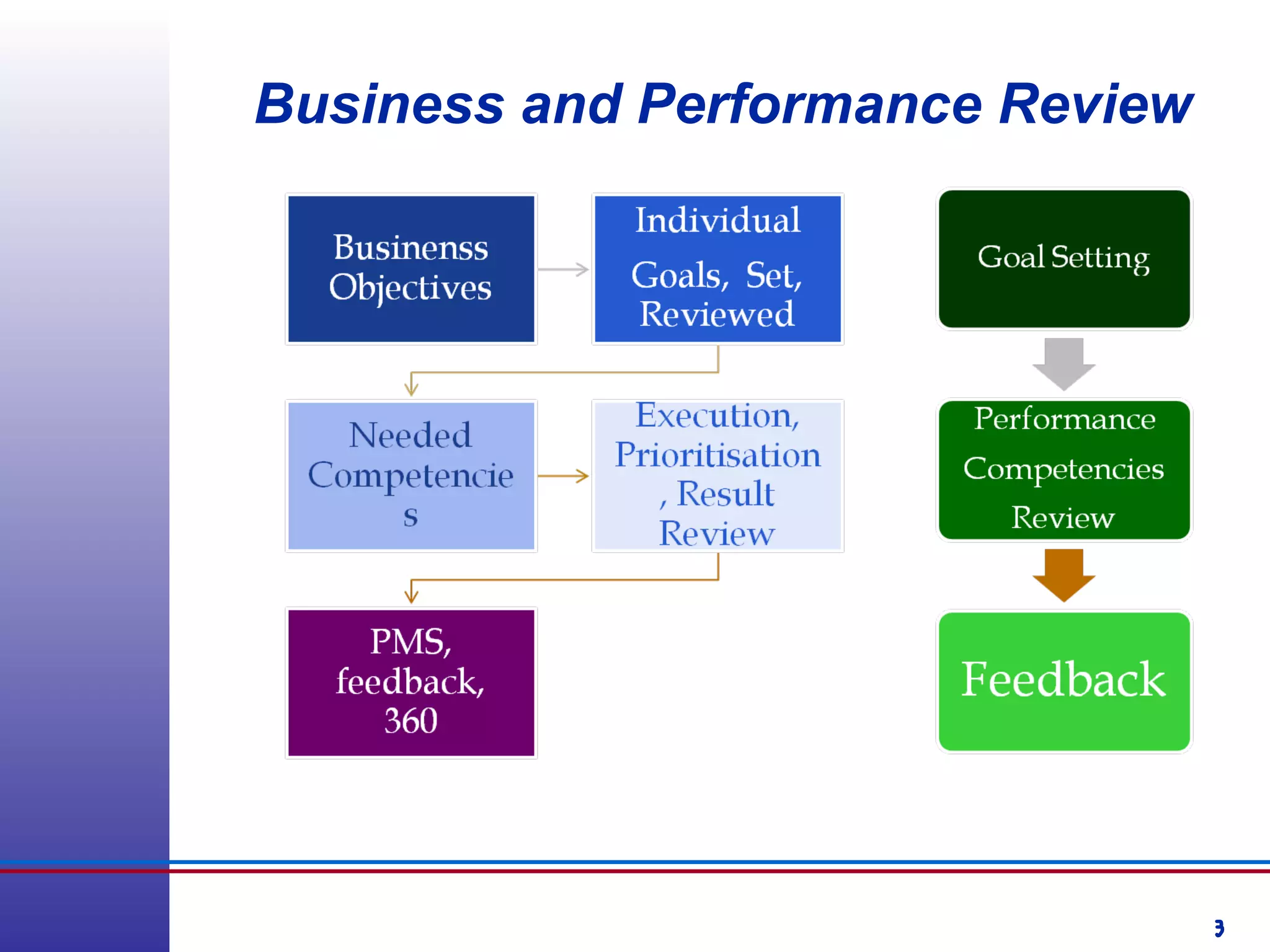
Business and Performance Review
4
Chandramowly
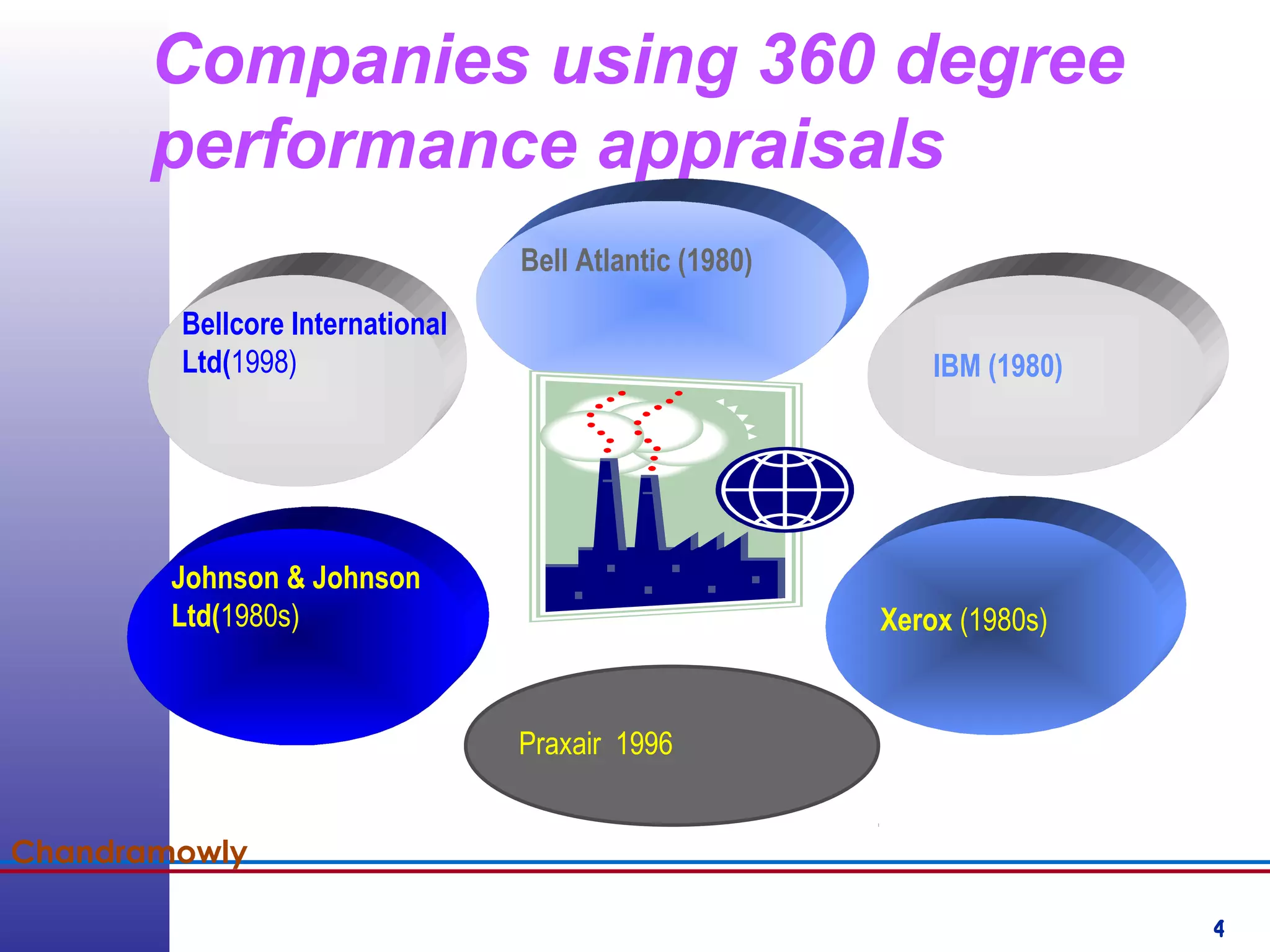
Companies using 360 degree
performance appraisals
Bellcore International
Ltd(1998)
Johnson & Johnson
Ltd(1980s)
Praxair 1996
Xerox (1980s)
IBM (1980)
Bell Atlantic (1980)
5
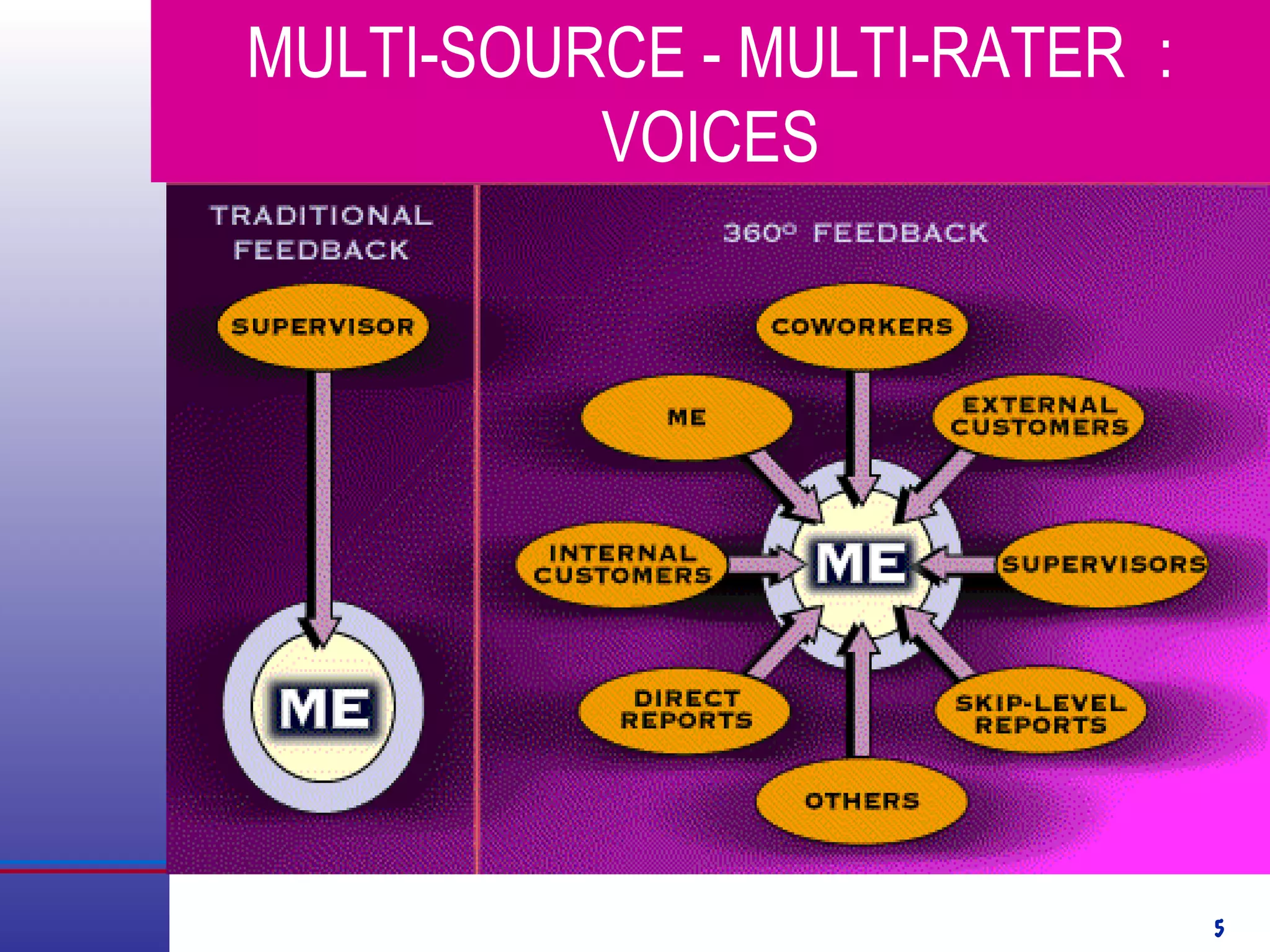
MULTI-SOURCE - MULTI-RATER :
VOICES
6
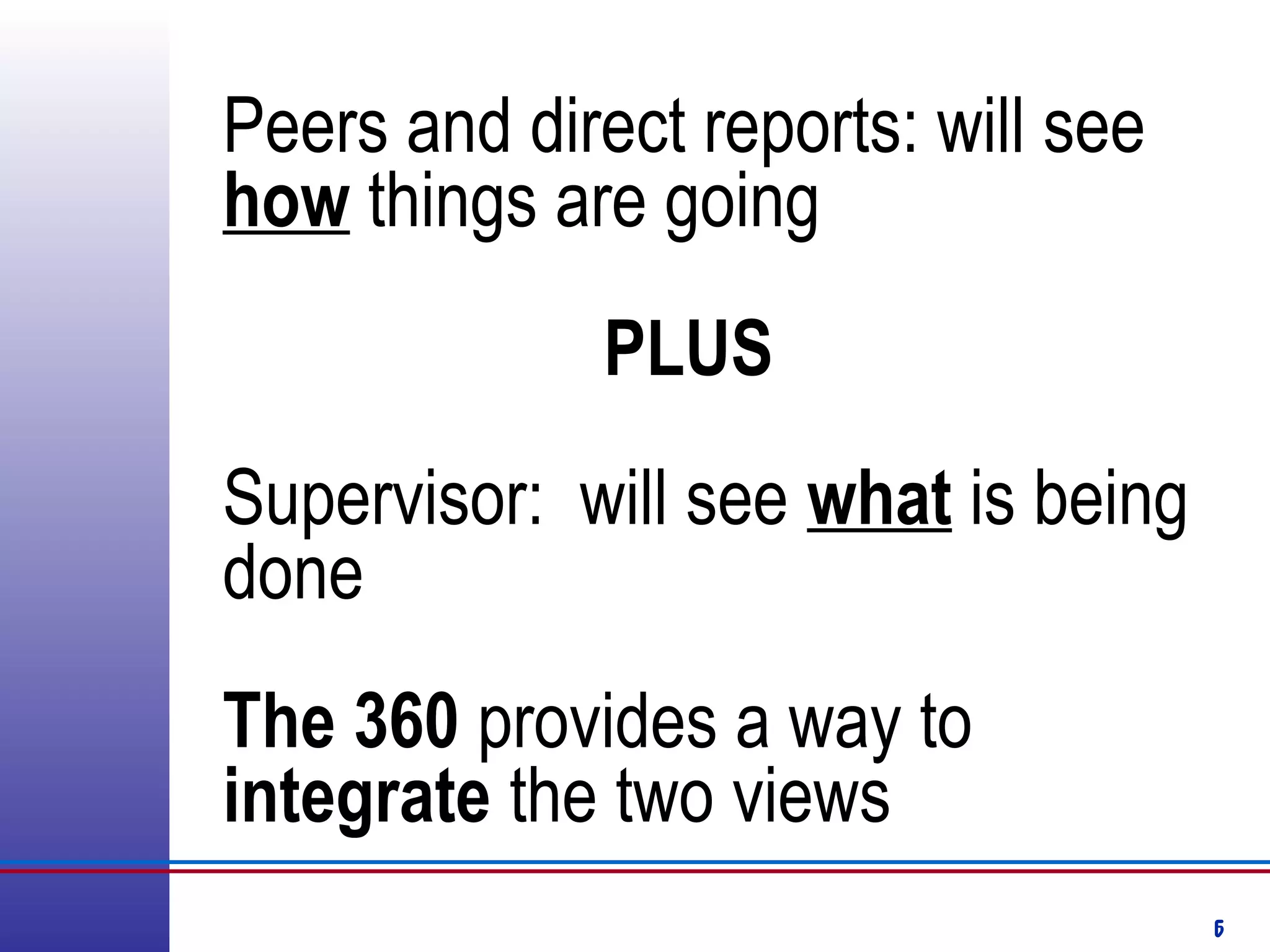
Peers and direct reports: will see
how things are going
PLUS
Supervisor: will see what is being
done
The 360 provides a way to
integrate the two views
7
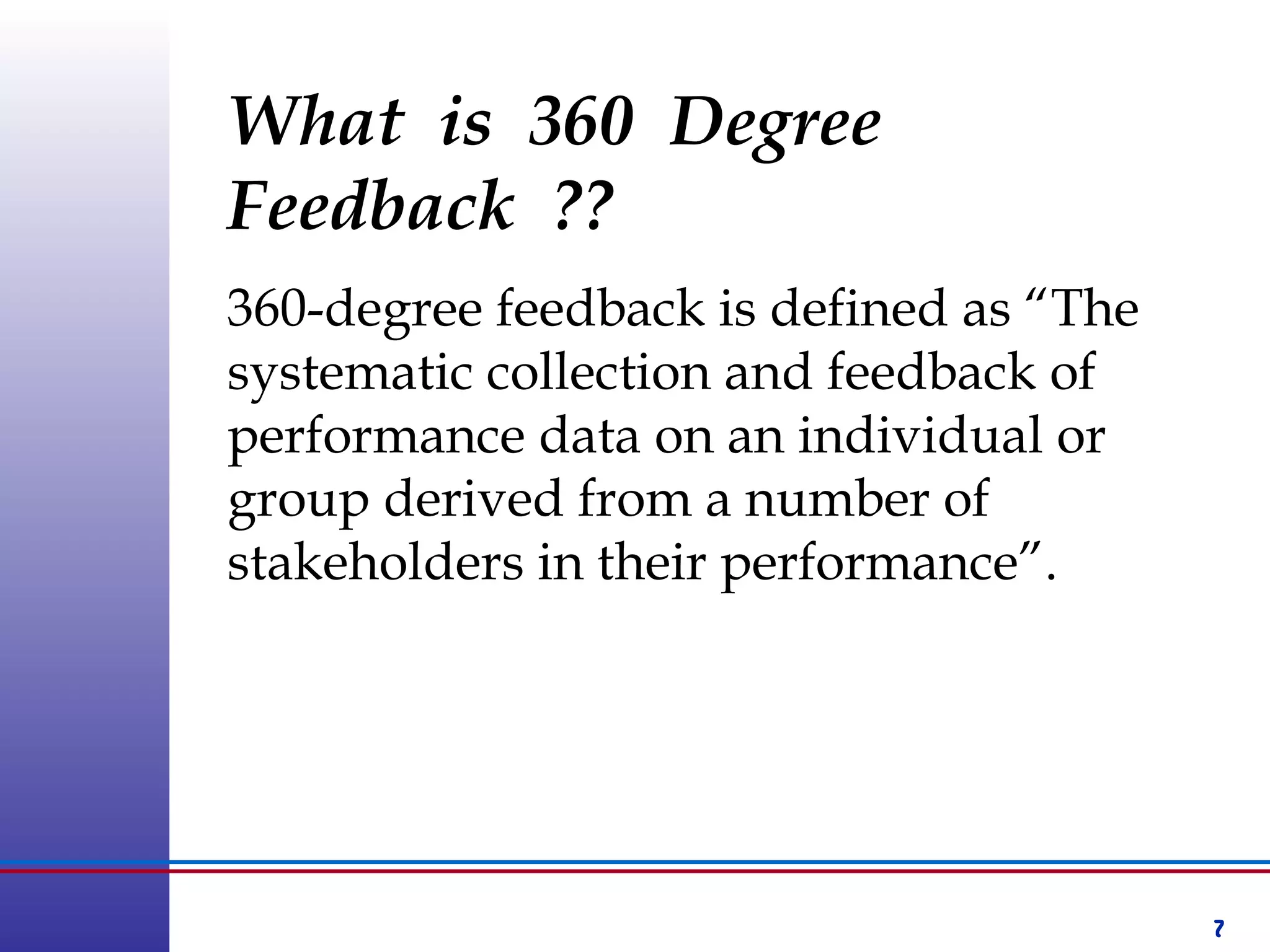
What is 360 Degree
Feedback ??
360-degree feedback is defined as “The
systematic collection and feedback of
performance data on an individual or
group derived from a number of
stakeholders in their performance”.
8
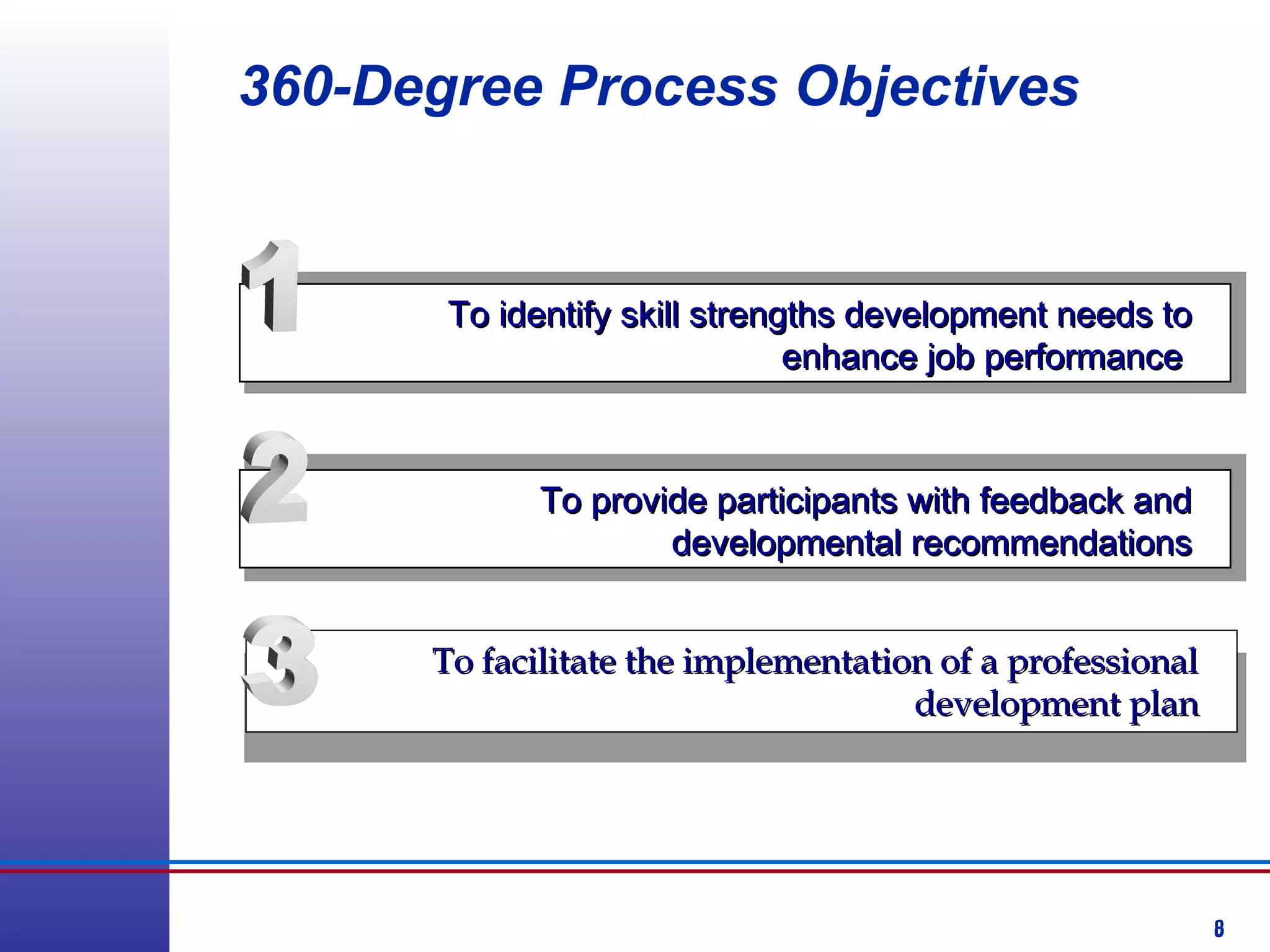
To facilitate the implementation of a professionalTo facilitate the implementation of a professional
development plandevelopment plan
To identify skill strengths development needs toTo identify skill strengths development needs to
enhance job performanceenhance job performance
To provide participants with feedback andTo provide participants with feedback and
developmental recommendationsdevelopmental recommendations
360-Degree Process Objectives
9
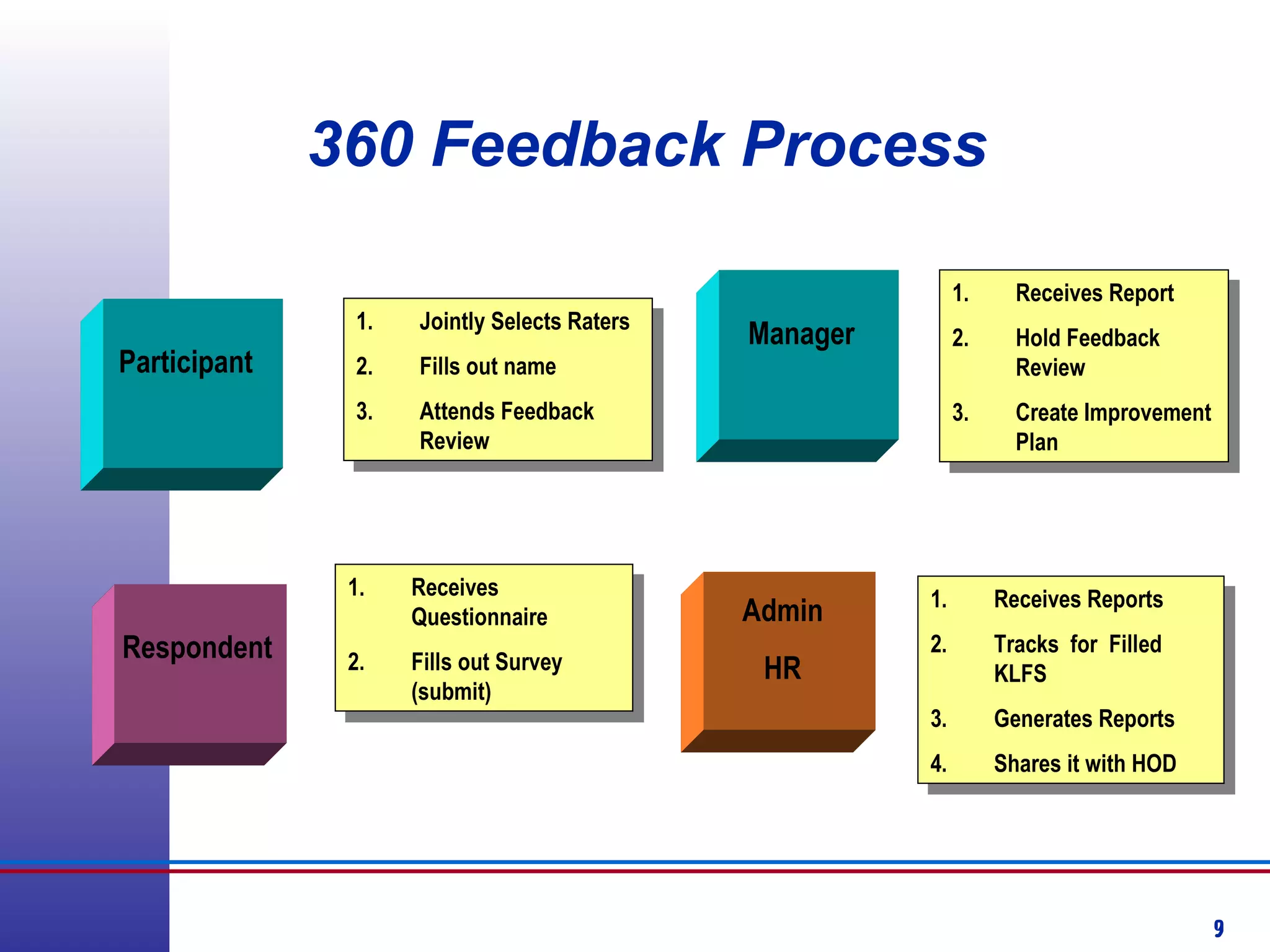
360 Feedback Process
Participant
Respondent
1. Jointly Selects Raters
2. Fills out name
3. Attends Feedback
Review
1. Jointly Selects Raters
2. Fills out name
3. Attends Feedback
Review
1. Receives
Questionnaire
2. Fills out Survey
(submit)
1. Receives
Questionnaire
2. Fills out Survey
(submit)
Manager
1. Receives Report
2. Hold Feedback
Review
3. Create Improvement
Plan
1. Receives Report
2. Hold Feedback
Review
3. Create Improvement
Plan
1. Receives Reports
2. Tracks for Filled
KLFS
3. Generates Reports
4. Shares it with HOD
1. Receives Reports
2. Tracks for Filled
KLFS
3. Generates Reports
4. Shares it with HOD
Admin
HR
10
Chandramowly
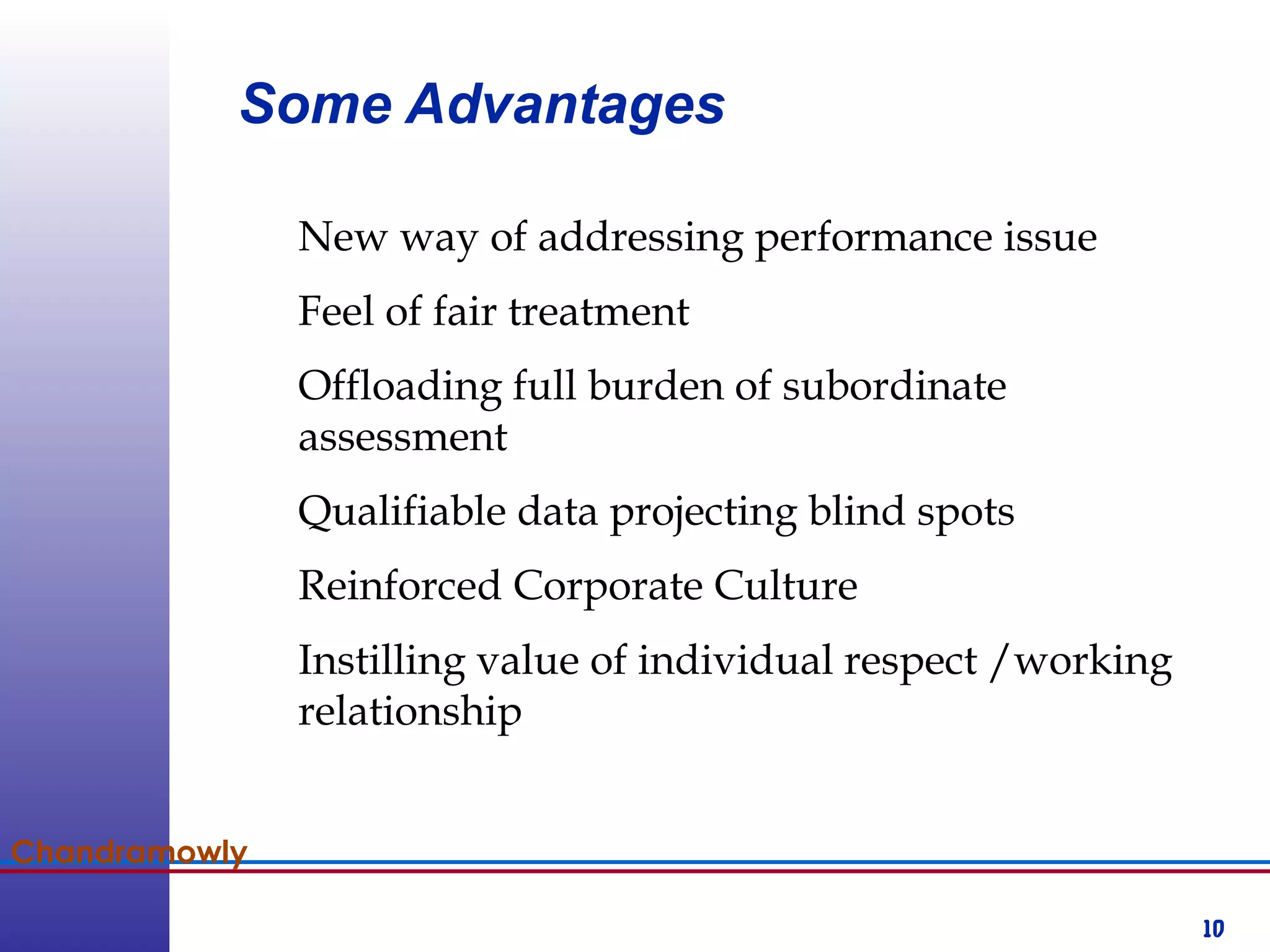
Some Advantages
New way of addressing performance issue
Feel of fair treatment
Offloading full burden of subordinate
assessment
Qualifiable data projecting blind spots
Reinforced Corporate Culture
Instilling value of individual respect /working
relationship
11
Chandramowly
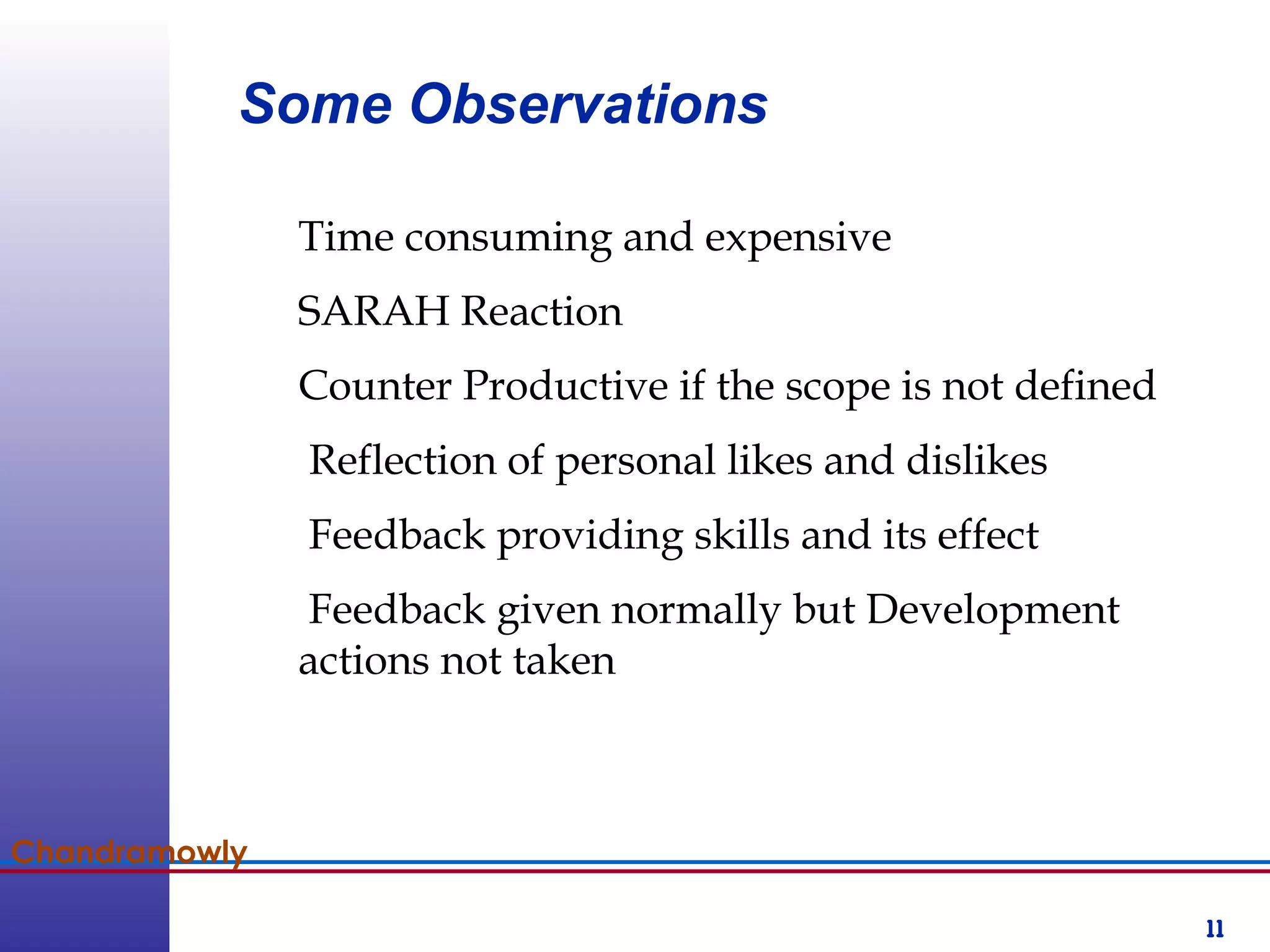
Some Observations
Time consuming and expensive
SARAH Reaction
Counter Productive if the scope is not defined
Reflection of personal likes and dislikes
Feedback providing skills and its effect
Feedback given normally but Development
actions not taken
12
Chandramowly
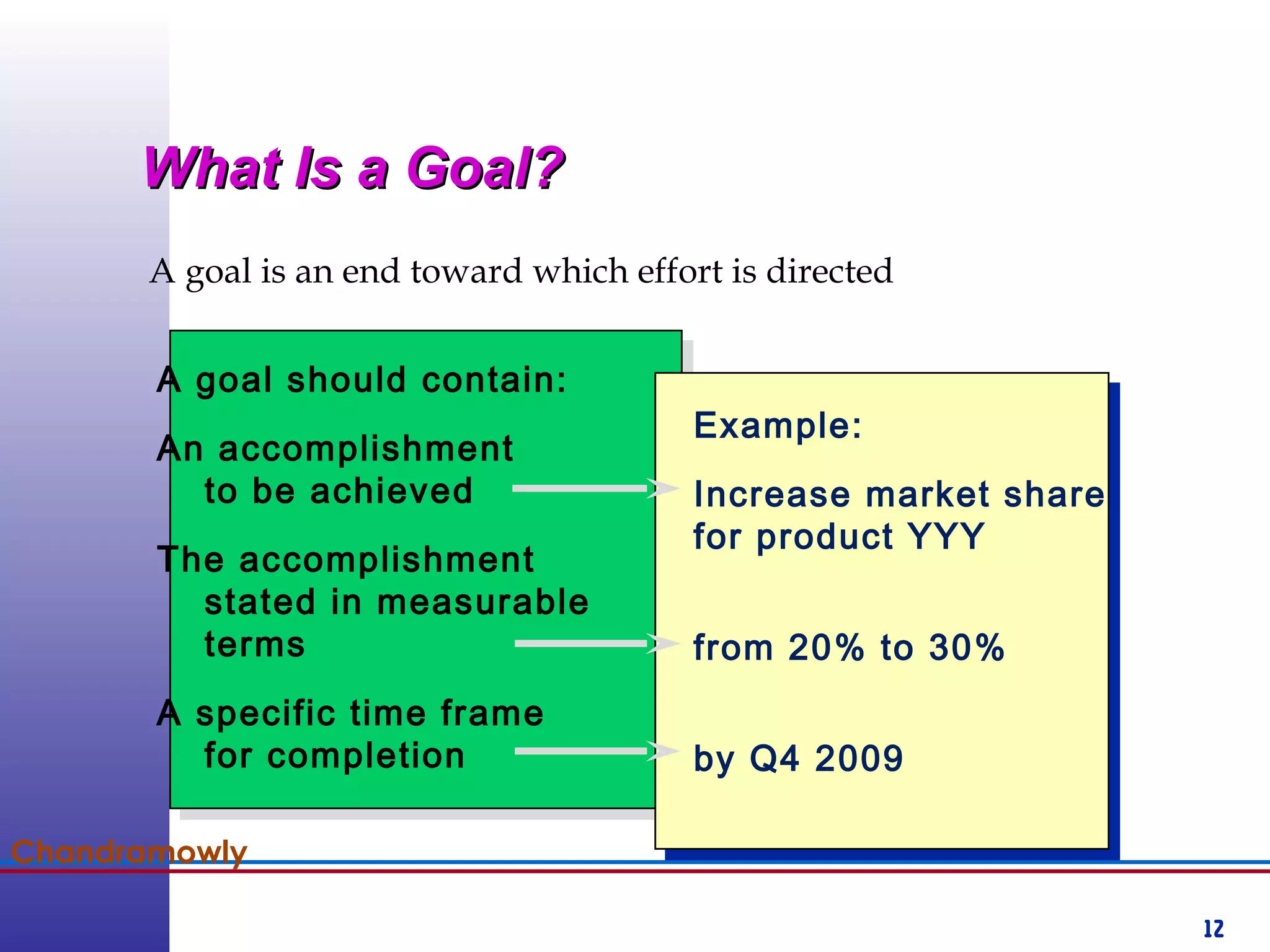
What Is a Goal?What Is a Goal?
A goal is an end toward which effort is directed
Example:
Increase market share
for product YYY
from 20% to 30%
by Q4 2009
A goal should contain:
An accomplishment
to be achieved
The accomplishment
stated in measurable
terms
A specific time frame
for completion
13
Chandramowly
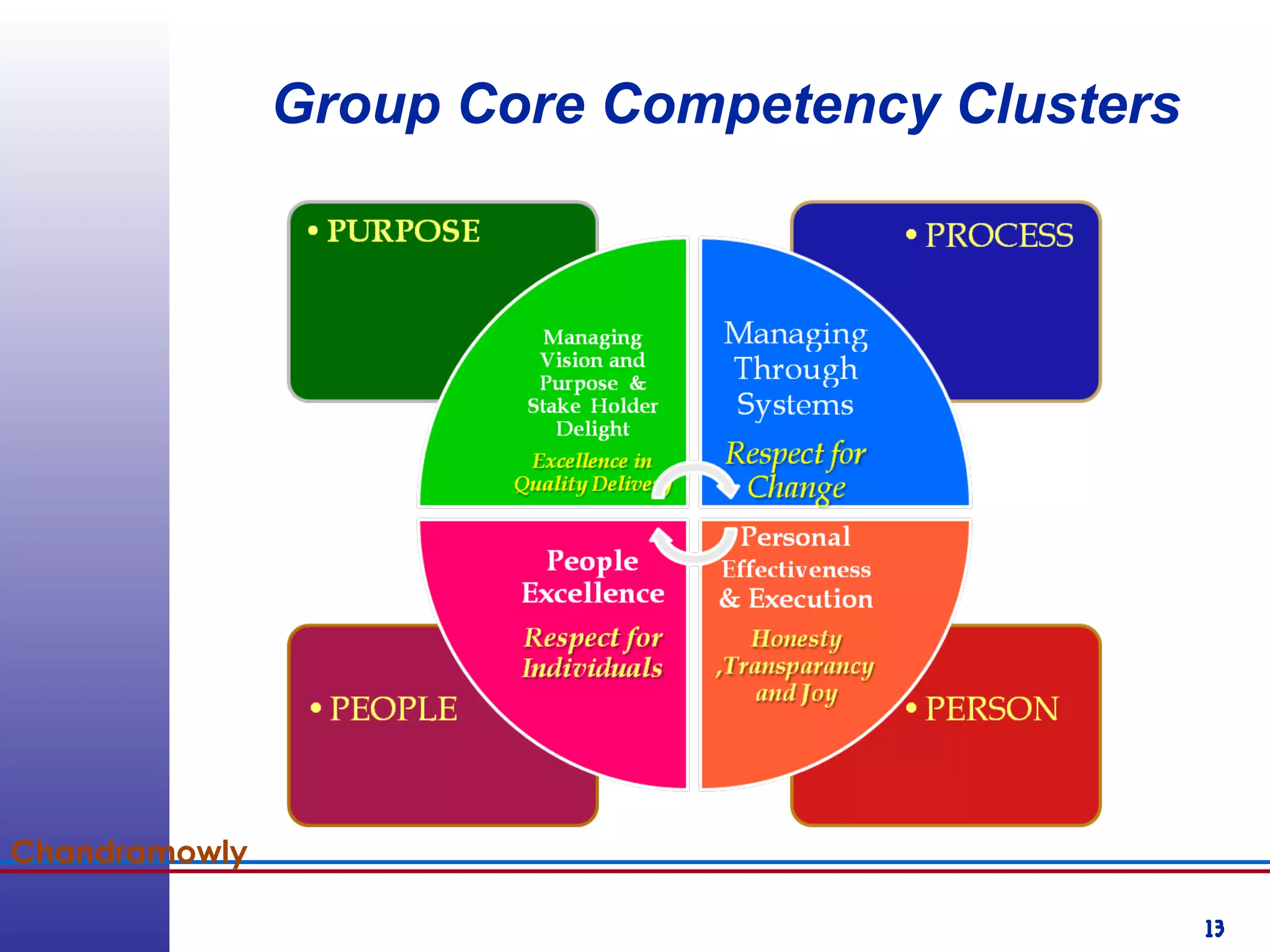
Group Core Competency Clusters
14
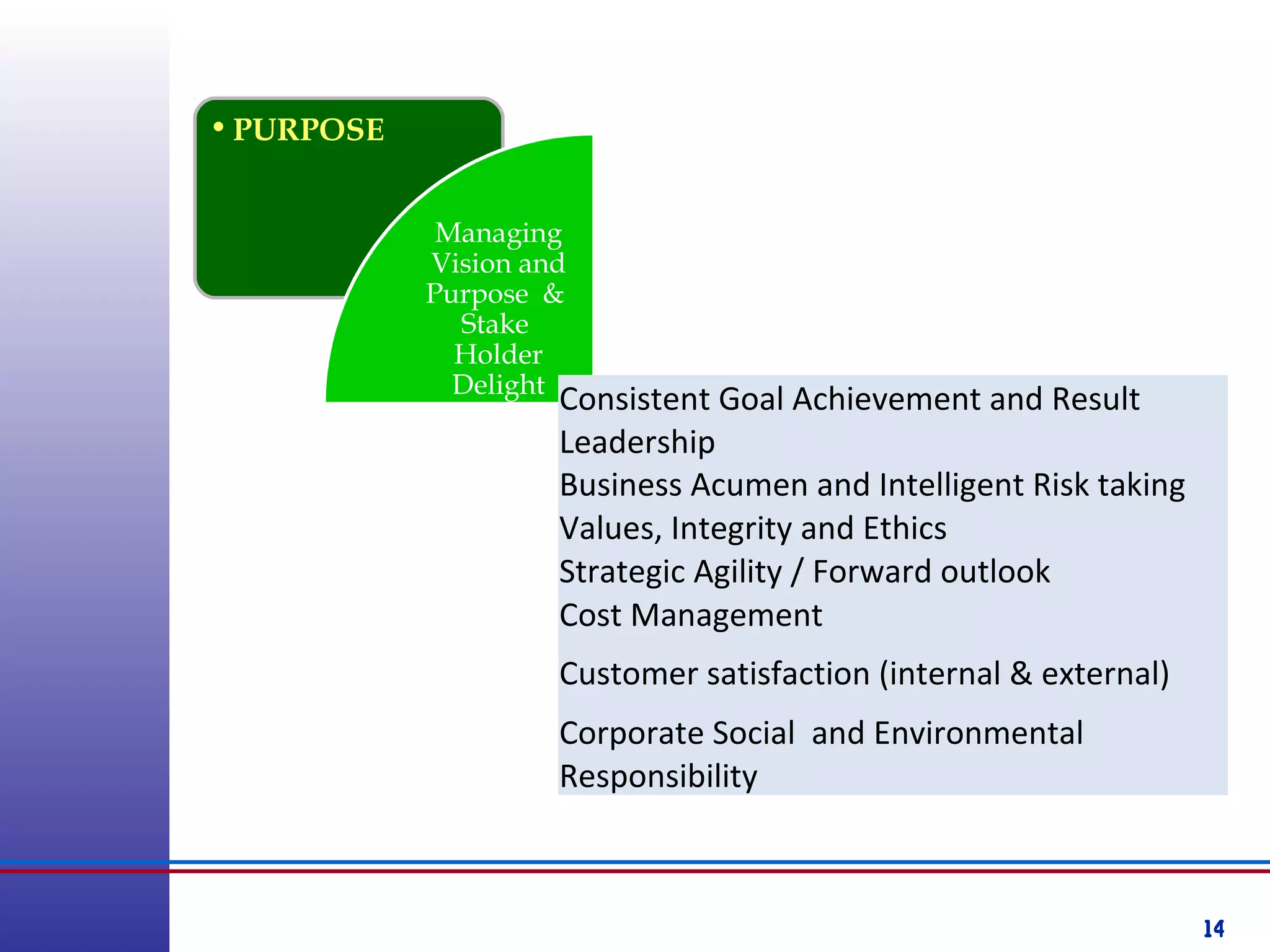
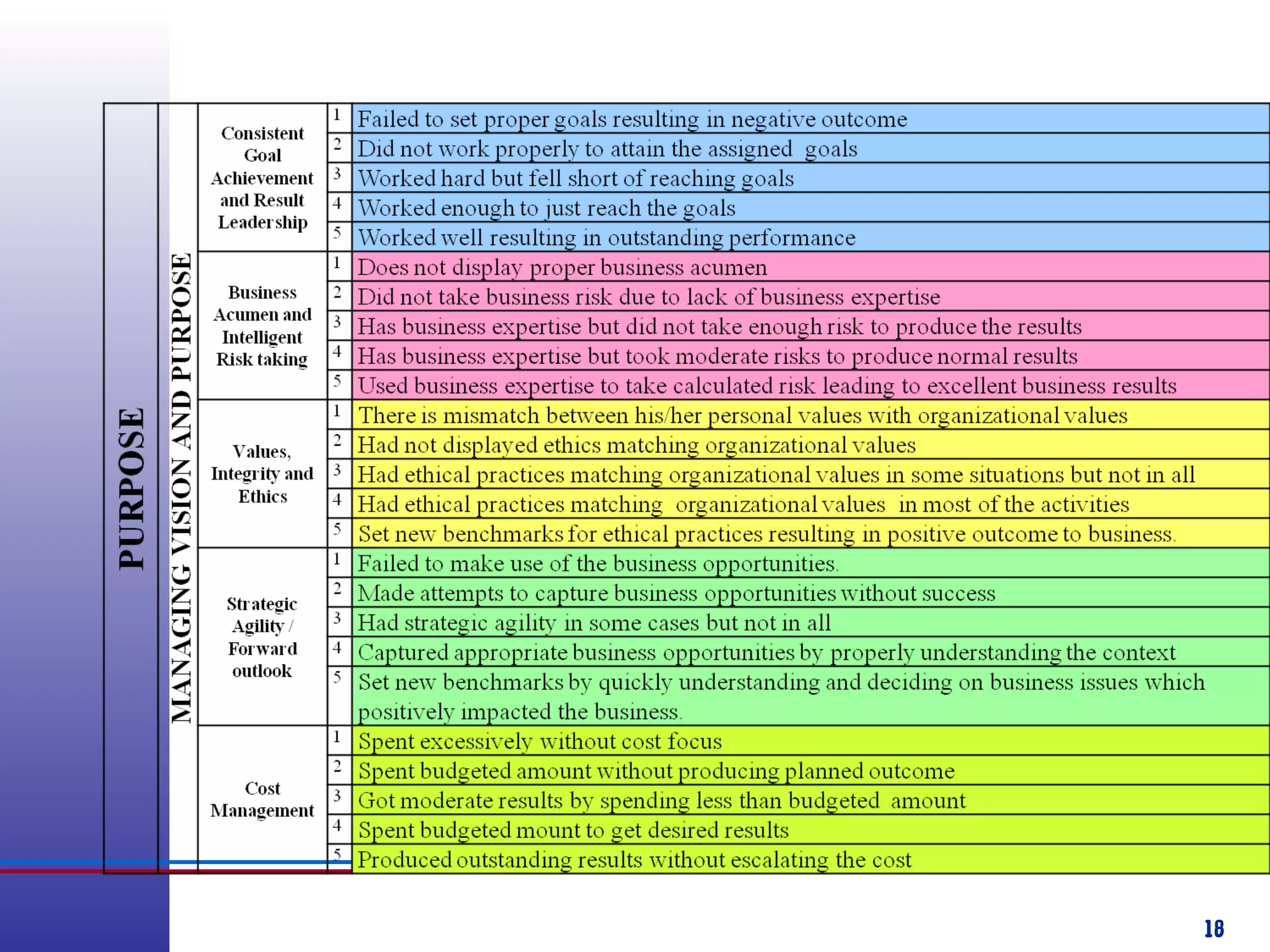
•PURPOSE
Managing
Vision and
Purpose &
Stake
Holder
Delight
Consistent Goal Achievement and Result
Leadership
Business Acumen and Intelligent Risk taking
Values, Integrity and Ethics
Strategic Agility / Forward outlook
Cost Management
Customer satisfaction (internal & external)
Corporate Social and Environmental
Responsibility
15
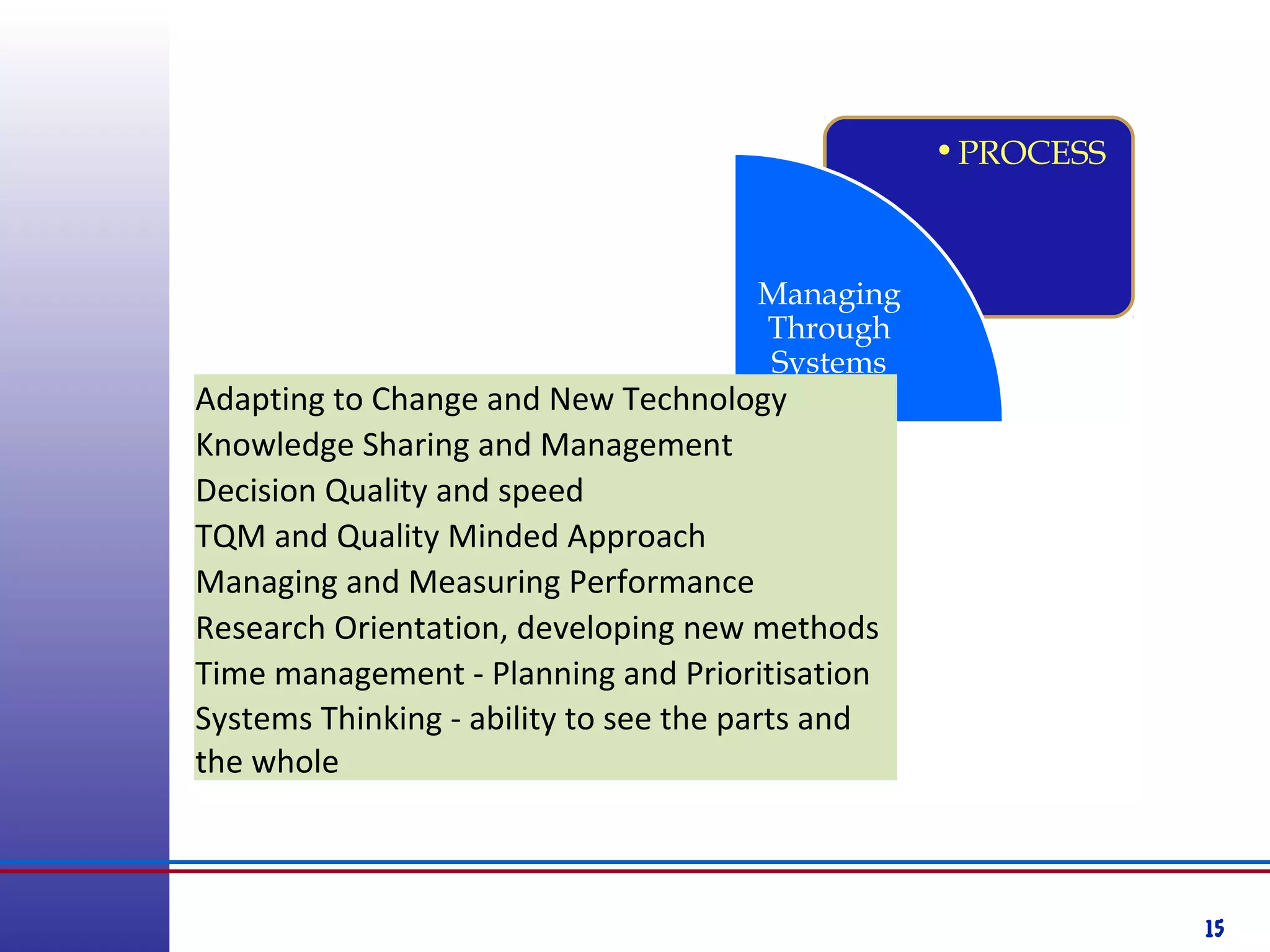
•PROCESS
Managing
Through
Systems
Adapting to Change and New Technology
Knowledge Sharing and Management
Decision Quality and speed
TQM and Quality Minded Approach
Managing and Measuring Performance
Research Orientation, developing new methods
Time management - Planning and Prioritisation
Systems Thinking - ability to see the parts and
the whole
16
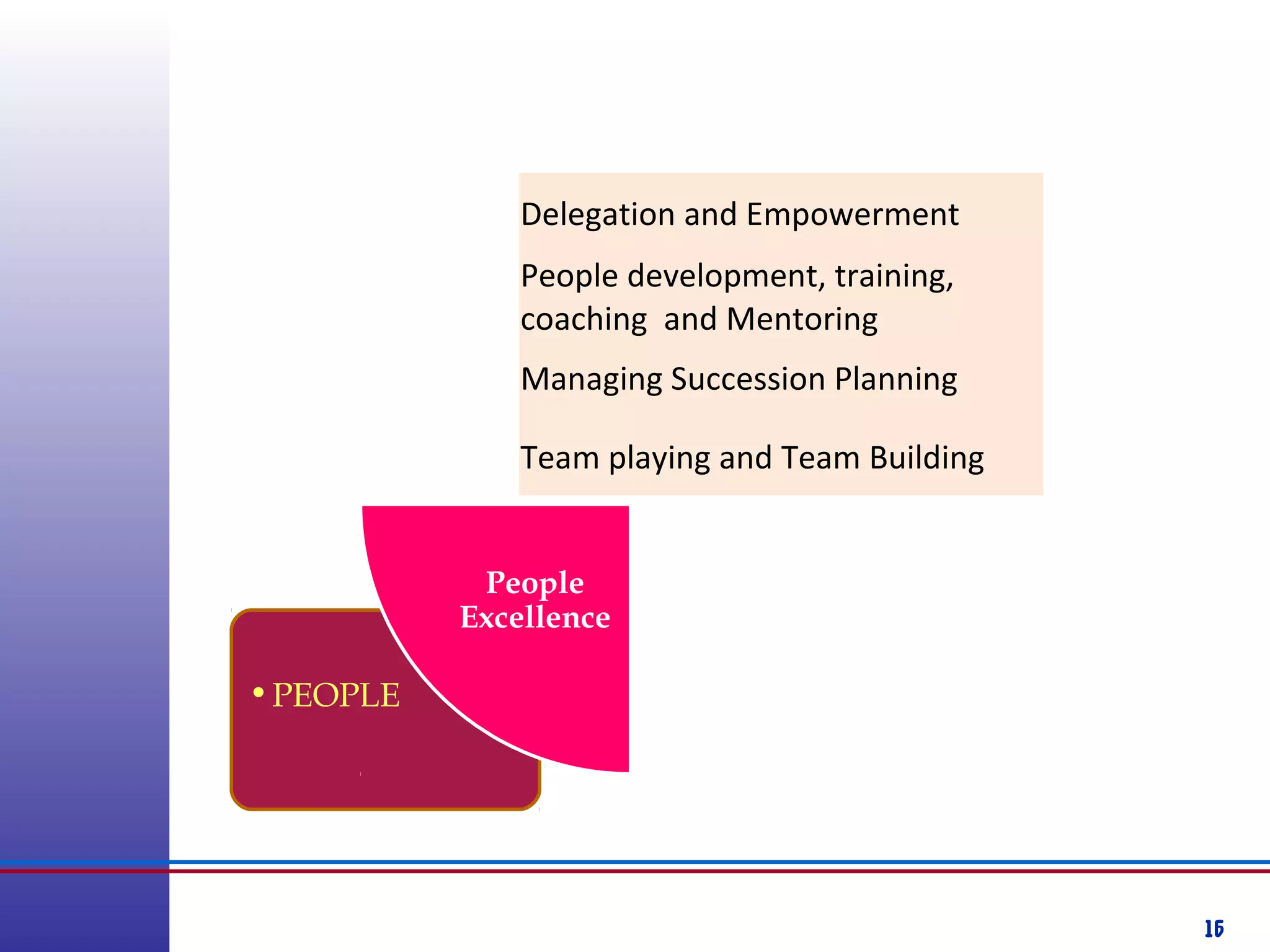
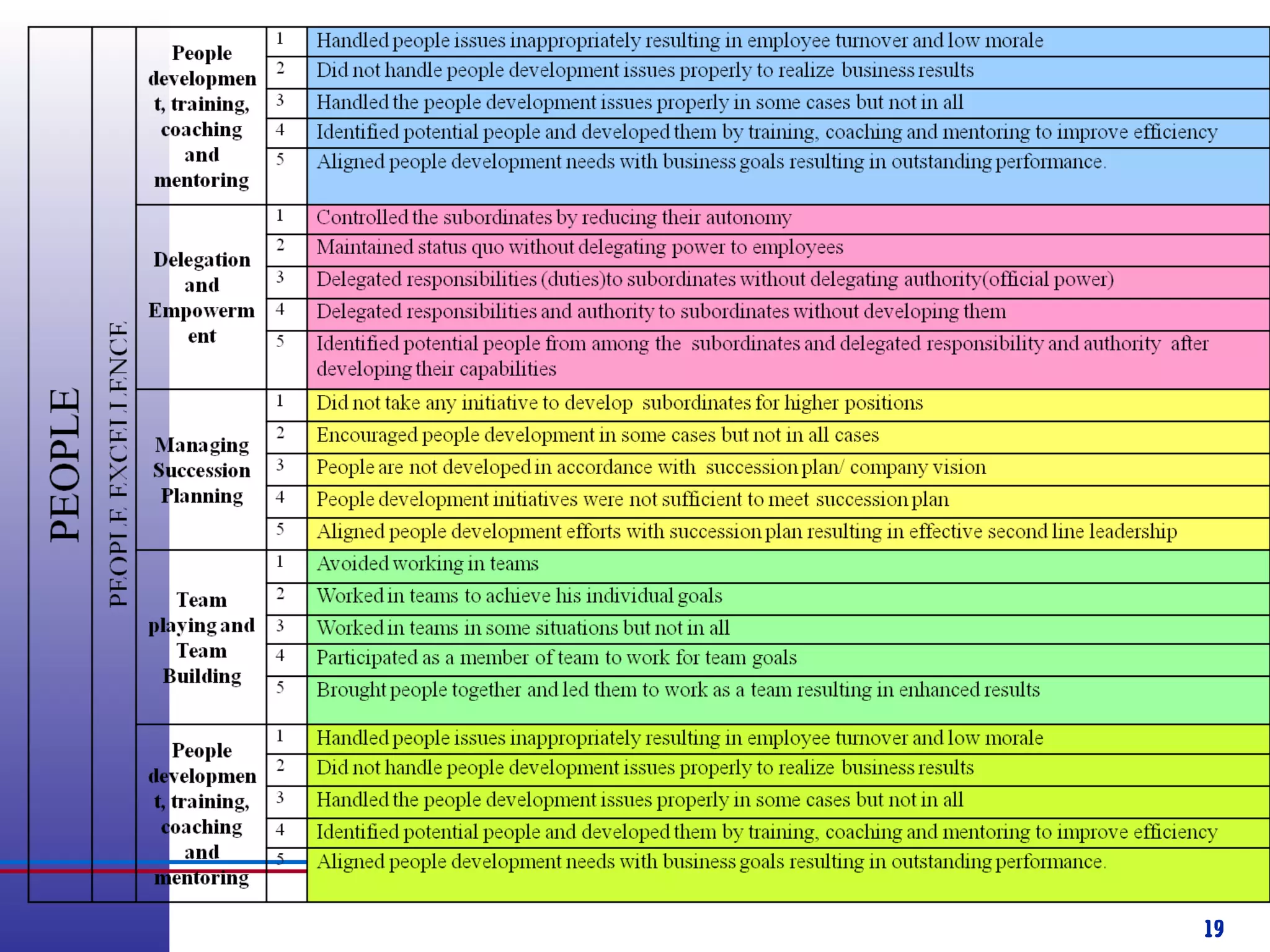
•PEOPLE
People
Excellence
Delegation and Empowerment
People development, training,
coaching and Mentoring
Managing Succession Planning
Team playing and Team Building
17
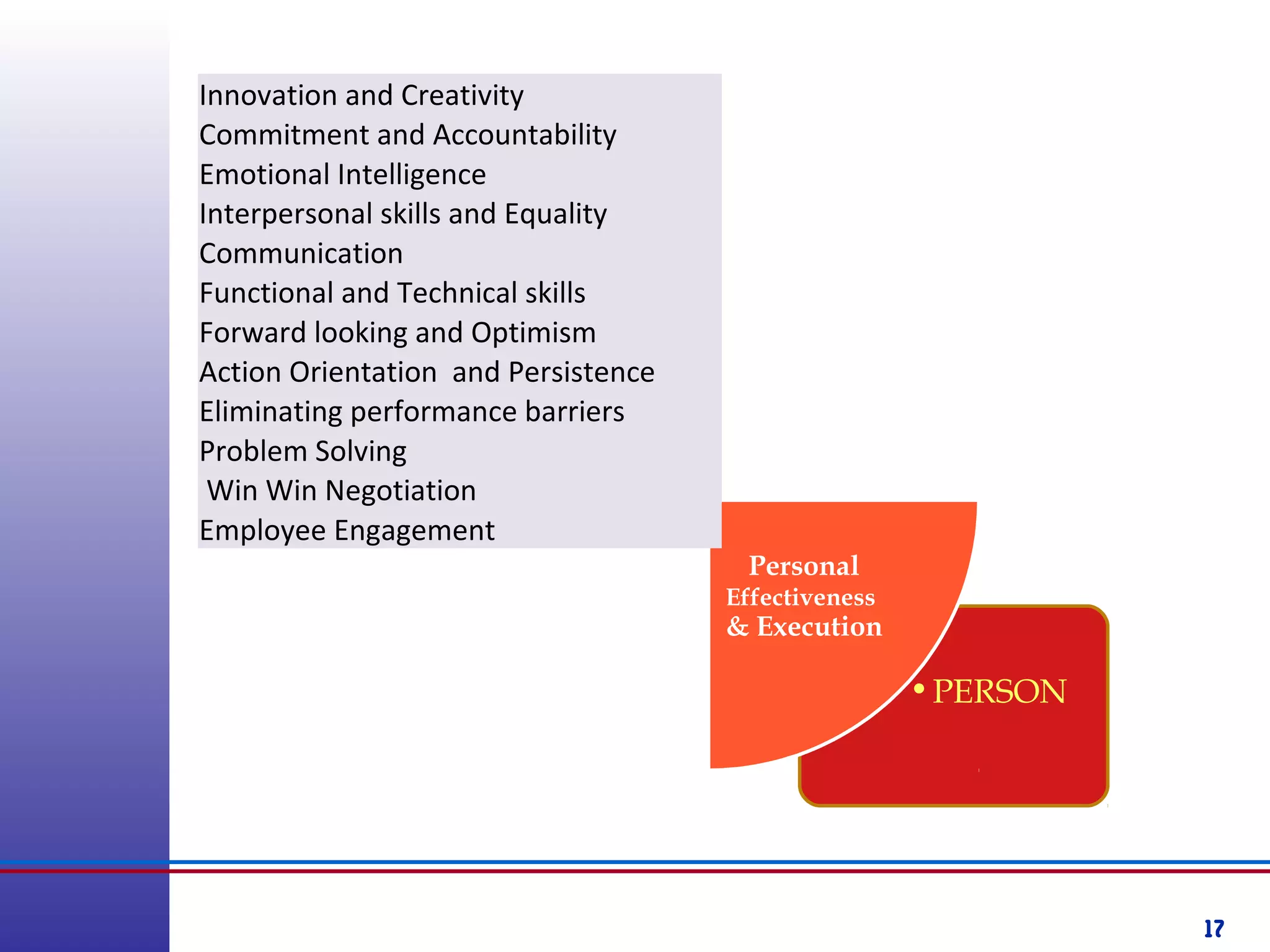
•PERSON
Personal
Effectiveness
& Execution
Innovation and Creativity
Commitment and Accountability
Emotional Intelligence
Interpersonal skills and Equality
Communication
Functional and Technical skills
Forward looking and Optimism
Action Orientation and Persistence
Eliminating performance barriers
Problem Solving
Win Win Negotiation
Employee Engagement
18
19
20
Chandramowly
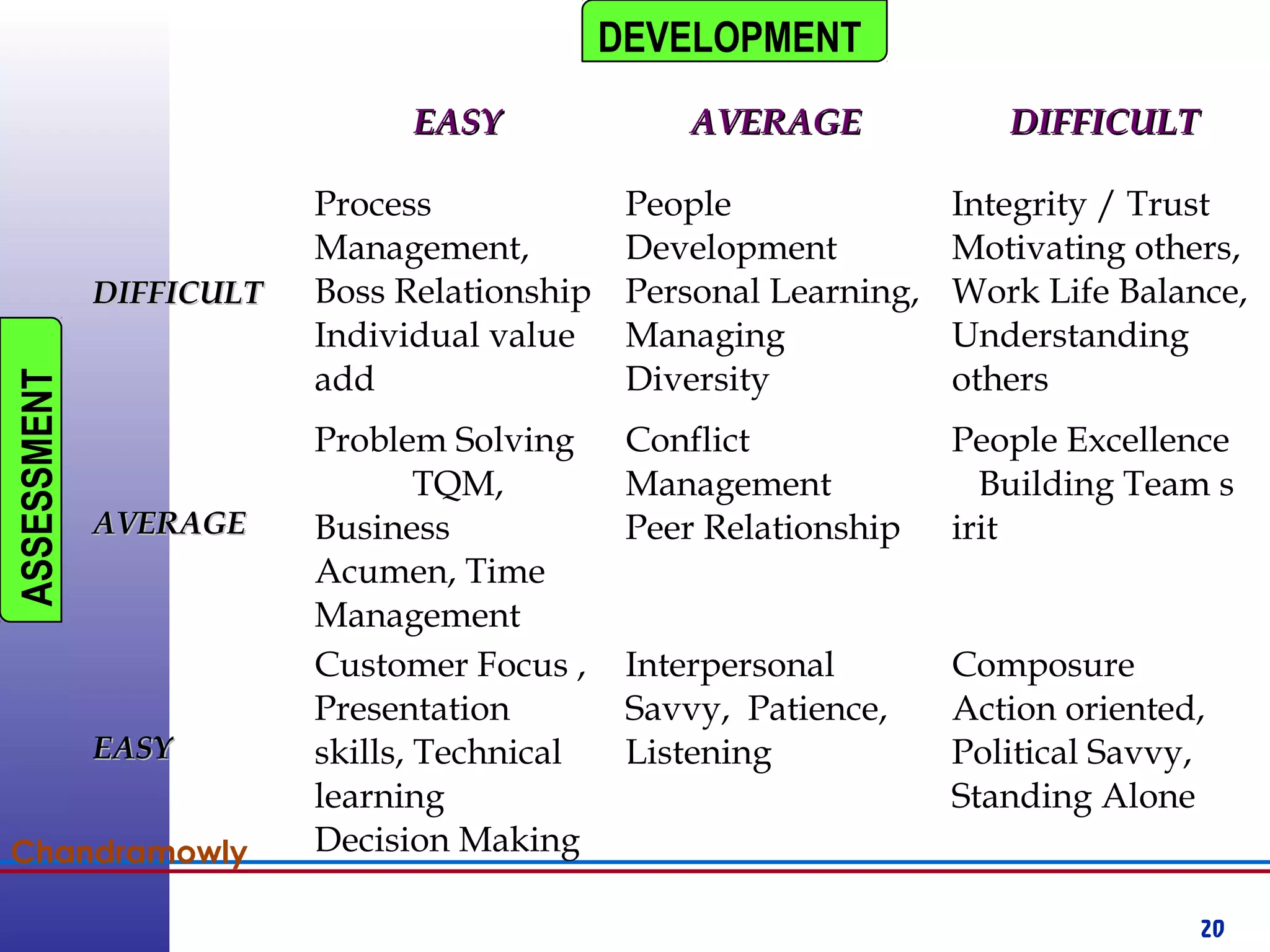
EASYEASY AVERAGEAVERAGE DIFFICULTDIFFICULT
DIFFICULTDIFFICULT
Process
Management,
Boss Relationship
Individual value
add
People
Development
Personal Learning,
Managing
Diversity
Integrity / Trust
Motivating others,
Work Life Balance,
Understanding
others
AVERAGEAVERAGE
Problem Solving
TQM,
Business
Acumen, Time
Management
Conflict
Management
Peer Relationship
People Excellence
Building Team s
irit
EASYEASY
Customer Focus ,
Presentation
skills, Technical
learning
Decision Making
Interpersonal
Savvy, Patience,
Listening
Composure
Action oriented,
Political Savvy,
Standing Alone
DEVELOPMENTASSESSMENT
21
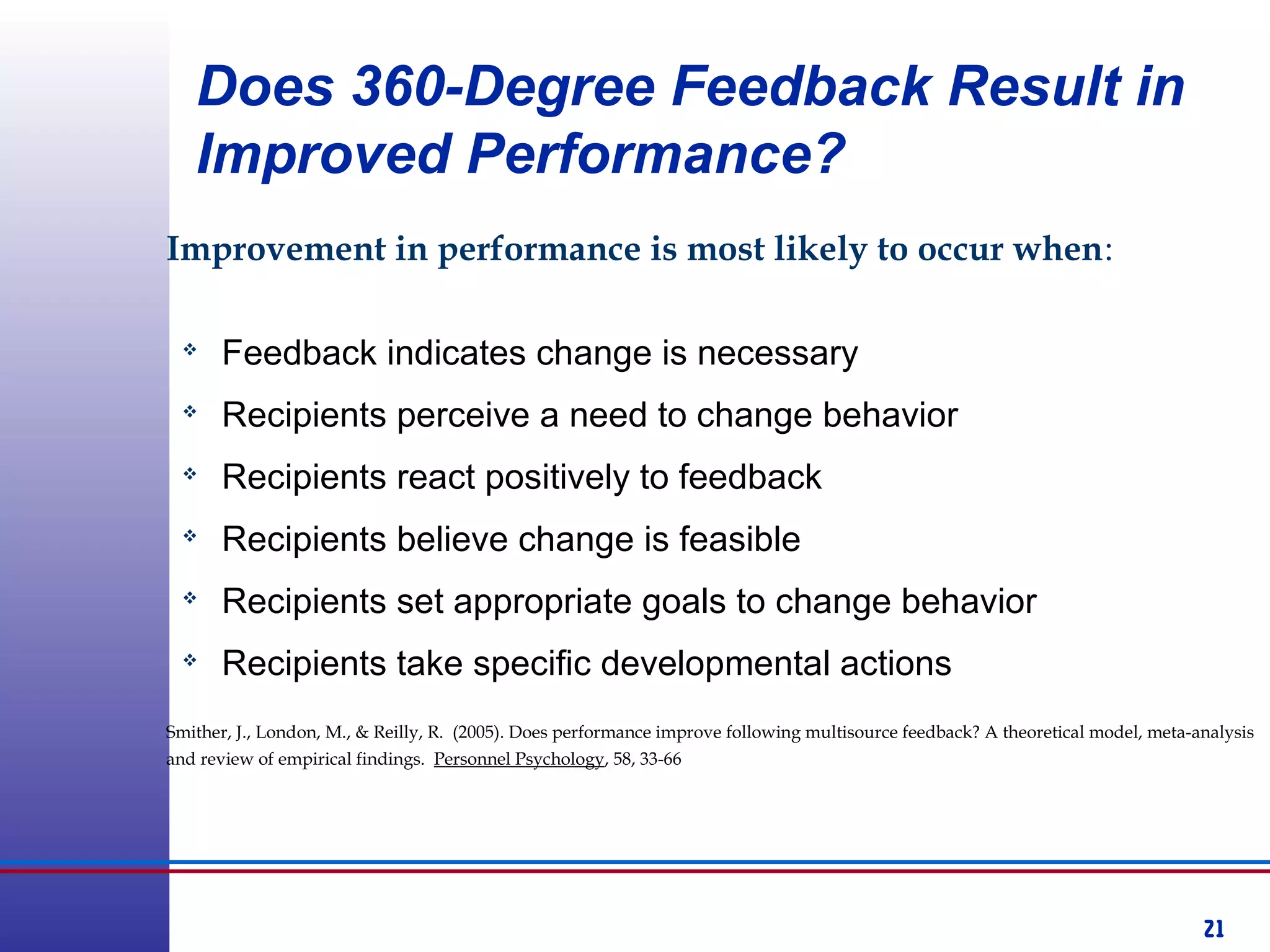
Improvement in performance is most likely to occur when:

Feedback indicates change is necessary

Recipients perceive a need to change behavior

Recipients react positively to feedback

Recipients believe change is feasible

Recipients set appropriate goals to change behavior

Recipients take specific developmental actions
Smither, J., London, M., & Reilly, R. (2005). Does performance improve following multisource feedback? A theoretical model, meta-analysis
and review of empirical findings. Personnel Psychology, 58, 33-66
Does 360-Degree Feedback Result in
Improved Performance?
22
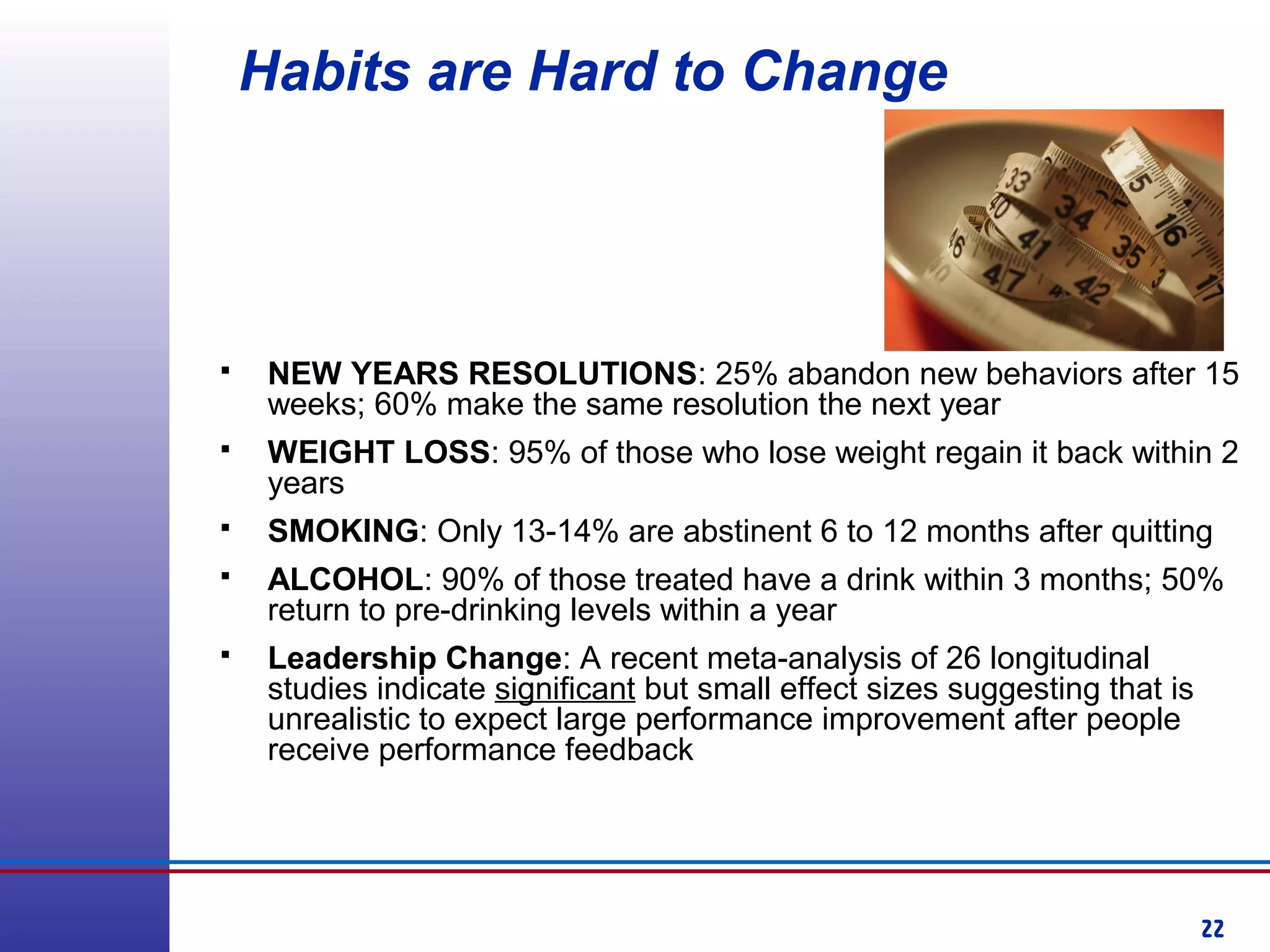
Habits are Hard to Change
 NEW YEARS RESOLUTIONS: 25% abandon new behaviors after 15
weeks; 60% make the same resolution the next year
 WEIGHT LOSS: 95% of those who lose weight regain it back within 2
years
 SMOKING: Only 13-14% are abstinent 6 to 12 months after quitting
 ALCOHOL: 90% of those treated have a drink within 3 months; 50%
return to pre-drinking levels within a year
 Leadership Change: A recent meta-analysis of 26 longitudinal
studies indicate significant but small effect sizes suggesting that is
unrealistic to expect large performance improvement after people
receive performance feedback
23
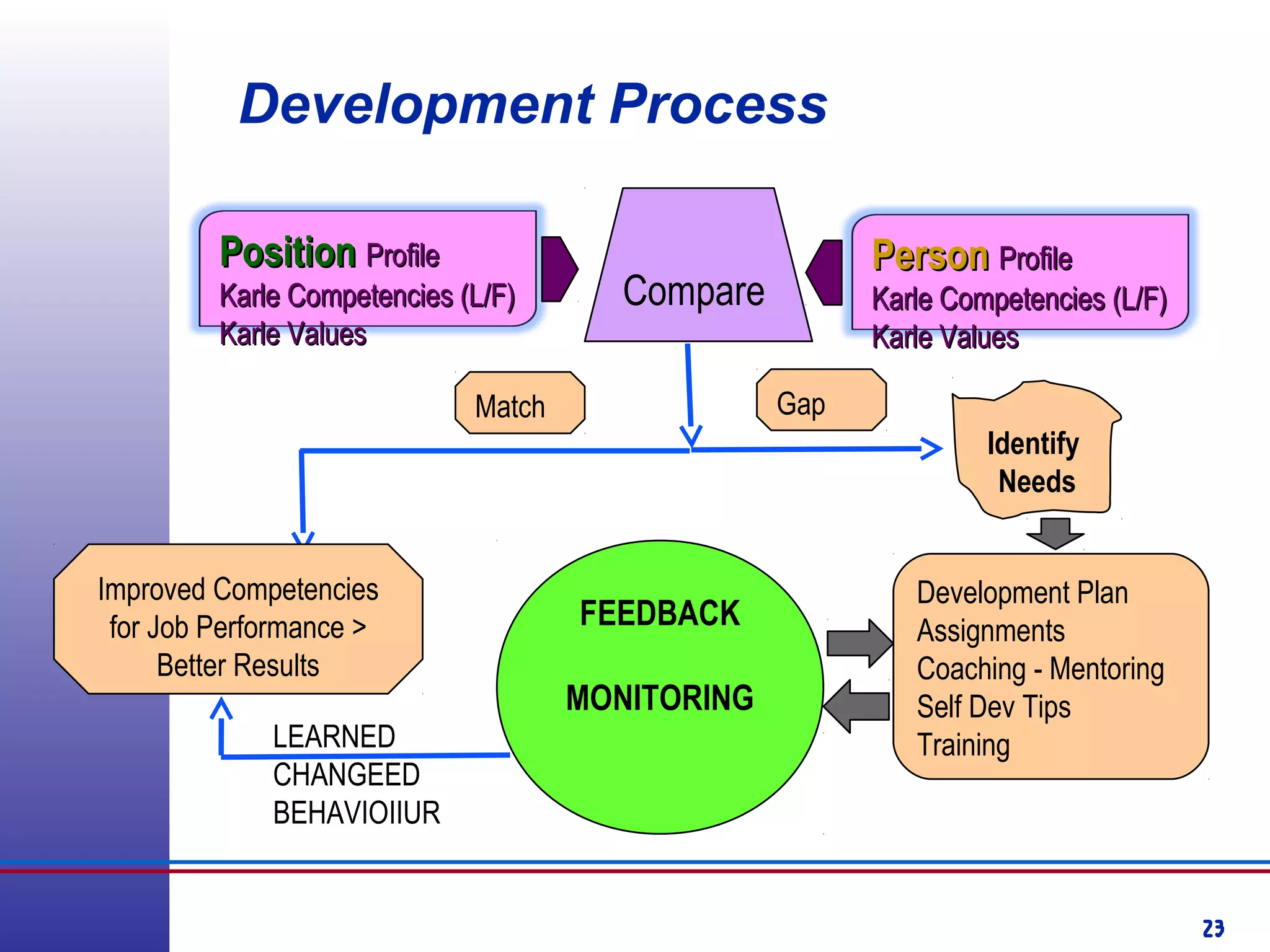
Development Process
PositionPosition ProfileProfile
Karle Competencies (L/F)Karle Competencies (L/F)
Karle ValuesKarle Values
PersonPerson ProfileProfile
Karle Competencies (L/F)Karle Competencies (L/F)
Karle ValuesKarle Values
Compare
Match Gap
Improved Competencies
for Job Performance >
Better Results
Identify
Needs
Development Plan
Assignments
Coaching - Mentoring
Self Dev Tips
Training
FEEDBACK
MONITORING
LEARNED
CHANGEED
BEHAVIOIIUR
24
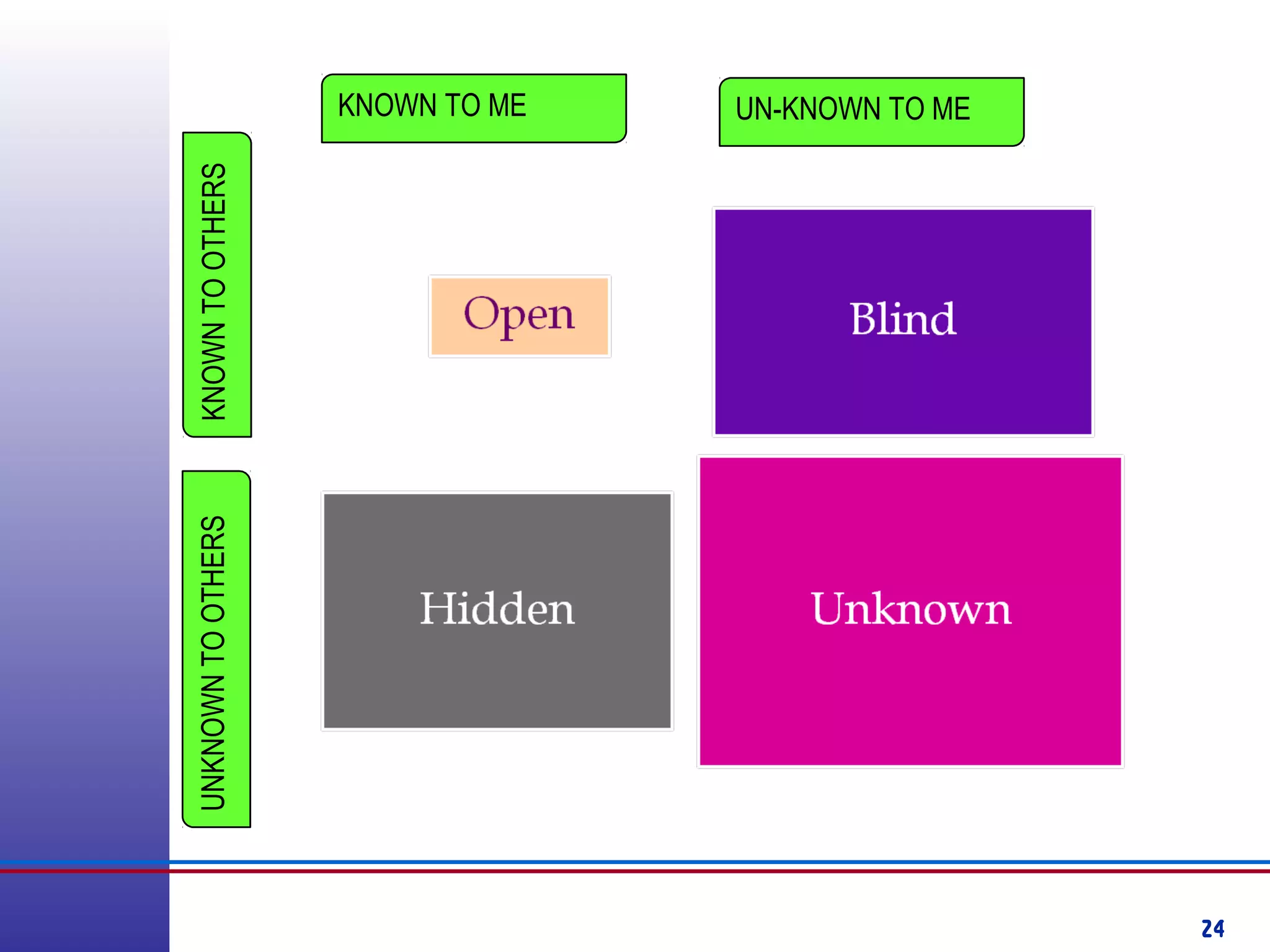
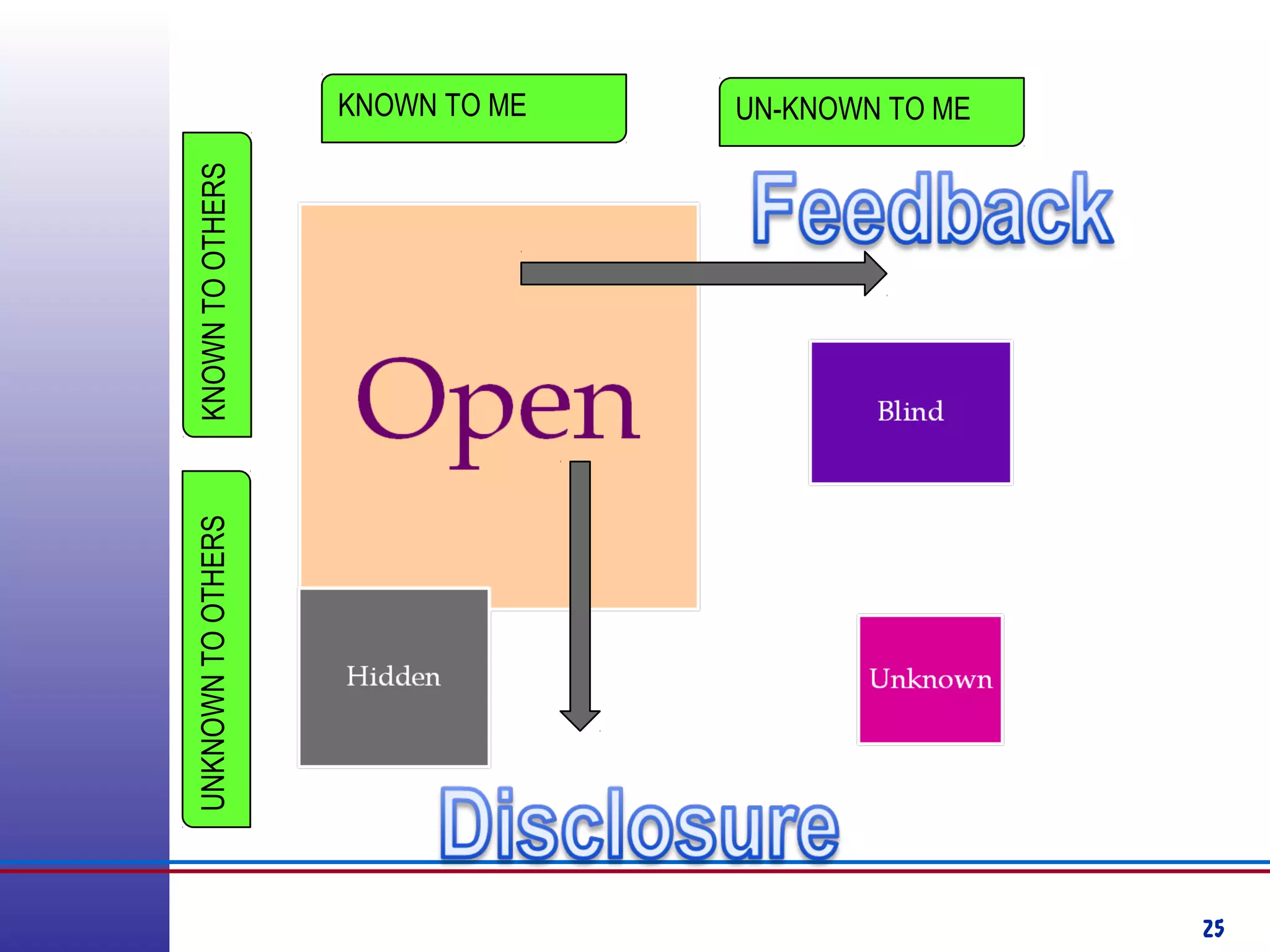
KNOWN TO ME UN-KNOWN TO ME
KNOWNTOOTHERSUNKNOWNTOOTHERS
25
KNOWN TO ME UN-KNOWN TO ME
KNOWNTOOTHERSUNKNOWNTOOTHERS
26
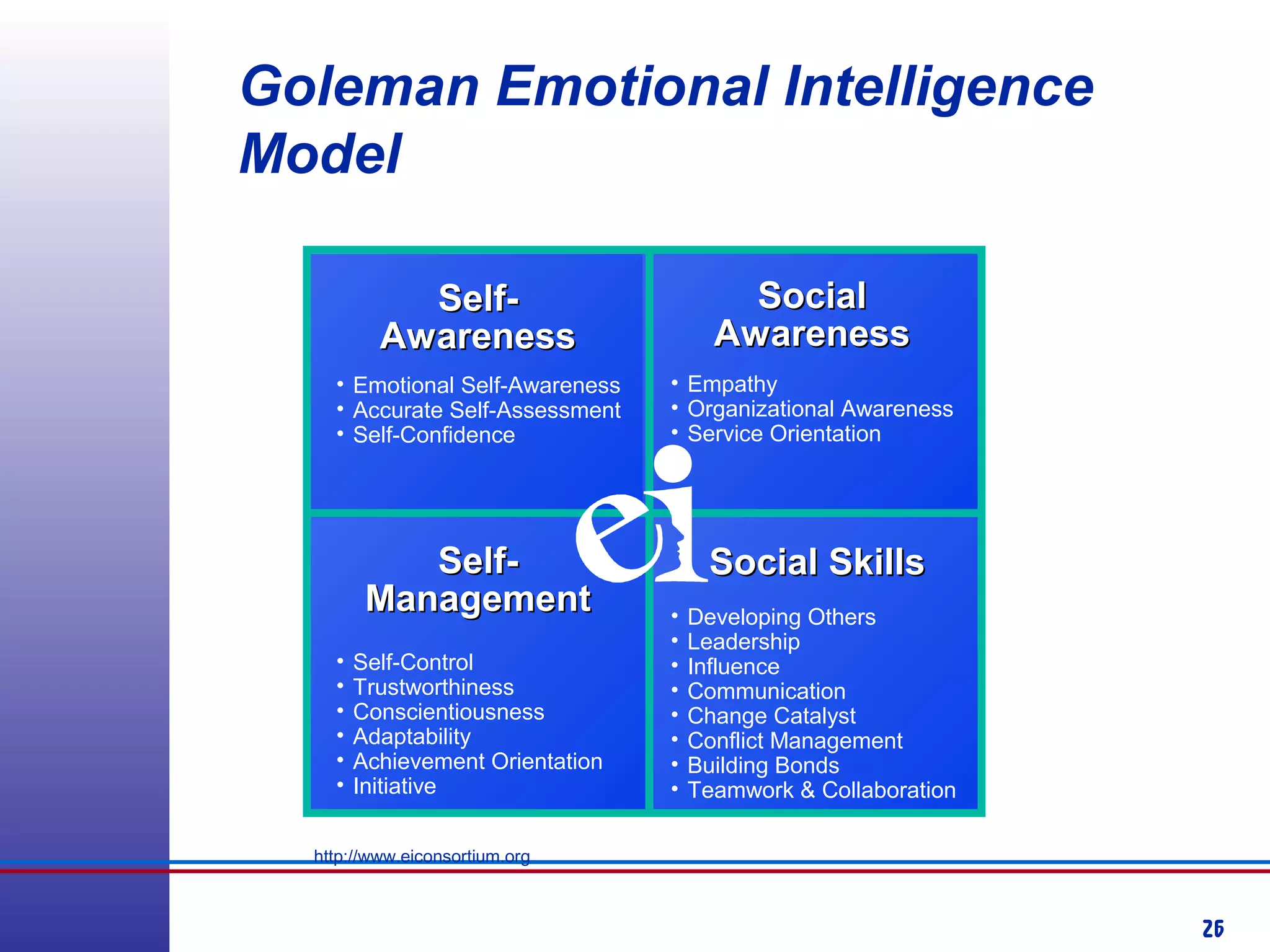
Self-Self-
AwarenessAwareness
SocialSocial
AwarenessAwareness
Social SkillsSocial SkillsSelf-Self-
ManagementManagement
• Emotional Self-Awareness
• Accurate Self-Assessment
• Self-Confidence
• Empathy
• Organizational Awareness
• Service Orientation
• Self-Control
• Trustworthiness
• Conscientiousness
• Adaptability
• Achievement Orientation
• Initiative
• Developing Others
• Leadership
• Influence
• Communication
• Change Catalyst
• Conflict Management
• Building Bonds
• Teamwork & Collaboration
Goleman Emotional Intelligence
Model
http://www.eiconsortium.org
27
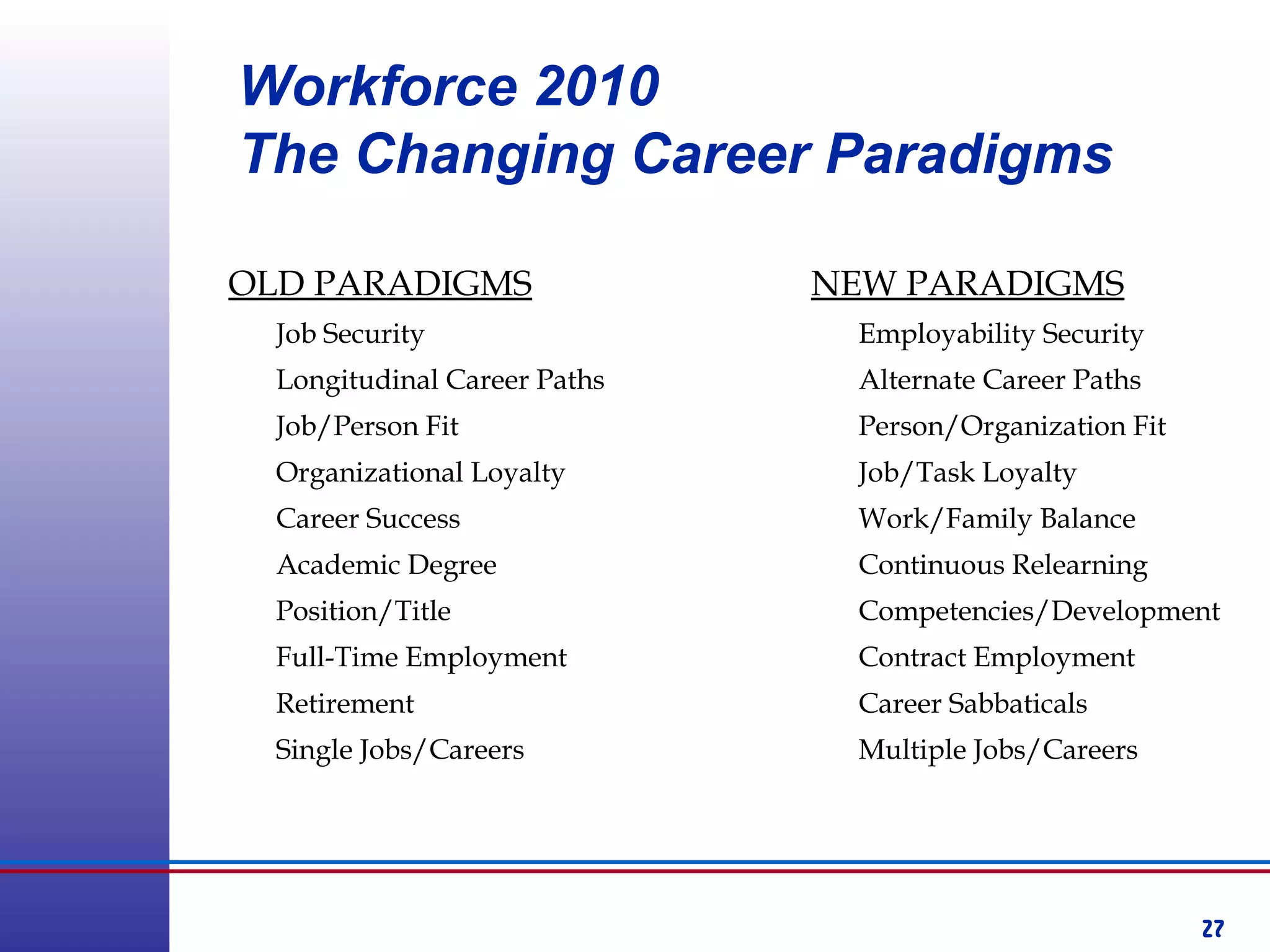
OLD PARADIGMS
Job Security
Longitudinal Career Paths
Job/Person Fit
Organizational Loyalty
Career Success
Academic Degree
Position/Title
Full-Time Employment
Retirement
Single Jobs/Careers
NEW PARADIGMS
Employability Security
Alternate Career Paths
Person/Organization Fit
Job/Task Loyalty
Work/Family Balance
Continuous Relearning
Competencies/Development
Contract Employment
Career Sabbaticals
Multiple Jobs/Careers
Workforce 2010
The Changing Career Paradigms
28
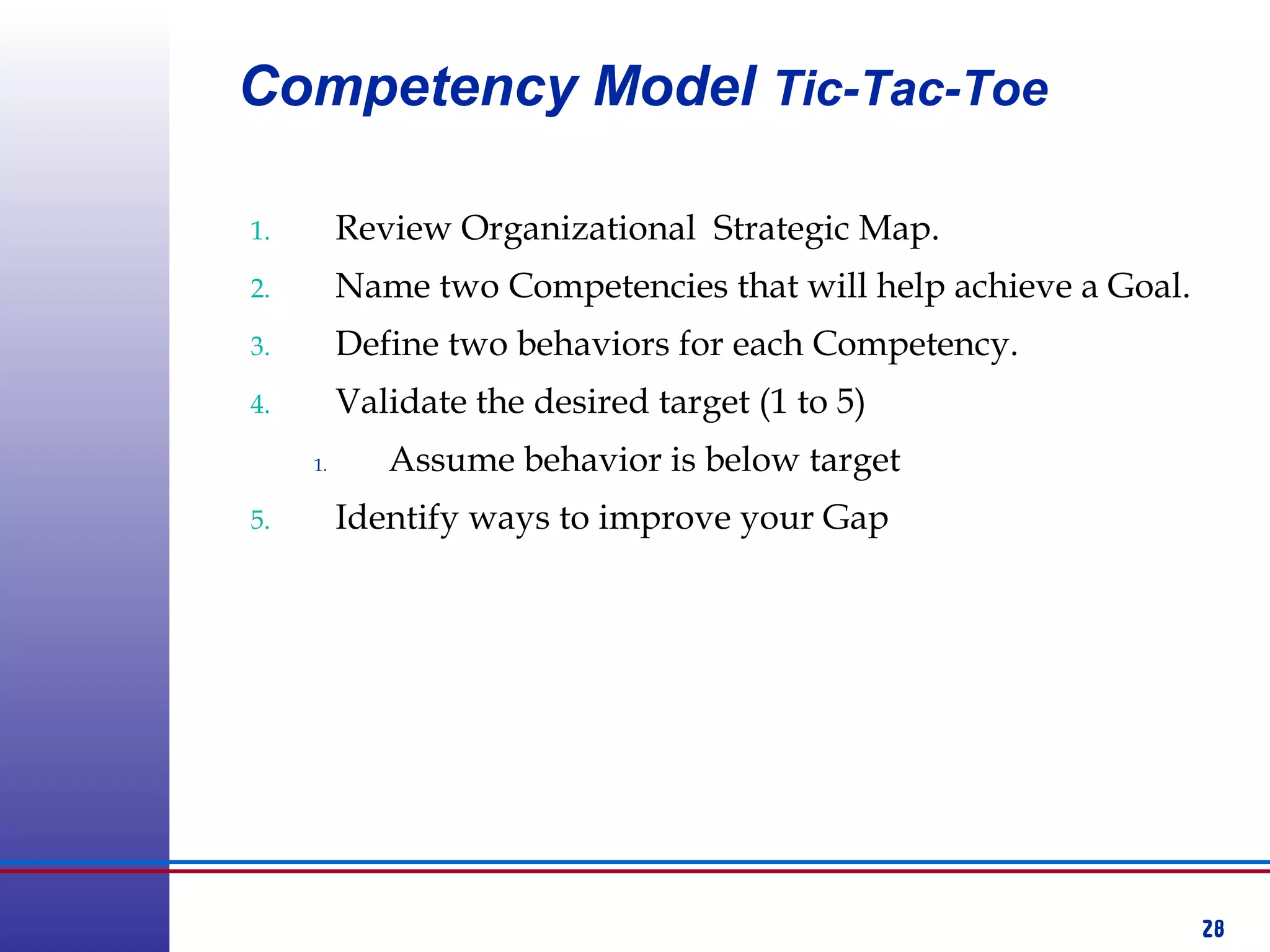
Competency Model Tic-Tac-Toe
1. Review Organizational Strategic Map.
2. Name two Competencies that will help achieve a Goal.
3. Define two behaviors for each Competency.
4. Validate the desired target (1 to 5)
1. Assume behavior is below target
5. Identify ways to improve your Gap
29
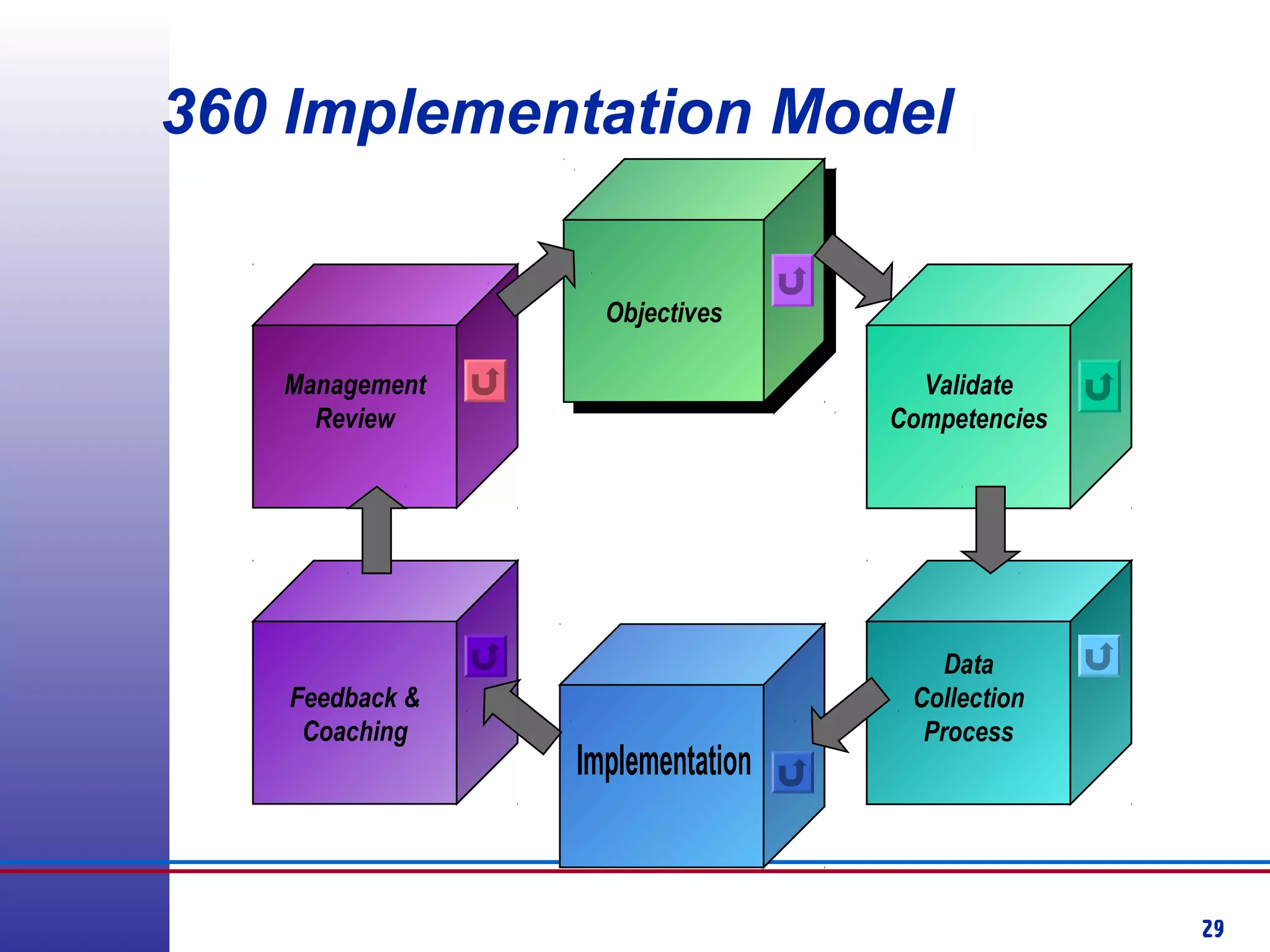
360 Implementation Model
ObjectivesObjectives
Validate
Competencies
Data
Collection
Process
Management
Review
Feedback &
Coaching
30
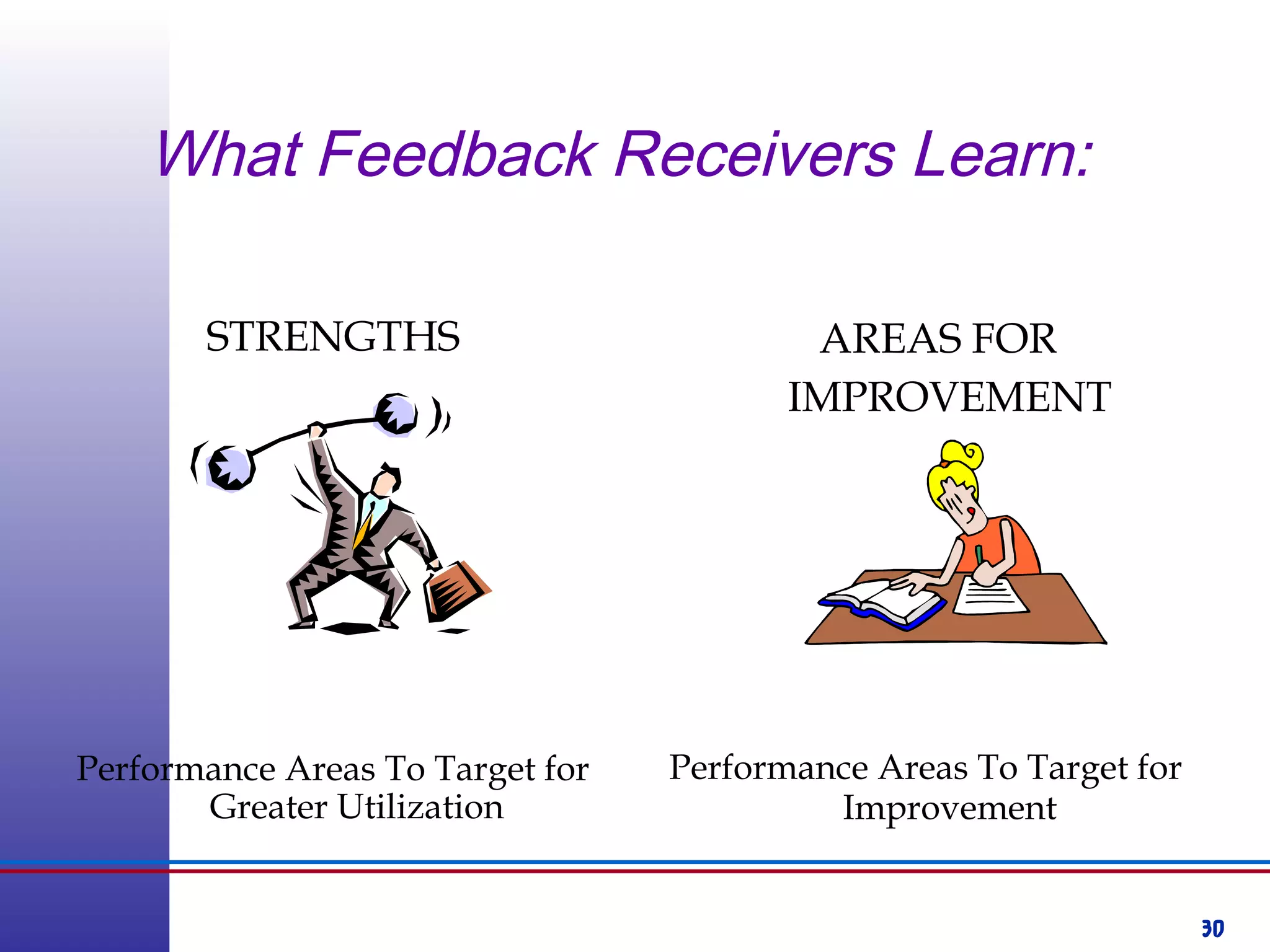
STRENGTHS
Performance Areas To Target for
Greater Utilization
AREAS FOR
IMPROVEMENT
Performance Areas To Target for
Improvement
What Feedback Receivers Learn:
31
Summary Questions
 What are one or two practices that make
this person effective in his or her role at the
oganisation? Sight an Example
 Describe any changes you believe are
important for this person to work more
effectively with you.
 Are there any other comments that
would be helpful?
32
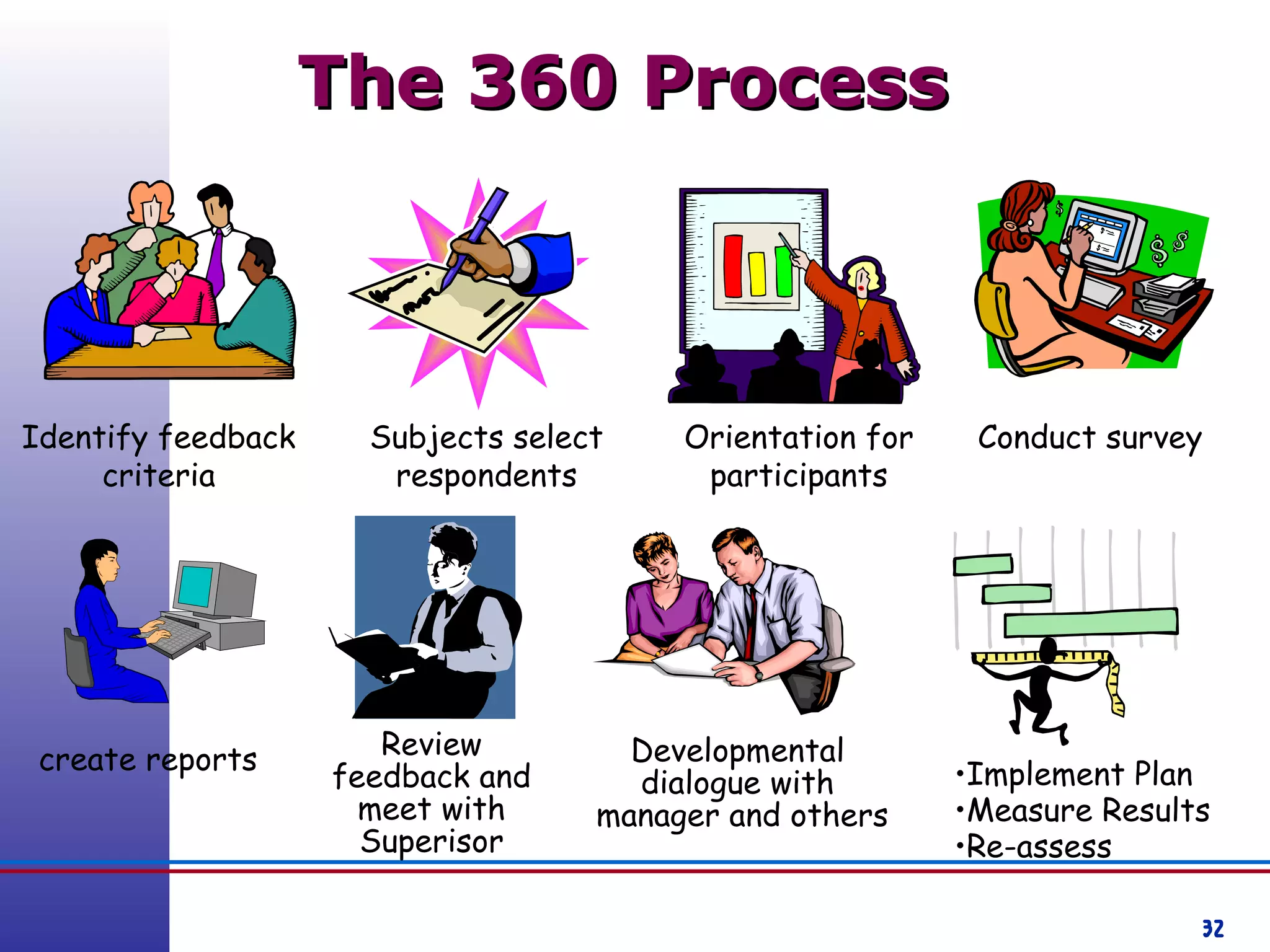
Identify feedback
criteria
Orientation for
participants
Subjects select
respondents
Conduct survey
create reports Review
feedback and
meet with
Superisor
Developmental
dialogue with
manager and others
•Implement Plan
•Measure Results
•Re-assess
The 360 ProcessThe 360 Process
33
What Do We Measure?
Observable Values and behaviors based on
competencies identified for
34
• Develops an awareness of the impact that his
or her actions have on others.
• Validates self-perceptions of strengths and
weaknesses.
• Provides information for professional
development.
How does 360 benefit the
feedback receiver?
35
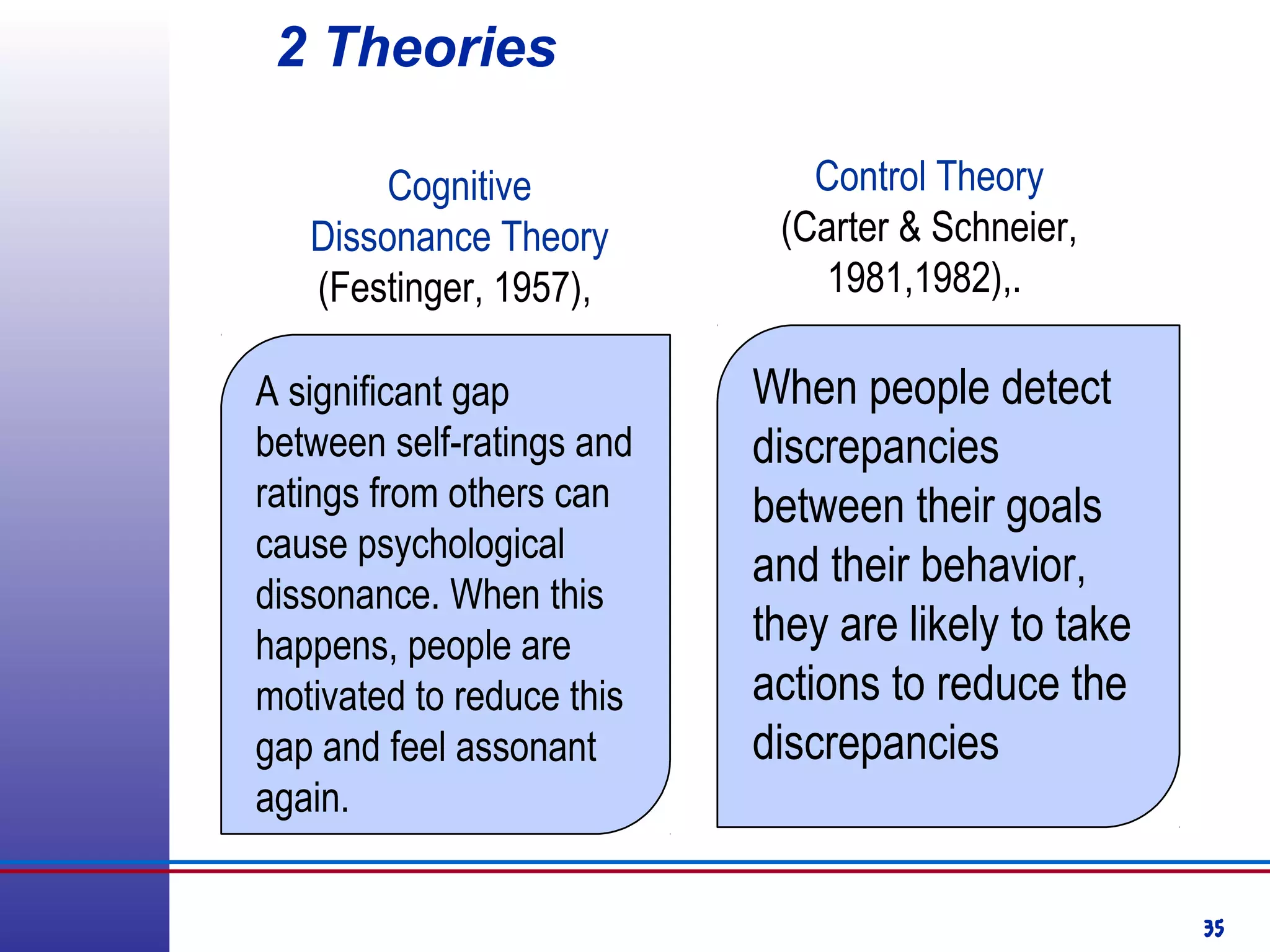
2 Theories
A significant gap
between self-ratings and
ratings from others can
cause psychological
dissonance. When this
happens, people are
motivated to reduce this
gap and feel assonant
again.
When people detect
discrepancies
between their goals
and their behavior,
they are likely to take
actions to reduce the
discrepancies
Cognitive
Dissonance Theory
(Festinger, 1957),
Control Theory
(Carter & Schneier,
1981,1982),.

Competency based feedback system workshop slides chadramowly

  • 1.
  • 2.
  • 3.
  • 4.
    4 Chandramowly Companies using 360degree performance appraisals Bellcore International Ltd(1998) Johnson & Johnson Ltd(1980s) Praxair 1996 Xerox (1980s) IBM (1980) Bell Atlantic (1980)
  • 5.
  • 6.
    6 Peers and directreports: will see how things are going PLUS Supervisor: will see what is being done The 360 provides a way to integrate the two views
  • 7.
    7 What is 360Degree Feedback ?? 360-degree feedback is defined as “The systematic collection and feedback of performance data on an individual or group derived from a number of stakeholders in their performance”.
  • 8.
    8 To facilitate theimplementation of a professionalTo facilitate the implementation of a professional development plandevelopment plan To identify skill strengths development needs toTo identify skill strengths development needs to enhance job performanceenhance job performance To provide participants with feedback andTo provide participants with feedback and developmental recommendationsdevelopmental recommendations 360-Degree Process Objectives
  • 9.
    9 360 Feedback Process Participant Respondent 1.Jointly Selects Raters 2. Fills out name 3. Attends Feedback Review 1. Jointly Selects Raters 2. Fills out name 3. Attends Feedback Review 1. Receives Questionnaire 2. Fills out Survey (submit) 1. Receives Questionnaire 2. Fills out Survey (submit) Manager 1. Receives Report 2. Hold Feedback Review 3. Create Improvement Plan 1. Receives Report 2. Hold Feedback Review 3. Create Improvement Plan 1. Receives Reports 2. Tracks for Filled KLFS 3. Generates Reports 4. Shares it with HOD 1. Receives Reports 2. Tracks for Filled KLFS 3. Generates Reports 4. Shares it with HOD Admin HR
  • 10.
    10 Chandramowly Some Advantages New wayof addressing performance issue Feel of fair treatment Offloading full burden of subordinate assessment Qualifiable data projecting blind spots Reinforced Corporate Culture Instilling value of individual respect /working relationship
  • 11.
    11 Chandramowly Some Observations Time consumingand expensive SARAH Reaction Counter Productive if the scope is not defined Reflection of personal likes and dislikes Feedback providing skills and its effect Feedback given normally but Development actions not taken
  • 12.
    12 Chandramowly What Is aGoal?What Is a Goal? A goal is an end toward which effort is directed Example: Increase market share for product YYY from 20% to 30% by Q4 2009 A goal should contain: An accomplishment to be achieved The accomplishment stated in measurable terms A specific time frame for completion
  • 13.
  • 14.
    14 •PURPOSE Managing Vision and Purpose & Stake Holder Delight ConsistentGoal Achievement and Result Leadership Business Acumen and Intelligent Risk taking Values, Integrity and Ethics Strategic Agility / Forward outlook Cost Management Customer satisfaction (internal & external) Corporate Social and Environmental Responsibility
  • 15.
    15 •PROCESS Managing Through Systems Adapting to Changeand New Technology Knowledge Sharing and Management Decision Quality and speed TQM and Quality Minded Approach Managing and Measuring Performance Research Orientation, developing new methods Time management - Planning and Prioritisation Systems Thinking - ability to see the parts and the whole
  • 16.
    16 •PEOPLE People Excellence Delegation and Empowerment Peopledevelopment, training, coaching and Mentoring Managing Succession Planning Team playing and Team Building
  • 17.
    17 •PERSON Personal Effectiveness & Execution Innovation andCreativity Commitment and Accountability Emotional Intelligence Interpersonal skills and Equality Communication Functional and Technical skills Forward looking and Optimism Action Orientation and Persistence Eliminating performance barriers Problem Solving Win Win Negotiation Employee Engagement
  • 18.
  • 19.
  • 20.
    20 Chandramowly EASYEASY AVERAGEAVERAGE DIFFICULTDIFFICULT DIFFICULTDIFFICULT Process Management, BossRelationship Individual value add People Development Personal Learning, Managing Diversity Integrity / Trust Motivating others, Work Life Balance, Understanding others AVERAGEAVERAGE Problem Solving TQM, Business Acumen, Time Management Conflict Management Peer Relationship People Excellence Building Team s irit EASYEASY Customer Focus , Presentation skills, Technical learning Decision Making Interpersonal Savvy, Patience, Listening Composure Action oriented, Political Savvy, Standing Alone DEVELOPMENTASSESSMENT
  • 21.
    21 Improvement in performanceis most likely to occur when:  Feedback indicates change is necessary  Recipients perceive a need to change behavior  Recipients react positively to feedback  Recipients believe change is feasible  Recipients set appropriate goals to change behavior  Recipients take specific developmental actions Smither, J., London, M., & Reilly, R. (2005). Does performance improve following multisource feedback? A theoretical model, meta-analysis and review of empirical findings. Personnel Psychology, 58, 33-66 Does 360-Degree Feedback Result in Improved Performance?
  • 22.
    22 Habits are Hardto Change  NEW YEARS RESOLUTIONS: 25% abandon new behaviors after 15 weeks; 60% make the same resolution the next year  WEIGHT LOSS: 95% of those who lose weight regain it back within 2 years  SMOKING: Only 13-14% are abstinent 6 to 12 months after quitting  ALCOHOL: 90% of those treated have a drink within 3 months; 50% return to pre-drinking levels within a year  Leadership Change: A recent meta-analysis of 26 longitudinal studies indicate significant but small effect sizes suggesting that is unrealistic to expect large performance improvement after people receive performance feedback
  • 23.
    23 Development Process PositionPosition ProfileProfile KarleCompetencies (L/F)Karle Competencies (L/F) Karle ValuesKarle Values PersonPerson ProfileProfile Karle Competencies (L/F)Karle Competencies (L/F) Karle ValuesKarle Values Compare Match Gap Improved Competencies for Job Performance > Better Results Identify Needs Development Plan Assignments Coaching - Mentoring Self Dev Tips Training FEEDBACK MONITORING LEARNED CHANGEED BEHAVIOIIUR
  • 24.
    24 KNOWN TO MEUN-KNOWN TO ME KNOWNTOOTHERSUNKNOWNTOOTHERS
  • 25.
    25 KNOWN TO MEUN-KNOWN TO ME KNOWNTOOTHERSUNKNOWNTOOTHERS
  • 26.
    26 Self-Self- AwarenessAwareness SocialSocial AwarenessAwareness Social SkillsSocial SkillsSelf-Self- ManagementManagement •Emotional Self-Awareness • Accurate Self-Assessment • Self-Confidence • Empathy • Organizational Awareness • Service Orientation • Self-Control • Trustworthiness • Conscientiousness • Adaptability • Achievement Orientation • Initiative • Developing Others • Leadership • Influence • Communication • Change Catalyst • Conflict Management • Building Bonds • Teamwork & Collaboration Goleman Emotional Intelligence Model http://www.eiconsortium.org
  • 27.
    27 OLD PARADIGMS Job Security LongitudinalCareer Paths Job/Person Fit Organizational Loyalty Career Success Academic Degree Position/Title Full-Time Employment Retirement Single Jobs/Careers NEW PARADIGMS Employability Security Alternate Career Paths Person/Organization Fit Job/Task Loyalty Work/Family Balance Continuous Relearning Competencies/Development Contract Employment Career Sabbaticals Multiple Jobs/Careers Workforce 2010 The Changing Career Paradigms
  • 28.
    28 Competency Model Tic-Tac-Toe 1.Review Organizational Strategic Map. 2. Name two Competencies that will help achieve a Goal. 3. Define two behaviors for each Competency. 4. Validate the desired target (1 to 5) 1. Assume behavior is below target 5. Identify ways to improve your Gap
  • 29.
  • 30.
    30 STRENGTHS Performance Areas ToTarget for Greater Utilization AREAS FOR IMPROVEMENT Performance Areas To Target for Improvement What Feedback Receivers Learn:
  • 31.
    31 Summary Questions  Whatare one or two practices that make this person effective in his or her role at the oganisation? Sight an Example  Describe any changes you believe are important for this person to work more effectively with you.  Are there any other comments that would be helpful?
  • 32.
    32 Identify feedback criteria Orientation for participants Subjectsselect respondents Conduct survey create reports Review feedback and meet with Superisor Developmental dialogue with manager and others •Implement Plan •Measure Results •Re-assess The 360 ProcessThe 360 Process
  • 33.
    33 What Do WeMeasure? Observable Values and behaviors based on competencies identified for
  • 34.
    34 • Develops anawareness of the impact that his or her actions have on others. • Validates self-perceptions of strengths and weaknesses. • Provides information for professional development. How does 360 benefit the feedback receiver?
  • 35.
    35 2 Theories A significantgap between self-ratings and ratings from others can cause psychological dissonance. When this happens, people are motivated to reduce this gap and feel assonant again. When people detect discrepancies between their goals and their behavior, they are likely to take actions to reduce the discrepancies Cognitive Dissonance Theory (Festinger, 1957), Control Theory (Carter & Schneier, 1981,1982),.