Comparison Between
Different Types Of
Vectors
Presented by Fahima Ashraf Kasi
Content
 Introduction
•Cloning vector
•Why cloning vector
•Features of C.V
•Choice of C.V
Different cloning vector its
advantages and disadvantages
 plasmid cloning vector
pBR322
Bacteriophage lambda cloning vector
 pUC19
Cosmid
YEp13
CLONING VECTORWhy cloning vector
CLONING VECTOR
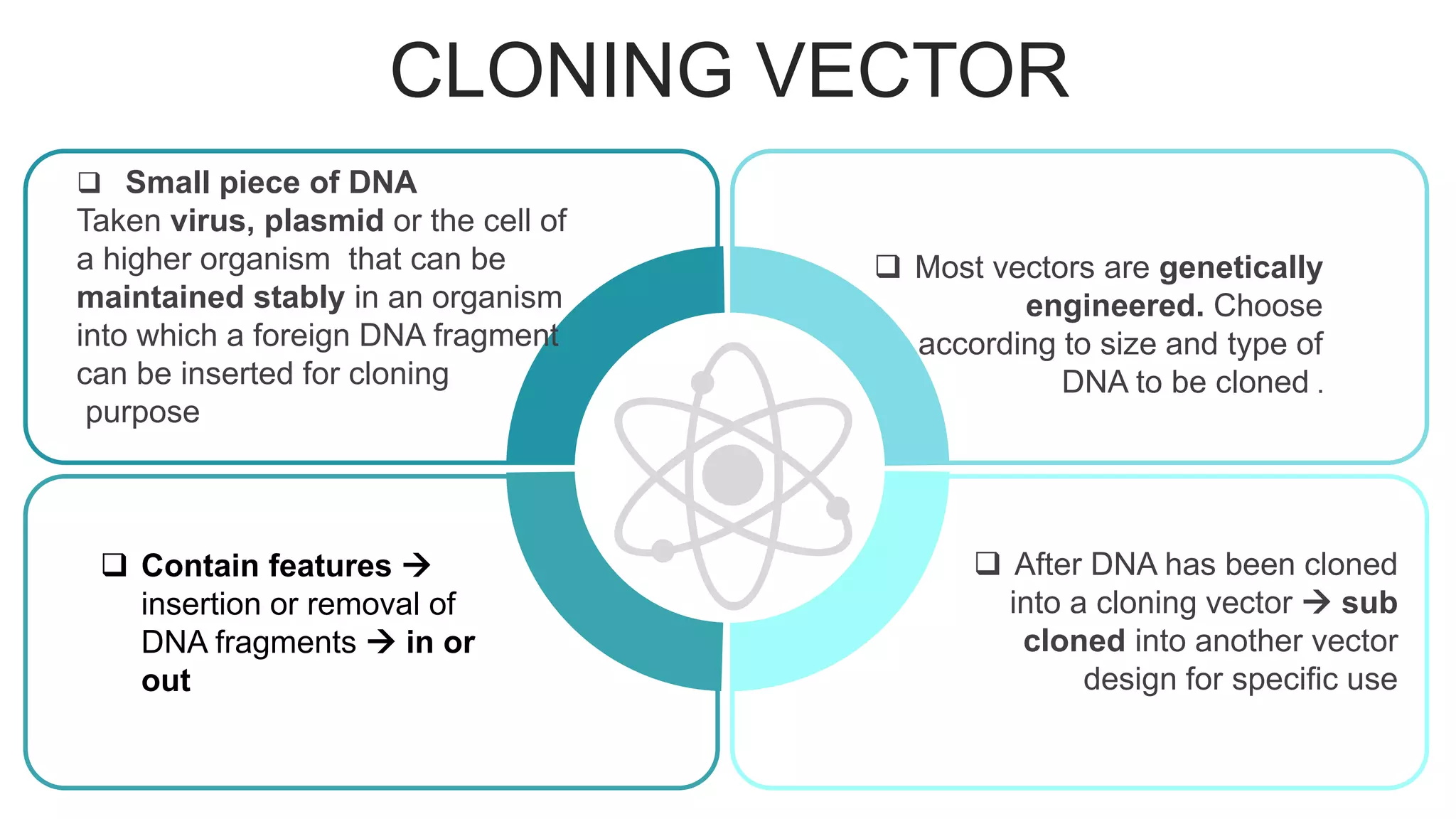
 Small piece of DNA
Taken virus, plasmid or the cell of
a higher organism that can be
maintained stably in an organism
into which a foreign DNA fragment
can be inserted for cloning
purpose
 Contain features 
insertion or removal of
DNA fragments  in or
out
 Most vectors are genetically
engineered. Choose
according to size and type of
DNA to be cloned .
 After DNA has been cloned
into a cloning vector  sub
cloned into another vector
design for specific use
Cloning vector
The molecular analysis of DNA has been made possible by
the cloning of DNA. The two molecules require for cloning
are .
 DNA to be
cloned
 Cloning
vector
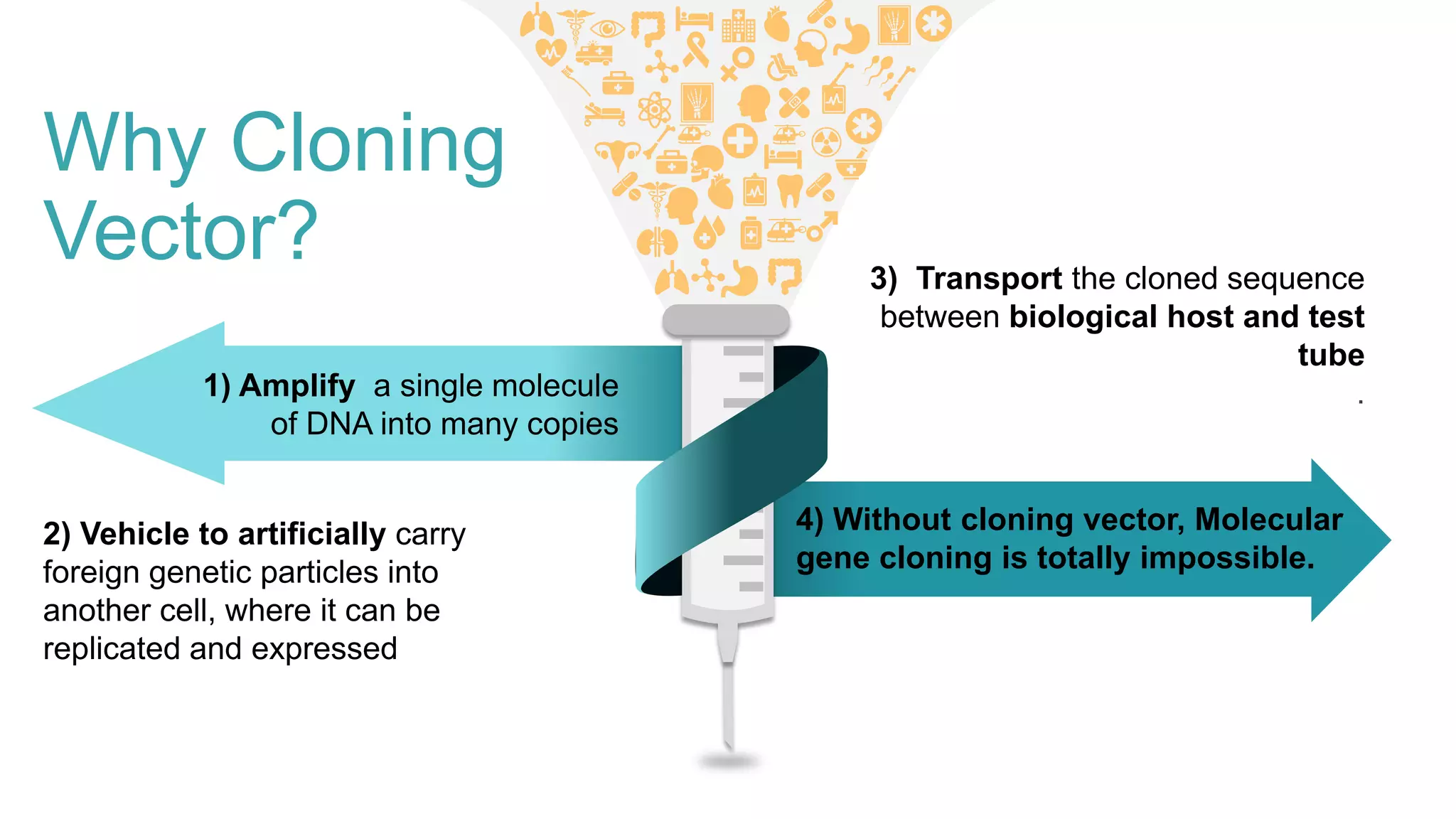
Why Cloning
Vector?
1) Amplify a single molecule
of DNA into many copies
4) Without cloning vector, Molecular
gene cloning is totally impossible.
2) Vehicle to artificially carry
foreign genetic particles into
another cell, where it can be
replicated and expressed
3) Transport the cloned sequence
between biological host and test
tube
.
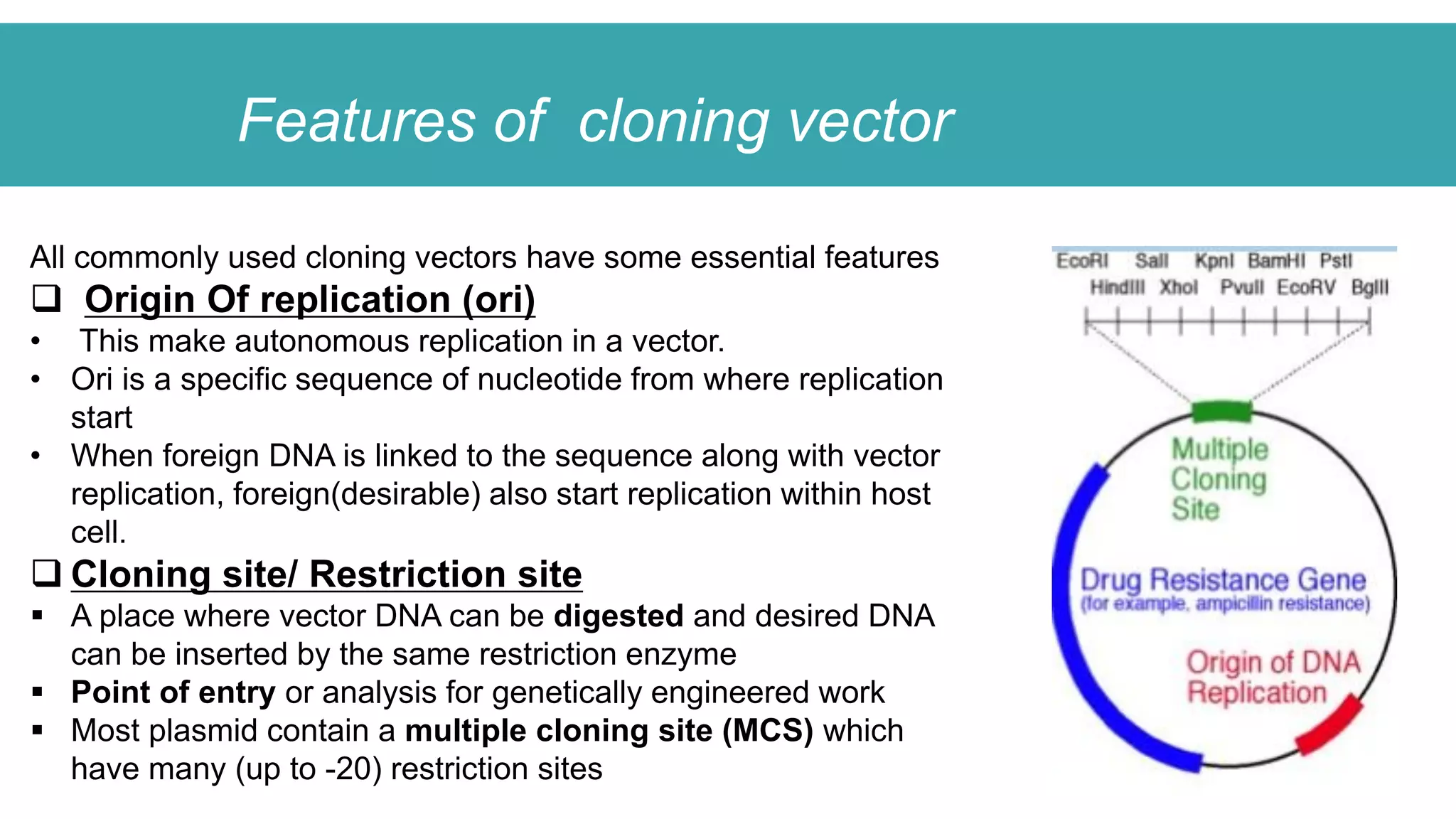
Features of cloning vector
All commonly used cloning vectors have some essential features
 Origin Of replication (ori)
• This make autonomous replication in a vector.
• Ori is a specific sequence of nucleotide from where replication
start
• When foreign DNA is linked to the sequence along with vector
replication, foreign(desirable) also start replication within host
cell.
 Cloning site/ Restriction site
 A place where vector DNA can be digested and desired DNA
can be inserted by the same restriction enzyme
 Point of entry or analysis for genetically engineered work
 Most plasmid contain a multiple cloning site (MCS) which
have many (up to -20) restriction sites
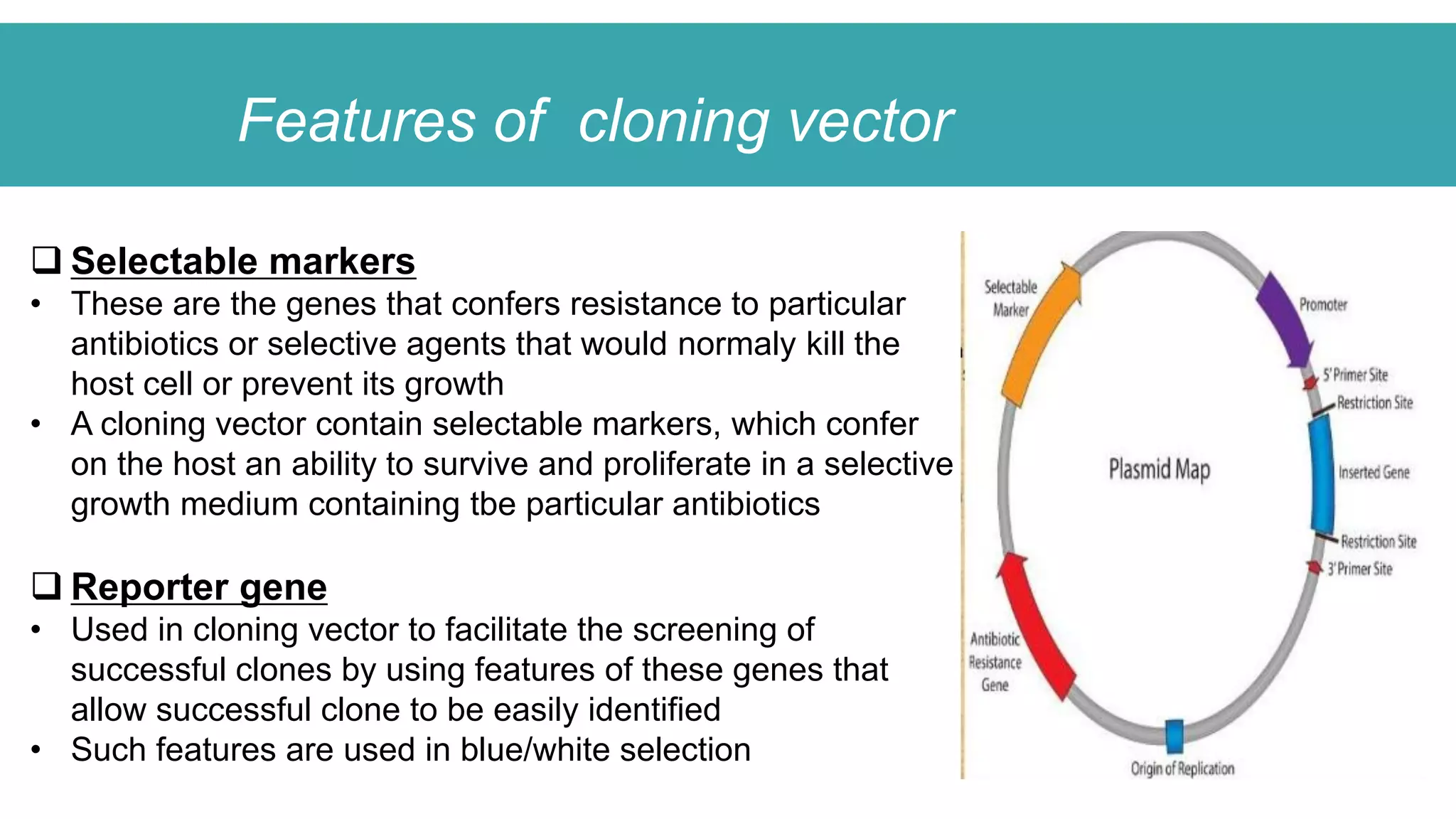
Features of cloning vector
 Selectable markers
• These are the genes that confers resistance to particular
antibiotics or selective agents that would normaly kill the
host cell or prevent its growth
• A cloning vector contain selectable markers, which confer
on the host an ability to survive and proliferate in a selective
growth medium containing tbe particular antibiotics
 Reporter gene
• Used in cloning vector to facilitate the screening of
successful clones by using features of these genes that
allow successful clone to be easily identified
• Such features are used in blue/white selection
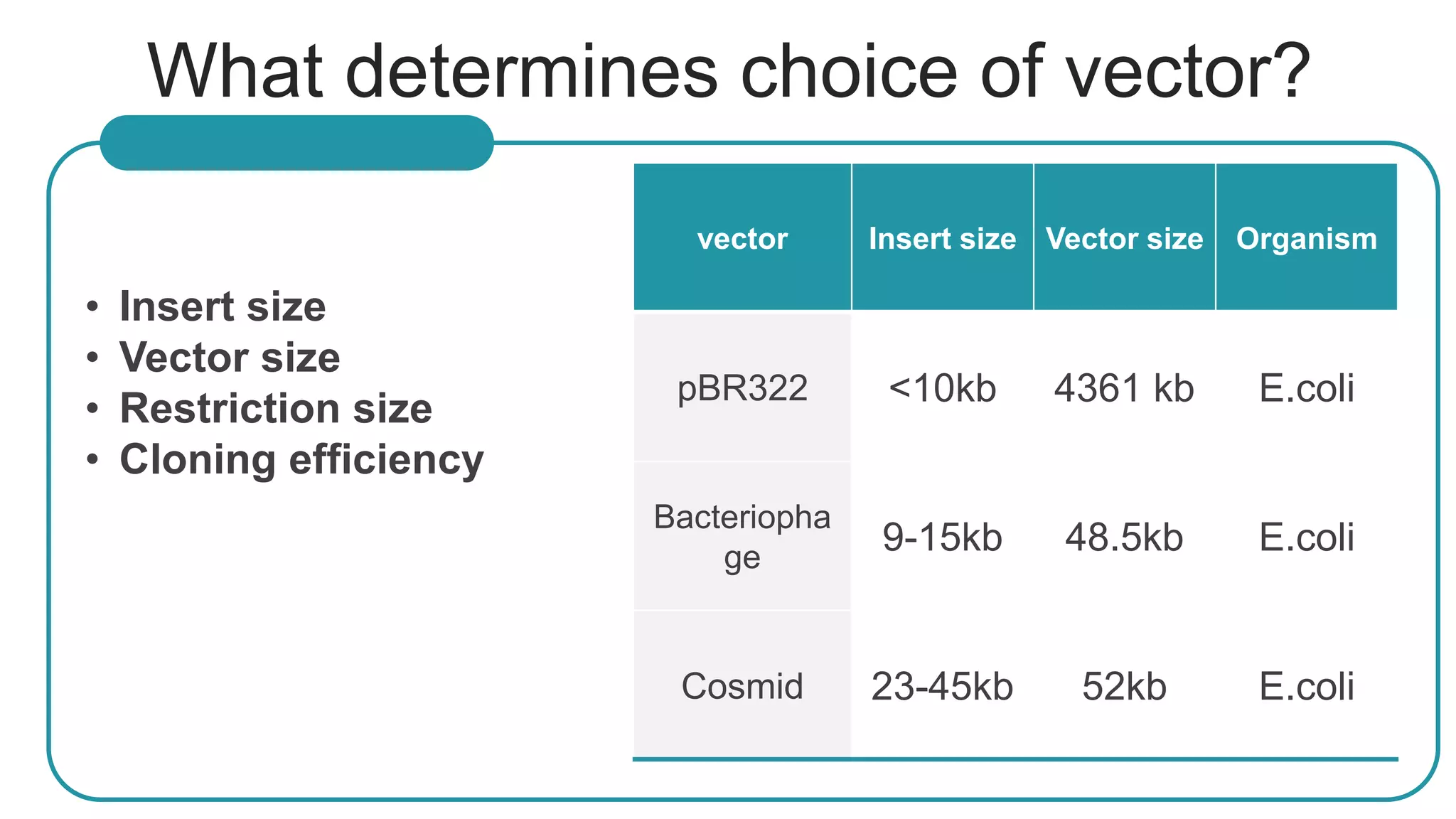
What determines choice of vector?
vector Insert size Vector size Organism
pBR322 <10kb 4361 kb E.coli
Bacteriopha
ge
9-15kb 48.5kb E.coli
Cosmid 23-45kb 52kb E.coli
• Insert size
• Vector size
• Restriction size
• Cloning efficiency
Your Text Here
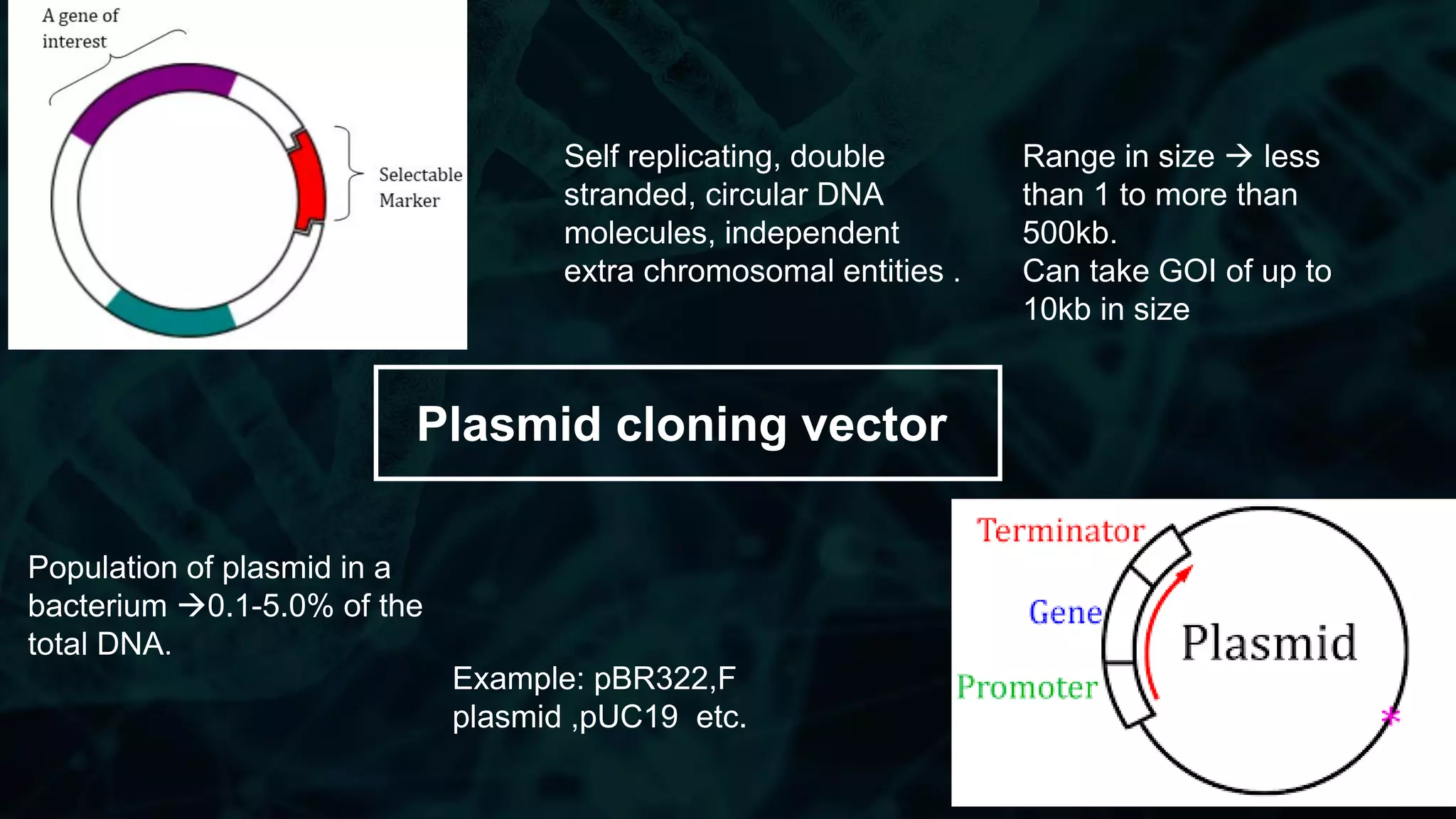
Self replicating, double
stranded, circular DNA
molecules, independent
extra chromosomal entities .
Range in size  less
than 1 to more than
500kb.
Can take GOI of up to
10kb in size
Population of plasmid in a
bacterium 0.1-5.0% of the
total DNA.
Example: pBR322,F
plasmid ,pUC19 etc.
Plasmid cloning vector
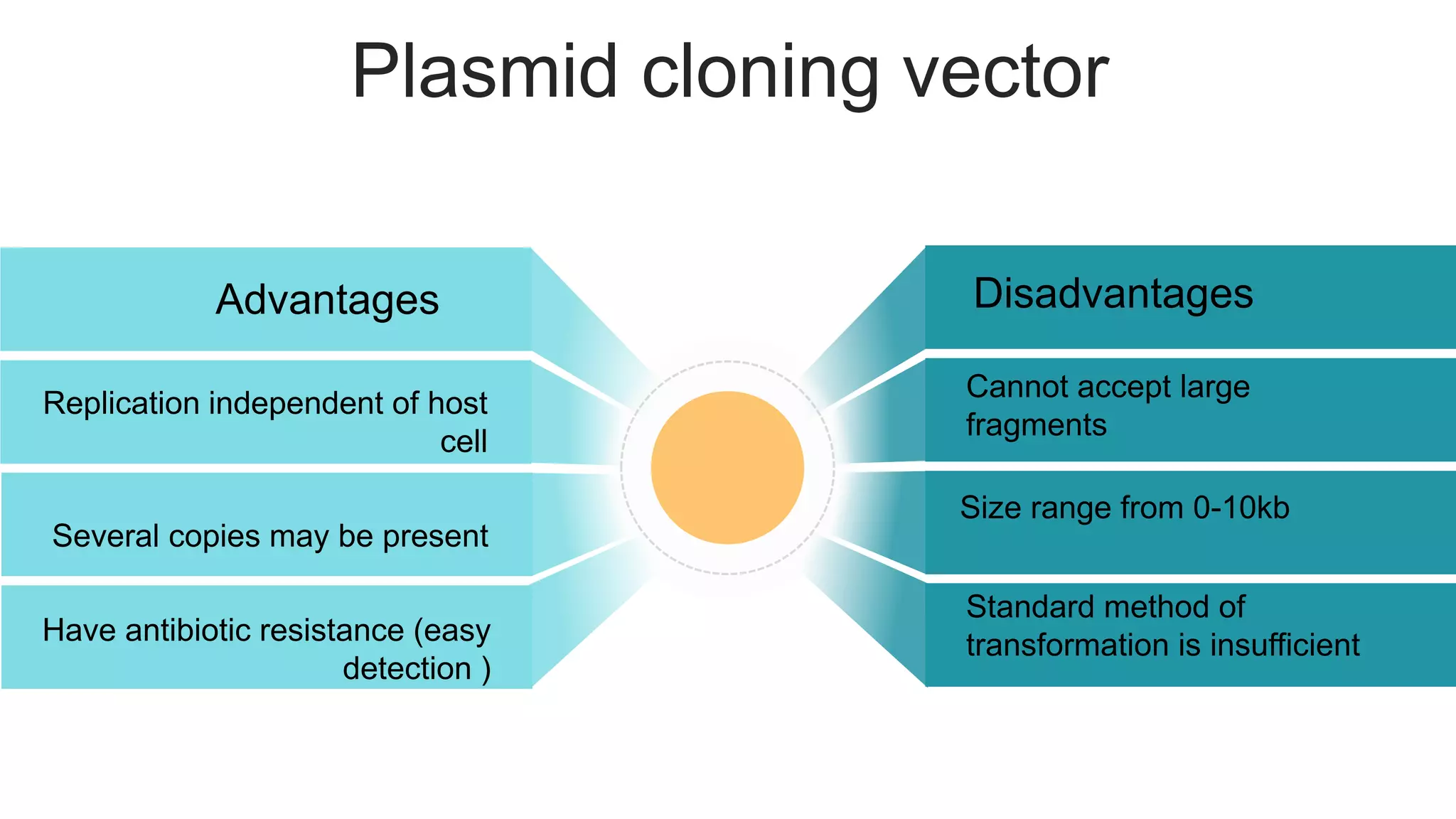
Disadvantages
Cannot accept large
fragments
Size range from 0-10kb
Standard method of
transformation is insufficient
Advantages
Replication independent of host
cell
Several copies may be present
Have antibiotic resistance (easy
detection )
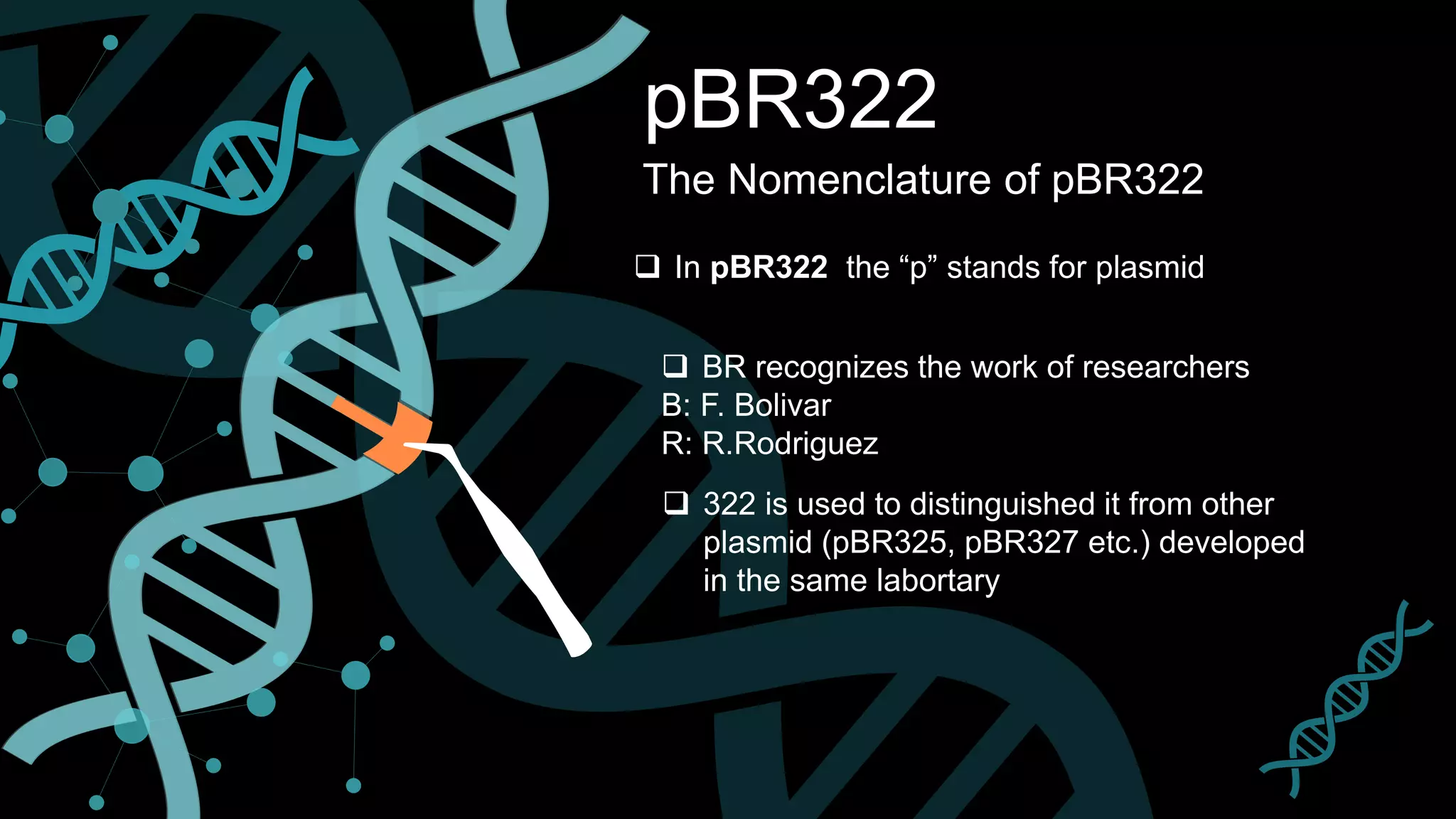
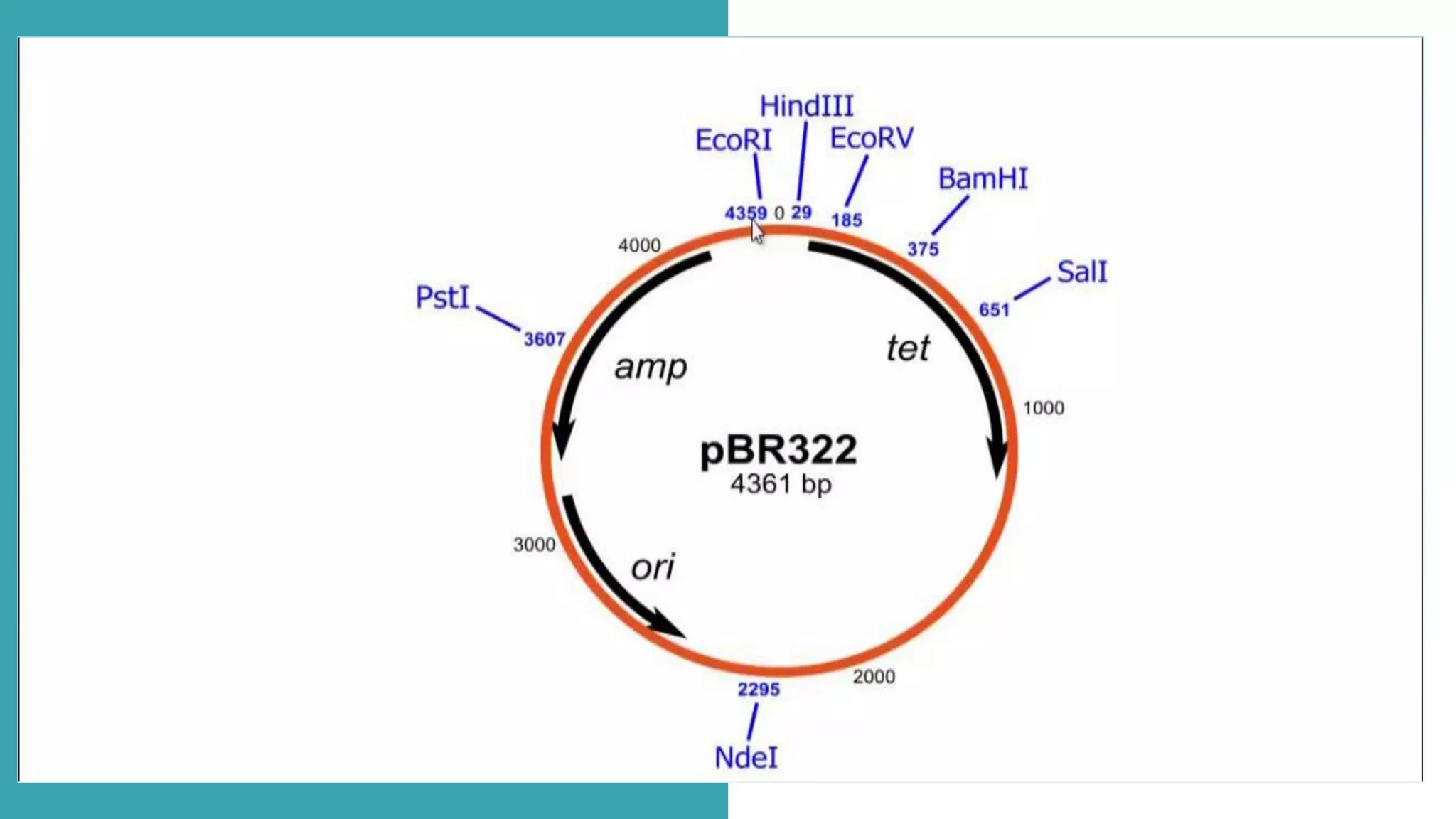
pBR322
The Nomenclature of pBR322
 In pBR322 the “p” stands for plasmid
 BR recognizes the work of researchers
B: F. Bolivar
R: R.Rodriguez
 322 is used to distinguished it from other
plasmid (pBR325, pBR327 etc.) developed
in the same labortary
The construction of pBR322
Text Here
Easy to change
colors, photos and
Text.
Text Here
Easy to change
colors, photos and
Text.
Text Here
Easy to change
colors, photos and
Text.
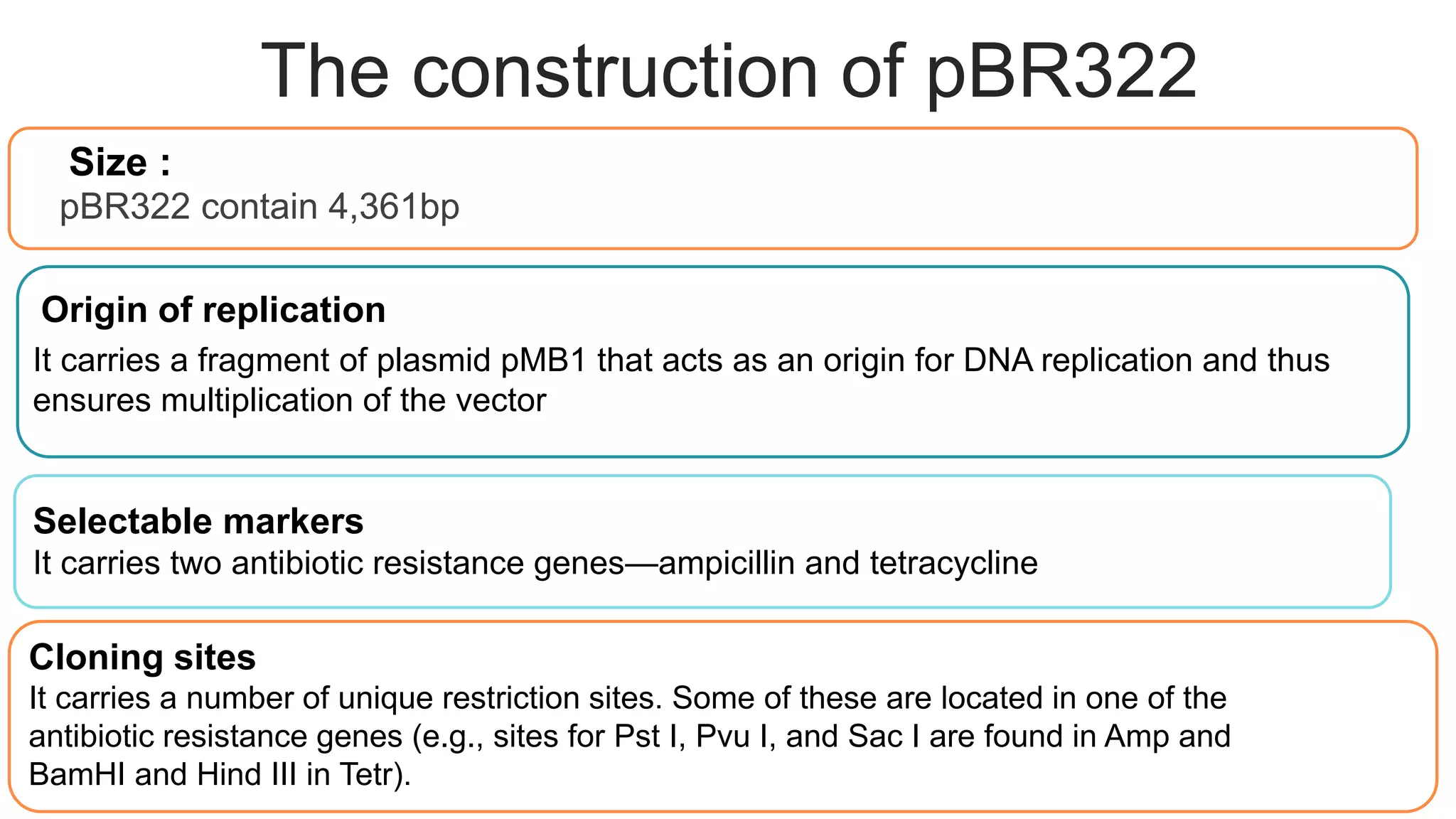
Size :
pBR322 contain 4,361bp
.
Origin of replication
Selectable markers
It carries two antibiotic resistance genes—ampicillin and tetracycline
It carries a fragment of plasmid pMB1 that acts as an origin for DNA replication and thus
ensures multiplication of the vector
Cloning sites
It carries a number of unique restriction sites. Some of these are located in one of the
antibiotic resistance genes (e.g., sites for Pst I, Pvu I, and Sac I are found in Amp and
BamHI and Hind III in Tetr).
Modern
Portfolio
Presentation
You can simply impress your audience and
add a unique zing and appeal to your
Presentations. Easy to change colors,
photos and Text. Get a modern
PowerPoint Presentation that is beautifully
designed. You can simply impress your
audience and add a unique zing and
appeal to your Presentations. Easy to
change colors, photos and Text. Get a
modern PowerPoint Presentation that is
beautifully designed.
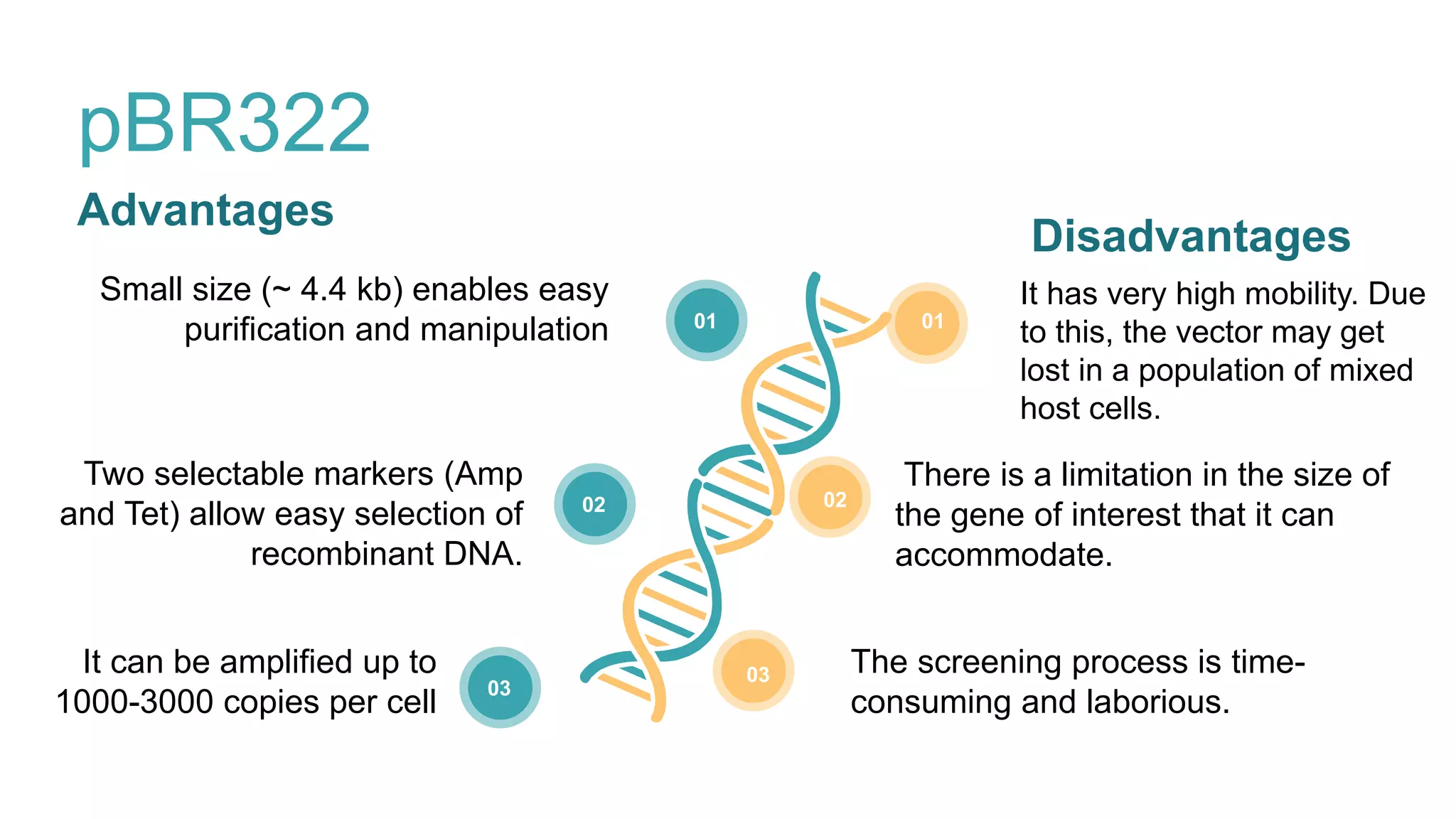
pBR322
It has very high mobility. Due
to this, the vector may get
lost in a population of mixed
host cells.
01
There is a limitation in the size of
the gene of interest that it can
accommodate.
02
The screening process is time-
consuming and laborious.
03
Small size (~ 4.4 kb) enables easy
purification and manipulation 01
Two selectable markers (Amp
and Tet) allow easy selection of
recombinant DNA.
02
It can be amplified up to
1000-3000 copies per cell
03
Advantages
Disadvantages
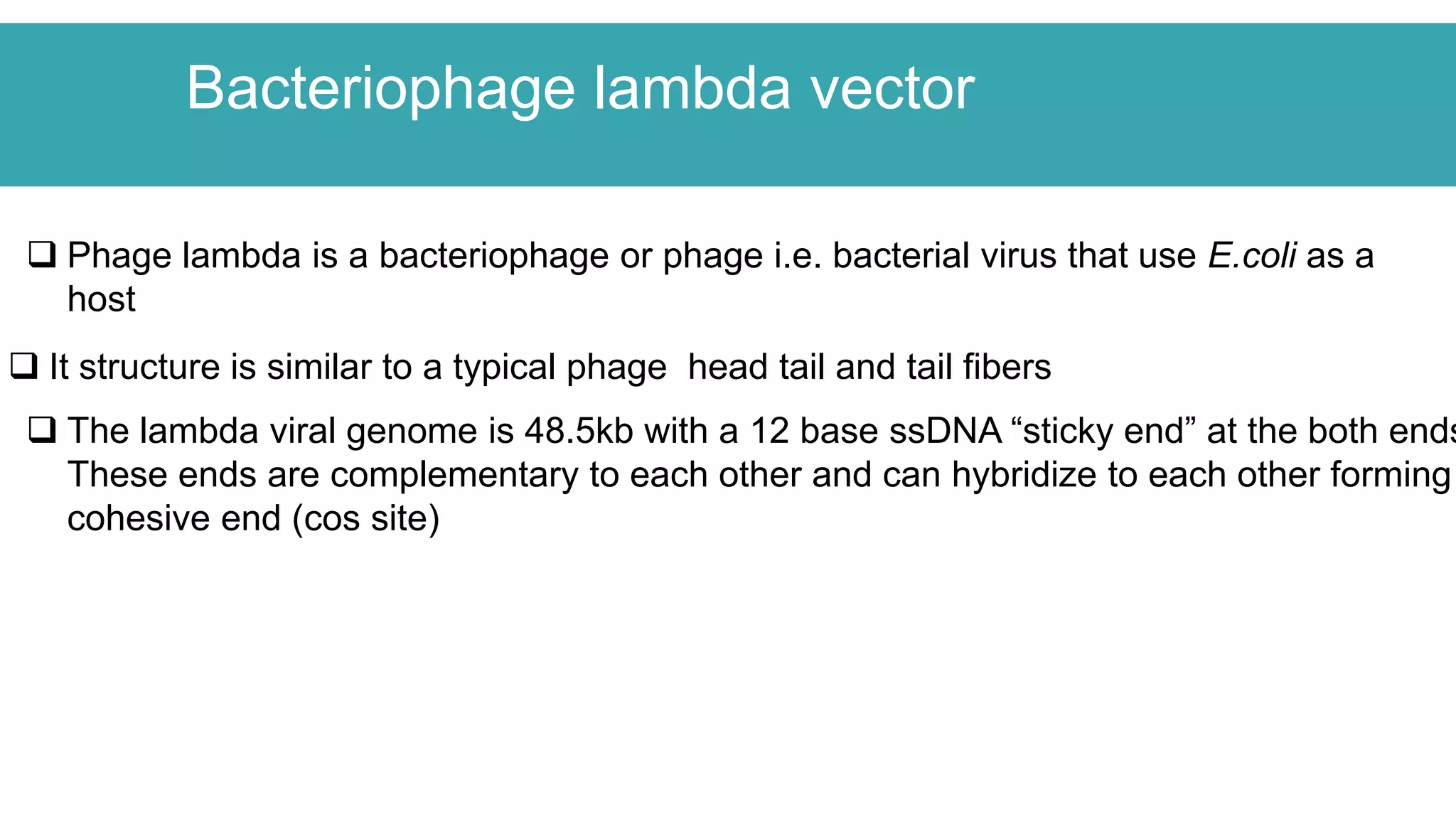
Bacteriophage lambda vector
 Phage lambda is a bacteriophage or phage i.e. bacterial virus that use E.coli as a
host
 It structure is similar to a typical phage head tail and tail fibers
 The lambda viral genome is 48.5kb with a 12 base ssDNA “sticky end” at the both ends
These ends are complementary to each other and can hybridize to each other forming
cohesive end (cos site)
Bacteriophage lambda vector
 Infection: lambda tail fibers absorbed through cell surface receptors, tail
contract, DNA is injected. The DNA is circularized and lambda begins its life
cycle in E.Coli
 There are two kinds of lambda phage vector : insertion vector and
replacement vector .
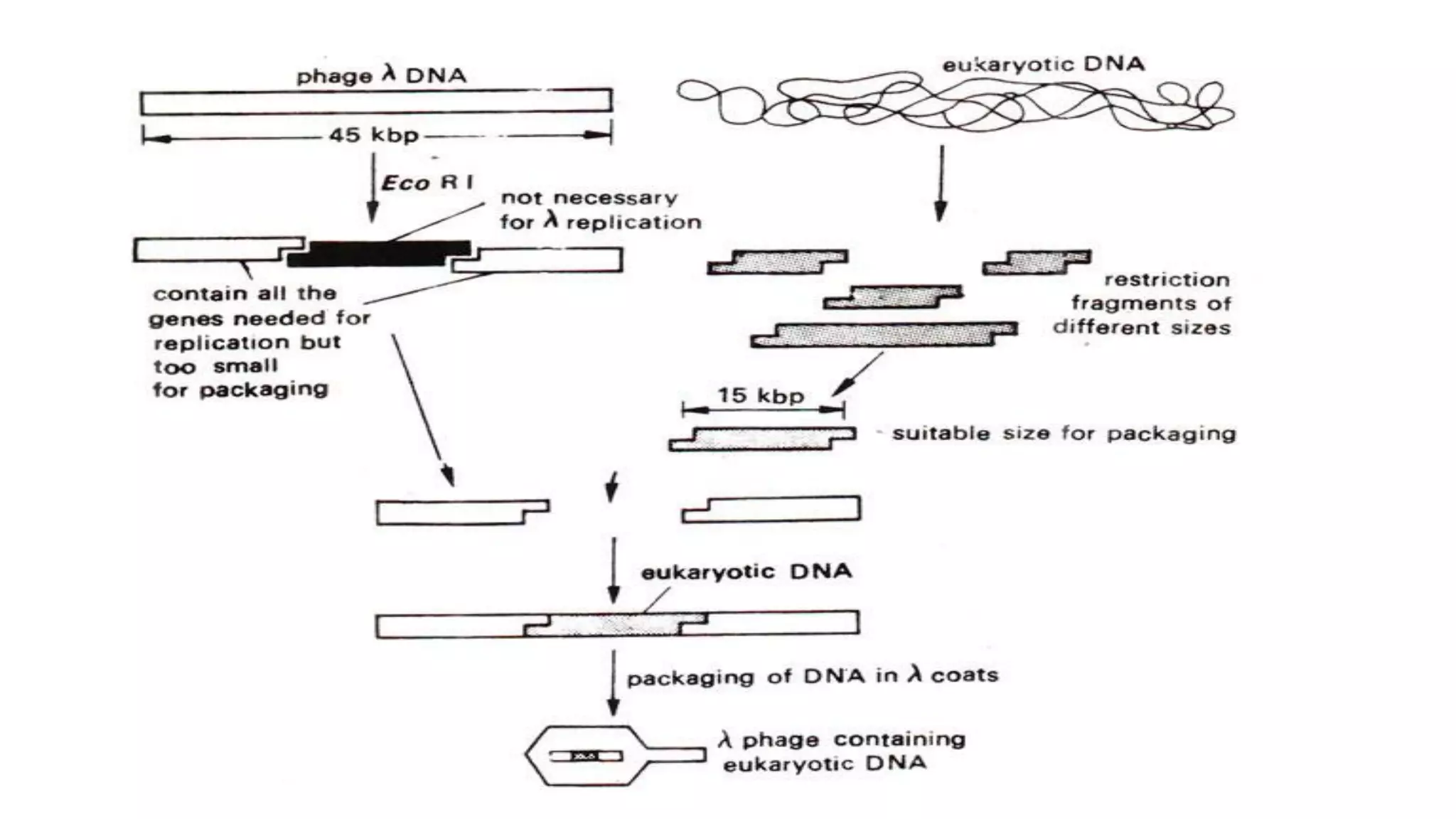
 Insertion vector contain unique cleavage site where foreign DNA with size 5-
15 kb may be inserted
 Replacement vector : here they cleave the region that are not necessary for
lytic cycle. They might be deleted and replaced with foreign DNA (gene of
interest) in cloning purpose
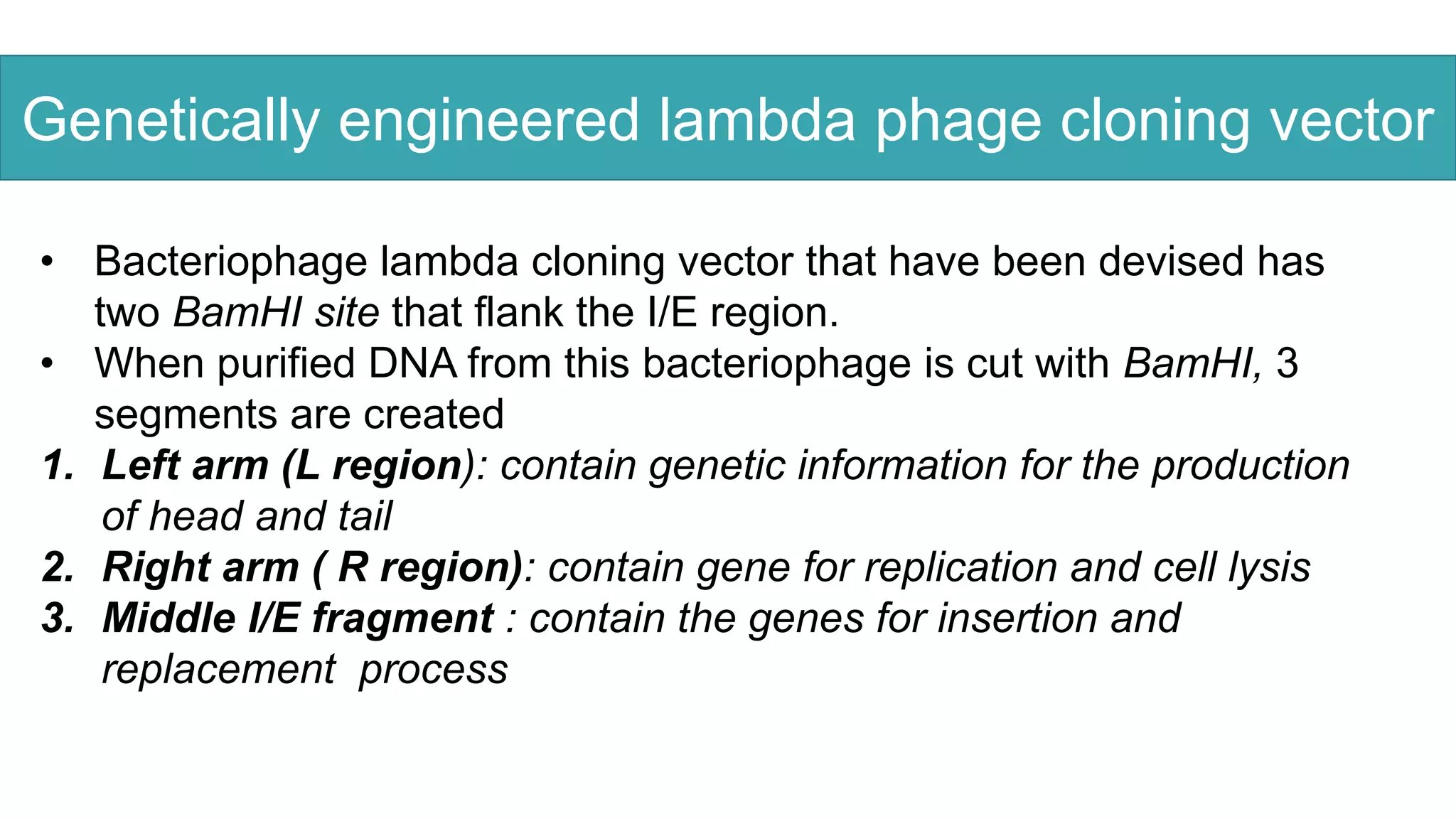
Genetically engineered lambda phage cloning vector
• Bacteriophage lambda cloning vector that have been devised has
two BamHI site that flank the I/E region.
• When purified DNA from this bacteriophage is cut with BamHI, 3
segments are created
1. Left arm (L region): contain genetic information for the production
of head and tail
2. Right arm ( R region): contain gene for replication and cell lysis
3. Middle I/E fragment : contain the genes for insertion and
replacement process
Objective
The objective of this protocol is to replace the middle segment of the
lambda DNA with the cloned DNA that is approximately 20kb in length
uses
The main use of all lambda based vectors is to clone DNA fragments that
are too long to be handled by other plasmid
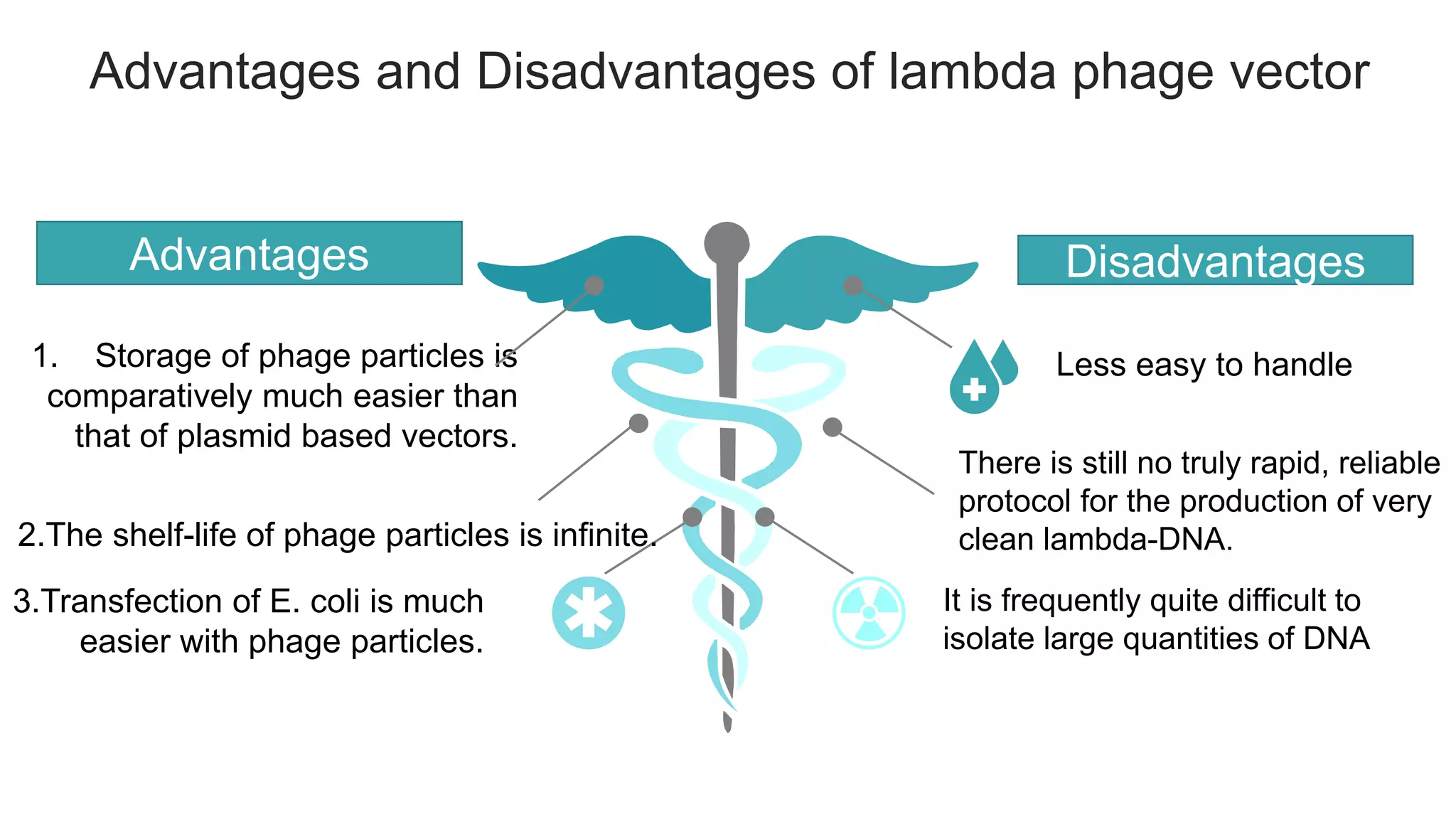
Advantages and Disadvantages of lambda phage vector
It is frequently quite difficult to
isolate large quantities of DNA
3.Transfection of E. coli is much
easier with phage particles.
Less easy to handle1. Storage of phage particles is
comparatively much easier than
that of plasmid based vectors.
2.The shelf-life of phage particles is infinite.
Advantages Disadvantages
There is still no truly rapid, reliable
protocol for the production of very
clean lambda-DNA.
 pUC19 is one of a series of plasmid cloning vectors
created by Joachim Messing and co-workers.
 Nomenclature
 The designation "pUC" is derived from the classical
"p" prefix (denoting “plasmid") and the abbreviation
for the University of California, where early work on
the plasmid series had been conducted.
What is pUC19?
.
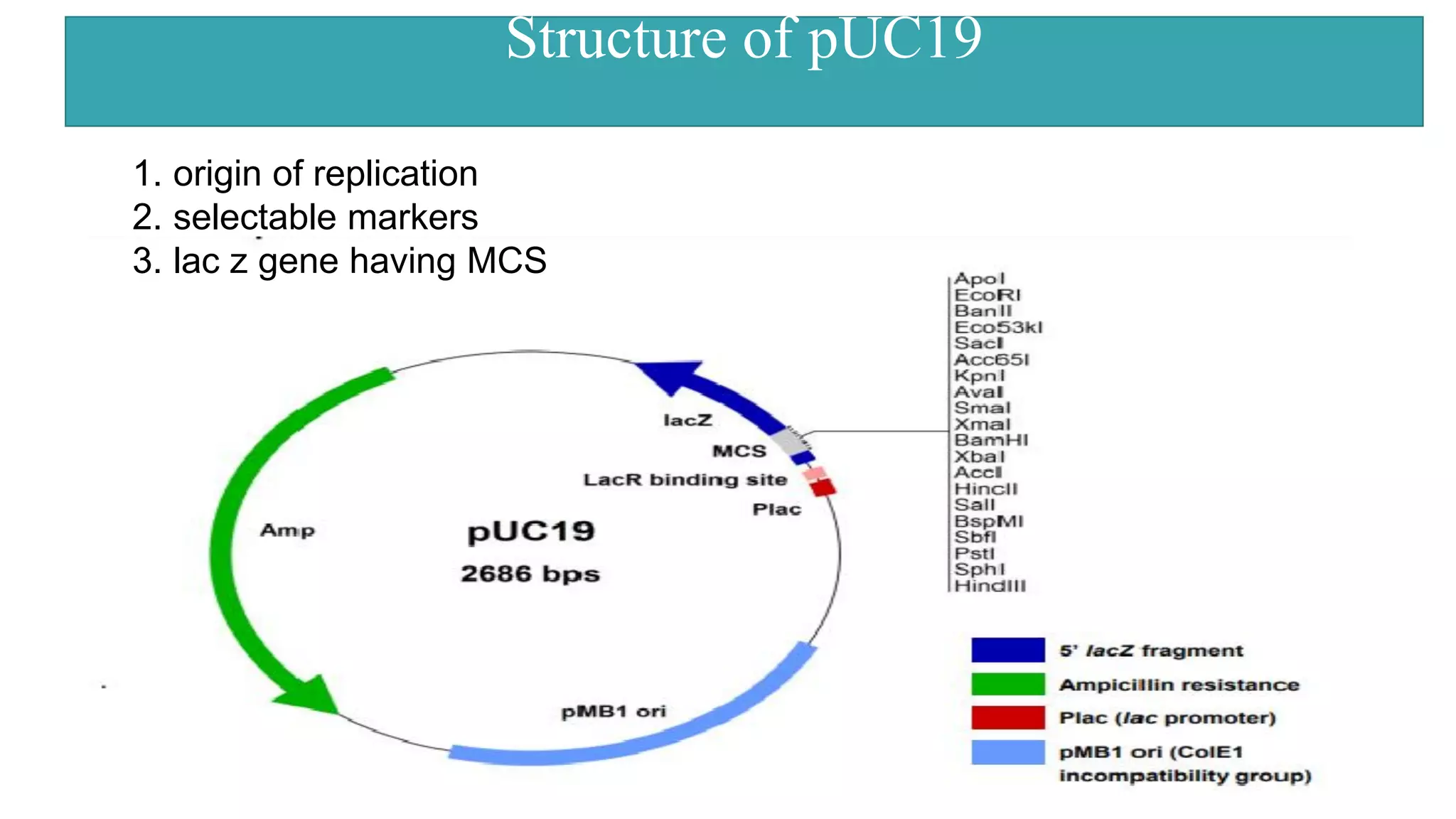
1. origin of replication
2. selectable markers
3. lac z gene having MCS
Structure of pUC19
Characteristics of PUC19
• pUC19 is a small, high copy cloning vector for replication in E. coli.
• Contains2868 bps.
• Puc19 are obtained by modifying the pbr322 vector.
• These are smaller then pbr322 of being only approximately 2.7kb.
• It produce 500-600 copies.
• It has been constructed using the ampicillin resistance gene and the pMB1 origin of
replication from Pbr322.
• The pMB1 of pUC19 differs from the pBR322 origin by a single point mutation and the
lack of the rop gene, leading to a high copy number.
• Uses
• Cab be used both as
Cloning vector
Expression vector
Characteristics of pUC19
1. Produces of high copy
no of 500-600 copies
per cell
It cannot accommodate a gene of
interest larger than 15kb
2. Easy and single step
selection.
Disadvantages
Advantages
Advantages and
disadvantages of pUC19
.
• It is the most sophisticated type of lambda based vector.
• Can carry 40 kb of cloned DNA and can be maintained as
plasmids in e.coli.
•
A cosmid is a plasmid that contains phage sequences that allow
the vector to be packaged and transmitted to bacteria like a phage
vector
• Cosmid are hybrid between phage DNA molecule and vector
plasmid.
Cosmid vector
.
• Basically a plasmid that carries a cos site.
• Origin of replication.
• Contain selectable markers e.g amp resistant gene.
Structure of cosmid
Uses
• Used for the construction of genomic libraries of eukaryotes.
Uses
.
• Used to clone gene of interest
up to 40 kb.
• As the lambda phage will insert
the recombinant DNA into the
host cell, an extra step of
inserting the recombinant DNA
into the host cell is not
performed.
• Cannot accept larger
fragments.
Advantages & disadvantages
.
• A vector, usually a plasmid constructed so that it can propagate in
two different host species.
• Why called as the shuttle vectors?
• Since these vectors can be grown in one host and then moved into
another without any extra manipulation.
Types
1. Eukaryotic-prokaryotic shuttle vectors.
2. Prokaryotic-prokaryotic shuttle vectors
Shuttle vectors
Continue…
• These vectors have been designed to replicate in cells of two
different species, therefore they contain two origins of replication .
• Created by recombinant DNA techniques.
• Example:yEp13 (yeast episomal plasmid)is an example of shuttle
vectors.
Continue…..
• ADVANTAGES
• They are capable of replicating into two or more types of hosts
including prokaryotic and eukaryotic cells.
• They replicate autonomously, or integrate into host genome and
replicate when the host cell multiplies.
• DISADVANTAGES
• The presence of two replication origins sometimes poses special
problems, one portion of replication origin of one species is totally
unrelated to another and interferes with the replication of other host.
Hence, in a shuttle vector various types of replication origins are to
be inserted and checked before experimenting.
Advantages and disadvantages
YEp13
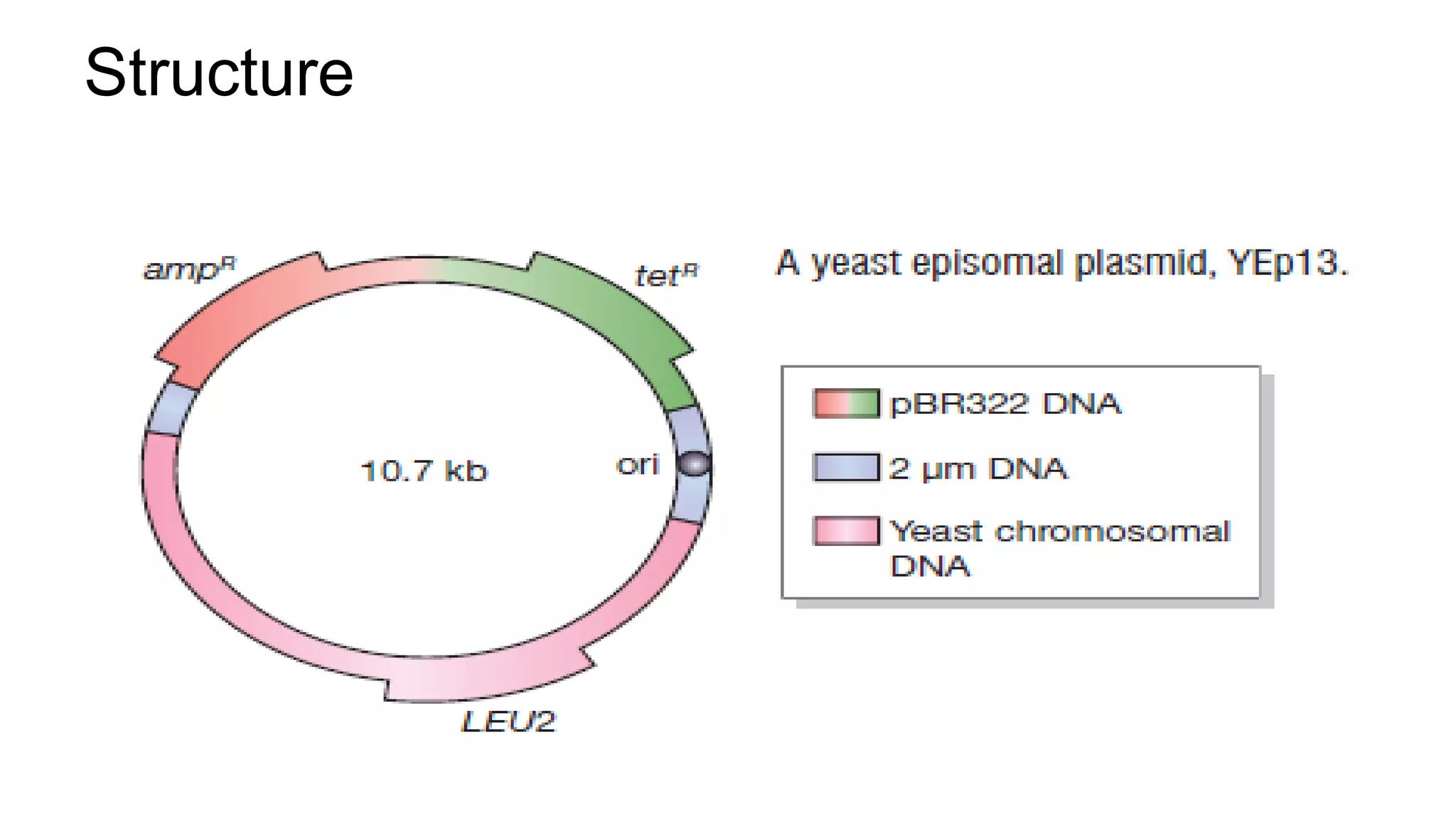
• It illustrates several general features of east clonning vectors.
• Contains 2um origin of replication and selectable LEU2 gene ,also
includes the entire pBR322 sequence and therefore can replicated
and selected both in yeast an E.coli.
YEp13
Structure
Thank You.

Comparison Between Different Types Of Vectors

  • 1.
    Comparison Between Different TypesOf Vectors Presented by Fahima Ashraf Kasi
  • 2.
    Content  Introduction •Cloning vector •Whycloning vector •Features of C.V •Choice of C.V Different cloning vector its advantages and disadvantages  plasmid cloning vector pBR322 Bacteriophage lambda cloning vector  pUC19 Cosmid YEp13
  • 3.
  • 4.
    CLONING VECTOR  Smallpiece of DNA Taken virus, plasmid or the cell of a higher organism that can be maintained stably in an organism into which a foreign DNA fragment can be inserted for cloning purpose  Contain features  insertion or removal of DNA fragments  in or out  Most vectors are genetically engineered. Choose according to size and type of DNA to be cloned .  After DNA has been cloned into a cloning vector  sub cloned into another vector design for specific use
  • 5.
    Cloning vector The molecularanalysis of DNA has been made possible by the cloning of DNA. The two molecules require for cloning are .  DNA to be cloned  Cloning vector
  • 6.
    Why Cloning Vector? 1) Amplifya single molecule of DNA into many copies 4) Without cloning vector, Molecular gene cloning is totally impossible. 2) Vehicle to artificially carry foreign genetic particles into another cell, where it can be replicated and expressed 3) Transport the cloned sequence between biological host and test tube .
  • 7.
    Features of cloningvector All commonly used cloning vectors have some essential features  Origin Of replication (ori) • This make autonomous replication in a vector. • Ori is a specific sequence of nucleotide from where replication start • When foreign DNA is linked to the sequence along with vector replication, foreign(desirable) also start replication within host cell.  Cloning site/ Restriction site  A place where vector DNA can be digested and desired DNA can be inserted by the same restriction enzyme  Point of entry or analysis for genetically engineered work  Most plasmid contain a multiple cloning site (MCS) which have many (up to -20) restriction sites
  • 8.
    Features of cloningvector  Selectable markers • These are the genes that confers resistance to particular antibiotics or selective agents that would normaly kill the host cell or prevent its growth • A cloning vector contain selectable markers, which confer on the host an ability to survive and proliferate in a selective growth medium containing tbe particular antibiotics  Reporter gene • Used in cloning vector to facilitate the screening of successful clones by using features of these genes that allow successful clone to be easily identified • Such features are used in blue/white selection
  • 9.
    What determines choiceof vector? vector Insert size Vector size Organism pBR322 <10kb 4361 kb E.coli Bacteriopha ge 9-15kb 48.5kb E.coli Cosmid 23-45kb 52kb E.coli • Insert size • Vector size • Restriction size • Cloning efficiency Your Text Here
  • 10.
    Self replicating, double stranded,circular DNA molecules, independent extra chromosomal entities . Range in size  less than 1 to more than 500kb. Can take GOI of up to 10kb in size Population of plasmid in a bacterium 0.1-5.0% of the total DNA. Example: pBR322,F plasmid ,pUC19 etc. Plasmid cloning vector
  • 11.
    Plasmid cloning vector Disadvantages Cannotaccept large fragments Size range from 0-10kb Standard method of transformation is insufficient Advantages Replication independent of host cell Several copies may be present Have antibiotic resistance (easy detection )
  • 12.
    pBR322 The Nomenclature ofpBR322  In pBR322 the “p” stands for plasmid  BR recognizes the work of researchers B: F. Bolivar R: R.Rodriguez  322 is used to distinguished it from other plasmid (pBR325, pBR327 etc.) developed in the same labortary
  • 13.
    The construction ofpBR322 Text Here Easy to change colors, photos and Text. Text Here Easy to change colors, photos and Text. Text Here Easy to change colors, photos and Text. Size : pBR322 contain 4,361bp . Origin of replication Selectable markers It carries two antibiotic resistance genes—ampicillin and tetracycline It carries a fragment of plasmid pMB1 that acts as an origin for DNA replication and thus ensures multiplication of the vector Cloning sites It carries a number of unique restriction sites. Some of these are located in one of the antibiotic resistance genes (e.g., sites for Pst I, Pvu I, and Sac I are found in Amp and BamHI and Hind III in Tetr).
  • 14.
    Modern Portfolio Presentation You can simplyimpress your audience and add a unique zing and appeal to your Presentations. Easy to change colors, photos and Text. Get a modern PowerPoint Presentation that is beautifully designed. You can simply impress your audience and add a unique zing and appeal to your Presentations. Easy to change colors, photos and Text. Get a modern PowerPoint Presentation that is beautifully designed.
  • 15.
    pBR322 It has veryhigh mobility. Due to this, the vector may get lost in a population of mixed host cells. 01 There is a limitation in the size of the gene of interest that it can accommodate. 02 The screening process is time- consuming and laborious. 03 Small size (~ 4.4 kb) enables easy purification and manipulation 01 Two selectable markers (Amp and Tet) allow easy selection of recombinant DNA. 02 It can be amplified up to 1000-3000 copies per cell 03 Advantages Disadvantages
  • 16.
    Bacteriophage lambda vector Phage lambda is a bacteriophage or phage i.e. bacterial virus that use E.coli as a host  It structure is similar to a typical phage head tail and tail fibers  The lambda viral genome is 48.5kb with a 12 base ssDNA “sticky end” at the both ends These ends are complementary to each other and can hybridize to each other forming cohesive end (cos site)
  • 17.
    Bacteriophage lambda vector Infection: lambda tail fibers absorbed through cell surface receptors, tail contract, DNA is injected. The DNA is circularized and lambda begins its life cycle in E.Coli  There are two kinds of lambda phage vector : insertion vector and replacement vector .  Insertion vector contain unique cleavage site where foreign DNA with size 5- 15 kb may be inserted  Replacement vector : here they cleave the region that are not necessary for lytic cycle. They might be deleted and replaced with foreign DNA (gene of interest) in cloning purpose
  • 18.
    Genetically engineered lambdaphage cloning vector • Bacteriophage lambda cloning vector that have been devised has two BamHI site that flank the I/E region. • When purified DNA from this bacteriophage is cut with BamHI, 3 segments are created 1. Left arm (L region): contain genetic information for the production of head and tail 2. Right arm ( R region): contain gene for replication and cell lysis 3. Middle I/E fragment : contain the genes for insertion and replacement process
  • 20.
    Objective The objective ofthis protocol is to replace the middle segment of the lambda DNA with the cloned DNA that is approximately 20kb in length uses The main use of all lambda based vectors is to clone DNA fragments that are too long to be handled by other plasmid
  • 21.
    Advantages and Disadvantagesof lambda phage vector It is frequently quite difficult to isolate large quantities of DNA 3.Transfection of E. coli is much easier with phage particles. Less easy to handle1. Storage of phage particles is comparatively much easier than that of plasmid based vectors. 2.The shelf-life of phage particles is infinite. Advantages Disadvantages There is still no truly rapid, reliable protocol for the production of very clean lambda-DNA.
  • 22.
     pUC19 isone of a series of plasmid cloning vectors created by Joachim Messing and co-workers.  Nomenclature  The designation "pUC" is derived from the classical "p" prefix (denoting “plasmid") and the abbreviation for the University of California, where early work on the plasmid series had been conducted. What is pUC19?
  • 23.
    . 1. origin ofreplication 2. selectable markers 3. lac z gene having MCS Structure of pUC19
  • 24.
    Characteristics of PUC19 •pUC19 is a small, high copy cloning vector for replication in E. coli. • Contains2868 bps. • Puc19 are obtained by modifying the pbr322 vector. • These are smaller then pbr322 of being only approximately 2.7kb. • It produce 500-600 copies. • It has been constructed using the ampicillin resistance gene and the pMB1 origin of replication from Pbr322. • The pMB1 of pUC19 differs from the pBR322 origin by a single point mutation and the lack of the rop gene, leading to a high copy number. • Uses • Cab be used both as Cloning vector Expression vector Characteristics of pUC19
  • 25.
    1. Produces ofhigh copy no of 500-600 copies per cell It cannot accommodate a gene of interest larger than 15kb 2. Easy and single step selection. Disadvantages Advantages Advantages and disadvantages of pUC19
  • 26.
    . • It isthe most sophisticated type of lambda based vector. • Can carry 40 kb of cloned DNA and can be maintained as plasmids in e.coli. • A cosmid is a plasmid that contains phage sequences that allow the vector to be packaged and transmitted to bacteria like a phage vector • Cosmid are hybrid between phage DNA molecule and vector plasmid. Cosmid vector
  • 27.
    . • Basically aplasmid that carries a cos site. • Origin of replication. • Contain selectable markers e.g amp resistant gene. Structure of cosmid
  • 28.
    Uses • Used forthe construction of genomic libraries of eukaryotes. Uses
  • 29.
    . • Used toclone gene of interest up to 40 kb. • As the lambda phage will insert the recombinant DNA into the host cell, an extra step of inserting the recombinant DNA into the host cell is not performed. • Cannot accept larger fragments. Advantages & disadvantages
  • 30.
    . • A vector,usually a plasmid constructed so that it can propagate in two different host species. • Why called as the shuttle vectors? • Since these vectors can be grown in one host and then moved into another without any extra manipulation. Types 1. Eukaryotic-prokaryotic shuttle vectors. 2. Prokaryotic-prokaryotic shuttle vectors Shuttle vectors
  • 31.
    Continue… • These vectorshave been designed to replicate in cells of two different species, therefore they contain two origins of replication . • Created by recombinant DNA techniques. • Example:yEp13 (yeast episomal plasmid)is an example of shuttle vectors. Continue…..
  • 32.
    • ADVANTAGES • Theyare capable of replicating into two or more types of hosts including prokaryotic and eukaryotic cells. • They replicate autonomously, or integrate into host genome and replicate when the host cell multiplies. • DISADVANTAGES • The presence of two replication origins sometimes poses special problems, one portion of replication origin of one species is totally unrelated to another and interferes with the replication of other host. Hence, in a shuttle vector various types of replication origins are to be inserted and checked before experimenting. Advantages and disadvantages
  • 33.
    YEp13 • It illustratesseveral general features of east clonning vectors. • Contains 2um origin of replication and selectable LEU2 gene ,also includes the entire pBR322 sequence and therefore can replicated and selected both in yeast an E.coli. YEp13
  • 34.
  • 35.