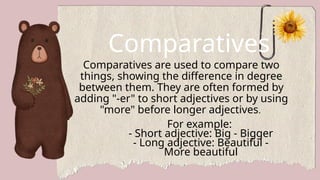
Comparatives are usedto compare two
things, showing the difference in degree
between them. They are often formed by
adding "-er" to short adjectives or by using
"more" before longer adjectives.
Comparatives
For example:
- Short adjective: Big - Bigger
- Long adjective: Beautiful -
More beautiful
3.
Superlatives
Superlatives are usedto compare
three or more things, indicating the
highest degree of a quality. They are
often formed by adding "-est" to
short adjectives or by using "the
most" before longer adjectives.
For example:
- Short adjective: Tall - The tallest
- Long adjective: Interesting - The most interesting
4.
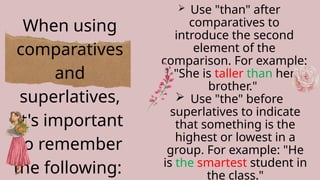
When using
comparatives
and
superlatives,
it's important
toremember
the following:
Use "than" after
comparatives to
introduce the second
element of the
comparison. For example:
"She is taller than her
brother."
Use "the" before
superlatives to indicate
that something is the
highest or lowest in a
group. For example: "He
is the smartest student in
the class."
5.
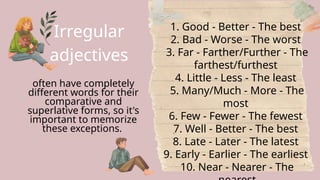
Irregular
adjectives
1. Good -Better - The best
2. Bad - Worse - The worst
3. Far - Farther/Further - The
farthest/furthest
4. Little - Less - The least
5. Many/Much - More - The
most
6. Few - Fewer - The fewest
7. Well - Better - The best
8. Late - Later - The latest
9. Early - Earlier - The earliest
10. Near - Nearer - The
often have completely
different words for their
comparative and
superlative forms, so it's
important to memorize
these exceptions.
6.
Which city doyou think is
more exciting, New York or
London?
7.
Do you findstudying in the
morning easier than
studying at night?
8.
Is traveling bytrain more
comfortable than traveling by
bus?