Prehistoric Times – Cave Paintings
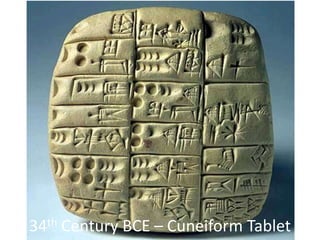
34th Century BCE – Cuneiform Tablet
Papyrus
Scrolls
Middle Ages – Illuminated Manuscripts
1450 AD – Printing Press
1844 - Telegraph
1901 Telegraph Connectionshttp://liftlab.com/think/nova/2009/12/31/communication-infrastructures-from-1901-to-2009
1950 – ENIAC (1st digital computer)
1957 – Sputnik Satellite
Communication through time

Communication through time

Editor's Notes

  • #8 The Printing PressThe printing press, a bit more so than Brother toner, has revolutionized global culture, allowing for the widespread availability of ideas. The Latin alphabet, with its two dozen characters permitted moveable type facing to print an entire lexicon, while the screw press, which was used to crush grapes and olives since Roman times, allowed for even distribution of pressure onto paper.  Johannes Gutenberg, a goldsmith, used these two facts, along with his knowledge of metals, to create a lead type set. He developed a movable under table that allowed for a swift interchange between sheets.  Gutenberg also invented oil based ink, which was much more durable than the water based inks so prevalent before his press.The press also allowed for an abundance of print copies. Up to 3600 copies could be made per day, which spread the books of contemporary writers, like Luther and Erasmus throughout Europe. The latter watched three quarters of a million of his book sell during his lifetime (1469-1536).The result of such widespread distribution of knowledge lead to the diminishment of spoken Latin, and a rise in the nationalistic languages of Europehttp://www.brothertonerblog.com/2010/05/the-printing-press/