COMMUNICATION TECHNIQUES
• A Satellite may have different service stations of its
own located at different places on the earth. They
send carrier signal for the satellite.
• Multiple access techniques enable satellite to take or
give signals from different stations at time without
any interference between them
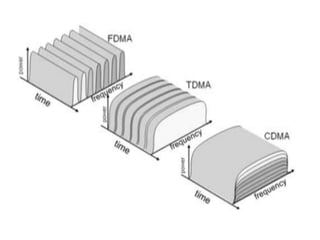
• FDMA (Frequency Division Multiple Access)
• TDMA (Time Division Multiple Access)
• CDMA (Code Division Multiple Access)
Frequency Division Multiple Access
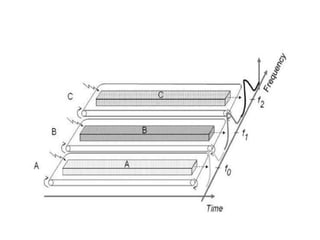
• Assign each signal a different type of
frequency band (range)
• Any two signals should not have same type of
frequency range
• No interference between them
• Guard bands are used between the adjacent
signal spectra to minimize crosstalk between
the channels
Advantages
• It reduces the cost and lowers the inter
symbol interference (ISI)
• An FDMA system can be easily implemented.
• Since the transmission is continuous, less
number of bits are required for
synchronization and framing.
Disadvantages
• Improving the capacity depends on the signal-
to-interference reduction, or a signal-to-noise
ratio (SNR).
• Guard bands lead to a waste of capacity.
• Hardware implies narrowband filters, which
cannot be realized in VLSI and therefore
increases the cost.
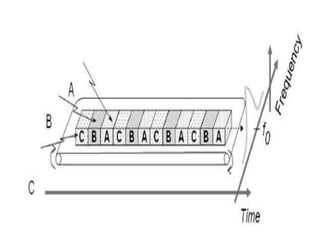
Time Division Multiple Access
• Certain time frame to each channel. Within that
time frame, the channel can access the entire
spectrum bandwidth
• Each station got a fixed length or slot
• The slots, which are unused will remain in idle
stage.
• If a channel is transmitting heavier loads, then it
can be assigned a bigger time slot than the
channel which is transmitting lighter loads.
Advantage over FDMA
Advantages
• Permits flexible rates (i.e. several slots can be assigned to
a user, for example, each time interval translates 32Kbps,
a user is assigned two 64 Kbps slots per frame).
• Can withstand gusty or variable bit rate traffic. Number
of slots allocated to a user can be changed frame by
frame (for example, two slots in the frame 1, three slots
in the frame 2, one slot in the frame 3, frame 0 of the
notches 4, etc.).
• No guard band required for the wideband system.
• No narrowband filter required for the wideband system
Disadvantages
• High data rates of broadband systems require
complex equalization.
• A large number of additional bits are required for
synchronization and supervision.
• Electronics operating at high bit rates increase
energy consumption.
• Complex signal processing is required to synchronize
within short slots.
CODE DIVISION MULTIPLE ACCESS
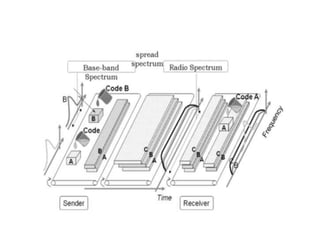
• A unique code has been assigned to each
channel to distinguish from each other . This
code is called spreading code
• A user has access to the whole bandwidth for
the entire duration
• A signal is generated which extends over a
wide bandwidth
• Two types
Direct sequence spread spectrum modulation
Frequency hopped spread spectrum modulation
Advanatages
• CDMA channel is not easily decodable
• Less interference
• Greatest spectrum efficiency
• CDMA does not require any synchronization
Disadavantages
• In while we are using CDMA, code length can
be carefully selected, because it can induce
delay
• Higher cost due to the greater equipment
COMMUNICATION TECHNIQUES.pptx

COMMUNICATION TECHNIQUES.pptx

  • 1.
  • 2.
    • A Satellitemay have different service stations of its own located at different places on the earth. They send carrier signal for the satellite. • Multiple access techniques enable satellite to take or give signals from different stations at time without any interference between them • FDMA (Frequency Division Multiple Access) • TDMA (Time Division Multiple Access) • CDMA (Code Division Multiple Access)
  • 3.
    Frequency Division MultipleAccess • Assign each signal a different type of frequency band (range) • Any two signals should not have same type of frequency range • No interference between them • Guard bands are used between the adjacent signal spectra to minimize crosstalk between the channels
  • 5.
    Advantages • It reducesthe cost and lowers the inter symbol interference (ISI) • An FDMA system can be easily implemented. • Since the transmission is continuous, less number of bits are required for synchronization and framing.
  • 6.
    Disadvantages • Improving thecapacity depends on the signal- to-interference reduction, or a signal-to-noise ratio (SNR). • Guard bands lead to a waste of capacity. • Hardware implies narrowband filters, which cannot be realized in VLSI and therefore increases the cost.
  • 7.
    Time Division MultipleAccess • Certain time frame to each channel. Within that time frame, the channel can access the entire spectrum bandwidth • Each station got a fixed length or slot • The slots, which are unused will remain in idle stage. • If a channel is transmitting heavier loads, then it can be assigned a bigger time slot than the channel which is transmitting lighter loads. Advantage over FDMA
  • 9.
    Advantages • Permits flexiblerates (i.e. several slots can be assigned to a user, for example, each time interval translates 32Kbps, a user is assigned two 64 Kbps slots per frame). • Can withstand gusty or variable bit rate traffic. Number of slots allocated to a user can be changed frame by frame (for example, two slots in the frame 1, three slots in the frame 2, one slot in the frame 3, frame 0 of the notches 4, etc.). • No guard band required for the wideband system. • No narrowband filter required for the wideband system
  • 10.
    Disadvantages • High datarates of broadband systems require complex equalization. • A large number of additional bits are required for synchronization and supervision. • Electronics operating at high bit rates increase energy consumption. • Complex signal processing is required to synchronize within short slots.
  • 11.
    CODE DIVISION MULTIPLEACCESS • A unique code has been assigned to each channel to distinguish from each other . This code is called spreading code • A user has access to the whole bandwidth for the entire duration • A signal is generated which extends over a wide bandwidth
  • 12.
    • Two types Directsequence spread spectrum modulation Frequency hopped spread spectrum modulation
  • 14.
    Advanatages • CDMA channelis not easily decodable • Less interference • Greatest spectrum efficiency • CDMA does not require any synchronization
  • 15.
    Disadavantages • In whilewe are using CDMA, code length can be carefully selected, because it can induce delay • Higher cost due to the greater equipment