New Media Technologies: Communication Theories COM 300 Kathy E. Gill 14 Jan 2008
Agenda Communication Theories More “New Media” Discussion Multi-Media: phones
New media (recapped) Some definitions focus on computer technology, others focus on interactivity Differences: Audiences  not  heterogeneous Control  shifts from communicator to audience
Communication A process in which participants create and share information with one another in order to reach mutual understanding (Rogers, 1995).
Mediated communication What is it? d. mediated . (adj) acting or brought about through an intervening agent; (v) to be in the middle Why would we study it? We live in an ever-increasingly mediated world
Part one : medium A go-between/intermediary in the communication binding the sender and receive Considers symbolic and cognitive theories of the psychology of representation  Considers theories of meaning in signs and symbols (semiotics)
Part two : mass media  (1/2) Mass communication characteristics: Directed towards a large, heterogeneous audience Messages are transmitted publicly, are transient in nature, and are timed to reach all simultaneously Communicator works for an organization Charles Wright, 1959, from Communication Theories: Origins, Methods and Uses in the Mass Media, 1988, p7
Part two : mass media  (2/2) Mass media communication traditionally encompasses these channels Newspapers, magazines (print technologies) TV, radio (electronic technologies) Note: “news” v “ads”
Channel The physical/technical transmission as well as any device needed for encoding/decoding May encompass advertising channels (direct mail) or news (TV) One-to-many, one-way channel is typical
So, what is new? Technologically? Socially? Your thoughts, based on readings? Three BIG things:
Concept of scarcity Gone! Bits can be shared; atoms cannot Implications? How does this relate to Bush’s musings about Memex? Does it make it easier or harder to “remediate”? Why?
Constraint of time Gone! Time-shifting (Tivo, podcasting, 24x7 tech support via the web … what else?) How do you think that the speed in which we now communicate (e-mail, mobile phones, etc.) has affected our communication?
Constraint of space Geographical barriers: Gone! Internet technology lets us “space shift” like we “time shift” – (almost) seamlessly There are environmental benefits from the advancement of technology, specifically from computers. If in the future, all of academia (from grade school & beyond) required only computer-based work, what would your response be to the change? Why?
New channels WWW E-mail Videoconferencing MP3 Electronic publishing Mobile telephony What do they have in common?
Your Daily DM Use  (1/3)   N=21 Cellphones Five mentioned talking Nine mentioned texting One mentioned music Other: alarm clock, Facebook, email, read NYT Types: iPhone (2), Blackberry (2), smartphone (1)
Your Daily DM Use  (2/3) MP3 Player Mentioned by five Podcasts mentioned by two iPod mentioned by seven Laptop Mentioned by five TV  Mentioned by six
Your Daily DM Use  (3/3) Web email – 14 mentions Social sites – MySpace (7), Facebook (5), Friendster (1), Yahoo!Groups (1), message boards (1) News – 9 (plus 1 iPhone mention) Blogs – 6 mentions IM – 5 mentions Commerce – 5 mentions (Craigslist, iTunes store, banking) Digital pix – 2 mentions (Flickr, YouTube)
Computer Mediated Communication  (1/2) Desktop computers used as tools to influence human cognition and convey messages among people (focuses on the technology, older definition) Any form of communication between two or more individuals who interact and/or influence each other using social software on separate computers linked by a network (focuses on the people)
CMC  (2/2) CMC software has two categories: asynchronous and synchronous (Smith, 1994).  http:// www.edb.utexas.edu/csclstudent/kim/text/ASCmC.html
Synchronous Two or more group members have real-time (simultaneous) communication Instant Messenging can be synchronous Face-to-face meetings; video conference; other?
Asynchronous  Allows group members to work individually and “alone” Provides time/space flexibility E-mail, BBs Example:  virtual teams
Virtual Teams Types Temporary (no common history or future) Permanent (common history and future) Forms of Interaction Face-to-face (meetings, formal or informal) Electronically-mediated (phone, CMC, videoconference) Context Culture and geography may be similar or different
CMC/Web Characteristics  (1/2) Hardware independent Software independent IM Not Here Yet, But Close (Google) Open standards Information sharing “Give back” (contribute) to the community
CMC/Web Characteristics  (2/2) A blend of characteristics from “old” media Print Radio Film TV
Print Characteristics Abstract Captive audience  Fixed  Linear  Primarily verbal  Reader controls pace
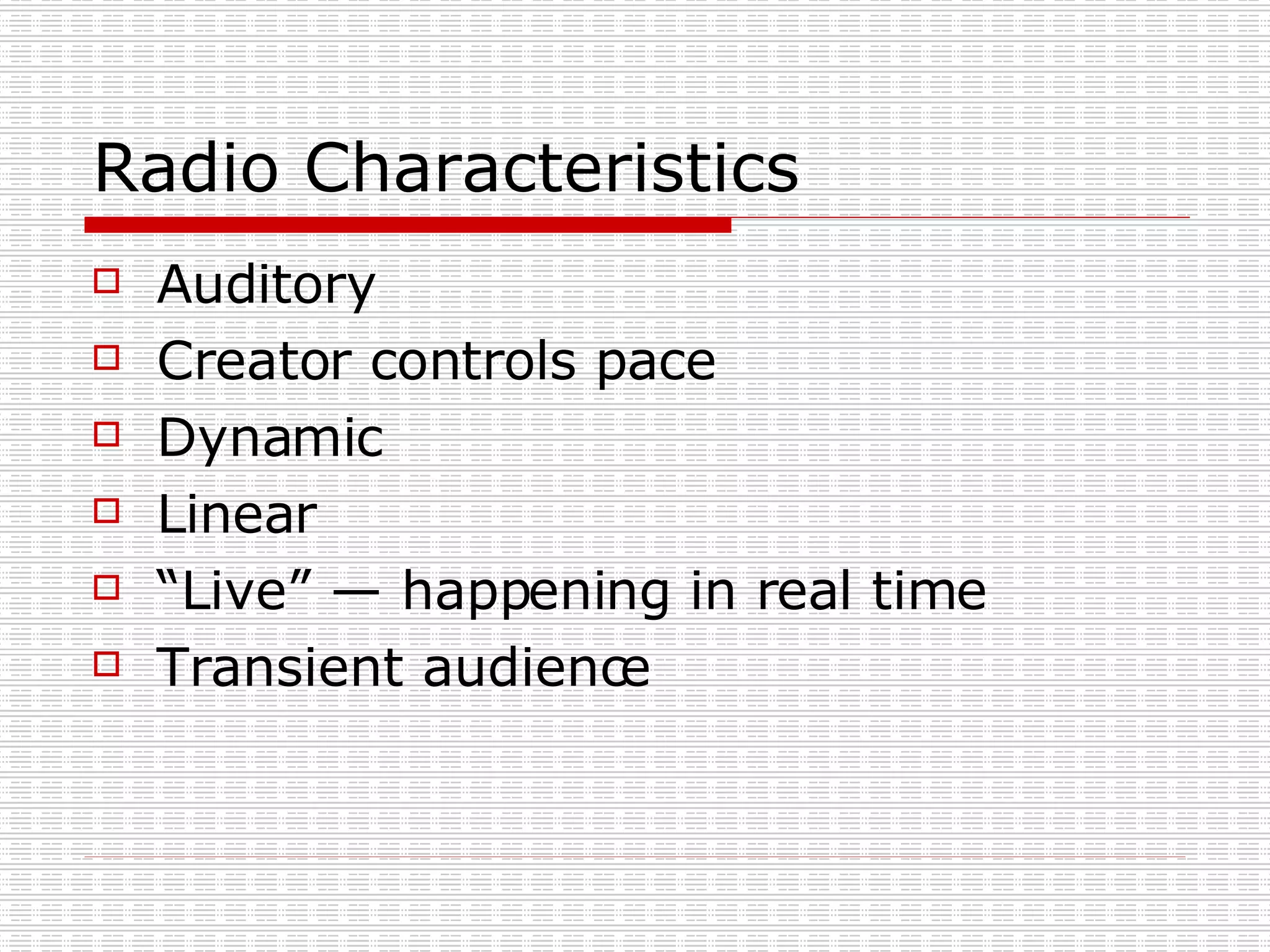
Radio Characteristics Auditory  Creator controls pace  Dynamic  Linear “Live” — happening in real time  Transient audience
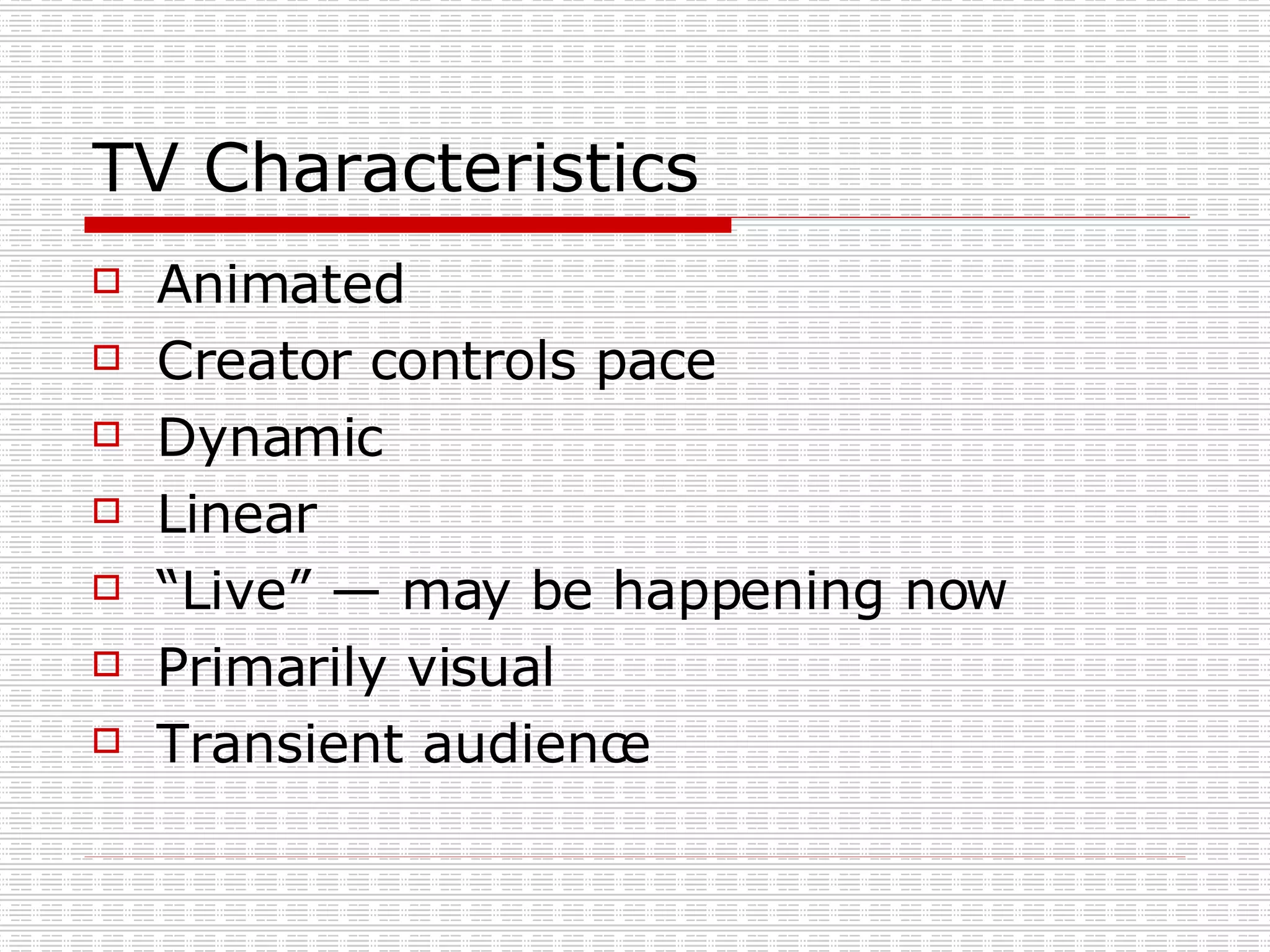
TV Characteristics Animated  Creator controls pace  Dynamic  Linear “Live” — may be happening now  Primarily visual Transient audience
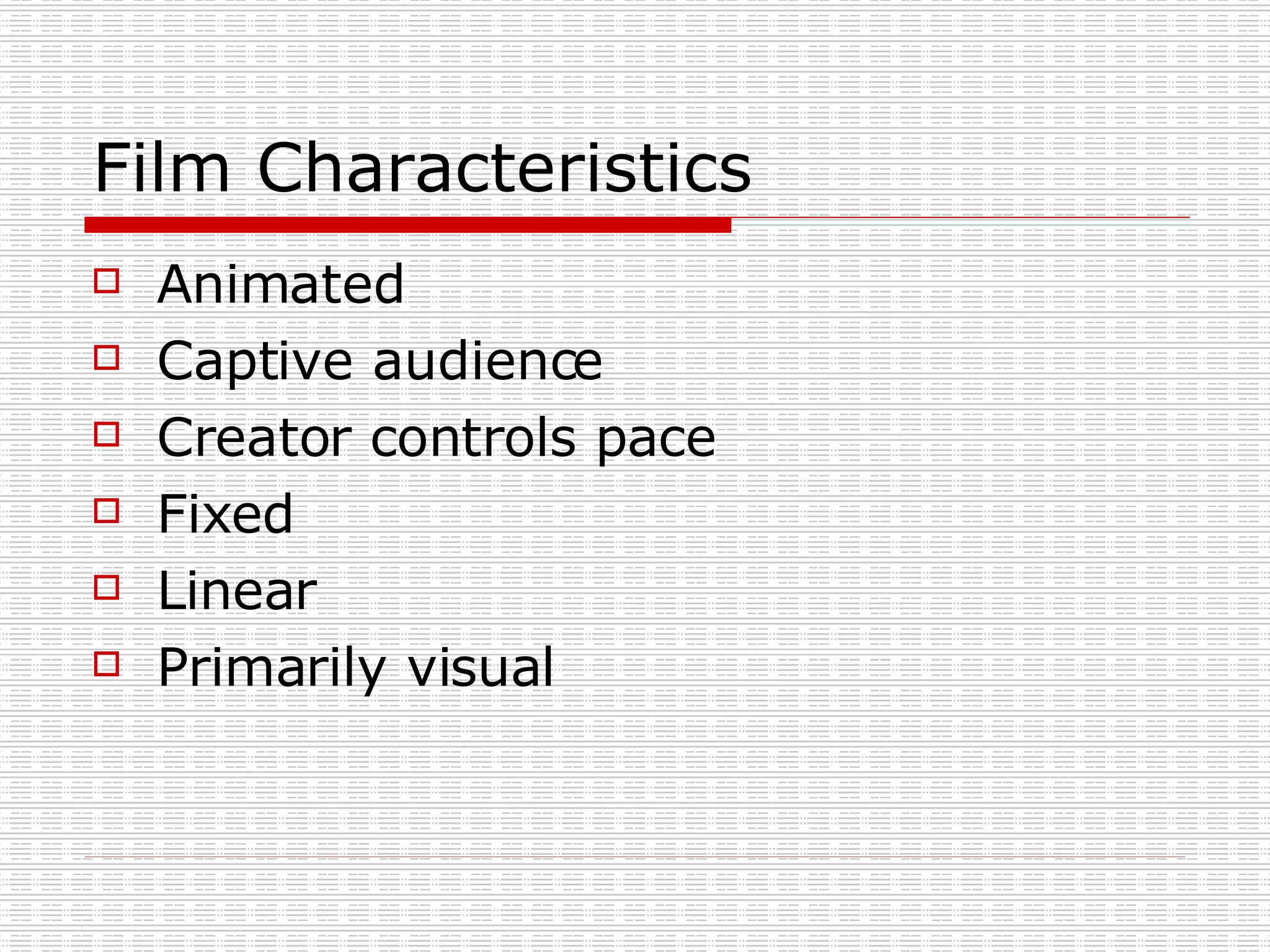
Film Characteristics Animated Captive audience  Creator controls pace  Fixed  Linear Primarily visual
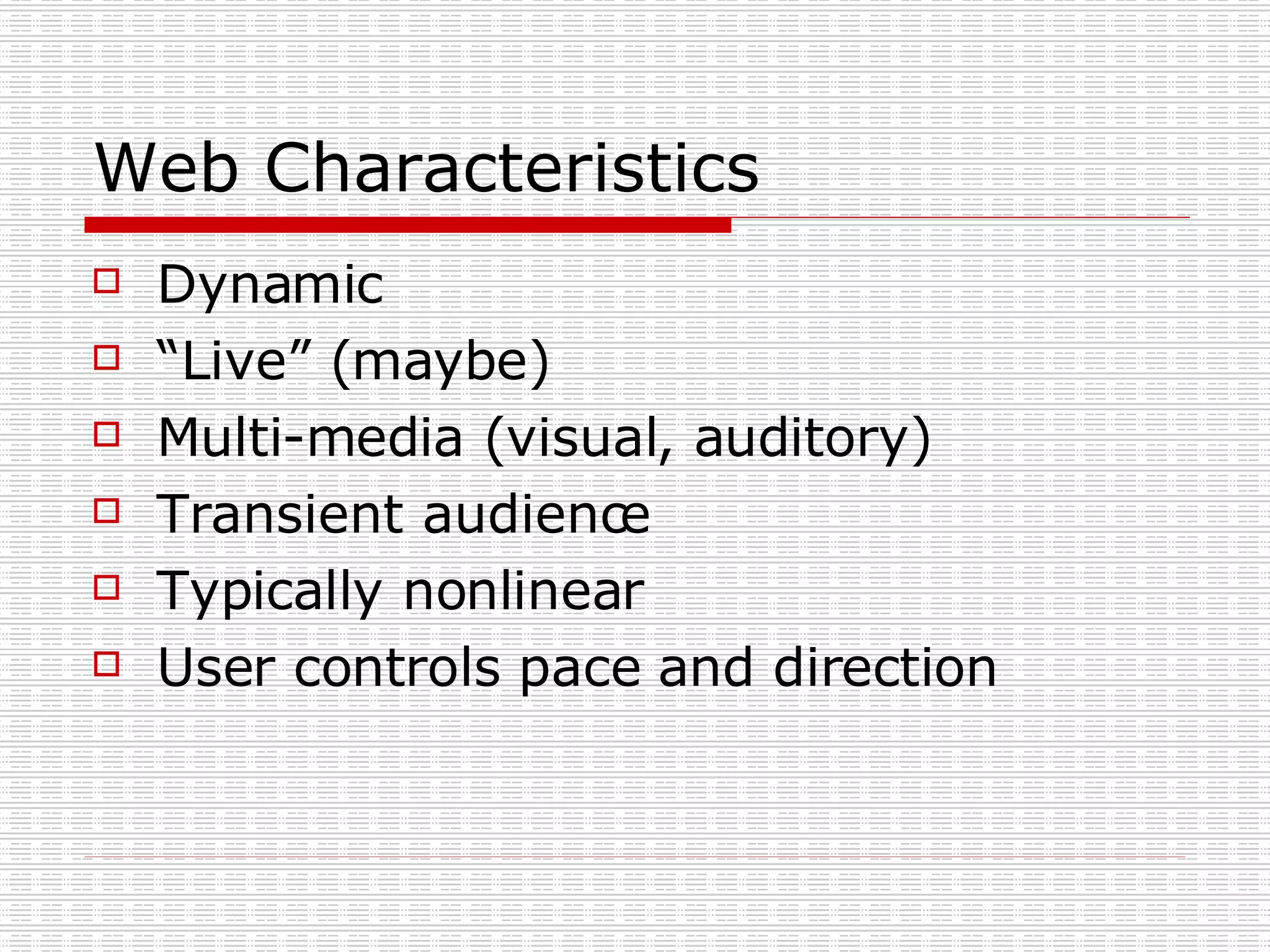
Web Characteristics Dynamic “Live” (maybe) Multi-media (visual, auditory) Transient audience  Typically nonlinear  User controls pace and direction
Mass audience no longer From broadcast to narrowcast Time-shifting Accelerates a move foreshadowed by niche publishing
Summary Mediated Communication is … Two types are … Three characteristics of new media and their impacts …
Resources Effects of Four CMC Channels on Trust Glossary of Internet Terms JCMC
Reading Discussion Break into your discussion groups There are four questions (seven groups) Discussion – reach as much consensus as possible “Report out” and group discussion

COM 300 - Week 2

  • 1.
    New Media Technologies:Communication Theories COM 300 Kathy E. Gill 14 Jan 2008
  • 2.
    Agenda Communication TheoriesMore “New Media” Discussion Multi-Media: phones
  • 3.
    New media (recapped)Some definitions focus on computer technology, others focus on interactivity Differences: Audiences not heterogeneous Control shifts from communicator to audience
  • 4.
    Communication A processin which participants create and share information with one another in order to reach mutual understanding (Rogers, 1995).
  • 5.
    Mediated communication Whatis it? d. mediated . (adj) acting or brought about through an intervening agent; (v) to be in the middle Why would we study it? We live in an ever-increasingly mediated world
  • 6.
    Part one :medium A go-between/intermediary in the communication binding the sender and receive Considers symbolic and cognitive theories of the psychology of representation Considers theories of meaning in signs and symbols (semiotics)
  • 7.
    Part two :mass media (1/2) Mass communication characteristics: Directed towards a large, heterogeneous audience Messages are transmitted publicly, are transient in nature, and are timed to reach all simultaneously Communicator works for an organization Charles Wright, 1959, from Communication Theories: Origins, Methods and Uses in the Mass Media, 1988, p7
  • 8.
    Part two :mass media (2/2) Mass media communication traditionally encompasses these channels Newspapers, magazines (print technologies) TV, radio (electronic technologies) Note: “news” v “ads”
  • 9.
    Channel The physical/technicaltransmission as well as any device needed for encoding/decoding May encompass advertising channels (direct mail) or news (TV) One-to-many, one-way channel is typical
  • 10.
    So, what isnew? Technologically? Socially? Your thoughts, based on readings? Three BIG things:
  • 11.
    Concept of scarcityGone! Bits can be shared; atoms cannot Implications? How does this relate to Bush’s musings about Memex? Does it make it easier or harder to “remediate”? Why?
  • 12.
    Constraint of timeGone! Time-shifting (Tivo, podcasting, 24x7 tech support via the web … what else?) How do you think that the speed in which we now communicate (e-mail, mobile phones, etc.) has affected our communication?
  • 13.
    Constraint of spaceGeographical barriers: Gone! Internet technology lets us “space shift” like we “time shift” – (almost) seamlessly There are environmental benefits from the advancement of technology, specifically from computers. If in the future, all of academia (from grade school & beyond) required only computer-based work, what would your response be to the change? Why?
  • 14.
    New channels WWWE-mail Videoconferencing MP3 Electronic publishing Mobile telephony What do they have in common?
  • 15.
    Your Daily DMUse (1/3) N=21 Cellphones Five mentioned talking Nine mentioned texting One mentioned music Other: alarm clock, Facebook, email, read NYT Types: iPhone (2), Blackberry (2), smartphone (1)
  • 16.
    Your Daily DMUse (2/3) MP3 Player Mentioned by five Podcasts mentioned by two iPod mentioned by seven Laptop Mentioned by five TV Mentioned by six
  • 17.
    Your Daily DMUse (3/3) Web email – 14 mentions Social sites – MySpace (7), Facebook (5), Friendster (1), Yahoo!Groups (1), message boards (1) News – 9 (plus 1 iPhone mention) Blogs – 6 mentions IM – 5 mentions Commerce – 5 mentions (Craigslist, iTunes store, banking) Digital pix – 2 mentions (Flickr, YouTube)
  • 18.
    Computer Mediated Communication (1/2) Desktop computers used as tools to influence human cognition and convey messages among people (focuses on the technology, older definition) Any form of communication between two or more individuals who interact and/or influence each other using social software on separate computers linked by a network (focuses on the people)
  • 19.
    CMC (2/2)CMC software has two categories: asynchronous and synchronous (Smith, 1994). http:// www.edb.utexas.edu/csclstudent/kim/text/ASCmC.html
  • 20.
    Synchronous Two ormore group members have real-time (simultaneous) communication Instant Messenging can be synchronous Face-to-face meetings; video conference; other?
  • 21.
    Asynchronous Allowsgroup members to work individually and “alone” Provides time/space flexibility E-mail, BBs Example: virtual teams
  • 22.
    Virtual Teams TypesTemporary (no common history or future) Permanent (common history and future) Forms of Interaction Face-to-face (meetings, formal or informal) Electronically-mediated (phone, CMC, videoconference) Context Culture and geography may be similar or different
  • 23.
    CMC/Web Characteristics (1/2) Hardware independent Software independent IM Not Here Yet, But Close (Google) Open standards Information sharing “Give back” (contribute) to the community
  • 24.
    CMC/Web Characteristics (2/2) A blend of characteristics from “old” media Print Radio Film TV
  • 25.
    Print Characteristics AbstractCaptive audience Fixed Linear Primarily verbal Reader controls pace
  • 26.
    Radio Characteristics Auditory Creator controls pace Dynamic Linear “Live” — happening in real time Transient audience
  • 27.
    TV Characteristics Animated Creator controls pace Dynamic Linear “Live” — may be happening now Primarily visual Transient audience
  • 28.
    Film Characteristics AnimatedCaptive audience Creator controls pace Fixed Linear Primarily visual
  • 29.
    Web Characteristics Dynamic“Live” (maybe) Multi-media (visual, auditory) Transient audience Typically nonlinear User controls pace and direction
  • 30.
    Mass audience nolonger From broadcast to narrowcast Time-shifting Accelerates a move foreshadowed by niche publishing
  • 31.
    Summary Mediated Communicationis … Two types are … Three characteristics of new media and their impacts …
  • 32.
    Resources Effects ofFour CMC Channels on Trust Glossary of Internet Terms JCMC
  • 33.
    Reading Discussion Breakinto your discussion groups There are four questions (seven groups) Discussion – reach as much consensus as possible “Report out” and group discussion