Faculty of
Humanities –
Placement Year
Agenda for today’s session
• Why take a Placement Year
• Faculty Requirements
• Finding a Placement:
• practical points to consider
• how to start your search
• working abroad
• Support Available during the Placement
Year
• Hear from students who have completed the
Placement Year
• Next steps
Page 2
Why should you do it?
• Get real-world experience
• Build a professional network
• New experiences & broaden your skills
• Graduate job offer from the placement
company
• Confirm your career choice
• Better employment prospects
• Get a Better Degree
• Earn Money
Page 3
So, what’s the problem?
• Your degree will take a year longer and you
will graduate later than some of your friends
• You will be a real, full-time employee. It’s
hard work
• Applying for placements itself is hard work
and will take up a lot of time and energy
• The process starts now but may take time
• You may have set-backs along the way
View, Master, Slide Master to change this text to the title of your presentation
Page 4
What the Faculty Requires…
• Can cover virtually any industry or
workplace
• Minimum requirement of 24 weeks
• Signed contract between the employer,
university and student
• Pass/fail
• Assessed by
 weekly/monthly blogs
 Employer questionnaire
 Reflective report
Page 5
Some practical things to consider……
• Where do you want to live?
• What type of organisation do you want to work
for?
• Type of industry/sector do you want to work
for?
• Do you want to…
consolidate /broaden your learning?
test out a particular career idea?
try something new?
position yourself to get a particular type of
graduate job?
earn money?
Page 6
Finding a Placement
• Do your research
• Speak to your Tutors
• Visit the Careers and Employability Service
• Apply early to the ‘BIG’ schemes
• Carry out internet searches e.g. Rate My
Placement
We will help you but ultimately it is your
responsibility to find a placement
Page 7
Thinking About Working Abroad?
• The Erasmus Programme offers course fee
waivers and non-means tested grants for
the duration of Placement Year (available to
UK and EU citizens)
• If you secure a placement in the UK but get
posted to the EU for three months or more
you may still be eligible for funding
• It is possible work anywhere in the world
but make sure you do your research, some
companies have specific work visa
regulations e.g. USA
Page 8
Support you will receive while on Placement
• Regular correspondence with the Placement
Year Officer
• Feedback on your blog
• At least one site visit
• News about your course and returning to
your studies e.g. Stage 3 Module
Registration
• Reminders about important deadlines
• Student Loan
Page 9
An overview of the process & some timescales
• Now – get your CV ready
• Autumn term & Spring Term – Apply for
Placements
• Summer Term – attend pre-placement
briefing
• By 20th
June – Inform your School of the
Placement details
• July – December – Start Placement
• A few weeks into the Placement – start to
write your learning log/ blog
• One/ Two months in – Workplace visit
Page 10
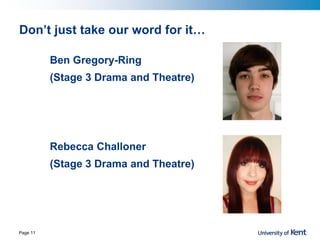
Don’t just take our word for it…
Ben Gregory-Ring
(Stage 3 Drama and Theatre)
Rebecca Challoner
(Stage 3 Drama and Theatre)
Page 11
What Next?
• Write/update your CV &
• Consider what you want from your
placement year
• Talk to colleagues in your home school
and/or CES
• Attend as many company presentations and
skills sessions as you can
• Start looking!
Page 12
Placement students return to Uni with…
• A great CV
• Real, credible work experience and examples to use
for future interviews
• Up-to-date knowledge that is in demand in industry
• A network of contacts
• A stronger idea of what they want to do in the future
• Better discipline and a good attitude to their studies
• A determination to get a good degree and maximise
their student days!
• A bunch of new friends, experiences and
expectations
And, if they are lucky, a graduate job offer!
Page 13
Any
Questions?
Page 14

College Placement Project.pptx

  • 1.
  • 2.
    Agenda for today’ssession • Why take a Placement Year • Faculty Requirements • Finding a Placement: • practical points to consider • how to start your search • working abroad • Support Available during the Placement Year • Hear from students who have completed the Placement Year • Next steps Page 2
  • 3.
    Why should youdo it? • Get real-world experience • Build a professional network • New experiences & broaden your skills • Graduate job offer from the placement company • Confirm your career choice • Better employment prospects • Get a Better Degree • Earn Money Page 3
  • 4.
    So, what’s theproblem? • Your degree will take a year longer and you will graduate later than some of your friends • You will be a real, full-time employee. It’s hard work • Applying for placements itself is hard work and will take up a lot of time and energy • The process starts now but may take time • You may have set-backs along the way View, Master, Slide Master to change this text to the title of your presentation Page 4
  • 5.
    What the FacultyRequires… • Can cover virtually any industry or workplace • Minimum requirement of 24 weeks • Signed contract between the employer, university and student • Pass/fail • Assessed by  weekly/monthly blogs  Employer questionnaire  Reflective report Page 5
  • 6.
    Some practical thingsto consider…… • Where do you want to live? • What type of organisation do you want to work for? • Type of industry/sector do you want to work for? • Do you want to… consolidate /broaden your learning? test out a particular career idea? try something new? position yourself to get a particular type of graduate job? earn money? Page 6
  • 7.
    Finding a Placement •Do your research • Speak to your Tutors • Visit the Careers and Employability Service • Apply early to the ‘BIG’ schemes • Carry out internet searches e.g. Rate My Placement We will help you but ultimately it is your responsibility to find a placement Page 7
  • 8.
    Thinking About WorkingAbroad? • The Erasmus Programme offers course fee waivers and non-means tested grants for the duration of Placement Year (available to UK and EU citizens) • If you secure a placement in the UK but get posted to the EU for three months or more you may still be eligible for funding • It is possible work anywhere in the world but make sure you do your research, some companies have specific work visa regulations e.g. USA Page 8
  • 9.
    Support you willreceive while on Placement • Regular correspondence with the Placement Year Officer • Feedback on your blog • At least one site visit • News about your course and returning to your studies e.g. Stage 3 Module Registration • Reminders about important deadlines • Student Loan Page 9
  • 10.
    An overview ofthe process & some timescales • Now – get your CV ready • Autumn term & Spring Term – Apply for Placements • Summer Term – attend pre-placement briefing • By 20th June – Inform your School of the Placement details • July – December – Start Placement • A few weeks into the Placement – start to write your learning log/ blog • One/ Two months in – Workplace visit Page 10
  • 11.
    Don’t just takeour word for it… Ben Gregory-Ring (Stage 3 Drama and Theatre) Rebecca Challoner (Stage 3 Drama and Theatre) Page 11
  • 12.
    What Next? • Write/updateyour CV & • Consider what you want from your placement year • Talk to colleagues in your home school and/or CES • Attend as many company presentations and skills sessions as you can • Start looking! Page 12
  • 13.
    Placement students returnto Uni with… • A great CV • Real, credible work experience and examples to use for future interviews • Up-to-date knowledge that is in demand in industry • A network of contacts • A stronger idea of what they want to do in the future • Better discipline and a good attitude to their studies • A determination to get a good degree and maximise their student days! • A bunch of new friends, experiences and expectations And, if they are lucky, a graduate job offer! Page 13
  • 14.