Conservatory of Music
Colburn
July 1, 2014–June 30, 2015
student catalog & handbook
  Conservatory of Music 
Calendar of Important Dates 2014‐15 
 
Fall 2014 
August 23  Move‐In Day  
August 23‐26  New Student Orientation and Testing 
August 27 
First Day of Fall Semester Classes 
Mandatory All‐School Business Meeting 
August 28  Dean’s Welcome & Conservatory Lunch 
September 1  Labor Day – No Classes 
November 26‐28 
Thanksgiving Break – No Classes 
(Residence Hall Open) 
December 8  Last Day of Classes 
December 9‐11  Juries 
December 15‐17  Final Exams 
December 18  Winter Break Begins 
December 19  Residence Hall Closes at Noon 
Spring 2015 
January 10  Residence Hall Opens at  8 AM 
January 12  First Day of Spring Semester Classes 
January 19  Martin Luther King Jr. Day – No Classes 
February 16‐26  Auditions 
March 16‐20 
Spring Break  ‐ No Classes 
(Residence Hall Open) 
April 27  Last Day of Classes 
April 28‐30  Juries 
May 4‐6  Final Exams 
May 8  Commencement 
May 9  Residence Hall Closes at Noon 
1
TABLE OF CONTENTS 
INTRODUCTION ......................................................................................... 5 
History of the Colburn School.......................................................................... 5 
The School’s Mission and Purpose .................................................................. 5 
The Conservatory Student Catalog and Handbook .......................................... 5 
PROGRAMS OF STUDY ............................................................................... 7 
APPLICATION AND ADMISSION INFORMATION .......................................... 9 
Deadlines ......................................................................................................... 9 
Age Limits ........................................................................................................ 9 
Application Materials ...................................................................................... 9 
Official Transcript(s) ...................................................................................... 10 
Letters of Recommendation .......................................................................... 10 
Résumé ......................................................................................................... 10 
Statement of Purpose ................................................................................... 11 
Standardized Test Scores .............................................................................. 11 
TOEFL Score ................................................................................................... 11 
Prescreening Video Recording....................................................................... 11 
Mailing Address ............................................................................................. 11 
TRANSFER APPLICANTS ............................................................................ 12 
Transfer Application Requirements ............................................................... 12 
Transfer of Credits ......................................................................................... 12 
INTERNATIONAL STUDENT ADMISSION .................................................... 15 
English Proficiency ......................................................................................... 15 
Admission in Cases of Substandard English Skills .......................................... 15 
Student Visa (F1 visa) and Visa Services ........................................................ 16 
Proof of Finances ........................................................................................... 17 
Employment .................................................................................................. 17 
More Information .......................................................................................... 17 
APPLICATION FORM ................................................................................. 18 
AUDITIONS AND PRESCREENING .............................................................. 19 
Prescreening .................................................................................................. 19 
AUDITION DAY OVERVIEW ....................................................................... 20 
Audition Dates ............................................................................................... 20 
Hotel Information .......................................................................................... 20 
DECISION PROCESS ................................................................................... 21 
AFTER THE AUDITION ............................................................................... 22 
Response Deadline ........................................................................................ 22 
Enrolling ........................................................................................................ 22 
Cancelling Enrollment ................................................................................... 22 
Final Transcript .............................................................................................. 23 
Orientation .................................................................................................... 23 
2
Registration ................................................................................................... 23 
WAIT LISTS ............................................................................................... 24 
CONTACT INFORMATION FOR CONSERVATORY ADMISSIONS ................... 25 
CONSERVATORY OF MUSIC FACULTY ........................................................ 26 
Conservatory Office Staff .............................................................................. 27 
CONSERVATORY OF MUSIC FACULTY BIOS ................................................ 28 
COURSE DESCRIPTIONS ............................................................................ 47 
Applied Music Courses .................................................................................. 47 
Ear Training Courses ...................................................................................... 48 
Ensemble Courses ......................................................................................... 48 
English as a Second Language (ESL) Courses ................................................. 50 
Graduate Courses – Other ............................................................................. 51 
Humanities Courses ....................................................................................... 52 
Independent Study Courses .......................................................................... 55 
Internship Courses ........................................................................................ 55 
Juries and Exams ........................................................................................... 56 
Keyboard Courses .......................................................................................... 56 
Music History and Literature Courses ........................................................... 57 
Music Technology Course .............................................................................. 60 
Music Theory Courses ................................................................................... 60 
Performance Forum and Chamber Forum ..................................................... 62 
Recital Courses .............................................................................................. 62 
Repertoire Classes ......................................................................................... 63 
Seminars and Workshops .............................................................................. 63 
ACADEMIC POLICIES AND PROCEDURES .................................................... 65 
Academic Freedom Policy ............................................................................. 65 
Academic Integrity ........................................................................................ 65 
Academic Progress and Student Achievement .............................................. 66 
Academic Support, Counseling and Assistance ............................................. 66 
Accompanying Policy ..................................................................................... 67 
Adding a Class ............................................................................................... 69 
Attendance Policy: Absences and Tardiness .................................................. 69 
Auditing a Class ............................................................................................. 74 
Building Hours ............................................................................................... 75 
Bulletin Boards .............................................................................................. 75 
Change in Status (Informational) ................................................................... 75 
Change of Program (Academic) ..................................................................... 75 
Class Size ....................................................................................................... 76 
Copyright Policy............................................................................................. 77 
Cost of Attendance, Fees and Refund Policies .............................................. 78 
Credit and Time Requirements ...................................................................... 79 
Credit for Experiential Learning ..................................................................... 79 
Credit for Non‐Colburn Classes ..................................................................... 80 
Credit Transferable to Other Institutions ...................................................... 81 
3
Disability Accommodation ............................................................................ 81 
Dismissal (See “Probation, Suspension, Dismissal” below) ........................... 82 
Dress Code .................................................................................................... 82 
Dropping a Class ............................................................................................ 83 
Email Communication ................................................................................... 83 
Extension of Program .................................................................................... 84 
Financial Assistance Policy ............................................................................ 84 
Form of Address ............................................................................................ 85 
Grading System and Policy ............................................................................ 85 
Health and Wellness ...................................................................................... 86 
Holds on Student Accounts ........................................................................... 86 
Housing ......................................................................................................... 86 
Incomplete Grade Policy ............................................................................... 87 
Indemnity ...................................................................................................... 87 
Independent Study ........................................................................................ 87 
Information Technology (IT) Acceptable Use Policy ...................................... 88 
Instruments ................................................................................................... 88 
Internships .................................................................................................... 88 
Jury Requirement .......................................................................................... 89 
Leave of Absence (Long‐Term) ...................................................................... 89 
Library – General Information ....................................................................... 90 
Library – Access and Policies ......................................................................... 90 
Make‐up Exams ............................................................................................. 91 
Office Hours .................................................................................................. 91 
Outside Scholarships ..................................................................................... 92 
Performance Diploma for ESL Reasons.......................................................... 92 
Placement Services ........................................................................................ 93 
Practical Training ........................................................................................... 93 
Practice Room Policy ..................................................................................... 93 
Probation, Suspension, Dismissal .................................................................. 95 
Program Length Policies ................................................................................ 99 
Publicity ....................................................................................................... 102 
Recital Policies ............................................................................................. 103 
Recital Requirements .................................................................................. 105 
Recording/Photography of Lessons, Performances, etc. ............................. 105 
Right to Change Student Catalog and Handbook ........................................ 105 
Room Usage Policy ...................................................................................... 105 
Security ....................................................................................................... 108 
Special Student Status ................................................................................. 108 
Student Grievance Procedure ..................................................................... 109 
Student Responsibilities .............................................................................. 110 
Student Rights ............................................................................................. 110 
Student Services .......................................................................................... 111 
Suspension (See “Probation, Suspension, Dismissal” above) ...................... 111 
Taxes and Withholdings .............................................................................. 111 
Teaching ...................................................................................................... 111 
Textbooks .................................................................................................... 112 
4
Touching Policy ........................................................................................... 112 
Transcripts ................................................................................................... 112 
Withdrawal, Administrative ........................................................................ 112 
Withdrawal from School ............................................................................. 112 
Withdrawing from a Class ........................................................................... 113 
LEGAL NOTICES....................................................................................... 114 
Accreditation, Approval and Authorization ................................................. 114 
Address, Location, Facilities and Equipment ............................................... 114 
Board of Directors. Board of Visitors, and Senior Administration ............... 115 
Filing a Complaint with the State of California ............................................ 115 
Financial Aid and Loans ............................................................................... 115 
Non‐Discrimination Notice .......................................................................... 115 
Notice of Non‐Bankruptcy ........................................................................... 115 
Sexual Assault Policy ................................................................................... 116 
Sexual Harassment and Other Unlawful Harassment Policy........................ 117 
Stalking Policy.............................................................................................. 118 
Statutory Rape Policy .................................................................................. 122 
Student Records, Privacy Information, Transcripts ..................................... 123 
Student Tuition Recovery Fund ................................................................... 127 
Transcripts ................................................................................................... 128 
APPENDIX A ........................................................................................... 130 
Acceptable Use of Information Resources Policy ........................................ 130 
Acceptable Use of Information Resources Agreement Form ...................... 133 
APPENDIX B ........................................................................................... 139 
Schedule of Student Charges 2014‐15 ......................................................... 139 
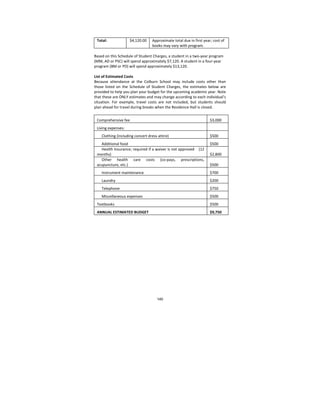
List of Estimated Costs ................................................................................ 140 
APPENDIX C ............................................................................................ 141 
Overview of Program Requirements ........................................................... 141 


5
INTRODUCTION 
History of the Colburn School 
The Colburn School was begun as a preparatory program for the University of 
Southern California in 1950. In 1980 it became an independent community 
school of performing arts, accredited as a non‐degree‐granting institution by 
the National Association of Schools of Music (NASM). 
 
The Colburn School then and now continues its community arts mission 
through its various divisions, which comprise the Community School of 
Performing Arts (CSPA), offering fee‐based enrollment in music, drama, and 
early childhood classes, and including the Trudl Zipper Dance Institute and 
the pre‐college Dance Academy; the Music Academy, offering a pre‐college 
curriculum for advanced music students; and the Adult Studies division. The 
School’s website (www.colburnschool.edu) provides complete information 
on all of the School’s programs. 
 
The Conservatory of Music, which is the college‐level division of the Colburn 
School, was opened in the Fall of 2003. This highly selective division offers 
instruction in instrumental music performance at the highest level, with 
training given by a faculty of international stature. 
 
The School’s Mission and Purpose 
The mission of the Colburn School is one of access and excellence, to enable 
all students to reach their highest potential in the performance of music, 
dance and drama.  
 
The purpose of the Conservatory of Music within the Colburn School is to 
provide intensive post‐secondary training to classical instrumental 
performance majors through the following programs: the Bachelor of Music 
in Performance degree, the Performance Diploma, the Master of Music in 
Performance degree, the Artist Diploma, and the Professional Studies 
Certificate. 
 
The Conservatory Student Catalog and Handbook 
The Student Catalog and Handbook (SC&H) of the Colburn School 
Conservatory of Music provides students with important information 
regarding degree requirements, classes offered, policies and procedures. 
Note that other divisions within the Colburn School have separate policies 
and procedures; these may differ from those defined in this SC&H specifically 
for Conservatory students. 
 
The Student Catalog and Handbook also presents information mandated by 
the State of California. Any questions a student may have regarding this 
catalog that have not been satisfactorily answered by the Colburn School 
may be directed to the Bureau for Private Postsecondary Education at PO 
Box 980818, West Sacramento CA 95798‐0818; phone 916‐431‐6959 or 888‐
370‐7589 toll‐free; fax 916‐263‐1897; www.bppe.ca.gov.  
6
 
All students in the Conservatory programs (the Bachelor of Music degree, the 
Performance Diploma, the Master of Music degree, the Artist Diploma, the 
Professional Studies Certificate) are responsible for reading and becoming 
familiar with this information, and for abiding by all policies and procedures 
stated herein.  
   
7
PROGRAMS OF STUDY 
The Colburn School Conservatory of Music offers five programs: two post‐
secondary (undergraduate) programs, and three post‐baccalaureate 
(graduate) programs. All students are performance majors. 
 
The Bachelor of Music (BM) degree program is a four‐year undergraduate 
curriculum focusing on the development of highly skilled performing 
musicians. As per National Association of Schools of Music (NASM) 
guidelines, the curriculum includes a general studies component. Students 
completing this program are prepared for graduate study at the master’s 
level, or for employment within the profession. A minimum of 120 semester 
units is required for completion of the program. 
 
The Performance Diploma (PD) is a four‐year curriculum designed for the 
student who has not yet completed a baccalaureate degree, but whose 
activities require more flexibility than the Bachelor of Music program. The 
program also supports students who need extra time to solidify their English 
language skills prior to enrolling in the BM program (see policy below). 
Requirements for music theory, humanities and music history are reduced or 
eliminated. Students completing this program are prepared for study at the 
diploma or certificate level, or for employment within the profession. 
Approximately 80 semester units are required for completion. 
 
The Master of Music (MM) degree is a post‐baccalaureate program that 
includes an academic component. Students must have completed a 
baccalaureate degree prior to matriculating. Students completing this 
program are prepared for further graduate study at the doctoral level, or for 
employment within the profession. A minimum of 42 semester units is 
required for completion of this program.  
 
The Artist Diploma (AD) program focuses on the development of highly 
skilled performing musicians. The program is a minimum of two years and a 
maximum of four years in length, with a requirement of four recitals. 
Students must have completed a baccalaureate degree prior to 
matriculating. Students completing this program are prepared for further 
study at the post‐graduate level, or for employment within the profession. 
Approximately 36 semester units are required for completion. 
 
The Professional Studies Certificate (PSC) program emphasizes professional 
and pre‐professional activities outside of the Colburn School. It is designed 
for students seeking intensive training in their applied area, often with 
specific goals in mind (such as preparation for competitions or auditions). 
Students are not required to have completed a baccalaureate degree, 
although the majority of students in this program will have done so. Students 
completing this program are prepared for further study at the post‐graduate 
level, or for employment within the profession. Approximately 26 semester 
units are required for completion. 
8
 
For information on the Graduate String Quartet‐in‐Residence program, 
please contact the Conservatory Office of Admissions (213‐621‐4534 or 
admissions@colburnschool.edu).  
 
Charts delineating the required courses and recommended sequence for 
each program can be found in Appendix C of this Student Catalog and 
Handbook.   
9
APPLICATION AND ADMISSION INFORMATION 
Information regarding application and admission to the Conservatory of 
Music is provided in this Student Catalog and Handbook. The School’s 
website (www.colburnschool.edu) also contains this information, and any 
updates made between printings of this Handbook. As a prospective student, 
you are encouraged to review this catalog prior to signing an Enrollment 
Agreement. You also are encouraged to review the School Performance Fact 
Sheet, which must be provided to you prior to signing an Enrollment 
Agreement.  
 
Enrollment in the Colburn School Conservatory of Music is based on the 
instrumentation of a symphony orchestra plus a piano department. The 
Conservatory of Music accepts applications only for instrumental areas in 
which there are openings. Applicants are expected to be ready for advanced 
training on their instruments. Students interested in enrolling must apply by 
following the process and requirements described here. 
 
Deadlines 
The completed application and ALL required application materials (including 
prescreening recordings, transcripts, and letters of recommendation) must 
arrive at the Colburn School by December 1. This is NOT a postmark 
deadline; the materials must arrive at the School by December 1. TOEFL 
scores also must arrive by December 1.  
 
Age Limits 
There is no age limit for applying to the Conservatory. However, at a 
minimum, students must have completed secondary education in order to 
enroll. Preference is generally given to students in the formative stages of 
their artistic development, as determined by the Admission Committees of 
the Conservatory. The Colburn School does not discriminate on the basis of 
race, color, nationality, gender, sexual orientation, gender expression, ethnic 
origin or religious belief in its admission, retention, student aid, scholarship, 
or other educational policies. 
 
Application Materials 
All applicants must complete the School's application form and must submit 
the required materials listed below. The résumé and statement of purpose 
must be attached to the online application. All other supplemental materials 
must be mailed to the Office of Admissions at the Colburn School (see 
address below). Do NOT send materials to faculty members. 
 
All application materials are due to the Office of Admissions by the 
announced deadline. In order to make sure that you have sent everything, 
we have created a checklist (available on our website). Use it to make sure 
your application is complete. 
 
 
10
 
Official Transcript(s) 
All applicants must submit official transcript(s) from previous school(s). 
 Freshman (BM) and PD applicants must submit a high school 
transcript. 
 Undergraduate (BM) transfer applicants must submit both high 
school and college transcripts. 
 Post‐baccalaureate applicants (those applying to the AD, PSC and 
MM programs) must submit transcripts from all colleges 
attended. 
 Documents that are not originally in English must be submitted in 
the original language and with a certified translation. 
 All transcripts must be submitted in envelopes sealed by the 
issuing school. 
 
Letters of Recommendation 
BM and MM applicants must submit two letters of recommendation: 
1. A recommendation describing the applicant’s instrumental 
development and abilities from the applicant’s current applied 
(private) teacher. 
2. A recommendation from another musician (such as a chamber 
music coach, orchestra director, summer festival teacher, etc.) 
describing the applicant’s musical abilities and ability to be 
successful in an academic degree program. 
 
PD, AD and PSC applicants must submit two letters of recommendation: 
1. A recommendation describing the applicant’s instrumental 
development and abilities from the applicant’s current applied 
(private) teacher. 
2. A recommendation from another musician (such as a chamber 
music coach, orchestra director, summer festival teacher, etc.) 
describing the applicant’s musical abilities. 
 
If preferred, your recommenders may complete our Recommendation Form 
(available on our website) and send that in instead of a letter. Note that 
recommendations should NOT come from relatives or family members. 
Please remind your recommenders that recommendations are due 
December 1st. 
 
Résumé 
A résumé must be submitted. A résumé is defined as a list of your academic 
and musical accomplishments. Please do NOT send a program bio. Because 
many applicants confuse a program bio with a résumé, we have created a 
sample résumé (available on our website) to help you. You may use our 
sample to create your own résumé. 
11
 
Statement of Purpose 
Prospective students must submit a brief Statement (essay) describing your 
objectives in enrolling at the Colburn School. This statement must be a 
minimum of two paragraphs in length, and a maximum of four paragraphs in 
length, single‐spaced. This is not a general essay, but must specifically 
address why you wish to enroll in the Colburn Conservatory. 
 
Standardized Test Scores 
Standardized test scores (SAT and ACT) are helpful but are not required. 
Usually these scores are included in high school transcripts.  
 
TOEFL Score 
An official TOEFL score is required if your native language is not English. The 
Colburn School's TOEFL code is 8477. (Information on the TOEFL—Test of 
English as a Foreign Language—may be found at www.ets.org). TOEFL scores 
are due December 1st. (For more information, see the section on 
International Student Admission below.) 
 
Prescreening Video Recording 
Applicants must upload a pre‐screening recording in video format through 
the online application. We do not accept DVDs or CDs. The required 
prescreening repertoire is posted on our website. 
 
Mailing Address 
The mailing address for sending supplemental materials is: 
 
The Colburn School 
Office of Conservatory Admissions 
200 South Grand Avenue 
Los Angeles CA 90012 
   
12
TRANSFER APPLICANTS 
A transfer applicant is someone who will not have completed their current 
program by the time they begin study at Colburn. Applicants who apply to 
transfer from their current school to the Colburn School must follow the 
same application and audition process as all other applicants, with some 
additional requirements as described here.  
 
Transfer applicants are typically undergraduate students. In cases where the 
student is applying to Colburn’s AD or PSC program, and he or she is 
currently enrolled in a post‐baccalaureate program at another school, and 
the applicant will not have completed this program by the time they begin 
study at Colburn, a Transfer Release Form will be required. Transfer 
applicants who choose to enroll at Colburn are required to withdraw 
appropriately from their current schools prior to matriculating at Colburn. 
 
The Colburn School does not accept transfer applicants to the Master of 
Music degree program. 
 
Transfer Application Requirements 
1. Application 
Complete the regular application form by the application deadline. 
 
2. Transcripts 
Students who have completed some college coursework must submit both 
college and secondary school transcripts. A college transcript alone is not 
acceptable if the applicant has not completed or will not have completed the 
program of study. 
 
3. Transfer Release Form 
As part of the application process to the Colburn School Conservatory of 
Music, this form must be submitted by any applicant currently enrolled in an 
institution of higher education within the United States who will NOT have 
completed their current program prior to matriculating (beginning studies) at 
the Colburn School. The Transfer Release Form is available on our website, or 
by emailing a request to the Admissions Office. This form must be completed 
and in the applicant's file before an offer of admission may be made by the 
Colburn School.  
  
International Transfer Applicants 
Please note that the Colburn School accepts international students as 
transfer students. The Transfer Release Form is NOT required for students 
currently enrolled in non‐U.S. institutions. All other requirements remain as 
stated below. 
 
Transfer of Credits 
Credit earned by applicants at another accredited post‐secondary institution 
may be transferable to the Colburn School, as noted below. In general, credit 
13
is granted only when the coursework involved and the level of the transfer 
applicant’s achievement is such that would permit the student to complete 
the remaining coursework at Colburn successfully.  
 
 General Education Credits 
Humanities courses completed with grades of "C" or better at 
other accredited undergraduate schools shall be considered for 
transfer credit.  
 
Up to 50% of the required General Education/Humanities credits 
(12 credits total) may be accepted in transfer for applicants who 
have completed at least two years of post‐secondary education, 
as noted below. 
 
Up to 25% of the required General Education/Humanities credits 
(6 credits total) may be accepted in transfer for applicants who 
have had less than two years of post‐secondary education, 
including high school students who have earned credit at post‐
secondary institutions.  
 
In all cases, an official transcript must be provided by the 
applicant showing the final grade. Students may be required to 
provide course descriptions from a catalog, a course syllabus, 
and/or textbooks and other class materials to establish 
equivalency. Requests for consideration of transfer credits must 
be made within the first semester of enrollment. 
  
Note that the Handbook contains a separate policy for currently enrolled 
students who wish to take classes outside of Colburn and transfer those 
credits back to Colburn (see Credit for Non‐Colburn Classes below). 
  
 Music Theory and Ear Training Credits 
Credit for Music Theory and Ear Training is based on assessment 
tests (challenge exams). Depending on the results, students may 
be given credit by exam for equivalent classes required at the 
Colburn School. (Example: A high school graduate may be given 
credit for two years of Music Theory classes at the School, and be 
placed in MTH 301 as a result of the test. Credit by examination 
for MTH 103‐204 would then appear on the student's transcript. 
In an inverse example, a student whose transcript shows four 
semesters of Music Theory may as a result of his/her exam score 
have to enroll in six semesters of theory at the Colburn School.) 
 
 Music History Credits 
Faculty will review the applicant’s transcripts for evidence of 
completed Music History courses. Placement in Colburn classes 
will be based on this review. An official transcript must be 
14
provided by the applicant showing the course(s) taken and the 
final grade(s). Students may be required to provide course 
descriptions from a catalog and/or textbooks and other class 
materials to establish equivalency. 
 
 Orchestra, Applied Study, and Chamber Music Credits 
All Conservatory students must enroll in applied studies (lessons), 
chamber music and orchestra (except pianists) during each 
semester of enrollment, regardless of previous experience or 
credits. 
 
 Determination of Transfer Credits 
Transferability of courses to the Colburn School is determined by 
the Associate Dean of the Conservatory, in consultation with the 
applied faculty and the relevant academic faculty. This 
determination is made individually, and is based on a review of 
the applicant’s academic record and placement testing. Normally, 
this is finalized during the registration process. Adjustments to 
transfer credits and placement may be made at the discretion of 
the School, and in consultation with the student’s academic 
advisor. 
15
INTERNATIONAL STUDENT ADMISSION 
The Conservatory is authorized under Federal law to enroll nonimmigrant 
students. The application process for non‐U.S. citizens is the same as that for 
U.S. citizens. The Colburn School does not discriminate on the basis of 
national origin. 
 
The following information may prove especially helpful for non‐U.S. citizens:  
 
English Proficiency 
English proficiency is a requirement for study at the Colburn School. In order 
to assess proficiency, we require all applicants whose native language is not 
English to take the Test of English as a Foreign Language (TOEFL). This test is 
offered worldwide. Information on the nearest testing center may be found 
at www.ets.org/toefl. In order for the Colburn School to receive an official 
copy of your score, you must enter the School’s code (8477) on the test 
document. Applicants should plan ahead to take the TOEFL in the Fall one 
year prior to the Fall of enrollment. We require a TOEFL score by December 
1st
.  
 
TOEFL minimum score requirements (ibt or internet‐based test) for 
admission are as follows: 
 BM:  79 
 PD:  65 
 AD:  65 
 PSC:  65 
 MM:  86 
 
In addition to submitting a TOEFL score, applicants invited to audition may be 
required to interview with School faculty as part of our assessment of English 
proficiency. 
 
There is no automatic waiver of the TOEFL requirement. Applicants who feel 
that their English language skills are strong enough to be granted a waiver 
must contact the Admissions Office to learn how to request a waiver 
(admissions@colburnschool.edu).  
 
Admission in Cases of Substandard English Skills 
Admission to the Colburn School Conservatory of Music is based first and 
foremost on the applicant’s musical performance skills, as demonstrated in 
the audition. Applicants do not always have adequate English language skills 
at the time of audition, as evaluated by the Admission Committee. In such 
cases the School may choose to admit applicants as follows: 
 
BM applicants with scores below the minimum requirement: 
BM applicants who do not have a TOEFL score of 79 or above may be 
admitted to the PD program. Such students have the option of remaining in 
16
the PD program for four years, or of being tested to enter the BM program at 
the end of the first year. Students who successfully pass the exam will be 
moved into the BM program. Students who do not pass this exam must 
remain in the PD program. English as a Second Language (ESL) courses are 
offered to help students prepare for this exam, and to provide ESL support in 
general. There is no additional charge for ESL classes. 
 
Provisional admission: 
Students must have a minimum TOEFL score of 79 plus the approval of the 
Admissions Committee in order to be admitted to the BM program. A score 
of 79 or higher by itself is not sufficient. The Admissions Committee may 
choose to extend an offer of admission to the PD program at its discretion. 
 
MM applicants with weak English skills: 
MM applicants whose English skills are either below the required TOEFL 
score or are assessed as inadequate by the Admission Committee will not be 
permitted to enroll in the MM degree program. Such students will be placed 
in either the AD or the PSC program. 
 
AD and PSC applicants with weak English skills: 
AD and PSC applicants whose English skills are either below the required 
TOEFL score or are assessed as inadequate by the Admission Committee may 
request tutoring from the ESL teacher.  
 
Student Visa (F1 visa) and Visa Services 
A Student Visa (F1 visa) for studying at the Colburn School can be obtained 
only after a student has applied, has been admitted, and has paid the 
enrollment deposit. The School will issue a Form I‐20 once all the above has 
occurred and the student has supplied the information required (including 
proof of finances). It is then the student's responsibility to take the I‐20 to 
the nearest U.S. consulate to obtain the visa. The Colburn School does not 
charge a fee for providing the Form I‐20. 
 
Note that although the Colburn School does not charge for providing the I‐
20, the US government charges a fee of US$200 or more for F1 visas. This fee 
is called the SEVIS I‐901 fee. This is a mandatory fee that must be paid to the 
US government before a visa will be issued. Go to 
www.fmjfee.com/i901fee for more details. A separate visa processing fee of 
approximately US$160 also may be charged. These fees must be paid by the 
applicant; the Colburn School does not pay these fees. 
 
Once an international student is enrolled in the Colburn Conservatory, the 
student may obtain proof of enrollment by contacting the Associate Dean or 
a member of the Conservatory Office staff. Proof of enrollment typically 
states the student’s enrollment date, anticipated graduation date, program 
of study, and whether the student is in good standing. 
17
 
Proof of Finances 
Part of obtaining a Form I‐20 is proving that the student has the means to 
cover expenses not covered by the School. Because the Colburn School 
provides housing and a food allowance, and also pays the student’s tuition, 
we require proof of finances only as stated on the estimated budget sent in 
your admission packet. Proof of finances must be in the form of an official 
bank statement. 
 
Employment 
The U.S. government strictly enforces visa regulations. International students 
are not permitted to work off‐campus, but may work on‐campus for the 
Colburn School. Depending on individual circumstances, students may 
engage in curricular practical training, including off‐campus practical training 
for pay. All questions regarding visa, work issues and practical training should 
be discussed with the Associate Dean of the Conservatory. 
 
More Information 
Information on study in the United States and help regarding visa matters 
may be found in your home country through EducationUSA advisers. To find 
the adviser nearest you, go to https://www.educationusa.info/. 
EducationUSA advisers are affiliated with the U.S. Department of State. 
18
APPLICATION FORM 
Applicants for Fall 2015 may apply online through the School’s website: 
http://www.colburnschool.edu/page.cfm?p=1896&pback=1889. The 
deadline for submitting the online application is December 1st. The School 
does not accept paper applications. 
 
Questions related to the Conservatory application form should be directed to 
admissions@colburnschool.edu or 213‐621‐4534. 
19
AUDITIONS AND PRESCREENING 
The goal of auditions at the Colburn School is to identify and enroll students 
whose potential is of the highest level, including the potential to make a 
positive contribution to the profession as musicians and as human beings. 
With that end in mind, we have created an audition process that allows for 
an exchange of information between the Conservatory of Music and 
applicants, and that is clear and professionally managed. 
 
Basically, you—the applicant—tell us about yourself through your résumé, 
your recommendations, your academic record, and (most of all) your 
audition and interview. We tell you about the Conservatory through our 
website, our Admissions staff, and through audition day activities. In the end, 
not every applicant can be admitted, but we hope that all applicants will gain 
a better understanding of the Colburn School Conservatory of Music, and will 
feel that they have been through a process that is respectful and 
professional. 
 
Prescreening 
Prescreening is the first round of the audition process; the second round is 
the in‐person audition in Los Angeles. The audition day includes several 
requirements beyond the audition itself (see Audition Day Overview below), 
which is why we only hold auditions in Los Angeles and why we have to limit 
the number of applicants that we invite to the in‐person audition. 
 
All applicants are required to submit a video recording for review by Colburn 
faculty. After hearing an applicant's preliminary recording, the faculty will 
indicate whether or not they feel an applicant should invest in a live audition. 
This recommendation to audition does NOT guarantee admission, but it may 
help you decide whether or not to invest in a trip to Los Angeles.  
 
Applicants who are invited to audition will be notified that they are 
scheduled for an audition that will take place in Los Angeles. Applicants who 
are not invited to audition will be notified that their files are closed. The 
Colburn School does not hold regional auditions. 
 
Prescreening recordings must be uploaded through the link on our website. 
Compact discs (CDs) and DVDs are not acceptable and will not be reviewed. 
Please see Audition and Prescreening Repertoire on our website for the 
requirements for your instrument. 
 
All submitted recordings become the property of the Colburn School. 
 
20
AUDITION DAY OVERVIEW 
The audition day allows us to become better acquainted with prospective 
students through several means, which may include: 
 
 The audition before a committee of faculty members.  
 A lesson or meeting with a faculty member (for selected 
students).  
 Assessment testing in music theory and ear training.  
 An interview with a senior administrator.  
 An interview for non‐native English speakers. 
 An essay writing exam for BM and PD applicants. 
 Other assessments as may be determined by the School. 
 
If you are invited to audition, you must be available for the entire audition 
day, usually 8:00 am ‐ 8:00 pm, unless otherwise notified. Scheduled audition 
day activities are NOT optional. Due to the complexity of the schedule, 
requests for specific times cannot be accommodated. 
 
Audition Dates 
Auditions will be held in Los Angeles in February 2015. Applicants must be 
available from 8am‐8pm on the audition day, for all the audition‐related 
activities. Travel should be planned accordingly.  
 
Audition dates are posted on our website. Openings are subject to change 
without notice. Please do not book your travel until you have received an 
invitation to audition in Los Angeles. 
 
Hotel Information 
A list of downtown hotels is posted on our website. There are several  hotels 
within walking distance of the Colburn School; the hotels in Little Tokyo are 
the farthest, and may require a short cab ride. Hotels outside of this area 
may not be in the safest locations. Feel free to check with Admissions 
regarding hotel choice.  
 
21
DECISION PROCESS 
Admission to the Colburn School Conservatory of Music is highly selective. 
The first consideration in any decision to accept or reject an applicant is the 
quality of the applicant's audition. Supporting materials such as transcripts, 
recommendations, and interviews are considered only after it has been 
determined that the audition demonstrates an acceptable level of 
proficiency, artistry and potential.  
  
In addition to the audition, several other areas are assessed: 
 Academic Record: All applicants submit academic transcripts, 
which are reviewed prior to a final decision on admission. 
 
 Interview: Applicants are interviewed by a member of the Colburn 
School staff as part of the audition process. The interview helps us 
to get better acquainted with the applicant. Interview impressions 
are discussed prior to a final decision on admission. 
 
 English Skills: Non‐native speakers of English are required to 
provide a TOEFL score and to have the same interview described 
above. In addition, an interview with the School’s ESL teacher is 
required. The applicant’s English skills are discussed prior to a 
final decision on admission.  
 
In making a decision, the committee discusses the overall results of the 
entire application and audition process. The final recommendation may be to 
admit a student to a program other than the one to which they applied. All 
such recommendations will be discussed with the applicant prior to issuing a 
letter of acceptance. A student is officially accepted to the Conservatory of 
Music only when he or she has received a letter of acceptance signed by the 
Associate Dean. 
  
The number of openings in the Conservatory is limited. Applicants who have 
not been accepted will be notified as soon as possible following the audition, 
so that they may proceed with making other plans. The decision not to 
accept a student in any one year does not preclude that student from 
applying again in future years. However, the same application and audition 
process must be completed each time the student applies. Note that all 
audition comments are confidential. The Colburn School does not provide 
comments to applicants. 
 
22
AFTER THE AUDITION 
The offer of admission to the Conservatory will include an official letter 
signed by the Conservatory’s designated admissions officer, an Enrollment 
Agreement, a School Performance Fact Sheet, and other documents to be 
reviewed and signed. Verbal discussion about possible admission is not an 
official offer. As a prospective student, you are encouraged to review the 
Conservatory Student Catalog and Handbook prior to signing an Enrollment 
Agreement. You are also encouraged to review the School Performance Fact 
Sheet, which must be provided to you prior to signing an Enrollment 
Agreement. 
 
Response Deadline 
All accepted applicants are required to respond to the offer of admission, 
whether the applicant's decision is to accept or to decline the Conservatory's 
offer. This is a critical requirement, because an applicant's decision may 
affect the status of another applicant on the wait list. In keeping with the 
Code of Ethics of the National Association of Schools of Music (NASM), 
students are allowed "...to choose without penalty among offers of 
admission and financial aid until May 1" or April 15 for post‐baccalaureate 
students (AD, PSC, MM).  After that date, enrollment commitments are 
considered binding. 
 
Accepted applicants are encouraged to read carefully the Enrollment 
Agreement, which provides specific information about cancelling enrollment, 
as required by state law.  
 
Enrolling 
An applicant is considered enrolled when s/he signs and returns the 
Enrollment Agreement, the School Performance Fact Sheet, and the non‐
refundable $500 enrollment deposit.  
 
Cancelling Enrollment 
A student who has enrolled as described above has the right to cancel 
his/her enrollment and withdraw from the Colburn School Conservatory of 
Music. Per California State law, the student has the right to obtain a refund 
of charges paid through attendance at the first class session, or the seventh 
day after enrollment, whichever is later, based on the start date on your 
Enrollment Agreement. Note that because the Colburn School provides a full‐
tuition scholarship and does not sponsor any negotiable instruments or 
disburse federal aid, and since the application fee and enrollment deposit are 
non‐refundable, no refund shall be due upon cancellation/withdrawal. 
 
To cancel your enrollment in the Colburn School Conservatory of Music, mail 
or deliver a signed and dated copy of your written notice to: 
 
Kathleen Tesar, Associate Dean and Custodian of Records 
The Colburn School Conservatory of Music 
23
200 South Grand Avenue 
Los Angeles CA  90012 
 
REMEMBER THAT YOU MUST CANCEL IN WRITING. You do not have the right 
to cancel by just telephoning the school or by not coming to class. 
 
Final Transcript 
All students who are admitted and who enroll in the Colburn School 
Conservatory of Music are required to submit a final transcript by July 1st
 of 
the summer prior to the start of classes. This transcript must document the 
completion of previous study. 
 
Orientation 
Orientation occurs just prior to the beginning of the academic term, and is 
required of all new students. Any exception to attendance at orientation 
requires the approval of the Associate Dean for the Conservatory. 
 
Registration 
Registration is scheduled as part of orientation for new students, and prior to 
the start of the new term for continuing students. 
 
 
24
WAIT LISTS 
The Conservatory of Music maintains wait lists in most areas. Applicants who 
are qualified for admission but who cannot be admitted immediately due to 
the limited number of openings shall be notified that they have been placed 
on a wait list. In accordance with the NACAC Statement of Principles of Good 
Practice, wait lists are closed by August 1. 
 
If the Conservatory wishes to offer admission to a student on our wait list 
after May 1 (or April 15 for post‐baccalaureate students), the School must 
determine first if the student has accepted an offer of admission from 
another school. The Conservatory must then contact the other school to 
inform them of a pending offer of admission from the Colburn School. In such 
cases, the applicant must obtain permission from that other school before 
the Colburn School can officially offer admission to the applicant. To signify 
permission, the music executive of the other school may be asked to sign 
Colburn's Release Form. Any questions on this matter should be discussed 
with the Associate Dean. 
 
25
CONTACT INFORMATION FOR CONSERVATORY ADMISSIONS 
The Colburn School 
Office of Conservatory Admissions 
200 South Grand Avenue 
Los Angeles, CA 90012 
Telephone:  213‐621‐4534 
Fax: 213‐625‐0371 
E‐mail: admissions@colburnschool.edu 
26
CONSERVATORY OF MUSIC FACULTY 
Andrew Bain, Horn 
Sarkis Baltaian, DMA, Keyboard Repertoire 
Martin Beaver, Violin; Co‐Director, String Chamber Music 
Richard Beene, Bassoon; Chair, Woodwinds, Brass, Percussion; 
   Chamber Music; Dean of the Conservatory 
Kristi Brown‐Montesano, PhD, Chair, Music History and Literature 
Alan Chapman, PhD, Music Theory 
Paul Coletti, Viola; Chamber Music 
Robert Duke, PhD, Consultant in the Psychology of Learning 
Vivian Fan, DMA, Director of Accompanying; Sonata Class 
Yehuda Gilad, Clarinet; Music Director and Conductor of the Colburn 
   Orchestra 
Clive Greensmith, Violoncello; Co‐Director, String Chamber Music 
Shayna Kessel, PhD, Humanities 
Jeffrey Kryka, PhD, Aural Skills/Ear Training 
Jeffrey Lavner, Keyboard Harmony 
Mark Lawrence, Trombone 
Ronald Leonard, Violoncello; Chamber Music 
Laura Liepins, Director, Artistic Administration and Career 
   Development 
Robert Lipsett, Violin/Jascha Heifetz Distinguished Violin Chair 
Peter Lloyd, Double Bass; Chamber Music 
Patricia Mabee, Harpsichord; Baroque Chamber Music 
Bruce Miller, PhD, Music Theory 
Jordan Nelson, PhD, Aural Skills/Ear Training 
Norman Pearson, Tuba 
Joel Peisinger, English as a Second Language 
John Perry, Piano 
Jacqueline Petitto, DMA, Seminar on The Healthy Musician 
Ian Pritchard, Music History and Literature 
Courtenay Raia, PhD, Humanities 
Gwen Robertson, PhD, Humanities 
Ory Shihor, Piano 
Deborah Smith, Library Director; Director, Conservatory Academic  
   Programs 
J. Douglas Smith, PhD, Chair, Humanities 
Warren Spaeth, Chair, Music Theory 
Arnold Steinhardt, Chamber Music; String Coach; Sonata Class 
JoAnn Turovsky, Harp 
Benjamin Ullery, Orchestral Repertoire, Viola 
Jack Van Geem, Percussion/Timpani 
Allan Vogel, DMA, Oboe 
Jim Walker, Flute; Music Technology 
James Wilt, Trumpet 
Nathaniel Zeisler, DMA, Director, Community Engagement and Adult 
   Studies 
27
Conservatory Office Staff 
Richard Beene, Dean 
  (213‐621‐1025 or rbeene@colburnschool.edu) 
Jessica Cameron, Administrative Assistant to the Associate Dean, PT 
(213‐621‐4534 or jcameron@colburnschool.edu)  
Christine Nakahara, Administrative Assistant to the Dean 
  (213‐621‐4786 or cnakahara@colburnschool.edu)  
Carrie Wade, Administrative Assistant to the Associate Dean, PT 
  (213‐621‐4788 or cwade@colburnschool.edu)  
Kathleen Tesar, Associate Dean 
  (213‐621‐4545 or ktesar@colburnschool.edu)  
28
CONSERVATORY OF MUSIC FACULTY BIOS 
 
Andrew Bain, Horn  
Appointed Principal Horn of the Los Angeles Philharmonic Orchestra in 2012, 
Andrew Bain has also served as Principal Horn of the Colorado Music Festival 
since 2003 and of the Melbourne Chamber Orchestra since 2009. Earlier 
posts include Principal Horn of the Melbourne Symphony Orchestra, 
Queensland Symphony Orchestra, Muenchner Symphoniker, and the 
Australian Opera and Ballet Orchestra at the Sydney Opera House. Solo 
appearances include the Queensland Symphony Orchestra and Melbourne 
Symphony, among others. He can be heard on the soundtracks of numerous 
recordings and films, including Happy Feet, Australia, and Anacondas. A 
sought‐after lecturer, Mr. Bain has given master classes and lectures at the 
Elder Conservatorium, the Queensland Conservatorium, the Shanghai 
Conservatory, and the Colorado Music Festival, and was Lecturer in Horn at 
the Sydney Conservatorium, the University of Melbourne, and the Tasmanian 
Conservatorium of Music. A native of Australia and a winner of the 2000 
Marten Bequest, Mr. Bain received a Bachelor of Music in French Horn 
Performance from the Elder Conservatorium of Music. He has also studied 
with Geoff Collinson in Sydney and Hector MacDonald in Vienna, and earned 
a Graduate Diploma in Chamber Music under Will Sanders in Karlsruhe. 
 
Sarkis Baltaian, DMA, Keyboard Repertoire  
Dr. Sarkis Baltaian has performed extensively as a recitalist and soloist with 
major orchestras throughout the United States, Europe, Asia and Australia. 
He made his Carnegie Hall debut in 1999 and has appeared as a guest artist 
in numerous festivals, including the Aspen International Music Festival, 
Holland Music Sessions, Bad Bertrich Klaviersommer, Pan Pacific Music 
Festival, and Plovdiv International Chamber Music Festival. As a teacher, Dr. 
Baltaian has served on the piano faculty at the Pan Pacific Music Festival in 
Sydney, Australia and California’s Mammoth Lakes Music Festival, and as a 
chamber music coach for the Junior Chamber Music Series in Los Angeles. He 
is frequently invited to adjudicate for such organizations as the Music 
Teachers National Association, Music Teachers Association of California, 
Junior Bach Festival, and Southwestern Youth Music Festival. Formerly an 
Assistant Professor of Music at the University of Alabama‐Huntsville, Dr. 
Baltaian joined the faculty at the Colburn School in 2011. Previous teaching 
posts include serving as a member of the piano faculty at California State 
University, Los Angeles (2005‐2008) and as the teaching assistant to 
Professor John Perry at the University of Southern California (2002‐2006). A 
native of Bulgaria, Dr. Baltaian began piano studies at age four with Rositza 
Ivancheva at the Dobrin Petkov Music High School for gifted students. He 
received his Bachelor of Music in Piano Performance, Master of Music in 
Piano Performance, and Doctor of Musical Arts in Piano Performance 
degrees under the direction of John Perry at the University of Southern 
California.  
 
29
Martin Beaver, Violin; Co‐Director, String Chamber Music 
Martin Beaver was named First Violin of the world‐renowned Tokyo String 
Quartet in 2002 and has since appeared on the major stages of the world 
including New York’s Carnegie Hall, London’s Wigmore Hall, Tokyo’s Suntory 
Hall, and the Sydney Opera House. Concerto and recital appearances have 
taken him to North and South America, Europe, and Asia with orchestras 
such as the San Francisco Symphony, l’Orchestre Philharmonique de Liège, 
the Montreal Symphony, and the Sapporo Symphony with conductors 
including Pinchas Zukerman, Raymond Leppard, and Charles Dutoit. Chamber 
music collaborations include eminent artists such as Leon Fleisher, Lynn 
Harrell, Sabine Meyer and the late Alicia de Larrocha. Mr. Beaver’s teachers 
include Victor Danchenko, Josef Gingold and Henryk Szeryng.  A laureate of 
the Queen Elisabeth, Montreal, and Indianapolis Competitions, he has 
subsequently served on the juries of major international competitions 
including the 2009 Queen Elisabeth Competition. A devoted educator, Mr. 
Beaver has conducted master classes on five continents. He has held 
teaching positions at the Royal Conservatory of Music, the University of 
British Columbia, the Peabody Conservatory, and New York University. Most 
recently, he was Artist in Residence at the Yale School of Music. Mr. Beaver 
received an Artist Diploma in Violin Performance from Indiana University and 
earned an Associate (ARCT) from the Royal Conservatory of Music in Toronto. 
 
Richard Beene, Bassoon; Chair, Woodwinds, Brass, Percussion; Chamber 
Music; Dean of the Conservatory 
Richard Beene enjoys an active career as a teacher, soloist, chamber 
musician, and orchestral performer. As a performer, he has appeared with 
the New York Philharmonic and the symphony orchestras of Chicago, 
Pittsburgh, and Detroit, to name a few. Dean Beene is former Principal 
Bassoonist with the Toledo Symphony Orchestra. He has toured Europe as a 
soloist with the American Sinfonietta and also performed as a soloist at the 
Festival de Musique de St. Barthélemy in the French West Indies. Included 
among his summer festival engagements are Kansas’s Sunflower Music 
Festival, Alaska’s Basically Bach Festival, the Colorado Music Festival, Strings 
in the Mountains (also in Colorado), the Arkansas Music Festival, 
Washington's Centrum Chamber Music Festival and Bellingham Festival of 
Music, and Wisconsin’s Peninsula Music Festival. Chamber music and recital 
engagements include New York's Merkin Concert Hall and the Library of 
Congress in Washington, D.C. as well as venues throughout Germany, 
Switzerland, Italy, and Austria. Dean Beene has been a featured recitalist at 
the annual convention of the International Double Reed Society. While 
serving as Professor of Bassoon at the University of Michigan, Dean Beene 
was awarded the 2001 Harold Haugh Award for excellence in studio teaching. 
He also has served on the faculties of Michigan State University and Wichita 
State University. A respected pedagogue, Dean Beene has been invited to 
present master classes and teaching residencies at a number of institutions, 
including the Thornton School of Music at the University of Southern 
California, Rice University's Shepherd School of Music, and McGill University. 
30
He holds a Bachelor of Music in Music Education from Baylor University and a 
Master of Music in Bassoon Performance from the University of Wisconsin‐
Madison, where he studied with Richard Lottridge.  
 
Kristi Brown‐Montesano, PhD, Chair, Music History and Literature  
Kristi Brown‐Montesano, musicologist and vocalist, was a co‐founding editor 
of Repercussions, a periodical devoted to critical and alternative viewpoints 
on music and scholarship, and worked as music editor and a feature writer 
for Britannica.com. Dr. Brown‐Montesano is the author of The Women of 
Mozart's Operas (University of California Press, 2007) as well as published 
essays on opera, children's music, and classical music in film. Her work on 
Bach, violence, and technology in contemporary cinema was featured in an 
article in the Los Angeles Times. As a vocalist, Dr. Brown has sung with 
several groups in Los Angeles and the San Francisco Bay Area, including the 
American Bach Soloists, Philharmonia Baroque Orchestra, California Bach 
Society, and Musica Angelica. Dr. Brown‐Montesano joined the faculty of the 
Colburn School in 2003 and enjoys teaching a wide range of music history 
courses in the Conservatory of Music. She received her Doctor of Philosophy 
in Music History and Literature from the University of California‐Berkeley in 
1997 with a specialization in 18th‐century Western European music. She also 
holds a Master of Arts in Music History and Literature and a Bachelor of Arts 
in Music. 
 
Alan Chapman, PhD, Music Theory 
Alan Chapman is a composer, lyricist, pianist and educator. Educated at MIT 
and Yale, he holds both a PhD and Master of Arts in Music Theory (along with 
a Bachelor of Arts in Humanities and Science) and has served on the faculties 
of Occidental College, the University of California‐Los Angeles and the 
University of California‐Santa Barbara. He is heard daily on Classical KUSC 
(91.5 FM) and globally as programmer and host of the classical channel on 
Delta Airlines. Dr. Chapman’s preconcert lectures have been presented by 
the Los Angeles Philharmonic, Los Angeles Master Chorale, Pacific Symphony, 
and others. His songs have been performed and recorded by many artists 
throughout the United States and England, and his children's opera Les 
Moose: The Operatic Adventures of Rocky and Bullwinkle was commissioned 
by the Los Angeles Opera. Dr. Chapman frequently appears with his wife, 
soprano Karen Benjamin, in evenings of his original songs as well as concerts 
dedicated to preserving the American Songbook. They have performed at 
Carnegie Hall, Lincoln Center, the Los Angeles Music Center, Broad Stage, and 
many other venues across the United States. Their CD, Que Será, Será: Songs 
of Livingston and Evans, features the late Ray Evans telling the stories behind 
such beloved songs as "Mona Lisa" and "Silver Bells." Their current 
collaborations include Music of the People: Songs of 19th Century America.  
 
Paul Coletti, Viola; Chamber Music  
Paul Coletti has performed as a soloist in every major European capital and at 
over fifty international music festivals. He has appeared with the Los Angeles 
31
Philharmonic, The London Soloists, and the Berlin and Hannover Radio 
Symphony Orchestras, and performed at the Sydney Opera House, London’s 
Queen Elizabeth Hall, Japan’s Suntory Hall, the Kennedy Center for the 
Performing Arts in Washington, D.C., and New York’s Lincoln Center. A 
Grammy‐nominated recording artist, Mr. Coletti has won accolades for his 
Hyperion recording English Music for Viola, which won best CD awards from 
Gramophone and BBC Music magazines and was named one of the one 
hundred best CDs of all time. While with the Menuhin Festival Piano Quartet 
he won the Forderpreiz in Zurich for the best chamber music recording of the 
year. Prior to becoming a faculty member at the Colburn School 
Conservatory of Music, Mr. Coletti held teaching positions at the 
International Menuhin Music Academy in Gstaad, the University of 
Washington (where he was Head of Strings at age 25), the Peabody 
Conservatory, and the University of California – Los Angeles. Born in 
Scotland, Mr. Colletti began his viola studies when he was eight years old, 
and later studied with Alberto Lysy and Yehudi Menuhin in Switzerland. 
Additional teachers include Sandor Vegh, Felix Galimir, Raphael Hillyer, Lillian 
Fuchs, Dorothy DeLay, Felix Andriewsky, Donald McInnes, and Zoltán Székely. 
He holds a Diploma from the International Menuhin Music Academy and a 
Post‐Graduate Diploma from the Julliard School, both in Viola Performance. 
 
Robert Duke, PhD, Consultant in the Psychology of Learning 
Visiting Consultant Robert Duke is the most recent recipient of the Senior 
Researcher Award from The National Association for Music Education. Dr. 
Duke has directed national research efforts under the sponsorship of such 
organizations as the National Piano Foundation and the International Suzuki 
Institute. His research on human learning and behavior spans multiple 
disciplines, including motor skill learning, cognitive psychology, and 
neuroscience. His most recent work explores procedural memory 
consolidation and the cognitive processes engaged during musical 
improvisation. The author of Scribe 4 behavior analysis software, Dr. Duke is 
the author of Intelligent Music Teaching: Essays on the Core Principles of 
Effective Instruction, and co‐author (with Jim Byo of Louisiana State 
University) of The Habits of Musicianship. A former studio musician and 
public school music teacher, he has worked closely with at‐risk children, both 
in the public schools and through the juvenile justice system. In addition to 
his work at Colburn, Dr. Duke is the Marlene and Morton Meyerson 
Centennial Professor and Head of Music and Human Learning at The 
University of Texas‐Austin, where he is University Distinguished Teaching 
Professor, Elizabeth Shatto Massey Distinguished Fellow in Teacher 
Education, and Director of the Center for Music Learning. Dr. Duke earned his 
Bachelor of Music Education, his Master of Music in Percussion Performance, 
and his PhD in Music Education from Florida State University. 
 
Vivian Fan, DMA, Director of Accompanying; Sonata Class 
Vivian Fan has served as a collaborative pianist at the International Music 
Course of Benidorm in Spain, Hawaii Performing Arts Festival, and Montecito 
32
Summer Music Festival and was awarded the Best Accompanist Award from 
The Edith Knox Performance Competition in 2009 and 2010. She performed 
at Walt Disney Concert Hall in the Los Angeles Philharmonic’s “Brahms 
Unbound” concert in 2011. Dr. Fan’s performances have been broadcast on 
KTLA and KNBC television as well as KUSC and WFMT radio. In 2012, she 
collaborated with Paul Coletti in a recording project for Bridge Records on 
Paul Chihara’s Viola Sonata. In the summer of 2006, Dr. Fan gave a 
symposium presentation at the International Society of Music Education 
World Conference. As a solo pianist, Dr. Fan has performed with conductors 
Jorge Mester, Jung Ho Pak, Mario Miragliotta, Sharon Lavery, Peter Askim, 
and Marc Riley. Her chamber music performances include recital 
collaborations with Paul Coletti, Shigenori Kudo, Lindsay Deutsch, Paul 
Wiancko, John Hayhurst, and Richard O’Neill, among many others. Dr. Fan 
currently holds the Director of Accompanying faculty position at the Colburn 
Conservatory. Prior to this position, she was on the piano faculty at the 
Idyllwild Arts Academy and was a teaching assistant to Professor John Perry 
at University of Southern California. Dr. Fan received her DMA, MM, and BM 
in Piano Performance from the University of Southern California Thornton 
School of Music under the tutelage of John Perry, where she was awarded 
the Michael Kamen Music Scholarship. She is also an elected member of Pi 
Kappa Lambda. 
 
Ariana Ghez  
Ariana Ghez joined the Los Angeles Philharmonic as Principal Oboe in 
September 2006. Prior to her appointment in Los Angeles, Ms. Ghez was 
principal oboe of the Rochester Philharmonic Orchestra and of the Santa Fe 
Opera. She has also performed as guest principal oboe with the Chicago 
Symphony Orchestra, the New York Philharmonic, and the St. Louis 
Symphony Orchestra. As a soloist, Ms. Ghez has performed with the Los 
Angeles Philharmonic, Rochester Philharmonic, New York String Orchestra at 
Carnegie Hall, Redlands Symphony Orchestra, Simon Bolivar Youth Orchestra 
in Caracas, and Aspen Music Festival, among many others. She can be heard 
playing Bach’s Oboe and Violin Concerto with violinist Lara St. John on 
Ancalagon Records. An avid lover of chamber music, Ms. Ghez performs 
frequently with her Los Angeles Philharmonic colleagues and guests on the 
chamber series at Disney Hall.  Other chamber engagements include 
collaborations with Jaime Laredo and Ida Kavafian (92nd
 Street Y), Gil Shaham 
(Aspen Music Festival), and Pinchas Zuckerman (with the Rochester 
Philharmonic).  She has performed with La Jolla Summerfest, the Mainly 
Mozart Festival (San Diego), Santa Fe Chamber Music Festival, Chamber 
Music Rochester, and the Colorado College Music Festival.  Ghez has 
participated in numerous festivals, including the Marlboro Music Festival in 
Vermont and the Tanglewood Music Center. She holds a bachelor's degree in 
English Literature from Columbia University, where she was enrolled in the 
Columbia/Juilliard School joint program and studied with John Mack and 
John Ferrillo.  She pursued graduate studies at Temple University in 
Philadelphia, where she studied with Richard Woodhams and was an oboe 
33
teaching assistant.  Ghez has given master classes at the Oberlin College 
Conservatory, Peabody Institute, University of Southern California, San 
Francisco Conservatory, and Kent/Blossom Summer Festival, among others.  
She has also served as guest faculty member at the Aspen Music Festival and 
School. 
 
Yehuda Gilad, Clarinet; Music Director and Conductor of the Colburn 
Orchestra  
An accomplished clarinetist, conductor, and teacher, Yehuda Gilad strives for 
"total musicianship," and as a result, he has won the acclaim of both critics 
and audiences alike. One of the founding faculty members of the Colburn 
Conservatory, and Music Director of the Colburn Orchestra since its 
inception, Mr. Gilad has also held music directorships with the Colonial 
Symphony of New Jersey (1988‐2003), Santa Fe’s 20th‐Century Unlimited 
concert series, the USC Thornton Chamber Orchestra, and the Santa Monica 
Symphony Orchestra.  He has guest conducted throughout the United States, 
Asia, and Europe. Mr. Gilad founded the Yoav Chamber Ensemble and the 
Colburn Woodwind Chamber Players. During his tenure as Music Director, 
the Colonial Symphony received NEA grants for seven consecutive years as 
well as two Distinguished Arts Organization Awards from the New Jersey 
State Council on the Arts for its artistry and program merits. His former 
clarinet students include members of major world‐renowned orchestras 
including the New York Philharmonic, Minnesota Orchestra, and the 
Stockholm, Hong Kong, and Seoul Philharmonics, among others. Regularly 
invited to present master classes and performances at music conservatories 
and festivals worldwide as well as adjudicate at major international 
competitions, Mr. Gilad has received the Distinguished Teacher Award from 
the White House Commission on Presidential Scholars and the Israel‐America 
Cultural Foundation Scholarship. In addition to his work at the Colburn 
School, Mr. Gilad also serves as Professor of Music at the University of 
Southern California. Born and raised on a kibbutz in Israel, Mr. Gilad 
immigrated to the United States in 1975 after completing his conservatory 
studies and earning a diploma in clarinet and chamber music. He participated 
in numerous master classes with Sergiu Celibidache and Leonard Bernstein. 
His former teachers include Giora Feidman, Mitchell Lurie, and Herbert 
Zipper.  
 
Clive Greensmith, Violoncello; Co‐Director, String Chamber Music 
Clive Greensmith, cellist, joined the Tokyo String Quartet in 1999 and has 
performed at the most prestigious venues and concert series across the 
United States, Europe, Australia, and the Far East. He previously held the 
position of Principal Cellist of London's Royal Philharmonic Orchestra. As a 
soloist, he has appeared with the London Symphony Orchestra, the Royal 
Philharmonic, Toronto Symphony Orchestra, English Chamber Orchestra, 
Mostly Mozart Orchestra, Seoul Philharmonic, and the RAI Orchestra of 
Rome. He has collaborated with distinguished musicians such as Leon 
Fleisher, Claude Frank, Alicia de Larrocha, Sabine Meyer, Midori, András 
34
Schiff, and Pinchas Zukerman, and has won several prizes including second 
place in the inaugural "Premio Stradivari" held in Cremona, Italy. A regular 
visitor to many international festivals, Mr. Greensmith has performed at the 
Marlboro Music Festival, The Salzburg Festival, the Edinburgh Festival, the 
Pacific Music Festival, the Sarasota Music Festival and the Norfolk Chamber 
Music Festival Yale Summer School of Music. Mr. Greensmith's recording of 
works by Brahms and Schumann with Boris Berman was recently released on 
the Biddulph label. Recordings with the Tokyo String Quartet include the 
complete Beethoven quartets and the Mozart 'Prussian' quartets.  Mr. 
Greensmith has served on the faculties of the Royal Northern College of 
Music, Yehudi Menuhin School, and San Francisco Conservatory of Music. 
Mr. Greensmith is currently a faculty member at the Colburn Conservatory of 
Music and the Meadowmount School of Music. A Professional Performer of 
the Royal Northern College of Music and graduate of the Musikhochschule in 
Cologne, he studied with Donald McCall and Boris Pergamenschikow. 
 
Shayna Kessel, PhD, Humanities  
Shayna Kessel has been a part‐time member of the faculty at the Colburn 
School Conservatory of Music since 2011. Her courses focus on American and 
world literature. Dr. Kessel is also an Assistant Dean in the Graduate School 
at the University of Southern California. She earned her bachelor's degree in 
Comparative Literature and Literary Theory in 2003 from the University of 
Virginia, where she was an Echols Scholar Interdisciplinary Major in 
Comparative Literature and Theory. In 2004, Dr. Kessel earned her master's 
degree in English from UVa, which was followed in 2007 by her second 
master's degree in English from USC. Dr. Kessel earned her PhD in English 
from USC in 2011.  
 
Jeffrey Kryka, Aural Skills/Ear Training 
Film and concert composer Jeff Kryka has received awards from Turner 
Classic Movies, ASCAP, the Recording Musician Association Los Angeles, and 
the Henry Mancini Foundation, and has had music performed and recorded 
by virtuoso violinists Anne Akiko Meyers and Maria Bachmann, the 
Hollywood Studio Symphony, The Hollywood Reporter Key Art Awards, 
Pacific Serenades, and the Heartland Symphony Orchestra. Jeff received his 
BM from the University of Wisconsin‐Madison, where he studied with 
composers Stephen Dembski and Laura Schwendinger. At the University of 
California‐Los Angeles, he studied with composers Paul Chihara, Roger 
Bourland, Ian Krouse, David Lefkowitz, Charles Fox, Laura Karpman, and 
Bruce Broughton, and earned his PhD in Music Composition there in 2011. 
He has worked for composers Michael Giacchino, Paul Chihara, Chris Tilton, 
and Laura Karpman. Projects include the Fox TV shows Fringe, Almost 
Human, Alcatraz, and UnderCovers; video games SimCity, Kung Fu Panda 2: 
The Kaboom of Doom!, Kinect Disneyland Adventures; and the films Star Trek 
Into Darkness, Jupiter Ascending, Super 8, John Carter, and Let Me In.  
 
 
35
Jeffrey Lavner, Keyboard Harmony  
Jeffrey Lavner’s earliest professional experiences were as a jazz pianist; he 
now performs as pianist and harpsichordist, using his improvisatory skills on 
both instruments. Formerly an assistant lecturer at the University of 
Southern California as well as a faculty member at Santa Monica and Golden 
West Colleges, Mr. Lavner is Co‐Chair of the Piano Department in the Colburn 
Community School of Performing Arts (where he has been on the faculty for 
twenty years), and Workshop Coordinator of Keyboard Skills for Non‐Majors 
in the Colburn Conservatory. Mr. Lavner holds a Bachelor of Music degree 
with performance honors from Syracuse University, and a Master of Music in 
Piano Performance from the University of Southern California.  
 
Mark Lawrence, Trombone  
An active soloist, clinician, chamber musician, and teacher, Mark Lawrence 
was Principal Trombonist with the San Francisco Symphony from 1974‐2007. 
He has also been Principal Trombonist with the Denver Symphony and a 
member of the Empire Brass Quintet, and is a founding member of Summit 
Brass. A frequent performer with Chicago's Music of the Baroque, Mr. 
Lawrence has also performed at both the International Brass and 
International Trombone Conferences. He is the youngest musician ever to 
play in the renowned Detroit Concert Band under the direction of cornet 
virtuoso Leonard B. Smith. As a teacher, Mr. Lawrence has served on the 
faculties of Boston University Tanglewood Institute and Music Academy of 
the West. In addition to his work at The Colburn Conservatory, Mr. Lawrence 
also teaches at the San Francisco Conservatory and the Rafael Mendez Brass 
Institute. Mr. Lawrence attended the University of Michigan and the Curtis 
Institute in Philadelphia, where he received his Bachelor of Music in 
Trombone Performance. His teachers have included Carlos Rivera, Allen H. 
Chase, Glenn Smith, M. Dee Stewart, and Glenn Dodson. 
 
Ronald Leonard, Violoncello; Chamber Music  
As Principal Cellist of the Los Angeles Philharmonic from 1975‐2000, Ronald 
Leonard has performed virtually the entire cello concerto literature under 
the direction of such conductors as Zubin Mehta, Michael Tilson Thomas, 
Carlo Maria Giulini, Vladimir Ashkenazy, André Previn, and Esa‐Pekka 
Salonen. Also a critically acclaimed chamber musician, Mr. Leonard is a 
former member of the Hartwell, Eastman, and Vermeer Quartets. Festival 
appearances include the Spoleto (Italy) Festival of Two Worlds, Festival 
Casals in Puerto Rico, and the Marlboro Festival, where he was also active in 
tours and recordings. Mr. Leonard has both performed and taught at the 
Aspen Music Festival and School, The Perlman Music Program, Sarasota 
Music Festival, Marrowstone Summer Festival, La Jolla Summer Fest, Aria 
International Summer Festival, and Musicorda. In May 1996, Mr. Leonard 
was inducted into the Rhode Island Heritage Hall of Fame in recognition of 
his achievements in the field of music. Mr. Leonard received a Diploma from 
Curtis Institute of Music with a major in Violoncello. One of the founding 
faculty members of the Colburn Conservatory of Music, Mr. Leonard 
36
currently teaches in the Conservatory, the Community School of Performing 
Arts, and the pre‐college Music Academy, with prize‐winning students in all 
divisions.   
 
Laura Liepins, Director, Artistic Administration and Career Development 
Laura Liepins is the Director of Artistic Administration and Career 
Development at the Colburn School, where she oversees the artistic activities 
of the school, co‐teaches a course on the music business, and runs an in‐
house artist management company which seeks to launch the professional 
careers of Colburn’s most accomplished student artists. Ms. Liepins has over 
20 years of experience working as an artist manager and has worked closely 
with soloists and conductors at the highest international level as well as 
those at the very beginning stages of their careers. Formerly Vice President 
at Opus 3 Artists, where her focus was on building the careers of young 
conductors, Ms. Liepins established her own artist management company in 
2008. A member of the staff and faculty of the Colburn School since 2011, 
she has been a guest speaker at the University of Southern California’s 
Thornton School of Music and at the Winnipeg Symphony’s International 
Young Conductors Symposium. A violinist by training, Laura studied with a 
member of the Boston Symphony Orchestra at the New England 
Conservatory Preparatory Division, with Andres Cardenes at the University of 
Michigan, and graduated cum laude with her Bachelor of Music in Violin 
Performance from USC’s Thornton School of Music.  
 
Robert Lipsett, Violin/Jascha Heifetz Distinguished Violin Chair  
A renowned teacher who has given master classes worldwide, Robert Lipsett 
has also enjoyed a career as an active solo artist, chamber musician, 
orchestral musician, and freelance commercial musician in the motion 
picture, television, and recording industries. His students hold principal 
positions with leading orchestras, including Concertmaster of the Chicago 
Symphony, Principal Associate Concertmaster and Assistant Concertmaster 
of the New York Philharmonic, and Concertmaster of the St. Paul Chamber 
Orchestra. Additionally, his students have consistently won important 
competitions, among them the Julius Stulberg Awards; the Yehudi Menuhin, 
Irvine M. Klein, and Hannover International Violin Competitions; and the 
International Tchaikovsky Competition. Several of his students have received 
highest honors from the National Association for the Advancement of the 
Arts and have been recognized as Presidential Scholars. A faculty member at 
the Colburn School for over twenty‐five years and one of the founding faculty 
members of the Conservatory, Mr. Lipsett also serves on the faculty of the 
Aspen Music Festival. He has taught at the University of Southern California 
as a tenured professor and at California State University‐Northridge (CSUN). 
A recipient of the Distinguished Teachers Award from the White House 
Commission for Presidential Scholars, Mr. Lipsett received his Bachelor of 
Arts in Music from CSUN. Principal teachers include Ivan Galamian, Ruth 
Lasley, Zelman Brunoff, Melvin Ritter, and Endre Granat. 
 
37
Peter Lloyd, Double Bass; Chamber Music 
Formerly Principal Bass of The Minnesota Orchestra (1986‐2007) and a 
member of The Philadelphia Orchestra for more than eight years prior, Peter 
Lloyd regularly appears as Principal Bass with a variety of ensembles 
worldwide. A respected chamber musician, he has performed with the 
Guarneri String Quartet, Beaux Arts Trio, and the Penderecki, Miami, Miro, 
Brentano, Borromeo and Biava Quartets. He has played with members of the 
Budapest, Guarneri, Emerson, Juilliard, and Orion String Quartets for many 
years as well. He has worked with conductors including Riccardo Muti, Klaus 
Tennstedt, Wolfgang Sawallisch, Leonard Bernstein, Bernard Haitink, Claudio 
Abbado, Daniel Barenboim, Kurt Masur, Charles Dutoit, Yuri Temirkanov, 
Eugene Ormandy, and James Levine. As a recording artist over the past three 
decades, Mr. Lloyd has participated in recordings for RCA, EMI, Sony, Telarc, 
Virgin Classical, BIS, and Reference Recordings. He gives master classes, 
lectures, and recitals at numerous leading music schools across the United 
States, and has served as a member of the board of directors for The 
International Society of Bassists. He is a graduate of The Curtis Institute of 
Music and The Settlement Music School, having studied with Roger Scott and 
Eligio Rossi.  
 
Patricia Mabee, Harpsichord; Baroque Chamber Music 
As a gifted solo recitalist and ensemble performer, harpsichordist 
Patricia Mabee has been hailed regularly by audiences and critics for her 
virtuosity, flawless technique, and outstanding performances. She has 
been featured frequently as a soloist with the Los Angeles Chamber 
Orchestra, where she has been Principal Keyboardist since 1976, and has 
appeared as guest soloist in more than twenty works from the concerto 
repertoire under such celebrated conductors as Christopher Hogwood, 
Nicholas McGegan, Neville Marriner, Harry Bicket, Helmuth Rilling, Iona 
Brown, and Cristof Perick. Ms. Mabee is also Principal Keyboardist with 
the New West Symphony. Her career as an ensemble player is equally 
distinguished, marked by regular appearances at many music festivals 
including the Casals Festival, Oregon Bach Festival, Chamber Music 
Northwest, Ojai Festival, and Los Angeles Bach Festival. Her versatility in 
both early music performance practices, including accompaniment from 
figured bass, and contemporary music techniques puts her in high 
demand as both performer and educator. As Musical Director for the 
period instrument ensemble Ritornello, she has developed programs 
and lecture demonstrations for schools and museums. Also, she has 
championed the use of early keyboards in contemporary composition, 
premiering many works written for her. Ms. Mabee has recorded for 
Angel, Nonesuch, Delos, Telarc and Verve recording companies and can 
be heard on many film soundtracks. Ms Mabee is on the faculty at 
California Institute of the Arts and The Colburn School Conservatory of 
Music. She also maintains an active multi‐keyboard studio for private 
students. She holds a Bachelor of Fine Arts in Music earned her Master 
38
of Music in Keyboard Performance from the California Institute of the 
Arts. 
 
Bruce Miller, PhD, Music Theory  
Pulitzer Prize nominee Bruce Miller has been a composer‐in‐residence or 
guest composer at music festivals, conventions, and schools in the U.S., 
Australia, and Europe. The recipient of numerous composition prizes and 
commissions, including the 1984 Henry Mancini Prize in composition, Dr. 
Miller was nominated for a Pulitzer Prize in 1993 for his Concerto for Viola 
and Chamber Orchestra, and was a semi‐finalist in the International 
BBC/Masterprize Competition for his composition The Return of the Banshee. 
As a conductor, Dr. Miller has worked with the Arkansas Symphony Chamber 
Orchestra and Armidale Orchestra and as Assistant Conductor of the 
Arkansas Symphony. Teaching posts include the University of California – Los 
Angeles (UCLA) and the University of New England in New South Wales, 
Australia, where he was also composer‐in‐residence. In addition to being a 
faculty member of the Colburn School Conservatory of Music, Dr. Miller is on 
the faculty of California’s Fullerton College. He received his PhD from UCLA 
and his master’s degree from the University of Cincinnati College‐
Conservatory of Music, both in Music Composition. 
 
Jordan Nelson, PhD, Aural Skills/Ear Training  
The music of Jordan Nelson has been described as "rapturous", "powerful", 
and "magnificently sculpted.” Inspired by an array of influences, Mr. Nelson’s 
compositional work includes music for solo acoustic instruments, chamber 
music, vocal and choral pieces, music for large ensemble, and electronic and 
electro‐acoustic works. His compositions have been performed by Orchestra 
2001 of Philadelphia, PA; New York City's NOW ensemble; the USC Thornton 
Symphony; Contemporaneous of Bard College; the USC Thornton Chamber 
Singers; the Yale Schola Cantorum; and the Los Robles Master Chorale, 
among others. Nelson is currently pursuing a DMA in Composition at the 
University of Southern California (USC) Thornton School of Music. His primary 
composition teachers have included Donald Crockett, Stephen Hartke, Frank 
Ticheli, and Morten Lauridsen. Mr. Nelson earned his master’s degree in 
Composition from USC Thornton School of Music in 2009.  In 2006, he was 
awarded a Bachelor of Arts in Music with Distinction from Yale University.  
Equally devoted to educating in addition to composing, Mr. Nelson has 
taught at Yale University, the University of Southern California Thornton 
School of Music, the West Chester University College of Visual and 
Performing Arts, and the Colburn School Conservatory of Music.  
 
Norman Pearson, Tuba  
Norman Pearson has been tubist with the Los Angeles Philharmonic 
Orchestra since 1993 and has served as Principal Tubist with the Orquesta 
Filarmonica de Caracas. Prior to his appointment with the Los Angeles 
Philharmonic, Mr. Pearson was a freelance musician in the Los Angeles area 
and performed regularly with the Los Angeles Philharmonic Orchestra, New 
39
Music Group, Pacific Symphony, Joffrey Ballet, Los Angeles Music Center 
Opera, and Los Angeles Chamber Orchestra. In the recording arena, he has 
worked with most of the major Hollywood motion picture and television 
studios. A faculty member of the Colburn Conservatory, Mr. Pearson is also 
on the faculty of the University of Southern California (USC) Thornton School 
of Music. Previous teaching posts include the California State Universities at 
Long Beach and Fullerton and Biola University. A native of Los Angeles, Mr. 
Pearson earned his BM in Tuba Performance from USC; he studied tuba with 
Tommy Johnson, Jim Self, and Roger Bobo. 
 
Joel Peisinger, English as a Second Language (ESL) 
After completing his undergraduate studies, Joel Peisinger moved overseas 
to teach and study in Latin America and Europe for the next 18 years, 
including stints in France, Germany, Italy and Sweden. He has worked in the 
Los Angeles area as a music and language instructor for the past 15 years, 
both privately and in institutional settings. He has been the ESL tutor at the 
Colburn School Conservatory of Music since 2007 and concurrently holds a 
position at UCLA working as a training coordinator within the School of 
Medicine. Mr. Peisinger studied linguistics and music, completing his 
Bachelor of Arts degree in Romance Languages and Music at the University of 
Texas‐Pan American in 1976. 
 
John Perry, Piano  
John Perry has won numerous awards, including the highest prizes in both 
the Busoni and Viotti International Piano Competitions in Italy and special 
honors at the Marguerite Long International Competition in Paris.  He enjoys 
an international reputation as a teacher and jury member, presenting master 
classes and adjudicating at prestigious piano competitions throughout the 
world.  His students have been prize winners in major competitions, 
including the Rubinstein, Naumburg, National Chopin, Beethoven 
Foundation, Washington Friday Morning Musical, YKA, AMSC, and YMF 
Competitions, and finalists in competitions such as the Chopin International 
in Warsaw, the Van Cliburn, the Queen Elisabeth, Leeds, Dublin, Busoni, 
Viotti, and the Leipzig Bach Competitions. Mr. Perry earned his bachelor’s 
and master’s degrees in Piano Performance at the Eastman School of Music, 
where he was a student of Cecile Genhart. As a Fulbright Scholar, Mr. Perry 
continued his studies in Europe, where he worked with Wladyslav Kedra, 
Polish concert artist and professor at the Akademie für Musik in Vienna, and 
Carlo Zecchi, renowned conductor, pianist, and head of the piano 
department at the Academy of Saint Cecilia in Rome. Additional studies were 
with Frank Mannheimer.  
 
Jacqueline Petitto, DMA, Seminar on the Healthy Musician 
Pianist Jacqueline Petitto is an active soloist and chamber musician who has 
performed throughout the United States, Canada, and Latin America. As a 
pianist, she has premiered several new works from the University of 
Southern California Thornton School of Music Composition Department and 
40
the Aspen Center for Composition Studies, and has performed with the USC 
Contemporary Music Ensemble. Dr. Petitto is in demand as an adjudicator 
and has been an active member in organizations such as the Music Teachers 
National Association and the California Association of Professional Music 
Teachers. At the Colburn School Conservatory of Music, Dr. Petitto teaches a 
seminar entitled The Healthy Musician. Previous teaching posts include USC 
and the University of La Verne. Dr. Petitto received her Bachelor of Music in 
Piano Performance cum laude from Santa Clara University, and both her 
Master of Music and Doctor of Musical Arts degrees in Piano Performance 
from the University of Southern California Thornton School of Music. She 
studied with Hans Boepple, James Bonn, and Antoinette Perry.  
 
Ian Pritchard, Music History and Literature 
A Los Angeles native, Ian Pritchard began studying the harpsichord at age 13 
with Susanne Shapiro. He earned his Bachelor of Music degree at the Oberlin 
College Conservatory, where he studied with Lisa Crawford. In 2000 he 
moved to London to study with John Toll at the Royal Academy of Music, 
earning the DipRAM for an exceptional final recital, and continuing his 
studies with James Johnstone. Mr. Pritchard has performed with groups such 
as Florilegium, the Academy of Ancient Music, the Orchestra of the Age of 
Enlightenment, and the Irish Baroque Orchestra, and as a chamber musician 
with Monica Huggett and Rachel Podger. With Florilegium, he has toured in 
Cyprus, South America, and throughout Europe.  Mr. Pritchard won 1st
 Prize 
in the 2001 Broadwood Harpsichord Competition, and was a prizewinner in 
the 2003 International Harpsichord Competition in Bologna. In that same 
year he was awarded a Fulbright Scholarship to Italy to research early Italian 
keyboard music and to study with Andrea Marcon and Liuwe Tamminga. He 
is currently a candidate for the PhD in musicology at the University of 
Southern California Thornton School of Music, where he is writing on 
keyboard notation and compositional practices in 16th‐century Italian music. 
His first CD, a disc of 16th‐century Venetian virginal music entitled 
L’arpicordo, was released last year. 
 
Courtenay Raia, PhD, Humanities  
A member of the Colburn School Conservatory of Music faculty since 2009, 
Courtenay Raia is the author of scholarly publications including “Picturing the 
Supernatural: Spirit Photography, Radiant Matter, and the Spectacular 
Science of Sir William Crookes,” which appeared in Images of the Industrial 
Age I (Ashgate Press, 2008), and “Ether Theory and Ether Theology: The 
Scientific Epistemologies of Faith in the Victorian Fin de Siècle,” the Burnham 
Early Career Award Winner 2006 published in The Journal of the History of 
the Behavioral Sciences (January, 2007). Her latest book is titled The New 
Prometheans: Faith, Science and the Supernatural Mind. Dr. Raia received her 
PhD in Modern European Cultural and Intellectual History from the 
University of California‐Los Angeles, where she also earned her Master of 
Arts in History and taught from 2005‐2009. Before that, Dr. Raia enjoyed a 
41
career as a stage actress touring with the National Theater Company, having 
received her Bachelor of Arts in Drama from Dartmouth College.  
 
Gwen Robertson, PhD, Humanities  
Gwen Robertson’s research and teaching interests center on rethinking the 
role of the arts in contemporary life with special focus on community‐
centered artistic practice. She is co‐editor of The Community Performance 
Reader. Dr. Robertson joined the Colburn School Conservatory of Music 
faculty in 2010 after teaching at Iowa State University and Humboldt State 
University. She received her PhD from the University of Iowa in 20th Century 
and Contemporary Art.   
 
Ory Shihor, Piano 
Ory Shihor’s orchestral engagements have included Israel’s Haifa Symphony 
Orchestra, Belgium’s Liège Philharmonic (as soloist in a tour of North 
America), and, in the United States, the Austin, Santa Rosa, Tallahassee, 
Missouri, and Chautauqua Symphony Orchestras, among others. Mr. Shihor 
has given recitals at such venues as the Kennedy Center for the Performing 
Arts and the Phillips Collection in Washington, D.C., and the 92nd
 Street Y, 
Merkin Hall, and the Frick Collection in New York City. Festival credits include 
Ravinia, the Cape May Music Festival, and the Chautauqua Music Festival. He 
is a winner of the Young Concert Artists International Auditions, a prize 
winner at the 9th Arthur Rubinstein International Piano Master Competition, 
and first prize winner at the 1999 Washington International Piano 
Competition. Born in Tel Aviv, Israel, Mr. Shihor immigrated to the United 
States to study with Jorge Bolet at the Curtis Institute of Music. He later 
earned his Bachelor of Music degree from The Juilliard School in New York, 
where he was a recipient of the prestigious Gina Bachauer Prize, and earned 
his Master of Music degree from the Thornton School of Music at the 
University of Southern California, where he studied with John Perry. Mr. 
Shihor has also studied with Russell Sherman.  
 
Deborah Smith, Library Director; Director, Conservatory Academic 
Programs  
Before coming to the Colburn School, Deborah Smith held the positions of 
Music Librarian at Occidental College and Head Librarian at the San Francisco 
Conservatory of Music.  She also worked as a program annotator, text editor, 
and grant writer for several performing arts organizations. Ms. Smith holds a 
Bachelor of Arts degree in Music from Occidental College, a Master of Arts in 
Music History from California State University‐Fullerton, and a Master of 
Science in Library and Information Science from the University of Southern 
California.   
 
J. Douglas Smith, PhD, Chair, Humanities  
J. Douglas Smith is the author of numerous articles, essays, reviews, and 
books including Managing White Supremacy: Race, Politics, and Citizenship in 
Jim Crow Virginia and On Democracy’s Doorstep: The Inside Story of How the 
42
Supreme Court Brought ‘One Person, One Vote’ to the United States (Hill & 
Wang, 2014). He is a recipient of the Library of Virginia Literary Award in 
Non‐Fiction as well as major fellowships and grants from the American 
Council of Learned Societies, the National Endowment for the Humanities, 
the Huntington Library, the Haynes Foundation, and the Kennedy and 
Johnson Presidential Libraries, among others. A visiting faculty member at 
Occidental College and former faculty member at the California Institute of 
Technology, Dr. Smith holds a Bachelor of Arts degree from the University of 
North Carolina at Chapel Hill, where he was a Morehead Scholar, and a 
Master of Arts and PhD in American History from the University of Virginia. 
 
Warren Spaeth, Chair, Music Theory 
Warren Spaeth completed his Bachelor of Music and Master of Music 
degrees in Music Theory at the Manhattan School of Music, followed by post‐
graduate studies at New York University with Gustave Reese and Jan La Rue, 
and at the University of California‐Santa Barbara with Theodor Goellner. He 
has held teaching positions at the University of Miami, Simon’s Rock College, 
and the University of California‐Santa Barbara. Mr. Spaeth was the first 
chairman of the Music department at the Crossroads School for Arts and 
Sciences in Santa Monica, California. He is a long‐time faculty member of the 
Colburn Community School of Performing Arts, where he serves as chair of 
the Music Theory Department. He also teaches in Colburn’s pre‐college 
Music Academy and in the Adult Studies Division. Mr. Spaeth was one of the 
original members of the Conservatory Planning Committee prior to the 
creation of that division, and continues to teach music theory in the 
Conservatory. 
 
Arnold Steinhardt, Chamber Music; String Coach; Sonata Class 
Arnold Steinhardt was First Violinist and founding member of the 
internationally acclaimed Guarneri String Quartet, which toured worldwide 
for 45 years. As a recitalist and soloist, Mr. Steinhardt has appeared 
throughout North America and Europe. He has appeared as guest soloist with 
the New York Philharmonic, Los Angeles Philharmonic, Detroit Symphony, 
and Cleveland Orchestra, to name a few. In addition to the numerous 
recordings made with the Guarneri for RCA Victor, Philips, and Arabesque, 
Mr. Steinhardt has also recorded Franz Schubert's complete works for violin 
and piano with Seymour Lipkin on Newport Classic; American Journey on 
Naxos Records featuring a variety of seldom heard American music and three 
new works written for him; two CDs on Sheffield Lab with pianist Lincoln 
Mayorga: Strauss and Dvorak, and Romantic Music for Violin; and a Town 
Hall recording of unaccompanied Bach works. Mr. Steinhardt has written two 
books: Indivisible by Four: A String Quartet in Pursuit of Harmony (Farrar, 
Straus and Giroux, 1998) and Violin Dreams (Houghton Mifflin, 2006). Mr. 
Steinhardt’s many honors and awards include winner of the 1957 
Philadelphia Youth Competition, the 1958 Leventritt Award, the Bronze 
Medal in the 1963 Queen Elizabeth International Violin Competition, and 
honorary doctorates from the University of South Florida and Harpur College, 
43
as well as an award for distinguished cultural service from the City of New 
York presented by Mayor Koch. In addition to his work at the Colburn School, 
Mr. Steinhardt is Professor of Violin at Rutgers University's Mason Gross 
School of the Arts, the University of Maryland, Bard College, and the Curtis 
Institute of Music. Mr. Steinhardt received his early training from Karl 
Moldrem, Peter Meremblum, and Toscha Seidel. He continued his studies 
with Ivan Galamian at the Curtis Institute of Music (where he earned his 
Bachelor of Music degree in Violin Performance) and with Joseph Szigeti in 
Switzerland in 1962 under the sponsorship of George Szell.  
 
JoAnn Turovsky, Harp  
JoAnn Turovsky is Principal Harpist with the Los Angeles Opera Orchestra, the 
Los Angeles Chamber Orchestra, and the Los Angeles Master Chorale 
Orchestra. She has won numerous awards for both her solo and chamber 
repertoire interpretations, including first prize in the American Harp Society 
National Competition, Young Professional Division; first prize in the Coleman 
Competition for Chamber Music; and prize winner at the Fifth International 
Harp Competition in Jerusalem, Israel. Ms. Turovsky is chair of the American 
Harp Society National Competition. She appears frequently as a soloist with 
musical organizations throughout California and works in the motion picture 
and television industry. Composer John Williams wrote a solo piece for harp 
that she performed on the Sony Classical soundtrack for Angela's Ashes. In 
addition to her work at The Colburn Conservatory and Colburn School of 
Performing Arts, Ms. Turovsky is Professor of Harp at the Thornton School of 
Music at the University of Southern California. She earned a Bachelor of 
Music in Harp Performance from the University of Southern California and a 
Master of Music in Harp Performance from the University of Arizona.  
 
Benjamin Ullery, Orchestral Repertoire, Viola 
Ben Ullery is Assistant Principal Viola of the Los Angeles Philharmonic 
Orchestra. Prior to joining the LA Philharmonic he was a member of the 
Minnesota Orchestra’s viola section for three years. He has also performed 
frequently with the Saint Paul Chamber Orchestra and the Orpheus Chamber 
Orchestra. Mr. Ullery holds a Bachelor of Music in Viola Performance from 
Oberlin Conservatory and a Professional Studies Certificate in Viola 
Performance from the Colburn School Conservatory of Music; he also studied 
at the New England Conservatory. Mr. Ullery’s former teachers include 
Gregory Fulkerson, James Buswell, and Paul Coletti. He joined the Colburn 
School Conservatory of Music faculty in 2012. 
 
Jack Van Geem, Percussion/Timpani 
Jack Van Geem is Principal Percussionist of the San Francisco Symphony and 
has been a member of the Symphony since 1981. Prior to that, he was 
percussionist for the San Francisco Ballet Orchestra for five years. As a solo 
marimbist, he performed the American premiere of Marimba Spiritual by 
Maki Ishi and the world premiere of Khan Variations by Alesandro Viñao. He 
performs in a marimba duo with Nancy Zeltsman, and among their repertoire 
44
is a work written for them by conductor/composer Michael Tilson Thomas 
entitled Island Music. Mr. Van Geem is a featured artist and teacher at the 
Zeltsman Marimba Festival. He is the author/composer of three books: Four 
Mallet Democracy, Rags & Hot Choruses and Symphonic Repertoire for 
Keyboard Percussion. Mr. Van Geem is an active lecturer/performer with the 
San Francisco Symphony “Keeping Score” project. In addition to teaching at 
the Colburn School, he is Chair of Percussion Studies at the San Francisco 
Conservatory of Music. Mr. Van Geem studied percussion with Tony Cirone 
and Jerome Neff and earned his Master of Arts degree from California State 
University at Hayward. In 1974 he was awarded an Alfred Hertz Traveling 
Scholarship from the University of California‐Berkeley, and studied 
contemporary percussion performance with Cristoph Caskel in Germany.  
 
Allan Vogel, DMA, Oboe  
Dr. Allan Vogel joined the Los Angeles Chamber Orchestra in 1972 and 
became Principal Oboe in 1974. As a soloist, he has performed with 
orchestras throughout the United States and been featured at such festivals 
as Marlboro, Santa Fe, Aspen, Mostly Mozart, Summerfest, Sarasota, Oregon 
Bach, Music@Menlo, and Chamber Music Northwest. He has been guest 
Principal Oboe with the Boston Symphony Orchestra for concerts in major 
European capitals, Carnegie Hall, the Kennedy Center, and Boston Symphony 
Hall. A frequent guest with the Chamber Music Society of Lincoln Center, he 
has also performed with the Academy of St. Martin in the Fields, the Orpheus 
Chamber Orchestra, and the Berlin and Los Angeles Philharmonic Orchestras. 
Dr. Vogel had the honor of performing at the White House during the last 
State dinner of the Clinton presidency. As a recording artist, Dr. Vogel’s 
discography includes two solo recordings on the Delos label: Bach’s Circle 
(Baroque sonatas) and Oboe Obsession (a collection of virtuoso romantic 
works). He has appeared on the Nonesuch, Dorian, and RCA labels, and 
recorded the Bach Concerto for Oboe and Violin with Hilary Hahn and the Los 
Angeles Chamber Orchestra under music director Jeffrey Kahane for 
Deutsche Grammophon. Dr. Vogel serves on the advisory board of the 
American Bach Society and is a member of Bach’s Circle Baroque Ensemble. 
In addition to the Colburn Conservatory, Dr. Vogel is on the faculty of the 
California Institute of the Arts and the University of Southern California. Dr. 
Vogel graduated from Harvard University with a Bachelor of Arts in 
Literature, won a Fulbright Grant to study in Germany, and earned his Master 
of Music and Doctor of Musical Arts degrees in oboe performance at Yale 
University.  
 
James Walker, Flute; Music Technology 
James Walker has served as Principal Flute in the Los Angeles Philharmonic, 
as Associate Principal Flute in the Pittsburgh Symphony, and played in the US 
Military Academy Band at West Point. While working with the Los Angeles 
Philharmonic, the New York Philharmonic briefly borrowed him as Principal 
Flute for their 1982 South American tour. Mr. Walker also enjoys a career as 
a jazz recording artist and performer and as a studio flutist; he has 
45
collaborated with such musicians as John Williams, Paul McCartney, Leonard 
Bernstein, Sir James Galway, and the Los Angeles Guitar Quartet. Before 
coming to Los Angeles, Mr. Walker held teaching positions at Duquesne 
University, Carnegie‐Mellon University, and the University of Pittsburgh. 
Since arriving in southern California he has been invited to be Visiting 
Professor at the University of North Texas, the University of Texas‐Austin, 
and Arizona State University. An instructor of flute and chamber music at the 
Colburn Conservatory, Mr. Walker is also a Senior Lecturer and Coordinator 
of Flute Studies at the University of Southern California’s Thornton School of 
Music. A graduate of the University of Louisville, he earned his bachelor’s 
degree in Music Education and became the University’s first Alumni Fellow 
from the School of Music. Mr. Walker studied with Sarah Fouse and Francis 
Fuge in Kentucky, Harold Bennet of the Metropolitan Opera, James Pellerite 
of the Philadelphia Orchestra, and internationally renowned flutist and 
conductor Claude Monteux.  
  
James Wilt, Trumpet 
Associate Principal Trumpet of the Los Angeles Philharmonic since March 
2003, James Wilt has also served as the Associate Principal Trumpet of the 
Houston Symphony for 14 years and held positions with New York 
Philharmonic, the Denver Symphony, the Rochester Philharmonic, and the 
Dayton Philharmonic. Although primarily an orchestral musician, Mr. Wilt has 
performed a wide range of solo and chamber music, including solo 
appearances with the Houston Symphony and on the New York 
Philharmonic's chamber music series. He has also performed with Da Camera 
and the Greenbriar Consortium and participated in the Grand Teton and 
Colorado Music Festivals. In 1999 and 2002, Mr. Wilt traveled to Japan to 
perform as Principal Trumpet of the Super World Orchestra at the Tokyo 
Music Festival as part of an orchestra of musicians selected from around the 
world. In January 2007, he performed as Principal Trumpet of the 
Symphonica Toscanini during a United States tour under the direction of 
Lorin Maazel. Mr. Wilt has taught at California State University‐Long Beach, 
Rice University's Shepherd School of Music, and the University of Northern 
Colorado, and conducted master classes in Europe and Asia. He earned his 
Bachelor of Music in Trumpet Performance and Literature magna cum laude 
from the University of Cincinnati College‐Conservatory of Music, where he 
studied with Eugene Blee. He also holds a Performer’s Certificate in Trumpet 
from the Eastman School of Music, where he studied with Charles Geyer. 
Other teachers include Edward Treutel, Gordon Smith and John Chipurn.  
 
Nathaniel Zeisler, DMA, Director, Community Engagement and Adult 
Studies 
Nathaniel Zeisler is passionate about supporting and developing the careers 
of artists and artistically minded entrepreneurs. Serving as the Director of 
Community Engagement and Adult Studies at the Colburn School, Dr. Zeisler 
is working to build a program that offers a menu of services and training to 
world‐class artists who seek sustainable careers, through engagement 
46
activities in Southern California. In 2004, he founded the Envision Chamber 
Consort, an organization dedicated to presenting music as a form of 
contemporary communication. Continuing to pursue connections between 
the business and arts communities, Dr. Zeisler co‐founded and led Arts 
Enterprise, an organization that helps students find sustainable careers in 
their chosen field. Additionally, Dr. Zeisler served as Assistant Professor of 
Bassoon and Professor of Entrepreneurship at Bowling Green State 
University in Ohio. As a musician, he served as Principal Bassoonist of the 
Ann Arbor Symphony and performed as Second Bassoonist with the Michigan 
Opera Theatre in Detroit. Dr. Zeisler earned his Master of Music and his 
Doctor of Musical Arts degrees in Bassoon Performance from the University 
of Michigan, and his Bachelor of Music degree in Choral and Instrumental 
Education from Old Dominion University in Norfolk, Virginia.  
 
47
COURSE DESCRIPTIONS 
The following courses are scheduled to be offered during the 2014‐15 
academic year. Course offerings are subject to change without notice. The 
most up‐to‐date information on courses offered can be found on the School’s 
website (www.colburnschool.edu).  
 
Applied Music Courses 
APL 101 through 406 – Applied Studies: APL 101, 102, 201, 202, 301, 302, 
401, 402, 403, 404, 405 and 406 are used to designate successive semesters 
of applied lessons in the Bachelor of Music degree program. Applied study is 
at the heart of the performance mission of the Colburn School. All such study 
is done one‐on‐one with faculty members who themselves have been trained 
and have careers at the highest musical levels. Applied Studies may include a 
studio class organized by the applied teacher. Applied Studies as a whole 
includes a requirement for practical training outside the School, whether 
during the academic year or during summer break. 
 
APL 101A through 406A – Applied Studies: APL 101A, 102A, 201A, 202A, 
301A, 302A, 401A, 402A, 403A, 404A, 405A and 406A are used to designate 
successive semesters of applied lessons in the Performance Diploma 
program. Applied study is at the heart of the performance mission of the 
Colburn School. All such study is done one‐on‐one with faculty members who 
themselves have been trained and have careers at the highest musical levels. 
Applied Studies may include a studio class organized by the applied teacher. 
Applied Studies as a whole includes a requirement for practical training 
outside the School, whether during the academic year or during summer 
break. 
 
APL 501 through 510 – Applied Studies: APL 501, 502, 503, 504, 505, 506, 
507, 508, 509, 510 are used to designate successive semesters of applied 
lessons in the Artist Diploma program. Applied study is at the heart of the 
performance mission of the Colburn School. All such study is done one‐on‐
one with faculty members who themselves have been trained and have 
careers at the highest musical levels. Applied Studies may include a studio 
class organized by the applied teacher. Applied studies as a whole includes a 
requirement for practical training outside the School, whether during the 
academic year or during summer break. 
 
APL 511 through 518 – Applied Studies: APL 511, 512, 513, 514, 515, 516, 
517, 518 are used to designate successive semesters of applied lessons in the 
Professional Studies Certificate program. Applied study is at the heart of the 
performance mission of the Colburn School. All such study is done one‐on‐
one with faculty members who themselves have been trained and have 
careers at the highest musical levels. Applied Studies may include a studio 
class organized by the applied teacher. Applied studies as a whole includes a 
requirement for practical training outside the School, whether during the 
academic year or during summer break. 
48
 
APL 521 through 526 – Applied Studies: APL 521, 522, 523, 524, 525 and 526 
are used to designate successive semesters of applied lessons in the Master 
of Music program. Applied study is at the heart of the performance mission 
of the Colburn School. All such study is done one‐on‐one with faculty 
members who themselves have been trained and have careers at the highest 
musical levels. Applied Studies may include a studio class organized by the 
applied teacher. Applied studies as a whole includes a requirement for 
practical training outside the School, whether during the academic year or 
during summer break. 
 
Ear Training Courses 
ETR 103 and 104 – Beginning Ear Training I and II: All ear‐training courses 
consist of dictation (identifying musical elements as they are sounded – 
rhythm, melody, harmony) and singing/sight‐singing (the ability to give voice 
correctly to what is written). The dictation component in the first year 
focuses on melodic and harmonic intervals, diatonic melodic and harmonic 
dictation with an introduction to chromaticism near the end of Beginning Ear 
Training II, and simple and compound rhythmic dictation. Aural identification 
of triads and seventh chords in inversions will be included. The singing 
component includes all triads in root position and inversions, as well as 
diatonic melodies with an introduction to chromaticism in both treble and 
bass clefs using solfège.  
 
ETR 203 and 204 – Intermediate Ear Training I and II: The second year of ear 
training further develops melodic and harmonic dictation skills to include 
chromaticism including Neapolitan and augmented sixth chords, borrowed 
chords, chromatic mediants, extended chords, etc., and modulation to 
related and foreign keys. Rhythmic dictation includes more advanced use of 
syncopation. Aural identification of all triads and seventh chords in root 
position and inversions, augmented sixth chords, chromatic mediants, and 
extended dominants will be included. The singing component includes 
singing all triads and seventh chords in root position and inversions, more 
advanced chromatic and modulating melodies, exercises in singing 
counterpoint, and the introduction of alto and tenor clefs. 
 
ETR 303 and 304 – Advanced Ear Training I and II: The third year ear training 
courses focus on two‐ and three‐part melodic dictation in various clefs, 
playing and singing simultaneously using four clefs, transposition, and 
elements of modern music such as contemporary vertical sonorities, modes, 
synthetic scales, and rhythmic elements such as asymmetrical meters, etc. 
Atonality is introduced in both singing and dictation exercises. 
 
Ensemble Courses 
Note: Beginning in Fall 2013, revisions have been made to the structure of 
chamber music classes and requirements. Participation in chamber music is 
required every semester. Students who were enrolled in years prior to Fall 
49
2013 may have semesters in which chamber music enrollment was not 
required. The graduation requirement for chamber music will be deemed met 
as long as the student earned credit in all previous semesters when chamber 
music was required, and in all semesters going forward from Fall 2013 
(inclusive). 
 
ENS 111 – Orchestra: Participation in orchestra is one of the central elements 
of the programs at the Colburn School. All students (with the exception of 
pianists) are required to enroll in orchestra during each semester of 
enrollment, regardless of previous experience. 
 
ENS 120 – Chamber Music for Strings: Participation in chamber music is one 
of the central elements of the programs in the Conservatory of Music. 
Working in small ensembles develops skills of listening and collaboration, as 
well as an appreciation for the challenges of melding unique individuals into 
a cohesive group. String students (violin, viola, violoncello and harp) are 
required to enroll in ENS 120 every semester. (Double bass students enroll in 
ENS 161; see below.) Enrollment in ENS 121 may substitute for ENS 120.  
 
ENS 121 – Chamber Music for Mixed Ensembles: Participation in chamber 
music is one of the central elements of the programs in the Conservatory of 
Music. Working in small ensembles develops skills of listening and 
collaboration, as well as an appreciation for the challenges of melding unique 
individuals into a cohesive group. Piano students are required to enroll in 
ENS 121 every semester. Other instruments may elect to enroll for additional 
credit, or as a substitute for ENS 120 – Chamber Music for Strings. 
 
ENS 122 – Baroque Chamber Music: This class is for those wind, string and 
keyboard students who wish to study and perform the chamber music 
of Johann Sebastian Bach and the greatest of his contemporaries – Handel, 
Vivaldi, Telemann and Couperin. The goals of the class are to develop a deep 
sense of Baroque sensibility and style, and to discover ways of playing 
modern instruments that best express these qualities. Ornamentation and 
improvisation, along with historically informed phrasing and articulation, 
shall be worked on with the aid of the great treatise by Quantz and the 
Methodical Sonatas by Telemann. The class shall also take into account the 
efforts made by specialists who play original instruments. Enrollment in ENS 
122 is in addition to enrollment in other required ensemble classes.  
 
ENS 123 – Sonata Class: Sonata Class is designed to provide training in the 
multifaceted art of performing with other musicians. It is an elective class for 
piano students. Participants will work toward refined duo playing, learn 
various repertoire, as well as gain experience working with different 
personalities. This class is performance based so a well‐prepared 
performance is expected in each class. Students will be given advice on 
balance, ensemble, style, and artistic interpretation. Performance feedback 
from peers will be expected.  
50
 
ENS 132 – Chamber Music for Woodwinds: Participation in chamber music is 
one of the central elements of the programs in the Conservatory of Music. 
Working in small ensembles develops skills of listening and collaboration, as 
well as an appreciation for the challenges of melding unique individuals into 
a cohesive group. Flute, oboe, clarinet, bassoon and horn students are 
required to enroll in ENS 132 every semester, and may elect to enroll in ENS 
121 for additional credit.  
 
ENS 141 – Brass Class: All brass students (horn, trumpet, tenor and bass 
trombone, and tuba) are required to participate in Brass Class. This class 
consists of chamber music and sectional rehearsals, and other activities as 
directed by the faculty. Brass students may elect to enroll in ENS 121 for 
additional credit.  
 
ENS 151 – Low Brass Class: All low brass students (tenor and bass 
trombones, and tuba) are required to participate in Low Brass Class. This 
class consists of chamber music and sectional rehearsals, and other activities 
as directed by the faculty.  
 
ENS 161 – Double Bass Class: All double bass students are required to 
participate in Double Bass Class. This class consists of orchestral repertoire 
study, sectional rehearsals, and other activities as directed by the faculty. 
Double bass students may elect to enroll in ENS 121 for additional credit.  
 
ENS 171 – Percussion Ensemble: All percussion students are required to 
participate in Percussion Ensemble. Repertoire is chosen at the discretion of 
the instructor. Percussion students may elect to enroll in ENS 121 for 
additional credit.  
 
English as a Second Language (ESL) Courses 
ESL 001 through 004 – English as a Second Language: Because all instruction 
at the Colburn School is in English, students must have knowledge of written 
and spoken English sufficient to complete their programs. The School 
provides up to four semesters of remedial, non‐credit instruction for those 
students needing further development of English skills. Assessment is done 
by TOEFL score and personal interview. 
 
ESL 999 – ESL Tutorial 
Non‐native English speakers who need supportive tutoring in English may 
register for the ESL Tutorial. Tutoring may be individual or in small groups. 
Instruction focuses on helping students to be successful in their academic 
classes, using the material from these classes as a basis for such help. This 
course is repeatable. 
 
51
Graduate Courses – Other  
MCR 500 – MM Comprehensive Review: Style and Idea: Taken in the final 
semester of residency for the Master of Music degree, Style and Idea is a 
synergetic, performance‐inspired seminar which will allow each graduating 
student, through collaboration and negotiation with peers and faculty, to 
examine performance choices based on stylistic and analytical considerations 
of repertoire. Each class member will be assigned one work, or movement of 
a work, possibly from his/her MM recital, for intensive study, class 
presentation/discussion, and rehearsal demonstration. The instructor(s) will 
be involved in the selection of works to ensure that the historic scope of 
works studied in the class is as broad as possible. Works will either be solo or 
small ensemble pieces, or possibly a string quartet from the graduating 
resident ensemble (if applicable). Each student, along with the class, will 
approach works in a unique manner based on personal strengths (analysis, 
history, as a performance practice project, etc.), for presentation to the class. 
This intensive, collaborative study will inform recital preparation now and in 
the future, and allow an exchange of ideas and the synthesis of knowledge 
acquired in the Master of Music degree. 
 
MPD 520 – Psychology of Learning: This course is required for those 
graduate students selected as Colburn Teaching Fellows. It is designed to 
introduce students to the fundamental principles of effective music 
instruction, and to provide opportunities for students to practice applying 
those principles in their own teaching. The course is designed to challenge 
students to examine carefully their own expectations, aspirations, and biases 
regarding a professional life in music. The ultimate goal of the course is that 
students acquire a basic understanding of the fundamental principles of 
learning in the discipline, a realistic perspective of their own strengths and 
weaknesses as developing professionals, and a compelling interest in 
learning about and confronting the challenges that lie before them in the 
remainder of their conservatory education and in their future professional 
lives.  
 
MPD 550 – Urban Crisis: Designed for Colburn students who have expressed 
an interest in outreach to underserved communities, this course will look 
closely at both the historical evolution and public policy implications of the 
most pressing challenges faced by urban Americans in the 21st
 century. In 
particular, the class will consider why and how two distinct Americas 
emerged in the decades after World War II: an increasingly non‐white, 
relatively poor, and politically disfranchised urban America and a mostly 
white, affluent, and increasingly politically powerful suburban America. Using 
primary documents, documentary film, autobiography, and historical 
monographs, among other sources, students will pay particular attention to 
the intersection of race, poverty, and politics; the importance of individual 
actors as well as local, state, and national political institutions in shaping 
racial, economic, urban, and suburban policy; and the persistence of poverty 
in one of the most advanced industrial nations in the world (the Census 
52
Bureau recently announced that the percentage of Americans living in 
poverty stood at its highest level in fifty years). Major topics of inquiry 
include the War on Poverty in the 1960s, education and busing, joblessness 
and economic dislocation, housing policy, and racial violence. Readings will 
address these issues with an examination of numerous cities and suburbs, 
but will pay special attention to Los Angeles and southern California, a 
culturally, ethnically, and racially diverse region that has witnessed more 
demographic change in the past half‐century than any other place in the 
United States, but also a region where more people live in poverty than 
anywhere else in the nation. 
 
MPD 561 – Teaching Fellows Practicum: This year‐long Practicum is required 
in the second year for Master of Music in Performance students who have 
declared a Teaching Fellows emphasis and have successfully completed MPD 
520 and MPD 550. The Practicum builds on skills and concepts learned in the 
previous courses. During the first semester of the Practicum, students 
continue their teaching practice under faculty guidance. During the second 
semester of the Practicum, students become mentors for the newly selected 
Teaching Fellows. Prerequisites: MPD 520 and MPD 550.  
 
Humanities Courses 
Note: All students in the Bachelor of Music degree program are required to 
take eight semesters (24 credits) of Humanities. In the first year of 
enrollment, two specific courses are required: HUM 112 and HUM 207. In the 
second, third and fourth years, students must elect one course in the fine arts, 
one in the social sciences, and one in literature. The remaining requirement is 
fulfilled by courses of the individual student’s choosing. 
 
HUM 112 – Freshman Writing Seminar: Organized around a topic that will 
vary from year to year, the Freshman Writing Seminar emphasizes the 
development of key skills essential to a successful college education and a 
life of literacy. Working individually and in groups, students will complete a 
series of projects that foster their analytical writing, critical reading and 
thinking, research, and oral presentation abilities. Using the resources of the 
Colburn Library and the nearby Los Angeles Public Library, students will learn 
how to conceive and complete a research project based on primary and 
secondary sources, including but not limited to newspaper and magazine 
articles, scholarly monographs, biography, fiction, documentary and feature 
film, photography, music, and oral histories.  
 
HUM 207 – Europe Since 1700: War, Reason and Irrationality: This course 
surveys the history of modern Europe from the early eighteenth century to 
the present. Beginning with the end of the ancien régime (The Old Order), 
this course explores the enormous political, social, economic, cultural and 
intellectual transformations that have defined the last 300 years of European 
history. While major political events and social transformations, the French 
Revolution, the Industrial Revolution, Imperialism, Fascism, World Wars, and 
53
the postwar, will drive the course forward, special attention will be paid 
throughout the way to the culture of the era, the film, novels, diaries, visual 
arts, and music that help explain and illuminate these transformations.   
 
HUM 305 – Modern and Contemporary Arts: This course, working with the 
exhibitions on display at the Museum of Contemporary Art, Los Angeles, will 
present a critical overview of the art and culture of the 20th and 21st 
centuries. Beginning at the end of the 19th century, we will trace the rise of 
modernism, explore the work of the avant‐garde, understand the importance 
of abstraction, question postmodernism and grapple with the art of our own 
time. Throughout the semester, we will study how artists have redefined the 
nature of the art object (and the very idea of art itself) in order to reflect and 
explore changing political and social realities. Class meeting will take place in 
the classroom and in the MOCA galleries. 
 
HUM 307 – History of the Avant‐Garde: The Past and Present of Imagining 
the Future: The goal of this course is to inspire, nurture and logistically 
support innovative performance projects framed within the rigorous 
academic context of an interdisciplinary history of the avant‐garde. This is 
not an "art history" course per se, but rather a study of how unmet historical 
longings have worked and continue to work their way through art as the 
romantic wing of the Enlightenment project. Students will come to know this 
tradition ‐ its history, theories, moral aspirations and body of work ‐ and 
hopefully use its rich performance vocabulary and puckish ethos to engineer 
new kinds of musical events in hitherto unclaimed social spaces, laying traps 
for the attention of the least likely audiences. In performance, they break the 
mold of the expected and allow everyone to inhabit this moment of alternity 
and its frisson of possibility.  
 
HUM 314 – Los Angeles: The History of a City, a Region, and an Idea: Have 
you ever wondered about the city that lies just beyond the doors of the 
Colburn bubble? For more than a century, civic boosters have proclaimed Los 
Angeles the “city of the future.” From its origins as a Spanish pueblo, located 
just blocks from the Colburn campus, to the mythic, sun‐drenched utopia 
that attracted hundreds of thousands of migrants from the Midwest in the 
first half of the 20th
 century, to the racial and ethnic melting pot that it has 
become today, Los Angeles has existed as an idea. On the one hand, 
Hollywood, Disneyland, and the Chamber of Commerce developed and 
promoted an image of Los Angeles that made southern California the envy of 
the world. Such images, however, have repeatedly collided with the reality of 
daily life for its citizens, many of whom have struggled to make ends meet 
and who have found themselves competing for precious resources and 
services. As a result, the home of sunshine and movie stars has witnessed 
abundant labor strife and racial and ethnic tension, including two of the 
worst riots in the United States in the 20th
 century. Los Angeles County today 
counts more homeless persons and more undocumented aliens among its 
population than any other county in the United States, and yet Los Angeles 
54
has emerged in the early 21st
 century as a vibrant international city with a 
truly multiracial and multiethnic population and world‐class educational and 
cultural institutions. Using a variety of sources, including film, television, 
photography, fiction, memoir, and perhaps even food, students will examine 
the idea of Los Angeles in the context of its full historical and cultural 
development, with a special emphasis on the past half‐century and the public 
policy issues that remain relevant today. 
 
HUM 320 – Psychology of Learning: This course is required for those 
undergraduate students selected as Colburn Teaching Fellows. It is designed 
to introduce students to the fundamental principles of effective music 
instruction, and to provide opportunities for students to practice applying 
those principles in their own teaching. The course is designed to challenge 
students to examine carefully their own expectations, aspirations, and biases 
regarding a professional life in music. The ultimate goal of the course is that 
students acquire a basic understanding of the fundamental principles of 
learning in the discipline, a realistic perspective of their own strengths and 
weaknesses as developing professionals, and a compelling interest in 
learning about and confronting the challenges that lie before them in the 
remainder of their conservatory education and in their future professional 
lives.  
 
HUM 324 ‐ Ethics and Moral Imagination: The Western Quest for Meaning 
in Art, Culture and Philosophy: This course will take an interdisciplinary look 
at what is perhaps our most fundamental creative capacity as human beings: 
the capacity to create meaning. In addition to using moral theory and specific 
case studies to test our ethical assumptions and styles of argumentation, 
we'll also try to grasp our moral identities through an historical survey of the 
major thresholds of Western transformation: the Greek Axial Age, the Roman 
Republic, the Reformation, the Enlightenment and Post‐Enlightenment. 
Along the way we'll be giving special attention to the role of artists and 
intellectuals, as well as drawing on the insights of psychology, sociology, 
anthropology, and aesthetics. Finally, we'll look at ethics under the pressures 
of contemporary globalization and the accelerating—and sometimes 
violent—convergence of the world's many different belief systems.   
 
HUM 326 – Twentieth‐Century World Literature: In this course, students will 
read fiction, poems, and plays written during the twentieth century by men 
and women from Europe, Latin America, Asia and Southeast Asia, Japan, and 
beyond. The reading will address a cross‐section of concerns and questions 
that have helped shape–and rock–the twenty‐first century, not only in the 
United States but also across the globe. The writers we’ll encounter in this 
course are interested in city life, wealth and poverty, spirituality, revolution, 
bigotry, large‐scale violence, gender and sexuality, shifting social relations, 
and radical, bold, even mass‐produced creative expression. Some of the texts 
interrogate everyday life, others approach everyday life as fundamentally 
surreal, and yet others suggest that the line between the ordinary and the 
55
extraordinary is extremely fine and perhaps not as firm as we’d like to think.  
Students will explore the specificity of each work in the context of its home 
culture and contemporary conditions, but will also think about these pieces 
of writing in terms of the work they do in their own time–and the ways in 
which these works continue to shape the twenty‐first century as well.  
 
HUM 328 – Literature and Performance: Across fiction, drama, poetry, and 
film, students in this course will find themselves at the intersection of 
literature and performance. We will think about oral traditions and texts that 
demand to be performed; we will examine the possibilities of a play or two; 
and we will think about what language does when it is performed. 
Performance will, of course, be a running theme in the texts. Students in this 
class will encounter texts from around the world and from many time 
periods, and they'll be asked to contribute a text or two of their own as well. 
Readings will include Anne Carson's Antigonick; Allen Ginsberg's "Howl"; and 
Jeanette Winterson's The Passion. 
 
HUM 481/482 – Advanced Humanities Seminar: Open to juniors and seniors 
with permission of the instructor, HUM 481/482 offers students an 
opportunity to explore in‐depth a topic of interest in any area of the 
Humanities that they have not otherwise had a chance to study while at 
Colburn. Students will select a topic in consultation with the instructor, 
engage in primary and secondary research, and produce a final paper of 
approximately fifteen pages. Students will work independently throughout 
most of the term, but will meet periodically to discuss common research 
strategies and problems and peer edit one another’s work.   
 
Students with a strong interest in the Humanities, especially those 
considering graduate school and who wish to refine their research and 
writing skills, are encouraged to consider taking this class. In working toward 
the completion of their papers, students will benefit significantly from the 
proximity of the Colburn School to several phenomenal archives, including 
the Los Angeles Public Library, the Los Angles Law Library, and the 
Huntington Library in San Marino. 
 
**Students may take the Advanced Humanities Seminar for full credit a 
maximum of two times. 
 
Independent Study Courses 
IND XXX – Independent Study: See the policy regarding Independent Study 
in the Academic Policies and Procedures section below. 
 
Internship Courses 
INT 100 – Internship: An internship is defined as a position in the music 
world that provides a student with practical training and career preparation. 
An internship may be full‐ or part‐time, paid or unpaid, depending on the 
organization sponsoring the internship. Examples of internships include 
56
positions in performing ensembles, teaching positions, apprenticeships, arts 
administration positions, etc. A student must have the approval of his/her 
applied teacher to register for this non‐credit‐bearing course.   
Specific policies related to this course may be found below, under 
“Internships.” 
 
Juries and Exams 
Juries: Performance exams judged by a faculty jury are held at the end of 
each semester. These exams allow faculty to assess the progress of the 
student in his/her applied area; a jury may be waived at the discretion of the 
applied teacher. Unsatisfactory progress in juries may lead to dismissal from 
the School. Note that the jury does not give a group grade; the applied grade 
for each student is determined solely by the applied teacher. 
 
Exams: At the discretion of the academic instructor, mid‐term and final (end‐
of‐term) academic exams are given each semester. The individual class 
syllabus defines the exams for each course. 
 
Keyboard Courses 
KBH 011 – Remedial Keyboard Skills: A solid foundation in keyboard skills is 
an essential part of musicianship. Students who need further training in skills 
such as reading pitches in treble and bass clefs, coordinating the right and 
left hands at the keyboard, and forming basic chords shall be placed in 
Remedial Keyboard Skills. This course prepares the student for the three 
semesters of Keyboard Harmony. Placement into this course is determined 
by an assessment test.  
 
KBH 104 – Keyboard Harmony I: The three‐course sequence of Keyboard 
Harmony is designed to apply the principles of harmony of the Common 
Practice Period to the keyboard, by studying diatonic triads through 
chromatic harmony and on into twentieth‐century practices over the course 
of three semesters. The classes are based on a three‐part format: (1) the 
typical settings of a chord; (2) figured bass in a variety of contexts for the 
given chord; (3) melodic harmonization utilizing the given chord. All exercises 
are done in a variety of keys. Students will practice aural recall and critical 
listening of harmonic progressions. 
 
KBH 203 – Keyboard Harmony II: KBD 203 is a continuation of KBD 104, with 
a correspondingly higher degree of difficulty in the keyboard exercises. 
Altered chords and chromatic harmony are introduced. Instruction continues 
to be based on the three‐part format: (1) the typical settings of a chord; (2) 
figured bass in a variety of contexts for the given chord; (3) melodic 
harmonization utilizing the given chord. All exercises are done in a variety of 
keys. Students will practice aural recall and critical listening of harmonic 
progressions. 
 
57
KBH 204 – Keyboard Harmony III: KBD 204 is a continuation of KBD 203, with 
a correspondingly higher degree of difficulty in the keyboard exercises, and 
concluding with study of twentieth‐century practices. Instruction continues 
to be based on the three‐part format: (1) the typical settings of a chord; (2) 
figured bass in a variety of contexts for the given chord; (3) melodic 
harmonization utilizing the given chord. All exercises are done in a variety of 
keys. Students will practice aural recall and critical listening of harmonic 
progressions. 
 
KBR 111 – Keyboard Repertoire of the Baroque Period: All BM and PD piano 
majors are required to take four semesters of keyboard repertoire classes. 
This class examines and explores piano repertoire and performance practice 
of the Baroque period, including study of Handel and J.S. Bach. Instruction 
includes lectures, listening and reading, and may include sessions taught by 
guest artists and pedagogues. 
 
KBR 115 – Keyboard Repertoire of the 20th
 Century: All BM and PD piano 
majors are required to take four semesters of keyboard repertoire classes. 
This class examines and explores piano repertoire and performance practice 
of the 20th century, including the form and direction taken by piano music in 
the hands of different composers. Works of the Viennese School are studied 
(Schoenberg, Webern, Berg), American works (Ives, Barber, Corigliano), and 
works by Berio, Stockhausen, Messiaen, Prokofiev, Bartok, Hindemith, etc. 
Instruction includes lectures, listening and reading, and may include sessions 
taught by guest artists and pedagogues. 
 
Music History and Literature Courses 
MHL 104 – Music from the Middle Ages through the Early Baroque: This 
course offers a concise overview of the developments in Western musical 
style within its socio‐historical context, beginning with its documented roots 
in Ancient Greece and early Christian Rome and extending through the 17th
 
century. The first part of the course will cover the Middle Ages (ecclesiastical 
chant, the Notre Dame school, troubadours and trouvères, the French ars 
nova and trecento Italy, and the international style that arises in the works of 
composers such as John Dunstable and Guillaume Du Fay.) The second 
portion of the course will focus on the Renaissance, including the Franco‐
Netherlands composers, the rise of national styles (particularly in vocal 
music), the Reformation and Counter‐Reformation, and the rise of 
instrumental music. The final section of the course will take us into the early 
and middle phases of the Baroque period, with a concise overview of the 
transformation of Western musical style within its socio‐historical context. 
The material will cover the major developments of the seventeenth century, 
including the rise of opera and the cantata, instrumental ensemble genres 
such as the sonata, suite, and concerto, and keyboard and solo instrument 
genres (i.e., fugue, fantasia, chorale prelude, suite). The readings and 
listening will introduce many general characteristics of baroque music, 
including form (ritornello, da capo, dance binary), harmony (change from 
58
modal to tonal, chordal basis of harmony, basso continuo), and 
aesthetics/performance practice (e.g., the seconda prattica, improvisation 
and ornamentation). Lectures and discussion also will consider the influence 
of non‐Western musical styles, with relevant listening samples, and will 
address the issues surrounding women as professional musicians and 
composers. 
 
MHL 107 – Exploring Music: History, Culture and Practice: This course serves 
as an introduction to the styles, aesthetics, and cultural/historical 
background of the Western “classical” tradition as well as non‐Western and 
popular musical repertoires. Lectures and in‐class activities will cover 
technical vocabulary, performance‐practice issues, and formal procedures as 
a basis for future, more detailed study of music history. Group and individual 
projects are crafted to develop writing abilities, research techniques (use and 
evaluation of library and Internet resources), and critical thinking. Frequent 
guided listening (with discussion) will enhance aural skills, helping students 
to understand and analyze what they are hearing from a variety of 
perspectives.  
 
MHL 205 – Late Baroque to Early Romantic Eras: This course offers a concise 
overview of the musical developments in Europe during the 18th
 century and 
the first half of the 19th century. Study of the late Baroque in the early part 
of the 18th century will focus on the lives and works of Antonio Vivaldi, Jean 
Philippe Rameau, Johann Sebastian Bach, and George Frideric Handel. The 
next section of the course examines of the important changes that occurred 
in the middle part of the eighteenth century, both culturally (i.e. the 
influence of the Enlightenment) and musically, particularly the emergence of 
comic opera and opera reform, and the development of the symphony, 
sonata, and concerto. The final part of the course will investigate early 
Romanticism, including the varying careers and music of Franz Schubert, 
Hector Berlioz, Felix Mendelssohn, Robert Schumann, and Fryderyk Chopin. 
 
MHL 206 – Late 19th
 Century to 1945: This course is divided into two parts. 
The first part will return to and examine further some of the concepts 
covered at the end of MHL 205 regarding nineteenth‐century musical 
culture, beginning at mid‐century through the final bloom of musical 
Romanticism. In addition to an overview of the major composers, genres, 
compositions, and developments in musical style of these decades, the 
lectures and reading materials also will consider such topics as the changing 
"job descriptions" of the artist‐musician (as critics, conductors, 
entrepreneurs, and theorists), the extraordinary popularity of touring 
virtuosi, the continued challenge posed by the "Beethoven legacy" in terms 
of the symphony, and the new challenge launched by Wagner's "artwork of 
the future" and his novel, tonally ambiguous harmonic idiom. Another 
concept that will be followed throughout the course is the influence of 
nationalism on composer output, including French, Italian, and German 
opera. The second part of the course examines the complex artistic socio‐
59
cultural changes of the early 20th century, leading to the cataclysmic event 
of World War II. We will study the early European mainstream, including the 
first "modern" generation (i.e., Debussy, Vaughan Williams, Sibelius, Scriabin, 
Schoenberg and his students), with special concern for changes in musical 
styles at the fundamental level of harmony (atonality, dodecaphony, 
bitonality), melody (new scales, klangfarbenmelodie, coloristic use of 
chords), and rhythm (cross‐rhythms, dissolution of pulse). We also will 
explore the relationship between music, musicians, and the socio‐cultural 
movements and political regimes in the first half of the century, with 
particular focus on Stravinsky, "The Six" in France, Bartók, Hindemith, 
Prokofiev and Shostakovich. 
 
MHL 326 – J.S. Bach: Then and Now: This course will focus on the music and 
(to some extent) the life of J.S. Bach. Instead of undertaking a broad survey, 
however, we will look at the music of Bach from a wide variety of vantage 
points, examining the various influences that Bach had on later generations 
as well as the role of his music in today's pluralistic musical culture.   The 
class will be conducted as a series of topics, each one geared towards 
understanding the place of Bach's music within a variety of cultural and 
historical contexts. Topics will include: eighteenth‐century performance 
practice, the early music revival, shifting trends in performance practices, 
contemporary cultural politics, reception history, Lutheranism/pietism, 
musical symbolism, improvisation, and musical influences. 
 
MHL 411 – Topics in Music After 1945: This course reviews the significance 
of the “Second Viennese School” (Schoenberg and pupils Berg and Webern), 
examining the trajectory through atonality, dodecaphonicism, serialism, and 
later developments such as the Darmstadt school (Boulez and Stockhausen, 
both pupils of Messiaen). The course also will explore the myriad issues that 
influenced compositional practice in the twentieth century, including the 
explosion of electronic resources and technologies (musique concrète, 
theremins, synthesizers, computer‐generated sound), composer control and 
performer freedom (determinacy vs. indeterminacy), the expansion of the 
conventional resources of the orchestra, the “new accessibility” in styles such 
as minimalism, as well as the problems of patronage and audience 
accessibility. The second part of the course will focus on American music 
after World War II, considering the “Europeanization” of American music 
through education and exchange, but also the heritage of colonial and 
indigenous music (i.e., psalmody and hymns, folk and popular songs, African 
and African‐American spirituals). Students will become familiar with early 
American art‐music composers (Ives, Cowell, Ruth Crawford Seeger, Varèse, 
and Copland), as well as those of later composers who pioneered new 
sounds/styles (i.e., John Cage, Steve Reich and Philip Glass) or employed 
more retrospective styles (Barber, Rorem, Tower). 
 
MHL 500 – Graduate Remedial Music History and Literature: This class 
provides a review of the major historic style periods, representative 
60
significant composers and works, formal and aesthetic concepts, and 
vocabulary. The goal of the class is to develop a practical and accessible 
foundation in these areas so as to participate more effectively in the study of 
music history at the graduate level. Students in the Master of Music degree 
program will be enrolled for no credit in this class based on placement 
testing. Throughout the semester, students will be expected to demonstrate 
their fluency in the concepts via periodic exams (three total). 
 
MHL 512 – The Figaro Project: This graduate music‐history elective will 
connect Colburn students with the Los Angeles Opera's project called Figaro 
Unbound: Culture, Power, and Revolution at Play. The works programmed by 
the LA Opera—Mozart's The Marriage of Figaro, Rossini's Barber of Seville, 
and Corigliano's The Ghost of Versailles—present an interesting array of 
operatic styles from the 18th, 19th, and 20th centuries, which students will 
have the opportunity to study and analyze. Moreover, these operas are 
linked through their relationship to Beaumarchais's "Figaro" trilogy of plays, 
and thus provide a special lens for examining the interplay of music, 
drama/literature, and social politics. Students will have the opportunity to 
see LA Opera productions or dress rehearsals of these three "Figaro" works.   
 
MHL 521 – Baroque Instrumental Genres: This course will explore the 
principal instrument genres of the seventeenth and eighteenth centuries, 
with an emphasis on form, function, and style. We will approach the material 
not only through score analysis, but by playing repertoire in class. We will 
also explore aspects of performance practice.  
 
Music Technology Course 
MTE 100 – Introduction to Music Technology: Introduction to Music 
Technology is a required one credit course for all second‐year students. The 
goal of the class is to give all students a fundamental working knowledge of 
music technology in order to be able to perform tasks with notation software 
(Finale), recording and editing (ProTools ‐ Mbox), and accompaniment/play‐
along software (Smartmusic). The class includes hands‐on work with iMac 
computers, midi keyboards, and the Mbox digital interface. 
 
Music Theory Courses 
MTH 101 and 102 – Diatonic Harmony I and II: First‐year music theory is a 
comprehensive study of the fundamental materials of tonal music. Emphasis 
in these courses is placed on part‐writing of diatonic harmonic progressions, 
non‐harmonic tones, the realization of figured basses, melodic analysis, and 
basic compositional analysis. Also included is the study of smaller forms and 
the linear origin of standard harmonic progressions. Students will be asked to 
compose pieces in these smaller forms. The instruments of the orchestra and 
their various transpositions will be introduced. 
  
MTH 201 and 202 – Chromatic Harmony I and II: The second year of music 
theory is an intensive study of modulation, secondary dominants, including 
61
the half‐ and fully‐diminished seventh chords, the deceptive resolution of all 
chromatic dominants, the Neapolitan Sixth and the Augmented Sixth chords. 
An emphasis on enharmonic spelling and its relation to advanced modulation 
will be studied during the second semester. The relation of ultra‐
chromaticism to the breakdown of tonality also will be a focus of study. 
Original composition will be required, using the chromatic material learned in 
class. 
 
MTH 301 – Counterpoint: Students in this class study 17th
 and 18th
 Century 
counterpoint, including its applications to the 20th
 Century. The class explores 
free counterpoint, techniques of canonic writing, plus the analyses of two‐
part inventions and three or four voice fugues. Students will compose 
original canons, two‐part inventions, and fugues.  
 
MTH 302 – Form and Analysis: This class engages students in intense 
analytical work on compositions of the Common Practice Era with emphasis 
on phrase structure, tonal design/prolongation, melodic/harmonic 
development, and formal structures, from a compositional and auditory 
perspective. Also incorporated will be analyses and discussion of pivotal 
works of the early 20th
 Century. 
 
MTH 401 – Materials of Modern Music: Students in this class learn to 
understand musically, philosophically, and audibly, the concepts used by 
composers through the last century. These concepts will include new 
scale/chord forms, polytonality, serialism, atonality, indeterminacy, 
minimalism, electronic music, pop culture. After analyses, readings, and 
discussions of particular processes, students will apply the ideas learned to 
the writing of two original works. 
 
MTH 406 – Music Composition: This elective class is comprised of the 
programmed use of creative exercises and assignments in the writing of 
original music compositions. The aim of the class is to help the student 
develop their own voice utilizing structures and sounds of contemporary 
concert music. 
 
MTH 500 – Graduate Remedial Music Theory: This class provides a review of 
the following topics: part‐writing, harmonic progressions, non‐harmonic 
tones, figured bass realization, melodic analysis, basic compositional analysis, 
modulation, secondary dominants, and altered sixth chords. Students in the 
Master of Music degree program will be enrolled for no credit in this class 
based on placement testing. At the end of the semester, students will be 
expected to demonstrate knowledge of the topics covered sufficient for the 
study of music theory at the graduate level.  
 
MTH 521 – Topics in Modern Music and Analysis: This course will explore 
selected works of the twentieth century along with a study of analytic 
methods that have been developed to deal with newer musical idioms. In 
62
addition to analyzing a variety of pieces, students will read and critique 
articles from the theoretical literature. 
 
MTH 532 – In Search of Style: Beethoven: Students in this class will pursue 
an understanding of what makes Beethoven’s music "Beethovean" through 
the study of a wide range of works, including piano sonatas, string quartets 
and symphonies. Analytical assignments will be supplemented by readings 
from the theoretical literature and a limited number of small‐scale 
compositional exercises. Undergraduates may elect this course with the 
approval of the instructor and advisor. 
 
Performance Forum and Chamber Forum 
PRF 100 – Performance Forum: The Performance Forum serves The Colburn 
Conservatory as a multi‐purpose gathering of the entire student body. It is a 
required class, and is structured primarily as a time when students perform 
for their peers and teachers. The Forum also may feature guest artists or 
lecturers, as well as announcements by faculty, administration, and students, 
as necessary. Attendance at the performance and at the luncheon following 
is mandatory. Students must formally request an excused absence if they will 
not be able to attend Forum. Grade is based on attendance. (See Attendance 
Policy below, and especially the “Artistic Attendance Policy” as it relates to 
Performance Forum.) 
 
PRF 100A – Chamber Forum: Chamber Forum features Conservatory 
students performing works for small ensembles. Appearance on the Forum is 
determined by chamber music coaches. Attendance at all Chamber Forums is 
mandatory, although Forum may not occur every week. Grade is based on 
attendance, and is part of the grade given for PRF 100 – Performance Forum. 
 
Recital Courses 
REC 101, 201, 301, 401 – Recitals, BM Program: Recitals are the culmination 
of a period of the student’s applied study, and the primary method for 
demonstrating increased technical and musical mastery. The BM program 
requires two recitals (see Recital Requirements below). The first recital given 
typically is performed during the third year of study, and is worth two 
semester units of credit; the second recital is typically performed during the 
final year of study, and is worth four semester units of credit, reflecting its 
cumulative nature. In all cases, the scheduling of the recital and the 
repertoire performed must be approved by the applied teacher, who will 
decide based on the ultimate good of the individual student. This 
requirement may be met by substitution of other activities, as approved by 
the applied teacher and the Artistic Steering Committee. 
 
REC 101A, 201A, 301A, 401A – Recitals, PD Program: The PD program 
requires two to four recitals, at the discretion of the applied teacher (see 
Recital Requirements below). Recitals are two semester units of credit, with 
the final recital receiving four credits. In all cases, the scheduling of the 
63
recital and the repertoire performed must be approved by the applied 
teacher, who will decide based on the ultimate good of the individual 
student. This requirement may be met by substitution of other activities, as 
approved by the applied teacher and the Artistic Steering Committee. 
 
REC 501 through 504 – Recitals, AD program: Recitals are the culmination of 
a period of the student’s applied study, and the primary method for 
demonstrating increased technical and musical mastery. The AD program 
requires four recitals (see Recital Requirements below). The first three given 
are each worth two semester units of credit; the fourth cumulative recital is 
worth four semester units of credit. In all cases, the scheduling of the recital 
and the repertoire performed must be approved by the applied teacher, who 
will decide based on the ultimate good of the individual student. This 
requirement may be met by substitution of other activities, as approved by 
the applied teacher and the Artistic Steering Committee. 
 
REC 524 – Recital, MM program: Recitals are the culmination of a period of 
the student’s applied study, and the primary method for demonstrating 
increased technical and musical mastery. The MM degree program requires 
one recital (see Recital Requirements below). The MM recital is generally 
given in the final semester of study. In all cases, the scheduling of the recital 
and the repertoire performed must be approved by the applied teacher, who 
will decide based on the ultimate good of the individual student.  
 
Repertoire Classes 
REP 100 – Orchestral Repertoire for Violists: This course prepares viola 
students for professional orchestral auditions. Primary goals of the course 
are to build a solid understanding of the orchestral playing style while also 
providing students with valuable expertise in the audition preparation 
process. In weekly two‐hour class meetings, students will work through a 
core set of excerpts from the orchestral literature of the eighteenth, 
nineteenth, and twentieth centuries. Requirements include solo in‐class 
playing, two mock auditions, and regular score study and listening 
assignments. Enrollment preference will be given to advanced students.  
 
Seminars and Workshops 
SEM 010 – The Healthy Musician: A seminar on crucial concepts and proven 
techniques to intelligently care for the musician’s health/wellness. The 
course will offer a setting in which to explore relevant topics through 
lectures, readings, presentations, discussion, and workshops by guest experts 
and specialists who will provide hands‐on demonstrations. The first half of 
the course will focus on the Do’s and Don’ts of Practice and the Anatomy of 
the Playing Mechanism; Performance‐Related Injuries and Physical Therapy; 
Chiropractic Care, Massage Therapy and Acupuncture; Alexander Technique 
and Pilates; Yoga and Feldenkrais Method; Performance Preparation and 
Stage Presence, and the Traveling Musician. The second half will cover 
Overall Health/Wellness; Mental Wellness; Spiritual Wellness; Financial 
64
Wellness, and Social Wellness. At the conclusion of the course, the student 
will be equipped with tools and resources to maintain a healthy performing 
lifestyle, and will be able to balance the mental, spiritual, financial, social, 
and physical aspects of performance.  
 
SEM 020 – The Working Musician: This seminar focuses on the essential 
tools for success as a professional musician. All Conservatory students must 
successfully complete this seminar, generally in the last year of their 
programs. 
 
SEM 040 – The Teaching Musician: This seminar examines the role of the 
musician in his/her community, exploring the intersection of music, social 
action, and education, and providing the support and accountability needed 
to effectively continue Colburn’s mentorship programs. The course provides 
valuable teaching experience along with entry points into a variety of topics 
within this evolving field. All BM and PD students must successfully complete 
this course as a requirement for graduation. 
 
SEM 061 – Recovered Voices: An Examination of Lesser‐Known Composers 
and Masterworks of the Early Twentieth Century: This course will examine 
two generations of composers who were active and, in many cases, very 
successful and influential in Europe prior to the entrenchment and 
dominance of the National Socialist German Workers Party (Nazi) party in 
Germany from 1933 to 1945. The music and lives of these composers‐‐most, 
though not all of them, Jewish‐‐will be examined in depth. The course will 
also review the lives and works of composers who lived in exile during those 
years, some of them here in Los Angeles. We will examine a variety of 
questions: Who were these composers and why do we know so little of their 
music? What were their artistic milieus? Why were these composers and 
their works suppressed? What happens when art collides with its society? 
Why were the works of these composers, many of whom having thrived 
before 1933, not revived after World War II? How do composers express 
themselves in times of great upheaval and personal duress? What are 
the challenges in reviving excellent, though relatively unknown, works? 
 
65
ACADEMIC POLICIES AND PROCEDURES 
The policies below are listed in alphabetical order. Any changes to the printed 
Student Catalog and Handbook during the 2014‐15 academic year will be 
posted on campus and on the School’s website. 
 
Academic Freedom Policy 
The Colburn School is committed to the protection of the academic freedom 
of its faculty. Academic Freedom includes the protection of the opportunity 
for the teacher to teach, and for the teacher and the student to study, 
without coercion, censorship, or other forms of restrictive interference. 
Academic freedom encourages the flow of ideas with the recognition that 
freedom to teach and freedom to learn imply both rights and responsibilities 
within the framework of the law and the policies and curricular objectives of 
the Colburn School. 
 
Instructional faculty, as citizens, members of a learned profession, and 
representatives of the Colburn School, shall be free from censorship and 
discipline when speaking or writing. However, the special position of faculty 
imposes special obligations. Faculty, as representatives of Colburn, are 
responsible to be accurate and objective, to exercise appropriate restraint, to 
encourage a spirit of respect for the opinion of others, and to ensure the 
relevancy of subject matter to their instructional areas. 
 
Within the School’s mission to educate performing musicians to the highest 
level, the principles of academic freedom and freedom of inquiry are upheld. 
In turn, each faculty member is expected to adhere to the institution’s ethical 
standards in all teaching, research, performance, and mentoring, and to 
discharge responsibly his/her obligations to the institution as a teacher, 
scholar, performer, and member of the community. 
 
Any questions, violations, or clarifications needed of this policy should be 
reported to the Dean of the Conservatory. Discussion, review, clarification, or 
sanction shall be decided by the Dean, with input from the faculty. 
 
It is noted here that academic freedom and freedom of inquiry are limited to 
no greater degree in electronic format than in printed and oral 
communication. However, School‐owned computers may not be used to 
infringe upon material protected by copyright, or to access sites whose 
content is illegal. 
 
Academic Integrity 
The Colburn School expects its students to act with integrity in their 
academic work at all times. Although it is impossible to enumerate every 
form of academic dishonesty in a handbook statement, academic dishonesty 
consists of any action that unfairly advances one’s academic progress. 
Cheating and falsifying information are examples of academic dishonesty, as 
66
is plagiarism. Plagiarism is using anyone else’s work, words or ideas and 
presenting it as one’s own. 
 
Violations of this policy shall result in the following disciplinary action: 
 
• A student’s first Academic Integrity violation shall result in 
probation (see “Probation” below), and a record of the violation 
shall be placed in the student’s permanent file. 
• Additionally, the student may receive a failing grade for the 
course, at the instructor’s discretion. 
• BM students who violate the policy a second time shall be 
removed from the BM program and may be moved to the PD 
program or dismissed from the School. 
• MM students who violate the policy a second time may be 
dismissed from the School. 
• If a second violation does not occur, the record of plagiarism shall 
be removed from the student’s permanent file upon graduation. 
 
Violations of this policy may impact the success of future applications to the 
Conservatory.  
 
Academic Progress and Student Achievement   
A student in the Colburn Conservatory is expected to progress through the 
coursework in his/her program as outlined in the Conservatory program 
charts (Appendix C), and to satisfactorily complete all the requirements of 
that program in the time prescribed (e.g., eight semesters for the BM and PD 
programs, four semesters for the MM degree, etc. See Program Length 
Policies below). Appropriate levels of progress are established by the 
following: 
 
 Satisfactory performance in applied studies and juries (defined as 
an applied grade of B‐ or higher). 
 Attainment of the expected level of accomplishment in 
performance as demonstrated in concerts and graded recitals 
(when required). 
 Passing grades in all classes (a passing grade is defined as D‐ or 
higher in all except applied coursework). 
 Satisfactory attendance in all classes and events as required (see 
Attendance Policy below). 
 
Academic Support, Counseling and Assistance 
Individual students who are not progressing appropriately in their academic 
classes may see the Associate Dean of the Conservatory to request academic 
support. In these cases of academic intervention, the Associate Dean may 
consult with the Dean and the faculty so as to provide whatever support is 
necessary to enable that student to make academic progress. Likewise, 
67
faculty may inform the Associate Dean of a student’s lack of progress, and 
the Associate Dean shall then intervene with the student as necessary.  
 
A student may choose to consult with his or her assigned advisor regarding 
the need for academic support. The advisor may then discuss the situation 
with the Associate Dean in order to determine the best way to address the 
student’s need for support.  
 
It should be noted that faculty and students have the responsibility of 
alerting the Conservatory staff to the need for intervention of any kind so 
that assistance may be provided to the student. 
 
Accompanying Policy 
Conservatory students work periodically with keyboard accompaniment in 
lessons, master classes, juries, recitals and other performances. The 
Conservatory has set aside funds in its budget to underwrite accompanying 
hours. THIS BUDGET IS LIMITED. Students are expected to plan ahead and 
make their accompanying requests as described below. All accompanying 
requests must be submitted through the accompanying request website 
(www.colburnaccompanying.com) at least one week in advance of any non‐
recital usage, and at least one month in advance of a recital date. 
 
Accompanying Coordinator: The Conservatory has appointed Dr. Vivian Fan 
as its Accompanying Coordinator (AC).  
 
Accompanying Team: A team of professional accompanists will be assigned 
by the Accompanying Coordinator as needed. These accompanists are 
contracted employees of the School, and are assigned only through the 
Coordinator. Current Conservatory students are NOT members of the 
Accompanying Team. 
 
Accompanying Limits: There are two budgetary limits for accompanying: (1) 
the student’s individual cap on total number of accompanying hours used per 
year and (2) the Conservatory‐wide cap of 60 hours for total accompanying 
hours used each week. These caps are necessary in order to stay within our 
financial limits. Once 60 hours of accompanying have been booked by 
students in a single week via the accompanying request website, students 
needing accompanying services after that must make their own 
arrangements (and pay out of their own pockets). Any hours in excess of the 
student’s individual cap will be billed by the School at the rate of $70 per 
hour. Students may not “borrow” from another student’s allotment. The 
School does not reimburse or provide financial aid for accompanying. 
 
The following points may help clarify this process: 
 
68
 Use of an accompanist through the Accompanying Coordinator 
must be booked at least ONE WEEK in advance for all use except 
recitals. 
 Use of an accompanist for a recital must be booked at least ONE 
MONTH in advance. 
 Once the Conservatory‐wide cap of 60 hours per week is reached, 
students will not be able to book accompanists through the 
Accompanying Coordinator for that week. 
 Once a student uses his/her total accompanying hours for the 
year, the student will be charged $70 per hour to use an 
accompanist through the Accompanying Coordinator. 
 EXAMPLE: A student needs three hours of accompanying time 
during a specific week. The student uses the accompanying 
request website to reserve hours two weeks in advance. If the 
accompanying request website has less than 60 total hours 
reserved for the week needed, the AC will assign a member of the 
Accompanying Team to the student.  
 EXAMPLE: A student needs three hours of accompanying time 
during a specific week. The student uses the accompanying 
request website to reserve hours two weeks in advance. If the 
accompanying request website has more than 60 total hours 
reserved for the week needed, the student will have to make 
his/her own arrangements for an accompanist, and will have to 
pay for the services of this accompanist. The School does not 
reimburse or provide financial aid for accompanying. 
 EXAMPLE: A student books three hours of accompanying, but 
then rehearses four hours with the assigned accompanist. The 
student must pay the accompanist directly for the extra hour—
even if the student is within his/her individual limits and even if 
the total weekly usage is under 60 hours—because the student 
has used more time than originally reserved. The student and the 
accompanist must agree on the charge for the additional time, up 
to a limit of $70 per hour. 
 “Involuntary hours” are not charged to the student. Involuntary 
hours are those hours of accompanist use that are required due 
to a student being assigned to perform in a guest artist master 
class or for a School event. Accompanying hours used to prepare 
for recitals or lessons are NOT involuntary, and thus DO count as 
part of the student’s total allotment.  
 Accompanying hours used to make recordings are counted as part 
of the student’s overall total. (Students may choose to use an 
accompanist who is not a member of the Team, and pay for that 
accompanist out of their own funds.) 
 The accompanying request website shows the approximate 
number of hours used by the student. If the student is 
approaching his/her individual total of annual accompanying 
69
hours, the Conservatory Administrative Assistant will notify the 
student. 
 
Using an accompanist who is not a member of the Accompanying Team: A 
student may choose to use an accompanist who is not a member of the 
Accompanying Team, including a current Conservatory student. In this case, 
the hours used are not subtracted from the student’s annual allotment. 
However, any charges incurred must be paid by the student; the School does 
not reimburse fees or provide financial aid for using accompanists who are 
not members of the Accompanying Team. A list of free‐lance accompanists 
can be found on the accompanying request website. Use of a free‐lance 
accompanist must be approved by the individual applied teacher.  
 
Oversight of accompanying hours: The Conservatory Administrative Assistant 
(AA) oversees the tracking of accompanying hours by studio, by individual 
student, and by accompanist. The AA will notify students if they are 
approaching their annual limit of accompanying hours, and also will notify 
students of any hourly charges. The AA shall report all accompanying charges 
to the Finance Office; the Finance Office shall then add the appropriate 
charge to the amount the student owes the School. Note that the hourly 
rate charged for accompanying hours is $70 per hour. 
 
Payment of accompanying charges: Students must pay the balance due when 
invoiced by the School, or must make arrangements with the Finance Office 
for a payment plan. A student who fails to make appropriate payment shall 
have a hold placed on his/her account (see Holds on Student Accounts 
below). Any decisions regarding overages of accompanying hours charged to 
the student will be made by the Accompanying Coordinator; in all cases, her 
decision is final. 
 
Adding a Class 
A student may add a class without teacher permission during the first week 
of the term by meeting with his/her academic advisor, completing the Class 
Add form and submitting the form to the Associate Dean. A student may add 
a class during the second and third weeks of the semester with the teacher’s 
permission by meeting with his/her academic advisor, completing the Class 
Add form, and submitting the form to the Associate Dean. After the third 
week of the term, students may not add classes. 
 
Attendance Policy: Absences and Tardiness 
The Conservatory’s attendance policy applies to ALL students, including 
those in the AD and PSC programs. Students are expected to approach their 
studies in a professional manner. This includes attendance and punctuality at 
all scheduled lessons, coachings, rehearsals, performances and academic 
classes. All absences must be approved by the process described below. 
 
70
Late arrival at the start of a term and early departure at the end of a term 
are also considered absences and must be approved as described in this 
policy. 
 
General absence policy: Students cannot miss more than 29% of each 
individual class for any reason, including both excused and unexcused 
absences. Failure to attend a minimum of 70% of any individual class shall 
seriously affect the student’s grade, and may place the student at risk of 
probation or dismissal. There shall be NO unexcused absences from 
orchestra (ENS 111). 
 
Individual class policies: Individual instructors may set attendance policies for 
a specific class. Such policies may include provision for a grace period and/or 
specific details about how tardiness affects the grade for that particular class. 
Individual teacher’s policies shall take precedence over the general absence 
policy above. 
 
Artistic attendance policy: Unexcused absences for artistic classes shall be 
defined as any absence at an event presided over by an applied faculty 
member (including but not necessarily limited to lessons, chamber music 
rehearsals and coachings, Performance Forums, Chamber Forums, large 
ensemble rehearsals, and performances) for which an absence request was 
not submitted and approved in advance. Unexcused absences from artistic 
classes shall result in disciplinary action as follows: 
 First violation – A warning letter from the Associate Dean shall be 
sent to the student and the student’s applied teacher. 
 Second violation – The student shall be placed on probation. 
 Third violation – The student may be dismissed from the School. 
 
Late arrival at start of term: All students are expected to be on campus by 
the first day of classes each semester. If a student cannot meet this 
requirement, s/he must request approval for late arrival, as follows: 
1. The student must contact his/her applied teacher and request 
permission for a late arrival. The student must inform the teacher 
as to the cause of the late arrival. 
2. The student must forward the teacher’s written permission to the 
Conservatory Office staff.  
3. The student must notify the Director of Residential Life of late 
arrival, and must make arrangements to gain access to the 
assigned suite on the date of arrival. (Note that staff may not be 
available after regular hours, and therefore it is very important 
that such arrangements are made so that the student is not 
locked out of the suite.) 
4. International students who are arriving late must contact the 
Associate Dean to ensure that the late arrival does not impact 
their legal status by violating F‐1 visa rules. 
71
5. This policy applies to ALL students whether new or returning. The 
approval of the applied teacher is NOT sufficient, as there are 
many parties who need to be aware of the student’s late arrival. 
This policy ensures that all necessary parties are notified 
(academic teachers, ensemble coaches, Residential Life staff, 
etc.).  
 
Conflicts between applied courses and academic courses: It is every student’s 
responsibility to ensure that there is no conflict between scheduled academic 
class times and times set for rehearsals, lessons and recitals. Rehearsals, 
lessons and recitals must NOT conflict with academic classes. 
 
Tardiness: Students are expected to attend all scheduled classes, rehearsals, 
and examination periods on time. Excessive tardiness, like unexcused 
absences, shall negatively affect the student’s grades. Specific policies are 
listed in class syllabi. 
 
Request for approved absence: In the case of an attendance conflict arising 
due to participation in off‐site competitions, auditions, or other such 
activities, a student may request an excused absence by completing the 
Absence Request Form in advance of the absence. Complete instructions are 
on the form, which is available in the Conservatory Office. If the Absence 
Request Form is not completed AND SUBMITTED 21 days PRIOR to the 
absence, then the absence is unexcused. Unexcused absences shall affect 
the student’s grade and may result in sanctions up to and including probation 
and dismissal. 
 
The School is not obligated to excuse an absence, and may deny a request 
based on instrumentation needs, upcoming performances, the academic 
standing of the student, or any reason deemed sufficient by the School in 
order to maintain the educational integrity of the institution. Failure to 
follow the required procedure, including failure to submit the completed 
Absence Request Form at least 21 days in advance of the absence, may 
result in unexcused absences and subsequent sanctions.  
 
Absence request timing: Participation in outside activities should 
be governed by the Guidelines for Student Activities that are a 
part of this Attendance Policy. Students are reminded that they 
are, first and foremost, students at the Colburn School. Therefore, 
students are expected to treat all Colburn School classes and 
activities—including those of the Colburn Orchestra—as their first 
priority. Students should begin the absence request process at 
least four weeks prior to the first date of absence, so that the 
completed form is turned in at least 21 days prior to the absence.  
 
Documentation: All requests for excused absences must include 
documentation of the reason for the absence. Documentation 
72
may be in the form of a letter or invitation, a concert/recital 
program, advertising, or other proof of the reason for absence. 
This documentation must be turned in with the Absence Request 
Form.  
 
Process: When absences will conflict with any Colburn 
commitments, an Absence Request Form must be completed AND 
SUBMITTED by at least 21 days prior to the absence. The 
Absence Request Process is as follows: 
 
1. Obtain an Absence Request Form from the 
Conservatory Office. 
2. Fill in basic information about your absence (Step 1 on 
the form). 
3. Attach official documentation of the absence 
(audition/competition invitation, performance 
schedule, etc.) to the form (Step 2). 
4. Seek approval for the absence from your applied 
teacher (Step 3). 
5. Obtain signatures (and assignments and comments) 
from all teachers whose classes you will miss (Step 4). 
Indicate whether you will be missing Performance 
Forum, Chamber Forum, chamber music, or Orchestra. 
6. IF THE ABSENCE DOES NOT INCLUDE MISSING 
ORCHESTRA SERVICES, return the completed Absence 
Request Form and documentation to the Conservatory 
Office. 
7. IF THE ABSENCE INCLUDES MISSING ORCHESTRA 
SERVICES, gather all signatures from your applied 
teacher and all other teachers except the Music 
Director of the Colburn Orchestra. Then turn the form 
with required documentation in to the Manager of 
Orchestral Activities. The Manager of Orchestral 
Activities will review your request with the Music 
Director. Do NOT approach the Music Director 
regarding absences from orchestra services. After 
meeting with the Music Director, the Manager of 
Orchestral Activities will return your completed form 
to the Conservatory Office. 
8. The Conservatory Office will notify you whether your 
request has been approved. 
 
Late requests: Any requests to be absent from classes, coachings 
and rehearsals, including Colburn Orchestra services, that are 
made 21 days or less prior to the first date of absence may be 
considered for excused absence on a case‐by‐case basis. When 
such absences involve missing Colburn Orchestra services, the 
73
steps outlined above must be taken. However, in the case of a 
late application for approval, the student’s applied teacher must 
coordinate the request directly with the Music Director of the 
Colburn Orchestra. Students must NOT approach the Music 
Director. The Manager of Orchestral Activities will notify the 
student whether the request to be absent from orchestra services 
has been approved, and she will return the Absence Request 
Form with documentation to the Conservatory Office. 
 
Reminder: All planned absences must be approved using the 
Absence Request Form and this procedure. This is a requirement, 
and is the only way to have an absence excused. The steps specific 
to Colburn Orchestra absences are critical due to the need to have 
all parts covered. Students are reminded to route all requests for 
absences from the Colburn Orchestra through the Manager of 
Orchestral Activities. 
 
Outside activities: Participation in activities outside the School should be 
regulated by the following guidelines: 
 
Guidelines for student activities: When the Colburn Conservatory 
was formed, its benefactor, Richard D. Colburn, dreamed of a 
school where students could grow musically, without financial 
pressure. To that end, his endowment provides the opportunity 
for students to live without the necessity of paying tuition, room 
and board. 
 
The acceptance of this gift places a substantial responsibility on 
the student. These guidelines are intended as suggestions for 
students to achieve a balance of musical activities that enhances 
both personal growth and the musical health of the entire school 
community. 
 
1. Musical priorities should consist of balancing on‐
campus solo, chamber music, and orchestral 
commitments. 
 
2. Freelancing off‐campus should not interfere with 
activities at the Colburn School. Availability for on‐
campus rehearsals of both orchestra and chamber 
music must be the first priority when planning 
freelance activities. 
 
3. Musical activities that require absence should consist 
of events that are professional in nature. Examples 
would be invitations to perform with professional 
chamber music organizations or professional 
74
orchestras, professional orchestra auditions, and solo 
or chamber music competitions. 
 
4. Activities that should not interfere with Colburn 
activities include: private teaching, local freelancing in 
per‐service orchestras, personal work outside the 
school, and off‐campus student ensembles. 
 
5. Should a Conservatory student find employment 
outside of the Colburn School in a non‐music, non‐
program‐related context, under no circumstances 
should such work exceed 10 hours per week, so as not 
to interfere with the student’s musical studies. 
Students should consult their applied teachers and the 
Dean with any questions. 
 
Faculty and administration realize that many opportunities are 
available to students. The hope is that the student’s focus while at 
the Colburn Conservatory shall consist of activities that will 
enhance long‐term goals, as opposed to activities that bring short‐
term gain. 
 
Illnesses and Emergencies: In the case of illness or family emergency, a 
student is required to notify all of his/her teachers at the time of the 
absence, and to provide written documentation as proof of illness or 
emergency; such documentation may be provided to the teacher(s) after the 
student returns to classes. Acceptable documentation includes doctor’s 
notes, verification of illness by a member of the Residential Life staff, or 
proof of family emergency (funeral notice, etc.).  
 
Make‐up work: Students who are absent from classes are required to make 
up all assignments and tests that have a bearing on their grade. The student 
is solely responsible for making up all work missed due to absence. Individual 
teachers may or may not allow make‐up work following an absence. 
 
Auditing a Class 
A student may audit a class that is not required within his/her program with 
teacher permission by first meeting with the instructor of the class to be 
audited, documenting the requirements and expectations for auditing the 
class (e.g., attendance, work to be completed, etc.), and obtaining the 
instructor’s approval and signature on the Class Audit form. The student then 
must meet with his/her academic advisor for the advisor’s approval and 
signature. The student must submit the completed form to the Associate 
Dean. An audited class shall appear on the student’s transcript with a grade 
of “Audit” and for no academic credit. In cases where a student is approved 
to audit and fails to complete the class, a grade of INC (Incomplete) shall be 
75
given. Requests for audits must be made within the first three weeks of 
classes; no requests shall be approved after that time. 
 
Building Hours  
Building hours vary depending on the time of year. In general, the Grand and 
Olive Buildings are open to the public during the academic term as follows: 
 
Monday through Friday 7:00am – 10:00pm 
Saturday 7:45am – 10:00pm 
Sunday 8:00am – 10:00pm 
 
At the closing times listed above, both buildings shall be closed to the public. 
Conservatory students shall continue to have access to Olive Building 
practice rooms throughout the night, but will not have access to the Grand 
Building. Access to Thayer Hall, the Olive Rehearsal Hall, and faculty studios is 
prohibited after closing unless special arrangements have been pre‐approved 
by the applied teacher. 
 
Bulletin Boards 
Bulletin boards are located on the second floor of the Olive Building, outside 
the classroom area, and also on the third floor of the Olive Building next to 
the elevators to the residential floors. These bulletin boards are used to post 
information such as: official notices (jury schedules, orchestra rehearsals, 
etc.), sign‐up sheets, upcoming events, opportunities outside of The Colburn 
School, and student achievements. Students are responsible for viewing 
these boards and reading any official postings. Notices for the bulletin boards 
must be approved by the Conservatory Office before posting.  
 
Change in Status (Informational) 
All students are required to notify the Conservatory Office when a change in 
status occurs, e.g., a change in address, phone number, attendance, marital 
status, or any other change that may have an impact upon the completion of 
the student's education or the student’s permanent record. 
 
International students are required to notify the Associate Dean of any 
changes that would affect the status of their Form I‐20. 
 
Change of Program (Academic) 
Students are admitted to the Conservatory of Music in a specific program 
(BM, PD, AD, PSC, MM), and are expected to complete that program on time. 
A student who wishes to change his/her program must request the change 
by completing the Change Program Form (available in the Conservatory 
Office), documenting specific reasons for the change. Approval is not 
guaranteed.  
 
Change of program requests are reviewed according to the timetable in this 
policy. Program changes must be approved by the Dean, in consultation with 
76
the faculty and the Associate Dean. Requests to extend a program should 
follow the Extension of Program policy below. 
 
Students who wish to change from the AD program to the PSC program, or 
from the PSC program to the AD program, must complete the Change 
Program Form by February 1. Decisions on such requests shall be made 
during the Admission Committee meetings following auditions. Approval is 
not guaranteed. If the program change is approved, it does not extend a 
student’s program.  
 
Students who wish to change from the BM to the PD program may request 
such a change at any point during the first three years of study, using the 
Change Program Form. The change must be approved by the Dean, in 
consultation with the faculty and the Associate Dean.  
 
Students who wish to change from the PD to the BM program, and who are 
enrolled in the PD program due to English language deficiencies, must follow 
the policy below under “Performance Diploma for ESL Reasons.”  
 
Students who request approval to move from the AD or PSC program to the 
MM program must complete the Change Program Form by February 1. Such 
students must take the music theory and music history competency exams 
scheduled on the audition days, as well as the group interview and, if 
applicable, the ESL interview. The decision to approve a change to the MM 
program shall be made during the Admission Committee meetings following 
auditions. Admission to the MM program will depend, in part, on the 
student’s previous undergraduate work, the results of the assessment tests, 
and the student’s proficiency in the English language (if not a native English 
speaker). Approval is not guaranteed. Overall enrollment in the MM program 
is limited in number, and a request may be denied if no opening exists. If the 
program change is approved, the student is expected to complete the MM 
program in two years, not including time already spent in the AD or PSC 
program. 
 
Any requests for exceptions to the process or the timing of changing 
programs must be made to the Associate Dean, who will consult with the 
Dean regarding such an exception. 
 
A change of program also may be initiated by faculty or the Dean. If it is 
deemed in the best interest of the individual student and/or the School, the 
student shall be notified that their program has been changed. A student has 
the right to accept this change, to appeal this change, or to withdraw from 
the School. 
 
Class Size 
Classes at the Colburn School in general are small, in keeping with the small 
number of students enrolled in the Conservatory of Music. Class size may 
77
range from the one‐on‐one of an applied music lesson to the gathering of the 
full student body for Performance or Chamber Forum. Average class size is 
between 10‐20 students. 
 
Copyright Policy  
The copying of sheet music, books, articles and sound recordings is generally 
prohibited. Exceptions to this rule apply if the purpose for duplication is for 
classroom use under the “fair use” clause. 
 
In determining whether the use made of a work in any particular case is a fair 
use, the factors to be considered shall include: 
 
• the purpose and character of the use, including whether such use 
is of a commercial nature or is for nonprofit educational purposes; 
• the nature of the copyrighted work; 
• the amount and substantiality of the portion used in relation to 
the copyrighted work as a whole; 
• and the effect of the use upon the potential market for, or value 
of, the copyrighted work. 
 
The fact that a work is unpublished shall not itself bar a finding of fair use if 
such finding is made upon consideration of all the above factors. In addition 
to the fair use rule, copying is accepted if one of the following conditions 
applies: 
 
Music scores: 
 
• Single copies for library reserve use (academic purposes other 
than performance): An entire performable unit (section, 
movement, aria, etc.) may be copied if the unit is out of print or 
available only in a larger work. 
• Multiple copies for classroom (non‐performance) use: Excerpts 
may comprise no more than 10% of a whole work and may not 
constitute a performable unit. 
 
Sound recordings: 
 
• Non‐music recordings: Cassettes or disks may not be copied 
unless there is no replacement recording available commercially. 
However, recording brief excerpts is considered fair use. 
• Music recordings: A single copy may be made by faculty for the 
purpose of constructing aural exercises or examinations. 
Otherwise, the restrictions on copying non‐music recordings 
apply. 
 
Any questions regarding copyright and fair use should be addressed to the 
Director of the Colburn Library. 
78
 
Cost of Attendance, Fees and Refund Policies 
The cost of attendance per academic year in the Conservatory of Music is as 
follows: 
 
 Tuition: $34,305 
 Room: $10,250 
 Board: $5,445 
 Comprehensive Fee: $3,000 
 
These costs are offset by institutional scholarships and grants, plus any 
outside scholarships awarded to students. The net cost for tuition, room and 
board is thus $0, both for the current academic year as well as for the 
duration of the student’s program. (See Appendix B for the Schedule of 
Student Charges for 2014‐15. See the Residential Life Guide Book for an 
estimated student budget.) Any tax liability incurred because of this policy is 
the sole responsibility of the student, whether U.S. citizen or not.  
 
The Colburn School charges students in the Conservatory of Music the 
following fees: 
 
 $120 application fee (a non‐refundable one‐time fee that must be 
paid before an applicant shall be considered for admission) 
 $500 enrollment deposit (a non‐refundable one‐time fee that is 
required before a student is considered enrolled) 
 $3,000 comprehensive fee (a non‐refundable fee that is charged 
annually) 
  
In addition, The Colburn School publishes a list of fees and fines that may be 
applied to student accounts. (Examples of these additional fees include dorm 
damage, room lockout, late fees, etc.) Failure to pay a fee or fine shall result 
in a hold being placed on the student’s account. (See “Holds on Student 
Accounts” below.)  
  
All students are required to have health insurance. More information on this 
requirement is provided by the Residential Life staff. 
 
Refunds prior to enrollment: Because the net cost of tuition, room and board 
is $0, and because the application fee and enrollment deposit are non‐
refundable one‐time fees, a student who cancels his/her Enrollment 
Agreement is not due any refund. 
 
Refunds after enrollment: Tuition, room, board, and the comprehensive fee 
charges are billed to students at the start of each semester. Tuition is offset 
by scholarship; room and board charges are offset by room and board grants. 
Other charges (comprehensive fee and parking, if applicable) are due at the 
beginning of each semester, or according to an approved payment plan. 
79
Students who withdraw or go on an approved leave of absence after a 
semester has begun will have their charges for comprehensive fee and 
parking prorated according to the following timetable: 
 
 Withdrawal or leave within the first two weeks of classes: 
complete refund of comprehensive fee and parking amounts paid 
to date. 
 Withdrawal or leave beginning in Week 3 through Week 8 of 
classes: prorated refund of comprehensive fee and parking 
amounts paid to date, calculated on a 17‐week semester. 
 Withdrawal or leave beginning in Week 9 of the semester: no 
refund of comprehensive or parking fees. 
 
Refund of health insurance: Students who have signed up for the School’s 
health insurance plan through Kaiser Permanente are covered for the entire 
year, even if the student leaves the School during that year. Therefore, 
health insurance is not prorated or refunded. The only exception to this is if a 
student leaves to enter the armed forces. This policy is set by our insurance 
carrier. Questions about health insurance should be directed to the Director 
of Residential Life. 
 
The Enrollment Agreement is binding after April 15 (for AD, PSC and MM 
students) or May 1 (for BM and PD students). This means that the student is 
considered enrolled once the binding date is reached. Students who choose 
to withdraw their commitment after the applicable date must do so in 
writing to the Admissions Office. (See Cancelling Enrollment above.) 
 
Credit and Time Requirements 
Credit for completion of programs is calculated in semester hours. One 
semester hour of credit represents at least three hours of work each week, 
on average, for a period of fifteen weeks. Although ratios may vary 
depending on the individual class, in lecture‐discussion classes normally one 
hour of credit is given for one classroom hour plus two hours of preparation 
each week of the term. (Example: HUM 304 is worth three credits, which 
means three hours of classroom time plus six hours of outside preparation 
time each week.) In ensembles or laboratory courses, normally one hour of 
credit is given for two or three classroom hours per week. (Example: ETR 104 
is worth one credit, and meets twice per week for a total of two hours.) 
 
This policy does not restrict individual teachers from requiring more student 
work per credit hour than indicated above. In all cases, credit is earned only 
when curricular, competency, and all other requirements are met and the 
final examination or equivalent is satisfactorily passed. 
 
Credit for Experiential Learning 
The Colburn School does not award credit for prior experiential learning. 
80
 
Credit for Non‐Colburn Classes 
This policy is specific to current students. For the policy specific to transfer 
applicants, see the section on Transfer Applicants above.  
 
Students enrolled in the Bachelor of Music degree program of the 
Conservatory may request to fulfill a Colburn requirement by taking a course 
at another accredited institution by following the procedure below. This 
policy does not apply to graduate programs. 
 
 The course must be in the areas of undergraduate Humanities, 
Music History and Literature, or Music Theory. Any exceptions to 
this restriction must be approved by the Academic Affairs 
Committee.  
 Once the student has identified the course, the student must 
discuss the request with his/her academic advisor, and then 
request approval from the Academic Affairs Committee and/or 
the relevant department chair in order to ensure that the course 
is appropriate and credit will be granted. In requesting approval, 
the student must provide a course description, a syllabus if 
available, and the name of the accredited institution offering the 
course. If a syllabus is unavailable before the course is taken, one 
must be submitted upon completion of the course. Online courses 
are not accepted for transfer credits. Any exceptions to this policy 
must have the approval of the Academic Affairs Committee and 
the Associate Dean. 
 Approval to take the course is given with the understanding that 
the student must achieve a grade of C or better in order for the 
credit to be accepted at Colburn.  
 In the case of a required Music Theory or Music History course, a 
student also may be required to take an exam upon completing 
the course to determine that the course material was equivalent 
to what is expected at Colburn.   
 A final official transcript showing the course grade and credits 
earned must be sent to the Associate Dean/Registrar, who shall 
then add the credit to the student’s transcript. 
 The Colburn curricula have been developed as a cohesive 
collection of courses aimed at training performing artists. 
Enrolling in classes outside of the School is a privilege granted by 
the faculty. Transfer credit is not guaranteed, and limits may be 
set as to how many outside credits may replace Colburn 
requirements. In all cases, the faculty has complete authority to 
make such decisions. 
 The Colburn School Conservatory of Music does not have any 
articulation or transfer agreements with any other colleges or 
universities.  
 
81
Credit Transferable to Other Institutions 
NOTICE CONCERNING TRANSFERABILITY OF CREDITS AND CREDENTIALS 
EARNED AT THE COLBURN SCHOOL: The transferability of credits earned at 
the Colburn School is at the complete discretion of an institution to which 
you may seek to transfer. Acceptance of the credits, degree, diploma, or 
certificate that you earn in the Conservatory is also at the complete 
discretion of the institution to which you may seek to transfer. If the credits, 
degree, diploma, or certificate that you earn at the Colburn School are not 
accepted at the institution to which you seek to transfer, you may be 
required to repeat some or all of your course work at the institution. For this 
reason you should make certain that your attendance at the Colburn School 
will meet your educational goals. This may include contacting an institution 
to which you may seek to transfer after attending the Colburn School to 
determine if your credits, degree, diploma, or certificate will transfer.  
 
Disability Accommodation 
This policy confirms the Colburn School’s commitment to providing 
reasonable accommodations to individuals with physical, mental, or learning 
disabilities recognized under the Americans with Disabilities Act of 1990 
(ADA) and the ADA Amendments Act of 2008 (ADAAA). Reasonable 
accommodation is the provision of aids, or modification to testing, services, 
or a program of study, that allows access by individuals with disabilities. Note 
that the Colburn School is not required to provide accommodations that 
would create undue hardship; that is, are unduly costly, substantially 
disruptive, or that would fundamentally alter the nature of the student’s 
program. 
 
An individual requesting reasonable accommodation is required to submit 
the request in writing to the Associate Dean, along with official 
documentation of the disability. Once eligibility has been established, 
accommodations are requested on a course‐by course (or exam‐by‐exam) 
basis. The requirements for documentation are as follows: 
 
 Documentation must be from an appropriate, licensed 
professional who is certified in the area of the student’s disability. 
 Documentation must be an original document on official 
letterhead, signed by the licensed professional. 
 Documentation must identify the specific disability and functional 
limitation(s).  
 Documentation must provide a diagnosis (permanent or 
temporary and, if temporary, the anticipated duration). 
 Documentation must specify the recommended 
accommodation(s), which must link to the functional limitation(s). 
 Documentation of disabilities must be no more than three years 
old. If necessary, the School may request an updated or more 
extensive evaluation, and/or a meeting with one of the School’s 
Clinical Consultants. 
82
 
Accommodations will be determined based upon the documentation of the 
disability. The Associate Dean shall confirm the specific accommodations 
with the student, and also will confidentially inform the course instructor(s) 
of the accommodations. Students are encouraged to establish 
documentation early in the academic year, so that appropriate support may 
be provided as soon as possible.  
 
Dismissal (See “Probation, Suspension, Dismissal” below) 
 
Dress Code 
Students in the Colburn School Conservatory of Music must observe the 
following dress code. At all times, both for concert dress and daily wear, 
faculty and staff reserve the right to decide what is appropriate. 
 
Orchestra concerts: Concert attire for the Colburn Orchestra is based on the 
standards used by professional orchestras. Students are required to have the 
appropriate wardrobe, and are expected to maintain the wardrobe so that 
garments are neat, clean and pressed. 
 
Note that the most recent version of this policy is that issued by the Manager 
of Orchestral Activities. Any conflicts between that version and the one 
published here shall be resolved in favor of the version published by the 
Manager of Orchestral Activities.  
 
 Women – Formal concert black consisting of the following:  
o Clothing may be a dress, a top and skirt, or a top and 
pants. Formal evening gowns in colors are not 
permitted, except for soloists.  
 Dresses and skirts must be black, formal, 
and floor length. No skirts or dresses above 
the ankle will be permitted. 
 Tops (dress or separate garment) must be 
black and have a modest neckline both 
front and back. Sleeve length can be from 
3/4 to wrist‐length. Colored, sleeveless, or 
short‐sleeved tops are not permitted. All 
decoration must be black. 
 Pants must be black, formal, full‐cut 
evening pants. Form‐fitting leggings, tights, 
and casual pants (including black denim) are 
prohibited. This prohibition includes Lycra 
and Spandex garments of any kind, 
including tops, pants, skirts and dresses. 
o Shoes must be black, closed‐toed dress shoes. No 
sandals or open‐toed shoes are permitted. 
o Black hose or black dress socks are required. 
83
 
   Men – Traditional tuxedo, consisting of the following:  
o Formal black tuxedo coat and trousers. 
o White shirt. 
o Black bow tie. 
o Black cummerbund. 
o Black dress shoes and black dress socks. Socks must 
reach above the ankle. 
 
 Violations 
o The first violation of any orchestral dress code 
requirement shall result in a warning. 
o The second violation of any orchestral dress code 
requirement shall result in a $25 fine. 
o Repeated violations may result in disciplinary action. 
 
Performance Forum and Chamber Forum Performers: 
o Concert stage dress for men and women (colors permitted). 
o Clothing should be neat, clean, and pressed. 
o “Classroom” casual dress is not permitted for performers. 
 
Daily dress: 
o Must be appropriate for a school with young children in 
attendance. This means no vulgar clothing, no clothing containing 
profanity, and no excessively revealing clothing. 
o Shoes must be worn in the public areas of campus at all times, 
especially in food service areas. Students will be asked to leave 
food service areas if not wearing shoes.  
 
Dropping a Class 
A student may drop a class without teacher permission through the end of 
the third week of the term by meeting with his/her academic advisor, 
completing the Class Drop form and submitting it to the Associate Dean for 
review. The Associate Dean may require documentation from the student as 
to how the class will be made up, given the degree requirements and the 
limited number of classes offered. Classes dropped according to this policy 
shall not appear on the student’s transcript. After the third week of the term, 
students may not drop classes, but they may request to withdraw from 
classes (see “Withdrawing from a Class” below). 
 
Email Communication  
Conservatory students are given an official Colburn School email address: 
lastnamefirstinitialyearofenrollment@students.colburnschool.edu. This 
address is used for official communication from the School. Students may 
choose to forward mail from their School address to personal accounts. 
84
Whether forwarded or not, students are responsible for reading and acting 
on all official communications sent to their School email accounts.  
 
Extension of Program 
A request to extend a program beyond its normal limits may be made by a 
student using the form available in the Conservatory Office. Program 
extensions must be approved by the Dean, in consultation with the faculty 
and the Associate Dean. The student must describe the reason for the 
extension request; approval is not guaranteed.  
 
All AD, PSC and MM students are admitted to two‐year programs, and are 
expected to complete those programs within the stated time frame. AD or 
PSC students who wish to extend their programs beyond two years must 
complete the Extend Program Form by February 1. Decisions regarding 
extensions shall be made during the Admission Committee meetings 
following auditions. Approval is not guaranteed. Because decisions are made 
late in the academic year, students are strongly encouraged to develop a 
post‐graduation plan at the beginning of the second year in order to make a 
smooth transition from Colburn at the end of two years. AD students who 
are requesting an extension in order to meet the recital requirement may be 
denied and graduated with a PSC instead.  
 
Financial Assistance Policy 
While the Colburn School does not participate in any state or federal 
financial aid programs, there may be times when students have particular 
needs for financial support beyond the tuition, room and board scholarships 
provided. All financial aid in the Conservatory is need‐based, and may be 
awarded for the following: 
  
 Health insurance (for those students on the School’s insurance 
plan) 
 Textbooks (for required classes only) 
 Travel (reimbursements only) 
 Comprehensive fee  
  
Any student needing financial help is advised to make a request to the 
Financial Aid Committee, completing the Financial Aid Application and 
providing supporting documentation as appropriate (see the Financial Aid 
Application for details). Students are responsible for meeting all deadlines 
and for providing all documentation, as listed on the application form. Forms 
are available in the Conservatory Office.  
  
Prior to considering requests for aid, the Financial Aid Committee shall 
review the student’s account for holds. If the student’s account is current, 
the Financial Aid Committee shall then determine if the School can provide 
support for the student’s request. Note again that financial assistance is 
awarded based on need, as demonstrated by the student in the financial aid 
85
application. Any tax liability resulting from such aid is solely the responsibility 
of the student. International students who are not U.S. resident aliens for tax 
purposes may have tax withheld from financial aid grants, per IRS 
regulations. 
 
Form of Address 
In keeping with the School’s goal of professional training, faculty and staff 
shall be addressed as “Mr.” or “Ms.” or “Dr.” unless given permission 
otherwise by the individual faculty or staff member. 
 
Grading System and Policy 
Grades are assigned according to the following system of evaluation: 
 
Grade   Percentage Value   Point Value   Interpretation 
A+   100%     4.0 
A   93‐100%     4.0     Excellent 
A‐   90‐92%     3.7 
B+   87‐89%     3.3 
B   83‐86%     3.0     Good 
B‐   80‐82%     2.7 
C+   77‐79%     2.3 
C   73‐76%     2.0     Fair 
C‐   70‐72%     1.7 
D+   67‐69%     1.3 
D   63‐66%     1.0     Poor 
D‐   60‐62%     0.7 
F   0‐59%     0.0     Failure 
AU           Audit (no credit) 
CBE           Credit by Exam 
INC           Incomplete 
NC           No Credit 
NG           No Grade Given 
TR          Transfer Credit 
W       Withdrawn 
 
Academic instructors shall complete a formal Progress Report for each class 
in which a student’s mid‐term grade averages a D or F. This Progress Report 
shall be submitted to the Associate Dean, who shall distribute copies to the 
student, the applied teacher, and the academic advisor. Students on 
probation shall receive formal Progress Reports as a condition of their 
probation.  
 
Final grade reports each semester shall be issued to the students by the 
School’s record keeper. 
 
For the policy on Incomplete grades, see “Incomplete Grade Policy” below. 
 
86
Health and Wellness 
As part of the education and training of Conservatory students, The Colburn 
School provides information on health and wellness, including the 
maintenance of professional health and the prevention of performance 
injuries. While health and safety in the end are the personal responsibility of 
the individual musician, the School includes the following in support of its 
students:  
 
 SEM 010 – The Healthy Musician seminar (required of all 
students, generally in the first semester of enrollment)  
 A consulting medical doctor 
 A consulting mental health professional 
 Access to a licensed physical therapist 
 Access to a licensed massage therapist 
 Discounted dance cards through the CSPA, providing access to 
classes in Yoga, Pilates, and Tap. 
 Wellness programs through Residential Life 
 
Students are encouraged to seek help as needed for all physical and mental 
health issues, and to use the information and resources provided by the 
School and by the student’s own health providers. 
 
Holds on Student Accounts 
Although charges for tuition, room or board are balanced out by scholarships 
and grants, there are other charges that may be applied to student accounts. 
Examples of such charges include but are not limited to library fines, 
overages on accompanying charges, parking fees, and charges for damages 
to residential areas. It is the responsibility of the student to pay any charges 
incurred. Unpaid charges may result in a hold on a student’s account. If a 
hold is in place, a student: 
 
 Will not be awarded a diploma or certificate 
 Will not be able to order a transcript 
 Will not be able to register for classes 
 May be denied financial assistance 
 
until such time as the outstanding amount is paid and the hold is removed. 
Students who cannot make payment due to financial hardship may arrange a 
payment plan with the Finance Department, and/or may apply to the 
Financial Aid Committee for assistance (see “Financial Assistance Policy” 
above). A late fee will be added every month that the balance remains 
unpaid. 
 
Housing 
Students in the Colburn Conservatory are provided housing on campus. The 
cost of this housing is covered by a grant. Students are placed in individual 
rooms within two‐, three‐, and four‐bedroom suites. 
87
 
Colburn’s Residence Hall is governed by the policies in the Residential Life 
Guide Book, issued by the Residence Life Office annually. Students who wish 
to live off‐campus may do so according to the policies in the Guide. The 
School has no responsibility to find or assist a student in locating off‐campus 
housing. 
 
Incomplete Grade Policy 
A student may request a grade of INC (incomplete) from a class instructor if 
special circumstances warrant the request. The student must complete the 
Request form, stating a valid reason (such as illness) for the request. The 
instructor shall indicate on the form what work is required to complete the 
class, the deadline for completion, and the grade to be given if the work is 
not completed by the deadline. In general, requests for INC grades are made 
at the end of the semester in which the student is enrolled in the class. 
 
Once the Request form is signed by the student and the instructor, and 
approved by the Associate Dean, it constitutes a binding contract. No further 
extensions are permitted, and the grade shall be final. 
 
Students who are unable to complete a class (possibly due to excessive 
absences, not meeting deadlines, failing to turn in assignments, etc.) are 
urged to withdraw from the class rather than earning a failing grade. (See 
“Withdrawing from a Class” policy below.) However, such withdrawal may 
seriously impact a student’s time to completion.  
 
Indemnity 
Students agree, for the student and their respective heirs, assigns, and legal 
representatives, to indemnify, defend and hold the Colburn School and its 
parties harmless from and against any and all damages (except damages 
caused solely by the gross negligence or intentional misconduct of Colburn 
School parties) that may be incurred or sustained by the Colburn School 
parties arising from or related to any injuries to the student, or the student’s 
acts or omissions. 
 
Independent Study 
Independent Study in the Conservatory refers to a credit‐bearing project 
created by the individual student in consultation with a faculty advisor, and 
with the approval of the Academic Affairs Committee and the Dean of the 
Conservatory. The project contract must include a timeline, specific goals and 
outcomes, and a specific number of credits to be granted (no less than one 
and no more than three). The contract must be signed by the student, the 
advisor and the Dean. The signed and approved contract must be filed with 
the Registrar/Associate Dean so that the project appears on the student’s 
transcript. Projects may be proposed in the areas of music theory, music 
history and literature, and humanities.  
 
88
There may be circumstances in which independent study is needed in order 
for a student to meet graduation requirements. In such cases, approval for 
using independent study to complete a graduation requirement must be 
sought by the student from the Academic Affairs Committee and the Dean of 
the Conservatory, who shall assign a faculty advisor/instructor for the class. 
The Dean and the AAC will set a deadline for completion of the independent 
study, usually at the end of the semester in which the class is initiated.  As 
with any required class, failure to complete such independent study may 
delay certification of graduation. As with all independent study proposals, 
the class must be approved by the Dean of the Conservatory and the 
Academic Affairs Committee. 
 
Information Technology (IT) Acceptable Use Policy 
The Information Technology (IT) Department of the Colburn School provides 
computing, networking, and information resources to students, faculty, and 
staff. The IT Department requires all students to read and sign policies 
regarding acceptable use of technology on the School campus. All IT policies 
and standards are part of this Student Catalog and Handbook, whether 
contained herein or issued separately. Students are required to abide by 
these policies; violators of these policies shall be disciplined through the 
campus disciplinary process, in accordance with School policy and based on 
the severity of the violation. 
 
NOTE: The complete IT Acceptable Use Policy may be found at the end of this 
book in APPENDIX A and on the School’s website. 
 
Instruments 
Students are expected to provide their own instruments (including reeds, 
strings, etc., and instrument maintenance) in their applied areas, with the 
exception of pianos, some percussion instruments, and the rarer orchestral 
instruments. The School strongly recommends that students purchase 
instrument insurance for their own instruments. 
 
Students using School‐owned instruments must sign an Instrument Lease 
Agreement for each instrument. Students are responsible for the condition 
of School instruments, and may be required by the School to provide 
instrument insurance. School‐owned instruments must be returned by 
graduating students by the day prior to Commencement or the School shall 
withhold diplomas and transcripts. A student leaving the School for other 
reasons must turn in School‐owned instruments on his/her last day of 
classes. Any questions regarding School‐owned instruments should be 
referred to the Conservatory Office. 
 
Internships 
Practical training in the music profession is encouraged by the School. This 
training may be in the form of an internship, either part‐time or full‐time, 
paid or unpaid, depending on the organization sponsoring the internship. 
89
(The policy for short‐term practical training is found below under “Practical 
Training.”) A student must have the approval of his/her applied teacher 
before accepting an internship, and must register for INT 100 – Internship in 
order for the class to appear on the student’s transcript. INT 100 is a non‐
credit‐bearing class. (See “Internship Courses” under Course Descriptions 
above.)  
 
One type of internship is employment in a symphony orchestra or other 
professional performing ensemble. Other types of internships include arts 
administration positions, teaching positions, apprenticeships, etc. Part‐time 
internships are those that take place concurrently with the student’s 
enrollment in classes. In such cases, the internship does not lengthen the 
student’s program. When the internship is full‐time and the student is unable 
to attend classes, the student shall be enrolled at the School in INT 100 – 
Internship full time, with the assumption that s/he shall return and complete 
his/her program following the end of the internship. In these cases, the 
student’s program is necessarily lengthened by the term of the internship 
(one semester or one year). Students who are not attending classes during 
the internship period shall not reside in the School’s Residence Hall until such 
time as they return to complete their programs. (Note the limitations on 
long‐term leave of absence in the Leave of Absence policy below.) 
 
Jury Requirement 
All Conservatory students are required to perform a jury (performance exam 
before a panel of faculty) at the end of each semester, and to complete a 
Jury Information Form documenting the semester’s studies. The requirement 
for a jury may be waived with the approval of the applied teacher. The 
waiver is based on the student having successfully prepared for and 
completed a musical endeavor that is of comparable weight to a jury. The 
student should request the waiver on the Jury Information Form, providing 
basic data on the event that is substituting for the jury (i.e., date, location, 
repertoire, etc.). See the Jury Information Form for further details. 
 
Leave of Absence (Long‐Term) 
Students who provide adequate evidence of extenuating circumstances may 
interrupt their studies and apply for a Leave of Absence (LOA). This is a long‐
term absence, as opposed to a short‐term absence requested using the 
Absence Request Form. Long‐term leaves may be granted for academic, 
artistic, medical, military service, or personal reasons. In general, long‐term 
leaves are granted for one semester or one academic year. The student must 
petition for an extension of leave beyond the time granted. Depending on 
the circumstances, a student with an extended leave may be required to re‐
apply and/or re‐audition. In cases where the leave was related to a 
professional position, a maximum leave of one academic year shall be 
granted. Academic progress toward graduation following a long‐term leave 
of absence shall be assessed on a case‐by‐case basis. Depending on the 
circumstances of the leave, a student may be permitted to continue course 
90
work while not on campus in order to stay on track for completion of his/her 
program. 
 
Requests for long‐term leaves must be made by written letter to the Dean of 
the Conservatory (with a copy to the Associate Dean), and must be approved 
in writing by the Dean. The written request must include the length of 
absence, the purpose of absence, and documentation verifying the purpose. 
Only students making satisfactory progress in their studies shall be granted 
leave. Students who do not contact the Dean for leave approval shall be 
dismissed after five school days of consecutive absences. 
 
Library – General Information 
The Colburn Library, located on the second floor of the Olive Building, houses 
a circulating collection of books, scores and parts, recordings, and a list of 
online subscription resources available to all students on campus, as well as 
links to useful supplemental internet resources. The Library also has an 
extensive collection of reference titles including collected editions, facsimiles 
and other print reference sources. The Library’s recordings include compact 
discs of the classical repertoire and jazz, and a DVD collection of 
performances and movies. 
 
Library – Access and Policies 
Using Colburn Library resources: All physical collections are accessible in the 
Library (second floor, Olive Building) during the hours listed below. The 
Library’s online catalog (library.colburnschool.edu), its streaming audio 
resources and its online print databases are accessible at all times from 
anywhere in the Colburn School through the school’s website, 
www.colburnschool.edu. For assistance in finding materials, using the online 
resources, and other information needs, please consult with a librarian 
during the hours listed below or contact a librarian for an appointment at the 
email address listed below. 
 
All Library policies, services and resources can be found on the Colburn 
School website (www.colburnschool.edu) under “Library.” Click on "For 
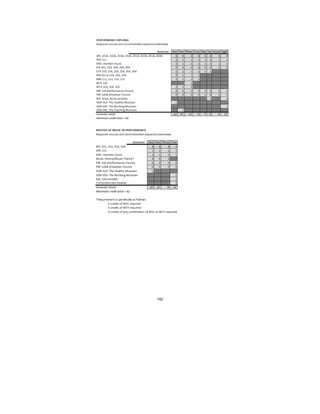
CSCM Students" in the left banner for services specifically for Conservatory 
students, including interlibrary loan requests and suggestions for Library 
purchases. Use the website to search the Library catalog and to explore 
online subscriptions, including streaming audio and text resources.    
 
Borrowing Library materials: Conservatory students are entitled to check out 
up to 50 books or scores at any given time. Books and scores are checked out 
for six weeks and may be renewed twice for an additional three weeks per 
renewal period. If another library user has put a hold on an item it cannot be 
renewed. Items needed for course reserve or for a Colburn performance are 
subject to immediate recall. Audio‐visual materials are for library use only 
and are not available for home check‐out. A fee of $.20 (20 cents) per day is 
charged for each overdue title. If items are overdue for more than 28 days, 
91
they are considered lost; replacement, billing, and processing fees shall be 
added to the overdue charges on the student’s account. A student with 
library charges on his/her account shall be subject to the Holds on Student 
Accounts policy (above). For questions regarding borrowing or fines, please 
contact a library technician (listed below.)  
  
Following are the policies for Library material check‐out: 
 
Materials  Loan period Renewal period
Circulating books and 
scores 
6 weeks 3 weeks (first time); 
3 weeks (second time) 
Audio‐visual material 4 hours (in‐house 
only) 
No renewal allowed
All reserve materials 3 hours (in‐house 
only) 
No renewal allowed
Reference materials N/A In‐library use only
 
Library hours: 
Monday and Friday  9:00am – 5:00pm
Tuesday through Thursday 9:00am – 7:00pm
Saturday  10:00am – 5:00pm
Sunday  Closed
Hours may vary during school breaks.
 
Library Staff contact information:  
Deborah Smith, Librarian       dsmith@colburnschool.edu 
Chris Garcia, Senior Librarian Technician  cgarcia@colburnschool.edu 
 
Make‐up Exams 
If a student requests a short‐term leave that conflicts with a scheduled class 
exam, that conflict must be resolved as part of the absence approval process. 
Make‐up exams may only be requested and approved prior to the exam date. 
It is the instructor’s prerogative to schedule or deny the request for a make‐
up exam.  Requests for make‐up exams made after the fact shall be denied.   
 
Office Hours 
Faculty: Conservatory of Music faculty may keep office hours to provide 
students with guidance and clarity regarding their classes. These hours are 
specifically for academic concerns, not for make‐up work or tutoring. Faculty 
may hold office hours by appointment, in which case students are 
encouraged to contact faculty directly to schedule a meeting time. Students 
who need special tutoring or counseling should contact the Associate Dean 
of the Conservatory for help. 
 
Administrative staff: Staff members (the Dean, Associate Dean, 
administrative assistants, etc.) are normally available Mondays through 
Fridays during regular business hours (typically 9am‐5pm). 
92
 
Outside Scholarships 
An outside scholarship is one that a student brings to the Colburn School 
from another institution or organization. Examples include but are not 
limited to Rotary scholarships, foundation scholarships, corporate 
scholarships, and civic scholarships. Because the Colburn School provides full 
tuition, room and board scholarships and grants to all students enrolled in 
the Conservatory of Music, it is the School’s policy that outside scholarships 
reduce the amount of the Colburn School scholarship accordingly. All outside 
scholarships received by students must be reported to the School for proper 
credit. 
 
A student who has received an outside scholarship will likely be asked by the 
donor organization to provide the name and address of the school in which 
he or she will be enrolling. The donor organization usually makes the check 
out to the school and sends it directly here. Students should provide the 
following information to scholarship donors for their donations: 
 
The Colburn School 
ATTN: Kathleen Tesar, Associate Dean  
200 South Grand Avenue 
Los Angeles CA 90012 
213‐621‐4545 
 
Student’s responsibilities for outside scholarships: As the recipient of an 
outside scholarship, you are required to provide the School with a copy of 
the award letter, or a letter from the donor specifying how the scholarship is 
to be used (for example, for tuition only, for books, for room and board, 
etc.). Make sure that the check references you as the recipient, so that we 
know where to credit the money. 
 
When required by scholarship donors, it is the student’s responsibility to 
request any supporting documentation (such as class schedules or 
transcripts) from the School. If documentation is required more than once, it 
is the student’s responsibility to make the request each time and to meet all 
deadlines. 
 
Performance Diploma for ESL Reasons 
In order to allow students with weak English language skills to progress 
musically while preparing for the academic demands of the BM program, the 
School places such students in the Performance Diploma (PD) program. Once 
in the PD program, the student has two options.  
 
Option 1: The student may choose to remain in the PD program for the entire 
four years. Note that most schools will require a BM degree for study in a 
graduate Master of Music degree program. A PD generally is not considered 
acceptable preparation for an MM degree. 
93
 
Option 2: If the student wishes to move from the PD to the BM program, the 
School offers an assessment exam at the end of the first year of enrollment 
in the PD program. This exam includes a reading and writing test, an oral 
exam, and a spoken conversation. In addition to the exam, any PD student 
wishing to move to the BM program is required to audit MHL 104 in the 
Spring semester of the first year in the PD program to assist in determining 
readiness for the academic demands of the BM.  
 
If the faculty panel determines that the student is prepared for study in the 
BM program, the student will be permitted to begin study in the BM program 
the following semester. In this case, the student will then be enrolled at The 
Colburn School for a total of five years (one year in the PD and four years in 
the BM). If it is determined that the student’s English language skills are not 
adequate for the BM program, the student must remain in the PD program. 
 
A PD student who wishes to take some BM courses for credit while in the PD 
program must discuss the option with his/her advisor, and then petition the 
Academic Affairs Committee. The BM classes would then appear on the 
student’s transcript, which will aid the student should he/she apply to a BM 
program at another school. 
 
Placement Services 
The Colburn Conservatory provides professional preparation and training for 
musicians. Employment is typically obtained through auditions. Although the 
Conservatory does not provide job placement services as defined in the non‐
musical world, preparation for employment is given to students through 
curricular (e.g., SEM 020 – The Working Musician), co‐curricular (e.g., Jump 
Start) programs, and one‐on‐one advising, particularly between students and 
their applied teachers. 
 
Practical Training 
The curricula for the Bachelor of Music degree, Performance Diploma, Artist 
Diploma, Professional Studies Certificate and Master of Music degree include 
a requirement for practical training as part of Applied Studies (refer to 
Course Descriptions). All students are required to participate in musical 
rehearsals, performances, and/or reading sessions. Such activities may take 
place within or without the School, may be paid or unpaid, and may take 
place during the academic year or during breaks.  
 
For international students, such practical training shall be documented and 
noted in their SEVIS records, according to DHS regulations. 
 
Practice Room Policy 
Practice rooms at the Colburn School are shared by the Conservatory of 
Music, the Community School of Performing Arts (CSPA), and the Music 
Academy. In an effort to balance the needs of all students, the following 
94
policy is in effect. Any changes to this policy will be posted and students will 
be notified. Please be respectful of all practice room users, and direct any 
issues or concerns to the Conservatory Office staff. 
  
 Usage of certain practice rooms is restricted. 
o CSPA Exclusive – Available for use exclusively by CSPA 
students Monday‐Friday 1:00‐8:00pm and Saturday 
8:00am‐2:00pm. Conservatory and Academy students 
are not allowed to practice in these rooms during CSPA 
priority hours.  
o CSPA Priority – Available for use on a priority basis by 
CSPA students Monday‐Friday 1:00‐8:00pm and 
Saturday 8:00am‐2:00pm. Conservatory and Academy 
students are not allowed to practice in these rooms 
during CSPA priority hours. During all other times, 
Conservatory and Academy students have priority. A 
reservation code from the computer sign‐out system 
authorizes a CSPA student to ask a Conservatory or 
Academy student to leave a practice room only during 
CSPA hours. CSPA students who need a practice room 
during non‐CSPA priority hours must first find an 
available room and then reserve it in the computerized 
system. 
o Piano Priority – Any Conservatory or Academy student 
may use a Piano Priority room but must vacate if 
requested to do so by a Conservatory or Academy 
piano student. 
o Specialty Rooms – Certain practice rooms are 
designated for particular instruments only. These 
include rooms for harp, percussion and chamber 
music. Conservatory students may reserve chamber 
music rooms through the Conservatory Office or 
through the Chamber Music Coordinator.  
o All other practice rooms in the Grand and Olive 
buildings are available for use by Conservatory and 
Academy students. 
 Food and drink are prohibited in the practice rooms at all times. 
 Students are prohibited from covering practice room windows. 
 Do not place any items on top of pianos. This includes instrument 
cases, metronomes, and writing utensils. 
 CSPA students may reserve practice rooms for up to 60 minutes. 
Conservatory and Academy students do not have a time limit on 
practice room use. However, instruments and all personal 
belongings must be removed if a student will be leaving a practice 
room for more than 15 minutes. 
 Students must not sign out or give access to practice rooms to 
non‐Colburn students. Guests must request practice room access 
95
through the CSPA Office. 
 Conservatory and Academy students access practice rooms by key 
card. CSPA students access practice rooms with a computerized 
reservation code. 
 Practice rooms in the Grand Building are accessible during 
building hours. Practice rooms in the Olive Building are accessible 
24 hours per day, 7 days per week. 
 Conservatory and Academy students may practice in their rooms 
in the Residence Hall during the hours designated in the Guide to 
Residential Life, following all rules and procedures noted in the 
Guide.  
  
Students who encounter any issues with practice room usage at the Colburn 
School are asked to complete a Practice Room Incident Report form 
(available at the Security desks and in the Conservatory, Music Academy, and 
CSPA offices). Practice room users are expected to respect the rights of all 
Colburn students to practice. Repeated violations of this policy may result in 
disciplinary action. 
 
Probation, Suspension, Dismissal 
A student in the Colburn Conservatory may be placed on probation, 
suspended, dismissed, or given a lesser sanction for failing to meet the 
standards of the School at any time during his/her enrollment. Decisions 
regarding probation, suspension and dismissal are communicated to the 
student by the Associate Dean, and are based on the terms and policy stated 
herein.  
 
The probationary period is usually one semester in length. In unusual 
circumstances, probation may be extended a second semester with the 
approval of the Dean. Students who are on probation for more than one 
semester, or who are placed on probation more than once, risk dismissal 
from the School.  
 
Definition of terms: 
 
Probation 
 
 This is a temporary status, lasting usually one semester, but it may 
be extended for a second semester. 
 The reason(s) for probation and the requirements to have it lifted 
are set according to the individual situation. 
 The threshold for probation in applied studies is:  
o a grade of C+ or lower in Applied Studies (APL courses) 
o OR two unexcused absences from an artistic event (see 
Attendance Policy above) 
o OR a recital grade of “fail.” 
 The threshold for probation in academic studies is: 
96
o For BM students, a semester’s academic GPA of 2.25 or 
lower OR a final grade of F in any academic course will 
result in probation. Note that a second instance of a 
final grade of F earned by a BM student in any course 
may result in the student being moved from the BM 
program to the PD program, or the student may be 
dismissed from the School.  
o For PD students, a semester’s academic GPA of 2.25 or 
lower OR a final grade of F in any academic course will 
result in probation. A second instance of a final grade 
of F earned by a PD student in any course may result in 
dismissal from the School 
o For MM students, a semester’s academic GPA of 2.5 or 
lower OR any academic grade of C or lower will result 
in probation. If the grade is a C‐, D+, D, D‐, or F, the 
student shall receive no credit for the course and must 
retake it (or an equivalent course) within the two years 
of MM residency. A second instance of a final grade of 
F earned by an MM student may result in the student 
being moved from the MM program to the AD or PSC 
program, or the student may be dismissed from the 
School. 
o As with all policies, the thresholds for academic 
probation may be revised. Students shall be notified of 
any revisions, which also shall be posted on the 
School’s website. 
 The threshold for probation for disciplinary causes is the violation 
of any of the non‐academic policies stated in the Student Guide to 
Residential Life. Whether probation is imposed shall depend on 
the nature of the disciplinary violation, as determined during the 
disciplinary review process.  
 During the period of probation, should the student violate any of 
the terms of probation, his/her academic advisor shall notify the 
student, and discuss possible consequences of the violation. 
 Faculty shall be provided with the names of students on 
probation. Faculty shall submit mid‐semester reports for all 
students on probation to the Associate Dean for review. The 
Associate Dean shall forward the reports to the students, and 
meet with probationary students when appropriate. 
 Students on probation may be restricted in the number of 
absences approved while on probationary status. At his/her 
discretion, the primary applied teacher may adjust performance 
assignments (chamber music, orchestra, CCMS, etc.) to allow 
students on probation more time to spend on their academic 
studies. 
97
 The Associate Dean, in consultation with the Dean and the faculty, 
shall review the progress of all students on probation at the end 
of each semester, and shall then determine whether: 
o Probation is lifted; the student returns to normal 
status; 
o Probation is extended for another semester; 
o The student is moved to another program; or 
o The student is dismissed from the School. 
 Students who are placed on probation more than one time, or 
who are on probation for more than one semester, risk dismissal 
from the School.  
 
Suspension 
 
 This is a temporary status. The length of a suspension is 
determined on a case‐by‐case basis depending on the 
circumstances leading to the suspension. 
 In general, students may be suspended for conduct that: 
o is detrimental to the academic environment;  
o is detrimental to the wellbeing of the individual 
student;  
o is detrimental to the wellbeing of other students, 
faculty or staff members;  
o or that causes damage to the School’s physical 
facilities. 
 Once the decision is made to suspend the student, the Associate 
Dean shall inform the student of the terms to be fulfilled before 
the student is allowed re‐entry. 
 In order for suspension to be lifted, the student must 
demonstrate to the School that all terms of the suspension have 
been met. 
 While on suspension, the student’s scholarship also is suspended. 
This means that the student shall not remain on campus, shall not 
participate in classes, rehearsals or performances, and shall not 
receive room, board and stipend from the School. Any impact to 
the student’s academic progress shall be discussed on a case‐by‐
case basis once the student has been allowed to return to active 
status. 
 Prior to re‐entry, the student is required to meet formally with 
the Associate Dean to review the terms of reinstatement and 
determine whether they have been met. 
 Once the student has met with the Associate Dean and has been 
approved for reinstatement, s/he may return to campus. The 
room, board and stipend shall be reinstated on the date that the 
student returns to active status. 
98
 A student returning from suspension is automatically placed on 
probation for a length of time to be determined by the Associate 
Dean, in consultation with the Dean and the faculty. 
 The Associate Dean may require regular meetings with the 
student in order to provide support for successful progress. 
 
Dismissal/Expulsion 
 
 This is a permanent status: The student’s enrollment is 
terminated, stipends and financial support cease, and all amounts 
owed to the School by the student come due. 
 Dismissal from the Colburn School is a step not taken lightly, and 
is generally the result of either severe lack of progress in applied 
or academic areas, or of some egregious disciplinary violation. 
 The decision to dismiss is made by the Associate Dean in 
consultation with the faculty and other administration as needed 
in the specific circumstances. 
 Re‐Entry after Dismissal: Students who have been dismissed must 
re‐apply and re‐audition if they wish to return; re‐admission is not 
guaranteed. Any exception to this requirement must be approved 
by the Dean of the Conservatory. Students who are granted 
permission to return shall be placed on probation for a minimum 
period of eight scholastic weeks after re‐entry, and must 
demonstrate satisfactory progress in order to continue in 
attendance. Other stipulations may be set by the Dean, in 
consultation with the faculty, on a case‐by‐case basis.  
 
Appealing a decision of probation, suspension or dismissal: Students who 
have been placed on probation, suspended, or dismissed from the 
Conservatory have the right to appeal the decision by following this 
procedure: 
 
1. Appeal of the action is made to the Associate Dean of the 
Conservatory. Appeal of any action must be made, in writing using 
the Appeals Form, within 14 calendar days of the action taken.   
2. The Associate Dean appoints a review committee to hear the 
appeal. The three‐person committee will be comprised of three 
members of the faculty and/or staff not directly involved in the 
student’s infractions leading to probation, dismissal, etc. The 
committee shall be chaired by the Associate Dean. 
3. The student may select a maximum of 2 advocates to speak on 
his/her behalf (but not as members of the review committee) at 
the review hearing. 
4. The Associate Dean sets the day and time of the appeal review 
hearing.   
5. At the appeal review hearing, the Associate Dean provides the 
committee with a summary of the circumstances leading to the 
99
action taken by the school. The student presents his/her case, the 
documentation and arguments to the committee. The committee 
may ask questions of the student at this time. The student’s 
advocates will speak at this meeting. 
6. After the case has been presented, the student will be dismissed 
from the meeting, allowing the committee an opportunity to 
question the advocates if desired. The advocates will be excused 
after any questions by the committee.   
7. The Committee will then consider the case and, if necessary, may 
request additional information from the student or other parties. 
8. The Committee will make a recommendation to the Associate 
Dean of an outcome. The Associate Dean will then make a ruling 
in the case. Once that decision is made, the student is notified by 
the Associate Dean. Every effort will be made to notify the 
student within 24 hours of the hearing, but in some cases more 
time may be needed. 
9. If the outcome does not overturn the probation, dismissal, 
etc. the student may appeal the decision to the Dean of the 
Conservatory within 72 hours. The Dean’s decision in this appeal 
will be final.  
 
Program Length Policies 
Bachelor of Music program length: The Bachelor of Music degree is designed 
as an eight‐semester program, to be completed within four years of 
consecutive enrollment starting from the time of initial matriculation. 
Students who matriculate in the Performance Diploma program and then 
move to the BM program shall have an additional two semesters to complete 
their BM studies, for a total of one year in the PD program and four years in 
the BM program. Approved long‐term leaves of absence or other special 
circumstances may extend program length up to a maximum of six years or 
twelve semesters from the date of matriculation.  
 
Students who transfer to the Colburn School from another college or 
university to earn a Bachelor of Music degree are required to complete a 
minimum of four consecutive full‐time semesters at Colburn.  
 
If a student has not completed his/her BM degree within the allotted number 
of semesters due to illness or approved leaves, the Dean and the faculty may 
approve an extension, or award a Performance Diploma to the student 
instead of a BM, assuming all PD requirements have been met.  
 
A student who has not met BM graduation requirements within eight 
semesters (or eight semesters plus two semesters in the PD program) due to 
lack of academic progress, and not due to illness or approved leaves of 
absence, may submit a written petition to the Associate Dean to request an 
extension. The Associate Dean shall consult with the faculty and the Dean to 
100
determine whether to approve or deny the extension. Such an extension 
shall be granted for a maximum of two additional semesters.  
 
In cases where a student has not completed his/her program and an 
extension is not approved, the student may be administratively withdrawn 
from the School, and his/her record marked inactive. Should a student in this 
situation wish to re‐enroll, in either the same or a different program, the 
student may be required to re‐apply and re‐audition; re‐admission is not 
guaranteed. 
 
Other special circumstances that require extended enrollment, and that are 
not covered by this policy, shall be considered on a case‐by‐case basis by 
petition to the Associate Dean, with the final approval of the Dean of the 
Conservatory. The Dean’s decision in such cases shall be final. 
 
Performance Diploma program length: The Performance Diploma is designed 
as an eight‐semester program, to be completed within four years of 
consecutive enrollment starting from the time of initial matriculation. 
Approved long‐term leaves of absence or other special circumstances may 
extend program length up to a total of five years or ten semesters from the 
date of matriculation.  
 
Students who transfer to the Colburn School from another college or 
university to earn a PD are required to complete a minimum of four 
consecutive full‐time semesters at Colburn.  
 
If a student has not completed his/her PD degree within the allotted number 
of semesters due to illness or approved leaves, the Dean and the faculty may 
approve an extension. 
 
A student who has not met PD graduation requirements within eight 
semesters due to lack of academic progress, and not due to illness or 
approved leaves of absence, may submit a written petition to the Associate 
Dean to request an extension. The Associate Dean shall consult with the 
faculty and the Dean to determine whether to approve or deny the 
extension. Such an extension shall be granted for a maximum of two 
additional semesters.  
 
In cases where a student has not completed his/her program and an 
extension is not approved, the student may be administratively withdrawn 
from the School, and his/her record marked inactive. Should a student in this 
situation wish to re‐enroll, in either the same or a different program, the 
student may be required to re‐apply and re‐audition; re‐admission is not 
guaranteed. 
 
Other special circumstances that require extended enrollment, and that are 
not covered by this policy, shall be considered on a case‐by‐case basis by 
101
petition to the Associate Dean, with the final approval of the Dean of the 
Conservatory. The Dean’s decision in such cases shall be final. 
 
Artist Diploma program length: The Artist Diploma is a minimum of two years 
(four semesters) and a maximum of four years (eight semesters) in length. 
The exact program length is established at the end of the second semester of 
enrollment, based on the applied teacher’s assessment of the student’s 
needs, progress and goals. At the end of the second semester, the student 
must complete an Artist Diploma Program Length Form, including the applied 
teacher’s signature and noting the program length, and submit it to the 
Associate Dean by the published deadline. In the absence of such a form, it 
will be assumed that the student shall complete the program within two 
years.  
 
A student who has not met AD graduation requirements within the time 
established by the process described above may request an extension by 
completing an Extend Program form, obtaining the signature of the applied 
teacher noting approval, and submitting the form to the Associate Dean for 
final approval. In cases where an extension is not approved, the student may 
be administratively withdrawn from the School, and his/her record marked 
inactive. Should a student in this situation wish to re‐enroll, in either the 
same or a different program, the student may be required to re‐apply and re‐
audition; re‐admission is not guaranteed. 
 
Artist Diploma students who have completed a Bachelor of Music degree at 
the Colburn School must complete the AD program in two years (four 
semesters). However, at the end of the second year a student may request 
an extension of one year by completing an Extend Program form, obtaining 
the signature of the applied teacher noting approval, and submitting the 
form to the Associate Dean for final approval. 
 
Other special circumstances that require extended enrollment, and that are 
not covered by this policy, shall be considered on a case‐by‐case basis by 
petition to the Associate Dean, with the final approval of the Dean of the 
Conservatory. The Dean’s decision in such cases shall be final. 
 
Professional Studies Certificate program length: The Professional Studies 
Certificate is designed as a four‐semester program, to be completed within 
two years of consecutive enrollment starting from the time of initial 
matriculation. A student who has not met PSC graduation requirements 
within the allotted number of semesters may request an extension by 
completing an Extend Program form, obtaining the signature of the applied 
teacher noting approval, and submitting the form to the Associate Dean for 
final approval. It should be noted that approval for a third year in the PSC 
program is not uncommon, but approval for a fourth year is rare and should 
not be assumed.  
 
102
In cases where an extension is not approved and the student has not 
completed his/her program, the student may be administratively withdrawn 
from the School, and his/her record marked inactive. Should a student in this 
situation wish to re‐enroll, in either the same or a different program, the 
student may be required to re‐apply and re‐audition; re‐admission is not 
guaranteed. 
 
Other special circumstances that require extended enrollment, and that are 
not covered by this policy, shall be considered on a case‐by‐case basis by 
petition to the Associate Dean, with the final approval of the Dean of the 
Conservatory. The Dean’s decision in such cases shall be final. 
 
Master of Music program length: The Master of Music degree program is 
designed as a four‐semester program, to be completed within two years of 
consecutive enrollment starting from the time of initial matriculation. 
Approved long‐term leaves of absence or other special circumstances may 
extend program length up to a total of three years or six semesters from the 
date of matriculation.  
 
In cases where an extension is not approved and the student has not 
completed his/her program, the student may be administratively withdrawn 
from the School, and his/her record marked inactive. Should a student in this 
situation wish to re‐enroll, in either the same or a different program, the 
student may be required to re‐apply and re‐audition; re‐admission is not 
guaranteed. 
 
Other special circumstances that require extended enrollment, and that are 
not covered by this policy, shall be considered on a case‐by‐case basis by 
petition to the Associate Dean, with the final approval of the Dean of the 
Conservatory. The Dean’s decision in such cases shall be final. 
 
Publicity  
By enrolling at the Colburn School Conservatory of Music, students consent 
to be filmed, recorded digitally or by video tape or other technology, and/or 
photographed (collectively, "recorded"), by the Colburn School (the 
"School"). The student grants the School the non‐exclusive right to use and 
license others to use the student’s recorded performances, name and 
likeness in connection with such performances, as applicable, for 
promotional purposes as well as for broadcast, distribution, exhibition, in all 
media, and formats including, without limitation, electronic and digital 
media, television, the worldwide web and the Internet, throughout the world 
in perpetuity, and waives any right to inspect or approve performances as 
recorded. 
 
Students are required to credit the Colburn School in their resumes, program 
bios, and in non‐School programs as a condition of enrollment. The following 
wording must be used: “[Student name] is a [list your degree program: 
103
Bachelor of Music, Performance Diploma, Artist Diploma, Professional 
Studies Certificate, Master of Music] candidate at The Colburn School 
Conservatory of Music in Los Angeles, California, where [he or she] studies 
[instrument] with [list applied teacher’s name].” Example: “Jane Doe is a 
Performance Diploma candidate at The Colburn School Conservatory of 
Music in Los Angeles, California, where she studies violin with Robert 
Lipsett.” 
 
Recital Policies 
Required recitals: 
 
• Requirement: BM, PD, AD and MM students are required to 
perform recitals as defined in “Recital Requirements” below. 
• Scheduling: It is the student’s responsibility to reserve the date 
and room for the recital. Recital times MUST NOT conflict with 
academic classes, juries or final exams. Students who are 
expected to graduate must fulfill all recital requirements by May 1 
of the year of graduation. Any exception to this policy must be 
approved by the Associate Dean of the Conservatory at least six 
weeks in advance of the recital date. 
• Room Reservation: The first step in reserving a time, date and 
hall is for the student to see the Facilities Scheduler (FS). (The FS 
office is near the Zipper Hall stage entrance. The FS is usually 
available Monday through Friday during regular business hours.) 
The FS shall assist the student in identifying a possible recital date. 
The student must then obtain the signature of the student’s 
applied teacher before the hall and date can be confirmed. 
FORMS WITHOUT THE APPLIED TEACHER’S SIGNATURE WILL NOT 
BE PROCESSED. A DELAY MAY RESULT IN LOSS OF ROOM 
RESERVATION. 
• Programs: The student must provide complete program 
information to the School’s program writer at least TWO WEEKS 
prior to the performance. Students who wish to create their own 
programs for required recitals must be sure to include the 
statement, “This recital is in partial fulfillment of the requirements 
of the [XX] degree [or program].” Students are required to submit 
recital programs as follows: 
 
• One copy of the program to the Conservatory 
Office for approval at least two weeks in advance 
of the program. The Conservatory Office uses the 
program information in its annual filing with 
music licensing agencies. 
• One copy of the program submitted after the 
performance to the Associate Dean along with 
the signed Recital Approval Form. Credit for 
recitals is given only after the recital program 
104
and approval form are turned in. (More 
information is on the Recital Approval Form, 
available in the Conservatory Office.) 
 
• Publicity: The School shall publicize required recitals within its 
regular publicity schedule, but only if recital information is 
provided in a timely manner (as set by the School’s publicity staff). 
• Stage Manager: The School shall provide a stage manager for 
required recitals at no cost to the student. 
• Recording: The School records all required recitals. A sound 
engineer will be scheduled by the School for this purpose. One 
copy of the recording will be provided to the student. Students 
may request additional copies of the recording; the student shall 
pay for the cost of such copies, and shall pay the cost of any 
editing. Students may choose to make a recording using their own 
recording equipment in addition to the School’s archival 
recording, but the fee requirement remains. 
 
Non‐required recitals: 
 
• Room reservation: Students should follow the procedure 
described above to reserve a hall, date and time. The Facilities 
Scheduler (FS) shall provide the student with a recital information 
packet containing all necessary forms. The signature of the 
student’s applied teacher is required (even for non‐required 
recitals) before the hall and date can be confirmed. FORMS 
WITHOUT THE APPLIED TEACHER’S SIGNATURE WILL NOT BE 
PROCESSED. A DELAY MAY RESULT IN LOSS OF ROOM 
RESERVATION. 
• Programs: For the purpose of consistent presentation, the 
School shall print programs for non‐required recitals as well as 
required recitals. However, the student must provide complete 
program information to the School’s program writer at least TWO 
WEEKS prior to the performance. If this information is not 
submitted by the deadline, no programs shall be printed. 
• Publicity: The School shall list non‐required recitals in its web 
calendar, and in other publicity as time and space permit. 
• Stage Manager: The School shall provide a stage manager for 
the recital at no cost to the student in the interest of safety and 
consistency. 
• Recording: Students who wish to record non‐required recitals 
have two choices: (1) The student may make his/her own 
recording, using his/her own “engineer” and sound equipment, at 
his/her own expense. (2) The student may hire one of the School’s 
approved engineers who are authorized to use the School’s 
equipment. (The list of approved engineers is available from 
Facilities Scheduler.) The student shall make all arrangements 
105
directly with the approved engineer, and shall pay him/her 
directly. 
 
Recital Requirements 
Bachelor of Music students are required to perform two recitals to complete 
the degree, generally in the junior and senior (third and fourth) years of the 
program. This requirement may be met by substitution of other activities, as 
approved by the applied teacher and the Artistic Steering Committee. 
 
Performance Diploma students must perform two to four recitals to 
complete the diploma. The number of recitals is at the discretion of the 
applied teacher. This requirement may be met by substitution of other 
activities, as approved by the applied teacher and the Artistic Steering 
Committee. 
 
Artist Diploma students must perform four recitals. This requirement may be 
met by substitution of other activities, as approved by the applied teacher 
and the Artistic Steering Committee. 
 
Professional Studies Certificate students are not required to perform recitals 
in order to complete the program. However, PSC students may elect to 
perform recitals, and recitals outside the School may meet the requirement 
for outside activities. 
 
Master of Music students must perform one recital, generally in the last 
semester of enrollment. This requirement may be met by substitution of 
other activities, as approved by the applied teacher and the Artistic Steering 
Committee. 
 
Recording/Photography of Lessons, Performances, etc. 
No audio recording or photography of classes, lessons or performances may 
take place without the prior permission of the teacher. 
 
Right to Change Student Catalog and Handbook 
The information in this Student Catalog and Handbook is up to date at the 
time of publication. The Colburn School reserves the right to make changes in 
its course offerings, program requirements, regulations, policies and 
procedures, and fees and expenses as educational and financial 
considerations require. Updates during the year (after publication of the 
printed Student Catalog and Handbook) shall appear on the School’s website, 
which shall be the most current version of all policies and procedures. 
 
Room Usage Policy 
The Colburn School has several large rooms/halls: 
 
• Zipper Hall (seats 420) 
• Thayer Hall (seats 189) 
106
• Mayman Hall (seats 75) 
• Olive Rehearsal Hall 
• Grand Rehearsal Hall 
 
These spaces are shared with ALL members of the Colburn Community. On 
occasion, these spaces may be rented to outside organizations. Because of 
this, there is one immutable rule for the sake of courtesy and equity: 
CONSERVATORY STUDENTS MUST OBTAIN PERMISSION TO USE ANY OF THE 
SPACES LISTED HERE. 
 
It is recognized that there may be times when Conservatory students need 
the use of these spaces in preparation for performances that will be 
occurring in the near future (including juries) or for making recordings. That 
said, these spaces are not to be used as regular practice rooms. 
 
In order to maintain the halls and protect the instruments and equipment in 
them, a reservation must be requested. When a reservation is made, the 
School schedules Production staff to be in attendance. If a room will not be 
used after it has been reserved,  
the student is expected to cancel the room request, thus freeing the room 
for use by others. If the student fails to cancel the reservation, s/he shall be 
charged for the time that the Production staff was in attendance. Abuse of 
this policy may lead to suspension of privileges and/or monetary fines. 
 
Use of all halls is coordinated by the Production Office, which is located near 
the Zipper Hall stage entrance. The Facilities Scheduler, who is usually 
available during business hours Monday through Friday, is responsible for 
confirming space reservations. 
 
• Zipper Hall 
 
o THIS IS A PERFORMANCE SPACE. It is NOT a practice 
space. It is the School’s responsibility to protect and 
maintain this space as our public performance space. 
o Use of Zipper Hall MUST be reserved ahead of time by 
the student. Same‐day usage by students is NOT 
permitted unless the teacher is present the entire 
time. 
o Students MUST use the room request form, and MUST 
have the applied teacher’s signature on the form to 
show approval before the hall will be reserved for 
them. If the applied teacher is not available to sign, the 
student must obtain a signature from the Conservatory 
Office. 
o Teachers may use Zipper Hall for teaching, even on the 
same day. Teachers are required to confirm with the 
Facilities Scheduler that the hall is available. The 
107
Production Assistant shall make any adjustments to 
the stage set‐up; faculty and students may NOT move 
pianos, nor may they change the stage set‐up that is in 
place when they enter. 
 
• Thayer Hall 
 
o Thayer Hall is the preferred recital and recording space 
for the School. Students MUST use the room request 
form, and MUST have the applied teacher’s signature 
on the form to show approval before the hall will be 
reserved for them. If the applied teacher is not 
available to sign, the student must obtain a signature 
from the Conservatory Office. Students are 
encouraged to use this hall for both required and non‐
required recitals. 
o Use of Thayer Hall MUST be reserved ahead of time by 
the student. Same‐day usage by students is NOT 
permitted unless the teacher is present the entire 
time. The Production Assistant shall make any 
adjustments to the stage set‐up; faculty and students 
may NOT move pianos, nor may they change the stage 
set‐up that is in place when they enter. 
 
• Mayman Hall 
 
o This room is a performance and recording space. The 
School must maintain it as such, especially considering 
use of the pianos in the hall. For example, if the piano 
is tuned for an evening performance, it must not be 
played or moved prior to that performance. 
o Students are permitted to request use of Mayman Hall, 
even on the same day.  
o Use of Mayman Hall is requested through the Facilities 
Scheduler (FS), who will know the status of the room. If 
the FS states that the piano is not to be used or moved, 
students must abide by that statement. 
o The FS may tell a student that he/she cannot use the 
room – even if the room appears unused at that 
moment. The decision of the FS is final. 
 
• Classrooms  
 
o Pianos must NOT be moved in classrooms. Any damage 
to a piano or to the classroom (walls, rugs, etc.) shall 
be charged to the student responsible for the damage. 
 
108
Abuses of policy: The following is a partial list of behaviors that are 
considered an abuse of this policy: 
 
• Booking a room and not using it. Production staff members are 
scheduled to be on hand when performance spaces are being 
used. If a staff member is scheduled to work and the student does 
not show up to use the room and does not cancel the reservation, 
the student shall be billed for the cost of the staff member’s time. 
• Booking a room and using it for only part of the time. If a 
student books a room, uses it and leaves early, the student must 
notify the Production staff that he/she is done. If the student 
books a room and fails to show within 30 minutes of the 
reservation start time, he/she shall be charged as noted above. 
• Not booking a room and using it anyway. 
• Moving an existing stage set‐up without the permission of a 
member of the Production Office staff. 
• Using or moving a piano without permission. Since pianos may 
be tuned in the morning for an evening event, use of the piano 
without permission may require that the piano be tuned again 
prior to the evening event. In such cases, the student shall be 
billed the cost of the additional tuning. If a piano is moved 
without permission and the move causes damage to the 
instrument or the room (floor, walls, etc.), the student shall be 
charged for the cost of repairs. 
• Damaging a hall or any instruments or equipment in it. Students 
shall be charged the cost of repairs, and may be disciplined 
depending on the nature and extent of the damage. 
 
Security 
The Colburn School is not responsible for loss or damage to personal 
property. Students are advised not to leave items unattended; this includes 
musical instruments. Please refer to the Student Guide from Residential Life 
for more specific information on safety and security. 
 
Special Student Status 
A Special Student is a student who is enrolled short‐term in the Conservatory 
but not in a Conservatory program leading to a degree, diploma or 
certificate. Special Student status is conferred by the Dean, who shall use his 
discretion in assessing the special circumstances and assigning such status. 
The specific terms of enrollment in Special Student status shall be explained 
to the student in writing by the Associate Dean. Typically such students 
follow the PSC curricular requirements. Students who are enrolled as Special 
Students may choose to apply for a regular Conservatory program, but 
admission is not guaranteed. 
 
109
Student Grievance Procedure 
A grievance is a complaint that a student makes arising out of a decision or 
action taken by a faculty or staff member in the course of his or her official 
duty which, in the student’s opinion, a) is in violation of written campus 
policies or procedures; or b) constitutes arbitrary, capricious, or unequal 
application of written campus policies or procedures. 
 
The School strongly believes that grievances should be resolved promptly in 
order to keep communication open and to avoid resentment and ill feelings 
within the School community. The School states here that there will be no 
retaliation against a student for presenting a grievance, and that all parties 
shall proceed toward resolution of the grievance in a spirit of mutual 
cooperation. Once decisions are made, students have the right to appeal. 
While the School agrees not to retaliate against a student for filing a 
grievance or an appeal, it is understood that students shall not file grievances 
or appeals frivolously, nor take the lack of retaliation as permission to abuse 
or harass members of the Colburn community.  
 
Procedure: 
 
 A student who wishes to file a formal grievance must complete 
and submit the Grievance Form (found on the School’s website) 
and supporting material to the Associate Dean of the 
Conservatory. The Associate Dean’s office is located in the 
Conservatory Office, and is open during regular business hours 
(9am‐5pm, Monday through Friday). 
 The Associate Dean, in consultation with faculty, shall review the 
grievance within 10 business days, meeting with all parties 
involved as appropriate to the complaint, and maintaining 
confidentiality.  
 The Associate Dean shall determine how to move forward 
depending on the nature of the grievance. When necessary, this 
step shall include creating a special review panel. 
 Steps taken on moving forward include review of documentation, 
witness testimony, etc., as appropriate. 
 The Associate Dean, in consultation with the parties involved, 
shall make a decision as to the required action, and shall 
communicate the decision to the student and other parties 
involved. 
 If the student wishes to appeal further, s/he must appeal in 
writing to the Dean of the Conservatory, stating the grounds for 
appeal and including any further information related to the 
appeal. 
 The Dean’s decision shall be in writing, and it shall be final. 
 
110
Student Responsibilities 
Students enrolled in the Conservatory of Music accept the following 
responsibilities as part of the contract of their enrollment: 
 
• Students are responsible for conducting themselves in accordance 
with accepted standards of professionalism, honesty, and 
propriety, with proper regard for the rights of others, and for 
knowing and abiding by the standards and policies in this 
Handbook and in the Student Guide from Residential Life. 
Violations of the standards and policies of the Colburn School may 
result in sanctions such as a warning, fine, probation, suspension, 
or dismissal. 
• The Colburn School abides by all state and federal laws regarding 
the use, manufacture, and/or sale of alcohol and drugs. Students 
are expected to comply with all such laws, and with School policy. 
Violations shall be dealt with according to the policies and 
procedures described in this Handbook and in the Student Guide 
from Residential Life. 
• Students are expected to attend all scheduled classes, rehearsals, 
and examination periods on time. (See Attendance Policy above.) 
• Students are responsible for the maintenance of their personal 
health. In the intensive musical and academic environment of the 
Colburn School, this means taking care of oneself physically, 
mentally, and emotionally, in order to continue to perform at the 
highest possible level.  
• Students are encouraged to exhibit good taste and discretion in 
their attire. Appearance should be appropriate and should 
contribute to the academic and professional atmosphere of the 
school. In addition, students must observe the dress code found 
above in this Student Catalog and Handbook. 
• In addition to the rights and responsibilities stated here, students 
at the Colburn School have all the rights assigned by the State of 
California and the United States as they may apply, and have the 
responsibility to abide by all laws of the State of California and of 
the United States. 
 
Student Rights 
Students enrolled in the Conservatory of Music have the following rights as 
part of the contract of their enrollment: 
 
• Students have the right to equal treatment, without regard for 
race, color, nationality, gender, sexual orientation, gender 
expression, ethnic origin or religious belief. 
• Students have the right to an environment free from 
discrimination and harassment. 
• Students have the right to expect academic and musical 
evaluation free from prejudice or capriciousness. 
111
• Students have the right to file grievances when they feel 
circumstances require such action. 
• Students have the right to free inquiry, expression, and 
association. 
• Students have the right to a secure environment in their persons, 
living quarters, papers, and effects. The Colburn School reserves 
the right to withdraw the privilege of enrollment from any 
student whose conduct is detrimental to the academic 
environment or to the wellbeing of other students, faculty or staff 
members, or physical facilities. 
• Students have the rights provided in the Family Education Rights 
and Privacy Act of 1974 (FERPA); these include rights against 
improper disclosure of information, and freedom of access to 
their personal records. 
 
Student Services 
In support of our mission to teach classical instrumental performance majors, 
the Conservatory provides various co‐curricular services to students. Given 
the small student population, inquiries about access to these services can be 
made of either the Conservatory Office staff or the Residential Life staff. 
Services include conduct and appeals, disability accommodation, housing, 
international student advising, Student Council, wellness and counseling 
services, etc. Career advisement and development is provided through SEM 
020 – The Working Musician and also through the Center for Student 
Advancement. All registrar services are available in the Conservatory Office. 
 
Suspension (See “Probation, Suspension, Dismissal” above) 
 
Taxes and Withholdings 
The Colburn School awards Conservatory students scholarships for tuition, 
and grants for room and board (housing and meals). In addition, students 
may receive financial assistance towards the cost of health insurance, the 
comprehensive fee, textbooks, and travel, and some students may earn 
wages from on‐campus employment. Some of these amounts are taxable. 
Depending on individual circumstances, the School has a legal obligation to 
withhold taxes, and to pay such withholdings to the U.S. government on 
behalf of the student. It is the student’s responsibility to file an annual tax 
return, which may or may not result in a tax refund. The Colburn School 
cannot file tax returns for students, nor can the School give tax advice. 
Students are strongly urged to consult with a tax specialist in order to meet 
their legal obligations.  
 
Teaching 
Students in the Conservatory of Music are enrolled in the School to further 
their own studies. Students may not use any Colburn School spaces to teach 
their own private students unless prior approval is obtained from the Dean of 
the Conservatory. This policy is strictly enforced. Any questions on this 
112
matter should be directed to the Dean of the Conservatory. (Note that 
teaching through Jump Start, Colburn Teaching Fellows, SEM 040, or other 
community engagement programs is exempt from this policy.) 
 
Textbooks 
The purchase of textbooks (and music) for classes and lessons is the sole 
responsibility of the student. Textbook requirements are noted by faculty in 
the course syllabi. Students are expected to have the correct books in time 
for the first class meeting, or as soon as possible after the instructor notifies 
the class about required materials. Need‐based financial aid is available for 
qualified students as a reimbursement after purchase. 
 
Touching Policy 
Participation in the performing arts may involve physical contact by 
instructors in the course of teaching, for the purpose of illustrating what is 
being taught. The Colburn School is aware of the difference between 
appropriate and inappropriate behavior, and follows state guidelines 
regarding training to recognize sexual harassment (see policy on Sexual 
Harassment below for more information on how to handle concerns in this 
area). 
 
Transcripts 
Transcripts may be requested by writing to the Colburn School Associate 
Dean; email requests are acceptable, although verification may be required. 
The request must include the name and address of the institution to which 
the transcript is to be sent, as well as any deadline. Only current students, 
previous students, graduates, or authorized parents/guardians may request 
transcripts. Parents/guardians seeking transcripts must provide written 
authorization from the student. Most requests are filled within one week of 
the date of request. NOTE: Although there is no charge for the transcript, 
express mail charges may apply. For more information about access and 
review of records, students may contact The Colburn School Conservatory’s 
Associate Dean. 
 
Withdrawal, Administrative 
Administrative withdrawal is the involuntary withdrawal of a student as a 
result of official administrative action. This policy may be invoked when a 
student is unable or unwilling to request a voluntary withdrawal following 
the policy below.  
 
Withdrawal from School 
Students who wish to withdraw from the School for any reason should 
consult with the Dean of the Conservatory prior to filing the Notice of 
Withdrawal form. This form is the only manner of withdrawal considered 
official (except for cases of administrative withdrawal). Courses left 
incomplete following withdrawal shall appear on the student’s transcript 
113
with a grade of “W.” For information on refunds of monies paid to the 
School, please see Cost of Attendance, Fees and Refund Policies above. 
 
Withdrawing from a Class 
Beginning in the fourth week of classes, a student may request to withdraw 
from a class by meeting with his/her academic advisor, completing the Class 
Withdrawal form, obtaining the signature of the course instructor on this 
form, and submitting the form to the Associate Dean for review. (The 
instructor’s signature acknowledges the withdrawal, but neither approves 
nor disapproves the request.) The Associate Dean may require 
documentation from the student as to how the course shall be made up, 
given the degree requirements and the limited number of courses offered. 
Courses dropped according to this policy shall appear on the student’s 
transcript with a grade of W. Students may not withdraw from courses after 
the 11th
 week of the term. 
 
 
114
LEGAL NOTICES 
Certain federal laws apply to educational institutions and students. In 
particular, some laws apply to educational institutions that receive federal 
funds. These laws include the Buckley Act (privacy rights or FERPA), the 
Solomon Amendment (Department of Defense rights to information), 
Megan’s Law (registration of sex offenders), the Gramm‐Leach‐Bliley Act 
(security of financial information), the USA PATRIOT Act (domestic or 
international terrorism), and SEVIS (Student and Education Visitors 
Information System, to register non‐U.S. students). The Colburn School does 
not participate in federal and state financial aid programs. The School retains 
legal counsel to which it can refer in the event any question arises regarding 
these laws. 
 
Accreditation, Approval and Authorization 
The Colburn School is a private non‐profit institution accredited by the 
National Association of Schools of Music.  
 
The School is approved to operate by the California Bureau for Private 
Postsecondary Education. Approval to operate means the institution is 
compliant with the minimum standards contained in the California Private 
Postsecondary Education Act of 2009 (as amended) and Division 7.5 of Title 5 
of the California Code of Regulations.  
 
The Colburn School is authorized under federal law to enroll nonimmigrant 
students. 
 
Address, Location, Facilities and Equipment 
The official mailing address of the Colburn School, as well as the physical 
address where Conservatory classes are held, is: 
 
200 South Grand Avenue 
Los Angeles CA 90012 
Main phone: 213‐621‐2200 
Fax: 213‐625‐0371 
www.colburnschool.edu 
 
The School is located in downtown Los Angeles, California, in the financial 
and cultural districts. All classes are held at this location. The campus consists 
of two buildings bordering 2nd Street to the north and spanning from Grand 
Avenue to Olive Street. These building are referred to as the Grand Building 
and the Olive Building. The School sits on the north end of California Plaza. Its 
closest neighbors are the Museum of Contemporary Art (MOCA) to the south 
and Walt Disney Concert Hall to the west. 
 
As appropriate to a conservatory of music and a community school of 
performing arts, the Colburn School’s facilities include a 420‐seat concert 
hall, a 189‐seat concert hall, a 75‐seat recital hall, two rehearsal halls, two 
115
dance studios, seven classrooms, offices for faculty and staff, teaching 
studios, a keyboard lab, and over 40 practice rooms. The Olive Building 
contains student residential housing. Of special note is the Jascha Heifetz 
Studio, which has been restored and relocated in the Grand Building. The 
Studio is used for violin lessons, as befits its history. 
 
Board of Directors. Board of Visitors, and Senior Administration 
A list of the Colburn School’s current administration, Board of Directors and 
Board of Visitors is available on the School’s website 
(www.colburnschool.edu). 
 
Filing a Complaint with the State of California 
A student or any member of the public may file a complaint about this 
institution with the Bureau for Private Postsecondary Education by calling 
888‐370‐7589, or by completing a complaint form which can be obtained on 
the Bureau’s Internet Web site (www.bppe.ca.gov). 
 
Financial Aid and Loans 
The Colburn School does not participate in any federal or state financial aid 
programs. Students who obtain loans while enrolled at Colburn, or who have 
obtained loans at previous institutions, are solely responsible to repay the 
full amount of the loans plus interest (if any).  
 
According to California State Senate Bill 1289, Chapter 623, Statutes of 2012, 
federal student loans are required by law to provide a range of flexible 
repayment options, including, but not limited to, income‐based repayment 
and income‐contingent repayment plans, and loan forgiveness benefits, 
which other student loans are not required to provide. Federal direct loans 
are available to students regardless of income, although not through The 
Colburn School (which does not participate in federal financial aid programs). 
 
Non‐Discrimination Notice 
The Colburn School does not discriminate on the basis of race, color, 
nationality, gender, sexual orientation, gender expression, ethnic origin or 
religious belief in its admission, retention, student aid, scholarship, or other 
educational policies and other School‐administered programs. 
 
Notice of Non‐Bankruptcy 
Per state law, the Colburn School hereby reports that the institution has no 
pending petition in bankruptcy, is not operating as a debtor in possession, 
has not filed a petition of bankruptcy within the preceding five years, and has 
not had a petition in bankruptcy filed against it within the preceding five 
years that resulted in reorganization under Chapter 11 of the United States 
Bankruptcy Code (11 U.S.C. Sec. 1101 et seq.). 
 
116
Sexual Assault Policy 
Under Section 94385 of the State’s Education Code, the Colburn School must 
have a written procedure to ensure that students, faculty, and staff who are 
victims of sexual assault on campus or during a school‐related function shall 
receive treatment and information. The victim of a sexual assault is not 
required to disclose his or her name unless he or she wishes, provided the 
victim is over age 18. As a result, the following activities may need to be 
adjusted to reflect the victim’s wishes. Per Education Code Section 94385, for 
purposes of this policy “sexual assault” includes, but is not limited to, rape, 
forced sodomy, forced oral copulation, rape by a foreign object, sexual 
battery, or threat of sexual assault. 
 
 Sexual assault is not tolerated at the Colburn School. 
 The Los Angeles Commission on Assaults Against Women 
(LACAAW) is the nearest rape crisis center for men and women. 
The Center provides a 24‐hour hotline (213‐626‐3393) for the 
reporting of sexual assault. Victims of assault may find medical aid 
at California Hospital, located at Grand Avenue and Venice Blvd., 
just minutes from the Colburn School. California Hospital has a 
Sexual Assault Response Team (SART) staffed by trained nurse 
examiners. The LACAAW, at the victim’s request, will provide a 
counselor to accompany the victim to the hospital, 24 hours a 
day. 
 Reporting sexual assault to the police ensures professional 
assistance for the victim, and strengthens the case for 
prosecution. It is recommended that the police be contacted 
immediately by calling 911. Assault on any individual under the 
age of 18 must be reported to the police. An individual over the 
age of 18 may request confidentiality. However, the hospital is 
required to report all sexual assaults. Note that the Colburn 
School encourages report of the assault, for the sake of the victim 
and to prevent further assaults of other victims. 
 Inform the Associate Dean of the Conservatory or other 
administrator of the assault as soon as possible. 
 If the assailant is a member of the campus community and is 
convicted of the assault, he or she shall be subject to disciplinary 
action within the School. 
 The Associate Dean or other administrator shall refer the victim to 
follow‐up counseling through one of several counseling services 
that are available in the community. 
 The Associate Dean or other administrator shall be responsible for 
on‐going case management, including keeping the victim 
informed of any in‐house disciplinary proceedings, and shall be 
available to assist the victim with any academic difficulties that 
may arise because of the victimization and its impact. 
Additionally, the staff at the Colburn School shall work with 
117
LACAAW and/or other help groups to ensure that the victim 
receives any and all available assistance. 
 Students and staff shall refer any inquiries from the press to the 
Vice President of Communications, who shall protect the 
confidentiality of the victim and the accused (until the criminal 
system has determined guilt). 
 
A victim of sexual assault shall be reminded by the Associate Dean or other 
administrator of all the options and services listed above. 
 
Sexual Harassment and Other Unlawful Harassment Policy 
The Colburn School is committed to providing an environment that is free 
from all forms of discrimination and conduct that can be considered 
harassing, coercive, or disruptive, including sexual harassment. The Colburn 
School will not tolerate any actions, words, jokes, or comments based on a 
person's sex, race, color, national origin, ancestry, age, religion, disability, 
perceived disability, sexual orientation, gender expression, or any other 
legally protected characteristic. 
 
Sexual harassment is defined as unwanted sexual advances, or visual, verbal, 
or physical conduct of a sexual nature. This definition includes many forms of 
offensive behavior, and includes gender‐based harassment of a person of the 
same sex as the harasser. The following is a partial list of sexual harassment 
examples: 
 
• Unwanted sexual advances. 
• Offering employment or academic benefits in exchange for 
sexual favors. 
• Making or threatening reprisals after a negative response to 
sexual advances. 
• Visual conduct that includes leering, making sexual gestures, or 
displaying of sexually suggestive objects or pictures, cartoons or 
posters. 
• Verbal conduct that includes making or using derogatory 
comments, epithets, slurs, or jokes. 
• Verbal sexual advances, propositions or sexual innuendo. 
• Verbal abuse of a sexual nature, graphic verbal commentaries 
about an individual's body, sexually degrading words used to 
describe an individual, or suggestive or obscene letters, notes, or 
invitations. 
• Physical conduct that includes touching, assaulting, or impeding 
or blocking movements. 
 
Unwelcome sexual advances (either verbal or physical), requests for sexual 
favors, or other verbal or physical conduct of a sexual nature constitute 
sexual harassment when: (1) submission to such conduct is made either 
explicitly or implicitly a term or condition of employment or academic 
118
progress; (2) submission or rejection of the conduct is used as a basis for 
making employment or academic decisions; or (3) the conduct has the 
purpose or effect of interfering with work or academic performance, or 
creating an intimidating, hostile, or offensive environment. 
 
Anyone experiencing or witnessing sexual or other unlawful harassment 
must report it immediately to the Dean. If the Dean is unavailable or if it is 
believed that it would be inappropriate to discuss the situation or 
harassment with the Dean, the Associate Dean, or another member of the 
School administration should be contacted immediately. There shall be no 
punishment or reprisal for reporting sexual harassment, or asking questions 
or raising concerns about it. 
 
All allegations of sexual harassment shall be quickly and discreetly 
investigated. To the extent possible, the identities of those involved shall be 
protected against unnecessary disclosure. When the investigation is 
completed, the person reporting the situation shall be informed of the 
outcome of the investigation. 
 
Any student, faculty, or administrator who becomes aware of possible sexual 
or other unlawful harassment must immediately advise the President, Dean, 
Associate Dean, or any member of the administration so the allegation can 
be investigated in a timely and confidential manner. Any person who 
engages in sexual or other unlawful harassment will be subject to disciplinary 
action, up to and including dismissal from the School or termination of 
employment. 
 
NOTE: This policy is not intended to be a substitute for legal advice or to 
provide legal guidance of any kind. 
 
Stalking Policy  
Purpose: The Colburn School is determined to provide a campus 
environment free of violence and discrimination for all members of the 
campus community. For this reason, the School does not tolerate stalking, 
and will pursue the perpetrators of such acts to the fullest extent possible. 
The Colburn School also is committed to supporting victims of stalking 
through the appropriate provision of safety and support services. This policy 
applies to all students at the Colburn School.  
 
Stalking incidents are occurring at an alarming rate on the nation’s college 
campuses. It is a crime that happens to men and women of all 
races/ethnicities, religions, ages, abilities, sexual orientations, and sexual 
identity. It is a crime that can affect every aspect of a victim’s life. Stalking 
often begins with phone calls, emails, social networking posts, and/or letters, 
and can sometimes escalate to violence. 
 
119
Stalking is a crime in California and is subject to criminal prosecution. 
Students perpetrating such acts of violence shall be subject to disciplinary 
action. This can include expulsion from the Colburn School and/or criminal 
prosecution simultaneously. 
 
Policy jurisdiction: This policy applies equally to all students at the Colburn 
School. 
 
Definition of stalking: Stalking is a course of conduct directed at a specific 
person that would cause a reasonable person to feel fear. “Course of 
conduct” is defined as “a pattern of actions composed of more than one act 
over a period of time, however short, evidencing a continuity of conduct.” 
 
Stalking behaviors: Stalking includes any behaviors or activities occurring on 
more than one occasion that collectively instill fear in a victim, and/or 
threaten her or his safety, mental health, or physical health. Such behaviors 
and activities may include, but are not limited to, the following: 
 
 Non‐consensual communication, including face‐to‐face 
communication, telephone calls, voice messages, emails, text 
messages, written letters, gifts, or any other communications that 
are undesired and place another person in fear. 
 Use of online, electronic, or digital technologies, including but not 
limited to: 
o Posting of pictures or information in chat rooms or on 
websites. 
o Sending unwanted/unsolicited email or talk requests. 
o Posting private or public messages on Internet sites, 
social networking sites, and/or school bulletin boards. 
o Installing spyware on a victim’s computer. 
o Using Global Positioning Systems (GPS) to monitor a 
victim. 
 Pursuing, following, waiting, or showing up uninvited at or near a 
residence, workplace, classroom, or other places frequented by 
the victim. 
 Surveillance or other types of observation including staring or 
“peeping.” 
 Trespassing. 
 Vandalism. 
 Non‐consensual touching. 
 Direct verbal or physical threats. 
 Gathering information about an individual from friends, family, 
and/or co‐workers. 
 Threats to harm self or others. 
 Defamation—lying to others about the victim. 
 
120
Reporting stalking: The Colburn School encourages reporting of all incidents 
of stalking to law enforcement authorities, and respects that whether or not 
to report to the police is a decision that the victim needs to make. Advocates 
in the Office of Residential Life, the Conservatory Office, and the Security 
Office are available to inform victims of the reporting procedures and offer 
appropriate referrals. Victims of stalking choosing to pursue the reporting 
process have the right to assistance or consultation of an advocate. The 
Colburn School offers services to victims even if they choose not to report 
the incidents. The Offices of Residential Life, Conservatory, and Security 
provide services, advocates, and information for victims in a safe, supportive, 
and confidential setting. In some circumstances, a victim may wish to seek an 
order of protection from a court of appropriate jurisdiction against the 
alleged perpetrator. Victims also may seek restriction of access to the School 
by non‐students or non‐employees in certain circumstances.  
 
Anyone experiencing or witnessing stalking behavior must report it 
immediately to the Associate Dean. If the Associate Dean is unavailable or if 
it is believed that it would be inappropriate to discuss the behavior with the 
Associate Dean, another member of the School administration should be 
contacted immediately. There shall be no punishment or reprisal for 
reporting stalking behavior or suspected stalking behavior, or asking 
questions or raising concerns about it. All allegations of stalking behavior 
shall be quickly investigated.  
 
Any student, faculty, or administrator who becomes aware of possible 
stalking behavior must immediately advise the President, Dean, Associate 
Dean, or any member of the administration so the allegation can be 
investigated in a timely and confidential manner. Any person who engages in 
stalking behavior shall be subject to disciplinary action, up to and including 
dismissal from the School or termination of employment. 
 
In certain instances, the Colburn School may need to report an incident to 
law enforcement authorities. Such circumstances include any incidents that 
warrant the undertaking of additional safety and security measures for the 
protection of the victim and the campus community or other situations in 
which there is clear and imminent danger, and when a weapon may be 
involved. However, it is crucial in these circumstances to consult with School 
Security since reporting may compromise the safety of the victim.  
 
Personal safety concerns are often very important for stalking victims. Crisis 
intervention and victim safety concerns shall take precedence. 
 
Safety for Victims of Stalking: The Colburn School is committed to supporting 
victims of stalking by providing the necessary safety and support services. 
Student victims of stalking are entitled to reasonable accommodations. Due 
to the complex nature of this problem, the student victim may need 
additional assistance in obtaining help in one or more of the following areas: 
121
 
 No‐contact order. 
 Services of a student victim advocate. 
 Witness impact statement. 
 Change in an academic schedule. 
 Provision of alternative housing opportunities. 
 The imposition of an interim suspension on the accused.  
 The provision of resources for medical and/or psychological 
support. 
 
For assistance obtaining these safety accommodations, please contact the 
Associate Dean, Director of Residential Life, Assistant Director of Residential 
Life, or Director of Security. 
 
If safety is an immediate concern, encourage the victim to contact law 
enforcement or School Security for assistance.  
 
Stalking Victim’s Rights: Students on our campus have the right to live free of 
behaviors that interfere with students attaining their educational goals. 
Students who report stalking have the right to: 
 
 Treatment with dignity and respect, not subjected to biased 
attitudes or judgments. 
 Not having past and irrelevant conduct discussed during any 
resulting proceedings. 
 Changes in academic and/or living situations, if possible.  
 All support services regardless of the choice to file a school or 
criminal complaint. 
 Submission of a written account of the incident and a victim‐
impact statement. 
 Having a person of choice, including legal counsel or an advocate, 
present throughout the proceedings. 
 Having one’s identity protected to the extent possible in the 
individual circumstances. 
 
Victims can request immediate on‐campus housing relocation, transfer of 
classes, or other steps to prevent unnecessary or unwanted contact or 
proximity to an alleged assailant. When possible, requests will be 
accommodated. 
 
Rights of the accused: Students accused of stalking behaviors have rights on 
this campus. These rights include: 
 
 The right to know the nature and source of the evidence used in 
the hearing process. 
 The right to present witnesses and material evidence relevant to 
the case.  
122
 The right to an advocate or attorney to aid in the preparation and 
presentation of the case. 
 Access to all usual services provided through the School, including 
access to the School’s Clinical Consultant for Mental Health if 
requested.  
 Residence Hall relocation. 
 Consultation with a campus official regarding academic support 
services and referrals to community resources, when appropriate.  
 The right to appeal a disciplinary decision, as noted in the Student 
Grievance policy above. 
 
Disciplinary process: Disciplinary sanctions for violations of this Stalking 
Policy shall be imposed in accordance with School policies as defined in this 
Handbook. Sanctions may include probation, suspension, or dismissal, as 
determined on a case‐by‐case basis.  
 
Accused parties should refer to this Conservatory of Music Student Catalog 
and Handbook for more information on their rights, resolution of disciplinary 
charges, disciplinary procedures and responsibilities, and appeals process. 
 
The Colburn School takes very seriously its responsibility to individual 
students, to the student body as a whole, and to the Colburn community. 
The School reserves its right to act in such a way as to protect the integrity of 
the educational endeavor. Actions on the part of the School may include, but 
are not limited to, the temporary suspension of parties involved, the 
relocation of said parties, or the involvement of civil authorities in order to 
protect the interests of the community and the institution. 
 
Statutory Rape Policy 
This policy addresses the legal limits of sexual relations. The student body of 
the Colburn School Conservatory of Music includes “minors” (defined as 
persons under the age of 18) and “adults” (defined as persons at least 18 
years of age). In addition, the School may house minor residents in the same 
facility as Conservatory students. All members of the Colburn community 
must be aware of state law regarding sexual relations with minors (California 
Penal Code – Section 261.5). While the School does not intend to dictate an 
individual’s right to have a relationship with another individual, the School 
must abide by State law and follow legal protocol in cases where the law is 
violated. 
 
Unlawful sexual intercourse is an act of sexual intercourse accomplished with 
a minor who is not the spouse of the perpetrator/actor. (In other words, you 
may have sexual intercourse with someone under the age of 18 if that person 
is your legal spouse. Otherwise such sexual intercourse is illegal, even if it is 
consensual.) 
 
123
Anyone who engages in an act of unlawful sexual intercourse with a person 
under age 18, and the actor is not more than three years older or three years 
younger, is guilty of a misdemeanor. (A misdemeanor is a crime, but a less 
serious one.) 
  
Anyone who engages in an act of unlawful sexual intercourse with a person 
under age 18 who is more than three years younger than the actor is guilty of 
either a misdemeanor or a felony. (A felony is a grave crime with serious 
consequences such as extended jail time.) 
  
Any person 21 years of age or older who engages in an act of unlawful sexual 
intercourse with a minor who is under 16 years of age is guilty of either a 
misdemeanor or a felony.  
 
The potential criminal penalties for violating this law include, but are not 
limited to: 
 Up to one year in county jail. 
 Up to one year in county jail or imprisonment in state prison 
(period unspecified). 
 Up to one year in a county jail or imprisonment in state prison for 
two, three, or four years. 
 
The potential civil penalties for violating this law include fines of up to 
$25,000. 
 
The Colburn School is required by law to report instances of sexual 
misconduct to the Los Angeles Police Department (LAPD) and its Department 
of Child Protective Services (DCPS). Once this report is made, the DCPS begins 
a criminal investigation. While this investigation is under way, the School 
shall take whatever steps it deems necessary to protect the institution and 
the individuals involved. 
 
Student Records, Privacy Information, Transcripts 
Maintenance of Student Records 
In the course of the student’s application, enrollment, and attendance, the 
School compiles a number of important records concerning the student, 
including grades, payment records, attendance records, and disciplinary 
records. In addition, a recorded archive of student performances documents 
the progress of Colburn students. 
 
The Records Custodian for the Colburn School’s Conservatory of Music is: 
 
Kathleen Tesar, Associate Dean  
The Colburn School 
200 South Grand Avenue 
Los Angeles, CA 90012 
 
124
Records of current students are maintained on site in hard copy form in 
secured and fireproof files; computer records are stored off‐site and are 
backed up regularly. Hard copies of transcripts of records are stored in 
fireproof files for 50 years, as required by state law. 
 
Disclosure of Information 
Although the Colburn School Conservatory of Music does not receive federal 
funding, the School does choose to follow federal privacy standards. The 
Family Educational Rights and Privacy Act (FERPA) affords students certain 
rights with respect to their education records. These rights include: 
 
 The right to inspect and review the student’s education records 
within 45 days of the day the School receives a request for access. 
To request access, a student must submit to the Associate Dean a 
written request that identifies the record(s) the student wishes to 
inspect. The Associate Dean shall make arrangements for access 
and notify the student of the time and place where the records 
may be inspected. 
 
 The right to request the amendment of the student’s education 
records that the student believes are inaccurate or misleading. 
 
A student may ask the School to amend a record that he/she 
believes is inaccurate. The student must write to the Associate 
Dean, clearly identifying the part of the record that they want 
changed, and specifying why the record is inaccurate. If after 
review the School decides not to amend the record as requested 
by the student, the School shall notify the student of the decision 
and advise the student of his/her right to a hearing regarding the 
request for amendment. Additional information regarding the 
hearing procedures shall be provided to the student when 
notified of the right to a hearing. 
 
 The right to consent to disclosure of personally identifiable 
information contained in the student’s education records, except 
to the extent that FERPA authorizes disclosure without consent.  
 
One exception which permits disclosure without consent is 
disclosure to school officials with legitimate educational interests. 
A school official is a person employed by the School in an 
administrative, supervisory, academic or research, or support staff 
position (including law enforcement unit personnel and health 
staff); a person or company with whom the School has contracted 
(such as an attorney, auditor, or collection agent); a person 
serving on the Board of Directors; or a student serving on an 
official committee, such as a disciplinary or grievance committee, 
or assisting another School official in performing his/her tasks. A 
125
School official has a legitimate educational interest if the official 
needs to review an education record in order to fulfill his/her 
professional responsibility. Further, upon request, the School 
discloses education records without consent to officials of 
another school in which a student seeks or intends to enroll. 
 
As of January 3, 2012, the U.S. Department of Education’s FERPA 
regulations expand the circumstances under which your 
education records and personally identifiable information (PII) 
contained in such records—including your Social Security Number, 
grades, or other private information—may be accessed without 
your consent. First, the U.S. Comptroller General, the U.S. 
Attorney General, the U.S. Secretary of Education, or state and 
local education authorities (“Federal and State Authorities”) may 
allow access to your records and PII without your consent to any 
third party designated by a Federal or State Authority to evaluate 
a federal‐ or state‐supported education program. The evaluation 
may relate to any program this is “principally engaged in the 
provision of education,” such as early childhood education and 
job training, as well as any program that is administered by an 
education agency or institution. Second, Federal and State 
Authorities may allow access to your education records and PII 
without your consent to researchers performing certain types of 
studies, in certain cases even when we object to or do not request 
such research. Federal and State Authorities must obtain certain 
use‐restriction and data security promises from the entities that 
they authorize to receive your PII, but the Authorities need not 
maintain direct control over such entities. In addition, in 
connection with Statewide Longitudinal Data Systems, State 
Authorities may collect, compile, permanently retain, and share 
without your consent PII from your education records, and they 
may track your participation in education and other programs by 
linking such PII to other personal information about you that they 
obtain from other Federal or State data sources, including 
workforce development, unemployment insurance, child welfare, 
juvenile justice, military service, and migrant student records 
systems. 
 
 The right to file a complaint with the U.S. Department of 
Education concerning alleged failures by the Colburn School to 
comply with the requirements of FERPA. The name and address of 
the Office that administers FERPA are:  
 
Family Policy Compliance Office  
U.S. Department of Education  
400 Maryland Avenue SW  
Washington DC 20202‐4605 
126
 
 The Colburn School Conservatory of Music identifies the following 
student information as directory information: 
 
o Name, address, telephone listing, electronic mail 
address 
o Place of birth 
o Field of study 
o Grade level 
o Enrollment status (full‐time, part‐time, undergraduate, 
post‐baccalaureate, graduate) 
o Dates of attendance 
o Degrees and awards received 
o Most recent previous school attended 
o Participation in officially recognized activities 
o Photographs 
 
According to FERPA, the School may disclose student directory 
information to a requesting third party without first obtaining a 
parent’s or eligible student’s written consent. However, a parent 
or eligible student has the right to direct the School not to 
designate some or all of this information as directory information, 
thereby preventing its disclosure to a third party, absent the 
parent’s or eligible student’s written consent. A parent or eligible 
student must notify the School’s Associate Dean within two weeks 
of the beginning of each academic semester if the parent or 
eligible student does not want any or all of the above‐referenced 
student information designated as directory information.  
 
Notwithstanding the School’s definition of directory information, 
the Department of Defense, pursuant to the Omnibus 
Consolidated Appropriations Act of 1997 (“Solomon 
Amendment”), identifies the following information as student 
recruiting information: student names, addresses, and telephone 
listings; and if known, students’ ages, levels of education, majors. 
If a parent or eligible student chooses not to exercise his/her 
aforementioned right and directs the School not to designate 
some or all of the student’s information as directory information, 
the School shall release to the Department of Defense, or an 
agency thereof, that student information which the Department 
of Defense has designated as student recruiting information. This 
may result in the nonconsensual disclosure of personally 
identifiable information (any student information not designated 
as directory information). When student information is released 
pursuant to a Department of Defense request, notice of the 
request and the release of student information in accordance 
127
therewith shall be posted in a conspicuous location in the 
Conservatory Office for the period of one academic year. 
 
 The information stated here regarding student rights under FERPA 
serves as annual notification of these rights. Further information 
regarding the Family Educational Rights and Privacy Act of 1974 
may be obtained from the Associate Dean’s Office. 
 
Privacy and Social Media 
California State Senate Bill 1349, Chapter 619, Statutes of 2012, prohibits 
public and private postsecondary educational institutions, and their 
employees and representatives, from requesting a student, prospective 
student, or student group to: (1) disclose a user name or password for 
accessing social media; (2) access personal social media in the presence of 
the institution’s employees or representatives; and (3) divulge any personal 
social media information. Institutions are prohibited from suspending, 
expelling, disciplining, or threatening to take any of those actions, or 
otherwise penalizing a student, prospective student, or student group in any 
way for refusing to comply with a request or demand that violates the 
aforementioned prohibitions. Institutions are not prohibited from: (1) 
exercising rights and obligations to protect against and investigate alleged 
student misconduct or violations of applicable laws and regulations; or (2) 
taking any adverse action against a student, prospective student, or student 
group for any lawful reason.  
 
Student Tuition Recovery Fund 
The State of California created the Student Tuition Recovery Fund (STRF) to 
relieve or mitigate economic losses suffered by students in educational 
programs who are California residents, or are enrolled in a residency 
programs attending certain schools regulated by the Bureau for Private 
Postsecondary and Vocational Education. You may be eligible for STRF if you 
are a California resident or are enrolled in a residency program, prepaid 
tuition, paid the STRF assessment, and suffered an economic loss as a result 
of any of the following:  
 
 The school closed before the course of instruction was completed.  
 The school's failure to pay refunds or charges on behalf of a 
student to a third party for license fees or any other purpose, or 
to provide equipment or materials for which a charge was 
collected within 180 days before the closure of the school.  
 The school's failure to pay or reimburse loan proceeds under a 
federally guaranteed student loan program as required by law or 
to pay or reimburse proceeds received by the school prior to 
closure in excess of tuition and other costs.  
 There was a material failure to comply with the Act or this 
Division within 30 days before the school closed or, if the material 
failure began earlier than 30 days prior to closure, the period 
128
determined by the Bureau. An inability after diligent efforts to 
prosecute, prove, and collect on a judgment against the 
institution for a violation of the Act. 
 
You must pay the state‐imposed assessment for the Student Tuition 
Recovery Fund (STRF) if all of the following applies to you: 
 
1. You are a student in an educational program, who is a 
California resident, or are enrolled in a residency program, 
and prepay all or part of your tuition either by cash, 
guaranteed, student loans, or personal loans, and  
2. Your total charges are not paid by any third‐party payer such 
as an employer, government program or other payer unless 
you have a separate agreement to repay the third party.  
 
You are not eligible for protection from the STRF and you are not required to 
pay the STRF assessment, if either of the following applies: 
 
1. You are not a California resident, or are not enrolled in a 
residency program, or 
 
2. Your total charges are paid by a third party, such as an 
employer, government program or other payer, and you 
have no separate agreement to repay the third party.  
 
Because the Colburn School does not charge tuition to students in the 
Conservatory of Music, students are not eligible for any refund under this 
Fund, nor are students charged a state‐imposed assessment for the STRF. 
 
Questions regarding the STRF may be directed to: 
 
Bureau for Private Postsecondary Education (BPPE) 
PO Box 980818 
Sacramento, CA 95798‐0818 
www.bppe.ca.gov  or (916) 574‐7720 
 
Transcripts 
Transcripts may be requested by writing to the Colburn School Associate 
Dean; email requests are acceptable, although verification may be required. 
The request must include the name and address of the institution to which 
the transcript is to be sent, as well as any deadline. Only current students, 
previous students, graduates, or authorized parents/guardians may request 
transcripts. Parents/guardians seeking transcripts must provide written 
authorization from the student. Most requests are filled within one week of 
the date of request. NOTE: Although there is no charge for the transcript, 
express mail charges may apply. For more information about access and 
129
review of records, students may contact the Colburn School Conservatory’s 
Associate Dean. 
130
APPENDIX A 
 
Acceptable Use of Information Resources Policy 
Policy Statement: All individuals granted access to the Colburn School’s 
Information Resources must follow the acceptable use rules set forth in the 
Acceptable Use of Information Resources Policy Agreement Form section 
below. This policy is established to achieve the following: 
 
 To establish prudent and acceptable practices regarding the use 
and safeguarding of Information Resources;  
 To educate individuals who may use Information Resources with 
respect to their responsibilities associated with such use;  
 To ensure compliance with applicable statutes, regulations, and 
mandates regarding the management of Information Resources.  
 
Rationale: The Colburn School strives to maintain access for its faculty, staff, 
and students (the "users") to local, national and international sources of 
information, and to provide an atmosphere that encourages sharing of 
knowledge, creative processes and collaborative efforts within the Colburn 
School's educational, research and service missions. Access to these 
electronic information systems is a privilege, not a right, and must be treated 
as such by all users of these systems. All users must act honestly, responsibly, 
and prudently. Every user is responsible for the integrity of these information 
resources. All users must respect the rights of other computer users, and 
take care in acting responsibly to safeguard the security and confidentiality 
of electronic resources, information, and similar assets. 
 
The Colburn School relies on networked computers and the data contained 
within those systems to achieve its missions. This Acceptable Use Policy is to 
protect these resources in accordance with state and federal laws and 
regulations, and in accordance with the Colburn School’s Human Resources 
and Information Technology policies and procedures. Formal 
acknowledgment of the Acceptable Use Policy by all individuals accessing the 
Colburn School’s Information Resources serves as a compliance and 
enforcement tool. 
 
Scope: This policy applies to all users of Information Resources at the Colburn 
School including employees, contractors, consultants, faculty, students, 
alumni, volunteers, guests, external individuals or organizations and 
individuals accessing external network services such as the Internet via the 
Colburn School’s facilities.     
 
131
Responsibilities: 
Information Technology creates and maintains an acceptable use policy and 
acknowledgement form for the acceptable use of information resources. 
 
Users must: 
 Read, acknowledge, and abide by the acceptable use policy. 
 Exercise good judgment regarding the reasonableness of personal 
use in accordance with all policies associated with the Acceptable 
Use of Information Resources. 
 Limit incidental personal use of Information Resources to 
activities that do not result in direct cost to the Colburn School or 
expose the Colburn School to unnecessary risks. 
 
Privacy & Security: There is no inherent expectation of privacy for 
information stored on the Colburn School’s information resources, except as 
provided by federal and state law and other school policies.  Every effort will 
be made to maintain individual privacy, but the Colburn School will not be 
liable for the failure of these privacy efforts.  While the School does not 
routinely monitor individual usage of its information resources, the normal 
operation and maintenance of the School’s information resources require 
the backup and caching of data and communications, the logging of activity, 
the monitoring of general usage patterns, the scanning of systems and 
network ports for anomalies and vulnerabilities, and other such activities 
that are necessary for the rendition of services. 
 
The Colburn School provides information technology (IT) and networks with 
the intent of making information available in an academic setting. Users 
should understand that this openness brings with it some inherent risks 
based on the nature of the Internet and other threat sources. Where 
sensitive information is processed in an official capacity, the IT policies of the 
Colburn School are intended to provide reasonable and appropriate 
protections to ensure the confidentiality and integrity of such data while 
making that information available to authorized persons. 
 
Compliance: Failure to comply with the appropriate use of information 
resources threatens the atmosphere for the sharing of information, the free 
exchange of ideas, and the secure environment for creating and maintaining 
information property, and subjects one to disciplinary action. 
 
The Colburn School reserves the right to place restrictions on the use of its 
electronic resources in response to complaints that present evidence of 
violations of Colburn School policies, rules, regulations or codes, or local, 
state or federal laws and regulations. Actions that violate these policies can 
result in immediate disabling, suspension, and/or revocation of the account 
owner's privileges pending review for further action. Such unauthorized or 
illegitimate use of electronic resources including computer accounts, 
resources or facilities may subject the violators to appropriate disciplinary, 
132
criminal and/or legal action by the Colburn School and/or the State. If 
evidence is established, the Colburn School authorities responsible for 
overseeing these policies and codes will be consulted on the appropriateness 
of specific actions. 
 
Contacts: Individuals who have concerns about the conduct of a member of 
the Colburn School community or the propriety of a given situation or activity 
should notify their department chair, dean, director, or an administrator. If 
action is deemed warranted by this official, the matter shall be referred to 
the appropriate Colburn School administrator who shall consult with the 
Colburn School's Human Resources Director and/or General Counsel. The 
responsible official shall then respond to Colburn School community 
members who express concerns about such activities or incidents. 
 
When concern about a given situation or activity involves an imminent threat 
to individuals, systems, or facilities, users should immediately communicate 
the concern directly to the Colburn School Technology Services (CSTS) at 
(213) 621‐1087 or helpdesk@colburnschool.edu. If you have any questions 
about this policy, IT‐POL‐004, Acceptable Use of Information Resources, 
contact the Information Security Office at (213) 621‐1089.  
 
Glossary: 
 
Information 
Resources 
Any and all computer printouts, online display devices, 
mass storage media, and all computer‐related activities 
involving any device capable of receiving email, 
browsing Web sites, or otherwise capable of receiving, 
storing, managing, or transmitting data including, but 
not limited to, servers, personal computers, notebook 
computers, hand‐held computers, personal digital 
assistants (PDA), pagers, distributed processing 
systems, network attached and computer controlled 
equipment (i.e., embedded technology), 
telecommunication resources, network environments, 
telephones, fax machines, printers. Additionally, it is 
the procedures, equipment, facilities, software, and 
data that are designed, built, operated, and maintained 
to create, collect, record, process, store, retrieve, 
display, and transmit information. 
 
 
Governing Regulations & Standards: 
International Organization for Standardization (ISO) 27002:2005 Clause 7.1.3.   
Asset Management, Acceptable Use of assets.   
 
133
Acceptable Use of Information Resources Agreement Form 
General   Information Resources are provided for the express 
purpose of conducting the business of the Colburn 
School.   
 The Colburn School Information Resources must 
not be used to: engage in acts against the mission 
and purposes of the Colburn School, intimidate or 
harass, degrade performance, deprive access to 
information resources, obtain extra resources 
beyond those allocated, or circumvent the Colburn 
School’s security measures.  
 Information Resources must not be used to conduct 
a personal business or used for the exclusive 
benefit of individuals or organizations that are not 
part of the Colburn School system.   
 Pornographic materials must not be intentionally 
accessed, created, stored or transmitted.    
 Students, employees, contractors, and consultants, 
must not give the impression that they are 
representing, giving opinions, or making statements 
on behalf of the Colburn School unless authorized 
(explicitly or implicitly) to do so in Email or postings 
to news groups, chat rooms or listservs.  They 
should use a disclaimer stating that the opinions 
expressed are their own and not necessarily those 
of the Colburn School, unless the posting is related 
to normal business responsibilities or unless it is 
clear from the context that the author is not 
representing the Colburn School.  An example of a 
simple disclaimer is: "The opinions expressed are 
my own, and not necessarily those of my employer 
or school."  
 Users must not copy or reproduce any licensed 
software except as expressly permitted by the 
software license, use unauthorized copies on 
school‐owned computers or use software not 
approved for use on system computers (approval 
from the Information Technology Services 
management). 
Data Protection   Data will be accessed on a need to know basis.  
Users of Information Resources must not attempt 
to access data or programs contained on systems 
for which they do not have authorization or explicit 
consent. 
 All Colburn School data (electronic files) will be 
saved on network servers to ensure backup of the 
data. 
134
 All records (electronic or paper) will be maintained 
in accordance with the Colburn School records 
retention policies and records management 
guidelines. 
Virus Protection   All computers connecting to the Colburn School 
network must run current virus protection 
software.  This software must not be disabled or 
bypassed with the exception of installation of 
software, or other special circumstance or 
procedure that requires the temporary disabling of 
virus protection software.  Computers found to be 
infected with a virus or other malicious code will be 
disconnected from the Colburn School network 
until deemed safe by the Information Technology 
Services department. 
Email   The following email activities are prohibited by 
policy: 
- Using email for purposes of political lobbying 
or campaigning. 
- Posing as anyone other than oneself when 
sending email, except when authorized to do 
so by the owner of the email account. 
- Reading another User's email unless 
authorized to do so by the owner of the email 
account, or as authorized by policy for 
investigation, or as necessary to maintain 
services.   
- Use of email software that poses high security 
risks to the Colburn School Information 
Resources.  
- Sending or forwarding chain letters. 
- Sending unsolicited messages to large groups 
except as required to conduct the Colburn 
School’s business. 
- Sending excessively large messages or 
attachments unless in performance of official 
Colburn School business. 
- Sending or forwarding email that is likely to 
contain computer viruses, worms, or 
malware. 
Confidential or 
Protected 
Information 
 Confidential or sensitive information must be 
stored on the centrally managed servers and not on 
a desktop local hard drive.  In cases when 
confidential or sensitive information must reside on 
a local hard drive, such information is required to 
be encrypted. 
135
 Confidential or sensitive information is required to 
be encrypted on all portable devices. 
 All confidential or sensitive information (e.g., social 
security numbers, protected health information, 
etc) transmitted over external networks or saved 
on system servers must be encrypted.  This 
information must not be sent or forwarded through 
non‐Colburn School System email accounts (like 
Hotmail, Yahoo, AOL, or email provided by other 
Internet Service Providers), and must not be 
knowingly transmitted via wireless to or from a 
portable computing device unless approved 
wireless transmission protocols and security 
techniques are utilized. 
Incidental Use 
of Information 
Resources 
 Incidental personal use is permitted by the 
Information Resources Use and Security Policy but 
is restricted to the Colburn School’s system users; 
(it does not extend to family members or other 
acquaintances).  It must not interfere with normal 
performance of the user’s duties, must not result in 
direct costs to the Colburn School, and must not 
expose the Colburn School to unnecessary risks.   
 Storage of any non‐work related email messages, 
voice messages, files and documents within the 
Colburn School System email system must be 
nominal (less than 5% of a User’s allocated mailbox 
space).   
 All messages, files and documents stored on the 
Colburn School system Information Resources – 
including personal messages, files and documents – 
are owned in accordance with the Colburn School’s 
Rules and Regulations.  
 Any files, messages or documents residing on the 
Colburn School system computers may be subject 
to public information requests and may be 
accessed in accordance with this policy. 
 A Colburn School email account should not be used 
for personal email correspondence that is 
confidential in nature. 
Internet Use   Software for browsing the Internet is provided to 
authorized Users for business and research 
purposes. 
 Due to network maintenance and performance 
monitoring and to ensure compliance with 
applicable laws and policies, all User activity may be 
subject to logging and review. 
 Personal commercial advertising must not be 
136
posted on the Colburn School web site.
Portable and 
Remote 
Computing 
 All computers and portable‐computing devices 
using the Colburn School Information Resources 
must be password protected using the “strong” 
password standard. 
 Users accessing the Colburn School network from a 
remote computer must adhere to all policies that 
apply to use from within the Colburn School 
facilities, must conform to the Information 
Technology minimum standards for portable 
computing, and are subject to the same rules and 
security‐related requirements that apply to the 
Colburn School‐owned computers. 
 Unattended portable computing devices must be 
physically secure.  
 If it is determined that required security related 
software is not installed on a remote computer or 
that a remote computer has a virus, is party to a 
cyber attack, or in some way endangers the security 
of the Colburn School System network, the account 
and/or network connection will  be disabled.  
Access will be re‐established once the computer or 
device is determined to be safe by the Information 
Technology Services department. 
 If critical Colburn School data is stored on portable 
computing devices it must be backed up to a 
network server for recovery in the event of a 
disaster or loss of information.  
 Special care should be taken to protect information 
stored on laptops and PDA devices, and in 
protecting such devices from theft. 
Passwords   Users are required to create network and email 
passwords using the “strong” password standard 
(at least 8 characters long, containing three or four 
of the following types of characters:  uppercase 
letters, lowercase letters, numbers, and special 
characters such as ~!@#$).  Users will be required 
to change passwords periodically. 
 Colburn School system account(s), passwords, 
Personal Identification Numbers (PIN), Digital 
Certificates, Security Tokens (i.e. Smartcard), or 
similar information or devices used for 
identification and authorization purposes must not 
be shared (including with family members). Each 
User is responsible for all activities conducted using 
his or her account(s).  
 Users must not circumvent password entry through 
137
use of auto logon, application “remember 
password” features, embedded scripts or hard‐
coded passwords in client software. Exceptions may 
be made for specific applications (like automated 
backup) with the approval of the Information 
Security Manager (ISM). Any exception situation 
must include a procedure to change the passwords 
and must adhere to security policies for password 
construction.  
Harassment, 
Threats, 
Stalking, and 
Similar 
Activities 
 Users may not use electronic communications to 
harass, stalk, or threaten others, or in similar ways 
create an atmosphere which unreasonably 
interferes with the education or employment 
experience.  Generally, communication that 
contains abusive, offensive or intimidating language 
and is repeated, unsolicited, unwanted or 
unwelcome may constitute harassment. 
Abuse, Damage, 
or Destruction 
of Electronic 
Resources 
 Users must take care not to engage in activities 
that, without proper authorization: 
- Overload the computing systems and 
networks, such as excessive use of processor 
time, data storage, or bandwidth, or activities, 
which otherwise impair or negatively impact 
performance and availability. 
- Interfere with, disable, damage, obstruct, or 
in similar manner impede the normal function 
and accessibility of computer or 
communication systems, or computer data, 
files, and other information. 
- Attempt the unauthorized connection, 
removal, or modification of computer or 
communication devices. 
Security   Security programs or utilities that reveal or exploit 
weaknesses in the security of a system or that 
reveal data by circumventing established 
authorization procedures and systems should not 
be downloaded and/or used by users.  For example, 
password cracking programs, packet sniffers, or 
port scanners on Colburn School’s Information 
Resources shall not be used.  Only the Information 
Security Manager (ISM) and authorized IT staff may 
utilize security programs and utilities for security 
audits and vulnerability testing. 
 Users must report any identified weaknesses in the 
Colburn School’s computer/information security 
and any incidents of possible misuse or violation of 
this agreement to an immediate supervisor, 
138
department head, school administrator, or 
Information Technology/Security management.   
 
139
APPENDIX B 
Schedule of Student Charges 2014‐15 
This Schedule of Student Charges is required by the State of California, and 
shows the approximate total that must be paid to the School during the first 
year of enrollment. The estimated budget which follows shows other 
expenses to be anticipated by students.  
Fee Name  Amount Notes
Tuition:  $0.00 Tuition charge is paid by full scholarship. 
No refund available. 
Housing:  $0.00 Housing costs (room and board) are paid 
by full grants. No refund available. 
Non‐
Refundable 
Fees: 
Application Fee 
(for Fall 2013) 
 
Enrollment 
(registration) 
Fee 
 
Student Tuition 
Recovery Fee 
(STRF) 
 
 
$120.00 


$500.00 


$0.00 
 
 
Payable when submitting an application. 
 
 
Payable upon committing to enroll into a 
program. 
 
 
Based on $0 tuition charge.  
Program 
Required 
Expenses: 
Comprehensive 
Fee 
 
 
$3,000.00 


The Comprehensive Fee is mandatory and 
non‐refundable.  
 
In addition to the Comprehensive Fee, 
School policy requires all students to show 
acceptable proof of health insurance. This 
may be coverage provided under a 
parent’s policy. Students who cannot 
provide acceptable proof must purchase 
health insurance through the School’s 
policy with Kaiser Permanente. The cost is 
approximately $2800 per year. Students 
who need financial assistance in meeting 
this obligation should apply for financial 
aid as detailed in the Student Catalog and 
Handbook. 
Books:   $500.00  Approximate total; cost of books may vary 
depending on program and year in 
program. 
140
Total:  $4,120.00  Approximate total due in first year; cost of 
books may vary with program. 
 
Based on this Schedule of Student Charges, a student in a two‐year program 
(MM, AD or PSC) will spend approximately $7,120. A student in a four‐year 
program (BM or PD) will spend approximately $13,120.  
 
List of Estimated Costs 
Because  attendance  at  the  Colburn  School  may  include  costs  other  than 
those  listed  on  the  Schedule  of  Student  Charges,  the  estimates  below  are 
provided to help you plan your budget for the upcoming academic year. Note 
that these are ONLY estimates and may change according to each individual’s 
situation.  For  example,  travel  costs  are  not  included,  but  students  should 
plan ahead for travel during breaks when the Residence Hall is closed.  
 
Comprehensive fee  $3,000 
Living expenses:   
     Clothing (including concert dress attire)  $500 
     Additional food  $500 
     Health Insurance; required if a waiver is not approved    (12 
months)  $2,800 
     Other  health  care  costs  (co‐pays,  prescriptions, 
acupuncture, etc.)  $500 
     Instrument maintenance  $700 
     Laundry  $200 
     Telephone  $750 
     Miscellaneous expenses  $500 
Textbooks  $500 
ANNUAL ESTIMATED BUDGET  $9,750 


141
 
 
APPENDIX C 
Overview of Program Requirements 
The Bachelor of Music degree and the Performance Diploma are post‐
secondary programs; students must have completed high school to enroll. 
The Master of Music, Artist Diploma, and Professional Studies Certificate are 
post‐baccalaureate programs; students must have completed bachelor’s 
level studies, at a minimum, to enroll.  
 
The charts below show the required courses and recommended sequence of 
courses for each program. These are general charts; specific requirements 
may be modified from year to year.  
 
 
142


143


200 South Grand Avenue
Los Angeles, ca 90012
colburnschool.edu
Colburn

Colburn SC&H 2014-15