
COHESIVE
DEVICES
English
10
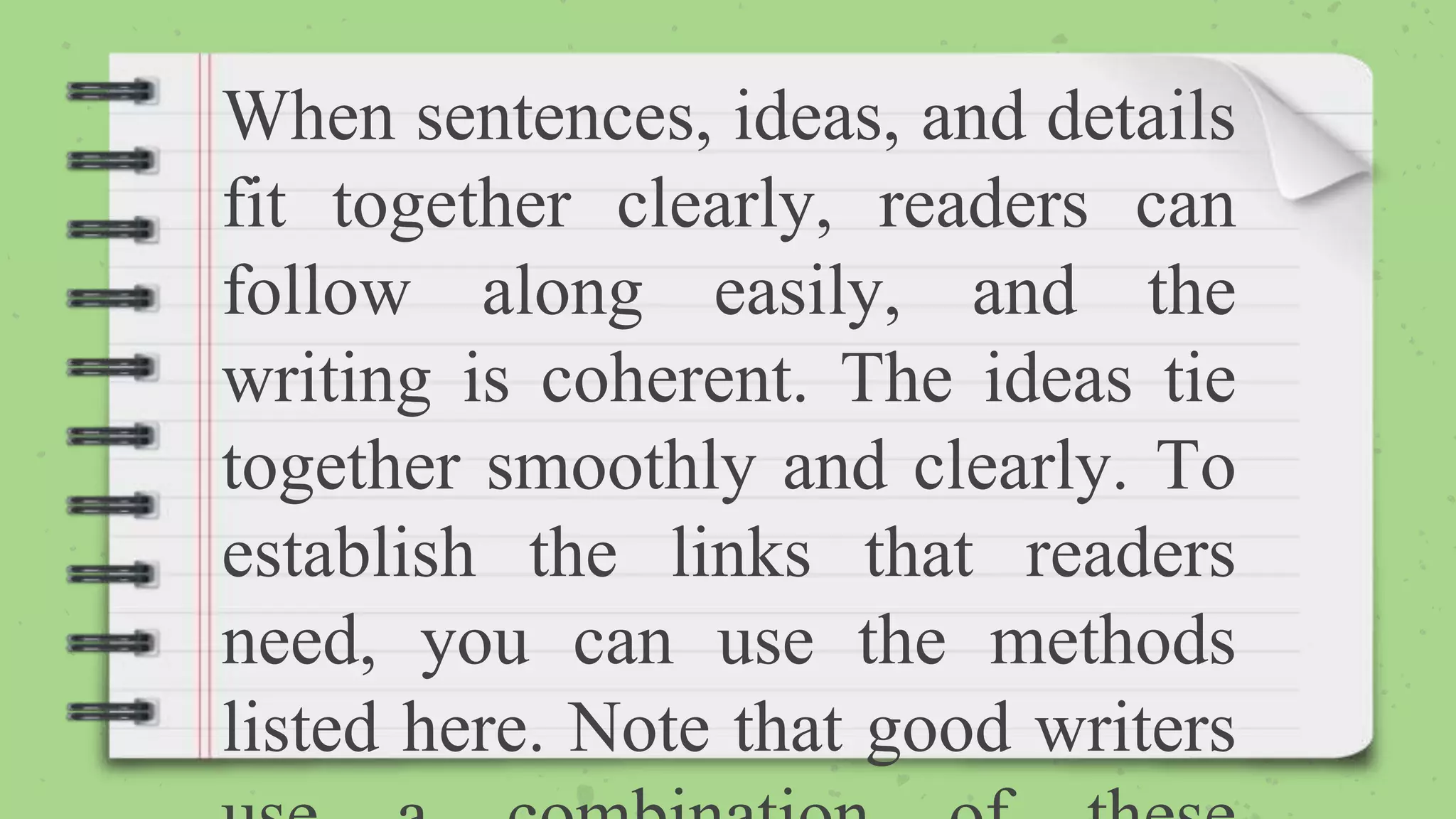
When sentences, ideas, and details
fit together clearly, readers can
follow along easily, and the
writing is coherent. The ideas tie
together smoothly and clearly. To
establish the links that readers
need, you can use the methods
listed here. Note that good writers
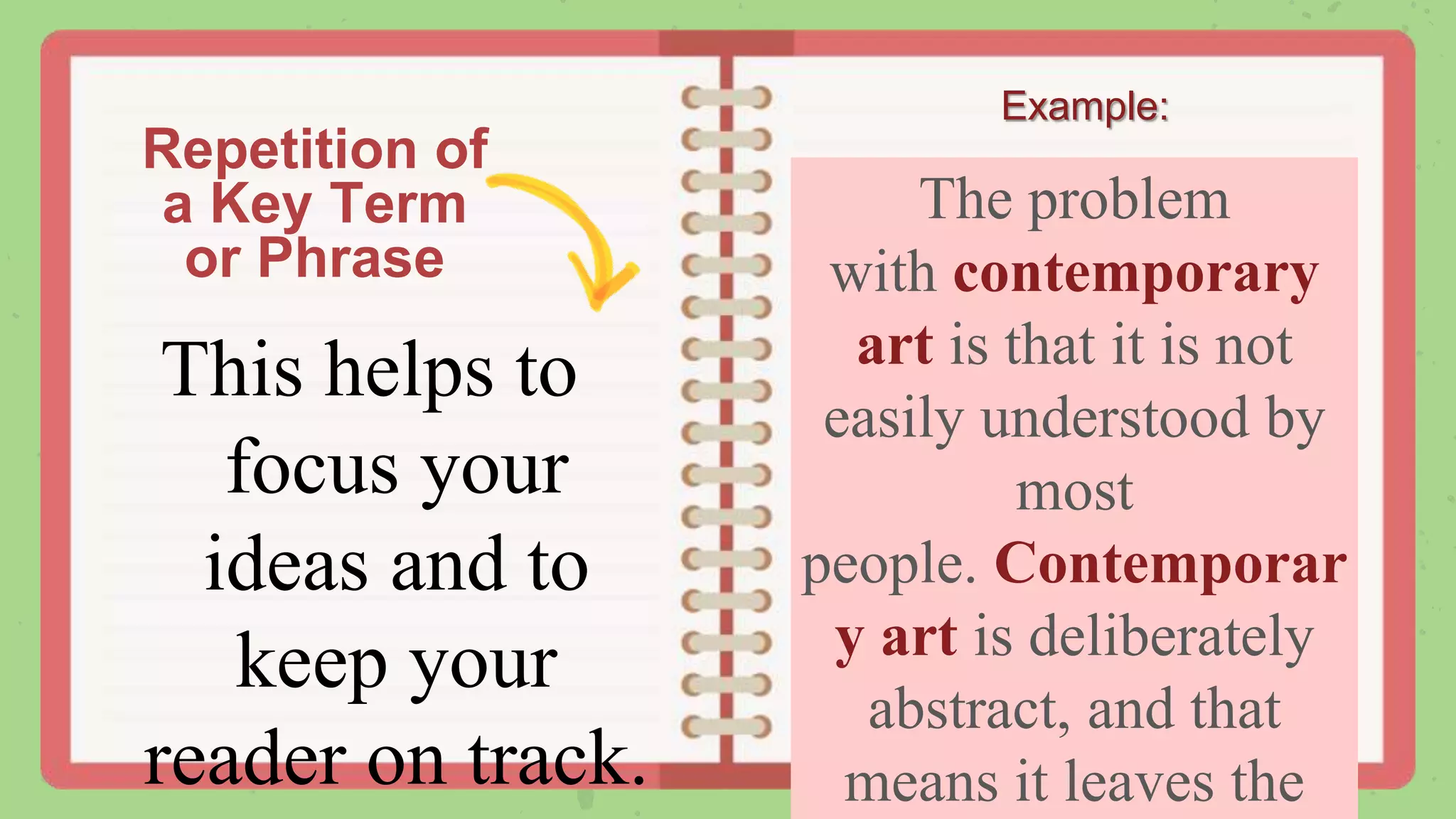
Repetition of
a Key Term
or Phrase
This helps to
focus your
ideas and to
keep your
reader on track.
Example:
The problem
with contemporary
art is that it is not
easily understood by
most
people. Contemporar
y art is deliberately
abstract, and that
means it leaves the
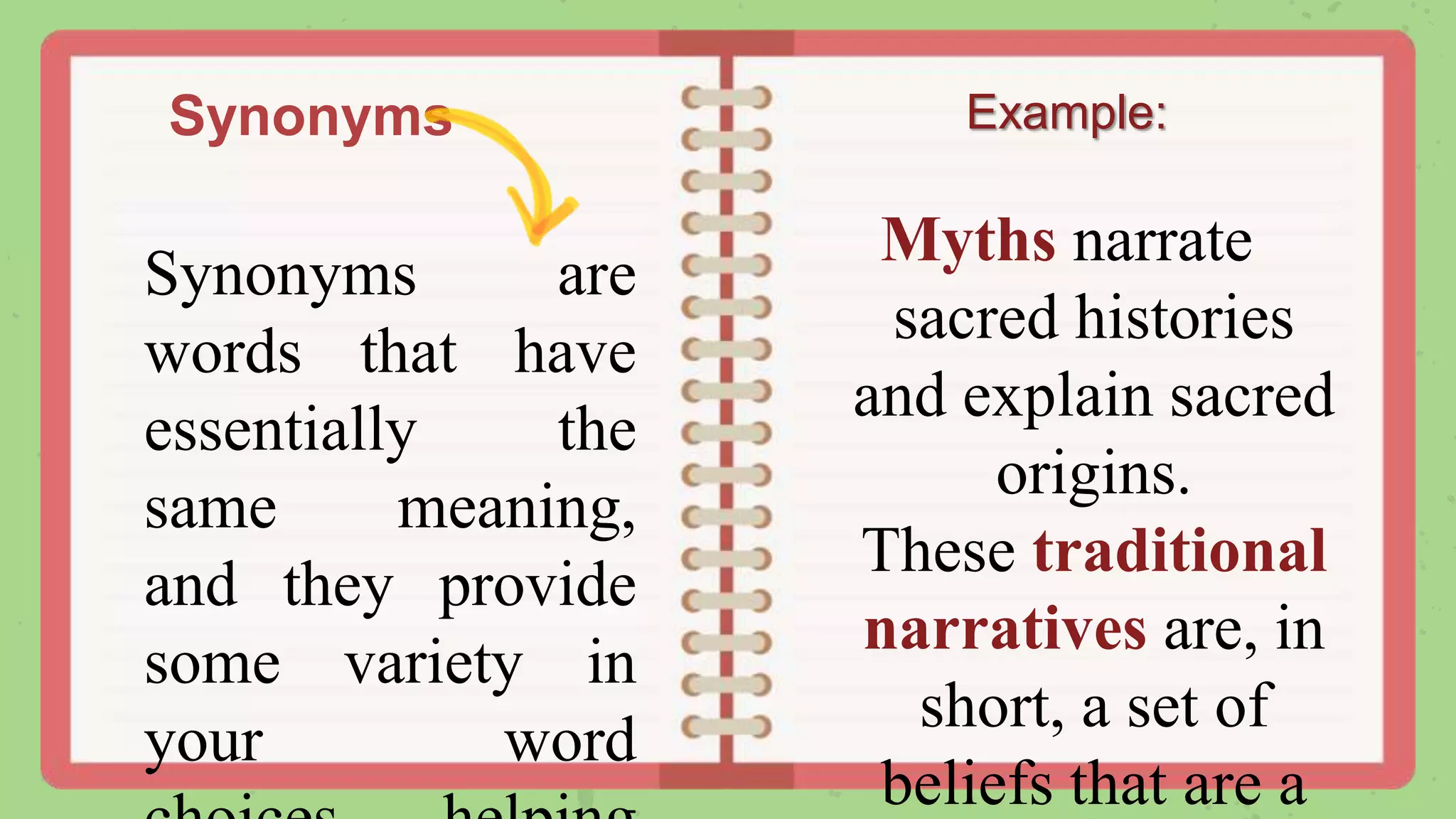
Synonyms
Synonyms are
words that have
essentially the
same meaning,
and they provide
some variety in
your word
Example:
Myths narrate
sacred histories
and explain sacred
origins.
These traditional
narratives are, in
short, a set of
beliefs that are a
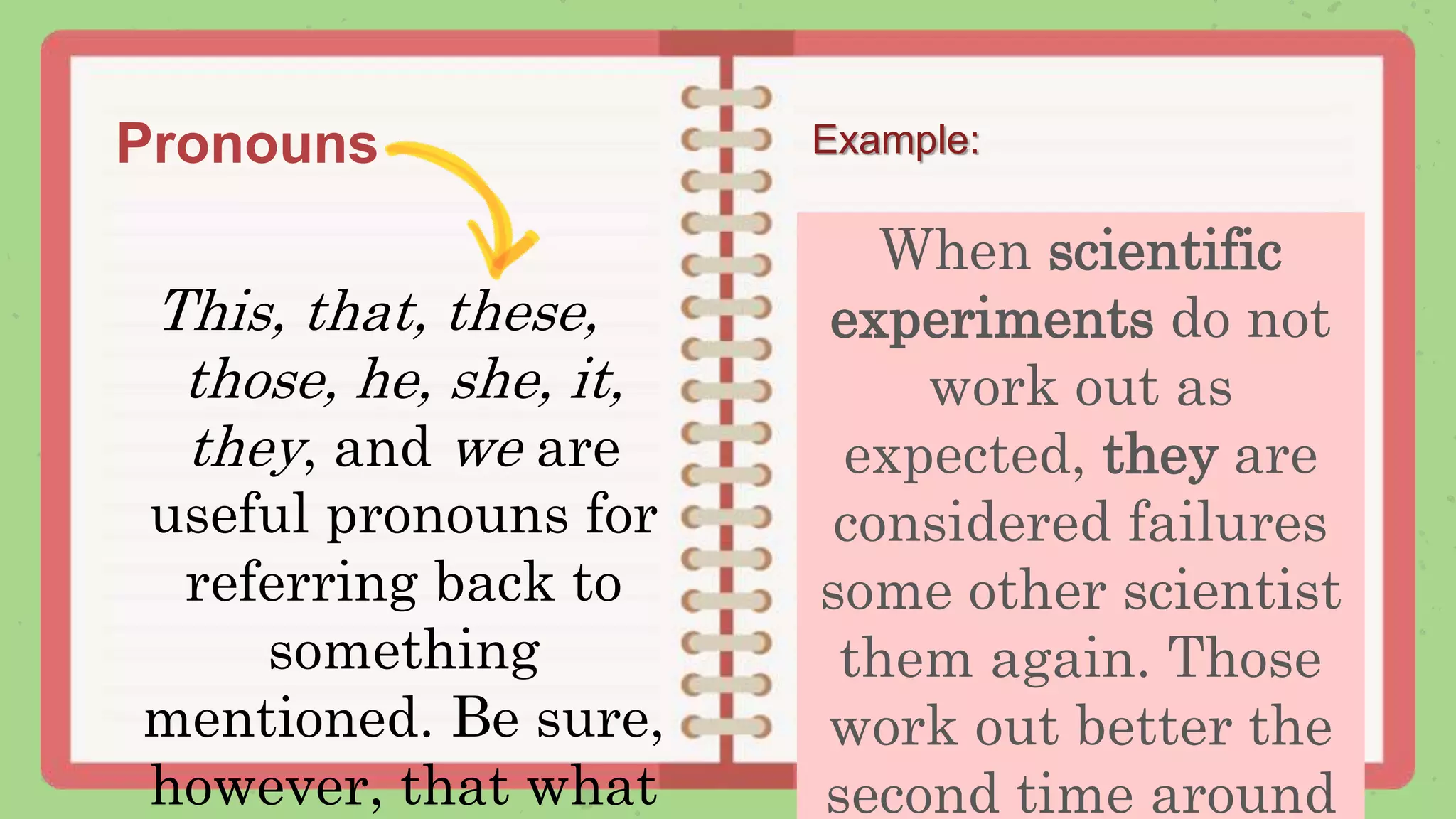
Pronouns
This, that, these,
those, he, she, it,
they, and we are
useful pronouns for
referring back to
something
mentioned. Be sure,
however, that what
When scientific
experiments do not
work out as
expected, they are
considered failures
some other scientist
them again. Those
work out better the
second time around
Example:
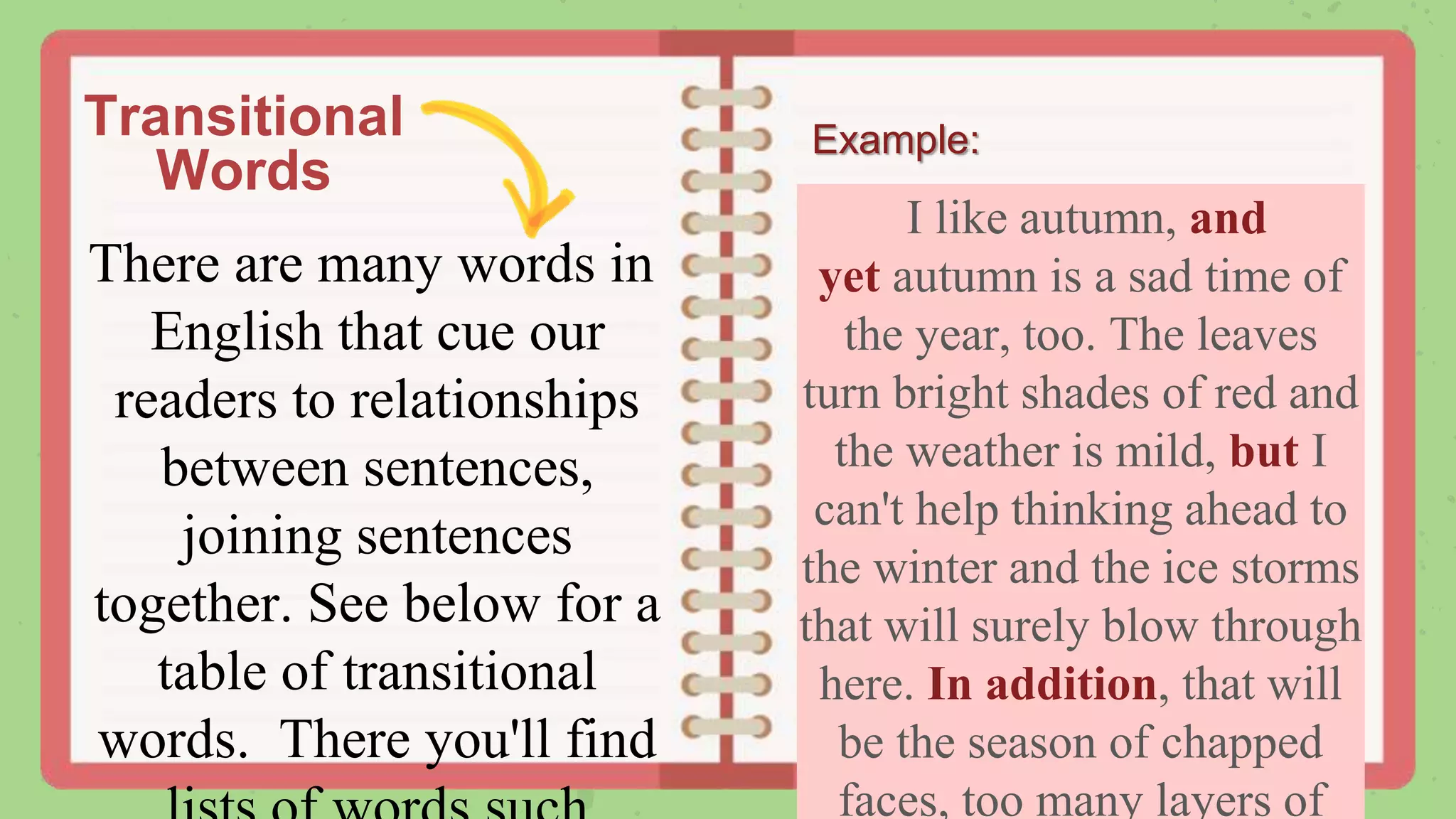
Transitional
Words
There are many words in
English that cue our
readers to relationships
between sentences,
joining sentences
together. See below for a
table of transitional
words. There you'll find
I like autumn, and
yet autumn is a sad time of
the year, too. The leaves
turn bright shades of red and
the weather is mild, but I
can't help thinking ahead to
the winter and the ice storms
that will surely blow through
here. In addition, that will
be the season of chapped
faces, too many layers of
Example:
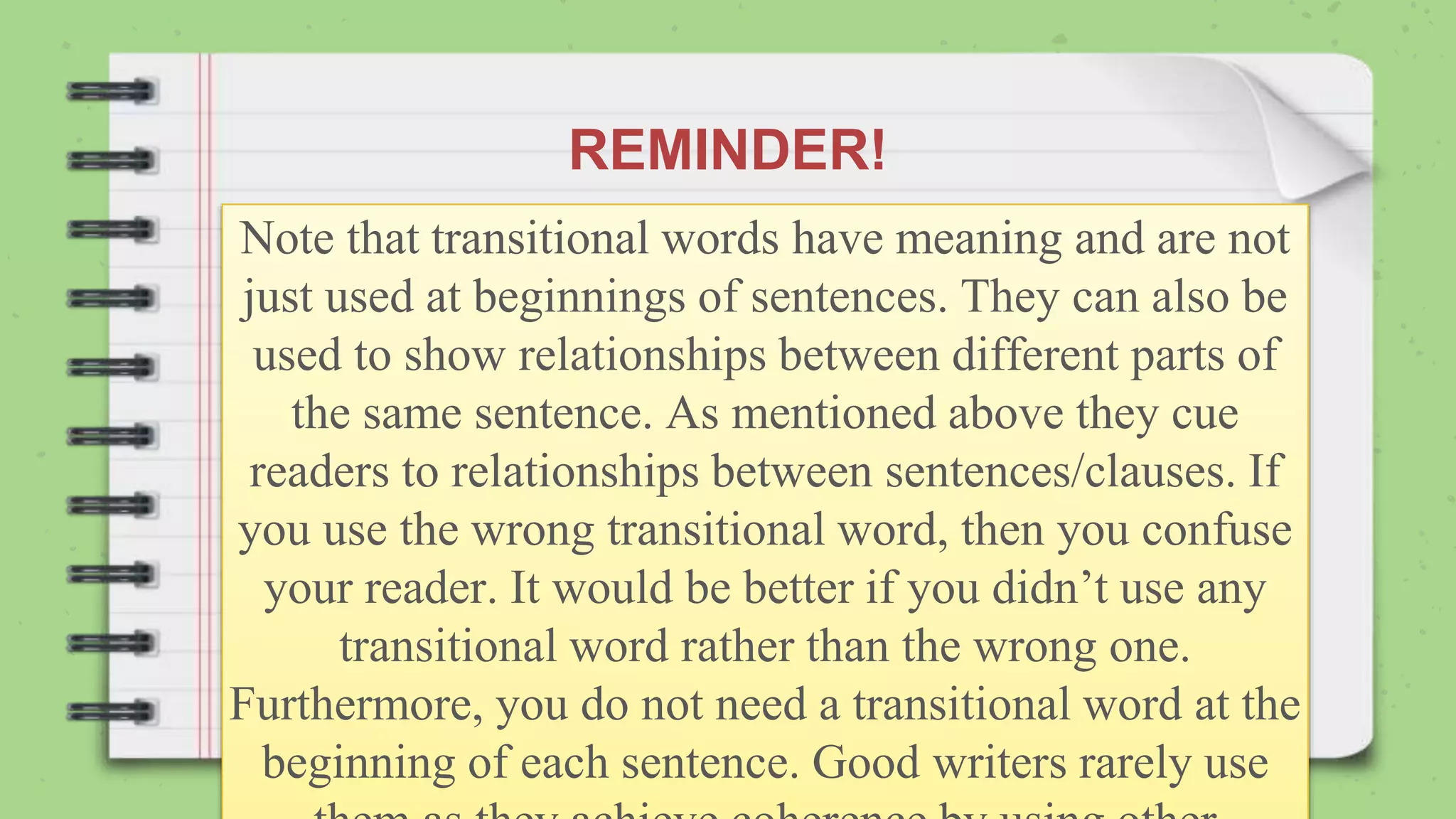
REMINDER!
Note that transitional words have meaning and are not
just used at beginnings of sentences. They can also be
used to show relationships between different parts of
the same sentence. As mentioned above they cue
readers to relationships between sentences/clauses. If
you use the wrong transitional word, then you confuse
your reader. It would be better if you didn’t use any
transitional word rather than the wrong one.
Furthermore, you do not need a transitional word at the
beginning of each sentence. Good writers rarely use
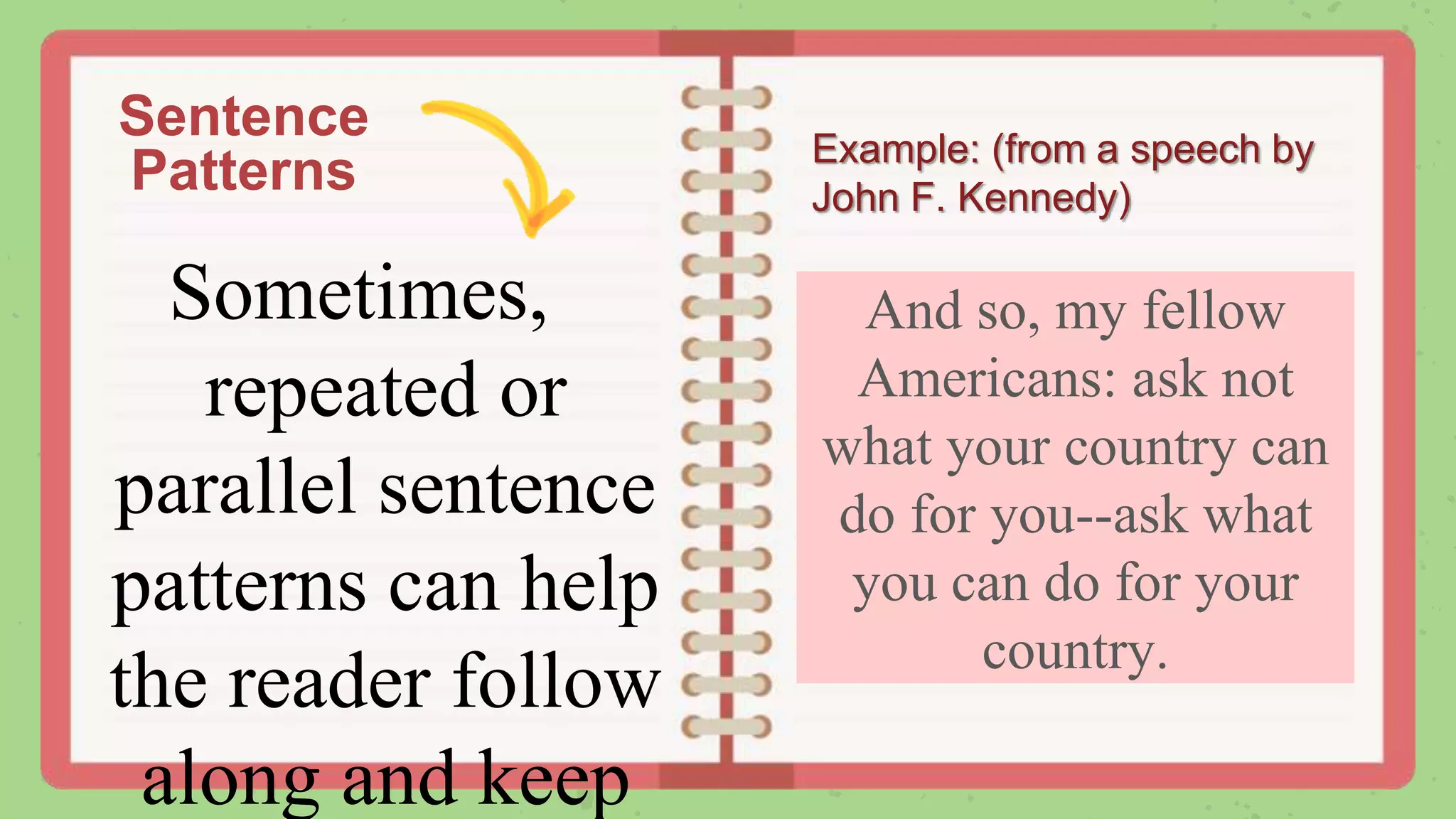
Sentence
Patterns
Sometimes,
repeated or
parallel sentence
patterns can help
the reader follow
along and keep
And so, my fellow
Americans: ask not
what your country can
do for you--ask what
you can do for your
country.
Example: (from a speech by
John F. Kennedy)
ARGUMENTATI
VE WRITING
TECHNIQUES
English
10
CAUSAL ARGUMENT
In this type of argument, you
argue that something has caused
something else. For example,
arguing why climate change is
occurring allows individuals to
explore potential causes and
EVALUATION
ARGUMENT
In this type of argument, you make
an argumentative evaluation of
something as “good” or “bad”, but
you need to establish the criteria for
“good” or “bad”. For example, you
might evaluate a children’s book for
an education class, but you would
PROPOSAL
ARGUMENT
In this type of argument, you
must propose a solution to a
problem. For example, you
might argue for a proposal
that would lessen the cases of
REBUTTAL
ARGUMENT
In this type of argument, you
build your case around refuting
an idea or ideas that have come
before. This type of argument
often involves including why a
particular idea or belief is flawed
DEFINITION
ARGUMENT
In this type of argument, you use a
definition as the starting point for
making your case. For example, in a
definition argument, you might
argue that NCAA basketball players
should be defined as professional

COHESIVE DEVICES.pptx

  • 1.
  • 2.
    When sentences, ideas,and details fit together clearly, readers can follow along easily, and the writing is coherent. The ideas tie together smoothly and clearly. To establish the links that readers need, you can use the methods listed here. Note that good writers
  • 3.
    Repetition of a KeyTerm or Phrase This helps to focus your ideas and to keep your reader on track. Example: The problem with contemporary art is that it is not easily understood by most people. Contemporar y art is deliberately abstract, and that means it leaves the
  • 4.
    Synonyms Synonyms are words thathave essentially the same meaning, and they provide some variety in your word Example: Myths narrate sacred histories and explain sacred origins. These traditional narratives are, in short, a set of beliefs that are a
  • 5.
    Pronouns This, that, these, those,he, she, it, they, and we are useful pronouns for referring back to something mentioned. Be sure, however, that what When scientific experiments do not work out as expected, they are considered failures some other scientist them again. Those work out better the second time around Example:
  • 6.
    Transitional Words There are manywords in English that cue our readers to relationships between sentences, joining sentences together. See below for a table of transitional words. There you'll find I like autumn, and yet autumn is a sad time of the year, too. The leaves turn bright shades of red and the weather is mild, but I can't help thinking ahead to the winter and the ice storms that will surely blow through here. In addition, that will be the season of chapped faces, too many layers of Example:
  • 7.
    REMINDER! Note that transitionalwords have meaning and are not just used at beginnings of sentences. They can also be used to show relationships between different parts of the same sentence. As mentioned above they cue readers to relationships between sentences/clauses. If you use the wrong transitional word, then you confuse your reader. It would be better if you didn’t use any transitional word rather than the wrong one. Furthermore, you do not need a transitional word at the beginning of each sentence. Good writers rarely use
  • 8.
    Sentence Patterns Sometimes, repeated or parallel sentence patternscan help the reader follow along and keep And so, my fellow Americans: ask not what your country can do for you--ask what you can do for your country. Example: (from a speech by John F. Kennedy)
  • 9.
  • 10.
    CAUSAL ARGUMENT In thistype of argument, you argue that something has caused something else. For example, arguing why climate change is occurring allows individuals to explore potential causes and
  • 11.
    EVALUATION ARGUMENT In this typeof argument, you make an argumentative evaluation of something as “good” or “bad”, but you need to establish the criteria for “good” or “bad”. For example, you might evaluate a children’s book for an education class, but you would
  • 12.
    PROPOSAL ARGUMENT In this typeof argument, you must propose a solution to a problem. For example, you might argue for a proposal that would lessen the cases of
  • 13.
    REBUTTAL ARGUMENT In this typeof argument, you build your case around refuting an idea or ideas that have come before. This type of argument often involves including why a particular idea or belief is flawed
  • 14.
    DEFINITION ARGUMENT In this typeof argument, you use a definition as the starting point for making your case. For example, in a definition argument, you might argue that NCAA basketball players should be defined as professional