What is e-Ticketing?
September 2020
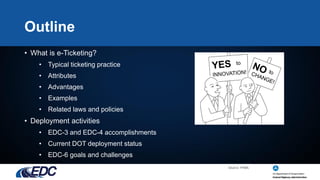
Outline
• What is e-Ticketing?
• Typical ticketing practice
• Attributes
• Advantages
• Examples
• Related laws and policies
• Deployment activities
• EDC-3 and EDC-4 accomplishments
• Current DOT deployment status
• EDC-6 goals and challenges
Source: FHWA
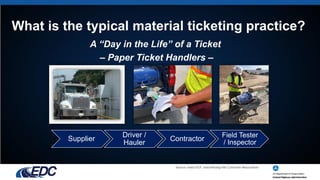
Supplier
Driver /
Hauler
Contractor
Field Tester
/ Inspector
What is the typical material ticketing practice?
A “Day in the Life” of a Ticket
– Paper Ticket Handlers –
Source: Iowa DOT, Iowa Ready Mix Concrete Association
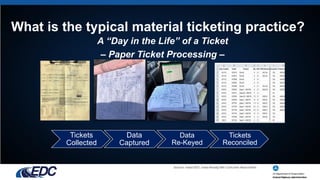
What is the typical material ticketing practice?
A “Day in the Life” of a Ticket
– Paper Ticket Processing –
Tickets
Collected
Data
Captured
Data
Re-Keyed
Tickets
Reconciled
Source: Iowa DOT, Iowa Ready Mix Concrete Association
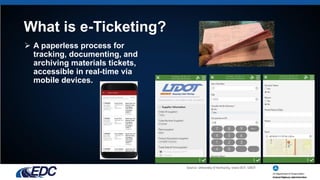
What is e-Ticketing?
 A paperless process for
tracking, documenting, and
archiving materials tickets,
accessible in real-time via
mobile devices.
Source: University of Kentucky, Iowa DOT, UDOT
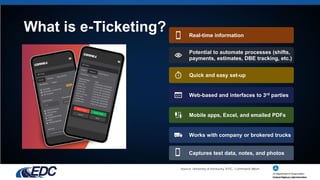
What is e-Ticketing? Real-time information
Potential to automate processes (shifts,
payments, estimates, DBE tracking, etc.)
Quick and easy set-up
Web-based and interfaces to 3rd parties
Mobile apps, Excel, and emailed PDFs
Works with company or brokered trucks
Source: University of Kentucky, KYTC, Command Alkon
Captures test data, notes, and photos
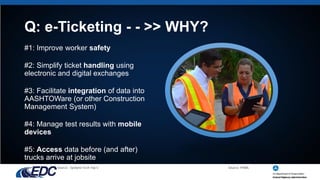
Q: e-Ticketing - - >> WHY?
#1: Improve worker safety
#2: Simplify ticket handling using
electronic and digital exchanges
#3: Facilitate integration of data into
AASHTOWare (or other Construction
Management System)
#4: Manage test results with mobile
devices
#5: Access data before (and after)
trucks arrive at jobsite
Source: FHWA
Source: Sysdyne Tech Top 5
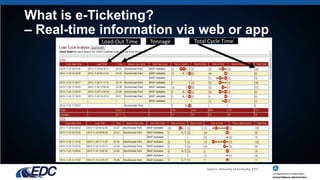
What is e-Ticketing?
– Real-time information via web or app
Source: University of Kentucky, KYTC
Load-Out Time Tonnage Total Cycle Time
What is e-Ticketing?
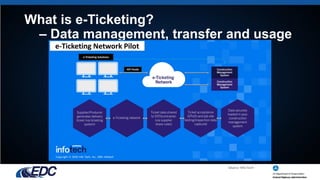
– Data management, transfer and usage
Source: Info Tech
e-Ticketing Solutions
API Feeds
e-Ticketing Network Pilot
What is e-Ticketing?
Source: Iowa DOT, University of Kentucky
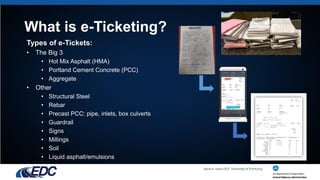
Types of e-Tickets:
• The Big 3
• Hot Mix Asphalt (HMA)
• Portland Cement Concrete (PCC)
• Aggregate
• Other
• Structural Steel
• Rebar
• Precast PCC: pipe, inlets, box culverts
• Guardrail
• Signs
• Millings
• Soil
• Liquid asphalt/emulsions
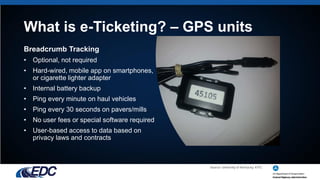
What is e-Ticketing? – GPS units
Breadcrumb Tracking
• Optional, not required
• Hard-wired, mobile app on smartphones,
or cigarette lighter adapter
• Internal battery backup
• Ping every minute on haul vehicles
• Ping every 30 seconds on pavers/mills
• No user fees or special software required
• User-based access to data based on
privacy laws and contracts
Source: University of Kentucky, KYTC
e-Ticketing Related Laws and Policies
• e-Transaction Laws
• Government Paperwork Elimination Act
(GPEA) 1998
• Electronic Signatures in Global and
National Commerce Act (E-SIGN) 2000
• Uniform Electronic Transactions Act
(UETA) 1999
• 2 CFR 200.335 Methods for Collection,
Transmission and Storage of Information
• 23 CFR 635.123 Determination and
Documentation of Pay Quantities
• 23 CFR 637 Construction Inspection and
Approval
• 2 FHWA Memos
• Computerization of Construction Records,
09/21/1989
• Electronic Security, 07/07/1993
Source: FHWA
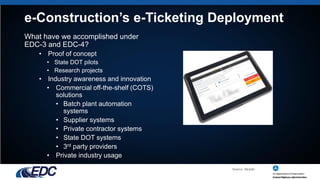
e-Construction’s e-Ticketing Deployment
What have we accomplished under
EDC-3 and EDC-4?
• Proof of concept
• State DOT pilots
• Research projects
• Industry awareness and innovation
• Commercial off-the-shelf (COTS)
solutions
• Batch plant automation
systems
• Supplier systems
• Private contractor systems
• State DOT systems
• 3rd party providers
• Private industry usage
Source: iStrada
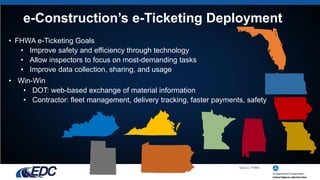
e-Construction’s e-Ticketing Deployment
• FHWA e-Ticketing Goals
• Improve safety and efficiency through technology
• Allow inspectors to focus on most-demanding tasks
• Improve data collection, sharing, and usage
• Win-Win
• DOT: web-based exchange of material information
• Contractor: fleet management, delivery tracking, faster payments, safety
Source: FHWA
e-Construction’s e-Ticketing Deployment
• What would we like to see in EDC-6?
• Expanded institutionalization of e-Ticketing
• Promotion of best practices of e-Ticket specifications and standardization of ticket
content
• Expanded use beyond 2020 temporary deployments
• Use of e-Ticket data for source documentation, acceptance, and payment
• Challenges
• State DOT, Local Agency, Contractor, and Supplier buy-in
• Privacy
• 54+ State DOT versions
• Delivery and data verification
• Data management and transfer
• Data usage beyond the construction project
• 2020 temporary deployments
Kat Weisner, PE, NRAEMT
202-823-2267
CONTACTS
www.fhwa.dot.gov/construction/econstruction
Antonio Nieves Torres
202-366-4597
e-Construction & e-Ticketing
kathryn.weisner@dot.gov antonio.nieves@dot.gov

Coding what_is_electronics ticketing.pdf

  • 1.
  • 2.
    Outline • What ise-Ticketing? • Typical ticketing practice • Attributes • Advantages • Examples • Related laws and policies • Deployment activities • EDC-3 and EDC-4 accomplishments • Current DOT deployment status • EDC-6 goals and challenges Source: FHWA
  • 3.
    Supplier Driver / Hauler Contractor Field Tester /Inspector What is the typical material ticketing practice? A “Day in the Life” of a Ticket – Paper Ticket Handlers – Source: Iowa DOT, Iowa Ready Mix Concrete Association
  • 4.
    What is thetypical material ticketing practice? A “Day in the Life” of a Ticket – Paper Ticket Processing – Tickets Collected Data Captured Data Re-Keyed Tickets Reconciled Source: Iowa DOT, Iowa Ready Mix Concrete Association
  • 5.
    What is e-Ticketing? A paperless process for tracking, documenting, and archiving materials tickets, accessible in real-time via mobile devices. Source: University of Kentucky, Iowa DOT, UDOT
  • 6.
    What is e-Ticketing?Real-time information Potential to automate processes (shifts, payments, estimates, DBE tracking, etc.) Quick and easy set-up Web-based and interfaces to 3rd parties Mobile apps, Excel, and emailed PDFs Works with company or brokered trucks Source: University of Kentucky, KYTC, Command Alkon Captures test data, notes, and photos
  • 7.
    Q: e-Ticketing -- >> WHY? #1: Improve worker safety #2: Simplify ticket handling using electronic and digital exchanges #3: Facilitate integration of data into AASHTOWare (or other Construction Management System) #4: Manage test results with mobile devices #5: Access data before (and after) trucks arrive at jobsite Source: FHWA Source: Sysdyne Tech Top 5
  • 8.
    What is e-Ticketing? –Real-time information via web or app Source: University of Kentucky, KYTC Load-Out Time Tonnage Total Cycle Time
  • 9.
    What is e-Ticketing? –Data management, transfer and usage Source: Info Tech e-Ticketing Solutions API Feeds e-Ticketing Network Pilot
  • 10.
    What is e-Ticketing? Source:Iowa DOT, University of Kentucky Types of e-Tickets: • The Big 3 • Hot Mix Asphalt (HMA) • Portland Cement Concrete (PCC) • Aggregate • Other • Structural Steel • Rebar • Precast PCC: pipe, inlets, box culverts • Guardrail • Signs • Millings • Soil • Liquid asphalt/emulsions
  • 11.
    What is e-Ticketing?– GPS units Breadcrumb Tracking • Optional, not required • Hard-wired, mobile app on smartphones, or cigarette lighter adapter • Internal battery backup • Ping every minute on haul vehicles • Ping every 30 seconds on pavers/mills • No user fees or special software required • User-based access to data based on privacy laws and contracts Source: University of Kentucky, KYTC
  • 12.
    e-Ticketing Related Lawsand Policies • e-Transaction Laws • Government Paperwork Elimination Act (GPEA) 1998 • Electronic Signatures in Global and National Commerce Act (E-SIGN) 2000 • Uniform Electronic Transactions Act (UETA) 1999 • 2 CFR 200.335 Methods for Collection, Transmission and Storage of Information • 23 CFR 635.123 Determination and Documentation of Pay Quantities • 23 CFR 637 Construction Inspection and Approval • 2 FHWA Memos • Computerization of Construction Records, 09/21/1989 • Electronic Security, 07/07/1993 Source: FHWA
  • 13.
    e-Construction’s e-Ticketing Deployment Whathave we accomplished under EDC-3 and EDC-4? • Proof of concept • State DOT pilots • Research projects • Industry awareness and innovation • Commercial off-the-shelf (COTS) solutions • Batch plant automation systems • Supplier systems • Private contractor systems • State DOT systems • 3rd party providers • Private industry usage Source: iStrada
  • 14.
    e-Construction’s e-Ticketing Deployment •FHWA e-Ticketing Goals • Improve safety and efficiency through technology • Allow inspectors to focus on most-demanding tasks • Improve data collection, sharing, and usage • Win-Win • DOT: web-based exchange of material information • Contractor: fleet management, delivery tracking, faster payments, safety Source: FHWA
  • 15.
    e-Construction’s e-Ticketing Deployment •What would we like to see in EDC-6? • Expanded institutionalization of e-Ticketing • Promotion of best practices of e-Ticket specifications and standardization of ticket content • Expanded use beyond 2020 temporary deployments • Use of e-Ticket data for source documentation, acceptance, and payment • Challenges • State DOT, Local Agency, Contractor, and Supplier buy-in • Privacy • 54+ State DOT versions • Delivery and data verification • Data management and transfer • Data usage beyond the construction project • 2020 temporary deployments
  • 16.
    Kat Weisner, PE,NRAEMT 202-823-2267 CONTACTS www.fhwa.dot.gov/construction/econstruction Antonio Nieves Torres 202-366-4597 e-Construction & e-Ticketing kathryn.weisner@dot.gov antonio.nieves@dot.gov