REPORTABLE 
Page 1 
IN THE SUPREME COURT OF INDIA 
CRIMINAL/CIVIL ORIGINAL JURISDICTION 
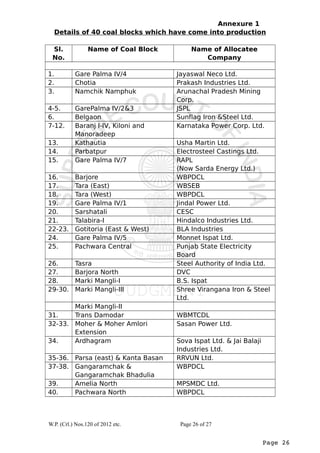
WRIT PETITION (CRL.) NO. 120 OF 2012 
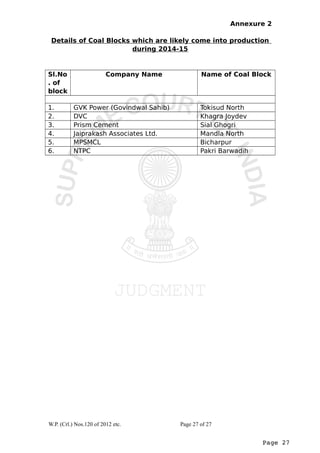
Manohar Lal Sharma ….Petitioner 
Versus 
The Principle Secretary & Ors. …Respondents 
WITH 
WRIT PETITION (CIVIL) NO. 463 OF 2012 
WITH 
WRIT PETITION (CIVIL) NO. 515 OF 2012 
AND 
WRIT PETITION (CIVIL) NO. 283 Of 2013 
O R D E R 
1. On 25th August, 2014 judgment was delivered in these 
cases and it was held, inter alia, that the allotment of coal 
blocks made by the Screening Committee of the 
Government of India, as also the allotments made through 
the Government dispensation route are arbitrary and 
illegal. Since the conclusion arrived at would have 
W.P. (Crl.) Nos.120 of 2012 etc. Page 1 of 27
potentially had far-reaching consequences, on which 
submissions were not made when the case was heard, the 
question of what should be the consequences of the 
declaration was left open for hearing. 
2. The relevant paragraphs of the judgment dated 25th 
August, 2014 read as follows:- 
“155. The allocation of coal blocks through Government 
dispensation route, however laudable the object may be, 
also is illegal since it is impermissible as per the scheme of 
the CMN Act. No State Government or public sector 
undertakings of the State Governments are eligible for 
mining coal for commercial use. Since allocation of coal is 
permissible only to those categories under Section 3(3) 
and (4), the joint venture arrangement with ineligible firms 
is also impermissible. Equally, there is also no question of 
any consortium/leader/association in allocation. Only an 
undertaking satisfying the eligibility criteria referred to in 
Section 3(3) of the CMN Act, viz., which has a unit engaged 
in the production of iron and steel and generation of 
power, washing of coal obtained from mine or production 
of cement, is entitled to the allocation in addition to 
Central Government, a Central Government company or a 
Central Government corporation. 
156. In this context, it is worthwhile to note that the 
1957 Act has been amended introducing Section 11-A 
w.e.f. 13.02.2012. As per the said amendment, the grant of 
reconnaissance permit or prospecting licence or mining 
lease in respect of an area containing coal or lignite can be 
made only through selection through auction by 
competitive bidding even among the eligible entities under 
Section 3(3)(a)(iii), referred to above. However, 
Government companies, Government corporations or 
companies or corporations, which have been awarded 
power projects on the basis of competitive bids for tariff 
(including Ultra Mega Power Projects) have been exempted 
of allocation in favour of them is not meant to be through 
the competitive bidding process. 
157. As we have already found that the allocations 
made, both under the Screening Committee route and the 
Page 2 
W.P. (Crl.) Nos.120 of 2012 etc. Page 2 of 27
Government dispensation route, are arbitrary and illegal, 
what should be the consequences, is the issue which 
remains to be tackled. We are of the view that, to this 
limited extent, the matter requires further hearing.” 
3. Accordingly, we heard several learned counsels 
appearing for a very large number of interveners, 
impleadment applicants and State Governments. 
Substantive submissions were made, amongst others, by 
the Coal Producers Association, the Independent Power 
Producers Association of India and the Sponge Iron 
Manufacturers Association. These associations had also 
been heard on an earlier occasion well before judgment 
was delivered on 25th August, 2014. 
4. For the purposes of these “consequence proceedings”, 
the Union of India filed an affidavit dated 8th September, 
2014. It is stated in the affidavit that coal is actually being 
mined from 40 coal blocks listed in Annexure I to the 
affidavit. This list includes two coal blocks allotted to an 
Ultra Mega Power Projects (Sasan Power Ltd. [UMPP] 
allotted the coal blocks Moher and Moher Amroli 
Extension). Coal blocks allotted to UMPPs have not been 
disturbed in the judgment. The list of the 40 coal blocks is 
attached to this order as Annexure 1. 
5. In addition to the above 40 coal blocks, it is stated in 
the affidavit that 6 more coal blocks are ready for 
Page 3 
W.P. (Crl.) Nos.120 of 2012 etc. Page 3 of 27
extraction of coal in 2014-15 and this list is Annexure II to 
the affidavit. These 6 coal blocks have obtained the Mine 
Opening Permission from the Coal Controller’s 
Organization under Rule 9 of the Colliery Control Rules 
20041 (framed under the Mines and Minerals 
(Development and Regulation) Act, 1957). This permission 
is granted subsequent to the execution of a mining lease. 
The list of these 6 coal blocks is attached to this order as 
Annexure 2. 
6. Therefore, the affidavit is quite clear that 40 coal blocks 
are already producing coal and 6 coal blocks are in a 
position to produce coal virtually with immediate effect. 
The question is whether the allotment of these coal blocks 
should be cancelled or not. 
7. It was submitted by the learned Attorney General that 
after the declaration of law and the conclusion that the 
allotment of coal blocks was arbitrary and illegal, only two 
consequences flow from the judgment. The first is the 
natural consequence, that is, the allotment of the coal 
blocks (other than those mentioned in the judgment) 
should be cancelled and the Central Government is fully 
Page 4 
1 9. Requirement of prior permission to open a coal mine, seam or section of a seam.-- 
(1) No owner of a colliery shall open a coal mine, seam or a section of a seam without the 
prior permission in writing of the Central Government. 
(2) No owner of a colliery shall also commence mining operations in a colliery or seam or a 
section of a seam, in which the mining operation has been discontinued for a period exceeding one 
hundred and eighty days, without the prior permission in writing of the Central Government. 
W.P. (Crl.) Nos.120 of 2012 etc. Page 4 of 27
prepared to take things forward. The second option is that 
46 coal blocks (as above) be left undisturbed (subject to 
conditions) and the allotment of the remaining coal blocks 
should be cancelled. 
8. Expounding on the alternative consequence, it was 
submitted that Coal India Limited (CIL) a public sector 
undertaking can take over and continue the extraction of 
coal from these 44 coal blocks without adversely affecting 
the rights of those employed therein. However, it was 
submitted that CIL would require some time to take over 
the coal blocks and manage its affairs for continuing the 
mining process. Effectively therefore, it was submitted 
that even if the allotment of these 44 coal blocks is 
cancelled, the Central Government can ensure that coal 
production will not stop. 
9. Learned Attorney General submitted that all the 
allottees of coal blocks should be directed to pay an 
additional levy of Rs. 295/- per metric ton of coal extracted 
from the date of extraction as per the Report of the 
Comptroller and Auditor General (CAG) dealing with the 
financial loss caused to the exchequer by the illegal and 
arbitrary allotments. It was further submitted that in the 
case of allottees supplying coal to the power sector, they 
Page 5 
W.P. (Crl.) Nos.120 of 2012 etc. Page 5 of 27
should be mandated to enter into Power Purchase 
Agreements (PPAs) with the State utility or distribution 
company (as the case may be) so that the benefit is 
passed on to the consumers. 
10. By way of abundant precaution, the learned 
Attorney General pointed out that in respect of the 
allotment of 6 coal blocks, a First Information Report has 
been lodged by the Central Bureau of Investigation (CBI). 
Therefore, investigations are in progress to ascertain 
whether any criminal offence has been committed in 
respect of the allotment of 6 coal blocks. In addition, it is 
pointed out that the CBI has on 3rd September, 2014 
informed that a final decision with regard to any alleged 
criminality or otherwise in the allotment of 6 other coal 
blocks is pending consideration. In other words, the 
alleged criminality in the allotment of 12 out of the 46 coal 
blocks identified by the learned Attorney General is under 
scrutiny by the CBI. 
11. To put the suggestions of the learned Attorney 
General in perspective, they are summarized below: 
(1) All coal block allotments (except those 
mentioned in the judgment) may be cancelled. 
(2) Alternatively, 
Page 6 
W.P. (Crl.) Nos.120 of 2012 etc. Page 6 of 27
(a) Extraction of coal from the 40 functional and 6 
“ready” coal blocks may be permitted and the 
remaining coal blocks be cancelled; 
(b) The allottees of all 46 coal blocks be directed 
to pay an additional levy of Rs.295/- per metric 
ton of coal extracted from the date of 
extraction; and 
(c) The allottees of coal blocks for the power 
sector be also directed to enter into PPAs with 
the State utility or distribution company as the 
case may be. 
12. Learned Attorney General made two supplementary 
submissions, not directly connected with the suggestions 
made. It was submitted that though all the allotments 
made by the Screening Committee and through the 
Government dispensation route were held illegal and 
arbitrary, the allotment of lignite blocks was not the 
subject matter of discussion in the judgment delivered on 
25th August, 2014. This is correct and it is made clear that 
the judgment delivered on 25th August, 2014 does not 
concern lignite blocks at all and their allotments are not 
covered by the said judgment. 
13. Secondly, the figure of Rs. 295/- per metric ton of 
Page 7 
W.P. (Crl.) Nos.120 of 2012 etc. Page 7 of 27
coal extracted as additional levy (based on the Report of 
the Comptroller and Auditor General) has been calculated 
on the basis of open cast mines and mixed mines, while 
underground mines were not taken into calculation. Of the 
coal blocks sought to be “saved” from cancellation, it has 
not been pointed out by any learned counsel whether any 
one of the 46 coal blocks contains an underground mine or 
not. Therefore, there is no occasion to deal with a 
hypothetical case. 
14. In response to the submissions of the learned 
Attorney General, Mr. K.K. Venugopal, Senior Advocate, 
appearing on behalf of the Coal Producers Association 
submitted that cancellation of all the coal blocks would 
have very serious and far reaching consequences. 
15. The consequences of cancellation of the coal blocks 
were categorized by Mr. Venugopal under various heads 
and these are detailed below. 
(1)There would be a serious adverse impact on the 
economy of the country: It was submitted that 
Government companies are not in a position to supply the 
required quantity of coal; in fact, a large number of 
applications are pending with the Ministry of Coal for long 
term coal linkages; power stations have a supply of less 
Page 8 
W.P. (Crl.) Nos.120 of 2012 etc. Page 8 of 27
than one week of coal and therefore there are possibilities 
of power outages; as many as 10 power plants of the 
National Thermal Power Corporation (NTPC) and the 
Damodar Valley Corporation (DVC) have been shut down 
because of shortage of coal supply by Coal India Ltd. (CIL); 
there is an issue of poor quality of coal supplied by CIL; 
huge investments up to about Rs. 2.87 lakh crores have 
been made in 157 coal blocks as on December, 2012; 
investments in end-use plants have been made to the 
extent of about Rs. 4 lakh crores; the employment of 
almost 10 lakh people is at stake; end-use plants have 
been designed keeping in mind the specification of coal in 
the allocated coal block and cancellation of the coal blocks 
would result in the end-use plant becoming redundant; 
loans to the extent of about Rs. 2.5 lakh crores given by 
banks and financial institutions would become non-performing 
assets; the State Bank of India may suffer a 
loss of up to Rs. 78,263 crores which is almost 7.9% of its 
net worth for the financial year 2013; other Public Sector 
Banks such as the Punjab National Bank and the Union 
Bank will receive a massive set back; Public Sector 
Corporations like Rural Electricity Corporation and Power 
Finance Corporation have an even higher exposure than 
Page 9 
W.P. (Crl.) Nos.120 of 2012 etc. Page 9 of 27
banks; there will be global ramifications of the de-allotments 
such as a negative impact on investor 
confidence; acute distress in some industries; the 
country’s dependence on coal as a primary fuel source 
with up to 60% for power generation may result in 
inflationary trends; 28,000 MW of power capacity will be 
affected due to de-allocation; closure of coal mines would 
result in an estimated loss of Rs. 4.4 lakh crores in terms 
of loss of royalty, cess, direct and indirect taxes; coal 
imports (already very high) will go up even more in FY 
2016-17 to the extent of Rs.1.44 lakh crores (without de-allocation); 
and on the other hand, the production of coal 
would substantially increase in case all coal blocks are 
made operational after the grant of necessary permission. 
(2)The cancellation of coal blocks would set back the 
process (of extraction and effective utilization of coal) by 
about 7 to 8 years: It was submitted that the auction of 
coal blocks would take at least 1-2 years and from past 
experience, it is unlikely that the auction would be 
successful due to lack of bids or proper participation; it 
would take at least 5-6 years for making the auctioned 
coal blocks operational; in any event (based on the time 
lines given by the Ministry of Coal in the allocation letters) 
Page 10 
W.P. (Crl.) Nos.120 of 2012 etc. Page 10 of 27
it would take 36-42 months to develop an open cast mine 
and about 48-54 months to develop an underground mine; 
and the commissioning of end-use plants after obtaining 
various clearances would take a minimum of 3-4 years. 
(3)If the coal blocks are not cancelled, the allottees could 
continue their contribution towards corporate social 
responsibility and socio-economic development of the 
country: It was submitted on a positive note that the 
allottees have invested in basic infrastructure like road, 
rail links etc. since the coal blocks allotted to them were in 
areas where CIL was not interested in making an 
investment; the allottees have made huge investments in 
setting up other infrastructure such as schools, hospitals, 
facilities for clean and potable water, residential colonies, 
community centers, playground etc. and in creation of job 
opportunities; thousands of crores of rupees have already 
been paid by the coal block allottees by way of direct and 
indirect taxes and in the form of royalty, cess etc.; and if 
the coal blocks are cancelled, the development activities 
initiated by the allottees would come to a standstill. 
(4)Many of the allottees have problems peculiar to them 
which need to be examined along with ground realities: It 
was submitted that the delay in development of coal 
Page 11 
W.P. (Crl.) Nos.120 of 2012 etc. Page 11 of 27
blocks is not attributable to the allottees who are actually 
victims of the faults of the Screening Committee; delays 
are attributable to various reasons such as administrative 
delays on the part of the Ministry of Environment and 
Forest and Ministry of Coal, the consent by the Pollution 
Control Boards was not given on time, Court orders, 
Naxalite issues in some areas, State Governments 
directing that mining lease should not be executed, 
introduction of go/no go areas or without statutory 
permission etc.; this Court has tacitly acknowledged 
administrative delays in grant of clearances in an order 
passed on 1st September, 2014 in Samaj Parivartana 
Samudaya v. State of Karnataka;2 the appropriate 
course of action to adopt would be for this Court to 
appoint a Committee to examine the peculiar facts of each 
individual allotment. 
(5) The additional levy of Rs. 295/- per metric ton of coal 
extracted (described as a penalty) is unjustified: The 
figure of loss of revenue to the exchequer to the extent of 
Rs. 295/- per metric ton of coal extracted is borrowed from 
the Report of the CAG which Report is contested by the 
Government of India and is pending consideration before a 
Page 12 
2 I.A. No.201 & 219, 223 in I.A. No.204 and I.A. Nos. 224 in I.A. No.215 in WP(C) No. 562/2009 
W.P. (Crl.) Nos.120 of 2012 etc. Page 12 of 27
Parliamentary Committee on Public Undertakings; the 
Report itself suggested that only a part of the financial 
gain could have accrued to the national exchequer; the 
Government of India has not applied its mind while 
suggesting the figure of Rs. 295/- per metric ton and it has 
only considered the average price of coal as given by CIL 
for the year 2010-11 (being Rs.1028/- per metric ton) and 
that cannot be adopted for earlier financial years; the coal 
extracted from the blocks allotted are of an inferior quality 
and the sale price thereof is much lower than the average 
sale price of CIL; the CAG has not taken into consideration 
underground mines while calculating the alleged financial 
loss; the cost of production of coal for CIL is less since CIL 
has economically viable mines as compared to the mines 
allocated to the private sector which lack infrastructure 
and have several other problems; and penalty cannot be 
imposed with retrospective effect since the coal extracted 
by the allottees has already been utilized for production of 
power, steel, cement etc. 
16. Finally, Mr. Venugopal relied on Ashok Hurrah v. 
Rupa Ashok Hurrah3 to contend that the allottees are 
entitled to a hearing before the cancellation of their coal 
Page 13 
3 (2002) 4 SCC 388 
W.P. (Crl.) Nos.120 of 2012 etc. Page 13 of 27
blocks in accordance with the well accepted principles of 
natural justice since the cancellation adversely affects 
their interests. Paragraph 51 of the Report was relied on 
and this reads as follows: 
“Nevertheless, we think that a petitioner is entitled to 
relief ex debito justitiae if he establishes (1) violation of 
the principles of natural justice in that he was not a party 
to the lis but the judgment adversely affected his interests 
or, if he was a party to the lis, he was not served with 
notice of the proceedings and the matter proceeded as if 
he had notice, and (2) where in the proceedings a learned 
Judge failed to disclose his connection with the subject-matter 
or the parties giving scope for an apprehension of 
Page 14 
bias and the judgment adversely affects the petitioner.” 
17. Mr. Harish Salve, Senior Advocate, appearing for the 
Sponge Iron Manufacturers Association generally 
supported the submissions made by Mr. Venugopal. He 
emphasized that the more appropriate course for this 
Court to adopt would be to appoint a Committee of three 
persons, including experts, to examine each individual 
allotment and consider the facts peculiar to each allottee 
and report to this Court whether the coal block allotment 
should be cancelled or not. 
18. Learned counsel also emphasized the necessity of 
granting a hearing to each allottee and referred to a 
passage from National Textile Workers’ Union v. P. R. 
Ramakrishna4 wherein the Constitution Bench 
4 (1983) 1 SCC 228 
W.P. (Crl.) Nos.120 of 2012 etc. Page 14 of 27
emphasized the importance of natural justice in paragraph 
16 of the Report. Particular emphasis was laid on the 
following passage: 
“….It will surely be a travesty of justice to deny natural 
justice on the ground that courts know better. There is a 
peculiar and surprising misconception of natural justice, 
in some quarters, that it is, exclusively, a principle of 
administrative law. It is not. It is first a universal 
principle and, therefore, a rule of administrative law. It is 
that part of the judicial procedure which is imported into 
the administrative process because of its universality. “It 
is of the essence of most systems of justice – certainly of 
the Anglo-Saxon System – that in litigation both sides of a 
dispute musts be heard before decision. ‘Audi Alteram 
Partem’ was the aphorism of St. Augustine which was 
adopted by the courts at a time when Latin Maxims were 
fashionable”. “Audi Alteram Partem is as much a principle 
of African, as it is of English legal procedure : a popular 
Yoruba saying is “ ‘wicked and iniquitous is he who 
decides a case upon the testimony of only one party to it” 
(T.O. Elias : The Nature of African Customary Law). Courts 
even more than administrators must observe natural 
justice.” 
19. Mr. Salve also referred to a passage from 
Administrative Law5 to contend that the principle of legal 
relativity should be borne in mind by the Court so that 
“the law can be made to operate justly and reasonably in 
cases where doctrine of ultra vires, rigidly applied, would 
produce unacceptable results.” 
20. Unfortunately, it is difficult to see relevance of the 
passage cited by learned counsel since it deals with the 
nullity and voidness of an Act or order which is ultra vires. 
Page 15 
5 Administrative Law by Sir William Wade, 9th Edn. 
W.P. (Crl.) Nos.120 of 2012 etc. Page 15 of 27
The applicable principles are completely different and we 
are not dealing with such a case. It would be more 
apposite to refer to a passage from Sheela Barse v. 
Union of India6 cited by Dr. A.M. Singhvi, Senior Advocate 
(appearing for the Independent Power Producers 
Association of India) wherein this Court observed the 
future is important (and that is what we are looking at). 
This Court said: 
“Again, the relief to be granted looks to the future and is, 
generally, corrective rather than compensatory which, 
sometimes, it also is. The pattern of relief need not 
necessarily be derived logically from the rights asserted or 
found. More importantly, the court is not merely a passive, 
disinterested umpire or onlooker, but has a more dynamic 
and positive role with the responsibility for the 
organization of the proceedings, moulding of the relief and 
– this is important – also supervising the implementation 
thereof. The court is entitled to, and often does, seek the 
assistance of expert panels, Commissioners, Advisory 
Committee, amici etc. This wide range of the 
responsibilities necessarily implies correspondingly higher 
measure of control over the parties, the subject matter and 
the procedure. Indeed as the relief is positive and implies 
affirmative action the decisions are not “one-shot” 
determinations but have ongoing implications. Remedy is 
both imposed, negotiated or quasi-negotiated.” 
21. Dr. A.M. Singhvi also submitted a note which 
essentially and substantially reiterates some of the 
submissions made by Mr. Venugopal. It is not, therefore, 
necessary to repeat those submissions. He also referred to 
Onkar Lal Bajaj v. Union of India7 to submit that in the 
Page 16 
6 (1988) 4 SCC 226 
7 (2003) 2 SCC 673 
W.P. (Crl.) Nos.120 of 2012 etc. Page 16 of 27
case of apparently tainted allotment of dealerships for 
petroleum products, this Court felt the necessity of 
appointing a Committee and therefore we should also 
appoint a Committee of retired judges to examine each 
individual case of coal block allotment. 
22. Dr. Rajeev Dhavan, Senior Advocate appearing for 
one of the interveners referred to Chingleput Bottlers v. 
Majestic Bottling Company8 to emphasize the necessity 
of applying the principles of natural justice before 
cancelling the allotments made in favour of the allottees. 
23. Other learned counsels more or less repeated and 
reiterated the submissions made, with slight variations 
and emphasis depending upon the facts of the case of 
their respective clients, including State Governments. 
24. In response to the submissions made by various 
learned counsels, it was submitted by the learned Attorney 
General that all the aspects mentioned above including 
the economic implications or fall-out of the cancellation of 
coal block allotments and the possible adverse impact that 
it may have on other socio-economic factors have been 
taken into consideration and it is only thereafter that the 
affidavit has been filed by the Union of India, which has 
Page 17 
8 AIR 1984 SC 1030 
W.P. (Crl.) Nos.120 of 2012 etc. Page 17 of 27
been explained by him in his opening address. In other 
words, the Union of India is fully prepared to face the 
consequences of the cancellation of all coal blocks, if need 
be, and is desirous of moving forward. 
25. The learned Attorney General vehemently opposed 
the setting up of any committee as proposed by learned 
counsels. He categorically and emphatically stated that 
the Central Government has no difficulty in taking matters 
forward consequent upon the cancellation of the coal 
blocks. 
26. Learned counsels for the allottees have essentially 
raised two contentions. Firstly, the principles of natural 
justice require that they must be heard before their coal 
block allotments are cancelled. Secondly, we should 
appoint a committee to consider each individual case to 
determine whether the coal block allotments should be 
cancelled or not. 
27. As far as the second contention is concerned, this is 
strongly opposed by the learned Attorney General and we 
think he is right in doing so. The judgment did not deal 
with any individual case. It dealt only with the process of 
allotment of coal blocks and found it to be illegal and 
arbitrary. The process of allotment cannot be reopened 
Page 18 
W.P. (Crl.) Nos.120 of 2012 etc. Page 18 of 27
collaterally through the appointment of a committee. This 
would virtually amount to nullifying the judgment. The 
process is a continuous thread that runs through all the 
allotments. Since it was fatally flawed, the beneficiaries of 
the flawed process must suffer the consequences thereof 
and the appointment of a committee would really amount 
to permitting a body to examine the correctness of the 
judgment. This is clearly impermissible. 
28. It is true that this Court has taken the assistance of 
one committee or the other in several cases but that was 
where an inquiry was required to be conducted and this 
Court was obviously not in a position to conduct any such 
inquiry. This had happened, for example, in Onkar Lal 
Bajaj. No such occasion or situation has arisen in the 
present case to necessitate the appointment of a 
committee. Therefore, the question of appointing a 
committee simply does not arise. 
29. The first contention relates to the applicability of the 
principles of natural justice. As far as this is concerned, it 
has specifically been recorded in the judgment (in 
paragraph 11) to the following effect: 
“Three Associations, viz., Coal Producers Association, 
Sponge Iron Manufacturers Association and Independent 
Power Producers Association of India have made 
applications for their intervention stating that these 
associations represented large number of allottees who 
Page 19 
W.P. (Crl.) Nos.120 of 2012 etc. Page 19 of 27
have been allocated subject coal blocks. Accordingly, Mr. 
K.K. Venugopal, learned senior counsel was heard for Coal 
Producers Association and Mr. Harish N. Salve, learned 
senior counsel was heard on behalf of the Sponge Iron 
Manufacturers Association and Independent Power 
Producers Association of India. They commenced their 
arguments on 09.01.2014, which continued on 
15.01.2014 and concluded on 16.01.2014.” 
30. Therefore, it is incorrect to say that these 
associations which represented the bulk (if not all) the 
allottees or beneficiaries of coal blocks were not heard. 
They presented their point of view, like any other party to 
a lis and it was only then that judgment was delivered. 
31. Similarly, several States were also heard as recorded 
in paragraph 10 of the judgment. In this regard, it was 
said: 
“The arguments re-commenced on 05.12.2013. On that 
day, arguments of the States of Jharkhand, Chhattisgarh 
and Odisha were concluded and matters were fixed for 
08.01.2014. On 08.01.2014, the arguments on behalf of 
the States of Maharashtra, Andhra Pradesh, Madhya 
Pradesh and West Bengal were concluded and the 
matters were fixed for 09.01.2014. On that day, 
arguments of learned Attorney General were concluded.” 
32. In effect, therefore, all parties likely to be adversely 
affected were given a hearing. The principles of natural 
justice, though universal, must be realistically and 
pragmatically applied. 
33. In Sheela Barse it was observed, and we endorse 
that view, that the relief to be granted in a case always 
Page 20 
W.P. (Crl.) Nos.120 of 2012 etc. Page 20 of 27
looks to the future. It is generally corrective and in some 
cases it is compensatory. The present case takes within its 
fold all three elements mentioned in Sheela Barse. Our 
judgment highlighted the illegality and arbitrariness in the 
allotment of coal blocks and these “consequence 
proceedings” are intended to correct the wrong done by 
the Union of India; these proceedings look to the future in 
that by highlighting the wrong, it is expected that the 
Government will not deal with the natural resources that 
belong to the country as if they belong to a few individuals 
who can fritter them away at their sweet will; these 
proceedings may also compensate the exchequer for the 
loss caused to it, in the manner suggested by the learned 
Attorney General, and which we now propose to consider. 
34. There are two categories of coal block allotments: 
the first category being allotments other than those 
mentioned in Annexure 1 and Annexure 2; the second 
category being the 46 coal blocks mentioned in Annexure 
1 and Annexure 2 that could possibly be “saved” from 
cancellation on certain terms and conditions, as submitted 
by the learned Attorney General. 
35. As far as the first category of coal block allotments 
is concerned, they must be cancelled (except those 
Page 21 
W.P. (Crl.) Nos.120 of 2012 etc. Page 21 of 27
mentioned in the judgment). There is no reason to “save” 
them from cancellation. The allocations are illegal and 
arbitrary; the allottees have not yet entered into any 
mining lease and they have not yet commenced 
production. Whether they are 95% ready or 92% ready or 
90% ready for production (as argued by some learned 
counsel) is wholly irrelevant. Their allocation was illegal 
and arbitrary, as already held, and therefore we quash all 
these allotments. 
36. Learned Attorney General identified 46 coal blocks 
that could be “saved” from the guillotine, since all of them 
have commenced production or are on the verge of 
commencing production. As these allocations are also 
illegal and arbitrary they are also liable to be cancelled. 
However, the allotment of three coal blocks in Annexure 1 
is not disturbed and they are Moher and Moher Amroli 
Extension allocated to Sasan Power Ltd. (UMPP) and Tasra 
(allotted to Steel Authority of India Ltd. (SAIL), a Central 
Government public sector undertaking not having any 
joint venture). 
As far the 6 coal blocks mentioned in Annexure 2 are 
concerned, the allocatees have not yet commenced 
production. They do not stand on a different or better 
Page 22 
W.P. (Crl.) Nos.120 of 2012 etc. Page 22 of 27
footing as far the consequences are concerned. These 
allotments are also liable to be cancelled. The allocation of 
the Pakri Barwadih coal block (allotted to National Thermal 
Power Corporation (NTPC), being a Central Government 
public sector undertaking not having any joint venture) is 
not liable to be cancelled. 
37. Except the above two allocations made to the UMPP 
and the two allocations made to the Central Government 
public sector undertaking not having any joint venture 
mentioned above, all other allocations mentioned in 
Annexure 1 and Annexure 2 are cancelled. 
38. It was submitted by the learned Attorney General 
that on the cancellation of the coal block allotments, CIL 
would require some breathing time to manage its affairs. 
The Central Government is keen to move ahead but some 
time would be required to manage the emerging situation. 
Similarly, breathing time is also required to be given to the 
allottees to manage their affairs on the cancellation of the 
coal blocks. 
39. In view of the submissions made, although we have 
quashed the allotment of 42 out of these 46 coal blocks, 
we make it clear that the cancellation will take effect only 
after six months from today, which is with effect from 31st 
Page 23 
W.P. (Crl.) Nos.120 of 2012 etc. Page 23 of 27
March, 2015. This period of six months is being given 
since the learned Attorney General submitted that the 
Central Government and CIL would need some time to 
adjust to the changed situation and move forward. This 
period will also give adequate time to the coal block 
allottees to adjust and manage their affairs. That the CIL is 
inefficient and incapable of accepting the challenge, as 
submitted by learned counsel, is not an issue at all. The 
Central Government is confident, as submitted by the 
learned Attorney General, that the CIL can fill the void and 
take things forward. 
40. In addition to the request for deferment of 
cancellation, we also accept the submission of the learned 
Attorney General that the allottees of the coal blocks other 
than those covered by the judgment and the four coal 
blocks covered by this order must pay an amount of Rs. 
295/- per metric ton of coal extracted as an additional 
levy. This compensatory amount is based on the 
assessment made by the CAG. It may well be that the cost 
of extraction of coal from an underground mine has not 
been taken into consideration by the CAG, but in matters 
of this nature it is difficult to arrive at any mathematically 
acceptable figure quantifying the loss sustained. The 
Page 24 
W.P. (Crl.) Nos.120 of 2012 etc. Page 24 of 27
estimated loss of Rs. 295/- per metric ton of coal is, 
therefore, accepted for the purposes of these cases. The 
compensatory payment on this basis should be made 
within a period of three months and in any case on or 
before 31st December, 2014. The coal extracted hereafter 
till 31st March, 2015 will also attract the additional levy of 
Rs. 295/- per metric ton. 
41. It is made clear that the scrutiny by the CBI in 
respect of the allotment of 12 coal blocks out of 46 
identified by the learned Attorney General (and for that 
matter against any other allottee) will continue and be 
taken to its logical conclusion. Needless to say, the 
observations and findings in this order shall have no 
bearing on the pending investigations. 
…......…………………….CJI. 
( R.M. Lodha ) 
….…………………………..J. 
( Madan B. Lokur ) 
…….………………………..J. 
( Kurian Joseph ) 
Page 25 
New Delhi; 
September 24, 2014 
W.P. (Crl.) Nos.120 of 2012 etc. Page 25 of 27
Page 26 
Annexure 1 
Details of 40 coal blocks which have come into production 
Sl. 
Name of Coal Block Name of Allocatee 
No. 
Company 
1. Gare Palma IV/4 Jayaswal Neco Ltd. 
2. Chotia Prakash Industries Ltd. 
3. Namchik Namphuk Arunachal Pradesh Mining 
Corp. 
4-5. GarePalma IV/2&3 JSPL 
6. Belgaon Sunflag Iron &Steel Ltd. 
7-12. Baranj I-IV, Kiloni and 
Manoradeep 
Karnataka Power Corp. Ltd. 
13. Kathautia Usha Martin Ltd. 
14. Parbatpur Electrosteel Castings Ltd. 
15. Gare Palma IV/7 RAPL 
(Now Sarda Energy Ltd.) 
16. Barjore WBPDCL 
17. Tara (East) WBSEB 
18. Tara (West) WBPDCL 
19. Gare Palma IV/1 Jindal Power Ltd. 
20. Sarshatali CESC 
21. Talabira-I Hindalco Industries Ltd. 
22-23. Gotitoria (East & West) BLA Industries 
24. Gare Palma IV/5 Monnet Ispat Ltd. 
25. Pachwara Central Punjab State Electricity 
Board 
26. Tasra Steel Authority of India Ltd. 
27. Barjora North DVC 
28. Marki Mangli-I B.S. Ispat 
29-30. Marki Mangli-III Shree Virangana Iron & Steel 
Ltd. 
Marki Mangli-II 
31. Trans Damodar WBMTCDL 
32-33. Moher & Moher Amlori 
Extension 
Sasan Power Ltd. 
34. Ardhagram Sova Ispat Ltd. & Jai Balaji 
Industries Ltd. 
35-36. Parsa (east) & Kanta Basan RRVUN Ltd. 
37-38. Gangaramchak & 
Gangaramchak Bhadulia 
WBPDCL 
39. Amelia North MPSMDC Ltd. 
40. Pachwara North WBPDCL 
W.P. (Crl.) Nos.120 of 2012 etc. Page 26 of 27
Annexure 2 
Details of Coal Blocks which are likely come into production 
Page 27 
during 2014-15 
Sl.No 
. of 
block 
Company Name Name of Coal Block 
1. GVK Power (Govindwal Sahib) Tokisud North 
2. DVC Khagra Joydev 
3. Prism Cement Sial Ghogri 
4. Jaiprakash Associates Ltd. Mandla North 
5. MPSMCL Bicharpur 
6. NTPC Pakri Barwadih 
W.P. (Crl.) Nos.120 of 2012 etc. Page 27 of 27

Verdict by Supreme Court Quashing Allocation of 218 Coal Blocks

  • 1.
    REPORTABLE Page 1 IN THE SUPREME COURT OF INDIA CRIMINAL/CIVIL ORIGINAL JURISDICTION WRIT PETITION (CRL.) NO. 120 OF 2012 Manohar Lal Sharma ….Petitioner Versus The Principle Secretary & Ors. …Respondents WITH WRIT PETITION (CIVIL) NO. 463 OF 2012 WITH WRIT PETITION (CIVIL) NO. 515 OF 2012 AND WRIT PETITION (CIVIL) NO. 283 Of 2013 O R D E R 1. On 25th August, 2014 judgment was delivered in these cases and it was held, inter alia, that the allotment of coal blocks made by the Screening Committee of the Government of India, as also the allotments made through the Government dispensation route are arbitrary and illegal. Since the conclusion arrived at would have W.P. (Crl.) Nos.120 of 2012 etc. Page 1 of 27
  • 2.
    potentially had far-reachingconsequences, on which submissions were not made when the case was heard, the question of what should be the consequences of the declaration was left open for hearing. 2. The relevant paragraphs of the judgment dated 25th August, 2014 read as follows:- “155. The allocation of coal blocks through Government dispensation route, however laudable the object may be, also is illegal since it is impermissible as per the scheme of the CMN Act. No State Government or public sector undertakings of the State Governments are eligible for mining coal for commercial use. Since allocation of coal is permissible only to those categories under Section 3(3) and (4), the joint venture arrangement with ineligible firms is also impermissible. Equally, there is also no question of any consortium/leader/association in allocation. Only an undertaking satisfying the eligibility criteria referred to in Section 3(3) of the CMN Act, viz., which has a unit engaged in the production of iron and steel and generation of power, washing of coal obtained from mine or production of cement, is entitled to the allocation in addition to Central Government, a Central Government company or a Central Government corporation. 156. In this context, it is worthwhile to note that the 1957 Act has been amended introducing Section 11-A w.e.f. 13.02.2012. As per the said amendment, the grant of reconnaissance permit or prospecting licence or mining lease in respect of an area containing coal or lignite can be made only through selection through auction by competitive bidding even among the eligible entities under Section 3(3)(a)(iii), referred to above. However, Government companies, Government corporations or companies or corporations, which have been awarded power projects on the basis of competitive bids for tariff (including Ultra Mega Power Projects) have been exempted of allocation in favour of them is not meant to be through the competitive bidding process. 157. As we have already found that the allocations made, both under the Screening Committee route and the Page 2 W.P. (Crl.) Nos.120 of 2012 etc. Page 2 of 27
  • 3.
    Government dispensation route,are arbitrary and illegal, what should be the consequences, is the issue which remains to be tackled. We are of the view that, to this limited extent, the matter requires further hearing.” 3. Accordingly, we heard several learned counsels appearing for a very large number of interveners, impleadment applicants and State Governments. Substantive submissions were made, amongst others, by the Coal Producers Association, the Independent Power Producers Association of India and the Sponge Iron Manufacturers Association. These associations had also been heard on an earlier occasion well before judgment was delivered on 25th August, 2014. 4. For the purposes of these “consequence proceedings”, the Union of India filed an affidavit dated 8th September, 2014. It is stated in the affidavit that coal is actually being mined from 40 coal blocks listed in Annexure I to the affidavit. This list includes two coal blocks allotted to an Ultra Mega Power Projects (Sasan Power Ltd. [UMPP] allotted the coal blocks Moher and Moher Amroli Extension). Coal blocks allotted to UMPPs have not been disturbed in the judgment. The list of the 40 coal blocks is attached to this order as Annexure 1. 5. In addition to the above 40 coal blocks, it is stated in the affidavit that 6 more coal blocks are ready for Page 3 W.P. (Crl.) Nos.120 of 2012 etc. Page 3 of 27
  • 4.
    extraction of coalin 2014-15 and this list is Annexure II to the affidavit. These 6 coal blocks have obtained the Mine Opening Permission from the Coal Controller’s Organization under Rule 9 of the Colliery Control Rules 20041 (framed under the Mines and Minerals (Development and Regulation) Act, 1957). This permission is granted subsequent to the execution of a mining lease. The list of these 6 coal blocks is attached to this order as Annexure 2. 6. Therefore, the affidavit is quite clear that 40 coal blocks are already producing coal and 6 coal blocks are in a position to produce coal virtually with immediate effect. The question is whether the allotment of these coal blocks should be cancelled or not. 7. It was submitted by the learned Attorney General that after the declaration of law and the conclusion that the allotment of coal blocks was arbitrary and illegal, only two consequences flow from the judgment. The first is the natural consequence, that is, the allotment of the coal blocks (other than those mentioned in the judgment) should be cancelled and the Central Government is fully Page 4 1 9. Requirement of prior permission to open a coal mine, seam or section of a seam.-- (1) No owner of a colliery shall open a coal mine, seam or a section of a seam without the prior permission in writing of the Central Government. (2) No owner of a colliery shall also commence mining operations in a colliery or seam or a section of a seam, in which the mining operation has been discontinued for a period exceeding one hundred and eighty days, without the prior permission in writing of the Central Government. W.P. (Crl.) Nos.120 of 2012 etc. Page 4 of 27
  • 5.
    prepared to takethings forward. The second option is that 46 coal blocks (as above) be left undisturbed (subject to conditions) and the allotment of the remaining coal blocks should be cancelled. 8. Expounding on the alternative consequence, it was submitted that Coal India Limited (CIL) a public sector undertaking can take over and continue the extraction of coal from these 44 coal blocks without adversely affecting the rights of those employed therein. However, it was submitted that CIL would require some time to take over the coal blocks and manage its affairs for continuing the mining process. Effectively therefore, it was submitted that even if the allotment of these 44 coal blocks is cancelled, the Central Government can ensure that coal production will not stop. 9. Learned Attorney General submitted that all the allottees of coal blocks should be directed to pay an additional levy of Rs. 295/- per metric ton of coal extracted from the date of extraction as per the Report of the Comptroller and Auditor General (CAG) dealing with the financial loss caused to the exchequer by the illegal and arbitrary allotments. It was further submitted that in the case of allottees supplying coal to the power sector, they Page 5 W.P. (Crl.) Nos.120 of 2012 etc. Page 5 of 27
  • 6.
    should be mandatedto enter into Power Purchase Agreements (PPAs) with the State utility or distribution company (as the case may be) so that the benefit is passed on to the consumers. 10. By way of abundant precaution, the learned Attorney General pointed out that in respect of the allotment of 6 coal blocks, a First Information Report has been lodged by the Central Bureau of Investigation (CBI). Therefore, investigations are in progress to ascertain whether any criminal offence has been committed in respect of the allotment of 6 coal blocks. In addition, it is pointed out that the CBI has on 3rd September, 2014 informed that a final decision with regard to any alleged criminality or otherwise in the allotment of 6 other coal blocks is pending consideration. In other words, the alleged criminality in the allotment of 12 out of the 46 coal blocks identified by the learned Attorney General is under scrutiny by the CBI. 11. To put the suggestions of the learned Attorney General in perspective, they are summarized below: (1) All coal block allotments (except those mentioned in the judgment) may be cancelled. (2) Alternatively, Page 6 W.P. (Crl.) Nos.120 of 2012 etc. Page 6 of 27
  • 7.
    (a) Extraction ofcoal from the 40 functional and 6 “ready” coal blocks may be permitted and the remaining coal blocks be cancelled; (b) The allottees of all 46 coal blocks be directed to pay an additional levy of Rs.295/- per metric ton of coal extracted from the date of extraction; and (c) The allottees of coal blocks for the power sector be also directed to enter into PPAs with the State utility or distribution company as the case may be. 12. Learned Attorney General made two supplementary submissions, not directly connected with the suggestions made. It was submitted that though all the allotments made by the Screening Committee and through the Government dispensation route were held illegal and arbitrary, the allotment of lignite blocks was not the subject matter of discussion in the judgment delivered on 25th August, 2014. This is correct and it is made clear that the judgment delivered on 25th August, 2014 does not concern lignite blocks at all and their allotments are not covered by the said judgment. 13. Secondly, the figure of Rs. 295/- per metric ton of Page 7 W.P. (Crl.) Nos.120 of 2012 etc. Page 7 of 27
  • 8.
    coal extracted asadditional levy (based on the Report of the Comptroller and Auditor General) has been calculated on the basis of open cast mines and mixed mines, while underground mines were not taken into calculation. Of the coal blocks sought to be “saved” from cancellation, it has not been pointed out by any learned counsel whether any one of the 46 coal blocks contains an underground mine or not. Therefore, there is no occasion to deal with a hypothetical case. 14. In response to the submissions of the learned Attorney General, Mr. K.K. Venugopal, Senior Advocate, appearing on behalf of the Coal Producers Association submitted that cancellation of all the coal blocks would have very serious and far reaching consequences. 15. The consequences of cancellation of the coal blocks were categorized by Mr. Venugopal under various heads and these are detailed below. (1)There would be a serious adverse impact on the economy of the country: It was submitted that Government companies are not in a position to supply the required quantity of coal; in fact, a large number of applications are pending with the Ministry of Coal for long term coal linkages; power stations have a supply of less Page 8 W.P. (Crl.) Nos.120 of 2012 etc. Page 8 of 27
  • 9.
    than one weekof coal and therefore there are possibilities of power outages; as many as 10 power plants of the National Thermal Power Corporation (NTPC) and the Damodar Valley Corporation (DVC) have been shut down because of shortage of coal supply by Coal India Ltd. (CIL); there is an issue of poor quality of coal supplied by CIL; huge investments up to about Rs. 2.87 lakh crores have been made in 157 coal blocks as on December, 2012; investments in end-use plants have been made to the extent of about Rs. 4 lakh crores; the employment of almost 10 lakh people is at stake; end-use plants have been designed keeping in mind the specification of coal in the allocated coal block and cancellation of the coal blocks would result in the end-use plant becoming redundant; loans to the extent of about Rs. 2.5 lakh crores given by banks and financial institutions would become non-performing assets; the State Bank of India may suffer a loss of up to Rs. 78,263 crores which is almost 7.9% of its net worth for the financial year 2013; other Public Sector Banks such as the Punjab National Bank and the Union Bank will receive a massive set back; Public Sector Corporations like Rural Electricity Corporation and Power Finance Corporation have an even higher exposure than Page 9 W.P. (Crl.) Nos.120 of 2012 etc. Page 9 of 27
  • 10.
    banks; there willbe global ramifications of the de-allotments such as a negative impact on investor confidence; acute distress in some industries; the country’s dependence on coal as a primary fuel source with up to 60% for power generation may result in inflationary trends; 28,000 MW of power capacity will be affected due to de-allocation; closure of coal mines would result in an estimated loss of Rs. 4.4 lakh crores in terms of loss of royalty, cess, direct and indirect taxes; coal imports (already very high) will go up even more in FY 2016-17 to the extent of Rs.1.44 lakh crores (without de-allocation); and on the other hand, the production of coal would substantially increase in case all coal blocks are made operational after the grant of necessary permission. (2)The cancellation of coal blocks would set back the process (of extraction and effective utilization of coal) by about 7 to 8 years: It was submitted that the auction of coal blocks would take at least 1-2 years and from past experience, it is unlikely that the auction would be successful due to lack of bids or proper participation; it would take at least 5-6 years for making the auctioned coal blocks operational; in any event (based on the time lines given by the Ministry of Coal in the allocation letters) Page 10 W.P. (Crl.) Nos.120 of 2012 etc. Page 10 of 27
  • 11.
    it would take36-42 months to develop an open cast mine and about 48-54 months to develop an underground mine; and the commissioning of end-use plants after obtaining various clearances would take a minimum of 3-4 years. (3)If the coal blocks are not cancelled, the allottees could continue their contribution towards corporate social responsibility and socio-economic development of the country: It was submitted on a positive note that the allottees have invested in basic infrastructure like road, rail links etc. since the coal blocks allotted to them were in areas where CIL was not interested in making an investment; the allottees have made huge investments in setting up other infrastructure such as schools, hospitals, facilities for clean and potable water, residential colonies, community centers, playground etc. and in creation of job opportunities; thousands of crores of rupees have already been paid by the coal block allottees by way of direct and indirect taxes and in the form of royalty, cess etc.; and if the coal blocks are cancelled, the development activities initiated by the allottees would come to a standstill. (4)Many of the allottees have problems peculiar to them which need to be examined along with ground realities: It was submitted that the delay in development of coal Page 11 W.P. (Crl.) Nos.120 of 2012 etc. Page 11 of 27
  • 12.
    blocks is notattributable to the allottees who are actually victims of the faults of the Screening Committee; delays are attributable to various reasons such as administrative delays on the part of the Ministry of Environment and Forest and Ministry of Coal, the consent by the Pollution Control Boards was not given on time, Court orders, Naxalite issues in some areas, State Governments directing that mining lease should not be executed, introduction of go/no go areas or without statutory permission etc.; this Court has tacitly acknowledged administrative delays in grant of clearances in an order passed on 1st September, 2014 in Samaj Parivartana Samudaya v. State of Karnataka;2 the appropriate course of action to adopt would be for this Court to appoint a Committee to examine the peculiar facts of each individual allotment. (5) The additional levy of Rs. 295/- per metric ton of coal extracted (described as a penalty) is unjustified: The figure of loss of revenue to the exchequer to the extent of Rs. 295/- per metric ton of coal extracted is borrowed from the Report of the CAG which Report is contested by the Government of India and is pending consideration before a Page 12 2 I.A. No.201 & 219, 223 in I.A. No.204 and I.A. Nos. 224 in I.A. No.215 in WP(C) No. 562/2009 W.P. (Crl.) Nos.120 of 2012 etc. Page 12 of 27
  • 13.
    Parliamentary Committee onPublic Undertakings; the Report itself suggested that only a part of the financial gain could have accrued to the national exchequer; the Government of India has not applied its mind while suggesting the figure of Rs. 295/- per metric ton and it has only considered the average price of coal as given by CIL for the year 2010-11 (being Rs.1028/- per metric ton) and that cannot be adopted for earlier financial years; the coal extracted from the blocks allotted are of an inferior quality and the sale price thereof is much lower than the average sale price of CIL; the CAG has not taken into consideration underground mines while calculating the alleged financial loss; the cost of production of coal for CIL is less since CIL has economically viable mines as compared to the mines allocated to the private sector which lack infrastructure and have several other problems; and penalty cannot be imposed with retrospective effect since the coal extracted by the allottees has already been utilized for production of power, steel, cement etc. 16. Finally, Mr. Venugopal relied on Ashok Hurrah v. Rupa Ashok Hurrah3 to contend that the allottees are entitled to a hearing before the cancellation of their coal Page 13 3 (2002) 4 SCC 388 W.P. (Crl.) Nos.120 of 2012 etc. Page 13 of 27
  • 14.
    blocks in accordancewith the well accepted principles of natural justice since the cancellation adversely affects their interests. Paragraph 51 of the Report was relied on and this reads as follows: “Nevertheless, we think that a petitioner is entitled to relief ex debito justitiae if he establishes (1) violation of the principles of natural justice in that he was not a party to the lis but the judgment adversely affected his interests or, if he was a party to the lis, he was not served with notice of the proceedings and the matter proceeded as if he had notice, and (2) where in the proceedings a learned Judge failed to disclose his connection with the subject-matter or the parties giving scope for an apprehension of Page 14 bias and the judgment adversely affects the petitioner.” 17. Mr. Harish Salve, Senior Advocate, appearing for the Sponge Iron Manufacturers Association generally supported the submissions made by Mr. Venugopal. He emphasized that the more appropriate course for this Court to adopt would be to appoint a Committee of three persons, including experts, to examine each individual allotment and consider the facts peculiar to each allottee and report to this Court whether the coal block allotment should be cancelled or not. 18. Learned counsel also emphasized the necessity of granting a hearing to each allottee and referred to a passage from National Textile Workers’ Union v. P. R. Ramakrishna4 wherein the Constitution Bench 4 (1983) 1 SCC 228 W.P. (Crl.) Nos.120 of 2012 etc. Page 14 of 27
  • 15.
    emphasized the importanceof natural justice in paragraph 16 of the Report. Particular emphasis was laid on the following passage: “….It will surely be a travesty of justice to deny natural justice on the ground that courts know better. There is a peculiar and surprising misconception of natural justice, in some quarters, that it is, exclusively, a principle of administrative law. It is not. It is first a universal principle and, therefore, a rule of administrative law. It is that part of the judicial procedure which is imported into the administrative process because of its universality. “It is of the essence of most systems of justice – certainly of the Anglo-Saxon System – that in litigation both sides of a dispute musts be heard before decision. ‘Audi Alteram Partem’ was the aphorism of St. Augustine which was adopted by the courts at a time when Latin Maxims were fashionable”. “Audi Alteram Partem is as much a principle of African, as it is of English legal procedure : a popular Yoruba saying is “ ‘wicked and iniquitous is he who decides a case upon the testimony of only one party to it” (T.O. Elias : The Nature of African Customary Law). Courts even more than administrators must observe natural justice.” 19. Mr. Salve also referred to a passage from Administrative Law5 to contend that the principle of legal relativity should be borne in mind by the Court so that “the law can be made to operate justly and reasonably in cases where doctrine of ultra vires, rigidly applied, would produce unacceptable results.” 20. Unfortunately, it is difficult to see relevance of the passage cited by learned counsel since it deals with the nullity and voidness of an Act or order which is ultra vires. Page 15 5 Administrative Law by Sir William Wade, 9th Edn. W.P. (Crl.) Nos.120 of 2012 etc. Page 15 of 27
  • 16.
    The applicable principlesare completely different and we are not dealing with such a case. It would be more apposite to refer to a passage from Sheela Barse v. Union of India6 cited by Dr. A.M. Singhvi, Senior Advocate (appearing for the Independent Power Producers Association of India) wherein this Court observed the future is important (and that is what we are looking at). This Court said: “Again, the relief to be granted looks to the future and is, generally, corrective rather than compensatory which, sometimes, it also is. The pattern of relief need not necessarily be derived logically from the rights asserted or found. More importantly, the court is not merely a passive, disinterested umpire or onlooker, but has a more dynamic and positive role with the responsibility for the organization of the proceedings, moulding of the relief and – this is important – also supervising the implementation thereof. The court is entitled to, and often does, seek the assistance of expert panels, Commissioners, Advisory Committee, amici etc. This wide range of the responsibilities necessarily implies correspondingly higher measure of control over the parties, the subject matter and the procedure. Indeed as the relief is positive and implies affirmative action the decisions are not “one-shot” determinations but have ongoing implications. Remedy is both imposed, negotiated or quasi-negotiated.” 21. Dr. A.M. Singhvi also submitted a note which essentially and substantially reiterates some of the submissions made by Mr. Venugopal. It is not, therefore, necessary to repeat those submissions. He also referred to Onkar Lal Bajaj v. Union of India7 to submit that in the Page 16 6 (1988) 4 SCC 226 7 (2003) 2 SCC 673 W.P. (Crl.) Nos.120 of 2012 etc. Page 16 of 27
  • 17.
    case of apparentlytainted allotment of dealerships for petroleum products, this Court felt the necessity of appointing a Committee and therefore we should also appoint a Committee of retired judges to examine each individual case of coal block allotment. 22. Dr. Rajeev Dhavan, Senior Advocate appearing for one of the interveners referred to Chingleput Bottlers v. Majestic Bottling Company8 to emphasize the necessity of applying the principles of natural justice before cancelling the allotments made in favour of the allottees. 23. Other learned counsels more or less repeated and reiterated the submissions made, with slight variations and emphasis depending upon the facts of the case of their respective clients, including State Governments. 24. In response to the submissions made by various learned counsels, it was submitted by the learned Attorney General that all the aspects mentioned above including the economic implications or fall-out of the cancellation of coal block allotments and the possible adverse impact that it may have on other socio-economic factors have been taken into consideration and it is only thereafter that the affidavit has been filed by the Union of India, which has Page 17 8 AIR 1984 SC 1030 W.P. (Crl.) Nos.120 of 2012 etc. Page 17 of 27
  • 18.
    been explained byhim in his opening address. In other words, the Union of India is fully prepared to face the consequences of the cancellation of all coal blocks, if need be, and is desirous of moving forward. 25. The learned Attorney General vehemently opposed the setting up of any committee as proposed by learned counsels. He categorically and emphatically stated that the Central Government has no difficulty in taking matters forward consequent upon the cancellation of the coal blocks. 26. Learned counsels for the allottees have essentially raised two contentions. Firstly, the principles of natural justice require that they must be heard before their coal block allotments are cancelled. Secondly, we should appoint a committee to consider each individual case to determine whether the coal block allotments should be cancelled or not. 27. As far as the second contention is concerned, this is strongly opposed by the learned Attorney General and we think he is right in doing so. The judgment did not deal with any individual case. It dealt only with the process of allotment of coal blocks and found it to be illegal and arbitrary. The process of allotment cannot be reopened Page 18 W.P. (Crl.) Nos.120 of 2012 etc. Page 18 of 27
  • 19.
    collaterally through theappointment of a committee. This would virtually amount to nullifying the judgment. The process is a continuous thread that runs through all the allotments. Since it was fatally flawed, the beneficiaries of the flawed process must suffer the consequences thereof and the appointment of a committee would really amount to permitting a body to examine the correctness of the judgment. This is clearly impermissible. 28. It is true that this Court has taken the assistance of one committee or the other in several cases but that was where an inquiry was required to be conducted and this Court was obviously not in a position to conduct any such inquiry. This had happened, for example, in Onkar Lal Bajaj. No such occasion or situation has arisen in the present case to necessitate the appointment of a committee. Therefore, the question of appointing a committee simply does not arise. 29. The first contention relates to the applicability of the principles of natural justice. As far as this is concerned, it has specifically been recorded in the judgment (in paragraph 11) to the following effect: “Three Associations, viz., Coal Producers Association, Sponge Iron Manufacturers Association and Independent Power Producers Association of India have made applications for their intervention stating that these associations represented large number of allottees who Page 19 W.P. (Crl.) Nos.120 of 2012 etc. Page 19 of 27
  • 20.
    have been allocatedsubject coal blocks. Accordingly, Mr. K.K. Venugopal, learned senior counsel was heard for Coal Producers Association and Mr. Harish N. Salve, learned senior counsel was heard on behalf of the Sponge Iron Manufacturers Association and Independent Power Producers Association of India. They commenced their arguments on 09.01.2014, which continued on 15.01.2014 and concluded on 16.01.2014.” 30. Therefore, it is incorrect to say that these associations which represented the bulk (if not all) the allottees or beneficiaries of coal blocks were not heard. They presented their point of view, like any other party to a lis and it was only then that judgment was delivered. 31. Similarly, several States were also heard as recorded in paragraph 10 of the judgment. In this regard, it was said: “The arguments re-commenced on 05.12.2013. On that day, arguments of the States of Jharkhand, Chhattisgarh and Odisha were concluded and matters were fixed for 08.01.2014. On 08.01.2014, the arguments on behalf of the States of Maharashtra, Andhra Pradesh, Madhya Pradesh and West Bengal were concluded and the matters were fixed for 09.01.2014. On that day, arguments of learned Attorney General were concluded.” 32. In effect, therefore, all parties likely to be adversely affected were given a hearing. The principles of natural justice, though universal, must be realistically and pragmatically applied. 33. In Sheela Barse it was observed, and we endorse that view, that the relief to be granted in a case always Page 20 W.P. (Crl.) Nos.120 of 2012 etc. Page 20 of 27
  • 21.
    looks to thefuture. It is generally corrective and in some cases it is compensatory. The present case takes within its fold all three elements mentioned in Sheela Barse. Our judgment highlighted the illegality and arbitrariness in the allotment of coal blocks and these “consequence proceedings” are intended to correct the wrong done by the Union of India; these proceedings look to the future in that by highlighting the wrong, it is expected that the Government will not deal with the natural resources that belong to the country as if they belong to a few individuals who can fritter them away at their sweet will; these proceedings may also compensate the exchequer for the loss caused to it, in the manner suggested by the learned Attorney General, and which we now propose to consider. 34. There are two categories of coal block allotments: the first category being allotments other than those mentioned in Annexure 1 and Annexure 2; the second category being the 46 coal blocks mentioned in Annexure 1 and Annexure 2 that could possibly be “saved” from cancellation on certain terms and conditions, as submitted by the learned Attorney General. 35. As far as the first category of coal block allotments is concerned, they must be cancelled (except those Page 21 W.P. (Crl.) Nos.120 of 2012 etc. Page 21 of 27
  • 22.
    mentioned in thejudgment). There is no reason to “save” them from cancellation. The allocations are illegal and arbitrary; the allottees have not yet entered into any mining lease and they have not yet commenced production. Whether they are 95% ready or 92% ready or 90% ready for production (as argued by some learned counsel) is wholly irrelevant. Their allocation was illegal and arbitrary, as already held, and therefore we quash all these allotments. 36. Learned Attorney General identified 46 coal blocks that could be “saved” from the guillotine, since all of them have commenced production or are on the verge of commencing production. As these allocations are also illegal and arbitrary they are also liable to be cancelled. However, the allotment of three coal blocks in Annexure 1 is not disturbed and they are Moher and Moher Amroli Extension allocated to Sasan Power Ltd. (UMPP) and Tasra (allotted to Steel Authority of India Ltd. (SAIL), a Central Government public sector undertaking not having any joint venture). As far the 6 coal blocks mentioned in Annexure 2 are concerned, the allocatees have not yet commenced production. They do not stand on a different or better Page 22 W.P. (Crl.) Nos.120 of 2012 etc. Page 22 of 27
  • 23.
    footing as farthe consequences are concerned. These allotments are also liable to be cancelled. The allocation of the Pakri Barwadih coal block (allotted to National Thermal Power Corporation (NTPC), being a Central Government public sector undertaking not having any joint venture) is not liable to be cancelled. 37. Except the above two allocations made to the UMPP and the two allocations made to the Central Government public sector undertaking not having any joint venture mentioned above, all other allocations mentioned in Annexure 1 and Annexure 2 are cancelled. 38. It was submitted by the learned Attorney General that on the cancellation of the coal block allotments, CIL would require some breathing time to manage its affairs. The Central Government is keen to move ahead but some time would be required to manage the emerging situation. Similarly, breathing time is also required to be given to the allottees to manage their affairs on the cancellation of the coal blocks. 39. In view of the submissions made, although we have quashed the allotment of 42 out of these 46 coal blocks, we make it clear that the cancellation will take effect only after six months from today, which is with effect from 31st Page 23 W.P. (Crl.) Nos.120 of 2012 etc. Page 23 of 27
  • 24.
    March, 2015. Thisperiod of six months is being given since the learned Attorney General submitted that the Central Government and CIL would need some time to adjust to the changed situation and move forward. This period will also give adequate time to the coal block allottees to adjust and manage their affairs. That the CIL is inefficient and incapable of accepting the challenge, as submitted by learned counsel, is not an issue at all. The Central Government is confident, as submitted by the learned Attorney General, that the CIL can fill the void and take things forward. 40. In addition to the request for deferment of cancellation, we also accept the submission of the learned Attorney General that the allottees of the coal blocks other than those covered by the judgment and the four coal blocks covered by this order must pay an amount of Rs. 295/- per metric ton of coal extracted as an additional levy. This compensatory amount is based on the assessment made by the CAG. It may well be that the cost of extraction of coal from an underground mine has not been taken into consideration by the CAG, but in matters of this nature it is difficult to arrive at any mathematically acceptable figure quantifying the loss sustained. The Page 24 W.P. (Crl.) Nos.120 of 2012 etc. Page 24 of 27
  • 25.
    estimated loss ofRs. 295/- per metric ton of coal is, therefore, accepted for the purposes of these cases. The compensatory payment on this basis should be made within a period of three months and in any case on or before 31st December, 2014. The coal extracted hereafter till 31st March, 2015 will also attract the additional levy of Rs. 295/- per metric ton. 41. It is made clear that the scrutiny by the CBI in respect of the allotment of 12 coal blocks out of 46 identified by the learned Attorney General (and for that matter against any other allottee) will continue and be taken to its logical conclusion. Needless to say, the observations and findings in this order shall have no bearing on the pending investigations. …......…………………….CJI. ( R.M. Lodha ) ….…………………………..J. ( Madan B. Lokur ) …….………………………..J. ( Kurian Joseph ) Page 25 New Delhi; September 24, 2014 W.P. (Crl.) Nos.120 of 2012 etc. Page 25 of 27
  • 26.
    Page 26 Annexure1 Details of 40 coal blocks which have come into production Sl. Name of Coal Block Name of Allocatee No. Company 1. Gare Palma IV/4 Jayaswal Neco Ltd. 2. Chotia Prakash Industries Ltd. 3. Namchik Namphuk Arunachal Pradesh Mining Corp. 4-5. GarePalma IV/2&3 JSPL 6. Belgaon Sunflag Iron &Steel Ltd. 7-12. Baranj I-IV, Kiloni and Manoradeep Karnataka Power Corp. Ltd. 13. Kathautia Usha Martin Ltd. 14. Parbatpur Electrosteel Castings Ltd. 15. Gare Palma IV/7 RAPL (Now Sarda Energy Ltd.) 16. Barjore WBPDCL 17. Tara (East) WBSEB 18. Tara (West) WBPDCL 19. Gare Palma IV/1 Jindal Power Ltd. 20. Sarshatali CESC 21. Talabira-I Hindalco Industries Ltd. 22-23. Gotitoria (East & West) BLA Industries 24. Gare Palma IV/5 Monnet Ispat Ltd. 25. Pachwara Central Punjab State Electricity Board 26. Tasra Steel Authority of India Ltd. 27. Barjora North DVC 28. Marki Mangli-I B.S. Ispat 29-30. Marki Mangli-III Shree Virangana Iron & Steel Ltd. Marki Mangli-II 31. Trans Damodar WBMTCDL 32-33. Moher & Moher Amlori Extension Sasan Power Ltd. 34. Ardhagram Sova Ispat Ltd. & Jai Balaji Industries Ltd. 35-36. Parsa (east) & Kanta Basan RRVUN Ltd. 37-38. Gangaramchak & Gangaramchak Bhadulia WBPDCL 39. Amelia North MPSMDC Ltd. 40. Pachwara North WBPDCL W.P. (Crl.) Nos.120 of 2012 etc. Page 26 of 27
  • 27.
    Annexure 2 Detailsof Coal Blocks which are likely come into production Page 27 during 2014-15 Sl.No . of block Company Name Name of Coal Block 1. GVK Power (Govindwal Sahib) Tokisud North 2. DVC Khagra Joydev 3. Prism Cement Sial Ghogri 4. Jaiprakash Associates Ltd. Mandla North 5. MPSMCL Bicharpur 6. NTPC Pakri Barwadih W.P. (Crl.) Nos.120 of 2012 etc. Page 27 of 27