What is carpaltunnel syndrome?
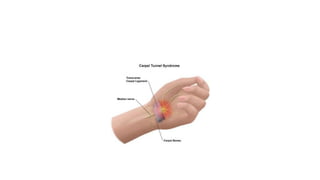
• The most common acquired comprehensive neuropathy of the
median nerve.
• Occurs when one of the major nerves to the hand — the median
nerve — is squeezed or compressed as it travels through the wrist.
4.
Causes of carpaltunnel syndrome?
• Heredity. The carpal tunnel may be naturally smaller in some people, or there may be anatomic
differences that change the amount of space for the nerve — and these traits can run in
families.
• Repeating the same hand and wrist motions or activities over a prolonged period of time may
aggravate the tendons in the wrist, causing swelling that puts pressure on the nerve.
• Hand and wrist position. Doing activities that involve extreme flexion or extension of the hand
and wrist for a prolonged period of time can increase pressure on the nerve.
• Pregnancy. Hormonal changes during pregnancy can cause swelling that results in pressure on
the nerve.
• Health conditions. Diabetes, rheumatoid arthritis, and thyroid gland imbalance are conditions
that are associated with carpal tunnel syndrome.
Physical examination
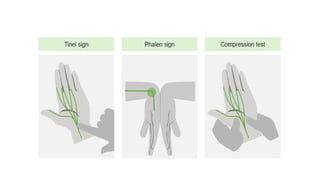
• Tinel’ssign-Press down or tap along the median nerve on
the palm side of your wrist and hand to see if it causes
any tingling into your fingers.
• Phalen sign-Bend and hold your wrists in a flexed
position to test for numbness or tingling in your hands.
• Compression/Durkan’s test- Pressing thumb over the
carpal tunnel and holding pressure for 30 seconds.
• Look for atrophy in the muscles around the base of your
thumb. In severe cases, these muscles may become
visibly smaller
11.
Electrodiagnostic tests
• Nerveconduction studies (NCS). These tests measure the
signals travelling in the nerves of your hand and arm
and can detect when a nerve is not conducting its signal
effectively. Nerve conduction studies can determine how
severe your problem is and help to guide treatment.
• Electromyogram (EMG). An EMG measures the electrical
activity in muscles. EMG results can show whether you
have any nerve or muscle damage.
Non Surgical
• Wristsplinting. A splint that holds the wrist still while you sleep can help relieve nighttime
symptoms of tingling and numbness. Even though you only wear the splint at night, it also can
help prevent daytime symptoms. Nighttime splinting may be a good option if you're pregnant
because it does not involve the use of any medicines to be effective.
• Nonsteroidal anti-inflammatory drugs (NSAIDs). NSAIDs, such as ibuprofen (Advil, Motrin IB,
others), may help relieve pain from carpal tunnel syndrome in the short term.
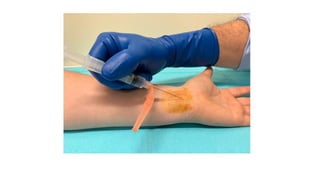
• Corticosteroids. Injecting the carpal tunnel with a corticosteroid medicine such as cortisone to
relieve pain. Sometimes an ultrasound is used to guide these injections. Corticosteroids decrease
inflammation and swelling, which relieves pressure on the median nerve. Oral corticosteroids
aren't considered as effective as corticosteroid injections for treating carpal tunnel syndrome.
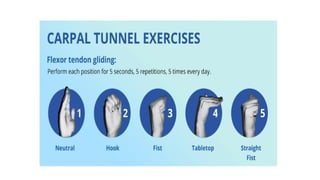
• Physiotherapy. Nerve gliding/stretching exercises