Cloud Services Market Players: In-Depth Analysis
and Competitive Dynamics
The cloud services market has undergone significant transformation over the past
decade, emerging as a cornerstone of modern business operations. As organizations
increasingly depend on cloud solutions for their flexibility, scalability, and cost-efficiency,
the market for cloud services continues its robust growth. This article provides a
detailed analysis of the major players in the cloud services market, their strategic
approaches, and the overall competitive landscape, supported by the latest statistics
and insights.
Market Overview: Cloud Services Landscape
In 2022, the global cloud services market was valued at approximately $445 billion.
Forecasts indicate that by 2026, this figure will soar to $947 billion, driven by a
compound annual growth rate (CAGR) of 20.8%. Several key factors contribute to this
explosive growth, including the escalating demand for remote work solutions, the surge
in big data analytics, and the widespread adoption of cutting-edge technologies like
artificial intelligence (AI) and the Internet of Things (IoT).
Leading Players in the Cloud Services Market
Amazon Web Services (AWS)
Overview: AWS stands as the world's largest cloud service provider, offering a
comprehensive array of services ranging from computing power and storage to machine
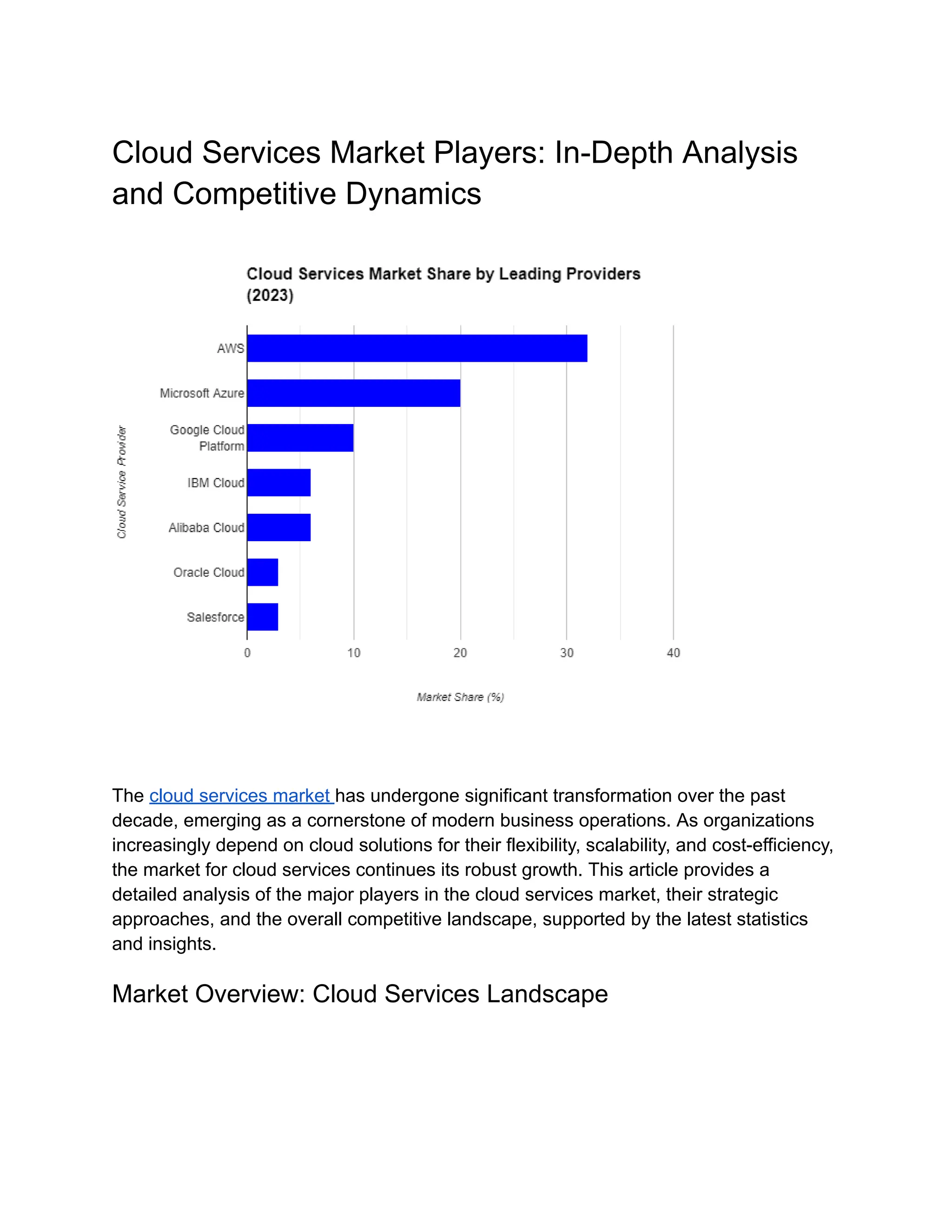
learning capabilities. As of 2023, AWS commands approximately 32% of the global
cloud market share.
Market Strategy: AWS's success is largely attributed to its relentless focus on
innovation. The company frequently introduces new services and features, maintaining
a competitive edge. AWS is also known for its customer-centric approach, offering
extensive documentation, support, and tools to help businesses optimize their cloud
usage.
Microsoft Azure
Overview: Microsoft Azure is a prominent cloud platform offering a broad spectrum of
services, including Infrastructure as a Service (IaaS), Platform as a Service (PaaS), and
Software as a Service (SaaS). Azure has secured a substantial market share of around
20% as of 2023.
Market Strategy: Microsoft capitalizes on its strong brand and established relationships
with enterprise customers to drive Azure adoption. Integration with other Microsoft
products, such as Office 365 and Dynamics 365, creates a seamless user experience,
further enhancing Azure's appeal.
Google Cloud Platform (GCP)
Overview: Google Cloud Platform is recognized for its robust data analytics and
machine learning capabilities. Holding approximately 10% of the market share, GCP is
rapidly expanding its influence in the cloud services arena.
Market Strategy: Google emphasizes innovation and advanced technologies,
particularly in AI and big data. The company offers competitive pricing and flexible
billing options, attracting customers across various industries.
IBM Cloud
Overview: IBM Cloud provides a hybrid cloud platform that integrates public and private
cloud services, focusing on enterprise-grade solutions with an emphasis on security and
compliance.
Market Strategy: IBM leverages its expertise in regulated industries such as
healthcare, finance, and government to differentiate its offerings. The company also
invests in strategic partnerships and collaborations to enhance its service portfolio.
Alibaba Cloud
Overview: As the largest cloud service provider in Asia, Alibaba Cloud is rapidly
expanding its global presence, currently holding about 6% of the global market share.
Market Strategy: Alibaba Cloud's strategy revolves around cost-effective solutions and
strong customer support. The company aims to leverage its extensive e-commerce
ecosystem to drive cloud adoption among businesses in Asia and beyond.
Oracle Cloud
Overview: Oracle Cloud offers a range of services including database management,
applications, and infrastructure. With a market share of around 3%, Oracle is a key
player in the cloud services market.
Market Strategy: Oracle focuses on integrating its cloud services with its existing
enterprise software solutions, providing a comprehensive suite of tools that help
businesses manage their operations more effectively.
Salesforce
Overview: Salesforce, a leader in customer relationship management (CRM) software,
has expanded its portfolio to include cloud-based solutions for sales, marketing, and
service.
Market Strategy: Salesforce prioritizes ease of use and integration capabilities,
allowing businesses to streamline their operations. The company also invests heavily in
AI-driven features to enhance customer engagement and deliver personalized
experiences.
Emerging Trends in the Cloud Services Market
Shift to Multi-Cloud Strategies
A growing number of organizations are adopting multi-cloud strategies to avoid vendor
lock-in and improve operational flexibility. According to recent surveys, 85% of
enterprises have implemented a multi-cloud approach, with 45% using three or more
cloud providers. This trend enables businesses to harness the unique strengths of
different cloud platforms while mitigating risks associated with dependence on a single
provider.
Edge Computing Integration
The convergence of edge computing and cloud services is gaining momentum, enabling
real-time data processing closer to the source. This development is particularly
significant for industries such as healthcare, manufacturing, and transportation, where
low latency and high-speed data processing are crucial.
Heightened Focus on Cloud Security
As organizations increasingly migrate sensitive data to the cloud, the emphasis on cloud
security has intensified. Businesses are investing in advanced security measures—such
as encryption, identity management, and threat detection—to safeguard their data and
ensure regulatory compliance. The global cloud security market is projected to reach
$12 billion by 2026, reflecting a CAGR of 12%.
Proliferation of Cloud-Native Applications
There is a rising demand for cloud-native applications designed to maximize the
benefits of cloud computing. These applications leverage microservices architecture
and containerization, facilitating faster development, deployment, and scalability. A
recent report indicates that 70% of organizations are adopting cloud-native technologies
to streamline their application development processes.
Sustainability Initiatives
With growing environmental concerns, there is increasing demand for sustainable cloud
solutions. Cloud service providers are adopting green practices, such as utilizing
renewable energy sources and optimizing data center efficiency. Companies that
prioritize sustainability are well-positioned to attract eco-conscious customers.
Market Segmentation: Analyzing the Cloud Services Sector
The cloud services market can be segmented based on service type, deployment
model, and geographic region:
By Service Type:
● Infrastructure as a Service (IaaS): Provides on-demand access to computing
resources such as servers, storage, and networking, offering organizations
flexibility and scalability.
● Platform as a Service (PaaS): Offers a platform for developing, testing, and
deploying applications, including tools for building, running, and managing
software applications.
● Software as a Service (SaaS): Delivers software applications over the internet,
eliminating the need for on-premises installation and maintenance.
By Deployment Model:
● Public Cloud: Cloud services provided over the internet by third-party providers
who manage and maintain the underlying infrastructure.
● Private Cloud: Cloud infrastructure dedicated to a single organization, offering
greater control and customization options.
● Hybrid Cloud: A combination of public and private cloud environments, enabling
organizations to leverage the benefits of both.
By Geography:
● North America: Currently holds the largest market share due to the presence of
major cloud service providers and early adoption of cloud technologies.
● Europe: Maintains a significant market presence, with a focus on data privacy
and regulatory compliance.
● Asia-Pacific: Expected to experience the highest growth rate, driven by
increasing cloud adoption in industries such as retail, healthcare, and financial
services.
Challenges in the Cloud Services Market
Despite the promising growth trajectory, the cloud services market faces several
challenges:
Data Privacy and Security Concerns
As organizations increasingly store and process sensitive data in the cloud, concerns
about data privacy and security remain prevalent. Cloud service providers must
implement robust security measures and comply with industry regulations to build and
maintain customer trust.
Skill Shortage
The rapid growth of the cloud services market has led to a significant shortage of
qualified professionals with cloud-related skills. Organizations need to invest in training
and upskilling their workforce to effectively leverage cloud technologies and maintain a
competitive edge.
Vendor Lock-in
Relying on a single cloud service provider can lead to vendor lock-in, making it
challenging for organizations to switch providers or adopt a multi-cloud strategy. To
mitigate this risk, cloud service providers must offer flexibility and interoperability within
their platforms.
Future Outlook: The Path Ahead for Cloud Services
The future of the cloud services market appears bright, with several key trends
expected to shape its evolution:
Continued Expansion of Cloud Adoption
As more organizations recognize the benefits of cloud computing, adoption rates are
expected to continue rising. Cloud services will become increasingly essential for
businesses of all sizes and across various industries.
Advancements in Edge Computing and 5G
The integration of edge computing with 5G technology is poised to enable faster data
processing and real-time decision-making at the edge. This development will drive the
growth of cloud services in industries such as healthcare, manufacturing, and
transportation.
Increased Focus on Sustainability
With rising environmental concerns, there will be a stronger emphasis on the
sustainability of cloud infrastructure. Cloud service providers that prioritize energy
efficiency and renewable energy sources are likely to attract a growing base of
eco-conscious customers.
Expansion into Emerging Markets
As disposable incomes rise and internet penetration increases in emerging markets,
cloud service providers have significant opportunities to expand their presence in these
regions. By capitalizing on the growing demand for cloud-based solutions, they can
secure a foothold in these burgeoning markets.
Conclusion
The cloud services market is on track for substantial growth, driven by the increasing
adoption of cloud computing technologies across various industries. With a projected
market size of $947 billion by 2026, the industry presents numerous opportunities for
stakeholders, including cloud service providers, system integrators, and end-users. Key
players in the market are focusing on innovation, security, and customer engagement to
thrive in this dynamic environment. As the industry continues to evolve, ongoing trends
such as multi-cloud strategies, edge computing, and cloud-native applications will
further shape the future of the cloud services market, enhancing the overall user
experience and driving digital transformation across industries worldwide.

Cloud Services Market Players: In-Depth Analysis and Competitive Dynamics

  • 1.
    Cloud Services MarketPlayers: In-Depth Analysis and Competitive Dynamics The cloud services market has undergone significant transformation over the past decade, emerging as a cornerstone of modern business operations. As organizations increasingly depend on cloud solutions for their flexibility, scalability, and cost-efficiency, the market for cloud services continues its robust growth. This article provides a detailed analysis of the major players in the cloud services market, their strategic approaches, and the overall competitive landscape, supported by the latest statistics and insights. Market Overview: Cloud Services Landscape
  • 2.
    In 2022, theglobal cloud services market was valued at approximately $445 billion. Forecasts indicate that by 2026, this figure will soar to $947 billion, driven by a compound annual growth rate (CAGR) of 20.8%. Several key factors contribute to this explosive growth, including the escalating demand for remote work solutions, the surge in big data analytics, and the widespread adoption of cutting-edge technologies like artificial intelligence (AI) and the Internet of Things (IoT). Leading Players in the Cloud Services Market Amazon Web Services (AWS) Overview: AWS stands as the world's largest cloud service provider, offering a comprehensive array of services ranging from computing power and storage to machine learning capabilities. As of 2023, AWS commands approximately 32% of the global cloud market share. Market Strategy: AWS's success is largely attributed to its relentless focus on innovation. The company frequently introduces new services and features, maintaining a competitive edge. AWS is also known for its customer-centric approach, offering extensive documentation, support, and tools to help businesses optimize their cloud usage. Microsoft Azure
  • 3.
    Overview: Microsoft Azureis a prominent cloud platform offering a broad spectrum of services, including Infrastructure as a Service (IaaS), Platform as a Service (PaaS), and Software as a Service (SaaS). Azure has secured a substantial market share of around 20% as of 2023. Market Strategy: Microsoft capitalizes on its strong brand and established relationships with enterprise customers to drive Azure adoption. Integration with other Microsoft products, such as Office 365 and Dynamics 365, creates a seamless user experience, further enhancing Azure's appeal. Google Cloud Platform (GCP) Overview: Google Cloud Platform is recognized for its robust data analytics and machine learning capabilities. Holding approximately 10% of the market share, GCP is rapidly expanding its influence in the cloud services arena. Market Strategy: Google emphasizes innovation and advanced technologies, particularly in AI and big data. The company offers competitive pricing and flexible billing options, attracting customers across various industries. IBM Cloud Overview: IBM Cloud provides a hybrid cloud platform that integrates public and private cloud services, focusing on enterprise-grade solutions with an emphasis on security and compliance. Market Strategy: IBM leverages its expertise in regulated industries such as healthcare, finance, and government to differentiate its offerings. The company also invests in strategic partnerships and collaborations to enhance its service portfolio. Alibaba Cloud Overview: As the largest cloud service provider in Asia, Alibaba Cloud is rapidly expanding its global presence, currently holding about 6% of the global market share. Market Strategy: Alibaba Cloud's strategy revolves around cost-effective solutions and strong customer support. The company aims to leverage its extensive e-commerce ecosystem to drive cloud adoption among businesses in Asia and beyond. Oracle Cloud
  • 4.
    Overview: Oracle Cloudoffers a range of services including database management, applications, and infrastructure. With a market share of around 3%, Oracle is a key player in the cloud services market. Market Strategy: Oracle focuses on integrating its cloud services with its existing enterprise software solutions, providing a comprehensive suite of tools that help businesses manage their operations more effectively. Salesforce Overview: Salesforce, a leader in customer relationship management (CRM) software, has expanded its portfolio to include cloud-based solutions for sales, marketing, and service. Market Strategy: Salesforce prioritizes ease of use and integration capabilities, allowing businesses to streamline their operations. The company also invests heavily in AI-driven features to enhance customer engagement and deliver personalized experiences. Emerging Trends in the Cloud Services Market Shift to Multi-Cloud Strategies A growing number of organizations are adopting multi-cloud strategies to avoid vendor lock-in and improve operational flexibility. According to recent surveys, 85% of enterprises have implemented a multi-cloud approach, with 45% using three or more cloud providers. This trend enables businesses to harness the unique strengths of different cloud platforms while mitigating risks associated with dependence on a single provider. Edge Computing Integration The convergence of edge computing and cloud services is gaining momentum, enabling real-time data processing closer to the source. This development is particularly significant for industries such as healthcare, manufacturing, and transportation, where low latency and high-speed data processing are crucial. Heightened Focus on Cloud Security As organizations increasingly migrate sensitive data to the cloud, the emphasis on cloud security has intensified. Businesses are investing in advanced security measures—such as encryption, identity management, and threat detection—to safeguard their data and
  • 5.
    ensure regulatory compliance.The global cloud security market is projected to reach $12 billion by 2026, reflecting a CAGR of 12%. Proliferation of Cloud-Native Applications There is a rising demand for cloud-native applications designed to maximize the benefits of cloud computing. These applications leverage microservices architecture and containerization, facilitating faster development, deployment, and scalability. A recent report indicates that 70% of organizations are adopting cloud-native technologies to streamline their application development processes. Sustainability Initiatives With growing environmental concerns, there is increasing demand for sustainable cloud solutions. Cloud service providers are adopting green practices, such as utilizing renewable energy sources and optimizing data center efficiency. Companies that prioritize sustainability are well-positioned to attract eco-conscious customers. Market Segmentation: Analyzing the Cloud Services Sector The cloud services market can be segmented based on service type, deployment model, and geographic region: By Service Type: ● Infrastructure as a Service (IaaS): Provides on-demand access to computing resources such as servers, storage, and networking, offering organizations flexibility and scalability. ● Platform as a Service (PaaS): Offers a platform for developing, testing, and deploying applications, including tools for building, running, and managing software applications. ● Software as a Service (SaaS): Delivers software applications over the internet, eliminating the need for on-premises installation and maintenance. By Deployment Model: ● Public Cloud: Cloud services provided over the internet by third-party providers who manage and maintain the underlying infrastructure. ● Private Cloud: Cloud infrastructure dedicated to a single organization, offering greater control and customization options. ● Hybrid Cloud: A combination of public and private cloud environments, enabling organizations to leverage the benefits of both.
  • 6.
    By Geography: ● NorthAmerica: Currently holds the largest market share due to the presence of major cloud service providers and early adoption of cloud technologies. ● Europe: Maintains a significant market presence, with a focus on data privacy and regulatory compliance. ● Asia-Pacific: Expected to experience the highest growth rate, driven by increasing cloud adoption in industries such as retail, healthcare, and financial services. Challenges in the Cloud Services Market Despite the promising growth trajectory, the cloud services market faces several challenges: Data Privacy and Security Concerns As organizations increasingly store and process sensitive data in the cloud, concerns about data privacy and security remain prevalent. Cloud service providers must implement robust security measures and comply with industry regulations to build and maintain customer trust. Skill Shortage The rapid growth of the cloud services market has led to a significant shortage of qualified professionals with cloud-related skills. Organizations need to invest in training and upskilling their workforce to effectively leverage cloud technologies and maintain a competitive edge. Vendor Lock-in Relying on a single cloud service provider can lead to vendor lock-in, making it challenging for organizations to switch providers or adopt a multi-cloud strategy. To mitigate this risk, cloud service providers must offer flexibility and interoperability within their platforms. Future Outlook: The Path Ahead for Cloud Services The future of the cloud services market appears bright, with several key trends expected to shape its evolution: Continued Expansion of Cloud Adoption
  • 7.
    As more organizationsrecognize the benefits of cloud computing, adoption rates are expected to continue rising. Cloud services will become increasingly essential for businesses of all sizes and across various industries. Advancements in Edge Computing and 5G The integration of edge computing with 5G technology is poised to enable faster data processing and real-time decision-making at the edge. This development will drive the growth of cloud services in industries such as healthcare, manufacturing, and transportation. Increased Focus on Sustainability With rising environmental concerns, there will be a stronger emphasis on the sustainability of cloud infrastructure. Cloud service providers that prioritize energy efficiency and renewable energy sources are likely to attract a growing base of eco-conscious customers. Expansion into Emerging Markets As disposable incomes rise and internet penetration increases in emerging markets, cloud service providers have significant opportunities to expand their presence in these regions. By capitalizing on the growing demand for cloud-based solutions, they can secure a foothold in these burgeoning markets. Conclusion The cloud services market is on track for substantial growth, driven by the increasing adoption of cloud computing technologies across various industries. With a projected market size of $947 billion by 2026, the industry presents numerous opportunities for stakeholders, including cloud service providers, system integrators, and end-users. Key players in the market are focusing on innovation, security, and customer engagement to thrive in this dynamic environment. As the industry continues to evolve, ongoing trends such as multi-cloud strategies, edge computing, and cloud-native applications will further shape the future of the cloud services market, enhancing the overall user experience and driving digital transformation across industries worldwide.