Cloud or On Premise
Chris Kernaghan
Principal Consultant
Types of Cloud
2
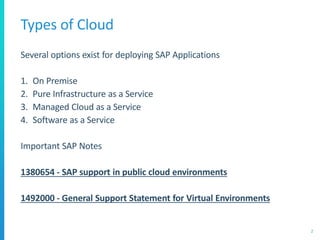
Several options exist for deploying SAP Applications
1. On Premise
2. Pure Infrastructure as a Service
3. Managed Cloud as a Service
4. Software as a Service
Important SAP Notes
1380654 - SAP support in public cloud environments
1492000 - General Support Statement for Virtual Environments
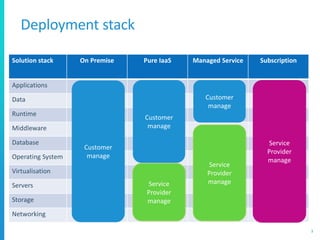
Deployment stack
3
Solution stack On Premise Pure IaaS Managed Service Subscription
Applications
Data
Runtime
Middleware
Database
Operating System
Virtualisation
Servers
Storage
Networking
Customer
manage
Service
Provider
manage
Customer
manage
Service
Provider
manage
Customer
manage
Service
Provider
manage
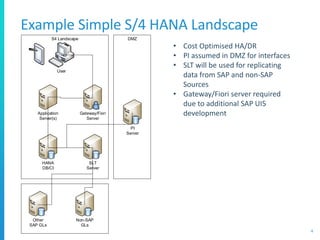
Example Simple S/4 HANA Landscape
4
S4 Landscape DMZ
HANA
DB/CI
Application
Server(s)
Gateway/Fiori
Server
SLT
Server
PI
Server
User
Other
SAP GLs
Non-SAP
GLs
• Cost Optimised HA/DR
• PI assumed in DMZ for interfaces
• SLT will be used for replicating
data from SAP and non-SAP
Sources
• Gateway/Fiori server required
due to additional SAP UI5
development
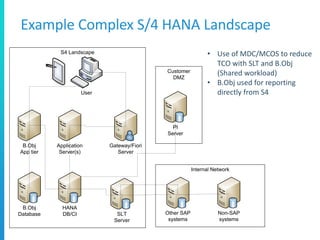
Example Complex S/4 HANA Landscape
S4 Landscape
HANA
DB/CI
Application
Server(s)
Gateway/Fiori
Server
SLT
Server
User
Internal Network
Other SAP
systems
Non-SAP
systems
B.Obj
App tier
B.Obj
Database
Customer
DMZ
PI
Server
• Use of MDC/MCOS to reduce
TCO with SLT and B.Obj
(Shared workload)
• B.Obj used for reporting
directly from S4
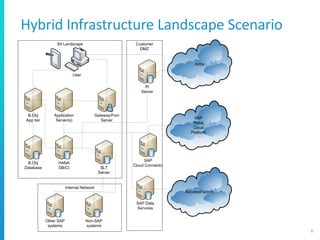
Hybrid Infrastructure Landscape Scenario
6
SuccessFactors
Ariba
SAP
Hana
Cloud
Platform
S4 Landscape Customer
DMZ
HANA
DB/CI
Application
Server(s)
Gateway/Fiori
Server
SLT
Server
PI
Server
User
Internal Network
Other SAP
systems
Non-SAP
systems
SAP
Cloud Connector
SAP Data
Services
B.Obj
App tier
B.Obj
Database
Commercial and contractual items
7
Services
• Migration services – how will the provider help you to migrate to their service
• Monitoring and alerting – what exactly is monitored and how does that create
action
• Full RACI of items – what exactly does the service provide (See Roles and
Responsibilities matrix from SAP HEC)
Business Continuity
• Business Continuity services (including DR testing) – what services does the
provider have and how does DR work
• Provider certifications – make sure the provider meets your certification
requirements
• DNS operation – who controls the DNS addressing
• Backup retention periods – does the provider meet your regulatory requirements
Interaction details
• Clear billing details
• Customer interaction – how does the provider interact with the customer
• Service interaction – how does the client interact with the service to determine
operations are optimal
• Service Desk integration – how can you track calls and SLAs
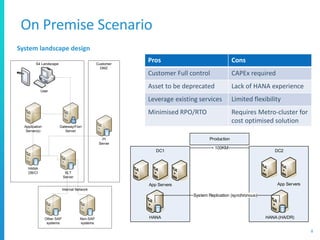
On Premise Scenario
8
System landscape design
Pros Cons
Customer Full control CAPEx required
Asset to be deprecated Lack of HANA experience
Leverage existing services Limited flexibility
Minimised RPO/RTO Requires Metro-cluster for
cost optimised solution
DC2DC1
HANA HANA (HA/DR)
< 100KM
System Replication (synchronous)
Production
App Servers App Servers
S4 Landscape Customer
DMZ
HANA
DB/CI
Application
Server(s)
Gateway/Fiori
Server
SLT
Server
PI
Server
User
Internal Network
Other SAP
systems
Non-SAP
systems
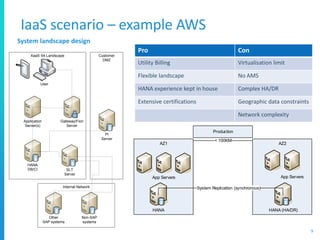
IaaS scenario – example AWS
99
System landscape design
Pro Con
Utility Billing Virtualisation limit
Flexible landscape No AMS
HANA experience kept in house Complex HA/DR
Extensive certifications Geographic data constraints
Network complexity
AZ2AZ1
HANA HANA (HA/DR)
< 100KM
System Replication (synchronous)
Production
App Servers App Servers
XaaS S4 Landscape Customer
DMZ
HANA
DB/CI
Application
Server(s)
Gateway/Fiori
Server
SLT
Server
PI
Server
User
Internal Network
Other
SAP systems
Non-SAP
systems
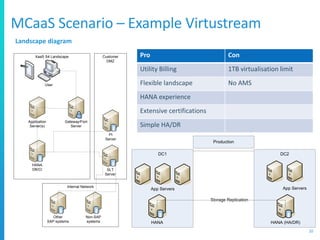
MCaaS Scenario – Example Virtustream
10
Landscape diagram
Pro Con
Utility Billing 1TB virtualisation limit
Flexible landscape No AMS
HANA experience
Extensive certifications
Simple HA/DR
XaaS S4 Landscape Customer
DMZ
HANA
DB/CI
Application
Server(s)
Gateway/Fiori
Server
SLT
Server
PI
Server
User
Internal Network
Other
SAP systems
Non-SAP
systems
DC2DC1
HANA HANA (HA/DR)
Storage Replication
Production
App Servers App Servers
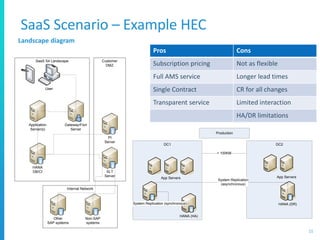
SaaS Scenario – Example HEC
11
Landscape diagram
Pros Cons
Subscription pricing Not as flexible
Full AMS service Longer lead times
Single Contract CR for all changes
Transparent service Limited interaction
HA/DR limitations
SaaS S4 Landscape Customer
DMZ
HANA
DB/CI
Application
Server(s)
Gateway/Fiori
Server
SLT
Server
PI
Server
User
Internal Network
Other
SAP systems
Non-SAP
systems
DC2DC1
HANA HANA (DR)
HANA (HA)
> 100KM
System Replication
(asynchronous)
System Replication (synchronous)
App Servers App Servers
Production
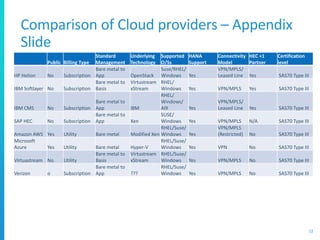
Comparison of Cloud providers – Appendix
Slide
12
Public Billing Type
Standard
Management
Underlying
Technology
Supported
O/Ss
HANA
Support
Connectivity
Model
HEC +1
Partner
Certification
level
HP Helion No Subscription
Bare metal to
App OpenStack
Suse/RHEL/
Windows Yes
VPN/MPLS/
Leased Line Yes SAS70 Type III
IBM Softlayer No Subscription
Bare metal to
Basis
Virtustream
xStream
RHEL/
Windows Yes VPN/MPLS Yes SAS70 Type III
IBM CMS No Subscription
Bare metal to
App IBM
RHEL/
Windows/
AIX Yes
VPN/MPLS/
Leased Line Yes SAS70 Type III
SAP HEC No Subscription
Bare metal to
App Xen
SUSE/
Windows Yes VPN/MPLS N/A SAS70 Type III
Amazon AWS Yes Utility Bare metal Modified Xen
RHEL/Suse/
Windows Yes
VPN/MPLS
(Restricted) No SAS70 Type III
Microsoft
Azure Yes Utility Bare metal Hyper-V
RHEL/Suse/
Windows Yes VPN No SAS70 Type III
Virtuastream No Utility
Bare metal to
Basis
Virtustream
xStream
RHEL/Suse/
Windows Yes VPN/MPLS No SAS70 Type III
Verizon o Subscription
Bare metal to
App ???
RHEL/Suse/
Windows Yes VPN/MPLS No SAS70 Type III

Cloud or On Premise

  • 1.
    Cloud or OnPremise Chris Kernaghan Principal Consultant
  • 2.
    Types of Cloud 2 Severaloptions exist for deploying SAP Applications 1. On Premise 2. Pure Infrastructure as a Service 3. Managed Cloud as a Service 4. Software as a Service Important SAP Notes 1380654 - SAP support in public cloud environments 1492000 - General Support Statement for Virtual Environments
  • 3.
    Deployment stack 3 Solution stackOn Premise Pure IaaS Managed Service Subscription Applications Data Runtime Middleware Database Operating System Virtualisation Servers Storage Networking Customer manage Service Provider manage Customer manage Service Provider manage Customer manage Service Provider manage
  • 4.
    Example Simple S/4HANA Landscape 4 S4 Landscape DMZ HANA DB/CI Application Server(s) Gateway/Fiori Server SLT Server PI Server User Other SAP GLs Non-SAP GLs • Cost Optimised HA/DR • PI assumed in DMZ for interfaces • SLT will be used for replicating data from SAP and non-SAP Sources • Gateway/Fiori server required due to additional SAP UI5 development
  • 5.
    Example Complex S/4HANA Landscape S4 Landscape HANA DB/CI Application Server(s) Gateway/Fiori Server SLT Server User Internal Network Other SAP systems Non-SAP systems B.Obj App tier B.Obj Database Customer DMZ PI Server • Use of MDC/MCOS to reduce TCO with SLT and B.Obj (Shared workload) • B.Obj used for reporting directly from S4
  • 6.
    Hybrid Infrastructure LandscapeScenario 6 SuccessFactors Ariba SAP Hana Cloud Platform S4 Landscape Customer DMZ HANA DB/CI Application Server(s) Gateway/Fiori Server SLT Server PI Server User Internal Network Other SAP systems Non-SAP systems SAP Cloud Connector SAP Data Services B.Obj App tier B.Obj Database
  • 7.
    Commercial and contractualitems 7 Services • Migration services – how will the provider help you to migrate to their service • Monitoring and alerting – what exactly is monitored and how does that create action • Full RACI of items – what exactly does the service provide (See Roles and Responsibilities matrix from SAP HEC) Business Continuity • Business Continuity services (including DR testing) – what services does the provider have and how does DR work • Provider certifications – make sure the provider meets your certification requirements • DNS operation – who controls the DNS addressing • Backup retention periods – does the provider meet your regulatory requirements Interaction details • Clear billing details • Customer interaction – how does the provider interact with the customer • Service interaction – how does the client interact with the service to determine operations are optimal • Service Desk integration – how can you track calls and SLAs
  • 8.
    On Premise Scenario 8 Systemlandscape design Pros Cons Customer Full control CAPEx required Asset to be deprecated Lack of HANA experience Leverage existing services Limited flexibility Minimised RPO/RTO Requires Metro-cluster for cost optimised solution DC2DC1 HANA HANA (HA/DR) < 100KM System Replication (synchronous) Production App Servers App Servers S4 Landscape Customer DMZ HANA DB/CI Application Server(s) Gateway/Fiori Server SLT Server PI Server User Internal Network Other SAP systems Non-SAP systems
  • 9.
    IaaS scenario –example AWS 99 System landscape design Pro Con Utility Billing Virtualisation limit Flexible landscape No AMS HANA experience kept in house Complex HA/DR Extensive certifications Geographic data constraints Network complexity AZ2AZ1 HANA HANA (HA/DR) < 100KM System Replication (synchronous) Production App Servers App Servers XaaS S4 Landscape Customer DMZ HANA DB/CI Application Server(s) Gateway/Fiori Server SLT Server PI Server User Internal Network Other SAP systems Non-SAP systems
  • 10.
    MCaaS Scenario –Example Virtustream 10 Landscape diagram Pro Con Utility Billing 1TB virtualisation limit Flexible landscape No AMS HANA experience Extensive certifications Simple HA/DR XaaS S4 Landscape Customer DMZ HANA DB/CI Application Server(s) Gateway/Fiori Server SLT Server PI Server User Internal Network Other SAP systems Non-SAP systems DC2DC1 HANA HANA (HA/DR) Storage Replication Production App Servers App Servers
  • 11.
    SaaS Scenario –Example HEC 11 Landscape diagram Pros Cons Subscription pricing Not as flexible Full AMS service Longer lead times Single Contract CR for all changes Transparent service Limited interaction HA/DR limitations SaaS S4 Landscape Customer DMZ HANA DB/CI Application Server(s) Gateway/Fiori Server SLT Server PI Server User Internal Network Other SAP systems Non-SAP systems DC2DC1 HANA HANA (DR) HANA (HA) > 100KM System Replication (asynchronous) System Replication (synchronous) App Servers App Servers Production
  • 12.
    Comparison of Cloudproviders – Appendix Slide 12 Public Billing Type Standard Management Underlying Technology Supported O/Ss HANA Support Connectivity Model HEC +1 Partner Certification level HP Helion No Subscription Bare metal to App OpenStack Suse/RHEL/ Windows Yes VPN/MPLS/ Leased Line Yes SAS70 Type III IBM Softlayer No Subscription Bare metal to Basis Virtustream xStream RHEL/ Windows Yes VPN/MPLS Yes SAS70 Type III IBM CMS No Subscription Bare metal to App IBM RHEL/ Windows/ AIX Yes VPN/MPLS/ Leased Line Yes SAS70 Type III SAP HEC No Subscription Bare metal to App Xen SUSE/ Windows Yes VPN/MPLS N/A SAS70 Type III Amazon AWS Yes Utility Bare metal Modified Xen RHEL/Suse/ Windows Yes VPN/MPLS (Restricted) No SAS70 Type III Microsoft Azure Yes Utility Bare metal Hyper-V RHEL/Suse/ Windows Yes VPN No SAS70 Type III Virtuastream No Utility Bare metal to Basis Virtustream xStream RHEL/Suse/ Windows Yes VPN/MPLS No SAS70 Type III Verizon o Subscription Bare metal to App ??? RHEL/Suse/ Windows Yes VPN/MPLS No SAS70 Type III