CLOUD INTEROPERABILITYCLOUD INTEROPERABILITY
ANDAND
IT’S STANDARDSIT’S STANDARDS
What is Interoperability?What is Interoperability?
 The ability of IT systems, as well as the business processes they
support, to exchange data and enable the sharing of information and
knowledge – UK Govt definition
 Interoperability means enabling the Cloud ecosystem so that multiple
cloud platforms can exchange information
 Interoperability means being able to seamlessly exchange data at
different layers between cloud service providers
 Interoperability is the capability of two systems understanding each
others’ intents in exchange of communications
 Interoperability is an enabler for interchange ability (replacement of
one element with another)
 Interoperability is the goal of standards but standards do not
guarantee interoperability
 You can achieve interoperability without standards
2
What is InteroperabilityWhat is Interoperability
Interoperability is an enabler for portability (at some
level interoperability is portability)
◦ Portability refers to the ability to port the layer above
◦ Paas portability is needed when moving apps
Interoperability refers to provisioning within the
layer itself – Saas-to-Saas interoperability occurs
between apps
Why is interoperability different in a cloud
ecosystem compared to normal software
development?
Motivations for interoperability:
◦ 1. To increase customer choice, competition and innovation
◦ 2. To allow more players in the market
3
Policy Objectives (background information)Policy Objectives (background information)
Right to move applications between Cloud providers
Right to port data (quickly) between Cloud providers
Right of user to own their data
Keep overhead of certification and compliance to a
minimum
Apply open access/open source policies that allow
extension of APIs and specs
Demand side: Interoperability between Cloud
services from different providers to prevent vendor
lock-in
Open and flexible market to provide choice for
consumers
Transparency and technology neutrality
4
Functional scopeFunctional scope
 Interoperability within the context of Cloud Computing
means enabling the Cloud Computing Ecosystem whereby
individuals and organizations are able to widely adopt Cloud
Computing technology and related services in such a fashion
that multiple Cloud platforms can exchange information in a
unified manor and ultimately work together seamlessly.
 Examples of such interoperability are e.g. solutions running
on multiple disparate Cloud instances and use of resources
in other heterogeneous Cloud instances.
 To realize this desired Interoperability, standards are
required at all levels, e.g. infrastructure, platform, application,
service, data and management.
5
Use Cases (1)Use Cases (1)
 User of one Cloud accessing storage in another Cloud (to provide elastic
storage)
 Applications and services running on (and communicating between)
heterogeneous cloud platforms
 Application using resources (CPU, storage) in another heterogeneous cloud
platform (resource bursting)
 Resource sharing across different time zones
 Demonstration of data portability (across Service Providers)
 What is needed to transfer a running STATEFULL service from Cloud
Provider A to B?
◦ Moving a file sharing service between Cloud providers
◦ Moving a streaming service between Cloud providers
6
Use CasesUse Cases
B2B (or Govt) procurement from Buyer Cloud vs.
Supplier Cloud
End customer (SME) going through broker (IT
Provider) to Cloud
Move of on-premise server to/from public, private or
hybrid Cloud
Multi-operator or multi-service provider
conferencing
Demonstration of need for integration/federation of
Clouds
Demonstration of use of Trans-National / Trans-
Regional Clouds
VM Govt (G-Cloud) – universal service for Govt staff
7
Use Case: User AccessUse Case: User Access
8
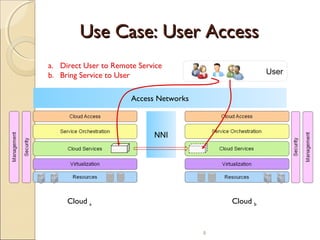
Cloud a Cloud b
User
Access Networks
NNI
a. Direct User to Remote Service
b. Bring Service to User

Cloud interoperability

  • 1.
  • 2.
    What is Interoperability?Whatis Interoperability?  The ability of IT systems, as well as the business processes they support, to exchange data and enable the sharing of information and knowledge – UK Govt definition  Interoperability means enabling the Cloud ecosystem so that multiple cloud platforms can exchange information  Interoperability means being able to seamlessly exchange data at different layers between cloud service providers  Interoperability is the capability of two systems understanding each others’ intents in exchange of communications  Interoperability is an enabler for interchange ability (replacement of one element with another)  Interoperability is the goal of standards but standards do not guarantee interoperability  You can achieve interoperability without standards 2
  • 3.
    What is InteroperabilityWhatis Interoperability Interoperability is an enabler for portability (at some level interoperability is portability) ◦ Portability refers to the ability to port the layer above ◦ Paas portability is needed when moving apps Interoperability refers to provisioning within the layer itself – Saas-to-Saas interoperability occurs between apps Why is interoperability different in a cloud ecosystem compared to normal software development? Motivations for interoperability: ◦ 1. To increase customer choice, competition and innovation ◦ 2. To allow more players in the market 3
  • 4.
    Policy Objectives (backgroundinformation)Policy Objectives (background information) Right to move applications between Cloud providers Right to port data (quickly) between Cloud providers Right of user to own their data Keep overhead of certification and compliance to a minimum Apply open access/open source policies that allow extension of APIs and specs Demand side: Interoperability between Cloud services from different providers to prevent vendor lock-in Open and flexible market to provide choice for consumers Transparency and technology neutrality 4
  • 5.
    Functional scopeFunctional scope Interoperability within the context of Cloud Computing means enabling the Cloud Computing Ecosystem whereby individuals and organizations are able to widely adopt Cloud Computing technology and related services in such a fashion that multiple Cloud platforms can exchange information in a unified manor and ultimately work together seamlessly.  Examples of such interoperability are e.g. solutions running on multiple disparate Cloud instances and use of resources in other heterogeneous Cloud instances.  To realize this desired Interoperability, standards are required at all levels, e.g. infrastructure, platform, application, service, data and management. 5
  • 6.
    Use Cases (1)UseCases (1)  User of one Cloud accessing storage in another Cloud (to provide elastic storage)  Applications and services running on (and communicating between) heterogeneous cloud platforms  Application using resources (CPU, storage) in another heterogeneous cloud platform (resource bursting)  Resource sharing across different time zones  Demonstration of data portability (across Service Providers)  What is needed to transfer a running STATEFULL service from Cloud Provider A to B? ◦ Moving a file sharing service between Cloud providers ◦ Moving a streaming service between Cloud providers 6
  • 7.
    Use CasesUse Cases B2B(or Govt) procurement from Buyer Cloud vs. Supplier Cloud End customer (SME) going through broker (IT Provider) to Cloud Move of on-premise server to/from public, private or hybrid Cloud Multi-operator or multi-service provider conferencing Demonstration of need for integration/federation of Clouds Demonstration of use of Trans-National / Trans- Regional Clouds VM Govt (G-Cloud) – universal service for Govt staff 7
  • 8.
    Use Case: UserAccessUse Case: User Access 8 Cloud a Cloud b User Access Networks NNI a. Direct User to Remote Service b. Bring Service to User