Cloud Computing
Standardization

    Seungyun Lee, Ph.D
       <syl@etri.re.kr>
Everything on the
    Clouds ?
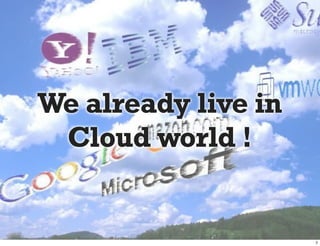
We already live in
 Cloud world !
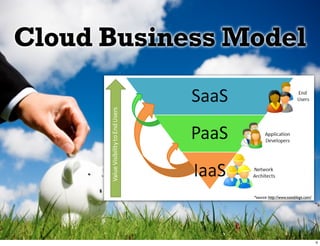
Cloud Business Model


                *source: http://www.saasblogs.com/
Cloud Business Model

      New business opportunity
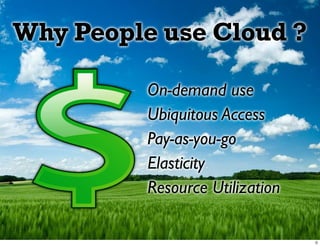
Why People use Cloud ?

          On-demand use
          Ubiquitous Access
          Pay-as-you-go
          Elasticity
          Resource Utilization
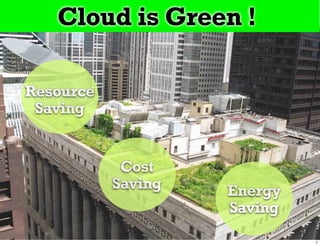
Cloud is Green !

Resource
 Saving


            Cost
           Saving   Energy
                    Saving
Does Cloud always Goodness ?
What’s the problem?
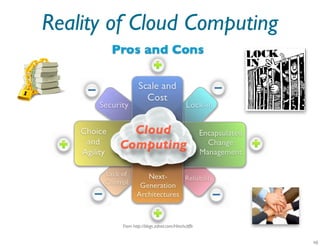
Reality of Cloud Computing
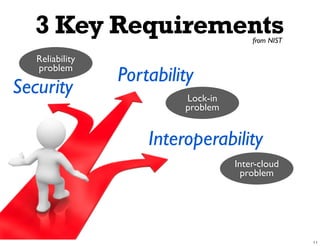
3 Key Requirements                   from NIST

   Reliability
   problem
                 Portability
Security                  Lock-in
                          problem


                     Interoperability
                                    Inter-cloud
                                      problem
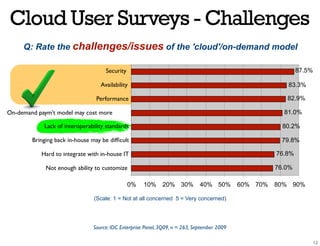
Cloud User Surveys - Challenges
     Q: Rate the challenges/issues of the 'cloud'/on-demand model

                                     Security                                                                   87.5%

                                   Availability                                                            83.3%

                                 Performance                                                               82.9%

On-demand paym’t model may cost more                                                                      81.0%

            Lack of interoperability standards                                                            80.2%

        Bringing back in-house may be difficult                                                           79.8%

           Hard to integrate with in-house IT                                                           76.8%

             Not enough ability to customize                                                            76.0%

                                                0%    10%     20% 30%          40% 50%        60% 70%   80% 90%

                                (Scale: 1 = Not at all concerned 5 = Very concerned)


                                Source: IDC Enterprise Panel, 3Q09, n = 263, September 2009
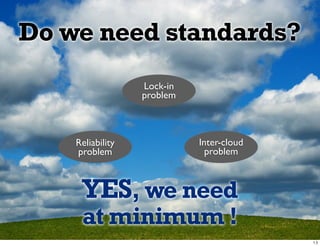
Do we need standards?
                  Lock-in
                  problem


    Reliability             Inter-cloud
    problem                   problem


     YES, we need
     at minimum !
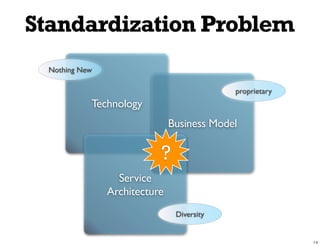
Standardization Problem
  Nothing New

                                            proprietary
            Technology
                               Business Model

                           ?
                  Service
                Architecture
                                Diversity
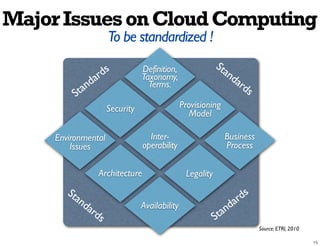
Major Issues on Cloud Computing
                     To be standardized !
                                                           St
                  ds            Definition,                     an
                ar              Taxonomy,                          da
            tand                  Terms.                             rd
                                                                       s
          S
                     Security                  Provisioning
                                                 Model

     Environmental                Inter-                        Business
         Issues                 operability                     Process

                 Architecture                   Legality
        St                                                         ds
          an                                                     ar
             da                 Availability                   nd
               rd                                            ta
                 s                                         S
                                                                           Source: ETRI, 2010
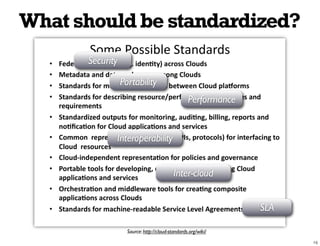
What should be standardized?
      Security

                 Portability
                                                 Performance


             Interoperability


                                          Inter-cloud


                                                               SLA

                   Source: http://cloud-standards.org/wiki/
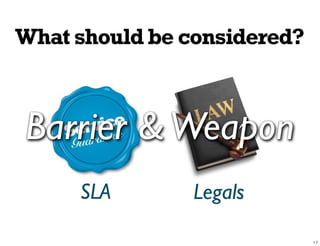
What should be considered?


Barrier & Weapon
     SLA        Legals
JTC1


            JTC1


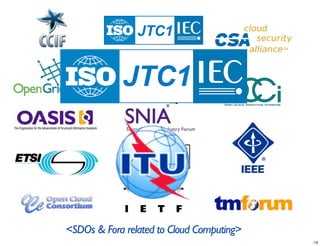
<SDOs & Fora related to Cloud Computing>
JTC1

     ISO/IEC JTC 1 SC38 / SGCC
Title:! Distributed Application Platforms and Services (DAPS)
Scope:!Standardization for interoperable Distributed Application
Platform and services including:
•! Web Services, Service Oriented Architecture (SOA), and
•! Cloud Computing.

As per the JTC 1 Directives, SC 38 establishes its own substructure at
its first meeting in Beijing China, May 2010
 •   Web Service WG
 •   Service Oriented Architecture (SOA) WG
 •   Cloud Computing SG
JTC1

           ISO/IEC JTC 1 SC38 / SGCC
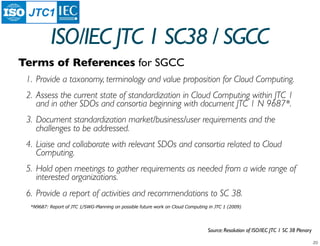
Terms of References for SGCC
 1. Provide a taxonomy, terminology and value proposition for Cloud Computing.
 2. Assess the current state of standardization in Cloud Computing within JTC 1
    and in other SDOs and consortia beginning with document JTC 1 N 9687*.
 3. Document standardization market/business/user requirements and the
    challenges to be addressed.
 4. Liaise and collaborate with relevant SDOs and consortia related to Cloud
    Computing.
 5. Hold open meetings to gather requirements as needed from a wide range of
    interested organizations.
 6. Provide a report of activities and recommendations to SC 38.
  *N9687: Report of JTC 1/SWG-Planning on possible future work on Cloud Computing in JTC 1 (2009)


                                                                                 Source: Resolution of ISO/IEC JTC 1 SC 38 Plenary
JTC1

        ISO/IEC JTC 1 SC38 / SGCC
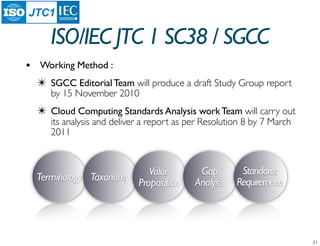
•   Working Method :
    !   SGCC Editorial Team will produce a draft Study Group report
        by 15 November 2010
    !   Cloud Computing Standards Analysis work Team will carry out
        its analysis and deliver a report as per Resolution 8 by 7 March
        2011


                            Value             Gap        Standards
    Terminology Taxonomy                     Analysis   Requirements
                         Proposition
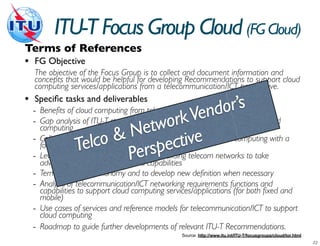
ITU-T Focus Group Cloud (FG Cloud)
Terms of References
• FG Objective
    The objective of the Focus Group is to collect and document information and
    concepts that would be helpful for developing Recommendations to support cloud
    computing services/applications from a telecommunication/ICT perspective.
•   Specific tasks and deliverables
                                                                  r’s
                                                          ndoto support cloud
                                                    Ve
    - Benefits of cloud computing from telecommunication/ICT perspectives
                                               ork
      computing
                                   N     tw
    - Gap analysis of ITU-T standards for telecommunication/ICT
                                      evalue propositions of cloud computing with a
    - Collect and summarize & and
                          o vision aspectsective
                  T  elcwithin the ITU-Tsinp telecom networks to take
      focus on telecommunication/ICT
                                     ercapabilities
    - Leverage expertise          P building
      advantage of cloud concepts and
    - Terminology and taxonomy and to develop new definition when necessary
    - Analysis of telecommunication/ICT networking requirements functions and
      capabilities to support cloud computing services/applications (for both fixed and
      mobile)
    - Use cases of services and reference models for telecommunication/ICT to support
      cloud computing
    - Roadmap to guide further developments of relevant ITU-T Recommendations.
                                                  Source: http://www.itu.int/ITU-T/focusgroups/cloud/tor.html
ITU-T Focus Group Cloud (FG Cloud)
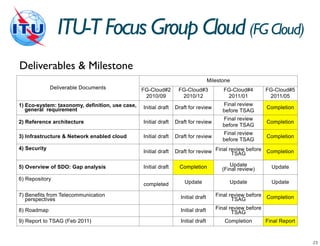
Deliverables & Milestone
                                                                                   Milestone
              Deliverable Documents              FG-Cloud#2       FG-Cloud#3             FG-Cloud#4         FG-Cloud#5
                                                  2010/09          2010/12                2011/01            2011/05
1) Eco-system: taxonomy, definition, use case,                                           Final review
   general requirement                           Initial draft   Draft for review                           Completion
                                                                                         before TSAG
                                                                                         Final review
2) Reference architecture                        Initial draft   Draft for review                           Completion
                                                                                         before TSAG
                                                                                         Final review
3) Infrastructure & Network enabled cloud        Initial draft   Draft for review                           Completion
                                                                                         before TSAG
4) Security
                                                 Initial draft   Draft for review Final review before Completion
                                                                                         TSAG

5) Overview of SDO: Gap analysis                 Initial draft     Completion              Update             Update
                                                                                        (Final review)
6) Repository
                                                 completed           Update                Update             Update

7) Benefits from Telecommunication                                 Initial draft      Final review before Completion
   perspectives                                                                              TSAG

8) Roadmap                                                         Initial draft      Final review before
                                                                                             TSAG
9) Report to TSAG (Feb 2011)                                       Initial draft         Completion         Final Report
ITU-T Focus Group Cloud (FG Cloud)
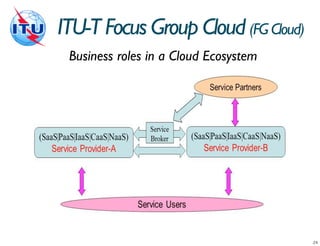
 Business roles in a Cloud Ecosystem
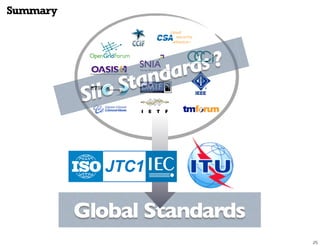
Summary


                     rds?
               Standa
          Silo


            JTC1

          Global Standards
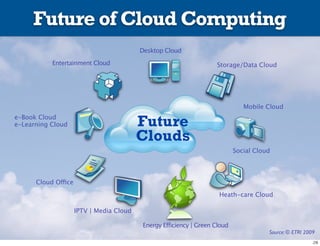
Future of Cloud Computing
                                          Desktop Cloud
           Entertainment Cloud                                      Storage/Data Cloud


                                                                               Mobile Cloud
e-Book Cloud
e-Learning Cloud                          Future
                                          Clouds
                                                                            Social Cloud


      Cloud Office
                                                                     Heath-care Cloud

                     IPTV | Media Cloud

                                          Energy Efficiency | Green Cloud
                                                                                       Source: © ETRI 2009
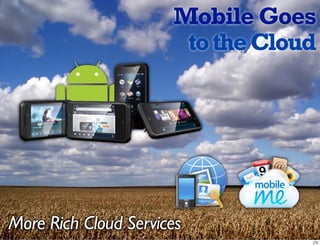
Mobile Goes
                       to the Cloud


More Rich Cloud Services
Operating System goes
to the Cloud
nd  the
Beyo
   Clo ud
More Standardization
      Issues ?
Thank You
Seungyun Lee / Ph.D.
Convenor of ISO/IEC JTC 1 SC38 SGCC | Study Group on Cloud Computing
Director of Service Convergence Standards Research Team,
Standards Research Center, ETRI
Manager of W3C Korea Office
Office. +82-42-860-5508, Mobile. +82-10-8720-2954
Email. syl@etri.re.kr, syl@w3.org, bluse2@gmail.com
twitter @seungyun

Cloud computing standards

  • 1.
    Cloud Computing Standardization Seungyun Lee, Ph.D <syl@etri.re.kr>
  • 2.
  • 3.
    We already livein Cloud world !
  • 4.
    Cloud Business Model *source: http://www.saasblogs.com/
  • 5.
    Cloud Business Model New business opportunity
  • 6.
    Why People useCloud ? On-demand use Ubiquitous Access Pay-as-you-go Elasticity Resource Utilization
  • 7.
    Cloud is Green! Resource Saving Cost Saving Energy Saving
  • 8.
  • 9.
  • 10.
  • 11.
    3 Key Requirements from NIST Reliability problem Portability Security Lock-in problem Interoperability Inter-cloud problem
  • 12.
    Cloud User Surveys- Challenges Q: Rate the challenges/issues of the 'cloud'/on-demand model Security 87.5% Availability 83.3% Performance 82.9% On-demand paym’t model may cost more 81.0% Lack of interoperability standards 80.2% Bringing back in-house may be difficult 79.8% Hard to integrate with in-house IT 76.8% Not enough ability to customize 76.0% 0% 10% 20% 30% 40% 50% 60% 70% 80% 90% (Scale: 1 = Not at all concerned 5 = Very concerned) Source: IDC Enterprise Panel, 3Q09, n = 263, September 2009
  • 13.
    Do we needstandards? Lock-in problem Reliability Inter-cloud problem problem YES, we need at minimum !
  • 14.
    Standardization Problem Nothing New proprietary Technology Business Model ? Service Architecture Diversity
  • 15.
    Major Issues onCloud Computing To be standardized ! St ds Definition, an ar Taxonomy, da tand Terms. rd s S Security Provisioning Model Environmental Inter- Business Issues operability Process Architecture Legality St ds an ar da Availability nd rd ta s S Source: ETRI, 2010
  • 16.
    What should bestandardized? Security Portability Performance Interoperability Inter-cloud SLA Source: http://cloud-standards.org/wiki/
  • 17.
    What should beconsidered? Barrier & Weapon SLA Legals
  • 18.
    JTC1 JTC1 <SDOs & Fora related to Cloud Computing>
  • 19.
    JTC1 ISO/IEC JTC 1 SC38 / SGCC Title:! Distributed Application Platforms and Services (DAPS) Scope:!Standardization for interoperable Distributed Application Platform and services including: •! Web Services, Service Oriented Architecture (SOA), and •! Cloud Computing. As per the JTC 1 Directives, SC 38 establishes its own substructure at its first meeting in Beijing China, May 2010 • Web Service WG • Service Oriented Architecture (SOA) WG • Cloud Computing SG
  • 20.
    JTC1 ISO/IEC JTC 1 SC38 / SGCC Terms of References for SGCC 1. Provide a taxonomy, terminology and value proposition for Cloud Computing. 2. Assess the current state of standardization in Cloud Computing within JTC 1 and in other SDOs and consortia beginning with document JTC 1 N 9687*. 3. Document standardization market/business/user requirements and the challenges to be addressed. 4. Liaise and collaborate with relevant SDOs and consortia related to Cloud Computing. 5. Hold open meetings to gather requirements as needed from a wide range of interested organizations. 6. Provide a report of activities and recommendations to SC 38. *N9687: Report of JTC 1/SWG-Planning on possible future work on Cloud Computing in JTC 1 (2009) Source: Resolution of ISO/IEC JTC 1 SC 38 Plenary
  • 21.
    JTC1 ISO/IEC JTC 1 SC38 / SGCC • Working Method : ! SGCC Editorial Team will produce a draft Study Group report by 15 November 2010 ! Cloud Computing Standards Analysis work Team will carry out its analysis and deliver a report as per Resolution 8 by 7 March 2011 Value Gap Standards Terminology Taxonomy Analysis Requirements Proposition
  • 22.
    ITU-T Focus GroupCloud (FG Cloud) Terms of References • FG Objective The objective of the Focus Group is to collect and document information and concepts that would be helpful for developing Recommendations to support cloud computing services/applications from a telecommunication/ICT perspective. • Specific tasks and deliverables r’s ndoto support cloud Ve - Benefits of cloud computing from telecommunication/ICT perspectives ork computing N tw - Gap analysis of ITU-T standards for telecommunication/ICT evalue propositions of cloud computing with a - Collect and summarize & and o vision aspectsective T elcwithin the ITU-Tsinp telecom networks to take focus on telecommunication/ICT ercapabilities - Leverage expertise P building advantage of cloud concepts and - Terminology and taxonomy and to develop new definition when necessary - Analysis of telecommunication/ICT networking requirements functions and capabilities to support cloud computing services/applications (for both fixed and mobile) - Use cases of services and reference models for telecommunication/ICT to support cloud computing - Roadmap to guide further developments of relevant ITU-T Recommendations. Source: http://www.itu.int/ITU-T/focusgroups/cloud/tor.html
  • 23.
    ITU-T Focus GroupCloud (FG Cloud) Deliverables & Milestone Milestone Deliverable Documents FG-Cloud#2 FG-Cloud#3 FG-Cloud#4 FG-Cloud#5 2010/09 2010/12 2011/01 2011/05 1) Eco-system: taxonomy, definition, use case, Final review general requirement Initial draft Draft for review Completion before TSAG Final review 2) Reference architecture Initial draft Draft for review Completion before TSAG Final review 3) Infrastructure & Network enabled cloud Initial draft Draft for review Completion before TSAG 4) Security Initial draft Draft for review Final review before Completion TSAG 5) Overview of SDO: Gap analysis Initial draft Completion Update Update (Final review) 6) Repository completed Update Update Update 7) Benefits from Telecommunication Initial draft Final review before Completion perspectives TSAG 8) Roadmap Initial draft Final review before TSAG 9) Report to TSAG (Feb 2011) Initial draft Completion Final Report
  • 24.
    ITU-T Focus GroupCloud (FG Cloud) Business roles in a Cloud Ecosystem
  • 25.
    Summary rds? Standa Silo JTC1 Global Standards
  • 26.
    Future of CloudComputing Desktop Cloud Entertainment Cloud Storage/Data Cloud Mobile Cloud e-Book Cloud e-Learning Cloud Future Clouds Social Cloud Cloud Office Heath-care Cloud IPTV | Media Cloud Energy Efficiency | Green Cloud Source: © ETRI 2009
  • 27.
    Mobile Goes to the Cloud More Rich Cloud Services
  • 28.
  • 29.
    nd the Beyo Clo ud More Standardization Issues ?
  • 30.
    Thank You Seungyun Lee/ Ph.D. Convenor of ISO/IEC JTC 1 SC38 SGCC | Study Group on Cloud Computing Director of Service Convergence Standards Research Team, Standards Research Center, ETRI Manager of W3C Korea Office Office. +82-42-860-5508, Mobile. +82-10-8720-2954 Email. syl@etri.re.kr, syl@w3.org, bluse2@gmail.com twitter @seungyun