Cloud Computing Essentials for IT ProsChris E. AvisSr. IT Pro Evangelist blogs.technet.com/chrisavis
AgendaWhat and WhyMicrosoft’s Vision
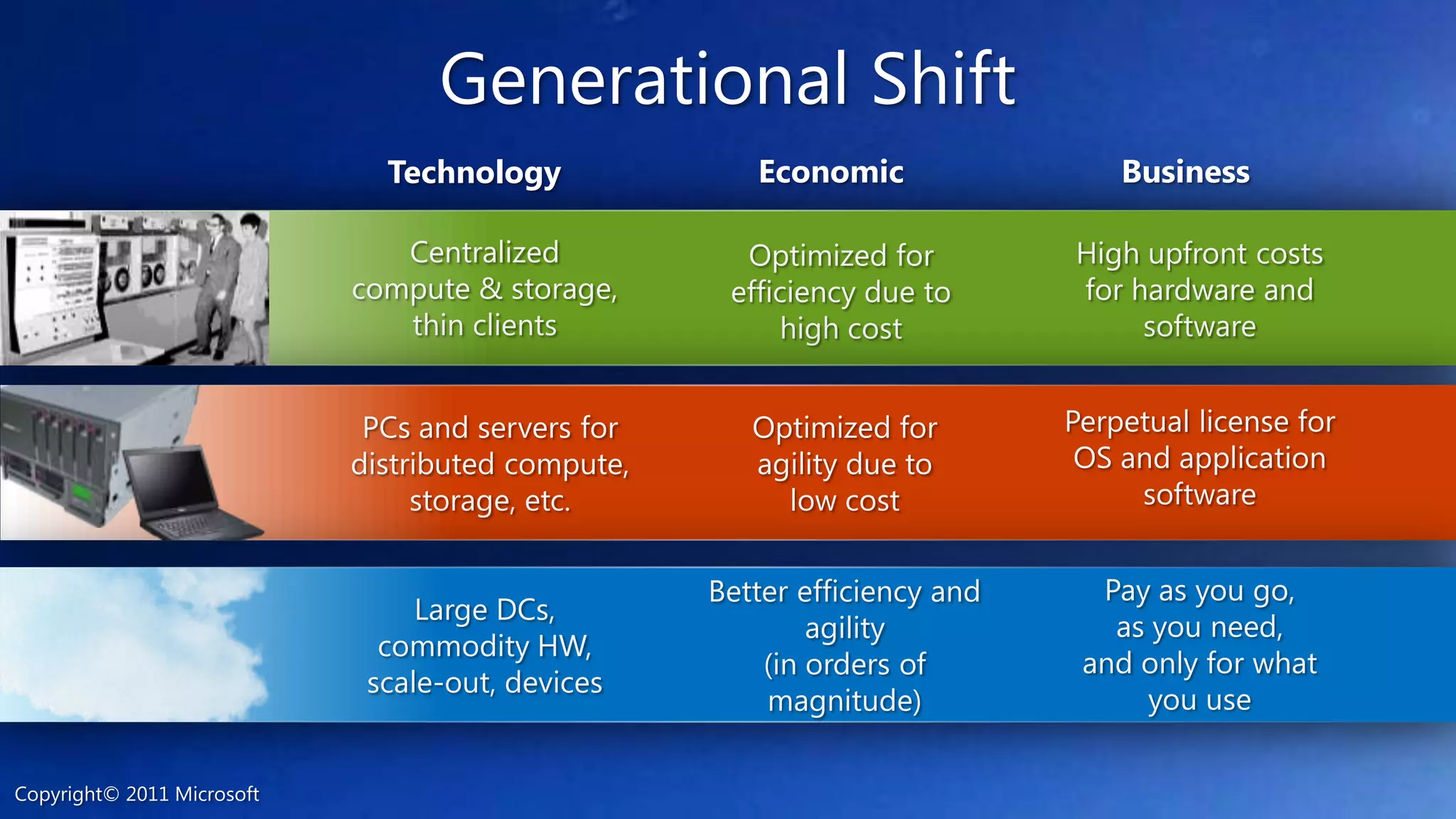
Generational ShiftBusinessEconomicTechnologyCentralized compute & storage, thin clientsHigh upfront costs for hardware and softwareOptimized for efficiency due to high costPerpetual license for OS and application softwarePCs and servers for distributed compute, storage, etc.Optimized for agility due to low costCopyright© 2011 MicrosoftPay as you go, as you need,and only for what you useBetter efficiency and agility(in orders of magnitude)Large DCs, commodity HW, scale-out, devices
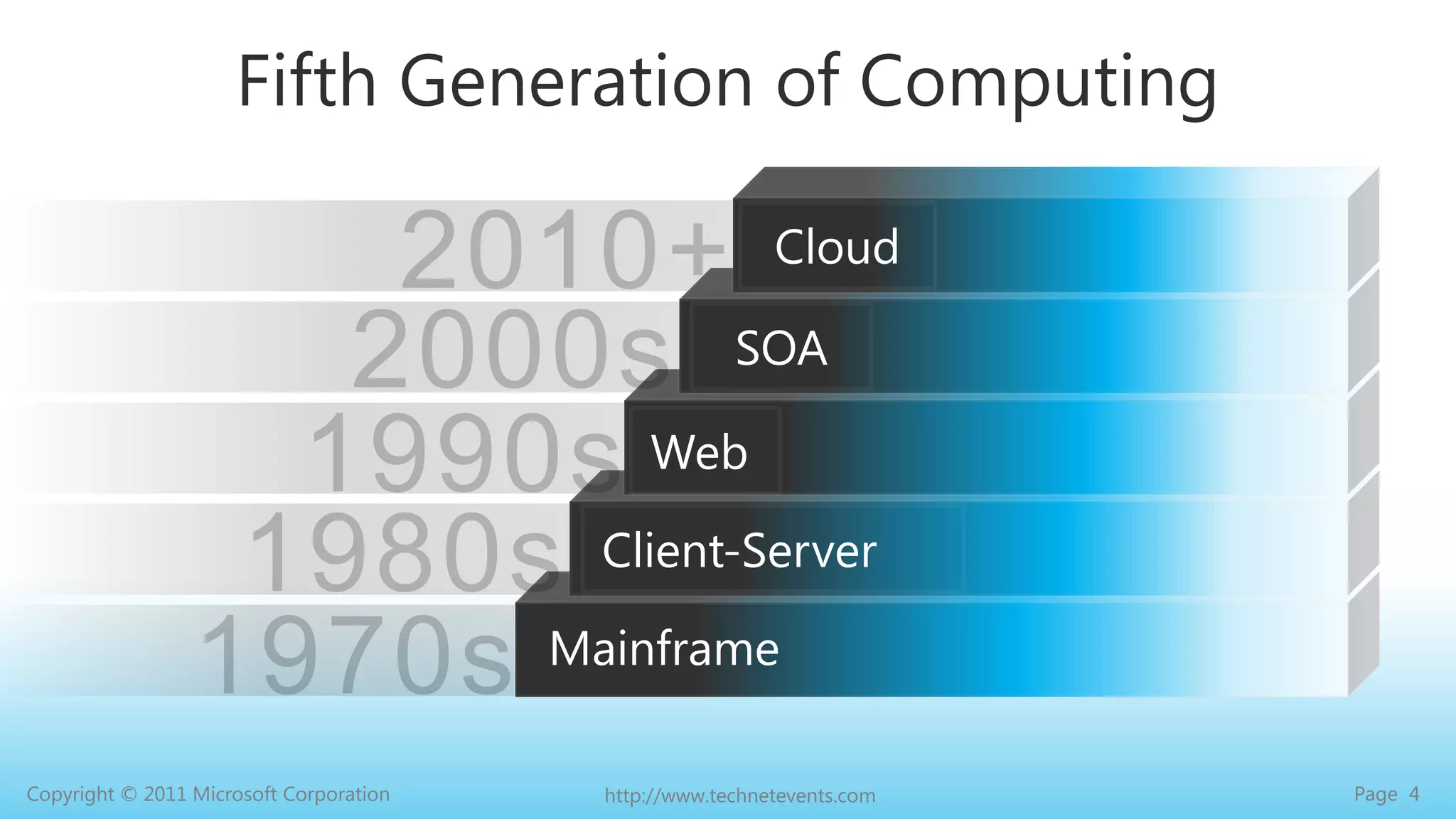
Fifth Generation of Computing2010+2000sCloud1990sSOA1980sWeb1970sClient-ServerMainframe
Really?Why?
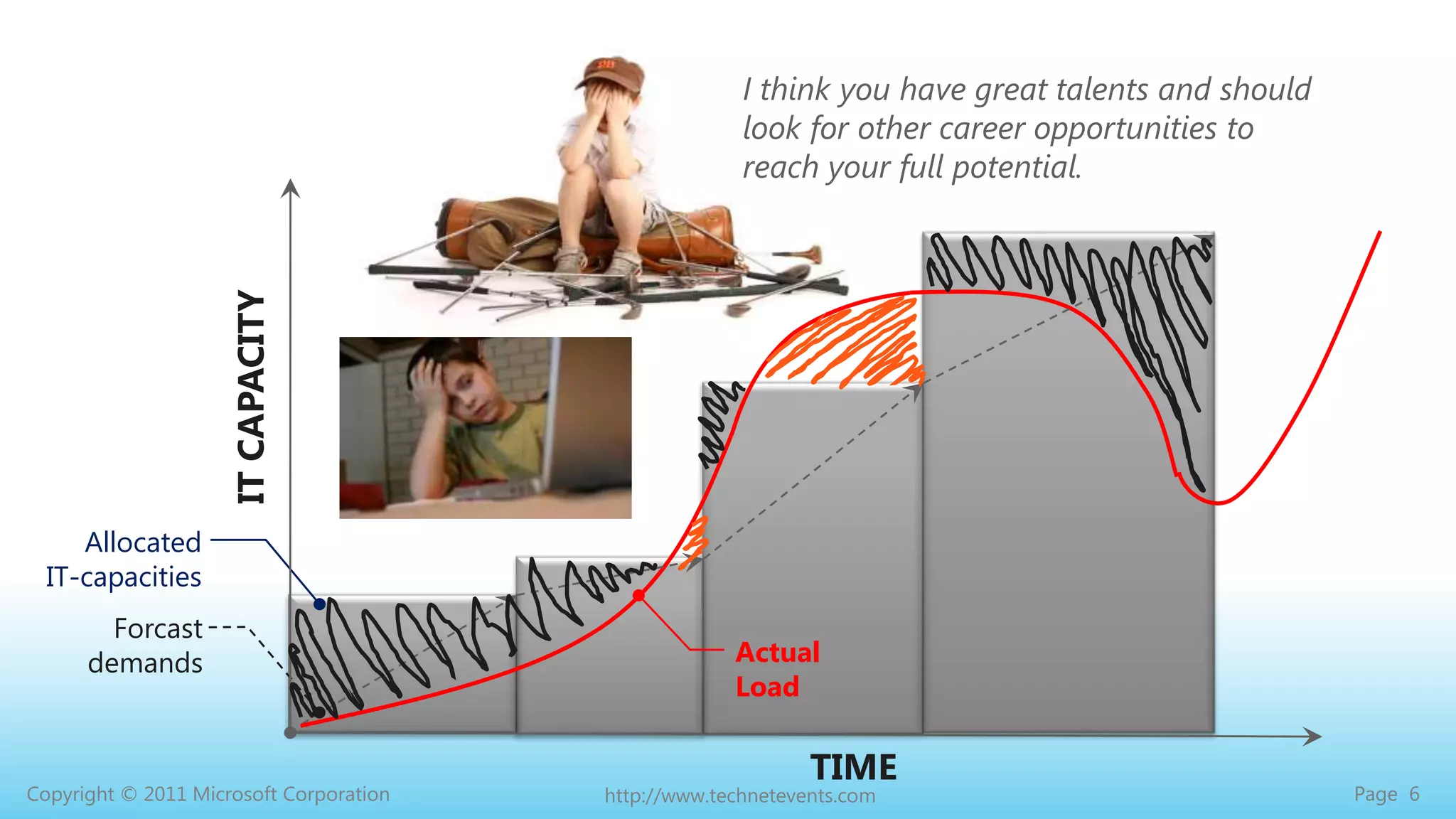
I think you have great talents and should look for other career opportunities to reach your full potential.IT CAPACITYAllocated IT-capacitiesForcast demandsActual LoadTIME
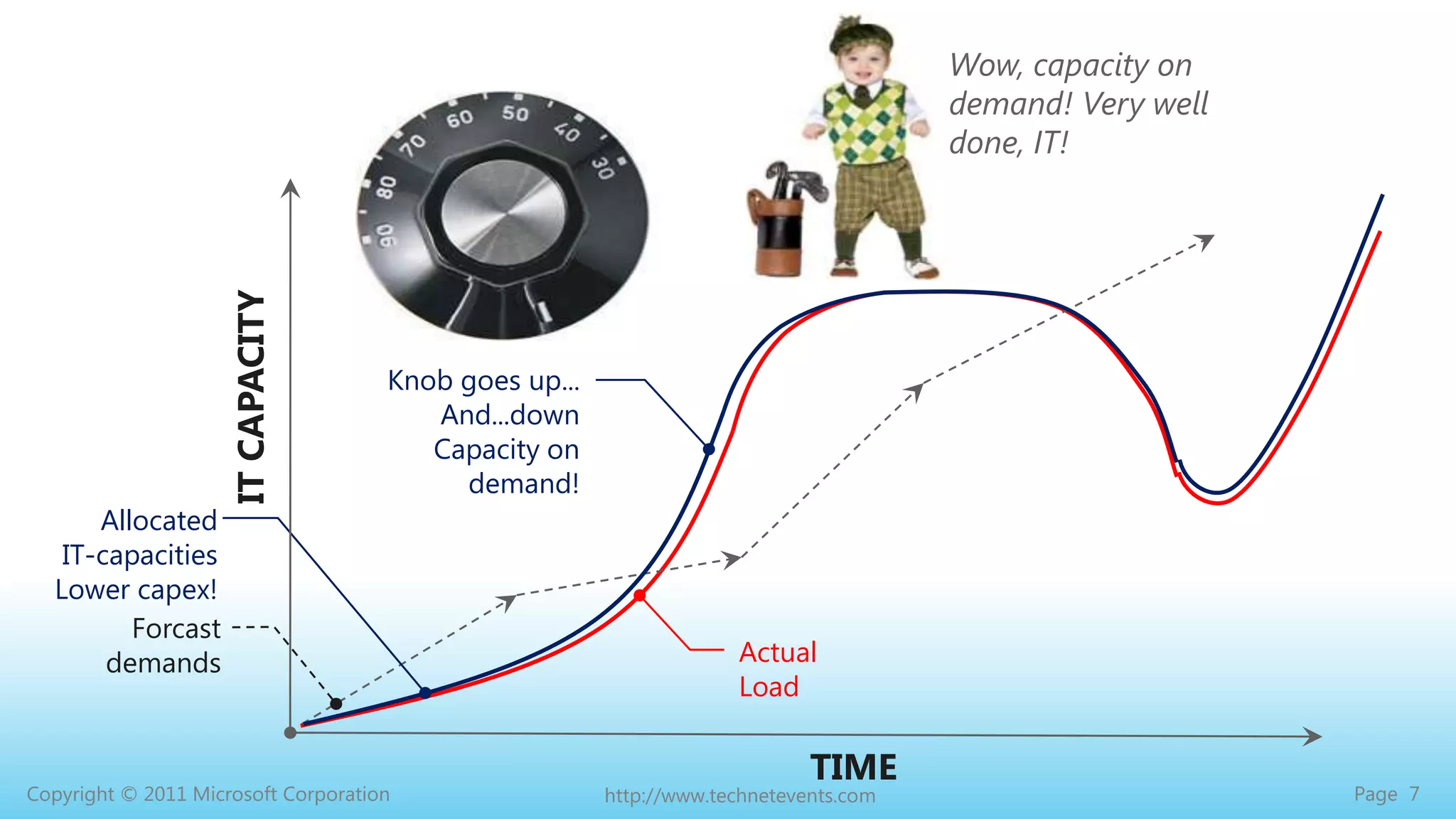
Wow, capacity on demand! Very well done, IT!Knob goes up...And...downCapacity on demand!IT CAPACITYAllocated IT-capacitiesLower capex!Forcast demandsActual LoadTIME
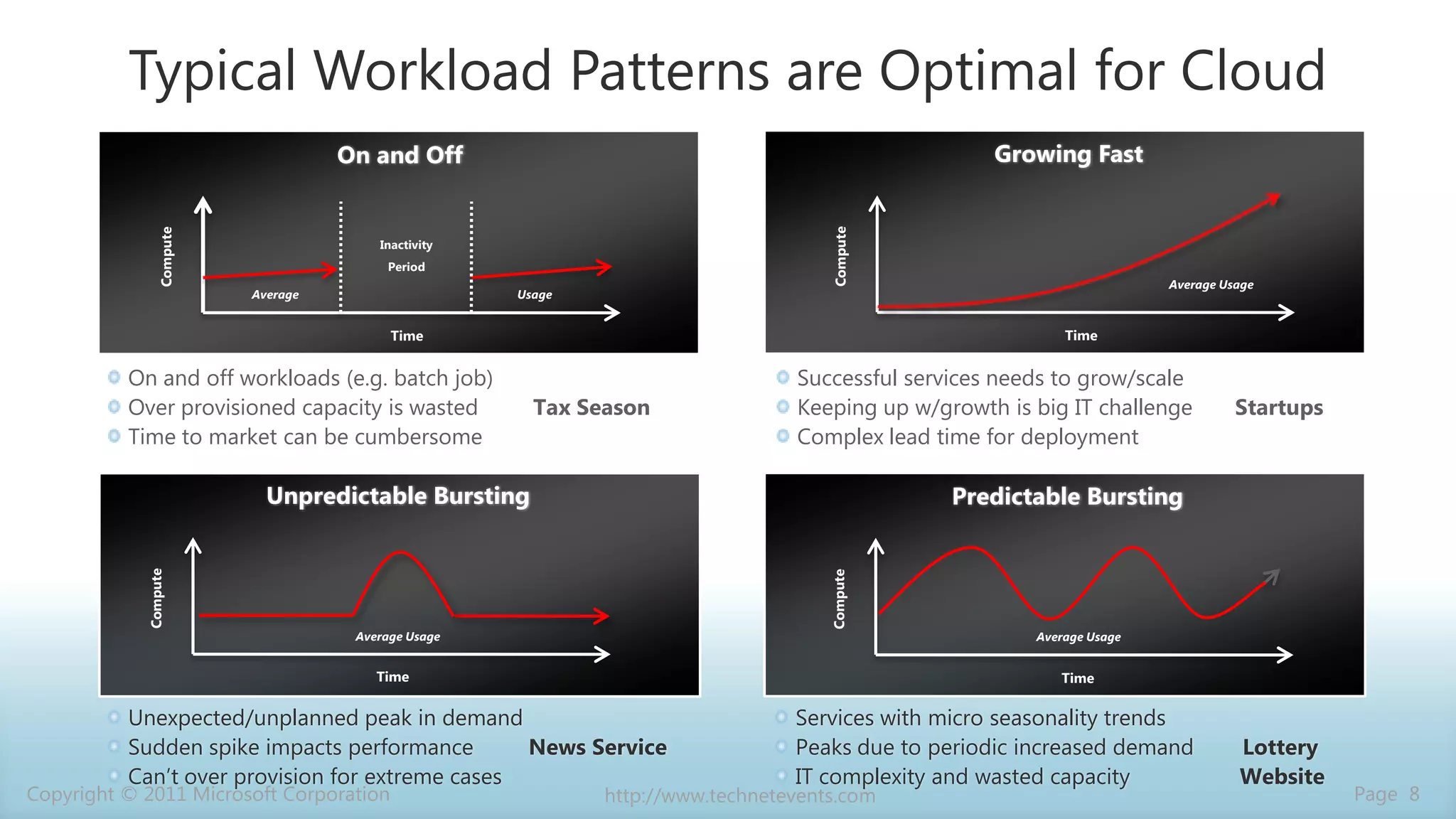
Growing Fast On and Off  InactivityPeriod Compute Compute Average UsageUsageAverageTime Time On and off workloads (e.g. batch job)Over provisioned capacity is wasted Tax SeasonTime to market can be cumbersome Successful services needs to grow/scale  Keeping up w/growth is big IT challenge       StartupsComplex lead time for deploymentUnpredictable Bursting  Predictable Bursting Compute Compute Average Usage Average Usage Time Time Unexpected/unplanned peak in demand Sudden spike impacts performance         News Service Can’t over provision for extreme cases Services with micro seasonality trends  Peaks due to periodic increased demand        LotteryIT complexity and wasted capacity  WebsiteTypical Workload Patterns are Optimal for Cloud
Your business is a service.What is a service?Capacity on demand?
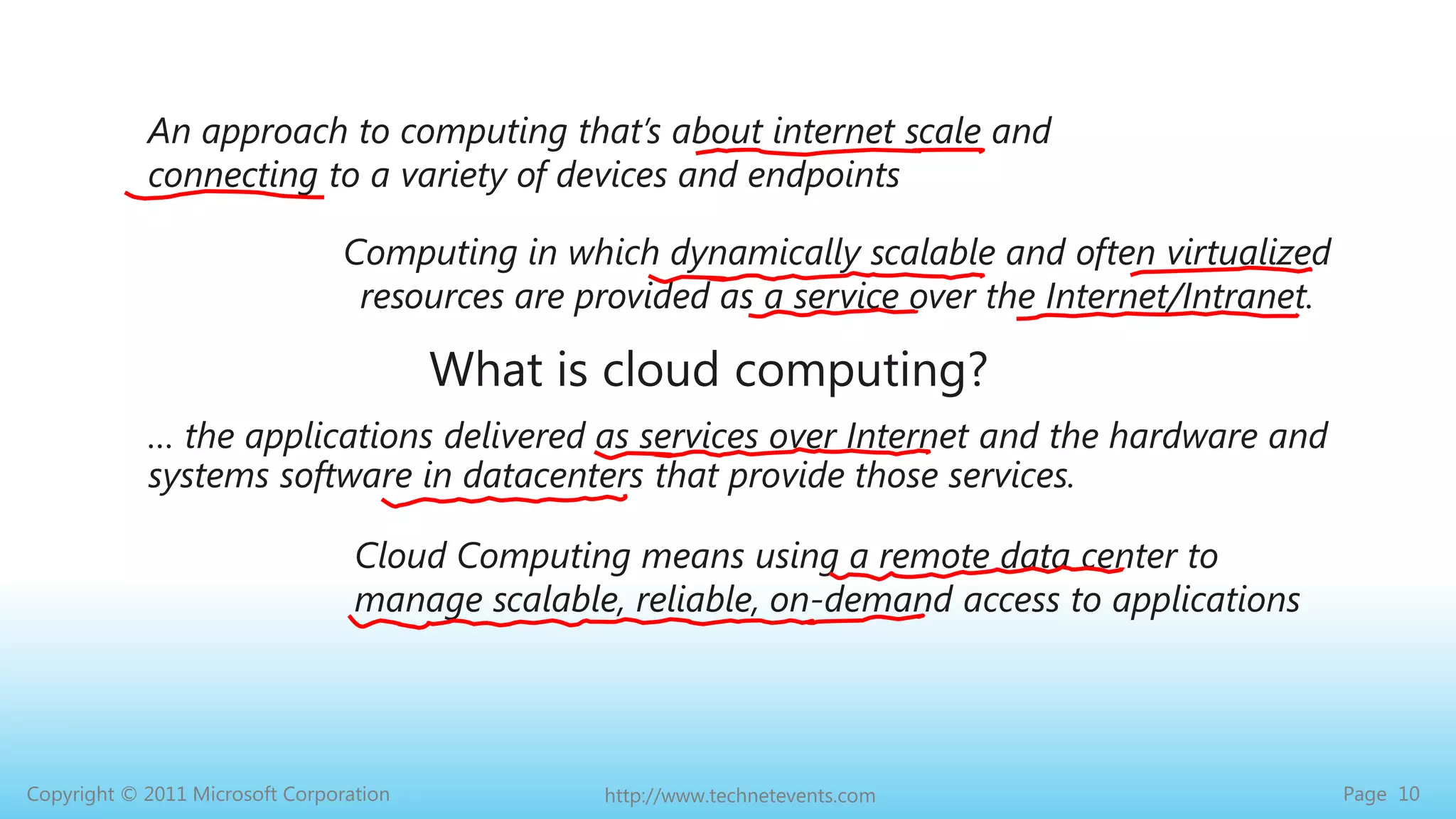
An approach to computing that’s about internet scale and connecting to a variety of devices and endpointsComputing in which dynamically scalable and often virtualized resources are provided as a service over the Internet/Intranet. What is cloud computing?… the applications delivered as services over Internet and the hardware and systems software in datacenters that provide those services. Cloud Computing means using a remote data center to manage scalable, reliable, on-demand access to applications
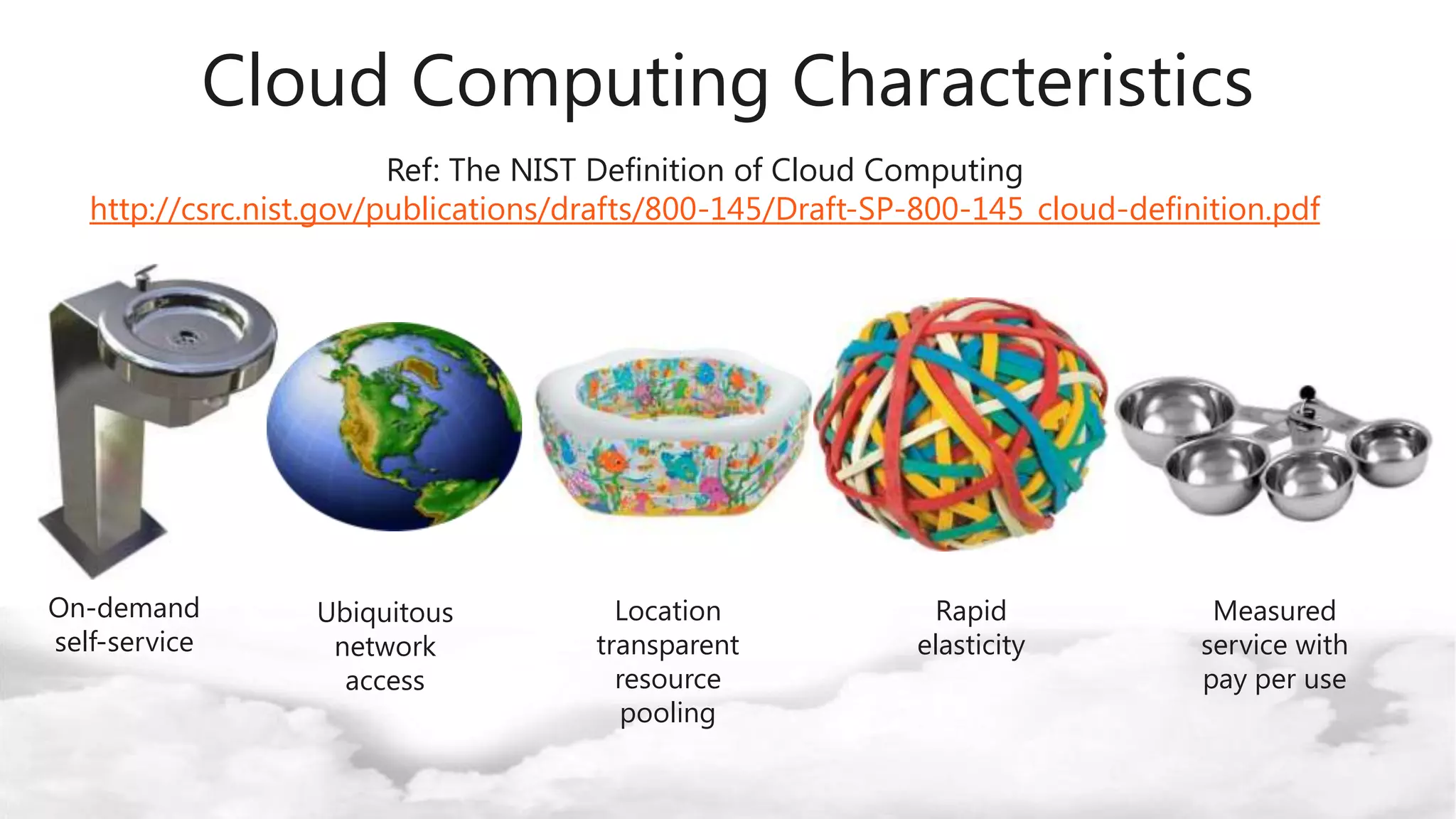
Cloud Computing CharacteristicsRef: The NIST Definition of Cloud Computinghttp://csrc.nist.gov/publications/drafts/800-145/Draft-SP-800-145_cloud-definition.pdfOn-demand self-serviceLocation transparent resource poolingRapid elasticityMeasured service with pay per useUbiquitous network access
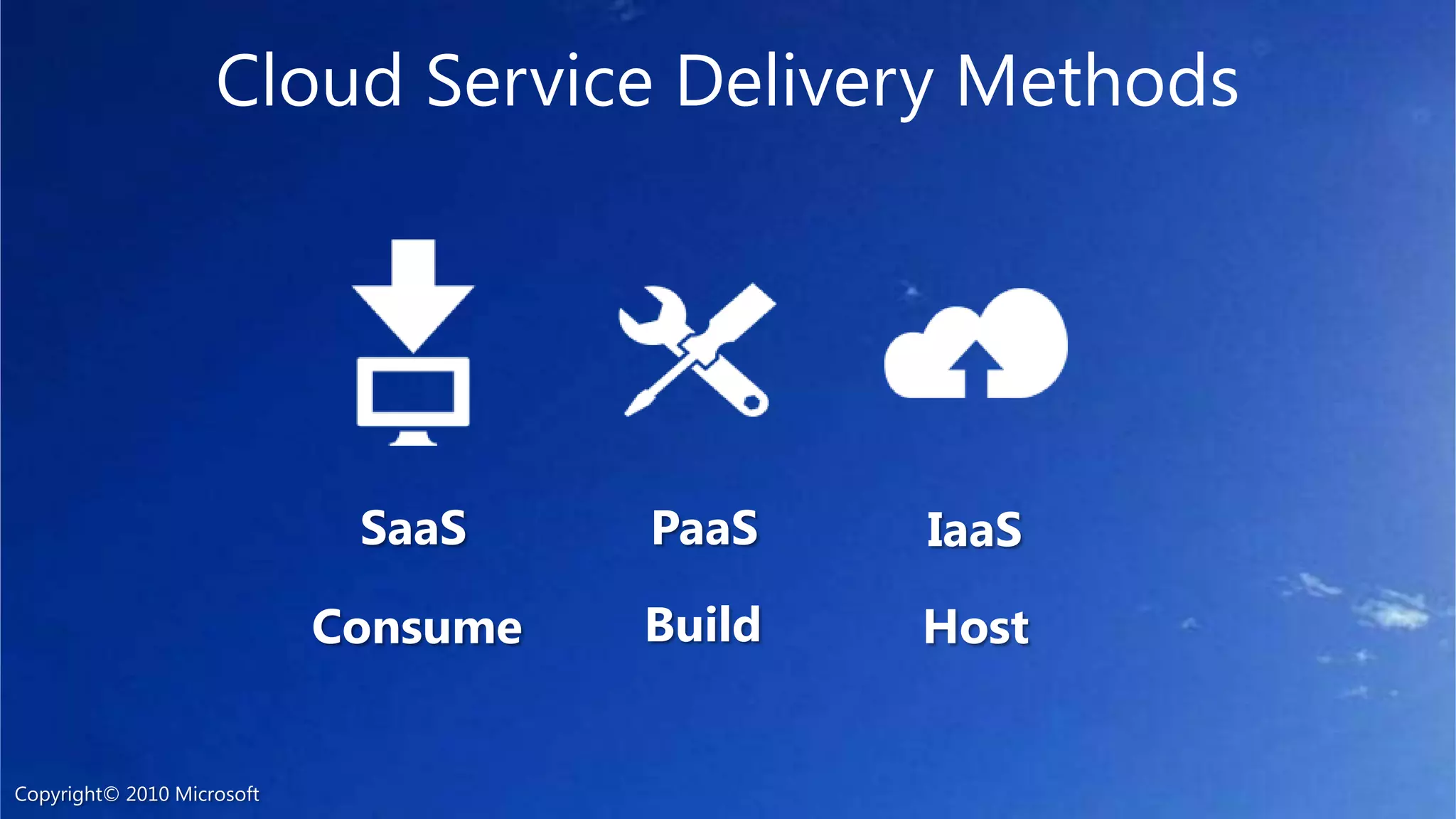
SaaSPaaSIaaSBuildConsumeHostCloud Service Delivery MethodsCopyright© 2010 Microsoft
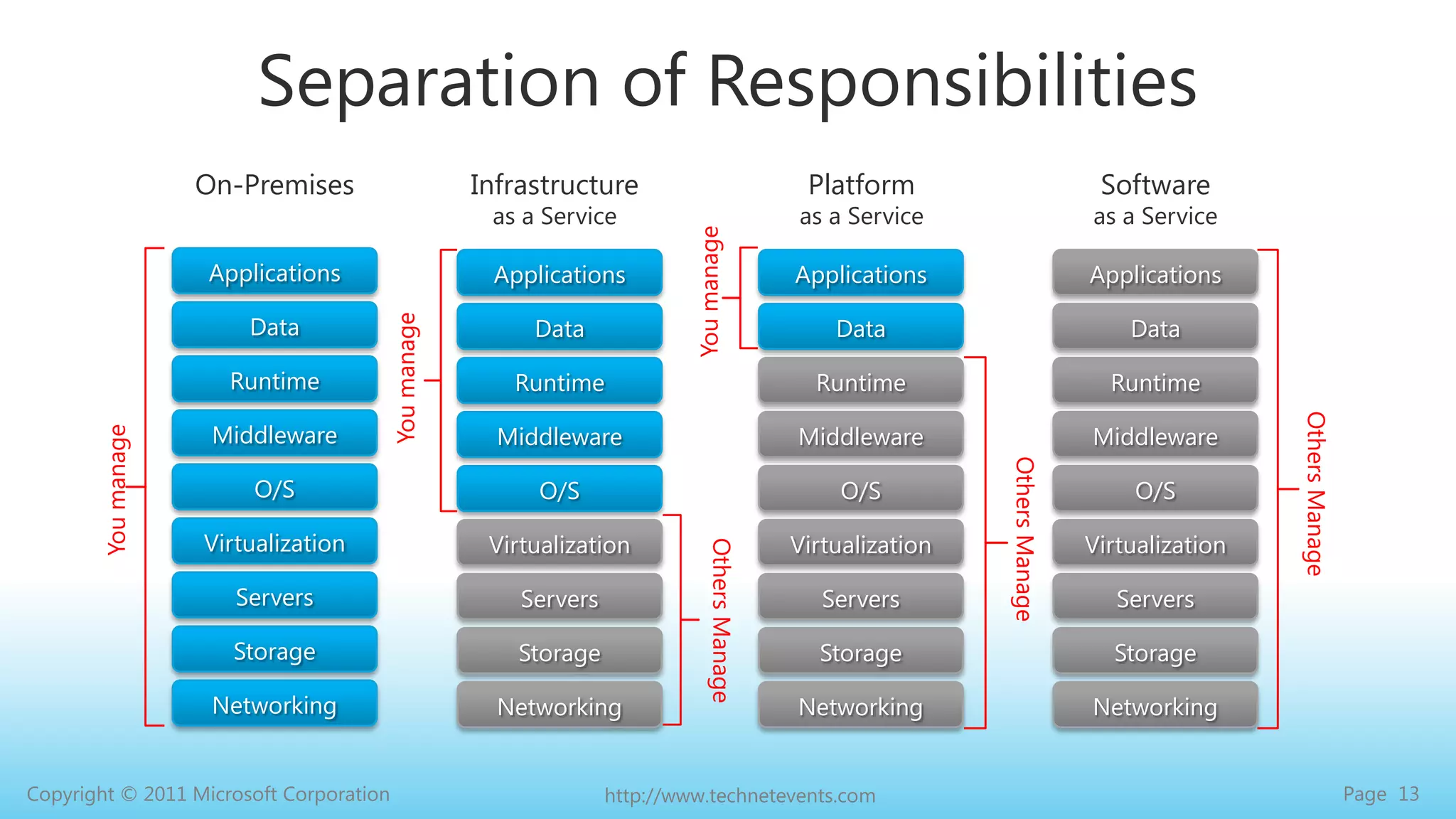
Separation of ResponsibilitiesOn-PremisesInfrastructureas a ServiceSoftwareas a ServicePlatformas a ServiceYou manageApplicationsApplicationsApplicationsApplicationsYou manageDataDataDataDataYou manageRuntimeRuntimeRuntimeRuntimeMiddlewareMiddlewareMiddlewareMiddlewareOthers ManageOthers ManageO/SO/SO/SO/SVirtualizationVirtualizationVirtualizationVirtualizationOthers ManageServersServersServersServersStorageStorageStorageStorageNetworkingNetworkingNetworkingNetworking
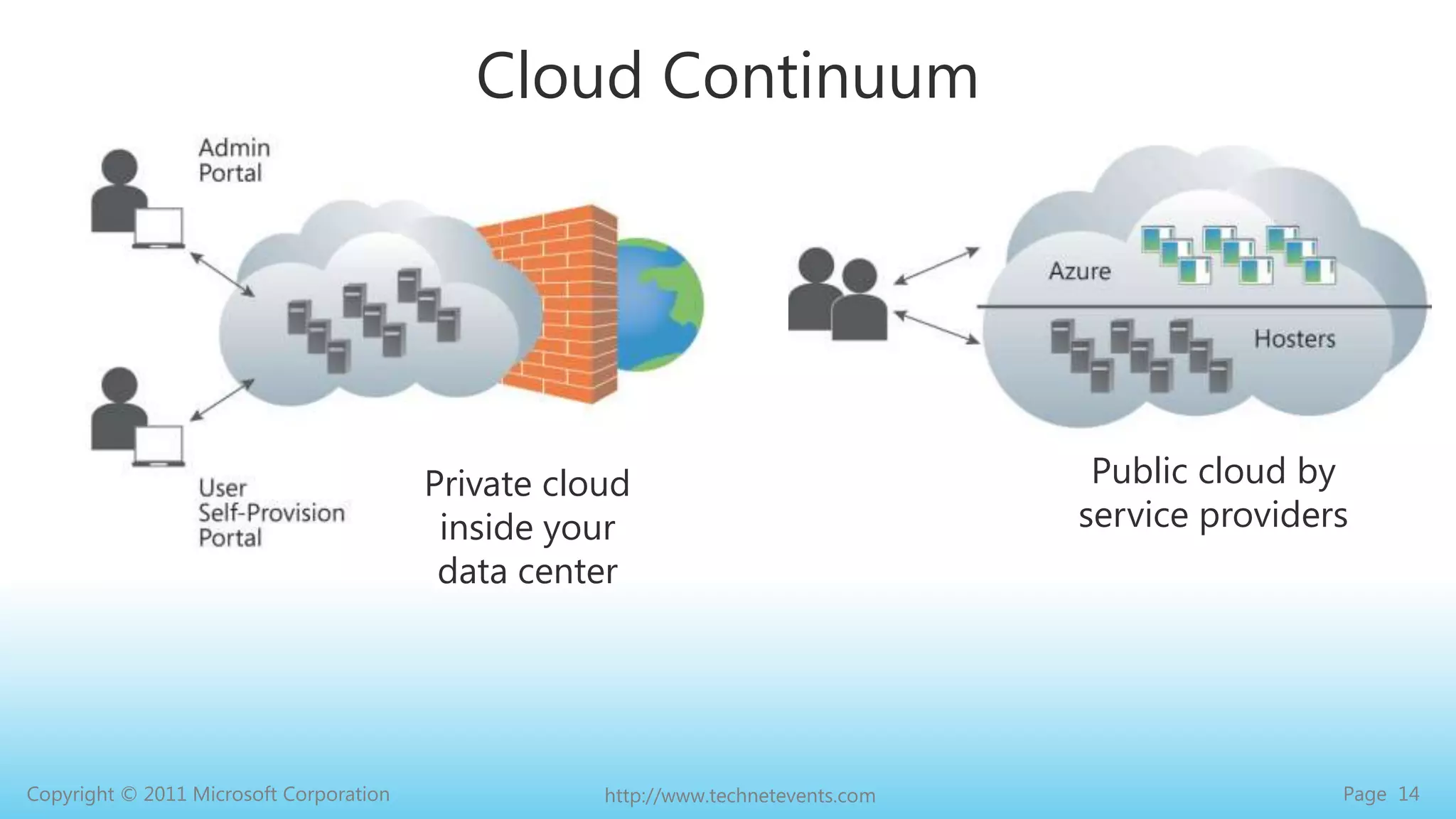
Cloud ContinuumPrivate cloud inside your data centerPublic cloud by service providers
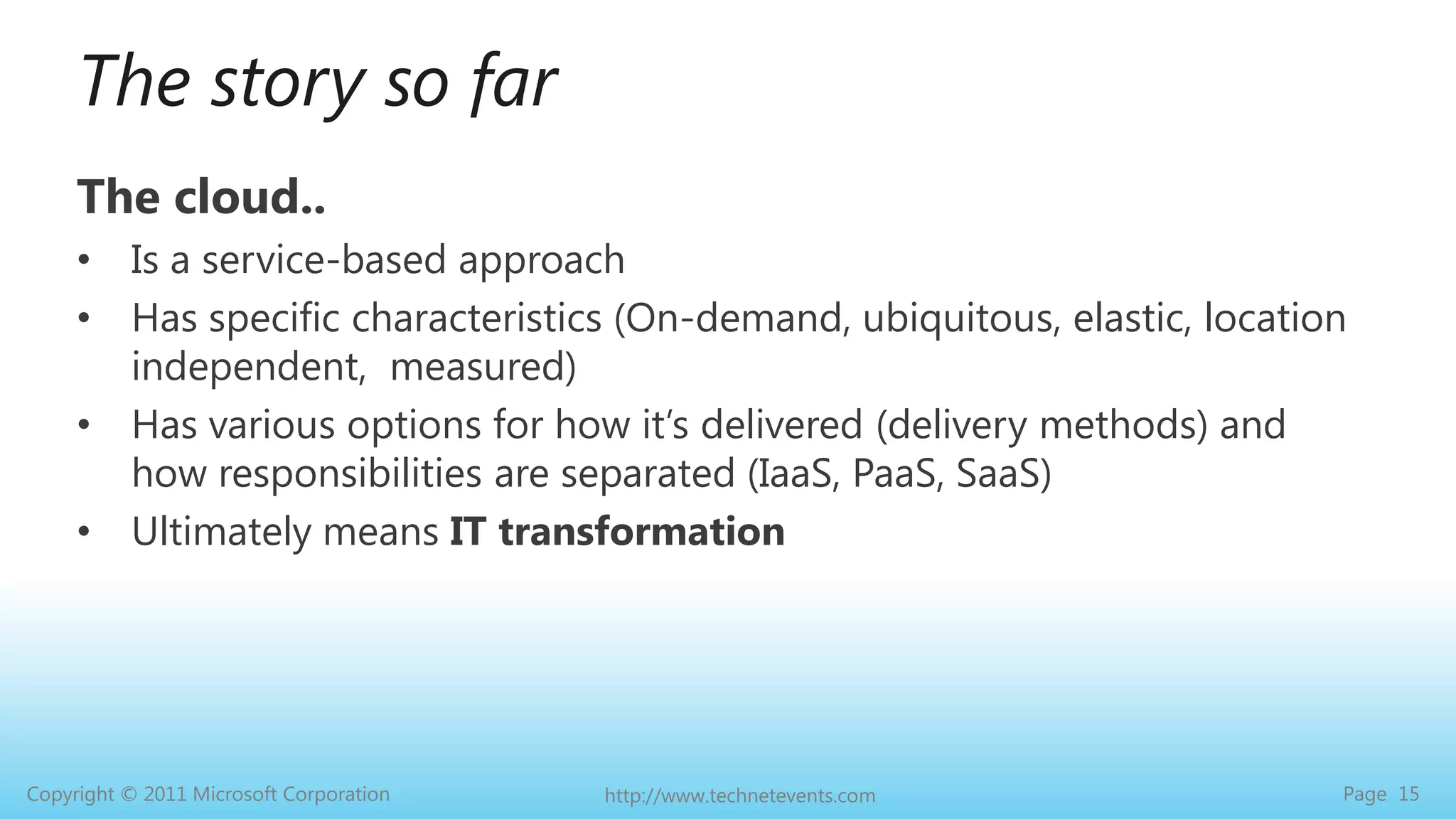
The story so farThe cloud..Is a service-based approachHas specific characteristics (On-demand, ubiquitous, elastic, location independent,  measured)Has various options for how it’s delivered (delivery methods) andhow responsibilities are separated (IaaS, PaaS, SaaS)Ultimately means IT transformation
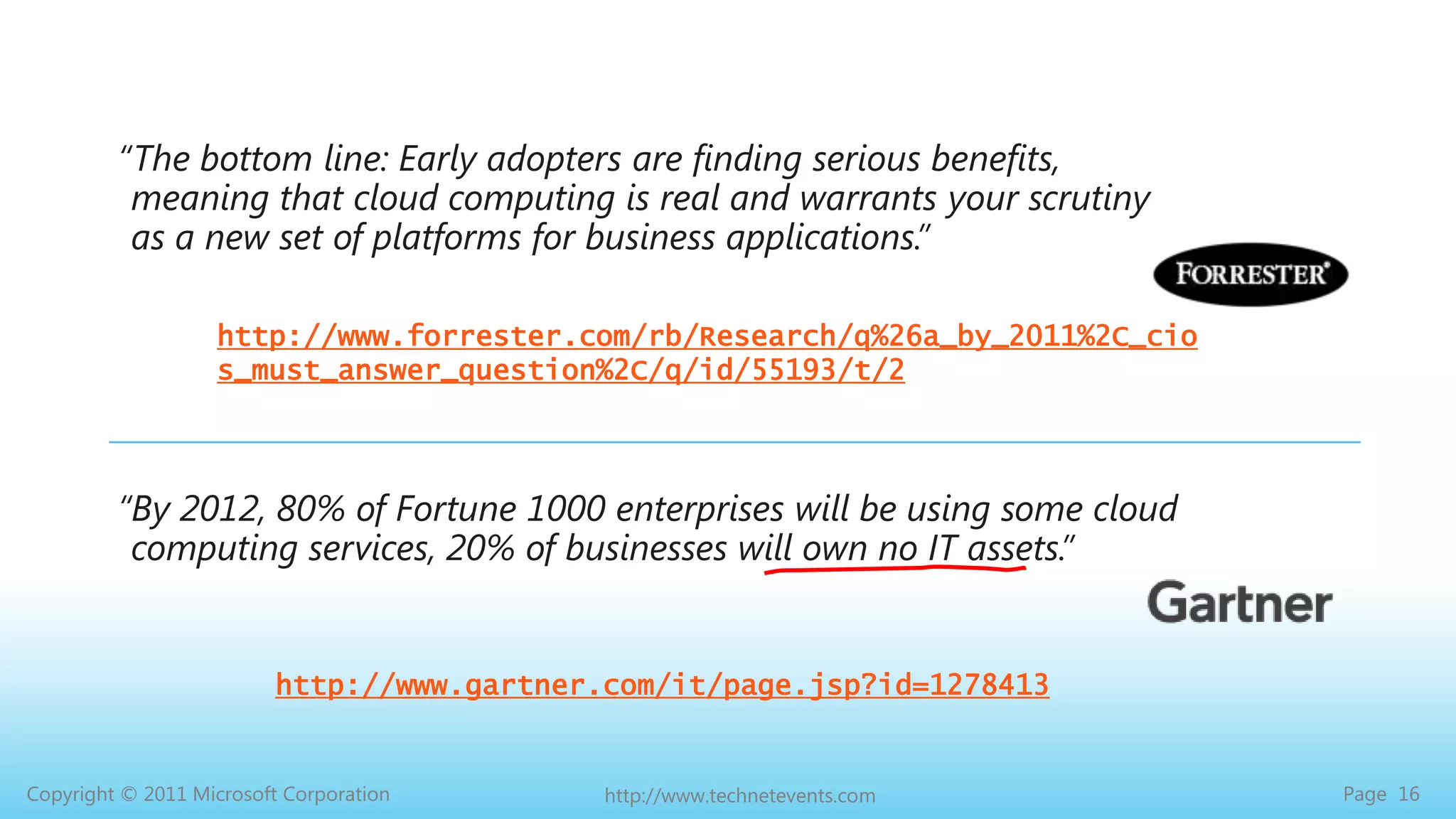
“The bottom line: Early adopters are finding serious benefits, meaning that cloud computing is real and warrants your scrutiny as a new set of platforms for business applications.” http://www.forrester.com/rb/Research/q%26a_by_2011%2C_cios_must_answer_question%2C/q/id/55193/t/2“By 2012, 80% of Fortune 1000 enterprises will be using some cloud computing services, 20% of businesses will own no IT assets.”http://www.gartner.com/it/page.jsp?id=1278413
AgendaWhat and WhyMicrosoft’s Vision
Yesterday and Today(Do we know how to do “cloud”?)
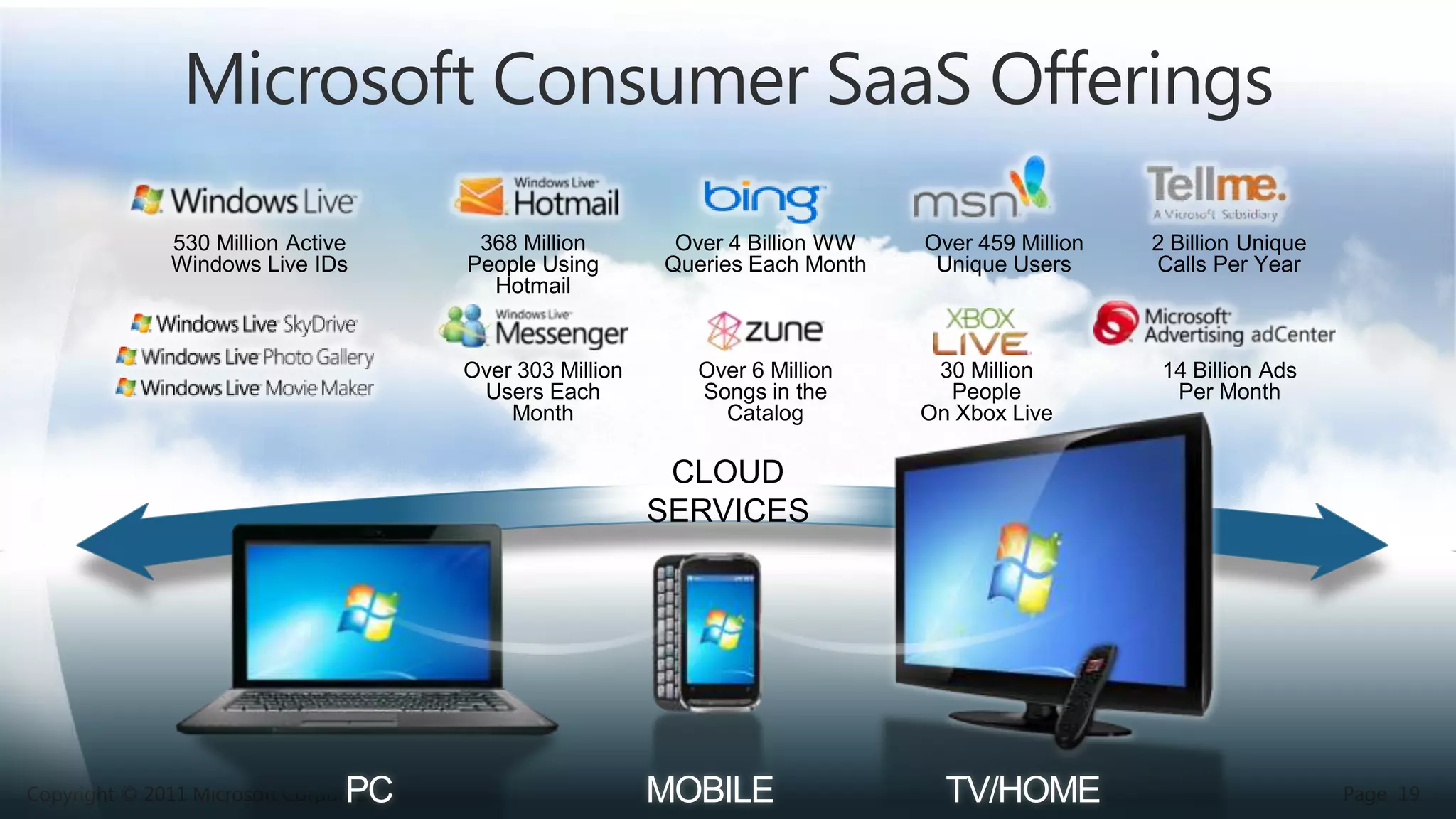
530 Million Active Windows Live IDs368 Million People Using HotmailOver 4 Billion WW Queries Each MonthOver 459 Million Unique Users2 Billion Unique Calls Per Year30 Million  People On Xbox LiveOver 6 Million Songs in the Catalog14 Billion Ads Per MonthOver 303 Million Users Each MonthCLOUD SERVICESTV/HOMEPCMOBILEMicrosoft Consumer SaaS Offerings
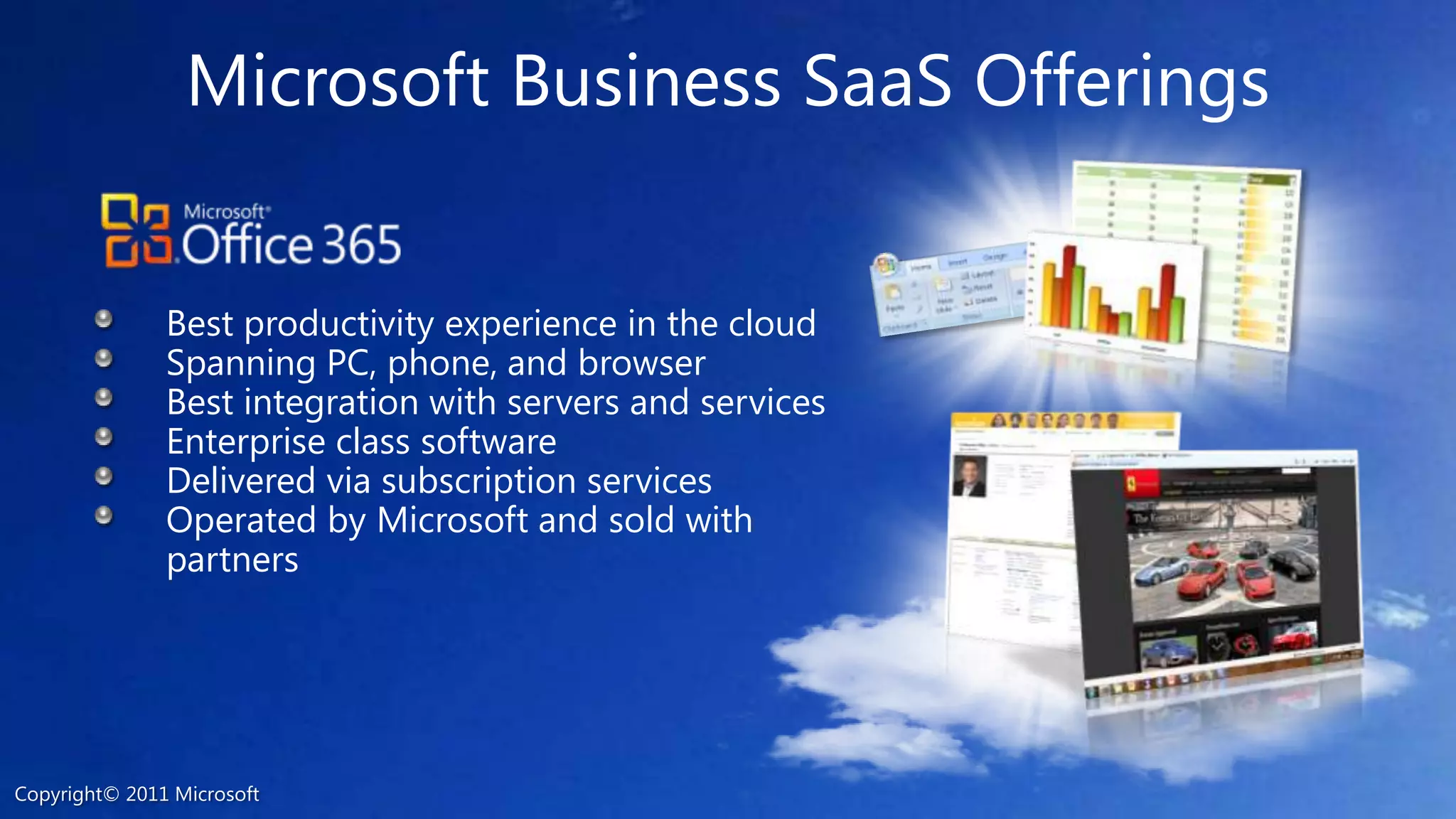
Best productivity experience in the cloudSpanning PC, phone, and browserBest integration with servers and servicesEnterprise class softwareDelivered via subscription servicesOperated by Microsoft and sold with partnersMicrosoft Business SaaS OfferingsCopyright© 2011 Microsoft
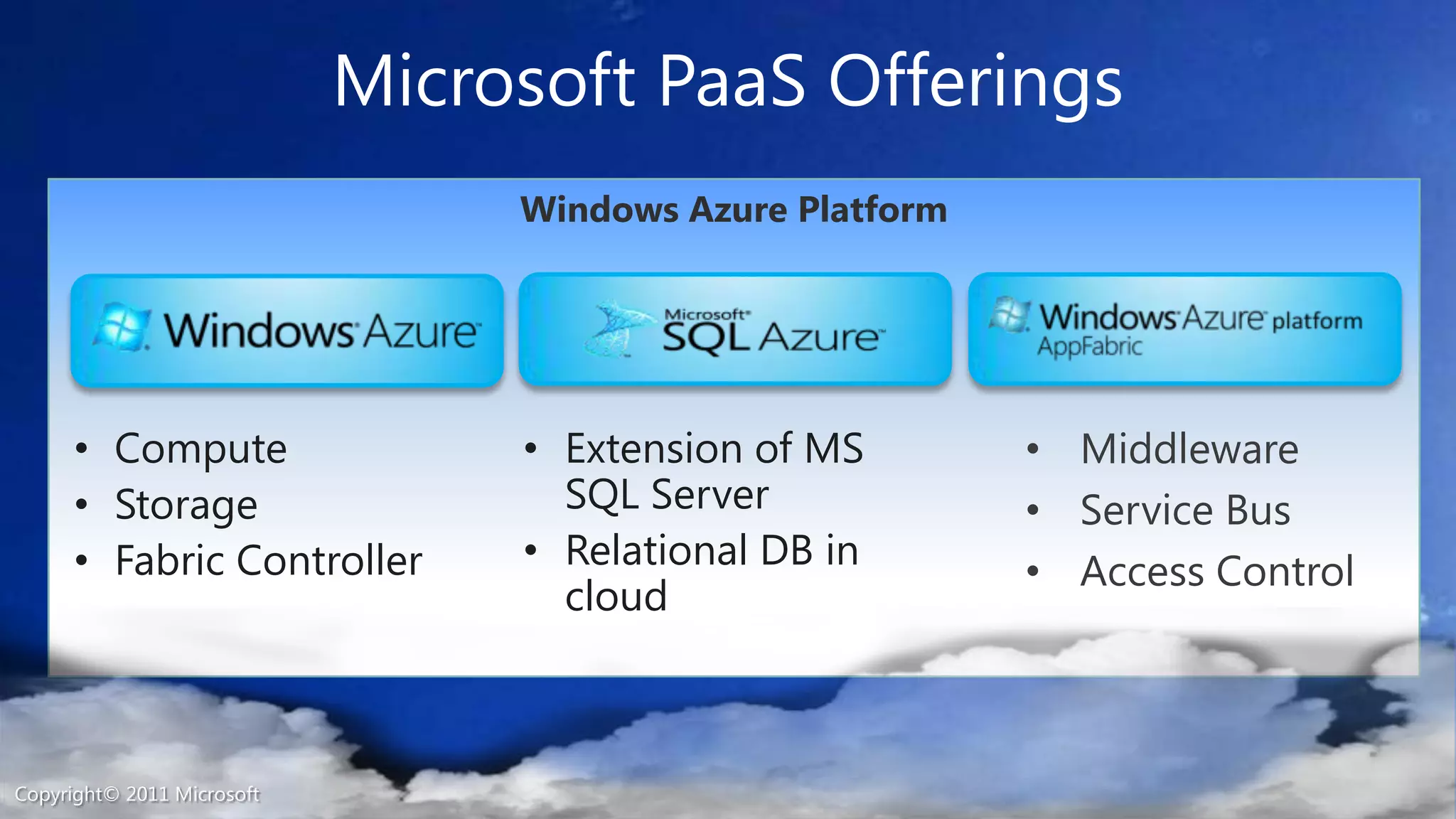
Windows Azure PlatformMicrosoft PaaS OfferingsMiddlewareService BusAccess ControlComputeStorageFabric ControllerExtension of MS SQL ServerRelational DB in cloudCopyright© 2011 Microsoft
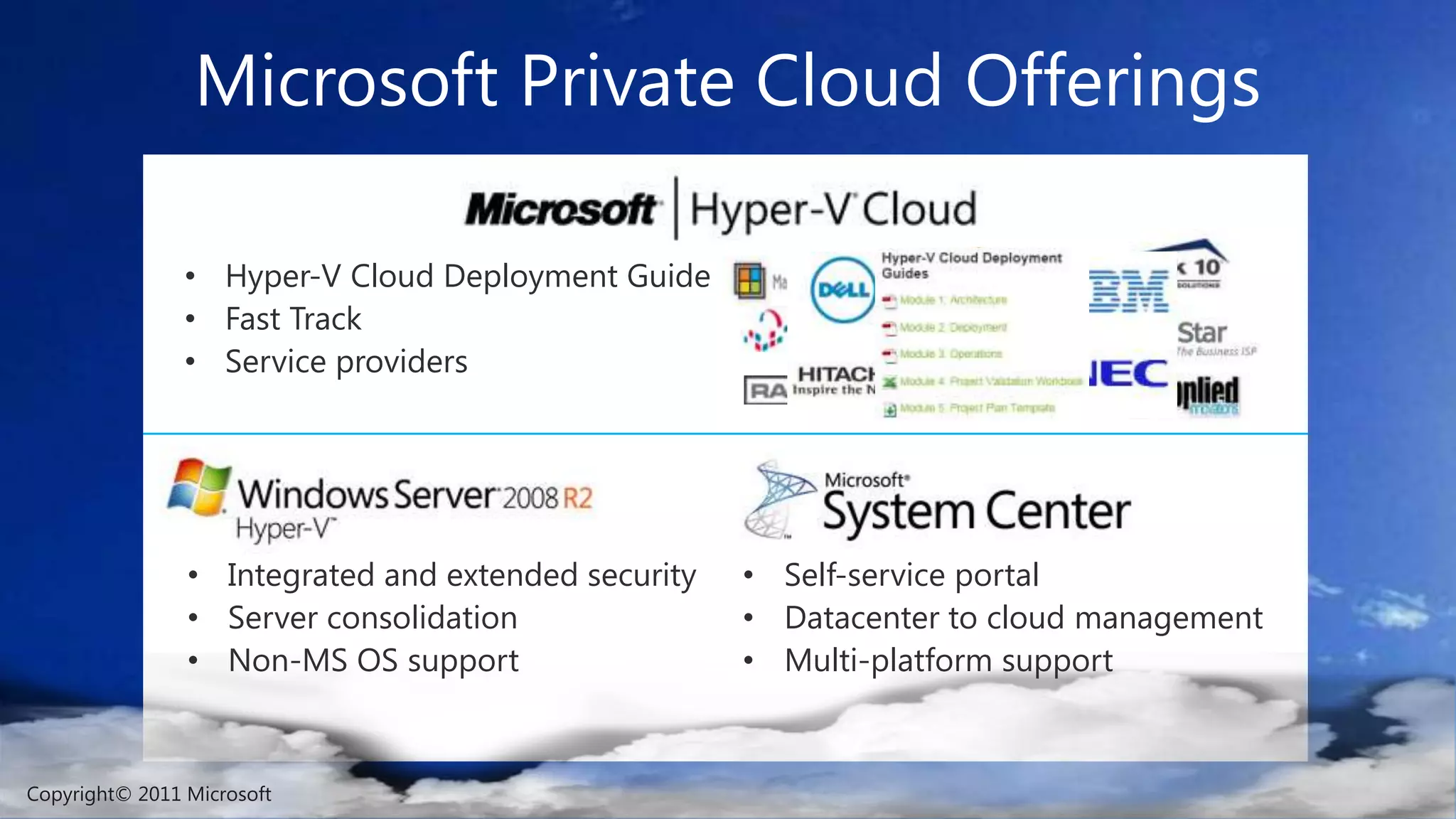
Microsoft Private Cloud OfferingsHyper-V Cloud Deployment GuideFast TrackService providersIntegrated and extended securityServer consolidationNon-MS OS supportSelf-service portalDatacenter to cloud managementMulti-platform supportCopyright© 2011 Microsoft
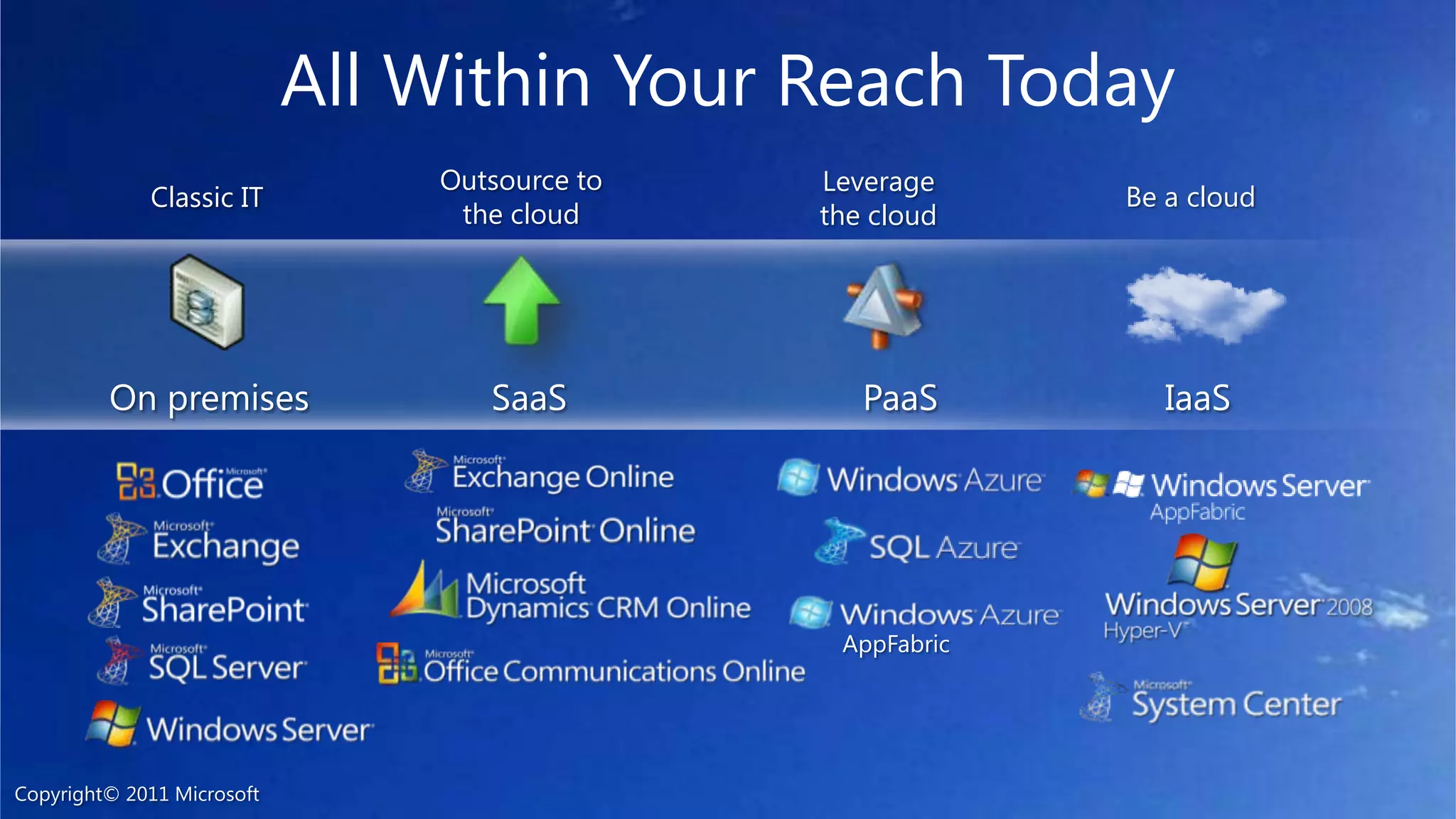
Outsource to the cloudLeverage the cloudBe a cloudClassic ITOn premisesSaaSPaaSIaaSAppFabricAll Within Your Reach TodayCopyright© 2011 Microsoft
Embracing Cloud Productivity with Microsoft
Call to ActionLearn more at:Microsoft Online Services - http://microsoft.com/onlineMicrosoft Windows Azure - http://microsoft.com/windowsazureMicrosoft Cloud Computing - http://microsoft.com/cloudMicrosoft Private Cloud - http://microsoft.com/privatecloud
© 2011 Microsoft Corporation. All rights reserved. This presentation is for informational purposes only. Microsoft makes no warranties, express or implied, in this summary.Microsoftand Your potential. Our passion. are trademarks of the Microsoft group of companies. The names of actual companies and products mentioned herein may be the trademarks of their respective owners. Microsoft Corporation • One Microsoft Way • Redmond, WA 98052-6399 • USA

Cloud Essentials

  • 1.
    Cloud Computing Essentialsfor IT ProsChris E. AvisSr. IT Pro Evangelist blogs.technet.com/chrisavis
  • 2.
  • 3.
    Generational ShiftBusinessEconomicTechnologyCentralized compute& storage, thin clientsHigh upfront costs for hardware and softwareOptimized for efficiency due to high costPerpetual license for OS and application softwarePCs and servers for distributed compute, storage, etc.Optimized for agility due to low costCopyright© 2011 MicrosoftPay as you go, as you need,and only for what you useBetter efficiency and agility(in orders of magnitude)Large DCs, commodity HW, scale-out, devices
  • 4.
    Fifth Generation ofComputing2010+2000sCloud1990sSOA1980sWeb1970sClient-ServerMainframe
  • 5.
  • 6.
    I think youhave great talents and should look for other career opportunities to reach your full potential.IT CAPACITYAllocated IT-capacitiesForcast demandsActual LoadTIME
  • 7.
    Wow, capacity ondemand! Very well done, IT!Knob goes up...And...downCapacity on demand!IT CAPACITYAllocated IT-capacitiesLower capex!Forcast demandsActual LoadTIME
  • 8.
    Growing Fast Onand Off InactivityPeriod Compute Compute Average UsageUsageAverageTime Time On and off workloads (e.g. batch job)Over provisioned capacity is wasted Tax SeasonTime to market can be cumbersome Successful services needs to grow/scale Keeping up w/growth is big IT challenge StartupsComplex lead time for deploymentUnpredictable Bursting Predictable Bursting Compute Compute Average Usage Average Usage Time Time Unexpected/unplanned peak in demand Sudden spike impacts performance News Service Can’t over provision for extreme cases Services with micro seasonality trends Peaks due to periodic increased demand LotteryIT complexity and wasted capacity WebsiteTypical Workload Patterns are Optimal for Cloud
  • 9.
    Your business isa service.What is a service?Capacity on demand?
  • 10.
    An approach tocomputing that’s about internet scale and connecting to a variety of devices and endpointsComputing in which dynamically scalable and often virtualized resources are provided as a service over the Internet/Intranet. What is cloud computing?… the applications delivered as services over Internet and the hardware and systems software in datacenters that provide those services. Cloud Computing means using a remote data center to manage scalable, reliable, on-demand access to applications
  • 11.
    Cloud Computing CharacteristicsRef:The NIST Definition of Cloud Computinghttp://csrc.nist.gov/publications/drafts/800-145/Draft-SP-800-145_cloud-definition.pdfOn-demand self-serviceLocation transparent resource poolingRapid elasticityMeasured service with pay per useUbiquitous network access
  • 12.
  • 13.
    Separation of ResponsibilitiesOn-PremisesInfrastructureasa ServiceSoftwareas a ServicePlatformas a ServiceYou manageApplicationsApplicationsApplicationsApplicationsYou manageDataDataDataDataYou manageRuntimeRuntimeRuntimeRuntimeMiddlewareMiddlewareMiddlewareMiddlewareOthers ManageOthers ManageO/SO/SO/SO/SVirtualizationVirtualizationVirtualizationVirtualizationOthers ManageServersServersServersServersStorageStorageStorageStorageNetworkingNetworkingNetworkingNetworking
  • 14.
    Cloud ContinuumPrivate cloudinside your data centerPublic cloud by service providers
  • 15.
    The story sofarThe cloud..Is a service-based approachHas specific characteristics (On-demand, ubiquitous, elastic, location independent, measured)Has various options for how it’s delivered (delivery methods) andhow responsibilities are separated (IaaS, PaaS, SaaS)Ultimately means IT transformation
  • 16.
    “The bottom line:Early adopters are finding serious benefits, meaning that cloud computing is real and warrants your scrutiny as a new set of platforms for business applications.” http://www.forrester.com/rb/Research/q%26a_by_2011%2C_cios_must_answer_question%2C/q/id/55193/t/2“By 2012, 80% of Fortune 1000 enterprises will be using some cloud computing services, 20% of businesses will own no IT assets.”http://www.gartner.com/it/page.jsp?id=1278413
  • 17.
  • 18.
    Yesterday and Today(Dowe know how to do “cloud”?)
  • 19.
    530 Million ActiveWindows Live IDs368 Million People Using HotmailOver 4 Billion WW Queries Each MonthOver 459 Million Unique Users2 Billion Unique Calls Per Year30 Million People On Xbox LiveOver 6 Million Songs in the Catalog14 Billion Ads Per MonthOver 303 Million Users Each MonthCLOUD SERVICESTV/HOMEPCMOBILEMicrosoft Consumer SaaS Offerings
  • 20.
    Best productivity experiencein the cloudSpanning PC, phone, and browserBest integration with servers and servicesEnterprise class softwareDelivered via subscription servicesOperated by Microsoft and sold with partnersMicrosoft Business SaaS OfferingsCopyright© 2011 Microsoft
  • 21.
    Windows Azure PlatformMicrosoftPaaS OfferingsMiddlewareService BusAccess ControlComputeStorageFabric ControllerExtension of MS SQL ServerRelational DB in cloudCopyright© 2011 Microsoft
  • 22.
    Microsoft Private CloudOfferingsHyper-V Cloud Deployment GuideFast TrackService providersIntegrated and extended securityServer consolidationNon-MS OS supportSelf-service portalDatacenter to cloud managementMulti-platform supportCopyright© 2011 Microsoft
  • 23.
    Outsource to thecloudLeverage the cloudBe a cloudClassic ITOn premisesSaaSPaaSIaaSAppFabricAll Within Your Reach TodayCopyright© 2011 Microsoft
  • 24.
  • 25.
    Call to ActionLearnmore at:Microsoft Online Services - http://microsoft.com/onlineMicrosoft Windows Azure - http://microsoft.com/windowsazureMicrosoft Cloud Computing - http://microsoft.com/cloudMicrosoft Private Cloud - http://microsoft.com/privatecloud
  • 26.
    © 2011 MicrosoftCorporation. All rights reserved. This presentation is for informational purposes only. Microsoft makes no warranties, express or implied, in this summary.Microsoftand Your potential. Our passion. are trademarks of the Microsoft group of companies. The names of actual companies and products mentioned herein may be the trademarks of their respective owners. Microsoft Corporation • One Microsoft Way • Redmond, WA 98052-6399 • USA

Editor's Notes

  • #12 Source: The NIST Definition of Cloud Computinghttp://csrc.nist.gov/groups/SNS/cloud-computing/cloud-def-v15.docOn-demand self-service Ubiquitous network access Location independent resource pooling Rapid elasticity Measured service Essential Characteristics:On-demand self-service. A consumer can unilaterally provision computing capabilities, such as server time and network storage, as needed automatically without requiring human interaction with each service’s provider. Broad network access. Capabilities are available over the network and accessed through standard mechanisms that promote use by heterogeneous thin or thick client platforms (e.g., mobile phones, laptops, and PDAs).Resource pooling. The provider’s computing resources are pooled to serve multiple consumers using a multi-tenant model, with different physical and virtual resources dynamically assigned and reassigned according to consumer demand. There is a sense of location independence in that the customer generally has no control or knowledge over the exact location of the provided resources but may be able to specify location at a higher level of abstraction (e.g., country, state, or datacenter). Examples of resources include storage, processing, memory, network bandwidth, and virtual machines.Rapid elasticity. Capabilities can be rapidly and elastically provisioned, in some cases automatically, to quickly scale out and rapidly released to quickly scale in. To the consumer, the capabilities available for provisioning often appear to be unlimited and can be purchased in any quantity at any time.Measured Service. Cloud systems automatically control and optimize resource use by leveraging a metering capability at some level of abstraction appropriate to the type of service (e.g., storage, processing, bandwidth, and active user accounts). Resource usage can be monitored, controlled, and reported providing transparency for both the provider and consumer of the utilized service.
  • #15 Private CloudAn internal service-oriented IT environment optimized for performance and cost that is deployed inside a customer’s datacenter. Powered by products including Windows Server® and Microsoft® System Center family of products, private clouds are deployed to work with existing applications and new applications while using cloud principles like elasticity, scalability and chargeback proportional to use. Public CloudA deployment model that provides highly scalable and elastic cloud services to multiple customers from Microsoft’s datacenters or other service providers’ (e.g. hosting partners, http://www.microsoft.com/virtualization/en/us/cloud-hosting-partners.aspx) datacenters. Windows® Azure™ is a highly scalable cloud services platform delivered from Microsoft’s datacenters that provides pay–as-you-go flexibility in a public cloud deployment model. Private Cloud - Public Cloud -Private Cloud for the EnterpriseThe private cloud is a new model of success for enterprises because it allows them to scale up as needed, quickly and cost-effectively while improving business capabilities with dynamic, flexible applications. Benefits include the ability to:Deliver scalable applications and workloads.Enable federated services across the full cloud continuum.Manage the data center fabric as a single pool of resources.Focus on the management of the data center service and its dependencies.
  • #17 Businesses are moving to the cloud. Analysts predict that the vast majority of large businesses will be using some type of cloud services in the next few years and that many will drastically be cutting the IT assets that they run and maintain in favor of pushing IT to the cloud and have others run the assets for them. Economics will always be an important driver in business. The economic cycle of recent years and the ongoing consequences have tended to put cost cutting above over factors in evaluating technology and this has led many companies to consider the cloud because – above all – it promises lower costs, shifts from more rigid capital expenses to the more fluid operating expenses and enables business to pay only for the computing that it consumes. Historically, economics tends to be a leading indicator for the success of a technology but the cloud dramatically democratizes technology too and enables hitherto impractical applications to become practical. You need to be very careful that your competitors don’t take better advantage of the cloud because it’s likely that, if they do, they’ll gain increased agility, lower costs and the ability to deliver better services to more customers more quickly. Do you want to take that risk?
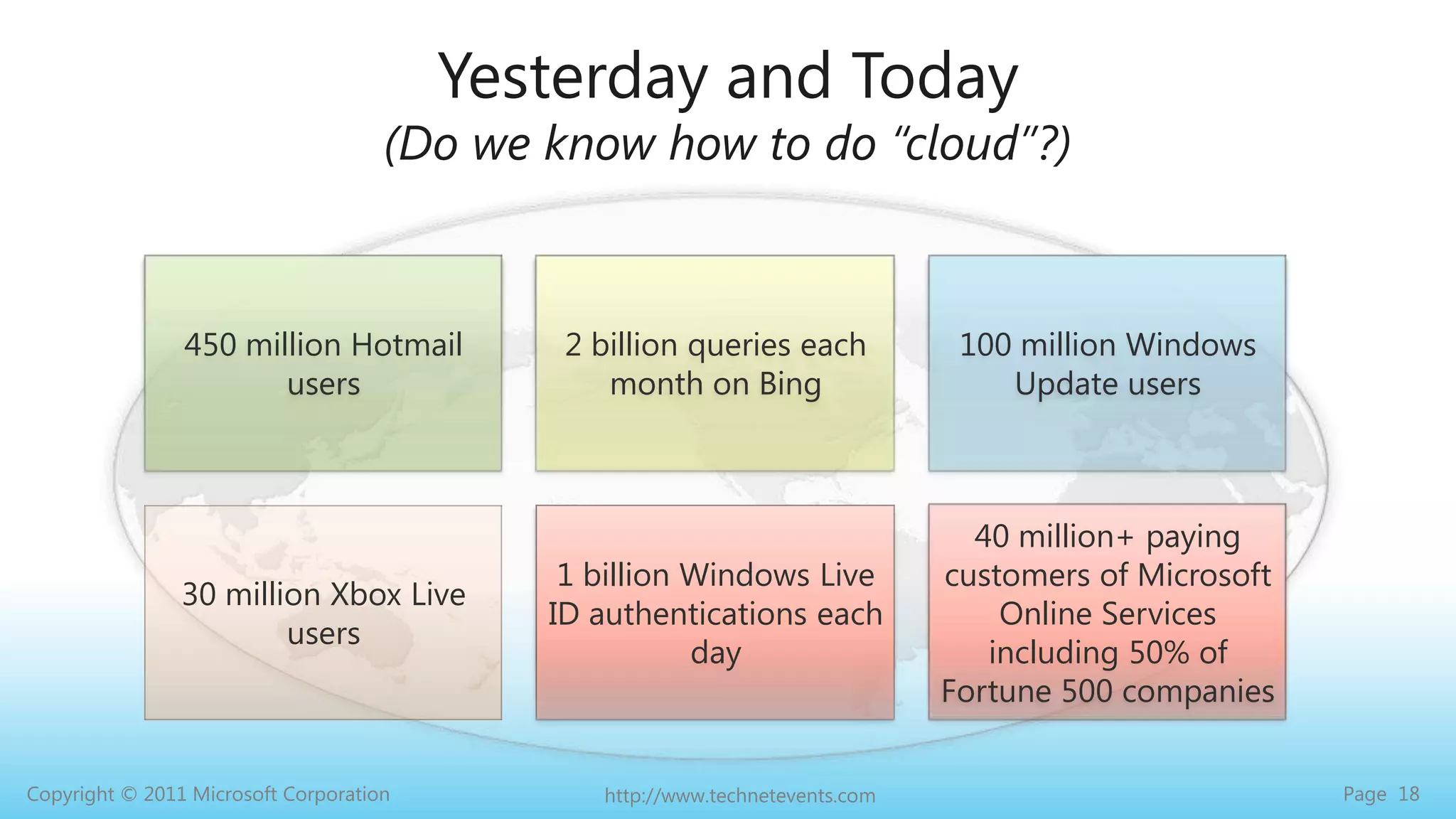
  • #19 So why are we here? Is Microsoft really serious about the world of Cloud Computing? Let’s take a look of some of the challenges that is happening in the IT industry. For instance, in Microsoft, we are facing: How to support 450 million Hotmail users?2 billion queries on Bing each month?100 million Windows Update users?30 million Xbox Live users?And everyday, 1 billion Windows Live authentications?while these numbers continue to grow, and with increased expectation on performance and availability
  • #23 Hyper-V, the Windows Server 2008 R2 hypervisor-based server virtualization technology, is a core component of the Microsoft private cloud. Hyper-V helps you to make the best use of your server hardware investments by consolidating multiple server roles as separate virtual machines (VMs) running on a single physical machine. It also helps you efficiently run multiple, different operating systems—Windows, Linux, and others—in parallel, on a single server, and fully leverage the power of x64 computing.Private Cloud for the EnterpriseThe private cloud is a new model of success for enterprises because it allows them to scale up as needed, quickly and cost-effectivelywhile improving business capabilities with dynamic, flexible applications. Benefits include the ability to:Deliver scalable applications and workloads.Enable federated services across the full cloud continuum.Manage the data center fabric as a single pool of resources.Focus on the management of the data center service and its dependencies.Hyper-V Cloud OfferingsDeployment guidesTo help you get started building your own private cloud with Microsoft products.Build your own private cloud based on Windows Server 2008 R2 Hyper-V and System CenterFast TrackFor pre-validated configurations from Microsoft and OEM server partners.Hyper-V Cloud partners have specialized resources, industry knowledge, and best practices to help you plan, build, and deploy commercial private and public clouds based on Windows Server Hyper-V, System Center, and related products.Service providersFor partners who can host a dedicated private cloud for you.
  • #24 In Classic IT, most systems are purchased when needed, and grow organically to handle what the business sees as peak demand at any given time. Most applications are in silos, and connections are made in an expensive point to point custom development fashion. Only a basic level of maturity is required although a company may be more advanced depending on their IT investment and commitment level.When a company chooses to Outsource to the Cloud, they are typically moving a commodity packaged software function to the cloud. All of these solutions are considered “Software as a Service.” They often require a higher level of maturity because of the need for a unified identity system to make them work seamlessly for employees. You can see that a move to BPOS will naturally increase the IT maturity level of an organization, thus opening up new avenues of cloud use and integration.Leveraging the Cloud in contrast can occur without a particularly advanced IT infrastructure as there is opportunity to take advantage of compute and storage in the cloud without touching any other systems. Of course it is preferable, but not required.Finally, a company may want to Be a Cloud. In other words, they wish to have the features of cloud based infrastructure such as elastic scaling available to them in a “private cloud” or they wish to provide data services or software as a service to their partners, suppliers, or customers.The products listed on this slide are not intended to be exhaustive of Microsoft’s offerings.