

Seventh International Conference on eLearning for Knowledge-Based
Society

Cloud Computing-The Magical
New ICT-Paradigm for Academic
xLearning ?
(eLearning, mLearning, uLearning)
Cloud Computing At A Glance
The term - Cloud

Computing – relatively new

The concept is not – Hotmail Web Hosting (Katzan 2010)
Lots of definitions (Golden 2009, Dothang 2010), the simplest one:

Cloud Computing – is getting computer services / resources
from the Internet.
Computer services means using all kinds of computer
resources on the web instead of using local resources.
Other Definitions of Cloud Computing
(Truitt 2009)

SaaS - Software-as-a-Service
SaaS - Security-as-a-Service
PaaS - Platform-as-a-Service
IaaS - Infrastructure-as-a-Service
XaaS – Everything-as-a-Service
Motivation
•

Merrill Lynch: 2012, the annual global market for cloud
computing is expected surge to $160 billion by 2012.

•

CA Technologies Chairman and CEO, William E. McCracken
said in CA World 2010 (May 2010): "In recent months, many
ask me whether I think that cloud computing is the IT future.
I always reply that I don't think, I'm sure".

•

Marc Andreessen, founder of the Mosaic web browser and
co-founder of Netscape, “cloud computing is the story of
the lifetime.”

•

Google CEO Eric Schmidt notes, "The cloud is a smart,
complex, powerful computing system in the sky that people
can just plug into."
Cloud Computing – Buzzword ?
Cloud Computing – is not a buzzword anymore !!!
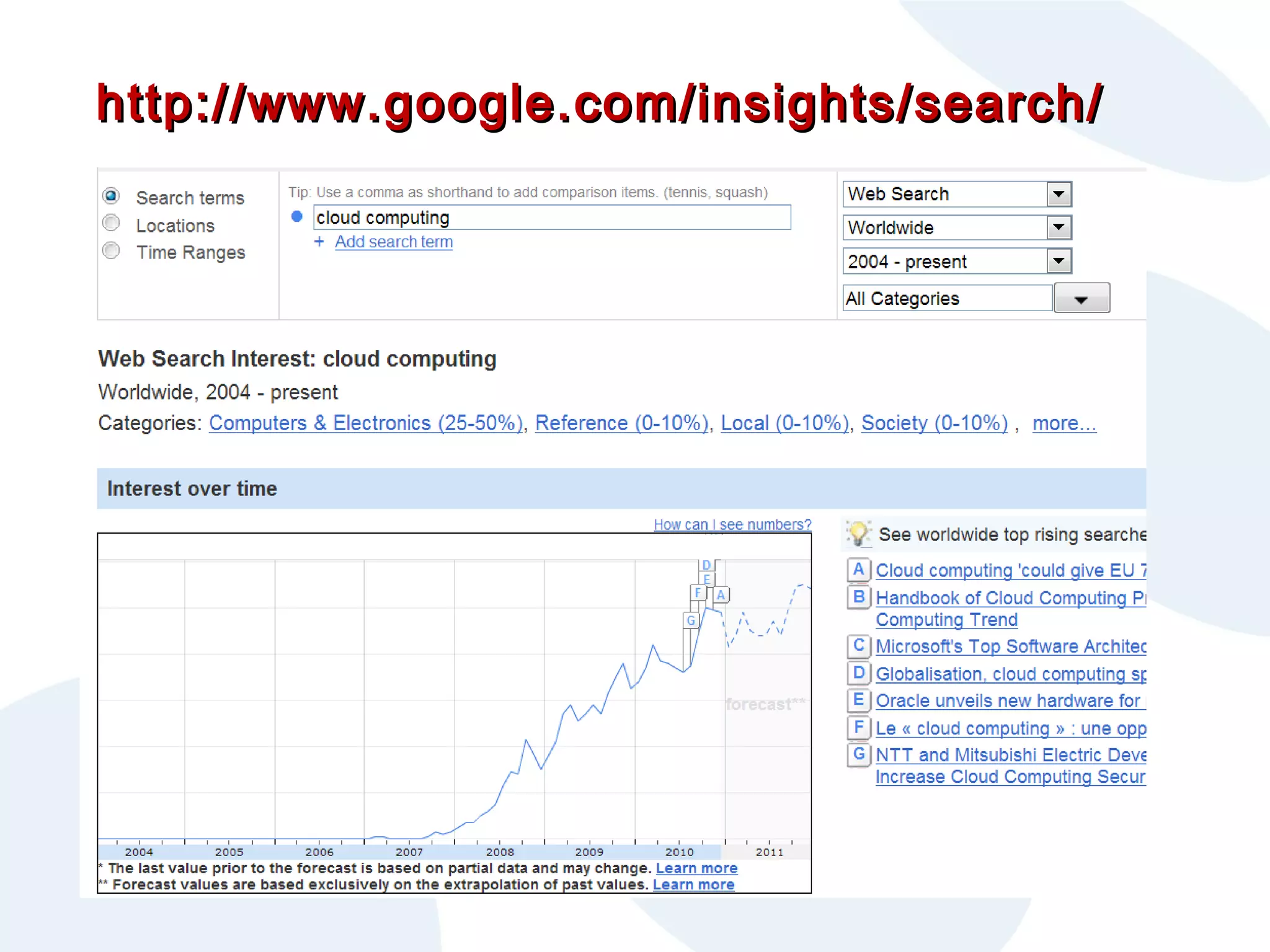
Search of the term:
http://www.google.com/insights/search/
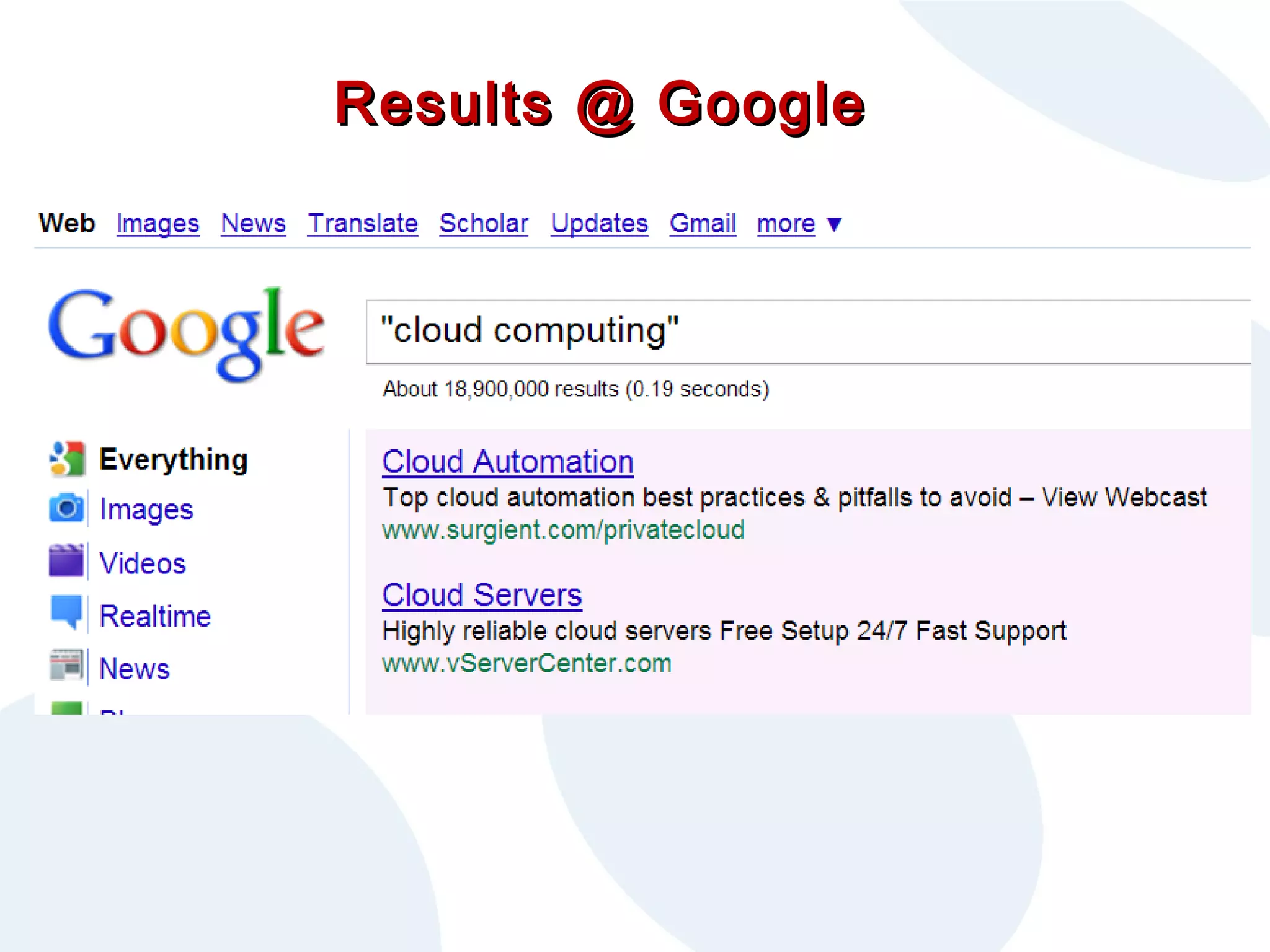
Number of search results:
Results @ Google
YouTube (xLearning) on Cloud Computing (one of many):
http://www.youtube.com/watch?v=QJncFirhjPg
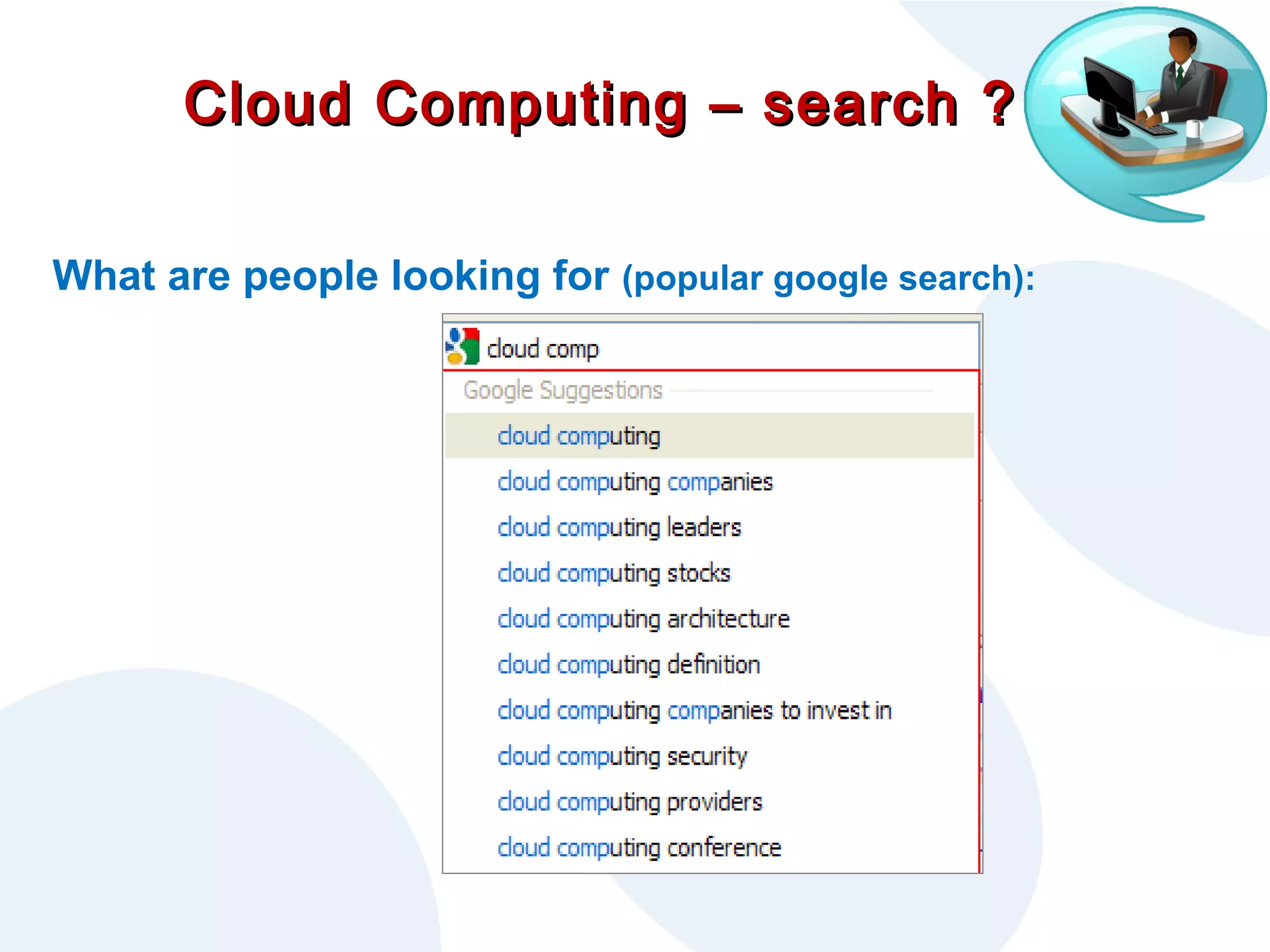
Cloud Computing – search ?
What are people looking for (popular google search):
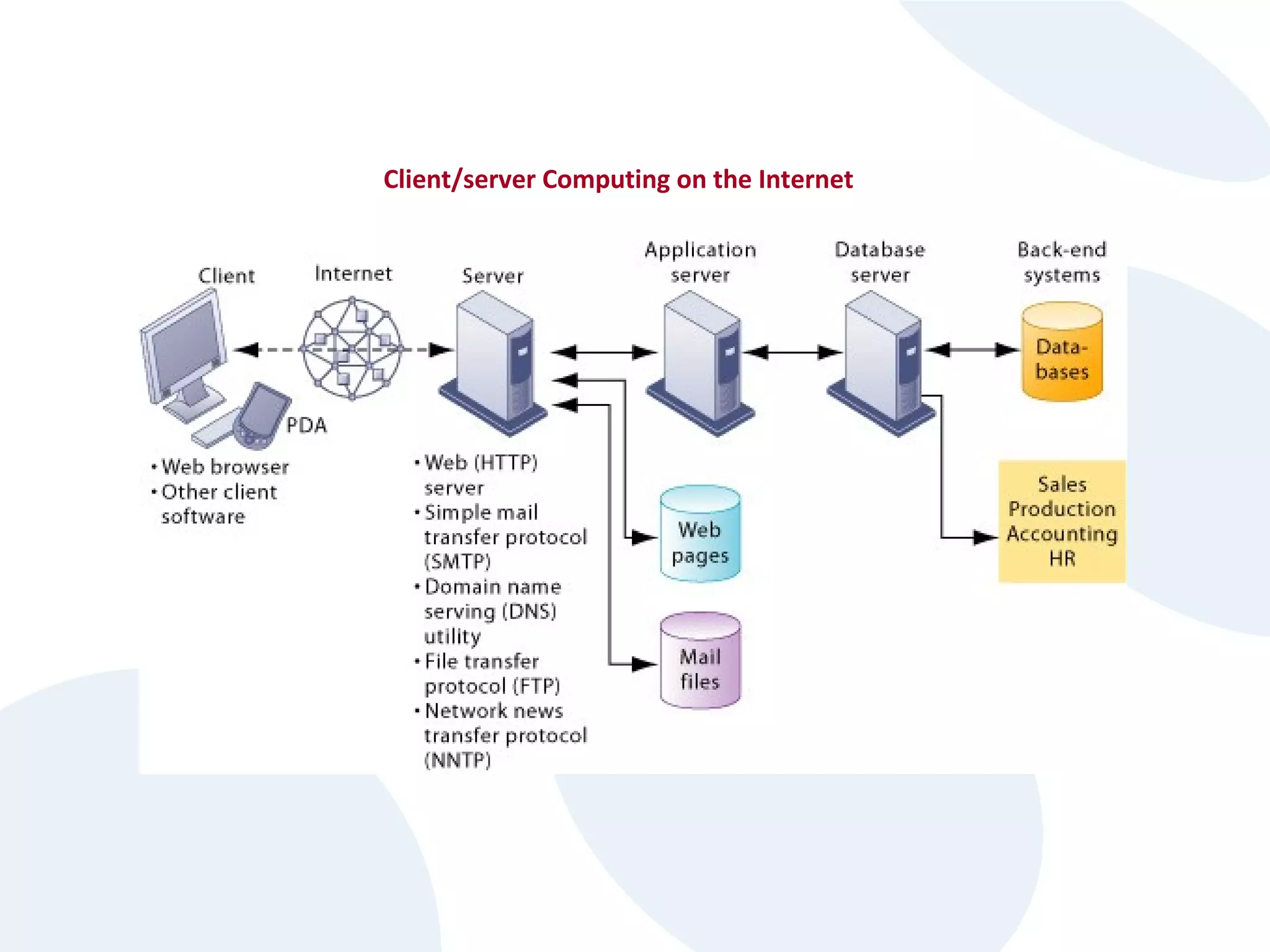
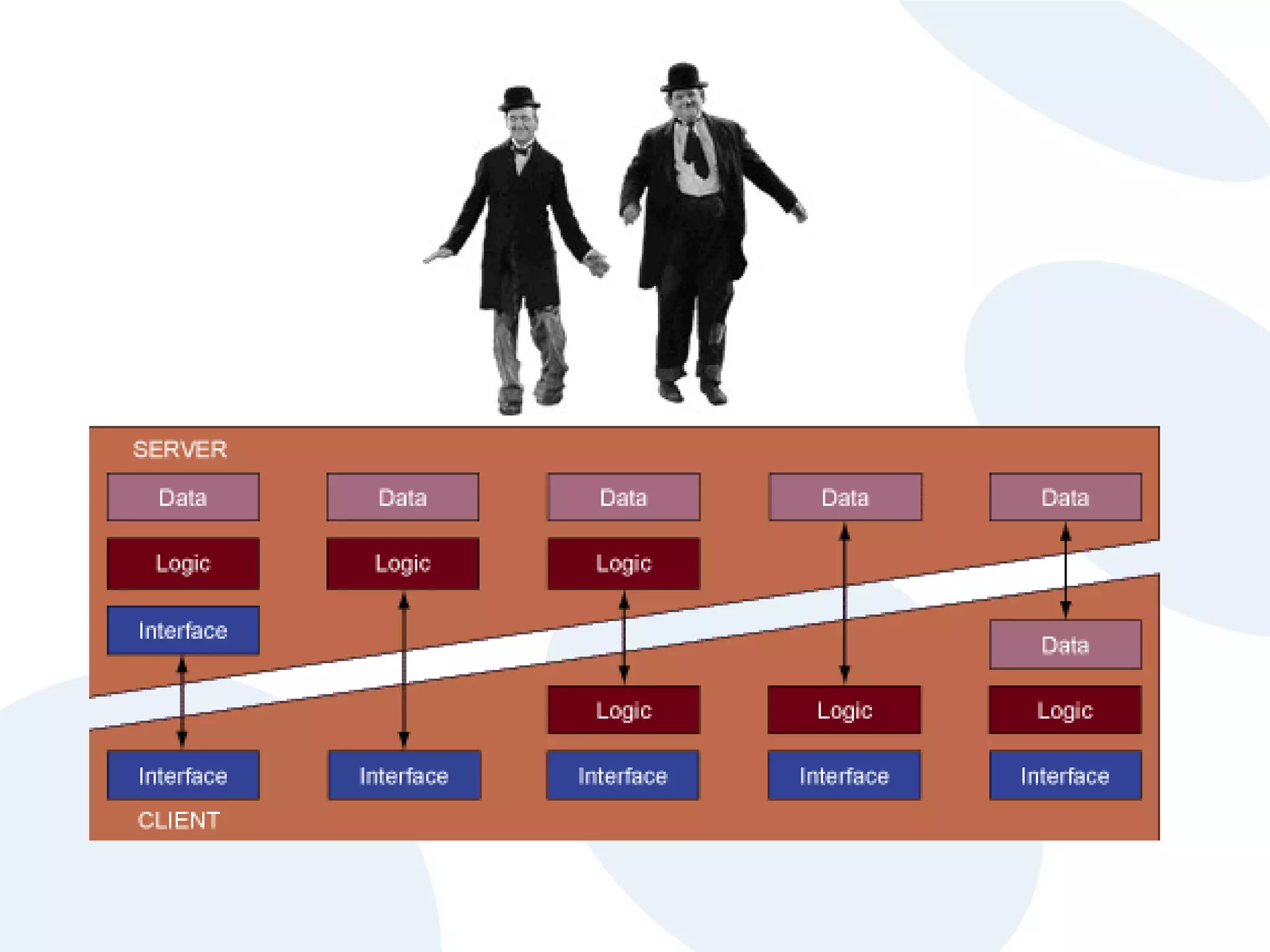
Client/server Computing on the Internet
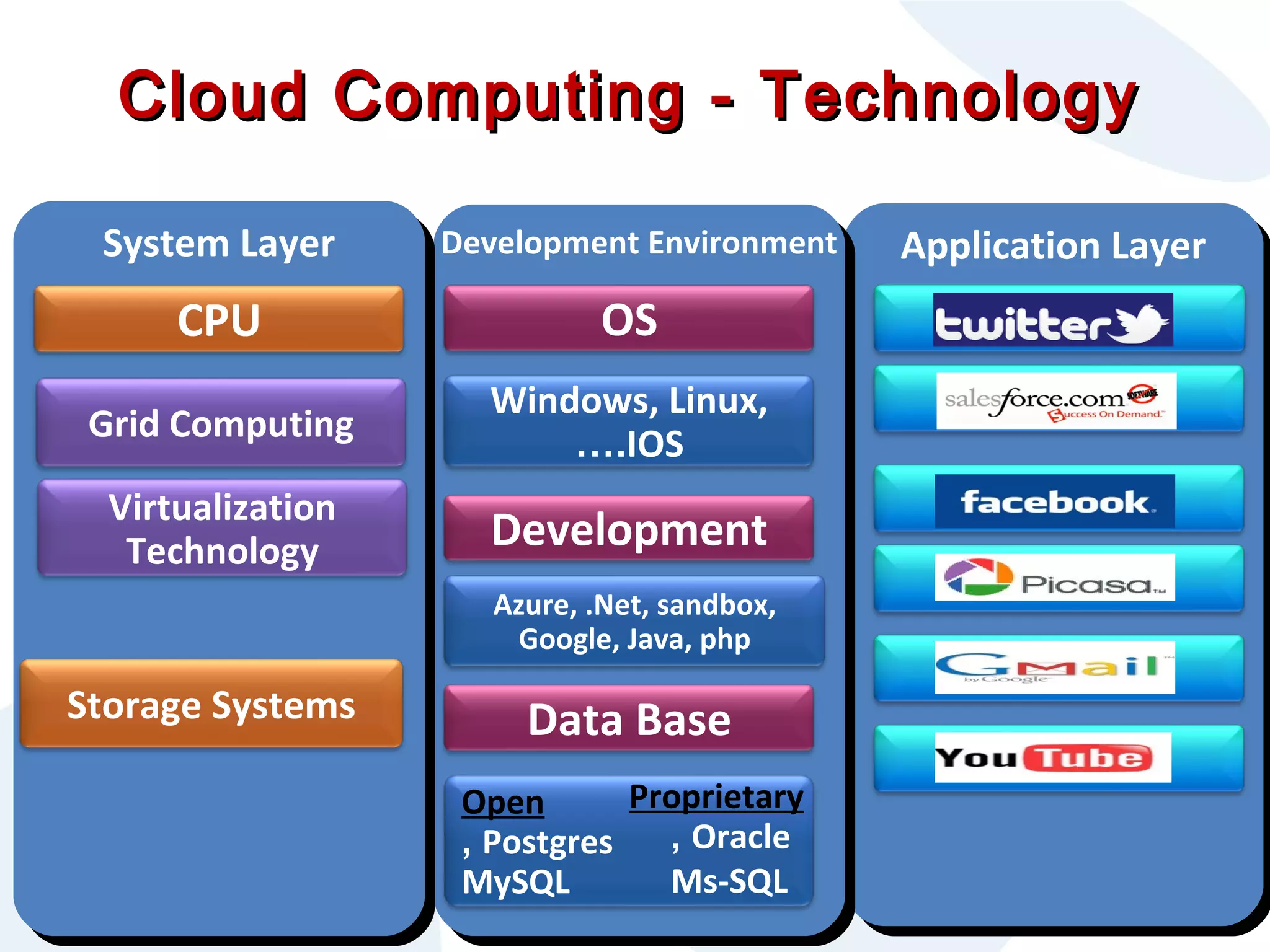
Cloud Computing - Technology
System Layer
System Layer

Development Environment

CPU

OS

Grid Computing

Windows, Linux,
….IOS

Virtualization
Technology

Development
Azure, .Net, sandbox,
Google, Java, php

Storage Systems

Data Base
Proprietary
Open
, Oracle
, Postgres
Ms-SQL
MySQL

Application Layer
Application Layer
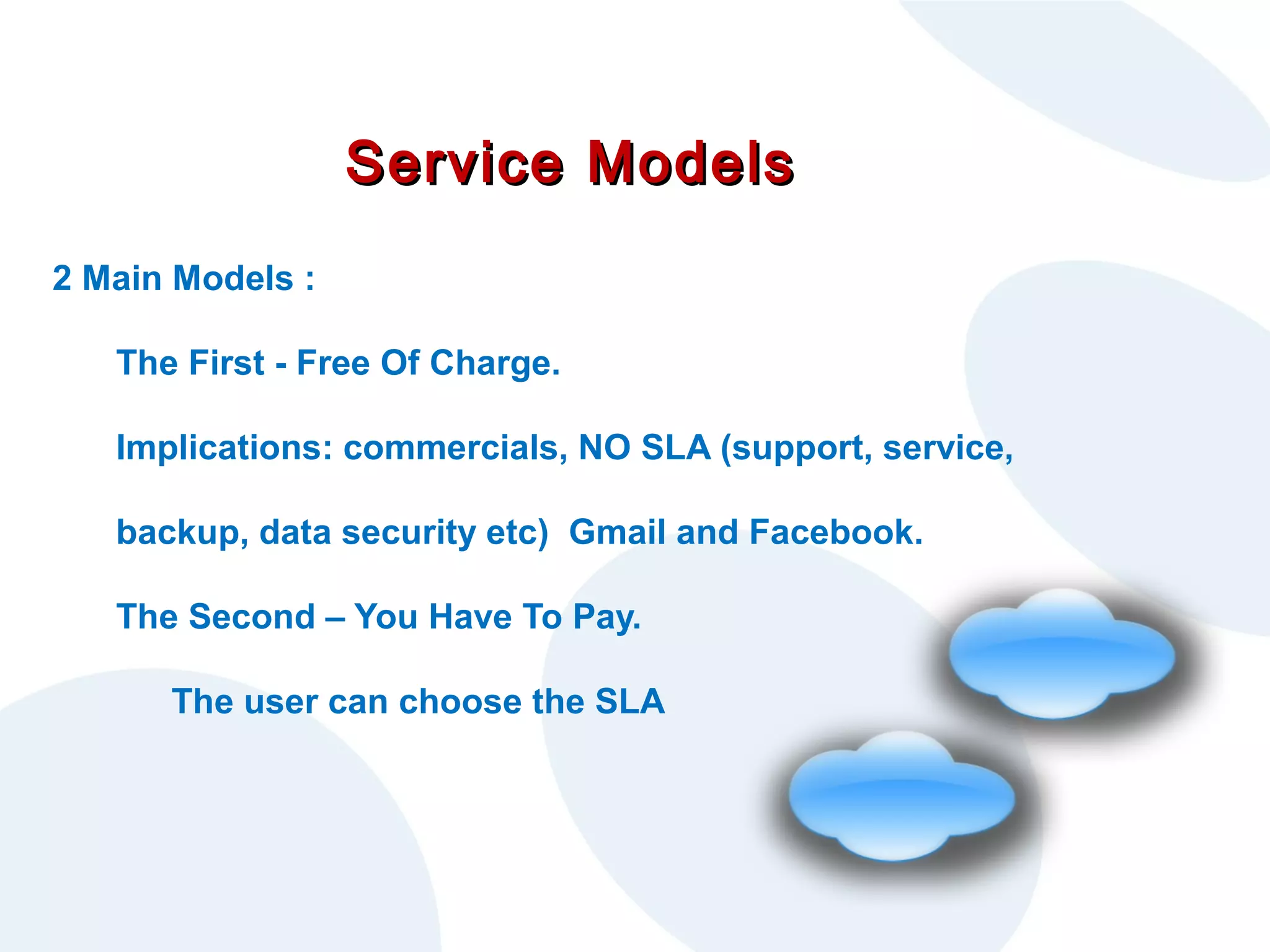
Service Models
2 Main Models :
The First - Free Of Charge.
Implications: commercials, NO SLA (support, service,
backup, data security etc) Gmail and Facebook.
The Second – You Have To Pay.
The user can choose the SLA
Cloud Computing - types
 Private Cloud
 Public Cloud
 Community Cloud (shared library software)
 Hybrid Cloud – most common in the future
Trends in ICT that make Cloud
Computing Popular
 Economic crisis
 More bandwidth (remember the 14,400 modem vs. NGN)
 Here and now – 24 hours a day 7 days a week
from everywhere (during flights)

 Pressure to lower the IT cost – TCO
 Technology people are expensive
 Green IT
 Pay-Per-Use (rent instead of buy)
 Real need for Scalability
Trends In ICT 2
 Lower the risk of IT projects (less than 50%
of the ICT projects are considered successful)

 Downsizing of client side – the mobile phone /
SmartPhone

 Economies of scale
 Phobia among CIOs (open source, cloud)
 Implementation and assimilation
Trends In ICT 3
 Storage prices went down (large data centers)
 Storage requirements and reliability went up
 Advanced Technology – Grid Computing
 Virtualization Technology
 TCP/IP – became standard
Who Can Benefit ?


Large organizations – not the core activity,
quick results, less risk (50% failure). Share the Email
system 85% outside 15% inside



Small organizations – Email, website, open office (free !!!)
collaborate with others, data protection, FW, backup,
no maintenance, CRM for a penny (salesforce )



The Individual – Gmail, Facebook, Twitter

 In other words – every one !!!
Risks and Disadvantages
• Security issues in cloud commuting might not be
resolved completely
• Third party environment might be considered
unsafe for most organizations, (Jean Thilmany,
2010).
• Lack of privacy since the third party will have full
access to the data.
Risks
• Losing management control (infrastructure)
• Loss of control on the backup and maintenance activities
• Losing data protection management
• Dependence upon outer services
• Integration between local and Cloud Computing systems.
• Implementing Identity Management (IDM)
• Data interchange between applications (SOA)
• Risk management using Cloud Computing
is much more complicated.
The Google Toilet
Is Jeff Goldblum dead ?
Our Experience @ “COMAS”
The College of Management Academic Studies :
– founded in 1978
– Located 10 km south to Tel Aviv
– the first non-subsidized, academic institution in Israel
– the largest college in Israel
– over 12,000 students
– over 34,000 alumni
– 1,300 desktops (PCs) and 150 servers, 80 of them virtual
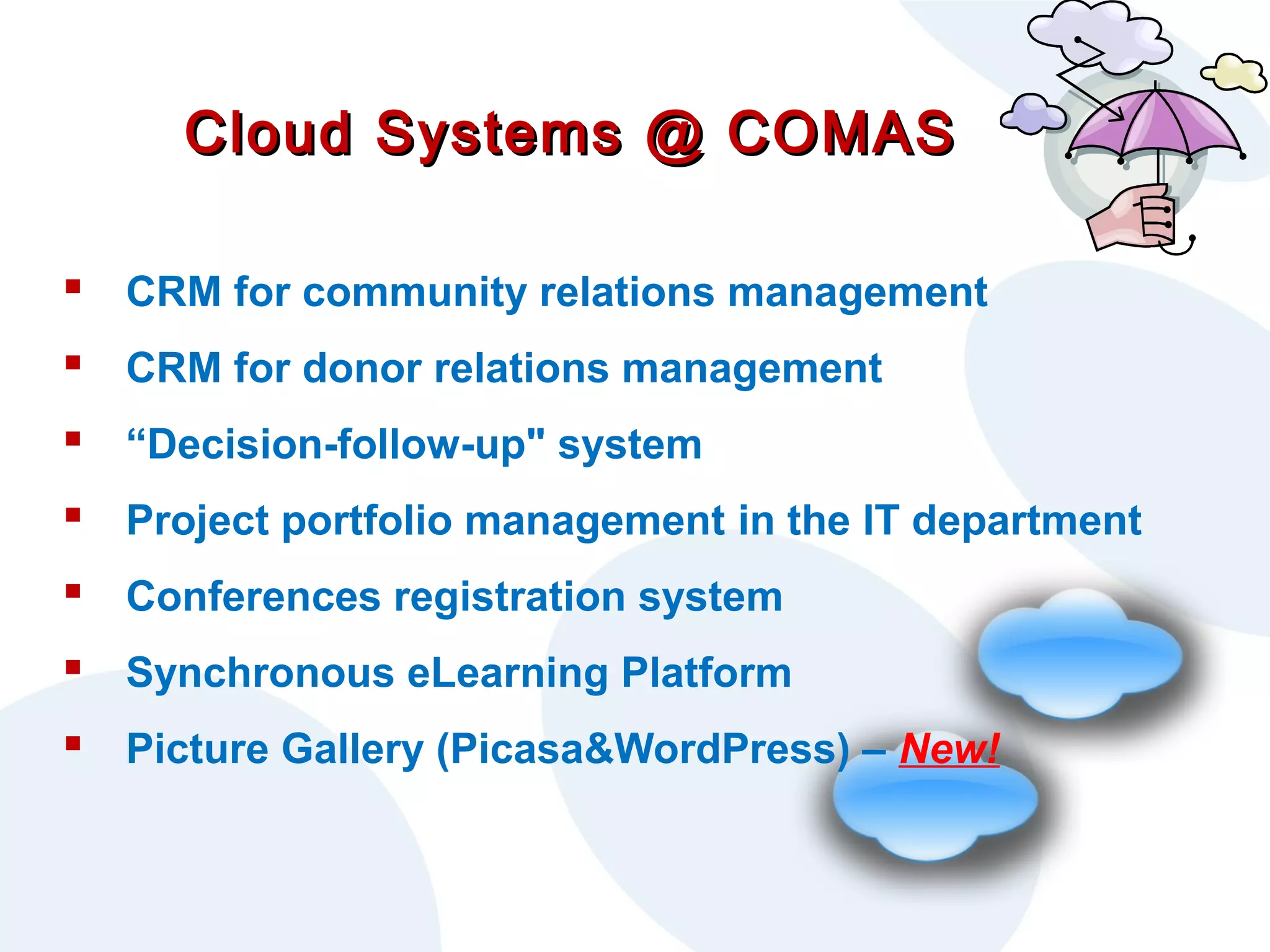
Cloud Systems @ COMAS
 CRM for community relations management
 CRM for donor relations management
 “Decision-follow-up" system
 Project portfolio management in the IT department
 Conferences registration system
 Synchronous eLearning Platform
 Picture Gallery (Picasa&WordPress) – New!
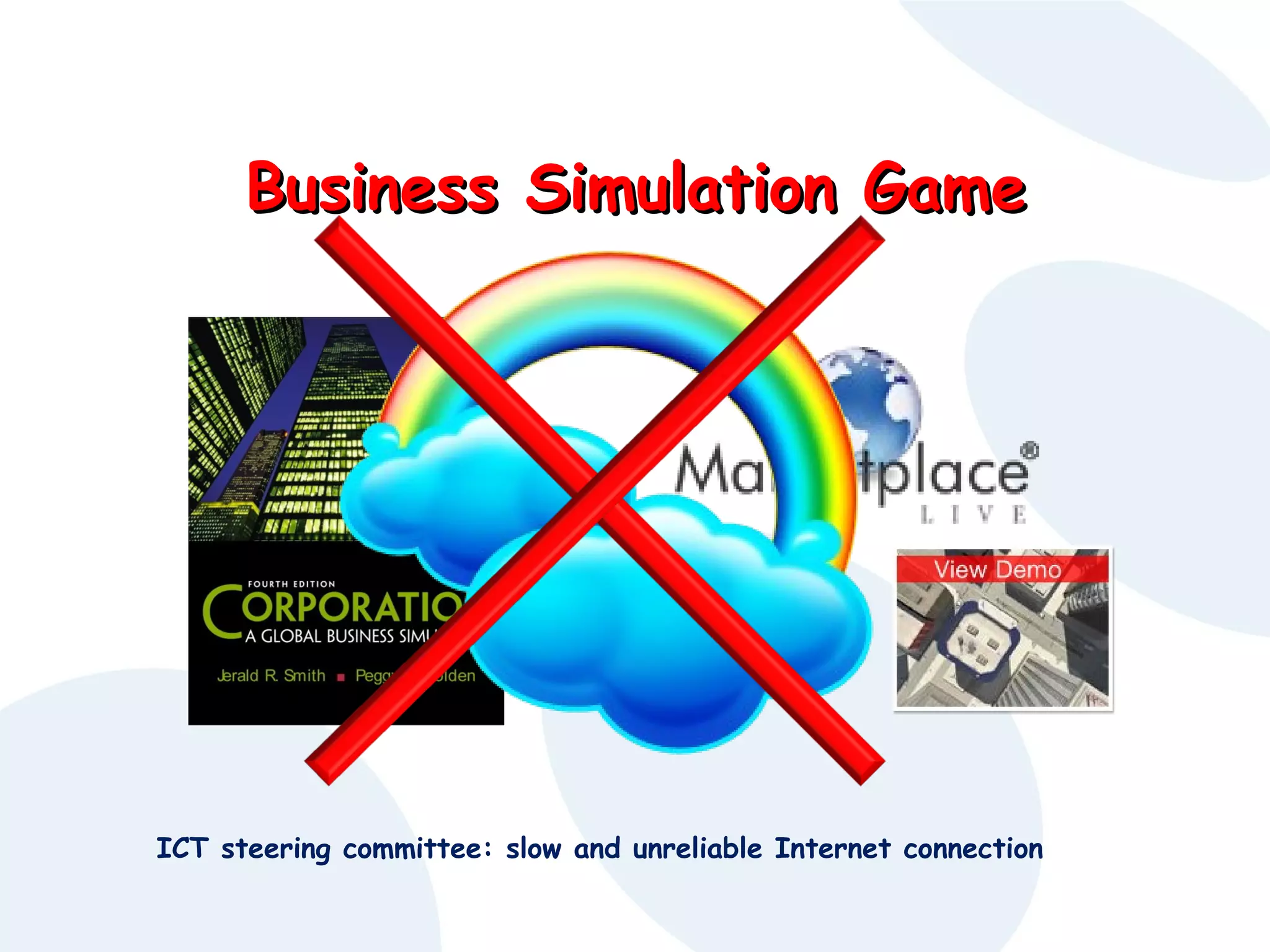
Business Simulation Game

ICT steering committee: slow and unreliable Internet connection
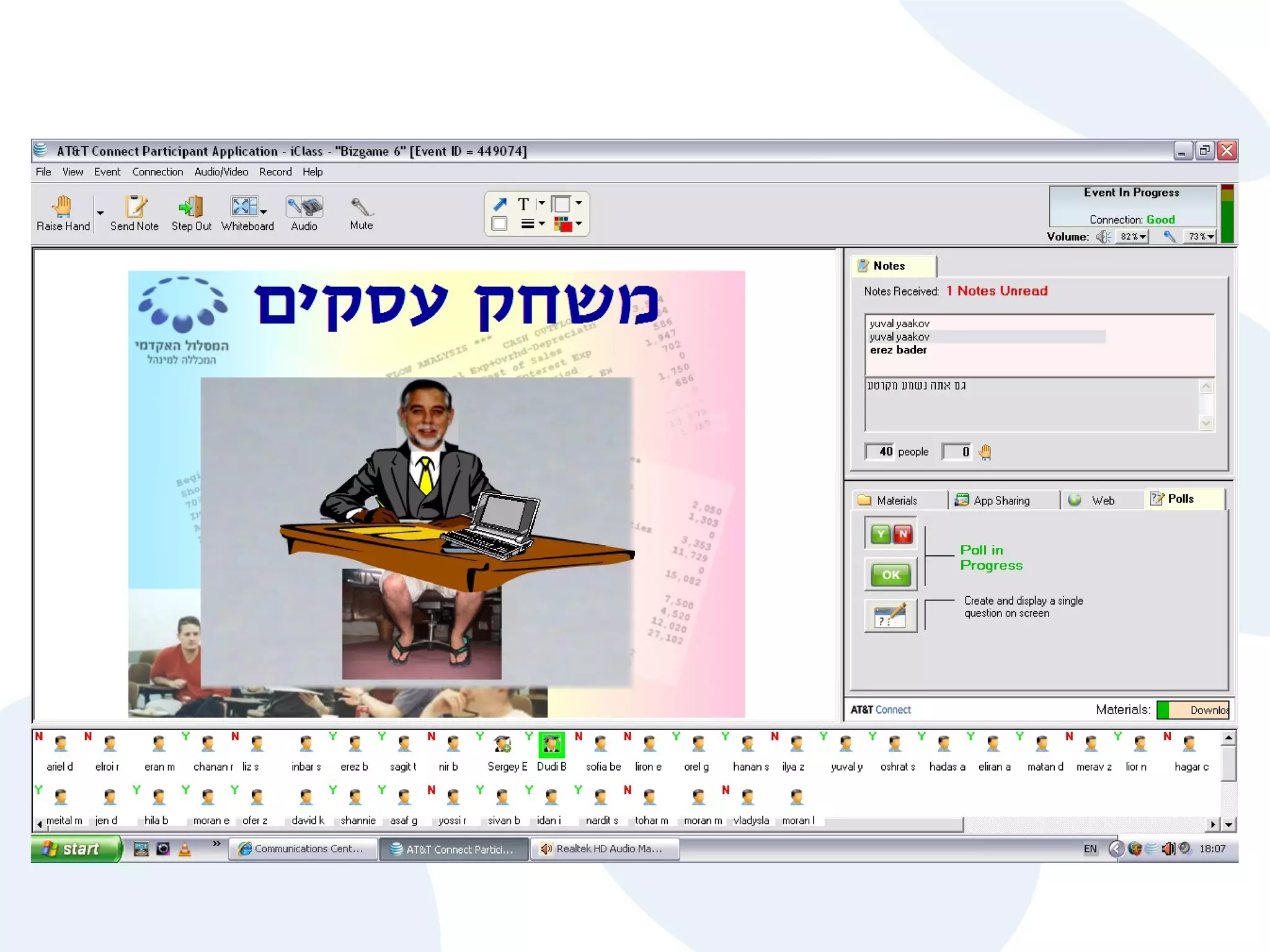
Synchronous eLearning Platform

®AT&T Connect
®AT&T Connect

•A large technical infrastructure (IaaS)
is needed to deliver synchronous courses.
•Technical support for both students and
professors.
Which Service Should be Moved
to the Cloud
• (1) Is it the operation / system - a core
operationactivityprocessapplication?
• (2) Is there a comparative advantage to installing them
on local servers?
• (3) Is it much cheaper to get these applications over the
cloud?
• (4) Is timetable a factor? Is fast implementation needed?
• (5) What is the risk of data security and data protection?
Conclusions and Implications


The economic crisis



The pressure to lower ICT costs



Higher education institutions - budget problems (chalenges)



Lack of regulations (unlike banks)
Conclusions 2


COMAS: "Implementing the cloud computing solution was
quick,

cheap,

efficient,

and

effective

resulting

satisfaction rate among users."



 H.E. are highly motivated to move to the cloud



The main barrier is data protection and security.



Computer resources will eventually become commodities

high
Further Research
• What will happen to IT departments in the future …
• What will happen to the Academia in the future
regarding xLearning …

• israeld@hdq.colman.ac.il , dudibreg@colman.ac.il
Thank You
http://www.google.com/insights/search/
Results @ Google

Cloud computing

  • 1.
    Seventh International Conferenceon eLearning for Knowledge-Based Society Cloud Computing-The Magical New ICT-Paradigm for Academic xLearning ? (eLearning, mLearning, uLearning)
  • 2.
    Cloud Computing AtA Glance The term - Cloud Computing – relatively new The concept is not – Hotmail Web Hosting (Katzan 2010) Lots of definitions (Golden 2009, Dothang 2010), the simplest one: Cloud Computing – is getting computer services / resources from the Internet. Computer services means using all kinds of computer resources on the web instead of using local resources.
  • 3.
    Other Definitions ofCloud Computing (Truitt 2009) SaaS - Software-as-a-Service SaaS - Security-as-a-Service PaaS - Platform-as-a-Service IaaS - Infrastructure-as-a-Service XaaS – Everything-as-a-Service
  • 4.
    Motivation • Merrill Lynch: 2012,the annual global market for cloud computing is expected surge to $160 billion by 2012. • CA Technologies Chairman and CEO, William E. McCracken said in CA World 2010 (May 2010): "In recent months, many ask me whether I think that cloud computing is the IT future. I always reply that I don't think, I'm sure". • Marc Andreessen, founder of the Mosaic web browser and co-founder of Netscape, “cloud computing is the story of the lifetime.” • Google CEO Eric Schmidt notes, "The cloud is a smart, complex, powerful computing system in the sky that people can just plug into."
  • 5.
    Cloud Computing –Buzzword ? Cloud Computing – is not a buzzword anymore !!! Search of the term: http://www.google.com/insights/search/ Number of search results: Results @ Google YouTube (xLearning) on Cloud Computing (one of many): http://www.youtube.com/watch?v=QJncFirhjPg
  • 6.
    Cloud Computing –search ? What are people looking for (popular google search):
  • 8.
  • 10.
    Cloud Computing -Technology System Layer System Layer Development Environment Development Environment CPU OS Grid Computing Windows, Linux, ….IOS Virtualization Technology Development Azure, .Net, sandbox, Google, Java, php Storage Systems Data Base Proprietary Open , Oracle , Postgres Ms-SQL MySQL Application Layer Application Layer
  • 11.
    Service Models 2 MainModels : The First - Free Of Charge. Implications: commercials, NO SLA (support, service, backup, data security etc) Gmail and Facebook. The Second – You Have To Pay. The user can choose the SLA
  • 12.
    Cloud Computing -types  Private Cloud  Public Cloud  Community Cloud (shared library software)  Hybrid Cloud – most common in the future
  • 13.
    Trends in ICTthat make Cloud Computing Popular  Economic crisis  More bandwidth (remember the 14,400 modem vs. NGN)  Here and now – 24 hours a day 7 days a week from everywhere (during flights)  Pressure to lower the IT cost – TCO  Technology people are expensive  Green IT  Pay-Per-Use (rent instead of buy)  Real need for Scalability
  • 14.
    Trends In ICT2  Lower the risk of IT projects (less than 50% of the ICT projects are considered successful)  Downsizing of client side – the mobile phone / SmartPhone  Economies of scale  Phobia among CIOs (open source, cloud)  Implementation and assimilation
  • 15.
    Trends In ICT3  Storage prices went down (large data centers)  Storage requirements and reliability went up  Advanced Technology – Grid Computing  Virtualization Technology  TCP/IP – became standard
  • 16.
    Who Can Benefit?  Large organizations – not the core activity, quick results, less risk (50% failure). Share the Email system 85% outside 15% inside  Small organizations – Email, website, open office (free !!!) collaborate with others, data protection, FW, backup, no maintenance, CRM for a penny (salesforce )  The Individual – Gmail, Facebook, Twitter  In other words – every one !!!
  • 17.
    Risks and Disadvantages •Security issues in cloud commuting might not be resolved completely • Third party environment might be considered unsafe for most organizations, (Jean Thilmany, 2010). • Lack of privacy since the third party will have full access to the data.
  • 18.
    Risks • Losing managementcontrol (infrastructure) • Loss of control on the backup and maintenance activities • Losing data protection management • Dependence upon outer services • Integration between local and Cloud Computing systems. • Implementing Identity Management (IDM) • Data interchange between applications (SOA) • Risk management using Cloud Computing is much more complicated.
  • 19.
  • 20.
  • 21.
    Our Experience @“COMAS” The College of Management Academic Studies : – founded in 1978 – Located 10 km south to Tel Aviv – the first non-subsidized, academic institution in Israel – the largest college in Israel – over 12,000 students – over 34,000 alumni – 1,300 desktops (PCs) and 150 servers, 80 of them virtual
  • 22.
    Cloud Systems @COMAS  CRM for community relations management  CRM for donor relations management  “Decision-follow-up" system  Project portfolio management in the IT department  Conferences registration system  Synchronous eLearning Platform  Picture Gallery (Picasa&WordPress) – New!
  • 23.
    Business Simulation Game ICTsteering committee: slow and unreliable Internet connection
  • 24.
  • 26.
    ®AT&T Connect •A largetechnical infrastructure (IaaS) is needed to deliver synchronous courses. •Technical support for both students and professors.
  • 27.
    Which Service Shouldbe Moved to the Cloud • (1) Is it the operation / system - a core operationactivityprocessapplication? • (2) Is there a comparative advantage to installing them on local servers? • (3) Is it much cheaper to get these applications over the cloud? • (4) Is timetable a factor? Is fast implementation needed? • (5) What is the risk of data security and data protection?
  • 28.
    Conclusions and Implications  Theeconomic crisis  The pressure to lower ICT costs  Higher education institutions - budget problems (chalenges)  Lack of regulations (unlike banks)
  • 29.
    Conclusions 2  COMAS: "Implementingthe cloud computing solution was quick, cheap, efficient, and effective resulting satisfaction rate among users."   H.E. are highly motivated to move to the cloud  The main barrier is data protection and security.  Computer resources will eventually become commodities high
  • 30.
    Further Research • Whatwill happen to IT departments in the future … • What will happen to the Academia in the future regarding xLearning … • israeld@hdq.colman.ac.il , dudibreg@colman.ac.il
  • 31.
  • 32.
  • 33.