CLIMATE RESPONSIVE
ARCHITECTURE-
in context of Climate Change and Adaptive
Architecture.
Dr. Janmejoy Gupta
Associate Professor & Head, Department of Architecture.
School of Planning & Architecture, Vijayawada.
INTRODUCTION
Bioclimatic Design: Design (in this case Architectural-
Design), which is done keeping -
the thermal-comfort of people who are going to
reside inside the building.
Bio part of the phrase refers to keeping the biological
thermal-comfort of the inhabitants in mind,
whereas, climatic part of the phrase indicates making
the building design in such a way that it is responsive
to the prevailing climate of the region.
STEPS IN
CLIMATE-
RESPONSIV
E
ARCHITECT
URE.
• Understand the local climate, relate the local
climate to the effect it has on the people;
• but not restricted to Mahoney-tables,
psychrometric-building-bioclimatic-chart study
of exact comfort-range required for biological
thermal-comfort, and the subsequent design-
interventions.
• Nowadays, a lot of computer soft-wares which
aid climate-responsive designs, like Ecotect
(Autodesk-Revit), Climate-Consultant
(developed by the University of California,
UCLA).
STEPS IN
CLIMATE-
RESPONSIVE
ARCHITECTURE.
Attempt to control these
variables (heat, light and sound)
by passive means (by the
building itself) as far as
practicable.
Based on the bio-climatic
requirements, take appropriate
technological solutions and
implement them in tune with the
existing architectural fabric.
Human
Comfort &
Adaptive
Comfort.
• Human Body--A Biological Machine: Here the
human-body is referred as ‘Biological Machine’ - it
has internal biological mechanisms to gain and lose
heat.
• Thermal comfort: “Thermal comfort is that
condition of mind which expresses satisfaction with
the thermal environment” (ASHRAE standard 55).
• The characteristics of the environment that affect a
person's heat loss or gain is known as thermal
environment.
• Adaptive comfort: As per the default values
programmed into the simulation software, following
ASHRAE Standard 55-2004, a range of 19.4°C (67°F)
and 27.77°C (82°F) is ideal for thermal comfort.
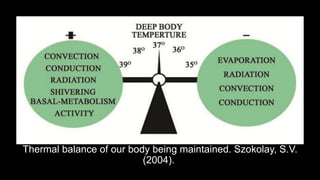
Thermal balance of our body being maintained. Szokolay, S.V.
(2004).
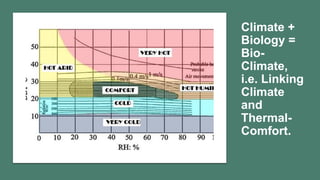
Climate +
Biology =
Bio-
Climate,
i.e. Linking
Climate
and
Thermal-
Comfort.
Click to add text
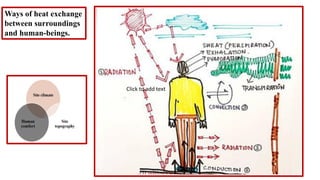
Ways of heat exchange
between surroundings
and human-beings.
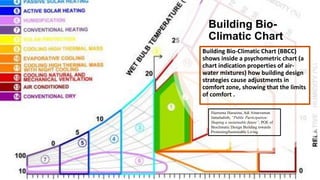
Building Bio-
Climatic Chart
Building Bio-Climatic Chart (BBCC)
shows inside a psychometric chart (a
chart indication properties of air-
water mixtures) how building design
strategies cause adjustments in
comfort zone, showing that the limits
of comfort .
Hazreena Husseina, Adi Ainurzaman
Jamaludinb, “Public Participation:
Shaping a sustainable future”, POE of
Bioclimatic Design Building towards
PromotingSustainable Living
Adaptive
Comfort
• A building designed for adaptive comfort is both
naturally ventilated (i.e., operable windows for part
of the year) and under the control of the occupants,
who can actively modify their immediate
environment hourly, daily, and seasonally, to meet
their needs. During any predominant season, interior
wall colors and furnishings can promote comfort.
• For example, warm colors such as red, yellow and
orange would be used in cold climates similarly cool
colors such as blue and green in hot climates. The
furniture design could support adaptation by having
the chair seats and backs made of a well-ventilated
open-weave fabric.
variables
affecting
thermal comfort
• According to Fanger (1970), the following
variables affect the thermal comfort most:
• • Activity level (heat produced in the body)
• • Thermal resistance of the clothing (clo-
value)
• • Air temperature
• • Mean radiant temperature
• • Relative air velocity
• • Water-vapor pressure in the ambient air
(Relative Humidity)
Earlier
studies ...
• Krishnan and others (2001) studied buildings
and settlements of the two desert
conditions of India, i.e., hot-dry desert of
Jaisalmer and cold-dry desert of Leh on the
basis of their climatic responsive indigenous
architecture.Buildings at the study location
showedhigh thermal performance. Earlier
studies have also shown that the various
passive strategies incorporated in the
vernacular homeshelp in creating
comfortable indoor conditions.
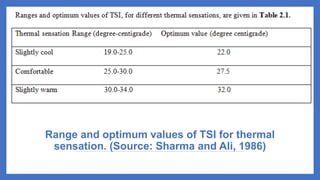
Range and optimum values of TSI for thermal
sensation. (Source: Sharma and Ali, 1986)
How can
Architects
can better
design
buildings.
• One of the primary functions of buildings is to help
create thermal comfort. By understanding human
comfort needs and the four conditions of the
environment that affect comfort (i.e., temperature,
RH, air speed, and MRT), the architect can better
design buildings that are comfortable, yet use a
minimum of mechanical equipment and little energy.
• Ventilation
• High Mass with or without nocturnal ventilation
• Direct Evaporative Cooling
• Indirect evaporative cooling by roof ponds
STEPS OF
CLIMATE-
RESPONSIV
E
ARCHITECT
URE.
• CLIMATE DATA of a specific region should be
analyzed with the yearly characteristics of
their constituent elements.
• BIOLOGICAL EVALUATION should be based
on human sensations. Plotting the climate
data on the bioclimatic chart at regular
intervals will show a “diagnosis” of the
region with the relative importance of the
various climatic elements.
• TECHNOLOGICAL SOLUTIONS.
• ARCHITECTURAL APPLICATION.
TECHNOLOGICAL SOLUTIONS
• A. In site selection most of the factors are variable.
• B. In orientation the sun’s heat is decisive both positively (in cold periods) and
negatively (in hot periods).
• C. Shading calculations are based on the maxim that throughout the year in
under heated times the sun should strike the building, and in overheated times
the structure should be in shade.
• D. Housing forms and building shapes should conform to favorable or adverse
impacts of the thermal environment;
• E. Air Movements
• F. Indoor temperature balance can be achieved to a certain degree with
careful use of materials.
CLIMATIC
ELEMENT
S
CRUCIAL
FOR
BUILDING
THERMAL
DESIGN.
• a. Site information. (latitude, longitude, and
altitude)
• b. Temperature Data (dry-bulb temperature)
• c. Humidity Data (wet-bulb temperature and
relative humidity)
• d. Solar Radiation data.
• e. Prevailing wind speeds and wind directions
in summer and water.
ENVIRONMENT WITH RESPECT TO
BUILDINGS.
• The prevailing year-round climatic conditions of the place where the building is located.
• Surrounding landforms (hills, mountains, water-bodies, deserts, etc.)
• Altitude
• Surrounding built-forms.
• What type of landform the land where the building itself is paced is, i.e. whether the building is sited on a
valley, , hilly slope, north slope or south slope,
• The existing vegetation in the area where the building is sited and the types and number of trees/shrubs
in the site.
• Street Widths and Orientation.
• Ratio of open Spaces and built spaces.
• Ground Character.
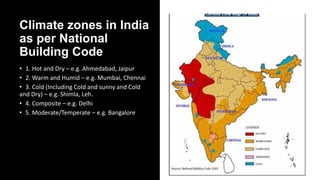
Climate zones in India
as per National
Building Code
• 1. Hot and Dry – e.g. Ahmedabad, Jaipur
• 2. Warm and Humid – e.g. Mumbai, Chennai
• 3. Cold (Including Cold and sunny and Cold
and Dry) – e.g. Shimla, Leh.
• 4. Composite – e.g. Delhi
• 5. Moderate/Temperate – e.g. Bangalore
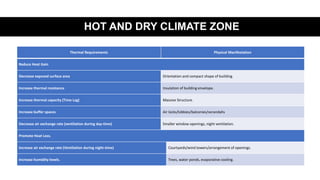
HOT AND DRY CLIMATE ZONE
Thermal Requirements Physical Manifestation
Reduce Heat Gain
Decrease exposed surface area Orientation and compact shape of building.
Increase thermal resistance Insulation of building envelope.
Increase thermal capacity (Time Lag) Massive Structure.
Increase buffer spaces Air locks/lobbies/balconies/verandahs
Decrease air exchange rate (ventilation during day-time) Smaller window openings, night ventilation.
Promote Heat Loss.
Increase air exchange rate (Ventilation during night-time) Courtyards/wind towers/arrangement of openings.
Increase humidity levels. Trees, water ponds, evaporative cooling.
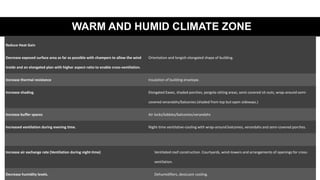
WARM AND HUMID CLIMATE ZONE
Reduce Heat Gain
Decrease exposed surface area as far as possible with champers to allow the wind
inside and an elongated plan with higher aspect-ratio to enable cross-ventilation.
Orientation and longish elongated shape of building.
Increase thermal resistance Insulation of building envelope.
Increase shading. Elongated Eaves, shaded porches, pergola-sitting areas, semi-covered sit-outs, wrap-around semi-
covered verandahs/balconies (shaded from top but open sideways.)
Increase buffer spaces Air locks/lobbies/balconies/verandahs
Increased ventilation during evening time. Night-time ventilative-cooling with wrap-around balconies, verandahs and semi-covered porches.
Increase air exchange rate (Ventilation during night-time) Ventilated roof construction. Courtyards, wind-towers and arrangements of openings for cross-
ventilation.
Decrease humidity levels. Dehumidifiers, desiccant cooling.
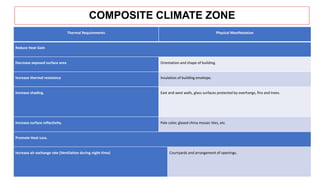
COMPOSITE CLIMATE ZONE
Thermal Requirements Physical Manifestation
Reduce Heat Gain
Decrease exposed surface area Orientation and shape of building.
Increase thermal resistance Insulation of building envelope.
Increase shading. East and west walls, glass surfaces protected by overhangs, fins and trees.
Increase surface reflectivity. Pale color, glazed china mosaic tiles, etc.
Promote Heat Loss.
Increase air exchange rate (Ventilation during night-time) Courtyards and arrangement of openings.
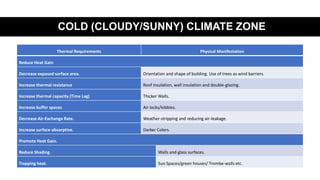
COLD (CLOUDY/SUNNY) CLIMATE ZONE
Thermal Requirements Physical Manifestation
Reduce Heat Gain
Decrease exposed surface area. Orientation and shape of building. Use of trees as wind barriers.
Increase thermal resistance Roof insulation, wall insulation and double-glazing.
Increase thermal capacity (Time Lag) Thicker Walls.
Increase buffer spaces Air locks/lobbies.
Decrease Air-Exchange Rate. Weather-stripping and reducing air-leakage.
Increase surface-absorptive. Darker Colors.
Promote Heat Gain.
Reduce Shading. Walls and glass surfaces.
Trapping heat. Sun Spaces/green houses/ Trombe-walls etc.
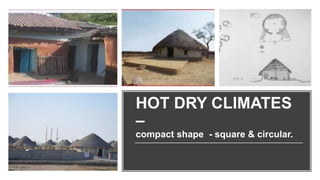
HOT DRY CLIMATES
–
compact shape - square & circular.
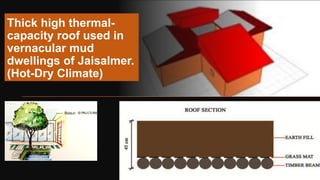
Thick high thermal-
capacity roof used in
vernacular mud
dwellings of Jaisalmer.
(Hot-Dry Climate)
TRADITIONAL
DWELLINGS IN HOT-
DRY REGIONS
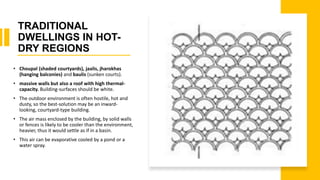
• Choupal (shaded courtyards), jaalis, jharokhas
(hanging balconies) and baulis (sunken courts).
• massive walls but also a roof with high thermal-
capacity. Building-surfaces should be white.
• The outdoor environment is often hostile, hot and
dusty, so the best-solution may be an inward-
looking, courtyard-type building.
• The air mass enclosed by the building, by solid walls
or fences is likely to be cooler than the environment,
heavier, thus it would settle as if in a basin.
• This air can be evaporative cooled by a pond or a
water spray.
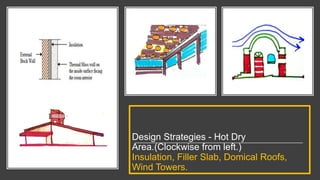
Design Strategies - Hot Dry
Area.(Clockwise from left.)
Insulation, Filler Slab, Domical Roofs,
Wind Towers.
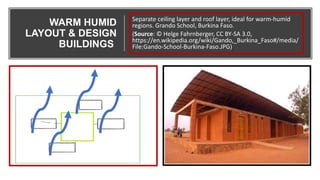
WARM HUMID
LAYOUT & DESIGN
BUILDINGS
Separate ceiling layer and roof layer, ideal for warm-humid
regions. Grando School, Burkina Faso.
(Source: © Helge Fahrnberger, CC BY-SA 3.0,
https://en.wikipedia.org/wiki/Gando,_Burkina_Faso#/media/
File:Gando-School-Burkina-Faso.JPG)
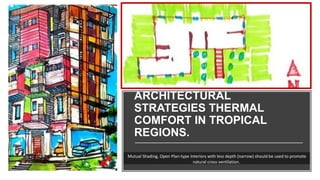
ARCHITECTURAL
STRATEGIES THERMAL
COMFORT IN TROPICAL
REGIONS.
Mutual Shading, Open Plan-type Interiors with less depth (narrow) should be used to promote
natural cross-ventilation.
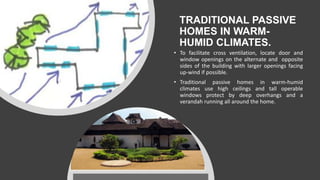
TRADITIONAL PASSIVE
HOMES IN WARM-
HUMID CLIMATES.
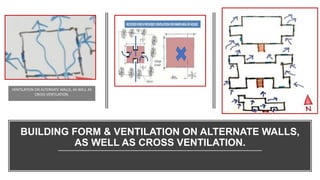
• To facilitate cross ventilation, locate door and
window openings on the alternate and opposite
sides of the building with larger openings facing
up-wind if possible.
• Traditional passive homes in warm-humid
climates use high ceilings and tall operable
windows protect by deep overhangs and a
verandah running all around the home.
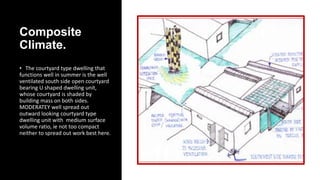
Composite
Climate.
• The courtyard type dwelling that
functions well in summer is the well
ventilated south side open courtyard
bearing U shaped dwelling unit,
whose courtyard is shaded by
building mass on both sides.
MODERATEY well spread out
outward looking courtyard type
dwelling unit with medium surface
volume ratio, ie not too compact
neither to spread out work best here.
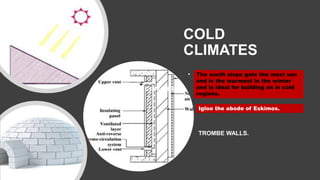
COLD
CLIMATES
• Tt
Igloo the abode of Eskimos.
The south slope gets the most sun
and is the warmest in the winter
and is ideal for building on in cold
regions.
COLD CLIMATES​
TROMBE WALLS.
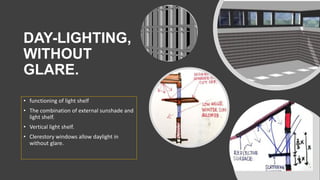
DAY-LIGHTING,
WITHOUT
GLARE.
• functioning of light shelf
• The combination of external sunshade and
light shelf.
• Vertical light shelf.
• Clerestory windows allow daylight in
without glare.
SOLAR
ACCESS-
ALLOWING &
CUTTING OFF.
• Shading Devices.
• There are three basic categories of
shading devices –
• Exterior or interior shading
devices
• Roof overhangs,
• Landscaping.
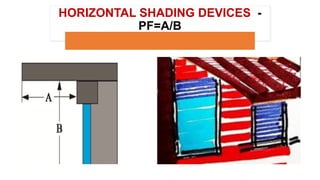
HORIZONTAL SHADING DEVICES -
PF=A/B
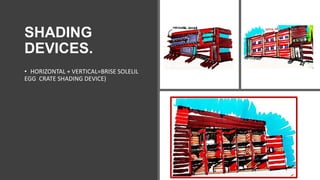
SHADING
DEVICES.
• HORIZONTAL + VERTICAL=BRISE SOLELIL
EGG CRATE SHADING DEVICE)
WIND AND BUILDING
DESIGN
• Natural Ventilation: Naturally-driven ventilation
the motive force, behind which, can be either
• thermal (pressure difference created due to
warm air rising and low pressure being created,
and colder wind from high pressure regions
coming in to fill the low-pressure created voids)
or
• dynamic (prevailing wind pattern-generated or
driven).
THERMAL-COMFORT
THROUGH VENTILATION
IN HOT AREAS.
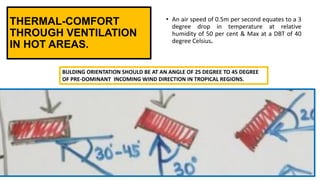
• An air speed of 0.5m per second equates to a 3
degree drop in temperature at relative
humidity of 50 per cent & Max at a DBT of 40
degree Celsius.
BULDING ORIENTATION SHOULD BE AT AN ANGLE OF 25 DEGREE TO 45 DEGREE
OF PRE-DOMINANT INCOMING WIND DIRECTION IN TROPICAL REGIONS.
BUILDING FORM & VENTILATION ON ALTERNATE WALLS,
AS WELL AS CROSS VENTILATION.
VENTILATION ON ALTERNATE WALLS, AS WELL AS
CROSS VENTILATION.​
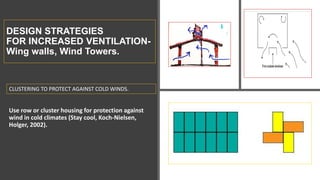
DESIGN STRATEGIES
FOR INCREASED VENTILATION-
Wing walls, Wind Towers.
Use row or cluster housing for protection against
wind in cold climates (Stay cool, Koch-Nielsen,
Holger, 2002).
CLUSTERING TO PROTECT AGAINST COLD WINDS.
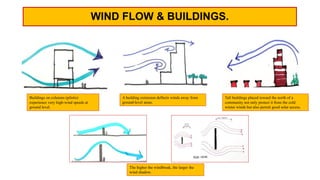
WIND FLOW & BUILDINGS.
Buildings on columns (pilotis)
experience very high-wind speeds at
ground level.
A building extension deflects winds away from
ground-level areas.
Tall buildings placed toward the north of a
community not only protect it from the cold
winter winds but also permit good solar access.
The higher the windbreak, the larger the
wind shadow.
At a
Glance...
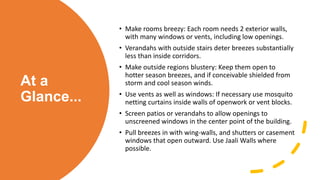
• Make rooms breezy: Each room needs 2 exterior walls,
with many windows or vents, including low openings.
• Verandahs with outside stairs deter breezes substantially
less than inside corridors.
• Make outside regions blustery: Keep them open to
hotter season breezes, and if conceivable shielded from
storm and cool season winds.
• Use vents as well as windows: If necessary use mosquito
netting curtains inside walls of openwork or vent blocks.
• Screen patios or verandahs to allow openings to
unscreened windows in the center point of the building.
• Pull breezes in with wing-walls, and shutters or casement
windows that open outward. Use Jaali Walls where
possible.
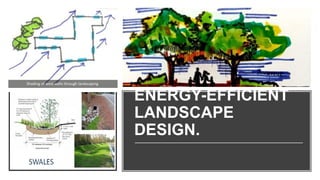
ENERGY-EFFICIENT
LANDSCAPE
DESIGN.
Shading of west walls through landscaping
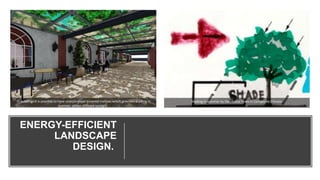
ENERGY-EFFICIENT
LANDSCAPE
DESIGN.
In buildings it is possible to have vines/creeper covered trellises which provides shading in
summer, allows diffused sunlight.
Shading in summer by Deciduous Trees in Composite Climate.
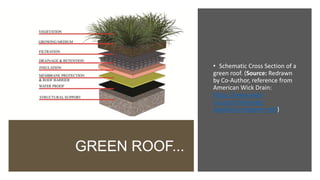
GREEN ROOF...
• Schematic Cross Section of a
green roof. (Source: Redrawn
by Co-Author, reference from
American Wick Drain:
https://www.awd-
usa.com/drainage-
applications/green-roof)
THAT’S ALL !
Thank you...For Patient Listening.
I welcome your Queries and Clarifications.

climate responsive architecture-basics

  • 1.
    CLIMATE RESPONSIVE ARCHITECTURE- in contextof Climate Change and Adaptive Architecture. Dr. Janmejoy Gupta Associate Professor & Head, Department of Architecture. School of Planning & Architecture, Vijayawada.
  • 2.
    INTRODUCTION Bioclimatic Design: Design(in this case Architectural- Design), which is done keeping - the thermal-comfort of people who are going to reside inside the building. Bio part of the phrase refers to keeping the biological thermal-comfort of the inhabitants in mind, whereas, climatic part of the phrase indicates making the building design in such a way that it is responsive to the prevailing climate of the region.
  • 3.
    STEPS IN CLIMATE- RESPONSIV E ARCHITECT URE. • Understandthe local climate, relate the local climate to the effect it has on the people; • but not restricted to Mahoney-tables, psychrometric-building-bioclimatic-chart study of exact comfort-range required for biological thermal-comfort, and the subsequent design- interventions. • Nowadays, a lot of computer soft-wares which aid climate-responsive designs, like Ecotect (Autodesk-Revit), Climate-Consultant (developed by the University of California, UCLA).
  • 4.
    STEPS IN CLIMATE- RESPONSIVE ARCHITECTURE. Attempt tocontrol these variables (heat, light and sound) by passive means (by the building itself) as far as practicable. Based on the bio-climatic requirements, take appropriate technological solutions and implement them in tune with the existing architectural fabric.
  • 5.
    Human Comfort & Adaptive Comfort. • HumanBody--A Biological Machine: Here the human-body is referred as ‘Biological Machine’ - it has internal biological mechanisms to gain and lose heat. • Thermal comfort: “Thermal comfort is that condition of mind which expresses satisfaction with the thermal environment” (ASHRAE standard 55). • The characteristics of the environment that affect a person's heat loss or gain is known as thermal environment. • Adaptive comfort: As per the default values programmed into the simulation software, following ASHRAE Standard 55-2004, a range of 19.4°C (67°F) and 27.77°C (82°F) is ideal for thermal comfort.
  • 6.
    Thermal balance ofour body being maintained. Szokolay, S.V. (2004).
  • 7.
    Climate + Biology = Bio- Climate, i.e.Linking Climate and Thermal- Comfort.
  • 8.
    Click to addtext Ways of heat exchange between surroundings and human-beings.
  • 9.
    Building Bio- Climatic Chart BuildingBio-Climatic Chart (BBCC) shows inside a psychometric chart (a chart indication properties of air- water mixtures) how building design strategies cause adjustments in comfort zone, showing that the limits of comfort . Hazreena Husseina, Adi Ainurzaman Jamaludinb, “Public Participation: Shaping a sustainable future”, POE of Bioclimatic Design Building towards PromotingSustainable Living
  • 10.
    Adaptive Comfort • A buildingdesigned for adaptive comfort is both naturally ventilated (i.e., operable windows for part of the year) and under the control of the occupants, who can actively modify their immediate environment hourly, daily, and seasonally, to meet their needs. During any predominant season, interior wall colors and furnishings can promote comfort. • For example, warm colors such as red, yellow and orange would be used in cold climates similarly cool colors such as blue and green in hot climates. The furniture design could support adaptation by having the chair seats and backs made of a well-ventilated open-weave fabric.
  • 11.
    variables affecting thermal comfort • Accordingto Fanger (1970), the following variables affect the thermal comfort most: • • Activity level (heat produced in the body) • • Thermal resistance of the clothing (clo- value) • • Air temperature • • Mean radiant temperature • • Relative air velocity • • Water-vapor pressure in the ambient air (Relative Humidity)
  • 12.
    Earlier studies ... • Krishnanand others (2001) studied buildings and settlements of the two desert conditions of India, i.e., hot-dry desert of Jaisalmer and cold-dry desert of Leh on the basis of their climatic responsive indigenous architecture.Buildings at the study location showedhigh thermal performance. Earlier studies have also shown that the various passive strategies incorporated in the vernacular homeshelp in creating comfortable indoor conditions.
  • 13.
    Range and optimumvalues of TSI for thermal sensation. (Source: Sharma and Ali, 1986)
  • 14.
    How can Architects can better design buildings. •One of the primary functions of buildings is to help create thermal comfort. By understanding human comfort needs and the four conditions of the environment that affect comfort (i.e., temperature, RH, air speed, and MRT), the architect can better design buildings that are comfortable, yet use a minimum of mechanical equipment and little energy. • Ventilation • High Mass with or without nocturnal ventilation • Direct Evaporative Cooling • Indirect evaporative cooling by roof ponds
  • 15.
    STEPS OF CLIMATE- RESPONSIV E ARCHITECT URE. • CLIMATEDATA of a specific region should be analyzed with the yearly characteristics of their constituent elements. • BIOLOGICAL EVALUATION should be based on human sensations. Plotting the climate data on the bioclimatic chart at regular intervals will show a “diagnosis” of the region with the relative importance of the various climatic elements. • TECHNOLOGICAL SOLUTIONS. • ARCHITECTURAL APPLICATION.
  • 16.
    TECHNOLOGICAL SOLUTIONS • A.In site selection most of the factors are variable. • B. In orientation the sun’s heat is decisive both positively (in cold periods) and negatively (in hot periods). • C. Shading calculations are based on the maxim that throughout the year in under heated times the sun should strike the building, and in overheated times the structure should be in shade. • D. Housing forms and building shapes should conform to favorable or adverse impacts of the thermal environment; • E. Air Movements • F. Indoor temperature balance can be achieved to a certain degree with careful use of materials.
  • 17.
    CLIMATIC ELEMENT S CRUCIAL FOR BUILDING THERMAL DESIGN. • a. Siteinformation. (latitude, longitude, and altitude) • b. Temperature Data (dry-bulb temperature) • c. Humidity Data (wet-bulb temperature and relative humidity) • d. Solar Radiation data. • e. Prevailing wind speeds and wind directions in summer and water.
  • 18.
    ENVIRONMENT WITH RESPECTTO BUILDINGS. • The prevailing year-round climatic conditions of the place where the building is located. • Surrounding landforms (hills, mountains, water-bodies, deserts, etc.) • Altitude • Surrounding built-forms. • What type of landform the land where the building itself is paced is, i.e. whether the building is sited on a valley, , hilly slope, north slope or south slope, • The existing vegetation in the area where the building is sited and the types and number of trees/shrubs in the site. • Street Widths and Orientation. • Ratio of open Spaces and built spaces. • Ground Character.
  • 19.
    Climate zones inIndia as per National Building Code • 1. Hot and Dry – e.g. Ahmedabad, Jaipur • 2. Warm and Humid – e.g. Mumbai, Chennai • 3. Cold (Including Cold and sunny and Cold and Dry) – e.g. Shimla, Leh. • 4. Composite – e.g. Delhi • 5. Moderate/Temperate – e.g. Bangalore
  • 20.
    HOT AND DRYCLIMATE ZONE Thermal Requirements Physical Manifestation Reduce Heat Gain Decrease exposed surface area Orientation and compact shape of building. Increase thermal resistance Insulation of building envelope. Increase thermal capacity (Time Lag) Massive Structure. Increase buffer spaces Air locks/lobbies/balconies/verandahs Decrease air exchange rate (ventilation during day-time) Smaller window openings, night ventilation. Promote Heat Loss. Increase air exchange rate (Ventilation during night-time) Courtyards/wind towers/arrangement of openings. Increase humidity levels. Trees, water ponds, evaporative cooling.
  • 21.
    WARM AND HUMIDCLIMATE ZONE Reduce Heat Gain Decrease exposed surface area as far as possible with champers to allow the wind inside and an elongated plan with higher aspect-ratio to enable cross-ventilation. Orientation and longish elongated shape of building. Increase thermal resistance Insulation of building envelope. Increase shading. Elongated Eaves, shaded porches, pergola-sitting areas, semi-covered sit-outs, wrap-around semi- covered verandahs/balconies (shaded from top but open sideways.) Increase buffer spaces Air locks/lobbies/balconies/verandahs Increased ventilation during evening time. Night-time ventilative-cooling with wrap-around balconies, verandahs and semi-covered porches. Increase air exchange rate (Ventilation during night-time) Ventilated roof construction. Courtyards, wind-towers and arrangements of openings for cross- ventilation. Decrease humidity levels. Dehumidifiers, desiccant cooling.
  • 22.
    COMPOSITE CLIMATE ZONE ThermalRequirements Physical Manifestation Reduce Heat Gain Decrease exposed surface area Orientation and shape of building. Increase thermal resistance Insulation of building envelope. Increase shading. East and west walls, glass surfaces protected by overhangs, fins and trees. Increase surface reflectivity. Pale color, glazed china mosaic tiles, etc. Promote Heat Loss. Increase air exchange rate (Ventilation during night-time) Courtyards and arrangement of openings.
  • 23.
    COLD (CLOUDY/SUNNY) CLIMATEZONE Thermal Requirements Physical Manifestation Reduce Heat Gain Decrease exposed surface area. Orientation and shape of building. Use of trees as wind barriers. Increase thermal resistance Roof insulation, wall insulation and double-glazing. Increase thermal capacity (Time Lag) Thicker Walls. Increase buffer spaces Air locks/lobbies. Decrease Air-Exchange Rate. Weather-stripping and reducing air-leakage. Increase surface-absorptive. Darker Colors. Promote Heat Gain. Reduce Shading. Walls and glass surfaces. Trapping heat. Sun Spaces/green houses/ Trombe-walls etc.
  • 24.
    HOT DRY CLIMATES – compactshape - square & circular.
  • 25.
    Thick high thermal- capacityroof used in vernacular mud dwellings of Jaisalmer. (Hot-Dry Climate)
  • 26.
    TRADITIONAL DWELLINGS IN HOT- DRYREGIONS • Choupal (shaded courtyards), jaalis, jharokhas (hanging balconies) and baulis (sunken courts). • massive walls but also a roof with high thermal- capacity. Building-surfaces should be white. • The outdoor environment is often hostile, hot and dusty, so the best-solution may be an inward- looking, courtyard-type building. • The air mass enclosed by the building, by solid walls or fences is likely to be cooler than the environment, heavier, thus it would settle as if in a basin. • This air can be evaporative cooled by a pond or a water spray.
  • 27.
    Design Strategies -Hot Dry Area.(Clockwise from left.) Insulation, Filler Slab, Domical Roofs, Wind Towers.
  • 28.
    WARM HUMID LAYOUT &DESIGN BUILDINGS Separate ceiling layer and roof layer, ideal for warm-humid regions. Grando School, Burkina Faso. (Source: © Helge Fahrnberger, CC BY-SA 3.0, https://en.wikipedia.org/wiki/Gando,_Burkina_Faso#/media/ File:Gando-School-Burkina-Faso.JPG)
  • 29.
    ARCHITECTURAL STRATEGIES THERMAL COMFORT INTROPICAL REGIONS. Mutual Shading, Open Plan-type Interiors with less depth (narrow) should be used to promote natural cross-ventilation.
  • 30.
    TRADITIONAL PASSIVE HOMES INWARM- HUMID CLIMATES. • To facilitate cross ventilation, locate door and window openings on the alternate and opposite sides of the building with larger openings facing up-wind if possible. • Traditional passive homes in warm-humid climates use high ceilings and tall operable windows protect by deep overhangs and a verandah running all around the home.
  • 31.
    Composite Climate. • The courtyardtype dwelling that functions well in summer is the well ventilated south side open courtyard bearing U shaped dwelling unit, whose courtyard is shaded by building mass on both sides. MODERATEY well spread out outward looking courtyard type dwelling unit with medium surface volume ratio, ie not too compact neither to spread out work best here.
  • 32.
    COLD CLIMATES • Tt Igloo theabode of Eskimos. The south slope gets the most sun and is the warmest in the winter and is ideal for building on in cold regions. COLD CLIMATES​ TROMBE WALLS.
  • 33.
    DAY-LIGHTING, WITHOUT GLARE. • functioning oflight shelf • The combination of external sunshade and light shelf. • Vertical light shelf. • Clerestory windows allow daylight in without glare.
  • 34.
    SOLAR ACCESS- ALLOWING & CUTTING OFF. •Shading Devices. • There are three basic categories of shading devices – • Exterior or interior shading devices • Roof overhangs, • Landscaping.
  • 35.
  • 36.
    SHADING DEVICES. • HORIZONTAL +VERTICAL=BRISE SOLELIL EGG CRATE SHADING DEVICE)
  • 37.
    WIND AND BUILDING DESIGN •Natural Ventilation: Naturally-driven ventilation the motive force, behind which, can be either • thermal (pressure difference created due to warm air rising and low pressure being created, and colder wind from high pressure regions coming in to fill the low-pressure created voids) or • dynamic (prevailing wind pattern-generated or driven).
  • 38.
    THERMAL-COMFORT THROUGH VENTILATION IN HOTAREAS. • An air speed of 0.5m per second equates to a 3 degree drop in temperature at relative humidity of 50 per cent & Max at a DBT of 40 degree Celsius. BULDING ORIENTATION SHOULD BE AT AN ANGLE OF 25 DEGREE TO 45 DEGREE OF PRE-DOMINANT INCOMING WIND DIRECTION IN TROPICAL REGIONS.
  • 39.
    BUILDING FORM &VENTILATION ON ALTERNATE WALLS, AS WELL AS CROSS VENTILATION. VENTILATION ON ALTERNATE WALLS, AS WELL AS CROSS VENTILATION.​
  • 40.
    DESIGN STRATEGIES FOR INCREASEDVENTILATION- Wing walls, Wind Towers. Use row or cluster housing for protection against wind in cold climates (Stay cool, Koch-Nielsen, Holger, 2002). CLUSTERING TO PROTECT AGAINST COLD WINDS.
  • 41.
    WIND FLOW &BUILDINGS. Buildings on columns (pilotis) experience very high-wind speeds at ground level. A building extension deflects winds away from ground-level areas. Tall buildings placed toward the north of a community not only protect it from the cold winter winds but also permit good solar access. The higher the windbreak, the larger the wind shadow.
  • 42.
    At a Glance... • Makerooms breezy: Each room needs 2 exterior walls, with many windows or vents, including low openings. • Verandahs with outside stairs deter breezes substantially less than inside corridors. • Make outside regions blustery: Keep them open to hotter season breezes, and if conceivable shielded from storm and cool season winds. • Use vents as well as windows: If necessary use mosquito netting curtains inside walls of openwork or vent blocks. • Screen patios or verandahs to allow openings to unscreened windows in the center point of the building. • Pull breezes in with wing-walls, and shutters or casement windows that open outward. Use Jaali Walls where possible.
  • 43.
  • 44.
    ENERGY-EFFICIENT LANDSCAPE DESIGN. In buildings itis possible to have vines/creeper covered trellises which provides shading in summer, allows diffused sunlight. Shading in summer by Deciduous Trees in Composite Climate.
  • 45.
    GREEN ROOF... • SchematicCross Section of a green roof. (Source: Redrawn by Co-Author, reference from American Wick Drain: https://www.awd- usa.com/drainage- applications/green-roof)
  • 46.
    THAT’S ALL ! Thankyou...For Patient Listening. I welcome your Queries and Clarifications.