ENVIRONMENTAL SCIENCE

       SEMINAR
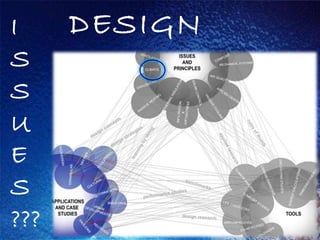
I     DESIGN
S
S
U
E
S
???
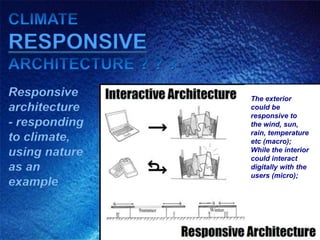
RESPONSIVE

Responsive     The exterior
architecture   could be
               responsive to
- responding   the wind, sun,
               rain, temperature
to climate,    etc (macro);
using nature   While the interior
               could interact
as an          digitally with the
               users (micro);
example
CLIMATE . . . ? ? ?
Climate encompasses the statistics of
• Temperature
• humidity
• atmospheric pressure
• wind
• precipitation
• atmospheric particle count and
  other meteorological elemental measurements in a
  given region over long periods.
DEFINITION IN SHORT!

• Climate (from Ancient Greek klima,
  meaning inclination) is commonly defined as the
  weather averaged over a long period.
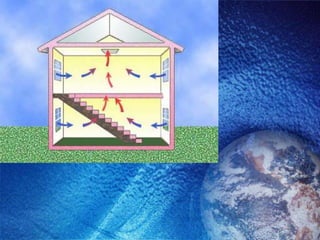
• The standard averaging period is 30 years
CLIMATE AND WEATHER
• The difference between weather and climate is a
  measure of time.

• Weather is what conditions of the atmosphere are
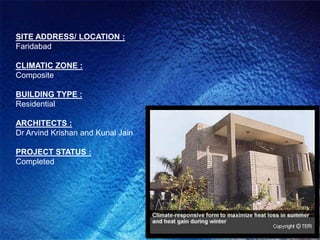
  over a short period of time, and climate is how the
  atmosphere "behaves" over relatively long periods of
  time.
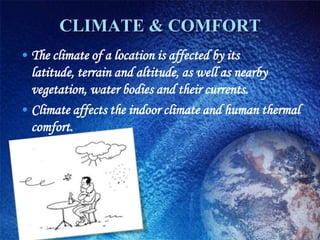
CLIMATE & COMFORT
• The climate of a location is affected by its
  latitude, terrain and altitude, as well as nearby
  vegetation, water bodies and their currents.
• Climate affects the indoor climate and human thermal
  comfort.
THERMAL COMFORT. . ?
   Comfort is defined as the sensation of complete physical and mental
    well being.
   Thermal neutrality, where an individual desires neither a warmer nor
    a colder environment, is a necessary condition for thermal comfort.

   The factors affecting comfort are divided into personal variables:
              activity
              Clothing
   and environmental variables,
               air temperature,
              mean radiant temperature
              air velocity
               air humidity
THERMAL COMFORT –
         ENVIRONMENTAL VARIABLES
   Temperature
    The average air temperature from the floor at a height of 1.1 m.

   Mean Radiant Temperature
    The average temperature of the surrounding surfaces, which includes
    the effect of the incident solar radiation.

   Air Velocity
    Which affects convective heat loss from the body, i.e. air at a greater
    velocity will seem cooler.

   Air Humidity
    Which affects the latent heat losses and has a particularly important
    impact in warm and humid environments
ELEMENTS OF CLIMATE
 The most important elements of climate and weather
  parameters that affect human comfort and are relevant to
  building design are:

•   Solar Radiation
•   Long wave Radiation
•   Temperature
•   Humidity
•   Wind
•   Precipitation
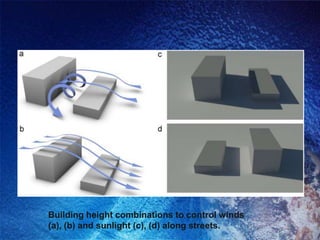
Building height combinations to control winds
(a), (b) and sunlight (c), (d) along streets.
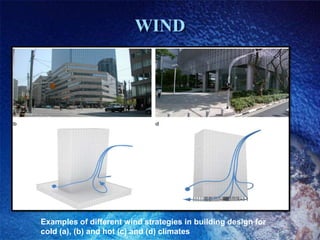
WIND


Examples of different wind strategies in building design for
cold (a), (b) and hot (c) and (d) climates
6 CLIMATE FACTORS


I.    Latitude      IV. Mountain Barriers

II.   Altitude      V.   Ocean Currents

III. Land - Water   VI. Prevailing Winds
     Relationship
Latitude
I.        Latitude - Distance north or south of
                     the equator
     A.     Low - Warm to hot

     B.     Middle - Seasonal

     C.     High - Polar (cool to cold)
*Latitude
       impacts EVERY
  PLACE on the Earth*
Altitude
II. Altitude - Height above sea level

  A. In mountain areas, there are major climatic
     differences from the bottom to the top.
  B. As air rises, it loses the ability to hold heat.
     It gets 1 F colder for every 300-400 ft. you
     go up.
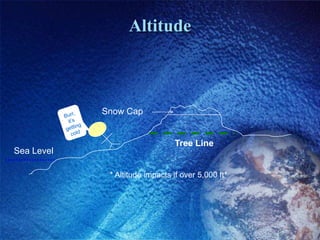
Altitude


            Snow Cap


                                Tree Line
Sea Level

             * Altitude impacts if over 5,000 ft*
Land-Water Relationship
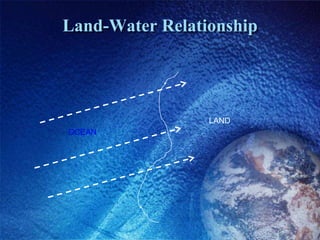
III. Land-Water Relationship
  A.   A large body of water tends to cause a
       mild or moderate climate. (Very little
       change)
  B.   A body of water heats up and cools down
       slower than a land mass
  C.   Wind assumes the temp. of the surface it
       passes over and carries that temp. with it.
Land-Water Relationship


                 LAND
OCEAN
Mountain Barriers
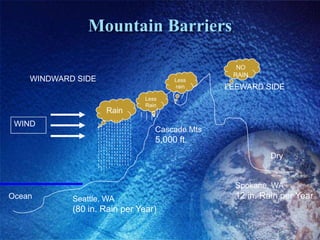
IV. Mountain Barriers - Cause different
    climates on opposite sides of mountain.

  A. Moisture carrying winds must rise to get
     over mountains.
  B. Air cools as it rises, losing ability to hold
     water causing rain on the windward side
  C. This leaves no moisture for the leeward side
     creating a desert.
Mountain Barriers

                                                  NO
                                                 RAIN
    WINDWARD SIDE                      Less
                                       rain     LEEWARD SIDE
                               Less
                               Rain
                    Rain
 WIND
                                  Cascade Mts
                                  5,000 ft.
                                                           Dry


                                                  Spokane, WA
Ocean       Seattle, WA                           12 in. Rain per Year
            (80 in. Rain per Year)
Ocean Currents
V. Ocean Currents - Rivers of water that
   move through the ocean.

  A. They assume the temperature of the water
     that they pass over and carry that
     temperature.
  B. Wind passing over the current must pass
     near the land mass to have an impact.
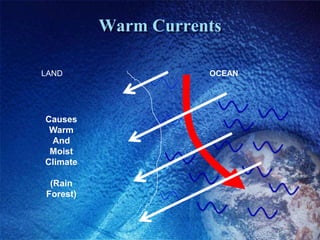
Warm Currents

LAND                 OCEAN


Causes
 Warm
 And
 Moist
Climate

 (Rain
Forest)
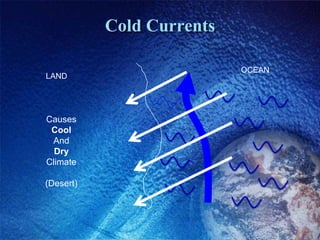
Cold Currents

                           OCEAN
LAND


Causes
 Cool
 And
  Dry
Climate

(Desert)
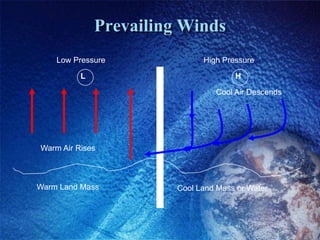
Prevailing Winds
VI. Prevailing Winds - Winds that blow
    most often in different parts of the Earth.
  A. Wind blows because:
     1. Air over warm land rises
     2. Cooler air moves in from surrounding areas to
        replace rising air
     3. The cool air is heated and process repeats
Prevailing Winds
    Low Pressure              High Pressure

          L                           H

                                 Cool Air Descends


Warm Air Rises


Warm Land Mass          Cool Land Mass or Water
CLIMATE RESPONSIVE DESIGN
• Climate responsive design is based on the way a building form
  and structure moderates the climate for human good and well
  being.
• Climate responsive design in buildings takes into account the following
  climatic parameters which have direct influence on indoor thermal
  comfort and energy consumption in buildings:

    •   The air temperature,
    •   The humidity,
    •   The prevailing wind direction and speed,
    •    The amount of solar radiation and the solar path.
    •   Long wave radiation between other buildings and the surrounding
        environment and sky also plays a major role in building
        performance.
PROJECT CLIMATE EVALUATION


• Every project starts with a careful evaluation
  of what a project’s climate capital provides.
• We need to understand the resources
  available for us to protect against and take
  advantage of – whether that is
  solar, wind, temperature, humidity or
  rainfall.
1.PERFORM A SITE ANALYSIS
• Determine the weather patterns, climate, soil types,
  wind speed and direction, heating degree days and
  path of the sun. Look at the water flows, habitat and
  geology of the site. Document each with a qualified
  team of professionals to understand the ramifications
  of building in that specific place.
2.LAYOUT THE BUILDING ON THE
            SITE.
• Using the general program, through an integrative team
  process, use a basic massing of the building layout to
  determine specifically on site the most optimal location
  for the building to be situated. Factors to consider here
  are access to infrastructure, staying at least 100 feet
  clear of any watershed, not building within a floodplain
  and/or in a habitat with endangered species. Ask: what
  trees and other existing geological features should be
  avoided? How does the water flow across the site dictate
  the location of the building?
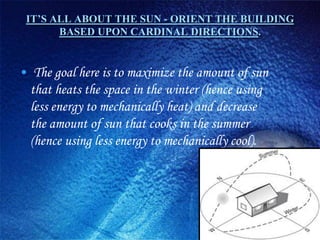
IT’S ALL ABOUT THE SUN - ORIENT THE BUILDING
       BASED UPON CARDINAL DIRECTIONS.


• The goal here is to maximize the amount of sun
  that heats the space in the winter (hence using
  less energy to mechanically heat) and decrease
  the amount of sun that cooks in the summer
  (hence using less energy to mechanically cool).
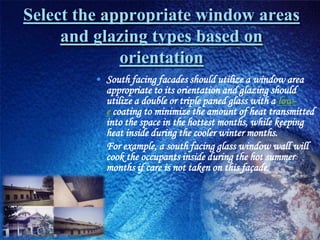
Select the appropriate window areas
     and glazing types based on
             orientation
        • South facing facades should utilize a window area
          appropriate to its orientation and glazing should
          utilize a double or triple paned glass with a low-
          e coating to minimize the amount of heat transmitted
          into the space in the hottest months, while keeping
          heat inside during the cooler winter months.
        • For example, a south facing glass window wall will
          cook the occupants inside during the hot summer
          months if care is not taken on this façade.
Building envelope design varies
     greatly by geographic area.

• When designing the envelope of the building, factors
  such as insulation, vapour barriers and air barriers
  will vary radically depending on whether the project
  is in the cold, snowy north, the hot and humid south
  or the arid desert.
Design for natural ventilation.

• Since warm air rises, a building can be cooled by
  designing for stack ventilation by drawing cooler air
  from openings low in the building, while carrying
  heat away through openings in the top of the space.
• The rate at which the air moves is a function of the
  vertical distance between the inlets and outlets, their
  size and the difference in temperature over the height
  of the room.
BIDANI HOUSE
       FARIDABAD
SITE ADDRESS/ LOCATION :
Faridabad

CLIMATIC ZONE :
Composite

BUILDING TYPE :
Residential

ARCHITECTS :
Dr Arvind Krishan and Kunal Jain

PROJECT STATUS :
Completed
 Very often it is stated that it is possible to design climatically responsive
buildings on a larger site, but in most urban situations where the sites are
constrained by their small size and of fixed orientation, it is not possible to
develop such a design.

 The Bidani House is a project that demonstrates a situation where a
climate -responsive form and design was achieved in an existing
urban situation with a fixed site size and orientation.

Faridabad, located in the ‘composite climate’ zone, has
large climatic swings over the year, i.e. very hot and dry period of
almost two and a half months and a colder period of a shorter
duration. The hot dry period is followed by a hot humid, monsoon
period of about two months with intervening periods of milder
climate.
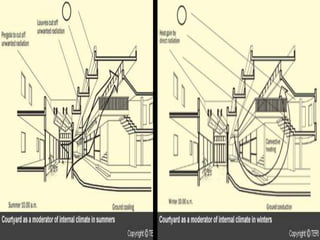
KEY SUSTAINABLE FEATURES
•House form developed around courtyard (acts as heat sink)

•Large volumes of spaces coupled with courtyard for ventilation

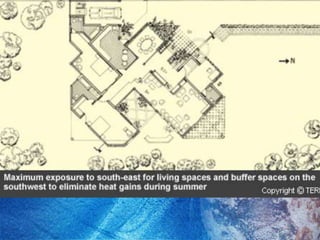
•Buffer spaces located on the overheated south-western exposure

•Form of the building allows solar penetration according to seasonal
changes

•Pergola and louvers cut off unwanted radiation

•Local stone used as major construction material, which provides
thermal mass for attenuation of diurnal swings in temperature
Climate Responsive Architecture

Climate Responsive Architecture

  • 1.
  • 2.
    I DESIGN S S U E S ???
  • 3.
    RESPONSIVE Responsive The exterior architecture could be responsive to - responding the wind, sun, rain, temperature to climate, etc (macro); using nature While the interior could interact as an digitally with the users (micro); example
  • 4.
    CLIMATE . .. ? ? ? Climate encompasses the statistics of • Temperature • humidity • atmospheric pressure • wind • precipitation • atmospheric particle count and other meteorological elemental measurements in a given region over long periods.
  • 5.
    DEFINITION IN SHORT! •Climate (from Ancient Greek klima, meaning inclination) is commonly defined as the weather averaged over a long period. • The standard averaging period is 30 years
  • 6.
    CLIMATE AND WEATHER •The difference between weather and climate is a measure of time. • Weather is what conditions of the atmosphere are over a short period of time, and climate is how the atmosphere "behaves" over relatively long periods of time.
  • 7.
    CLIMATE & COMFORT •The climate of a location is affected by its latitude, terrain and altitude, as well as nearby vegetation, water bodies and their currents. • Climate affects the indoor climate and human thermal comfort.
  • 8.
    THERMAL COMFORT. .?  Comfort is defined as the sensation of complete physical and mental well being.  Thermal neutrality, where an individual desires neither a warmer nor a colder environment, is a necessary condition for thermal comfort.  The factors affecting comfort are divided into personal variables:  activity  Clothing  and environmental variables,  air temperature,  mean radiant temperature  air velocity  air humidity
  • 9.
    THERMAL COMFORT – ENVIRONMENTAL VARIABLES  Temperature The average air temperature from the floor at a height of 1.1 m.  Mean Radiant Temperature The average temperature of the surrounding surfaces, which includes the effect of the incident solar radiation.  Air Velocity Which affects convective heat loss from the body, i.e. air at a greater velocity will seem cooler.  Air Humidity Which affects the latent heat losses and has a particularly important impact in warm and humid environments
  • 10.
    ELEMENTS OF CLIMATE The most important elements of climate and weather parameters that affect human comfort and are relevant to building design are: • Solar Radiation • Long wave Radiation • Temperature • Humidity • Wind • Precipitation
  • 11.
    Building height combinationsto control winds (a), (b) and sunlight (c), (d) along streets.
  • 12.
    WIND Examples of differentwind strategies in building design for cold (a), (b) and hot (c) and (d) climates
  • 13.
    6 CLIMATE FACTORS I. Latitude IV. Mountain Barriers II. Altitude V. Ocean Currents III. Land - Water VI. Prevailing Winds Relationship
  • 14.
    Latitude I. Latitude - Distance north or south of the equator A. Low - Warm to hot B. Middle - Seasonal C. High - Polar (cool to cold)
  • 15.
    *Latitude impacts EVERY PLACE on the Earth*
  • 16.
    Altitude II. Altitude -Height above sea level A. In mountain areas, there are major climatic differences from the bottom to the top. B. As air rises, it loses the ability to hold heat. It gets 1 F colder for every 300-400 ft. you go up.
  • 17.
    Altitude Snow Cap Tree Line Sea Level * Altitude impacts if over 5,000 ft*
  • 18.
    Land-Water Relationship III. Land-WaterRelationship A. A large body of water tends to cause a mild or moderate climate. (Very little change) B. A body of water heats up and cools down slower than a land mass C. Wind assumes the temp. of the surface it passes over and carries that temp. with it.
  • 19.
  • 20.
    Mountain Barriers IV. MountainBarriers - Cause different climates on opposite sides of mountain. A. Moisture carrying winds must rise to get over mountains. B. Air cools as it rises, losing ability to hold water causing rain on the windward side C. This leaves no moisture for the leeward side creating a desert.
  • 21.
    Mountain Barriers NO RAIN WINDWARD SIDE Less rain LEEWARD SIDE Less Rain Rain WIND Cascade Mts 5,000 ft. Dry Spokane, WA Ocean Seattle, WA 12 in. Rain per Year (80 in. Rain per Year)
  • 22.
    Ocean Currents V. OceanCurrents - Rivers of water that move through the ocean. A. They assume the temperature of the water that they pass over and carry that temperature. B. Wind passing over the current must pass near the land mass to have an impact.
  • 23.
    Warm Currents LAND OCEAN Causes Warm And Moist Climate (Rain Forest)
  • 24.
    Cold Currents OCEAN LAND Causes Cool And Dry Climate (Desert)
  • 25.
    Prevailing Winds VI. PrevailingWinds - Winds that blow most often in different parts of the Earth. A. Wind blows because: 1. Air over warm land rises 2. Cooler air moves in from surrounding areas to replace rising air 3. The cool air is heated and process repeats
  • 26.
    Prevailing Winds Low Pressure High Pressure L H Cool Air Descends Warm Air Rises Warm Land Mass Cool Land Mass or Water
  • 27.
    CLIMATE RESPONSIVE DESIGN •Climate responsive design is based on the way a building form and structure moderates the climate for human good and well being. • Climate responsive design in buildings takes into account the following climatic parameters which have direct influence on indoor thermal comfort and energy consumption in buildings: • The air temperature, • The humidity, • The prevailing wind direction and speed, • The amount of solar radiation and the solar path. • Long wave radiation between other buildings and the surrounding environment and sky also plays a major role in building performance.
  • 29.
    PROJECT CLIMATE EVALUATION •Every project starts with a careful evaluation of what a project’s climate capital provides. • We need to understand the resources available for us to protect against and take advantage of – whether that is solar, wind, temperature, humidity or rainfall.
  • 30.
    1.PERFORM A SITEANALYSIS • Determine the weather patterns, climate, soil types, wind speed and direction, heating degree days and path of the sun. Look at the water flows, habitat and geology of the site. Document each with a qualified team of professionals to understand the ramifications of building in that specific place.
  • 31.
    2.LAYOUT THE BUILDINGON THE SITE. • Using the general program, through an integrative team process, use a basic massing of the building layout to determine specifically on site the most optimal location for the building to be situated. Factors to consider here are access to infrastructure, staying at least 100 feet clear of any watershed, not building within a floodplain and/or in a habitat with endangered species. Ask: what trees and other existing geological features should be avoided? How does the water flow across the site dictate the location of the building?
  • 32.
    IT’S ALL ABOUTTHE SUN - ORIENT THE BUILDING BASED UPON CARDINAL DIRECTIONS. • The goal here is to maximize the amount of sun that heats the space in the winter (hence using less energy to mechanically heat) and decrease the amount of sun that cooks in the summer (hence using less energy to mechanically cool).
  • 33.
    Select the appropriatewindow areas and glazing types based on orientation • South facing facades should utilize a window area appropriate to its orientation and glazing should utilize a double or triple paned glass with a low- e coating to minimize the amount of heat transmitted into the space in the hottest months, while keeping heat inside during the cooler winter months. • For example, a south facing glass window wall will cook the occupants inside during the hot summer months if care is not taken on this façade.
  • 34.
    Building envelope designvaries greatly by geographic area. • When designing the envelope of the building, factors such as insulation, vapour barriers and air barriers will vary radically depending on whether the project is in the cold, snowy north, the hot and humid south or the arid desert.
  • 35.
    Design for naturalventilation. • Since warm air rises, a building can be cooled by designing for stack ventilation by drawing cooler air from openings low in the building, while carrying heat away through openings in the top of the space. • The rate at which the air moves is a function of the vertical distance between the inlets and outlets, their size and the difference in temperature over the height of the room.
  • 37.
    BIDANI HOUSE FARIDABAD
  • 38.
    SITE ADDRESS/ LOCATION: Faridabad CLIMATIC ZONE : Composite BUILDING TYPE : Residential ARCHITECTS : Dr Arvind Krishan and Kunal Jain PROJECT STATUS : Completed
  • 40.
     Very oftenit is stated that it is possible to design climatically responsive buildings on a larger site, but in most urban situations where the sites are constrained by their small size and of fixed orientation, it is not possible to develop such a design.  The Bidani House is a project that demonstrates a situation where a climate -responsive form and design was achieved in an existing urban situation with a fixed site size and orientation. Faridabad, located in the ‘composite climate’ zone, has large climatic swings over the year, i.e. very hot and dry period of almost two and a half months and a colder period of a shorter duration. The hot dry period is followed by a hot humid, monsoon period of about two months with intervening periods of milder climate.
  • 41.
    KEY SUSTAINABLE FEATURES •Houseform developed around courtyard (acts as heat sink) •Large volumes of spaces coupled with courtyard for ventilation •Buffer spaces located on the overheated south-western exposure •Form of the building allows solar penetration according to seasonal changes •Pergola and louvers cut off unwanted radiation •Local stone used as major construction material, which provides thermal mass for attenuation of diurnal swings in temperature