Building a Hydrogen
Future: U.S. Federal
Policy
SEPTEMBER 22, 2022
CHFC Foundational Principles
(1) Clean hydrogen is a critical pathway to achieve U.S. decarbonization objectives.
(2) Investments in the full value chain of clean hydrogen production, transport and delivery,
storage and use, as well as the infrastructure across multiple sectors, will be necessary to
scale clean hydrogen in the U.S.
(3) Policies designed to stimulate clean hydrogen production and use throughout the U.S.
economy should be fuel agnostic and technology neutral and focus on the carbon intensity of
CO2 hydrogen production method.
(4) Skilled labor and the use of existing infrastructure are essential to the deployment of clean
hydrogen throughout our economy.
CHFC Members Represent the Complete
Clean Hydrogen Supply Chain
174 Power Global
American Gas Association
American Public Gas Association
Apex Clean Energy
Battelle
Bayotech
bp
California Fuel Cell Partnership
Chevron
ClearPath Action
Daroga Power
Dastur
Duke Energy
Equinor
Gas Technology Institute
GE Gas Power
Int’l Brotherhood of Boilermakers
INGAA
LanzaTech
Linde
Nikola
Nel
North Slope Borough
Nuclear Energy Institute
ONE Gas
Sempra Energy
Shell
Siemens Energy
Southern
TC Energy
Tennessee Valley Authority
U. of Wyoming School of Energy
Resources
U. of North Dakota EERC
Voice of the Arctic Inupiat
Wabash Valley Resources
Williams Companies
3
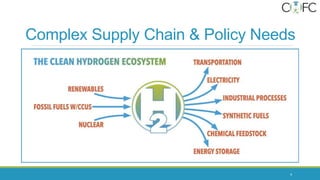
Complex Supply Chain & Policy Needs
4
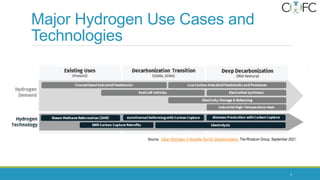
Major Hydrogen Use Cases and
Technologies
5
Source: Clean Hydrogen: A Versatile Tool for Decarbonization, The Rhodium Group, September 2021.
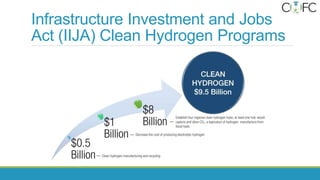
Infrastructure Investment and Jobs
Act (IIJA) Clean Hydrogen Programs
Hydrogen Hub Initiatives in the U.S.
7
Source: DOE Hydrogen Shot Summit
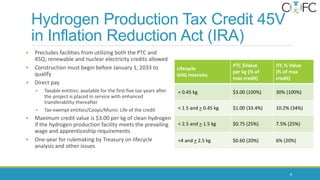
Hydrogen Production Tax Credit 45V
in Inflation Reduction Act (IRA)
• Precludes facilities from utilizing both the PTC and
45Q; renewable and nuclear electricity credits allowed
• Construction must begin before January 1, 2033 to
qualify
• Direct pay
• Taxable entities: available for the first five tax-years after
the project is placed in service with enhanced
transferability thereafter
• Tax-exempt entities/Coops/Munis: Life of the credit
• Maximum credit value is $3.00 per kg of clean hydrogen
if the hydrogen production facility meets the prevailing
wage and apprenticeship requirements
• One-year for rulemaking by Treasury on lifecycle
analysis and other issues
Lifecycle
GHG Intensity
PTC $Value
per kg (% of
max credit)
ITC % Value
(% of max
credit)
< 0.45 kg $3.00 (100%) 30% (100%)
< 1.5 and > 0.45 kg $1.00 (33.4%) 10.2% (34%)
< 2.5 and > 1.5 kg $0.75 (25%) 7.5% (25%)
<4 and > 2.5 kg​ $0.60 (20%) 6% (20%)
8
IRA Hydrogen Related Programs
Alternative Refueling Property Credit
Electricity Sector Credits
Clean Vehicle (hydrogen) Investment Tax Credits
Advanced Manufacturing Tax Credits
Advanced Industrial Facilities Deployment Program
Loan Program Office Authorization
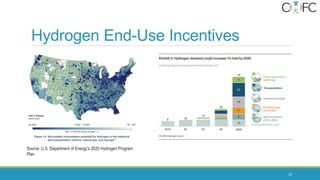
Hydrogen End-Use Incentives
Source: U.S. Department of Energy’s 2020 Hydrogen Program
Plan
10
Contact information
Jenna Peth
Director of Policy
Van Ness Feldman and Clean Hydrogen Future Coalition
jpeth@vnf.com
(360) 707-1060 (mobile)
www.vnf.com
www.cleanh2.org
Questions…
11

Clean-Hydrogen-Future-Coalition-Presentation-Jenna-Peth(3).pptx

  • 1.
    Building a Hydrogen Future:U.S. Federal Policy SEPTEMBER 22, 2022
  • 2.
    CHFC Foundational Principles (1)Clean hydrogen is a critical pathway to achieve U.S. decarbonization objectives. (2) Investments in the full value chain of clean hydrogen production, transport and delivery, storage and use, as well as the infrastructure across multiple sectors, will be necessary to scale clean hydrogen in the U.S. (3) Policies designed to stimulate clean hydrogen production and use throughout the U.S. economy should be fuel agnostic and technology neutral and focus on the carbon intensity of CO2 hydrogen production method. (4) Skilled labor and the use of existing infrastructure are essential to the deployment of clean hydrogen throughout our economy.
  • 3.
    CHFC Members Representthe Complete Clean Hydrogen Supply Chain 174 Power Global American Gas Association American Public Gas Association Apex Clean Energy Battelle Bayotech bp California Fuel Cell Partnership Chevron ClearPath Action Daroga Power Dastur Duke Energy Equinor Gas Technology Institute GE Gas Power Int’l Brotherhood of Boilermakers INGAA LanzaTech Linde Nikola Nel North Slope Borough Nuclear Energy Institute ONE Gas Sempra Energy Shell Siemens Energy Southern TC Energy Tennessee Valley Authority U. of Wyoming School of Energy Resources U. of North Dakota EERC Voice of the Arctic Inupiat Wabash Valley Resources Williams Companies 3
  • 4.
    Complex Supply Chain& Policy Needs 4
  • 5.
    Major Hydrogen UseCases and Technologies 5 Source: Clean Hydrogen: A Versatile Tool for Decarbonization, The Rhodium Group, September 2021.
  • 6.
    Infrastructure Investment andJobs Act (IIJA) Clean Hydrogen Programs
  • 7.
    Hydrogen Hub Initiativesin the U.S. 7 Source: DOE Hydrogen Shot Summit
  • 8.
    Hydrogen Production TaxCredit 45V in Inflation Reduction Act (IRA) • Precludes facilities from utilizing both the PTC and 45Q; renewable and nuclear electricity credits allowed • Construction must begin before January 1, 2033 to qualify • Direct pay • Taxable entities: available for the first five tax-years after the project is placed in service with enhanced transferability thereafter • Tax-exempt entities/Coops/Munis: Life of the credit • Maximum credit value is $3.00 per kg of clean hydrogen if the hydrogen production facility meets the prevailing wage and apprenticeship requirements • One-year for rulemaking by Treasury on lifecycle analysis and other issues Lifecycle GHG Intensity PTC $Value per kg (% of max credit) ITC % Value (% of max credit) < 0.45 kg $3.00 (100%) 30% (100%) < 1.5 and > 0.45 kg $1.00 (33.4%) 10.2% (34%) < 2.5 and > 1.5 kg $0.75 (25%) 7.5% (25%) <4 and > 2.5 kg​ $0.60 (20%) 6% (20%) 8
  • 9.
    IRA Hydrogen RelatedPrograms Alternative Refueling Property Credit Electricity Sector Credits Clean Vehicle (hydrogen) Investment Tax Credits Advanced Manufacturing Tax Credits Advanced Industrial Facilities Deployment Program Loan Program Office Authorization
  • 10.
    Hydrogen End-Use Incentives Source:U.S. Department of Energy’s 2020 Hydrogen Program Plan 10
  • 11.
    Contact information Jenna Peth Directorof Policy Van Ness Feldman and Clean Hydrogen Future Coalition jpeth@vnf.com (360) 707-1060 (mobile) www.vnf.com www.cleanh2.org Questions… 11

Editor's Notes

  • #4 Our members represent the entire hydrogen value chain – from producers to transporters to end users. The coalitions policy approach is focused on the carbon intensity of the hydrogen produced, rather than a preference for certain production pathways over others. In order to have a true hydrogen economy, we need to scale up all forms of production quickly and bring down costs for that production.
  • #6 This graphic from the Rhodium group does an excellent job of showing the timeline for different hydrogen use cases and how the balance of production might change over time. This really emphasizes the need for promoting all production pathways now so that we can effectively scale a hydrogen economy in the coming decades.
  • #7 The IIJA included significant funding for clean hydrogen, the centerpiece of which is the $8 billion for regional clean hydrogen hubs, a program that CHFC staff helped develop with Senate staff. The program included statutory language that requires the Department of Energy to award funding to hubs with a variety of feedstocks – including at least one hub that captures and stores CO2. In addition to the hydrogen hubs funding, the $1 billion for electrolytic hydrogen will help to bring down costs for that production pathway and leverage the hydrogen hub funding.
  • #8 As I mentioned previously, the hydrogen hubs RFI that was issued by the department resulted in thousands of pages of feedback from across the country. As you can see on this map, many regions can make a good case for hydrogen but only a few will actually be awarded these projects. Each of these regions and states are at various stages in the planning process for their responses, with some states engaging formally by enacting legislation and appointing a coordinator for the response or signing a memorandum of understanding with other regional partners to strengthen their response. Other groups are engaging more informally through commercial groups or other affiliations.
  • #11 So where are we going next? The CHFC is again focused on all aspect of the hydrogen economy and we are currently looking at different incentive models for hydrogen end uses. We will be working on a bipartisan basis next congress on advancing these types of incentives.