Mr. Suresh G
Assistant Professor
Department of Management Sciences - BBA
Sri Ramakrishna College of Arts & Science (Autonomous)
Coimbatore - 641 006
Tamil Nadu, India
23BM403 – Insurance Principles and Practices
UNIT - I
1
Sri Ramakrishna College of Arts and Science
Classification of Risks
Risk Classification
• Risk classification is the process of grouping risks into
different categories based on their characteristics.
Sri Ramakrishna College of Arts and Science
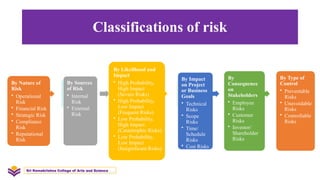
Classifications of risk
By Nature of
Risk
• Operational
Risk
• Financial Risk
• Strategic Risk
• Compliance
Risk
• Reputational
Risk
By Sources
of Risk
• Internal
Risk
• External
Risk
By Likelihood and
Impact
• High Probability,
High Impact
(Severe Risks)
• High Probability,
Low Impact
(Frequent Risks)
• Low Probability,
High Impact
(Catastrophic Risks)
• Low Probability,
Low Impact
(Insignificant Risks)
By Impact
on Project
or Business
Goals
• Technical
Risks
• Scope
Risks
• Time/
Schedule
Risks
• Cost Risks
By
Consequence
on
Stakeholders
• Employee
Risks
• Customer
Risks
• Investor/
Shareholder
Risks
By Type of
Control
• Preventable
Risks
• Unavoidable
Risks
• Controllable
Risks
Sri Ramakrishna College of Arts and Science
By Nature of Risk
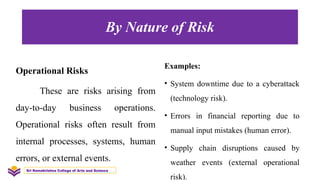
Operational Risks
These are risks arising from
day-to-day business operations.
Operational risks often result from
internal processes, systems, human
errors, or external events.
Examples:
• System downtime due to a cyberattack
(technology risk).
• Errors in financial reporting due to
manual input mistakes (human error).
• Supply chain disruptions caused by
weather events (external operational
risk).
Sri Ramakrishna College of Arts and Science
By Nature of Risk
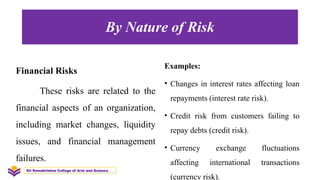
Financial Risks
These risks are related to the
financial aspects of an organization,
including market changes, liquidity
issues, and financial management
failures.
Examples:
• Changes in interest rates affecting loan
repayments (interest rate risk).
• Credit risk from customers failing to
repay debts (credit risk).
• Currency exchange fluctuations
affecting international transactions
(currency risk).
Sri Ramakrishna College of Arts and Science
By Nature of Risk
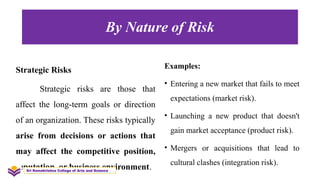
Strategic Risks
Strategic risks are those that
affect the long-term goals or direction
of an organization. These risks typically
arise from decisions or actions that
may affect the competitive position,
reputation, or business environment.
Examples:
• Entering a new market that fails to meet
expectations (market risk).
• Launching a new product that doesn't
gain market acceptance (product risk).
• Mergers or acquisitions that lead to
cultural clashes (integration risk).
Sri Ramakrishna College of Arts and Science
By Nature of Risk
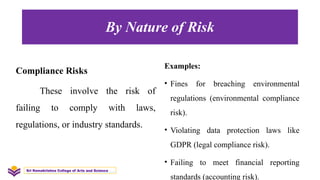
Compliance Risks
These involve the risk of
failing to comply with laws,
regulations, or industry standards.
Examples:
• Fines for breaching environmental
regulations (environmental compliance
risk).
• Violating data protection laws like
GDPR (legal compliance risk).
• Failing to meet financial reporting
standards (accounting risk).
Sri Ramakrishna College of Arts and Science
By Nature of Risk
Reputational Risks
Reputation risk arises from
negative perceptions or events that
can damage an organization's image
or brand.
Examples:
• A public relations scandal that damages
a company's reputation (media
coverage).
• Customer dissatisfaction with a product
leading to negative reviews (customer
trust).
Sri Ramakrishna College of Arts and Science
By Source of Risk
Internal Risks
These risks arise from within
the organization and are usually
controllable to some extent by
management.
Examples:
• Mismanagement or lack of leadership
(management risk).
• Organizational culture problems, such as
poor communication or low morale
(employee relations).
• Failure of internal controls or compliance
processes (internal audit risks).
Sri Ramakrishna College of Arts and Science
External Risks
These risks come from factors
outside the organization, typically
beyond its control.
Examples:
• Economic recessions affecting demand
for products (economic risk).
• Natural disasters, like earthquakes or
floods (environmental risk).
• Political instability in a country where the
company operates (political risk).
Sri Ramakrishna College of Arts and Science
By Source of Risk
By Likelihood and Impact
High Probability, High Impact
(Severe Risks)
These risks have a high
likelihood of occurring and would
cause significant damage if they do.
Examples:
• A cybersecurity breach exposing sensitive
customer data (IT security risk).
• A major factory fire disrupting production
(operational risk).
Sri Ramakrishna College of Arts and Science
By Likelihood and Impact
High Probability, Low Impact
(Frequent Risks)
These risks are likely to occur
but have a relatively low impact
when they do.
Examples:
• Minor shipping delays due to weather
conditions (supply chain risk).
• Small equipment malfunctions that can be
fixed quickly (maintenance risk).
Sri Ramakrishna College of Arts and Science
By Likelihood and Impact
Low Probability, High Impact
(Catastrophic Risks)
These risks are unlikely to
occur but could have disastrous
effects if they do.
Examples:
• A major oil spill causing environmental
damage and financial penalties
(environmental disaster).
• A fire destroying a data centre (IT
disaster).
Sri Ramakrishna College of Arts and Science
By Likelihood and Impact
Low Probability, Low Impact
(Insignificant Risks)
These risks are unlikely to
occur and would have minimal
consequences if they do.
Examples:
• Minor administrative errors that are easily
corrected (clerical risk).
• Unforeseen small fluctuations in market
prices that do not significantly affect
operations (market risk).
Sri Ramakrishna College of Arts and Science
By Impact on Project or Business
Goals
Technical Risks
These risks are related to the
technical aspects of a project or
business, such as the technology
being used, product development, or
technical challenges.
Examples:
• Software bugs or glitches in a product
(technology risk).
• Delays due to technical issues in
production (manufacturing risk).
Sri Ramakrishna College of Arts and Science
By Impact on Project or Business
Goals
Scope Risks
These risks relate to changes
in the scope of a project or business
initiative, affecting timelines and
resource allocation.
Examples:
• A project’s scope being expanded
unexpectedly (scope creep).
• New regulations requiring additional
compliance efforts (regulatory scope
change).
Sri Ramakrishna College of Arts and Science
By Impact on Project or Business
Goals
Time/ Schedule Risks
These risks are related to
meeting deadlines and schedules.
They usually affect project timelines
and delivery dates.
Examples:
• Delay in construction due to weather or
labor strikes (construction risk).
• Delayed product launch due to unforeseen
testing issues (product development risk).
Sri Ramakrishna College of Arts and Science
By Impact on Project or Business
Goals
Cost Risks
Cost risks involve budget
overruns, financial mismanagement,
or unexpected expenses.
Examples:
• Overestimating the costs of a project,
leading to a budget shortfall (cost
estimation risk).
• Unexpected increase in material costs due
to supply shortages (material cost risk).
Sri Ramakrishna College of Arts and Science
By Consequence on Stakeholders
Employee Risks
These are risks that affect
employees, such as health, safety, or
job satisfaction.
Examples:
• Work-related accidents leading to injuries
(safety risk).
• Low employee morale affecting
productivity (human resources risk).
Sri Ramakrishna College of Arts and Science
By Consequence on Stakeholders
Customer Risks
These risks impact customers
directly and can affect customer
satisfaction, loyalty, and retention.
Examples:
• Poor product quality leading to customer
complaints (product risk).
• Service interruptions affecting customer
experience (service risk).
Sri Ramakrishna College of Arts and Science
By Consequence on Stakeholders
Investor/Shareholder Risks
These risks concern the impact
on the financial interests of investors
or shareholders.
Examples:
• Declining stock prices due to poor
financial performance (financial risk).
• Change in dividend policies affecting
investor expectations (dividend risk).
Sri Ramakrishna College of Arts and Science
By Type of Control
Preventable Risks
These risks can be avoided or
mitigated through proper
management and controls.
Examples:
• Employee negligence that could have
been prevented with proper training
(human error).
• Failure to implement fire safety measures
leading to avoidable accidents (safety
risk).
Sri Ramakrishna College of Arts and Science
By Type of Control
Unavoidable Risks
These risks cannot be avoided,
but they can be managed or
minimized.
Examples:
• Natural disasters like earthquakes or
floods (environmental risk).
• Changes in global market conditions due
to geopolitical instability (market risk).
Sri Ramakrishna College of Arts and Science
By Type of Control
Controllable Risks
These risks can be managed or
reduced through mitigation strategies
and proactive measures.
Examples:
• Delays due to ineffective project
management (project risk).
• Cybersecurity risks that can be mitigated
through investment in secure systems (IT
security risk).
Sri Ramakrishna College of Arts and Science

Classification of Risks based on their characteristics.pptx

  • 1.
    Mr. Suresh G AssistantProfessor Department of Management Sciences - BBA Sri Ramakrishna College of Arts & Science (Autonomous) Coimbatore - 641 006 Tamil Nadu, India 23BM403 – Insurance Principles and Practices UNIT - I 1 Sri Ramakrishna College of Arts and Science
  • 2.
    Sri Ramakrishna Collegeof Arts and Science Classification of Risks
  • 3.
    Risk Classification • Riskclassification is the process of grouping risks into different categories based on their characteristics. Sri Ramakrishna College of Arts and Science
  • 4.
    Classifications of risk ByNature of Risk • Operational Risk • Financial Risk • Strategic Risk • Compliance Risk • Reputational Risk By Sources of Risk • Internal Risk • External Risk By Likelihood and Impact • High Probability, High Impact (Severe Risks) • High Probability, Low Impact (Frequent Risks) • Low Probability, High Impact (Catastrophic Risks) • Low Probability, Low Impact (Insignificant Risks) By Impact on Project or Business Goals • Technical Risks • Scope Risks • Time/ Schedule Risks • Cost Risks By Consequence on Stakeholders • Employee Risks • Customer Risks • Investor/ Shareholder Risks By Type of Control • Preventable Risks • Unavoidable Risks • Controllable Risks Sri Ramakrishna College of Arts and Science
  • 5.
    By Nature ofRisk Operational Risks These are risks arising from day-to-day business operations. Operational risks often result from internal processes, systems, human errors, or external events. Examples: • System downtime due to a cyberattack (technology risk). • Errors in financial reporting due to manual input mistakes (human error). • Supply chain disruptions caused by weather events (external operational risk). Sri Ramakrishna College of Arts and Science
  • 6.
    By Nature ofRisk Financial Risks These risks are related to the financial aspects of an organization, including market changes, liquidity issues, and financial management failures. Examples: • Changes in interest rates affecting loan repayments (interest rate risk). • Credit risk from customers failing to repay debts (credit risk). • Currency exchange fluctuations affecting international transactions (currency risk). Sri Ramakrishna College of Arts and Science
  • 7.
    By Nature ofRisk Strategic Risks Strategic risks are those that affect the long-term goals or direction of an organization. These risks typically arise from decisions or actions that may affect the competitive position, reputation, or business environment. Examples: • Entering a new market that fails to meet expectations (market risk). • Launching a new product that doesn't gain market acceptance (product risk). • Mergers or acquisitions that lead to cultural clashes (integration risk). Sri Ramakrishna College of Arts and Science
  • 8.
    By Nature ofRisk Compliance Risks These involve the risk of failing to comply with laws, regulations, or industry standards. Examples: • Fines for breaching environmental regulations (environmental compliance risk). • Violating data protection laws like GDPR (legal compliance risk). • Failing to meet financial reporting standards (accounting risk). Sri Ramakrishna College of Arts and Science
  • 9.
    By Nature ofRisk Reputational Risks Reputation risk arises from negative perceptions or events that can damage an organization's image or brand. Examples: • A public relations scandal that damages a company's reputation (media coverage). • Customer dissatisfaction with a product leading to negative reviews (customer trust). Sri Ramakrishna College of Arts and Science
  • 10.
    By Source ofRisk Internal Risks These risks arise from within the organization and are usually controllable to some extent by management. Examples: • Mismanagement or lack of leadership (management risk). • Organizational culture problems, such as poor communication or low morale (employee relations). • Failure of internal controls or compliance processes (internal audit risks). Sri Ramakrishna College of Arts and Science
  • 11.
    External Risks These riskscome from factors outside the organization, typically beyond its control. Examples: • Economic recessions affecting demand for products (economic risk). • Natural disasters, like earthquakes or floods (environmental risk). • Political instability in a country where the company operates (political risk). Sri Ramakrishna College of Arts and Science By Source of Risk
  • 12.
    By Likelihood andImpact High Probability, High Impact (Severe Risks) These risks have a high likelihood of occurring and would cause significant damage if they do. Examples: • A cybersecurity breach exposing sensitive customer data (IT security risk). • A major factory fire disrupting production (operational risk). Sri Ramakrishna College of Arts and Science
  • 13.
    By Likelihood andImpact High Probability, Low Impact (Frequent Risks) These risks are likely to occur but have a relatively low impact when they do. Examples: • Minor shipping delays due to weather conditions (supply chain risk). • Small equipment malfunctions that can be fixed quickly (maintenance risk). Sri Ramakrishna College of Arts and Science
  • 14.
    By Likelihood andImpact Low Probability, High Impact (Catastrophic Risks) These risks are unlikely to occur but could have disastrous effects if they do. Examples: • A major oil spill causing environmental damage and financial penalties (environmental disaster). • A fire destroying a data centre (IT disaster). Sri Ramakrishna College of Arts and Science
  • 15.
    By Likelihood andImpact Low Probability, Low Impact (Insignificant Risks) These risks are unlikely to occur and would have minimal consequences if they do. Examples: • Minor administrative errors that are easily corrected (clerical risk). • Unforeseen small fluctuations in market prices that do not significantly affect operations (market risk). Sri Ramakrishna College of Arts and Science
  • 16.
    By Impact onProject or Business Goals Technical Risks These risks are related to the technical aspects of a project or business, such as the technology being used, product development, or technical challenges. Examples: • Software bugs or glitches in a product (technology risk). • Delays due to technical issues in production (manufacturing risk). Sri Ramakrishna College of Arts and Science
  • 17.
    By Impact onProject or Business Goals Scope Risks These risks relate to changes in the scope of a project or business initiative, affecting timelines and resource allocation. Examples: • A project’s scope being expanded unexpectedly (scope creep). • New regulations requiring additional compliance efforts (regulatory scope change). Sri Ramakrishna College of Arts and Science
  • 18.
    By Impact onProject or Business Goals Time/ Schedule Risks These risks are related to meeting deadlines and schedules. They usually affect project timelines and delivery dates. Examples: • Delay in construction due to weather or labor strikes (construction risk). • Delayed product launch due to unforeseen testing issues (product development risk). Sri Ramakrishna College of Arts and Science
  • 19.
    By Impact onProject or Business Goals Cost Risks Cost risks involve budget overruns, financial mismanagement, or unexpected expenses. Examples: • Overestimating the costs of a project, leading to a budget shortfall (cost estimation risk). • Unexpected increase in material costs due to supply shortages (material cost risk). Sri Ramakrishna College of Arts and Science
  • 20.
    By Consequence onStakeholders Employee Risks These are risks that affect employees, such as health, safety, or job satisfaction. Examples: • Work-related accidents leading to injuries (safety risk). • Low employee morale affecting productivity (human resources risk). Sri Ramakrishna College of Arts and Science
  • 21.
    By Consequence onStakeholders Customer Risks These risks impact customers directly and can affect customer satisfaction, loyalty, and retention. Examples: • Poor product quality leading to customer complaints (product risk). • Service interruptions affecting customer experience (service risk). Sri Ramakrishna College of Arts and Science
  • 22.
    By Consequence onStakeholders Investor/Shareholder Risks These risks concern the impact on the financial interests of investors or shareholders. Examples: • Declining stock prices due to poor financial performance (financial risk). • Change in dividend policies affecting investor expectations (dividend risk). Sri Ramakrishna College of Arts and Science
  • 23.
    By Type ofControl Preventable Risks These risks can be avoided or mitigated through proper management and controls. Examples: • Employee negligence that could have been prevented with proper training (human error). • Failure to implement fire safety measures leading to avoidable accidents (safety risk). Sri Ramakrishna College of Arts and Science
  • 24.
    By Type ofControl Unavoidable Risks These risks cannot be avoided, but they can be managed or minimized. Examples: • Natural disasters like earthquakes or floods (environmental risk). • Changes in global market conditions due to geopolitical instability (market risk). Sri Ramakrishna College of Arts and Science
  • 25.
    By Type ofControl Controllable Risks These risks can be managed or reduced through mitigation strategies and proactive measures. Examples: • Delays due to ineffective project management (project risk). • Cybersecurity risks that can be mitigated through investment in secure systems (IT security risk). Sri Ramakrishna College of Arts and Science
  • 26.
    Sri Ramakrishna Collegeof Arts and Science