Classification ofClassification of
bacteriabacteria
Shyam Kumar MishraShyam Kumar Mishra
Assistant Professor,Assistant Professor,
Department of MicrobiologyDepartment of Microbiology
Institute of MedicineInstitute of Medicine
Tribhuvan UniversityTribhuvan University 1
Basis of classification
• Phenotypic classification
 Morphological
 Anatomical
 Staining
 Cultural characteristics
 Nutrition
 Environmental factors
 Biochemical reactions
 Antigenic structure
• Genotypic classification
 DNA-DNA hybridization
 G+C content 2
Morphological classification
• Bacteria can be classified into six major groups on
morphological basis.
1. TRUE BACTERIA1. TRUE BACTERIA
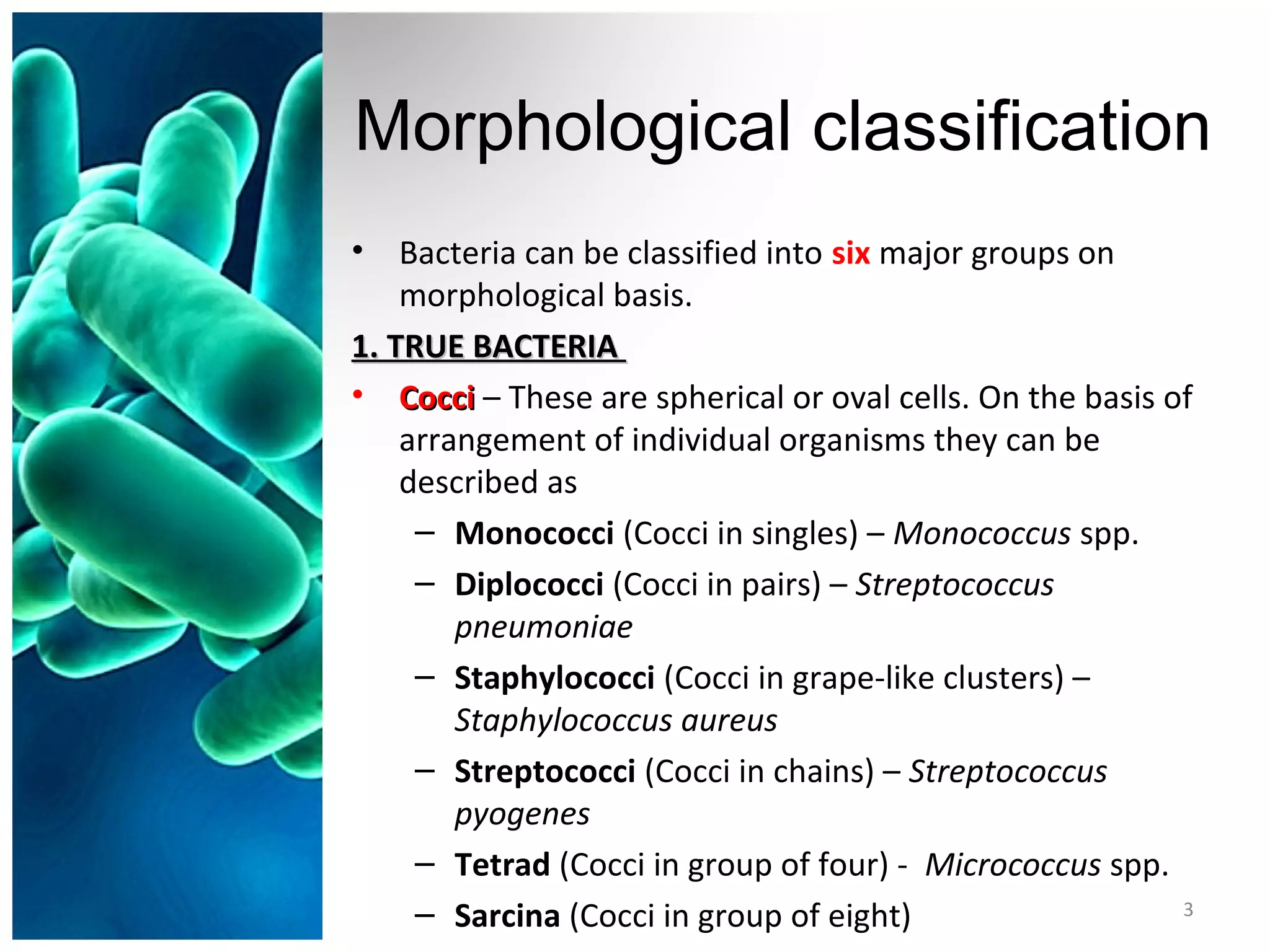
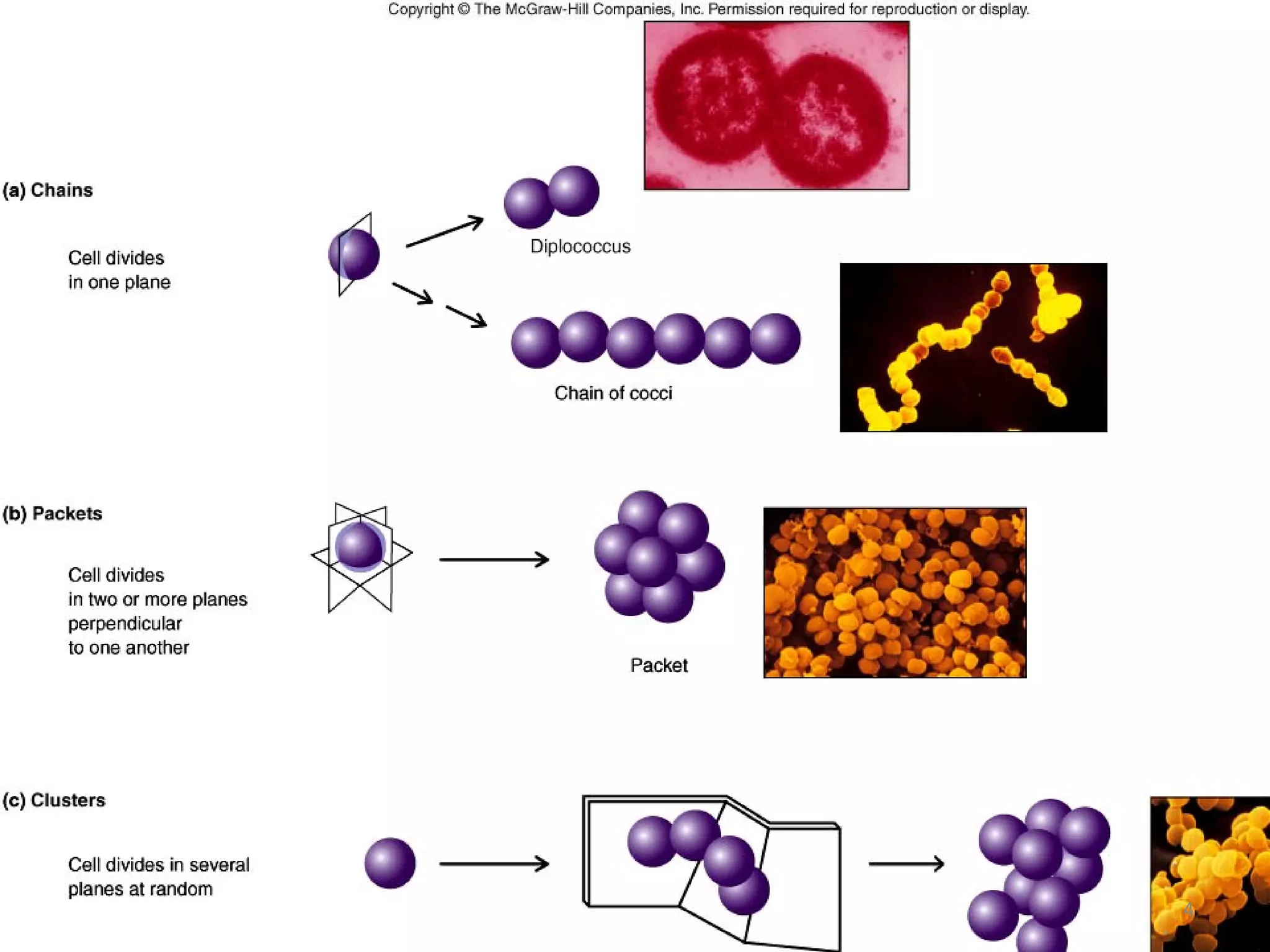
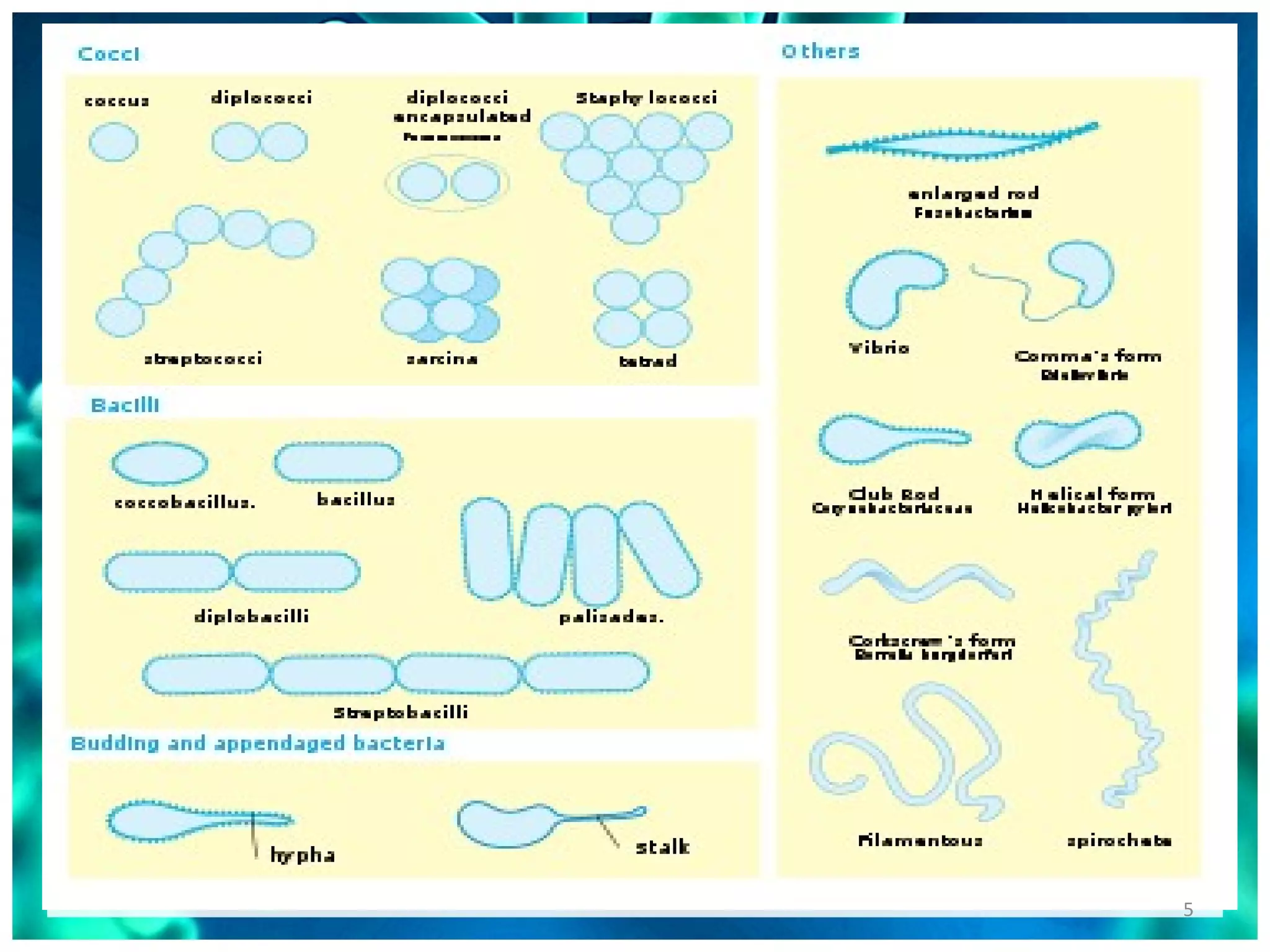
• CocciCocci – These are spherical or oval cells. On the basis of
arrangement of individual organisms they can be
described as
– Monococci (Cocci in singles) – Monococcus spp.
– Diplococci (Cocci in pairs) – Streptococcus
pneumoniae
– Staphylococci (Cocci in grape-like clusters) –
Staphylococcus aureus
– Streptococci (Cocci in chains) – Streptococcus
pyogenes
– Tetrad (Cocci in group of four) - Micrococcus spp.
– Sarcina (Cocci in group of eight) 3
4
5
• BacilliBacilli – These are rod-shaped bacteria. On the basis of arrangement of
organisms, they can be described as
– Diplobacilli
– Streptobacilli
– Palisades
– Chinese-letter form
– Coccobacilli
– Comma-shaped
6
Morphological classification
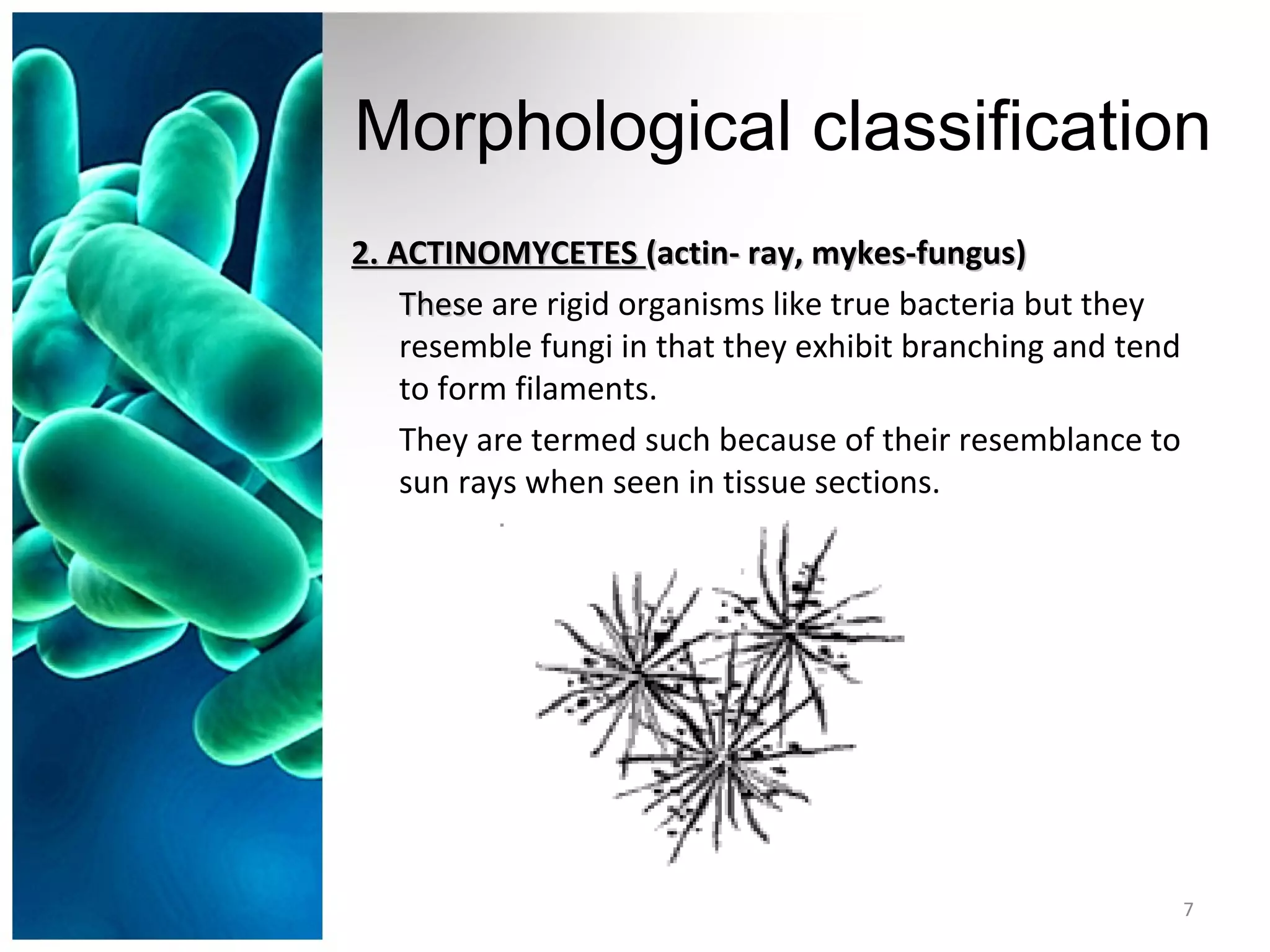
2. ACTINOMYCETES2. ACTINOMYCETES (actin- ray, mykes-fungus)(actin- ray, mykes-fungus)
ThesThese are rigid organisms like true bacteria but they
resemble fungi in that they exhibit branching and tend
to form filaments.
They are termed such because of their resemblance to
sun rays when seen in tissue sections.
7
Morphological classification
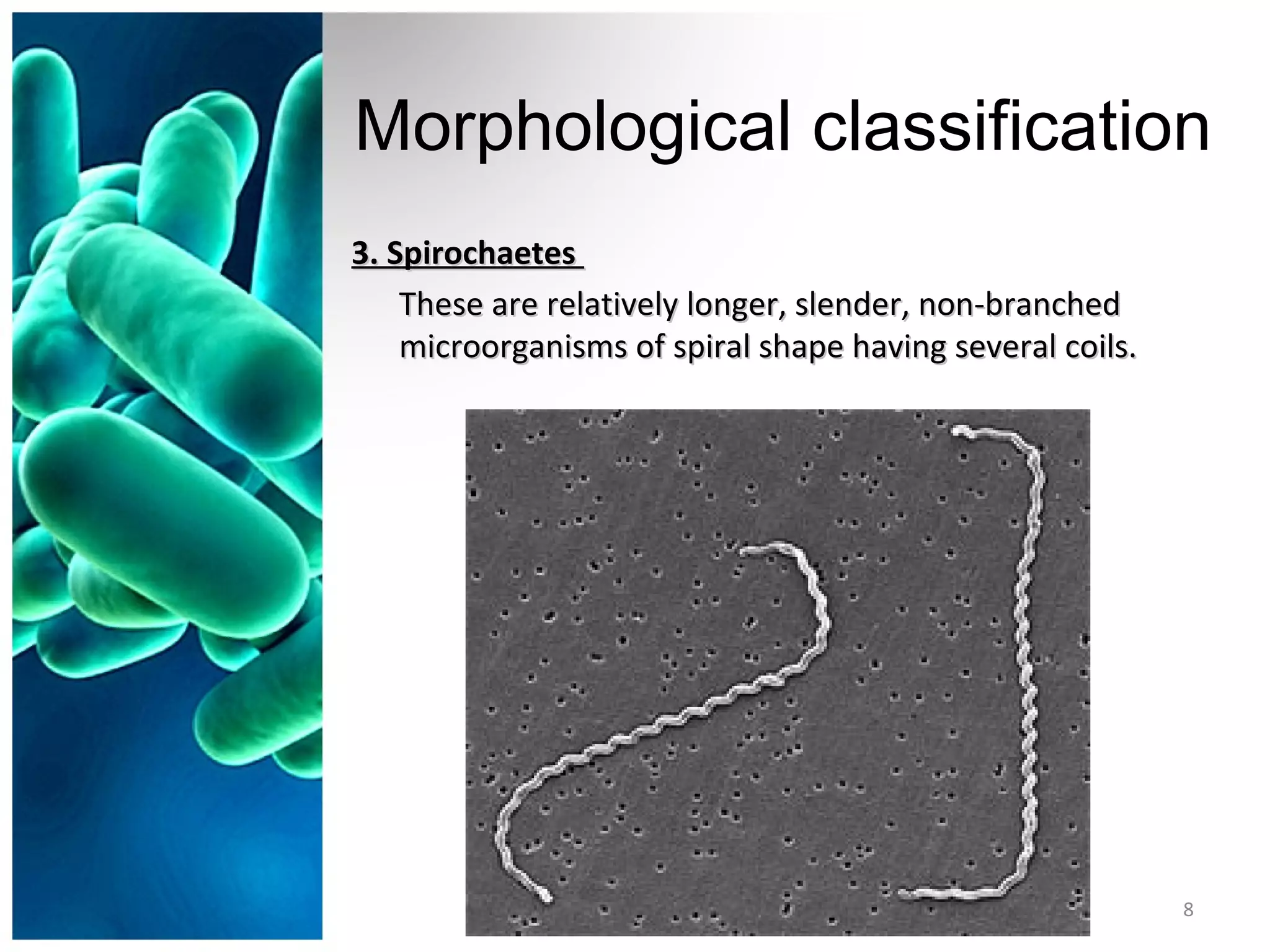
3. Spirochaetes3. Spirochaetes
These are relatively longer, slender, non-branchedThese are relatively longer, slender, non-branched
microorganisms of spiral shape having several coils.microorganisms of spiral shape having several coils.
8
Morphological classification
4. Mycoplasmas4. Mycoplasmas
These bacteria lack in rigid cell wall (cell wall lacking)These bacteria lack in rigid cell wall (cell wall lacking)
and are highly pleomorphic and of indefinite shape.and are highly pleomorphic and of indefinite shape.
They occur in round or oval bodies and in interlacingThey occur in round or oval bodies and in interlacing
filaments.filaments.
5. Rickettsiae and Chlamydiae5. Rickettsiae and Chlamydiae
These are very small, obligate parasites, and at one timeThese are very small, obligate parasites, and at one time
were considered closely related to the viruses. Now,were considered closely related to the viruses. Now,
these are regarded as bacteria.these are regarded as bacteria.
9
Based on Anatomical features
• Capsule
– Capsulate– Streptococcus pneumoniae
– Non-capsulate – Viridans streptococci
• Flagella
– Flagellate –
• Monotrichous
• Lophotrichous
• Amphitrichous
• Peritrichous
– Aflagellate – Shigella spp.
• Spore
– Spore-forming – Bacillus spp.
– Non-sporing – Escherichia coli 10
Based on Staining reaction
• GRAM’S STAIN
– Gram-positive cocci – Staphylococcus aureus
– Gram-negative cocci – Neisseria gonorrhoeae
– Gram-positive rods – Clostridium spp.
– Gram-negative rods – E. coli
• ACID FAST STAIN
– Acid-fast bacilli –Mycobacterium tuberculosis
– Non-acid-fast bacilli – Staphylococcus aureus
11
Based on Cultural characteristics
• Extra growth factors requirements
– Fastidious – Hemophilus influenzae
– Non-fastidious – Escherichia coli
• Hemolysis on Sheep Blood Agar
– Alpha-hemolysis – Streptococcus pneumoniae
– Beta-hemolysis – Streptococcus pyogenes
• Utilization of carbohydrates
– Oxidative - Micrococcus
– Fermentative – Escherichia coli
12
Based on Cultural characteristics
• Growth rate
– Rapid growers– Vibrio cholerae
– Slow growers – Mycobacterium tuberculosis
• Pigment production
– Pigment producer – Staphylococcus aureus
– Pigment non-producer – Escherichia coli
13
Based on Nutrition
• Autotrophs
• Heterotrophs
14
Based on environmental factors
• Temperature
• Oxygen dependence
• pH
• Salt concentration
• Atmospheric pressure
15
Temperature
• Psychrophiles (15-200
C) – Pseudomonas
fluorescens
• Mesophiles (20-400
C) – Escherichia coli,
Salmonella enterica, Staphylococcus aureus
• Thermophiles (50-600
C)- Bacillus
stearothermophilus
• Extremely thermophiles (as high as 2500
C)
16
Oxygen dependence
• Aerobe (grow in ambient temperature, which
contains 21% O2 and a small amount of CO2,
0.03%)
• Obligate aerobes – Strictly require O2for their
growth (Pseudomonas aeruginosa)
• Microaerophilic (grow under reduced O2, 5-
10% and increased CO2, 8-10%)- Campylobacter
jejuni, Helicobacter pylori
17
Oxygen dependence
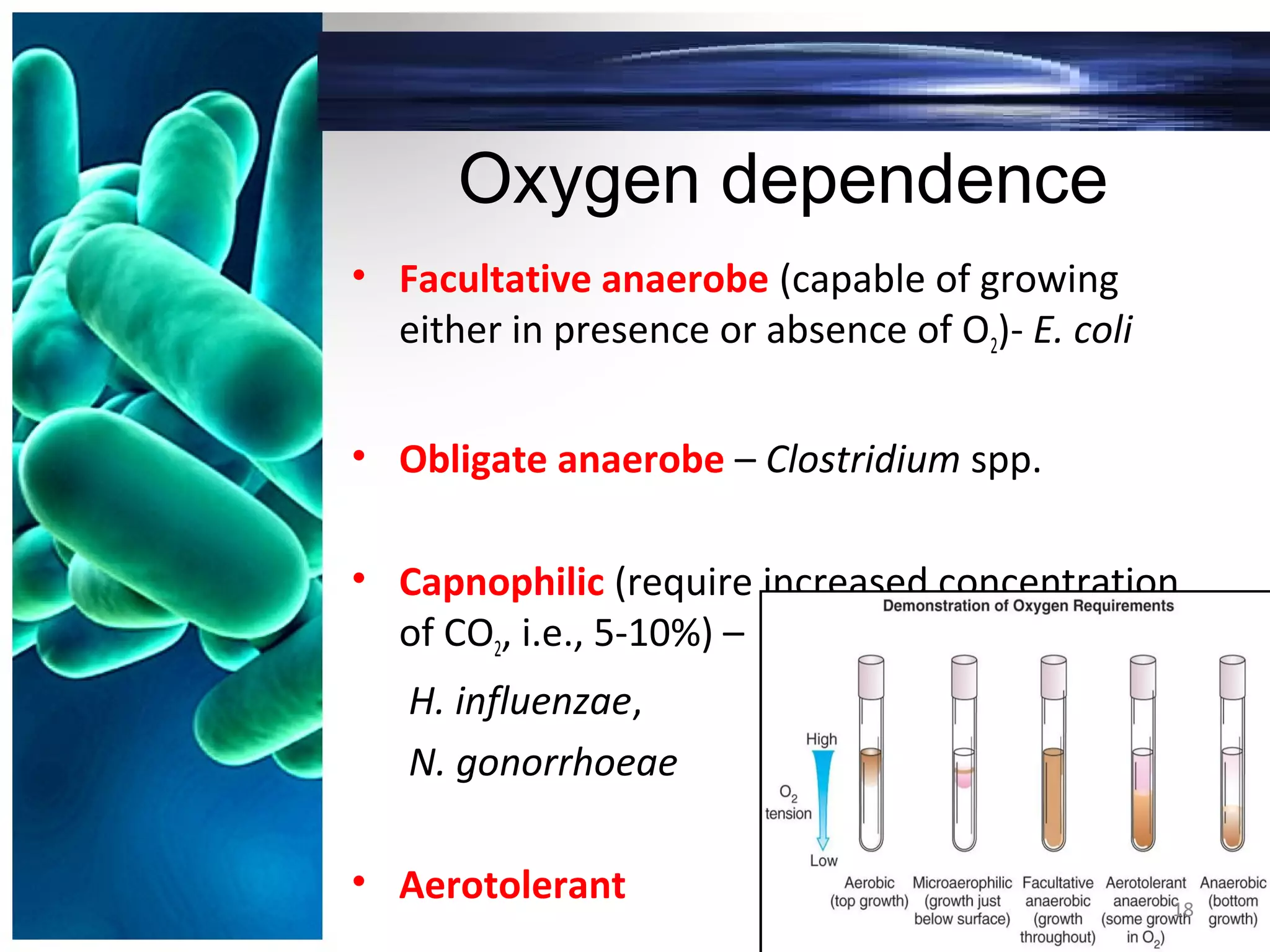
• Facultative anaerobe (capable of growing
either in presence or absence of O2)- E. coli
• Obligate anaerobe – Clostridium spp.
• Capnophilic (require increased concentration
of CO2, i.e., 5-10%) –
H. influenzae,
N. gonorrhoeae
• Aerotolerant 18
pH
• Acidophiles (Lactobacillus acidophilus)
• Alkaliphiles (Vibrio)
• Neutralophiles (pH 6-8)
Majority of the medically important bacteria grow
best at neutral or slightly alkaline reaction (pH
7.2-7.6)
19
Salt concentration
• Halophiles
• Non-halophiles
20
Other ways of classification
• Motile/Non-motile
• Pathogenic/Non-pathogenic
• Sensitive/Resistant (to particular antibiotic/ chemicals)
• Lactose fermenter/Lactose non-fermenter
• Bergey’s Manual of Determinative Bacteriology
– Gram-negative eubacteria that have cell walls
– Gram-positive eubacteria that have cell walls
– Cell wall-less eubacteria: Mycoplasma
– Archaeobacteria
21
22

Classification of bacteria

  • 1.
    Classification ofClassification of bacteriabacteria ShyamKumar MishraShyam Kumar Mishra Assistant Professor,Assistant Professor, Department of MicrobiologyDepartment of Microbiology Institute of MedicineInstitute of Medicine Tribhuvan UniversityTribhuvan University 1
  • 2.
    Basis of classification •Phenotypic classification  Morphological  Anatomical  Staining  Cultural characteristics  Nutrition  Environmental factors  Biochemical reactions  Antigenic structure • Genotypic classification  DNA-DNA hybridization  G+C content 2
  • 3.
    Morphological classification • Bacteriacan be classified into six major groups on morphological basis. 1. TRUE BACTERIA1. TRUE BACTERIA • CocciCocci – These are spherical or oval cells. On the basis of arrangement of individual organisms they can be described as – Monococci (Cocci in singles) – Monococcus spp. – Diplococci (Cocci in pairs) – Streptococcus pneumoniae – Staphylococci (Cocci in grape-like clusters) – Staphylococcus aureus – Streptococci (Cocci in chains) – Streptococcus pyogenes – Tetrad (Cocci in group of four) - Micrococcus spp. – Sarcina (Cocci in group of eight) 3
  • 4.
  • 5.
  • 6.
    • BacilliBacilli –These are rod-shaped bacteria. On the basis of arrangement of organisms, they can be described as – Diplobacilli – Streptobacilli – Palisades – Chinese-letter form – Coccobacilli – Comma-shaped 6
  • 7.
    Morphological classification 2. ACTINOMYCETES2.ACTINOMYCETES (actin- ray, mykes-fungus)(actin- ray, mykes-fungus) ThesThese are rigid organisms like true bacteria but they resemble fungi in that they exhibit branching and tend to form filaments. They are termed such because of their resemblance to sun rays when seen in tissue sections. 7
  • 8.
    Morphological classification 3. Spirochaetes3.Spirochaetes These are relatively longer, slender, non-branchedThese are relatively longer, slender, non-branched microorganisms of spiral shape having several coils.microorganisms of spiral shape having several coils. 8
  • 9.
    Morphological classification 4. Mycoplasmas4.Mycoplasmas These bacteria lack in rigid cell wall (cell wall lacking)These bacteria lack in rigid cell wall (cell wall lacking) and are highly pleomorphic and of indefinite shape.and are highly pleomorphic and of indefinite shape. They occur in round or oval bodies and in interlacingThey occur in round or oval bodies and in interlacing filaments.filaments. 5. Rickettsiae and Chlamydiae5. Rickettsiae and Chlamydiae These are very small, obligate parasites, and at one timeThese are very small, obligate parasites, and at one time were considered closely related to the viruses. Now,were considered closely related to the viruses. Now, these are regarded as bacteria.these are regarded as bacteria. 9
  • 10.
    Based on Anatomicalfeatures • Capsule – Capsulate– Streptococcus pneumoniae – Non-capsulate – Viridans streptococci • Flagella – Flagellate – • Monotrichous • Lophotrichous • Amphitrichous • Peritrichous – Aflagellate – Shigella spp. • Spore – Spore-forming – Bacillus spp. – Non-sporing – Escherichia coli 10
  • 11.
    Based on Stainingreaction • GRAM’S STAIN – Gram-positive cocci – Staphylococcus aureus – Gram-negative cocci – Neisseria gonorrhoeae – Gram-positive rods – Clostridium spp. – Gram-negative rods – E. coli • ACID FAST STAIN – Acid-fast bacilli –Mycobacterium tuberculosis – Non-acid-fast bacilli – Staphylococcus aureus 11
  • 12.
    Based on Culturalcharacteristics • Extra growth factors requirements – Fastidious – Hemophilus influenzae – Non-fastidious – Escherichia coli • Hemolysis on Sheep Blood Agar – Alpha-hemolysis – Streptococcus pneumoniae – Beta-hemolysis – Streptococcus pyogenes • Utilization of carbohydrates – Oxidative - Micrococcus – Fermentative – Escherichia coli 12
  • 13.
    Based on Culturalcharacteristics • Growth rate – Rapid growers– Vibrio cholerae – Slow growers – Mycobacterium tuberculosis • Pigment production – Pigment producer – Staphylococcus aureus – Pigment non-producer – Escherichia coli 13
  • 14.
    Based on Nutrition •Autotrophs • Heterotrophs 14
  • 15.
    Based on environmentalfactors • Temperature • Oxygen dependence • pH • Salt concentration • Atmospheric pressure 15
  • 16.
    Temperature • Psychrophiles (15-200 C)– Pseudomonas fluorescens • Mesophiles (20-400 C) – Escherichia coli, Salmonella enterica, Staphylococcus aureus • Thermophiles (50-600 C)- Bacillus stearothermophilus • Extremely thermophiles (as high as 2500 C) 16
  • 17.
    Oxygen dependence • Aerobe(grow in ambient temperature, which contains 21% O2 and a small amount of CO2, 0.03%) • Obligate aerobes – Strictly require O2for their growth (Pseudomonas aeruginosa) • Microaerophilic (grow under reduced O2, 5- 10% and increased CO2, 8-10%)- Campylobacter jejuni, Helicobacter pylori 17
  • 18.
    Oxygen dependence • Facultativeanaerobe (capable of growing either in presence or absence of O2)- E. coli • Obligate anaerobe – Clostridium spp. • Capnophilic (require increased concentration of CO2, i.e., 5-10%) – H. influenzae, N. gonorrhoeae • Aerotolerant 18
  • 19.
    pH • Acidophiles (Lactobacillusacidophilus) • Alkaliphiles (Vibrio) • Neutralophiles (pH 6-8) Majority of the medically important bacteria grow best at neutral or slightly alkaline reaction (pH 7.2-7.6) 19
  • 20.
  • 21.
    Other ways ofclassification • Motile/Non-motile • Pathogenic/Non-pathogenic • Sensitive/Resistant (to particular antibiotic/ chemicals) • Lactose fermenter/Lactose non-fermenter • Bergey’s Manual of Determinative Bacteriology – Gram-negative eubacteria that have cell walls – Gram-positive eubacteria that have cell walls – Cell wall-less eubacteria: Mycoplasma – Archaeobacteria 21
  • 22.