CL-NLP –
A Natural Language Processing
Library for Common Lisp
Vsevolod Dyomkin
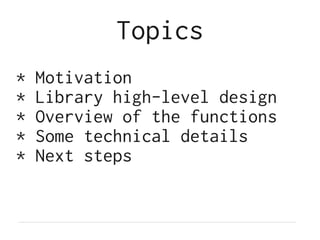
Topics
* Motivation
* Library high-level design
* Overview of the functions
* Some technical details
* Next steps
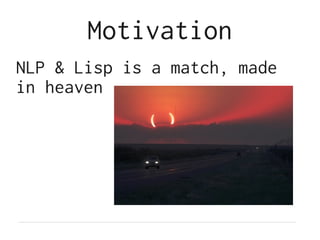
Motivation
NLP & Lisp is a match, made
in heaven
Previous Work
* CL-Langutils
* Lexiparse, Sparser, CL-EARLY-
PARSER, Basic-English-Grammar
* Wordnet interfaces
* CMU AI Repository
* Natural Language Understanding
* Natural Language Processing in
Lisp
Essential Scope
* Corpora interfaces
* Language modeling
* Measures
* Tokenization
* Tagging
* Parsing
* Wordnet interface
* Construct a pipeline
TDD, BDD, CDD
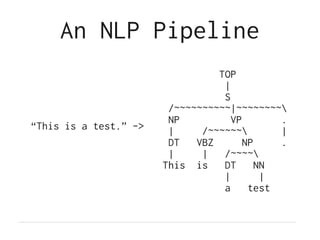
An NLP Pipeline
“This is a test.” ->
TOP
|
S
/~~~~~~~~~~|~~~~~~~~
NP VP .
| /~~~~~~ |
DT VBZ NP .
| | /~~~~
This is DT NN
| |
a test
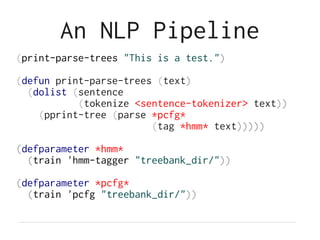
An NLP Pipeline
(print-parse-trees "This is a test.")
(defun print-parse-trees (text)
(dolist (sentence
(tokenize <sentence-tokenizer> text))
(pprint-tree (parse *pcfg*
(tag *hmm* text)))))
(defparameter *hmm*
(train 'hmm-tagger "treebank_dir/"))
(defparameter *pcfg*
(train 'pcfg "treebank_dir/"))
Some Design Choices
* A pseudo-hierarchical
package design
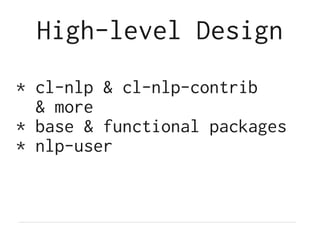
High-level Design
* cl-nlp & cl-nlp-contrib
& more
* base & functional packages
* nlp-user
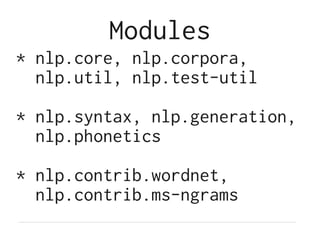
Modules
* nlp.core, nlp.corpora,
nlp.util, nlp.test-util
* nlp.syntax, nlp.generation,
nlp.phonetics
* nlp.contrib.wordnet,
nlp.contrib.ms-ngrams
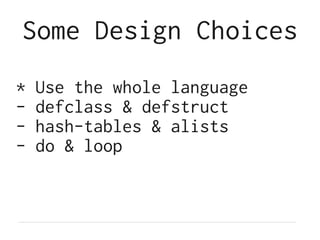
Some Design Choices
* Use the whole language
- defclass & defstruct
- hash-tables & alists
- do & loop
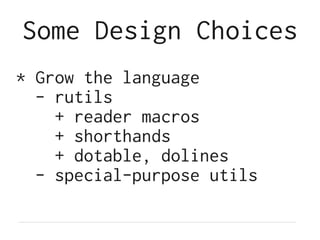
Some Design Choices
* Grow the language
- rutils
+ reader macros
+ shorthands
+ dotable, dolines
- special-purpose utils
General-Purpose Utils
(json:encode-json #{
"success" t
"sentence" text
"match"
(when-it (2nd (funcall fn (get-model text)))
(strcat
"{"
(strjoin ","
(mapcar #`(fmt ""~A":[~A,~A]"
(car %) (cadr %)
(cddr %))
(ht->alist it)))
"}"))
} stream)
A Special-Purpose Util
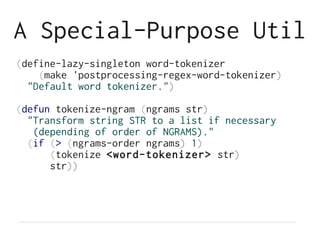
(define-lazy-singleton word-tokenizer
(make 'postprocessing-regex-word-tokenizer)
"Default word tokenizer.")
(defun tokenize-ngram (ngrams str)
"Transform string STR to a list if necessary
(depending of order of NGRAMS)."
(if (> (ngrams-order ngrams) 1)
(tokenize <word-tokenizer> str)
str))
A Special-Purpose Util
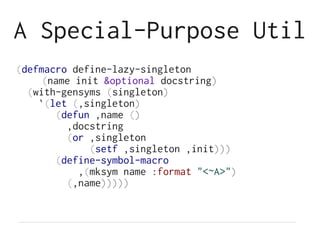
(defmacro define-lazy-singleton
(name init &optional docstring)
(with-gensyms (singleton)
`(let (,singleton)
(defun ,name ()
,docstring
(or ,singleton
(setf ,singleton ,init)))
(define-symbol-macro
,(mksym name :format "<~A>")
(,name)))))
Some Design Choices
* Use CLOS as a foundation
Basic Cell
(defclass regex-word-tokenizer (tokenizer)
((regex :accessor tokenizer-regex
:initarg :regex
:initform
(re:create-scanner
"w+|[!"#$%&'*+,./:;<=>?@^`~…()
{}[|] «»“”‘’¶-]"⟨⟩ ‒–—― )
:documentation
"A simpler variant would be [^s]+ —
it doesn't split punctuation, yet
sometimes it's desirable."))
(:documentation
"Regex-based word tokenizer."))
Basic Cell
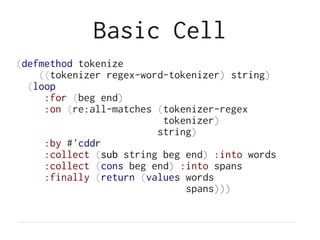
(defmethod tokenize
((tokenizer regex-word-tokenizer) string)
(loop
:for (beg end)
:on (re:all-matches (tokenizer-regex
tokenizer)
string)
:by #'cddr
:collect (sub string beg end) :into words
:collect (cons beg end) :into spans
:finally (return (values words
spans)))
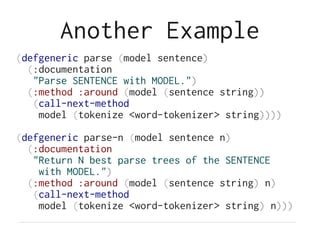
Another Example
(defgeneric parse (model sentence)
(:documentation
"Parse SENTENCE with MODEL.")
(:method :around (model (sentence string))
(call-next-method
model (tokenize <word-tokenizer> string))))
(defgeneric parse-n (model sentence n)
(:documentation
"Return N best parse trees of the SENTENCE
with MODEL.")
(:method :around (model (sentence string) n)
(call-next-method
model (tokenize <word-tokenizer> string) n)))
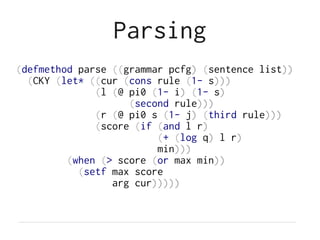
Parsing
(defmethod parse ((grammar pcfg) (sentence list))
(CKY (let* ((cur (cons rule (1- s)))
(l (@ pi0 (1- i) (1- s)
(second rule)))
(r (@ pi0 s (1- j) (third rule)))
(score (if (and l r)
(+ (log q) l r)
min)))
(when (> score (or max min))
(setf max score
arg cur)))))
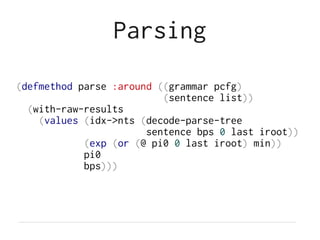
Parsing
(defmethod parse :around ((grammar pcfg)
(sentence list))
(with-raw-results
(values (idx->nts (decode-parse-tree
sentence bps 0 last iroot))
(exp (or (@ pi0 0 last iroot) min))
pi0
bps)))
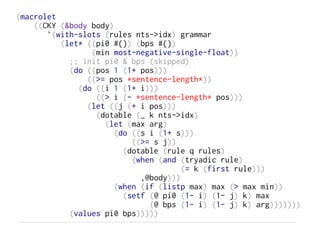
(macrolet
((CKY (&body body)
`(with-slots (rules nts->idx) grammar
(let* ((pi0 #{}) (bps #{})
(min most-negative-single-float))
;; init pi0 & bps (skipped)
(do ((pos 1 (1+ pos)))
((>= pos *sentence-length*))
(do ((i 1 (1+ i)))
((> i (- *sentence-length* pos)))
(let ((j (+ i pos)))
(dotable (_ k nts->idx)
(let (max arg)
(do ((s i (1+ s)))
((>= s j))
(dotable (rule q rules)
(when (and (tryadic rule)
(= k (first rule)))
,@body)))
(when (if (listp max) max (> max min))
(setf (@ pi0 (1- i) (1- j) k) max
(@ bps (1- i) (1- j) k) arg)))))))
(values pi0 bps)))))
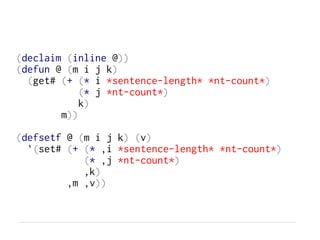
(declaim (inline @))
(defun @ (m i j k)
(get# (+ (* i *sentence-length* *nt-count*)
(* j *nt-count*)
k)
m))
(defsetf @ (m i j k) (v)
`(set# (+ (* ,i *sentence-length* *nt-count*)
(* ,j *nt-count*)
,k)
,m ,v))
http://lisp-univ-etc.blogspot.com/search/label/nltk

CL-NLP

  • 1.
    CL-NLP – A NaturalLanguage Processing Library for Common Lisp Vsevolod Dyomkin
  • 2.
    Topics * Motivation * Libraryhigh-level design * Overview of the functions * Some technical details * Next steps
  • 3.
    Motivation NLP & Lispis a match, made in heaven
  • 4.
    Previous Work * CL-Langutils *Lexiparse, Sparser, CL-EARLY- PARSER, Basic-English-Grammar * Wordnet interfaces * CMU AI Repository * Natural Language Understanding * Natural Language Processing in Lisp
  • 5.
    Essential Scope * Corporainterfaces * Language modeling * Measures * Tokenization * Tagging * Parsing * Wordnet interface * Construct a pipeline
  • 6.
  • 7.
    An NLP Pipeline “Thisis a test.” -> TOP | S /~~~~~~~~~~|~~~~~~~~ NP VP . | /~~~~~~ | DT VBZ NP . | | /~~~~ This is DT NN | | a test
  • 8.
    An NLP Pipeline (print-parse-trees"This is a test.") (defun print-parse-trees (text) (dolist (sentence (tokenize <sentence-tokenizer> text)) (pprint-tree (parse *pcfg* (tag *hmm* text))))) (defparameter *hmm* (train 'hmm-tagger "treebank_dir/")) (defparameter *pcfg* (train 'pcfg "treebank_dir/"))
  • 9.
    Some Design Choices *A pseudo-hierarchical package design
  • 10.
    High-level Design * cl-nlp& cl-nlp-contrib & more * base & functional packages * nlp-user
  • 11.
    Modules * nlp.core, nlp.corpora, nlp.util,nlp.test-util * nlp.syntax, nlp.generation, nlp.phonetics * nlp.contrib.wordnet, nlp.contrib.ms-ngrams
  • 12.
    Some Design Choices *Use the whole language - defclass & defstruct - hash-tables & alists - do & loop
  • 13.
    Some Design Choices *Grow the language - rutils + reader macros + shorthands + dotable, dolines - special-purpose utils
  • 14.
    General-Purpose Utils (json:encode-json #{ "success"t "sentence" text "match" (when-it (2nd (funcall fn (get-model text))) (strcat "{" (strjoin "," (mapcar #`(fmt ""~A":[~A,~A]" (car %) (cadr %) (cddr %)) (ht->alist it))) "}")) } stream)
  • 15.
    A Special-Purpose Util (define-lazy-singletonword-tokenizer (make 'postprocessing-regex-word-tokenizer) "Default word tokenizer.") (defun tokenize-ngram (ngrams str) "Transform string STR to a list if necessary (depending of order of NGRAMS)." (if (> (ngrams-order ngrams) 1) (tokenize <word-tokenizer> str) str))
  • 16.
    A Special-Purpose Util (defmacrodefine-lazy-singleton (name init &optional docstring) (with-gensyms (singleton) `(let (,singleton) (defun ,name () ,docstring (or ,singleton (setf ,singleton ,init))) (define-symbol-macro ,(mksym name :format "<~A>") (,name)))))
  • 17.
    Some Design Choices *Use CLOS as a foundation
  • 18.
    Basic Cell (defclass regex-word-tokenizer(tokenizer) ((regex :accessor tokenizer-regex :initarg :regex :initform (re:create-scanner "w+|[!"#$%&'*+,./:;<=>?@^`~…() {}[|] «»“”‘’¶-]"⟨⟩ ‒–—― ) :documentation "A simpler variant would be [^s]+ — it doesn't split punctuation, yet sometimes it's desirable.")) (:documentation "Regex-based word tokenizer."))
  • 19.
    Basic Cell (defmethod tokenize ((tokenizerregex-word-tokenizer) string) (loop :for (beg end) :on (re:all-matches (tokenizer-regex tokenizer) string) :by #'cddr :collect (sub string beg end) :into words :collect (cons beg end) :into spans :finally (return (values words spans)))
  • 20.
    Another Example (defgeneric parse(model sentence) (:documentation "Parse SENTENCE with MODEL.") (:method :around (model (sentence string)) (call-next-method model (tokenize <word-tokenizer> string)))) (defgeneric parse-n (model sentence n) (:documentation "Return N best parse trees of the SENTENCE with MODEL.") (:method :around (model (sentence string) n) (call-next-method model (tokenize <word-tokenizer> string) n)))
  • 21.
    Parsing (defmethod parse ((grammarpcfg) (sentence list)) (CKY (let* ((cur (cons rule (1- s))) (l (@ pi0 (1- i) (1- s) (second rule))) (r (@ pi0 s (1- j) (third rule))) (score (if (and l r) (+ (log q) l r) min))) (when (> score (or max min)) (setf max score arg cur)))))
  • 22.
    Parsing (defmethod parse :around((grammar pcfg) (sentence list)) (with-raw-results (values (idx->nts (decode-parse-tree sentence bps 0 last iroot)) (exp (or (@ pi0 0 last iroot) min)) pi0 bps)))
  • 23.
    (macrolet ((CKY (&body body) `(with-slots(rules nts->idx) grammar (let* ((pi0 #{}) (bps #{}) (min most-negative-single-float)) ;; init pi0 & bps (skipped) (do ((pos 1 (1+ pos))) ((>= pos *sentence-length*)) (do ((i 1 (1+ i))) ((> i (- *sentence-length* pos))) (let ((j (+ i pos))) (dotable (_ k nts->idx) (let (max arg) (do ((s i (1+ s))) ((>= s j)) (dotable (rule q rules) (when (and (tryadic rule) (= k (first rule))) ,@body))) (when (if (listp max) max (> max min)) (setf (@ pi0 (1- i) (1- j) k) max (@ bps (1- i) (1- j) k) arg))))))) (values pi0 bps)))))
  • 24.
    (declaim (inline @)) (defun@ (m i j k) (get# (+ (* i *sentence-length* *nt-count*) (* j *nt-count*) k) m)) (defsetf @ (m i j k) (v) `(set# (+ (* ,i *sentence-length* *nt-count*) (* ,j *nt-count*) ,k) ,m ,v))
  • 25.