Citi Prime Finance
The Rise of Liquid Alternatives &
the Changing Dynamics of Alternative
Product Manufacturing and Distribution
May 2013
Table of Contents
Summary of Key Survey Findings	 4
Methodology 	 6
Section I: Institutional Investors Evolve Use of
Hedge Funds in Their Portfolio	 8
Section II: Increased Risks in Institutional Portfolios
Drive Investors’ Need for Hedge Fund “Insurance” 	 19
Section III: European Regulatory Pressures Force a Reallocation of
Alternative Assets Away from Private Fund Structures 	 27
Section IV: U.S. Regulations Flatten Barriers Between
Privately and Publically Offered Funds 	 35
Section V: Changing U.S. Wealth Adviser Dynamics Are
Driving New Demand for Alternatives Products 	 39
Section VI: Overall Industry Assets to Rise as Hedge Funds Become
More Institutional & Liquid Alternatives Draw a New Audience 	 47
Section VII: Expanding View on Active Fund Management
Encourages New Product Opportunities 	 58
Section VIII: Market Players Face Differing Credibility Gaps in
Trying to Extend into New Products	 65
Section IX: Traditional Asset Managers and Private Equity Firms
Look to Hedge Fund Talent for Product Creation	 70
Section X: Hedge Fund Managers Face More Choices on
How to Evolve Their Firm and Product Offering	 77
ƒƒ Interviewees see capital coming off the sidelines
and moving into actively managed equity long-only
funds, increasing the need to dampen potential
volatility and exposures in institutions’ core equity
holdings. In line with this view, HFR noted positive
inflows to equity hedge strategies in Q1 2013—the
first such uptick in flows since Q3 2011.
ƒƒ Investors are also seen moving out the liquidity
curve in search of yield and perceptions were that
inflows to shadow-banking products are back to
levels not seen since the GFC. Illustrative of this
point, CLO issuance in the U.S. reached its third
highest level on record in Q1 2013. Concern about
another liquidity shock is helping fuel interest in
longer duration credit hedge funds. These new
5-year lock-up vehicles are competing for private
equity allocations with hedge fund managers
looking to differentiate their offering by stressing
that their “trading” as opposed to “banking”
mindset could offer superior protection in case of
another liquidity event.
ƒƒ Concern about a turn in the credit cycle is also
prompting hedge funds to offer lower fee liquid
credit funds that have a long bias, but that can
still use shorting to provide insurance in case of
a shift in market dynamics. These hedge fund
offerings are competing with publically traded
diversified growth funds and with risk parity
funds for flows shifting over from long-only vanilla
bond allocations.
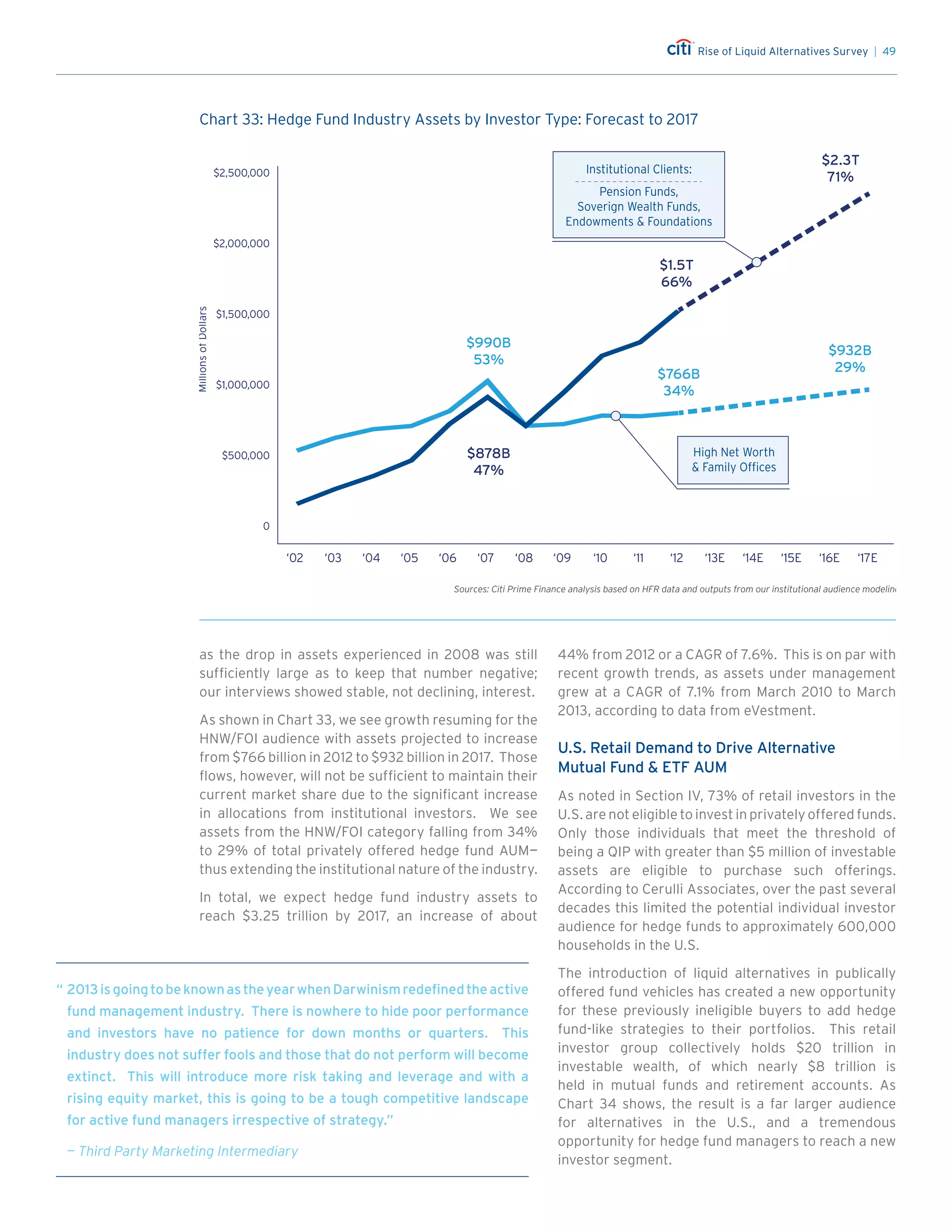
We see institutional investment in hedge funds rising
from$1.485trillionin2012(4.2%oftotalglobalassets)
to $2.314 trillion by 2017 (5.3%). Proportionately, this
will increase institutional investors’ share of hedge
fund industry AUM from 66% to 71% as flows from
this sector continue to outpace recovery, although
with significantly lower flows from High Net Worth &
Family Office investor segments.
The big story in 2013 is not, however, the outlook for
the institutional market. Rather, the topic of primary
interest to survey participants this year was the
emergence of a new “middle tier” liquid alternatives
market catering to a retail audience whose net worth
makes them ineligible for privately offered funds.
Led by U.S. wealth advisers, demand for publicly
available U.S. alternative retail funds has been
surging, allowing assets to more than triple from
$95 billion in 2008 to $305 billion in 2012. Our
estimate outlined in this report is that the retail
investor segment account for 85% ($259 billion)
of those assets. The following factors are driving
demand for these products.
ƒƒ Regulations enacted in the 1940 Investment
Companies Act are working to make these
structures more attractive for alternative strategies.
ƒƒ Regulation of the private funds industry has
forced an unprecedented level of transparency
on traditional hedge funds and required that
participants create compliance and reporting
procedures that more closely mirror the demands
placed on publically offered funds. The result
has been a flattening of the differences between
publically offered and privately offered funds.
ƒƒ Such changes come at a time when shifting
dynamics in the wealth adviser market are creating
a growing need for alternative strategies. More
wealth advisers in the U.S. market now get paid
a combination of fees on AUM and commissions.
Ensuring the stability of their asset base is
becoming as important to these participants as to
their institutional counterparts.
Institutional investor views about the role hedge funds play in their portfolio continue to
evolve. In line with the shift from a capital-based to a risk-aligned allocation approach
discussed in our 2012 survey, more interviewees now describe hedge funds as being
“shock absorbers” and as offering “insurance” against losses in their portfolio versus
being seen primarily as a diversification and risk-adjusted return vehicle. This bodes well
for continued growth in industry assets, given participants’ assessment of increased
risks in the market environment.
Summary of Key Survey Findings
Rise of Liquid Alternatives Survey | 5
ƒƒ The composition of the financial adviser market
is also shifting, with more assets flowing to
independent Registered Investment Advisers
(RIAs) and independent and regional broker-
dealers. These advisors have an open architecture
approach to product and are active in supporting
new fund launches. RIAs also have discretion over
their client portfolios and can purchase alternative
retail products on their behalf.
Our analysis in this report shows U.S. retail demand
for alternative 40 Act mutual funds and alternative
ETFs pushing assets up from $259 billion in 2012
to $779 billion by 2017. If this trend has a spillover
effect in the global marketplace, as several
interviewees expect, we could also see demand
for alternative UCITS rekindled, but from a retail
audience rather than from the institutional investors.
In total, we see global demand for liquid alternatives
from the retail audience reaching $939 billion by 2017
and $1.3 trillion when demand from a small sub-set
of institutions drawn by their liquidity is factored in.
This would make the liquid alternatives market nearly
as big as the entire hedge fund industry at the end
of 2008.
What is especially impactful about this trend, beyond
the size of the potential asset pool is the way survey
participants saw these new products being managed.
They expect liquid alternatives to trade in-parallel
with privately offered funds and therefore the same
portfolio manager would be able to isolate a subset
of their more liquid trading ideas and package them
in a publically offered fund wrapper. This would help
to differentiate the product from their higher fee
privately offered fund, but allow for an expanded use
of the team’s investment research.
In many ways, this approach marks an expansion
in the concept of “actively managed” product. The
emerging view is that a manager can pursue multiple
alpha streams and better manage their portfolio risk
by layering on increasingly sophisticated investment
techniques as a fund becomes more illiquid. In this
dynamic, it is easier for a manager to convince
investors about their ability to use fewer skills in
creating a new product than it is for a portfolio
manager to add more sophisticated alternative skills.
In a sense, this new way of looking at product
manufacturing and active management is a result
of the convergence trend that has been blurring the
lines between traditional asset managers, hedge
funds and private equity firms. Our model has been
tracking changes in this space for several years, and
we now believe the convergence trend to be complete.
Investors can source an entire range of product
from each type of investment firm, and for the more
liquid of these strategies they can also source the
management of that fund in a publically offered or a
privately offered fund structure.
Investors interviewed do not see each type of
investment manager as equally well suited to create
and manage those funds. Traditional asset managers
run into a credibility barrier as they attempt to move
into alternative products. Private equity firms are
seen as offering more of a deal-based as opposed
to transactional mindset, making it hard for them to
offer strategies that require active trading to manage
day-to-day risk.
The result has been that both types of investment
managers are now looking to bring hedge fund talent
into their organizations to close their capability
gaps, create more credible alternative strategies and
enable them to better leverage their infrastructure,
brand and distribution networks. This pursuit is taking
place in parallel with their organic growth efforts,
and is increasingly characterized by the recruitment
of hedge fund teams and by leveraging the portfolio
creation expertise of fund of hedge funds either
through a direct acquisition or a strategic partnership.
Hedge funds are thus in a strong position. The
demand for their skill set is creating new options for
smaller managers that are struggling to appeal to an
increasingly institutional audience base and cover the
increased costs of regulation. Institutional interest
continues to support growth in managers that are
able to surpass the institutional threshold and enter
the direct allocators’ and consultants’ sweet spot.
Managers that have chosen to continue raising assets
up to the $5.0 billion AUM band and beyond can now
consider new paths for developing their organization.
Increasingly, these large hedge fund firms will need to
consider whether they want to 1) offer their product
exclusively to buyers eligible for their privately
offered funds; 2) choose to sub-advise a fund in the
publically offered market, either as a single manager
or as part of a multi-alt structure that contains several
other hedge fund firms or 3) extend their franchise
fully into the publically offered fund domain and
begin creating and issuing their own product, thus
becoming a new breed of alternative asset manager.
Experimentation and evaluation of each of these
options is occurring in real time. Numerous
launches of publically offered funds have already
been announced for 2013, and reports are that the
pipeline is filling rapidly. This presents a new era
in the industry’s growth, one that brings with it the
opportunity to bring more diverse trading skill to a
larger audience.
Methodology
The 2013 Citi Prime Finance & Futures Annual
Industry Evolution report is the synthesis of views
collected across a broad set of industry leaders
involved in the global hedge fund, traditional
long-only asset management, and private equity
industry. Comprehensive interviews were conducted
in the U.S., Europe and Asia, with hedge fund
managers, asset managers, private equity companies,
consultants, fund of hedge funds, pension funds,
sovereign wealth funds, endowments & foundations
(E&Fs), and intermediaries.
To better comprehend evolving industry dynamics,
we conducted 82 in-depth interviews Collectively,
our survey participants represented $336 billion in
hedge fund assets and $5.6 trillion in overall assets
managed or advised. The interviews were conducted
as free-flowing discussions rather than constructed,
one-dimensional responses to multiple-choice
questionnaires. We gathered more than 100 hours
of dialog, and used this material to drive internal
analysis and create a holistic view of major themes
and developments.
This report is intended to be a qualitative and
quantitative prediction of future industry trends:
constructed around the comments and views of the
participants. We have also built indicative models
based on those views to illustrate how asset flows and
opportunity pools may develop in the near future.
The structure and presentation of the report
isintended to reflect the voice of the participants,
and is our interpretation of their valued feedback. To
highlight key points, we have included quotes from
our interviews; however, citations are anonymous,
as participation in the survey was done on a strictly
confidential basis.
As can be expected, there are a few topics that this
survey has touched upon that have been covered in
more detail by other recent publications from Citi
Prime Finance & Futures. In those cases, we have
referenced that document and, where it touches
on broader adjacent trends, we have noted it but
remained on topic for the subject at hand.
The following chart shows the survey participants
that we interviewed this year, representing all major
global markets.
Chart 1: Overview of Survey Participants
Survey Participants
Chart 1-A
39%
7%
7%
9%
38%
Investors
Hedge Fund Managers
Asset
Managers
Consultants
Intermediaries
Survey Participants
Regional Survey Participants
Chart 1-D
Regional Survey Paricipants
51%
18%
31%
US
EMEA
APAC
Rise of Liquid Alternatives Survey | 7
Chart 1: Overview of Survey Participants (continued)
Chart 1-F
Consultant Paricipant AuA (Millions of Dollars)
$1,186,000
Total AuA
HF AuA
$82,300
Consultant Participant AuA
(Millions of Dollars)
Chart 1-B
Investors and FoF Participant AuM
(Millions of Dollars)
Total AuM
$2,188,650
HF AuM
$99,803
Investors and FoF Participant AuM
(Millions of Dollars)
Chart 1-E
Asset Manager Paricipant AuM (Millions of Dollars)
$1,069,000
Total AuM
HF AuM
$38,125
Asset Manager Participant AuM
(Millions of Dollars)
Chart 1-C
Hedge Fund Paricipant AuM (Millions of Dollars)
Total AuM
$440,240
HF AuM
$116,090
Hedge Fund Participant AuM
(Millions of Dollars)
Institutional investors have become the predominant
audience for hedge fund investing over the past
decade. Their view on where hedge funds fit into their
portfolio, and their investment goals for their hedge
fund allocations, have both undergone significant
change over the years, with market leaders moving
from capital-based allocations that placed hedge
funds in the satellite of their portfolio to risk-aligned
considerations that move hedge funds into their core
equity and bond holdings.
We provided an in-depth analysis of these changes
in last year’s survey, Evolving Investor Portfolio
Construction Drives Product Convergence, and
for those familiar with that report, we recommend
skipping this introductory section and beginning your
reading of this year’s survey with Section II: Increased
Risks in Institutional Portfolios Drive Investors’ Need
for Hedge Fund “Insurance”. For those unfamiliar
with that report, Section I should provide a sufficient
summary of our previous work to lay the groundwork
for understanding the importance of developments
in the past year, as well as the outlook for 2013
and beyond. Last year’s report can be obtained by
contacting the team at prime.advisory@citi.com.
Few Institutional Investors Participated in
Hedge Funds Prior to 2000
General equity market conditions in the 1990s
provided investors with strong returns on their
investment portfolio. As highlighted in Chart 2, the
average annualized trailing 3-year return for global
equity markets was +15.7% as measured by MSCI
World Index, and the U.S. equity market measured by
the S&P 500 provided investors with +21.9% returns.
It should be noted that investors with allocations
to the technology sector witnessed even stronger
returns during this period. In addition to the equity
markets, interest rates offered a reasonable return
on fixed-income assets. Chart 2 illustrates that the
10-year U.S. Treasury average yield was 6.01% from
1994 to 2000.
Given these market dynamics, institutional investors
with traditional long-only equity and bond investments
saw their portfolios expand. In particular, pension
funds’assetgrowthoutpacedtheirliabilities.Asshown
in Chart 2, global pension assets as a percentage
of their liabilities averaged 108.5% from 1998 to
2000 according to the Towers Watson Assets/
Liability Index.
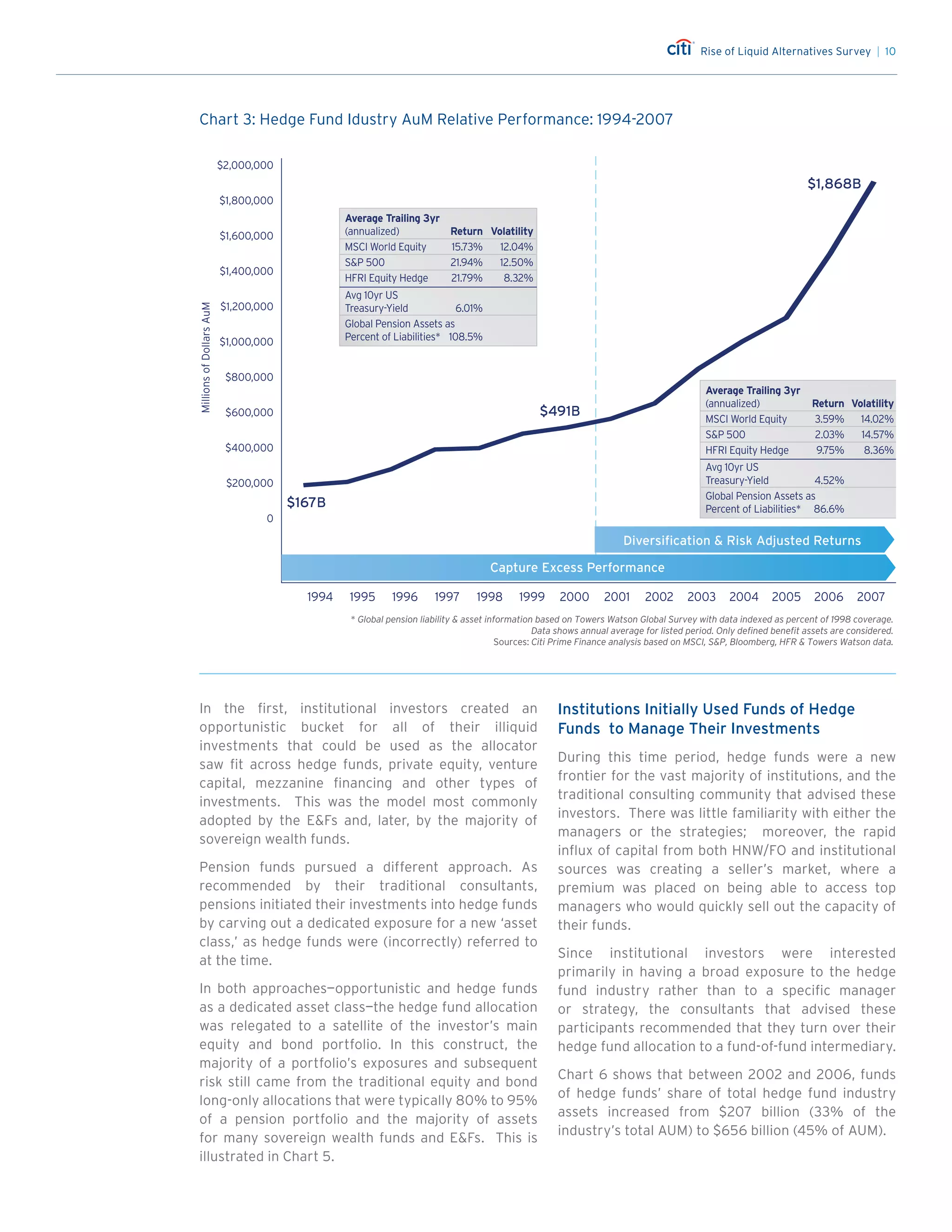
During this era, hedge fund interest was beginning
to grow, and the industry saw assets rise from $167
billion in 1994 to $491 billion in 2000. The majority of
these flows were coming from high net worth investors
and family offices (HNW/FO) that met the Qualified
Investment Person (QIP) threshold requirements, and
were thus allowed to allocate to private partnerships
and offshore funds.
These investors viewed hedge funds as a mechanism
to capture excess performance. As seen in
Chart 2, the HFRI Equity Hedge index returned
+21.8% for investors during this period, but with
only two-thirds of the monthly volatility of the equity
markets. Placing hedge funds into their portfolio
allowed HNW/FO investors to amplify their returns,
but with less risk than if they had purchased more
outright long equity positions.
At this time, only a small set of leading endowments
and corporate pensions were looking at hedge funds
for their potential to provide an illiquidity premium
and diversified alpha source. Their pioneering use
of hedge funds became the foundation for a massive
wave of investments from other institutional investors
after the technology bubble.
Section I: Institutional Investors Evolve Use of
Hedge Funds in Their Portfolio
Rise of Liquid Alternatives Survey | 9
Institutional Investors Then Moved into Hedge
Funds for Portfolio Diversification
Extensive losses in the equity market correction after
the technology bubble caused many institutional
investors to reassess their portfolio’s exposures in
the early 2000s. Chart 3 illustrates that returns from
equity markets were muted from 2000 to mid-2007.
The average trailing 3-year return for the MSCI World
Equity Index was +3.6%, and the S&P 500 was only
+2.0%. Against this backdrop, institutional investors’
pension liabilities increased at a faster pace. Assets
fell from covering 108.5% of projected liabilities in
the years just before 2000 to only covering 86.6% of
of liabilities on average from 2000 to 2007.
Hedge fund assets grew significantly during the early
part of this millennium, increasing four-fold (from
$491 billion in 2000 to $1,868 billion) by 2007, as
shown in Chart 3. A massive wave of inflows from the
institutional audience accounted for the majority of
that growth.
The rationale for including hedge funds in institutional
portfolios was to provide return diversification and
stability to the overall portfolio by having a “portable
alpha” stream able to capture returns from illiquid
investments that were seen as uncorrelated to
investor’s core long-only equity and bond holdings.
As shown in Chart 3, hedge funds continued to
perform well in these years, as 3-year trailing returns
for the HFRI Equity Hedge Index showed an average
gain of +9.7%—superior to both the equity and bond
market returns.
Institutional investors’ investments in hedge funds
during this period outpaced HNW/FO investments,
although allocations from this latter group also
continued to grow. As seen in Chart 4, institutional
investors significantly increased their exposure to
hedge funds, from $125 billion in 2002 to $878 billion
by 2007. This compares to HNW/FO investors that
increased their allocations from $500 billion to $990
billion in the same timeframe. Due to the sheer
size of their investable assets, institutional clients’
percentage of the industry’s assets increased to
47%, up from 20% in 2002.
Institutional Flows Outpace HNW/FO Allocations
Institutions needed to update their portfolio approach
in order to create an allocation for hedge funds, since
their investment portfolios had consisted almost
entirely of long-only equity and bond holdings in
previous years. Two configurations for allocating to
hedge funds emerged in this period.
Chart 2: Hedge Fund Industry AuM Relative Performance: 1994-2000
Chart 2
* Global pension liability & asset information based on Towers Watson Global Survey with data indexed as percent of 1998 coverage.
Data shows annual average for listed period. Only defined benefit assets are considered.
Sources: Citi Prime Finance analysis based on MSCI, S&P, Bloomberg, HFR & Towers Watson data.
MillionsofDollarsAuM
Hedge Fund Industry AuM & Relative Performance: 1994-2000
1995 1996 1997 1998 19991994 2000
$167B
$491B
Average Trailing 3yr
(annualized) Return Volatility
MSCI World Equity 15.73% 12.04%
S&P 500 21.94% 12.50%
HFRI Equity Hedge 21.79% 8.32%
Avg 10yr US
Treasury-Yield 6.01%
Global Pension Assets as
Percent of Liabilities* 108.5%
Capture Excess Performance0
$600,000
$500,000
$400,000
$300,000
$200,000
$100,000
Chart 2
* Global pension liability & asset information based on Towers Watson Global Survey with data indexed as percent of 1998 coverage.
Data shows annual average for listed period. Only defined benefit assets are considered.
Sources: Citi Prime Finance analysis based on MSCI, S&P, Bloomberg, HFR & Towers Watson data.
MillionsofDollarsAuM
Hedge Fund Industry AuM & Relative Performance: 1994-2000
1995 1996 1997 1998 19991994 2000
$167B
$491B
Average Trailing 3yr
(annualized) Return Volatility
MSCI World Equity 15.73% 12.04%
S&P 500 21.94% 12.50%
HFRI Equity Hedge 21.79% 8.32%
Avg 10yr US
Treasury-Yield 6.01%
Global Pension Assets as
Percent of Liabilities* 108.5%
Capture Excess Performance0
$600,000
$500,000
$400,000
$300,000
$200,000
$100,000
Rise of Liquid Alternatives Survey | 10
In the first, institutional investors created an
opportunistic bucket for all of their illiquid
investments that could be used as the allocator
saw fit across hedge funds, private equity, venture
capital, mezzanine financing and other types of
investments. This was the model most commonly
adopted by the E&Fs and, later, by the majority of
sovereign wealth funds.
Pension funds pursued a different approach. As
recommended by their traditional consultants,
pensions initiated their investments into hedge funds
by carving out a dedicated exposure for a new ‘asset
class,’ as hedge funds were (incorrectly) referred to
at the time.
In both approaches—opportunistic and hedge funds
as a dedicated asset class—the hedge fund allocation
was relegated to a satellite of the investor’s main
equity and bond portfolio. In this construct, the
majority of a portfolio’s exposures and subsequent
risk still came from the traditional equity and bond
long-only allocations that were typically 80% to 95%
of a pension portfolio and the majority of assets
for many sovereign wealth funds and E&Fs. This is
illustrated in Chart 5.
Institutions Initially Used Funds of Hedge
Funds to Manage Their Investments
During this time period, hedge funds were a new
frontier for the vast majority of institutions, and the
traditional consulting community that advised these
investors. There was little familiarity with either the
managers or the strategies; moreover, the rapid
influx of capital from both HNW/FO and institutional
sources was creating a seller’s market, where a
premium was placed on being able to access top
managers who would quickly sell out the capacity of
their funds.
Since institutional investors were interested
primarily in having a broad exposure to the hedge
fund industry rather than to a specific manager
or strategy, the consultants that advised these
participants recommended that they turn over their
hedge fund allocation to a fund-of-fund intermediary.
Chart 6 shows that between 2002 and 2006, funds
of hedge funds’ share of total hedge fund industry
assets increased from $207 billion (33% of the
industry’s total AUM) to $656 billion (45% of AUM).
Chart 3: Hedge Fund Idustry AuM Relative Performance: 1994-2007
Chart 3
* Global pension liability & asset information based on Towers Watson Global Survey with data indexed as percent of 1998 coverage.
Data shows annual average for listed period. Only defined benefit assets are considered.
Sources: Citi Prime Finance analysis based on MSCI, S&P, Bloomberg, HFR & Towers Watson data.
0
MillionsofDollarsAuM
Hedge Fund Industry AuM & Relative Performance: 1994-2007
1995 1996 1997 1998 1999 20001994 2002 2003 2004 2005 2006 20072001
$2,000,000
$1,800,000
$1,600,000
$1,400,000
$1,200,000
$1,000,000
$600,000
$400,000
$200,000
$167B
$491B
$1,868B
Average Trailing 3yr
(annualized) Return Volatility
MSCI World Equity 15.73% 12.04%
S&P 500 21.94% 12.50%
HFRI Equity Hedge 21.79% 8.32%
Avg 10yr US
Treasury-Yield 6.01%
Global Pension Assets as
Percent of Liabilities* 108.5%
Capture Excess Performance
Diversification & Risk Adjusted Returns
Average Trailing 3yr
(annualized) Return Volatility
MSCI World Equity 3.59% 14.02%
S&P 500 2.03% 14.57%
HFRI Equity Hedge 9.75% 8.36%
Avg 10yr US
Treasury-Yield 4.52%
Global Pension Assets as
Percent of Liabilities* 86.6%
$800,000
Chart 3
* Global pension liability & asset information based on Towers Watson Global Survey with data indexed as percent of 1998 coverage.
Data shows annual average for listed period. Only defined benefit assets are considered.
Sources: Citi Prime Finance analysis based on MSCI, S&P, Bloomberg, HFR & Towers Watson data.
0
MillionsofDollarsAuM
Hedge Fund Industry AuM & Relative Performance: 1994-2007
1995 1996 1997 1998 1999 20001994 2002 2003 2004 2005 2006 20072001
$2,000,000
$1,800,000
$1,600,000
$1,400,000
$1,200,000
$1,000,000
$600,000
$400,000
$200,000
$167B
$491B
$1,868B
Average Trailing 3yr
(annualized) Return Volatility
MSCI World Equity 15.73% 12.04%
S&P 500 21.94% 12.50%
HFRI Equity Hedge 21.79% 8.32%
Avg 10yr US
Treasury-Yield 6.01%
Global Pension Assets as
Percent of Liabilities* 108.5%
Capture Excess Performance
Diversification & Risk Adjusted Returns
Average Trailing 3yr
(annualized) Return Volatility
MSCI World Equity 3.59% 14.02%
S&P 500 2.03% 14.57%
HFRI Equity Hedge 9.75% 8.36%
Avg 10yr US
Treasury-Yield 4.52%
Global Pension Assets as
Percent of Liabilities* 86.6%
$800,000
Rise of Liquid Alternatives Survey | 11
“	We assess and place our absolute return strategies into an
alternatives bucket.”
	 — Insurance Company
“	About 10% of the overall portfolio is allocated to this independent
bucket labeled Alternatives, which is essentially hedge funds. This has
remained constant even during 2008 and in the years since.”
	 — Corporate Pension
As clients’ allocations to hedge funds increased,
traditional consultants became more educated about
the various hedge fund managers and strategies.
A new breed of consultant, with expertise in the
alternatives space, also emerged. As knowledge
increased about the industry and resources for
helping them manage their investments, many
institutions began to move away from funds of hedge
funds allocations.
Several factors were seen as limiting interest
in continued use of funds of hedge funds as
intermediaries, but the most frequently cited was the
additional layer of fees their services imposed on the
investor. In these early years, most funds of hedge
funds charged an additional 1% management fee
and 10% performance fee on top of their underlying
managers’ 2% & 20% arrangements. In addition,
Chart 5: Institutional Investor Portfolio
Configurations Pre-GFC
Hedge
Funds
Private
Equity &
Real
Assets
Investments
Seeking an
Illiquidity
Premium
Satellite
Commodities
Alternative or
Opportunisitic
Chart 5
Passive
Active
Equity
Passive
Active
Credit &
Rates
Long Only
Funds
Measured
Against
a Benchmark
80-95% of
Pension Portfolios
40-70% of SWFs,
Endowments
& Foundations
CoreofPortfolio
Equity
Bonds
Liquidity
Illiquid
Liquid
Source: Citi Prime Finance.
Institutional Investor Portfolio
Configurations Pre-GFC
Hedge
Funds
Private
Equity &
Real
Assets
Investments
Seeking an
Illiquidity
Premium
Satellite
Commodities
Alternative or
Opportunisitic
Chart 5
Passive
Active
Equity
Passive
Active
Credit &
Rates
Long Only
Funds
Measured
Against
a Benchmark
80-95% of
Pension Portfolios
40-70% of SWFs,
Endowments
& Foundations
CoreofPortfolio
Equity
Bonds
Liquidity
Illiquid
Liquid
Source: Citi Prime Finance.
Institutional Investor Portfolio
Configurations Pre-GFC
Chart 4: Hedge Fund Industry Assets by Investor Type
Chart 4
Source: Citi Prime Finance Analysis based on HFR data.
0
MillionsofDollars
Hedge Fund Industry Assets by Investor Type
2003 2004 2005 20062002 2007
$1,200,000
$1,000,000
$800,000
$600,000
$400,000
$125B
20%
$878B
47%
$990B
53%
$500B
87%
$200,000
High Net Worth
& Family Offices
Institutional Clients:
Pension Funds,
Soverign Wealth Funds,
Endowments & Foundations
Rise of Liquid Alternatives Survey | 12
many of these portfolios were overdiversified and run
by managers that would “chase returns” by quickly
moving into and out of managers based on who had
performed strongly in the most recent period.
By 2006, the institutional wave of money into funds
of hedge funds had peaked and begun to retreat.
As can be seen in Chart 6, although overall funds of
hedge fund flows continued to rise, reaching a record
$799 billion in 2007, their share of overall industry
AUM had begun to decline . A new model began to
emerge just before the global financial crisis (GFC),
and this model has gained traction in the years after
the GFC.
More Experienced Institutions Began to
Directly Allocate their Capital
As institutional investors and their consultants
became more familiar with hedge funds, market
leaders began to work with their intermediaries
or build out their own investment teams in order
to directly invest in single-manager hedge funds.
Typically, there was a progression to this changeover
from intermediary led to direct investing.
Often the initial allocation was to a multi-strategy
fund, where the portfolio manager had discretion to
move capital between the various underlying strategy
sleeves of its master fund. Over time, institutions
“	There has been a constant theme of dis-intermediating the middle man in
the traditional hedge fund market. Pension plans and sovereign wealth
funds have the wherewithal to directly invest as clients. Originally, these
guys came into hedge funds many years ago and were using fund of funds
because the rosy return environment meant that the fees on fees nature
of that investment wasn’t as big a deal. Now, they’ve been invested in
hedge funds for many years and their boards are comfortable and they
know the managers and they are thus more confident to go direct.”
	 — Asset Manager
“	There is still a role for traditional fund of hedge funds that can solve for
client’s issues such as governance, but the additional fee drag in a low
return world will continue to be an issue.”
	 — Full Service Consultant
Chart 6
Source: Citi Prime Finance Analysis based on HFR data.
31%
Hedge Fund Investment Approach Being Used by Investors
2003 2004 2005 20062002 2007
45%
41%
39%
37%
35%
33%
45%
55%
67%
33%
Direct
(Right Axis)
Fund of Funds
(Left Axis)
43%
54%
66%
64%
62%
60%
58%
56%
FundofFunds
Direct
Chart 6: Hedge Fund Investment Approach Being Used by Investors
Rise of Liquid Alternatives Survey | 13
gained confidence in their own ability to create a
diversified portfolio, and they began to invest in a set
of single managers.
This direct engagement of institutional investors
with single-manager hedge funds had a profound
effect on the industry. In order to secure these
direct allocations, managers began to invest more
in the non-investment side of their business and
built more robust infrastructures that allowed for
improved controls.
This was the beginning of what many call the
“institutionalization” of the hedge fund industry.
Initially, managers made these investments to
advance the argument to investors that they could
generate alpha in their portfolio and differentiate
their returns. Post-GFC, the requirement to have
an institutional caliber infrastructure became a
threshold standard for managers seeking allocations.
Institutional interest in directly allocating capital
rose sharply in the period immediately after the GFC.
Significant problems with the fund of hedge fund
model came to light in that crisis. Many funds of
hedge funds had created a mismatch between their
stated liquidity terms and the holdings in their
portfolio that left them unable to meet investor
requests for redemptions. This shook investor
confidence in their expertise.
Furthermore, funds of hedge funds exposure to
the Madoff fraud revealed a lack of rigor in their
supposedly superior manager evaluation and
selection ability and many institutions made a
permanent shift in approach.Chart 7
Source: Citi Prime Finance Analysis based on HFR data.
26%
Hedge Fund Investment Approach Being Used by Investors
2004 2006 2008 20102002 2012
46%
41%
36%
33%
45%
55%
67%
31%
Direct
FundofFunds
54%
74%
69%
64%
59%
2003 2005 2007 2009 2011
28%
34%
66%
72%
Fund
of Funds
Direct
Chart 7: Hedge Fund Investment Approach Being Used by Investors
“	Our hedge fund program is currently split 70% direct allocations
versus 30% indirect via fund of hedge funds. We are moving quickly to
an 80%/20% split and eventually we will end up at a 95%/5% split.”
	 — Public Pension
“	We have seen a move towards Institutions rather than funds of funds
investors which has been led by the US. Pensions have grown in assets
and now fund of funds account for just 20% of our investor base.”
	 — $1.0 to %5.0 Billion AuM Hedge Fund
“	Public pensions represent 60% of our assets. 20-25% are funds of
funds or managed accounts without look through and many of those are
also likely pensions coming via a different channel.”
	 — $10 Billion AuM Hedge Fund
Rise of Liquid Alternatives Survey | 14
Chart 7 shows that in the post-GFC years, the share
of market controlled by funds of hedge funds fell
precipitously from their peak of 45% in 2006 to
34% in 2010, when we first forecast a continuation
of this trend. As predicted, their market share has
continued to decline, falling to only 28% in 2012.
Volatility-Dampening Aspect of Hedge Funds
Gained Prominence
Since the GFC, confidence that hedge funds can
outperform the underlying markets has been
strained, and more emphasis has been placed on their
role in controlling volatility.
The idea that hedge funds are a vehicle from which
to capture excess market return has lapsed for the
time being for many institutional investors; investors
still experienced sharp losses in their hedge fund
portfolios during the GFC, and returns in recent
years have not been differentiated from those of the
traditional equity and bond markets. As shown in
Chart 8, the annualized trailing 3-year HFRI Index was
+3.3% on average between 2007 and 2012—barely
better than 10-Year U.S. Treasuries (+3.04%) and only
slightly above the major equity indices (MSCI World
Equity Index [+2.41%] and SP 500 [+2.45%]).
Indeed, in November and December 2011, hedge
fund returns actually fell more than equity market
returns — a phenomenon that many investors thought
impossible. This lack of performance has been a
major deterrent to the HNW/FO audience that had
originally moved into hedge funds because of their
perceived ability to generate outsized returns. As
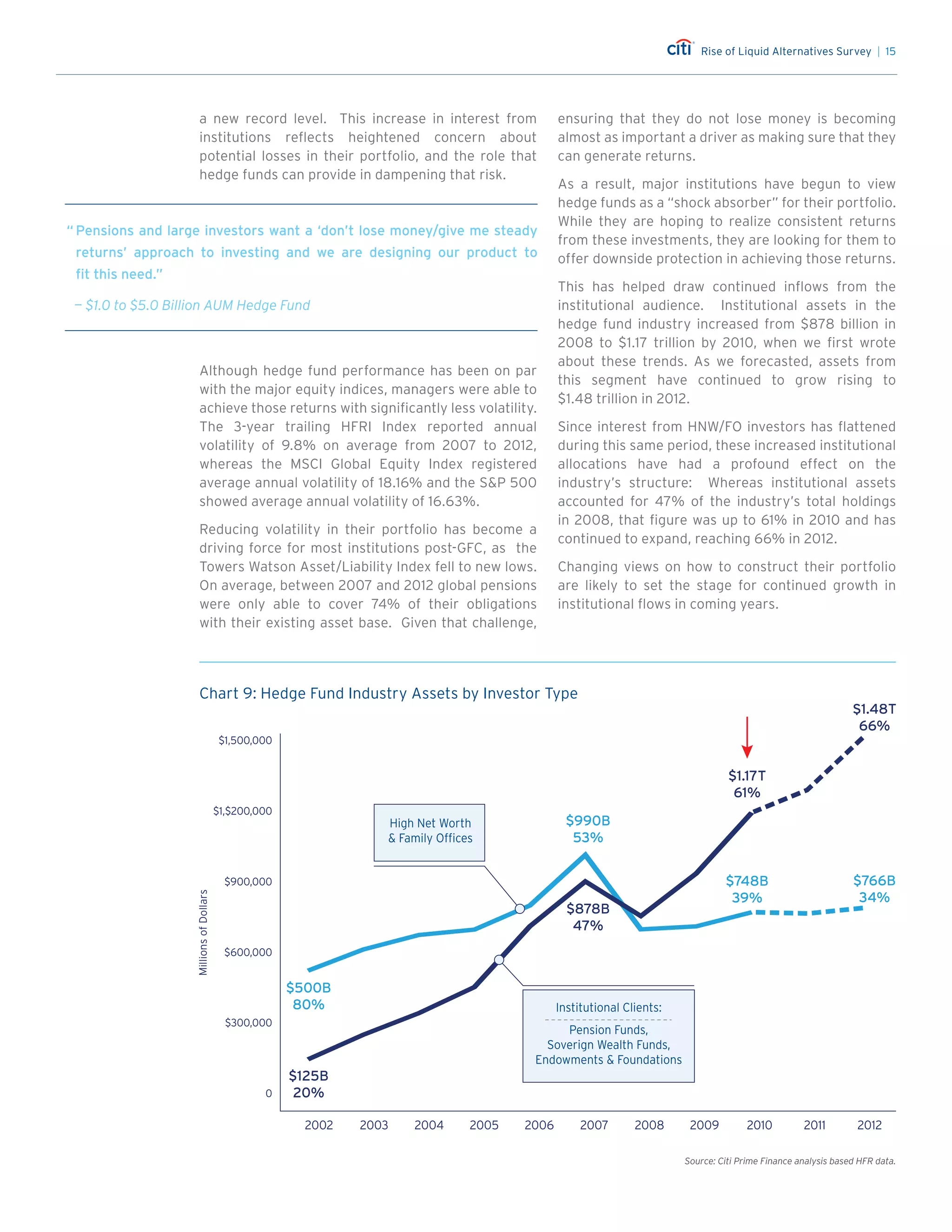
shown in Chart 9, allocations from this audience
fell sharply in 2008 from their peak of $990
billion and have not recovered in subsequent years,
hovering around the mid-$700 billion area for the
past several years.
Institutional investor allocations recovered quickly
post-GFC, however, and have subsequently risen
sharply, driving total hedge fund industry AUM to
“	Our expectations for alternative funds is to provide protection on the
downside (maximum 50%) and good upside participation with a 6-9%
annualized return.”
	 — Insurance Company
“	We treat our hedge fund allocation as market shock absorbers.
Our hedge fund allocation is meant to be a stable value asset.”
	 — Endowment
Chart 8
* Global pension liability  asset information based on Towers Watson Global Survey with data indexed as percent of 1998 coverage.
Data shows annual average for listed period. Only defined benefit assets are considered.
Sources: Citi Prime Finance analysis based on MSCI, SP, Bloomberg, HFR  Towers Watson data.
0
MillionsofDollarsAuM
Hedge Fund Industry AuM  Relative Performance in Various Periods
‘95 ‘96 ‘97 ‘98 ‘99 ‘00‘94 ‘02 ‘03 ‘04 ‘05 ‘06 ‘12‘01
$2,500,000
$2,000,000
$1,500,000
$1,000,000
$500,000
Diversification  Risk Adjusted Returns
$167B
$491B
$2,252B
Capture Excess Performance
‘07 ‘08 ‘09 ‘10 ‘11
Shock Absorption
$1,868B
Average Trailing 3yr
(annualized) Return Volatility
MSCI World Equity 3.59% 14.02%
SP 500 2.03% 14.57%
HFRI Equity Hedge 9.75% 8.36%
Avg 10yr US
Treasury-Yield 4.52%
Global Pension Assets as
Percent of Liabilities* 86.6%
Average Trailing 3yr
(annualized) Return Volatility
MSCI World Equity 15.73% 12.04%
SP 500 21.94% 12.50%
HFRI Equity Hedge 21.79% 8.32%
Avg 10yr US
Treasury-Yield 6.01%
Global Pension Assets as
Percent of Liabilities* 108.5%
Average Trailing 3yr
(annualized) Return Volatility
MSCI World Equity 2.48% 18.16%
SP 500 2.45% 16.63%
HFRI Equity Hedge 3.30% 9.80%
Avg 10yr US
Treasury-Yield 3.04%
Global Pension Assets as
Percent of Liabilities* 74.0%
Chart 8
* Global pension liability  asset information based on Towers Watson Global Survey with data indexed as percent of 1998 coverage.
Data shows annual average for listed period. Only defined benefit assets are considered.
Sources: Citi Prime Finance analysis based on MSCI, SP, Bloomberg, HFR  Towers Watson data.
0
MillionsofDollarsAuM
Hedge Fund Industry AuM  Relative Performance in Various Periods
‘95 ‘96 ‘97 ‘98 ‘99 ‘00‘94 ‘02 ‘03 ‘04 ‘05 ‘06 ‘12‘01
$2,500,000
$2,000,000
$1,500,000
$1,000,000
$500,000
Diversification  Risk Adjusted Returns
$167B
$491B
$2,252B
Capture Excess Performance
‘07 ‘08 ‘09 ‘10 ‘11
Shock Absorption
$1,868B
Average Trailing 3yr
(annualized) Return Volatility
MSCI World Equity 3.59% 14.02%
SP 500 2.03% 14.57%
HFRI Equity Hedge 9.75% 8.36%
Avg 10yr US
Treasury-Yield 4.52%
Global Pension Assets as
Percent of Liabilities* 86.6%
Average Trailing 3yr
(annualized) Return Volatility
MSCI World Equity 15.73% 12.04%
SP 500 21.94% 12.50%
HFRI Equity Hedge 21.79% 8.32%
Avg 10yr US
Treasury-Yield 6.01%
Global Pension Assets as
Percent of Liabilities* 108.5%
Average Trailing 3yr
(annualized) Return Volatility
MSCI World Equity 2.48% 18.16%
SP 500 2.45% 16.63%
HFRI Equity Hedge 3.30% 9.80%
Avg 10yr US
Treasury-Yield 3.04%
Global Pension Assets as
Percent of Liabilities* 74.0%
Chart 8: Hedge Fund Industry AuM Relative Performance iv Various Periods
Rise of Liquid Alternatives Survey | 15
a new record level. This increase in interest from
institutions reflects heightened concern about
potential losses in their portfolio, and the role that
hedge funds can provide in dampening that risk.
Although hedge fund performance has been on par
with the major equity indices, managers were able to
achieve those returns with significantly less volatility.
The 3-year trailing HFRI Index reported annual
volatility of 9.8% on average from 2007 to 2012,
whereas the MSCI Global Equity Index registered
average annual volatility of 18.16% and the SP 500
showed average annual volatility of 16.63%.
Reducing volatility in their portfolio has become a
driving force for most institutions post-GFC, as the
Towers Watson Asset/Liability Index fell to new lows.
On average, between 2007 and 2012 global pensions
were only able to cover 74% of their obligations
with their existing asset base. Given that challenge,
ensuring that they do not lose money is becoming
almost as important a driver as making sure that they
can generate returns.
As a result, major institutions have begun to view
hedge funds as a “shock absorber” for their portfolio.
While they are hoping to realize consistent returns
from these investments, they are looking for them to
offer downside protection in achieving those returns.
This has helped draw continued inflows from the
institutional audience. Institutional assets in the
hedge fund industry increased from $878 billion in
2008 to $1.17 trillion by 2010, when we first wrote
about these trends. As we forecasted, assets from
this segment have continued to grow rising to
$1.48 trillion in 2012.
Since interest from HNW/FO investors has flattened
during this same period, these increased institutional
allocations have had a profound effect on the
industry’s structure: Whereas institutional assets
accounted for 47% of the industry’s total holdings
in 2008, that figure was up to 61% in 2010 and has
continued to expand, reaching 66% in 2012.
Changing views on how to construct their portfolio
are likely to set the stage for continued growth in
institutional flows in coming years.
“	Pensions and large investors want a ‘don’t lose money/give me steady
returns’ approach to investing and we are designing our product to
fit this need.”
	 — $1.0 to $5.0 Billion AUM Hedge Fund
Chart 9
Source: Citi Prime Finance analysis based HFR data.
0
MillionsofDollars
Hedge Fund Industry Assets by Investor Type
2004 2006 2008 20102002 2012
$1,500,000
$1,$200,000
$900,000
$600,000
$300,000
$125B
20%
$500B
80%
2003 2005 2007 2009 2011
$878B
47%
$990B
53%
$748B
39%
$1.17T
61%
$1.48T
66%
$766B
34%
Institutional Clients:
Pension Funds,
Soverign Wealth Funds,
Endowments  Foundations
High Net Worth
 Family Offices
Chart 9: Hedge Fund Industry Assets by Investor Type
Rise of Liquid Alternatives Survey | 16
Leading Institutions Shift from a Capital-Based
to a Risk-Aligned Portfolio
Several previously mentioned trends have come
together in recent years to lay the foundation for a
significant change in how many leading institutional
investors are positioning hedge funds in their
portfolio. Rather than viewing hedge fund allocations
as part of a satellite allocation, institutional investors
are increasingly beginning to reposition certain
types of hedge fund strategies into the core of
their portfolio, where they are better positioned to
compete for a new pool of capital.
Hedge fund managers have become less reluctant
to share information about their portfolio holdings
with their investors post-GFC, as problems uncovered
at that time have led to an industry-wide view on
the need for transparency and better operational
oversight and control.
The move to direct investing, and the fact that
many hedge fund managers now have ongoing
relationships with their investors, has helped
reduce concerns about sharing information. As
investors have gained more insight into hedge
fund holdings, they can get a more holistic view on
how those positions compare to positions held
elsewhere in their portfolio, and thus have been able
to better evaluate how their hedge fund holdings
interact with their long-only exposures.
Investors also saw that CTA/macro strategies were
able to produce significantly uncorrelated returns
during the crisis, and that these strategies that are
focused almost exclusively in highly liquid exchange-
traded markets could help diversify their portfolio
and insulate them from a different set of risks than
their more security-focused strategies.
Both these realizations came about in parallel
with many institutions beginning to question the
core theories that have driven their strategic asset
allocation decisions for the past 50 years.
Since the emergence of modern portfolio theory
and the capital asset pricing model in the late 1950s,
investors have evaluated their portfolio diversification
by the amount of capital they had allocated between
equity strategies and bonds. This is the origin of the
commonly referred to 60/40 allocation. Investors
following that model would allocate 60% of the money
they had to invest in equities and 40% in bonds to
achieve the optimal amount of return relative to the
underlying risk in the portfolio.
Investors following this approach came to a rude
awakening in 2008 when they realized that there was
no true diversification benefit with this construct.
Chart 10
Source: Citi Prime Finance.
Illustrative Institutional Investor Risk-Aligned Portfolio
Directionality
High
Highly Liquidity Illiquid
Low
Long /
Short
Actively
Managed
Rates
Volatility
 Tail Risk
Directional
Hedge Funds
Passive
Active
Equity 
Credit Long
Only
Event
Driven
Macro
 CTA
Private MarketsPublic Markets
SatelliteCoreofPortfolio
Distressed
Market
Neutral
Arbitrage
Relative
Value
Infrastructure,
Real Estate, Timber
Commodities
Corporate
Private Equity
Stable Value /
Inflation Risk
Macro HFs
Absolute Return Real Assets
Company Risk
Chart 10: Illustrative Institutional Investor Risk-Aligned Portfolio
Chart 10
Source: Citi Prime Finance.
Illustrative Institutional Investor Risk-Aligned Portfolio
Directionality
High
Highly Liquidity Illiquid
Low
Long /
Short
Actively
Managed
Rates
Volatility
 Tail Risk
Directional
Hedge Funds
Passive
Active
Equity 
Credit Long
Only
Event
Driven
Macro
 CTA
Private MarketsPublic Markets
SatelliteCoreofPortfolio
Distressed
Market
Neutral
Arbitrage
Relative
Value
Infrastructure,
Real Estate, Timber
Commodities
Corporate
Private Equity
Stable Value /
Inflation Risk
Macro HFs
Absolute Return Real Assets
Company Risk
Rise of Liquid Alternatives Survey | 17
Sharp equity declines in that period underscored
to these investors that with a 60/40 capital-
based allocation, 90% of their portfolio risk was
concentrated in their equity holdings and only 10%
with their bonds.
In response, many market leaders have begun to
reformulate their portfolios around the risks of their
underlying investments. Commonly examined risks
are the liquidity, directionality and correlation of
investments in the portfolio. Investments with a
similar risk profile are grouped together. The new risk-
aligned model for investing is illustrated in Chart 10.
This change in thinking has had a profound effect
on where hedge funds are positioned in investor
portfolios. Rather than viewing hedge funds as a
singular allocation because of their liquidity profile,
leading investors are now repositioning certain types
of hedge funds into their core portfolio holdings.
This reflects a more nuanced understanding of
how the assets held in those hedge fund strategies
correlate with their equity and bond holdings, and
a more sophisticated view about the concept of
“shock absorption”.
By repositioning hedge funds with a more directional
bias into their core equity and credit holdings, the
investor aggregates all those investments that share
an underlying exposure to changes in a company’s
equity or credit position. A hedge fund’s ability to
provide volatility dampening alongside more risky
long-only holdings provides the insurance that
institutions are looking for to insulate their portfolio
in case of market shocks while allowing them to
take advantage of the embedded directionality in
those strategies so as to realize some portion of the
market’s upside exposure.
Similarly, repositioning CTA/macro strategies into
an investment category with other interest rate and
commodity investments that are likely to respond
similarly to economic conditions provides insurance
against inflation, and some degree of stable value to
investor portfolios.
Chart 11-A
Allocations to Hedge Funds by Strategy Bucket
2006: $1.46T AuM
21%
Event Driven
Relative Value
38%
23%
17%
Equity Hedge
Macro
Source: HFR
Chart 11-B
Allocations to Hedge Funds by Strategy Bucket
2012: $2.25T AuM
25%
Event Driven
Relative Value
27%27%
22%
Equity Hedge
Macro
Source: HFR
Chart 11: Allocations to Hedge Funds by Strategy Bucket
2006: $1.46T AuM 2012: $2.25T AuM
“	We use hedge funds in different parts of a clients’ portfolios. Hedge
funds have been put alongside long-only portfolios and they have also
been a part of the private equity allocation, especially the longer-
dated hybrid structures. We don’t have a standard model hedge fund
allocation that we stick to in every client’s portfolio. We expect hedge
funds to compliment the client’s existing portfolio and expect the hedge
fund allocation to be a solution.”
	 — Full Service Consultant
Rise of Liquid Alternatives Survey | 18
“	Ifweallocatetherightwayanddoourhomeworkrightitwillcreateaportfolio
that is differentiated and when rolled up at the overall portfolio level it won’t
have any more volatility than a portfolio of un-volatile managers.”
	 — Endowment
In this emerging approach, hedge fund strategies
with a true absolute return profile can be isolated
from other types of hedge fund investments and
used in a more targeted manner for producing
uncorrelated returns.
This idea that different hedge fund strategies can
be used to different effect in various portions of the
portfolio is just beginning to gain traction, but the
idea of investors looking at hedge funds as a pool of
different types of exposures is clearly taking hold. A
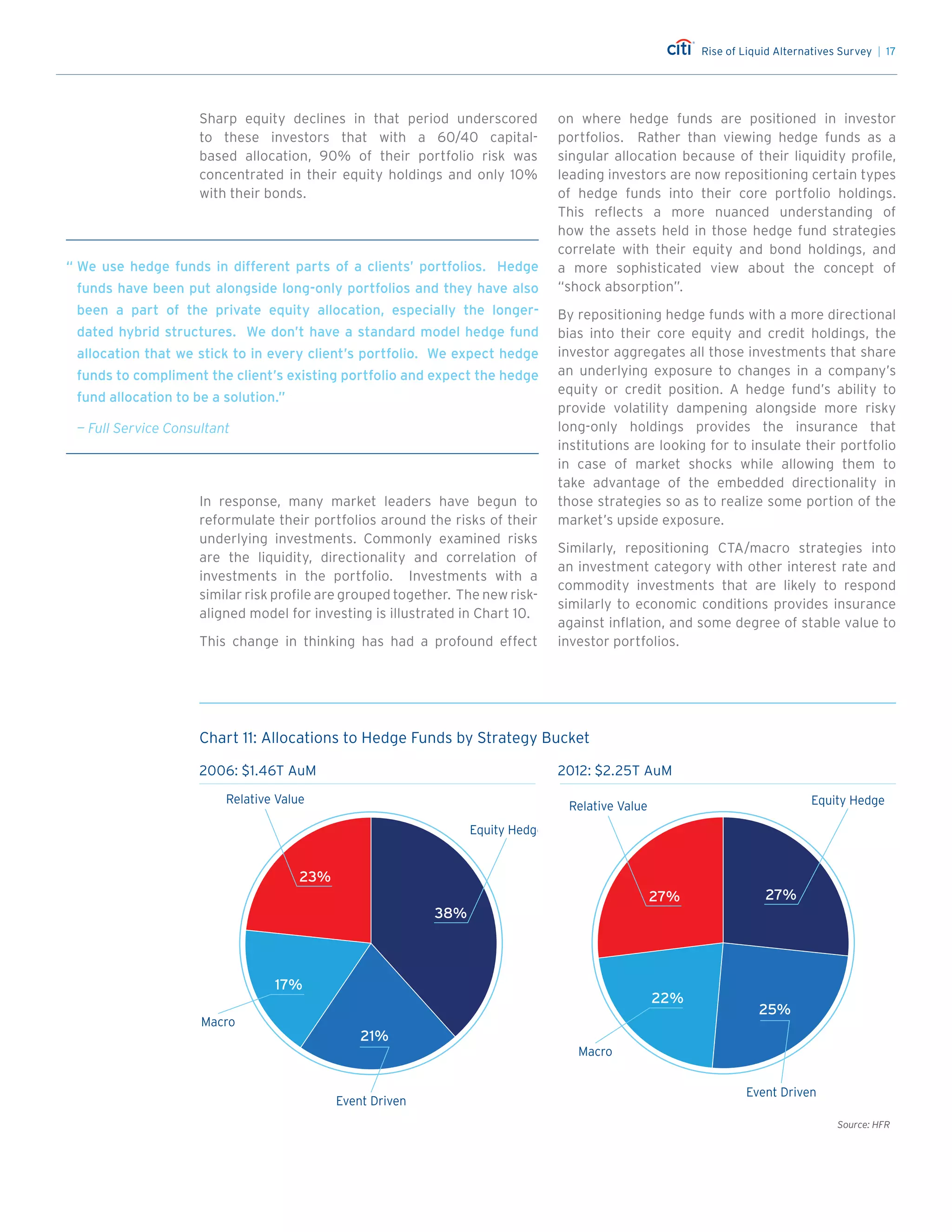
comparison of the allocation of hedge fund industry
AUM in 2006 and 2012 clearly illustrates this shift, as
shown in Chart 11.
Back in 2006, the industry was heavily weighted
to equity hedge strategies, and macro strategies
accounted for a small portion of overall assets; there
has since been a rebalancing of AUM. By 2012, each
of the four major strategy categories had nearly a
25% market share.
By balancing their holdings, investors are looking
to maximize the shock absorption potential of their
hedge fund allocations and create resiliency for any
set of market conditions. This premise is likely to
be tested in the near future—as is the efficacy of the
risk-aligned allocation approach—as three major
factors are perceived as driving up the risk in
institutional holdings and increasing the focus on how
investor hedge fund holdings will perform.
“	The underlying risk of long/short managers is equity-like so we place all of
them in our Equity risk bucket.”
	 — Endowment
For those readers who were familiar with industry
trends covered in last year’s survey and who have
skipped Section I of this year’s report, we now resume
our update on the emerging trends in the hedge
fund industry.
Three important changes in the macro investing
environment are accelerating the move toward using
hedge funds as a shock absorber in institutional
portfolios. First, perceptions that assets are moving
into active equity long-only funds is increasing
institutions’ overall portfolio risk. Second, the
resurgence of illiquid shadow-banking products is
creating renewed concern about a potential liquidity
shock and encouraging investors to seek longer-
duration products to insulate themselves. Finally,
anticipation that we are approaching a turn in the
long-term credit cycle is prompting investors to seek
protection against rising interest rates through credit
hedge products.
Industry flows are likely to increase in 2013 in
response to these three factors, and hedge funds
are likely to compete more directly for institutional
allocations from asset managers and private equity
funds than in previous years.
Flows to Active Equity Funds Increase
Investors’ Risk Profile
Equity market moves to record highs in early 2013 are
being seen by many survey participants as a signal
that we are entering a renewed period of growth,
and that the impacts of quantitative easing have
advanced enough that cash may now be coming off
the sidelines. Many expressed views that we may be
positioned for a more directional period of market
Section II: Increased Risks in Institutional Portfolios Drive
Investors’ Need for Hedge Fund “Insurance”
Chart 12
Source: Towers Watson Global Pension Assets Study 2013.
60
IndexChangeSince1998
‘02 ‘06 ‘10‘98 ‘12
120
100
90
80
70
100%
‘00 ‘04 ‘08 ‘09 ‘11
118.5%
68.2%
73.7%
90.3%
75.3%
‘01 ‘05‘99 ‘03 ‘07
110
Ability of Assets Held by Global Defined Benefit Pension Plans to Cover Liabilities:
Index Changes Relative to 1998Chart 12: Ability of Assets Held by Global Defined
Benefit Pension Plans to Cover Liabilities: Index Investor Changes Relative to 1998
Rise of Liquid Alternatives Survey | 20
performance where idiosyncratic risks re-emerge,
thus benefitting hedge fund trading styles.
Optimism about improved equity market returns is
coming at a time when most institutional investors
are struggling to meet their obligations. The
technology bubble in the early 2000s, followed by
the GFC in 2008, have both significantly affected
most institutions.
The impact of these events is clearly visible when
viewing the asset and liability situation of the world’s
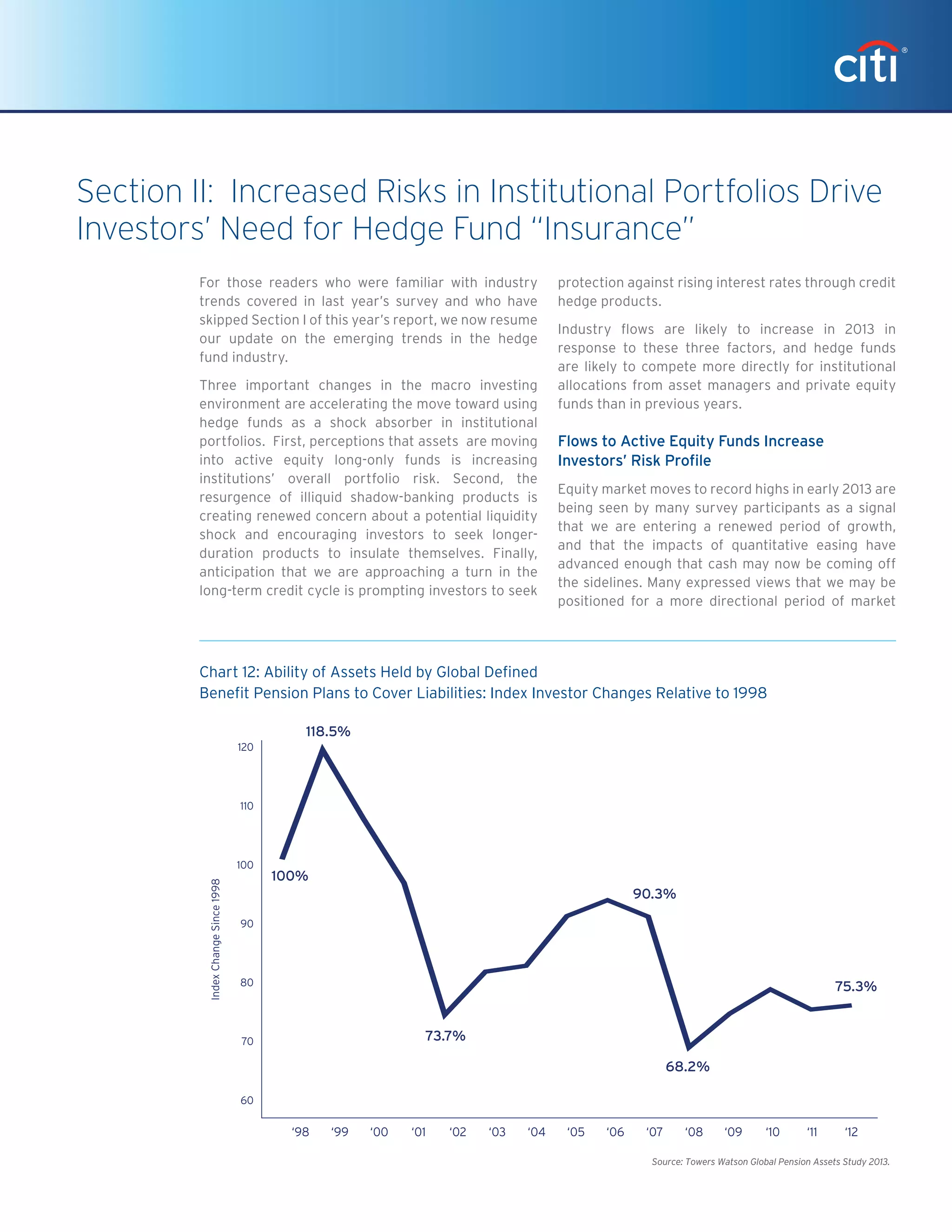
top defined benefit pension plans. As shown in
Chart 12, these organizations had sufficient assets to
cover 106.9% of their liabilities in 2000 according to
Towers Watson, but saw their ratio drop sharply in the
wake of the Technology Bubble
Over the following years, there was a rebound in their
asset coverage, but pensions were still in deficit by
2007, when their asset to liability coverage was only
90.3%. TheGFCpushedcoverageratiosdownsharply,
to as low as 68.2%, and difficult market conditions in
subsequent years have limited a recovery. By the end
of 2012, assets at these organizations were still seen
as only covering 75.3% of liabilities.
Pensions are the largest segment of institutional
investors in the hedge fund market, but their struggle
is reflective of similar problems at EFs, and even of
some sovereign wealth funds.
Although equity markets have risen post-GFC, they
have not offered institutions much opportunity to
increase returns because of their discomfort with the
expanded volatility. Institutional investor interest
in equities has been primarily in a risk-on, risk-off
mode that has not allowed for any sustained
investment move.
This reflects a growing realization across the
institutional community about the over-concentration
of equity risk they had been running in their portfolios.
Institutions have realized the benefits of portfolio
diversification for the past 50 years and sought such
diversification in their allocations by balancing their
portfolio across equities and bonds—most frequently
allocating 60% of their capital to equity investments
and 40% to bonds. The failure of this configuration to
offer any insulation in the GFC prompted a realization
that from a risk perspective, this 60/40 capital-based
allocation was actually a 90/10 allocation, with 90%
of the risk in the portfolio belonging to the equities
component and only 10% with bonds.
As discussed at the end of the previous section, this
change in thinking is what has driven many leading
Chart 13
Source: HFR.
Changes in Global Equity Hedge  Event Driven Flows
-$15,000
$10,000
$5,000
-5,000
0
-10,000
Chart 13
Q1
2011
Q1
2013
Q2
2011
Q3
2011
Q4
2011
Q1
2012
Q2
2012
Q3
2012
Q4
2012
Millions
Chart 13: Changes in Global Equity Hedge 
Event Driven Flows
Chart 13
Source: HFR.
Changes in Global Equity Hedge  Event Driven Flows
-$15,000
$10,000
$5,000
-5,000
0
-10,000
Chart 13
Q1
2011
Q1
2013
Q2
2011
Q3
2011
Q4
2011
Q1
2012
Q2
2012
Q3
2012
Q4
2012
Millions
0%
25%
15%
10%
5%
20%
Chart 14
Source: Citi Prime Finance analysis of data provided by HFR  SP.
10%2% 6% 16% 18%
Historical Comparison of Index Volatility  Returns
HFRI: Equity Hedge Total Index vs. SP 500
Returns
12%4% 8% 14%
Volatility
SP 500
1992-1998
HFRI Equity Hedge
1999-2005
HFRI Equity Hedge
2006-2012
SP 500
2006-2012
SP 500
1999-2005
HFRI Equity Hedge
1992-1998
Chart 14: Historical Comparison of Index
Volatility  Returns, HFRI: Equity Hedge
Total Index vs. SP 500
Rise of Liquid Alternatives Survey | 21
institutions to reposition more directional equity
and event driven hedge funds alongside their core
equity holdings. With a risk-aligned allocation
approach, hedge funds that provide downside
protection during market volatility can make the
portfolio more resilient. This recent trend is confirmed
by HFR flow data for these strategies. As illustrated
in Chart 13, net flows into equity and event driven
hedge funds were positive in the 1st quarter 2013.
This is the first positive quarterly flows into these
strategies since Q3 2011.
Historically, equity hedge funds have outperformed
and offered lower volatility than outright equity
exposure. A comparison of the SP 500 versus the
HFRI Equity Hedge Index over three separate 6-year
intervals,commencing in 1992, demonstrates that
the HFRI Equity Hedge Index exhibits approximately
two-thirds of the volatility with similar or better
performance. As shown in Chart 14, the HFRI Equity
Hedge Index had an average annualized return
of +12.2%, with a volatility of monthly returns of
9.5% from 1999 to 2005. In contrast, the SP 500
Index average annual return was +2.5%, with 15.4%
volatility of monthly returns.
Equityhedgefundsalsoexhibitedmuchlowervolatility
during the most recent 6-year period ending in 2012—
a period that includes the major market correction of
2008. Chart 14 shows that the HFRI Equity Hedge
index reported slightly lower performance of +3.8%
versus the +4.7% average annualized returns of the
SP 500 index from 2006 to 2012, but annualized
volatility was significantly lower at 9.8% compared to
16.9% for the SP 500 index.
Given the lessons of recent years, most survey
participants expect institutional investors to up
their allocation to equity hedge when they increase
their outright equity exposures in 2013. This is a
continuation of the story we outlined in last year’s
report showing how equity hedge strategies were
moving into an “equity risk” bucket.
A recent development, discussed further in this year’s
survey, was the strategy of using credit focused
hedge funds for insurance alongside the investor’s
core credit positions.
“	The world has been an odd place since Lehman Brothers. Investors have
been terrified by the macro environment and have been hiding under a
stone of fixed income and capital protection. That’s starting to change.
We’re seeing more idiosyncratic risks and rotation into equities. This is
more of a hedge fund environment. That compares to the last few years
of risk on/risk off.”
	 — $1.0 to 5.0 Billion AUM Hedge Fund
“	There’s no question we’ve seen significant uptick in demand for our
equity long/short book which is surprising because we’re coming off
a couple of years where performance has not been that great and the
equity indexes and markets performed better. We really see this as
being linked to the idea that you can still get some of the beta with our
strategies, but with some downside protection as well. Our strategies
tend to be longer biased and they will tend to do better if markets rise
while still offering downside protection.”
	 — Asset Manager
“	After lengthy discussions with our Board, it was agreed that the overall
purpose of hedge funds in our portfolio is to be a diversifier for the
equity bucket. Alpha generation is not a stated goal.”
	 — Public Pension
“	There is quite a lot of fear from investors on the rotation out of bonds into
equities. So far, the money has been coming out of money market funds
and not from bond funds. I don’t see this as a 2013 story. I think the
much-feared exit from bonds is going to be more of a 2014/2015 story.
No doubt, there will be a scare or two in 2013, but the big migration
timing is probably later.”
	 — $1.0 to 5.0 Billion AUM Hedge Fund
Rise of Liquid Alternatives Survey | 22
New Long-Duration Credit Funds Are Used to
Protect Against a Second Liquidity Shock
With equities having been seen as overly volatile and
difficult for sustained investment, institutions have
been looking elsewhere for returns in their portfolios.
This has been a difficult proposition given that the
30-year bull market in fixed income and deliberate
government interventions post-GFC have combined
to push interest rates to record lows.
Against this backdrop, investors have been using
their credit allocations to look for returns in some of
the more risky and opaque areas of the market. The
search for yield has begun to push many institutional
investors out on the credit curve into increasingly
illiquid products, raising concerns about a potential
repeat of 2008 liquidity issues.
One investment that symbolized liquidity fears during
2008 by proving to be problematic to value and
liquidate was collateralized loan obligations (CLOs).
Just before the GFC, interest rates and credit spreads
were low and investors were reaching for yield, much
like the situation today.
CLOs are structured products that repackage a set of
corporate loans that are then divided into tranches.
Each CLO is unique to itself, and neither the CLOs nor
the underlying loans trade on any exchange. These
products offered investors yields that were higher
than yields on traditional credit securities in the
market in the period leading up to the GFC, and many
investors seem to be mirroring this investment trend
in 2013.
In order to satisfy investor demand for yield, CLO
issuance volume reached peak levels in 2006 and
2007. As illustrated in Chart 15, quarterly issuance
of CLOs is approaching levels not seen since pre-GFC.
According to SP/Capital IQ, in the first quarter of
2013 CLO issuance was the third highest on record.
One theme in this year’s survey was a growing
concern from many market participants that the
move into these illiquid, shadow-bank products could
be setting the industry up for another liquidity shock.
“	There is definitely a trend toward people getting comfortable moving out
the credit spectrum. We’re even seeing investors looking to get directly
into our equity CLOs. We even had an investor come to us and ask for a
levered CLO portfolio. I looked at the terms and got sick to my stomach.
All I could think was, ‘Oh no, not that again’.”
	 — $10 Billion AUM Hedge Fund
Chart 15
0
3Q06 1Q13
$35B
$25B
$15B
1Q051Q04 3Q053Q04 3Q12
CLO Issuance, by Quarter (US Vehicles)
$5B
3Q093Q07 3Q113Q08 1Q123Q10
$30B
$10B
$20B
Source: SP Caital IQ/LCD.
1Q101Q081Q06 1Q091Q07 1Q11
Chart 15: CLO Issuance, by Quarter (US Vehicles)
Rise of Liquid Alternatives Survey | 23
Rather than looking to take on such exposure in an
uncovered way, however, change has been noted in
investors’ risk behavior relative to the earlier pre-
GFC cycle. Many institutional investors have been
working with their credit hedge fund managers
to carve out a longer duration credit fund that
minimizes any possible asset-liability mismatch by
leaving them free to maneuver and seek short-side
profits without fear of redemptions if another liquidity
shock were to occur.
These long-duration credit funds are typically
commanding a 5-year lock-up that is positioning
them as an alternative to a traditional private
equity investment. Long-duration funds from hedge
fund managers are seen as an insurance policy for
investors when compared to traditional private equity,
as the hedge fund manager is likely to pursue its
strategy with a “trading” as opposed to a “banking”
mindset and by offering a pooled investment vehicle
as opposed to a deal specific pay out scheme. This
is seen as increasing the likelihood that managers
would be able to insulate investors’ portfolios if
another crisis arises.
This is a distinct change in approach; these credit
hedge fund managers previously only offered
opportunistic ‘go anywhere’ credit funds whose
mandate would allow the fund to span the liquidity
spectrum within the credit markets. In order to
properly manage the assets, these funds typically
offer investors quarterly or annual redemption rights,
and also limit the percentage that can be redeemed
each period.
“	People are going after CLO’S the instruments that blew up so hard.
You’d think that they’d be dead but they’re actually back and people are
chasing them.”
—  $1.0 Billion AUM Hedge Fund
“	We launched a single closed, 5-year structure that sits between a
hedge fund and private equity type offering. It is definitely not long-
only, it’s long-biased. When you have a longer-term fund, beta is less
important because it evens out. We will have a longer bias than in our
co-mingled fund.”
	 — $10 Billion AUM Hedge Fund
Beta
Alpha
Chart 16
Source: Citi Prime Finance.
Liquid Illiquid
Illustrative Institutional Investor Portfolio Groupings
Risk
Parity
Funds
Go
Anywhere
Credit
Hedge
Funds
Long
Duration
Liquid
Credit
Traditional
Private
Equity
Funds
Diversified
Growth
Credit
Mutual
Funds 
SMAs
Competing
for Allocations
from Private
Equity Bucket
Competing for
Allocations
from Core
Credit Bucket
Beta
Alpha
Chart 16
Source: Citi Prime Finance.
Liquid Illiquid
Illustrative Institutional Investor Portfolio Groupings
Risk
Parity
Funds
Go
Anywhere
Credit
Hedge
Funds
Long
Duration
Liquid
Credit
Traditional
Private
Equity
Funds
Diversified
Growth
Credit
Mutual
Funds 
SMAs
Competing
for Allocations
from Private
Equity Bucket
Competing for
Allocations
from Core
Credit Bucket
Chart 16: Illustrative Institutional Investor Portfolio Groupings
Rise of Liquid Alternatives Survey | 24
Moving to a long-duration structure is thus a marked
changeinapproach.Thefactthatthisshiftisoccurring
with direct investor input and support is a sign of how
credit hedge fund managers are partnering with their
investors to dampen volatility and risk in the portfolio
in much the same way that directional equity hedge
fund managers are being placed.
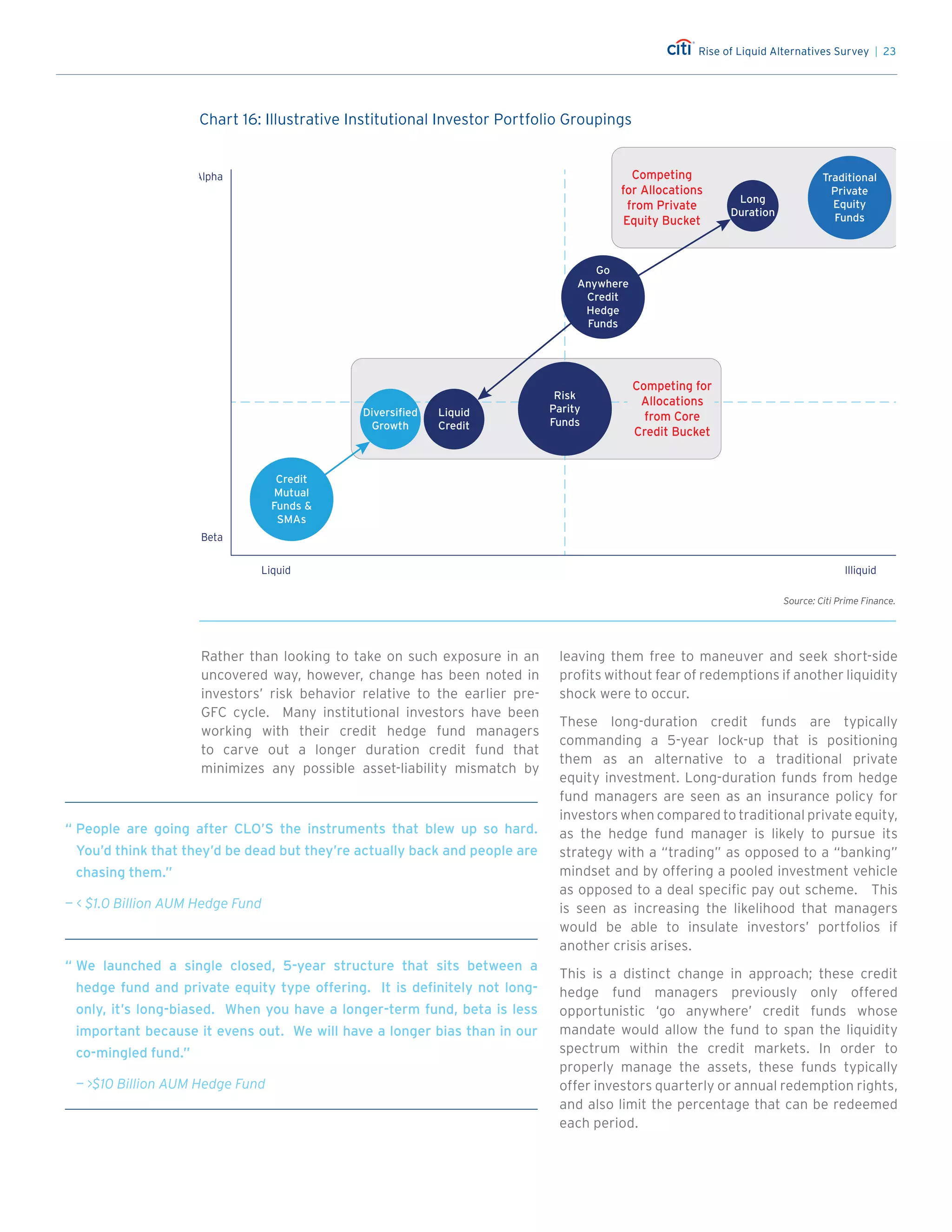
Further evidence of this trend is the fact that in the
past year, credit hedge funds have begun to launch
not only long-duration funds, but they are also
carving out the more liquid side of their portfolio and
creating long-bias credit funds that are competing for
allocations from the institutions’ core credit bucket.
This is illustrated in Chart 16.
Rising Credit Fears Turn Equity Risk Bucket
to Company Risk Bucket
As illustrated in Chart 17, credit yields are lower
than they were in 2007 in both U.S. high yield and
emerging markets.
In conjunction with tighter credit spreads, absolute
global interest rates are also at historic lows.
Quantitative easing by monetary authorities around
the globe has brought about this lower interest rate
environment. Changes in interest rates and widening
of credit spreads in the coming years are a major
concern for many investors when thinking about their
fixed income exposures.
To address these concerns about a turn in the interest
rate cycle, investors are shifting a portion of their
liquid fixed-income bond holdings into strategies that
offer some type of downside protection. Investors
are interested in actively managed credit hedge fund
products that vary in liquidity and duration profiles to
fill this need.
Chart 17
4%
2001 2009
20%
14%
10%
19991997 20001998 2008
18%
Historical Comparison of Credit Yields: Citi Index US HY  Citi Index Emerging Market Soverign Bond
6%
20042002 20062003 20072005
Yield to Worst, HYM Yield to Worst, ESBI, 10-20 yrs
16%
8%
12%
2010 2011 2012
Returns
Chart 17: Historical Comparison of Credit Yields:
Citi Index US HY  Citi Index Emerging Market Sovereign Bond
“	Our liquid high yield co-mingled fund is really being seen as interesting
to institutional investors with plain vanilla bond portfolios. It can trade
a mix of bonds, loans and mortgages. It’s mostly a long fund that offers
a little bit of protection. It should be able to capture 90% of the upside
and protect against 60% of the downside.”
	 — $10 Billion AUM Hedge Fund
“	We’ve seen the pension side coming out of a portion of their vanilla credit
into alternative credit—strategies with a degree of shorting in them.
We’ve seen some go even further. All the way to reallocating vanilla
credit to distressed.”
	 — $10 Billion AUM Hedge Fund
Rise of Liquid Alternatives Survey | 25
“	I was shocked at the level of institutional demand I encountered for these
Diversified Growth Funds when I was out visiting Japanese investors.
I think that these may end up being the first real publically traded
product that has potential to draw off institutional hedge fund demand.”
	 — $5.0-$10.0 Billion AUM Hedge Fund
“	I see hedge funds as a bond surrogate, but they’ll perform better
than bonds.”
	 — Sovereign Wealth Fund
These privately offered liquid credit hedge funds,
including long/short credit funds, only utilize a
manager’s more liquid strategies expressed by
instruments that are readily priced and traded.
Because of the more liquid nature of the underlying
instruments and strategies, these funds can offer
private investors more frequent redemption terms
(i.e., monthly) compared to a hedge fund manager’s
flagship funds that may only be redeemed quarterly
or semi-annually. In addition, manager fees on these
funds are typically lower than a for manager’s main
hedge funds, in an effort to compete more directly
with actively-managed credit funds.
This credit product extension is being driven by the
same risk concerns that are prompting allocators
to place more equity hedge strategies into their
portfolio alongside their actively managed, long-only
equity allocations. If the credit cycle turns, the same
companies in this equity risk bucket will be impacted,
and having credit hedge strategies in the portfolio
alongside investors’ core credit long-only funds
should help to dampen such exposure. This trend
is what is prompting us to widen our description of
the equity risk bucket to be a broader company risk
bucket for 2013 forward. This change is highlighted
back in Chart 10.
In this year’s survey interviews, it has been
interesting to note the depth of collaboration taking
place between the large credit hedge fund firms
and their investors in designing these new products
and in determining where they fit in the investors’
portfolio. Because of the size of their investments
and the strategic, longer-term nature of their capital,
institutional investors have built deep relationships
with these managers and are working with them in a
more collaborative, advisory manner.
This consultative approach with investors partially
explains why large and franchise-sized credit firms
are getting larger.
Credit Hedge Funds Compete to Provide
Portfolio Insulation with a New Class of
Publically Offered Fund Products
In looking to offer downside protection in the core
credit holdings of institutional portfolios, credit
hedge fund managers have begun to compete head
to head with a new class of publically offered funds
that seek to offer the same portfolio insulation and
protection in periods of market stress. Last year we
discussed how ”All Weather” funds were attracting
flows from institutions looking to experiment with
risk parity. This year, we heard more in our interviews
about similar publically offered multi-strategy funds
that have a more flexible mandate, and how they are
gaining traction with investors.
These are broad strategy funds that include some
hedging techniques that can be expressed with liquid
instruments. They seek high total return over the long
term that is consistent with prudent risk management
by allocating assets actively across stocks, bonds and
short-term instruments, with the various exposures to
each asset type varying opportunistically in response
to changing market and economic trends.
What has been interesting about these publically
offered multi-asset funds is that they seem to be
gaining a degree of traction with the institutional
audience, while publically offered equity funds with
a degree of hedging are not finding this same level
of receptivity.
There is expected to be ongoing competition between
these products for institutional dollars, particularly
among investors that are not yet fully developed in
their hedge fund investing programs.
“	Being a big franchise sized firm has helped a lot with the bigger pensions
and sovereign wealth funds. People are looking for one-stop solutions
much more so now than in the past. The advisory nature of what we offer
investors is seen as extremely valuable. They say, ‘I want you to tell me
when I should move into a different segment’. We’re really starting to
see the advisory aspect of the relationship be a real selling point. Once
we get our foot in the door, our experience has been positive in that the
relationship deepens over time.”
	 — $10 Billion AUM Hedge Fund
Rise of Liquid Alternatives Survey | 26
In Europe, these funds are known as diversified growth
funds, (DGFs) and they have also seen significant
asset growth in recent years. These funds take a
flexible approach to asset allocation and offer clients
access to equities, bonds, alternative assets and cash
within certain range limits. This approach allows
these funds to dynamically switch between defensive
assets, growth assets and diversifier strategies, with
the aim of achieving strong risk-adjusted returns.
As shown in Chart 18, DGFs in Europe have raised
$37 billion in total assets from 2009 through 2012,
moving from $14 billion to $51 billion AUM—a increase
of 270%. This growth is emblematic of a broader
trend in Europe, where traditional private hedge
fund allocations from key institutions are being
driven toward publically offered vehicles in response
to regulatory pressure. Indeed, as we will explore,
European regulations that have emerged post-GFC
are working to reallocate a significant portion of
private fund capital to publically offered vehicles
that offer lower fixed fees, daily liquidity and more
frequent transparency. This is fundamentally altering
the structure of the European hedge fund industry.
$0
$60
$40
$30
$50
$10
$20
Chart 18
Source: Citi Prime Finance analysis based on eVestment Data.
European Diversified Growth Funds
2009-2012
2009 2012
BillionsofDollars
$14B
$51B
+270%
Chart 18: European Diversified Growth Funds
2009-2012
Across Europe, continued regulatory change and
uncertainty, combined with more risk-averse investor
sentiment, is encouraging a reallocation of alternative
investment dollars away from private hedge funds
toward both alternative UCITS that offer daily or
weekly liquidity and separately managed accounts.
Shifts in European demand for specific alternative
structures are occurring almost exclusively among
traditional hedge fund investors—the majority of
which are large institutions that have discretion over
their asset pools, and are highly attuned to both
public sentiment and political signals. As such, we
see the changing flows as part of a rebalancing and
not an expansion of the overall European industry.
Anticipation of AIFMD Dampens Growth in
European Private Hedge Funds
Post-GFC, public sentiment in Europe demanded that
more be done to regulate hedge funds and other
private fund vehicles to provide investors better
protections. The European Commission published its
original draft proposal for the Directive on Alternative
Investment Fund Managers (AIFMD) on April 30,
2009, which was aimed at regulating all private funds.
The text for AIFMD was adopted by the European
Council and Parliament in May 2011 and came into
force in July 2011. In December 2012, the European
Commission published its Level 2 Delegated
Regulation. European states will have until July 22,
2013 to transpose the rules into their national law as
the first tranche of regulations are due to take effect
on that date.
The goal of the legislation has been to put hedge
funds and private equity firms under the supervision
of the European Union regulatory body. The rules
focus on both alternative investment fund managers
(AIFMs) and on alternative investment funds (AIFs),
and apply to both European Union members and to
non-EU members.
The new rules cover a number of elements of an
AIFM’s fund operations, spanning across marketing,
depositories, risk, remuneration, supervision and
reporting. Each of these areas will require significant
changes in the industry. Just how significant is not
clear, however, as there continues to be meaningful
debate regarding the rules, even with the first
implementation deadline approaching.
The scope and scale of pending regulatory changes
for the European industry has been a dampening
influence on asset growth for the traditional private
fund industry, especially against the backdrop of a
turbulent and often difficult investment environment.
This is shown in Chart 19.
Indications are that assets held by private funds in
Europe have grown by only 9.2% in recent years,
rising from $399 billion at the end of 2008 to
an estimated $436 billion at the end of 2012. By
comparison, assets managed in private hedge funds
outside of Europe grew by 80%, rising from $1.0
trillion to $1.8 trillion in a similar timeframe.
Section III: European Regulatory Pressures Force a
Reallocation of Alternative Assets Away from
Private Fund Structures
Chart 19: European Hedge Fund Industry Change
Onshore  Offshore Private Funds 2008 vs. 2012
0
$450
$250
$150
$350
$50
$100
Chart 19
Source: Citi Prime Finance analysis based on HFI  HFR data.
European Hedge Fund Insutry Change
Onshore  Offshore Private Funds 2008 vs. 2012
End-2008 End-2012
BillionsofDollars
$377B
$101B$400
$200
$300 $355B
$436B
$399B
$22
Billion
Offshore Onshore
Rise of Liquid Alternatives Survey | 28
AIFMD Marketing Considerations Draw More
Funds Onshore
AIFMD does not have a specific requirement for
funds to be registered onshore in Europe. However,
the spirit of the directive has encouraged many
managers to assess whether their offering could
be seen as more attractive if it were registered or
domiciled onshore in Europe.
Specifically, European AIFMs with a European AIF
will have access to a marketing passport that allows
them to promote their fund across all the member
states, starting in July 2013. It is envisaged that all
other fund managers will still be able to distribute
their funds in Europe from July 2013 to July 2015,
but they must do so under country-specific private
placement regimes that require certain transparency
and controlling interest requirements. In addition
to the added complexity of complying with multiple
country-specific guidelines, the full scale of how and
when these private placement regimes may change is
still unclear.
Starting in July 2015, European AIFMs with non-
European AIFs—and all other non-European AIFMs
who market their products to European investors—
will also be able to apply for a marketing passport.
On the other hand, the ability of non-European AIFMs
with European AIFs to continue offering their funds
under the private placement regime will lapse. At
that point, all European AIFs must be part of the
passport system, and the AIFMs offering these funds
must be in full compliance with the regulations. As
currently envisioned, all private placement options
will be gradually phased out; starting in July 2018,
any AIFM marketing an AIF in Europe will need to have
a passport and be in compliance with the directives.
Rising Scrutiny of Institutional Investors Limits
Interest in Private Funds
In addition to regulatory uncertainty about
the impacts of AIFMD and a turbulent market
environment, increased regulation and scrutiny of
key institutional investors has also worked to limit
growth in private funds in Europe. Chart 20 shows
“	There are not enough asset raising opportunities in Europe right now so
bright people won’t be launching new hedge funds. The European hedge
fund industry is very flat. I am not seeing anything exciting at this time.”
	 — UCITS Platform Intermediary
“	We view AIFMD as a major opportunity for a firm of our brand and scale.
We already have a $65 billion long only UCITS business in Luxembourg
which is distributed throughout Europe and Asia. We see the addition of
both alternative UCITS and AIFMD compliant hedge funds as a natural
extension of our platform.”
	 — Asset Manager
Chart 20
Source: EFAMA
Breakdown of European Investment Landscapes by Participant Type
2011: €13.8 Trillion
42%
31%
27%
Retail
€4.28T
Alternative UCITS
€9.52T
69%
31%
Insurance
Companies
Pensions
Banks
 Others
Chart 20: Breakdown of European Investment Landscapes by Participant Type, 2011: €13.8 Trillion
Rise of Liquid Alternatives Survey | 29
the current breakdown of the European investor base.
As shown, European investment is heavily skewed
toward institutions as opposed to a retail audience.
European institutions account for 69%, or €9.6
trillion, of the region’s overall €13.8 trillion in assets,
while retail investors account for only 31%, or €4.3
trillion, according to EAFMA.
This allocation of capital reflects the strong role that
European institutions play in managing capital on
behalf of their constituents. Unlike the U.S. market
(discussed in Section IV), where retail clients exercise
substantial control over their savings and investment
portfolios, the European asset management industry
is largely defined by discretionary institutional
asset allocations.
Political pressure on these organizations to limit
their investment in private funds has grown post-
GFC. Large pension funds have been especially
scrutinized, as sponsors are focused on falling
asset/liability ratios, the need for greater corporate
governance at fund managers and the high fees
charged by private vehicles.
For insurance companies, the largest European
institutional segment, new rules being discussed
would actually apply punitive charges to firms
investing in private hedge fund offerings; an exception
would be made when a private fund provides complete
transparency to the underlying assets.
Insurance companies account for 42% of European
institutional assets. Since the 1970s, insurance
companies in Europe have been operating under a
set of regulations broadly referred to as Solvency I.
Solvency I focused primarily on the capital adequacy
of insurers and required little in terms of risk
management and governance. This framework is
set to be updated in 2014, with a new regime called
Solvency II. Among other requirements, Solvency II
provides minimum levels for an insurance company’s
risk-based capital.
Pillar 1 of the proposed Solvency II rules requires that
insurers hold sufficient capital to ensure a 99.5%
probability of meeting obligations to policyholders
over a 1-year period. To meet this goal, the standard
formula proposed in the directive sets a sliding scale
of capital charges against a portfolio’s assets. The
most punitive capital charges are reserved for hedge
funds and private equity funds, which are classified
as “other equities” and assessed with a 49%
capital charge.
Although Solvency II rules are still not in effect, the
tone of public discourse in Europe has made it difficult
for insurance companies and other institutions to
invest as freely in private fund vehicles. The result
has been a reallocation of investment dollars to more
heavily regulated and transparent structures in the
alternatives marketplace.
Alternative UCITS Draw Increased Flows from
European Institutions
All publically offered fund structures in Europe
fall under the auspice of a set of laws known as
the Undertakings for Collective Investment in
Transferrable Securities (UCITS). In 2003, a third
iteration of the UCITS rules was released that allowed
for the expanded use of exchange traded and over-
the-counter derivatives. It also introduced a common
prospectus and marketing “passport” that provided
distributors access to all of the EU countries and
eliminated previous costly and disparate private
placement regimes. These key changes opened
the door for the first wave of publically offered
alternatives—or alternative UCITS—vehicles.
Asset managers, who saw alternative UCITS as an
expansion of their unconstrained long products
and were able to leverage existing marketing and
distribution organizations, accounted for the initial
wave of alternative UCITS offerings launched in the
years pre-GFC. Hedge funds initially avoided creating
alternative UCITS funds due to the perceived product
constraints, costs of daily reporting and fear of
cannibalizing their higher-fee private fund offerings.
Although UCITS III envisioned a product for retail
investors offering daily, weekly or monthly liquidity,
interest in alternative UCITS came predominantly
from institutions that faced restrictions on their
ability to invest in private fund vehicles.
By 2007, according to SEI/Strategic Insights,
alternative UCITS AUM had reached $212 billion.
These assets proved fleeting, however, as AUM fell
by 55% in the GFC to only $117 billion, as shown in
“	Pension funds are reconsidering hedge fund investments because of
liquidity issues and fees. Some of them are annoyed due to the lockups
and high fees.”
	 — Boutique Research and Consultancy Firm
“	For some insurance companies in Europe, there are rules that they can
invest only in UCITS.”
	 — Boutique Research and Consultancy Firm
Rise of Liquid Alternatives Survey | 30
Chart 21.
Post-GFC, the entire investor community, and
investors in Europe in particular, had a severe backlash
against liquidity issues that emerged during the crisis.
Institutional investors that had been prevented from
accessing their privately placed capital throughout
the crisis due to lock=ups and fund gates were
attracted to the daily, weekly or monthly liquidity
provisions of alternative UCITS. These institutions
sought approval from—and were encouraged by—
their constituents to reallocate assets to products
that offered greater regulation, public oversight and
disclosure requirements.
In the immediate wake of the GFC, the launch of
several UCITS platforms provided an access point
for institutional investors to make allocations into
a range of alternative UCITS funds. Further, these
platforms helped facilitate this trend by reducing the
costs for hedge fund managers looking to set up and
distribute an alternative UCITS product.
The result was a rapid recovery in alternative
UCITS AUM. As noted in Chart 21, alternative UCITS
products had recouped almost all of their pre-GFC
capital by 2010.
The caliber of firms willing to launch alternative
UCITS products was one factor helping to speed this
recovery. Previously, the products had been emerging
primarily from asset manager organizations; the wave
of launches post-GFC were coming from recognized
names in the hedge fund industry. Indeed, SEI/
Strategic Insight notes that alternative UCITS funds
launched post-2007 garnered 70% of incoming flows
in the 2 years immediately following the GFC.
“	We were approached by an existing investor that had been in our
sovereign debt fund for 6-7 years. They are an insurer and because
of Solvency II, they have to come out of unregulated hedge funds and
into the registered space. They have said that they are willing to seed a
UCITS fund and that they don’t mind setting it up as a sole investor.”
— $1.0 to 5.0 Billion AUM Hedge Fund
“	Our current UCITS fund is on [a bank] platform. We have used it as a
means of gaining access to European investors who can only invest via
UCITS vehicles.”
	 — $1.0 AUM Billion Hedge Fund
“	We are thinking about UCITS again and would explore going on to a
platform as we see this as cost efficiency. Our Long bias product is easy
to put into the UCITS wrapper.”
	 — $1.0 Billion AUM Hedge Fun
Chart 21
Source: SEI/Strategic Insight data.
0
$250,000
$200,000
$100,000
$150,000
$50,000
2008 2009 2010 2011 YTD
11/2012
Changes in Alternative UCITS AuM:
2008-November 2012
MillionsofDollars
Chart 21: Changes in Alternative UCITS AuM:
2008-November 2012
Rise of Liquid Alternatives Survey | 31
Alternative UCITS Investment Limitations
Slow Growth Post-2010
Institutional enthusiasm for alternative UCITS peaked
in the immediate aftermath of the GFC. As Chart 21
illustrates, assets grew 89% between 2008 and 2010,
but have only been able to gain an additional 19% since
that time. Slowing interest in the product reflects
increased awareness on the part of institutional
investors about the limitations of these products in
terms of replicating private fund strategies.
According to survey participants, most of the
institutional assets that have shifted to alternative
UCITS have been focused in a highly liquid sub-
set of strategies. Those strategies requiring more
illiquid assets have been difficult to duplicate in
UCITS structures. Consequently, optimism about
continued institutional interest in these products is
muted at best.
Indeed, Eurohedge’s 2012 UCITS survey attributes
the jump in alternative UCITS AUM in 2012 to a
surge in demand from retail buyers; the retail share
of alternative UCITS ownership is cited as having
increased from 25% to 38% in just the past year.
Our observation has been that institutional investors
that have already rebalanced the more liquid portion
of their alternatives allocation, and are therefore
more likely to turn to managed accounts for the
transparency and liquidity benefits they require in
more complex strategies.
Separately Managed Accounts Gain Assets,
but at Extensive Costs
Similar to regulated alternatives, separately managed
accounts (SMAs) can provide improved governance
and control, greater transparency, enhanced liquidity
terms, and reduced capital charges under the look-
through provision of Solvency II. SMAs also benefit
from broader investment flexibility and, for the
largest institutional investors, customized terms and
fee structures.
Institutions with the means and willingness to allocate
a large enough ticket are, for all purposes, able to hire
a fund manager to run a customized strategy. This is
becoming increasingly common as investors look to
mold strategies and acquire specific exposures to fill
a particular niche in their portfolio.
Costs associated with running an SMA are not
inconsequential, however. In many ways, the SMA
bears the same expenses as a pooled vehicle; but with
an SMA, those costs are borne by one investor and
often represent a larger portion of the account’s or
fund’s assets.
The investor also assumes the counterparty credit
risk when the account trades derivatives or uses
financing, and investors must negotiate their
own credit risk and ISDA documents, as well as PB
agreements. Operationally, it is difficult for many
institutional investors to oversee and manage these
processes without sufficient scale.
Managed Account Platforms Offer
Convenience, but at a Cost
Institutions looking to streamline the operational
burden of a managed account platform (MAP)
can outsource the set-up and administration to a
platform provider.
The top MAPs have been attracting an increased
flow of assets in recent years. Overall assets have
increased from $41 billion in March 2009 to $57.7
billion at the end of 2012. Competition for assets
across the top platforms is steep, but confined to a
small set of firms. As Chart 22 shows, 9 of the top
10 MAP providers in the post-crisis period remain in
the top slots today.
“	The perception from some pension funds about UCITS is that the
products being offered are not great. If the strategy is in a UCITS format,
it is not the same strategy as a private fund and it would not have the
same performance.”
	 — UCITS Platform Intermediary
“	We thought for a few days about doing a UCITS fund. We quickly decided
that the things that made it attractive would make it unattractive…our
most liquid fund is quarterly on 90. If you shorten that, you’d have to
keep too much liquid capital…and that sacrifices returns.”
	 — $10 Billion AUM Hedge Fund
“	If you look at the rules you have to follow in UCITS, it’s really a long
only strategy…The bulk of UCITS funds say that they are total return or
absolute return and they charge fees at that side of the scale, but when
you look at them they have 2 short positions.”
	 — $1.0-5.0 Billion AUM Hedge Fund
“	All of our UCITS fund of hedge fund products are overall long bias in
nature. We view UCITS as necessary to keep them in business, a way
to appeal to investors nervous about the Madoff experience when
considering investing in Alternatives.”
	 — Fund of Hedge Funds
Rise of Liquid Alternatives Survey | 32
For investors, the platforms identify, complete due
diligence on and provide access to a set of managers
that have already agreed to offer SMAs. In many
instances, the platform has pre-negotiated terms
with the SMA manager. A platform that represents
the potential assets of a number of investors may
be able to negotiate for more attractive terms than
a single institution could otherwise achieve. Where
an institution has a series of SMAs, the platform also
provides consolidated reporting.
Investors working with bank-sponsored MAPs can
also explore financing and structuring opportunities.
Such offerings could include negotiating a “maximum
drawdown” threshold, below which the bank sponsor
will hedge off additional losses.
The convenience of these platforms cannot be
disputed, but there is little cost savings involved,
as the platforms charge substantial fees for their
services. Even in cases where a platform negotiates
reduced management and performance fees with an
underlying account manager, those savings are not
necessarily passed on to the investor.
New Balance of Alternative Asset Structures
Emerges in Europe
When all of these different pools of alternative hedge
fund strategy assets are considered together, it
becomes clear that emerging regulations in Europe
are working to redirect the industry from privately
offered hedge funds to either publically offered
alternative UCITS or SMAs. This is illustrated in
Chart 23.
“	Managed accounts are a reflection that investor power is growing and
they are calling the shots. We had a raise in January and at the last
minute, the investor dictated the exact term sheet with fees, liquidity
provisions, key man risk and insurance. It was inconceivable to the
investor that they would go into a co-mingled fund.”
	 — Third Party Marketing Intermediary
“	If we are establishing a long-term relationship with a manager we will
invest in large size via SMAs which allow us to negotiate lower fees and
provide us better access to the managers along with daily transparency.”
	 — Insurance Company
+40.6%
$41.0 Bn AuM $57.7 Bn AuM
MANAGED ACCOUNT PLATFORMS
AuM AS OF
MARCH 2009
(Bn, USD)
AuM 2012
(Bn, USD)
NUMBER OF FUNDS
ON PLATFORM
(March 2009)
NUMBER OF FUNDS
ON PLATFORM
(2012)
Deutsche Bank 8.00 12.40 136 223
Lyxor Asset Management 10.50 11.80 113 121
Man Group 7.0 8.0 70 80
AlphaMetrix 2.10 6.90 66 150
Lighthouse Partners 2.90 4.80 82 90
Goldman Sachs 3.20 3.50 20 54
HFR Asset Management 1.79 3.10 75 78
UBS N/A 2.50 N/A 30
Innocap 2.00 2.40 59 48
Amundi 1.79 2.30 54 31
Guggenheim 1.75 N/A 38 N/A
Chart 22: Assets Managed on 10 Largest Managed Account Platforms
Source: HFMWeek
Rise of Liquid Alternatives Survey | 33
Since 2008, Alternative UCITS assets increased by
$131 billion, while the combined assets of onshore and
offshore private funds increased by only $37 billion.
(MAP assets grew by $17 billion, but this total is not
counted as a separate asset pool in our analysis,
because the AUM is already likely to be listed in either
the alternative UCITS or onshore private fund figure.)
This dramatic swing in flows has significantly changed
the structure of the European marketplace. Chart
24 illustrates that the combined pool of alternative
assets in Europe increased from $516 billion at the
end of 2008/early 2009 to $684 billion by the end of
2012. The share of these assets allocated to privately
held hedge funds (both onshore and offshore)
declined, however, from 77% to only 64% of assets
during the corresponding period.
In many ways, what has occurred in Europe could be
a model for the much larger U.S. market. As will now
be discussed, U.S. regulatory changes both before
and after the GFC have worked to flatten differences
between privately offered and publically offered
funds, just like AIFMD has done in regards to UCITS.
And, while there is no Solvency II- type imperative
hanging over U.S. institutional investors, there has
been increased public focus post-GFC on asset/
liability management and the high cost of hedge
fund fees.
Simply having more harmonized policies and
oversight, however, may not warrant a shift in
allocations. It was a desire for the liquidity benefits
of these new structures that drew European
institutional investors, but there is not nearly the
same level of concern about this factor from the U.S.
institutional audience.
What we will explore in coming sections is that the
change in U.S. alternative asset pools is likely to be
sparked not by traditional institutional buyers, but by
the emergence of a new retail audience.
“	Investors are all about transparency. They want managed accounts. In a
way, it’s back to the future. This used to be the ways that CTAs managed
back in the day and then to be cleaner operationally, people went toward
co-mingled funds.”
	 — CTA Fund
“	We used to want to be highly opportunistic in the market. We had
distressed, middle market and structured credit all in our co-mingled
account, but now we’ve broken that up into separate sleeves. Meanwhile,
our managed accounts are going in the opposite direction and becoming
more custom and mixed in terms of product.”
	 — $10 Billion AUM Hedge Fund
“	Managed Account Platforms are a good option because of the
transparency… investments through managed account platforms will
increase and they are also good from a Solvency II perspective.”
	 — Boutique Research and Consultancy Firm
“	In Europe right now, managed account platforms have become
best practice.”
	 — Platform Provider
“	AIFMD and Solvency II are pushing Europe toward managed account
platforms. As the investor, I don’t want to have to go to the pension’s
board and say I am invested in an offshore Cayman fund and I don’t know
what it’s invested in.”
	 — Consultant
Chart 23: Changes in European Alternative
Structures: 2008 to 2012
Chart 23
Sources: Citi Prime Finance analysis based on
HFI EuroHedge, HFM Week, HFR, Strategic Insight data
Changes in European Alternative Asset Structures:
2008 to 2012
Managed
Account
Platforms
Alternative
UCITs
Onshore
HFs
Offshore
HFs
BillionsofDollars
$17B
$131B
-$42B
$79B
$-60
$140
$80
$40
$100
$-20
0
$120
$60
$80
$-40
$37B
Subset of
Alternative
UCITS 
Onshore
Funds
The $37B notation floating ABOVE the
right column has no apparent purpose.
Please verify need to include.
$20
Rise of Liquid Alternatives Survey | 34
“	We see a real difference between U.S. and European investors. U.S.
investors want more long-term returns and they see European allocators
as more likely to swing into and out of positions.”
	 — $1.0 to 5.0 Billion AUM Hedge Fund
“	Europe was always freaked out by liquidity.”
	 — Multi-Family Office
Chart 24: Changing Structure of European Hedge Fund Industry
End-2008 / Early-2009: $516B AuM 2012: $684B AuM
Chart 24-A
Sources: Citi Prime Finance analysis based on
HFI EuroHedge, HFM Week, HFR, Strategic Insight data
Offshore European
Hedge Funds
$377B
Changing Structure of European Hedge Fund
Industry: End-2008 / Early-2009: $516B AuM
4%
23%
Onshore European
Hedge Funds
$22B
Alternative UCITS
$117B
73%
Managed
Account
Platforms
$41B
8%
Chart 24-B
Sources: Citi Prime Finance analysis based on
HFI EuroHedge, HFM Week, HFR, Strategic Insight data
Changing Structure of European Hedge Fund
Industry: 2012: $684B AuM
Offshore European
Hedge Funds
$335B
15%
36%
Onshore European
Hedge Funds
$101B
Alternative UCITS
$248B
49%
Managed
Account
Platforms
$58B
8%
The regulation of ”pooled investment vehicles”,
defined under U.S. financial services regulation as
comprising registered investment companies (RICs),
business development companies (BDCs) and hedge
funds, and their respective registered investment
advisers (RIAs), has gone through significant changes
since the original incarnations of these rules were
established in the 1940’s.
Whether or not it was their intention, regulators are
helping to bring marketing, compliance, reporting
and many of the operational processes of privately
offered funds closer to publically offered funds
and the investment rules, fees and tax treatment
of publically offered funds closer to the private
fund world.
Publically and Privately Offered Funds Develop
Along Parallel Paths
The Investment Company Act of 1940 (the 40 Act)
and the supporting Investment Advisers Act (Advisers
Act) of the same year together form the backbone of
U.S. financial regulation, and were originally written
to instill public confidence in the fledging investment
company industry following the Wall Street Crash of
1929. It was designed to protect the public from a
new type of investment vehicle, mutual funds, which
had been growing in popularity since their creation in
1924. The 40 Act applies to all investment companies,
but exempts several types of investment companies
from its purview. The most common exemptions are
found in Sections 3(c)(1) and 3(c)(7) of the 40 Act and
include hedge funds.
Since the 40 Act was released, the rules and
regulations governing non-exempt investment
companies (including mutual funds, BDCs, etc.) and
exempt investment companies (including hedge
funds) diverged with regards to disclosures, frequency
and transparency of reporting. This divergence also
accounted for the types of investment techniques
allowed within the various investment vehicles,
principally short selling of shares and use of portfolio
leverage to deliver excess returns.
The non-exempt mutual fund companies were
traditionally considered ‘long only’ and invested
in public securities in the equity and debt markets.
Exempt hedge funds could engage in the short selling
of securities through borrowing relationships with
broker-dealers and the use of portfolio leverage
above standard portfolio margin, as defined under
the Federal Reserve Board Regulation T (Reg T).
These two parallel worlds, the regulated and publically
available mutual funds and the lightly regulated and
only privately offered hedge fund industries, have
grown in size since the 40 Act to reach $11 trillion and
$2.3 Trillion, respectively, in the U.S. A number of
market events and rule changes over the past decade
have resulted in the bridging of these two types of
investment vehicles, and have consequently eroded
the artificial barrier between publicly offered and
privately offered funds.
40 Act Mutual Fund Restrictions Ease,
Creating a More Flexible Landscape
The creation of the Securities  Exchange Commission
(SEC) and the passing of the Securities Act of 1933 put
in place safeguards to protect investors, and required
all mutual funds to register with the SEC and provide
disclosures in the form of a prospectus describing the
activities and investment guidelines for the fund. The
40 Act then put in place additional regulations that
required further disclosures and sought to minimize
conflicts of interest.
Overthepreviousdecade,theSECbegantomodernize
and update the 40 Act regulations that had not
significantly changed since their original inception. A
whole set of changes took place in the interpretation
and implementation of 40 Act regulations for RICs.
The SEC adopted changes in July 2006 permitting
these funds to take small positions in an unlimited
number of funds and affiliated funds of funds. The
significance of this regulatory loosening opened up
the ability of closed-end funds to invest in unregulated
hedge funds, as long as the fees were transparent
and reported to investors. This marked the first time
that retail investors could access the privately offered
hedge fund products, and began to bridge the public-
private boundary for pooled investment companies.
Around the same time period (late 2005) an update
to the fee structure for mutual funds included
the implementation of redemption fees aimed at
increasing the duration of retail investments and
deterring market timing and late trading of mutual
Section IV: U.S. Regulations Flatten Barriers Between
Privately and Publically Offered Funds
Rise of Liquid Alternatives Survey | 36
fund listed securities. This seemingly small change
to fee structure began to lengthen the duration of
capital flows and ease liquidity pressure on mutual
fund managers.
In 2009, the SEC made changes to the delivery and
transparency requirements for fund prospectuses,
allowing funds to provide investors an online summary
prospectus. This automation and streamlining led
to cost savings for fund managers and allowed for
standardized, transparent comparison of funds.
In July 2010, further updates to fee structures were
implemented with the rescission of the Rule 12b-1
requirement and its replacement by a standardized
fee of 25 bps, paid annually for the distribution
activities of the fund. This AUM-based fee, charged
on an ongoing basis, began to better align the
incentives of the financial adviser and the investor
because the size and duration of the investment
were more important than just an initial sale and
commission environment.
In December 2010, the U.S. Congress successfully
passed the Regulated Investment Company
Modernization Act of 2010, which was aimed at
making registered funds more efficient by reducing
the burden arising from amended year-end tax
information statements. This improved a fund’s
ability to meet its distribution requirements and
amended the tax treatment of investing in a fund of
funds structure.
All of these changes served to modernize the 40 Act
investment funds in a way that increased efficiency,
reduced turnover, broadened investment guidelines
with the introduction of non-affiliated fund-of-funds,
streamlined tax treatment of fund investments and
improved transparency on the $11 trillion U.S. industry
Around the same time these regulatory changes
were taking place for the mutual fund industry, U.S.
regulators were imposing laws that would significantly
affect the privately offered fund industry.
Dodd-Frank Act Drives Greater Hedge Fund
Transparency and Compliance
The GFC also had a dramatic impact on transparency
and compliance culture in the privately offered fund
industry, which until 2010 had avoided increased
regulation and oversight by the SEC. Until the
Dodd-Frank Act was passed, this industry relied
on Investment Company Act exemptions originally
defined in 1940.
Dodd-Frank required that the vast majority of
unregistered advisers to become registered with
the SEC and therefore fall under the oversight of
the same securities market regulator as registered
funds and BDCs. This law required private fund
managers to become RIAs and introduced broad
compliance requirements.
Private fund managers with more than $150 million
AUM are now providing an unprecedented degree of
transparency and standard marketing disclosures
to the SEC under the same process as publically
registered funds. The new ‘ADV’ form requirements
were considered a significant reporting change
for hedge fund managers, who until this point had
remained unregistered and provided no public
information about their investment activities.
Investments in compliance programs to meet
the requirements of being an RIA under the SEC
guidelines were significant across the U.S. hedge
fund industry in 2011 and 2012. A dramatic increase
in manager registrations took place, identifying these
firms to the public via the SEC registration process.
As part of the RIA guidelines, registered private fund
managers now had to have a defined compliance
program and a designated compliance officer while
becoming subject to SEC reviews and scrutiny.
As shown in Chart 25, in October 2012 the SEC
reported the number of private fund managers now
registered with the SEC increased to 4,061 during
2012, when registration became mandatory. This
represents an increase of 59% over the 2,557 funds
that had chosen to voluntarily register in previous
periods, and does not include the more than 2,000
small funds that were shifted from federal to state
oversight as a result of the Dodd-Frank Act rule
changes. Indeed, many hedge fund managers enacted
dual registrations in 2012, choosing to register with
“	We felt that the liberalization of the 40 Act around 2007 made it possible
to run a proper strategy. We felt that it would be difficult to raise money
for a hedge fund as there were so many hedge funds out there. At one
point in 2007, the New York Times ran an article saying that the hedge
fund industry had run out of Greek and Roman god names.”
	 — $5.0 to $10.0 Billion AUM Liquid Alternatives Manager
“	Transparency in hedge funds has created a middle ground where the IFA
networks can now educate the mass affluent buyer. These buyers are
not worried about the same things as the pension funds. They just want
good returns.”
	 — Asset Manager
Rise of Liquid Alternatives Survey | 37
the Commodities Futures Trading Commission (CFTC)
in addition to the SEC if their portfolio contained a
significant use of futures and/or options.
Beyond registration, there have also been increased
demands for transparency into the actual hedge fund
holdings. Post-GFC, rules emerged that required
managers to disclose their largest short-sale
positions. This was followed in 2012 by additional
reporting requirements. A new systemic risk report
known as ‘Form PF’ (or form private fund) was
introduced as a reporting requirement by a newly
formed department within the U.S. Treasury called
the Financial Stability Oversight Council (FSOC).
The FSOC was established to monitor systemic
market risk. To fulfill this mandate, registered hedge
fund managers must now provide the FSOC with
information on a variety of private fund activities that
had until that point remained completely opaque.
Such Form PF disclosures include extensive
information about their position holdings and risk
practices — data that had rarely been shared with
any regularity with investors. The production and
delivery of Form PF prompted widespread industry
investments in reporting technologies, and resulted
in nearly all larger hedge funds having to upgrade
their procedures to aggregate risk information and
detailed fund investment information. These changes
have narrowed the gap between where U.S. hedge
fund managers were prior to the GFC and where they
stand today vis à vis the mutual fund industry.
JOBS Act Proposed Changes Will Allow
Expansion of Alternative “Brands”
The most recent regulatory change that is serving
to blur the boundary between publically offered
and privately offered investment funds is embedded
within the Jumpstart Our Business Startups Act
(JOBS Act) which was passed in April 2012. The
JOBS Act’s purpose is to encourage funding of small
businesses in the U.S. by easing various securities
regulations.
There are two main changes in the JOBS Act affecting
pooled investment vehicles, one relating to BDCs and
exchange listed closed-end funds, and one relating to
the marketing and advertising of private funds.
The JOBS Act proposed relief for certain types
of companies, referred to as ‘emerging growth
companies’, from specific regulatory and disclosure
requirements in their registration statement that they
file when they first go public and for the following 5
years. This allows new public companies, including
BDCs, to have a longer phase in period to meet the
full requirements of being a public company. This
makes it easier and less expensive to launch a new
closed-end publically traded investment company.
This allows more fund managers to come to market
with these products in a shorter timeframe.
ThemoresignificantchangeproposedwithintheJOBS
Act is the lifting of the ban on ‘general solicitation’
and advertising of specific types of private placement
securities, including privately offered hedge funds
or private equity funds, which has been in place
since the original securities acts defined in 1930s.
Chart 25
Source: Based on information released by the SEC
in press release dated October 19, 2012.
Hedge  Private Fund Advisors Registered with SEC
Only Shows Managers with More than $100M AuM
Voluntary Mandatory
NumberofRegisteredPrivateFundAdvisors
2,557
4,061
+59%
0
4,500
2,500
1,500
3,500
500
1,000
3,000
2,000
4,000
Chart 25: Hedge  Private Fund Adivsors
Registered with SEC Only Shows Managers with
More than $100M AuM
“Hedge fund managers are becoming regulated on their home turf so
getting more regulated on another turf is not as big a deal.”
— $5.0 to $10.0 Billion AUM Hedge Fund
“Hedge funds themselves are being subject to much greater regulatory
obligations and their fund operations are now very transparent. Managers
are going through a fatigue of going through these regulations and are
now looking to monetize these investments.”
— Law Firm Intermediary
Rise of Liquid Alternatives Survey | 38
If implemented by the SEC this year, the changes
may allow hedge fund managers to promote their
privately offered hedge funds in the same way that a
registered fund manager can promote a mutual fund
by using public media to build a brand and explain the
benefits of their fund products.
The ability of these managers to promote their
“brand” is especially important as demand for
publically offered alternative 40 Act funds is growing
dramatically. Hedge fund firms are deciding whether
to create or sub-advise these vehicles. This will
allow managers to discuss their firm and investment
capabilities with a broader set of financial wealth
advisers and audiences to gauge potential interest.
New Rules Erode Barrier between Publically
and Privately Offered Funds
More than 80 years ago, the paths of registered
investment funds and privately offered hedge funds
diverged along the lines of transparency, oversight,
reporting and target audience. We saw the U.S.
mutual fund industry explode throughout the 1980s
and 1990s while the hedge fund industry remained
the domain of wealthy investors and large institutions.
Those barriers on either side have slowly eroded,
but the GFC was the most significant event that has
bought these products closer in line with the roll-out
of Dodd-Frank and the subsequent opening up of the
private fund universe.
“	Regardless of the JOBS Act, you can market a 40 Act fund. You can go
out and take ads out on television to market a 40 Act fund. As a hedge
fund manager, you can’t do that.”
	 — $1.0 to $5.0 Billion AUM Hedge Fund
“	The SEC has no idea that over regulation of hedge fund managers has
led to a new audience for these products. Hedge fund law firms are
now desperate for 40 Act lawyers to help managers figure out how to
leverage the opportunity.”
	 — Law Firm Intermediary
“	We are creating products on the cutting edge of regulatory engineering.”
	 — CTA Fund
Foundational changes in the U.S. financial advisor
market have been taking place in parallel to the
changes in U.S. regulations outlined in the previous
section. While regulatory changes structurally
helped to flatten differences between publically
and privately regulated funds in the U.S., financial
advisors are driving demand from a completely
new audience for hedge fund-like strategies. This
combination of demand from a new source and a
more level regulatory playing field are spurring rapid
growth in U.S. publically offered alternative vehicles.
This is a significant development, not only because
financial advisors bring a new set of buyers to the
table, but because the U.S. mutual fund and ETF
market is the largest in the world. Changes in the U.S.
are likely to have a ripple effect globally and influence
wealth advisory in other regions. Understanding
what’s occurring in this market is critical in thinking
about how other markets around the globe may
develop in the future, which may influence demand
for hedge fund and hedge fund-like strategies.
Three-Quarters of U.S. Retail Investors
Do Not Qualify for Private Funds
Unlike the European marketplace that is heavily
weighted to the institutional investor, the U.S. market
is nearly evenly split between institutional and
retail buyers. Chart 26 illustrates this breakdown.
Institutional investors in 2011 accounted for
$14.5 trillion of the total $27.3 trillion market for
professionally managed assets in the U.S. (53%), and
retail investors accounted for $12.8 trillion (47%).
Retail investors control a higher share of
professionally managed assets in the U.S. because
the majority of pension and retirement plans are
defined contribution systems, not defined benefit
Section V: Changing U.S. Wealth Adviser Dynamics Are
Driving New Demand for Alternatives Products
Chart 26
Sources: Cerulli Associates citing Department of Labor, ICI, Federal Retirement Thrift Investment Board, PlanSponsor, Insuranceassetmanager.com,
The Foundation Center, NACUBO, Insured Retirement Institute, VARDS, Morningstar Direct, Strategic Insight/SIMFUND, SIFMA, Investment News, Financial
Planning Bank, Insurance Market Research Group, Meridian IQ, SP Capital IQ MMID, The Institute of Management and Administration, Pensions  Investments,
FDIC, OCC, Barron's, Financial Planning Association, Investment Management Consultants Association.
$8,000
BillionsofDollars
2005 20092001 2011
$15,000
$13,000
$12,000
$11,000
$9,000
$9.9T
2003 2007
$14.2T
$12.8T
$8.6T
$12.5T
$14.5T
2004 20082002 2006 2010
$14,000
Professionally Managed U.S. Assets Under Management: Retail  Institutional
(Excludes Non-Professionally Managed Assets, Adjust Channels for Double Counting)
$10,000
Retail
Institutional
Chart 26: Professionally Managed U.S. Assets Under Management: Retail  Institutional
(Excludes Non-Professionally Managed Assets, Adjusts Channels for Double Counting)
Chart 26
Sources: Cerulli Associates citing Department of Labor, ICI, Federal Retirement Thrift Investment Board, PlanSponsor, Insuranceassetmanager.com,
The Foundation Center, NACUBO, Insured Retirement Institute, VARDS, Morningstar Direct, Strategic Insight/SIMFUND, SIFMA, Investment News, Financial
Planning Bank, Insurance Market Research Group, Meridian IQ, SP Capital IQ MMID, The Institute of Management and Administration, Pensions  Investments,
FDIC, OCC, Barron's, Financial Planning Association, Investment Management Consultants Association.
$8,000
BillionsofDollars
2005 20092001 2011
$15,000
$13,000
$12,000
$11,000
$9,000
$9.9T
2003 2007
$14.2T
$12.8T
$8.6T
$12.5T
$14.5T
2004 20082002 2006 2010
$14,000
Professionally Managed U.S. Assets Under Management: Retail  Institutional
(Excludes Non-Professionally Managed Assets, Adjust Channels for Double Counting)
$10,000
Retail
Institutional
Rise of Liquid Alternatives Survey | 40
schemes like in Europe. In a defined contribution
plan, individual investors are given control to make
their own selections around how to invest their
assets rather than turning discretion for managing
those portfolios over to the sponsoring institution.
To facilitate such discretionary investing, there is
an established market of financial advisers. This
section will examine trends occurring in that financial
adviser landscape.
There are multiple categories of retail investors in
the U.S. that break down by their level of wealth.
To illustrate points about how demand from these
investors may impact the hedge fund industry, we
collapse the upper wealth bands and simply say that
all individual investors with more than $5.0 million
net worth are considered high net worth. This is an
important cut-off point because all those above this
band are considered a qualified investment purchases
and are able to buy into a private fund vehicle.
Our analysis shows that these high net worth investors
represent 27% of the total U.S. market of household
investable assets. That means that under current
law, nearly three-quarters of the retail U.S. investor
market (73%) are not currently wealthy enough to
invest in privately offered hedge fund vehicles.
This pool of retail investors with less than $5.0 million
in net worth is split into three segments: affluent
investors, with $2.0 million to $5.0 million of net
worth; mass affluent, with $500,000 to $2.0 million
of net worth and retail, with less than $500,000 of
net worth.
For our analysis, we are going to focus primarily on
the affluent and mass affluent categories because
real estate- and college-related savings take up a
smaller portion of these investors’ assets, and they
thus have a larger amount of unencumbered capital
to invest.
This audience relies heavily on financial advisors
in making investment decisions, often signing over
discretion for their portfolio and allowing their
financial adviser to make investments on their
behalf. This is a critical point to remember, since
a change in approach adopted by such advisers can
be enacted without having to gain permission from
each individual they advise. Such a change in adviser
thinking and approach occurred post-GFC.
Wealth Advisers Move toward a More
Risk-Aligned Portfolio Approach
Increasingly, retail wealth advisers in the U.S.
operate like Chief Investment Officers (CIOs) charged
with managing the return stream for a pension,
endowment or foundation. To preserve their clients’
trust and business, they look to create a stable return
investment portfolio that, over time, helps their
clients’ assets grow.
Not surprisingly, the majority of these advisers relied
on a model portfolio constructed using strategic
asset allocation principles to create diversity in
their portfolios. As was the case for institutions,
these wealth advisers initially used modern portfolio
theory and the capital asset pricing model to create
seemingly diversified holdings.
Prior to 2008, wealth advisers were for the most
part pursuing a capital-weighted model portfolio
that looked very much like the institutional 60%
equities/40% bonds portfolio. Within their equities
portfolio, they would look to diversify holdings across
value and growth stocks of various capitalizations,
and in their bond portfolio they would look to diversify
holdings by credit quality and duration. Because
the majority of their clients were restricted from
investing in private funds, nearly all of the wealth
advisor portfolios were invested in long-only vehicles.
These portfolios took substantial hits in the 2008 GFC.
Just as we saw with leading institutions in subsequent
years, there is now a large class of wealth advisers in
the U.S. that are now looking at the allocation of risk
in their portfolio as opposed to simply looking at the
allocation of capital.
“	Alternatives are a major focus of the U.S. retail market as mass affluent
investors have had 5 years of poor returns in money markets, bonds and
equities. This is an economic driven trend that has nothing to do with
regulation.”
	 — Asset Manager
“	Long investors and their advisers were both unclear on what to do after
2008. The way that they had been thinking about their portfolio—value
and growth, credit quality and duration—were not working anymore.
Correlations became close to 1 between credit risk and equity risk. Many
of these investors thought they were 60/40 in their portfolio and it turned
out they were 90/10. That’s why these products became appealing from
the demand side. Advisors wanted to diversify their portfolios to better
spread their clients’ risk.”
	 — Morningstar Alternatives Research Team
Rise of Liquid Alternatives Survey | 41
As noted earlier, a portfolio with 60% allocated
to equities and 40% allocated to fixed income in
2008 was not diversified when viewed from a risk
perspective. When the equity markets were down
40% to 50% in 2008, this was a major wake-up call
to the wealth advisor industry.
These investors and advisors responded very much
like leading institutions and began aggressively
looking for options to dampen volatility in their
portfolios and create more robust portfolios. Unlike
institutional investors, however, clients that are in
the affluent and mass affluent categories do not
qualify for investment in the private hedge fund
vehicles that are being used to achieve those aims in
institutional portfolios.
To satisfy this need, there has been a dramatic
increase in demand for publically offered alternative
strategies. These publically offered alternative
mutual funds and ETFs employ many of the same
hedge and investment techniques as for private
funds, and nearly all of the structures are available to
the full range of clients in the retail category.
Tax Reporting for Publically Traded Alternative
Funds Is Seen as Superior
Many wealth advisers are even promoting these
products to clients in their high net worth category
that may have been put off either by the high fees
associated with hedge funds or by the tax treatment
of private investment vehicles. Investors in the limited
partnership structures associated with privately
offered funds typically get a K-1 tax statement each
year as opposed to a 1099 form for the vast majority
of publically offered funds.
While this may seem like a minor point, it was one
widely cited by survey participants. There are
federal tax rules requiring investment firms to issue
1099 statements by the end of January each year. In
contrast, K-1 statements often arrive late in the tax
preparation cycle and force wealthy individuals to
delay filings from April to August each season. For
individuals that have engineered their investment
portfolios in ways to achieve maximum tax savings,
this delay in being able to receive tax refunds from
the government is viewed by some as burdensome.
Moreover, there are distribution considerations for
a more retail audience. Many of the mutual fund
supermarkets, independent and regional broker-
dealer firms are not set up to process K-1s, and will
not accept products on to their platforms that require
this filing.
Achieving the portfolio benefits of alternative
strategies is not only important for clients, but,
because of changes in the way that financial advisors
are getting paid, these products are also seen as a
way to insure a more stable revenue stream for the
advisers themselves.
Shift in Wealth Advisor Compensation
Also Drives Alternatives Demand
To qualify to sell securities or funds to a retail
audience, an adviser at a minimum has to be a
“registered representative” and for many years this
was the preferred model in the industry. A registered
representative looks to sell specific financial
products (securities or funds) to their clients and
they must determine their client’s suitability
to purchase that product and ensure that their
client has all required disclosures before allowing
them to engage in a transaction. The registered
representatives were typically paid a commission
when such a transaction occurred.
A new breed of adviser began to emerge in the early
to mid-1990s that looked to differentiate themselves
from the traditional representative by actually
registering as an RIA with the SEC and taking on
fiduciary responsibility for their clients’ portfolios.
For compensation, these advisors chose to take a fee
only on the assets they managed and to not charge
commissions. They marketed themselves as having
greater independence as a result of not having to
push product, and as promoting better long-term
“	What’s driving the emergence of these products is the demand for
downside protection, outsized returns and alpha. The RIA and wire
house community in gatekeeper positions are really clamoring for
alternative products.”
	 — Law Firm
“	High net worth investors like these regulated alternative products
because they’re so sick of waiting around for K-1s. They like getting the
1099s so that they can get their taxes done on time.”
	 — Asset Manager
“	There is some interest from the mass affluent for the liquid alternatives.
Most importantly, the structure allows them to get a 1099 versus a K-1
form. I’ve had direct conversations with the distributors of these liquid
alternative products and its puzzling to me that the 1099 issue is such a
big deal, but they tell me that no financial advisor wants to be the one to
introduce a K-1 into their client’s portfolio.”
	 — Asset Manager
Rise of Liquid Alternatives Survey | 42
“	Targeted investor demographics will be a deciding factor since many
retail platforms will not distribute products to their clients that issue
K-1s. These platforms’ investor base is not familiar with K-1s so the
advisers need products for their clients that issue 1099s. The more
retail platforms may not even have procedures or systems able to
process K1s for their clients. Conversely, most accredited investors
(and their wealth advisors) are familiar with K-1s so everything else
being equal they would be agnostic to whether a fund is structured to
issue 1099s or K-1s.”
	 — Law Firm
“	Advisers were also pushing for alternative mutual funds and ETFs
because there had been a shift in adviser’s pay from commission to
fee-based. They liked these products because they reduced volatility
in their pay stream.”
— Morningstar Alternatives Research Team
returns by encouraging clients to buy and hold rather
than move in and out of investments.
The traditional brokerage firms resisted this trend
toward fees rather than commissions until just after
the technology bubble (1999 to 2001). Revenues for
many of the brokers at these firms were exceptionally
high in those years due to the excessive day-trading
that was taking place from retail investors. When
the market crashed, so too did the compensation for
many registered representatives. To keep their most
successful advisers, the traditional broker-dealers
moved to a combined fee and commission model.
Chart 27 shows that by 2008, 30% of financial
advisers were compensated solely by fees, and 43%
were compensated by a combination of fees and
commissions. The sharp drop in assets that occurred
in the GFC hit the wealth adviser community especially
hard because they saw not only their clients’ assets,
but their own compensation, drop precipitously.
Since 2008, the trend in the wealth adviser market
has trended towards a combined fee and commission
structure. By 2012, 60% of advisers were being paid
in this manner, and the share of advisers being paid
solely on a fee basis was down to 17%.
Alternative mutual funds and ETFs are seen as
especially attractive to financial advisers that are paid
on both fees and commissions. As already discussed,
the ability of these strategies to offer some volatility
dampening effect, keeping their clients’ portfolios
more resilient to market corrections, can help to
stabilize adviser asset-based fees.
These are also the “new” products on the block, and
many are being offered by investment managers that
were previously unavailable to the retail audience.
Chart 27: Shifting Pay Structure for U.S. Wealth Advisors
2008 2011
Chart 27-A
Source: College of Financial Planners
11%
30%
16%
Commissions
Only
Fees  Commissions
Salary Based Fees Only
43%
Shifting Pay Structure for U.S. Wealth Advisors
2008
Chart 27-B
Source: College of Financial Planners
7%
17%15%
Commissions
Only
Fees  Commissions
Salary Based
Fees Only
60%
Shifting Pay Structure for U.S. Wealth Advisors
2011
Rise of Liquid Alternatives Survey | 43
As a result, these funds are able to command
higher commissions than the traditional long-only
mutual funds and ETFs, where fees have been under
compression for many years.
Change in Distribution Channels Create
Ready Market for Alternatives
Changing dynamics within retail distribution
channels are also driving interest in publically
offered alternatives. Unlike privately offered funds
that are primarily marketed and distributed by the
firm that manages the product, the dynamics of the
wealth adviser market rely predominantly on third
parties and “affiliates” to promote their funds. An
affiliate in this sense is a firm that has a distribution
arrangement with a product manufacturer to create
exclusive products.
Chart 28 shows that only 6% of retail products are
offered directly from the product manufacturer,
whereas the broker-dealer channel accounts for 62%
of retail distribution. According to Cerrulli Associates,
assets controlled by the U.S. broker-dealer channel
reached a record $11.6 trillion in 2011, surpassing the
pre-GFC peak of $11.4 trillion.
Within the broker-dealer category, there are a
number of sub-categories. Movement within these
sub-categories has had an important impact on the
sourcing of products.
The wealth adviser market has been dominated by
a handful of powerful wire houses. The term wire
house dates back to early years when these firms
were expanding their branch network nationally and
would look to connect regional offices to exchanges
via telegraph wires, a technology innovation at the
time. In these organizations, all of the branches
and their representatives have access to a common
set of research, resources and products. Today,
the remaining wire houses in the U.S. are Morgan
Stanley’s Smith Barney, Bank of America’s Merrill
Lynch, Wells Fargo and UBS Wealth Advisors.
As a sub-category, wire houses control the largest
single pool of assets, but their overall holdings and
their share of market has been falling in recent years.
In 2007, according to Cerrulli Associates, wire houses
controlled $5.5 trillion in assets and accounted for
48% of the broker-dealer total. By 2011, their assets
had declined to only $4.8 trillion, and their share had
fallen to only 41%.
This is a significant development, because the wire
houses sell “dedicated” product. Smith Barney
representatives only sell products on the Smith
Barney platform, and the same would hold true for
the other wire houses as well.
As Chart 29 shows, a different set of advisers
within the broker-dealer space has been gaining
prominence, and these advisers have a different
product distribution model.
As noted earlier, RIAs are individuals that have
formally filed with the SEC to have fiduciary
responsibility over their clients’ portfolios. Many of
these RIAs also affiliate with an independent broker-
dealer to get the advantages of a “branch” network
without the restrictions of being on a formal wire
house platform. These advisors are called “dually
registered,” since they are both an RIA and registered
representative. Examples of independent broker-
dealers include traditional securities brokerage firms
like LPL Financial, Raymond James and Ameriprise
Financial as well as online brokerages like Charles
Schwab, TD Ameritrade and E*Trade.
There is a lot of overlap between the independentChart 28
* Excludes channel overlap and non-professionally managed assets.
Sources: Cerulli Associates citing Department of Labor, ICI, Federal Retirement
Thrift Investment Board, PlanSponsor, Insuranceassetmanager.com,
The Foundation Center,NACUBO, Insured Retirement Institute, VARDS,
Morningstar Direct, Strategic Insight/SIMFUND, SIFMA, Investment News,
Financial Planning Bank, Insurance Market Research Group, Meridian IQ,
SP Capital IQ MMID, The Institute of Management and Administration,
Pensions  Investments, FDIC, OCC, Barron's, Financial Planning
Association, Investment Management Consultants Association
U.S. Retail Distribution Channels 2011**
62%
6%
14%
Broker-Dealers
Discount Trading
Platforms 
Supermarkets
Private Client
Groups 
Bank Trusts
Direct from
Product
Manufacturer
18%
Chart 28: U.S. Retail Distribution Channels 2011*
“	The first adopters of alternative mutual funds and ETFs were independent
RIAs—maybe 2 years down the road from 2008, the wire houses then
started getting involved and putting them into their model portfolios. So
now, both segments are involved.”
	 — Morningstar Alternatives Research Team
Rise of Liquid Alternatives Survey | 44
broker-dealers and the regional broker-dealer
category. Regional broker-dealers originally tended
to have operations only in specific areas of the
country, but today many run national networks. The
top regional broker-dealers include Legg Mason,
Oppenheimer, A.G. Edwards, Robert W. Baird, and
Edward Jones.
Together, RIAs, independent broker-dealers and
regional broker-dealers have been gaining market
share, rising from $4.9 trillion in assets in 2007 or
43% of the broker-dealer total, according to Cerrulli
Associates, to $5.8 trillion or 50% of assets in 2011.
The majority of RIAs, independent broker-dealers and
even many regional firms have an “open architecture”
in that they are product agnostic and can source new
funds from a wide array of manufacturers rather than
being locked into selling only sponsored products.
Indeed, some have developed a reputation for funding
new products by putting up money to help launch a
fund or by coming in early in a fund’s development
with a large block purchase in order to qualify for a
special “adviser” share class.
Since these advisors have discretion over their
client portfolios, they are able to secure a large
block of shares in a new fund in order to get the fee
benefits and then allocate parcels of that purchase
out across their accounts to help their clients realize
cost savings.
These RIAs, independent broker-dealers and regional
broker-dealers are proving to be a critical origination
pipeline for new alternative fund offerings coming
to market. Once these new products begin to gain
traction, they are then able negotiate with the wire
houses and create affiliate deals to offer product on
sponsored platforms.
Chart 29: Assets Controlled by Broker-Dealers  IRAs, IBDs  Regional Broker-Dealer Share
0
$12,000
$6,000
$4,000
$8,000
$2,000
$10,000
42%
52%
50%
51%
49%
44%
45%
47%
48%
46%
43%
Chart 29
* Excludes channel overlap and non-professionally managed assets.
Sources: Cerulli Associates citing Department of Labor, ICI, Federal Retirement Thrift Investment Board, PlanSponsor, Insuranceassetmanager.com, The Foundation Center, NACUBO,
Insured Retirement Institute, VARDS, Morningstar Direct, Strategic Insight/SIMFUND, SIFMA, Investment News, Financial Planning Bank, Insurance Market Research Group,
Meridian IQ, SP Capital IQ MMID, The Institute of Management and Administration, Pensions  Investments, FDIC, OCC, Barron's, Financial Planning Association,
Investment Management Consultants Association.
20092007 2008 2010 2011
Assets Controlled by Broker-Dealers  RIAs, IBDs  Regional Broker-Dealer Share
$11.4T
$8.9T
$11.6T
43%
$11.4T
50%
Broker-Dealer Channel Assets Percent Controlled by RIAs, IBDs  Regional B/Ds
$10.4T
BillionsofDollars
“The demand from the retail adviser within the wire house was such that
the distribution side felt that they had to have alternative products.”
	 — Public Fund Packager  Distributor
“	If you are targeting the wire houses with a registered fund, you still need
advisors to push the product.”
	 — $10 Billion AUM Hedge Fund
Rise of Liquid Alternatives Survey | 45
Publically Offered Alternative 40 Act
Mutual Fund  ETF Assets Surge
Spurred by each of the factors discussed thus far—
wealth advisers becoming more sensitive to risk
in client portfolios, more standard tax treatment,
changing compensation structures and a shifting
distribution model-AUM in the publically offered
alternative 40 Act mutual fund and ETF space have
surged, as can be seen in Chart 30. In 2006, there
was a combined AUM of only $50 billion across the
two product sets; by 2008, that amount had nearly
doubled to $95 billion, with these registered “liquid
alternatives” perhaps being the only investment
category besides money market funds to see net
inflows in that period.
The market nearly doubled again between 2008 and
2009, rising from $95 billion to $166 billion, and this
rapid growth has been evident since with AUM rising
to $305 billion by the end of 2012. To put this figure
in perspective, the entire hedge fund industry’s AUM
was $368 billion in 1997, only 15 years ago.
While there is no specific audience breakdown for
ownership of these funds, it is understood that the
majority of investment dollars are coming from a
more retail audience. Institutional investors and
multi-family office investors we surveyed expressed
little interest in these products. These investors
believe the restrictions imposed on these funds make
them less likely to achieve the returns that the more
flexible, privately offered hedge funds can provide.
Also, unlike their European counterparts, the vast
majority of U.S. institutions did not see the liquidity
these products offered as especially attractive.
Liquid Alternatives Exceed Hedge Fund Growth
in Some Categories
In an attempt to evaluate flows into the various
publically offered liquid alternative strategies, we
have grouped the various offerings to most closely
mimic the hedge fund categories. Chart 31 shows
0
$350
$50
$150
$250
$100
$200
$300
Chart 30
Source: Morningstar.
20052003 2004 2012
Publically Offered U.S. Alternative 40 Act Mutual Funds  ETFs
$95B
$166B
$305B
$239B
BillionsofDollars
$264B
20072006 20092008 20112010
$80B
$25B
$50B
$9B $16B
Chart 30: Publically Offered U.S. Alternative 40 Act Mutual Funds  ETFs
0
$350
$50
$150
$250
$100
$200
$300
Chart 30
Source: Morningstar.
20052003 2004 2012
Publically Offered U.S. Alternative 40 Act Mutual Funds  ETFs
$95B
$166B
$305B
$239BBillionsofDollars
$264B
20072006 20092008 20112010
$80B
$25B
$50B
$9B $16B
“	There was a lot of talk about liquid alternatives at an institutional
investor conference we were at recently and 75% of the attendees said
that they would never consider investing in these products.”
	 — Asset Manager
“	Liquid alternatives are not really hedge funds, and this messaging
needs to emerge in the future with clients. When converting a hedge
fund strategy to a 40 Act product, investors need to haircut their
expectations.”
— Insurance Company
Rise of Liquid Alternatives Survey | 46
these groupings and flows.
Three of the most recognizable strategies within
the publically offered liquid alternatives space are
those that most closely resemble the “equity hedge”
category, as defined by HFR. These strategies are
long/short equity, market neutral and bear market
funds. Flows into these strategies between 2009 and
2012 amounted to $28.9 billion, while during the same
period the HFR equity hedge category experienced
outflows of $57.4 billion.
The next publically offered category is non-traditional
bond funds, which include a range of strategies from
unconstrained long, where the investment manager
can hold cash, to long-bias, with only a small degree
of hedging or shorting, all the way to liquid go-
anywhere long/short credit funds that can span
various durations and credit profiles. Flows into this
publically offered liquid alternative category were
$53 billion, on par with flows of $57 billion as listed
for HFR’s Relative Value funds—the category that
experienced the most rapid growth in the same 2009
to 2012 period.
The third set of publically offered liquid alternative
funds is managed futures and currency funds. These
funds most closely align to HFR’s macro category.
Because the primary focus of these funds is in futures
markets as opposed to securities markets, there are
exceptions in the 40 Act rules about how they can
operate. It should be noted that the fees on these
products are significantly higher than for the other
publically offered liquid alternatives that are more
focused in the traditional securities space. Flows
into these products were only $11 billion compared to
flows of $33 billion into HFR’s macro category.
The final type of publically offered liquid alternative
fund is a multi-alternative or “multi-alt” fund, as they
were commonly referred to in our survey interviews.
This is a multi-manager fund structure that can have
a mix of different strategies within it, all being sub-
advised by different investment managers.
While similar in many respects to a multi-strategy
fund, there is no direct analogy to the hedge fund
industry, since the sub-advisors within the fund come
from different firms. Nor is it like a traditional fund
of hedge fund offering, because the sub-advisers are
set up as separately managed accounts within the
fund and do not incur an additional layer of fees. The
fund manager can add a new sub-adviser or remove
a sub-advisor from the fund at their discretion as
outlined in the prospectus. Flows into multi-alts in
2012 were $13.4 billion, but that figure is likely to
spike in 2013 because there are many new multi-alt
funds currently in the product development pipeline
that will launch this year.
Having introduced these emerging products and the
investor audience driving their demand, we will now
try and assess their impact on the overall hedge fund
industry’s future profile.
Chart 31
Source: Morningstar.
Investor Flows into Publically Offered U.S.
Alternative Funds by Strategy: 2009-2012
Long/Short
Equity,
Market
Neutral 
Bear Market
Non-
Traditional
Bond
Managed
Features 
Currency
Multi-
Alternative
BillionsofDollars
$28.9B
$53B
$13.4B
$11.4B
0
$60
$40
$30
$50
$10
$20
Chart 31: Investor Flows into Publically Offered
U.S. Alternative Funds by Strategy: 2009-2012
Chart 31
Source: Morningstar.
Investor Flows into Publically Offered U.S.
Alternative Funds by Strategy: 2009-2012
Long/Short
Equity,
Market
Neutral 
Bear Market
Non-
Traditional
Bond
Managed
Features 
Currency
Multi-
Alternative
BillionsofDollars
$28.9B
$53B
$13.4B
$11.4B
0
$60
$40
$30
$50
$10
$20
“	When you look at Marketfield taking in $2.8 billion in flows in January
2013 and $1.8 billion February, it’s hard to ignore the potential of the 40
Act liquid alternatives space.”
	 — Asset Manager
“	If alternative mutual funds are the only access point for an investor, they
are a better option than most long-only funds.”
	 — Multi-Family Office
While the emergence and subsequent surge in demand
for publically available liquid alternatives has already
had a noticeable impact on the hedge fund industry,
we are only in the early stages of growth. As these
products become more widely accepted, we expect to
see a widening gap between privately offered hedge
funds that will become increasingly institutional and
a middle tier of publically offered alternative funds.
These emerging “liquid alternatives” have already
captured a portion of the assets from traditional
high net worth hedge fund buyers, as well as some
institutional interest from organizations that were
mandated (or came under constituent pressure)
to invest in lower fee, higher liquidity products in
their portfolios. Our analysis shows that 10% of the
assets eligible for privately offered hedge funds have
already moved into these publically offered products.
Going forward we expect that share to remain steady,
rising to approximately 12% over the coming years.
Growth in liquid alternatives is expected to come from
a broadening set of retail investors. In the U.S., the
investor base is expanding from mutual funds into
retirement funds. Over time, we anticipate this spur
in demand for similar products in wealth centers in
Europe, Asia and Latin America. These represent a
completely new pool of buyers that will be additive to
existing hedge fund industry assets.
Privately Offered Fund Industry Will Become
Increasingly Institutional
Institutional investors have had a marked impact
on the hedge fund industry over the past decade.
Collectively, pension plans, sovereign wealth funds
and EFs became the dominant investing class in
2008, marking a pivotal point in the industry as
interest from this segment surpassed traditional
HNW/FOIs.
Throughout our interviews in this year’s survey,
we looked to gain insight into investors’ intentions
for future hedge fund allocations. Thematically,
most indicated that increased inflows are likely; on
the other hand, many also commented that 2013
may be “Darwinian” for managers unable to show
performance after 2 years of mediocre returns.
Rather than withdraw allocations, however, investors
indicated that they would shift assets to higher
performing managers while keeping their overall
commitment to hedge funds steady.
Relative to their total pool of investable assets,
institutions continue to channel only a small portion
of their overall holdings to the hedge fund industry.
Chart 32 shows that, globally, institutional assets
managed by pensions, sovereign wealth funds and
EFs increased 23% between 2007 and 2012, rising
from $29.1 trillion to $35.7 trillion. Based on that
5-year rate of change, we forecast that this pool will
rise to $44.0 trillion by 2017.
Institutional allocations to the broad alternatives
category that includes hedge funds, private
equity, mezzanine financing, real estate and other
investments rose from 18% in 2007 to 22% in 2012.
We project that growth to continue, with alternatives
increasing to 27% by 2017. We predict institutions
will continue to allocate assets to long-term
investments in illiquid holdings, where they can
take advantage of this historically low interest rate
environment. They will also look to forge partnerships
with firms that sit on the cusp of the hedge fund and
private equity worlds.
Hedge funds as a sub-set of alternatives accounted
for 17% of allocations in 2007, rising to 19% in 2012.
We conservatively project that share to rise to 20%
of alternative allocations in 2017. This implies that
hedge funds as a percentage of global institutional
assets will reach to 5.3% by 2017, compared to just
4.2% in 2012 and 3.0% in 2007.
The impact of this increase in allocations is illustrated
in Chart 33. As shown, institutional assets invested
Section VI: Overall Industry Assets to Rise as Hedge
Funds Become More Institutional  Liquid Alternatives
Draw a New Audience
“	Our long-only managers outperformed the markets by 6% in 2012 and
I’m overall happy with our hedge fund managers. I’m little disappointed
by some hedge fund performance last year but our managers still beat
their peers.”
	 — Endowment
Rise of Liquid Alternatives Survey | 48
in privately offered hedge funds are expected to
increase to $2.3 trillion by 2017, up from $1.5 trillion
in 2012 and $878 billion in 2007.
Had we projected the growth of institutional assets in
privately offered hedge funds using a straightforward
5-year average, it would have indicated $2.6 trillion
instead of $2.3 trillion. The reason for this slight
downward adjustment is that we re-categorized $220
billion in AUM for 2012, shifting those assets into a
new designation of publically offered liquid alternative
funds owned by institutional investors or QIPs. Such
publically offered funds include alternative UCITS,
alternative 40 Act mutual funds and ETFs—a category
that we broadly classify as liquid alternatives. By
carving out this pool, we can forecast how growth
in liquid alternatives is likely to be driven by the
traditional hedge fund buying audience or reflect new
demand from a previously untapped retail audience.
To complete our estimation for the privately offered
hedge fund industry, we used a 3-year average rate
of growth from high net worth and family office
investors. It was not possible to use a 5-year average,
TOTAL
ASSETS
BiLLIONS US $
ALTERNATIVES
AS % OF
TOTAL ASSETS
ALTERNATIVE
ASSETS
BiLLIONS US $
HEDGE FUNDS
AS % OF
ALTERNATIVES
HEDGE FUND
ASSETS
BiLLIONS US $
HEDGE FUNDS
AS % OF
TOTAL ASSETS
GLOBAL PENSION FUNDS
2007 $24,932 16.0% $3,989 15.0% $598 2.4%
2012 $29,754 18.0% $5,356 16.8% $900 3.0%
2017E $35,509 23.0% $8,167 17.1% $1,397 3.9%
SOVERIGN WEALTH FUNDS
2007 $3,737 25.0% $934 18.0% $168 4.5%
2012 $5,184 40.0% $2,074 22.0% 456 8.8%
2017E $7,191 40.0% $2,876 24.0% 690 9.6%
ENDOWMENTS  FOUNDATIONS
2007 $440 39.0% $172 60.0% $103 23.4%
2012 752 52.0% $391 33.0% $129 17.2%
2017E $1,286 52.0% $669 34.0% $227 17.7%
TOTAL INSTITUTIONAL
2007 $29,109 18%.0 $5,095 17.1% $869 3.0%
2012 $35,690 22.0% $7,820 19.0% $1,485 4.2%
2017E $43,986 27.0% $11,712 19.8% $2,314 5.3%
Sources: Citi Prime Finance analysis based on Towers Watson Global Pension Studies, SWF Institute, NACUBO  Commonfund Studies.
Assumptions:
1. U.S.  Canadian endowments  foundations estimated at 70% of global EF assets
2. Alternative percentage of global pension funds based on top 7 nations’ share of global assets
3. Sovereign wealth fund allocation to alternatives  hedge funds estimated based on Citi Prime Finance interviews
4. EF share of alternatives  hedge funds based on NACUBO Endowment Study  Commonfund estimates
Chart 32: Institutional Investment in Hedge Funds by Segment
Rise of Liquid Alternatives Survey | 49
as the drop in assets experienced in 2008 was still
sufficiently large as to keep that number negative;
our interviews showed stable, not declining, interest.
As shown in Chart 33, we see growth resuming for the
HNW/FOI audience with assets projected to increase
from $766 billion in 2012 to $932 billion in 2017. Those
flows, however, will not be sufficient to maintain their
current market share due to the significant increase
in allocations from institutional investors. We see
assets from the HNW/FOI category falling from 34%
to 29% of total privately offered hedge fund AUM—
thus extending the institutional nature of the industry.
In total, we expect hedge fund industry assets to
reach $3.25 trillion by 2017, an increase of about
44% from 2012 or a CAGR of 7.6%. This is on par with
recent growth trends, as assets under management
grew at a CAGR of 7.1% from March 2010 to March
2013, according to data from eVestment.
U.S. Retail Demand to Drive Alternative
Mutual Fund  ETF AUM
As noted in Section IV, 73% of retail investors in the
U.S. are not eligible to invest in privately offered funds.
Only those individuals that meet the threshold of
being a QIP with greater than $5 million of investable
assets are eligible to purchase such offerings.
According to Cerulli Associates, over the past several
decades this limited the potential individual investor
audience for hedge funds to approximately 600,000
households in the U.S.
The introduction of liquid alternatives in publically
offered fund vehicles has created a new opportunity
for these previously ineligible buyers to add hedge
fund-like strategies to their portfolios. This retail
investor group collectively holds $20 trillion in
investable wealth, of which nearly $8 trillion is
held in mutual funds and retirement accounts. As
Chart 34 shows, the result is a far larger audience
for alternatives in the U.S., and a tremendous
opportunity for hedge fund managers to reach a new
investor segment.
Chart 33: Hedge Fund Industry Assets by Investor Type: Forecast to 2017
Chart 33
Sources: Citi Prime Finance analysis based on HFR data and outputs from our institutional audience modeling.
0
MillionsofDollars
‘05 ‘09‘02 ‘17E
$2,500,000
$1,500,000
$1,000,000
$990B
53%
‘03 ‘07
$1.5T
66%
$932B
29%
$878B
47%
$766B
34%
$2.3T
71%
‘04 ‘08‘06 ‘16E
$2,000,000
Hedge Fund Industry Assets by Investor Type: Forecast to 2017
$500,000
‘12‘10 ‘14E‘11 ‘15E‘13E
High Net Worth
 Family Offices
Institutional Clients:
Pension Funds,
Soverign Wealth Funds,
Endowments  Foundations
Chart 33
Sources: Citi Prime Finance analysis based on HFR data and outputs from our institutional audience modeling.
0
MillionsofDollars
‘05 ‘09‘02 ‘17E
$2,500,000
$1,500,000
$1,000,000
$990B
53%
‘03 ‘07
$1.5T
66%
$932B
29%
$878B
47%
$766B
34%
$2.3T
71%
‘04 ‘08‘06 ‘16E
$2,000,000
Hedge Fund Industry Assets by Investor Type: Forecast to 2017
$500,000
‘12‘10 ‘14E‘11 ‘15E‘13E
High Net Worth
 Family Offices
Institutional Clients:
Pension Funds,
Soverign Wealth Funds,
Endowments  Foundations
“	2013isgoingtobeknownastheyearwhenDarwinismredefinedtheactive
fund management industry. There is nowhere to hide poor performance
and investors have no patience for down months or quarters. This
industry does not suffer fools and those that do not perform will become
extinct. This will introduce more risk taking and leverage and with a
rising equity market, this is going to be a tough competitive landscape
for active fund managers irrespective of strategy.”
	 — Third Party Marketing Intermediary
Rise of Liquid Alternatives Survey | 50
Currently the alternative mutual fund and ETF
universe stands at $305 billion in AUM, as reported
by Morningstar. We see retail investors with less
than $5.0 million net worth accounting for 85%, or
$259 billion, while institutions and qualified buyers
represent only $46 billion.
Approximately half the total holdings ($151 billion)
are in alternative mutual funds, a figure representing
approximately 1.9% of the total mutual fund industry
in the U.S. The remaining $154 billion is held in
alternative ETFs.
According to the Investment Company Institute,
an estimated 3.5 million U.S. households held ETFs
in 2011. Of households that owned mutual funds, an
estimated 6 percent also owned ETFs. ETF-owning
households tended to originate from the more
affluent, experienced investors who owned a range of
equity and fixed-income investments.
As previously discussed, leading RIAs, IFAs and dually
registered advisors are seeking publically offered
alternative product and looking to expand their
distribution efforts to further engage the affluent,
mass affluent and retail audience in order to better
target that audiences’ $8 trillion in retirement and
mutual fund investments. These advisors are pulling
other retail sales channels in their wake, and interest
from the segment overall still has substantial room
to grow. Cerulli Associates estimates that as of
2012, less than one-third of financial advisers use
alternative mutual funds or ETFs in constructing their
client portfolios.
Over the past 4 years there has been prolific growth
in the number of these funds launching; more than
207 have been created since 2008, bringing the
current total to over 350. Interviewees noted that
these figures are likely to jump sharply in 2013, as a
wave of new offerings is reportedly in the pipeline.
As marketing and distribution picks up steam,
understanding and uptake of the new vehicles is
likely to rise. Our moderate growth scenario sees
the liquid alternative share of mutual fund holdings
increasing from the current 1.9% share to capture
10% of mutual fund assets overall and 5% to
10% of retirement assets depending on the
wealth segment by 2017. This is illustrated in
Chart 35.
Chart 34
Alternatives Audience Expansion in the U.S.
Source: Citi Prime Finance.
PublicFundEligible
Institutional
PrivateFundEligible
TraditionalAlternativesAudience
EmergingUSAudience
SWFs
Pension
Funds
Endowments
 Foundations
High Net Worth  Family Offices
Affluent
Mass Affluent
Retail
Chart 34: Alternatives Audience Expansion in the U.S.
Source: Citi Prime Finance.
PublicFundEligible
Institutional
PrivateFundEligible
ffices
“	The next step for alternative mutual funds is the 401(k) market. There is
going to be tremendous pressure to put alternative product on the plans
for retail investors.”
	 — Law Firm
Rise of Liquid Alternatives Survey | 51
Our projection is for the share of households owning
alternative ETFs to double for the affluent and
mass affluent segments, reaching 12% of total
households that also own alternative mutual funds,
and the more retail audience is likely to reach the
same 6% threshold currently seen by their more
wealthy counterparts.
Together, we see retail assets for alternative mutual
funds and ETFs growing from $259 billion to $772
billion in the U.S. Our forecast based on our interviews
is for the institutional share of this market to remain
flat Those institutions mandated or inclined to shift
from privately offered to publically offered funds
have already been moving capital into these vehicles,
and most institutions expressed a preference to
remain in a manager’s private fund offering that was
seen delivering superior returns. We see institutional
demand rising from $46 billion in 2012 to $136 billion
in 2017, remaining at 15% of total market share.
This could boost the total asset pool for alternative
mutual funds and ETFs to $908 billion by 2017. This
is illustrated in Chart 36.
This projection for growth may prove to be overly
cautious, since we are not assuming any expansion in
the overall mutual fund and retirement account asset
pool and instead are projecting based solely on shifts
and reallocations within the current figures. The
trend, however, is clear. Demand for these products
from a completely new audience is expected to rise
sharply. Given the role of the U.S. in the global wealth
markets, there is a significant likelihood that demand
from wealthy individuals that do not currently qualify
to purchase privately offered funds elsewhere in the
world may begin to follow suit.
“	Hedge funds are likely to move into the direct lending market and the
large managers are going to start looking like the investment banks did
15 years ago. There is a re-shaping of the financing market shaking out
and banks can’t extend the credit they did before the crisis. The large
private equity/hedge fund shops are well placed to step into this gap and
provide corporate financing.”
	 — $1.0 to $5.0 Billion AUM Hedge Fund
10% of Mutual
Funds  5% of
Retirement
Accounts – 6%
of those Households
Also Owning
Alternative ETFs
Chart 35
Sources: Citi Prime Finance assumptions based on Federal Reserve, Current Populations Survey, Cerulli Associates, Deloitte Center for Financial Services
U.S. Households Investable Assets by Wealth Category  Share of Target Audience Assets Held
in Mutual  Retirement Funds
High Net Worth 
Ultra High Net Worth
$5.0 Million
$7.39T
Affluent
$2.0 - $5.0 Million
$8.12T
Mass Affluent
$500,000 - $2.0 Million
$5.75T
Retail
$500,000
$6.18T
0
$5
$10
$15
$20
$25
$30
2011
$13.87T
10% of Mutual
Funds 
Retirement
Accounts – 12%
of those Households
Also Owning
Alternative ETFs
Real Estate  OtherMutual Funds Retirement Accounts
$0.17T
$4.04T
$1.97T
$8.07T
$1.47T
$4.33T
TrillionsofDollars
2017
Assumptions
10% of Mutual
Funds  5% of
Retirement
Accounts – 6%
of those Households
Also Owning
Alternative ETFs
Chart 35
Sources: Citi Prime Finance assumptions based on Federal Reserve, Current Populations Survey, Cerulli Associates, Deloitte Center for Financial Services
U.S. Households Investable Assets by Wealth Category  Share of Target Audience Assets Held
in Mutual  Retirement Funds
High Net Worth 
Ultra High Net Worth
$5.0 Million
$7.39T
Affluent
$2.0 - $5.0 Million
$8.12T
Mass Affluent
$500,000 - $2.0 Million
$5.75T
Retail
$500,000
$6.18T
0
$5
$10
$15
$20
$25
$30
2011
$13.87T
10% of Mutual
Funds 
Retirement
Accounts – 12%
of those Households
Also Owning
Alternative ETFs
Real Estate  OtherMutual Funds Retirement Accounts
$0.17T
$4.04T
$1.97T
$8.07T
$1.47T
$4.33T
TrillionsofDollars
2017
Assumptions
Chart 35: U.S. Households Investable by Wealth Category  Share of Target Audience Assets Held
in Mututal  Retirement Funds
Rise of Liquid Alternatives Survey | 52
U.S. Retail Demand Could Spark Similar Interest
from Other Global Investors
As we look more broadly at the potential audience for
publically offered alternative products, it’s important
to understand the current balance of investment
fund asset distribution across the globe. In their 2012
study, the European Fund and Asset Management
Association (EFAMA) puts global investment fund
assets at €20.8 trillion. Of this total, the U.S. accounts
for 48.9%, followed by Europe with 28.6%. This is
illustrated in Chart 37.
It is interesting to note that asset trends in the
European UCITS market appear to correlate with
growth patterns in the U.S. market. This is illustrated
in Chart 38. Assets in the two regions tend to rise
and fall in parallel. EFAMA estimates that from 1991 to
2011, net assets held in U.S. mutual funds have risen
by a CAGR of 11.2%, while assets held in European
UCITS have increased by a CAGR of 11.0% in the
same period. If liquid alternatives begin to account
for a rising share of total U.S. mutual fund AUM, it
is reasonable to expect that investors in the next
largest investment region might experience similar
demand and begin to mimic this trend.
0
$1,000
$100
$300
$700
$200
$500
$900
Chart 36
Sources: Citi Prime Finance assumptions based on Morningstar, ICI, Federal Reserve, Current Populations Survey, Cerulli Associates, Deloitte Center for Financial Services.
20092007 2008 2017E
Regulated U.S. Alternative 40 Act Mutual Funds  ETFs Forecast on Assets to 2017
$908B
BillionsofDollars
20112010 2013E2012 2015E2014E
$305B
$80B
2016E
$600
$400
$800
+198%
0
$1,000
$100
$300
$700
$200
$500
$900
Chart 36
Sources: Citi Prime Finance assumptions based on Morningstar, ICI, Federal Reserve, Current Populations Survey, Cerulli Associates, Deloitte Center for Financial Services.
20092007 2008 2017E
Regulated U.S. Alternative 40 Act Mutual Funds  ETFs Forecast on Assets to 2017
$908B
BillionsofDollars
20112010 2013E2012 2015E2014E
$305B
$80B
2016E
$600
$400
$800
+198%
Chart 36: Regulated U.S. Alternative 40 Act Mutual Funds  ETFs Forecast on Assets to 2017
“	When you look at where traditional portfolio manager products are and
what investors are going to have to do to achieve a higher yield, they are
going to have to use alternatives. It’s hard to guess what the market size
will be, but you know it’s going to be huge.”
	 — Asset Manager
Chart 37
Global Investment Fund Assets
Q1 2012: €20.8 Trillion
Source: EFAMA
48.9%
5.5%
5.9%
United States
Europe
Brazil
Australia
Japan
3.7%
Canada
3.6%
China
1.2%
Other
3.0%
28.6%
Chart 37
Global Investment Fund Assets
Q1 2012: €20.8 Trillion
Source: EFAMA
48.9%
5.5%
5.9%
United States
Europe
Brazil
Australia
Japan
3.7%
Canada
3.6%
China
1.2%
Other
3.0%
28.6%
Chart 37: Global Investment Fund Assets
Q1 2012: €20.8 Trillion
Rise of Liquid Alternatives Survey | 53
While U.S. tax requirements can often dissuade
foreign buyers from purchasing U.S. mutual funds,
the European UCITS framework is one that has been
adopted widely by other countries for establishing
funds to be distributed to their local investors and
in the global marketplace. According to Lipper for
Investment Management data, as of July 2012, 11.1% of
all UCITS fund registrations originated from countries
outside Europe, thus allowing their native investors
access to product with recognized international
regulatory oversight.
As discussed in Section III, retail demand for
alternative UCITS products has been fairly muted in
recent years, with institutional investors accounting
for the large majority of AUM. There was some
uptick in retail interest during 2012, however,
according to HFI, and this may be a harbinger of more
demand to come.
If the U.S. alternative mutual fund and ETF market
surges as we anticipate, many other nations in the
world may look to promote publically offered liquid
alternatives to their own wealth segments that
are ineligible for privately offered funds. Given its
flexibility for allowing foreign managers to create
funds, we think it likely that many such firms looking
to create liquid alternative product may look first
to the UCITS framework as a potential vehicle for
expressing that interest. As such, there may be
potential to reinvigorate the alternative UCITS
market with new demand from retail participants in
coming years.
“	Alternatives are a natural evolution for U.S. retail investing. We started
with U.S. equities in the 1970s, then moved to global equities and then
moved to bonds. Now we’re moving into long/short products with more
juice in the return stream.”
	 — Asset Manager
Chart 38: Comparison of U.S. Mutual Funds  UCITS Growth
Chart 38
0
‘96 ‘11
$14,000
$10,000
$6,000
‘93‘91 ‘94‘92 ‘10
Comparison of U.S. Mutual Funds  UCITS Growth
$2,000
‘02‘98 ‘06‘00 ‘07‘04
$12,000
$4,000
$8,000
Source: EFAMA
‘03‘99‘95 ‘01‘97 ‘05 ‘08 ‘09
UCITS net assets (EURbn) US mutual funds net asssets (US$bn)
CAGR 11.0%
CAGR 11.2%
BillionsofDollars
Chart 38
0
‘96 ‘11
$14,000
$10,000
$6,000
‘93‘91 ‘94‘92 ‘10
Comparison of U.S. Mutual Funds  UCITS Growth
$2,000
‘02‘98 ‘06‘00 ‘07‘04
$12,000
$4,000
$8,000
Source: EFAMA
‘03‘99‘95 ‘01‘97 ‘05 ‘08 ‘09
UCITS net assets (EURbn) US mutual funds net asssets (US$bn)
CAGR 11.0%
CAGR 11.2%
BillionsofDollars
Rise of Liquid Alternatives Survey | 54
Alternative UCITS Likely to Become
Increasingly Retail in Coming Years
Using the average annual growth rate of 11% from
2007 to 2012 as a baseline, we project alternative
UCITS growth of 68% from $248 billion at the end
of 2012, to $417 billion in 2017. This projection is
detailed in Chart 39.
In trying to extrapolate the appetite for retail
investment in alternative UCITS, we analyzed the
global trends in retail-focused asset management,
and incorporated related insights from hedge fund
managers we spoke with that are launching new
alternative UCITS products.
As more U.S.-based hedge fund managers expand
into alternative mutual fund products, we predict
some will also look to create UCITS offerings, while
European based hedge fund managers and managers
from other regions looking to leverage the UCITS
framework may concurrently follow this trend and
extend their offerings as well.
In short, the broader acceptance of retail-focused
alternatives in the U.S. is likely to have a follow-on
effect in other regions. Our projections for alternative
UCITS show retail investment growing at a CAGR
of 17.7% from $74 billion at the end of 2012 to $167
billion in 2017.
Such growth would shift the mix of ownership in
alternative UCITS with retail buyers ineligible to
purchase privately offered funds rising from 30%
to 40% of the total asset pool, and institutions and
other buyers eligible to purchase privately offered
funds falling from 70% to 60% of the market.
$0
$450,000
$50,000
$150,000
$350,000
$100,000
$250,000
Chart 39
Source: Citi Prime Finance analysis based on Morningstar data.
20092007 2008 2017E
Alternative UCITS Assets Under Management Forecast to 2017
$417B
20112010 2013E2012 2015E2014E
$248B
$217B
2016E
$300,000
$200,000
$400,000
+68%Average Annual Growth, 11%
MillionsofDollars
$0
$450,000
$50,000
$150,000
$350,000
$100,000
$250,000
Chart 39
Source: Citi Prime Finance analysis based on Morningstar data.
20092007 2008 2017E
Alternative UCITS Assets Under Management Forecast to 2017
$417B
20112010 2013E2012 2015E2014E
$248B
$217B
2016E
$300,000
$200,000
$400,000
+68%Average Annual Growth, 11%
MillionsofDollars
Chart 39: Alternative UCITS Assets Under Management Forecast to 2017
“	At the moment, the liquid alternatives space is a U.S. story, but I see
the rest of the world catching up quickly once they realize that you can
make good returns on a mid-fee product. They all claim they see the
story in the U.S., but they are underestimating it in the rest of the world,
particularly if there is another problem in the hedge fund industry that
undermines confidence or if we go through another couple years of
mediocre returns.”
— $5.0 to $10.0 Billion AUM Hedge Fund
Rise of Liquid Alternatives Survey | 55
Retail Audience Projected to Reach 21% of
Industry Assets by 2017
Taken collectively, the global opportunities for both
alternative UCITS and 40 Act regulated alternative
productsoverthenext5yearsisextremelysignificant,
and will be an increasingly important part of the
investor set for hedge fund managers extending their
traditional individual investor base further down the
wealth spectrum.
Our projection for the combined pool of assets in
alternative UCITS and 40 Act alternative funds shows
AUM growing to $1.325 trillion by 2017 compared
to $553 billion today, an increase of 140% over the
next 5 years. This would bring the liquid alternative
universe up to nearly the same size as the entire
hedge fund industry was in the wake of the 2008
GFC. This is illustrated in Chart 41.
Of that total, we see a $939 billion opportunity in
liquid alternatives for buyers that are not eligible
for privately offered funds. That compares to the
present $333 billion market size for that retail
investor audience.
$0
$300,000
$50,000
$150,000
$100,000
$250,000
Chart 40
Source: Citi Prime Finance analysis based on Morningstar data.
2009 2017E
Alternative UCITS Interest by Audience Forecast to 2017
$250B
20112010 2013E2012 2015E2014E
$173B
$124B
2016E
$200,000
Institutional Audience Retail Audience
$167B
$74B
$41B
MillionsofDollars
Chart 40: Alternative UCITS Interest by Audience Forecast to 2017
“	Our European business isn’t huge to begin with. We’ve long looked at
the UCITS markets, but we don’t have any of these products currently
because there are a lot of restrictions on what you can trade. With the
rise of the alternative 40 Act funds, however, we rethinking our decision.”
	 — Asset Manager
“	Our original UCITS that has a long track record went retail to mom and
pop in the U.K. market.”
	 — Asset Manager
$0
$300,000
$50,000
$150,000
$100,000
$250,000
Chart 40
Source: Citi Prime Finance analysis based on Morningstar data.
2009 2017E
Alternative UCITS Interest by Audience Forecast to 2017
$250B
20112010 2013E2012 2015E2014E
$173B
$124B
2016E
$200,000
Institutional Audience Retail Audience
$167B
$74B
$41B
MillionsofDollars
Rise of Liquid Alternatives Survey | 56
What is important to note is that, proportionately,
growth in liquid alternatives is likely to lag for those
audiences that would qualify for privately offered
funds—namely, institutional investors and HNW/FOIs.
Their share of the liquid alternatives is seen declining
from 40% to only 29% of the total market. This
reflects our view that for these investors, their ability
to invest in privately offered funds, whether through
co-mingled vehicles, SMAs or funds of one, is going
to be seen as preferable to publically offered funds.
As noted earlier, our view is that by 2012, this
audience had already shifted $220 billion, or 10% of
their assets, from privately offered hedge funds to
publically offered alternative vehicles in the years
post-GFC, often keeping those assets with the same
hedge fund manager, but in a different structure.
“	It just makes sense for today’s hedge fund manager to try and use
theirintellectual capital in ways to reach the trillion of dollars of
retail investors.”
	 — Asset Manager
“	There is a whole new universe of retail investors that want to get
exposure to any hedge fund and not necessarily discerning about which
hedge fund. And it is a quick way to raise a lot of capital.”
	 — Multi-Family Office
Chart 41: Combined Outlook for Both Alternative UCITS  40 Act Alternative Funds Forecast to
2017 by Audience
0
$1,400
$800
$600
$1,000
$200
$1,200
40%
75%
70%
65%
45%
55%
60%
50%
Chart 41
Sources: Citi Prime Finance assumptions based on Morningstar, SEI/Strategic Insight data  Federal Reserve,
Current Populations Survey, Cerulli Associates, Deloitte Center for Financial Services.
2007 2017E
Combined Outlook for Both Alternative UCITS  40 Act Alternative Funds Forecast to 2017 by Audience
$292B
$553B
$127B
43%
$333B
60%
$1.325T
$400
20092008 2016E20122010 2014E2011 2015E2013E
$939B
71%
RetailAudiencetoPurchaseHedgeFunds
Alternative40ActUCITSFunds
Rise of Liquid Alternatives Survey | 57
Going forward, we see little additional impetus for
this audience to move. By 2017, our view is that 12%
of privately eligible funds will be trading in publically
offered vehicles versus 10% today. This is highlighted
in Chart 42.
Our outlook for the entire industry’s growth is
therefore quite positive based on the exploration of
trends in this year’s survey. From today’s combined
asset figure of $2.61 trillion, we anticipate the overall
pool of AUM to grow 77% to $4.18 trillion by 2017.
Privately offered hedge funds will rise from $2.03 to
$3.25 trillion—an increase of 60%. Publically offered
liquid alternative funds held by institutions or QIPs
will increase from $220 billion to $386 billion, but by
far the largest pool of growth will occur in publically
offered liquid alternatives held by retail investors that
are not eligible to purchase private funds today. We
forecast this pool of assets moving from 13% of the
combined market today to 21% by 2017.
Competition to access that new pool of investors is
likely to be intense and have a profound effect on how
alternative product manufacturing and distribution
changes in the coming years. We are already seeing
some major industry partnerships, acquisitions
and expansions emerge. The following sections of
this year’s report will focus on how various sets of
investment managers, from traditional long-only
asset managers to hedge funds to private equity firms,
are positioning themselves, and where each of these
types of managers is likely to be most successful.
“	Our wealth management group that focuses on high net worth and
ultra-high net worth clients has developed a Wealth Management Select
platform of mutual fund wrappers for alternatives from which it offers
client access to single managers.”
	 — Insurance Company
Chart 42-A
Hedge Fund  Liquid Alternatives Market Outlook
2012: Total $2,608 Billion
Sources: Citi Prime Finance assumptions based on
Morningstar, SEI/Strategic Insight data  Federal
Reserve, Current Populations Survey, Cerulli
Associates, Deloitte Center for Financial Services
Publically Offered Liquid
Alternatives Retail Audience
$2,032B
79%
$333B
13%
$220B
9%
Privately Offered
Hedge Funds
Publically Offered
Liquid Alternatives
Institutional  QIP
Audience
Chart 42-B
Hedge Fund  Liquid Alternatives Market Outlook
2012: Total $4,184 Billion
Sources: Citi Prime Finance assumptions based on
Morningstar, SEI/Strategic Insight data  Federal
Reserve, Current Populations Survey, Cerulli
Associates, Deloitte Center for Financial Services
Publically Offered Liquid
Alternatives Retail Audience
$3,246B
71%
$939B
21%
$386B
8%
Privately Offered
Hedge Funds
Publically Offered
Liquid Alternatives
Institutional  QIP
Audience
Chart 42: Hedge Funds  Liquid Alternatives Market Outlook
2012: Total $2,608 Billion 2012: Total $4,184 Billion
Expectations for continued strong demand for
privately offered hedge fund product from the
institutional audience and emerging demand from a
new retail audience for publically offered alternative
strategies are pushing the boundaries on what
investors consider to be active management, and
exposing a desire on the part of all investors to have
managers with a broader set of skills in their portfolio.
The traditional view of active management as being
a fund’s ability to post positive tracking error relative
to a benchmark is fading, and a more expansive view
is emerging that evaluates a manager on how much
of a market’s opportunity they can capture and with
what volatility and risk profile. As this new view
takes hold, the way in which managers discuss their
product is changing.
A whole new set of vehicles is emerging that fall
under an “actively managed” mandate. The majority
of these products are available in either a publically
or a privately offered fund structure, marking the
culmination of convergence trends of recent years
and the erosion of boundaries between previously
distinct investment segments.
Distinctions between Various Investment
Segments Erode
As recently as the late 1990s, investors viewed
long-only asset managers, hedge funds and private
equity firms as belonging in separate spheres with
each type of portfolio manager possessing a unique
skill set, having distinct products and commanding
a specific compensation model. As discussed at
length in our report last year, a number of drivers
emerged that began to blur those product boundaries
and create convergence zones across various
audiences. We will briefly revisit those drivers in this
section, but recommend reading last year’s survey
for a more in-depth analysis of the factors driving
product convergence.
Chart 43 illustrates the drivers of change and shows
how those drivers caused asset managers, hedge
funds and private equity firms to shift from their
traditional positioning within the transparency and
liquidity spectrum.
Asset managers traditionally offer a set of highly
liquid, long-only products that provide position level
transparency in the publically offered fund space.
Portfolio managers tend to invest the majority of
their funds’ cash in the markets, fully paying for most
securities. For many years, institutional portfolios
were composed almost exclusively of these long-only
products and evaluated their performance relative to
a specific benchmark. A growing desire on the part
of institutional investors to diversify their portfolios
and seek an illiquidity premium after the technology
bubble burst, and a shift in investor thinking toward
isolating beta with passive investment products,
both began to threaten the franchises these asset
managers had built up in the early 2000s. They
responded by creating new fund offerings that moved
out of their traditional comfort zone.
New products emerging from asset manager
organizations began to free long-only portfolio
Section VII: Expanding View on Active Fund Management
Encourages New Product Opportunities
Chart 43
Source: Citi Prime Finance.
Factors Driving Convergence Through 2012
High Transparency Low
Liquidity
Illiquid
Liquid
Public Funds Private Funds
Access Larger Capital Pool
 Diversify Investor Base
Hedge Fund Managers
Create Liquidity 
Diversify Investor Base
Private Equity Firms
Traditional Asset Managers
Protect Active
Management Franchise
Chart 43: Factors Driving Convergence
Through 2012
Rise of Liquid Alternatives Survey | 59
managers from benchmark constraints, allowing
them to use an expanded set of investment
techniques, some of which mirrored those being used
by managers in the privately offered fund space. New
offerings that emerged to compete with hedge funds
were typically less liquid than the asset managers’
traditional offerings. They also commanded a higher
fee than the manager’s traditional long-only product.
Meanwhile,hedgefundmanagershadlostasignificant
share of their assets in the GFC and realized that they
had been overly concentrated with fund of hedge
fund investors. In order to diversify their investor
base, they began to forge relationships directly with
large institutional investors and the consultants that
were advising those participants.
In response to demands from this new audience,
hedge funds began to offer greater transparency
into their portfolio holdings and their trading
approach (i.e., their use of leverage, determination
of risk and method for controlling volatility). There
was also a widespread push in the industry to
better align liquidity terms to the assets being
held in the portfolio, with those managers in highly
liquid strategies often accepting fee concessions to
maintain their allocations.
As discussed in previous sections of this paper,
investor views about different hedge fund strategies
became more nuanced, with recognition of the
different characteristics of each strategy in building
better diversified and more resilient portfolios. They
were also able to better evaluate their hedge fund
Chart 44: Convergence in 2012
Chart 44
Convergence in 2012
Source: Citi Prime Finance.
Transparency Low
Liquidity
Liquid
High
Illiquid
Public Funds Private Funds
Traditional Asset Managers Hedge Fund Managers Private Equity Firms
Benchmarked
Long Only
Passive ETF 
Index Funds
Private
Equity
Unconstrained
Long
UCITS 
Regulated
Alternative
Funds
Directional
Non-Distressed
Macro
Absolute
Return
CONVERGENCE
Distressed
Cash
Plus Alpha
CONVERGENCE
Chart 44
Convergence in 2012
Source: Citi Prime Finance.
Transparency Low
Liquidity
Liquid
High
Illiquid
Public Funds Private Funds
Traditional Asset Managers Hedge Fund Managers Private Equity Firms
Benchmarked
Long Only
Passive ETF 
Index Funds
Private
Equity
Unconstrained
Long
UCITS 
Regulated
Alternative
Funds
Directional
Non-Distressed
Macro
Absolute
Return
CONVERGENCE
Distressed
Cash
Plus Alpha
CONVERGENCE
“	The concept of long and long/short is disappearing and we are moving
to an active versus passive market where we will only pay high fees
for true alpha. This is going to be how investors all see the world in 5
years’ time.”
	 — European Fund of Fund
Rise of Liquid Alternatives Survey | 60
managers’ positions in conjunction with their long-
only manager positions and gain insight into their
consolidated exposures, thus allowing them to focus
more carefully on the risk factors in their portfolio.
The impact of these two trends is illustrated by the
large ‘convergence zone’ highlighted in Chart 44.
Both asset managers and hedge funds began to offer
a similar set of products that spanned both sides
of the publically offered and privately offered fund
dividing line.
A similar pattern was taking place at the less liquid
end of the spectrum. Hedge fund managers were
able to step into funding gaps left in the wake of
the GFC and begin to engineer less liquid products
with associated cash flows that looked much more
like traditional private equity investments. These
“cash + alpha” products proved very attractive to
an institutional audience that was in search of yield,
given record low interest rates.
During the same time, private equity firms were
coming under pressure from their investor base for
being under-invested and sitting on too much cash in
their portfolios. They began to look for more liquid
investment opportunities and to expand their set
of product offerings. The result was a smaller, but
equally important, convergence zone that is also
highlighted in Chart 44.
Factors Driving Convergence Shift from
Defensive to Offensive
Up until 2012, much of what was driving product
convergence were defensive reactions to ongoing
market developments. Asset managers had to
protect their franchise[s?], hedge fund managers had
to regain assets lost in the GFC and diversify their
investor base and private equity firms had to prove
they could effectively deploy their capital. A more
positive set of drivers has emerged in the past 12
months, and firms in each investment management
segment are taking a more offensive posture in
pursuing new opportunities.
Chart 45 highlights these new drivers. Asset
managers are beginning to think more holistically
abouttheirinstitutionalinvestmentaudience.Toretain
investor allocations, managers need to offer holistic
solutions that can span a broad liquidity spectrum
including products with an inherent illiquidity
premium. This move demonstrates recognition on
the part of asset managers that the time horizon and
return requirements of large institutional investors
are more complex than in previous years, and that
they need to be able to offer a range of investment
options in order to be a long-term strategic partner.
“	We use active management allocations for more concentrated funds
that have higher volatility but not necessarily higher risk. We view
hedge funds as a compensation scheme and they are the epitome of
active management.”
— Full Service Consultant
“	When we think about traditional active management, that’s a business
that’s going to be challenged.”
— Asset Manager
“	The private equity companies have been under drawn and this is causing
LPs to move away from the larger asset gathering firms who cannot
deploy their capital.”
— Third Party Marketing Intermediary
Chart 45
Source: Citi Prime Finance.
Factors Driving Convergence in 2013  Beyond
High Transparency Low
LiquidityIlliquidLiquid
Public Funds Private Funds
Private Equity Firms
Leverage Investment Expertise 
Brand to Build Broad Capital Base Create Liquidity 
Diversify Investor Base
Traditional Asset Managers
Hedge Fund Managers
Create More Stable Capital 
Recapture Illiquidity Premiums
Create Institutional Solutions
 Preserve Client Base
Protect Active
Management Franchise
Access Larger Capital Pool
 Diversify Investor Base
Chart 45
Source: Citi Prime Finance.
Factors Driving Convergence in 2013  Beyond
High Transparency Low
LiquidityIlliquidLiquid
Public Funds Private Funds
Private Equity Firms
Leverage Investment Expertise 
Brand to Build Broad Capital Base Create Liquidity 
Diversify Investor Base
Traditional Asset Managers
Hedge Fund Managers
Create More Stable Capital 
Recapture Illiquidity Premiums
Create Institutional Solutions
 Preserve Client Base
Protect Active
Management Franchise
Access Larger Capital Pool
 Diversify Investor Base
Chart 45: Factors Driving Convergence
in 2013 and Beyond
Rise of Liquid Alternatives Survey | 61
Hedge fund managers had already begun to leverage
their expertise in more liquid offerings in order
to access larger capital pools. Now they are also
pursuing an expanded set of partnerships and using
their expertise at managing distressed or illiquid
assets with a trading component as opposed to an
investing mindset, creating the longer duration funds
discussed in Section II and forming new partnerships
with reinsurance companies, MLPs, infrastructure,
real estate and other types of firms. New insurance-
linked security funds in catastrophe bonds and funds
that provide investors cash flow from a unique income
stream are the result of this product innovation.
Finally, private equity firms are looking to significantly
change their profile and leverage their brand in
the liquid trading space. These firms are offering
long-only mutual funds in some instances, and
an entire range of products that fit into publically
offered alternatives.
Convergence Trend Culminates in
New Market Configuration
The result of more offensive strategies and product
creation from each type of investment manager has
significantly changed the industry model for 2013
and beyond. In many ways, these changes mark
the culmination of the convergence trend and the
establishment of a new norm. This is illustrated in
Chart 46.
Several features are immediately evident in looking at
this new model. Previously, there were two separate
convergence zones, one between asset managers
and hedge funds and another between private equity
“	Long-only money is so big that hedge fund managers cannot ignore it.
Just look at AQR.”
— Insurance Company
Chart 46
Convergence in 2013  Beyond
Source: Citi Prime Finance.
Transparency Low
Liquidity
Liquid
High
Illiquid
Public Funds Private FundsPublic  Private Overlap
Traditional Asset Managers Hedge Fund Managers Private Equity Firms
Benchmarked
Long Only
Passive ETF 
Index Funds
Private
Equity
Unconstrained
Long
Hedged Long
 Actively
Managed Futures
(Alternative Beta)
Liquid
Long / Short
Long / Short
Opportunistic
Real Assets 
Long Duration
CONVERGENCE
Asset Managers, Hedge Funds 
Private Equity Firms
More Liquid Less Liquid
Chart 46
Convergence in 2013  Beyond
Source: Citi Prime Finance.
Transparency Low
Liquidity
Liquid
High
Illiquid
Public Funds Private FundsPublic  Private Overlap
Traditional Asset Managers Hedge Fund Managers Private Equity Firms
Benchmarked
Long Only
Passive ETF 
Index Funds
Private
Equity
Unconstrained
Long
Hedged Long
 Actively
Managed Futures
(Alternative Beta)
Liquid
Long / Short
Long / Short
Opportunistic
Real Assets 
Long Duration
CONVERGENCE
Asset Managers, Hedge Funds 
Private Equity Firms
More Liquid Less Liquid
Chart 46: Convergence in 2013  Beyond
Chart 46
Convergence in 2013  Beyond
Source: Citi Prime Finance.
Transparency Low
Liquidity
Liquid
High
Illiquid
Public Funds Private FundsPublic  Private Overlap
Traditional Asset Managers Hedge Fund Managers Private Equity Firms
Benchmarked
Long Only
Passive ETF 
Index Funds
Private
Equity
Unconstrained
Long
Hedged Long
 Actively
Managed Futures
(Alternative Beta)
Liquid
Long / Short
Long / Short
Opportunistic
Real Assets 
Long Duration
CONVERGENCE
Asset Managers, Hedge Funds 
Private Equity Firms
More Liquid Less Liquid
Rise of Liquid Alternatives Survey | 62
firms and hedge funds. Now, there is an uninterrupted
area of overlap where offerings from all three types
of market participants can be found.
Another major change over the past few years,
discussed throughout this report, has been the
erosion of a hard boundary between publically and
privately offered products. There is now an extensive
zone in which investors can source a virtually identical
strategy in either a publically or a privately offered
vehicle. Not surprisingly, all of the more liquid trading
strategies are contained within this zone.
The third important change is that there has been
a simplification in the industry’s presentation of
different strategy types. The overlap in products
has become extensive enough that we can now
collapse down different types of strategies and
regroup them. In our new convergence model, we
have opted to classify strategies by the type of
investment approach they use to produce excess
returns. Rather than there being a string of products
with varying degrees of liquidity and transparency,
as we saw in last year’s convergence model, this
year we see only five main types of strategies.
We see three types of strategies in the more
liquid convergence space—unconstrained long,
which encompasses all unbenchmarked long-only
strategies; hedged long and actively managed
futures (both of which can also be termed alternative
beta strategies) and liquid long/short strategies,
either in equities or credit.
In the less liquid convergence space, we see two
additional types of strategies. The first is a set of
long/short opportunistic funds that encompass
many special situational and less liquid event-driven
strategies, as well as relative value and credit funds
that can move fluidly between durations. The second
are real-asset and long-duration funds that are
looking to realize returns over an extended period
of time and often require investors to agree to
multi-year lock-ups.
As will be discussed, the reason we have chosen to
group the strategies within the convergence zone in
this way is because each offering employs a slightly
different set of skills in realizing their investment
goals, and the techniques required to manage the
strategies become increasingly more sophisticated
as the liquidity of the offering diminishes.
“	For hedge funds, diversifying into long only can be equated to investing
in dividend/coupon paying instrument; it’s a much more steady revenue
stream; plus long only investors can be more stable so from a business
building perspective the long only business can be a good thing.”
— Asset Manager
“	Our liquid credit strategy is hedged, but it is not a hedge fund. We’re
winning assets from the bigger part of the allocator’s pool. Fixed income
is usually 30% of the pension’s overall pool. We’re getting these flows.
We’re seeing a migration toward more traditional high yield product with
some downside protection.”
— $10 Billion AUM Hedge Fund
“	We are working on a legal funds claims product that focuses on the
recovery of hard assets through the courts. We are underwriting a
claims product which is also structured as a private equity vehicle. You
commit capital for 3-5 years and as assets are recovered, the dividend is
paid out to investors.”
— Third Party Marketing Intermediary
“	Forget about the assumptions you made before Dodd-Frank and revisit
the legal structure for offering your strategy. It is now a Chinese menu
of options for offering your products to new audiences. You need to ask,
‘how liquid is your strategy?’ If you have no more than 15% in illiquid
securities then you need to think about a mutual fund.”
— Law Firm
Rise of Liquid Alternatives Survey | 63
Convergence Zone Products Span a Broad
Range of Active Trading Skills
In the traditional definition of active management,
the only investment technique available to a
portfolio manager to realize positive returns relative
to their benchmark was to over- or under-weight
their positions. As the industry is moving away from
strict benchmarking, there are an increasing variety
of ways for the portfolio manager to outperform and
obtain alpha in their portfolio.
Chart 47 provides a listing of the most commonly
used trading skills employed in the strategies within
our new convergence zone.
Unconstrained long funds, the most liquid and
transparent within the convergence zone, employ the
fewest number of skills. Managers in these strategies
are able to hold cash and choose only a limited set of
securities to purchase rather than always needing to
be fully invested. They can stay long only, or they have
the option to “over-bet” on certain long securities
by using proceeds generated through short sales to
purchase additional longs. Sometimes the managers
will purchase longs in an amount proportional to their
short proceeds, like in the 130/30 strategies that rose
to prominence a few years ago. Other unconstrained
long strategies run in a range, typically between 80%
and 120% net long.
The same core skills are used to support the next
convergence product, but additional techniques are
utilized that completely change the profile of how
the strategy is realized. Hedged long strategies
typically have a lower net long position than with
unconstrained long funds, and can go all the way to
market neutral. The majority of managers in these
choose some instrument to “hedge” their long
securities exposure, typically sticking with a liquid
exchange traded product or a custom swap to realize
the hedge. Occasionally, these managers may choose
“	More and more over time, we see investors’ portfolios bar-belling
between cheap beta and then a whole variety of options for alpha.”
— Asset Manager
“	The future of active fund management will all be about the disaggregation
of risk and packaging of products around a specific profile. Transparency
and technology are allowing us to offer private and public products that
have similar characteristics and can appeal to different audiences.”
— Asset Manager
UNCONSTRAINED
LONG
HEDGED
LONG
LIQUID
LONG / SHORT
OPPORTUNISITIC
LONG / SHORT
REAL ASSETS 
LONG DURATION
Actively Participate in
Management of Company/Asset P
Manage Illiquid or Distressed
Pools of Assets P P
Examine Capital Structure 
Identify Relative Value P P P
Finance Portfolio  Leverage
Long Positions P P P
Identify Short Alpha on Single
Securities P P P P
Hedge Long Positions w/ETFs,
Indices, Futures or Swaps P P P P
Over bet on Long Positions
Using Short Proceeds P P P P
Hold Cash  Buy Only Select
Opportunities P P P P
Chart 47: Investment Skills Required to Support Convergence Products
Source: Citi Prime Finance.
Rise of Liquid Alternatives Survey | 64
a single security short for the portfolio, but that is a
rare occurrence and, if pursued, there will typically
only be a limited number of such positions held in the
portfolio. For actively managed futures, currency
funds and CTAs, the fund can use either long or
short positions or some combination across different
markets, but all of the products are exchange traded
or highly liquid.
The pursuit of short alpha through the use of single
security shorts is a dividing line in many investors’
minds between a hedged long and a true long/
short strategy. Using short positions to hedge long
securities is distinct from choosing a security to short
in order to capture alpha. Investors have consistently
cited an ability to identify alpha on the short side as
a highly prized, capacity-constrained and difficult to
learn skill. The other hallmark of liquid long/short
products is an ability to finance the portfolio and
lever the long position.
As we move from the liquid to the less liquid
convergence zone products, the skill set again
evolves. Managing an illiquid or distressed set of
securities requires a different mindset and risk
discipline than working in a more liquid set of holdings.
Similarly, being able to fully realize the benefit of
long-duration or real-asset strategies requires that a
portfolio manager be able to actively participate in
the management of that asset or company.
This idea of layering on an increasingly sophisticated
set of trading techniques to realize alpha is at the heart
of the expanding definition of active management.
Understanding how different types of investment
firms in the convergence zone are able to bring those
skills into their product offering is at the heart of how
alternative product manufacturing is changing.
“	If I did do a liquid alternatives product, I wouldn’t do a lot of what I do
in the hedge fund. The most notable solution is not to do any individual
shorts. I would probably just use ETFs.”
— Asset Manager
“	For traditional asset managers, learning how to short from both an
investment and operational perspective is a steep learning curve.”
— $1.0 to 5.0B AUM Hedge Fund
“	Each of the sleeves in our alternative 40 Act product runs at 8-10%
volatility, but when you put the sleeves together they net out to 5%
volatility. That’s good for a regulated product. Then we’ll seed a private
placement version of the fund that we’ll run at 2x which gets us up
toward our desired 10-12% volatility for private placement products.”
— Asset Manager
Although asset managers, hedge funds and private
equity firms are competing for allocations within the
convergence zone, this does not imply that they are
all equally well positioned to do so. Each investment
segment has a different core competency that has
been established for some time in investors’ minds.
By focusing on their respective skill sets, firms may
find launching products much easier than overcoming
some of these embedded industry biases.
The experience of the past few years has shown that
it is much easier for an asset manager to leverage its
recognized skills to create a new offering as opposed
to adding new skills that stretch investor confidence
Asset Managers Encounter Resistance
Moving Up the Skills Spectrum
Traditional asset managers’ core competency
has been in identifying and investing in fully paid
for long securities. In the equities space, their
expertise is in assessing securities along a value to
growth continuum and doing so in within various
capitalization bands. In bonds, they assess the credit
quality of relative instruments across a broad set of
durations.
In looking to participate in product creation within
the convergence zone, these managers are able to
extend that core skill set in only a limited way, as their
background has not established them as experts
in trading techniques with investors, but rather
as experts in having investment opinions. This is
illustrated in Chart 48.
Portfolio managers hailing from a traditional long-
only background are able to most easily pursue
unconstrained long strategies that allow them
hold back cash and only purchase select securities
because this technique aligns most closely to the
“value” mindset that investors expect from this
type of manager. They have also been able in some
instances to use short proceeds to over-bet on long
positions, but their use of that technique can bring
forward questions about their experience, as many
long-only managers had problems with this approach
in 130/30 strategies they had launched pre-GFC.
More often, these long-only managers are able to
win investor confidence by choosing to hedge their
long positions with ETFs, indices, futures or swaps,
as they can hire traders that can follow the portfolio
manager’s guidance and manage these positions on
their behalf. As a result, traditional asset managers’
skills are aligned to offer hedged long strategies
within the convergence zone as well.
Beyond those two more liquid offerings, however,
traditional asset managers run into a credibility gap.
Only a select group of these portfolio managers have
been able to convince investors that they are able to
identify short alpha on single securities, but, even
then, there is not a sense that these managers are
experienced in using long leverage or in any of the
other more sophisticated investment techniques.
This makes it difficult for these managers to credibly
extend much further in the convergence zone beyond
the most liquid product offerings. This is illustrated
in Chart 49.
Section VIII: Market Players Face Differing Credibility
Gaps in Trying to Extend into New Products
FUNDLIQUIDITY
lessliquid
CORE
INVESTMENT
SKILLS
TRADITIONAL
ASSET
MANAGERS
Actively Participate in
Management of
Company/Asset
Manage Illiquid or
Distressed Pools of Assets
Examine Capital Structure 
Identify Relative Value
Finance Portfolio 
Leverage Long Positions
Identify Short Alpha on
Single Securities
Hedge Long Positions
w/ ETFs, Indices, Futures
or Swaps
Over bet on Long Positions
Using Short Proceeds
Hold Cash  Buy Only
Select Opportunities
moreliquid
Chart 48: Areas of Core Competency for
Traditional Asset Managers
Source: Citi Prime Finance
Rise of Liquid Alternatives Survey | 66
As a traditional long-only portfolio manager tries
to extend into less liquid, higher fee products that
require a more sophisticated set of investment skills,
they run into a credibility gap that often limits their
ability to launch and grow these offerings. Many
asset managers we interviewed as part of this year’s
survey noted that they had a number of small hedge
fund offerings, many of which were below $100
million AUM and most of which were under the $500
million threshold that would be considered necessary
to be seen as institutionally viable for an independent
hedge fund manager.
Because these long-only portfolio managers do not
need to live off the proceeds of these hedge funds, but
rather view them as supplementary to their existing
income, these small funds can persist for extended
periods of time without raising additional assets. The
thinking in most asset manager organizations is that
these small hedge funds can establish long enough
track records over time to convince investors about
the manager’s skill.
Hedge Funds Are Viewed as More Credible for
Using Fewer Skills to Create Product
Chart 50 illustrates that hedge fund managers have
built their businesses around being able to leverage
a substantially broader set of investment techniques.
Indeed, many of the portfolio managers at these firms
originated from proprietary trading desks on the sell-
side, where being able to use a range of investment
techniques to make profits as market conditions
evolved lay at the core of their daily activities.
That is not to say that hedge fund managers only have
a trading as opposed to investing mindset. Survey
participants expressed the view that most hedge
fund managers can deploy the same skills that asset
managers possess in terms of being able to identify
value in running the long side of their portfolio, but
they are also able to do more.
They cited an ability of hedge fund managers to
leverage their long portfolios in the right conditions
to amplify their bets. They also noted that hedge
Chart 49: Ability of Traditional Asset Managers
to Extend Their Core Competency
Chart 49
Source: Citi Prime Finance.
Ability of Traditional Asset Managers to Extend
Their Core Competency
InvestmentSkillsRequired
Less
Sophisticated
More
Sophisticated
Credibility
Barrier
FeesLowHigh
More Liquidity Less
Traditional
Asset
Managers
Chart 49
Source: Citi Prime Finance.
Ability of Traditional Asset Managers to Extend
Their Core Competency
InvestmentSkillsRequired
Less
Sophisticated
More
Sophisticated
Credibility
Barrier
FeesLowHigh
More Liquidity Less
Traditional
Asset
Managers
CORE
INVESTMENT
SKILLS
TRADITIONAL
ASSET
MANAGERS
HEDGE
FUNDS
Actively Participate
in Management of
Company/Asset
Manage Illiquid
or Distressed
Pools of Assets
Examine Capital
Structure  Identify
Relative Value
Finance Portfolio
 Leverage
Long Positions
Identify Short
Alpha on
Single Securities
Hedge Long
Positions w/ETFs,
Indices, Futures or
Swaps
Over bet on Long
Positions Using
Short Proceeds
Hold Cash 
Buy Only Select
Opportunities
Chart 50: Areas of Core Competency for
Traditional Asset Managers  Hedge Funds
FUNDLIQUIDITY
moreliquidlessliquid
Sources: Citi Prime Finance
Rise of Liquid Alternatives Survey | 67
Chart 51
Source: Citi Prime Finance.
Ability of Traditional Asset Managers vs. Hedge Funds to Extend Their Core Competency
InvestmentSkillsRequired
More
Sophisticated
More Liquidity Less
FeesLowHigh
Less
Sophisticated
Credibility
Barrier
Traditional
Asset
Managers
Credibility
Barrier
Credibility
Barrier
More Liquid
Hedge Funds
Less Liquid
Hedge Funds
Chart 51
Source: Citi Prime Finance.
Ability of Traditional Asset Managers vs. Hedge Funds to Extend Their Core Competency
InvestmentSkillsRequired
More
Sophisticated
More Liquidity Less
FeesLowHigh
Less
Sophisticated
Credibility
Barrier
Traditional
Asset
Managers
Credibility
Barrier
Credibility
Barrier
More Liquid
Hedge Funds
Less Liquid
Hedge Funds
Chart 51: Ability of Traditional Asset Managers vs. Hedge Funds to Extend Their Core Competency
fund managers often have multiple ideas working
in parallel in their portfolios, so that they can be
investing for value with some portion of their assets
and pursuing other goals such as mean reversion,
arbitrage or capturing relative value across a capital
structure with other portions of their trading book,
thus enabling them to have multiple return streams
within the same portfolio.
Chart 51 illustrates that hedge fund managers are
thus seen as more credible when trying to launch
products within the convergence zone. As shown,
they are able to pare back on their trading and utilize
a sub-set of their skills to offer less liquid strategies,
but that the trade-off for these managers in launching
these products is that they have to accept lower fees
for doing so.
As illustrated in Chart 51, there is also a perceived
difference in the ability of various types of hedge
fund managers to extend their skills. Managers that
focus on the more liquid products, including the
majority of equity hedge fund managers, described
a typical set of fees that were lower for hedged long
and unconstrained long strategies than those being
realized by hedge fund managers originating from
less liquid strategies.
Equity hedge fund managers were able to demand at
best a 1% management fee and 10% incentive fee in
privately offered structures and usually only 50 to
75 bps on publically offered vehicles. By contrast,
credit hedge fund managers offering similar products
were indicating that they were obtaining a 1.5%
management fee and up to a 15% incentive fee above
a returns hurdle for privately offered funds, and that
they were able to obtain a full 1% management fee in
publically offered vehicles.
In either instance, it is clear that hedge fund
managers are finding it easier to convince investors
of their ability to employ a smaller set of skills than
asset managers are finding it to convince investors
of the opposite.
Source: Citi Prime Finance.
Rise of Liquid Alternatives Survey | 68
Private Equity Managers Struggle to Move
Beyond Perceived Banking Skills
Private equity firms are seen as being value investors,
much like asset managers, but the skill set they
use to realize that value is quite different. Survey
participants cited private equity firms as having a
“deal” mentality in terms of thinking deeply about
one specific company or asset and envisioning how
to create value with that investment. Rarely do they
think broadly across an entire industry or sector.
The techniques used for realizing value in private
equity investments can include participating in
the management of that asset or company and
restructuring their capital. Oftentimes, private
equity firms get involved when the asset is in distress
or is privately held and thus illiquid. Their mindset
in looking at a company or asset is also much
longer term, and they do not look to insulate their
investments to interim market movements. Instead,
they focus on finding a long-term exit plan that allows
the private equity manager and their investors to
realize a profit.
As Chart 52 shows, these skills overlap in some
sense with similar hedge fund manager skills, but
the mindset and the manner that private equity
firms execute is quite different. Indeed, most market
participants felt that private equity firms offered a
skill set more akin to the banking industry than to the
trading community.
CORE
INVESTMENT SKILLS
TRADITIONAL
ASSET MANAGERS
HEDGE
FUNDS
PRIVATE
EQUITY FIRMS
Actively Participate in Management of Company/Asset
Manage Illiquid or Distressed Pools of Assets
Examine Capital Structure  Identify Relative Value
Finance Portfolio  Leverage Long Positions
Identify Short Alpha on Single Securities
Hedge Long Positions w/ETFs, Indices,
Futures or Swaps
Over bet on Long Positions Using Short Proceeds
Hold Cash  Buy Only Select Opportunities
Chart 52: Areas of Core Competency for Traditional Asset Managers, Hedge Funds 
Private Equity Firms
FUNDLIQUIDITY
moreliquidlessliquid
Source: Citi Prime Finance.
Rise of Liquid Alternatives Survey | 69
Private equity firms have nonetheless been trying
to deploy capital into more liquid investments, as
discussed in Section VII. Their ability to do so with
their existing skills is limited, however, as they, too,
run into a credibility gap. Long-duration products,
where they compete head-to-head with credit hedge
funds for investor capital, are the area where they
have the most credibility, since these are in essence
shorter-dated private equity funds. Getting into
more opportunistic or liquid long/short strategies or
hedged strategies is difficult for them as they struggle
to convince investors about their competency.
This is illustrated in Chart 53.
Recently, we have seen several private equity firms
launch publically offered, unconstrained long funds
that seek to leverage their brand for identifying value
with a retail audience. This strategy for the most part
relies on an investor set that may be less attuned to
the nuance of how private equity investors pursue
their investment goals and how this differs from a
typical asset manager.
Chart 51
Source: Citi Prime Finance.
Ability of Traditional Asset Managers vs. Hedge Funds to Extend Their Core Competency
InvestmentSkillsRequired
More
Sophisticated
More Liquidity Less
FeesLowHigh
Less
Sophisticated
Credibility
Barrier
Traditional
Asset
Managers
Credibility
Barrier
Credibility
Barrier
More Liquid
Hedge Funds
Less Liquid
Hedge Funds
Chart 53: Ability of Each Type of Market to Extend Their Core Competency
Chart 53
Source: Citi Prime Finance.
Ability of Each Type of Market Participant to Extend Their Core Competency
InvestmentSkillsRequired
More
Sophisticated
More Liquidity Less
FeesLowHigh
Less
Sophisticated
Credibility
Barrier
Traditional
Asset
Managers
Credibility
Barrier
Credibility
Barrier
Credibility
Barrier
More Liquid
Hedge Funds
Less Liquid
Hedge Funds
Private Equity
Firms
Source: Citi Prime Finance.
Privateequityfirmsandtraditionalassetmanagersare
rethinking their approach to product manufacturing
in the convergence zone. This is due to perceived
credibility barriers and their experience of only
being able to achieve a limited degree of success
in building expanded offerings organically. Both
segments appear to recognize that a more optimal
solution is to acquire hedge fund talent to bridge their
skills gap in this product space.
This is not a new idea, particularly for the traditional
asset manager community. There have been many
high-profile mergers attempted in the past that ran
into integration issues that ended up limiting the
effectiveness of this strategy. As a result, there has
been a subtle shift in approach; organizations are
looking to acquire hedge fund talent, not necessarily
hedge fund firms. The struggling fund of hedge
fund industry has proven ripe ground from which
to source such talent, as have smaller hedge fund
firms struggling to raise assets in an environment of
rising costs.
On the private equity side, managers have used
a variety of approaches that focus on creating a
better alignment of skills that look at similar types of
opportunities as the core private equity investment
teams, but from a trading as opposed to banking
mentality. A new model is emerging where the private
equity firm buys minority stakes in hedge fund
managers in order to get exposure to a portfolio of
hedge fund return streams.
Asset Managers Build Hedge Funds
Organically with Internal Talent
Asset managers have pursued several models in
their quest to build hedge fund capabilities. We will
look at each of those models in the coming sections,
including the newest model that focuses on acquiring
fund of hedge fund talent. The first model we will
examine is when asset managers look to grow hedge
fund product organically.
Section IX: Traditional Asset Managers and Private Equity
Firms Look to Hedge Fund Talent for Product Creation
CHART 54 Organic Growth Asset Manager Model
Unconstrained Long Unconstrained Long
Long/Short Fund
Benchmarked
Long Only Fund
Benchmarked
Long Only Fund
Benchmarked
Long Only Fund
RESEARCH TEAM
AnalystAnalystAnalystAnalyst
Portfolio Manager Portfolio Manager Portfolio Manager
VALUE
SENIORITY
Chart 54: Organic Growth Asset Manager Model
Rise of Liquid Alternatives Survey | 71
A number of brand-name asset managers began to
expand into long/short products in the late 1990s. The
model they developed has been widely followed by
other asset managers in subsequent years. The asset
manager allows a top portfolio manager to launch
and develop their fund internally with firm or partner
capital. These internal long/short funds develop a
track record until a point where the organization
believes it will be able to successfully attract outside
money. At that time, the fund begins to be marketed
and becomes part of the asset manager’s privately
offered product suite. This organic growth model is
highlighted in Chart 54.
Firms adopting this model typically do so in order to
keep talented individuals within the firm and allow
them to participate in higher fee products as they
prove their seniority in the organization. Allowing
existing managers to expand their span of control
is less disruptive than bringing in outside managers
and, in turn, allows these organizations to better
control and preserve their culture.
At its foundation, this approach reflects a belief
that the skill set required for unconstrained long,
hedged long and hedge fund strategies is primarily
an extension of the long-only, value-driven skill set,
and that the same manager can use its convictions to
oversee a variety of fund vehicles.
The most common critique of this approach is that the
long-only manager is unable to run a long-only and a
hedge fund strategy without experiencing a conflict
of interest between the objectives of each type of
portfolio. The bulk of the manager’s money will be in
its long-only product, but it will have the opportunity
to collect more fees if it were to generate profits in
their hedge fund products.
The mechanics of running funds with significantly
different size pools of assets is also a challenge. The
skills, expertise and time it takes to establish positions
in large, long-only funds are at odds with the nimble,
often small positions that portfolio managers seek to
establish in hedge fund vehicles.
How managers identify and handle the short side of
their portfolio is another area that draws skepticism.
Long-only managers typically over-weight the stocks
they like the most and under-weight the stocks they
like the least in their value portfolios. Choosing
to short a stock they like less is not the same as
choosing to short a stock in which they see defined
downside potential. Moreover, because they oversee
long-only and long/short portfolios, the manager
may under-weight securities in some portfolios and
outright short in others. This is why many of the asset
manager products prefer to use ETFs or indices on
the short side, thus placing them in our hedged long
category as opposed to a true long/short offering.
Several asset managers have built up multi-billion
AUM hedge fund franchises pursuing the organic
growth strategy, but those assets typically account
for no more than 10% to 15% of the traditional asset
manager’s total AUM, a factor which often gives
institutional investors pause in thinking about their
inherent skills and commitment to the space.
Many of the asset managers with successful hedge
fund franchises today focus more on their traditional
set of wealthy investors that would be more apt to
recognize the brand value of having a leading long-
only manager overseeing their hedge fund assets.
Merger and Acquisition Approach Creates
Cultural  Integration Challenges
The second model being used to obtain the right
skill set to effectively offer hedge fund product is to
purchase or merge with an established hedge fund
manager and leverage their brand and capabilities.
Asset managers following this model had a different
viewpoint about the skills required to offer hedge
fund products. Whereas in the organic model the
hypothesis was that research teams and portfolio
managers could take their proven fundamental
approach and use different fund vehicles to express
their views, those organizations following the
merger and acquisition (MA) approach believed
the opposite.
These asset managers expressed their belief that
to effectively offer hedge fund or hedge fund-like
products, they required teams that have honed their
skills to think about portfolio construction as a multi-
dimensional money-making opportunity across the
long side, the short side and even potentially the
hedge portion of a trade. Their view was that there
is a certain ‘DNA’ to a hedge fund portfolio manager.
Since portfolios managers and analysts emerging
from the long only world have not been steeped in
this mindset, traditional asset managers pursuing the
MA model feel that they must go outside the walls
of their current organization to access the required
skills. This is illustrated in Chart 55.
There have been many high-profile examples of
this approach both, before and after the 2008
GFC, including the Morgan Stanley Investment
Management’s purchase of Frontpoint in 2006,
JP Morgan Investment Management’s purchase
of Highbridge Capital in 2006 and subsequently
Gavea Asset Management in 2011 and the BlackRock
acquisition of Barclay’s BGI unit in 2009. Other firms
known for their acquisition strategy include Legg
Mason, Lord Abbott and Guggenheim.
Rise of Liquid Alternatives Survey | 72
The most substantial benefit of this approach is that
the asset manager immediately has a market-ready
offering. There is no need to create and incubate a
product and build a credible track record. There is
an existing product that has immediate credibility
with the asset manager’s client base and that brings
with it a new client base of hedge fund investors. This
can speed the organization’s ability to cross-pollinate
their funds across these two audience sets.
Experience has shown, however, that there are
several concerns that are unique to the MA model,
each of which relates in some way to the challenges
of integrating two financial firms of very different
scale and focus.
Relative pay between the “real money” and hedge
side of the organizations is a major point of concern.
Asset managers purchasing these hedge fund units
have typically not previously dealt with the collection
and allocation of incentive fees. The relative pools
of money that are available to distribute across the
investment teams on the long-only side versus the
hedge fund side can be extremely divergent. This can
lead to resentment within the organization and make
for an uneasy management environment.
The level of bureaucracy within most asset
management firms can also be a challenge for the
hedge fund team. From a scale perspective, the
number of employees in each unit is likely to be highly
skewed toward the asset manager. Most hedge funds
have fewer than 100 employees, and even some of the
very largest tend to operate with just a few hundred.
This compares to asset managers that can have
thousands of employees. Processes, controls and
policies that work for large organizations can be seen
as stifling for smaller hedge fund teams. Conversely,
hedge fund controls can be seen as lacking when
viewed against the culture of oversight demanded
by traditional asset managers that operate in the
public domain.
Talent retention thus becomes a real concern. In
some of the highest profile mergers, the key research
and trading talent from the hedge fund side has left
within a relatively short period of time after joining
the broader asset manager organization. This dilutes
the value of the hedge fund acquisition and causes
questions about the investment skill set to re-emerge.
Emphasis Shifts from Acquiring Hedge Fund
Firms to Acquiring Teams
After many years of trial and error, both the organic
and the MA model seem to be giving way to a
new trend toward targeted talent acquisition and
development. In this model, the asset manager keeps
a hard separation between their privately offered
fund product and their publically offered fund product
REGULATED FUND DIVISION PRIVATE FUND DIVISION
CHART 55 - MA approach to building hedge fund capabilities
Unconstrained Long
Benchmarked
Long Only Fund
Benchmarked
Long Only Fund
ASSET MANAGER RESEARCH TEAM
AnalystAnalystAnalyst
Portfolio Manager Portfolio Manager
HEDGE FUND RESEARCH TEAM
AnalystAnalyst
Hedge Fund
Hedge Fund Manager
Chart 55: MA Approach to Building Hedge Fund Capabilities
“	The largest asset management firms are starting to position themselves
to be major players in the alternatives space.”
— Public Pension
Rise of Liquid Alternatives Survey | 73
(as was the case in the MA model), but they do so
organically by allowing a select number of resources
to “cross the line’ into the private fund division and
by hiring select hedge fund talent directly into that
part of the organization so that they bring with
them the required hedge fund ‘DNA’. The firm then
builds dedicated hedge fund product around these
individuals which they market separately and apart
from their long-only funds.
This approach addresses concerns about alignment
by requiring that portfolio managers that wish to
move in this direction give up their long-only funds,
and it further addresses concerns about the hedge
fund skill set by finding candidates with deep hedge
fund backgrounds that can be integrated into the
private fund organization individually rather than
as part of a firm acquisition so that the impact is
minimized. This model is illustrated in Chart 56.
Finding a good fit of individuals is critical to this
approach. Internally, the number of candidates
wishing to move into the hedge fund space is likely to
be much more limited. When faced with the decision
to give up their long-only fund, only those portfolio
managers with a true passion for managing a hedge
fund portfolio are likely to want to make the move.
Externally, the goal is to find the right individuals
that will integrate with the asset manager’s existing
culture. Identifying hedge fund managers willing to
make such a move is becoming somewhat easier as
the cost of running a hedge fund has been going up
due to regulatory pressures and the requirement for
institutional levels of operational controls. As noted
in our December 2012 benchmark survey, a small
hedge fund manager needs to have between $280
million and $350 million in AUM just to break even off
their management fees. Given this backdrop, there
is a broadening set of hedge fund teams that may be
REGULATED FUND PRIVATE FUND
CHART 56 Talent Acquisition Approach to Building Hedge Fund Capabilities
Unconstrained Long
VALUE, DOWNSIDE  STRUCTURE
AnalystAnalystAnalyst
VALUE
AnalystAnalyst
Benchmarked
Long Only Fund
Portfolio Manager
VALUE  DOWNSIDE
AnalystAnalyst
Benchmarked
Long Only Fund
Portfolio Manager
Long/Short Fund
Portfolio Manager
Hedge Fund
Hedge Fund Manager
SENIORITY
RESEARCH ORGANIZATION
Chart 56: Talent Acquisition Approach to Building Hedge Fund Capabilities
“	I don’t see the asset managers really gaining a foothold in the liquid
alternatives space. Their managers grew up with a very specific mindset
and they simply don’t understand why you go short. If you go short on
value, you get killed. If you go short on consensus you get killed. Even
if they start bringing in hedge fund guys to build products, it’s going to
be tough for them. If you’re good at shorting, you are likely to be picking
holes in the very securities that are attracting the most long flows for
the organization. It’s very hard for an asset manager not to get in their
own way because of their capital structure being primarily long.”
— $5.0 to $10.0 Billion AUM Hedge Fund
Rise of Liquid Alternatives Survey | 74
willing to consider the benefits of re-launching their
funds on a more robust managed account platform.
Hedge fund managers entering these organizations
are able to concentrate solely on their investment
process. They are able to leave behind the business
demands that they had to juggle as independent
entities and can forego capital-raising efforts and
focus on building their investment track record.
The odds of hedge fund talent staying with the asset
management firm are also higher than in the MA
model. New hedge fund product is built specifically
around the individual that has been brought in to the
hedge fund side and the asset management firm is
using their brand and distribution network to build
that manager’s persona in the same way as they do
for their long-only portfolio managers. This differs
from having a known hedge fund product brought
onto the asset management platform with its own
reputation and brand that has been pre-established.
The cultural impact of this approach is dampened.
The asset manager is evolving, not changing their
culture. They are finding ways to accommodate new
skills and new products, but the shift happens slowly
over time as key individuals are brought in to act as
agents for change.
The final factor that firms pursuing this model
must realize is that their hedge fund product is going
to be built out very opportunistically. It may be some
time before the asset manager has a full platform
of hedge fund products. The number of internal
managers apt to make a move will be very limited if it
involves giving up their long-only funds. Identifying,
vetting and bringing hedge fund talent onto the
platform and building a new fund offering around
those individuals is going to take time and a strong
organizational commitment.
“	The large asset managers have not done well historically. Ideally, you
need a more specialized board and specialized service providers. Big
firms try to launch alternatives but they feel watered down. The large
asset managers added the products to offer the strategy, but they did
not have the same expertise as the hedge funds. Compliance and legal
and investment decisions are all very slow in a large asset manager. You
need to acquire a firm or run a separate unit.”
— Law Firm
Fund of
Fund
Expertise
Chart 57
Source: Citi Prime Finance.
Ability of Each Type of Market Participant to Extend Their Core Competency
InvestmentSkillsRequired
More
Sophisticated
More Liquidity Less
FeesLowHigh
Less
Sophisticated
Credibility
Barrier
Traditional
Asset
Managers
Credibility
Barrier
Credibility
Barrier
Credibility
Barrier
More Liquid
Hedge Funds
Less Liquid
Hedge Funds
Private Equity
Firms
Chart 51
Source: Citi Prime Finance.
Ability of Traditional Asset Managers vs. Hedge Funds to Extend Their Core Competency
InvestmentSkillsRequired
More
Sophisticated
More Liquidity Less
FeesLowHigh
Less
Sophisticated
Credibility
Barrier
Traditional
Asset
Managers
Credibility
Barrier
Credibility
Barrier
More Liquid
Hedge Funds
Less Liquid
Hedge Funds
Chart 57: Ability of Each Type of Market to Extend Their Core Competency
Rise of Liquid Alternatives Survey | 75
Acquiring Funds of Hedge Funds Emerges
as a New Approach
An alternate approach that has gained traction since
last year’s survey is the acquisition of independent
fund of hedge fund businesses by traditional asset
managers, in an effort to accelerate their hedge fund
product offerings. This route to market provides
asset managers access to hedge fund products that
they can distribute to their client bases. Chart 57
shows that fund of hedge funds have a recognized
expertise in selecting both liquid and illiquid hedge
fund managers to create co-mingled and custom
portfolios. Applying these skills and re-packaging
them to suit a broader audience is a new route to
market for these participants in both the traditional
privately offered fund space and increasingly through
new publically offered vehicles.
Fund of hedge funds have been struggling post-GFC
and losing both assets and market share, as discussed
earlier. They have been looking for new ways to
leverage their infrastructure and their core skill set.
Because fund of fund managers are compensated
on their skill in selecting managers, and not on their
actual investing expertise, there are fewer integration
and cultural conflicts for a traditional asset manager
to manage in forging partnerships with these entities.
There have been numerous high-profile acquisitions
and partnerships announced in the last 12 months
including Franklin Templeton’s acquisition of K2
in October 2012, Legg Mason’s Permal Funds
business acquiring Fauchier Partners Management
in December 2012, and Wells Fargo acquiring a 35%
stake in Rock Creek’s fund-of-hedge-fund business,
also in December 2012.
A new partnership between Fidelity Investments
and Arden Asset Management to offer hedge
fund products to retail investors via a mutual fund
structure was also announced in December,
highlighting how these acquisitions are likely to be
utilized in 2013. Indeed, not only those funds of funds
involved in public deals with asset managers, but
most of the leading independent funds of funds are
looking at the publically offered fund space as a ripe
opportunity set.
These examples in 2012 all highlight a continued
focus from the traditional asset manager community
on developing hedge fund product.
Private Equity Firms Use a Blend of
These Models under an Umbrella Brand
Private equity firms are looking to leverage their
strong “private fund” reputation to set up a broad
range of products under their umbrella brand. Their
approach has been a blend of several of the models
explored in the asset manager world.
Bain Capital chose to grow their hedge fund
organization organically, allowing several partners
to set up affiliated firms focused in the more
liquid hedge fund trading space—Brookside,
Absolute Return Capital and Sankaty all originated
from this model.
Other firms have followed the MA approach. Early
in 2012, Apollo Global Management acquired Stone
Tower Capital, a large fixed- income, relative value
hedge fund; a product with clear adjacency to the
private equity fund management discipline that is
core to the Apollo business. This adjacency was also
highlighted in Carlyle’s earlier acquisition of the
hedge fund Claren Road in December 2010.
“	Big guys like us have enough infrastructure and capability to do
something in the liquid alternatives space. For mid-sized guys, it’s
more work and they may be hesitant to do this. Small guys are just so
desperate to raise money they’d do anything.”
— Asset Manager
“	When we think about launching an alternative 40 Act product, the good
news is that we already run a lot of 40 Act money so we know what we’re
getting into with daily NAV.”
— Asset Manager
“It takes 3 years of track record to get your Morningstar rating, but as we
are a recognized brand, we should start to see real AUM growth sooner
than a 3-year horizon.”
— Asset Manager
“	Everyone is trying to explore marketing alternatives to the retail market,
but many do not have the brand to build a big business in this market.
We see the private bank platforms actually consolidating their providers
of product and we think that this plays to the larger asset management
firms with a strong brand.”
— Asset Manager
Rise of Liquid Alternatives Survey | 76
There have also been examples of the private equity
firms bringing on specific hedge fund talent and
building out product around those individuals. KKR
brought on a set of Goldman Sachs proprietary
traders at the end of 2010, and recently Blackstone
announced that they have hired the head of Barclay’s
investment banking unit for the purpose of setting up a
fund that takes minority stakes in a portfolio of hedge
fund firms to obtain a portion of the management
fees as well as the funds’ return streams.
Blackstone set up its own fund of funds model many
years ago and has been extending that product
recently, filing with the SEC their intent to register
an open-end, multi-alternative product that is
expected to launch in June 2013. In June 2012, KKR
announced that they would acquire a majority stake
in Prisma Capital Partners LP, a leading fund of hedge
funds provider founded in 2004 by partners from
Goldman Sachs.
In Asia, survey participants also noted an emergence
of this theme. A number of Chinese private equity
firms have been jumping on the hedge fund
bandwagon, typically at the behest of existing private
equity investors. As an example, SAIF Partners, one
of the PRC’s largest homegrown private equity firms,
is planning to launch a Greater China hedge fund this
year. Others have already launched such vehicles to
varying degrees of success. Conversely, some Asia-
based hedge fund firms have launched or are planning
to launch private equity vehicles, too.
The unifying theme to the majority of these asset
manager and private equity firm moves has been
the need to go to the hedge fund industry to source
the unique skill sets required in order to offer more
credible hedge fund products.
Hedge fund managers are also examining their
product and assessing their franchise at strategic
growth points as will be discussed in the next section.
“	The big private equity guys are still raising billions and billions but do not
have the investment opportunities to source.”
— Third Party Marketing Intermediary
“	The PE guys are getting dragged into hedge because they don’t have
enough places to put the incoming allocations. The cash on the sidelines
needs to be deployed so this is leading to business expansion and growth
of the huge firms like KKR, Apollo, and Blackstone.”
— $1.0 Billion AUM Hedge Fund
“	We are already seeing private equity firms become competitors, but
they’re coming at it from a very different way than we look at it. We see
it as a look through to a pool of assets and then what structures do you
want to have in place to create good convexity and return stream. The
type of return a private equity firm purports to achieve is going to be
very different. We are looking to protect on both sides.”
— $10 Billion AUM Hedge Fund
Despite the majority of retail investors being ineligible
to purchase privately offered hedge fund products,
hedge fund skills and managers are at the core of
the unfolding evolution of alternative 40 Act- and
UCITS-compliant funds. This is creating more
strategic paths for a hedge fund manager to consider,
and a chance to diversify revenue streams for its core
products. However, it must first decide whether it is
interested in pursuing these lower fee asset pools,
and then how much engagement they want to have
with this audience.
In our 2011 report, entitled Global Pension and
Sovereign Wealth Fund Investment in Hedge Funds:
The Growth and Impact of Direct Investing, we
identified two critical inflection points in a hedge
fund’s development. The first was when its AUM
reached $500 million to $1.0 billion, as that was
the point at which it became sufficiently large to
absorb institutional tickets without having a single
investor account for too large a share of its total
assets. The second was between $3.0 billion and
$5.0 billion, where the industry tended to bifurcate—
some managers choosing to limit additional capital
raising because of capacity considerations, and other
managers deciding to continue to build their assets
and their franchise.
In this year’s survey, we have now identified and added
a third inflection point in a hedge fund’s strategic
development. As assets reach the $8.0 billion to
$10.0 billion threshold, managers must make one of
three determinations about their future direction.
They must choose whether to 1) keep their franchise
solely focused in the privately offered funds space
or 2) cross over into publically offered fund space
in a limited capacity as a sub-adviser or 3) expand
their organizational mandate and directly offer a
mix of publically and privately offered funds. As the
retail market opportunity expands, more and more
hedge fund managers will face this decision as
they reach what we are now referring to as the
“trifurcation” zone.
However,beforeexploringtheconceptofatrifurcation
for the largest hedge fund managers, it is important
to understand the impact these industry trends are
having on small and emerging hedge fund managers,
and their path to the institutional allocations that
facilitate their growth progression to and above
$1.0 billion AUM.
Small and Emerging Hedge Funds Struggle to
Survive in the Post-GFC Environment
Several factors have made raising assets particularly
difficult for small and emerging hedge funds post-
GFC, and the shifting audience base in the industry
has for the most part worked against smaller
hedge funds.
Small and emerging managers look to quickly
establish a track record in order to attract assets.
To get onto investors’ radars, they need impressive
performance, and to achieve such outsized returns
they will often use more leverage and demonstrate
higher volatility than more established managers.
This behavior remains attractive to HNW/FOIs
looking for such outperformance, but is not as
attractive to large institutional investors seeking
more stability in their portfolios.
The shift toward institutions directly allocating their
own capital, rather than relying on a fund of hedge
fund manager to allocate that capital on their behalf,
has also reduced flows. Fund of hedge funds were
the primary source of assets for emerging managers,
and since fund of funds made allocations from a co-
mingled vehicle, they could afford to write a large
number of small $5 million to $10 million tickets
and spread their bets. In going direct, institutions
typically write significantly larger tickets of
$50million to $100 million each, and this makes
it nearly impossible for them to consider small
managers, as their investment would represent too
large a share of that manager’s total assets, thus
creating concentration risk for the institution.
The shift in thinking about where hedge funds fit in
an investor’s portfolio is also adversely impacting
small managers. In the new risk-aligned allocation
approach outlined in Section I, institutional investors
Section X: Hedge Fund Managers Face More Choices on
How to Evolve Their Firm and Product Offering
“	I see the line between long only and alternatives blurring and we are only
a small boutique player at one end of the spectrum which means we are
competing with a wider set of asset managers.”
— $1.0 Billion AUM Hedge Fund
Rise of Liquid Alternatives Survey | 78
are moving away from having a dedicated alternatives
allocation bucket and are instead viewing different
types of hedge funds as belonging in different
portions of their portfolio. This shift means that
institutions are no longer looking to diversify by size,
strategy and region within an alternatives category
and instead are looking to invest by risk/return and
asset class profile. This has had a noticeable impact
on managers in Asia, as they tend to be localized
and much smaller than managers elsewhere in the
world, making it much harder for them to participate
as tools within the risk-aligned investment portfolios
being constructed.
Meanwhile, the costs of running a hedge fund
have been increasing. Not only are institutional
investors looking for higher standards of operational
excellence and well-established controls, regulators,
too, are requiring more managers to register their
funds, create robust compliance programs and
adhere to new types of reporting that are straining
the infrastructure of small managers.
All of this has led to a challenging environment for
small hedge funds. This is illustrated in Chart 58.
As shown, industry-wide assets were $194 billion for
managers under the $1.0 billion threshold at the end
of 2008. That figure recovered modestly over the
next 2 years, rising 23% to $239 billion, but additional
gains have not been forthcoming. Between 2010 and
2012, there was no growth in assets from managers
under the $1.0 billion threshold.
This has led to increased churn in the industry.
According to HFR, there were 1.3 hedge fund launches
per hedge fund liquidation in the industry during the
first 9 months of 2012. This compares to a launch/
liquidation ratio of 2.1 back in 2007.
“	Control and transparency are driving demand for boutique products
towards Managed Account Platforms, particularly for European clients.
You need to understand the threshold requirements imposed by the
platforms but we think our products would fit.”
— $1.0 Billion AUM Hedge Fund
“	Most of this money comes with a demand for an SMA. We do not see
interest in co-mingled vehicles in the current environment.”
—  $1.0 B AUM Hedge Fund
“	We have had questions from FoF clients who are looking for sub-advisers
for their products. It requires SEC registration and we have reached that
hurdle. It is unclear whether the investment staff need to be in the US.”
—  $1.0 Billion AUM Hedge Fund
Chart 58
Data reflects assets as of end of Q4.
Source: Citi Prime Finance Analysis based on HFR data.
Total Assets for Hedge Fund Firms
With Less than $1.0 Billion in AuM
2008 2010 2012
MillionsofDollars
2,557
+23%
+0%
$0
$100,000
$200,000
$300,000
$400,000
$500,000
$600,000
$700,000
$800,000
$900,000
$1,000,000
$194B
$239B $240B
Chart 58: Total Assets for Hedge Fund Firms
With Less than $1.0 Billion in AuM
Data reflects assets as of end of Q4.
Source: Citi Prime Finance Analysis based on HFR data.
Rise of Liquid Alternatives Survey | 79
The Search for Hedge Fund Talent Offers
Small Managers a New Direction
Regardless of the factors limiting their growth, many
small hedge funds have niche investment products
and demonstrate strong performance in their early
years. There are starting to be a growing number
of paths open to such managers that struggle to
operate as an independent firm but nonetheless wish
to remain in the fund management arena.
Many of the large multi-manager hedge fund
platforms have been growing through the acquisition
of small hedge funds. Rather than setting any type
of valuation on the small hedge fund manager’s
firm, these platforms are attracting managers by
promising them larger sums of capital to manage out
of the gate by having them operate as a single unit
within a broader umbrella fund, thus allowing them to
keep the majority of their management and incentive
fees after an allocation for costs.
The rise of liquid alternative products and the
expansion of strategies being offered by traditional
asset managers and private equity firms within
the convergence zone, are also providing another
option for these firms. We have witnessed examples
in the last 12 months where a portfolio manager
has negotiated a “team” acquisition, whereby it
bring its research team and traders to the new
organization. These “team” acquisitions are becoming
increasingly popular, and there are a growing
number of introductions being made between smaller
hedge funds and large asset management or private
equity organizations.
The past 12 months has also witnessed a continued
demand for SMAs and the continued growth of MAPs.
This trend, in particular in the European market where
investor control and transparency are becoming key
requirements, is presenting another option for smaller
managers to offer and distribute their product. The
ability to support MAPs and relationships with the
MAP providers requires a significant investment by
the fund manager, but the outcome can be worth the
effort. Chart 22 in Section II of the report provides
a list of the 10 largest MAPs that offer exposure to
managers of all sizes, including small and emerging
fund firms.
The final development offering potential for small
hedge funds in the last 12 months has been the
emergence of the “multi-alt” mutual funds in the U.S.
that are creating an opportunity for some smaller
hedge funds to sub-advise a sleeve of a publically
offered 40 Act product and raise assets from retail
investors through this structure. There is also a
similar opportunity in the alternative UCITS fund
of fund structure in Europe, where the sub-adviser
performance can be replicated using a total return
swap product. We are even starting to see this trend
emerge in Asia. where select hedge fund managers
have been approached to sub-advise on 40 Act funds.
Small and emerging hedge funds are therefore
becoming more creative in how they target growth,
with the realization that the chances of survival are
greatly increased upon reaching the $500 million
threshold and then growing to the key milestone
size of $1.0 billion AUM, a level defined in our model
as the institutional threshold. Merging with a larger
platform, joining a large asset manager looking for
hedge fund talent, accepting SMAs or distributing
via a MAP, sub-advising a publicly offered multi-alt
product in a UCITS fund or mutual fund, can all offer
pathways for a small manager to evolve and develop
their product.
There is an acute understanding by smaller fund
managers that all options need to be explored. Our
interviews this year revealed a level of urgency
among the small manager community to understand
the advantages and challenges associated with each
potential option discussed above.
Managers in Direct Allocators’ Sweet Spot
Focus on Core Business
Hedge funds that do reach the institutional threshold
of $1.0 billion AUM continue to experience an
expansion in their investor audience as they come
onto the radar of pension funds, insurance companies
and other institutional participants with direct
allocation programs. These organizations tend to
work with a more niche set of alternative industry
consultants that perform due diligence on managers
and maintain an “approved list” of funds that are
deemed to be attractive investment targets for their
client mandates. Getting onto these approved lists
and directly engaging with the institutional audience
can result in managers seeing a major acceleration in
their capital raising.
“	Somebody approached us about starting a $100M 40 act fund where we
would be one of 10 sub advisors so essentially we would manage $10M of
capital for 75bps, which is not worth it to us. Unless you think they can
grow to $1B pretty quickly it’s not something we want to participate in
because we can earn more in our HF product with a smaller asset base.
We have been doing a break-even analysis on this product to see if it’s
worth it.”
—  $1.0 Billion AUM Hedge Fund
Rise of Liquid Alternatives Survey | 80
According to Absolute Return magazine’s Global
Billion Dollar Plus list, as of Q1 2013 there were
approximately 369 hedge fund managers with
assets greater than $1.0 billion. Managers above this
threshold have demonstrated a significantly different
trend in their asset growth as compared to the small
managers cited in Chart 58.
Chart 59 shows that at the end of 2008, assets for
hedge fund managers with more than $1.0 billion
AUM stood at $1.2 trillion, according to HFR. That
figure rose 38% in the next 2 years, to $1.9 trillion.
By comparison, small hedge funds increased their
AUM only 23% in the same period, and this gain
was coming off a far smaller asset base. Between
2010 and 2012, large hedge funds continued to gain
assets, with their AUM increasing another 20% to
$2.01 billion at a time when growth for smaller
managers was flat.
These figures illustrate how significant the $1.0 billion
threshold has become. This shift toward allocators
favoring larger funds has hit the Asian hedge fund
industry particularly hard. Some of our Asian survey
participants emphasized that their pension plans
have been more aggressive in allocating capital to
hedge fund managers as they struggle with a rapidly
aging population in many developed Asian countries.
Yet, few of the Asian pension funds allocate as
aggressively to hedge funds as U.S. pension funds do;
and, when they do make such allocations, they are
typically to the larger global franchises. This perhaps
explains why Asian hedge funds only account for
2.5% of the Global Billion Dollar Plus list.
As discussed in the findings of our 2011 survey, direct
institutional allocators like to identify managers just
as they surpass the $1.0 billion threshold, and they
continue to lock in capacity with these managers so
long as their assets remain in the $1.0billion to $3.0
billion AUM range. Direct allocators indicated that
managers within these bands were seen as sufficiently
large to absorb their ticket sizes, but were also still
nimble and able to most effectively deploy capital. An
early allocation to these funds guaranteed investors
a slot in the event a manager decided to limit or close
capacity. Moreover, direct allocators indicated that
they had a greater ability to influence managers in
this band in terms of shaping their reporting, their
level of transparency and their frequency of contact.
In short, direct allocators felt that they could better
forge a relationship with managers in the $1.0 billion
to $3.0 billion AUM zone than with many of their
larger hedge fund counterparts. It is for this reason
that we deemed hedge funds falling within this AUM
zone as being in the direct allocators’ “sweet spot”.
Chart 60 below illustrates this pathway to the direct
allocators’ sweet spot, which we believe is still an
important evolutionary decision point and has not
significantly changed since our report in 2011.
In this year’s survey, hedge funds with AUM in the low
billion dollar region expressed little interest in the
options smaller managers were exploring in terms of
joining multi-manager platforms, moving onto asset
manager or private equity platforms, distributing via
MAPs, or looking to sub-advise within the publically
offered liquid alternatives space. Most stated that
they wanted their investors to know that the manager
was focused solely on their privately offered hedge
fund product.
When a hedge fund manager’s AUM nears the top of
this band, they start to reassess their options as they
“	We think our strategy only works on $4.0 billion and we already have
$3.3 billion. We’d like to make the rest through appreciation. If we go
above the $4.0 billion threshold, we’d distribute profits.”
	 — $1.0 Billion AUM Hedge Fund
Chart 59
Data reflects assets as of end of Q4.
Source: Citi Prime Finance Analysis based on HFR data.
Total Assets for Hedge Fund Firms
With More than $1.0 Billion in AuM
2008 2010 2012
MillionsofDollars
+38%
+20%
$0
$100,000
$300,000
$600,000
$900,000
$1,200,000
$1,500,000
$1,800,000
$2,100,000
$1,213B
$1,678B $2.012B
Chart 59: Asset Growth in Hedge Funds with
Greater than $1.0B
Data reflects assets as of end of Q4.
Source: Citi Prime Finance Analysis based on HFR data.
Rise of Liquid Alternatives Survey | 81
hit the first of two major inflection points where they
need to make important strategic decisions about
their future direction.
Managers Assess Capacity and Industry
Bifurcates Near $5.0 Billion AUM
In our 2011 report, we identified a bifurcation zone
for more mature hedge funds at the top of the direct
allocators’ sweet spot. As managers neared the $3.0
to $5.0 billion AUM region, many began to assess
whether their strategy could maintain the same level
of performance if new capital continued to flow into
the fund.
Many managers’ strategies are realized in less liquid
markets, where it becomes difficult to find sufficient
inventory at a reasonable price as their transaction
size grows. Sometimes, managers decide to limit
their size, maintaining smaller, more entrepreneurial
organizations rather than extend their headcount and
build additional infrastructure to manage increased
assets, especially once they have reached a size
where the main partners are realizing substantial
personal wealth.
Managers that fall into these categories often
choose to either soft or hard close their fund in
“	We have had several fund of funds approach us to sub-advise a 40 Act
fund but the major issue is how to replicate our structure of 2/20 into
a zero performance and daily liquidity vehicle. This is just not possible.
Our compensation structure is based on the performance fee and if we
go down the 40 Act route this will create a lot of conflict.”
— $5.0 to $10.0 Billion AUM Hedge Fund
Chart 60: Traditional Hedge Fund Maturation
Traditional
Consultants’
Sweet Spot
Chart 60
Traditional Hedge Fund Industry Maturation
Source: Citi Prime Finance Analysis.
AuM
High
Low
$10.0B
$5.0B
$3.0B
$1.0B
$500M
Seeders,
Day One 
Early Stage
Investors
HNW, Family Office
 Experienced
Institutional Hedge Fund
Investors
Private Fund Audience
Bank Platforms
 Less Experienced
Institutional Hedge
Fund Investors
HNW,
Family Office,
Emerging Manager
Funds
Direct
Allocators
Sweet Spot
Bifurcation
Decision Zone
Institutional Threshold
Alternative
Consultants’
Sweet Spot
Source: Citi Prime Finance Analysis.
Rise of Liquid Alternatives Survey | 82
this $3.0 billion to $5.0 billion region, and allow for
the organic realization of additional asset growth
through performance rather than the addition of
new capital. These managers are seen as having
more of a boutique business model. They are likely to
replace an investor if one chooses to leave the fund,
but they typically reduce their marketing efforts
and focus more on investor relations with their
existingclients.Theleanoperationsandinfrastructure
that these funds can typically have also reduce their
need for additional income streams outside of their
core products.
The bifurcation occurs as other hedge funds see
continued opportunities to grow their assets without
sacrificing performance, and they accept the need
to expand their headcount and infrastructure to
achieve this goal. If their performance stays strong,
these managers will continue to draw interest from
the alternative consulting community, and often
can experience a second burst of growth as they
come onto the radar of more traditional full-service
consulting firms. These full-service consultants often
deal with less experienced institutional investors
and, as such, they are looking for hedge fund
managers that present a more professional profile.
The addition of infrastructure and more specialized
teams overseeing daily operations gives these
traditional full-service consultants confidence in the
“institutional” quality of the hedge fund managers’
organization, thus leading many in the industry to say
that these consultants equate ‘big’ with ‘safe’.
Hedge funds that move beyond the $5.0 billion
threshold begin to think about ways to expand their
franchise that allows them to continue to deploy
incoming capital and raise revenues to pay for an
expanding infrastructure. These managers begin to
have more options about their future direction. By the
time firms reach the $8.0 to $10.0 billion AUM zone,
they encounter another strategic inflection point.
In addition to choices they can make to grow their
privately offered fund franchise, these managers
also will have come to the attention of intermediaries
looking to create publically offered product for
the liquid alternatives space. This increases the
number of choices for the manager to consider, and
introduces a menu of new options for structuring
and distributing a range of hedge fund products. As
such, we are calling this strategic inflection point
between the $5.0 to $8.0 billion AUM threshold the
“trifurcation zone”.
“	We have had several fund of funds approach us to sub-advise a 40 Act
fund but the major issue is how to replicate our structure of 2/20 into
a zero performance and daily liquidity vehicle. This is just not possible.
Our compensation structure is based on the performance fee and if we
go down the 40 Act route this will create a lot of conflict.”
— $5.0 to $10.0 Billion AUM Hedge Fund
Rise of Liquid Alternatives Survey | 83
Franchise-Sized Firms Decide Whether to
Cross into Public Funds
This new trifurcation zone is illustrated in Chart 61.
As shown, there are three paths that branch out from
this zone, each representing a different strategic
choice about the hedge fund manager’s future
direction. The three paths that we are now observing
in the industry are laid out following Chart 61 and will
be explained in the following paragraphs.
Path 1: Hedge Funds Focused Solely on Privately
Offered Alternative Product
This remains the traditional hedge fund path,
and there are a number of approaches that we
observed managers pursing at this juncture in their
development.
Many firms are choosing to bring on more resources
that will allow them to generate a broader set of
trading signals. In the quantitative or systematic
funds, this is achieved by extending the research team
and challenging them to identify new market patterns
or a broader opportunity set to apply models against.
In more fundamental and discretionary strategies,
this same objective is achieved by bringing on more
portfolio managers to serve under the CIO, either
within the same core mandate as the main fund or in
“	Conversion of existing HF strategies into 40 Acts very much depends on
liquidity of strategy. For example some our funds are only 10% different
than the reference fund, but other may be 50% different. Our offshore
EM ELS fund was closed for capacity. But we assessed the 40 signals
and found that 15 of them were not capacity constrained so we packaged
them into a 40 Act fund.”
— $10 Billion AUM Hedge Fund
“	You can’t always just repackage existing HF into a 40 Act wrapper. Our
credit long/short fund had to be redesigned from scratch to get into a
registered fund wrapper.”
— $10 Billion AUM Hedge Fund
Chart 61: Emerging Hedge Fund Industry Maturation
Traditional
Consultant
Sweet Spot
Chart 61
Emerging Hedge Fund Industry Maturation
Source: Citi Prime Finance Analysis.
AuM
High
Low
$20.0B
$10.0B
$8.0B
$5.0B
$3.0B
$1.0B
$500M
Private Fund Audience Public Fund Audience
Direct
Allocators
Sweet Spot
Trifurcation
Decision Zone
Bifurcation
Decision Zone
Institutional Threshold
Alternative
Consultant
Sweet Spot
Alternative
Asset
Managers
Sub-Advisory
1
2
3
Source: Citi Prime Finance Analysis.
Rise of Liquid Alternatives Survey | 84
new sleeves that can attract differentiated flows. This
talent acquisition is also being fueled by the churn
in the smaller managers looking for more stable
infrastructures to potentially join.
The other option is to create another master fund to
be run by a new portfolio manager who is typically
a trusted associate that has proven its strengths
within the original master fund construct. Creating
a secondary master fund, sometimes referred to as
a ‘satellite fund’, around this individual allows the
hedge fund to retain this individual, and is viewed
positively by investors worried that most hedge
funds fail to become multi-generational. Having
a secondary master fund also allows investors to
evaluate the performance of a potential successor
to the original CIO over time, which can make for
smoother transitions.
The common traits of this traditional growth path are
a belief in the success of the privately offered 2/20
hedge fund model and an aversion to risking the
alpha potential of their strategy by entering into
the public space. Fund managers we interviewed
on this path all highlighted potential “cannibalization”
of the 2/20 income in that a lower fee-based,
publically available product would alienate their
current investors.
Path 2: To Sub-Advise or Not to Sub-Advise?
That is the New Question.
The new dynamic that has emerged in the last 12
months and creates the core of our trifurcation
argument is being driven by the acceleration in
demand for hedge fund products in retail structures.
Fund of funds, asset managers and private equity
firms are all exploring the ‘multi-alt mutual fund
structure, which allows a hedge fund manager to
become a sub-adviser to a sleeve of capital within the
publically offered fund.
The managers entering the trifurcation zone have
all proven their caliber as hedge fund managers,
developed their own unique brand within the private
funds industry and have just gone through a huge
wave of regulatory transparency with the Dodd-
Frank, and now AIFMD, requirements. These traits
and experiences are attracting the interest of a
new group of intermediaries that are developing
hedge fund products for retail distribution channels
and their end clients. Such packagers can hail from
a traditional institutional background such as an
insurance company, whereas others may represent
a completely new class of counterpart whose
entire business model is set up for this purpose.
Understanding the trade-offs and implications
of these new relationships and products is a key
discussion playing out in the industry with new
partnerships and alliances developing in real-time.
Some of the challenges and concerns emerging with
these multi-strategy mutual funds include how to
balance those multiple strategies to stay within the
leverage and short sale restrictions inherent in 40
Act structures and how to ensure that overall fund
liquidity stays above 85% when multiple managers
are sub-advising the same pool of investments.
The concern around cannibalization identified by
managers in path 1 still needs to be addressed as these
sub-adviser relationships are discussed along with
their approach to managing private fund investors
in a parallel relationship. Meanwhile, investors need
to assess whether the investment proposition of the
hedge fund strategy can be effectively executed in a
more restricted sleeve of capital.
The majority of interviewees stressed that to be
successful in expanding their investor base without
undermining their flagship product, they needed to
develop a new product description to differentiate
how they traded in each type of vehicle. Managers
frequently discussed the number of opportunities or
signals they pursue in their privately offered fund and
then explained how they isolate a sub-set of the more
liquid opportunities to offer in a publically traded
fund. That way, investors eligible for the privately
offered fund option feel that they are getting access
“	We have created a sub-advisor relationship with a product packager
in the 40 Act space. They had approached us and wanted something
differentiated to offer their clients. They are marketing it and pushing
it out to their audience. We view them more as a partnership. From our
side, this investment looks like a managed account.”
	 — $1.0 to $5.0 Billion AUM Hedge Fund
“	We have $6.4 billion in our onshore 40 Act fund. We’ve been raising about
$1.0 billion a month since launching our sub-advised 40 Act product in
October 2012 with our distribution partner.”
	— $5.0 to$10.0 Billion AUM Hedge Fund
“	One of the reasons hedge funds are looking at the 40 Act space is that it’s
getting harder to raise money in the private hedge fund space. Also, they
look at a mutual fund manager with $7.0 billion in their fund and they look
at their own hedge fund with $1.0 billion and they think, ‘I’m smarter than
this guy’. You have to be careful though. It’s a mindset issue you have to
deal with. You have to be more humble as a mutual fund manager. You
need the wholesalers to sell your product for you.”
	 — $5.0 to $10.0 Billion AUM Hedge Fund
Rise of Liquid Alternatives Survey | 85
to a superior product offering enhanced alpha over
the public version.
For the majority of the equity-focused strategies
(unconstrained long, hedged long, market neutral
and long/short), these constraints do not introduce
significant issues and the products are easy to
package within a public product. However, for the
fixed-income and relative-value strategies investing in
corporate capital structures using cash securities and
related derivatives, the fit can be more problematic.
If a hedge fund manager determines that its strategy
can be successfully realized within the constraints of
a public structure liquid alternative and that it can
adequately differentiate its offering from its core
hedge fund product, it then must decide whether
there is a significant enough fee opportunity to
pursue the new audience. The multi-alt mutual funds
prohibit managers from collecting performance fees,
and because the manager is sub-advising, it can only
expect to collect a portion of the management fee.
The invitation to sub-advise a public product typically
comes with a request to accept a management fee in
the range indicated by interviewees of between 70-
100-bps, which represents a significant step-down in
terms of fee income potential for the strategy.
Testing the water in a sub-advisory relationship was
most often described as a manager agreeing to be one
of several sleeves in a multi-alternative fund offering.
Initialallocationsinthesestructurescanbequitesmall
(in the $10 million to $20 million AUM range), but over
time, as the fund grows, the size of the sub-adviser’s
allocation can grow proportionately. What is most
appealing to many hedge fund managers exploring
this arrangement is that they do not directly offer
a vehicle that their investors can access, but rather
only provide a slice in a bigger pie, thus creating some
distance from the manager’s core product.
A good example of these new emerging multi-alt
products is the Arden Alternative Strategies Fund
(ARDNX) that launched in Q4 2012 and is sub-
advised by a number of brand name hedge funds
including CQS, York Capital, JANA and Babson
Capital Management. This fund co-mingles event-
driven, equity hedge, global macro, and relative-
value strategies in a single multi-strategy product
that offers a broad exposure and diversification to
retail investors. Other examples include the Principal
Global Multi-Strategy Fund (PSMIX), which is sub-
advised by AQR, PIMCO, Wellington, LA Capital and
Loomis Sayles, and the Altegris Equity Long Short
Fund (ELSAX), which is sub-advised by Visium Asset
Management, Harvest Capital Strategies, and OMT
Capital Management.
The other sub-advisory model involves launching a
single manager fund where the hedge fund manager
has an exclusive relationship with the fund sponsor
and receives all of the capital being raised into the
mutual fund. We have witnessed some specific
examples in the last 12 months that have highlighted
the upside potential of this model and make for an
interesting case studies on how to accelerate growth
by developing these new retail channels.
One such example is Marketfield Asset Management,
an equity long/short hedge fund manager with a
global macro focus that, in addition to its private
hedge fund offering, acts as a sub-adviser to the
New York Life Mainstay Marketfield mutual fund
(MFADX). Marketfield launched its own mutual fund in
parallel with a private fund in late 2007 (the private
fund launched early in 2008), but did not begin
their relationship with New York Life until Q4 2012.
At this point, they chose to transfer to a sub-adviser
relationship in exchange for accessing the New York
Life distribution network, and have seen assets
increase significantly since that point. This example
highlights a dramatic acceleration from being an
institutional hedge fund to being a significant mutual
fund sub-adviser in a very short period of time, which
is possible with the right distribution partnership.
“	Hedge funds themselves are being subject to much greater regulatory
obligations and their fund operations are now very transparent.
Managers are going through a fatigue of going through these regulations
and are now looking to monetize these investments.”
— Law Firm
“	We have taken a subset of the ideas we have within our event driven
fund and created an account with an asset manager. We are one of the
sub-advisors on their newest alternative mutual fund. The 40 Act fund
is a regular mutual fund and will issue investors a 1099 at the end of the
year. We are not willing to put out into the market any access, even if
co-mingled, to our regular private fund offering without receiving our
full fees.”
— $1.0 to$5.0 Billion AUM Hedge Fund
“	There are not many ‘multi-alts’ yet, but they will come quickly. It is easier
for an IFA to recommend a product that is sub-advised by many hedge
fund managers as the risk is spread and they are effectively offering a
multi-strategy hedge fund to a retail audience.”
— Asset Manager
Rise of Liquid Alternatives Survey | 86
Whether a hedge fund manager that opts to sub-
advise in the publically offered fund space can achieve
the type of success Marketfield has demonstrated
or whether it chooses to accept fewer assets for
less access, it is clear that the sub-advisory path
outlined by path 2 in the trifurcation zone offers a
significant opportunity for a manager to grow assets
and diversify income streams outside of their private
fund products.
We expect that the majority of the 360 hedge funds
$1.0 billion AUM will be approached to sub-advise
mutual fund products being constructed by the fund
of funds, private equity and large asset managers,
and this year we are already seeing a strong
pipeline of products coming to market. One of
the most anticipated launches is the Blackstone
Alternative Multi-Manager Fund (BAMMF), which
is expected to launch in June of this year, with the
sub-advisers not yet finalized but eagerly awaited.
These new multi- and single-manager funds will likely
come to market more quickly for the more liquid
hedge fund strategies focused on equities,
commodities and global macro investment themes.
We are seeing the fixed-income, relative-value
strategies emerge, and within the boundaries being
explored, we predict that the majority of the inbound
flows will be in liquid alternatives.
Path 3: The Final Path Sees the Emergence
of the Alternative Asset Managers
A small universe of now very large hedge fund
managers have fully crossed the line between private
and public and broadened their businesses to become
“alternative asset managers”. These firms originated
as hedge funds, but have developed distinct products
and distribution strategies that are designed to appeal
to a much broader audience of investors and now look
very similar to that of the traditional asset manager
organizations. Their split of capital between privately
offered versus publically offered funds comes much
closer to being 50/50 than to the 15/85 noted with
even the most successful traditional asset managers.
These firms are therefore competing directly with the
asset managers and the large private equity firms
discussed in Section IX.
Since these firms have developed publically offered
fund vehicles alongside their private hedge fund
offerings, they are already out marketing themselves
to retail investors, and although these managers
cannot discuss their private fund performance,
they can talk about their firm and their investment
process and how this informs the creation of their
publically offered fund vehicles. This is helping to
create a certain brand appeal and perception of
expertise around these firms that many traditional
asset managers are hard pressed to match. It is also
giving these firms a first mover’s advantage over
their peers in the traditional hedge fund universe that
have stayed solely in the privately offered fund space
awaiting clarification on JOBS Act rules-making
before launching any brand-building campaigns of
their own.
AQR is one of the standout alternative asset managers
that have successfully created both traditional and
alternative mutual funds. It is recognized as a pioneer
in product innovation, having established the model of
scaling back signals to create different fund vehicles
with different risk/return profiles. It has, however,
chosen initially to distribute its publically offered
funds only to institutional investors or through
financial advisors, and does not allow direct retail
access. Nevertheless, it has been able to increase
its assets more than four-fold since 2009, and it has
established its brand in advance of the wave of retail
capital we are predicting.
There is likely to be another handful of large hedge
fund firms that grow organically out of the privately
offered fund space to compete more directly with
traditional asset managers, and there could be more
“	Wecomefrom ahedge funds backgroundversus someofourcompetitors.
Long-only managers entering the alternative market now is difficult.
They need to have alpha generators within the firm to create the
product around.”
— $10 Billion AUM Hedge Fund
“	We think the more established firms with brand recognition including
the biggest mutual fund providers with be successful in launching retail
alternative funds, not boutique firms.”
— $10 Billion AUM Hedge Fund
“	Our retail alternatives push is a bright spot on our firm’s platform.
We raised $1bn in 2012 for alternative registered funds from our
various strategies. With the existing hedge fund teams, we just
changed the portfolio characteristics, models and signals to fit into
‘40 Act requirements.”
— $10 Billion AUM Hedge Fund
“	The ‘40 Act risk parity products are growing extremely fast with AQR
leading the way. They got out early and are gaining market share quickly.
We expect Bridgewater to follow suit and file for a ‘40 Act product soon.”
— Asset Manager
Rise of Liquid Alternatives Survey | 87
mergers along the lines of BlackRock/BGI that create
a similar profile alternative asset management firm.
BlackRock has a broad platform of portfolio managers
and fund strategies, and can therefore choose to
package a variety of different products for a broad
investor audience. Their DNA as a hedge fund, and
their significant brand value, put them in a category
with AQR that is likely to be very compelling to the
retail distribution channels and end retail investor.
Unlike those traditional asset manager firms that
have had to fill credibility gaps to extend their
products into hedge funds, these alternative asset
managers, hailing from the traditional hedge fund
space, will have a unique marketing angle that should
position them well in pursuit of the $1.3 trillion in
liquid alternatives we highlighted in Section VI and
potentially for the broader pool of actively managed
long-only assets.
The new pathway for hedge fund managers that
we have introduced in the 2013 outlook survey, and
the trifurcation argument about a firm’s strategic
development, marks a watershed moment in the
story of the development of the private and public
funds industries in both the largest market in the
world— the U.S.— and its counterparts in Europe
and Asia.
The crossing of the line between private and public
has been the result of numerous economic boom-and-
bust cycles and their related regulatory responses,
and we are now seeing the removal of barriers that
have existed since the early stage development of
the securities and investment funds industries in the
1940s. It was clear from our interview and analysis
that the opportunity for hedge fund talent and hedge
fund managers is significant, and the pathways and
hurdles need to be evaluated and understood.
Conclusion
As we examine shifts in the hedge fund industry’s
evolution through these annual surveys, we typically
pick up on nuanced changes that happen gradually
over time. These reports attempt to be forward-
looking and consider where the industry is headed
based on where it’s been and how participants view
current challenges and opportunities. Occasionally,
our line of inquiry uncovers an abrupt and more
disruptive shift. Such was the case with this
year’s report.
Interest in understanding the dynamics and
mechanics of the liquid alternatives space, invitations
to sub-advise publically offered funds, acquisitions or
partnerships between traditional asset management
and private equity firms of hedge fund teams and
fund of hedge fund talent, announcements about new
launches offering access to a widening set of well-
recognized hedge fund names and debate about the
appeal and potential performance of these products
that use a sub-set of skills pursued in privately offered
fund structures, were all happening in real- time and
discussed in nearly every interview we conducted.
In dissecting the root causes of this surging interest,
we were able to recognize many trends that have
come together in the post-GFC world. That analysis
formed the basis of this report and foundation for our
forecasts on how the total alternative pie and relative
share of publically offered and privately offered fund
AUM is likely to grow.
Citi Prime Finance is committed to helping our
clients understand these unfolding dynamics and
make necessary changes to their own organizations
to be best positioned to take advantage of the
emerging trends.
A detailed overview of the sub-advised mutual fund
products is being published as Citi Prime Finance
primer in Q2 2013 and is available by contacting
prime.advisory@citi.com
“	We have looked closely at Alternative 40 Act funds and we think there
will be growth in the 40 Act market. The growth will take away assets
from mutual funds and not from traditional alternative allocations,”
— Multi-family Office
“	Smart hedge fund managers should look at creating product for
retail distribution. If the strategy is not capacity constrained, they
should consider creating all versions of their fund including 150/50,
UCITS, etc,”
	 — $10 Billion AUM Hedge Fund
“	AQR did a great job differentiating their customer base between their
2/20 product and ’40 Act offering. Being quantitative shop, their core
business was set up to grow regulated product. They essentially took
the flagship fund, decreased leverage and increased liquidity to create
a ’40 Act offering with lower fees. From a scaling perspective, this fund
would still be quite profitable. Even with low expense ratios, when you
factor in the assets being raised they are still collecting similar fees
compared to their hedged product.”
— Morningstar Alternatives Research Team
New York 1.888.274.4650
San Francisco 1.415.617.8554
EMEA +44 (0) 207.986.3359
Hong Kong +852.2501.8353
Singapore +65.6432.1223
Sydney +612.8225.6424
Tokyo +813.6270.3165
http://icg.citi.com/icg/global_markets/prime_finance/index.jsp
©2013 Citigroup Inc. All rights reserved. Citi, Citi and Arc Design,
Citibank and Citigroup are trademarks and service marks of
Citigroup Inc. and are used and registered throughout the world.

Citi prime services report on liquid alternatives

  • 1.
    Citi Prime Finance TheRise of Liquid Alternatives & the Changing Dynamics of Alternative Product Manufacturing and Distribution May 2013
  • 3.
    Table of Contents Summaryof Key Survey Findings 4 Methodology 6 Section I: Institutional Investors Evolve Use of Hedge Funds in Their Portfolio 8 Section II: Increased Risks in Institutional Portfolios Drive Investors’ Need for Hedge Fund “Insurance” 19 Section III: European Regulatory Pressures Force a Reallocation of Alternative Assets Away from Private Fund Structures 27 Section IV: U.S. Regulations Flatten Barriers Between Privately and Publically Offered Funds 35 Section V: Changing U.S. Wealth Adviser Dynamics Are Driving New Demand for Alternatives Products 39 Section VI: Overall Industry Assets to Rise as Hedge Funds Become More Institutional & Liquid Alternatives Draw a New Audience 47 Section VII: Expanding View on Active Fund Management Encourages New Product Opportunities 58 Section VIII: Market Players Face Differing Credibility Gaps in Trying to Extend into New Products 65 Section IX: Traditional Asset Managers and Private Equity Firms Look to Hedge Fund Talent for Product Creation 70 Section X: Hedge Fund Managers Face More Choices on How to Evolve Their Firm and Product Offering 77
  • 4.
    ƒƒ Interviewees seecapital coming off the sidelines and moving into actively managed equity long-only funds, increasing the need to dampen potential volatility and exposures in institutions’ core equity holdings. In line with this view, HFR noted positive inflows to equity hedge strategies in Q1 2013—the first such uptick in flows since Q3 2011. ƒƒ Investors are also seen moving out the liquidity curve in search of yield and perceptions were that inflows to shadow-banking products are back to levels not seen since the GFC. Illustrative of this point, CLO issuance in the U.S. reached its third highest level on record in Q1 2013. Concern about another liquidity shock is helping fuel interest in longer duration credit hedge funds. These new 5-year lock-up vehicles are competing for private equity allocations with hedge fund managers looking to differentiate their offering by stressing that their “trading” as opposed to “banking” mindset could offer superior protection in case of another liquidity event. ƒƒ Concern about a turn in the credit cycle is also prompting hedge funds to offer lower fee liquid credit funds that have a long bias, but that can still use shorting to provide insurance in case of a shift in market dynamics. These hedge fund offerings are competing with publically traded diversified growth funds and with risk parity funds for flows shifting over from long-only vanilla bond allocations. We see institutional investment in hedge funds rising from$1.485trillionin2012(4.2%oftotalglobalassets) to $2.314 trillion by 2017 (5.3%). Proportionately, this will increase institutional investors’ share of hedge fund industry AUM from 66% to 71% as flows from this sector continue to outpace recovery, although with significantly lower flows from High Net Worth & Family Office investor segments. The big story in 2013 is not, however, the outlook for the institutional market. Rather, the topic of primary interest to survey participants this year was the emergence of a new “middle tier” liquid alternatives market catering to a retail audience whose net worth makes them ineligible for privately offered funds. Led by U.S. wealth advisers, demand for publicly available U.S. alternative retail funds has been surging, allowing assets to more than triple from $95 billion in 2008 to $305 billion in 2012. Our estimate outlined in this report is that the retail investor segment account for 85% ($259 billion) of those assets. The following factors are driving demand for these products. ƒƒ Regulations enacted in the 1940 Investment Companies Act are working to make these structures more attractive for alternative strategies. ƒƒ Regulation of the private funds industry has forced an unprecedented level of transparency on traditional hedge funds and required that participants create compliance and reporting procedures that more closely mirror the demands placed on publically offered funds. The result has been a flattening of the differences between publically offered and privately offered funds. ƒƒ Such changes come at a time when shifting dynamics in the wealth adviser market are creating a growing need for alternative strategies. More wealth advisers in the U.S. market now get paid a combination of fees on AUM and commissions. Ensuring the stability of their asset base is becoming as important to these participants as to their institutional counterparts. Institutional investor views about the role hedge funds play in their portfolio continue to evolve. In line with the shift from a capital-based to a risk-aligned allocation approach discussed in our 2012 survey, more interviewees now describe hedge funds as being “shock absorbers” and as offering “insurance” against losses in their portfolio versus being seen primarily as a diversification and risk-adjusted return vehicle. This bodes well for continued growth in industry assets, given participants’ assessment of increased risks in the market environment. Summary of Key Survey Findings
  • 5.
    Rise of LiquidAlternatives Survey | 5 ƒƒ The composition of the financial adviser market is also shifting, with more assets flowing to independent Registered Investment Advisers (RIAs) and independent and regional broker- dealers. These advisors have an open architecture approach to product and are active in supporting new fund launches. RIAs also have discretion over their client portfolios and can purchase alternative retail products on their behalf. Our analysis in this report shows U.S. retail demand for alternative 40 Act mutual funds and alternative ETFs pushing assets up from $259 billion in 2012 to $779 billion by 2017. If this trend has a spillover effect in the global marketplace, as several interviewees expect, we could also see demand for alternative UCITS rekindled, but from a retail audience rather than from the institutional investors. In total, we see global demand for liquid alternatives from the retail audience reaching $939 billion by 2017 and $1.3 trillion when demand from a small sub-set of institutions drawn by their liquidity is factored in. This would make the liquid alternatives market nearly as big as the entire hedge fund industry at the end of 2008. What is especially impactful about this trend, beyond the size of the potential asset pool is the way survey participants saw these new products being managed. They expect liquid alternatives to trade in-parallel with privately offered funds and therefore the same portfolio manager would be able to isolate a subset of their more liquid trading ideas and package them in a publically offered fund wrapper. This would help to differentiate the product from their higher fee privately offered fund, but allow for an expanded use of the team’s investment research. In many ways, this approach marks an expansion in the concept of “actively managed” product. The emerging view is that a manager can pursue multiple alpha streams and better manage their portfolio risk by layering on increasingly sophisticated investment techniques as a fund becomes more illiquid. In this dynamic, it is easier for a manager to convince investors about their ability to use fewer skills in creating a new product than it is for a portfolio manager to add more sophisticated alternative skills. In a sense, this new way of looking at product manufacturing and active management is a result of the convergence trend that has been blurring the lines between traditional asset managers, hedge funds and private equity firms. Our model has been tracking changes in this space for several years, and we now believe the convergence trend to be complete. Investors can source an entire range of product from each type of investment firm, and for the more liquid of these strategies they can also source the management of that fund in a publically offered or a privately offered fund structure. Investors interviewed do not see each type of investment manager as equally well suited to create and manage those funds. Traditional asset managers run into a credibility barrier as they attempt to move into alternative products. Private equity firms are seen as offering more of a deal-based as opposed to transactional mindset, making it hard for them to offer strategies that require active trading to manage day-to-day risk. The result has been that both types of investment managers are now looking to bring hedge fund talent into their organizations to close their capability gaps, create more credible alternative strategies and enable them to better leverage their infrastructure, brand and distribution networks. This pursuit is taking place in parallel with their organic growth efforts, and is increasingly characterized by the recruitment of hedge fund teams and by leveraging the portfolio creation expertise of fund of hedge funds either through a direct acquisition or a strategic partnership. Hedge funds are thus in a strong position. The demand for their skill set is creating new options for smaller managers that are struggling to appeal to an increasingly institutional audience base and cover the increased costs of regulation. Institutional interest continues to support growth in managers that are able to surpass the institutional threshold and enter the direct allocators’ and consultants’ sweet spot. Managers that have chosen to continue raising assets up to the $5.0 billion AUM band and beyond can now consider new paths for developing their organization. Increasingly, these large hedge fund firms will need to consider whether they want to 1) offer their product exclusively to buyers eligible for their privately offered funds; 2) choose to sub-advise a fund in the publically offered market, either as a single manager or as part of a multi-alt structure that contains several other hedge fund firms or 3) extend their franchise fully into the publically offered fund domain and begin creating and issuing their own product, thus becoming a new breed of alternative asset manager. Experimentation and evaluation of each of these options is occurring in real time. Numerous launches of publically offered funds have already been announced for 2013, and reports are that the pipeline is filling rapidly. This presents a new era in the industry’s growth, one that brings with it the opportunity to bring more diverse trading skill to a larger audience.
  • 6.
    Methodology The 2013 CitiPrime Finance & Futures Annual Industry Evolution report is the synthesis of views collected across a broad set of industry leaders involved in the global hedge fund, traditional long-only asset management, and private equity industry. Comprehensive interviews were conducted in the U.S., Europe and Asia, with hedge fund managers, asset managers, private equity companies, consultants, fund of hedge funds, pension funds, sovereign wealth funds, endowments & foundations (E&Fs), and intermediaries. To better comprehend evolving industry dynamics, we conducted 82 in-depth interviews Collectively, our survey participants represented $336 billion in hedge fund assets and $5.6 trillion in overall assets managed or advised. The interviews were conducted as free-flowing discussions rather than constructed, one-dimensional responses to multiple-choice questionnaires. We gathered more than 100 hours of dialog, and used this material to drive internal analysis and create a holistic view of major themes and developments. This report is intended to be a qualitative and quantitative prediction of future industry trends: constructed around the comments and views of the participants. We have also built indicative models based on those views to illustrate how asset flows and opportunity pools may develop in the near future. The structure and presentation of the report isintended to reflect the voice of the participants, and is our interpretation of their valued feedback. To highlight key points, we have included quotes from our interviews; however, citations are anonymous, as participation in the survey was done on a strictly confidential basis. As can be expected, there are a few topics that this survey has touched upon that have been covered in more detail by other recent publications from Citi Prime Finance & Futures. In those cases, we have referenced that document and, where it touches on broader adjacent trends, we have noted it but remained on topic for the subject at hand. The following chart shows the survey participants that we interviewed this year, representing all major global markets. Chart 1: Overview of Survey Participants Survey Participants Chart 1-A 39% 7% 7% 9% 38% Investors Hedge Fund Managers Asset Managers Consultants Intermediaries Survey Participants Regional Survey Participants Chart 1-D Regional Survey Paricipants 51% 18% 31% US EMEA APAC
  • 7.
    Rise of LiquidAlternatives Survey | 7 Chart 1: Overview of Survey Participants (continued) Chart 1-F Consultant Paricipant AuA (Millions of Dollars) $1,186,000 Total AuA HF AuA $82,300 Consultant Participant AuA (Millions of Dollars) Chart 1-B Investors and FoF Participant AuM (Millions of Dollars) Total AuM $2,188,650 HF AuM $99,803 Investors and FoF Participant AuM (Millions of Dollars) Chart 1-E Asset Manager Paricipant AuM (Millions of Dollars) $1,069,000 Total AuM HF AuM $38,125 Asset Manager Participant AuM (Millions of Dollars) Chart 1-C Hedge Fund Paricipant AuM (Millions of Dollars) Total AuM $440,240 HF AuM $116,090 Hedge Fund Participant AuM (Millions of Dollars)
  • 8.
    Institutional investors havebecome the predominant audience for hedge fund investing over the past decade. Their view on where hedge funds fit into their portfolio, and their investment goals for their hedge fund allocations, have both undergone significant change over the years, with market leaders moving from capital-based allocations that placed hedge funds in the satellite of their portfolio to risk-aligned considerations that move hedge funds into their core equity and bond holdings. We provided an in-depth analysis of these changes in last year’s survey, Evolving Investor Portfolio Construction Drives Product Convergence, and for those familiar with that report, we recommend skipping this introductory section and beginning your reading of this year’s survey with Section II: Increased Risks in Institutional Portfolios Drive Investors’ Need for Hedge Fund “Insurance”. For those unfamiliar with that report, Section I should provide a sufficient summary of our previous work to lay the groundwork for understanding the importance of developments in the past year, as well as the outlook for 2013 and beyond. Last year’s report can be obtained by contacting the team at prime.advisory@citi.com. Few Institutional Investors Participated in Hedge Funds Prior to 2000 General equity market conditions in the 1990s provided investors with strong returns on their investment portfolio. As highlighted in Chart 2, the average annualized trailing 3-year return for global equity markets was +15.7% as measured by MSCI World Index, and the U.S. equity market measured by the S&P 500 provided investors with +21.9% returns. It should be noted that investors with allocations to the technology sector witnessed even stronger returns during this period. In addition to the equity markets, interest rates offered a reasonable return on fixed-income assets. Chart 2 illustrates that the 10-year U.S. Treasury average yield was 6.01% from 1994 to 2000. Given these market dynamics, institutional investors with traditional long-only equity and bond investments saw their portfolios expand. In particular, pension funds’assetgrowthoutpacedtheirliabilities.Asshown in Chart 2, global pension assets as a percentage of their liabilities averaged 108.5% from 1998 to 2000 according to the Towers Watson Assets/ Liability Index. During this era, hedge fund interest was beginning to grow, and the industry saw assets rise from $167 billion in 1994 to $491 billion in 2000. The majority of these flows were coming from high net worth investors and family offices (HNW/FO) that met the Qualified Investment Person (QIP) threshold requirements, and were thus allowed to allocate to private partnerships and offshore funds. These investors viewed hedge funds as a mechanism to capture excess performance. As seen in Chart 2, the HFRI Equity Hedge index returned +21.8% for investors during this period, but with only two-thirds of the monthly volatility of the equity markets. Placing hedge funds into their portfolio allowed HNW/FO investors to amplify their returns, but with less risk than if they had purchased more outright long equity positions. At this time, only a small set of leading endowments and corporate pensions were looking at hedge funds for their potential to provide an illiquidity premium and diversified alpha source. Their pioneering use of hedge funds became the foundation for a massive wave of investments from other institutional investors after the technology bubble. Section I: Institutional Investors Evolve Use of Hedge Funds in Their Portfolio
  • 9.
    Rise of LiquidAlternatives Survey | 9 Institutional Investors Then Moved into Hedge Funds for Portfolio Diversification Extensive losses in the equity market correction after the technology bubble caused many institutional investors to reassess their portfolio’s exposures in the early 2000s. Chart 3 illustrates that returns from equity markets were muted from 2000 to mid-2007. The average trailing 3-year return for the MSCI World Equity Index was +3.6%, and the S&P 500 was only +2.0%. Against this backdrop, institutional investors’ pension liabilities increased at a faster pace. Assets fell from covering 108.5% of projected liabilities in the years just before 2000 to only covering 86.6% of of liabilities on average from 2000 to 2007. Hedge fund assets grew significantly during the early part of this millennium, increasing four-fold (from $491 billion in 2000 to $1,868 billion) by 2007, as shown in Chart 3. A massive wave of inflows from the institutional audience accounted for the majority of that growth. The rationale for including hedge funds in institutional portfolios was to provide return diversification and stability to the overall portfolio by having a “portable alpha” stream able to capture returns from illiquid investments that were seen as uncorrelated to investor’s core long-only equity and bond holdings. As shown in Chart 3, hedge funds continued to perform well in these years, as 3-year trailing returns for the HFRI Equity Hedge Index showed an average gain of +9.7%—superior to both the equity and bond market returns. Institutional investors’ investments in hedge funds during this period outpaced HNW/FO investments, although allocations from this latter group also continued to grow. As seen in Chart 4, institutional investors significantly increased their exposure to hedge funds, from $125 billion in 2002 to $878 billion by 2007. This compares to HNW/FO investors that increased their allocations from $500 billion to $990 billion in the same timeframe. Due to the sheer size of their investable assets, institutional clients’ percentage of the industry’s assets increased to 47%, up from 20% in 2002. Institutional Flows Outpace HNW/FO Allocations Institutions needed to update their portfolio approach in order to create an allocation for hedge funds, since their investment portfolios had consisted almost entirely of long-only equity and bond holdings in previous years. Two configurations for allocating to hedge funds emerged in this period. Chart 2: Hedge Fund Industry AuM Relative Performance: 1994-2000 Chart 2 * Global pension liability & asset information based on Towers Watson Global Survey with data indexed as percent of 1998 coverage. Data shows annual average for listed period. Only defined benefit assets are considered. Sources: Citi Prime Finance analysis based on MSCI, S&P, Bloomberg, HFR & Towers Watson data. MillionsofDollarsAuM Hedge Fund Industry AuM & Relative Performance: 1994-2000 1995 1996 1997 1998 19991994 2000 $167B $491B Average Trailing 3yr (annualized) Return Volatility MSCI World Equity 15.73% 12.04% S&P 500 21.94% 12.50% HFRI Equity Hedge 21.79% 8.32% Avg 10yr US Treasury-Yield 6.01% Global Pension Assets as Percent of Liabilities* 108.5% Capture Excess Performance0 $600,000 $500,000 $400,000 $300,000 $200,000 $100,000 Chart 2 * Global pension liability & asset information based on Towers Watson Global Survey with data indexed as percent of 1998 coverage. Data shows annual average for listed period. Only defined benefit assets are considered. Sources: Citi Prime Finance analysis based on MSCI, S&P, Bloomberg, HFR & Towers Watson data. MillionsofDollarsAuM Hedge Fund Industry AuM & Relative Performance: 1994-2000 1995 1996 1997 1998 19991994 2000 $167B $491B Average Trailing 3yr (annualized) Return Volatility MSCI World Equity 15.73% 12.04% S&P 500 21.94% 12.50% HFRI Equity Hedge 21.79% 8.32% Avg 10yr US Treasury-Yield 6.01% Global Pension Assets as Percent of Liabilities* 108.5% Capture Excess Performance0 $600,000 $500,000 $400,000 $300,000 $200,000 $100,000
  • 10.
    Rise of LiquidAlternatives Survey | 10 In the first, institutional investors created an opportunistic bucket for all of their illiquid investments that could be used as the allocator saw fit across hedge funds, private equity, venture capital, mezzanine financing and other types of investments. This was the model most commonly adopted by the E&Fs and, later, by the majority of sovereign wealth funds. Pension funds pursued a different approach. As recommended by their traditional consultants, pensions initiated their investments into hedge funds by carving out a dedicated exposure for a new ‘asset class,’ as hedge funds were (incorrectly) referred to at the time. In both approaches—opportunistic and hedge funds as a dedicated asset class—the hedge fund allocation was relegated to a satellite of the investor’s main equity and bond portfolio. In this construct, the majority of a portfolio’s exposures and subsequent risk still came from the traditional equity and bond long-only allocations that were typically 80% to 95% of a pension portfolio and the majority of assets for many sovereign wealth funds and E&Fs. This is illustrated in Chart 5. Institutions Initially Used Funds of Hedge Funds to Manage Their Investments During this time period, hedge funds were a new frontier for the vast majority of institutions, and the traditional consulting community that advised these investors. There was little familiarity with either the managers or the strategies; moreover, the rapid influx of capital from both HNW/FO and institutional sources was creating a seller’s market, where a premium was placed on being able to access top managers who would quickly sell out the capacity of their funds. Since institutional investors were interested primarily in having a broad exposure to the hedge fund industry rather than to a specific manager or strategy, the consultants that advised these participants recommended that they turn over their hedge fund allocation to a fund-of-fund intermediary. Chart 6 shows that between 2002 and 2006, funds of hedge funds’ share of total hedge fund industry assets increased from $207 billion (33% of the industry’s total AUM) to $656 billion (45% of AUM). Chart 3: Hedge Fund Idustry AuM Relative Performance: 1994-2007 Chart 3 * Global pension liability & asset information based on Towers Watson Global Survey with data indexed as percent of 1998 coverage. Data shows annual average for listed period. Only defined benefit assets are considered. Sources: Citi Prime Finance analysis based on MSCI, S&P, Bloomberg, HFR & Towers Watson data. 0 MillionsofDollarsAuM Hedge Fund Industry AuM & Relative Performance: 1994-2007 1995 1996 1997 1998 1999 20001994 2002 2003 2004 2005 2006 20072001 $2,000,000 $1,800,000 $1,600,000 $1,400,000 $1,200,000 $1,000,000 $600,000 $400,000 $200,000 $167B $491B $1,868B Average Trailing 3yr (annualized) Return Volatility MSCI World Equity 15.73% 12.04% S&P 500 21.94% 12.50% HFRI Equity Hedge 21.79% 8.32% Avg 10yr US Treasury-Yield 6.01% Global Pension Assets as Percent of Liabilities* 108.5% Capture Excess Performance Diversification & Risk Adjusted Returns Average Trailing 3yr (annualized) Return Volatility MSCI World Equity 3.59% 14.02% S&P 500 2.03% 14.57% HFRI Equity Hedge 9.75% 8.36% Avg 10yr US Treasury-Yield 4.52% Global Pension Assets as Percent of Liabilities* 86.6% $800,000 Chart 3 * Global pension liability & asset information based on Towers Watson Global Survey with data indexed as percent of 1998 coverage. Data shows annual average for listed period. Only defined benefit assets are considered. Sources: Citi Prime Finance analysis based on MSCI, S&P, Bloomberg, HFR & Towers Watson data. 0 MillionsofDollarsAuM Hedge Fund Industry AuM & Relative Performance: 1994-2007 1995 1996 1997 1998 1999 20001994 2002 2003 2004 2005 2006 20072001 $2,000,000 $1,800,000 $1,600,000 $1,400,000 $1,200,000 $1,000,000 $600,000 $400,000 $200,000 $167B $491B $1,868B Average Trailing 3yr (annualized) Return Volatility MSCI World Equity 15.73% 12.04% S&P 500 21.94% 12.50% HFRI Equity Hedge 21.79% 8.32% Avg 10yr US Treasury-Yield 6.01% Global Pension Assets as Percent of Liabilities* 108.5% Capture Excess Performance Diversification & Risk Adjusted Returns Average Trailing 3yr (annualized) Return Volatility MSCI World Equity 3.59% 14.02% S&P 500 2.03% 14.57% HFRI Equity Hedge 9.75% 8.36% Avg 10yr US Treasury-Yield 4.52% Global Pension Assets as Percent of Liabilities* 86.6% $800,000
  • 11.
    Rise of LiquidAlternatives Survey | 11 “ We assess and place our absolute return strategies into an alternatives bucket.” — Insurance Company “ About 10% of the overall portfolio is allocated to this independent bucket labeled Alternatives, which is essentially hedge funds. This has remained constant even during 2008 and in the years since.” — Corporate Pension As clients’ allocations to hedge funds increased, traditional consultants became more educated about the various hedge fund managers and strategies. A new breed of consultant, with expertise in the alternatives space, also emerged. As knowledge increased about the industry and resources for helping them manage their investments, many institutions began to move away from funds of hedge funds allocations. Several factors were seen as limiting interest in continued use of funds of hedge funds as intermediaries, but the most frequently cited was the additional layer of fees their services imposed on the investor. In these early years, most funds of hedge funds charged an additional 1% management fee and 10% performance fee on top of their underlying managers’ 2% & 20% arrangements. In addition, Chart 5: Institutional Investor Portfolio Configurations Pre-GFC Hedge Funds Private Equity & Real Assets Investments Seeking an Illiquidity Premium Satellite Commodities Alternative or Opportunisitic Chart 5 Passive Active Equity Passive Active Credit & Rates Long Only Funds Measured Against a Benchmark 80-95% of Pension Portfolios 40-70% of SWFs, Endowments & Foundations CoreofPortfolio Equity Bonds Liquidity Illiquid Liquid Source: Citi Prime Finance. Institutional Investor Portfolio Configurations Pre-GFC Hedge Funds Private Equity & Real Assets Investments Seeking an Illiquidity Premium Satellite Commodities Alternative or Opportunisitic Chart 5 Passive Active Equity Passive Active Credit & Rates Long Only Funds Measured Against a Benchmark 80-95% of Pension Portfolios 40-70% of SWFs, Endowments & Foundations CoreofPortfolio Equity Bonds Liquidity Illiquid Liquid Source: Citi Prime Finance. Institutional Investor Portfolio Configurations Pre-GFC Chart 4: Hedge Fund Industry Assets by Investor Type Chart 4 Source: Citi Prime Finance Analysis based on HFR data. 0 MillionsofDollars Hedge Fund Industry Assets by Investor Type 2003 2004 2005 20062002 2007 $1,200,000 $1,000,000 $800,000 $600,000 $400,000 $125B 20% $878B 47% $990B 53% $500B 87% $200,000 High Net Worth & Family Offices Institutional Clients: Pension Funds, Soverign Wealth Funds, Endowments & Foundations
  • 12.
    Rise of LiquidAlternatives Survey | 12 many of these portfolios were overdiversified and run by managers that would “chase returns” by quickly moving into and out of managers based on who had performed strongly in the most recent period. By 2006, the institutional wave of money into funds of hedge funds had peaked and begun to retreat. As can be seen in Chart 6, although overall funds of hedge fund flows continued to rise, reaching a record $799 billion in 2007, their share of overall industry AUM had begun to decline . A new model began to emerge just before the global financial crisis (GFC), and this model has gained traction in the years after the GFC. More Experienced Institutions Began to Directly Allocate their Capital As institutional investors and their consultants became more familiar with hedge funds, market leaders began to work with their intermediaries or build out their own investment teams in order to directly invest in single-manager hedge funds. Typically, there was a progression to this changeover from intermediary led to direct investing. Often the initial allocation was to a multi-strategy fund, where the portfolio manager had discretion to move capital between the various underlying strategy sleeves of its master fund. Over time, institutions “ There has been a constant theme of dis-intermediating the middle man in the traditional hedge fund market. Pension plans and sovereign wealth funds have the wherewithal to directly invest as clients. Originally, these guys came into hedge funds many years ago and were using fund of funds because the rosy return environment meant that the fees on fees nature of that investment wasn’t as big a deal. Now, they’ve been invested in hedge funds for many years and their boards are comfortable and they know the managers and they are thus more confident to go direct.” — Asset Manager “ There is still a role for traditional fund of hedge funds that can solve for client’s issues such as governance, but the additional fee drag in a low return world will continue to be an issue.” — Full Service Consultant Chart 6 Source: Citi Prime Finance Analysis based on HFR data. 31% Hedge Fund Investment Approach Being Used by Investors 2003 2004 2005 20062002 2007 45% 41% 39% 37% 35% 33% 45% 55% 67% 33% Direct (Right Axis) Fund of Funds (Left Axis) 43% 54% 66% 64% 62% 60% 58% 56% FundofFunds Direct Chart 6: Hedge Fund Investment Approach Being Used by Investors
  • 13.
    Rise of LiquidAlternatives Survey | 13 gained confidence in their own ability to create a diversified portfolio, and they began to invest in a set of single managers. This direct engagement of institutional investors with single-manager hedge funds had a profound effect on the industry. In order to secure these direct allocations, managers began to invest more in the non-investment side of their business and built more robust infrastructures that allowed for improved controls. This was the beginning of what many call the “institutionalization” of the hedge fund industry. Initially, managers made these investments to advance the argument to investors that they could generate alpha in their portfolio and differentiate their returns. Post-GFC, the requirement to have an institutional caliber infrastructure became a threshold standard for managers seeking allocations. Institutional interest in directly allocating capital rose sharply in the period immediately after the GFC. Significant problems with the fund of hedge fund model came to light in that crisis. Many funds of hedge funds had created a mismatch between their stated liquidity terms and the holdings in their portfolio that left them unable to meet investor requests for redemptions. This shook investor confidence in their expertise. Furthermore, funds of hedge funds exposure to the Madoff fraud revealed a lack of rigor in their supposedly superior manager evaluation and selection ability and many institutions made a permanent shift in approach.Chart 7 Source: Citi Prime Finance Analysis based on HFR data. 26% Hedge Fund Investment Approach Being Used by Investors 2004 2006 2008 20102002 2012 46% 41% 36% 33% 45% 55% 67% 31% Direct FundofFunds 54% 74% 69% 64% 59% 2003 2005 2007 2009 2011 28% 34% 66% 72% Fund of Funds Direct Chart 7: Hedge Fund Investment Approach Being Used by Investors “ Our hedge fund program is currently split 70% direct allocations versus 30% indirect via fund of hedge funds. We are moving quickly to an 80%/20% split and eventually we will end up at a 95%/5% split.” — Public Pension “ We have seen a move towards Institutions rather than funds of funds investors which has been led by the US. Pensions have grown in assets and now fund of funds account for just 20% of our investor base.” — $1.0 to %5.0 Billion AuM Hedge Fund “ Public pensions represent 60% of our assets. 20-25% are funds of funds or managed accounts without look through and many of those are also likely pensions coming via a different channel.” — $10 Billion AuM Hedge Fund
  • 14.
    Rise of LiquidAlternatives Survey | 14 Chart 7 shows that in the post-GFC years, the share of market controlled by funds of hedge funds fell precipitously from their peak of 45% in 2006 to 34% in 2010, when we first forecast a continuation of this trend. As predicted, their market share has continued to decline, falling to only 28% in 2012. Volatility-Dampening Aspect of Hedge Funds Gained Prominence Since the GFC, confidence that hedge funds can outperform the underlying markets has been strained, and more emphasis has been placed on their role in controlling volatility. The idea that hedge funds are a vehicle from which to capture excess market return has lapsed for the time being for many institutional investors; investors still experienced sharp losses in their hedge fund portfolios during the GFC, and returns in recent years have not been differentiated from those of the traditional equity and bond markets. As shown in Chart 8, the annualized trailing 3-year HFRI Index was +3.3% on average between 2007 and 2012—barely better than 10-Year U.S. Treasuries (+3.04%) and only slightly above the major equity indices (MSCI World Equity Index [+2.41%] and SP 500 [+2.45%]). Indeed, in November and December 2011, hedge fund returns actually fell more than equity market returns — a phenomenon that many investors thought impossible. This lack of performance has been a major deterrent to the HNW/FO audience that had originally moved into hedge funds because of their perceived ability to generate outsized returns. As shown in Chart 9, allocations from this audience fell sharply in 2008 from their peak of $990 billion and have not recovered in subsequent years, hovering around the mid-$700 billion area for the past several years. Institutional investor allocations recovered quickly post-GFC, however, and have subsequently risen sharply, driving total hedge fund industry AUM to “ Our expectations for alternative funds is to provide protection on the downside (maximum 50%) and good upside participation with a 6-9% annualized return.” — Insurance Company “ We treat our hedge fund allocation as market shock absorbers. Our hedge fund allocation is meant to be a stable value asset.” — Endowment Chart 8 * Global pension liability asset information based on Towers Watson Global Survey with data indexed as percent of 1998 coverage. Data shows annual average for listed period. Only defined benefit assets are considered. Sources: Citi Prime Finance analysis based on MSCI, SP, Bloomberg, HFR Towers Watson data. 0 MillionsofDollarsAuM Hedge Fund Industry AuM Relative Performance in Various Periods ‘95 ‘96 ‘97 ‘98 ‘99 ‘00‘94 ‘02 ‘03 ‘04 ‘05 ‘06 ‘12‘01 $2,500,000 $2,000,000 $1,500,000 $1,000,000 $500,000 Diversification Risk Adjusted Returns $167B $491B $2,252B Capture Excess Performance ‘07 ‘08 ‘09 ‘10 ‘11 Shock Absorption $1,868B Average Trailing 3yr (annualized) Return Volatility MSCI World Equity 3.59% 14.02% SP 500 2.03% 14.57% HFRI Equity Hedge 9.75% 8.36% Avg 10yr US Treasury-Yield 4.52% Global Pension Assets as Percent of Liabilities* 86.6% Average Trailing 3yr (annualized) Return Volatility MSCI World Equity 15.73% 12.04% SP 500 21.94% 12.50% HFRI Equity Hedge 21.79% 8.32% Avg 10yr US Treasury-Yield 6.01% Global Pension Assets as Percent of Liabilities* 108.5% Average Trailing 3yr (annualized) Return Volatility MSCI World Equity 2.48% 18.16% SP 500 2.45% 16.63% HFRI Equity Hedge 3.30% 9.80% Avg 10yr US Treasury-Yield 3.04% Global Pension Assets as Percent of Liabilities* 74.0% Chart 8 * Global pension liability asset information based on Towers Watson Global Survey with data indexed as percent of 1998 coverage. Data shows annual average for listed period. Only defined benefit assets are considered. Sources: Citi Prime Finance analysis based on MSCI, SP, Bloomberg, HFR Towers Watson data. 0 MillionsofDollarsAuM Hedge Fund Industry AuM Relative Performance in Various Periods ‘95 ‘96 ‘97 ‘98 ‘99 ‘00‘94 ‘02 ‘03 ‘04 ‘05 ‘06 ‘12‘01 $2,500,000 $2,000,000 $1,500,000 $1,000,000 $500,000 Diversification Risk Adjusted Returns $167B $491B $2,252B Capture Excess Performance ‘07 ‘08 ‘09 ‘10 ‘11 Shock Absorption $1,868B Average Trailing 3yr (annualized) Return Volatility MSCI World Equity 3.59% 14.02% SP 500 2.03% 14.57% HFRI Equity Hedge 9.75% 8.36% Avg 10yr US Treasury-Yield 4.52% Global Pension Assets as Percent of Liabilities* 86.6% Average Trailing 3yr (annualized) Return Volatility MSCI World Equity 15.73% 12.04% SP 500 21.94% 12.50% HFRI Equity Hedge 21.79% 8.32% Avg 10yr US Treasury-Yield 6.01% Global Pension Assets as Percent of Liabilities* 108.5% Average Trailing 3yr (annualized) Return Volatility MSCI World Equity 2.48% 18.16% SP 500 2.45% 16.63% HFRI Equity Hedge 3.30% 9.80% Avg 10yr US Treasury-Yield 3.04% Global Pension Assets as Percent of Liabilities* 74.0% Chart 8: Hedge Fund Industry AuM Relative Performance iv Various Periods
  • 15.
    Rise of LiquidAlternatives Survey | 15 a new record level. This increase in interest from institutions reflects heightened concern about potential losses in their portfolio, and the role that hedge funds can provide in dampening that risk. Although hedge fund performance has been on par with the major equity indices, managers were able to achieve those returns with significantly less volatility. The 3-year trailing HFRI Index reported annual volatility of 9.8% on average from 2007 to 2012, whereas the MSCI Global Equity Index registered average annual volatility of 18.16% and the SP 500 showed average annual volatility of 16.63%. Reducing volatility in their portfolio has become a driving force for most institutions post-GFC, as the Towers Watson Asset/Liability Index fell to new lows. On average, between 2007 and 2012 global pensions were only able to cover 74% of their obligations with their existing asset base. Given that challenge, ensuring that they do not lose money is becoming almost as important a driver as making sure that they can generate returns. As a result, major institutions have begun to view hedge funds as a “shock absorber” for their portfolio. While they are hoping to realize consistent returns from these investments, they are looking for them to offer downside protection in achieving those returns. This has helped draw continued inflows from the institutional audience. Institutional assets in the hedge fund industry increased from $878 billion in 2008 to $1.17 trillion by 2010, when we first wrote about these trends. As we forecasted, assets from this segment have continued to grow rising to $1.48 trillion in 2012. Since interest from HNW/FO investors has flattened during this same period, these increased institutional allocations have had a profound effect on the industry’s structure: Whereas institutional assets accounted for 47% of the industry’s total holdings in 2008, that figure was up to 61% in 2010 and has continued to expand, reaching 66% in 2012. Changing views on how to construct their portfolio are likely to set the stage for continued growth in institutional flows in coming years. “ Pensions and large investors want a ‘don’t lose money/give me steady returns’ approach to investing and we are designing our product to fit this need.” — $1.0 to $5.0 Billion AUM Hedge Fund Chart 9 Source: Citi Prime Finance analysis based HFR data. 0 MillionsofDollars Hedge Fund Industry Assets by Investor Type 2004 2006 2008 20102002 2012 $1,500,000 $1,$200,000 $900,000 $600,000 $300,000 $125B 20% $500B 80% 2003 2005 2007 2009 2011 $878B 47% $990B 53% $748B 39% $1.17T 61% $1.48T 66% $766B 34% Institutional Clients: Pension Funds, Soverign Wealth Funds, Endowments Foundations High Net Worth Family Offices Chart 9: Hedge Fund Industry Assets by Investor Type
  • 16.
    Rise of LiquidAlternatives Survey | 16 Leading Institutions Shift from a Capital-Based to a Risk-Aligned Portfolio Several previously mentioned trends have come together in recent years to lay the foundation for a significant change in how many leading institutional investors are positioning hedge funds in their portfolio. Rather than viewing hedge fund allocations as part of a satellite allocation, institutional investors are increasingly beginning to reposition certain types of hedge fund strategies into the core of their portfolio, where they are better positioned to compete for a new pool of capital. Hedge fund managers have become less reluctant to share information about their portfolio holdings with their investors post-GFC, as problems uncovered at that time have led to an industry-wide view on the need for transparency and better operational oversight and control. The move to direct investing, and the fact that many hedge fund managers now have ongoing relationships with their investors, has helped reduce concerns about sharing information. As investors have gained more insight into hedge fund holdings, they can get a more holistic view on how those positions compare to positions held elsewhere in their portfolio, and thus have been able to better evaluate how their hedge fund holdings interact with their long-only exposures. Investors also saw that CTA/macro strategies were able to produce significantly uncorrelated returns during the crisis, and that these strategies that are focused almost exclusively in highly liquid exchange- traded markets could help diversify their portfolio and insulate them from a different set of risks than their more security-focused strategies. Both these realizations came about in parallel with many institutions beginning to question the core theories that have driven their strategic asset allocation decisions for the past 50 years. Since the emergence of modern portfolio theory and the capital asset pricing model in the late 1950s, investors have evaluated their portfolio diversification by the amount of capital they had allocated between equity strategies and bonds. This is the origin of the commonly referred to 60/40 allocation. Investors following that model would allocate 60% of the money they had to invest in equities and 40% in bonds to achieve the optimal amount of return relative to the underlying risk in the portfolio. Investors following this approach came to a rude awakening in 2008 when they realized that there was no true diversification benefit with this construct. Chart 10 Source: Citi Prime Finance. Illustrative Institutional Investor Risk-Aligned Portfolio Directionality High Highly Liquidity Illiquid Low Long / Short Actively Managed Rates Volatility Tail Risk Directional Hedge Funds Passive Active Equity Credit Long Only Event Driven Macro CTA Private MarketsPublic Markets SatelliteCoreofPortfolio Distressed Market Neutral Arbitrage Relative Value Infrastructure, Real Estate, Timber Commodities Corporate Private Equity Stable Value / Inflation Risk Macro HFs Absolute Return Real Assets Company Risk Chart 10: Illustrative Institutional Investor Risk-Aligned Portfolio Chart 10 Source: Citi Prime Finance. Illustrative Institutional Investor Risk-Aligned Portfolio Directionality High Highly Liquidity Illiquid Low Long / Short Actively Managed Rates Volatility Tail Risk Directional Hedge Funds Passive Active Equity Credit Long Only Event Driven Macro CTA Private MarketsPublic Markets SatelliteCoreofPortfolio Distressed Market Neutral Arbitrage Relative Value Infrastructure, Real Estate, Timber Commodities Corporate Private Equity Stable Value / Inflation Risk Macro HFs Absolute Return Real Assets Company Risk
  • 17.
    Rise of LiquidAlternatives Survey | 17 Sharp equity declines in that period underscored to these investors that with a 60/40 capital- based allocation, 90% of their portfolio risk was concentrated in their equity holdings and only 10% with their bonds. In response, many market leaders have begun to reformulate their portfolios around the risks of their underlying investments. Commonly examined risks are the liquidity, directionality and correlation of investments in the portfolio. Investments with a similar risk profile are grouped together. The new risk- aligned model for investing is illustrated in Chart 10. This change in thinking has had a profound effect on where hedge funds are positioned in investor portfolios. Rather than viewing hedge funds as a singular allocation because of their liquidity profile, leading investors are now repositioning certain types of hedge funds into their core portfolio holdings. This reflects a more nuanced understanding of how the assets held in those hedge fund strategies correlate with their equity and bond holdings, and a more sophisticated view about the concept of “shock absorption”. By repositioning hedge funds with a more directional bias into their core equity and credit holdings, the investor aggregates all those investments that share an underlying exposure to changes in a company’s equity or credit position. A hedge fund’s ability to provide volatility dampening alongside more risky long-only holdings provides the insurance that institutions are looking for to insulate their portfolio in case of market shocks while allowing them to take advantage of the embedded directionality in those strategies so as to realize some portion of the market’s upside exposure. Similarly, repositioning CTA/macro strategies into an investment category with other interest rate and commodity investments that are likely to respond similarly to economic conditions provides insurance against inflation, and some degree of stable value to investor portfolios. Chart 11-A Allocations to Hedge Funds by Strategy Bucket 2006: $1.46T AuM 21% Event Driven Relative Value 38% 23% 17% Equity Hedge Macro Source: HFR Chart 11-B Allocations to Hedge Funds by Strategy Bucket 2012: $2.25T AuM 25% Event Driven Relative Value 27%27% 22% Equity Hedge Macro Source: HFR Chart 11: Allocations to Hedge Funds by Strategy Bucket 2006: $1.46T AuM 2012: $2.25T AuM “ We use hedge funds in different parts of a clients’ portfolios. Hedge funds have been put alongside long-only portfolios and they have also been a part of the private equity allocation, especially the longer- dated hybrid structures. We don’t have a standard model hedge fund allocation that we stick to in every client’s portfolio. We expect hedge funds to compliment the client’s existing portfolio and expect the hedge fund allocation to be a solution.” — Full Service Consultant
  • 18.
    Rise of LiquidAlternatives Survey | 18 “ Ifweallocatetherightwayanddoourhomeworkrightitwillcreateaportfolio that is differentiated and when rolled up at the overall portfolio level it won’t have any more volatility than a portfolio of un-volatile managers.” — Endowment In this emerging approach, hedge fund strategies with a true absolute return profile can be isolated from other types of hedge fund investments and used in a more targeted manner for producing uncorrelated returns. This idea that different hedge fund strategies can be used to different effect in various portions of the portfolio is just beginning to gain traction, but the idea of investors looking at hedge funds as a pool of different types of exposures is clearly taking hold. A comparison of the allocation of hedge fund industry AUM in 2006 and 2012 clearly illustrates this shift, as shown in Chart 11. Back in 2006, the industry was heavily weighted to equity hedge strategies, and macro strategies accounted for a small portion of overall assets; there has since been a rebalancing of AUM. By 2012, each of the four major strategy categories had nearly a 25% market share. By balancing their holdings, investors are looking to maximize the shock absorption potential of their hedge fund allocations and create resiliency for any set of market conditions. This premise is likely to be tested in the near future—as is the efficacy of the risk-aligned allocation approach—as three major factors are perceived as driving up the risk in institutional holdings and increasing the focus on how investor hedge fund holdings will perform. “ The underlying risk of long/short managers is equity-like so we place all of them in our Equity risk bucket.” — Endowment
  • 19.
    For those readerswho were familiar with industry trends covered in last year’s survey and who have skipped Section I of this year’s report, we now resume our update on the emerging trends in the hedge fund industry. Three important changes in the macro investing environment are accelerating the move toward using hedge funds as a shock absorber in institutional portfolios. First, perceptions that assets are moving into active equity long-only funds is increasing institutions’ overall portfolio risk. Second, the resurgence of illiquid shadow-banking products is creating renewed concern about a potential liquidity shock and encouraging investors to seek longer- duration products to insulate themselves. Finally, anticipation that we are approaching a turn in the long-term credit cycle is prompting investors to seek protection against rising interest rates through credit hedge products. Industry flows are likely to increase in 2013 in response to these three factors, and hedge funds are likely to compete more directly for institutional allocations from asset managers and private equity funds than in previous years. Flows to Active Equity Funds Increase Investors’ Risk Profile Equity market moves to record highs in early 2013 are being seen by many survey participants as a signal that we are entering a renewed period of growth, and that the impacts of quantitative easing have advanced enough that cash may now be coming off the sidelines. Many expressed views that we may be positioned for a more directional period of market Section II: Increased Risks in Institutional Portfolios Drive Investors’ Need for Hedge Fund “Insurance” Chart 12 Source: Towers Watson Global Pension Assets Study 2013. 60 IndexChangeSince1998 ‘02 ‘06 ‘10‘98 ‘12 120 100 90 80 70 100% ‘00 ‘04 ‘08 ‘09 ‘11 118.5% 68.2% 73.7% 90.3% 75.3% ‘01 ‘05‘99 ‘03 ‘07 110 Ability of Assets Held by Global Defined Benefit Pension Plans to Cover Liabilities: Index Changes Relative to 1998Chart 12: Ability of Assets Held by Global Defined Benefit Pension Plans to Cover Liabilities: Index Investor Changes Relative to 1998
  • 20.
    Rise of LiquidAlternatives Survey | 20 performance where idiosyncratic risks re-emerge, thus benefitting hedge fund trading styles. Optimism about improved equity market returns is coming at a time when most institutional investors are struggling to meet their obligations. The technology bubble in the early 2000s, followed by the GFC in 2008, have both significantly affected most institutions. The impact of these events is clearly visible when viewing the asset and liability situation of the world’s top defined benefit pension plans. As shown in Chart 12, these organizations had sufficient assets to cover 106.9% of their liabilities in 2000 according to Towers Watson, but saw their ratio drop sharply in the wake of the Technology Bubble Over the following years, there was a rebound in their asset coverage, but pensions were still in deficit by 2007, when their asset to liability coverage was only 90.3%. TheGFCpushedcoverageratiosdownsharply, to as low as 68.2%, and difficult market conditions in subsequent years have limited a recovery. By the end of 2012, assets at these organizations were still seen as only covering 75.3% of liabilities. Pensions are the largest segment of institutional investors in the hedge fund market, but their struggle is reflective of similar problems at EFs, and even of some sovereign wealth funds. Although equity markets have risen post-GFC, they have not offered institutions much opportunity to increase returns because of their discomfort with the expanded volatility. Institutional investor interest in equities has been primarily in a risk-on, risk-off mode that has not allowed for any sustained investment move. This reflects a growing realization across the institutional community about the over-concentration of equity risk they had been running in their portfolios. Institutions have realized the benefits of portfolio diversification for the past 50 years and sought such diversification in their allocations by balancing their portfolio across equities and bonds—most frequently allocating 60% of their capital to equity investments and 40% to bonds. The failure of this configuration to offer any insulation in the GFC prompted a realization that from a risk perspective, this 60/40 capital-based allocation was actually a 90/10 allocation, with 90% of the risk in the portfolio belonging to the equities component and only 10% with bonds. As discussed at the end of the previous section, this change in thinking is what has driven many leading Chart 13 Source: HFR. Changes in Global Equity Hedge Event Driven Flows -$15,000 $10,000 $5,000 -5,000 0 -10,000 Chart 13 Q1 2011 Q1 2013 Q2 2011 Q3 2011 Q4 2011 Q1 2012 Q2 2012 Q3 2012 Q4 2012 Millions Chart 13: Changes in Global Equity Hedge Event Driven Flows Chart 13 Source: HFR. Changes in Global Equity Hedge Event Driven Flows -$15,000 $10,000 $5,000 -5,000 0 -10,000 Chart 13 Q1 2011 Q1 2013 Q2 2011 Q3 2011 Q4 2011 Q1 2012 Q2 2012 Q3 2012 Q4 2012 Millions 0% 25% 15% 10% 5% 20% Chart 14 Source: Citi Prime Finance analysis of data provided by HFR SP. 10%2% 6% 16% 18% Historical Comparison of Index Volatility Returns HFRI: Equity Hedge Total Index vs. SP 500 Returns 12%4% 8% 14% Volatility SP 500 1992-1998 HFRI Equity Hedge 1999-2005 HFRI Equity Hedge 2006-2012 SP 500 2006-2012 SP 500 1999-2005 HFRI Equity Hedge 1992-1998 Chart 14: Historical Comparison of Index Volatility Returns, HFRI: Equity Hedge Total Index vs. SP 500
  • 21.
    Rise of LiquidAlternatives Survey | 21 institutions to reposition more directional equity and event driven hedge funds alongside their core equity holdings. With a risk-aligned allocation approach, hedge funds that provide downside protection during market volatility can make the portfolio more resilient. This recent trend is confirmed by HFR flow data for these strategies. As illustrated in Chart 13, net flows into equity and event driven hedge funds were positive in the 1st quarter 2013. This is the first positive quarterly flows into these strategies since Q3 2011. Historically, equity hedge funds have outperformed and offered lower volatility than outright equity exposure. A comparison of the SP 500 versus the HFRI Equity Hedge Index over three separate 6-year intervals,commencing in 1992, demonstrates that the HFRI Equity Hedge Index exhibits approximately two-thirds of the volatility with similar or better performance. As shown in Chart 14, the HFRI Equity Hedge Index had an average annualized return of +12.2%, with a volatility of monthly returns of 9.5% from 1999 to 2005. In contrast, the SP 500 Index average annual return was +2.5%, with 15.4% volatility of monthly returns. Equityhedgefundsalsoexhibitedmuchlowervolatility during the most recent 6-year period ending in 2012— a period that includes the major market correction of 2008. Chart 14 shows that the HFRI Equity Hedge index reported slightly lower performance of +3.8% versus the +4.7% average annualized returns of the SP 500 index from 2006 to 2012, but annualized volatility was significantly lower at 9.8% compared to 16.9% for the SP 500 index. Given the lessons of recent years, most survey participants expect institutional investors to up their allocation to equity hedge when they increase their outright equity exposures in 2013. This is a continuation of the story we outlined in last year’s report showing how equity hedge strategies were moving into an “equity risk” bucket. A recent development, discussed further in this year’s survey, was the strategy of using credit focused hedge funds for insurance alongside the investor’s core credit positions. “ The world has been an odd place since Lehman Brothers. Investors have been terrified by the macro environment and have been hiding under a stone of fixed income and capital protection. That’s starting to change. We’re seeing more idiosyncratic risks and rotation into equities. This is more of a hedge fund environment. That compares to the last few years of risk on/risk off.” — $1.0 to 5.0 Billion AUM Hedge Fund “ There’s no question we’ve seen significant uptick in demand for our equity long/short book which is surprising because we’re coming off a couple of years where performance has not been that great and the equity indexes and markets performed better. We really see this as being linked to the idea that you can still get some of the beta with our strategies, but with some downside protection as well. Our strategies tend to be longer biased and they will tend to do better if markets rise while still offering downside protection.” — Asset Manager “ After lengthy discussions with our Board, it was agreed that the overall purpose of hedge funds in our portfolio is to be a diversifier for the equity bucket. Alpha generation is not a stated goal.” — Public Pension “ There is quite a lot of fear from investors on the rotation out of bonds into equities. So far, the money has been coming out of money market funds and not from bond funds. I don’t see this as a 2013 story. I think the much-feared exit from bonds is going to be more of a 2014/2015 story. No doubt, there will be a scare or two in 2013, but the big migration timing is probably later.” — $1.0 to 5.0 Billion AUM Hedge Fund
  • 22.
    Rise of LiquidAlternatives Survey | 22 New Long-Duration Credit Funds Are Used to Protect Against a Second Liquidity Shock With equities having been seen as overly volatile and difficult for sustained investment, institutions have been looking elsewhere for returns in their portfolios. This has been a difficult proposition given that the 30-year bull market in fixed income and deliberate government interventions post-GFC have combined to push interest rates to record lows. Against this backdrop, investors have been using their credit allocations to look for returns in some of the more risky and opaque areas of the market. The search for yield has begun to push many institutional investors out on the credit curve into increasingly illiquid products, raising concerns about a potential repeat of 2008 liquidity issues. One investment that symbolized liquidity fears during 2008 by proving to be problematic to value and liquidate was collateralized loan obligations (CLOs). Just before the GFC, interest rates and credit spreads were low and investors were reaching for yield, much like the situation today. CLOs are structured products that repackage a set of corporate loans that are then divided into tranches. Each CLO is unique to itself, and neither the CLOs nor the underlying loans trade on any exchange. These products offered investors yields that were higher than yields on traditional credit securities in the market in the period leading up to the GFC, and many investors seem to be mirroring this investment trend in 2013. In order to satisfy investor demand for yield, CLO issuance volume reached peak levels in 2006 and 2007. As illustrated in Chart 15, quarterly issuance of CLOs is approaching levels not seen since pre-GFC. According to SP/Capital IQ, in the first quarter of 2013 CLO issuance was the third highest on record. One theme in this year’s survey was a growing concern from many market participants that the move into these illiquid, shadow-bank products could be setting the industry up for another liquidity shock. “ There is definitely a trend toward people getting comfortable moving out the credit spectrum. We’re even seeing investors looking to get directly into our equity CLOs. We even had an investor come to us and ask for a levered CLO portfolio. I looked at the terms and got sick to my stomach. All I could think was, ‘Oh no, not that again’.” — $10 Billion AUM Hedge Fund Chart 15 0 3Q06 1Q13 $35B $25B $15B 1Q051Q04 3Q053Q04 3Q12 CLO Issuance, by Quarter (US Vehicles) $5B 3Q093Q07 3Q113Q08 1Q123Q10 $30B $10B $20B Source: SP Caital IQ/LCD. 1Q101Q081Q06 1Q091Q07 1Q11 Chart 15: CLO Issuance, by Quarter (US Vehicles)
  • 23.
    Rise of LiquidAlternatives Survey | 23 Rather than looking to take on such exposure in an uncovered way, however, change has been noted in investors’ risk behavior relative to the earlier pre- GFC cycle. Many institutional investors have been working with their credit hedge fund managers to carve out a longer duration credit fund that minimizes any possible asset-liability mismatch by leaving them free to maneuver and seek short-side profits without fear of redemptions if another liquidity shock were to occur. These long-duration credit funds are typically commanding a 5-year lock-up that is positioning them as an alternative to a traditional private equity investment. Long-duration funds from hedge fund managers are seen as an insurance policy for investors when compared to traditional private equity, as the hedge fund manager is likely to pursue its strategy with a “trading” as opposed to a “banking” mindset and by offering a pooled investment vehicle as opposed to a deal specific pay out scheme. This is seen as increasing the likelihood that managers would be able to insulate investors’ portfolios if another crisis arises. This is a distinct change in approach; these credit hedge fund managers previously only offered opportunistic ‘go anywhere’ credit funds whose mandate would allow the fund to span the liquidity spectrum within the credit markets. In order to properly manage the assets, these funds typically offer investors quarterly or annual redemption rights, and also limit the percentage that can be redeemed each period. “ People are going after CLO’S the instruments that blew up so hard. You’d think that they’d be dead but they’re actually back and people are chasing them.” — $1.0 Billion AUM Hedge Fund “ We launched a single closed, 5-year structure that sits between a hedge fund and private equity type offering. It is definitely not long- only, it’s long-biased. When you have a longer-term fund, beta is less important because it evens out. We will have a longer bias than in our co-mingled fund.” — $10 Billion AUM Hedge Fund Beta Alpha Chart 16 Source: Citi Prime Finance. Liquid Illiquid Illustrative Institutional Investor Portfolio Groupings Risk Parity Funds Go Anywhere Credit Hedge Funds Long Duration Liquid Credit Traditional Private Equity Funds Diversified Growth Credit Mutual Funds SMAs Competing for Allocations from Private Equity Bucket Competing for Allocations from Core Credit Bucket Beta Alpha Chart 16 Source: Citi Prime Finance. Liquid Illiquid Illustrative Institutional Investor Portfolio Groupings Risk Parity Funds Go Anywhere Credit Hedge Funds Long Duration Liquid Credit Traditional Private Equity Funds Diversified Growth Credit Mutual Funds SMAs Competing for Allocations from Private Equity Bucket Competing for Allocations from Core Credit Bucket Chart 16: Illustrative Institutional Investor Portfolio Groupings
  • 24.
    Rise of LiquidAlternatives Survey | 24 Moving to a long-duration structure is thus a marked changeinapproach.Thefactthatthisshiftisoccurring with direct investor input and support is a sign of how credit hedge fund managers are partnering with their investors to dampen volatility and risk in the portfolio in much the same way that directional equity hedge fund managers are being placed. Further evidence of this trend is the fact that in the past year, credit hedge funds have begun to launch not only long-duration funds, but they are also carving out the more liquid side of their portfolio and creating long-bias credit funds that are competing for allocations from the institutions’ core credit bucket. This is illustrated in Chart 16. Rising Credit Fears Turn Equity Risk Bucket to Company Risk Bucket As illustrated in Chart 17, credit yields are lower than they were in 2007 in both U.S. high yield and emerging markets. In conjunction with tighter credit spreads, absolute global interest rates are also at historic lows. Quantitative easing by monetary authorities around the globe has brought about this lower interest rate environment. Changes in interest rates and widening of credit spreads in the coming years are a major concern for many investors when thinking about their fixed income exposures. To address these concerns about a turn in the interest rate cycle, investors are shifting a portion of their liquid fixed-income bond holdings into strategies that offer some type of downside protection. Investors are interested in actively managed credit hedge fund products that vary in liquidity and duration profiles to fill this need. Chart 17 4% 2001 2009 20% 14% 10% 19991997 20001998 2008 18% Historical Comparison of Credit Yields: Citi Index US HY Citi Index Emerging Market Soverign Bond 6% 20042002 20062003 20072005 Yield to Worst, HYM Yield to Worst, ESBI, 10-20 yrs 16% 8% 12% 2010 2011 2012 Returns Chart 17: Historical Comparison of Credit Yields: Citi Index US HY Citi Index Emerging Market Sovereign Bond “ Our liquid high yield co-mingled fund is really being seen as interesting to institutional investors with plain vanilla bond portfolios. It can trade a mix of bonds, loans and mortgages. It’s mostly a long fund that offers a little bit of protection. It should be able to capture 90% of the upside and protect against 60% of the downside.” — $10 Billion AUM Hedge Fund “ We’ve seen the pension side coming out of a portion of their vanilla credit into alternative credit—strategies with a degree of shorting in them. We’ve seen some go even further. All the way to reallocating vanilla credit to distressed.” — $10 Billion AUM Hedge Fund
  • 25.
    Rise of LiquidAlternatives Survey | 25 “ I was shocked at the level of institutional demand I encountered for these Diversified Growth Funds when I was out visiting Japanese investors. I think that these may end up being the first real publically traded product that has potential to draw off institutional hedge fund demand.” — $5.0-$10.0 Billion AUM Hedge Fund “ I see hedge funds as a bond surrogate, but they’ll perform better than bonds.” — Sovereign Wealth Fund These privately offered liquid credit hedge funds, including long/short credit funds, only utilize a manager’s more liquid strategies expressed by instruments that are readily priced and traded. Because of the more liquid nature of the underlying instruments and strategies, these funds can offer private investors more frequent redemption terms (i.e., monthly) compared to a hedge fund manager’s flagship funds that may only be redeemed quarterly or semi-annually. In addition, manager fees on these funds are typically lower than a for manager’s main hedge funds, in an effort to compete more directly with actively-managed credit funds. This credit product extension is being driven by the same risk concerns that are prompting allocators to place more equity hedge strategies into their portfolio alongside their actively managed, long-only equity allocations. If the credit cycle turns, the same companies in this equity risk bucket will be impacted, and having credit hedge strategies in the portfolio alongside investors’ core credit long-only funds should help to dampen such exposure. This trend is what is prompting us to widen our description of the equity risk bucket to be a broader company risk bucket for 2013 forward. This change is highlighted back in Chart 10. In this year’s survey interviews, it has been interesting to note the depth of collaboration taking place between the large credit hedge fund firms and their investors in designing these new products and in determining where they fit in the investors’ portfolio. Because of the size of their investments and the strategic, longer-term nature of their capital, institutional investors have built deep relationships with these managers and are working with them in a more collaborative, advisory manner. This consultative approach with investors partially explains why large and franchise-sized credit firms are getting larger. Credit Hedge Funds Compete to Provide Portfolio Insulation with a New Class of Publically Offered Fund Products In looking to offer downside protection in the core credit holdings of institutional portfolios, credit hedge fund managers have begun to compete head to head with a new class of publically offered funds that seek to offer the same portfolio insulation and protection in periods of market stress. Last year we discussed how ”All Weather” funds were attracting flows from institutions looking to experiment with risk parity. This year, we heard more in our interviews about similar publically offered multi-strategy funds that have a more flexible mandate, and how they are gaining traction with investors. These are broad strategy funds that include some hedging techniques that can be expressed with liquid instruments. They seek high total return over the long term that is consistent with prudent risk management by allocating assets actively across stocks, bonds and short-term instruments, with the various exposures to each asset type varying opportunistically in response to changing market and economic trends. What has been interesting about these publically offered multi-asset funds is that they seem to be gaining a degree of traction with the institutional audience, while publically offered equity funds with a degree of hedging are not finding this same level of receptivity. There is expected to be ongoing competition between these products for institutional dollars, particularly among investors that are not yet fully developed in their hedge fund investing programs. “ Being a big franchise sized firm has helped a lot with the bigger pensions and sovereign wealth funds. People are looking for one-stop solutions much more so now than in the past. The advisory nature of what we offer investors is seen as extremely valuable. They say, ‘I want you to tell me when I should move into a different segment’. We’re really starting to see the advisory aspect of the relationship be a real selling point. Once we get our foot in the door, our experience has been positive in that the relationship deepens over time.” — $10 Billion AUM Hedge Fund
  • 26.
    Rise of LiquidAlternatives Survey | 26 In Europe, these funds are known as diversified growth funds, (DGFs) and they have also seen significant asset growth in recent years. These funds take a flexible approach to asset allocation and offer clients access to equities, bonds, alternative assets and cash within certain range limits. This approach allows these funds to dynamically switch between defensive assets, growth assets and diversifier strategies, with the aim of achieving strong risk-adjusted returns. As shown in Chart 18, DGFs in Europe have raised $37 billion in total assets from 2009 through 2012, moving from $14 billion to $51 billion AUM—a increase of 270%. This growth is emblematic of a broader trend in Europe, where traditional private hedge fund allocations from key institutions are being driven toward publically offered vehicles in response to regulatory pressure. Indeed, as we will explore, European regulations that have emerged post-GFC are working to reallocate a significant portion of private fund capital to publically offered vehicles that offer lower fixed fees, daily liquidity and more frequent transparency. This is fundamentally altering the structure of the European hedge fund industry. $0 $60 $40 $30 $50 $10 $20 Chart 18 Source: Citi Prime Finance analysis based on eVestment Data. European Diversified Growth Funds 2009-2012 2009 2012 BillionsofDollars $14B $51B +270% Chart 18: European Diversified Growth Funds 2009-2012
  • 27.
    Across Europe, continuedregulatory change and uncertainty, combined with more risk-averse investor sentiment, is encouraging a reallocation of alternative investment dollars away from private hedge funds toward both alternative UCITS that offer daily or weekly liquidity and separately managed accounts. Shifts in European demand for specific alternative structures are occurring almost exclusively among traditional hedge fund investors—the majority of which are large institutions that have discretion over their asset pools, and are highly attuned to both public sentiment and political signals. As such, we see the changing flows as part of a rebalancing and not an expansion of the overall European industry. Anticipation of AIFMD Dampens Growth in European Private Hedge Funds Post-GFC, public sentiment in Europe demanded that more be done to regulate hedge funds and other private fund vehicles to provide investors better protections. The European Commission published its original draft proposal for the Directive on Alternative Investment Fund Managers (AIFMD) on April 30, 2009, which was aimed at regulating all private funds. The text for AIFMD was adopted by the European Council and Parliament in May 2011 and came into force in July 2011. In December 2012, the European Commission published its Level 2 Delegated Regulation. European states will have until July 22, 2013 to transpose the rules into their national law as the first tranche of regulations are due to take effect on that date. The goal of the legislation has been to put hedge funds and private equity firms under the supervision of the European Union regulatory body. The rules focus on both alternative investment fund managers (AIFMs) and on alternative investment funds (AIFs), and apply to both European Union members and to non-EU members. The new rules cover a number of elements of an AIFM’s fund operations, spanning across marketing, depositories, risk, remuneration, supervision and reporting. Each of these areas will require significant changes in the industry. Just how significant is not clear, however, as there continues to be meaningful debate regarding the rules, even with the first implementation deadline approaching. The scope and scale of pending regulatory changes for the European industry has been a dampening influence on asset growth for the traditional private fund industry, especially against the backdrop of a turbulent and often difficult investment environment. This is shown in Chart 19. Indications are that assets held by private funds in Europe have grown by only 9.2% in recent years, rising from $399 billion at the end of 2008 to an estimated $436 billion at the end of 2012. By comparison, assets managed in private hedge funds outside of Europe grew by 80%, rising from $1.0 trillion to $1.8 trillion in a similar timeframe. Section III: European Regulatory Pressures Force a Reallocation of Alternative Assets Away from Private Fund Structures Chart 19: European Hedge Fund Industry Change Onshore Offshore Private Funds 2008 vs. 2012 0 $450 $250 $150 $350 $50 $100 Chart 19 Source: Citi Prime Finance analysis based on HFI HFR data. European Hedge Fund Insutry Change Onshore Offshore Private Funds 2008 vs. 2012 End-2008 End-2012 BillionsofDollars $377B $101B$400 $200 $300 $355B $436B $399B $22 Billion Offshore Onshore
  • 28.
    Rise of LiquidAlternatives Survey | 28 AIFMD Marketing Considerations Draw More Funds Onshore AIFMD does not have a specific requirement for funds to be registered onshore in Europe. However, the spirit of the directive has encouraged many managers to assess whether their offering could be seen as more attractive if it were registered or domiciled onshore in Europe. Specifically, European AIFMs with a European AIF will have access to a marketing passport that allows them to promote their fund across all the member states, starting in July 2013. It is envisaged that all other fund managers will still be able to distribute their funds in Europe from July 2013 to July 2015, but they must do so under country-specific private placement regimes that require certain transparency and controlling interest requirements. In addition to the added complexity of complying with multiple country-specific guidelines, the full scale of how and when these private placement regimes may change is still unclear. Starting in July 2015, European AIFMs with non- European AIFs—and all other non-European AIFMs who market their products to European investors— will also be able to apply for a marketing passport. On the other hand, the ability of non-European AIFMs with European AIFs to continue offering their funds under the private placement regime will lapse. At that point, all European AIFs must be part of the passport system, and the AIFMs offering these funds must be in full compliance with the regulations. As currently envisioned, all private placement options will be gradually phased out; starting in July 2018, any AIFM marketing an AIF in Europe will need to have a passport and be in compliance with the directives. Rising Scrutiny of Institutional Investors Limits Interest in Private Funds In addition to regulatory uncertainty about the impacts of AIFMD and a turbulent market environment, increased regulation and scrutiny of key institutional investors has also worked to limit growth in private funds in Europe. Chart 20 shows “ There are not enough asset raising opportunities in Europe right now so bright people won’t be launching new hedge funds. The European hedge fund industry is very flat. I am not seeing anything exciting at this time.” — UCITS Platform Intermediary “ We view AIFMD as a major opportunity for a firm of our brand and scale. We already have a $65 billion long only UCITS business in Luxembourg which is distributed throughout Europe and Asia. We see the addition of both alternative UCITS and AIFMD compliant hedge funds as a natural extension of our platform.” — Asset Manager Chart 20 Source: EFAMA Breakdown of European Investment Landscapes by Participant Type 2011: €13.8 Trillion 42% 31% 27% Retail €4.28T Alternative UCITS €9.52T 69% 31% Insurance Companies Pensions Banks Others Chart 20: Breakdown of European Investment Landscapes by Participant Type, 2011: €13.8 Trillion
  • 29.
    Rise of LiquidAlternatives Survey | 29 the current breakdown of the European investor base. As shown, European investment is heavily skewed toward institutions as opposed to a retail audience. European institutions account for 69%, or €9.6 trillion, of the region’s overall €13.8 trillion in assets, while retail investors account for only 31%, or €4.3 trillion, according to EAFMA. This allocation of capital reflects the strong role that European institutions play in managing capital on behalf of their constituents. Unlike the U.S. market (discussed in Section IV), where retail clients exercise substantial control over their savings and investment portfolios, the European asset management industry is largely defined by discretionary institutional asset allocations. Political pressure on these organizations to limit their investment in private funds has grown post- GFC. Large pension funds have been especially scrutinized, as sponsors are focused on falling asset/liability ratios, the need for greater corporate governance at fund managers and the high fees charged by private vehicles. For insurance companies, the largest European institutional segment, new rules being discussed would actually apply punitive charges to firms investing in private hedge fund offerings; an exception would be made when a private fund provides complete transparency to the underlying assets. Insurance companies account for 42% of European institutional assets. Since the 1970s, insurance companies in Europe have been operating under a set of regulations broadly referred to as Solvency I. Solvency I focused primarily on the capital adequacy of insurers and required little in terms of risk management and governance. This framework is set to be updated in 2014, with a new regime called Solvency II. Among other requirements, Solvency II provides minimum levels for an insurance company’s risk-based capital. Pillar 1 of the proposed Solvency II rules requires that insurers hold sufficient capital to ensure a 99.5% probability of meeting obligations to policyholders over a 1-year period. To meet this goal, the standard formula proposed in the directive sets a sliding scale of capital charges against a portfolio’s assets. The most punitive capital charges are reserved for hedge funds and private equity funds, which are classified as “other equities” and assessed with a 49% capital charge. Although Solvency II rules are still not in effect, the tone of public discourse in Europe has made it difficult for insurance companies and other institutions to invest as freely in private fund vehicles. The result has been a reallocation of investment dollars to more heavily regulated and transparent structures in the alternatives marketplace. Alternative UCITS Draw Increased Flows from European Institutions All publically offered fund structures in Europe fall under the auspice of a set of laws known as the Undertakings for Collective Investment in Transferrable Securities (UCITS). In 2003, a third iteration of the UCITS rules was released that allowed for the expanded use of exchange traded and over- the-counter derivatives. It also introduced a common prospectus and marketing “passport” that provided distributors access to all of the EU countries and eliminated previous costly and disparate private placement regimes. These key changes opened the door for the first wave of publically offered alternatives—or alternative UCITS—vehicles. Asset managers, who saw alternative UCITS as an expansion of their unconstrained long products and were able to leverage existing marketing and distribution organizations, accounted for the initial wave of alternative UCITS offerings launched in the years pre-GFC. Hedge funds initially avoided creating alternative UCITS funds due to the perceived product constraints, costs of daily reporting and fear of cannibalizing their higher-fee private fund offerings. Although UCITS III envisioned a product for retail investors offering daily, weekly or monthly liquidity, interest in alternative UCITS came predominantly from institutions that faced restrictions on their ability to invest in private fund vehicles. By 2007, according to SEI/Strategic Insights, alternative UCITS AUM had reached $212 billion. These assets proved fleeting, however, as AUM fell by 55% in the GFC to only $117 billion, as shown in “ Pension funds are reconsidering hedge fund investments because of liquidity issues and fees. Some of them are annoyed due to the lockups and high fees.” — Boutique Research and Consultancy Firm “ For some insurance companies in Europe, there are rules that they can invest only in UCITS.” — Boutique Research and Consultancy Firm
  • 30.
    Rise of LiquidAlternatives Survey | 30 Chart 21. Post-GFC, the entire investor community, and investors in Europe in particular, had a severe backlash against liquidity issues that emerged during the crisis. Institutional investors that had been prevented from accessing their privately placed capital throughout the crisis due to lock=ups and fund gates were attracted to the daily, weekly or monthly liquidity provisions of alternative UCITS. These institutions sought approval from—and were encouraged by— their constituents to reallocate assets to products that offered greater regulation, public oversight and disclosure requirements. In the immediate wake of the GFC, the launch of several UCITS platforms provided an access point for institutional investors to make allocations into a range of alternative UCITS funds. Further, these platforms helped facilitate this trend by reducing the costs for hedge fund managers looking to set up and distribute an alternative UCITS product. The result was a rapid recovery in alternative UCITS AUM. As noted in Chart 21, alternative UCITS products had recouped almost all of their pre-GFC capital by 2010. The caliber of firms willing to launch alternative UCITS products was one factor helping to speed this recovery. Previously, the products had been emerging primarily from asset manager organizations; the wave of launches post-GFC were coming from recognized names in the hedge fund industry. Indeed, SEI/ Strategic Insight notes that alternative UCITS funds launched post-2007 garnered 70% of incoming flows in the 2 years immediately following the GFC. “ We were approached by an existing investor that had been in our sovereign debt fund for 6-7 years. They are an insurer and because of Solvency II, they have to come out of unregulated hedge funds and into the registered space. They have said that they are willing to seed a UCITS fund and that they don’t mind setting it up as a sole investor.” — $1.0 to 5.0 Billion AUM Hedge Fund “ Our current UCITS fund is on [a bank] platform. We have used it as a means of gaining access to European investors who can only invest via UCITS vehicles.” — $1.0 AUM Billion Hedge Fund “ We are thinking about UCITS again and would explore going on to a platform as we see this as cost efficiency. Our Long bias product is easy to put into the UCITS wrapper.” — $1.0 Billion AUM Hedge Fun Chart 21 Source: SEI/Strategic Insight data. 0 $250,000 $200,000 $100,000 $150,000 $50,000 2008 2009 2010 2011 YTD 11/2012 Changes in Alternative UCITS AuM: 2008-November 2012 MillionsofDollars Chart 21: Changes in Alternative UCITS AuM: 2008-November 2012
  • 31.
    Rise of LiquidAlternatives Survey | 31 Alternative UCITS Investment Limitations Slow Growth Post-2010 Institutional enthusiasm for alternative UCITS peaked in the immediate aftermath of the GFC. As Chart 21 illustrates, assets grew 89% between 2008 and 2010, but have only been able to gain an additional 19% since that time. Slowing interest in the product reflects increased awareness on the part of institutional investors about the limitations of these products in terms of replicating private fund strategies. According to survey participants, most of the institutional assets that have shifted to alternative UCITS have been focused in a highly liquid sub- set of strategies. Those strategies requiring more illiquid assets have been difficult to duplicate in UCITS structures. Consequently, optimism about continued institutional interest in these products is muted at best. Indeed, Eurohedge’s 2012 UCITS survey attributes the jump in alternative UCITS AUM in 2012 to a surge in demand from retail buyers; the retail share of alternative UCITS ownership is cited as having increased from 25% to 38% in just the past year. Our observation has been that institutional investors that have already rebalanced the more liquid portion of their alternatives allocation, and are therefore more likely to turn to managed accounts for the transparency and liquidity benefits they require in more complex strategies. Separately Managed Accounts Gain Assets, but at Extensive Costs Similar to regulated alternatives, separately managed accounts (SMAs) can provide improved governance and control, greater transparency, enhanced liquidity terms, and reduced capital charges under the look- through provision of Solvency II. SMAs also benefit from broader investment flexibility and, for the largest institutional investors, customized terms and fee structures. Institutions with the means and willingness to allocate a large enough ticket are, for all purposes, able to hire a fund manager to run a customized strategy. This is becoming increasingly common as investors look to mold strategies and acquire specific exposures to fill a particular niche in their portfolio. Costs associated with running an SMA are not inconsequential, however. In many ways, the SMA bears the same expenses as a pooled vehicle; but with an SMA, those costs are borne by one investor and often represent a larger portion of the account’s or fund’s assets. The investor also assumes the counterparty credit risk when the account trades derivatives or uses financing, and investors must negotiate their own credit risk and ISDA documents, as well as PB agreements. Operationally, it is difficult for many institutional investors to oversee and manage these processes without sufficient scale. Managed Account Platforms Offer Convenience, but at a Cost Institutions looking to streamline the operational burden of a managed account platform (MAP) can outsource the set-up and administration to a platform provider. The top MAPs have been attracting an increased flow of assets in recent years. Overall assets have increased from $41 billion in March 2009 to $57.7 billion at the end of 2012. Competition for assets across the top platforms is steep, but confined to a small set of firms. As Chart 22 shows, 9 of the top 10 MAP providers in the post-crisis period remain in the top slots today. “ The perception from some pension funds about UCITS is that the products being offered are not great. If the strategy is in a UCITS format, it is not the same strategy as a private fund and it would not have the same performance.” — UCITS Platform Intermediary “ We thought for a few days about doing a UCITS fund. We quickly decided that the things that made it attractive would make it unattractive…our most liquid fund is quarterly on 90. If you shorten that, you’d have to keep too much liquid capital…and that sacrifices returns.” — $10 Billion AUM Hedge Fund “ If you look at the rules you have to follow in UCITS, it’s really a long only strategy…The bulk of UCITS funds say that they are total return or absolute return and they charge fees at that side of the scale, but when you look at them they have 2 short positions.” — $1.0-5.0 Billion AUM Hedge Fund “ All of our UCITS fund of hedge fund products are overall long bias in nature. We view UCITS as necessary to keep them in business, a way to appeal to investors nervous about the Madoff experience when considering investing in Alternatives.” — Fund of Hedge Funds
  • 32.
    Rise of LiquidAlternatives Survey | 32 For investors, the platforms identify, complete due diligence on and provide access to a set of managers that have already agreed to offer SMAs. In many instances, the platform has pre-negotiated terms with the SMA manager. A platform that represents the potential assets of a number of investors may be able to negotiate for more attractive terms than a single institution could otherwise achieve. Where an institution has a series of SMAs, the platform also provides consolidated reporting. Investors working with bank-sponsored MAPs can also explore financing and structuring opportunities. Such offerings could include negotiating a “maximum drawdown” threshold, below which the bank sponsor will hedge off additional losses. The convenience of these platforms cannot be disputed, but there is little cost savings involved, as the platforms charge substantial fees for their services. Even in cases where a platform negotiates reduced management and performance fees with an underlying account manager, those savings are not necessarily passed on to the investor. New Balance of Alternative Asset Structures Emerges in Europe When all of these different pools of alternative hedge fund strategy assets are considered together, it becomes clear that emerging regulations in Europe are working to redirect the industry from privately offered hedge funds to either publically offered alternative UCITS or SMAs. This is illustrated in Chart 23. “ Managed accounts are a reflection that investor power is growing and they are calling the shots. We had a raise in January and at the last minute, the investor dictated the exact term sheet with fees, liquidity provisions, key man risk and insurance. It was inconceivable to the investor that they would go into a co-mingled fund.” — Third Party Marketing Intermediary “ If we are establishing a long-term relationship with a manager we will invest in large size via SMAs which allow us to negotiate lower fees and provide us better access to the managers along with daily transparency.” — Insurance Company +40.6% $41.0 Bn AuM $57.7 Bn AuM MANAGED ACCOUNT PLATFORMS AuM AS OF MARCH 2009 (Bn, USD) AuM 2012 (Bn, USD) NUMBER OF FUNDS ON PLATFORM (March 2009) NUMBER OF FUNDS ON PLATFORM (2012) Deutsche Bank 8.00 12.40 136 223 Lyxor Asset Management 10.50 11.80 113 121 Man Group 7.0 8.0 70 80 AlphaMetrix 2.10 6.90 66 150 Lighthouse Partners 2.90 4.80 82 90 Goldman Sachs 3.20 3.50 20 54 HFR Asset Management 1.79 3.10 75 78 UBS N/A 2.50 N/A 30 Innocap 2.00 2.40 59 48 Amundi 1.79 2.30 54 31 Guggenheim 1.75 N/A 38 N/A Chart 22: Assets Managed on 10 Largest Managed Account Platforms Source: HFMWeek
  • 33.
    Rise of LiquidAlternatives Survey | 33 Since 2008, Alternative UCITS assets increased by $131 billion, while the combined assets of onshore and offshore private funds increased by only $37 billion. (MAP assets grew by $17 billion, but this total is not counted as a separate asset pool in our analysis, because the AUM is already likely to be listed in either the alternative UCITS or onshore private fund figure.) This dramatic swing in flows has significantly changed the structure of the European marketplace. Chart 24 illustrates that the combined pool of alternative assets in Europe increased from $516 billion at the end of 2008/early 2009 to $684 billion by the end of 2012. The share of these assets allocated to privately held hedge funds (both onshore and offshore) declined, however, from 77% to only 64% of assets during the corresponding period. In many ways, what has occurred in Europe could be a model for the much larger U.S. market. As will now be discussed, U.S. regulatory changes both before and after the GFC have worked to flatten differences between privately offered and publically offered funds, just like AIFMD has done in regards to UCITS. And, while there is no Solvency II- type imperative hanging over U.S. institutional investors, there has been increased public focus post-GFC on asset/ liability management and the high cost of hedge fund fees. Simply having more harmonized policies and oversight, however, may not warrant a shift in allocations. It was a desire for the liquidity benefits of these new structures that drew European institutional investors, but there is not nearly the same level of concern about this factor from the U.S. institutional audience. What we will explore in coming sections is that the change in U.S. alternative asset pools is likely to be sparked not by traditional institutional buyers, but by the emergence of a new retail audience. “ Investors are all about transparency. They want managed accounts. In a way, it’s back to the future. This used to be the ways that CTAs managed back in the day and then to be cleaner operationally, people went toward co-mingled funds.” — CTA Fund “ We used to want to be highly opportunistic in the market. We had distressed, middle market and structured credit all in our co-mingled account, but now we’ve broken that up into separate sleeves. Meanwhile, our managed accounts are going in the opposite direction and becoming more custom and mixed in terms of product.” — $10 Billion AUM Hedge Fund “ Managed Account Platforms are a good option because of the transparency… investments through managed account platforms will increase and they are also good from a Solvency II perspective.” — Boutique Research and Consultancy Firm “ In Europe right now, managed account platforms have become best practice.” — Platform Provider “ AIFMD and Solvency II are pushing Europe toward managed account platforms. As the investor, I don’t want to have to go to the pension’s board and say I am invested in an offshore Cayman fund and I don’t know what it’s invested in.” — Consultant Chart 23: Changes in European Alternative Structures: 2008 to 2012 Chart 23 Sources: Citi Prime Finance analysis based on HFI EuroHedge, HFM Week, HFR, Strategic Insight data Changes in European Alternative Asset Structures: 2008 to 2012 Managed Account Platforms Alternative UCITs Onshore HFs Offshore HFs BillionsofDollars $17B $131B -$42B $79B $-60 $140 $80 $40 $100 $-20 0 $120 $60 $80 $-40 $37B Subset of Alternative UCITS Onshore Funds The $37B notation floating ABOVE the right column has no apparent purpose. Please verify need to include. $20
  • 34.
    Rise of LiquidAlternatives Survey | 34 “ We see a real difference between U.S. and European investors. U.S. investors want more long-term returns and they see European allocators as more likely to swing into and out of positions.” — $1.0 to 5.0 Billion AUM Hedge Fund “ Europe was always freaked out by liquidity.” — Multi-Family Office Chart 24: Changing Structure of European Hedge Fund Industry End-2008 / Early-2009: $516B AuM 2012: $684B AuM Chart 24-A Sources: Citi Prime Finance analysis based on HFI EuroHedge, HFM Week, HFR, Strategic Insight data Offshore European Hedge Funds $377B Changing Structure of European Hedge Fund Industry: End-2008 / Early-2009: $516B AuM 4% 23% Onshore European Hedge Funds $22B Alternative UCITS $117B 73% Managed Account Platforms $41B 8% Chart 24-B Sources: Citi Prime Finance analysis based on HFI EuroHedge, HFM Week, HFR, Strategic Insight data Changing Structure of European Hedge Fund Industry: 2012: $684B AuM Offshore European Hedge Funds $335B 15% 36% Onshore European Hedge Funds $101B Alternative UCITS $248B 49% Managed Account Platforms $58B 8%
  • 35.
    The regulation of”pooled investment vehicles”, defined under U.S. financial services regulation as comprising registered investment companies (RICs), business development companies (BDCs) and hedge funds, and their respective registered investment advisers (RIAs), has gone through significant changes since the original incarnations of these rules were established in the 1940’s. Whether or not it was their intention, regulators are helping to bring marketing, compliance, reporting and many of the operational processes of privately offered funds closer to publically offered funds and the investment rules, fees and tax treatment of publically offered funds closer to the private fund world. Publically and Privately Offered Funds Develop Along Parallel Paths The Investment Company Act of 1940 (the 40 Act) and the supporting Investment Advisers Act (Advisers Act) of the same year together form the backbone of U.S. financial regulation, and were originally written to instill public confidence in the fledging investment company industry following the Wall Street Crash of 1929. It was designed to protect the public from a new type of investment vehicle, mutual funds, which had been growing in popularity since their creation in 1924. The 40 Act applies to all investment companies, but exempts several types of investment companies from its purview. The most common exemptions are found in Sections 3(c)(1) and 3(c)(7) of the 40 Act and include hedge funds. Since the 40 Act was released, the rules and regulations governing non-exempt investment companies (including mutual funds, BDCs, etc.) and exempt investment companies (including hedge funds) diverged with regards to disclosures, frequency and transparency of reporting. This divergence also accounted for the types of investment techniques allowed within the various investment vehicles, principally short selling of shares and use of portfolio leverage to deliver excess returns. The non-exempt mutual fund companies were traditionally considered ‘long only’ and invested in public securities in the equity and debt markets. Exempt hedge funds could engage in the short selling of securities through borrowing relationships with broker-dealers and the use of portfolio leverage above standard portfolio margin, as defined under the Federal Reserve Board Regulation T (Reg T). These two parallel worlds, the regulated and publically available mutual funds and the lightly regulated and only privately offered hedge fund industries, have grown in size since the 40 Act to reach $11 trillion and $2.3 Trillion, respectively, in the U.S. A number of market events and rule changes over the past decade have resulted in the bridging of these two types of investment vehicles, and have consequently eroded the artificial barrier between publicly offered and privately offered funds. 40 Act Mutual Fund Restrictions Ease, Creating a More Flexible Landscape The creation of the Securities Exchange Commission (SEC) and the passing of the Securities Act of 1933 put in place safeguards to protect investors, and required all mutual funds to register with the SEC and provide disclosures in the form of a prospectus describing the activities and investment guidelines for the fund. The 40 Act then put in place additional regulations that required further disclosures and sought to minimize conflicts of interest. Overthepreviousdecade,theSECbegantomodernize and update the 40 Act regulations that had not significantly changed since their original inception. A whole set of changes took place in the interpretation and implementation of 40 Act regulations for RICs. The SEC adopted changes in July 2006 permitting these funds to take small positions in an unlimited number of funds and affiliated funds of funds. The significance of this regulatory loosening opened up the ability of closed-end funds to invest in unregulated hedge funds, as long as the fees were transparent and reported to investors. This marked the first time that retail investors could access the privately offered hedge fund products, and began to bridge the public- private boundary for pooled investment companies. Around the same time period (late 2005) an update to the fee structure for mutual funds included the implementation of redemption fees aimed at increasing the duration of retail investments and deterring market timing and late trading of mutual Section IV: U.S. Regulations Flatten Barriers Between Privately and Publically Offered Funds
  • 36.
    Rise of LiquidAlternatives Survey | 36 fund listed securities. This seemingly small change to fee structure began to lengthen the duration of capital flows and ease liquidity pressure on mutual fund managers. In 2009, the SEC made changes to the delivery and transparency requirements for fund prospectuses, allowing funds to provide investors an online summary prospectus. This automation and streamlining led to cost savings for fund managers and allowed for standardized, transparent comparison of funds. In July 2010, further updates to fee structures were implemented with the rescission of the Rule 12b-1 requirement and its replacement by a standardized fee of 25 bps, paid annually for the distribution activities of the fund. This AUM-based fee, charged on an ongoing basis, began to better align the incentives of the financial adviser and the investor because the size and duration of the investment were more important than just an initial sale and commission environment. In December 2010, the U.S. Congress successfully passed the Regulated Investment Company Modernization Act of 2010, which was aimed at making registered funds more efficient by reducing the burden arising from amended year-end tax information statements. This improved a fund’s ability to meet its distribution requirements and amended the tax treatment of investing in a fund of funds structure. All of these changes served to modernize the 40 Act investment funds in a way that increased efficiency, reduced turnover, broadened investment guidelines with the introduction of non-affiliated fund-of-funds, streamlined tax treatment of fund investments and improved transparency on the $11 trillion U.S. industry Around the same time these regulatory changes were taking place for the mutual fund industry, U.S. regulators were imposing laws that would significantly affect the privately offered fund industry. Dodd-Frank Act Drives Greater Hedge Fund Transparency and Compliance The GFC also had a dramatic impact on transparency and compliance culture in the privately offered fund industry, which until 2010 had avoided increased regulation and oversight by the SEC. Until the Dodd-Frank Act was passed, this industry relied on Investment Company Act exemptions originally defined in 1940. Dodd-Frank required that the vast majority of unregistered advisers to become registered with the SEC and therefore fall under the oversight of the same securities market regulator as registered funds and BDCs. This law required private fund managers to become RIAs and introduced broad compliance requirements. Private fund managers with more than $150 million AUM are now providing an unprecedented degree of transparency and standard marketing disclosures to the SEC under the same process as publically registered funds. The new ‘ADV’ form requirements were considered a significant reporting change for hedge fund managers, who until this point had remained unregistered and provided no public information about their investment activities. Investments in compliance programs to meet the requirements of being an RIA under the SEC guidelines were significant across the U.S. hedge fund industry in 2011 and 2012. A dramatic increase in manager registrations took place, identifying these firms to the public via the SEC registration process. As part of the RIA guidelines, registered private fund managers now had to have a defined compliance program and a designated compliance officer while becoming subject to SEC reviews and scrutiny. As shown in Chart 25, in October 2012 the SEC reported the number of private fund managers now registered with the SEC increased to 4,061 during 2012, when registration became mandatory. This represents an increase of 59% over the 2,557 funds that had chosen to voluntarily register in previous periods, and does not include the more than 2,000 small funds that were shifted from federal to state oversight as a result of the Dodd-Frank Act rule changes. Indeed, many hedge fund managers enacted dual registrations in 2012, choosing to register with “ We felt that the liberalization of the 40 Act around 2007 made it possible to run a proper strategy. We felt that it would be difficult to raise money for a hedge fund as there were so many hedge funds out there. At one point in 2007, the New York Times ran an article saying that the hedge fund industry had run out of Greek and Roman god names.” — $5.0 to $10.0 Billion AUM Liquid Alternatives Manager “ Transparency in hedge funds has created a middle ground where the IFA networks can now educate the mass affluent buyer. These buyers are not worried about the same things as the pension funds. They just want good returns.” — Asset Manager
  • 37.
    Rise of LiquidAlternatives Survey | 37 the Commodities Futures Trading Commission (CFTC) in addition to the SEC if their portfolio contained a significant use of futures and/or options. Beyond registration, there have also been increased demands for transparency into the actual hedge fund holdings. Post-GFC, rules emerged that required managers to disclose their largest short-sale positions. This was followed in 2012 by additional reporting requirements. A new systemic risk report known as ‘Form PF’ (or form private fund) was introduced as a reporting requirement by a newly formed department within the U.S. Treasury called the Financial Stability Oversight Council (FSOC). The FSOC was established to monitor systemic market risk. To fulfill this mandate, registered hedge fund managers must now provide the FSOC with information on a variety of private fund activities that had until that point remained completely opaque. Such Form PF disclosures include extensive information about their position holdings and risk practices — data that had rarely been shared with any regularity with investors. The production and delivery of Form PF prompted widespread industry investments in reporting technologies, and resulted in nearly all larger hedge funds having to upgrade their procedures to aggregate risk information and detailed fund investment information. These changes have narrowed the gap between where U.S. hedge fund managers were prior to the GFC and where they stand today vis à vis the mutual fund industry. JOBS Act Proposed Changes Will Allow Expansion of Alternative “Brands” The most recent regulatory change that is serving to blur the boundary between publically offered and privately offered investment funds is embedded within the Jumpstart Our Business Startups Act (JOBS Act) which was passed in April 2012. The JOBS Act’s purpose is to encourage funding of small businesses in the U.S. by easing various securities regulations. There are two main changes in the JOBS Act affecting pooled investment vehicles, one relating to BDCs and exchange listed closed-end funds, and one relating to the marketing and advertising of private funds. The JOBS Act proposed relief for certain types of companies, referred to as ‘emerging growth companies’, from specific regulatory and disclosure requirements in their registration statement that they file when they first go public and for the following 5 years. This allows new public companies, including BDCs, to have a longer phase in period to meet the full requirements of being a public company. This makes it easier and less expensive to launch a new closed-end publically traded investment company. This allows more fund managers to come to market with these products in a shorter timeframe. ThemoresignificantchangeproposedwithintheJOBS Act is the lifting of the ban on ‘general solicitation’ and advertising of specific types of private placement securities, including privately offered hedge funds or private equity funds, which has been in place since the original securities acts defined in 1930s. Chart 25 Source: Based on information released by the SEC in press release dated October 19, 2012. Hedge Private Fund Advisors Registered with SEC Only Shows Managers with More than $100M AuM Voluntary Mandatory NumberofRegisteredPrivateFundAdvisors 2,557 4,061 +59% 0 4,500 2,500 1,500 3,500 500 1,000 3,000 2,000 4,000 Chart 25: Hedge Private Fund Adivsors Registered with SEC Only Shows Managers with More than $100M AuM “Hedge fund managers are becoming regulated on their home turf so getting more regulated on another turf is not as big a deal.” — $5.0 to $10.0 Billion AUM Hedge Fund “Hedge funds themselves are being subject to much greater regulatory obligations and their fund operations are now very transparent. Managers are going through a fatigue of going through these regulations and are now looking to monetize these investments.” — Law Firm Intermediary
  • 38.
    Rise of LiquidAlternatives Survey | 38 If implemented by the SEC this year, the changes may allow hedge fund managers to promote their privately offered hedge funds in the same way that a registered fund manager can promote a mutual fund by using public media to build a brand and explain the benefits of their fund products. The ability of these managers to promote their “brand” is especially important as demand for publically offered alternative 40 Act funds is growing dramatically. Hedge fund firms are deciding whether to create or sub-advise these vehicles. This will allow managers to discuss their firm and investment capabilities with a broader set of financial wealth advisers and audiences to gauge potential interest. New Rules Erode Barrier between Publically and Privately Offered Funds More than 80 years ago, the paths of registered investment funds and privately offered hedge funds diverged along the lines of transparency, oversight, reporting and target audience. We saw the U.S. mutual fund industry explode throughout the 1980s and 1990s while the hedge fund industry remained the domain of wealthy investors and large institutions. Those barriers on either side have slowly eroded, but the GFC was the most significant event that has bought these products closer in line with the roll-out of Dodd-Frank and the subsequent opening up of the private fund universe. “ Regardless of the JOBS Act, you can market a 40 Act fund. You can go out and take ads out on television to market a 40 Act fund. As a hedge fund manager, you can’t do that.” — $1.0 to $5.0 Billion AUM Hedge Fund “ The SEC has no idea that over regulation of hedge fund managers has led to a new audience for these products. Hedge fund law firms are now desperate for 40 Act lawyers to help managers figure out how to leverage the opportunity.” — Law Firm Intermediary “ We are creating products on the cutting edge of regulatory engineering.” — CTA Fund
  • 39.
    Foundational changes inthe U.S. financial advisor market have been taking place in parallel to the changes in U.S. regulations outlined in the previous section. While regulatory changes structurally helped to flatten differences between publically and privately regulated funds in the U.S., financial advisors are driving demand from a completely new audience for hedge fund-like strategies. This combination of demand from a new source and a more level regulatory playing field are spurring rapid growth in U.S. publically offered alternative vehicles. This is a significant development, not only because financial advisors bring a new set of buyers to the table, but because the U.S. mutual fund and ETF market is the largest in the world. Changes in the U.S. are likely to have a ripple effect globally and influence wealth advisory in other regions. Understanding what’s occurring in this market is critical in thinking about how other markets around the globe may develop in the future, which may influence demand for hedge fund and hedge fund-like strategies. Three-Quarters of U.S. Retail Investors Do Not Qualify for Private Funds Unlike the European marketplace that is heavily weighted to the institutional investor, the U.S. market is nearly evenly split between institutional and retail buyers. Chart 26 illustrates this breakdown. Institutional investors in 2011 accounted for $14.5 trillion of the total $27.3 trillion market for professionally managed assets in the U.S. (53%), and retail investors accounted for $12.8 trillion (47%). Retail investors control a higher share of professionally managed assets in the U.S. because the majority of pension and retirement plans are defined contribution systems, not defined benefit Section V: Changing U.S. Wealth Adviser Dynamics Are Driving New Demand for Alternatives Products Chart 26 Sources: Cerulli Associates citing Department of Labor, ICI, Federal Retirement Thrift Investment Board, PlanSponsor, Insuranceassetmanager.com, The Foundation Center, NACUBO, Insured Retirement Institute, VARDS, Morningstar Direct, Strategic Insight/SIMFUND, SIFMA, Investment News, Financial Planning Bank, Insurance Market Research Group, Meridian IQ, SP Capital IQ MMID, The Institute of Management and Administration, Pensions Investments, FDIC, OCC, Barron's, Financial Planning Association, Investment Management Consultants Association. $8,000 BillionsofDollars 2005 20092001 2011 $15,000 $13,000 $12,000 $11,000 $9,000 $9.9T 2003 2007 $14.2T $12.8T $8.6T $12.5T $14.5T 2004 20082002 2006 2010 $14,000 Professionally Managed U.S. Assets Under Management: Retail Institutional (Excludes Non-Professionally Managed Assets, Adjust Channels for Double Counting) $10,000 Retail Institutional Chart 26: Professionally Managed U.S. Assets Under Management: Retail Institutional (Excludes Non-Professionally Managed Assets, Adjusts Channels for Double Counting) Chart 26 Sources: Cerulli Associates citing Department of Labor, ICI, Federal Retirement Thrift Investment Board, PlanSponsor, Insuranceassetmanager.com, The Foundation Center, NACUBO, Insured Retirement Institute, VARDS, Morningstar Direct, Strategic Insight/SIMFUND, SIFMA, Investment News, Financial Planning Bank, Insurance Market Research Group, Meridian IQ, SP Capital IQ MMID, The Institute of Management and Administration, Pensions Investments, FDIC, OCC, Barron's, Financial Planning Association, Investment Management Consultants Association. $8,000 BillionsofDollars 2005 20092001 2011 $15,000 $13,000 $12,000 $11,000 $9,000 $9.9T 2003 2007 $14.2T $12.8T $8.6T $12.5T $14.5T 2004 20082002 2006 2010 $14,000 Professionally Managed U.S. Assets Under Management: Retail Institutional (Excludes Non-Professionally Managed Assets, Adjust Channels for Double Counting) $10,000 Retail Institutional
  • 40.
    Rise of LiquidAlternatives Survey | 40 schemes like in Europe. In a defined contribution plan, individual investors are given control to make their own selections around how to invest their assets rather than turning discretion for managing those portfolios over to the sponsoring institution. To facilitate such discretionary investing, there is an established market of financial advisers. This section will examine trends occurring in that financial adviser landscape. There are multiple categories of retail investors in the U.S. that break down by their level of wealth. To illustrate points about how demand from these investors may impact the hedge fund industry, we collapse the upper wealth bands and simply say that all individual investors with more than $5.0 million net worth are considered high net worth. This is an important cut-off point because all those above this band are considered a qualified investment purchases and are able to buy into a private fund vehicle. Our analysis shows that these high net worth investors represent 27% of the total U.S. market of household investable assets. That means that under current law, nearly three-quarters of the retail U.S. investor market (73%) are not currently wealthy enough to invest in privately offered hedge fund vehicles. This pool of retail investors with less than $5.0 million in net worth is split into three segments: affluent investors, with $2.0 million to $5.0 million of net worth; mass affluent, with $500,000 to $2.0 million of net worth and retail, with less than $500,000 of net worth. For our analysis, we are going to focus primarily on the affluent and mass affluent categories because real estate- and college-related savings take up a smaller portion of these investors’ assets, and they thus have a larger amount of unencumbered capital to invest. This audience relies heavily on financial advisors in making investment decisions, often signing over discretion for their portfolio and allowing their financial adviser to make investments on their behalf. This is a critical point to remember, since a change in approach adopted by such advisers can be enacted without having to gain permission from each individual they advise. Such a change in adviser thinking and approach occurred post-GFC. Wealth Advisers Move toward a More Risk-Aligned Portfolio Approach Increasingly, retail wealth advisers in the U.S. operate like Chief Investment Officers (CIOs) charged with managing the return stream for a pension, endowment or foundation. To preserve their clients’ trust and business, they look to create a stable return investment portfolio that, over time, helps their clients’ assets grow. Not surprisingly, the majority of these advisers relied on a model portfolio constructed using strategic asset allocation principles to create diversity in their portfolios. As was the case for institutions, these wealth advisers initially used modern portfolio theory and the capital asset pricing model to create seemingly diversified holdings. Prior to 2008, wealth advisers were for the most part pursuing a capital-weighted model portfolio that looked very much like the institutional 60% equities/40% bonds portfolio. Within their equities portfolio, they would look to diversify holdings across value and growth stocks of various capitalizations, and in their bond portfolio they would look to diversify holdings by credit quality and duration. Because the majority of their clients were restricted from investing in private funds, nearly all of the wealth advisor portfolios were invested in long-only vehicles. These portfolios took substantial hits in the 2008 GFC. Just as we saw with leading institutions in subsequent years, there is now a large class of wealth advisers in the U.S. that are now looking at the allocation of risk in their portfolio as opposed to simply looking at the allocation of capital. “ Alternatives are a major focus of the U.S. retail market as mass affluent investors have had 5 years of poor returns in money markets, bonds and equities. This is an economic driven trend that has nothing to do with regulation.” — Asset Manager “ Long investors and their advisers were both unclear on what to do after 2008. The way that they had been thinking about their portfolio—value and growth, credit quality and duration—were not working anymore. Correlations became close to 1 between credit risk and equity risk. Many of these investors thought they were 60/40 in their portfolio and it turned out they were 90/10. That’s why these products became appealing from the demand side. Advisors wanted to diversify their portfolios to better spread their clients’ risk.” — Morningstar Alternatives Research Team
  • 41.
    Rise of LiquidAlternatives Survey | 41 As noted earlier, a portfolio with 60% allocated to equities and 40% allocated to fixed income in 2008 was not diversified when viewed from a risk perspective. When the equity markets were down 40% to 50% in 2008, this was a major wake-up call to the wealth advisor industry. These investors and advisors responded very much like leading institutions and began aggressively looking for options to dampen volatility in their portfolios and create more robust portfolios. Unlike institutional investors, however, clients that are in the affluent and mass affluent categories do not qualify for investment in the private hedge fund vehicles that are being used to achieve those aims in institutional portfolios. To satisfy this need, there has been a dramatic increase in demand for publically offered alternative strategies. These publically offered alternative mutual funds and ETFs employ many of the same hedge and investment techniques as for private funds, and nearly all of the structures are available to the full range of clients in the retail category. Tax Reporting for Publically Traded Alternative Funds Is Seen as Superior Many wealth advisers are even promoting these products to clients in their high net worth category that may have been put off either by the high fees associated with hedge funds or by the tax treatment of private investment vehicles. Investors in the limited partnership structures associated with privately offered funds typically get a K-1 tax statement each year as opposed to a 1099 form for the vast majority of publically offered funds. While this may seem like a minor point, it was one widely cited by survey participants. There are federal tax rules requiring investment firms to issue 1099 statements by the end of January each year. In contrast, K-1 statements often arrive late in the tax preparation cycle and force wealthy individuals to delay filings from April to August each season. For individuals that have engineered their investment portfolios in ways to achieve maximum tax savings, this delay in being able to receive tax refunds from the government is viewed by some as burdensome. Moreover, there are distribution considerations for a more retail audience. Many of the mutual fund supermarkets, independent and regional broker- dealer firms are not set up to process K-1s, and will not accept products on to their platforms that require this filing. Achieving the portfolio benefits of alternative strategies is not only important for clients, but, because of changes in the way that financial advisors are getting paid, these products are also seen as a way to insure a more stable revenue stream for the advisers themselves. Shift in Wealth Advisor Compensation Also Drives Alternatives Demand To qualify to sell securities or funds to a retail audience, an adviser at a minimum has to be a “registered representative” and for many years this was the preferred model in the industry. A registered representative looks to sell specific financial products (securities or funds) to their clients and they must determine their client’s suitability to purchase that product and ensure that their client has all required disclosures before allowing them to engage in a transaction. The registered representatives were typically paid a commission when such a transaction occurred. A new breed of adviser began to emerge in the early to mid-1990s that looked to differentiate themselves from the traditional representative by actually registering as an RIA with the SEC and taking on fiduciary responsibility for their clients’ portfolios. For compensation, these advisors chose to take a fee only on the assets they managed and to not charge commissions. They marketed themselves as having greater independence as a result of not having to push product, and as promoting better long-term “ What’s driving the emergence of these products is the demand for downside protection, outsized returns and alpha. The RIA and wire house community in gatekeeper positions are really clamoring for alternative products.” — Law Firm “ High net worth investors like these regulated alternative products because they’re so sick of waiting around for K-1s. They like getting the 1099s so that they can get their taxes done on time.” — Asset Manager “ There is some interest from the mass affluent for the liquid alternatives. Most importantly, the structure allows them to get a 1099 versus a K-1 form. I’ve had direct conversations with the distributors of these liquid alternative products and its puzzling to me that the 1099 issue is such a big deal, but they tell me that no financial advisor wants to be the one to introduce a K-1 into their client’s portfolio.” — Asset Manager
  • 42.
    Rise of LiquidAlternatives Survey | 42 “ Targeted investor demographics will be a deciding factor since many retail platforms will not distribute products to their clients that issue K-1s. These platforms’ investor base is not familiar with K-1s so the advisers need products for their clients that issue 1099s. The more retail platforms may not even have procedures or systems able to process K1s for their clients. Conversely, most accredited investors (and their wealth advisors) are familiar with K-1s so everything else being equal they would be agnostic to whether a fund is structured to issue 1099s or K-1s.” — Law Firm “ Advisers were also pushing for alternative mutual funds and ETFs because there had been a shift in adviser’s pay from commission to fee-based. They liked these products because they reduced volatility in their pay stream.” — Morningstar Alternatives Research Team returns by encouraging clients to buy and hold rather than move in and out of investments. The traditional brokerage firms resisted this trend toward fees rather than commissions until just after the technology bubble (1999 to 2001). Revenues for many of the brokers at these firms were exceptionally high in those years due to the excessive day-trading that was taking place from retail investors. When the market crashed, so too did the compensation for many registered representatives. To keep their most successful advisers, the traditional broker-dealers moved to a combined fee and commission model. Chart 27 shows that by 2008, 30% of financial advisers were compensated solely by fees, and 43% were compensated by a combination of fees and commissions. The sharp drop in assets that occurred in the GFC hit the wealth adviser community especially hard because they saw not only their clients’ assets, but their own compensation, drop precipitously. Since 2008, the trend in the wealth adviser market has trended towards a combined fee and commission structure. By 2012, 60% of advisers were being paid in this manner, and the share of advisers being paid solely on a fee basis was down to 17%. Alternative mutual funds and ETFs are seen as especially attractive to financial advisers that are paid on both fees and commissions. As already discussed, the ability of these strategies to offer some volatility dampening effect, keeping their clients’ portfolios more resilient to market corrections, can help to stabilize adviser asset-based fees. These are also the “new” products on the block, and many are being offered by investment managers that were previously unavailable to the retail audience. Chart 27: Shifting Pay Structure for U.S. Wealth Advisors 2008 2011 Chart 27-A Source: College of Financial Planners 11% 30% 16% Commissions Only Fees Commissions Salary Based Fees Only 43% Shifting Pay Structure for U.S. Wealth Advisors 2008 Chart 27-B Source: College of Financial Planners 7% 17%15% Commissions Only Fees Commissions Salary Based Fees Only 60% Shifting Pay Structure for U.S. Wealth Advisors 2011
  • 43.
    Rise of LiquidAlternatives Survey | 43 As a result, these funds are able to command higher commissions than the traditional long-only mutual funds and ETFs, where fees have been under compression for many years. Change in Distribution Channels Create Ready Market for Alternatives Changing dynamics within retail distribution channels are also driving interest in publically offered alternatives. Unlike privately offered funds that are primarily marketed and distributed by the firm that manages the product, the dynamics of the wealth adviser market rely predominantly on third parties and “affiliates” to promote their funds. An affiliate in this sense is a firm that has a distribution arrangement with a product manufacturer to create exclusive products. Chart 28 shows that only 6% of retail products are offered directly from the product manufacturer, whereas the broker-dealer channel accounts for 62% of retail distribution. According to Cerrulli Associates, assets controlled by the U.S. broker-dealer channel reached a record $11.6 trillion in 2011, surpassing the pre-GFC peak of $11.4 trillion. Within the broker-dealer category, there are a number of sub-categories. Movement within these sub-categories has had an important impact on the sourcing of products. The wealth adviser market has been dominated by a handful of powerful wire houses. The term wire house dates back to early years when these firms were expanding their branch network nationally and would look to connect regional offices to exchanges via telegraph wires, a technology innovation at the time. In these organizations, all of the branches and their representatives have access to a common set of research, resources and products. Today, the remaining wire houses in the U.S. are Morgan Stanley’s Smith Barney, Bank of America’s Merrill Lynch, Wells Fargo and UBS Wealth Advisors. As a sub-category, wire houses control the largest single pool of assets, but their overall holdings and their share of market has been falling in recent years. In 2007, according to Cerrulli Associates, wire houses controlled $5.5 trillion in assets and accounted for 48% of the broker-dealer total. By 2011, their assets had declined to only $4.8 trillion, and their share had fallen to only 41%. This is a significant development, because the wire houses sell “dedicated” product. Smith Barney representatives only sell products on the Smith Barney platform, and the same would hold true for the other wire houses as well. As Chart 29 shows, a different set of advisers within the broker-dealer space has been gaining prominence, and these advisers have a different product distribution model. As noted earlier, RIAs are individuals that have formally filed with the SEC to have fiduciary responsibility over their clients’ portfolios. Many of these RIAs also affiliate with an independent broker- dealer to get the advantages of a “branch” network without the restrictions of being on a formal wire house platform. These advisors are called “dually registered,” since they are both an RIA and registered representative. Examples of independent broker- dealers include traditional securities brokerage firms like LPL Financial, Raymond James and Ameriprise Financial as well as online brokerages like Charles Schwab, TD Ameritrade and E*Trade. There is a lot of overlap between the independentChart 28 * Excludes channel overlap and non-professionally managed assets. Sources: Cerulli Associates citing Department of Labor, ICI, Federal Retirement Thrift Investment Board, PlanSponsor, Insuranceassetmanager.com, The Foundation Center,NACUBO, Insured Retirement Institute, VARDS, Morningstar Direct, Strategic Insight/SIMFUND, SIFMA, Investment News, Financial Planning Bank, Insurance Market Research Group, Meridian IQ, SP Capital IQ MMID, The Institute of Management and Administration, Pensions Investments, FDIC, OCC, Barron's, Financial Planning Association, Investment Management Consultants Association U.S. Retail Distribution Channels 2011** 62% 6% 14% Broker-Dealers Discount Trading Platforms Supermarkets Private Client Groups Bank Trusts Direct from Product Manufacturer 18% Chart 28: U.S. Retail Distribution Channels 2011* “ The first adopters of alternative mutual funds and ETFs were independent RIAs—maybe 2 years down the road from 2008, the wire houses then started getting involved and putting them into their model portfolios. So now, both segments are involved.” — Morningstar Alternatives Research Team
  • 44.
    Rise of LiquidAlternatives Survey | 44 broker-dealers and the regional broker-dealer category. Regional broker-dealers originally tended to have operations only in specific areas of the country, but today many run national networks. The top regional broker-dealers include Legg Mason, Oppenheimer, A.G. Edwards, Robert W. Baird, and Edward Jones. Together, RIAs, independent broker-dealers and regional broker-dealers have been gaining market share, rising from $4.9 trillion in assets in 2007 or 43% of the broker-dealer total, according to Cerrulli Associates, to $5.8 trillion or 50% of assets in 2011. The majority of RIAs, independent broker-dealers and even many regional firms have an “open architecture” in that they are product agnostic and can source new funds from a wide array of manufacturers rather than being locked into selling only sponsored products. Indeed, some have developed a reputation for funding new products by putting up money to help launch a fund or by coming in early in a fund’s development with a large block purchase in order to qualify for a special “adviser” share class. Since these advisors have discretion over their client portfolios, they are able to secure a large block of shares in a new fund in order to get the fee benefits and then allocate parcels of that purchase out across their accounts to help their clients realize cost savings. These RIAs, independent broker-dealers and regional broker-dealers are proving to be a critical origination pipeline for new alternative fund offerings coming to market. Once these new products begin to gain traction, they are then able negotiate with the wire houses and create affiliate deals to offer product on sponsored platforms. Chart 29: Assets Controlled by Broker-Dealers IRAs, IBDs Regional Broker-Dealer Share 0 $12,000 $6,000 $4,000 $8,000 $2,000 $10,000 42% 52% 50% 51% 49% 44% 45% 47% 48% 46% 43% Chart 29 * Excludes channel overlap and non-professionally managed assets. Sources: Cerulli Associates citing Department of Labor, ICI, Federal Retirement Thrift Investment Board, PlanSponsor, Insuranceassetmanager.com, The Foundation Center, NACUBO, Insured Retirement Institute, VARDS, Morningstar Direct, Strategic Insight/SIMFUND, SIFMA, Investment News, Financial Planning Bank, Insurance Market Research Group, Meridian IQ, SP Capital IQ MMID, The Institute of Management and Administration, Pensions Investments, FDIC, OCC, Barron's, Financial Planning Association, Investment Management Consultants Association. 20092007 2008 2010 2011 Assets Controlled by Broker-Dealers RIAs, IBDs Regional Broker-Dealer Share $11.4T $8.9T $11.6T 43% $11.4T 50% Broker-Dealer Channel Assets Percent Controlled by RIAs, IBDs Regional B/Ds $10.4T BillionsofDollars “The demand from the retail adviser within the wire house was such that the distribution side felt that they had to have alternative products.” — Public Fund Packager Distributor “ If you are targeting the wire houses with a registered fund, you still need advisors to push the product.” — $10 Billion AUM Hedge Fund
  • 45.
    Rise of LiquidAlternatives Survey | 45 Publically Offered Alternative 40 Act Mutual Fund ETF Assets Surge Spurred by each of the factors discussed thus far— wealth advisers becoming more sensitive to risk in client portfolios, more standard tax treatment, changing compensation structures and a shifting distribution model-AUM in the publically offered alternative 40 Act mutual fund and ETF space have surged, as can be seen in Chart 30. In 2006, there was a combined AUM of only $50 billion across the two product sets; by 2008, that amount had nearly doubled to $95 billion, with these registered “liquid alternatives” perhaps being the only investment category besides money market funds to see net inflows in that period. The market nearly doubled again between 2008 and 2009, rising from $95 billion to $166 billion, and this rapid growth has been evident since with AUM rising to $305 billion by the end of 2012. To put this figure in perspective, the entire hedge fund industry’s AUM was $368 billion in 1997, only 15 years ago. While there is no specific audience breakdown for ownership of these funds, it is understood that the majority of investment dollars are coming from a more retail audience. Institutional investors and multi-family office investors we surveyed expressed little interest in these products. These investors believe the restrictions imposed on these funds make them less likely to achieve the returns that the more flexible, privately offered hedge funds can provide. Also, unlike their European counterparts, the vast majority of U.S. institutions did not see the liquidity these products offered as especially attractive. Liquid Alternatives Exceed Hedge Fund Growth in Some Categories In an attempt to evaluate flows into the various publically offered liquid alternative strategies, we have grouped the various offerings to most closely mimic the hedge fund categories. Chart 31 shows 0 $350 $50 $150 $250 $100 $200 $300 Chart 30 Source: Morningstar. 20052003 2004 2012 Publically Offered U.S. Alternative 40 Act Mutual Funds ETFs $95B $166B $305B $239B BillionsofDollars $264B 20072006 20092008 20112010 $80B $25B $50B $9B $16B Chart 30: Publically Offered U.S. Alternative 40 Act Mutual Funds ETFs 0 $350 $50 $150 $250 $100 $200 $300 Chart 30 Source: Morningstar. 20052003 2004 2012 Publically Offered U.S. Alternative 40 Act Mutual Funds ETFs $95B $166B $305B $239BBillionsofDollars $264B 20072006 20092008 20112010 $80B $25B $50B $9B $16B “ There was a lot of talk about liquid alternatives at an institutional investor conference we were at recently and 75% of the attendees said that they would never consider investing in these products.” — Asset Manager “ Liquid alternatives are not really hedge funds, and this messaging needs to emerge in the future with clients. When converting a hedge fund strategy to a 40 Act product, investors need to haircut their expectations.” — Insurance Company
  • 46.
    Rise of LiquidAlternatives Survey | 46 these groupings and flows. Three of the most recognizable strategies within the publically offered liquid alternatives space are those that most closely resemble the “equity hedge” category, as defined by HFR. These strategies are long/short equity, market neutral and bear market funds. Flows into these strategies between 2009 and 2012 amounted to $28.9 billion, while during the same period the HFR equity hedge category experienced outflows of $57.4 billion. The next publically offered category is non-traditional bond funds, which include a range of strategies from unconstrained long, where the investment manager can hold cash, to long-bias, with only a small degree of hedging or shorting, all the way to liquid go- anywhere long/short credit funds that can span various durations and credit profiles. Flows into this publically offered liquid alternative category were $53 billion, on par with flows of $57 billion as listed for HFR’s Relative Value funds—the category that experienced the most rapid growth in the same 2009 to 2012 period. The third set of publically offered liquid alternative funds is managed futures and currency funds. These funds most closely align to HFR’s macro category. Because the primary focus of these funds is in futures markets as opposed to securities markets, there are exceptions in the 40 Act rules about how they can operate. It should be noted that the fees on these products are significantly higher than for the other publically offered liquid alternatives that are more focused in the traditional securities space. Flows into these products were only $11 billion compared to flows of $33 billion into HFR’s macro category. The final type of publically offered liquid alternative fund is a multi-alternative or “multi-alt” fund, as they were commonly referred to in our survey interviews. This is a multi-manager fund structure that can have a mix of different strategies within it, all being sub- advised by different investment managers. While similar in many respects to a multi-strategy fund, there is no direct analogy to the hedge fund industry, since the sub-advisors within the fund come from different firms. Nor is it like a traditional fund of hedge fund offering, because the sub-advisers are set up as separately managed accounts within the fund and do not incur an additional layer of fees. The fund manager can add a new sub-adviser or remove a sub-advisor from the fund at their discretion as outlined in the prospectus. Flows into multi-alts in 2012 were $13.4 billion, but that figure is likely to spike in 2013 because there are many new multi-alt funds currently in the product development pipeline that will launch this year. Having introduced these emerging products and the investor audience driving their demand, we will now try and assess their impact on the overall hedge fund industry’s future profile. Chart 31 Source: Morningstar. Investor Flows into Publically Offered U.S. Alternative Funds by Strategy: 2009-2012 Long/Short Equity, Market Neutral Bear Market Non- Traditional Bond Managed Features Currency Multi- Alternative BillionsofDollars $28.9B $53B $13.4B $11.4B 0 $60 $40 $30 $50 $10 $20 Chart 31: Investor Flows into Publically Offered U.S. Alternative Funds by Strategy: 2009-2012 Chart 31 Source: Morningstar. Investor Flows into Publically Offered U.S. Alternative Funds by Strategy: 2009-2012 Long/Short Equity, Market Neutral Bear Market Non- Traditional Bond Managed Features Currency Multi- Alternative BillionsofDollars $28.9B $53B $13.4B $11.4B 0 $60 $40 $30 $50 $10 $20 “ When you look at Marketfield taking in $2.8 billion in flows in January 2013 and $1.8 billion February, it’s hard to ignore the potential of the 40 Act liquid alternatives space.” — Asset Manager “ If alternative mutual funds are the only access point for an investor, they are a better option than most long-only funds.” — Multi-Family Office
  • 47.
    While the emergenceand subsequent surge in demand for publically available liquid alternatives has already had a noticeable impact on the hedge fund industry, we are only in the early stages of growth. As these products become more widely accepted, we expect to see a widening gap between privately offered hedge funds that will become increasingly institutional and a middle tier of publically offered alternative funds. These emerging “liquid alternatives” have already captured a portion of the assets from traditional high net worth hedge fund buyers, as well as some institutional interest from organizations that were mandated (or came under constituent pressure) to invest in lower fee, higher liquidity products in their portfolios. Our analysis shows that 10% of the assets eligible for privately offered hedge funds have already moved into these publically offered products. Going forward we expect that share to remain steady, rising to approximately 12% over the coming years. Growth in liquid alternatives is expected to come from a broadening set of retail investors. In the U.S., the investor base is expanding from mutual funds into retirement funds. Over time, we anticipate this spur in demand for similar products in wealth centers in Europe, Asia and Latin America. These represent a completely new pool of buyers that will be additive to existing hedge fund industry assets. Privately Offered Fund Industry Will Become Increasingly Institutional Institutional investors have had a marked impact on the hedge fund industry over the past decade. Collectively, pension plans, sovereign wealth funds and EFs became the dominant investing class in 2008, marking a pivotal point in the industry as interest from this segment surpassed traditional HNW/FOIs. Throughout our interviews in this year’s survey, we looked to gain insight into investors’ intentions for future hedge fund allocations. Thematically, most indicated that increased inflows are likely; on the other hand, many also commented that 2013 may be “Darwinian” for managers unable to show performance after 2 years of mediocre returns. Rather than withdraw allocations, however, investors indicated that they would shift assets to higher performing managers while keeping their overall commitment to hedge funds steady. Relative to their total pool of investable assets, institutions continue to channel only a small portion of their overall holdings to the hedge fund industry. Chart 32 shows that, globally, institutional assets managed by pensions, sovereign wealth funds and EFs increased 23% between 2007 and 2012, rising from $29.1 trillion to $35.7 trillion. Based on that 5-year rate of change, we forecast that this pool will rise to $44.0 trillion by 2017. Institutional allocations to the broad alternatives category that includes hedge funds, private equity, mezzanine financing, real estate and other investments rose from 18% in 2007 to 22% in 2012. We project that growth to continue, with alternatives increasing to 27% by 2017. We predict institutions will continue to allocate assets to long-term investments in illiquid holdings, where they can take advantage of this historically low interest rate environment. They will also look to forge partnerships with firms that sit on the cusp of the hedge fund and private equity worlds. Hedge funds as a sub-set of alternatives accounted for 17% of allocations in 2007, rising to 19% in 2012. We conservatively project that share to rise to 20% of alternative allocations in 2017. This implies that hedge funds as a percentage of global institutional assets will reach to 5.3% by 2017, compared to just 4.2% in 2012 and 3.0% in 2007. The impact of this increase in allocations is illustrated in Chart 33. As shown, institutional assets invested Section VI: Overall Industry Assets to Rise as Hedge Funds Become More Institutional Liquid Alternatives Draw a New Audience “ Our long-only managers outperformed the markets by 6% in 2012 and I’m overall happy with our hedge fund managers. I’m little disappointed by some hedge fund performance last year but our managers still beat their peers.” — Endowment
  • 48.
    Rise of LiquidAlternatives Survey | 48 in privately offered hedge funds are expected to increase to $2.3 trillion by 2017, up from $1.5 trillion in 2012 and $878 billion in 2007. Had we projected the growth of institutional assets in privately offered hedge funds using a straightforward 5-year average, it would have indicated $2.6 trillion instead of $2.3 trillion. The reason for this slight downward adjustment is that we re-categorized $220 billion in AUM for 2012, shifting those assets into a new designation of publically offered liquid alternative funds owned by institutional investors or QIPs. Such publically offered funds include alternative UCITS, alternative 40 Act mutual funds and ETFs—a category that we broadly classify as liquid alternatives. By carving out this pool, we can forecast how growth in liquid alternatives is likely to be driven by the traditional hedge fund buying audience or reflect new demand from a previously untapped retail audience. To complete our estimation for the privately offered hedge fund industry, we used a 3-year average rate of growth from high net worth and family office investors. It was not possible to use a 5-year average, TOTAL ASSETS BiLLIONS US $ ALTERNATIVES AS % OF TOTAL ASSETS ALTERNATIVE ASSETS BiLLIONS US $ HEDGE FUNDS AS % OF ALTERNATIVES HEDGE FUND ASSETS BiLLIONS US $ HEDGE FUNDS AS % OF TOTAL ASSETS GLOBAL PENSION FUNDS 2007 $24,932 16.0% $3,989 15.0% $598 2.4% 2012 $29,754 18.0% $5,356 16.8% $900 3.0% 2017E $35,509 23.0% $8,167 17.1% $1,397 3.9% SOVERIGN WEALTH FUNDS 2007 $3,737 25.0% $934 18.0% $168 4.5% 2012 $5,184 40.0% $2,074 22.0% 456 8.8% 2017E $7,191 40.0% $2,876 24.0% 690 9.6% ENDOWMENTS FOUNDATIONS 2007 $440 39.0% $172 60.0% $103 23.4% 2012 752 52.0% $391 33.0% $129 17.2% 2017E $1,286 52.0% $669 34.0% $227 17.7% TOTAL INSTITUTIONAL 2007 $29,109 18%.0 $5,095 17.1% $869 3.0% 2012 $35,690 22.0% $7,820 19.0% $1,485 4.2% 2017E $43,986 27.0% $11,712 19.8% $2,314 5.3% Sources: Citi Prime Finance analysis based on Towers Watson Global Pension Studies, SWF Institute, NACUBO Commonfund Studies. Assumptions: 1. U.S. Canadian endowments foundations estimated at 70% of global EF assets 2. Alternative percentage of global pension funds based on top 7 nations’ share of global assets 3. Sovereign wealth fund allocation to alternatives hedge funds estimated based on Citi Prime Finance interviews 4. EF share of alternatives hedge funds based on NACUBO Endowment Study Commonfund estimates Chart 32: Institutional Investment in Hedge Funds by Segment
  • 49.
    Rise of LiquidAlternatives Survey | 49 as the drop in assets experienced in 2008 was still sufficiently large as to keep that number negative; our interviews showed stable, not declining, interest. As shown in Chart 33, we see growth resuming for the HNW/FOI audience with assets projected to increase from $766 billion in 2012 to $932 billion in 2017. Those flows, however, will not be sufficient to maintain their current market share due to the significant increase in allocations from institutional investors. We see assets from the HNW/FOI category falling from 34% to 29% of total privately offered hedge fund AUM— thus extending the institutional nature of the industry. In total, we expect hedge fund industry assets to reach $3.25 trillion by 2017, an increase of about 44% from 2012 or a CAGR of 7.6%. This is on par with recent growth trends, as assets under management grew at a CAGR of 7.1% from March 2010 to March 2013, according to data from eVestment. U.S. Retail Demand to Drive Alternative Mutual Fund ETF AUM As noted in Section IV, 73% of retail investors in the U.S. are not eligible to invest in privately offered funds. Only those individuals that meet the threshold of being a QIP with greater than $5 million of investable assets are eligible to purchase such offerings. According to Cerulli Associates, over the past several decades this limited the potential individual investor audience for hedge funds to approximately 600,000 households in the U.S. The introduction of liquid alternatives in publically offered fund vehicles has created a new opportunity for these previously ineligible buyers to add hedge fund-like strategies to their portfolios. This retail investor group collectively holds $20 trillion in investable wealth, of which nearly $8 trillion is held in mutual funds and retirement accounts. As Chart 34 shows, the result is a far larger audience for alternatives in the U.S., and a tremendous opportunity for hedge fund managers to reach a new investor segment. Chart 33: Hedge Fund Industry Assets by Investor Type: Forecast to 2017 Chart 33 Sources: Citi Prime Finance analysis based on HFR data and outputs from our institutional audience modeling. 0 MillionsofDollars ‘05 ‘09‘02 ‘17E $2,500,000 $1,500,000 $1,000,000 $990B 53% ‘03 ‘07 $1.5T 66% $932B 29% $878B 47% $766B 34% $2.3T 71% ‘04 ‘08‘06 ‘16E $2,000,000 Hedge Fund Industry Assets by Investor Type: Forecast to 2017 $500,000 ‘12‘10 ‘14E‘11 ‘15E‘13E High Net Worth Family Offices Institutional Clients: Pension Funds, Soverign Wealth Funds, Endowments Foundations Chart 33 Sources: Citi Prime Finance analysis based on HFR data and outputs from our institutional audience modeling. 0 MillionsofDollars ‘05 ‘09‘02 ‘17E $2,500,000 $1,500,000 $1,000,000 $990B 53% ‘03 ‘07 $1.5T 66% $932B 29% $878B 47% $766B 34% $2.3T 71% ‘04 ‘08‘06 ‘16E $2,000,000 Hedge Fund Industry Assets by Investor Type: Forecast to 2017 $500,000 ‘12‘10 ‘14E‘11 ‘15E‘13E High Net Worth Family Offices Institutional Clients: Pension Funds, Soverign Wealth Funds, Endowments Foundations “ 2013isgoingtobeknownastheyearwhenDarwinismredefinedtheactive fund management industry. There is nowhere to hide poor performance and investors have no patience for down months or quarters. This industry does not suffer fools and those that do not perform will become extinct. This will introduce more risk taking and leverage and with a rising equity market, this is going to be a tough competitive landscape for active fund managers irrespective of strategy.” — Third Party Marketing Intermediary
  • 50.
    Rise of LiquidAlternatives Survey | 50 Currently the alternative mutual fund and ETF universe stands at $305 billion in AUM, as reported by Morningstar. We see retail investors with less than $5.0 million net worth accounting for 85%, or $259 billion, while institutions and qualified buyers represent only $46 billion. Approximately half the total holdings ($151 billion) are in alternative mutual funds, a figure representing approximately 1.9% of the total mutual fund industry in the U.S. The remaining $154 billion is held in alternative ETFs. According to the Investment Company Institute, an estimated 3.5 million U.S. households held ETFs in 2011. Of households that owned mutual funds, an estimated 6 percent also owned ETFs. ETF-owning households tended to originate from the more affluent, experienced investors who owned a range of equity and fixed-income investments. As previously discussed, leading RIAs, IFAs and dually registered advisors are seeking publically offered alternative product and looking to expand their distribution efforts to further engage the affluent, mass affluent and retail audience in order to better target that audiences’ $8 trillion in retirement and mutual fund investments. These advisors are pulling other retail sales channels in their wake, and interest from the segment overall still has substantial room to grow. Cerulli Associates estimates that as of 2012, less than one-third of financial advisers use alternative mutual funds or ETFs in constructing their client portfolios. Over the past 4 years there has been prolific growth in the number of these funds launching; more than 207 have been created since 2008, bringing the current total to over 350. Interviewees noted that these figures are likely to jump sharply in 2013, as a wave of new offerings is reportedly in the pipeline. As marketing and distribution picks up steam, understanding and uptake of the new vehicles is likely to rise. Our moderate growth scenario sees the liquid alternative share of mutual fund holdings increasing from the current 1.9% share to capture 10% of mutual fund assets overall and 5% to 10% of retirement assets depending on the wealth segment by 2017. This is illustrated in Chart 35. Chart 34 Alternatives Audience Expansion in the U.S. Source: Citi Prime Finance. PublicFundEligible Institutional PrivateFundEligible TraditionalAlternativesAudience EmergingUSAudience SWFs Pension Funds Endowments Foundations High Net Worth Family Offices Affluent Mass Affluent Retail Chart 34: Alternatives Audience Expansion in the U.S. Source: Citi Prime Finance. PublicFundEligible Institutional PrivateFundEligible ffices “ The next step for alternative mutual funds is the 401(k) market. There is going to be tremendous pressure to put alternative product on the plans for retail investors.” — Law Firm
  • 51.
    Rise of LiquidAlternatives Survey | 51 Our projection is for the share of households owning alternative ETFs to double for the affluent and mass affluent segments, reaching 12% of total households that also own alternative mutual funds, and the more retail audience is likely to reach the same 6% threshold currently seen by their more wealthy counterparts. Together, we see retail assets for alternative mutual funds and ETFs growing from $259 billion to $772 billion in the U.S. Our forecast based on our interviews is for the institutional share of this market to remain flat Those institutions mandated or inclined to shift from privately offered to publically offered funds have already been moving capital into these vehicles, and most institutions expressed a preference to remain in a manager’s private fund offering that was seen delivering superior returns. We see institutional demand rising from $46 billion in 2012 to $136 billion in 2017, remaining at 15% of total market share. This could boost the total asset pool for alternative mutual funds and ETFs to $908 billion by 2017. This is illustrated in Chart 36. This projection for growth may prove to be overly cautious, since we are not assuming any expansion in the overall mutual fund and retirement account asset pool and instead are projecting based solely on shifts and reallocations within the current figures. The trend, however, is clear. Demand for these products from a completely new audience is expected to rise sharply. Given the role of the U.S. in the global wealth markets, there is a significant likelihood that demand from wealthy individuals that do not currently qualify to purchase privately offered funds elsewhere in the world may begin to follow suit. “ Hedge funds are likely to move into the direct lending market and the large managers are going to start looking like the investment banks did 15 years ago. There is a re-shaping of the financing market shaking out and banks can’t extend the credit they did before the crisis. The large private equity/hedge fund shops are well placed to step into this gap and provide corporate financing.” — $1.0 to $5.0 Billion AUM Hedge Fund 10% of Mutual Funds 5% of Retirement Accounts – 6% of those Households Also Owning Alternative ETFs Chart 35 Sources: Citi Prime Finance assumptions based on Federal Reserve, Current Populations Survey, Cerulli Associates, Deloitte Center for Financial Services U.S. Households Investable Assets by Wealth Category Share of Target Audience Assets Held in Mutual Retirement Funds High Net Worth Ultra High Net Worth $5.0 Million $7.39T Affluent $2.0 - $5.0 Million $8.12T Mass Affluent $500,000 - $2.0 Million $5.75T Retail $500,000 $6.18T 0 $5 $10 $15 $20 $25 $30 2011 $13.87T 10% of Mutual Funds Retirement Accounts – 12% of those Households Also Owning Alternative ETFs Real Estate OtherMutual Funds Retirement Accounts $0.17T $4.04T $1.97T $8.07T $1.47T $4.33T TrillionsofDollars 2017 Assumptions 10% of Mutual Funds 5% of Retirement Accounts – 6% of those Households Also Owning Alternative ETFs Chart 35 Sources: Citi Prime Finance assumptions based on Federal Reserve, Current Populations Survey, Cerulli Associates, Deloitte Center for Financial Services U.S. Households Investable Assets by Wealth Category Share of Target Audience Assets Held in Mutual Retirement Funds High Net Worth Ultra High Net Worth $5.0 Million $7.39T Affluent $2.0 - $5.0 Million $8.12T Mass Affluent $500,000 - $2.0 Million $5.75T Retail $500,000 $6.18T 0 $5 $10 $15 $20 $25 $30 2011 $13.87T 10% of Mutual Funds Retirement Accounts – 12% of those Households Also Owning Alternative ETFs Real Estate OtherMutual Funds Retirement Accounts $0.17T $4.04T $1.97T $8.07T $1.47T $4.33T TrillionsofDollars 2017 Assumptions Chart 35: U.S. Households Investable by Wealth Category Share of Target Audience Assets Held in Mututal Retirement Funds
  • 52.
    Rise of LiquidAlternatives Survey | 52 U.S. Retail Demand Could Spark Similar Interest from Other Global Investors As we look more broadly at the potential audience for publically offered alternative products, it’s important to understand the current balance of investment fund asset distribution across the globe. In their 2012 study, the European Fund and Asset Management Association (EFAMA) puts global investment fund assets at €20.8 trillion. Of this total, the U.S. accounts for 48.9%, followed by Europe with 28.6%. This is illustrated in Chart 37. It is interesting to note that asset trends in the European UCITS market appear to correlate with growth patterns in the U.S. market. This is illustrated in Chart 38. Assets in the two regions tend to rise and fall in parallel. EFAMA estimates that from 1991 to 2011, net assets held in U.S. mutual funds have risen by a CAGR of 11.2%, while assets held in European UCITS have increased by a CAGR of 11.0% in the same period. If liquid alternatives begin to account for a rising share of total U.S. mutual fund AUM, it is reasonable to expect that investors in the next largest investment region might experience similar demand and begin to mimic this trend. 0 $1,000 $100 $300 $700 $200 $500 $900 Chart 36 Sources: Citi Prime Finance assumptions based on Morningstar, ICI, Federal Reserve, Current Populations Survey, Cerulli Associates, Deloitte Center for Financial Services. 20092007 2008 2017E Regulated U.S. Alternative 40 Act Mutual Funds ETFs Forecast on Assets to 2017 $908B BillionsofDollars 20112010 2013E2012 2015E2014E $305B $80B 2016E $600 $400 $800 +198% 0 $1,000 $100 $300 $700 $200 $500 $900 Chart 36 Sources: Citi Prime Finance assumptions based on Morningstar, ICI, Federal Reserve, Current Populations Survey, Cerulli Associates, Deloitte Center for Financial Services. 20092007 2008 2017E Regulated U.S. Alternative 40 Act Mutual Funds ETFs Forecast on Assets to 2017 $908B BillionsofDollars 20112010 2013E2012 2015E2014E $305B $80B 2016E $600 $400 $800 +198% Chart 36: Regulated U.S. Alternative 40 Act Mutual Funds ETFs Forecast on Assets to 2017 “ When you look at where traditional portfolio manager products are and what investors are going to have to do to achieve a higher yield, they are going to have to use alternatives. It’s hard to guess what the market size will be, but you know it’s going to be huge.” — Asset Manager Chart 37 Global Investment Fund Assets Q1 2012: €20.8 Trillion Source: EFAMA 48.9% 5.5% 5.9% United States Europe Brazil Australia Japan 3.7% Canada 3.6% China 1.2% Other 3.0% 28.6% Chart 37 Global Investment Fund Assets Q1 2012: €20.8 Trillion Source: EFAMA 48.9% 5.5% 5.9% United States Europe Brazil Australia Japan 3.7% Canada 3.6% China 1.2% Other 3.0% 28.6% Chart 37: Global Investment Fund Assets Q1 2012: €20.8 Trillion
  • 53.
    Rise of LiquidAlternatives Survey | 53 While U.S. tax requirements can often dissuade foreign buyers from purchasing U.S. mutual funds, the European UCITS framework is one that has been adopted widely by other countries for establishing funds to be distributed to their local investors and in the global marketplace. According to Lipper for Investment Management data, as of July 2012, 11.1% of all UCITS fund registrations originated from countries outside Europe, thus allowing their native investors access to product with recognized international regulatory oversight. As discussed in Section III, retail demand for alternative UCITS products has been fairly muted in recent years, with institutional investors accounting for the large majority of AUM. There was some uptick in retail interest during 2012, however, according to HFI, and this may be a harbinger of more demand to come. If the U.S. alternative mutual fund and ETF market surges as we anticipate, many other nations in the world may look to promote publically offered liquid alternatives to their own wealth segments that are ineligible for privately offered funds. Given its flexibility for allowing foreign managers to create funds, we think it likely that many such firms looking to create liquid alternative product may look first to the UCITS framework as a potential vehicle for expressing that interest. As such, there may be potential to reinvigorate the alternative UCITS market with new demand from retail participants in coming years. “ Alternatives are a natural evolution for U.S. retail investing. We started with U.S. equities in the 1970s, then moved to global equities and then moved to bonds. Now we’re moving into long/short products with more juice in the return stream.” — Asset Manager Chart 38: Comparison of U.S. Mutual Funds UCITS Growth Chart 38 0 ‘96 ‘11 $14,000 $10,000 $6,000 ‘93‘91 ‘94‘92 ‘10 Comparison of U.S. Mutual Funds UCITS Growth $2,000 ‘02‘98 ‘06‘00 ‘07‘04 $12,000 $4,000 $8,000 Source: EFAMA ‘03‘99‘95 ‘01‘97 ‘05 ‘08 ‘09 UCITS net assets (EURbn) US mutual funds net asssets (US$bn) CAGR 11.0% CAGR 11.2% BillionsofDollars Chart 38 0 ‘96 ‘11 $14,000 $10,000 $6,000 ‘93‘91 ‘94‘92 ‘10 Comparison of U.S. Mutual Funds UCITS Growth $2,000 ‘02‘98 ‘06‘00 ‘07‘04 $12,000 $4,000 $8,000 Source: EFAMA ‘03‘99‘95 ‘01‘97 ‘05 ‘08 ‘09 UCITS net assets (EURbn) US mutual funds net asssets (US$bn) CAGR 11.0% CAGR 11.2% BillionsofDollars
  • 54.
    Rise of LiquidAlternatives Survey | 54 Alternative UCITS Likely to Become Increasingly Retail in Coming Years Using the average annual growth rate of 11% from 2007 to 2012 as a baseline, we project alternative UCITS growth of 68% from $248 billion at the end of 2012, to $417 billion in 2017. This projection is detailed in Chart 39. In trying to extrapolate the appetite for retail investment in alternative UCITS, we analyzed the global trends in retail-focused asset management, and incorporated related insights from hedge fund managers we spoke with that are launching new alternative UCITS products. As more U.S.-based hedge fund managers expand into alternative mutual fund products, we predict some will also look to create UCITS offerings, while European based hedge fund managers and managers from other regions looking to leverage the UCITS framework may concurrently follow this trend and extend their offerings as well. In short, the broader acceptance of retail-focused alternatives in the U.S. is likely to have a follow-on effect in other regions. Our projections for alternative UCITS show retail investment growing at a CAGR of 17.7% from $74 billion at the end of 2012 to $167 billion in 2017. Such growth would shift the mix of ownership in alternative UCITS with retail buyers ineligible to purchase privately offered funds rising from 30% to 40% of the total asset pool, and institutions and other buyers eligible to purchase privately offered funds falling from 70% to 60% of the market. $0 $450,000 $50,000 $150,000 $350,000 $100,000 $250,000 Chart 39 Source: Citi Prime Finance analysis based on Morningstar data. 20092007 2008 2017E Alternative UCITS Assets Under Management Forecast to 2017 $417B 20112010 2013E2012 2015E2014E $248B $217B 2016E $300,000 $200,000 $400,000 +68%Average Annual Growth, 11% MillionsofDollars $0 $450,000 $50,000 $150,000 $350,000 $100,000 $250,000 Chart 39 Source: Citi Prime Finance analysis based on Morningstar data. 20092007 2008 2017E Alternative UCITS Assets Under Management Forecast to 2017 $417B 20112010 2013E2012 2015E2014E $248B $217B 2016E $300,000 $200,000 $400,000 +68%Average Annual Growth, 11% MillionsofDollars Chart 39: Alternative UCITS Assets Under Management Forecast to 2017 “ At the moment, the liquid alternatives space is a U.S. story, but I see the rest of the world catching up quickly once they realize that you can make good returns on a mid-fee product. They all claim they see the story in the U.S., but they are underestimating it in the rest of the world, particularly if there is another problem in the hedge fund industry that undermines confidence or if we go through another couple years of mediocre returns.” — $5.0 to $10.0 Billion AUM Hedge Fund
  • 55.
    Rise of LiquidAlternatives Survey | 55 Retail Audience Projected to Reach 21% of Industry Assets by 2017 Taken collectively, the global opportunities for both alternative UCITS and 40 Act regulated alternative productsoverthenext5yearsisextremelysignificant, and will be an increasingly important part of the investor set for hedge fund managers extending their traditional individual investor base further down the wealth spectrum. Our projection for the combined pool of assets in alternative UCITS and 40 Act alternative funds shows AUM growing to $1.325 trillion by 2017 compared to $553 billion today, an increase of 140% over the next 5 years. This would bring the liquid alternative universe up to nearly the same size as the entire hedge fund industry was in the wake of the 2008 GFC. This is illustrated in Chart 41. Of that total, we see a $939 billion opportunity in liquid alternatives for buyers that are not eligible for privately offered funds. That compares to the present $333 billion market size for that retail investor audience. $0 $300,000 $50,000 $150,000 $100,000 $250,000 Chart 40 Source: Citi Prime Finance analysis based on Morningstar data. 2009 2017E Alternative UCITS Interest by Audience Forecast to 2017 $250B 20112010 2013E2012 2015E2014E $173B $124B 2016E $200,000 Institutional Audience Retail Audience $167B $74B $41B MillionsofDollars Chart 40: Alternative UCITS Interest by Audience Forecast to 2017 “ Our European business isn’t huge to begin with. We’ve long looked at the UCITS markets, but we don’t have any of these products currently because there are a lot of restrictions on what you can trade. With the rise of the alternative 40 Act funds, however, we rethinking our decision.” — Asset Manager “ Our original UCITS that has a long track record went retail to mom and pop in the U.K. market.” — Asset Manager $0 $300,000 $50,000 $150,000 $100,000 $250,000 Chart 40 Source: Citi Prime Finance analysis based on Morningstar data. 2009 2017E Alternative UCITS Interest by Audience Forecast to 2017 $250B 20112010 2013E2012 2015E2014E $173B $124B 2016E $200,000 Institutional Audience Retail Audience $167B $74B $41B MillionsofDollars
  • 56.
    Rise of LiquidAlternatives Survey | 56 What is important to note is that, proportionately, growth in liquid alternatives is likely to lag for those audiences that would qualify for privately offered funds—namely, institutional investors and HNW/FOIs. Their share of the liquid alternatives is seen declining from 40% to only 29% of the total market. This reflects our view that for these investors, their ability to invest in privately offered funds, whether through co-mingled vehicles, SMAs or funds of one, is going to be seen as preferable to publically offered funds. As noted earlier, our view is that by 2012, this audience had already shifted $220 billion, or 10% of their assets, from privately offered hedge funds to publically offered alternative vehicles in the years post-GFC, often keeping those assets with the same hedge fund manager, but in a different structure. “ It just makes sense for today’s hedge fund manager to try and use theirintellectual capital in ways to reach the trillion of dollars of retail investors.” — Asset Manager “ There is a whole new universe of retail investors that want to get exposure to any hedge fund and not necessarily discerning about which hedge fund. And it is a quick way to raise a lot of capital.” — Multi-Family Office Chart 41: Combined Outlook for Both Alternative UCITS 40 Act Alternative Funds Forecast to 2017 by Audience 0 $1,400 $800 $600 $1,000 $200 $1,200 40% 75% 70% 65% 45% 55% 60% 50% Chart 41 Sources: Citi Prime Finance assumptions based on Morningstar, SEI/Strategic Insight data Federal Reserve, Current Populations Survey, Cerulli Associates, Deloitte Center for Financial Services. 2007 2017E Combined Outlook for Both Alternative UCITS 40 Act Alternative Funds Forecast to 2017 by Audience $292B $553B $127B 43% $333B 60% $1.325T $400 20092008 2016E20122010 2014E2011 2015E2013E $939B 71% RetailAudiencetoPurchaseHedgeFunds Alternative40ActUCITSFunds
  • 57.
    Rise of LiquidAlternatives Survey | 57 Going forward, we see little additional impetus for this audience to move. By 2017, our view is that 12% of privately eligible funds will be trading in publically offered vehicles versus 10% today. This is highlighted in Chart 42. Our outlook for the entire industry’s growth is therefore quite positive based on the exploration of trends in this year’s survey. From today’s combined asset figure of $2.61 trillion, we anticipate the overall pool of AUM to grow 77% to $4.18 trillion by 2017. Privately offered hedge funds will rise from $2.03 to $3.25 trillion—an increase of 60%. Publically offered liquid alternative funds held by institutions or QIPs will increase from $220 billion to $386 billion, but by far the largest pool of growth will occur in publically offered liquid alternatives held by retail investors that are not eligible to purchase private funds today. We forecast this pool of assets moving from 13% of the combined market today to 21% by 2017. Competition to access that new pool of investors is likely to be intense and have a profound effect on how alternative product manufacturing and distribution changes in the coming years. We are already seeing some major industry partnerships, acquisitions and expansions emerge. The following sections of this year’s report will focus on how various sets of investment managers, from traditional long-only asset managers to hedge funds to private equity firms, are positioning themselves, and where each of these types of managers is likely to be most successful. “ Our wealth management group that focuses on high net worth and ultra-high net worth clients has developed a Wealth Management Select platform of mutual fund wrappers for alternatives from which it offers client access to single managers.” — Insurance Company Chart 42-A Hedge Fund Liquid Alternatives Market Outlook 2012: Total $2,608 Billion Sources: Citi Prime Finance assumptions based on Morningstar, SEI/Strategic Insight data Federal Reserve, Current Populations Survey, Cerulli Associates, Deloitte Center for Financial Services Publically Offered Liquid Alternatives Retail Audience $2,032B 79% $333B 13% $220B 9% Privately Offered Hedge Funds Publically Offered Liquid Alternatives Institutional QIP Audience Chart 42-B Hedge Fund Liquid Alternatives Market Outlook 2012: Total $4,184 Billion Sources: Citi Prime Finance assumptions based on Morningstar, SEI/Strategic Insight data Federal Reserve, Current Populations Survey, Cerulli Associates, Deloitte Center for Financial Services Publically Offered Liquid Alternatives Retail Audience $3,246B 71% $939B 21% $386B 8% Privately Offered Hedge Funds Publically Offered Liquid Alternatives Institutional QIP Audience Chart 42: Hedge Funds Liquid Alternatives Market Outlook 2012: Total $2,608 Billion 2012: Total $4,184 Billion
  • 58.
    Expectations for continuedstrong demand for privately offered hedge fund product from the institutional audience and emerging demand from a new retail audience for publically offered alternative strategies are pushing the boundaries on what investors consider to be active management, and exposing a desire on the part of all investors to have managers with a broader set of skills in their portfolio. The traditional view of active management as being a fund’s ability to post positive tracking error relative to a benchmark is fading, and a more expansive view is emerging that evaluates a manager on how much of a market’s opportunity they can capture and with what volatility and risk profile. As this new view takes hold, the way in which managers discuss their product is changing. A whole new set of vehicles is emerging that fall under an “actively managed” mandate. The majority of these products are available in either a publically or a privately offered fund structure, marking the culmination of convergence trends of recent years and the erosion of boundaries between previously distinct investment segments. Distinctions between Various Investment Segments Erode As recently as the late 1990s, investors viewed long-only asset managers, hedge funds and private equity firms as belonging in separate spheres with each type of portfolio manager possessing a unique skill set, having distinct products and commanding a specific compensation model. As discussed at length in our report last year, a number of drivers emerged that began to blur those product boundaries and create convergence zones across various audiences. We will briefly revisit those drivers in this section, but recommend reading last year’s survey for a more in-depth analysis of the factors driving product convergence. Chart 43 illustrates the drivers of change and shows how those drivers caused asset managers, hedge funds and private equity firms to shift from their traditional positioning within the transparency and liquidity spectrum. Asset managers traditionally offer a set of highly liquid, long-only products that provide position level transparency in the publically offered fund space. Portfolio managers tend to invest the majority of their funds’ cash in the markets, fully paying for most securities. For many years, institutional portfolios were composed almost exclusively of these long-only products and evaluated their performance relative to a specific benchmark. A growing desire on the part of institutional investors to diversify their portfolios and seek an illiquidity premium after the technology bubble burst, and a shift in investor thinking toward isolating beta with passive investment products, both began to threaten the franchises these asset managers had built up in the early 2000s. They responded by creating new fund offerings that moved out of their traditional comfort zone. New products emerging from asset manager organizations began to free long-only portfolio Section VII: Expanding View on Active Fund Management Encourages New Product Opportunities Chart 43 Source: Citi Prime Finance. Factors Driving Convergence Through 2012 High Transparency Low Liquidity Illiquid Liquid Public Funds Private Funds Access Larger Capital Pool Diversify Investor Base Hedge Fund Managers Create Liquidity Diversify Investor Base Private Equity Firms Traditional Asset Managers Protect Active Management Franchise Chart 43: Factors Driving Convergence Through 2012
  • 59.
    Rise of LiquidAlternatives Survey | 59 managers from benchmark constraints, allowing them to use an expanded set of investment techniques, some of which mirrored those being used by managers in the privately offered fund space. New offerings that emerged to compete with hedge funds were typically less liquid than the asset managers’ traditional offerings. They also commanded a higher fee than the manager’s traditional long-only product. Meanwhile,hedgefundmanagershadlostasignificant share of their assets in the GFC and realized that they had been overly concentrated with fund of hedge fund investors. In order to diversify their investor base, they began to forge relationships directly with large institutional investors and the consultants that were advising those participants. In response to demands from this new audience, hedge funds began to offer greater transparency into their portfolio holdings and their trading approach (i.e., their use of leverage, determination of risk and method for controlling volatility). There was also a widespread push in the industry to better align liquidity terms to the assets being held in the portfolio, with those managers in highly liquid strategies often accepting fee concessions to maintain their allocations. As discussed in previous sections of this paper, investor views about different hedge fund strategies became more nuanced, with recognition of the different characteristics of each strategy in building better diversified and more resilient portfolios. They were also able to better evaluate their hedge fund Chart 44: Convergence in 2012 Chart 44 Convergence in 2012 Source: Citi Prime Finance. Transparency Low Liquidity Liquid High Illiquid Public Funds Private Funds Traditional Asset Managers Hedge Fund Managers Private Equity Firms Benchmarked Long Only Passive ETF Index Funds Private Equity Unconstrained Long UCITS Regulated Alternative Funds Directional Non-Distressed Macro Absolute Return CONVERGENCE Distressed Cash Plus Alpha CONVERGENCE Chart 44 Convergence in 2012 Source: Citi Prime Finance. Transparency Low Liquidity Liquid High Illiquid Public Funds Private Funds Traditional Asset Managers Hedge Fund Managers Private Equity Firms Benchmarked Long Only Passive ETF Index Funds Private Equity Unconstrained Long UCITS Regulated Alternative Funds Directional Non-Distressed Macro Absolute Return CONVERGENCE Distressed Cash Plus Alpha CONVERGENCE “ The concept of long and long/short is disappearing and we are moving to an active versus passive market where we will only pay high fees for true alpha. This is going to be how investors all see the world in 5 years’ time.” — European Fund of Fund
  • 60.
    Rise of LiquidAlternatives Survey | 60 managers’ positions in conjunction with their long- only manager positions and gain insight into their consolidated exposures, thus allowing them to focus more carefully on the risk factors in their portfolio. The impact of these two trends is illustrated by the large ‘convergence zone’ highlighted in Chart 44. Both asset managers and hedge funds began to offer a similar set of products that spanned both sides of the publically offered and privately offered fund dividing line. A similar pattern was taking place at the less liquid end of the spectrum. Hedge fund managers were able to step into funding gaps left in the wake of the GFC and begin to engineer less liquid products with associated cash flows that looked much more like traditional private equity investments. These “cash + alpha” products proved very attractive to an institutional audience that was in search of yield, given record low interest rates. During the same time, private equity firms were coming under pressure from their investor base for being under-invested and sitting on too much cash in their portfolios. They began to look for more liquid investment opportunities and to expand their set of product offerings. The result was a smaller, but equally important, convergence zone that is also highlighted in Chart 44. Factors Driving Convergence Shift from Defensive to Offensive Up until 2012, much of what was driving product convergence were defensive reactions to ongoing market developments. Asset managers had to protect their franchise[s?], hedge fund managers had to regain assets lost in the GFC and diversify their investor base and private equity firms had to prove they could effectively deploy their capital. A more positive set of drivers has emerged in the past 12 months, and firms in each investment management segment are taking a more offensive posture in pursuing new opportunities. Chart 45 highlights these new drivers. Asset managers are beginning to think more holistically abouttheirinstitutionalinvestmentaudience.Toretain investor allocations, managers need to offer holistic solutions that can span a broad liquidity spectrum including products with an inherent illiquidity premium. This move demonstrates recognition on the part of asset managers that the time horizon and return requirements of large institutional investors are more complex than in previous years, and that they need to be able to offer a range of investment options in order to be a long-term strategic partner. “ We use active management allocations for more concentrated funds that have higher volatility but not necessarily higher risk. We view hedge funds as a compensation scheme and they are the epitome of active management.” — Full Service Consultant “ When we think about traditional active management, that’s a business that’s going to be challenged.” — Asset Manager “ The private equity companies have been under drawn and this is causing LPs to move away from the larger asset gathering firms who cannot deploy their capital.” — Third Party Marketing Intermediary Chart 45 Source: Citi Prime Finance. Factors Driving Convergence in 2013 Beyond High Transparency Low LiquidityIlliquidLiquid Public Funds Private Funds Private Equity Firms Leverage Investment Expertise Brand to Build Broad Capital Base Create Liquidity Diversify Investor Base Traditional Asset Managers Hedge Fund Managers Create More Stable Capital Recapture Illiquidity Premiums Create Institutional Solutions Preserve Client Base Protect Active Management Franchise Access Larger Capital Pool Diversify Investor Base Chart 45 Source: Citi Prime Finance. Factors Driving Convergence in 2013 Beyond High Transparency Low LiquidityIlliquidLiquid Public Funds Private Funds Private Equity Firms Leverage Investment Expertise Brand to Build Broad Capital Base Create Liquidity Diversify Investor Base Traditional Asset Managers Hedge Fund Managers Create More Stable Capital Recapture Illiquidity Premiums Create Institutional Solutions Preserve Client Base Protect Active Management Franchise Access Larger Capital Pool Diversify Investor Base Chart 45: Factors Driving Convergence in 2013 and Beyond
  • 61.
    Rise of LiquidAlternatives Survey | 61 Hedge fund managers had already begun to leverage their expertise in more liquid offerings in order to access larger capital pools. Now they are also pursuing an expanded set of partnerships and using their expertise at managing distressed or illiquid assets with a trading component as opposed to an investing mindset, creating the longer duration funds discussed in Section II and forming new partnerships with reinsurance companies, MLPs, infrastructure, real estate and other types of firms. New insurance- linked security funds in catastrophe bonds and funds that provide investors cash flow from a unique income stream are the result of this product innovation. Finally, private equity firms are looking to significantly change their profile and leverage their brand in the liquid trading space. These firms are offering long-only mutual funds in some instances, and an entire range of products that fit into publically offered alternatives. Convergence Trend Culminates in New Market Configuration The result of more offensive strategies and product creation from each type of investment manager has significantly changed the industry model for 2013 and beyond. In many ways, these changes mark the culmination of the convergence trend and the establishment of a new norm. This is illustrated in Chart 46. Several features are immediately evident in looking at this new model. Previously, there were two separate convergence zones, one between asset managers and hedge funds and another between private equity “ Long-only money is so big that hedge fund managers cannot ignore it. Just look at AQR.” — Insurance Company Chart 46 Convergence in 2013 Beyond Source: Citi Prime Finance. Transparency Low Liquidity Liquid High Illiquid Public Funds Private FundsPublic Private Overlap Traditional Asset Managers Hedge Fund Managers Private Equity Firms Benchmarked Long Only Passive ETF Index Funds Private Equity Unconstrained Long Hedged Long Actively Managed Futures (Alternative Beta) Liquid Long / Short Long / Short Opportunistic Real Assets Long Duration CONVERGENCE Asset Managers, Hedge Funds Private Equity Firms More Liquid Less Liquid Chart 46 Convergence in 2013 Beyond Source: Citi Prime Finance. Transparency Low Liquidity Liquid High Illiquid Public Funds Private FundsPublic Private Overlap Traditional Asset Managers Hedge Fund Managers Private Equity Firms Benchmarked Long Only Passive ETF Index Funds Private Equity Unconstrained Long Hedged Long Actively Managed Futures (Alternative Beta) Liquid Long / Short Long / Short Opportunistic Real Assets Long Duration CONVERGENCE Asset Managers, Hedge Funds Private Equity Firms More Liquid Less Liquid Chart 46: Convergence in 2013 Beyond Chart 46 Convergence in 2013 Beyond Source: Citi Prime Finance. Transparency Low Liquidity Liquid High Illiquid Public Funds Private FundsPublic Private Overlap Traditional Asset Managers Hedge Fund Managers Private Equity Firms Benchmarked Long Only Passive ETF Index Funds Private Equity Unconstrained Long Hedged Long Actively Managed Futures (Alternative Beta) Liquid Long / Short Long / Short Opportunistic Real Assets Long Duration CONVERGENCE Asset Managers, Hedge Funds Private Equity Firms More Liquid Less Liquid
  • 62.
    Rise of LiquidAlternatives Survey | 62 firms and hedge funds. Now, there is an uninterrupted area of overlap where offerings from all three types of market participants can be found. Another major change over the past few years, discussed throughout this report, has been the erosion of a hard boundary between publically and privately offered products. There is now an extensive zone in which investors can source a virtually identical strategy in either a publically or a privately offered vehicle. Not surprisingly, all of the more liquid trading strategies are contained within this zone. The third important change is that there has been a simplification in the industry’s presentation of different strategy types. The overlap in products has become extensive enough that we can now collapse down different types of strategies and regroup them. In our new convergence model, we have opted to classify strategies by the type of investment approach they use to produce excess returns. Rather than there being a string of products with varying degrees of liquidity and transparency, as we saw in last year’s convergence model, this year we see only five main types of strategies. We see three types of strategies in the more liquid convergence space—unconstrained long, which encompasses all unbenchmarked long-only strategies; hedged long and actively managed futures (both of which can also be termed alternative beta strategies) and liquid long/short strategies, either in equities or credit. In the less liquid convergence space, we see two additional types of strategies. The first is a set of long/short opportunistic funds that encompass many special situational and less liquid event-driven strategies, as well as relative value and credit funds that can move fluidly between durations. The second are real-asset and long-duration funds that are looking to realize returns over an extended period of time and often require investors to agree to multi-year lock-ups. As will be discussed, the reason we have chosen to group the strategies within the convergence zone in this way is because each offering employs a slightly different set of skills in realizing their investment goals, and the techniques required to manage the strategies become increasingly more sophisticated as the liquidity of the offering diminishes. “ For hedge funds, diversifying into long only can be equated to investing in dividend/coupon paying instrument; it’s a much more steady revenue stream; plus long only investors can be more stable so from a business building perspective the long only business can be a good thing.” — Asset Manager “ Our liquid credit strategy is hedged, but it is not a hedge fund. We’re winning assets from the bigger part of the allocator’s pool. Fixed income is usually 30% of the pension’s overall pool. We’re getting these flows. We’re seeing a migration toward more traditional high yield product with some downside protection.” — $10 Billion AUM Hedge Fund “ We are working on a legal funds claims product that focuses on the recovery of hard assets through the courts. We are underwriting a claims product which is also structured as a private equity vehicle. You commit capital for 3-5 years and as assets are recovered, the dividend is paid out to investors.” — Third Party Marketing Intermediary “ Forget about the assumptions you made before Dodd-Frank and revisit the legal structure for offering your strategy. It is now a Chinese menu of options for offering your products to new audiences. You need to ask, ‘how liquid is your strategy?’ If you have no more than 15% in illiquid securities then you need to think about a mutual fund.” — Law Firm
  • 63.
    Rise of LiquidAlternatives Survey | 63 Convergence Zone Products Span a Broad Range of Active Trading Skills In the traditional definition of active management, the only investment technique available to a portfolio manager to realize positive returns relative to their benchmark was to over- or under-weight their positions. As the industry is moving away from strict benchmarking, there are an increasing variety of ways for the portfolio manager to outperform and obtain alpha in their portfolio. Chart 47 provides a listing of the most commonly used trading skills employed in the strategies within our new convergence zone. Unconstrained long funds, the most liquid and transparent within the convergence zone, employ the fewest number of skills. Managers in these strategies are able to hold cash and choose only a limited set of securities to purchase rather than always needing to be fully invested. They can stay long only, or they have the option to “over-bet” on certain long securities by using proceeds generated through short sales to purchase additional longs. Sometimes the managers will purchase longs in an amount proportional to their short proceeds, like in the 130/30 strategies that rose to prominence a few years ago. Other unconstrained long strategies run in a range, typically between 80% and 120% net long. The same core skills are used to support the next convergence product, but additional techniques are utilized that completely change the profile of how the strategy is realized. Hedged long strategies typically have a lower net long position than with unconstrained long funds, and can go all the way to market neutral. The majority of managers in these choose some instrument to “hedge” their long securities exposure, typically sticking with a liquid exchange traded product or a custom swap to realize the hedge. Occasionally, these managers may choose “ More and more over time, we see investors’ portfolios bar-belling between cheap beta and then a whole variety of options for alpha.” — Asset Manager “ The future of active fund management will all be about the disaggregation of risk and packaging of products around a specific profile. Transparency and technology are allowing us to offer private and public products that have similar characteristics and can appeal to different audiences.” — Asset Manager UNCONSTRAINED LONG HEDGED LONG LIQUID LONG / SHORT OPPORTUNISITIC LONG / SHORT REAL ASSETS LONG DURATION Actively Participate in Management of Company/Asset P Manage Illiquid or Distressed Pools of Assets P P Examine Capital Structure Identify Relative Value P P P Finance Portfolio Leverage Long Positions P P P Identify Short Alpha on Single Securities P P P P Hedge Long Positions w/ETFs, Indices, Futures or Swaps P P P P Over bet on Long Positions Using Short Proceeds P P P P Hold Cash Buy Only Select Opportunities P P P P Chart 47: Investment Skills Required to Support Convergence Products Source: Citi Prime Finance.
  • 64.
    Rise of LiquidAlternatives Survey | 64 a single security short for the portfolio, but that is a rare occurrence and, if pursued, there will typically only be a limited number of such positions held in the portfolio. For actively managed futures, currency funds and CTAs, the fund can use either long or short positions or some combination across different markets, but all of the products are exchange traded or highly liquid. The pursuit of short alpha through the use of single security shorts is a dividing line in many investors’ minds between a hedged long and a true long/ short strategy. Using short positions to hedge long securities is distinct from choosing a security to short in order to capture alpha. Investors have consistently cited an ability to identify alpha on the short side as a highly prized, capacity-constrained and difficult to learn skill. The other hallmark of liquid long/short products is an ability to finance the portfolio and lever the long position. As we move from the liquid to the less liquid convergence zone products, the skill set again evolves. Managing an illiquid or distressed set of securities requires a different mindset and risk discipline than working in a more liquid set of holdings. Similarly, being able to fully realize the benefit of long-duration or real-asset strategies requires that a portfolio manager be able to actively participate in the management of that asset or company. This idea of layering on an increasingly sophisticated set of trading techniques to realize alpha is at the heart of the expanding definition of active management. Understanding how different types of investment firms in the convergence zone are able to bring those skills into their product offering is at the heart of how alternative product manufacturing is changing. “ If I did do a liquid alternatives product, I wouldn’t do a lot of what I do in the hedge fund. The most notable solution is not to do any individual shorts. I would probably just use ETFs.” — Asset Manager “ For traditional asset managers, learning how to short from both an investment and operational perspective is a steep learning curve.” — $1.0 to 5.0B AUM Hedge Fund “ Each of the sleeves in our alternative 40 Act product runs at 8-10% volatility, but when you put the sleeves together they net out to 5% volatility. That’s good for a regulated product. Then we’ll seed a private placement version of the fund that we’ll run at 2x which gets us up toward our desired 10-12% volatility for private placement products.” — Asset Manager
  • 65.
    Although asset managers,hedge funds and private equity firms are competing for allocations within the convergence zone, this does not imply that they are all equally well positioned to do so. Each investment segment has a different core competency that has been established for some time in investors’ minds. By focusing on their respective skill sets, firms may find launching products much easier than overcoming some of these embedded industry biases. The experience of the past few years has shown that it is much easier for an asset manager to leverage its recognized skills to create a new offering as opposed to adding new skills that stretch investor confidence Asset Managers Encounter Resistance Moving Up the Skills Spectrum Traditional asset managers’ core competency has been in identifying and investing in fully paid for long securities. In the equities space, their expertise is in assessing securities along a value to growth continuum and doing so in within various capitalization bands. In bonds, they assess the credit quality of relative instruments across a broad set of durations. In looking to participate in product creation within the convergence zone, these managers are able to extend that core skill set in only a limited way, as their background has not established them as experts in trading techniques with investors, but rather as experts in having investment opinions. This is illustrated in Chart 48. Portfolio managers hailing from a traditional long- only background are able to most easily pursue unconstrained long strategies that allow them hold back cash and only purchase select securities because this technique aligns most closely to the “value” mindset that investors expect from this type of manager. They have also been able in some instances to use short proceeds to over-bet on long positions, but their use of that technique can bring forward questions about their experience, as many long-only managers had problems with this approach in 130/30 strategies they had launched pre-GFC. More often, these long-only managers are able to win investor confidence by choosing to hedge their long positions with ETFs, indices, futures or swaps, as they can hire traders that can follow the portfolio manager’s guidance and manage these positions on their behalf. As a result, traditional asset managers’ skills are aligned to offer hedged long strategies within the convergence zone as well. Beyond those two more liquid offerings, however, traditional asset managers run into a credibility gap. Only a select group of these portfolio managers have been able to convince investors that they are able to identify short alpha on single securities, but, even then, there is not a sense that these managers are experienced in using long leverage or in any of the other more sophisticated investment techniques. This makes it difficult for these managers to credibly extend much further in the convergence zone beyond the most liquid product offerings. This is illustrated in Chart 49. Section VIII: Market Players Face Differing Credibility Gaps in Trying to Extend into New Products FUNDLIQUIDITY lessliquid CORE INVESTMENT SKILLS TRADITIONAL ASSET MANAGERS Actively Participate in Management of Company/Asset Manage Illiquid or Distressed Pools of Assets Examine Capital Structure Identify Relative Value Finance Portfolio Leverage Long Positions Identify Short Alpha on Single Securities Hedge Long Positions w/ ETFs, Indices, Futures or Swaps Over bet on Long Positions Using Short Proceeds Hold Cash Buy Only Select Opportunities moreliquid Chart 48: Areas of Core Competency for Traditional Asset Managers Source: Citi Prime Finance
  • 66.
    Rise of LiquidAlternatives Survey | 66 As a traditional long-only portfolio manager tries to extend into less liquid, higher fee products that require a more sophisticated set of investment skills, they run into a credibility gap that often limits their ability to launch and grow these offerings. Many asset managers we interviewed as part of this year’s survey noted that they had a number of small hedge fund offerings, many of which were below $100 million AUM and most of which were under the $500 million threshold that would be considered necessary to be seen as institutionally viable for an independent hedge fund manager. Because these long-only portfolio managers do not need to live off the proceeds of these hedge funds, but rather view them as supplementary to their existing income, these small funds can persist for extended periods of time without raising additional assets. The thinking in most asset manager organizations is that these small hedge funds can establish long enough track records over time to convince investors about the manager’s skill. Hedge Funds Are Viewed as More Credible for Using Fewer Skills to Create Product Chart 50 illustrates that hedge fund managers have built their businesses around being able to leverage a substantially broader set of investment techniques. Indeed, many of the portfolio managers at these firms originated from proprietary trading desks on the sell- side, where being able to use a range of investment techniques to make profits as market conditions evolved lay at the core of their daily activities. That is not to say that hedge fund managers only have a trading as opposed to investing mindset. Survey participants expressed the view that most hedge fund managers can deploy the same skills that asset managers possess in terms of being able to identify value in running the long side of their portfolio, but they are also able to do more. They cited an ability of hedge fund managers to leverage their long portfolios in the right conditions to amplify their bets. They also noted that hedge Chart 49: Ability of Traditional Asset Managers to Extend Their Core Competency Chart 49 Source: Citi Prime Finance. Ability of Traditional Asset Managers to Extend Their Core Competency InvestmentSkillsRequired Less Sophisticated More Sophisticated Credibility Barrier FeesLowHigh More Liquidity Less Traditional Asset Managers Chart 49 Source: Citi Prime Finance. Ability of Traditional Asset Managers to Extend Their Core Competency InvestmentSkillsRequired Less Sophisticated More Sophisticated Credibility Barrier FeesLowHigh More Liquidity Less Traditional Asset Managers CORE INVESTMENT SKILLS TRADITIONAL ASSET MANAGERS HEDGE FUNDS Actively Participate in Management of Company/Asset Manage Illiquid or Distressed Pools of Assets Examine Capital Structure Identify Relative Value Finance Portfolio Leverage Long Positions Identify Short Alpha on Single Securities Hedge Long Positions w/ETFs, Indices, Futures or Swaps Over bet on Long Positions Using Short Proceeds Hold Cash Buy Only Select Opportunities Chart 50: Areas of Core Competency for Traditional Asset Managers Hedge Funds FUNDLIQUIDITY moreliquidlessliquid Sources: Citi Prime Finance
  • 67.
    Rise of LiquidAlternatives Survey | 67 Chart 51 Source: Citi Prime Finance. Ability of Traditional Asset Managers vs. Hedge Funds to Extend Their Core Competency InvestmentSkillsRequired More Sophisticated More Liquidity Less FeesLowHigh Less Sophisticated Credibility Barrier Traditional Asset Managers Credibility Barrier Credibility Barrier More Liquid Hedge Funds Less Liquid Hedge Funds Chart 51 Source: Citi Prime Finance. Ability of Traditional Asset Managers vs. Hedge Funds to Extend Their Core Competency InvestmentSkillsRequired More Sophisticated More Liquidity Less FeesLowHigh Less Sophisticated Credibility Barrier Traditional Asset Managers Credibility Barrier Credibility Barrier More Liquid Hedge Funds Less Liquid Hedge Funds Chart 51: Ability of Traditional Asset Managers vs. Hedge Funds to Extend Their Core Competency fund managers often have multiple ideas working in parallel in their portfolios, so that they can be investing for value with some portion of their assets and pursuing other goals such as mean reversion, arbitrage or capturing relative value across a capital structure with other portions of their trading book, thus enabling them to have multiple return streams within the same portfolio. Chart 51 illustrates that hedge fund managers are thus seen as more credible when trying to launch products within the convergence zone. As shown, they are able to pare back on their trading and utilize a sub-set of their skills to offer less liquid strategies, but that the trade-off for these managers in launching these products is that they have to accept lower fees for doing so. As illustrated in Chart 51, there is also a perceived difference in the ability of various types of hedge fund managers to extend their skills. Managers that focus on the more liquid products, including the majority of equity hedge fund managers, described a typical set of fees that were lower for hedged long and unconstrained long strategies than those being realized by hedge fund managers originating from less liquid strategies. Equity hedge fund managers were able to demand at best a 1% management fee and 10% incentive fee in privately offered structures and usually only 50 to 75 bps on publically offered vehicles. By contrast, credit hedge fund managers offering similar products were indicating that they were obtaining a 1.5% management fee and up to a 15% incentive fee above a returns hurdle for privately offered funds, and that they were able to obtain a full 1% management fee in publically offered vehicles. In either instance, it is clear that hedge fund managers are finding it easier to convince investors of their ability to employ a smaller set of skills than asset managers are finding it to convince investors of the opposite. Source: Citi Prime Finance.
  • 68.
    Rise of LiquidAlternatives Survey | 68 Private Equity Managers Struggle to Move Beyond Perceived Banking Skills Private equity firms are seen as being value investors, much like asset managers, but the skill set they use to realize that value is quite different. Survey participants cited private equity firms as having a “deal” mentality in terms of thinking deeply about one specific company or asset and envisioning how to create value with that investment. Rarely do they think broadly across an entire industry or sector. The techniques used for realizing value in private equity investments can include participating in the management of that asset or company and restructuring their capital. Oftentimes, private equity firms get involved when the asset is in distress or is privately held and thus illiquid. Their mindset in looking at a company or asset is also much longer term, and they do not look to insulate their investments to interim market movements. Instead, they focus on finding a long-term exit plan that allows the private equity manager and their investors to realize a profit. As Chart 52 shows, these skills overlap in some sense with similar hedge fund manager skills, but the mindset and the manner that private equity firms execute is quite different. Indeed, most market participants felt that private equity firms offered a skill set more akin to the banking industry than to the trading community. CORE INVESTMENT SKILLS TRADITIONAL ASSET MANAGERS HEDGE FUNDS PRIVATE EQUITY FIRMS Actively Participate in Management of Company/Asset Manage Illiquid or Distressed Pools of Assets Examine Capital Structure Identify Relative Value Finance Portfolio Leverage Long Positions Identify Short Alpha on Single Securities Hedge Long Positions w/ETFs, Indices, Futures or Swaps Over bet on Long Positions Using Short Proceeds Hold Cash Buy Only Select Opportunities Chart 52: Areas of Core Competency for Traditional Asset Managers, Hedge Funds Private Equity Firms FUNDLIQUIDITY moreliquidlessliquid Source: Citi Prime Finance.
  • 69.
    Rise of LiquidAlternatives Survey | 69 Private equity firms have nonetheless been trying to deploy capital into more liquid investments, as discussed in Section VII. Their ability to do so with their existing skills is limited, however, as they, too, run into a credibility gap. Long-duration products, where they compete head-to-head with credit hedge funds for investor capital, are the area where they have the most credibility, since these are in essence shorter-dated private equity funds. Getting into more opportunistic or liquid long/short strategies or hedged strategies is difficult for them as they struggle to convince investors about their competency. This is illustrated in Chart 53. Recently, we have seen several private equity firms launch publically offered, unconstrained long funds that seek to leverage their brand for identifying value with a retail audience. This strategy for the most part relies on an investor set that may be less attuned to the nuance of how private equity investors pursue their investment goals and how this differs from a typical asset manager. Chart 51 Source: Citi Prime Finance. Ability of Traditional Asset Managers vs. Hedge Funds to Extend Their Core Competency InvestmentSkillsRequired More Sophisticated More Liquidity Less FeesLowHigh Less Sophisticated Credibility Barrier Traditional Asset Managers Credibility Barrier Credibility Barrier More Liquid Hedge Funds Less Liquid Hedge Funds Chart 53: Ability of Each Type of Market to Extend Their Core Competency Chart 53 Source: Citi Prime Finance. Ability of Each Type of Market Participant to Extend Their Core Competency InvestmentSkillsRequired More Sophisticated More Liquidity Less FeesLowHigh Less Sophisticated Credibility Barrier Traditional Asset Managers Credibility Barrier Credibility Barrier Credibility Barrier More Liquid Hedge Funds Less Liquid Hedge Funds Private Equity Firms Source: Citi Prime Finance.
  • 70.
    Privateequityfirmsandtraditionalassetmanagersare rethinking their approachto product manufacturing in the convergence zone. This is due to perceived credibility barriers and their experience of only being able to achieve a limited degree of success in building expanded offerings organically. Both segments appear to recognize that a more optimal solution is to acquire hedge fund talent to bridge their skills gap in this product space. This is not a new idea, particularly for the traditional asset manager community. There have been many high-profile mergers attempted in the past that ran into integration issues that ended up limiting the effectiveness of this strategy. As a result, there has been a subtle shift in approach; organizations are looking to acquire hedge fund talent, not necessarily hedge fund firms. The struggling fund of hedge fund industry has proven ripe ground from which to source such talent, as have smaller hedge fund firms struggling to raise assets in an environment of rising costs. On the private equity side, managers have used a variety of approaches that focus on creating a better alignment of skills that look at similar types of opportunities as the core private equity investment teams, but from a trading as opposed to banking mentality. A new model is emerging where the private equity firm buys minority stakes in hedge fund managers in order to get exposure to a portfolio of hedge fund return streams. Asset Managers Build Hedge Funds Organically with Internal Talent Asset managers have pursued several models in their quest to build hedge fund capabilities. We will look at each of those models in the coming sections, including the newest model that focuses on acquiring fund of hedge fund talent. The first model we will examine is when asset managers look to grow hedge fund product organically. Section IX: Traditional Asset Managers and Private Equity Firms Look to Hedge Fund Talent for Product Creation CHART 54 Organic Growth Asset Manager Model Unconstrained Long Unconstrained Long Long/Short Fund Benchmarked Long Only Fund Benchmarked Long Only Fund Benchmarked Long Only Fund RESEARCH TEAM AnalystAnalystAnalystAnalyst Portfolio Manager Portfolio Manager Portfolio Manager VALUE SENIORITY Chart 54: Organic Growth Asset Manager Model
  • 71.
    Rise of LiquidAlternatives Survey | 71 A number of brand-name asset managers began to expand into long/short products in the late 1990s. The model they developed has been widely followed by other asset managers in subsequent years. The asset manager allows a top portfolio manager to launch and develop their fund internally with firm or partner capital. These internal long/short funds develop a track record until a point where the organization believes it will be able to successfully attract outside money. At that time, the fund begins to be marketed and becomes part of the asset manager’s privately offered product suite. This organic growth model is highlighted in Chart 54. Firms adopting this model typically do so in order to keep talented individuals within the firm and allow them to participate in higher fee products as they prove their seniority in the organization. Allowing existing managers to expand their span of control is less disruptive than bringing in outside managers and, in turn, allows these organizations to better control and preserve their culture. At its foundation, this approach reflects a belief that the skill set required for unconstrained long, hedged long and hedge fund strategies is primarily an extension of the long-only, value-driven skill set, and that the same manager can use its convictions to oversee a variety of fund vehicles. The most common critique of this approach is that the long-only manager is unable to run a long-only and a hedge fund strategy without experiencing a conflict of interest between the objectives of each type of portfolio. The bulk of the manager’s money will be in its long-only product, but it will have the opportunity to collect more fees if it were to generate profits in their hedge fund products. The mechanics of running funds with significantly different size pools of assets is also a challenge. The skills, expertise and time it takes to establish positions in large, long-only funds are at odds with the nimble, often small positions that portfolio managers seek to establish in hedge fund vehicles. How managers identify and handle the short side of their portfolio is another area that draws skepticism. Long-only managers typically over-weight the stocks they like the most and under-weight the stocks they like the least in their value portfolios. Choosing to short a stock they like less is not the same as choosing to short a stock in which they see defined downside potential. Moreover, because they oversee long-only and long/short portfolios, the manager may under-weight securities in some portfolios and outright short in others. This is why many of the asset manager products prefer to use ETFs or indices on the short side, thus placing them in our hedged long category as opposed to a true long/short offering. Several asset managers have built up multi-billion AUM hedge fund franchises pursuing the organic growth strategy, but those assets typically account for no more than 10% to 15% of the traditional asset manager’s total AUM, a factor which often gives institutional investors pause in thinking about their inherent skills and commitment to the space. Many of the asset managers with successful hedge fund franchises today focus more on their traditional set of wealthy investors that would be more apt to recognize the brand value of having a leading long- only manager overseeing their hedge fund assets. Merger and Acquisition Approach Creates Cultural Integration Challenges The second model being used to obtain the right skill set to effectively offer hedge fund product is to purchase or merge with an established hedge fund manager and leverage their brand and capabilities. Asset managers following this model had a different viewpoint about the skills required to offer hedge fund products. Whereas in the organic model the hypothesis was that research teams and portfolio managers could take their proven fundamental approach and use different fund vehicles to express their views, those organizations following the merger and acquisition (MA) approach believed the opposite. These asset managers expressed their belief that to effectively offer hedge fund or hedge fund-like products, they required teams that have honed their skills to think about portfolio construction as a multi- dimensional money-making opportunity across the long side, the short side and even potentially the hedge portion of a trade. Their view was that there is a certain ‘DNA’ to a hedge fund portfolio manager. Since portfolios managers and analysts emerging from the long only world have not been steeped in this mindset, traditional asset managers pursuing the MA model feel that they must go outside the walls of their current organization to access the required skills. This is illustrated in Chart 55. There have been many high-profile examples of this approach both, before and after the 2008 GFC, including the Morgan Stanley Investment Management’s purchase of Frontpoint in 2006, JP Morgan Investment Management’s purchase of Highbridge Capital in 2006 and subsequently Gavea Asset Management in 2011 and the BlackRock acquisition of Barclay’s BGI unit in 2009. Other firms known for their acquisition strategy include Legg Mason, Lord Abbott and Guggenheim.
  • 72.
    Rise of LiquidAlternatives Survey | 72 The most substantial benefit of this approach is that the asset manager immediately has a market-ready offering. There is no need to create and incubate a product and build a credible track record. There is an existing product that has immediate credibility with the asset manager’s client base and that brings with it a new client base of hedge fund investors. This can speed the organization’s ability to cross-pollinate their funds across these two audience sets. Experience has shown, however, that there are several concerns that are unique to the MA model, each of which relates in some way to the challenges of integrating two financial firms of very different scale and focus. Relative pay between the “real money” and hedge side of the organizations is a major point of concern. Asset managers purchasing these hedge fund units have typically not previously dealt with the collection and allocation of incentive fees. The relative pools of money that are available to distribute across the investment teams on the long-only side versus the hedge fund side can be extremely divergent. This can lead to resentment within the organization and make for an uneasy management environment. The level of bureaucracy within most asset management firms can also be a challenge for the hedge fund team. From a scale perspective, the number of employees in each unit is likely to be highly skewed toward the asset manager. Most hedge funds have fewer than 100 employees, and even some of the very largest tend to operate with just a few hundred. This compares to asset managers that can have thousands of employees. Processes, controls and policies that work for large organizations can be seen as stifling for smaller hedge fund teams. Conversely, hedge fund controls can be seen as lacking when viewed against the culture of oversight demanded by traditional asset managers that operate in the public domain. Talent retention thus becomes a real concern. In some of the highest profile mergers, the key research and trading talent from the hedge fund side has left within a relatively short period of time after joining the broader asset manager organization. This dilutes the value of the hedge fund acquisition and causes questions about the investment skill set to re-emerge. Emphasis Shifts from Acquiring Hedge Fund Firms to Acquiring Teams After many years of trial and error, both the organic and the MA model seem to be giving way to a new trend toward targeted talent acquisition and development. In this model, the asset manager keeps a hard separation between their privately offered fund product and their publically offered fund product REGULATED FUND DIVISION PRIVATE FUND DIVISION CHART 55 - MA approach to building hedge fund capabilities Unconstrained Long Benchmarked Long Only Fund Benchmarked Long Only Fund ASSET MANAGER RESEARCH TEAM AnalystAnalystAnalyst Portfolio Manager Portfolio Manager HEDGE FUND RESEARCH TEAM AnalystAnalyst Hedge Fund Hedge Fund Manager Chart 55: MA Approach to Building Hedge Fund Capabilities “ The largest asset management firms are starting to position themselves to be major players in the alternatives space.” — Public Pension
  • 73.
    Rise of LiquidAlternatives Survey | 73 (as was the case in the MA model), but they do so organically by allowing a select number of resources to “cross the line’ into the private fund division and by hiring select hedge fund talent directly into that part of the organization so that they bring with them the required hedge fund ‘DNA’. The firm then builds dedicated hedge fund product around these individuals which they market separately and apart from their long-only funds. This approach addresses concerns about alignment by requiring that portfolio managers that wish to move in this direction give up their long-only funds, and it further addresses concerns about the hedge fund skill set by finding candidates with deep hedge fund backgrounds that can be integrated into the private fund organization individually rather than as part of a firm acquisition so that the impact is minimized. This model is illustrated in Chart 56. Finding a good fit of individuals is critical to this approach. Internally, the number of candidates wishing to move into the hedge fund space is likely to be much more limited. When faced with the decision to give up their long-only fund, only those portfolio managers with a true passion for managing a hedge fund portfolio are likely to want to make the move. Externally, the goal is to find the right individuals that will integrate with the asset manager’s existing culture. Identifying hedge fund managers willing to make such a move is becoming somewhat easier as the cost of running a hedge fund has been going up due to regulatory pressures and the requirement for institutional levels of operational controls. As noted in our December 2012 benchmark survey, a small hedge fund manager needs to have between $280 million and $350 million in AUM just to break even off their management fees. Given this backdrop, there is a broadening set of hedge fund teams that may be REGULATED FUND PRIVATE FUND CHART 56 Talent Acquisition Approach to Building Hedge Fund Capabilities Unconstrained Long VALUE, DOWNSIDE STRUCTURE AnalystAnalystAnalyst VALUE AnalystAnalyst Benchmarked Long Only Fund Portfolio Manager VALUE DOWNSIDE AnalystAnalyst Benchmarked Long Only Fund Portfolio Manager Long/Short Fund Portfolio Manager Hedge Fund Hedge Fund Manager SENIORITY RESEARCH ORGANIZATION Chart 56: Talent Acquisition Approach to Building Hedge Fund Capabilities “ I don’t see the asset managers really gaining a foothold in the liquid alternatives space. Their managers grew up with a very specific mindset and they simply don’t understand why you go short. If you go short on value, you get killed. If you go short on consensus you get killed. Even if they start bringing in hedge fund guys to build products, it’s going to be tough for them. If you’re good at shorting, you are likely to be picking holes in the very securities that are attracting the most long flows for the organization. It’s very hard for an asset manager not to get in their own way because of their capital structure being primarily long.” — $5.0 to $10.0 Billion AUM Hedge Fund
  • 74.
    Rise of LiquidAlternatives Survey | 74 willing to consider the benefits of re-launching their funds on a more robust managed account platform. Hedge fund managers entering these organizations are able to concentrate solely on their investment process. They are able to leave behind the business demands that they had to juggle as independent entities and can forego capital-raising efforts and focus on building their investment track record. The odds of hedge fund talent staying with the asset management firm are also higher than in the MA model. New hedge fund product is built specifically around the individual that has been brought in to the hedge fund side and the asset management firm is using their brand and distribution network to build that manager’s persona in the same way as they do for their long-only portfolio managers. This differs from having a known hedge fund product brought onto the asset management platform with its own reputation and brand that has been pre-established. The cultural impact of this approach is dampened. The asset manager is evolving, not changing their culture. They are finding ways to accommodate new skills and new products, but the shift happens slowly over time as key individuals are brought in to act as agents for change. The final factor that firms pursuing this model must realize is that their hedge fund product is going to be built out very opportunistically. It may be some time before the asset manager has a full platform of hedge fund products. The number of internal managers apt to make a move will be very limited if it involves giving up their long-only funds. Identifying, vetting and bringing hedge fund talent onto the platform and building a new fund offering around those individuals is going to take time and a strong organizational commitment. “ The large asset managers have not done well historically. Ideally, you need a more specialized board and specialized service providers. Big firms try to launch alternatives but they feel watered down. The large asset managers added the products to offer the strategy, but they did not have the same expertise as the hedge funds. Compliance and legal and investment decisions are all very slow in a large asset manager. You need to acquire a firm or run a separate unit.” — Law Firm Fund of Fund Expertise Chart 57 Source: Citi Prime Finance. Ability of Each Type of Market Participant to Extend Their Core Competency InvestmentSkillsRequired More Sophisticated More Liquidity Less FeesLowHigh Less Sophisticated Credibility Barrier Traditional Asset Managers Credibility Barrier Credibility Barrier Credibility Barrier More Liquid Hedge Funds Less Liquid Hedge Funds Private Equity Firms Chart 51 Source: Citi Prime Finance. Ability of Traditional Asset Managers vs. Hedge Funds to Extend Their Core Competency InvestmentSkillsRequired More Sophisticated More Liquidity Less FeesLowHigh Less Sophisticated Credibility Barrier Traditional Asset Managers Credibility Barrier Credibility Barrier More Liquid Hedge Funds Less Liquid Hedge Funds Chart 57: Ability of Each Type of Market to Extend Their Core Competency
  • 75.
    Rise of LiquidAlternatives Survey | 75 Acquiring Funds of Hedge Funds Emerges as a New Approach An alternate approach that has gained traction since last year’s survey is the acquisition of independent fund of hedge fund businesses by traditional asset managers, in an effort to accelerate their hedge fund product offerings. This route to market provides asset managers access to hedge fund products that they can distribute to their client bases. Chart 57 shows that fund of hedge funds have a recognized expertise in selecting both liquid and illiquid hedge fund managers to create co-mingled and custom portfolios. Applying these skills and re-packaging them to suit a broader audience is a new route to market for these participants in both the traditional privately offered fund space and increasingly through new publically offered vehicles. Fund of hedge funds have been struggling post-GFC and losing both assets and market share, as discussed earlier. They have been looking for new ways to leverage their infrastructure and their core skill set. Because fund of fund managers are compensated on their skill in selecting managers, and not on their actual investing expertise, there are fewer integration and cultural conflicts for a traditional asset manager to manage in forging partnerships with these entities. There have been numerous high-profile acquisitions and partnerships announced in the last 12 months including Franklin Templeton’s acquisition of K2 in October 2012, Legg Mason’s Permal Funds business acquiring Fauchier Partners Management in December 2012, and Wells Fargo acquiring a 35% stake in Rock Creek’s fund-of-hedge-fund business, also in December 2012. A new partnership between Fidelity Investments and Arden Asset Management to offer hedge fund products to retail investors via a mutual fund structure was also announced in December, highlighting how these acquisitions are likely to be utilized in 2013. Indeed, not only those funds of funds involved in public deals with asset managers, but most of the leading independent funds of funds are looking at the publically offered fund space as a ripe opportunity set. These examples in 2012 all highlight a continued focus from the traditional asset manager community on developing hedge fund product. Private Equity Firms Use a Blend of These Models under an Umbrella Brand Private equity firms are looking to leverage their strong “private fund” reputation to set up a broad range of products under their umbrella brand. Their approach has been a blend of several of the models explored in the asset manager world. Bain Capital chose to grow their hedge fund organization organically, allowing several partners to set up affiliated firms focused in the more liquid hedge fund trading space—Brookside, Absolute Return Capital and Sankaty all originated from this model. Other firms have followed the MA approach. Early in 2012, Apollo Global Management acquired Stone Tower Capital, a large fixed- income, relative value hedge fund; a product with clear adjacency to the private equity fund management discipline that is core to the Apollo business. This adjacency was also highlighted in Carlyle’s earlier acquisition of the hedge fund Claren Road in December 2010. “ Big guys like us have enough infrastructure and capability to do something in the liquid alternatives space. For mid-sized guys, it’s more work and they may be hesitant to do this. Small guys are just so desperate to raise money they’d do anything.” — Asset Manager “ When we think about launching an alternative 40 Act product, the good news is that we already run a lot of 40 Act money so we know what we’re getting into with daily NAV.” — Asset Manager “It takes 3 years of track record to get your Morningstar rating, but as we are a recognized brand, we should start to see real AUM growth sooner than a 3-year horizon.” — Asset Manager “ Everyone is trying to explore marketing alternatives to the retail market, but many do not have the brand to build a big business in this market. We see the private bank platforms actually consolidating their providers of product and we think that this plays to the larger asset management firms with a strong brand.” — Asset Manager
  • 76.
    Rise of LiquidAlternatives Survey | 76 There have also been examples of the private equity firms bringing on specific hedge fund talent and building out product around those individuals. KKR brought on a set of Goldman Sachs proprietary traders at the end of 2010, and recently Blackstone announced that they have hired the head of Barclay’s investment banking unit for the purpose of setting up a fund that takes minority stakes in a portfolio of hedge fund firms to obtain a portion of the management fees as well as the funds’ return streams. Blackstone set up its own fund of funds model many years ago and has been extending that product recently, filing with the SEC their intent to register an open-end, multi-alternative product that is expected to launch in June 2013. In June 2012, KKR announced that they would acquire a majority stake in Prisma Capital Partners LP, a leading fund of hedge funds provider founded in 2004 by partners from Goldman Sachs. In Asia, survey participants also noted an emergence of this theme. A number of Chinese private equity firms have been jumping on the hedge fund bandwagon, typically at the behest of existing private equity investors. As an example, SAIF Partners, one of the PRC’s largest homegrown private equity firms, is planning to launch a Greater China hedge fund this year. Others have already launched such vehicles to varying degrees of success. Conversely, some Asia- based hedge fund firms have launched or are planning to launch private equity vehicles, too. The unifying theme to the majority of these asset manager and private equity firm moves has been the need to go to the hedge fund industry to source the unique skill sets required in order to offer more credible hedge fund products. Hedge fund managers are also examining their product and assessing their franchise at strategic growth points as will be discussed in the next section. “ The big private equity guys are still raising billions and billions but do not have the investment opportunities to source.” — Third Party Marketing Intermediary “ The PE guys are getting dragged into hedge because they don’t have enough places to put the incoming allocations. The cash on the sidelines needs to be deployed so this is leading to business expansion and growth of the huge firms like KKR, Apollo, and Blackstone.” — $1.0 Billion AUM Hedge Fund “ We are already seeing private equity firms become competitors, but they’re coming at it from a very different way than we look at it. We see it as a look through to a pool of assets and then what structures do you want to have in place to create good convexity and return stream. The type of return a private equity firm purports to achieve is going to be very different. We are looking to protect on both sides.” — $10 Billion AUM Hedge Fund
  • 77.
    Despite the majorityof retail investors being ineligible to purchase privately offered hedge fund products, hedge fund skills and managers are at the core of the unfolding evolution of alternative 40 Act- and UCITS-compliant funds. This is creating more strategic paths for a hedge fund manager to consider, and a chance to diversify revenue streams for its core products. However, it must first decide whether it is interested in pursuing these lower fee asset pools, and then how much engagement they want to have with this audience. In our 2011 report, entitled Global Pension and Sovereign Wealth Fund Investment in Hedge Funds: The Growth and Impact of Direct Investing, we identified two critical inflection points in a hedge fund’s development. The first was when its AUM reached $500 million to $1.0 billion, as that was the point at which it became sufficiently large to absorb institutional tickets without having a single investor account for too large a share of its total assets. The second was between $3.0 billion and $5.0 billion, where the industry tended to bifurcate— some managers choosing to limit additional capital raising because of capacity considerations, and other managers deciding to continue to build their assets and their franchise. In this year’s survey, we have now identified and added a third inflection point in a hedge fund’s strategic development. As assets reach the $8.0 billion to $10.0 billion threshold, managers must make one of three determinations about their future direction. They must choose whether to 1) keep their franchise solely focused in the privately offered funds space or 2) cross over into publically offered fund space in a limited capacity as a sub-adviser or 3) expand their organizational mandate and directly offer a mix of publically and privately offered funds. As the retail market opportunity expands, more and more hedge fund managers will face this decision as they reach what we are now referring to as the “trifurcation” zone. However,beforeexploringtheconceptofatrifurcation for the largest hedge fund managers, it is important to understand the impact these industry trends are having on small and emerging hedge fund managers, and their path to the institutional allocations that facilitate their growth progression to and above $1.0 billion AUM. Small and Emerging Hedge Funds Struggle to Survive in the Post-GFC Environment Several factors have made raising assets particularly difficult for small and emerging hedge funds post- GFC, and the shifting audience base in the industry has for the most part worked against smaller hedge funds. Small and emerging managers look to quickly establish a track record in order to attract assets. To get onto investors’ radars, they need impressive performance, and to achieve such outsized returns they will often use more leverage and demonstrate higher volatility than more established managers. This behavior remains attractive to HNW/FOIs looking for such outperformance, but is not as attractive to large institutional investors seeking more stability in their portfolios. The shift toward institutions directly allocating their own capital, rather than relying on a fund of hedge fund manager to allocate that capital on their behalf, has also reduced flows. Fund of hedge funds were the primary source of assets for emerging managers, and since fund of funds made allocations from a co- mingled vehicle, they could afford to write a large number of small $5 million to $10 million tickets and spread their bets. In going direct, institutions typically write significantly larger tickets of $50million to $100 million each, and this makes it nearly impossible for them to consider small managers, as their investment would represent too large a share of that manager’s total assets, thus creating concentration risk for the institution. The shift in thinking about where hedge funds fit in an investor’s portfolio is also adversely impacting small managers. In the new risk-aligned allocation approach outlined in Section I, institutional investors Section X: Hedge Fund Managers Face More Choices on How to Evolve Their Firm and Product Offering “ I see the line between long only and alternatives blurring and we are only a small boutique player at one end of the spectrum which means we are competing with a wider set of asset managers.” — $1.0 Billion AUM Hedge Fund
  • 78.
    Rise of LiquidAlternatives Survey | 78 are moving away from having a dedicated alternatives allocation bucket and are instead viewing different types of hedge funds as belonging in different portions of their portfolio. This shift means that institutions are no longer looking to diversify by size, strategy and region within an alternatives category and instead are looking to invest by risk/return and asset class profile. This has had a noticeable impact on managers in Asia, as they tend to be localized and much smaller than managers elsewhere in the world, making it much harder for them to participate as tools within the risk-aligned investment portfolios being constructed. Meanwhile, the costs of running a hedge fund have been increasing. Not only are institutional investors looking for higher standards of operational excellence and well-established controls, regulators, too, are requiring more managers to register their funds, create robust compliance programs and adhere to new types of reporting that are straining the infrastructure of small managers. All of this has led to a challenging environment for small hedge funds. This is illustrated in Chart 58. As shown, industry-wide assets were $194 billion for managers under the $1.0 billion threshold at the end of 2008. That figure recovered modestly over the next 2 years, rising 23% to $239 billion, but additional gains have not been forthcoming. Between 2010 and 2012, there was no growth in assets from managers under the $1.0 billion threshold. This has led to increased churn in the industry. According to HFR, there were 1.3 hedge fund launches per hedge fund liquidation in the industry during the first 9 months of 2012. This compares to a launch/ liquidation ratio of 2.1 back in 2007. “ Control and transparency are driving demand for boutique products towards Managed Account Platforms, particularly for European clients. You need to understand the threshold requirements imposed by the platforms but we think our products would fit.” — $1.0 Billion AUM Hedge Fund “ Most of this money comes with a demand for an SMA. We do not see interest in co-mingled vehicles in the current environment.” — $1.0 B AUM Hedge Fund “ We have had questions from FoF clients who are looking for sub-advisers for their products. It requires SEC registration and we have reached that hurdle. It is unclear whether the investment staff need to be in the US.” — $1.0 Billion AUM Hedge Fund Chart 58 Data reflects assets as of end of Q4. Source: Citi Prime Finance Analysis based on HFR data. Total Assets for Hedge Fund Firms With Less than $1.0 Billion in AuM 2008 2010 2012 MillionsofDollars 2,557 +23% +0% $0 $100,000 $200,000 $300,000 $400,000 $500,000 $600,000 $700,000 $800,000 $900,000 $1,000,000 $194B $239B $240B Chart 58: Total Assets for Hedge Fund Firms With Less than $1.0 Billion in AuM Data reflects assets as of end of Q4. Source: Citi Prime Finance Analysis based on HFR data.
  • 79.
    Rise of LiquidAlternatives Survey | 79 The Search for Hedge Fund Talent Offers Small Managers a New Direction Regardless of the factors limiting their growth, many small hedge funds have niche investment products and demonstrate strong performance in their early years. There are starting to be a growing number of paths open to such managers that struggle to operate as an independent firm but nonetheless wish to remain in the fund management arena. Many of the large multi-manager hedge fund platforms have been growing through the acquisition of small hedge funds. Rather than setting any type of valuation on the small hedge fund manager’s firm, these platforms are attracting managers by promising them larger sums of capital to manage out of the gate by having them operate as a single unit within a broader umbrella fund, thus allowing them to keep the majority of their management and incentive fees after an allocation for costs. The rise of liquid alternative products and the expansion of strategies being offered by traditional asset managers and private equity firms within the convergence zone, are also providing another option for these firms. We have witnessed examples in the last 12 months where a portfolio manager has negotiated a “team” acquisition, whereby it bring its research team and traders to the new organization. These “team” acquisitions are becoming increasingly popular, and there are a growing number of introductions being made between smaller hedge funds and large asset management or private equity organizations. The past 12 months has also witnessed a continued demand for SMAs and the continued growth of MAPs. This trend, in particular in the European market where investor control and transparency are becoming key requirements, is presenting another option for smaller managers to offer and distribute their product. The ability to support MAPs and relationships with the MAP providers requires a significant investment by the fund manager, but the outcome can be worth the effort. Chart 22 in Section II of the report provides a list of the 10 largest MAPs that offer exposure to managers of all sizes, including small and emerging fund firms. The final development offering potential for small hedge funds in the last 12 months has been the emergence of the “multi-alt” mutual funds in the U.S. that are creating an opportunity for some smaller hedge funds to sub-advise a sleeve of a publically offered 40 Act product and raise assets from retail investors through this structure. There is also a similar opportunity in the alternative UCITS fund of fund structure in Europe, where the sub-adviser performance can be replicated using a total return swap product. We are even starting to see this trend emerge in Asia. where select hedge fund managers have been approached to sub-advise on 40 Act funds. Small and emerging hedge funds are therefore becoming more creative in how they target growth, with the realization that the chances of survival are greatly increased upon reaching the $500 million threshold and then growing to the key milestone size of $1.0 billion AUM, a level defined in our model as the institutional threshold. Merging with a larger platform, joining a large asset manager looking for hedge fund talent, accepting SMAs or distributing via a MAP, sub-advising a publicly offered multi-alt product in a UCITS fund or mutual fund, can all offer pathways for a small manager to evolve and develop their product. There is an acute understanding by smaller fund managers that all options need to be explored. Our interviews this year revealed a level of urgency among the small manager community to understand the advantages and challenges associated with each potential option discussed above. Managers in Direct Allocators’ Sweet Spot Focus on Core Business Hedge funds that do reach the institutional threshold of $1.0 billion AUM continue to experience an expansion in their investor audience as they come onto the radar of pension funds, insurance companies and other institutional participants with direct allocation programs. These organizations tend to work with a more niche set of alternative industry consultants that perform due diligence on managers and maintain an “approved list” of funds that are deemed to be attractive investment targets for their client mandates. Getting onto these approved lists and directly engaging with the institutional audience can result in managers seeing a major acceleration in their capital raising. “ Somebody approached us about starting a $100M 40 act fund where we would be one of 10 sub advisors so essentially we would manage $10M of capital for 75bps, which is not worth it to us. Unless you think they can grow to $1B pretty quickly it’s not something we want to participate in because we can earn more in our HF product with a smaller asset base. We have been doing a break-even analysis on this product to see if it’s worth it.” — $1.0 Billion AUM Hedge Fund
  • 80.
    Rise of LiquidAlternatives Survey | 80 According to Absolute Return magazine’s Global Billion Dollar Plus list, as of Q1 2013 there were approximately 369 hedge fund managers with assets greater than $1.0 billion. Managers above this threshold have demonstrated a significantly different trend in their asset growth as compared to the small managers cited in Chart 58. Chart 59 shows that at the end of 2008, assets for hedge fund managers with more than $1.0 billion AUM stood at $1.2 trillion, according to HFR. That figure rose 38% in the next 2 years, to $1.9 trillion. By comparison, small hedge funds increased their AUM only 23% in the same period, and this gain was coming off a far smaller asset base. Between 2010 and 2012, large hedge funds continued to gain assets, with their AUM increasing another 20% to $2.01 billion at a time when growth for smaller managers was flat. These figures illustrate how significant the $1.0 billion threshold has become. This shift toward allocators favoring larger funds has hit the Asian hedge fund industry particularly hard. Some of our Asian survey participants emphasized that their pension plans have been more aggressive in allocating capital to hedge fund managers as they struggle with a rapidly aging population in many developed Asian countries. Yet, few of the Asian pension funds allocate as aggressively to hedge funds as U.S. pension funds do; and, when they do make such allocations, they are typically to the larger global franchises. This perhaps explains why Asian hedge funds only account for 2.5% of the Global Billion Dollar Plus list. As discussed in the findings of our 2011 survey, direct institutional allocators like to identify managers just as they surpass the $1.0 billion threshold, and they continue to lock in capacity with these managers so long as their assets remain in the $1.0billion to $3.0 billion AUM range. Direct allocators indicated that managers within these bands were seen as sufficiently large to absorb their ticket sizes, but were also still nimble and able to most effectively deploy capital. An early allocation to these funds guaranteed investors a slot in the event a manager decided to limit or close capacity. Moreover, direct allocators indicated that they had a greater ability to influence managers in this band in terms of shaping their reporting, their level of transparency and their frequency of contact. In short, direct allocators felt that they could better forge a relationship with managers in the $1.0 billion to $3.0 billion AUM zone than with many of their larger hedge fund counterparts. It is for this reason that we deemed hedge funds falling within this AUM zone as being in the direct allocators’ “sweet spot”. Chart 60 below illustrates this pathway to the direct allocators’ sweet spot, which we believe is still an important evolutionary decision point and has not significantly changed since our report in 2011. In this year’s survey, hedge funds with AUM in the low billion dollar region expressed little interest in the options smaller managers were exploring in terms of joining multi-manager platforms, moving onto asset manager or private equity platforms, distributing via MAPs, or looking to sub-advise within the publically offered liquid alternatives space. Most stated that they wanted their investors to know that the manager was focused solely on their privately offered hedge fund product. When a hedge fund manager’s AUM nears the top of this band, they start to reassess their options as they “ We think our strategy only works on $4.0 billion and we already have $3.3 billion. We’d like to make the rest through appreciation. If we go above the $4.0 billion threshold, we’d distribute profits.” — $1.0 Billion AUM Hedge Fund Chart 59 Data reflects assets as of end of Q4. Source: Citi Prime Finance Analysis based on HFR data. Total Assets for Hedge Fund Firms With More than $1.0 Billion in AuM 2008 2010 2012 MillionsofDollars +38% +20% $0 $100,000 $300,000 $600,000 $900,000 $1,200,000 $1,500,000 $1,800,000 $2,100,000 $1,213B $1,678B $2.012B Chart 59: Asset Growth in Hedge Funds with Greater than $1.0B Data reflects assets as of end of Q4. Source: Citi Prime Finance Analysis based on HFR data.
  • 81.
    Rise of LiquidAlternatives Survey | 81 hit the first of two major inflection points where they need to make important strategic decisions about their future direction. Managers Assess Capacity and Industry Bifurcates Near $5.0 Billion AUM In our 2011 report, we identified a bifurcation zone for more mature hedge funds at the top of the direct allocators’ sweet spot. As managers neared the $3.0 to $5.0 billion AUM region, many began to assess whether their strategy could maintain the same level of performance if new capital continued to flow into the fund. Many managers’ strategies are realized in less liquid markets, where it becomes difficult to find sufficient inventory at a reasonable price as their transaction size grows. Sometimes, managers decide to limit their size, maintaining smaller, more entrepreneurial organizations rather than extend their headcount and build additional infrastructure to manage increased assets, especially once they have reached a size where the main partners are realizing substantial personal wealth. Managers that fall into these categories often choose to either soft or hard close their fund in “ We have had several fund of funds approach us to sub-advise a 40 Act fund but the major issue is how to replicate our structure of 2/20 into a zero performance and daily liquidity vehicle. This is just not possible. Our compensation structure is based on the performance fee and if we go down the 40 Act route this will create a lot of conflict.” — $5.0 to $10.0 Billion AUM Hedge Fund Chart 60: Traditional Hedge Fund Maturation Traditional Consultants’ Sweet Spot Chart 60 Traditional Hedge Fund Industry Maturation Source: Citi Prime Finance Analysis. AuM High Low $10.0B $5.0B $3.0B $1.0B $500M Seeders, Day One Early Stage Investors HNW, Family Office Experienced Institutional Hedge Fund Investors Private Fund Audience Bank Platforms Less Experienced Institutional Hedge Fund Investors HNW, Family Office, Emerging Manager Funds Direct Allocators Sweet Spot Bifurcation Decision Zone Institutional Threshold Alternative Consultants’ Sweet Spot Source: Citi Prime Finance Analysis.
  • 82.
    Rise of LiquidAlternatives Survey | 82 this $3.0 billion to $5.0 billion region, and allow for the organic realization of additional asset growth through performance rather than the addition of new capital. These managers are seen as having more of a boutique business model. They are likely to replace an investor if one chooses to leave the fund, but they typically reduce their marketing efforts and focus more on investor relations with their existingclients.Theleanoperationsandinfrastructure that these funds can typically have also reduce their need for additional income streams outside of their core products. The bifurcation occurs as other hedge funds see continued opportunities to grow their assets without sacrificing performance, and they accept the need to expand their headcount and infrastructure to achieve this goal. If their performance stays strong, these managers will continue to draw interest from the alternative consulting community, and often can experience a second burst of growth as they come onto the radar of more traditional full-service consulting firms. These full-service consultants often deal with less experienced institutional investors and, as such, they are looking for hedge fund managers that present a more professional profile. The addition of infrastructure and more specialized teams overseeing daily operations gives these traditional full-service consultants confidence in the “institutional” quality of the hedge fund managers’ organization, thus leading many in the industry to say that these consultants equate ‘big’ with ‘safe’. Hedge funds that move beyond the $5.0 billion threshold begin to think about ways to expand their franchise that allows them to continue to deploy incoming capital and raise revenues to pay for an expanding infrastructure. These managers begin to have more options about their future direction. By the time firms reach the $8.0 to $10.0 billion AUM zone, they encounter another strategic inflection point. In addition to choices they can make to grow their privately offered fund franchise, these managers also will have come to the attention of intermediaries looking to create publically offered product for the liquid alternatives space. This increases the number of choices for the manager to consider, and introduces a menu of new options for structuring and distributing a range of hedge fund products. As such, we are calling this strategic inflection point between the $5.0 to $8.0 billion AUM threshold the “trifurcation zone”. “ We have had several fund of funds approach us to sub-advise a 40 Act fund but the major issue is how to replicate our structure of 2/20 into a zero performance and daily liquidity vehicle. This is just not possible. Our compensation structure is based on the performance fee and if we go down the 40 Act route this will create a lot of conflict.” — $5.0 to $10.0 Billion AUM Hedge Fund
  • 83.
    Rise of LiquidAlternatives Survey | 83 Franchise-Sized Firms Decide Whether to Cross into Public Funds This new trifurcation zone is illustrated in Chart 61. As shown, there are three paths that branch out from this zone, each representing a different strategic choice about the hedge fund manager’s future direction. The three paths that we are now observing in the industry are laid out following Chart 61 and will be explained in the following paragraphs. Path 1: Hedge Funds Focused Solely on Privately Offered Alternative Product This remains the traditional hedge fund path, and there are a number of approaches that we observed managers pursing at this juncture in their development. Many firms are choosing to bring on more resources that will allow them to generate a broader set of trading signals. In the quantitative or systematic funds, this is achieved by extending the research team and challenging them to identify new market patterns or a broader opportunity set to apply models against. In more fundamental and discretionary strategies, this same objective is achieved by bringing on more portfolio managers to serve under the CIO, either within the same core mandate as the main fund or in “ Conversion of existing HF strategies into 40 Acts very much depends on liquidity of strategy. For example some our funds are only 10% different than the reference fund, but other may be 50% different. Our offshore EM ELS fund was closed for capacity. But we assessed the 40 signals and found that 15 of them were not capacity constrained so we packaged them into a 40 Act fund.” — $10 Billion AUM Hedge Fund “ You can’t always just repackage existing HF into a 40 Act wrapper. Our credit long/short fund had to be redesigned from scratch to get into a registered fund wrapper.” — $10 Billion AUM Hedge Fund Chart 61: Emerging Hedge Fund Industry Maturation Traditional Consultant Sweet Spot Chart 61 Emerging Hedge Fund Industry Maturation Source: Citi Prime Finance Analysis. AuM High Low $20.0B $10.0B $8.0B $5.0B $3.0B $1.0B $500M Private Fund Audience Public Fund Audience Direct Allocators Sweet Spot Trifurcation Decision Zone Bifurcation Decision Zone Institutional Threshold Alternative Consultant Sweet Spot Alternative Asset Managers Sub-Advisory 1 2 3 Source: Citi Prime Finance Analysis.
  • 84.
    Rise of LiquidAlternatives Survey | 84 new sleeves that can attract differentiated flows. This talent acquisition is also being fueled by the churn in the smaller managers looking for more stable infrastructures to potentially join. The other option is to create another master fund to be run by a new portfolio manager who is typically a trusted associate that has proven its strengths within the original master fund construct. Creating a secondary master fund, sometimes referred to as a ‘satellite fund’, around this individual allows the hedge fund to retain this individual, and is viewed positively by investors worried that most hedge funds fail to become multi-generational. Having a secondary master fund also allows investors to evaluate the performance of a potential successor to the original CIO over time, which can make for smoother transitions. The common traits of this traditional growth path are a belief in the success of the privately offered 2/20 hedge fund model and an aversion to risking the alpha potential of their strategy by entering into the public space. Fund managers we interviewed on this path all highlighted potential “cannibalization” of the 2/20 income in that a lower fee-based, publically available product would alienate their current investors. Path 2: To Sub-Advise or Not to Sub-Advise? That is the New Question. The new dynamic that has emerged in the last 12 months and creates the core of our trifurcation argument is being driven by the acceleration in demand for hedge fund products in retail structures. Fund of funds, asset managers and private equity firms are all exploring the ‘multi-alt mutual fund structure, which allows a hedge fund manager to become a sub-adviser to a sleeve of capital within the publically offered fund. The managers entering the trifurcation zone have all proven their caliber as hedge fund managers, developed their own unique brand within the private funds industry and have just gone through a huge wave of regulatory transparency with the Dodd- Frank, and now AIFMD, requirements. These traits and experiences are attracting the interest of a new group of intermediaries that are developing hedge fund products for retail distribution channels and their end clients. Such packagers can hail from a traditional institutional background such as an insurance company, whereas others may represent a completely new class of counterpart whose entire business model is set up for this purpose. Understanding the trade-offs and implications of these new relationships and products is a key discussion playing out in the industry with new partnerships and alliances developing in real-time. Some of the challenges and concerns emerging with these multi-strategy mutual funds include how to balance those multiple strategies to stay within the leverage and short sale restrictions inherent in 40 Act structures and how to ensure that overall fund liquidity stays above 85% when multiple managers are sub-advising the same pool of investments. The concern around cannibalization identified by managers in path 1 still needs to be addressed as these sub-adviser relationships are discussed along with their approach to managing private fund investors in a parallel relationship. Meanwhile, investors need to assess whether the investment proposition of the hedge fund strategy can be effectively executed in a more restricted sleeve of capital. The majority of interviewees stressed that to be successful in expanding their investor base without undermining their flagship product, they needed to develop a new product description to differentiate how they traded in each type of vehicle. Managers frequently discussed the number of opportunities or signals they pursue in their privately offered fund and then explained how they isolate a sub-set of the more liquid opportunities to offer in a publically traded fund. That way, investors eligible for the privately offered fund option feel that they are getting access “ We have created a sub-advisor relationship with a product packager in the 40 Act space. They had approached us and wanted something differentiated to offer their clients. They are marketing it and pushing it out to their audience. We view them more as a partnership. From our side, this investment looks like a managed account.” — $1.0 to $5.0 Billion AUM Hedge Fund “ We have $6.4 billion in our onshore 40 Act fund. We’ve been raising about $1.0 billion a month since launching our sub-advised 40 Act product in October 2012 with our distribution partner.” — $5.0 to$10.0 Billion AUM Hedge Fund “ One of the reasons hedge funds are looking at the 40 Act space is that it’s getting harder to raise money in the private hedge fund space. Also, they look at a mutual fund manager with $7.0 billion in their fund and they look at their own hedge fund with $1.0 billion and they think, ‘I’m smarter than this guy’. You have to be careful though. It’s a mindset issue you have to deal with. You have to be more humble as a mutual fund manager. You need the wholesalers to sell your product for you.” — $5.0 to $10.0 Billion AUM Hedge Fund
  • 85.
    Rise of LiquidAlternatives Survey | 85 to a superior product offering enhanced alpha over the public version. For the majority of the equity-focused strategies (unconstrained long, hedged long, market neutral and long/short), these constraints do not introduce significant issues and the products are easy to package within a public product. However, for the fixed-income and relative-value strategies investing in corporate capital structures using cash securities and related derivatives, the fit can be more problematic. If a hedge fund manager determines that its strategy can be successfully realized within the constraints of a public structure liquid alternative and that it can adequately differentiate its offering from its core hedge fund product, it then must decide whether there is a significant enough fee opportunity to pursue the new audience. The multi-alt mutual funds prohibit managers from collecting performance fees, and because the manager is sub-advising, it can only expect to collect a portion of the management fee. The invitation to sub-advise a public product typically comes with a request to accept a management fee in the range indicated by interviewees of between 70- 100-bps, which represents a significant step-down in terms of fee income potential for the strategy. Testing the water in a sub-advisory relationship was most often described as a manager agreeing to be one of several sleeves in a multi-alternative fund offering. Initialallocationsinthesestructurescanbequitesmall (in the $10 million to $20 million AUM range), but over time, as the fund grows, the size of the sub-adviser’s allocation can grow proportionately. What is most appealing to many hedge fund managers exploring this arrangement is that they do not directly offer a vehicle that their investors can access, but rather only provide a slice in a bigger pie, thus creating some distance from the manager’s core product. A good example of these new emerging multi-alt products is the Arden Alternative Strategies Fund (ARDNX) that launched in Q4 2012 and is sub- advised by a number of brand name hedge funds including CQS, York Capital, JANA and Babson Capital Management. This fund co-mingles event- driven, equity hedge, global macro, and relative- value strategies in a single multi-strategy product that offers a broad exposure and diversification to retail investors. Other examples include the Principal Global Multi-Strategy Fund (PSMIX), which is sub- advised by AQR, PIMCO, Wellington, LA Capital and Loomis Sayles, and the Altegris Equity Long Short Fund (ELSAX), which is sub-advised by Visium Asset Management, Harvest Capital Strategies, and OMT Capital Management. The other sub-advisory model involves launching a single manager fund where the hedge fund manager has an exclusive relationship with the fund sponsor and receives all of the capital being raised into the mutual fund. We have witnessed some specific examples in the last 12 months that have highlighted the upside potential of this model and make for an interesting case studies on how to accelerate growth by developing these new retail channels. One such example is Marketfield Asset Management, an equity long/short hedge fund manager with a global macro focus that, in addition to its private hedge fund offering, acts as a sub-adviser to the New York Life Mainstay Marketfield mutual fund (MFADX). Marketfield launched its own mutual fund in parallel with a private fund in late 2007 (the private fund launched early in 2008), but did not begin their relationship with New York Life until Q4 2012. At this point, they chose to transfer to a sub-adviser relationship in exchange for accessing the New York Life distribution network, and have seen assets increase significantly since that point. This example highlights a dramatic acceleration from being an institutional hedge fund to being a significant mutual fund sub-adviser in a very short period of time, which is possible with the right distribution partnership. “ Hedge funds themselves are being subject to much greater regulatory obligations and their fund operations are now very transparent. Managers are going through a fatigue of going through these regulations and are now looking to monetize these investments.” — Law Firm “ We have taken a subset of the ideas we have within our event driven fund and created an account with an asset manager. We are one of the sub-advisors on their newest alternative mutual fund. The 40 Act fund is a regular mutual fund and will issue investors a 1099 at the end of the year. We are not willing to put out into the market any access, even if co-mingled, to our regular private fund offering without receiving our full fees.” — $1.0 to$5.0 Billion AUM Hedge Fund “ There are not many ‘multi-alts’ yet, but they will come quickly. It is easier for an IFA to recommend a product that is sub-advised by many hedge fund managers as the risk is spread and they are effectively offering a multi-strategy hedge fund to a retail audience.” — Asset Manager
  • 86.
    Rise of LiquidAlternatives Survey | 86 Whether a hedge fund manager that opts to sub- advise in the publically offered fund space can achieve the type of success Marketfield has demonstrated or whether it chooses to accept fewer assets for less access, it is clear that the sub-advisory path outlined by path 2 in the trifurcation zone offers a significant opportunity for a manager to grow assets and diversify income streams outside of their private fund products. We expect that the majority of the 360 hedge funds $1.0 billion AUM will be approached to sub-advise mutual fund products being constructed by the fund of funds, private equity and large asset managers, and this year we are already seeing a strong pipeline of products coming to market. One of the most anticipated launches is the Blackstone Alternative Multi-Manager Fund (BAMMF), which is expected to launch in June of this year, with the sub-advisers not yet finalized but eagerly awaited. These new multi- and single-manager funds will likely come to market more quickly for the more liquid hedge fund strategies focused on equities, commodities and global macro investment themes. We are seeing the fixed-income, relative-value strategies emerge, and within the boundaries being explored, we predict that the majority of the inbound flows will be in liquid alternatives. Path 3: The Final Path Sees the Emergence of the Alternative Asset Managers A small universe of now very large hedge fund managers have fully crossed the line between private and public and broadened their businesses to become “alternative asset managers”. These firms originated as hedge funds, but have developed distinct products and distribution strategies that are designed to appeal to a much broader audience of investors and now look very similar to that of the traditional asset manager organizations. Their split of capital between privately offered versus publically offered funds comes much closer to being 50/50 than to the 15/85 noted with even the most successful traditional asset managers. These firms are therefore competing directly with the asset managers and the large private equity firms discussed in Section IX. Since these firms have developed publically offered fund vehicles alongside their private hedge fund offerings, they are already out marketing themselves to retail investors, and although these managers cannot discuss their private fund performance, they can talk about their firm and their investment process and how this informs the creation of their publically offered fund vehicles. This is helping to create a certain brand appeal and perception of expertise around these firms that many traditional asset managers are hard pressed to match. It is also giving these firms a first mover’s advantage over their peers in the traditional hedge fund universe that have stayed solely in the privately offered fund space awaiting clarification on JOBS Act rules-making before launching any brand-building campaigns of their own. AQR is one of the standout alternative asset managers that have successfully created both traditional and alternative mutual funds. It is recognized as a pioneer in product innovation, having established the model of scaling back signals to create different fund vehicles with different risk/return profiles. It has, however, chosen initially to distribute its publically offered funds only to institutional investors or through financial advisors, and does not allow direct retail access. Nevertheless, it has been able to increase its assets more than four-fold since 2009, and it has established its brand in advance of the wave of retail capital we are predicting. There is likely to be another handful of large hedge fund firms that grow organically out of the privately offered fund space to compete more directly with traditional asset managers, and there could be more “ Wecomefrom ahedge funds backgroundversus someofourcompetitors. Long-only managers entering the alternative market now is difficult. They need to have alpha generators within the firm to create the product around.” — $10 Billion AUM Hedge Fund “ We think the more established firms with brand recognition including the biggest mutual fund providers with be successful in launching retail alternative funds, not boutique firms.” — $10 Billion AUM Hedge Fund “ Our retail alternatives push is a bright spot on our firm’s platform. We raised $1bn in 2012 for alternative registered funds from our various strategies. With the existing hedge fund teams, we just changed the portfolio characteristics, models and signals to fit into ‘40 Act requirements.” — $10 Billion AUM Hedge Fund “ The ‘40 Act risk parity products are growing extremely fast with AQR leading the way. They got out early and are gaining market share quickly. We expect Bridgewater to follow suit and file for a ‘40 Act product soon.” — Asset Manager
  • 87.
    Rise of LiquidAlternatives Survey | 87 mergers along the lines of BlackRock/BGI that create a similar profile alternative asset management firm. BlackRock has a broad platform of portfolio managers and fund strategies, and can therefore choose to package a variety of different products for a broad investor audience. Their DNA as a hedge fund, and their significant brand value, put them in a category with AQR that is likely to be very compelling to the retail distribution channels and end retail investor. Unlike those traditional asset manager firms that have had to fill credibility gaps to extend their products into hedge funds, these alternative asset managers, hailing from the traditional hedge fund space, will have a unique marketing angle that should position them well in pursuit of the $1.3 trillion in liquid alternatives we highlighted in Section VI and potentially for the broader pool of actively managed long-only assets. The new pathway for hedge fund managers that we have introduced in the 2013 outlook survey, and the trifurcation argument about a firm’s strategic development, marks a watershed moment in the story of the development of the private and public funds industries in both the largest market in the world— the U.S.— and its counterparts in Europe and Asia. The crossing of the line between private and public has been the result of numerous economic boom-and- bust cycles and their related regulatory responses, and we are now seeing the removal of barriers that have existed since the early stage development of the securities and investment funds industries in the 1940s. It was clear from our interview and analysis that the opportunity for hedge fund talent and hedge fund managers is significant, and the pathways and hurdles need to be evaluated and understood. Conclusion As we examine shifts in the hedge fund industry’s evolution through these annual surveys, we typically pick up on nuanced changes that happen gradually over time. These reports attempt to be forward- looking and consider where the industry is headed based on where it’s been and how participants view current challenges and opportunities. Occasionally, our line of inquiry uncovers an abrupt and more disruptive shift. Such was the case with this year’s report. Interest in understanding the dynamics and mechanics of the liquid alternatives space, invitations to sub-advise publically offered funds, acquisitions or partnerships between traditional asset management and private equity firms of hedge fund teams and fund of hedge fund talent, announcements about new launches offering access to a widening set of well- recognized hedge fund names and debate about the appeal and potential performance of these products that use a sub-set of skills pursued in privately offered fund structures, were all happening in real- time and discussed in nearly every interview we conducted. In dissecting the root causes of this surging interest, we were able to recognize many trends that have come together in the post-GFC world. That analysis formed the basis of this report and foundation for our forecasts on how the total alternative pie and relative share of publically offered and privately offered fund AUM is likely to grow. Citi Prime Finance is committed to helping our clients understand these unfolding dynamics and make necessary changes to their own organizations to be best positioned to take advantage of the emerging trends. A detailed overview of the sub-advised mutual fund products is being published as Citi Prime Finance primer in Q2 2013 and is available by contacting prime.advisory@citi.com “ We have looked closely at Alternative 40 Act funds and we think there will be growth in the 40 Act market. The growth will take away assets from mutual funds and not from traditional alternative allocations,” — Multi-family Office “ Smart hedge fund managers should look at creating product for retail distribution. If the strategy is not capacity constrained, they should consider creating all versions of their fund including 150/50, UCITS, etc,” — $10 Billion AUM Hedge Fund “ AQR did a great job differentiating their customer base between their 2/20 product and ’40 Act offering. Being quantitative shop, their core business was set up to grow regulated product. They essentially took the flagship fund, decreased leverage and increased liquidity to create a ’40 Act offering with lower fees. From a scaling perspective, this fund would still be quite profitable. Even with low expense ratios, when you factor in the assets being raised they are still collecting similar fees compared to their hedged product.” — Morningstar Alternatives Research Team
  • 88.
    New York 1.888.274.4650 SanFrancisco 1.415.617.8554 EMEA +44 (0) 207.986.3359 Hong Kong +852.2501.8353 Singapore +65.6432.1223 Sydney +612.8225.6424 Tokyo +813.6270.3165 http://icg.citi.com/icg/global_markets/prime_finance/index.jsp ©2013 Citigroup Inc. All rights reserved. Citi, Citi and Arc Design, Citibank and Citigroup are trademarks and service marks of Citigroup Inc. and are used and registered throughout the world.