STRATEGY ANALYSIS
Aditya J
Chidambaram N
Haneef M
Lucille D
Siddhartha S
BACKGROUND
&
HISTORY
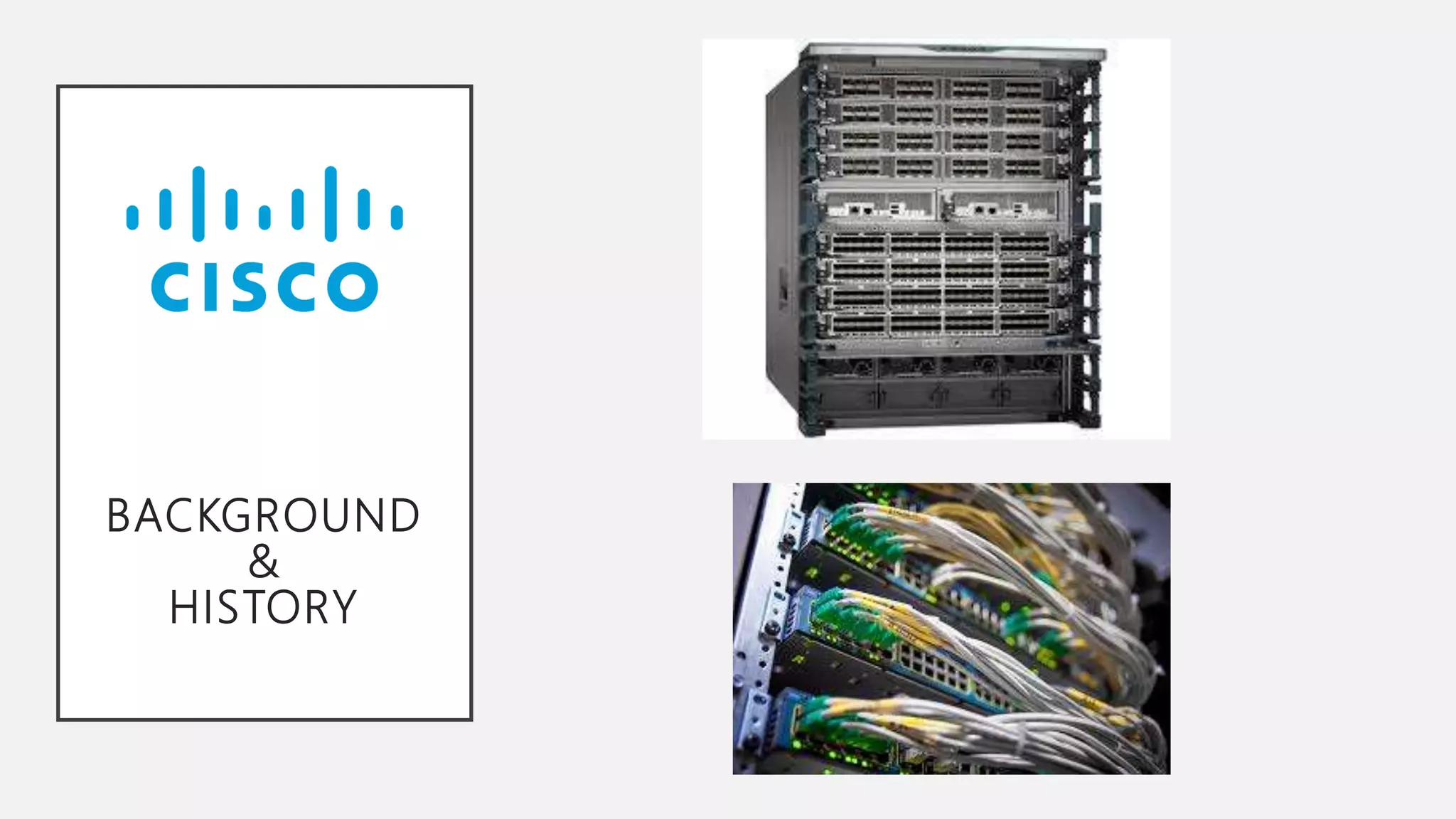
oDevelop, Manufacture and Sell Networking,
hardware and other advanced Telecommunications
products.
o45% of revenue from Switching & Routing;
oGlobal presence in 95 countries. 50% of revenues
from outside North America
8 Major Product Categories
Switching Routing
Collaboration Data Center
Security Wireless
Services Others
BACKGROUND
&
HISTORY
BACKGROUND
&
HISTORY
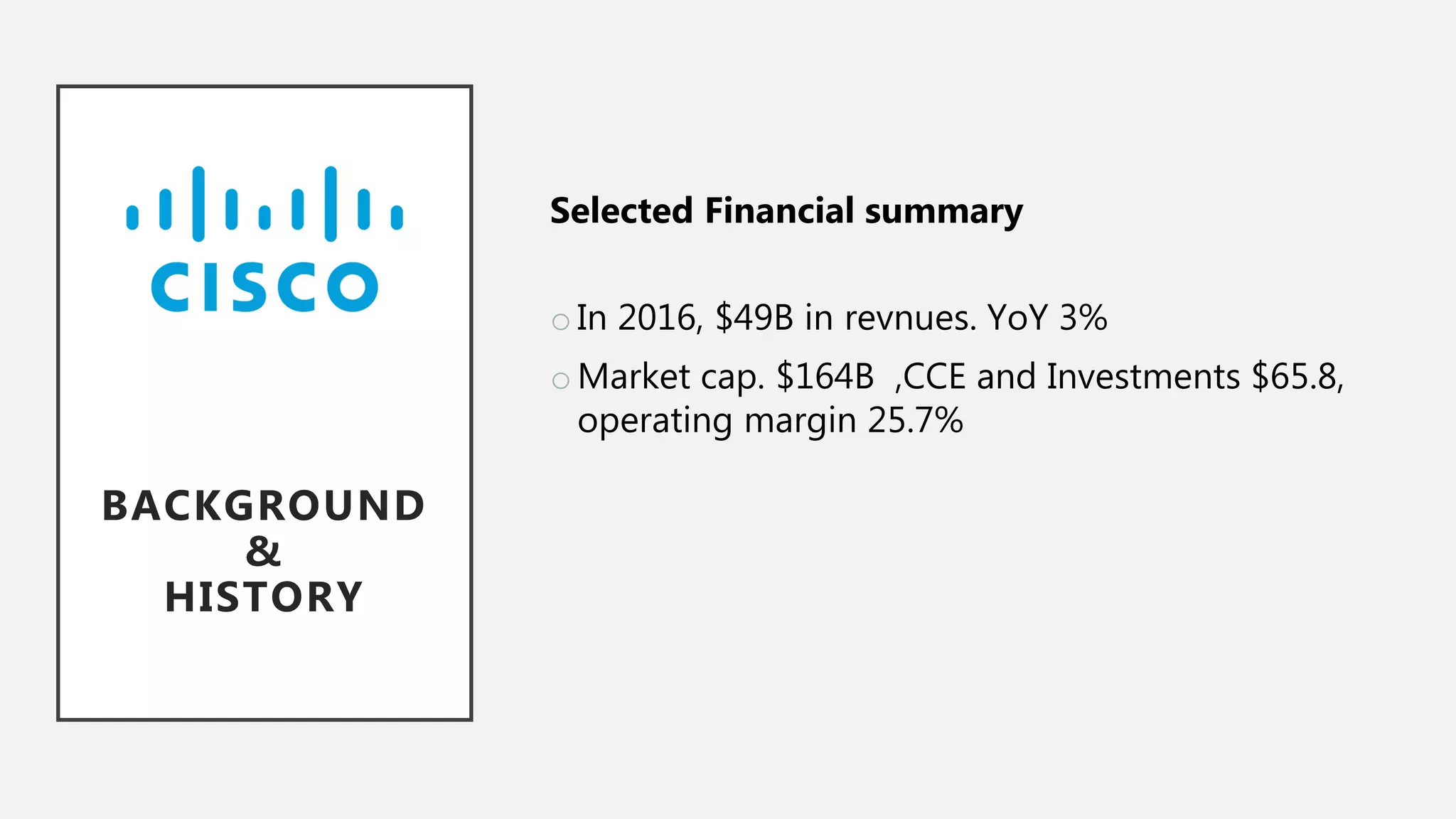
Selected Financial summary
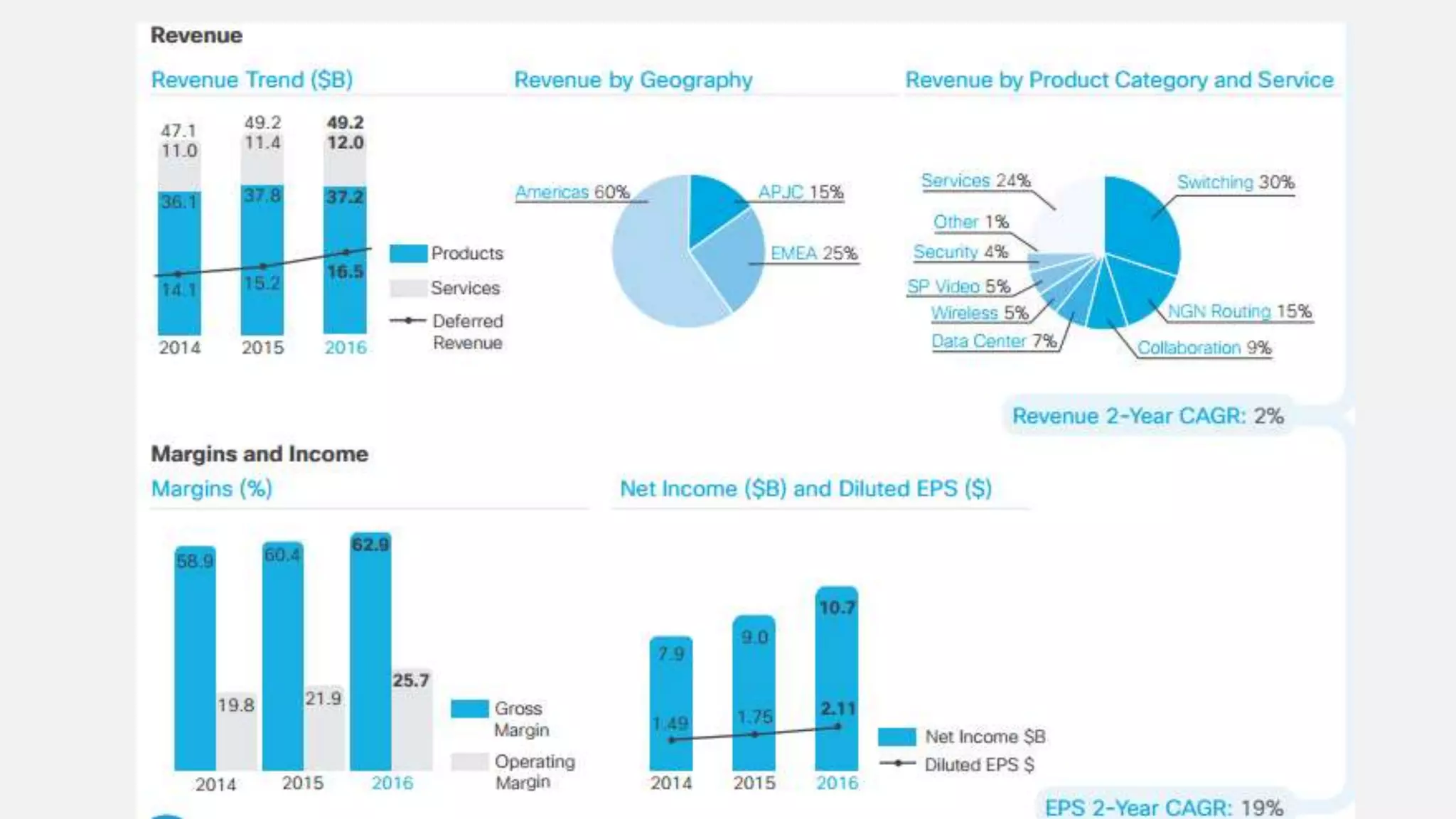
oIn 2016, $49B in revnues. YoY 3%
oMarket cap. $164B ,CCE and Investments $65.8,
operating margin 25.7%
BACKGROUND
&
HISTORY
EXTERNAL ENVIRONMENT
ANALYSIS
EXTERNAL ENVIRONMENT ANALYSIS
GENERAL ENVIRONMENT
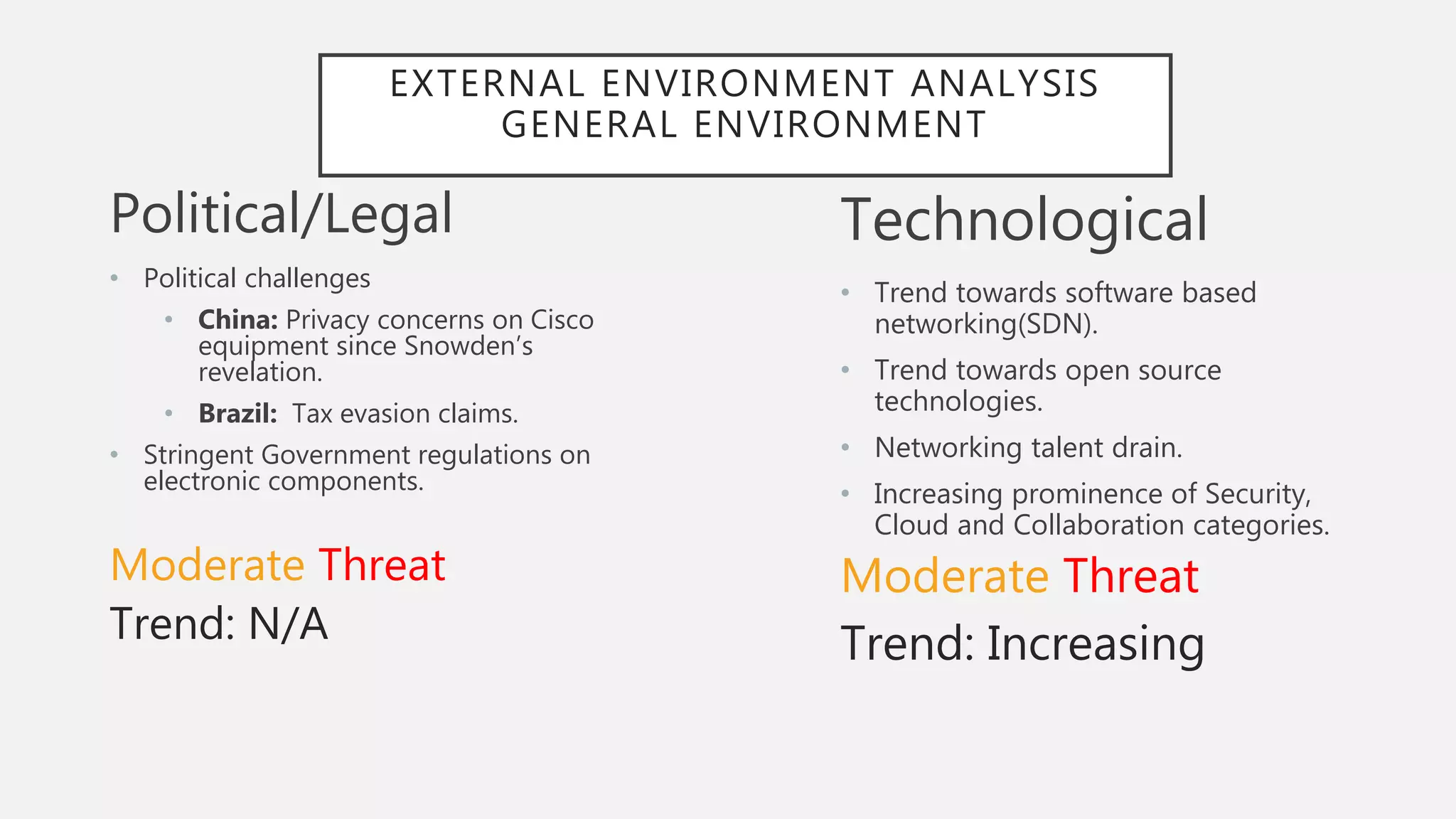
Political/Legal
• Political challenges
• China: Privacy concerns on Cisco
equipment since Snowden’s
revelation.
• Brazil: Tax evasion claims.
• Stringent Government regulations on
electronic components.
Moderate Threat
Trend: N/A
Technological
• Trend towards software based
networking(SDN).
• Trend towards open source
technologies.
• Networking talent drain.
• Increasing prominence of Security,
Cloud and Collaboration categories.
Moderate Threat
Trend: Increasing
EXTERNAL ENVIRONMENT ANALYSIS
GENERAL ENVIRONMENT
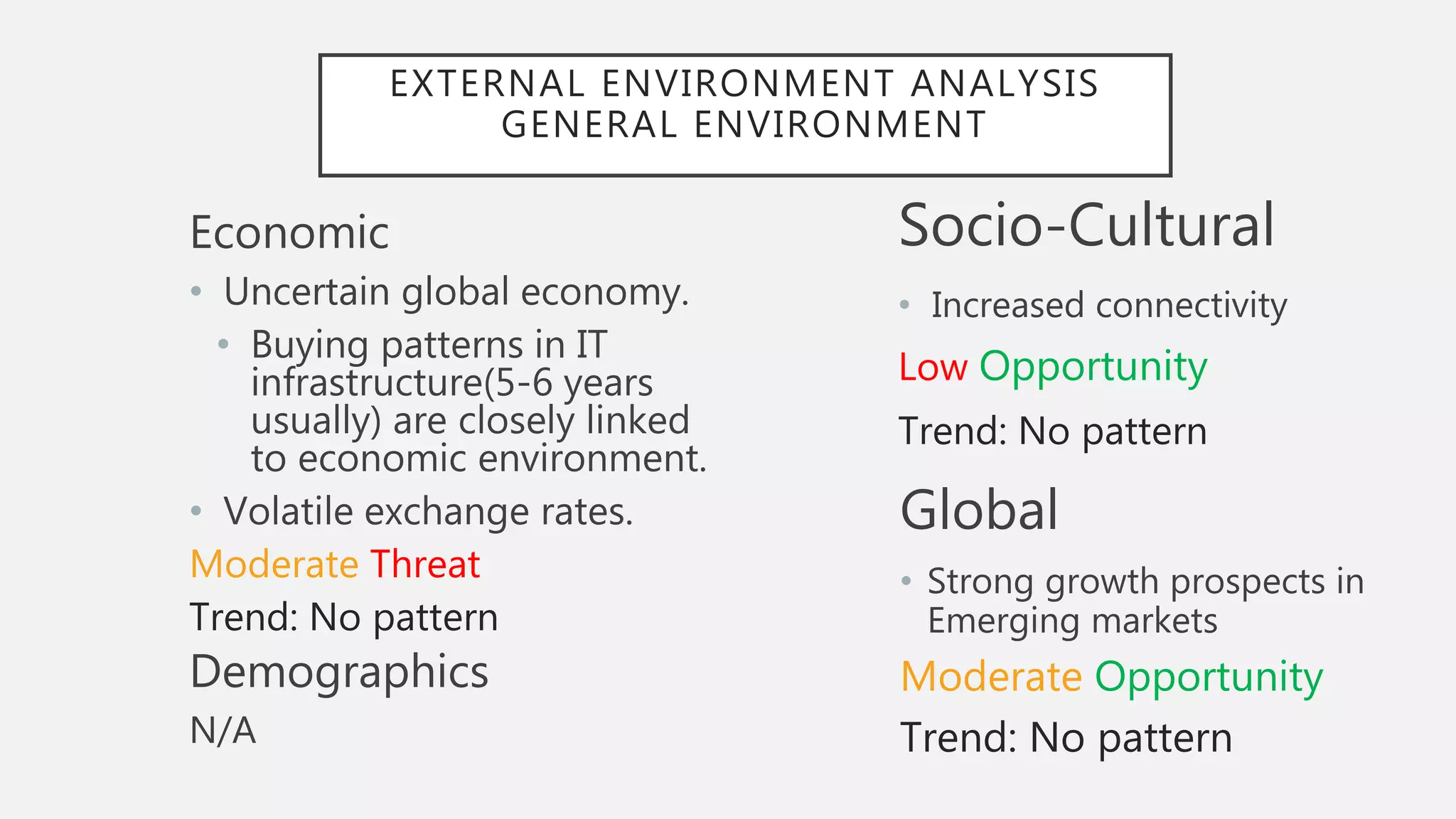
Socio-Cultural
• Increased connectivity
Low Opportunity
Trend: No pattern
Economic
• Uncertain global economy.
• Buying patterns in IT
infrastructure(5-6 years
usually) are closely linked
to economic environment.
• Volatile exchange rates.
Moderate Threat
Trend: No pattern
Demographics
N/A
Global
• Strong growth prospects in
Emerging markets
Moderate Opportunity
Trend: No pattern
EXTERNAL ENVIRONMENT ANALYSIS
INDUSTRY ENVIRONMENT
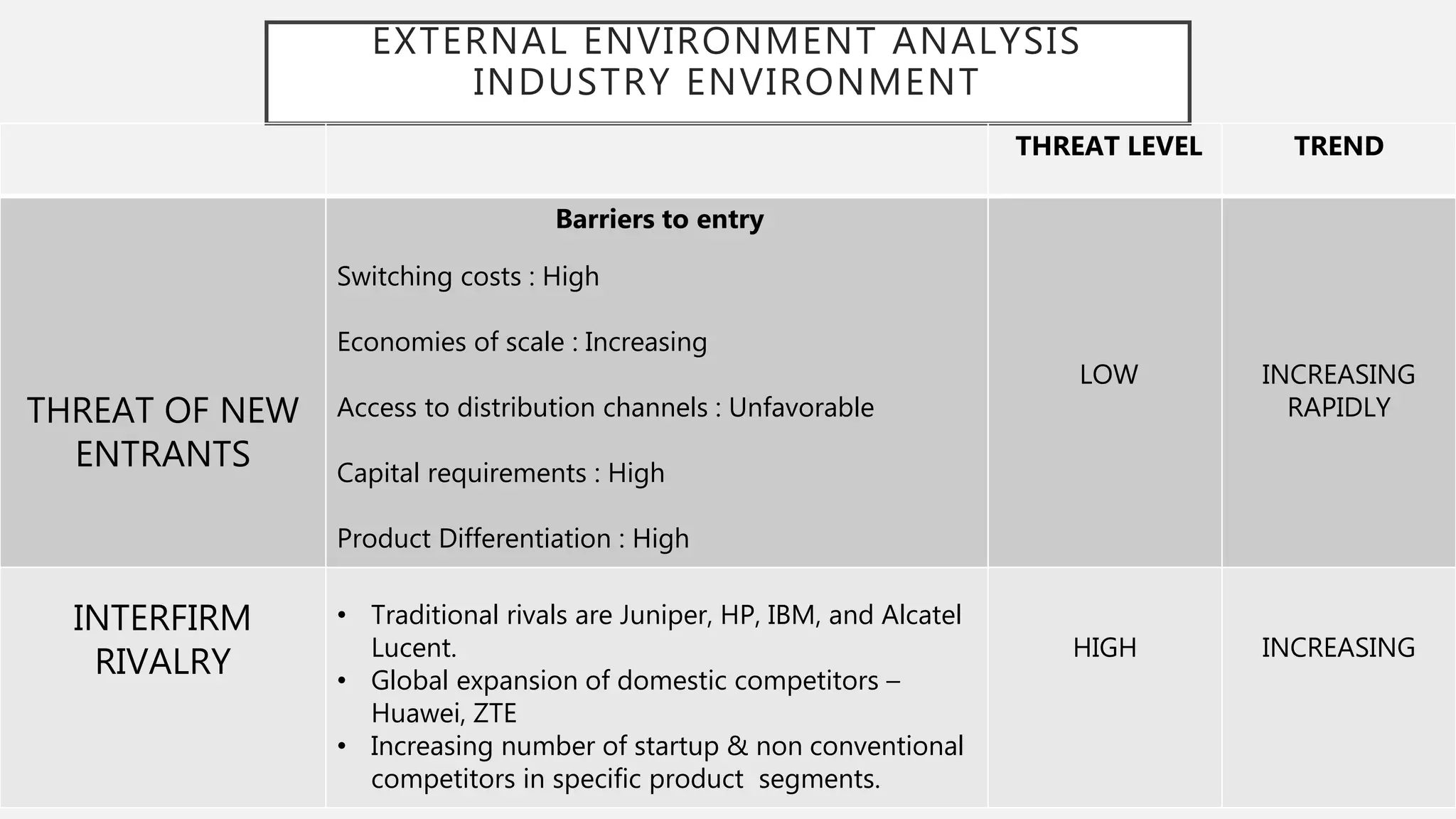
THREAT LEVEL TREND
THREAT OF NEW
ENTRANTS
Barriers to entry
Switching costs : High
Economies of scale : Increasing
Access to distribution channels : Unfavorable
Capital requirements : High
Product Differentiation : High
LOW INCREASING
RAPIDLY
INTERFIRM
RIVALRY
• Traditional rivals are Juniper, HP, IBM, and Alcatel
Lucent.
• Global expansion of domestic competitors –
Huawei, ZTE
• Increasing number of startup & non conventional
competitors in specific product segments.
HIGH INCREASING
THREAT LEVEL TREND
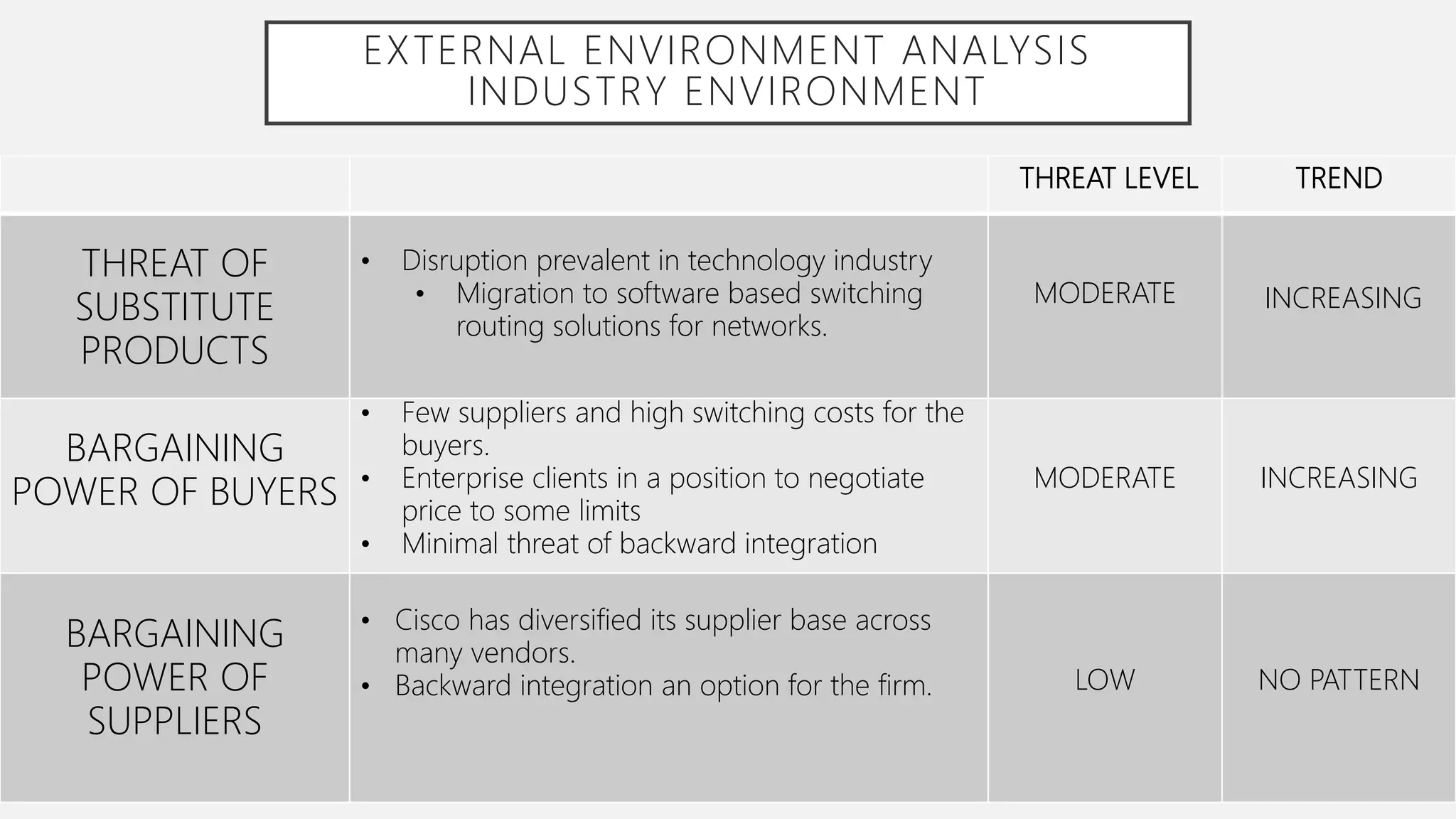
THREAT OF
SUBSTITUTE
PRODUCTS
• Disruption prevalent in technology industry
• Migration to software based switching
routing solutions for networks.
MODERATE INCREASING
BARGAINING
POWER OF BUYERS
• Few suppliers and high switching costs for the
buyers.
• Enterprise clients in a position to negotiate
price to some limits
• Minimal threat of backward integration
MODERATE INCREASING
BARGAINING
POWER OF
SUPPLIERS
• Cisco has diversified its supplier base across
many vendors.
• Backward integration an option for the firm. LOW NO PATTERN
EXTERNAL ENVIRONMENT ANALYSIS
INDUSTRY ENVIRONMENT
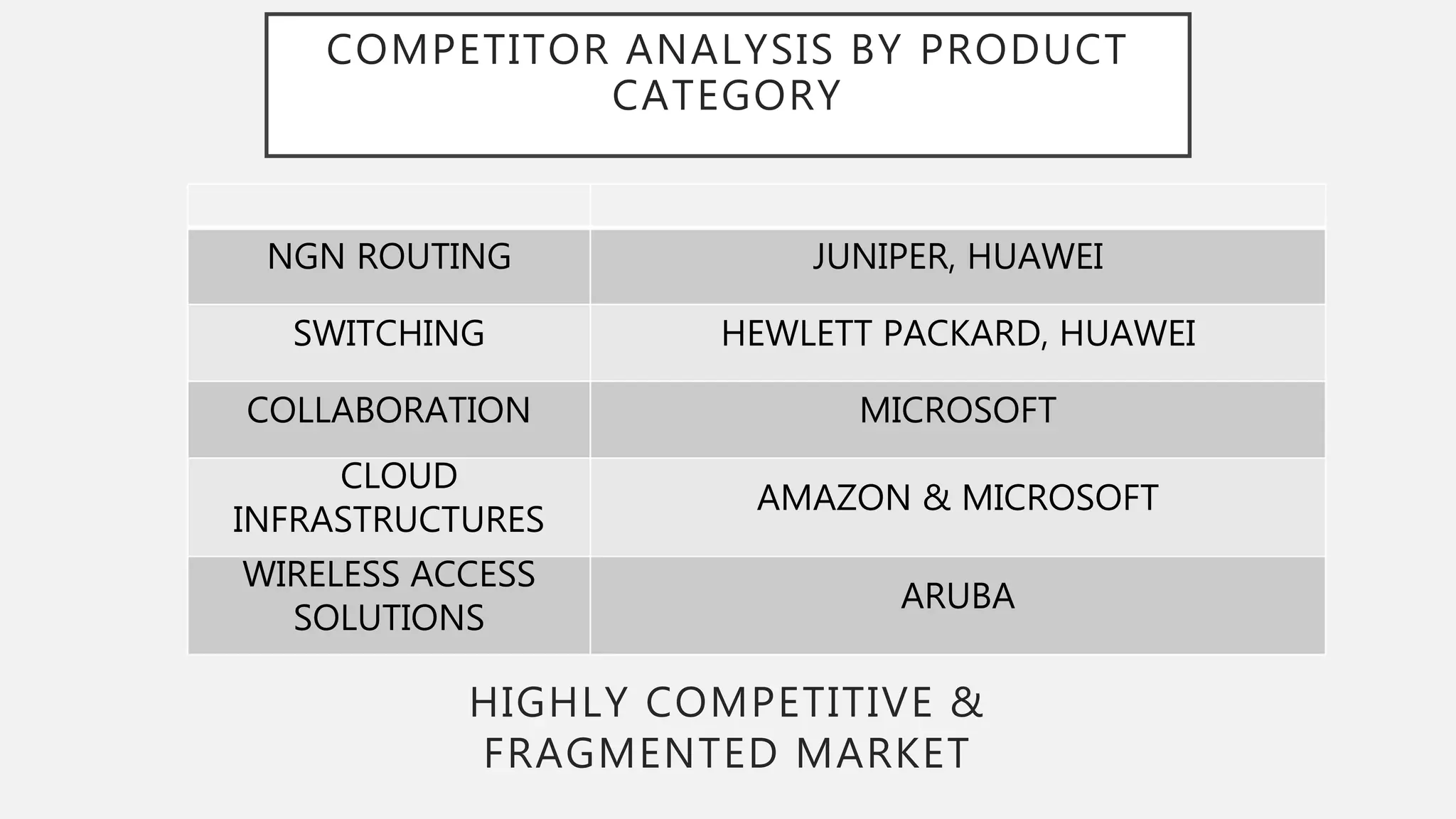
COMPETITOR ANALYSIS BY PRODUCT
CATEGORY
NGN ROUTING JUNIPER, HUAWEI
SWITCHING HEWLETT PACKARD, HUAWEI
COLLABORATION MICROSOFT
CLOUD
INFRASTRUCTURES
AMAZON & MICROSOFT
WIRELESS ACCESS
SOLUTIONS
ARUBA
HIGHLY COMPETITIVE &
FRAGMENTED MARKET
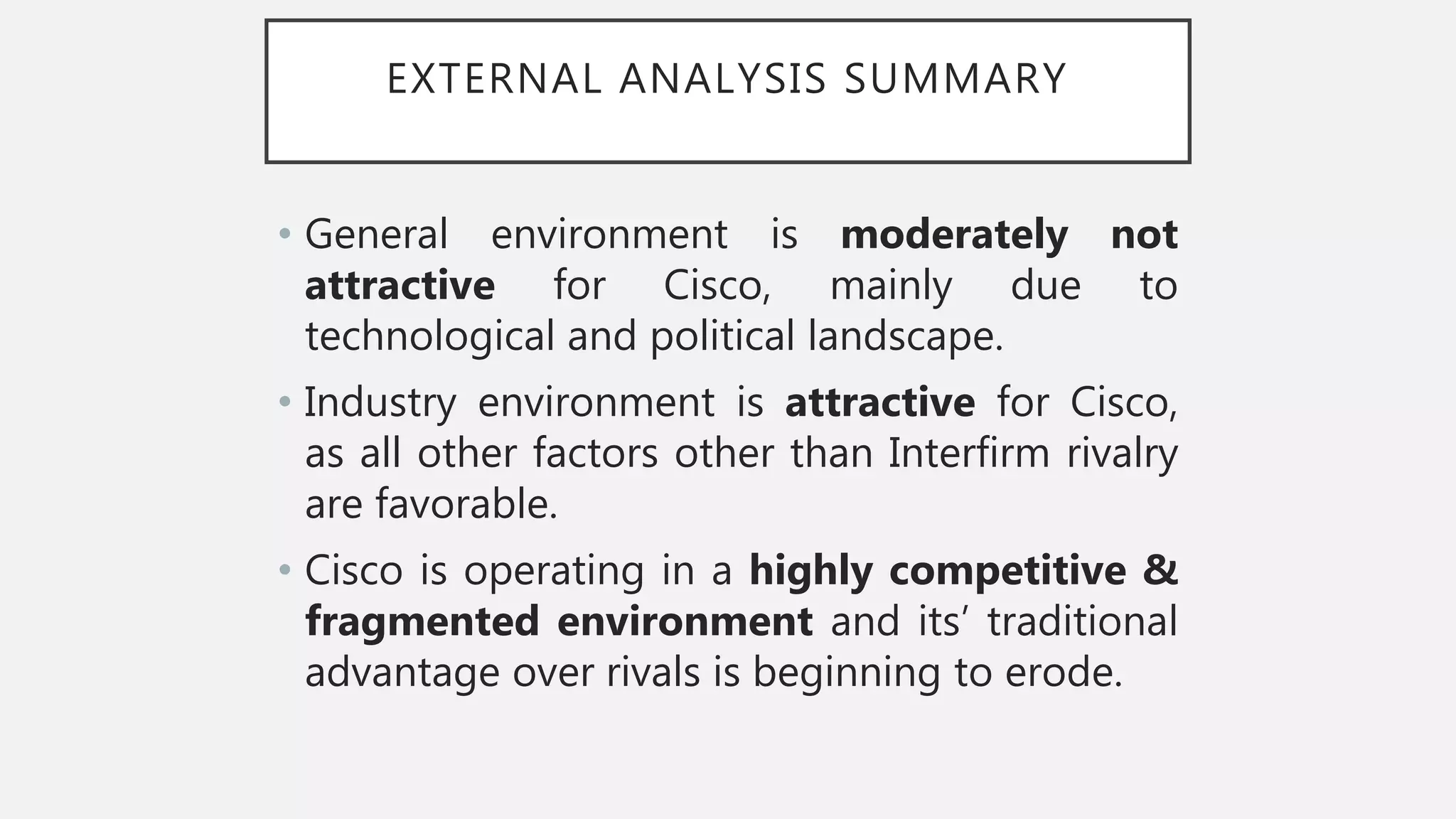
EXTERNAL ANALYSIS SUMMARY
• General environment is moderately not
attractive for Cisco, mainly due to
technological and political landscape.
• Industry environment is attractive for Cisco,
as all other factors other than Interfirm rivalry
are favorable.
• Cisco is operating in a highly competitive &
fragmented environment and its’ traditional
advantage over rivals is beginning to erode.
INTERNAL ENVIRONMENT
ANALYSIS
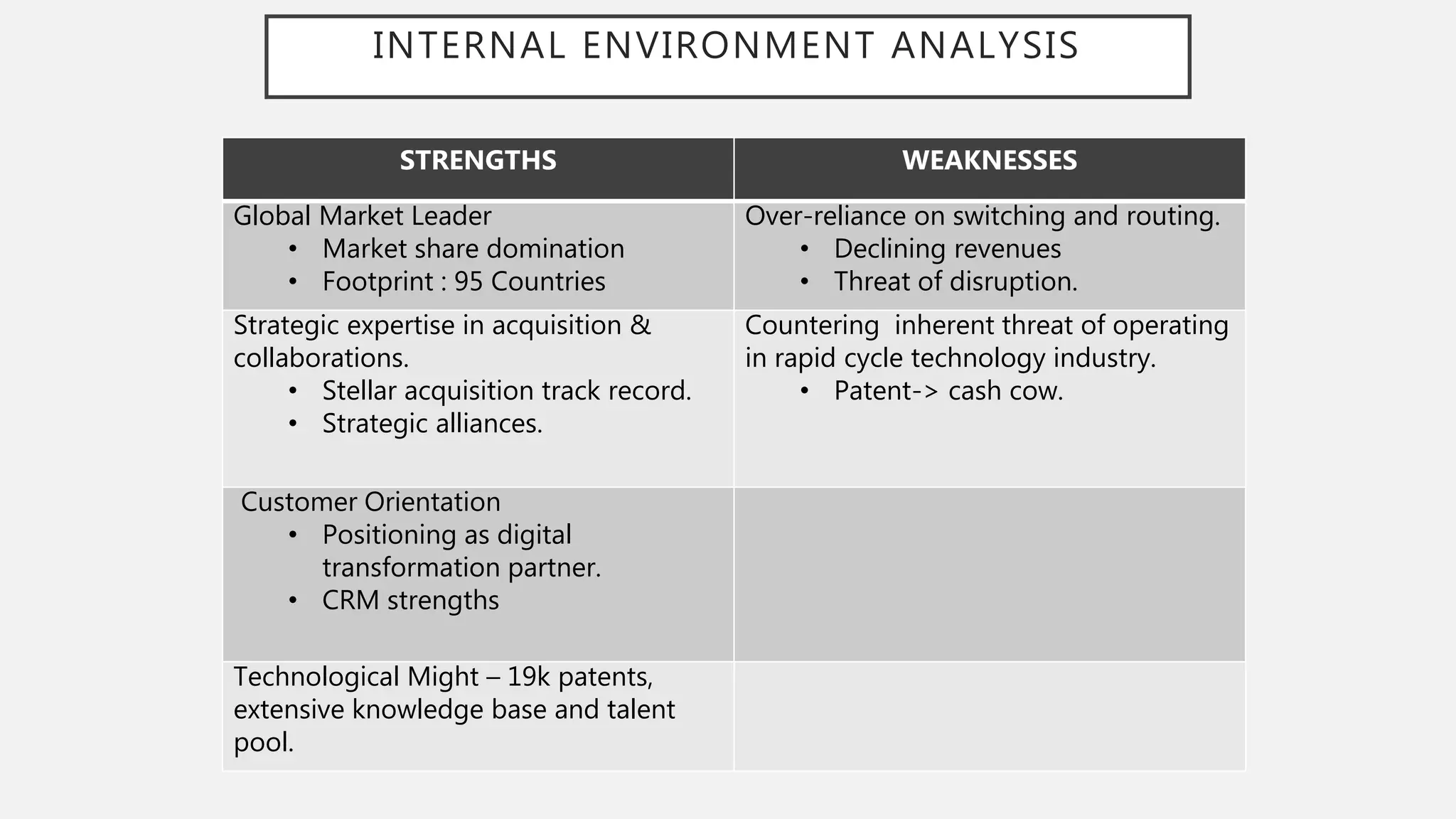
INTERNAL ENVIRONMENT ANALYSIS
STRENGTHS WEAKNESSES
Global Market Leader
• Market share domination
• Footprint : 95 Countries
Over-reliance on switching and routing.
• Declining revenues
• Threat of disruption.
Strategic expertise in acquisition &
collaborations.
• Stellar acquisition track record.
• Strategic alliances.
Countering inherent threat of operating
in rapid cycle technology industry.
• Patent-> cash cow.
Customer Orientation
• Positioning as digital
transformation partner.
• CRM strengths
Technological Might – 19k patents,
extensive knowledge base and talent
pool.
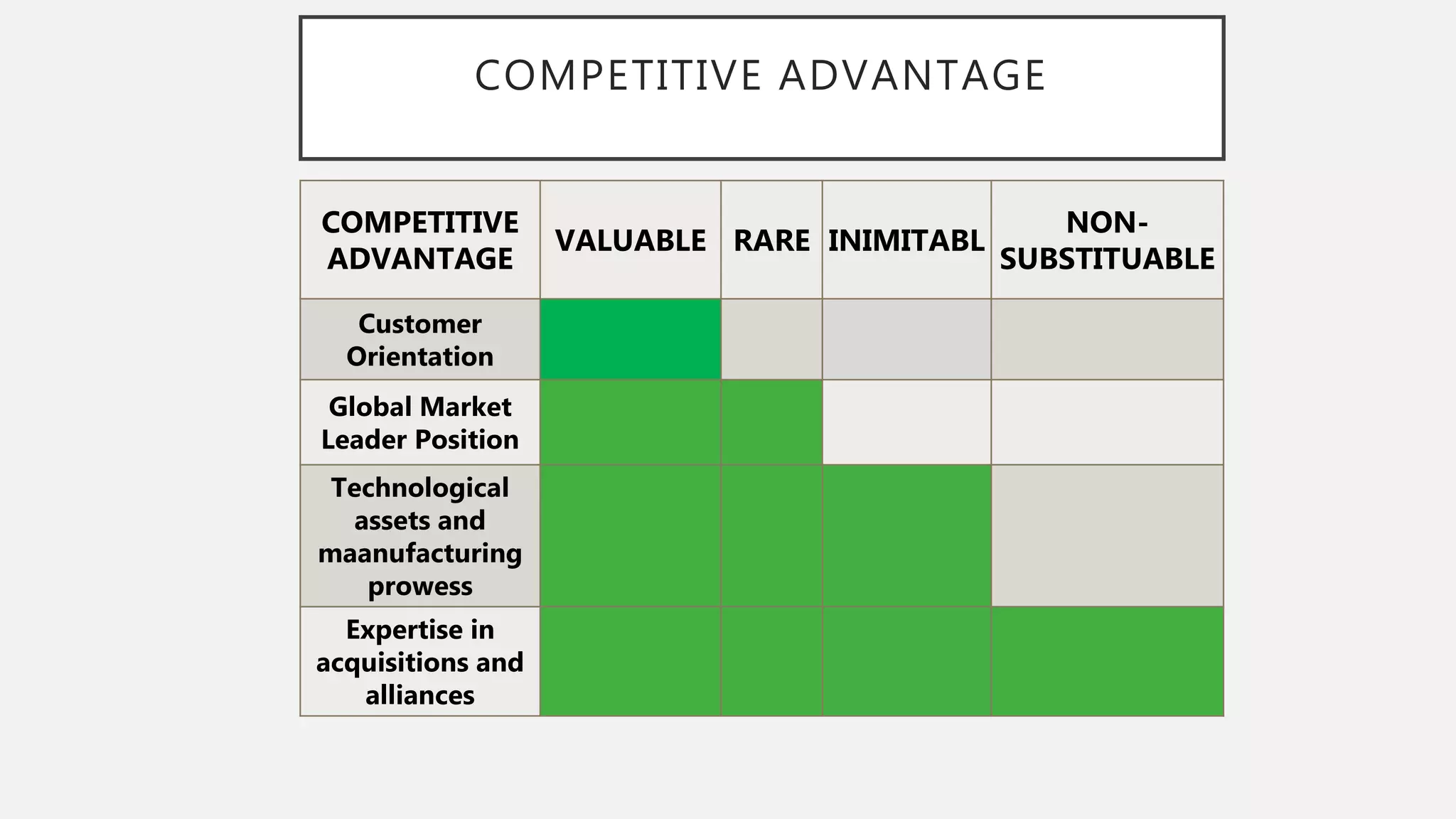
COMPETITIVE ADVANTAGE
COMPETITIVE
ADVANTAGE
VALUABLE RARE INIMITABL
NON-
SUBSTITUABLE
Customer
Orientation
Global Market
Leader Position
Technological
assets and
maanufacturing
prowess
Expertise in
acquisitions and
alliances
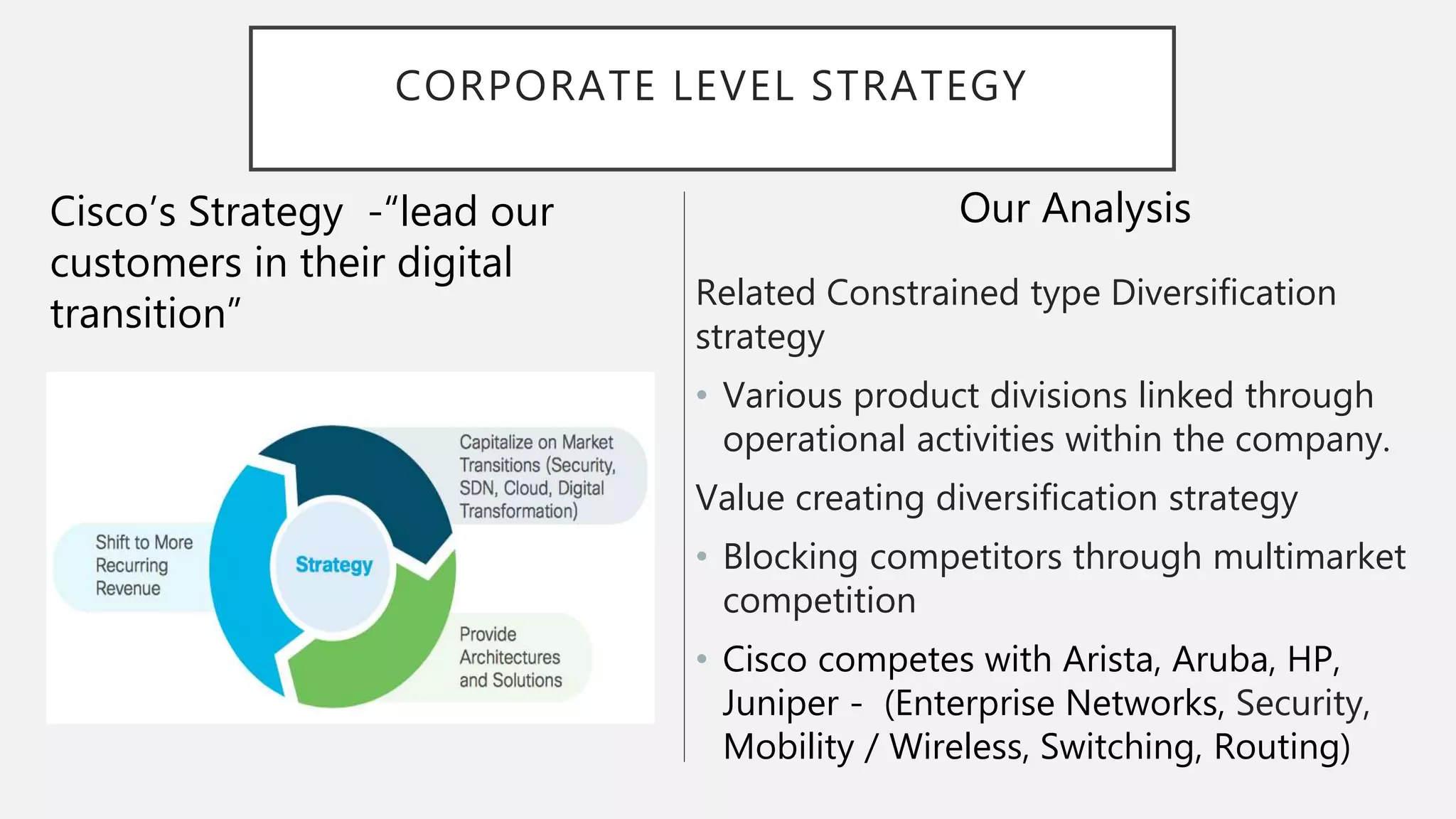
CORPORATE LEVEL STRATEGY
Our Analysis
Related Constrained type Diversification
strategy
• Various product divisions linked through
operational activities within the company.
Value creating diversification strategy
• Blocking competitors through multimarket
competition
• Cisco competes with Arista, Aruba, HP,
Juniper - (Enterprise Networks, Security,
Mobility / Wireless, Switching, Routing)
Cisco’s Strategy -“lead our
customers in their digital
transition”
MERGERS AND
ACQUISITIONS
• 180 acquisitions in its 30 year
history.
• Cisco Acquisition guideline: small
companies, fast growing, focused,
entrepreneurial, in geographical
proximity and culturally similar.
• A 50 strong Strategy Team directs
& executes the seamless
integration in few days
• Diversification and horizontal
acquisitions
MERGERS AND
ACQUISITIONS
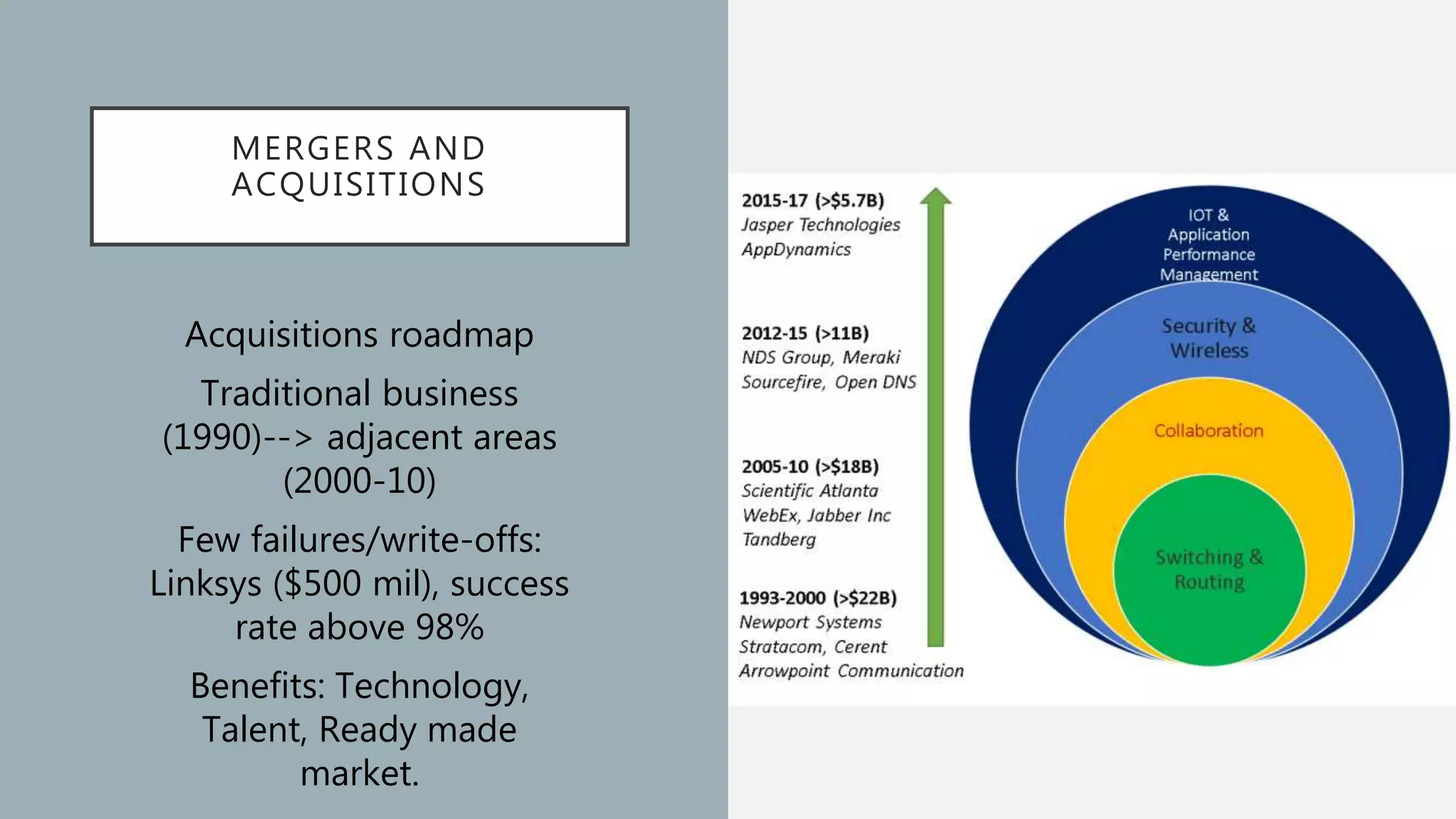
Acquisitions roadmap
Traditional business
(1990)--> adjacent areas
(2000-10)
Few failures/write-offs:
Linksys ($500 mil), success
rate above 98%
Benefits: Technology,
Talent, Ready made
market.
ADVANTAGES
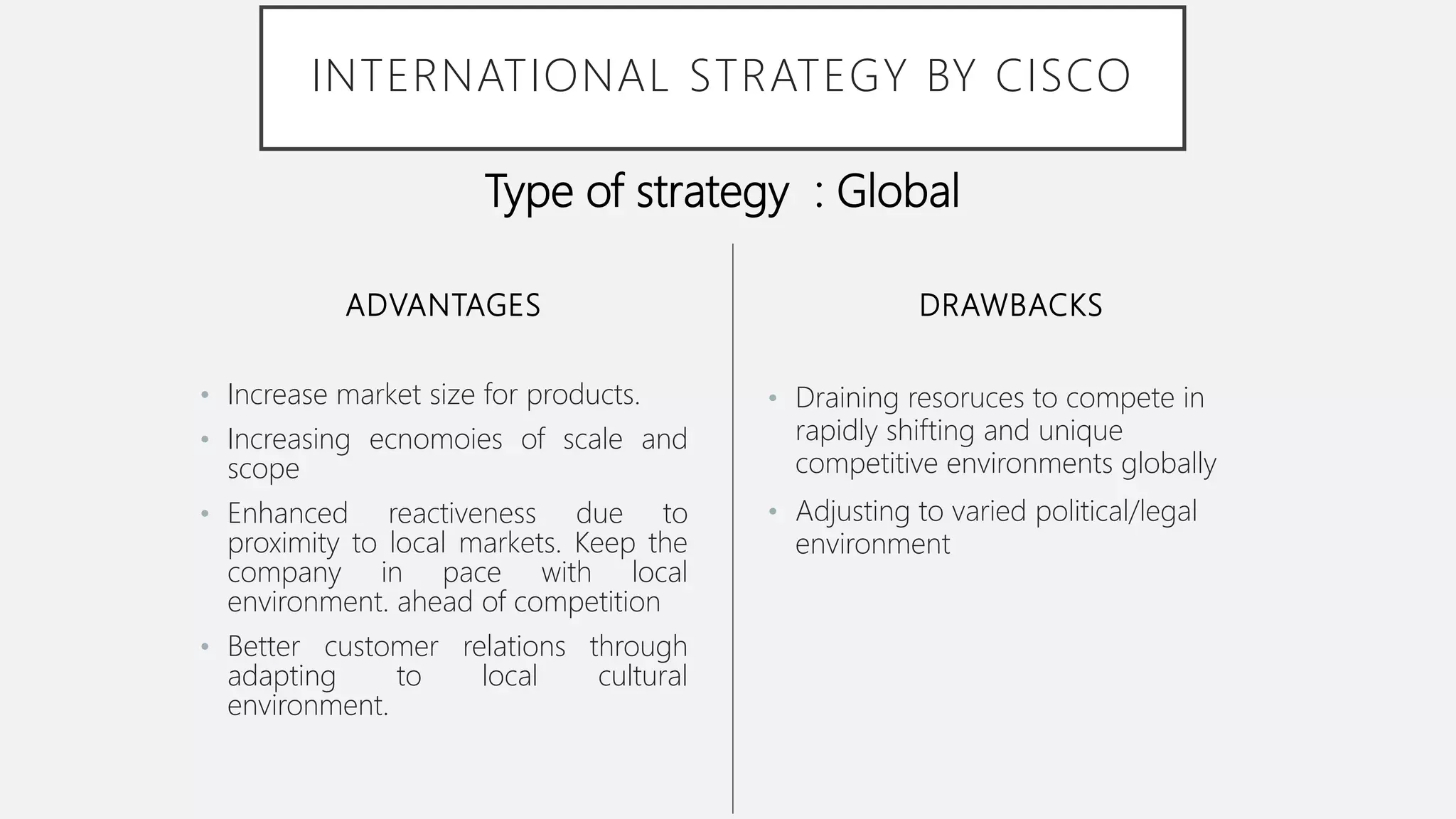
• Increase market size for products.
• Increasing ecnomoies of scale and
scope
• Enhanced reactiveness due to
proximity to local markets. Keep the
company in pace with local
environment. ahead of competition
• Better customer relations through
adapting to local cultural
environment.
• Draining resoruces to compete in
rapidly shifting and unique
competitive environments globally
• Adjusting to varied political/legal
environment
DRAWBACKS
INTERNATIONAL STRATEGY BY CISCO
Type of strategy : Global
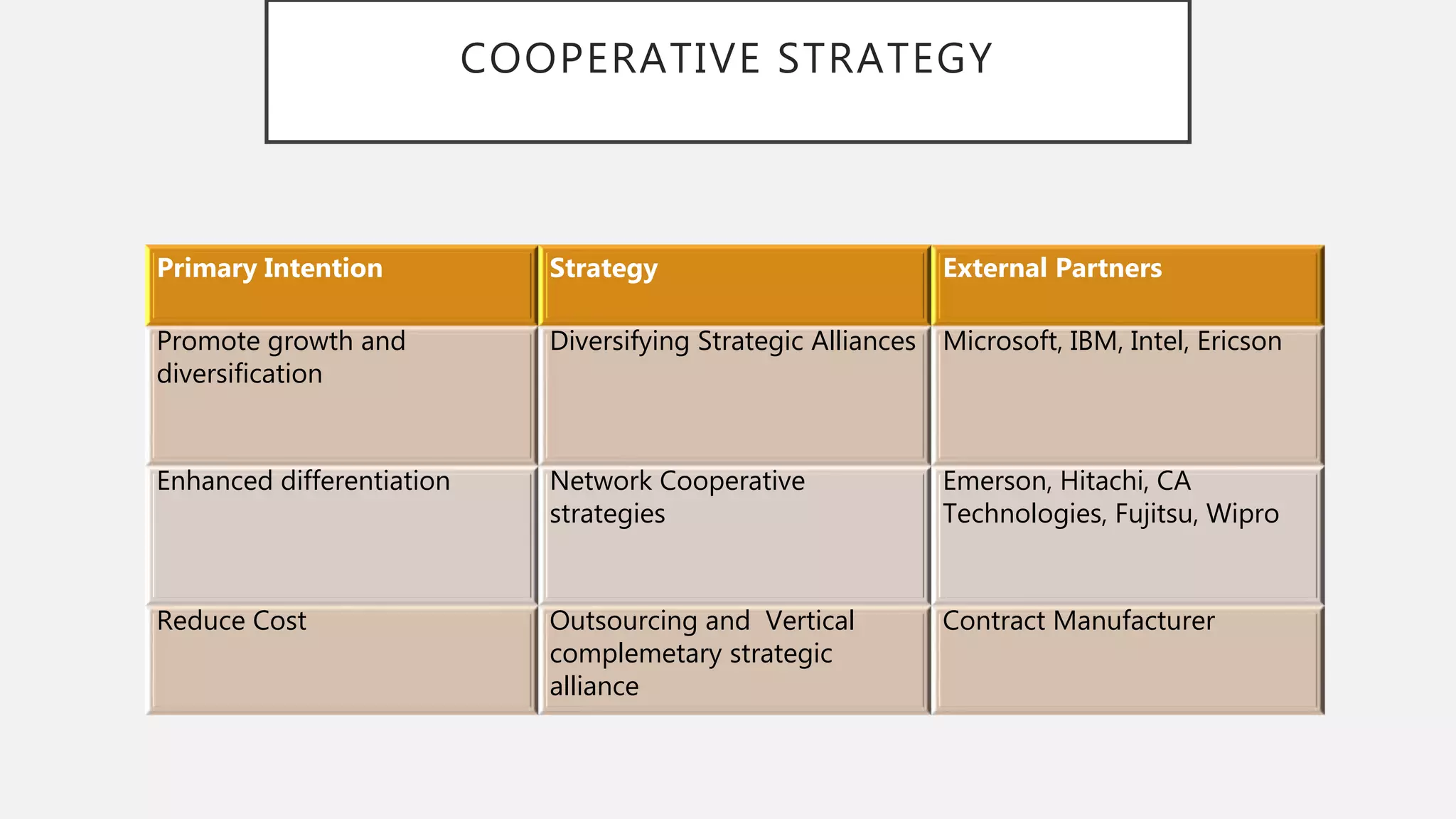
COOPERATIVE STRATEGY
Primary Intention Strategy External Partners
Promote growth and
diversification
Diversifying Strategic Alliances Microsoft, IBM, Intel, Ericson
Enhanced differentiation Network Cooperative
strategies
Emerson, Hitachi, CA
Technologies, Fujitsu, Wipro
Reduce Cost Outsourcing and Vertical
complemetary strategic
alliance
Contract Manufacturer
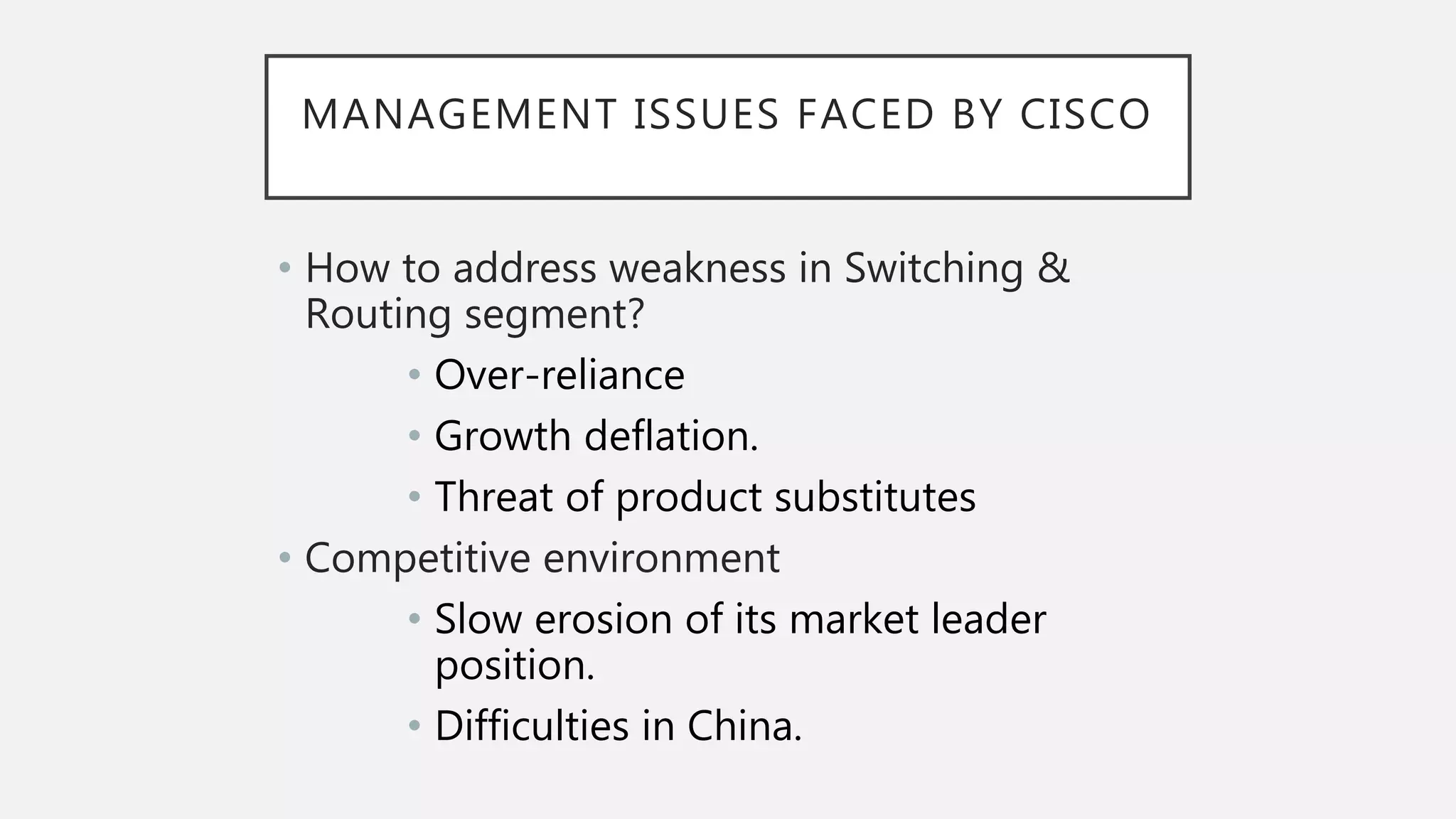
MANAGEMENT ISSUES FACED BY CISCO
• How to address weakness in Switching &
Routing segment?
• Over-reliance
• Growth deflation.
• Threat of product substitutes
• Competitive environment
• Slow erosion of its market leader
position.
• Difficulties in China.
QUESTIONS??
THANK YOU
APPENDIX
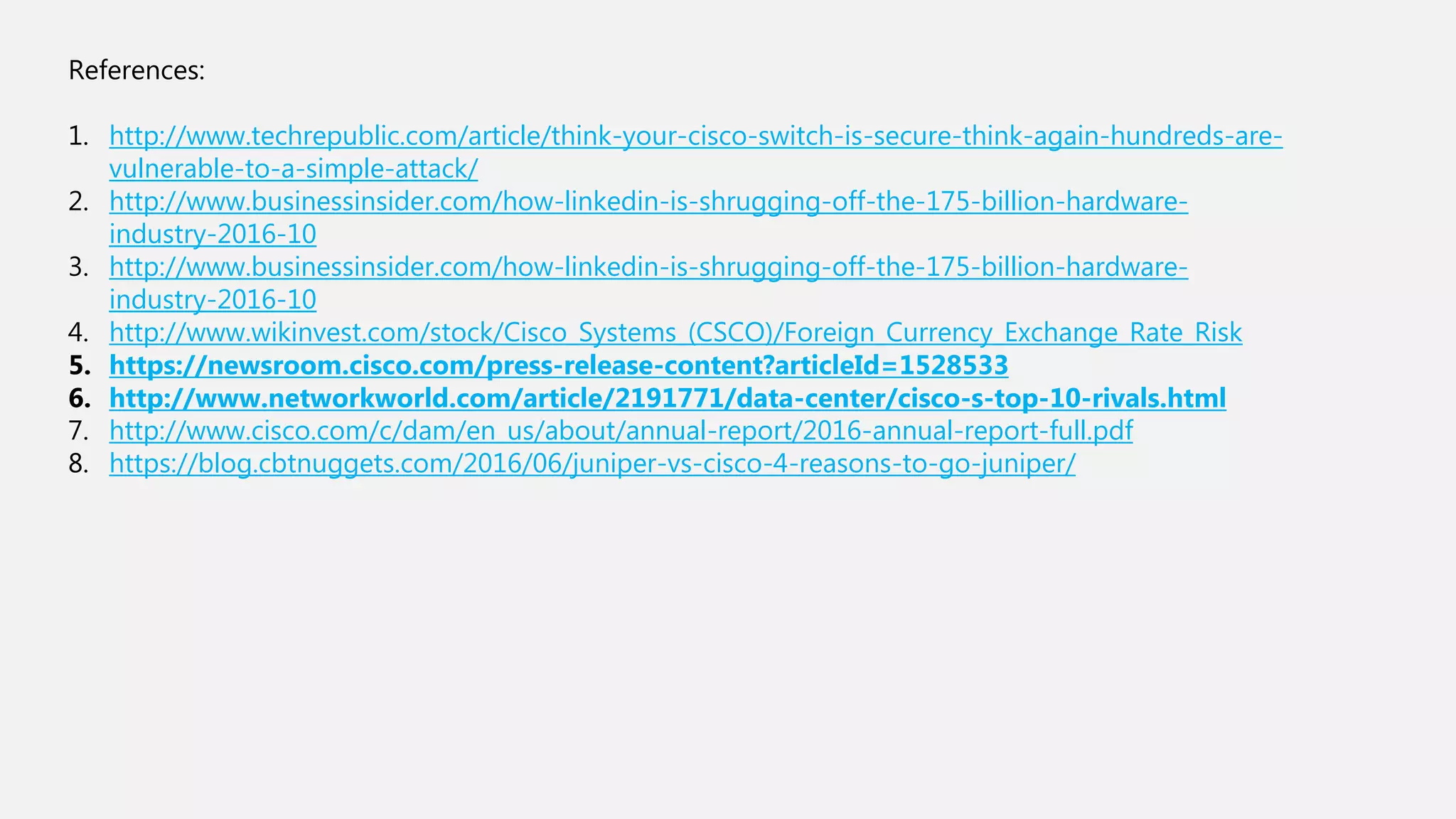
References:
1. http://www.techrepublic.com/article/think-your-cisco-switch-is-secure-think-again-hundreds-are-
vulnerable-to-a-simple-attack/
2. http://www.businessinsider.com/how-linkedin-is-shrugging-off-the-175-billion-hardware-
industry-2016-10
3. http://www.businessinsider.com/how-linkedin-is-shrugging-off-the-175-billion-hardware-
industry-2016-10
4. http://www.wikinvest.com/stock/Cisco_Systems_(CSCO)/Foreign_Currency_Exchange_Rate_Risk
5. https://newsroom.cisco.com/press-release-content?articleId=1528533
6. http://www.networkworld.com/article/2191771/data-center/cisco-s-top-10-rivals.html
7. http://www.cisco.com/c/dam/en_us/about/annual-report/2016-annual-report-full.pdf
8. https://blog.cbtnuggets.com/2016/06/juniper-vs-cisco-4-reasons-to-go-juniper/
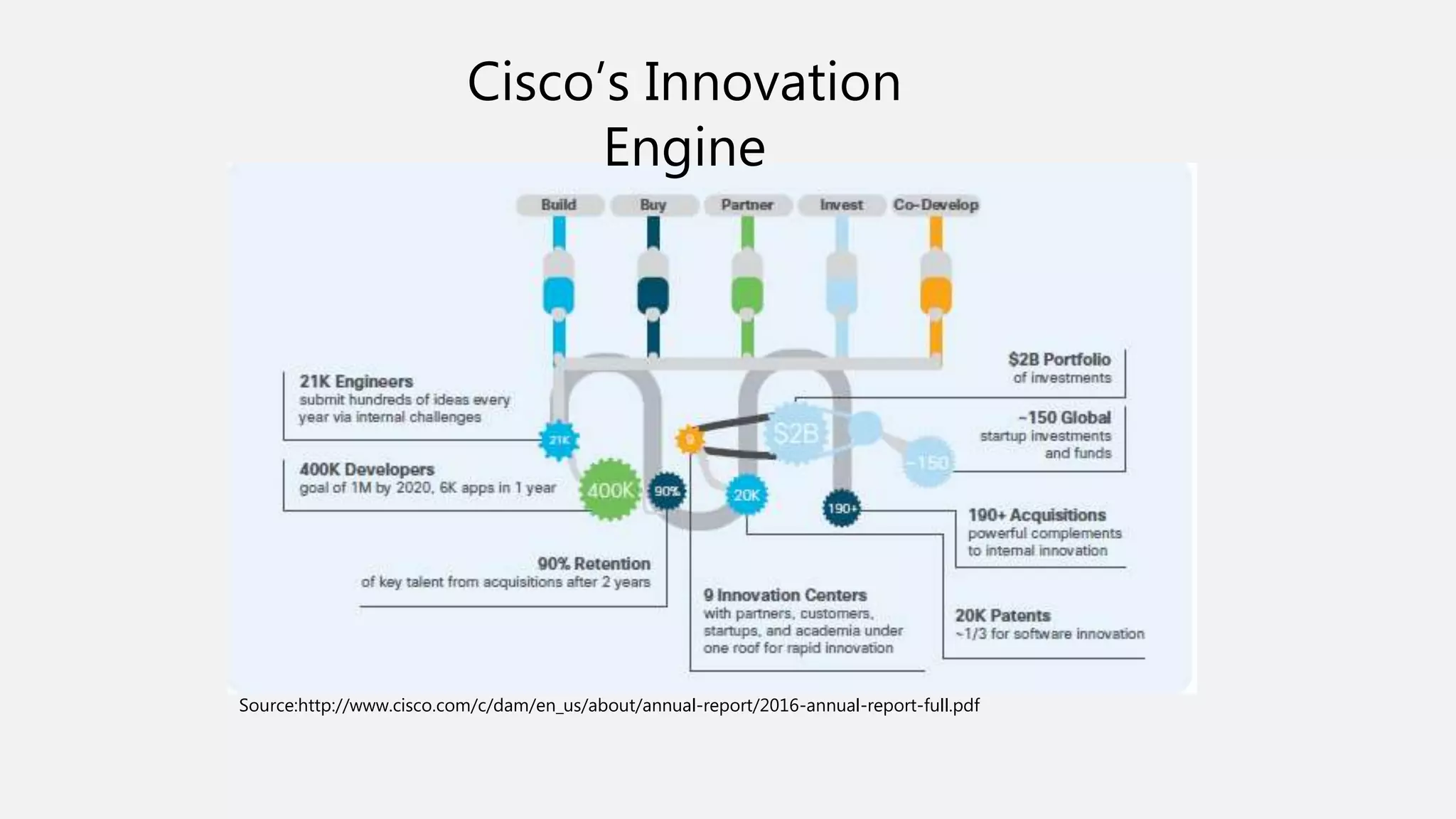
Cisco’s Innovation
Engine
Source:http://www.cisco.com/c/dam/en_us/about/annual-report/2016-annual-report-full.pdf
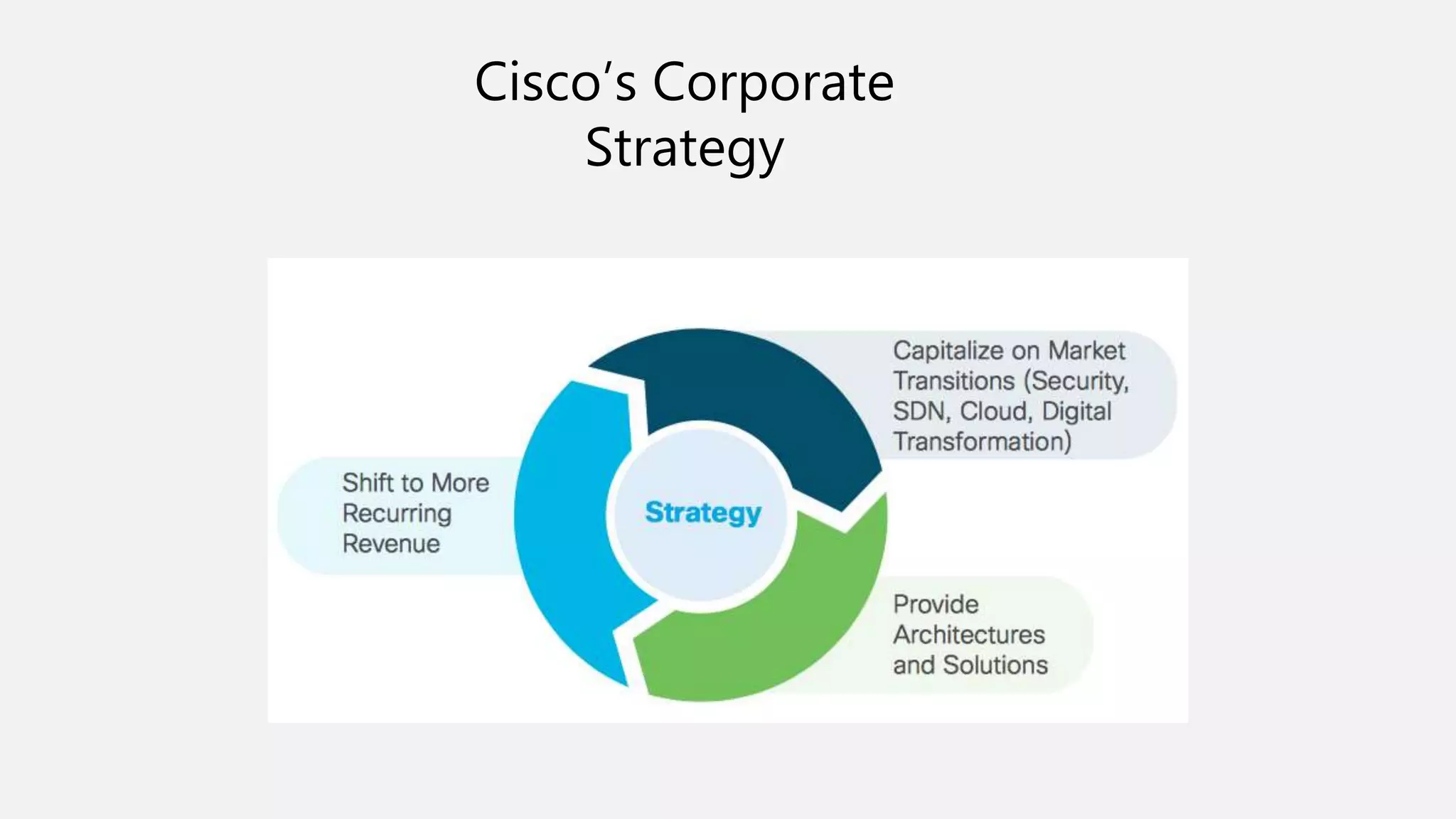
Cisco’s Corporate
Strategy
Cisco Strategy Analysis

Cisco Strategy Analysis

  • 1.
    STRATEGY ANALYSIS Aditya J ChidambaramN Haneef M Lucille D Siddhartha S
  • 2.
    BACKGROUND & HISTORY oDevelop, Manufacture andSell Networking, hardware and other advanced Telecommunications products. o45% of revenue from Switching & Routing; oGlobal presence in 95 countries. 50% of revenues from outside North America 8 Major Product Categories Switching Routing Collaboration Data Center Security Wireless Services Others
  • 3.
  • 4.
  • 5.
    Selected Financial summary oIn2016, $49B in revnues. YoY 3% oMarket cap. $164B ,CCE and Investments $65.8, operating margin 25.7% BACKGROUND & HISTORY
  • 6.
  • 7.
    EXTERNAL ENVIRONMENT ANALYSIS GENERALENVIRONMENT Political/Legal • Political challenges • China: Privacy concerns on Cisco equipment since Snowden’s revelation. • Brazil: Tax evasion claims. • Stringent Government regulations on electronic components. Moderate Threat Trend: N/A Technological • Trend towards software based networking(SDN). • Trend towards open source technologies. • Networking talent drain. • Increasing prominence of Security, Cloud and Collaboration categories. Moderate Threat Trend: Increasing
  • 8.
    EXTERNAL ENVIRONMENT ANALYSIS GENERALENVIRONMENT Socio-Cultural • Increased connectivity Low Opportunity Trend: No pattern Economic • Uncertain global economy. • Buying patterns in IT infrastructure(5-6 years usually) are closely linked to economic environment. • Volatile exchange rates. Moderate Threat Trend: No pattern Demographics N/A Global • Strong growth prospects in Emerging markets Moderate Opportunity Trend: No pattern
  • 9.
    EXTERNAL ENVIRONMENT ANALYSIS INDUSTRYENVIRONMENT THREAT LEVEL TREND THREAT OF NEW ENTRANTS Barriers to entry Switching costs : High Economies of scale : Increasing Access to distribution channels : Unfavorable Capital requirements : High Product Differentiation : High LOW INCREASING RAPIDLY INTERFIRM RIVALRY • Traditional rivals are Juniper, HP, IBM, and Alcatel Lucent. • Global expansion of domestic competitors – Huawei, ZTE • Increasing number of startup & non conventional competitors in specific product segments. HIGH INCREASING
  • 10.
    THREAT LEVEL TREND THREATOF SUBSTITUTE PRODUCTS • Disruption prevalent in technology industry • Migration to software based switching routing solutions for networks. MODERATE INCREASING BARGAINING POWER OF BUYERS • Few suppliers and high switching costs for the buyers. • Enterprise clients in a position to negotiate price to some limits • Minimal threat of backward integration MODERATE INCREASING BARGAINING POWER OF SUPPLIERS • Cisco has diversified its supplier base across many vendors. • Backward integration an option for the firm. LOW NO PATTERN EXTERNAL ENVIRONMENT ANALYSIS INDUSTRY ENVIRONMENT
  • 11.
    COMPETITOR ANALYSIS BYPRODUCT CATEGORY NGN ROUTING JUNIPER, HUAWEI SWITCHING HEWLETT PACKARD, HUAWEI COLLABORATION MICROSOFT CLOUD INFRASTRUCTURES AMAZON & MICROSOFT WIRELESS ACCESS SOLUTIONS ARUBA HIGHLY COMPETITIVE & FRAGMENTED MARKET
  • 12.
    EXTERNAL ANALYSIS SUMMARY •General environment is moderately not attractive for Cisco, mainly due to technological and political landscape. • Industry environment is attractive for Cisco, as all other factors other than Interfirm rivalry are favorable. • Cisco is operating in a highly competitive & fragmented environment and its’ traditional advantage over rivals is beginning to erode.
  • 13.
  • 14.
    INTERNAL ENVIRONMENT ANALYSIS STRENGTHSWEAKNESSES Global Market Leader • Market share domination • Footprint : 95 Countries Over-reliance on switching and routing. • Declining revenues • Threat of disruption. Strategic expertise in acquisition & collaborations. • Stellar acquisition track record. • Strategic alliances. Countering inherent threat of operating in rapid cycle technology industry. • Patent-> cash cow. Customer Orientation • Positioning as digital transformation partner. • CRM strengths Technological Might – 19k patents, extensive knowledge base and talent pool.
  • 15.
    COMPETITIVE ADVANTAGE COMPETITIVE ADVANTAGE VALUABLE RAREINIMITABL NON- SUBSTITUABLE Customer Orientation Global Market Leader Position Technological assets and maanufacturing prowess Expertise in acquisitions and alliances
  • 16.
    CORPORATE LEVEL STRATEGY OurAnalysis Related Constrained type Diversification strategy • Various product divisions linked through operational activities within the company. Value creating diversification strategy • Blocking competitors through multimarket competition • Cisco competes with Arista, Aruba, HP, Juniper - (Enterprise Networks, Security, Mobility / Wireless, Switching, Routing) Cisco’s Strategy -“lead our customers in their digital transition”
  • 17.
    MERGERS AND ACQUISITIONS • 180acquisitions in its 30 year history. • Cisco Acquisition guideline: small companies, fast growing, focused, entrepreneurial, in geographical proximity and culturally similar. • A 50 strong Strategy Team directs & executes the seamless integration in few days • Diversification and horizontal acquisitions
  • 18.
    MERGERS AND ACQUISITIONS Acquisitions roadmap Traditionalbusiness (1990)--> adjacent areas (2000-10) Few failures/write-offs: Linksys ($500 mil), success rate above 98% Benefits: Technology, Talent, Ready made market.
  • 19.
    ADVANTAGES • Increase marketsize for products. • Increasing ecnomoies of scale and scope • Enhanced reactiveness due to proximity to local markets. Keep the company in pace with local environment. ahead of competition • Better customer relations through adapting to local cultural environment. • Draining resoruces to compete in rapidly shifting and unique competitive environments globally • Adjusting to varied political/legal environment DRAWBACKS INTERNATIONAL STRATEGY BY CISCO Type of strategy : Global
  • 20.
    COOPERATIVE STRATEGY Primary IntentionStrategy External Partners Promote growth and diversification Diversifying Strategic Alliances Microsoft, IBM, Intel, Ericson Enhanced differentiation Network Cooperative strategies Emerson, Hitachi, CA Technologies, Fujitsu, Wipro Reduce Cost Outsourcing and Vertical complemetary strategic alliance Contract Manufacturer
  • 21.
    MANAGEMENT ISSUES FACEDBY CISCO • How to address weakness in Switching & Routing segment? • Over-reliance • Growth deflation. • Threat of product substitutes • Competitive environment • Slow erosion of its market leader position. • Difficulties in China.
  • 22.
  • 23.
  • 24.
    References: 1. http://www.techrepublic.com/article/think-your-cisco-switch-is-secure-think-again-hundreds-are- vulnerable-to-a-simple-attack/ 2. http://www.businessinsider.com/how-linkedin-is-shrugging-off-the-175-billion-hardware- industry-2016-10 3.http://www.businessinsider.com/how-linkedin-is-shrugging-off-the-175-billion-hardware- industry-2016-10 4. http://www.wikinvest.com/stock/Cisco_Systems_(CSCO)/Foreign_Currency_Exchange_Rate_Risk 5. https://newsroom.cisco.com/press-release-content?articleId=1528533 6. http://www.networkworld.com/article/2191771/data-center/cisco-s-top-10-rivals.html 7. http://www.cisco.com/c/dam/en_us/about/annual-report/2016-annual-report-full.pdf 8. https://blog.cbtnuggets.com/2016/06/juniper-vs-cisco-4-reasons-to-go-juniper/
  • 26.
  • 27.

Editor's Notes

  • #3 Notes: (Cisco Systems, Inc. (known as Cisco) is an American multinational technology conglomerate headquartered in San José, California, in the center of Silicon Valley, that develops, manufactures, and sells networking hardware, telecommunications equipment, and other high-technology services and products. Through its numerous acquired subsidiaries, such as OpenDNS, WebEx, and Jasper, Cisco specializes into specific tech markets, such as Internet of Things, domain security, and energy management. Cisco is the largest networking company in the world. Cisco’s culture and values are to - change the world, - focus intensively on customers, Make innovation happen win together, respect and care for each other - Always do the right thing The stock was added to the Dow Jones Industrial Average on June 8, 2009, and is also included in the S&P 500 Index, the Russell 1000 Index, NASDAQ-100 Index and the Russell 1000 Growth Stock Index.Cisco Systems was founded in December 1984 by Leonard Bosack and Sandy Lerner, two Stanford University computer scientists, who pioneered the concept of a local area network (LAN) being used to connect geographically disparate computers over a multiprotocol router system, which was unheard of technology at the time. By the time the company went public in 1990, when it was listed on the NASDAQ, Cisco had a market capitalization of $224 million. Cisco was the most valuable company in the world by 2000, with a more than $500 billion market capitalization.)
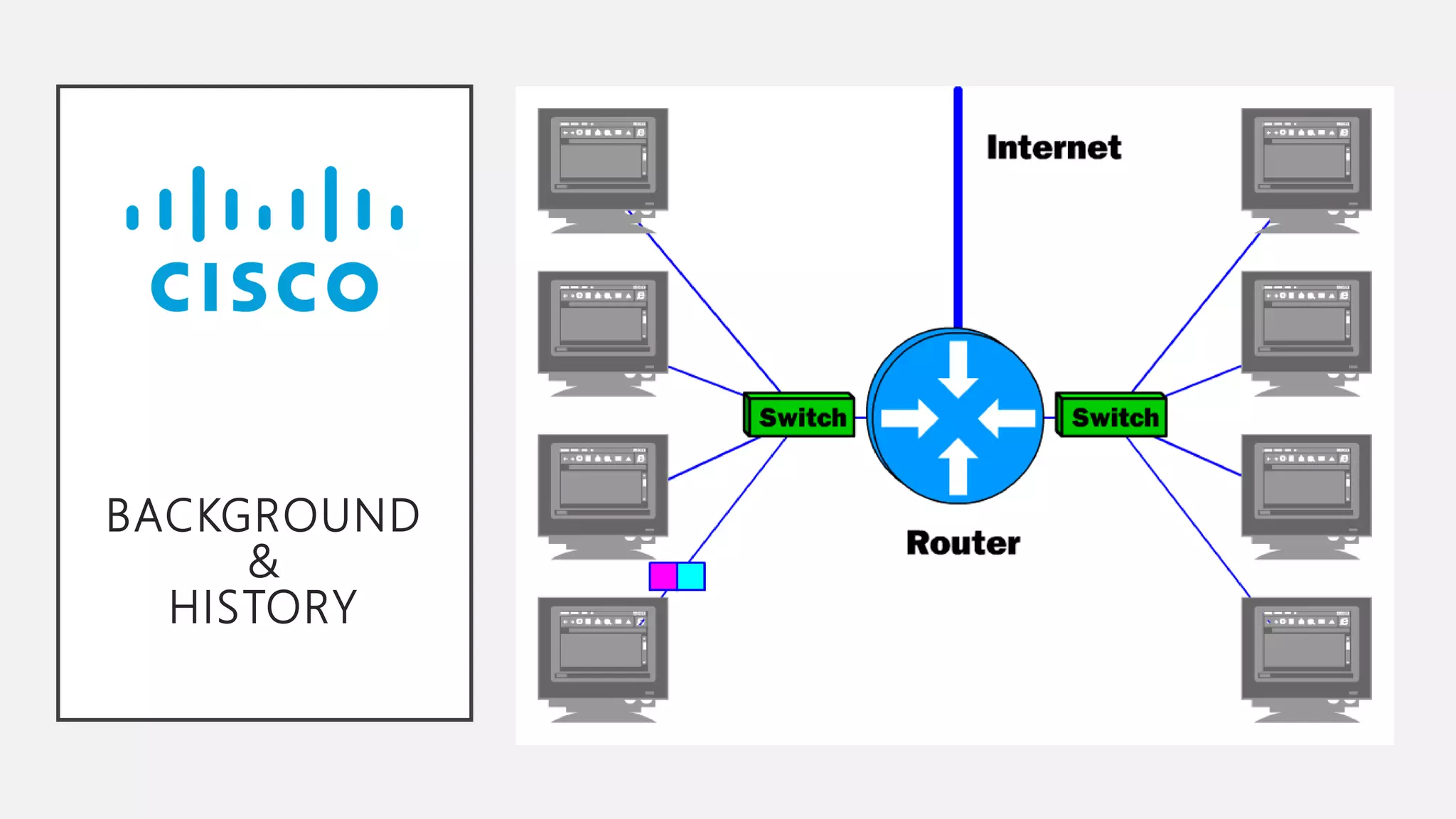
  • #5 This picture is a good depiction of what switches and routers do.
  • #6 Selected Financial summaryy In 2016, $49B in revnues. YoY 3% Market cap. $164B ,CCE and Investments $65.8, operating margin 25.7% In 2016 - 6.3 billion R&D budget 12% of revenue;1/3 of its spending. 21,250/73700 workforce in R&D; 17 Financial might & stability: 7.6 billion cash reserve on 2016 balance sheets; with investments amounting to 57 billion. Fun facts: Founded by Leonard Bosack and Sandy Lerner, computer scientist at Stanford in 1984. Here lies the twist. Leonard and Sandy invented the first multiprotocol router partly as a way to send messages to each other over Stanford GSB’s network. Golden gate bridges Most valuable company in 2000 $550B
  • #8 Political/Legal: Political challenges: Cisco operates globally in about 95 countries with differing legal and political scenarios. The two main issues on their horizon currently are In China, there are privacy concerns and allegations of Cisco hardware used for spying since Snowden’s  revelations in 2012. There were allegations that US tech firm products were being used by the American government to spy on China. Chinese leaders have told government departments and state-owned companies to buy more local equipment, while drafting stricter regulations for foreign gear makers and accelerating investment in domestic technology. This has led to a market opening for local competitors. In 2015, Cisco’s revenue is estimated(Cisco doesn’t report country wise revenues) to have fell 30% from $2.04 billion in 2012. This represents a market share of just above 10%. The precipitous drop in revenues was a result of the Chinese government favoring home-grown companies such as Huawei and ZTE over foreign firms such as Cisco, Microsoft and Qualcomm. Huawei now enjoys a 67% market share in the networking industry in China. In Brazil, tax authorities have claimed an evasion of approx. $262 million, $1.1 billion for interest and $1.2 billion for other penalties on Cisco. Stringent government regulations – Elaborate government regulations and compliance requirement of electronic components in the product. We have classified it as moderate threat because they are localized to specific markets, viz-a-viz China and Brazil. Cisco are threat neutral in most other markets. Technological Technological trends in the networking industry such as Software Defined Networking (SDN) and Network Virtualization are threatening Cisco’s two main products segments in terms of revenue - switching and routing. SDN – Software defined networking uses software to manage an enterprise’s network. While they may not entirely replace routers and switches in the future, they reduce the need for high-end, high-cost routers in favor of more rudimentary hardware. Firms such as Facebook, LinkedIn and Microsoft have been using specialized SDN solutions in their IT infrastructure to gain better control over their networks and hence products. Adoption of SDNs is likely to become prevalent with this market predicted to grow by over 50% by 2020. Further more, SDN currently under development are based on open source protocols. Cisco has been hesitant to adopt open standards as they derive margins from their proprietary hardware & software much like Microsfot. We have classified it as a moderate and increasing threat, since the technologies are only emerging and Cisco has the opportunity to adopt these technologies. Cisco is also in a favorable position to pursue market share in the other product segments such as Security, Collaboration and Cloud solutions.
  • #9 Socio-Cultural Increasing Connectivity : Now, more than ever before, customers understand the importance of information and the availability of information and are always connected. Modern enterprises are constantly looking for new ways to gather and process information that will help to enhance productivity and efficiency. Economic: Uncertain global economy: Buying patterns in IT infrastructure(which are 5-6 years usually) are closely linked to economic environment. For instance, in the wake of the international credit crunch, Cisco’s customers reduced their technology spending, resulting in Cisco’s first drop in sales in 2009 relative to the previous year. Volatile exchange rates : (The direct effect of foreign currency fluctuations on sales has not been material because Cisco’s sales are primarily denominated in U.S. dollars. However, if the U.S. dollar strengthens relative to other currencies) it could have an indirect effect on Cisco’s sales to the extent it raises the cost of products to non-U.S. customers and thereby reduces demand. A weaker U.S. dollar could have the opposite effect. We have classified the economic environment as a moderate threat because Cisco, to a certain extent, is familiar dealing with such risks in the past and adequately prepared for these risks.  with no trend(these risks change over time without any predictable pattern). Global: Cisco’s market share in some emerging markets has room for growth . They have China – 10 % in 2015, Mexico – 26.5, Brazil -27.1  in 2014. We have rated the global environment as a moderate opportunity because while there is room to grow, they also face unique domestic challenges in these markets.
  • #10 Threat of New Entrants Switching Cost : Investment in IT are usually significant portions of the client’s operating budget. Not only are the hardware costs high, the quality of services and trust between supplier and client are other significant factors in the high switching cost. Economies of Scale: Manufacturing in the network gear industry is Made to Order(MTO) process. Companies with the most market share can lower costs and achieve EoS. Access to distribution channels : favors established companies. However, new entrants can pursue collaborative or cost leader(independent of scale)/differentiation strategy. Capital Requirements : The cost involved in R&D, customer relationship maintenance are high. Product differentiation: Proprietary technology –both hardware and software make for high variation in products. All factors that account towards Barriers of Entry are highly unfavorable  for new entrants. However there are numerous firms – both big(non conventional rivals like Facebook, LinkedIn) and small(startups - ) that are working on disruptive solutions that can threaten Cisco’s business. Hence we judged this threat to be increasing rapidly. Interfirm Rivalry: Number of rivals over different product category NGN Routing & Switching - Juniper (1/3 market share in routing), HP(in switching), Alcatel- Lucent(19%), Huawei (67% market share in china) is looking to expand globally. Number of startup firms emerging in Collaboration, Security, Wireless, Cloud and IoT spaces. Non traditional rivals such as Facebook and LinkedIn are developing technologies that could disrupt networking industry.
  • #11 Threat of Substitute products. Disruptive innovations that replace whole product categories are common in the technology industry in general. This applies to a large extent to Networking industry as well. That said, Cisco has been able to rely on switching and routing segments since they entered in 1990. However, experts see significant disruptions on the horizon for the networking segment. Hence moderate but increasing in the future. BPOB : BPOS: Cisco has diversified its supplier base across many vendors. For example, the semi-conductor industry accounts for significant portion of Cisco’s manufacturing input spending. Major Suppliers are from the semiconductor industries: Xilinx, BroadCom, Texas Instruments and Applied Materials.1 Other major supplier industries include Advanced Materials, Hardware, Energy & Control systems. 2 Cisco also has the option to acquire suppliers that gain leverage over them, as they have done in the past. References: http://www.barrons.com/articles/six-suppliers-boosted-by-cisco-q4-report-1439494817 http://csimarket.com/stocks/competition.php?supply&code=CSCO
  • #12 The market for company products and services are highly competitive and fragmented due to improvements in existing technologies and the development of new technologies. The company faces competition with numerous vendors in each product category. We will talk about a few of its major competitors in significant product categories – Routing, Switching and Collaboration In Routing, Juniper took one-third of Cisco's share in core routing shortly after coming onto the scene in 1997. The company remains Cisco's one and only rival in core Internet routing. Juniper held a 28 percent market share in the routing market. Juniper’s edge : Product differentiation –Higher performance than competitors. Preferred by ISPs. Enthusiastic adoption of open SDN protocols.1 HUAWEI holds a market share advantage over Cisco in the Chinese domestic market and is rapidly expanding its foot-print in European and American market through cost leadership and service differentiation. Huawei has many advantages relative to Cisco in the switching and routing. In addition, to its exploitation of Cisco’s weakness in the Chinese market, Huawei’s competitive advantage in international markets comes from successfully underbidding international rivals .This strategy is enabled by its investors tolerance for lower margins, leveraging higher cost efficiencies through Chinese manufacturing ties and higher R&D spending in recent times ($9.2 billion in 2015 vs $6.2 dollars of Cisco) 2 Microsoft has been problematic for Cisco. Lync, Microsoft's Unified Communications solution, introduced new buyers into the mix that have the same level of loyalty to Redmond as customers have to Cisco. Cisco has spent countless hours trying to prove that its solution is not only more reliable than Lync, but also cheaper and broader. This may be true, but customers buy Lync because of Microsoft familiarity, and that's a tough value proposition to compete with. 3 The identity and composition of competitors may change as they increase their activity in their new product markets. As they continue to diversify and expand globally, they are likely to see more & more competition. References : https://blog.cbtnuggets.com/2016/06/juniper-vs-cisco-4-reasons-to-go-juniper/ https://www.bloomberg.com/view/articles/2016-07-26/huawei-conquers-the-world-except-the-u-s http://www.infoworld.com/article/2606773/techology-business/111748-10-competitors-Cisco-couldn-t-kill-off.html#slide10 http://searchnetworking.techtarget.com/news/450296358/Cisco-slides-as-critical-supplier-to-enterprises
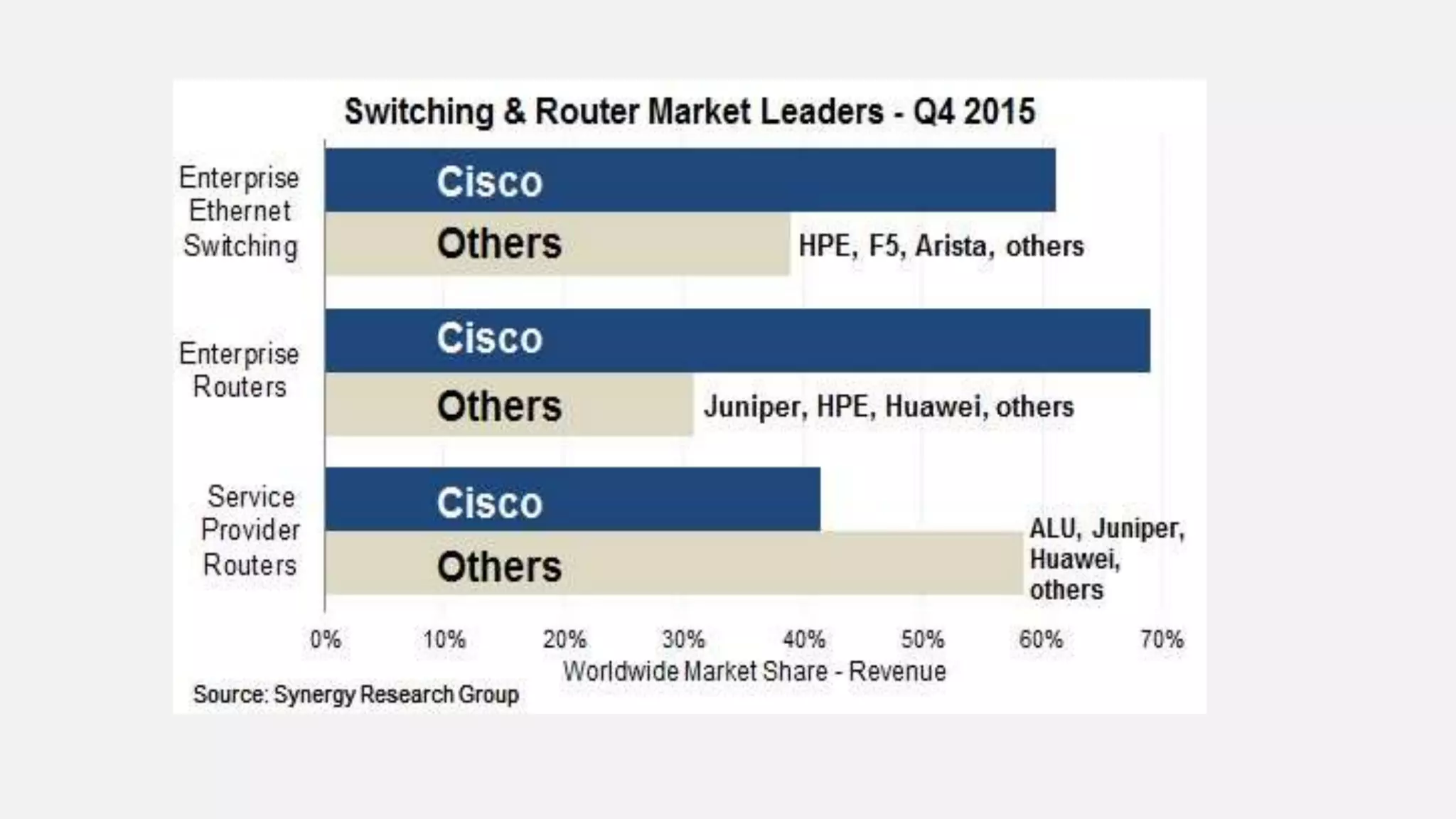
  • #15 Global Market Leader Cisco is a global market leader, the company operates in 95 countries. By market share single largest player in Switching & Routing worldwide. Bigger than all competitors put together in Switching with nearly 60% market share.1 M&A Expertise – Read out bullet points. More to come in later slides. Customer Orientation In recent years, Cisco has moved its positioning towards a digital transformation partner from IT hardware vendor. 2 The sales teams organized around individual client(bigger clients such as government and enterprise clients) can and do cross sell other Cisco products. Additionally, Cisco’s customer service record is an advantageous differentiation when compared to its rival. Ex-CEO John Chambers inculcated a strong customer service orientation in the organization, famously requiring executives   spend 50% of their time with customers. 3 Technological Might – 19K patents, extensive knowledge base and talent pool. WEAKNESSES Over-reliance on switching and routing: Cisco’s revenue growth from switching and routing segments represented 59.5% of their total revenues. They have traditionally been the core revenues driver for Cisco over the years. However, the growth in this market has been stagnating over the past few years due to a maturing network hardware market. Volume of sales from these segments fell from nearly 80% in the early 90’s to 70% of all products sales in 2006 to 59.5% in 2016. In 2016 alone, sales from switching fell by 3% and routing fell by 5%. Threat of disruption: Cisco has traditionally made substantial revenues from selling proprietary routers and switches. With SDN, the software solutions make the hardware underneath irrelevant, meaning customers can in theory buy any supplier equipment and get the same performance out of it. With the expense associated with Cisco and the inevitable tie-in due to its proprietary nature, SDN could steal away significant market share if the momentum behind it continues to grow at the same pace4. Another major weakness is Cisco has been following an approach similar to that of Microsoft. Patent protect technologies and milk these proprietary solutions to the optimum. However, there is a marked trend in recent years in the technology industry towards open source licensing. Microsoft has successfully managed this transistion. Remains to be seen how Cisco navigates this problem. References : https://www.srgresearch.com/articles/ciscos-dominant-share-switching-routers-holds-steady http://www.cisco.com/c/dam/en_us/about/annual-report/2016-annual-report-full.pdf Karaoke Capitalism: Daring to be Different in a Copycat World,pg.122 http://www.computerweekly.com/news/2240171835/Why-Cisco-chooses-acquisition-over-RD
  • #16 Customer orientation (V) = Cisco is viewed as a trusted digital partner by most of its’ customer base. Global Market leader position (V,R) = Cisco market share leadership across markets and product segments is both valuable and rare. Technological assets and manufacturing prowess(V,R,I) = Cisco has a phenomenally strong product and patent portfolio. They hold 19,000 patents globally, with 12,000 of those coming in the US. The value of the company rests upon the intellectual property embodied in their networking products- both hardware and software. Cisco's patent depth is rare and difficult to duplicate by competitors – both established & new.  Expertise in acquisitions and alliances (V,R,I,N) = Cisco acquisitions prowess has been honed over 2 decades in an industry characterized by rapid tech cycles. They have successfully used this CA to counter rivals’ strengths. as well as to grow market share through exclusive alliances that broaden its sales channels. This capacity is very costly to imitate, few of cisco’s competitors have the means to acquire so many firms and they lack strategic equivalents. Strong Brand image (V,I) = Cisco’s Brand image allows the company to neutralize threats from in its external environment. It is valuable in the sense that it the miror through which the company’s key values are reflected: Change the world, focus intensively on customers, make innovation happen.Through its numerous acquisitions over the decade and its position of World leader within its industry, Cisco has built a strong brand image and these elements makes it difficult to imitate.
  • #17 Read out from the picture Related Constrained Diversification strategy – Why? With the various product divisions in Cisco, many operational resources are interrelated and utilized across product divisions. Such as cloud level computing not using resources from Small and Business markets productions, even though they are linked at a higher level and carry overall business for an enterprise market. Benefits – They achieve economies of scope through operational synergy. Supports their positioning as digital transformation partner. The client focused team hierarchy at Cisco leverages strong client relationship to enables wins across product segments. Related constrained strategy most likely to offer high performance. Risks – Ability to derive benefits from operational relatedness tends to diminish as they grow through acquisitions and by geography. However these risks can be managed. Cisco has written off companies(Monterey Networks and Pirelli Optical) in the past due to these reasons. Value creating diversification strategy – Cisco is able to obtain value by diversification into new product divisions ( grew from 2 to 7 major product categories) through acquisitions, internal innovation efforts, in more international markets( grew to 30 consumer markets), Benefits: This strategy enables them to block competitors market power . Cisco engages in multimarket competition with its major rivals . Multimarket Competition – (http://www.networkworld.com/article/3149585/uc-voip/what-to-expect-from-ciscos-competitors-in-2017.html) Mutual forbearance is less in this case since Cisco is competing at a different level of their Multilevel competition. References: https://books.google.com/books?id=eJ7nVD6-R8QC&pg=PA117&lpg=PA117&dq=benefits+of+cisco+vertical+integration&source=bl&ots=KiwW_EdL4v&sig=9470mEDmfp6lM3YXlGsAf7hlmQs&hl=en&sa=X&ved=0ahUKEwj1ltWnnI_TAhUCYyYKHdGNB_U4ChDoAQgeMAE#v=onepage&q=benefits%20of%20cisco%20vertical%20integration&f=false
  • #18 Cisco is King of kings when it comes to Mergers and acquisitions as it has acquired over 180 acquisitions over its 30-year history. Cisco’s approach constitutes of targeting small companies, which are fast growing, focused, entrepreneurial, in geographical proximity and culturally similar. A 50 people dedicated team executes this tasks successfully. A common theme in motivation for Cisco’s acquisitions – Horizontal expansion and diversification.
  • #19 In the 1990’s, Cisco focused on its core business - switching and routing, investing more than $22B as it acquired various companies, (some of important ones are Cerent and Stratacom through which cisco was able ) to enhance its networking offerings. (by providing customers with a complete infrastructure solution for transitional and new world networks. ) In the 2000s, Cisco began to branch out into new product areas like consumer video, cable tv set top boxes and business collaboration. E.g. WebEx for web conferencing (which enabled cisco to offer services as hosted email). Acquisitions in the Collaboration category not only helped diversification but also drove growth in networking category (switching and routing) as these products required more bandwidth and hence requiring infrastructure upgrades. Since 2012, the company entered Security and Wireless domain by capturing major companies like NDS group, Meraki, Sourcefire. Sourcefire was a leader in intelligent cybersecurity solutions. (Cisco and Sourcefire combined their world-class products, technologies and research teams to provide continuous and pervasive advanced threat protection.) After 2015 its focused shifted to nascent technologies such as IoT and Application Performance Management (AppDynamics). Mostly companies face difficulties in successfully integrating the acquired firm’s employees and their culture. Cisco demonstrates a high absorption capacity with very few failed acquisitions. The integration process is carried over short timelines with typically high employee retention. Cisco’s success rate is above 98%( 3 out of 180 acquisitions failed ) as it had very few significant failures . Cisco’s foray in to the consumer market with Linksys – a home network router for $500 million ended in failure. They sold Linksys in 2013 to Belkin due to low margins in the consumer market. Some of the key benefits through cisco’s M&A are that they get new technology, talent and a readymade market (depending on the acquired firm’s market share). Risks in relying heavily on acquisitions, any errors in strategic direction and due diligence process could saddle Cisco with non-performers(or not meeting the goals for acquisition – which leads to more business risk).
  • #20 Cisco operates through a Global strategy. It doesn’t adapt its products to local markets, on the contrary the firm assumes more standardization of its products across country markets. Cisco has exploits its core competencies of its product line up by diversifying globally. Their international units have significant autonomy when it comes to strategic decision making and operations and they have a culturally diverse global leadership team. Cisco signified it intent to expand globally with pledge of $10B investment in China, $4B in Mexico $570 million in Brazil and $100 million in R&D facilities in India all within the last 5 years. Some of the benefits of this strategy are increased market size, increasing economies of scale and scope, Enhanced reactiveness due to proximity to local markets. Keep the company in pace with local environment. ahead of competition and Better customer relations through adapting to local cultural environment Risks of this strategy are Draining resoruces to compete in rapidly shifting and unique competitive environments globally Adjusting to varied political/legal environment (They created the executive level position of Chief Globalization Officer to oversee such operations and have created a globalization center in Bangalore, India. This allows Cisco to have a presence in rapidly evolving markets and also gain insight into the market to keep their company ahead of the competition. In many cultures, a physical presence is of vital importance to establishing a good business relationship. With the Globalization center in Bangalore, 70% of the world’s population is within a five hour plane ride. This allows them to provide the excellent customer service Cisco is renowned for, as well as developing new relationships with customers in the fastest growing market segments. In the past decade, more than half of Cisco’s business now comes from outside of North America. Cisco has organized its efforts into three main geographic segments: The Americas; Europe, Middle East, and Africa; and Asia Pacific, Japan, and China. Though they have been having success with this global market strategy, there are challenges they face. They must face a variety of infrastructure challenges of developing nations. Also the challenge of decentralizing their business model to reach their customers is difficult to implement and adjust to for employees. Time zone change is also a challenge for the company, as the Globalization center is in a different time zone by about 12 hours.) https://sites.google.com/a/email.vccs.edu/cisco-systems-business-portfolio-for-bus100/strategies-for-reaching-global-markets https://www.forbes.com/sites/patrickmoorhead/2015/12/18/demystifying-ciscos-five-pillar-innovation-strategy/#7e8946467983
  • #21 Through its partner and channel , Cisco works with companies such as IBM, Microsoft, Emerson to drive its business. Microsoft Some of the objectives of forming strategic alliances with Microsoft is to : To broaden CISCO’s knowledge base ( Ex: Providing innovation in the development of fog computing technology and Architecture). To provide enhanced customer services (Ex : Providing Accelerated growth and innovation for enterprise customers and service providers through Unified communication systems. Hence, the primary intention here is to promote diversification and the strategy implemented is Diversifying strategic alliances. IBM :
  • #22 In our view, The 2 most important issues that threaten Cisco growth are How to address weakness in Switching & Routing segment? A summary of the weakness are Over-reliance Growth deflation. Threat of product substitutes Competitive environment Slow but marked erosion of its market leader position. Difficulties in China.
  • #26 Source: https://www.srgresearch.com/articles/ciscos-dominant-share-switching-routers-holds-steady
  • #27 Source:http://www.cisco.com/c/dam/en_us/about/annual-report/2016-annual-report-full.pdf
  • #28 Source:http://www.cisco.com/c/dam/en_us/about/annual-report/2016-annual-report-full.pdf
  • #29 Source:http://www.cisco.com/c/dam/en_us/about/annual-report/2016-annual-report-full.pdf