Advanced Data Structures &
Algorithm Design
Introduction to Algorithms and Algorithm
Analysis
Introduction to Algorithms & Algorithm
Analysis 2
What is an Algorithm?
 Any well-defined computational procedure that takes
some value or set of values as input, and produces
some value or values as output; or
 A sequence of computational steps that transforms
the input into the output; or
 Tool for solving a well-specified computational
problem
 The problem specifies the relationship between input and
output
 The algorithm describes a procedure for achieving that
relationship
Introduction to Algorithms & Algorithm
Analysis 3
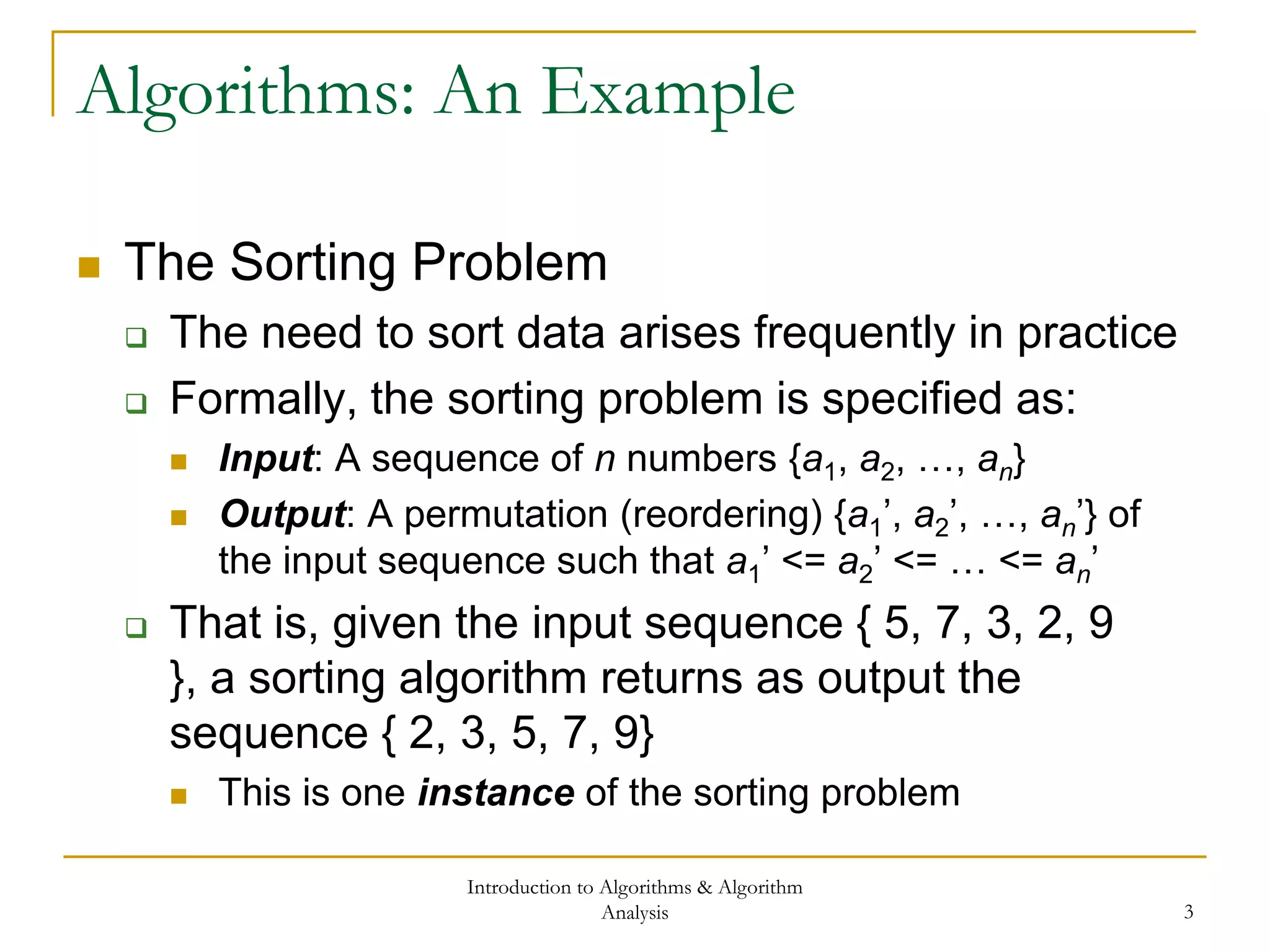
Algorithms: An Example
 The Sorting Problem
 The need to sort data arises frequently in practice
 Formally, the sorting problem is specified as:
 Input: A sequence of n numbers {a1, a2, …, an}
 Output: A permutation (reordering) {a1’, a2’, …, an’} of
the input sequence such that a1’ <= a2’ <= … <= an’
 That is, given the input sequence { 5, 7, 3, 2, 9
}, a sorting algorithm returns as output the
sequence { 2, 3, 5, 7, 9}
 This is one instance of the sorting problem
Introduction to Algorithms & Algorithm
Analysis 4
Correctness of Algorithms
 An algorithm is correct if for every input
instance, it halts with the correct output
 i.e., it solves the given computational problem
 Correctness isn't everything
 Incorrectness can be useful, if the error rate can
be controlled
Introduction to Algorithms & Algorithm
Analysis 5
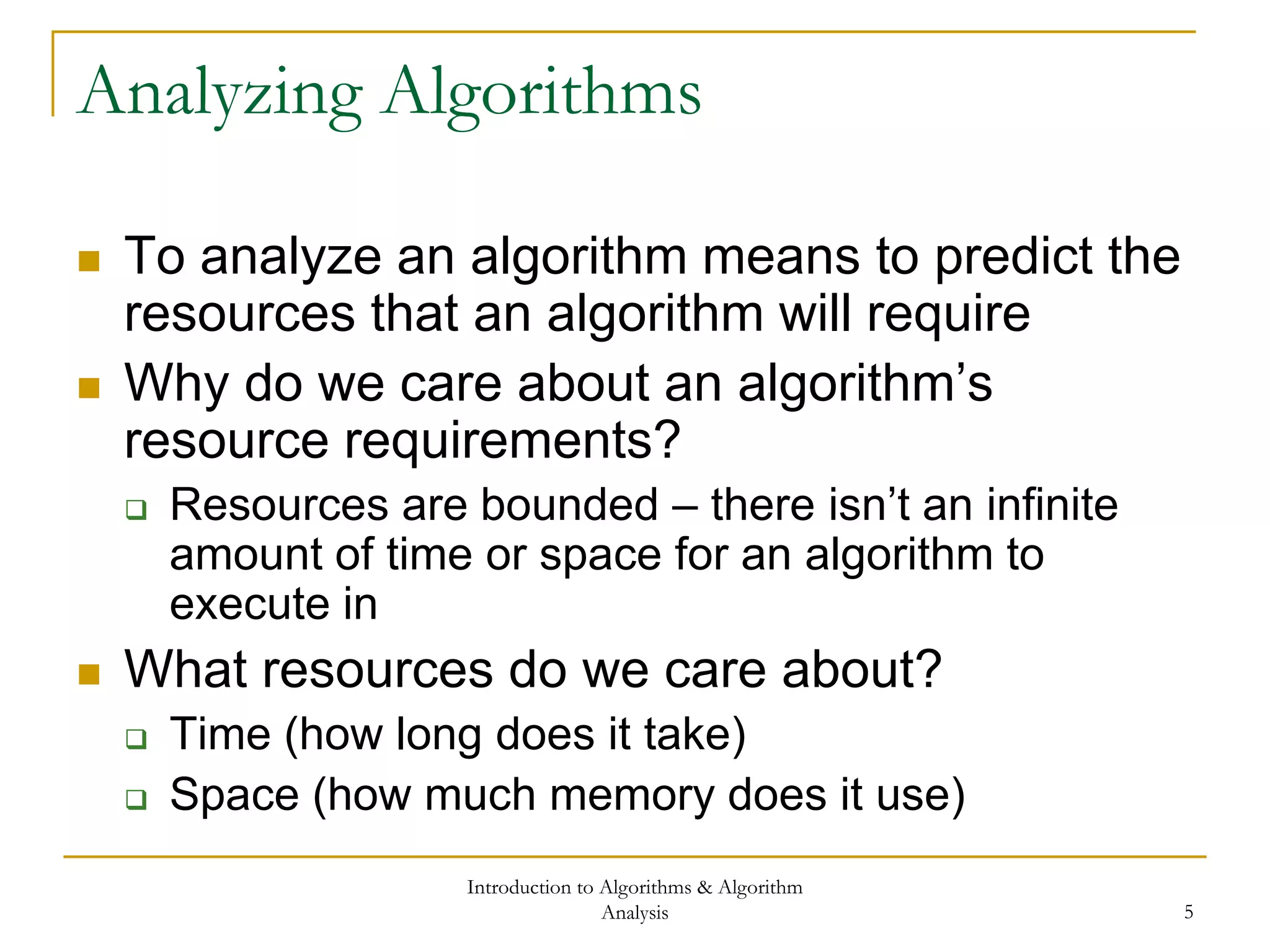
Analyzing Algorithms
 To analyze an algorithm means to predict the
resources that an algorithm will require
 Why do we care about an algorithm’s
resource requirements?
 Resources are bounded – there isn’t an infinite
amount of time or space for an algorithm to
execute in
 What resources do we care about?
 Time (how long does it take)
 Space (how much memory does it use)
Introduction to Algorithms & Algorithm
Analysis 6
Analyzing Algorithms
 Analysis usually measures two forms of
complexity:
 Spatial Complexity: memory, communications
bandwidth
 Temporal Complexity: computational time
Introduction to Algorithms & Algorithm
Analysis 7
Analyzing Algorithms: An Example
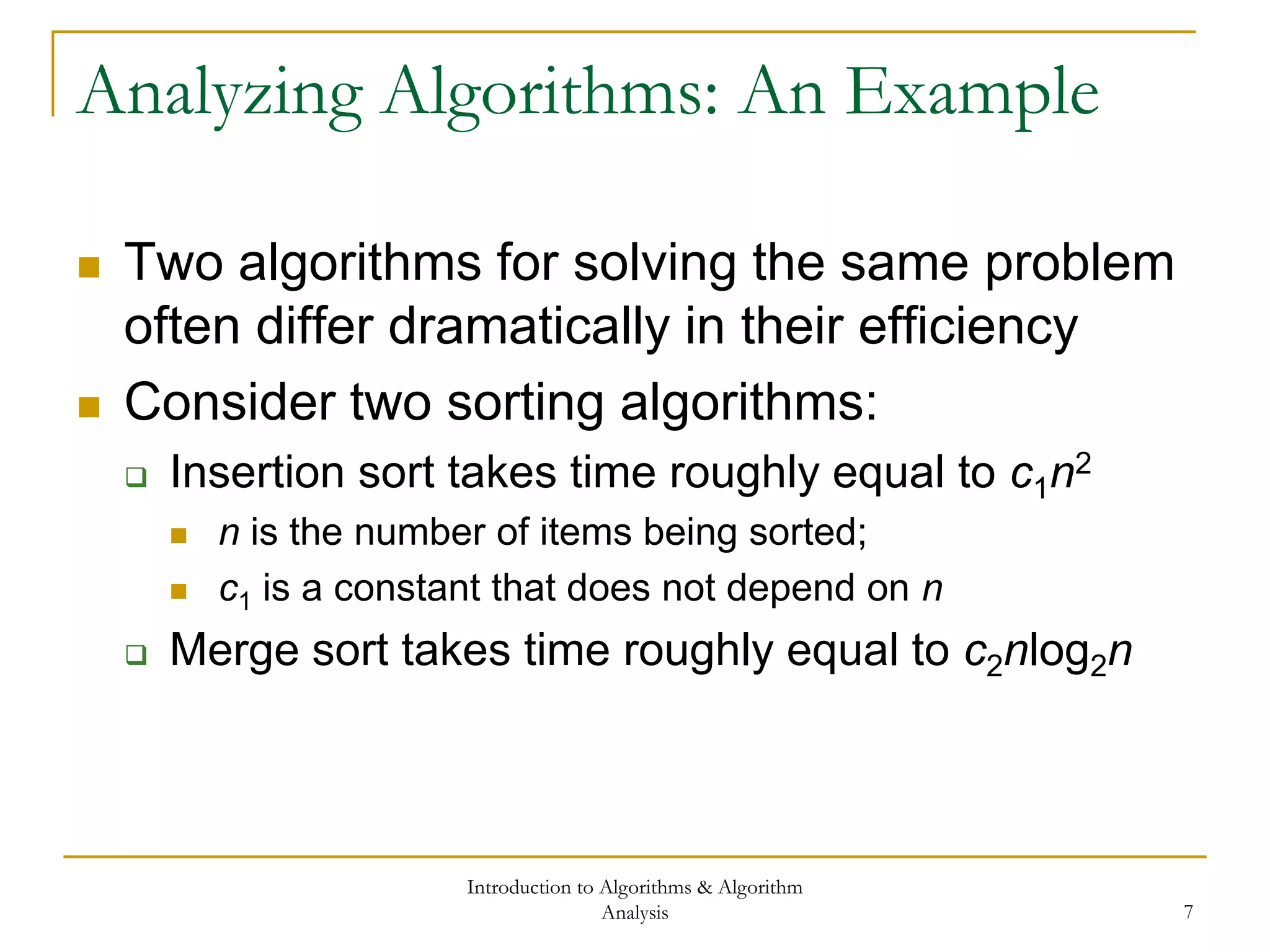
 Two algorithms for solving the same problem
often differ dramatically in their efficiency
 Consider two sorting algorithms:
 Insertion sort takes time roughly equal to c1n2
 n is the number of items being sorted;
 c1 is a constant that does not depend on n
 Merge sort takes time roughly equal to c2nlog2n
Introduction to Algorithms & Algorithm
Analysis 8
Analyzing Algorithms: An Example
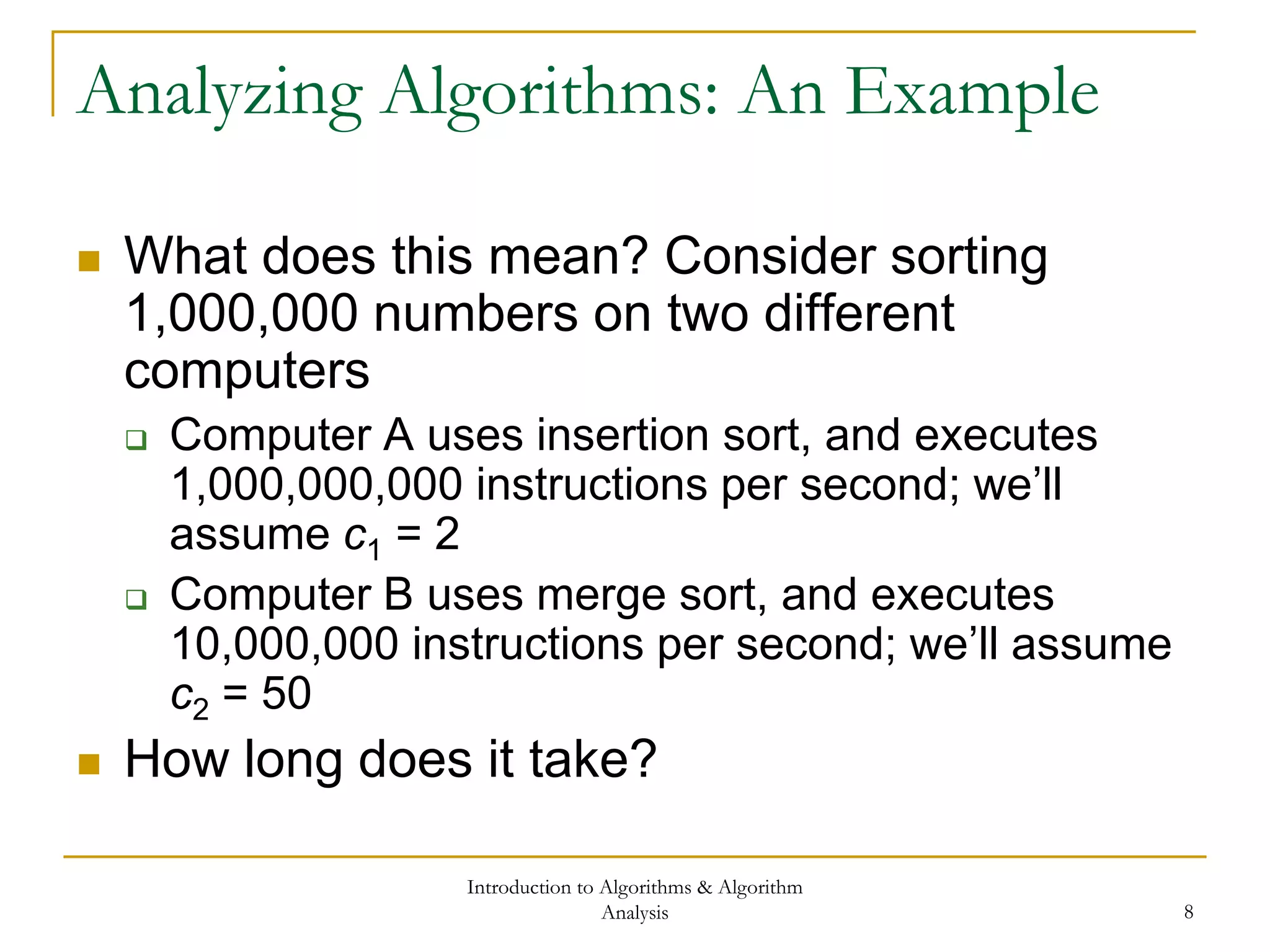
 What does this mean? Consider sorting
1,000,000 numbers on two different
computers
 Computer A uses insertion sort, and executes
1,000,000,000 instructions per second; we’ll
assume c1 = 2
 Computer B uses merge sort, and executes
10,000,000 instructions per second; we’ll assume
c2 = 50
 How long does it take?
Introduction to Algorithms & Algorithm
Analysis 9
Analyzing Algorithms: An Example
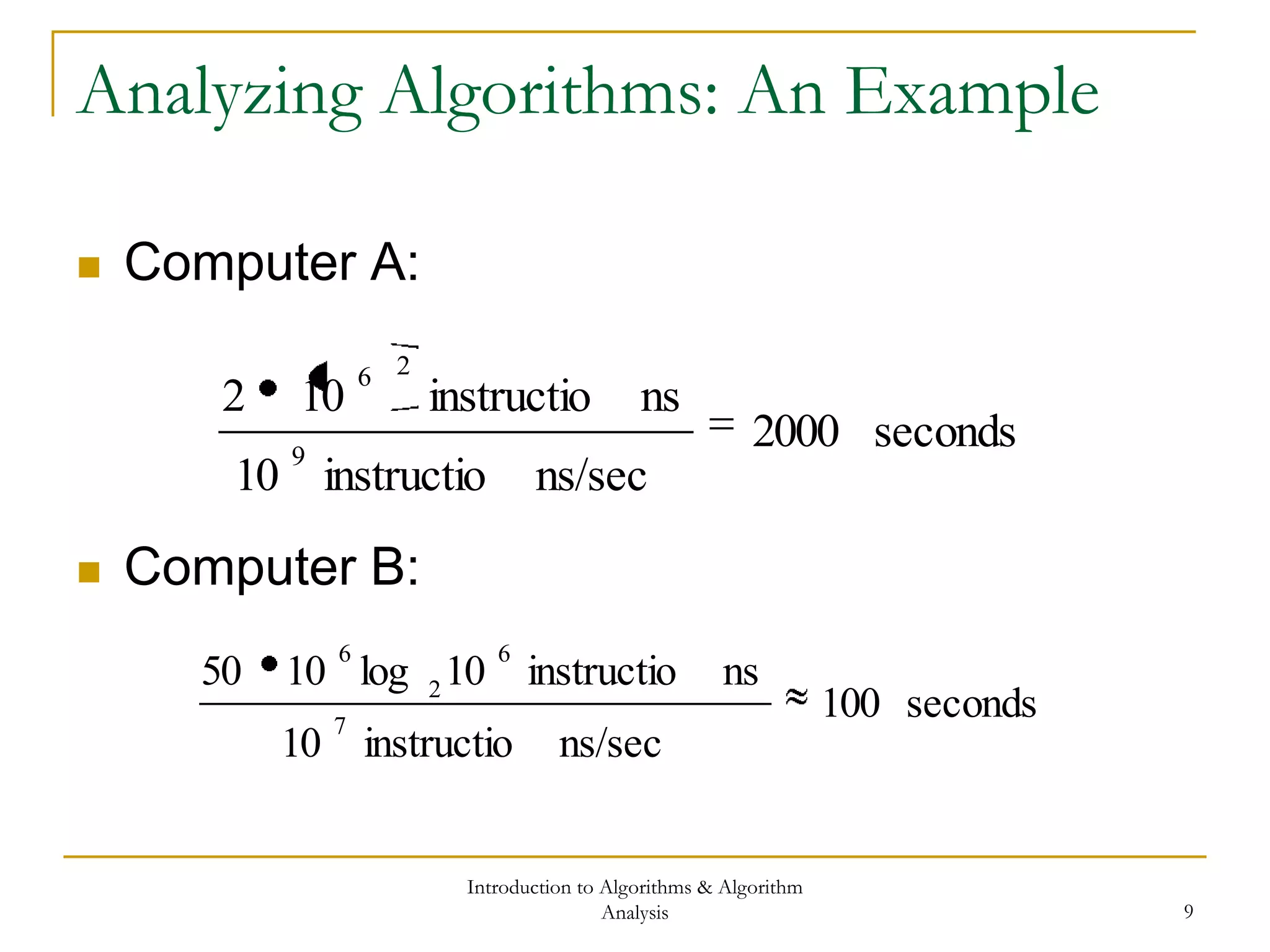
 Computer A:
 Computer B:
seconds2000
ns/secinstructio10
nsinstructio102
9
26
seconds100
ns/secinstructio10
nsinstructio10log1050
7
6
2
6
Introduction to Algorithms & Algorithm
Analysis 10
Insertion Sort
 Insertion sort is one method of solving the
sorting problem
 Conceptually, insertion sort works the way
many people sort playing cards:
 Start with one hand empty and the cards face
down
 Remove one card at a time from the table and
insert it into the correct position in the left hand
Introduction to Algorithms & Algorithm
Analysis 11
Insertion Sort: Algorithm
void InsertionSort(ArrayType A[], unsigned size)
{
for ( unsigned j = 1 ; j < size ; ++j )
{
ArrayType key = A[j];
int i = j-1;
while ( i >= 0 && A[i] > key )
{
A[i+1] = A[i];
--i;
}
A[i+1] = key;
}
}
Introduction to Algorithms & Algorithm
Analysis 12
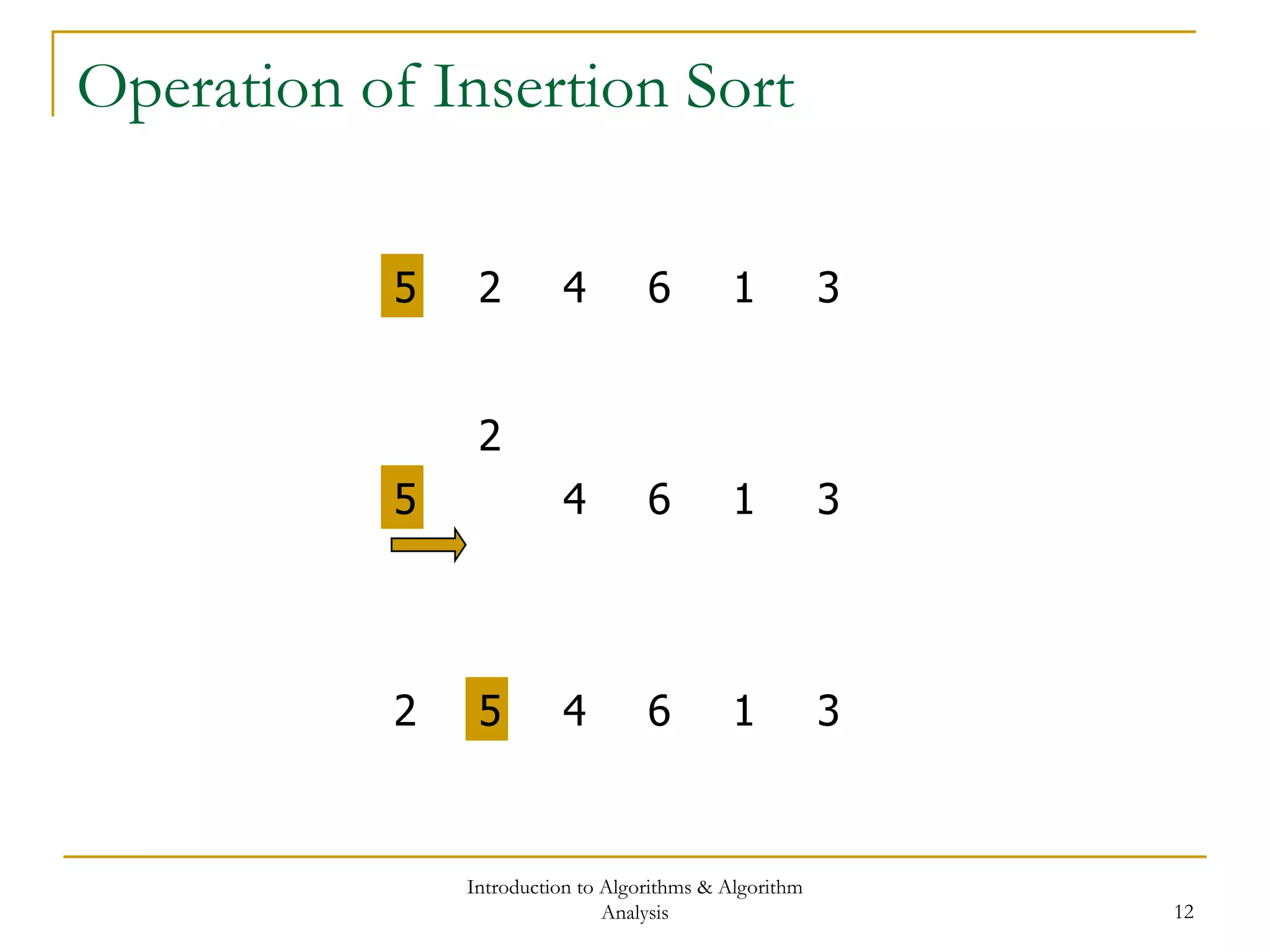
Operation of Insertion Sort
5 2 4 6 1 3
5
2
4 6 1 3
52 4 6 1 3
Introduction to Algorithms & Algorithm
Analysis 13
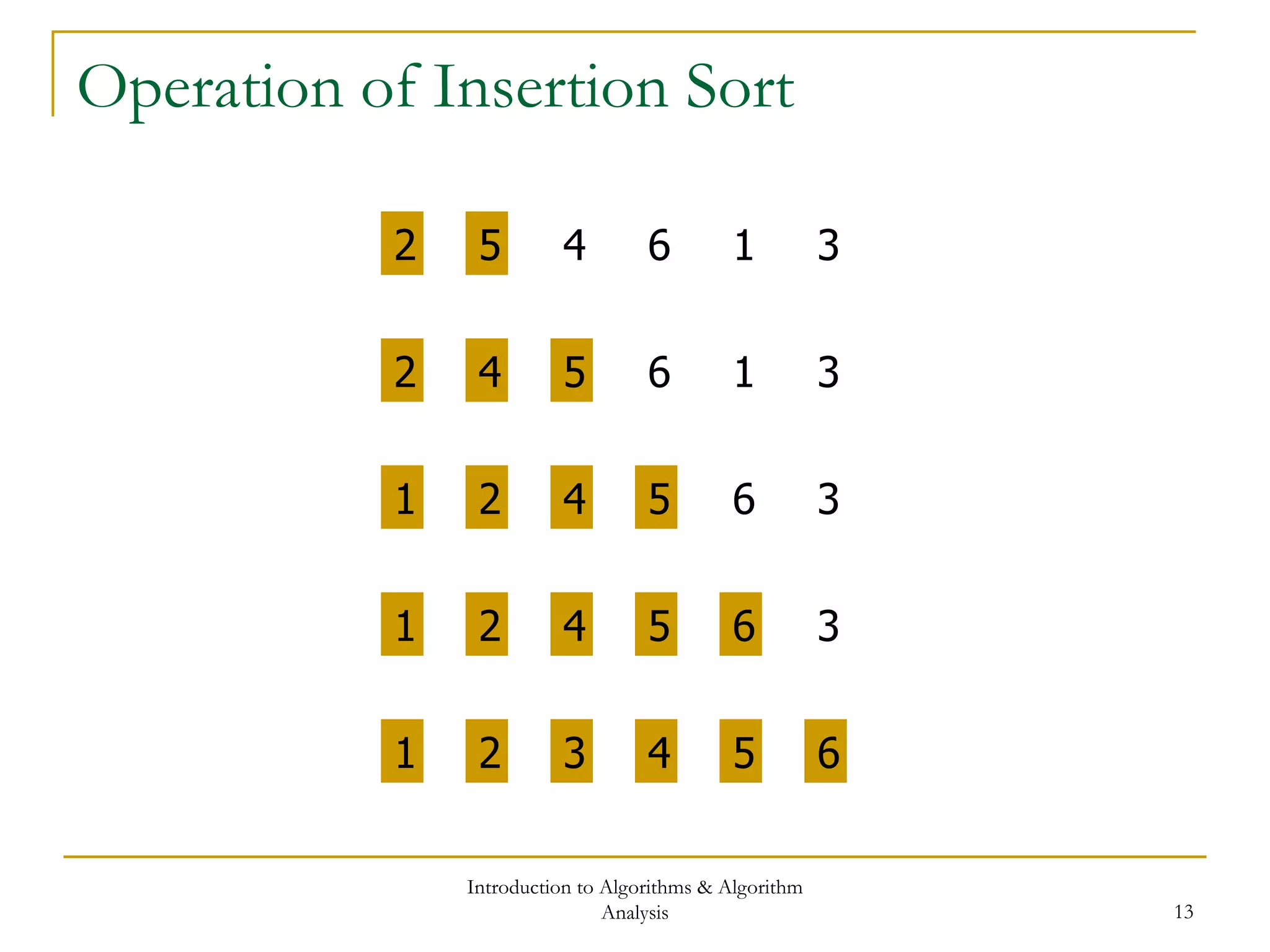
Operation of Insertion Sort
52 4 6 1 3
52 4 6 1 3
52 4 61 3
52 4 61 3
52 4 61 3
Introduction to Algorithms & Algorithm
Analysis 14
Analysis of Insertion Sort
 How long does insertion sort take?
 Time varies based on:
 The size of the input
 How well sorted the input is to begin with
 What is “the size of the input”?
 May represent the number of items in the input, or
the number of bits being calculated
 May be represented by more than one number
Introduction to Algorithms & Algorithm
Analysis 15
Analysis of Insertion Sort
 What is “running time”?
 Running time is based on the number of steps
performed by the processor
 Different processors run at different speeds, so
time per step will vary between processors
 We will express times in terms of a constant cost
per step, ci
Introduction to Algorithms & Algorithm
Analysis 16
Analysis of Insertion Sort
 What is the “cost” of Insertion Sort?
 Total cost = the sum of the cost of each statement *
number of times statement is executed
Statem ent Cost Tim es
for ( unsigned j = 1 ; j < size ; ++j ) c1 n
ArrayType key = A[j]; c2 n-1
int i = j-1; c3 n-1
while ( i >= 0 && A[i] > key ) c4
n
j j
t
1
A[i+1] = A[i]; c5
n
j
t j1
)1(
--i; c6
n
j
t j1
)1(
A[i+1] = key; c7 n-1
Introduction to Algorithms & Algorithm
Analysis 17
Analysis of Insertion Sort
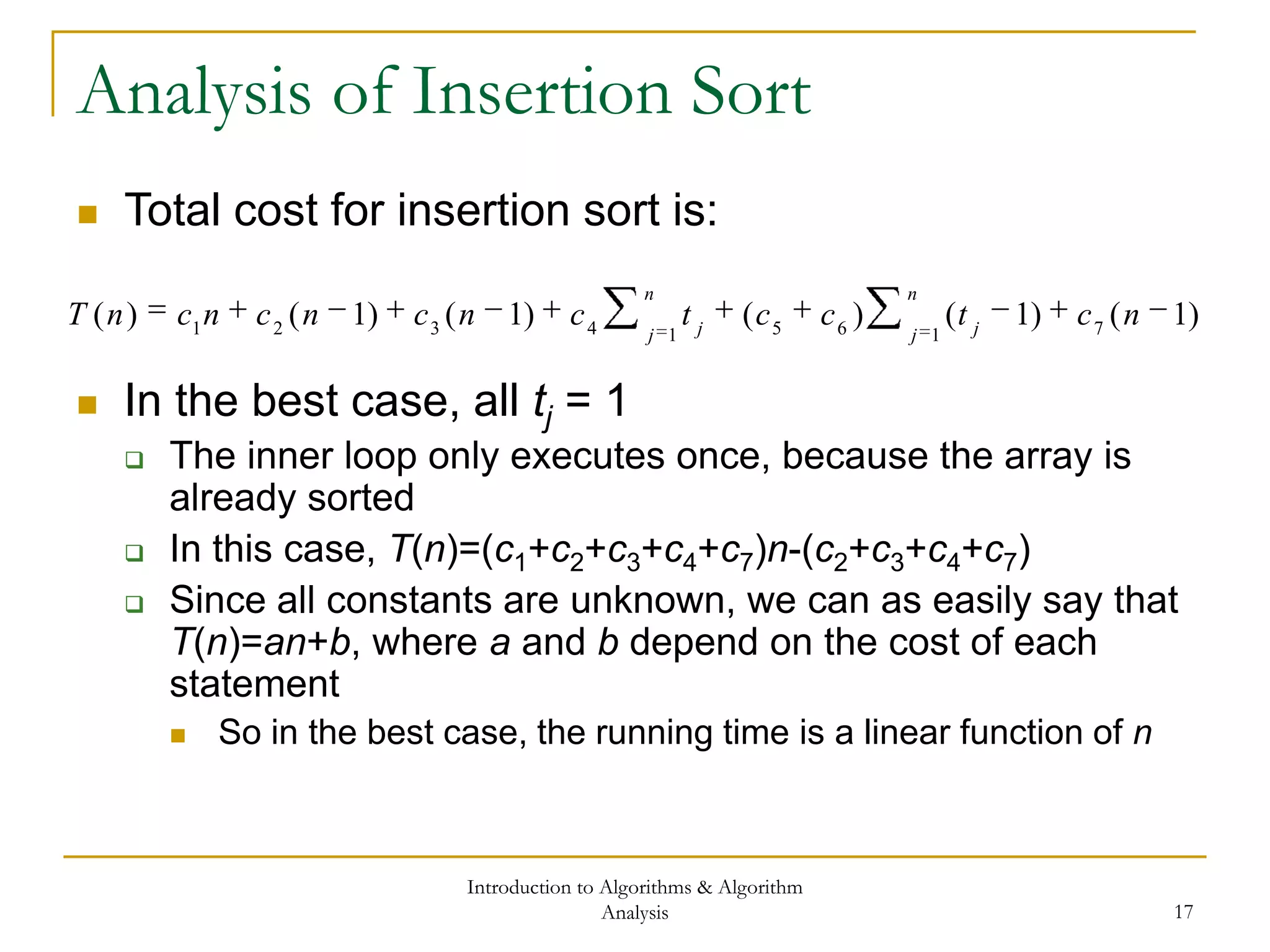
 In the best case, all tj = 1
 The inner loop only executes once, because the array is
already sorted
 In this case, T(n)=(c1+c2+c3+c4+c7)n-(c2+c3+c4+c7)
 Since all constants are unknown, we can as easily say that
T(n)=an+b, where a and b depend on the cost of each
statement
 So in the best case, the running time is a linear function of n
)1()1()()1()1()( 716514321
nctcctcncncncnT
n
j j
n
j j
 Total cost for insertion sort is:
Introduction to Algorithms & Algorithm
Analysis 18
Analysis of Insertion Sort
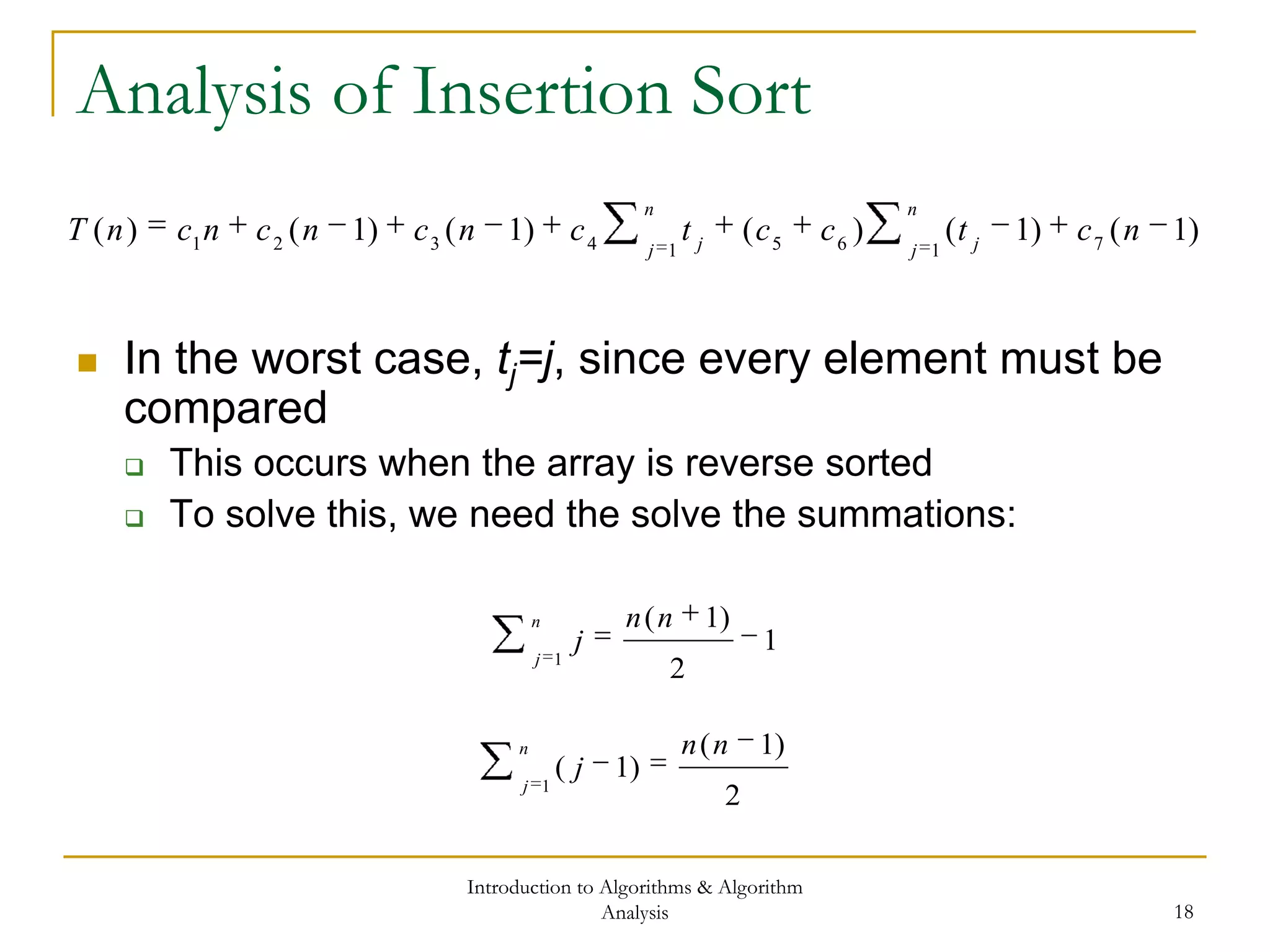
 In the worst case, tj=j, since every element must be
compared
 This occurs when the array is reverse sorted
 To solve this, we need the solve the summations:
)1()1()()1()1()( 716514321
nctcctcncncncnT
n
j j
n
j j
n
j
nn
j
1
1
2
)1(
n
j
nn
j
1
2
)1(
)1(
Introduction to Algorithms & Algorithm
Analysis 19
Analysis of Insertion Sort
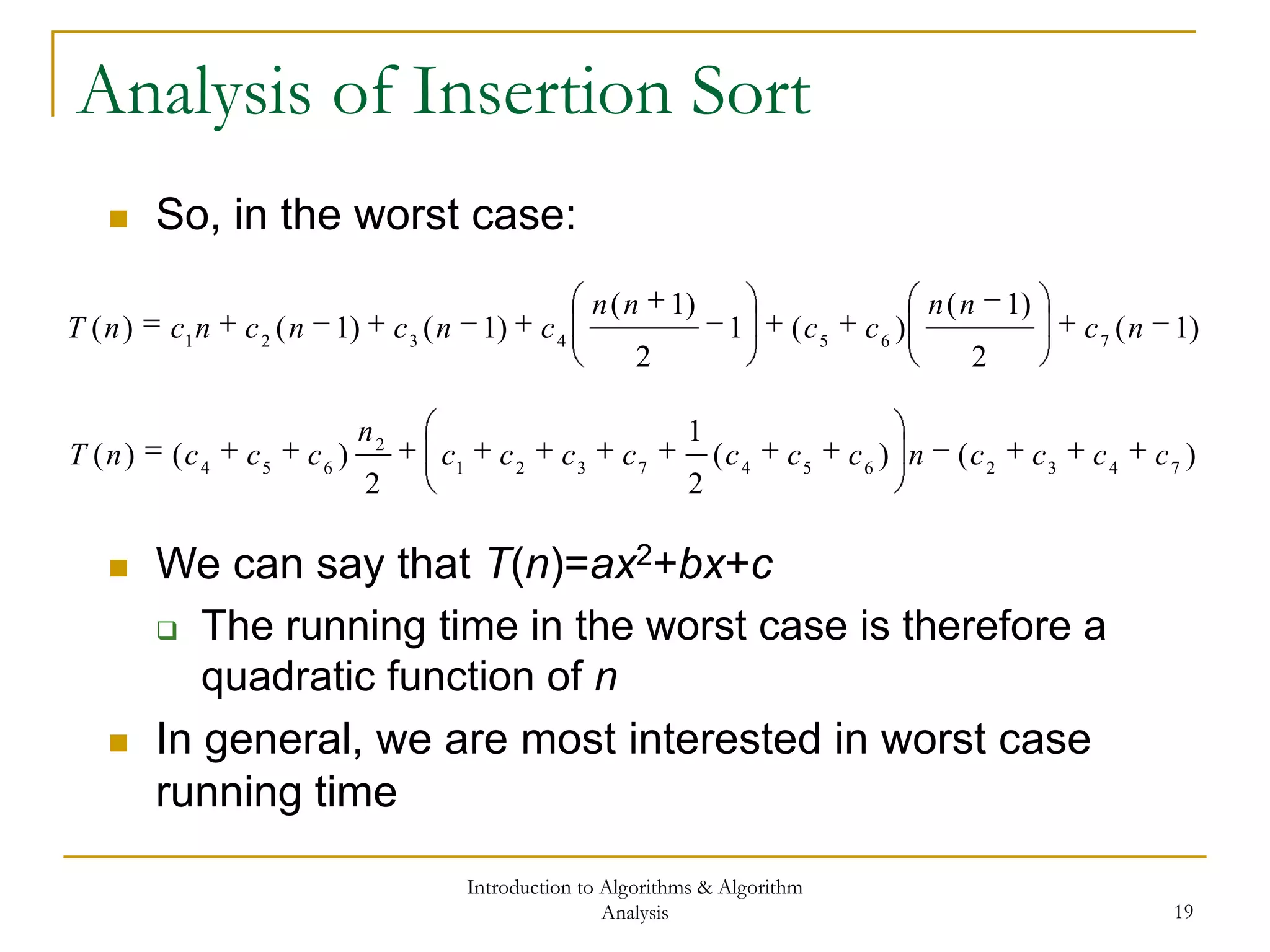
 So, in the worst case:
)1(
2
)1(
)(1
2
)1(
)1()1()( 7654321
nc
nn
cc
nn
cncncncnT
)()(
2
1
2
)()( 74326547321
2
654
ccccnccccccc
n
cccnT
 We can say that T(n)=ax2+bx+c
 The running time in the worst case is therefore a
quadratic function of n
 In general, we are most interested in worst case
running time
Introduction to Algorithms & Algorithm
Analysis 20
Analysis of Insertion Sort
 Order of Growth
 Actual running time is not nearly as important as
the “order of growth” of the running time
 Order of growth of the running time is how the running
time changes as the size of the input changes
 Provides a concrete method of comparing alternative
algorithms
Introduction to Algorithms & Algorithm
Analysis 21
Analysis of Insertion Sort
 Order of Growth
 Order of growth is typically easier to compute than
exact running time
 In general, we are most interested in the highest order
terms of the running time
 Lower order terms become insignificant as the input size
grows larger
 We can also ignore leading coefficients
 constant factors are not as significant as growth rate in
determining computational efficiency
Introduction to Algorithms & Algorithm
Analysis 22
Analysis of Insertion Sort
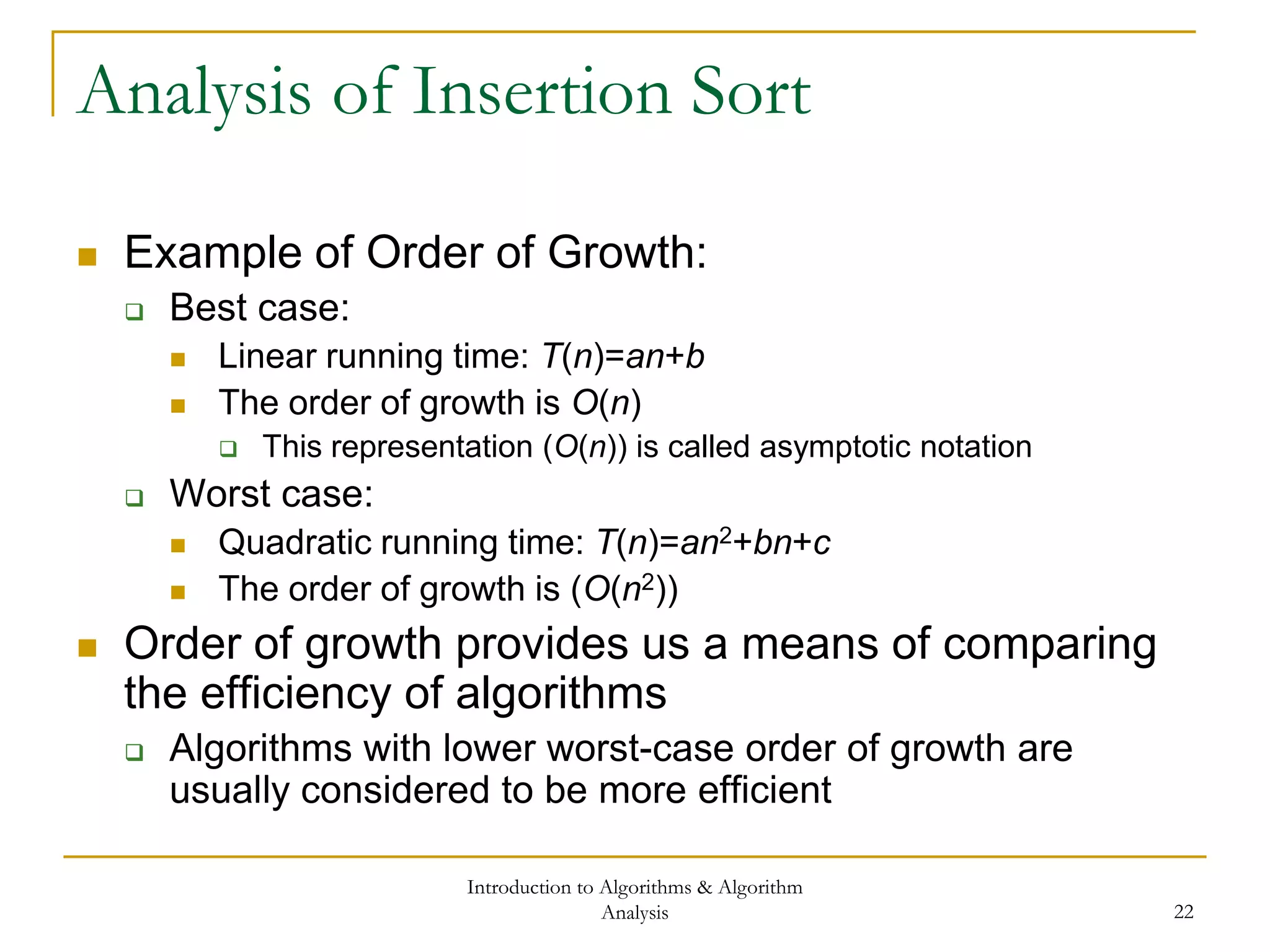
 Example of Order of Growth:
 Best case:
 Linear running time: T(n)=an+b
 The order of growth is O(n)
 This representation (O(n)) is called asymptotic notation
 Worst case:
 Quadratic running time: T(n)=an2+bn+c
 The order of growth is (O(n2))
 Order of growth provides us a means of comparing
the efficiency of algorithms
 Algorithms with lower worst-case order of growth are
usually considered to be more efficient
Introduction to Algorithms & Algorithm
Analysis 23
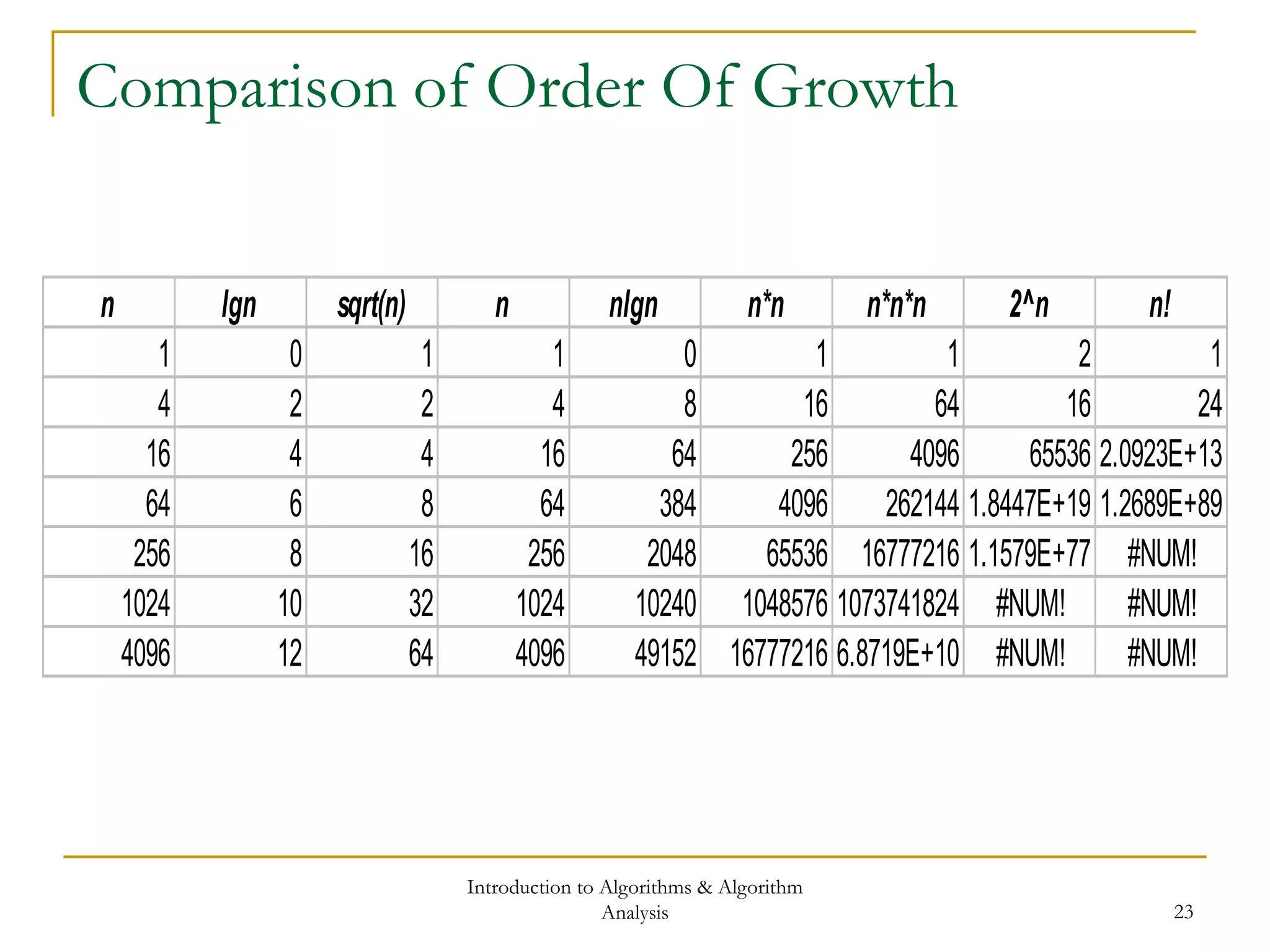
Comparison of Order Of Growth
n lgn sqrt(n) n nlgn n*n n*n*n 2^n n!
1 0 1 1 0 1 1 2 1
4 2 2 4 8 16 64 16 24
16 4 4 16 64 256 4096 65536 2.0923E+13
64 6 8 64 384 4096 262144 1.8447E+19 1.2689E+89
256 8 16 256 2048 65536 16777216 1.1579E+77 #NUM!
1024 10 32 1024 10240 1048576 1073741824 #NUM! #NUM!
4096 12 64 4096 49152 16777216 6.8719E+10 #NUM! #NUM!
Introduction to Algorithms & Algorithm
Analysis 24
Designing Algorithms
 Insertion sort is typical of an incremental
approach to algorithm design
 The input is processed in equally sized
increments
 An alternative approach is divide-and-
conquer
 The input is recursively divided and processed in
smaller, similar chunks
Introduction to Algorithms & Algorithm
Analysis 25
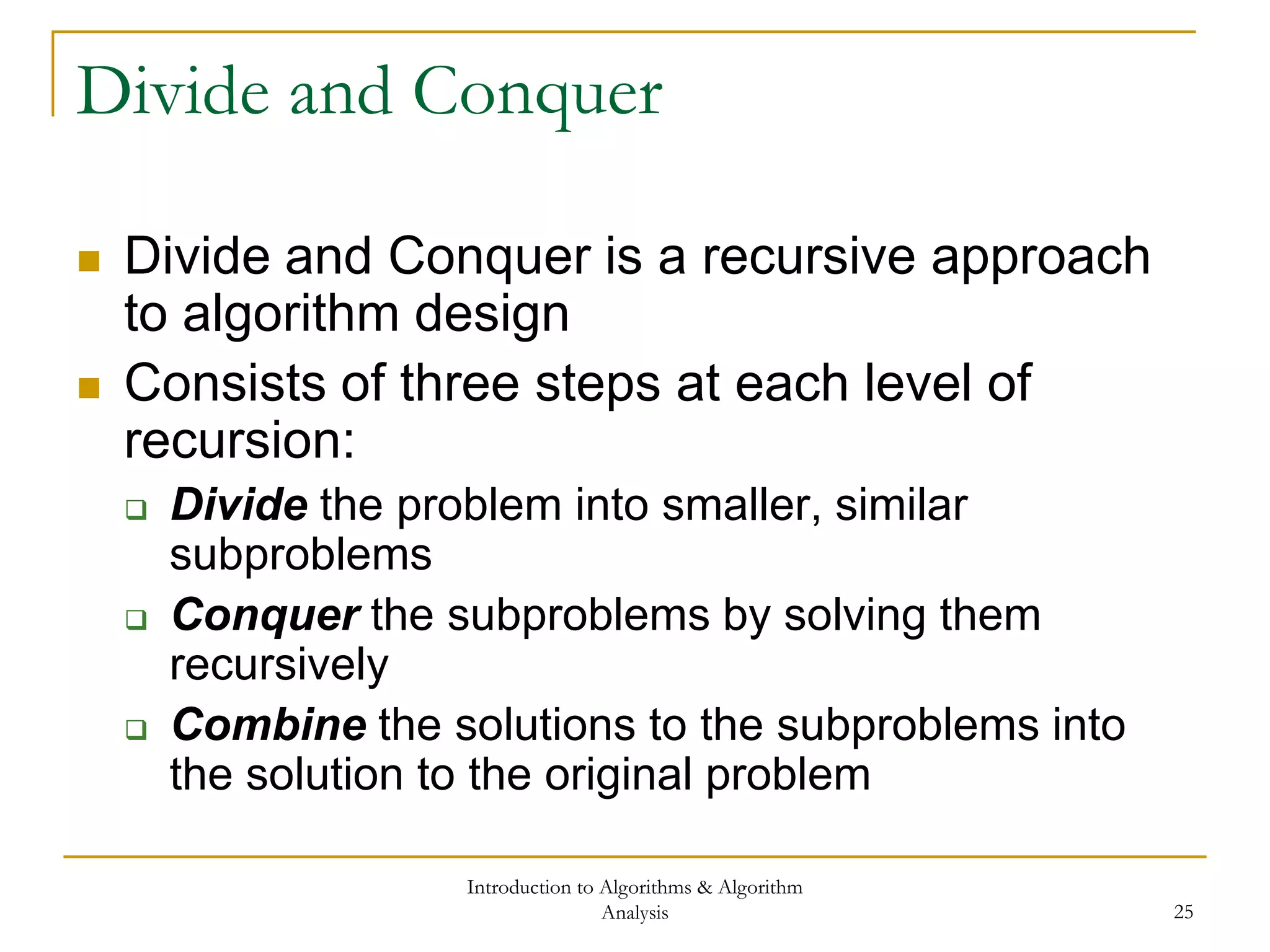
Divide and Conquer
 Divide and Conquer is a recursive approach
to algorithm design
 Consists of three steps at each level of
recursion:
 Divide the problem into smaller, similar
subproblems
 Conquer the subproblems by solving them
recursively
 Combine the solutions to the subproblems into
the solution to the original problem
Introduction to Algorithms & Algorithm
Analysis 26
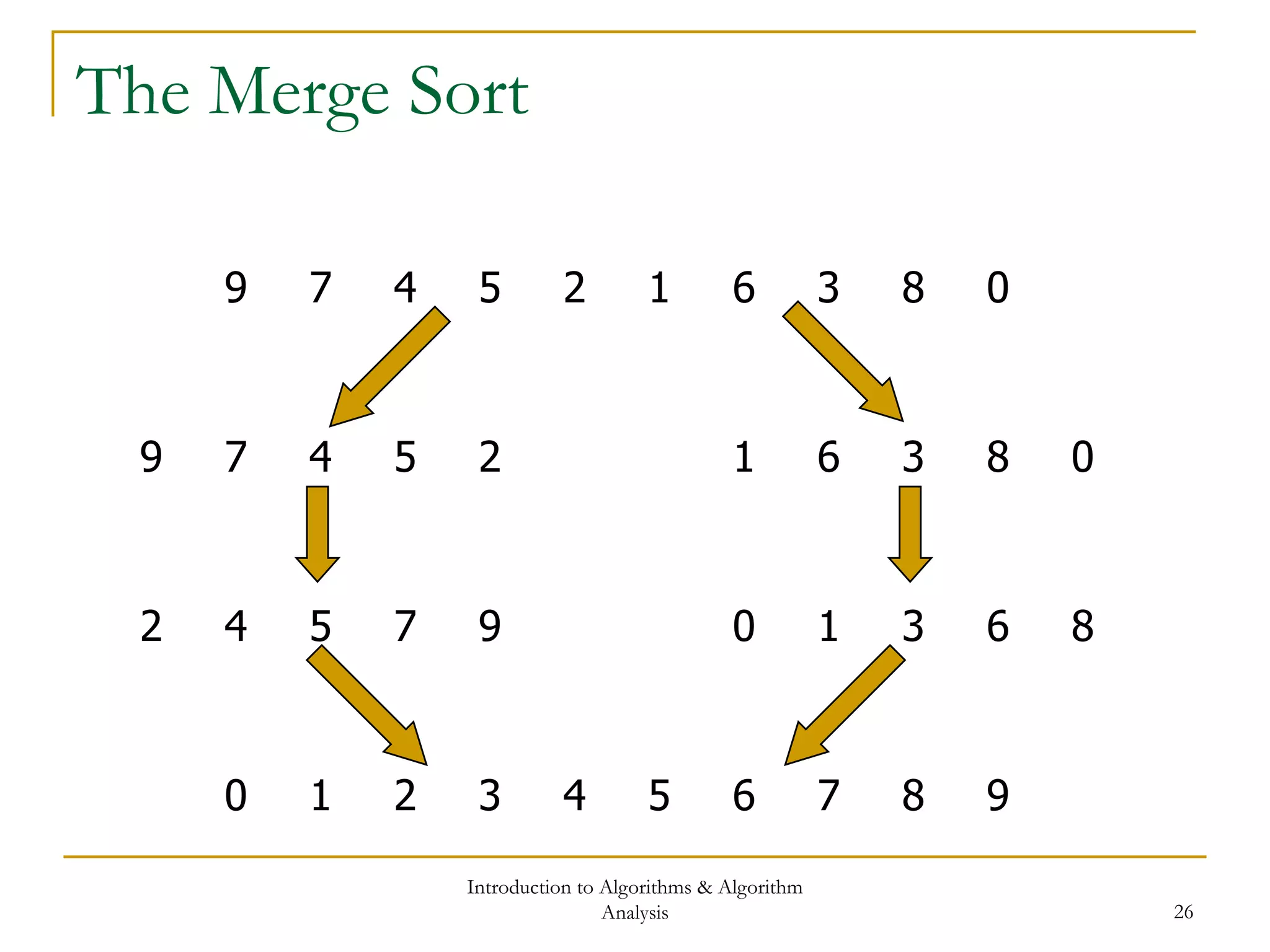
The Merge Sort
9 7 4 5 2 1 6 3 8 0
9 7 4 5 2 1 6 3 8 0
974 52 1 63 80
0 1 2 3 4 5 6 7 8 9
Introduction to Algorithms & Algorithm
Analysis 27
The Merge Sort
void MergeSort(ArrayType A[], int p, int r)
{
if ( p < r )
{
int q = (p+r)/2; // Divide
MergeSort(A, p, q); // Conquer left
MergeSort(A, q+1, r); // Conquer right
Merge(A, p, q, r); // Combine
}
}
Introduction to Algorithms & Algorithm
Analysis 28
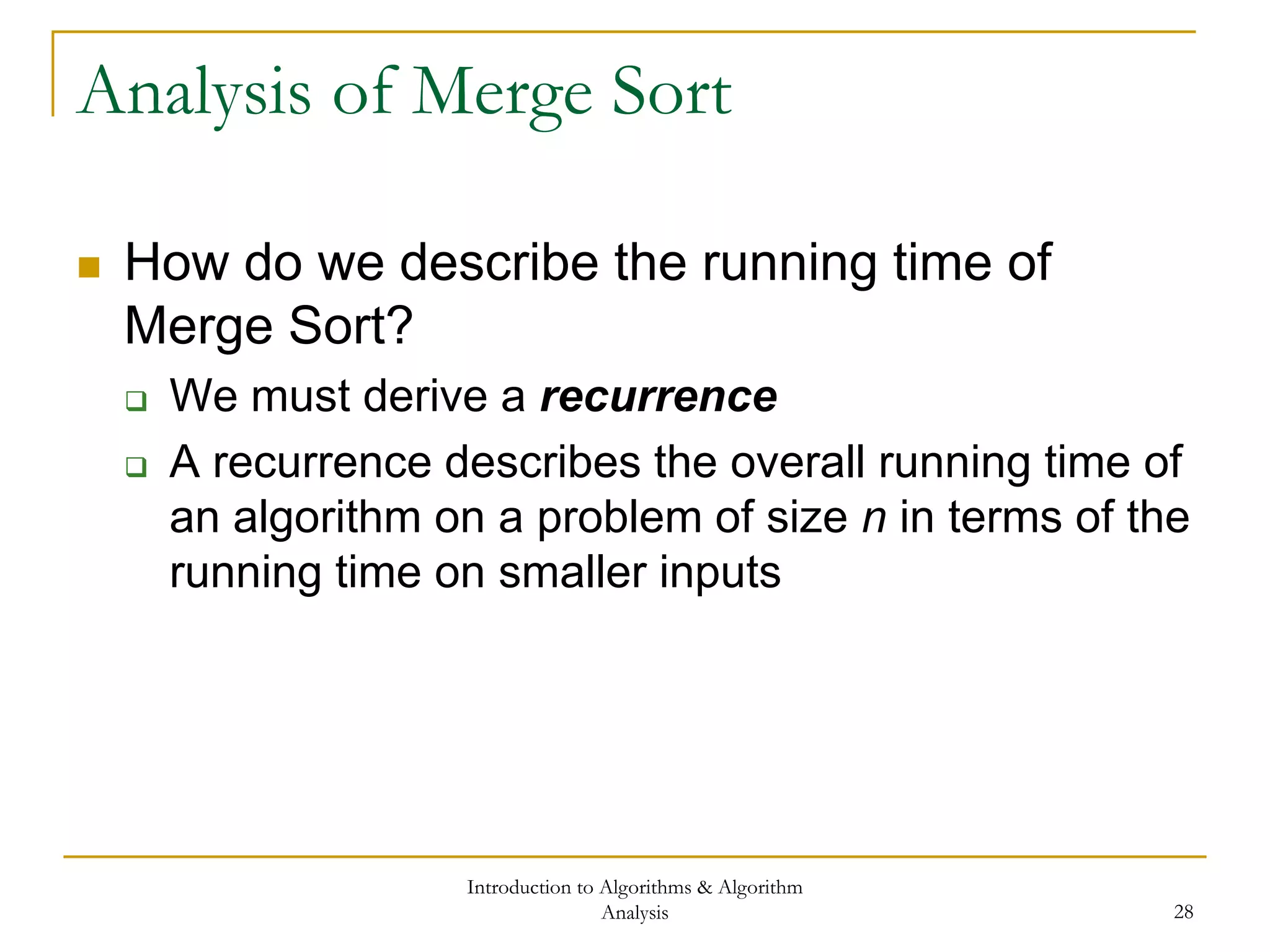
Analysis of Merge Sort
 How do we describe the running time of
Merge Sort?
 We must derive a recurrence
 A recurrence describes the overall running time of
an algorithm on a problem of size n in terms of the
running time on smaller inputs
Introduction to Algorithms & Algorithm
Analysis 29
Analysis of Merge Sort
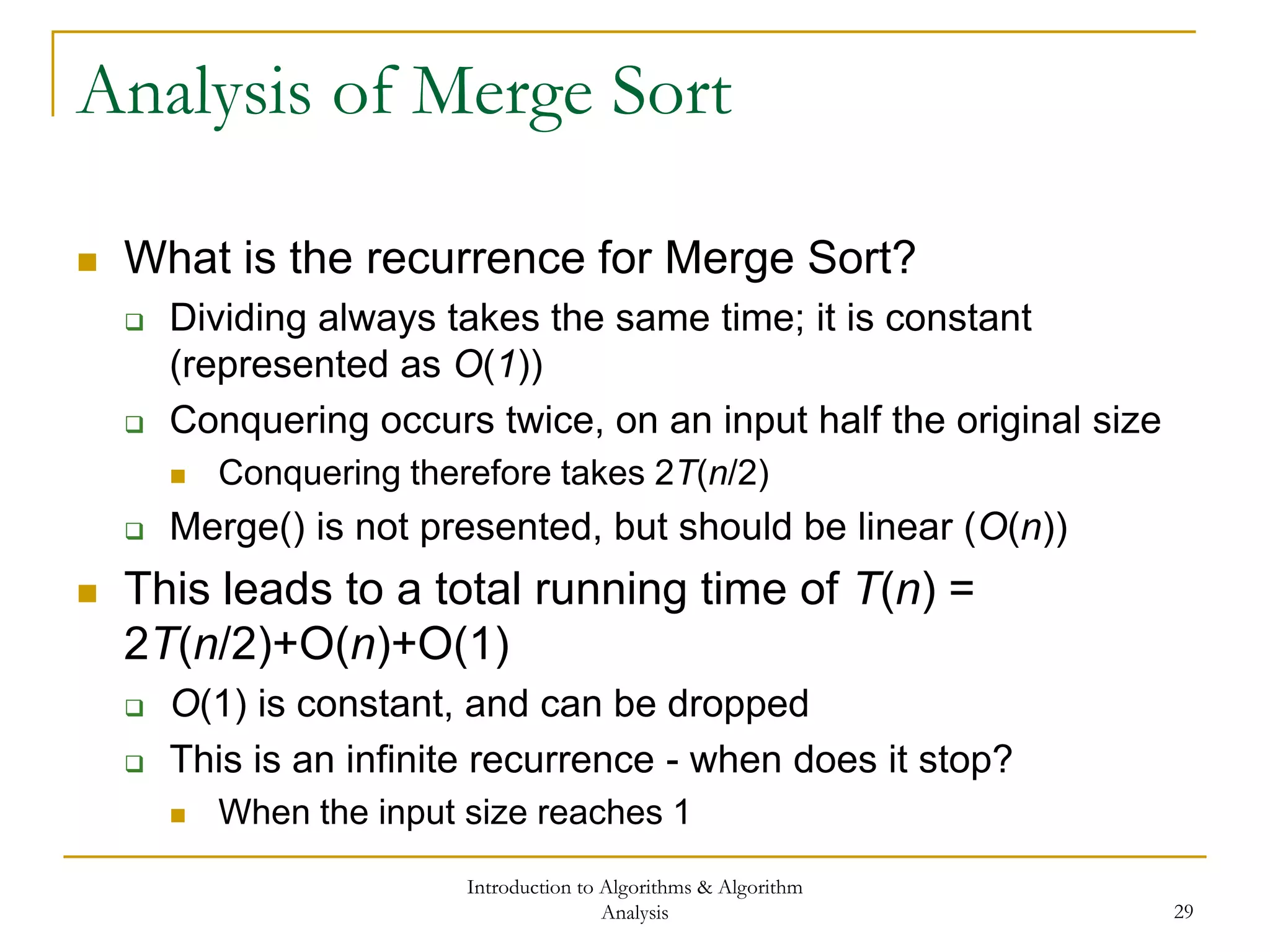
 What is the recurrence for Merge Sort?
 Dividing always takes the same time; it is constant
(represented as O(1))
 Conquering occurs twice, on an input half the original size
 Conquering therefore takes 2T(n/2)
 Merge() is not presented, but should be linear (O(n))
 This leads to a total running time of T(n) =
2T(n/2)+O(n)+O(1)
 O(1) is constant, and can be dropped
 This is an infinite recurrence - when does it stop?
 When the input size reaches 1
Introduction to Algorithms & Algorithm
Analysis 30
Analysis of Merge Sort
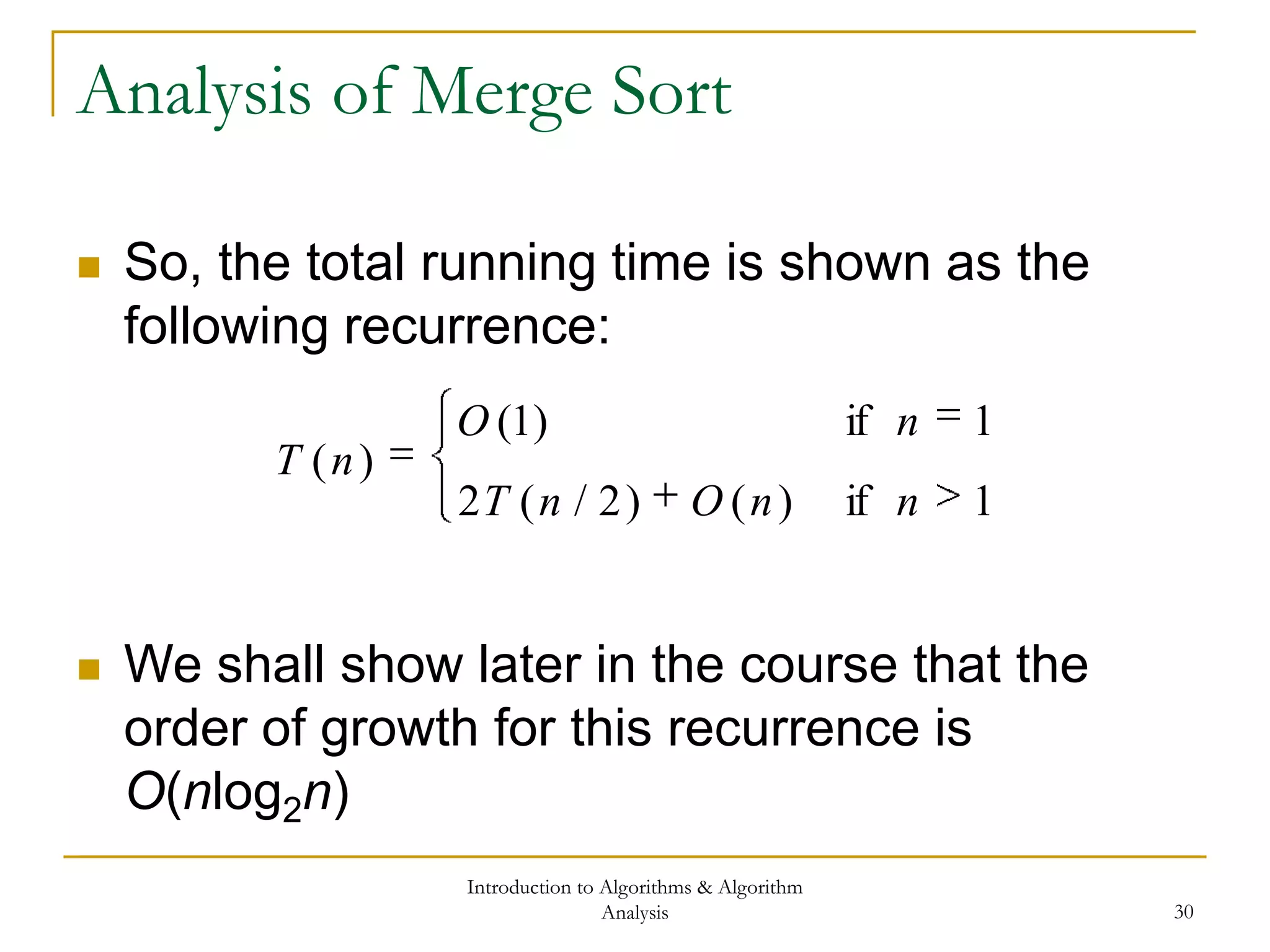
 So, the total running time is shown as the
following recurrence:
 We shall show later in the course that the
order of growth for this recurrence is
O(nlog2n)
1if)()2/(2
1if)1(
)(
nnOnT
nO
nT
Introduction to Algorithms & Algorithm
Analysis 31
Asymptotic Notation
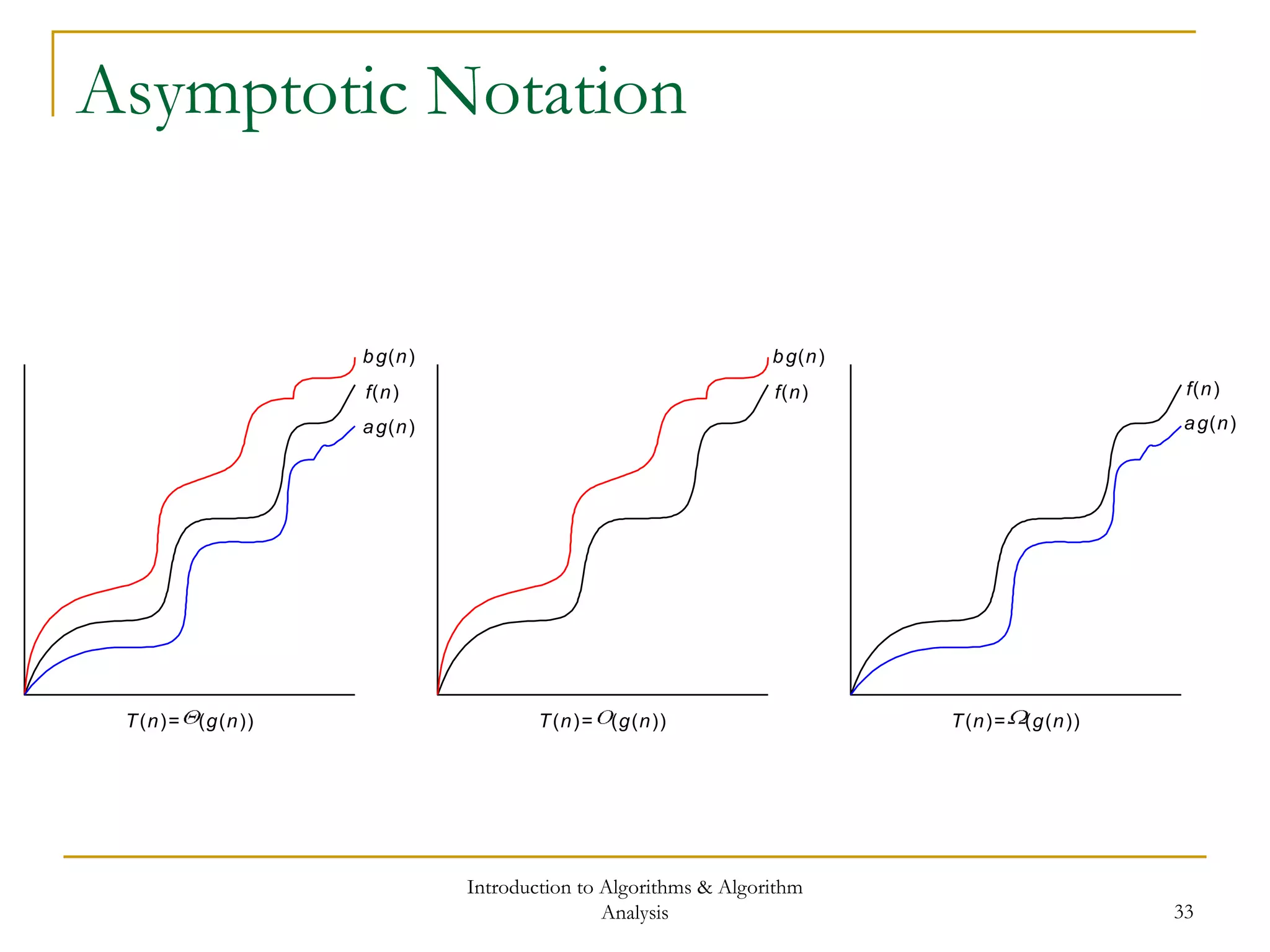
 Asymptotic notation provides a means of
bounding the running time of an algorithm
 Upper bounds signify worst-case running times
 E.g., if T(n) has an upper bound of g(n), this means that
the running time of T(n) is at most cg(n)
 Lower bounds signify best-case running times
Introduction to Algorithms & Algorithm
Analysis 32
Asymptotic Notation
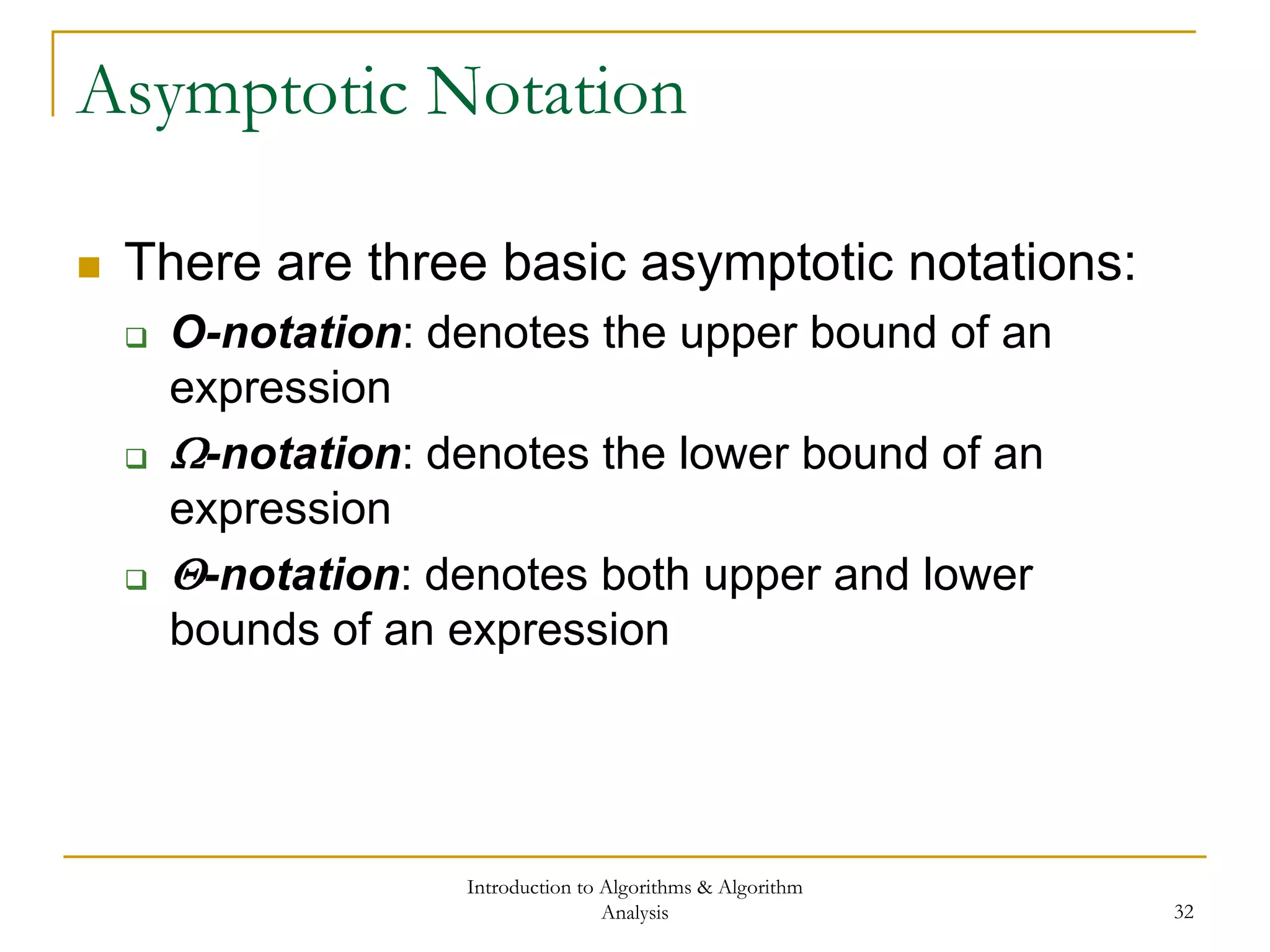
 There are three basic asymptotic notations:
 O-notation: denotes the upper bound of an
expression
 -notation: denotes the lower bound of an
expression
 -notation: denotes both upper and lower
bounds of an expression
Introduction to Algorithms & Algorithm
Analysis 33
Asymptotic Notation
f(n)
ag(n)
bg(n)
f(n)
bg(n)
f(n)
ag(n)
T(n)= (g(n)) T(n)= (g(n)) T(n)= (g(n))
Introduction to Algorithms & Algorithm
Analysis 34
Asymptotic Notation
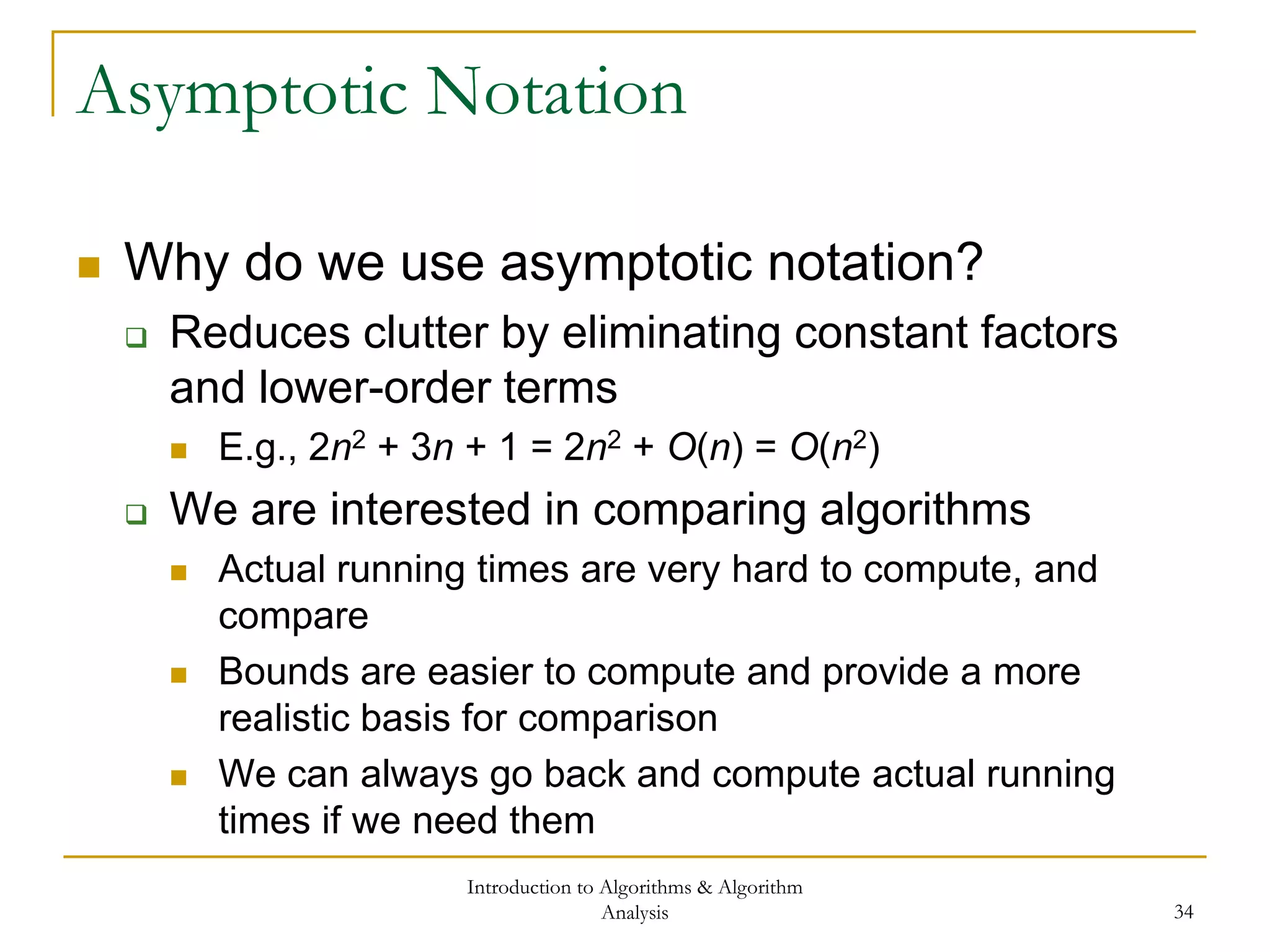
 Why do we use asymptotic notation?
 Reduces clutter by eliminating constant factors
and lower-order terms
 E.g., 2n2 + 3n + 1 = 2n2 + O(n) = O(n2)
 We are interested in comparing algorithms
 Actual running times are very hard to compute, and
compare
 Bounds are easier to compute and provide a more
realistic basis for comparison
 We can always go back and compute actual running
times if we need them
Introduction to Algorithms & Algorithm
Analysis 35
Asymptotic Notation
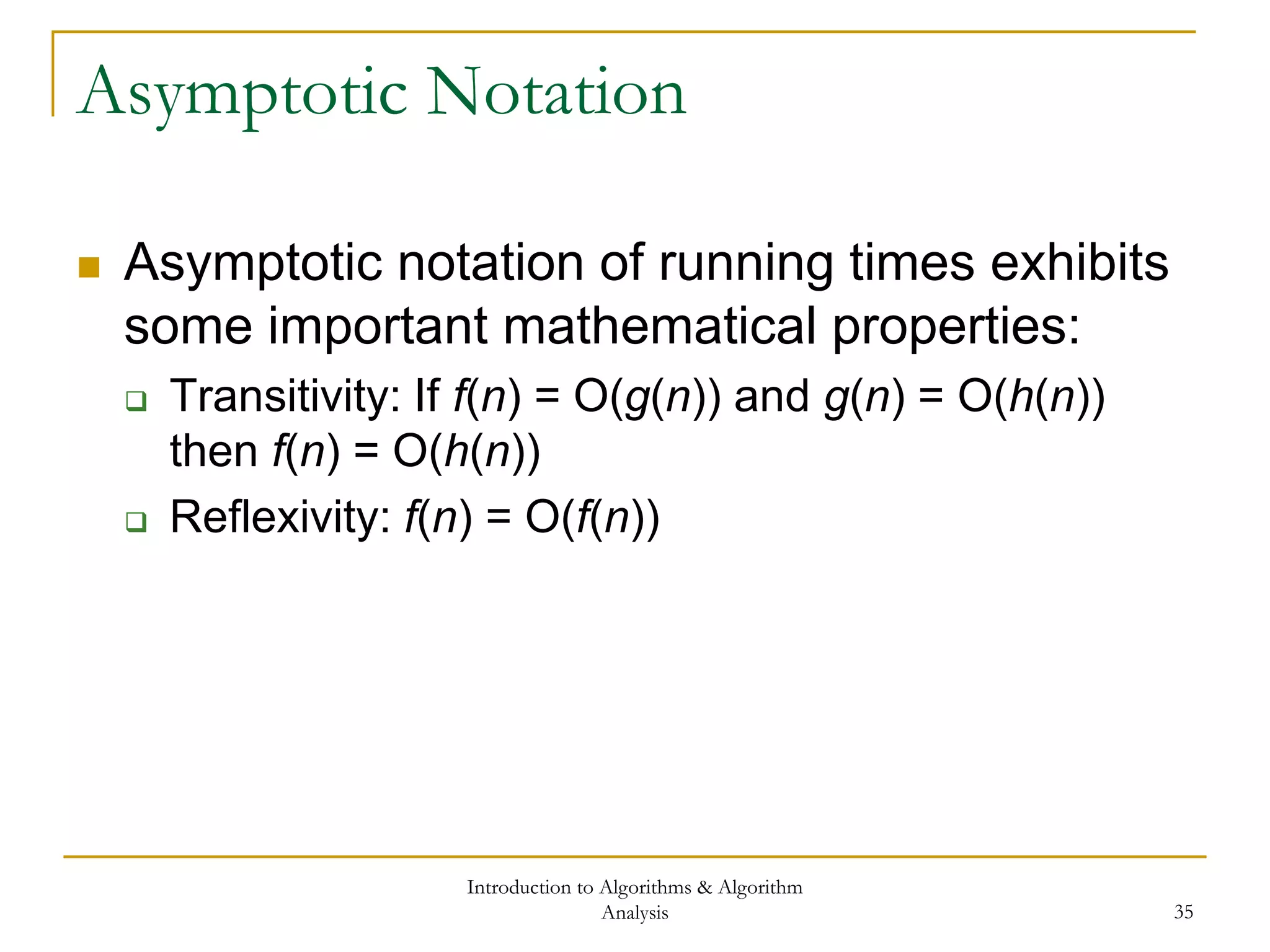
 Asymptotic notation of running times exhibits
some important mathematical properties:
 Transitivity: If f(n) = O(g(n)) and g(n) = O(h(n))
then f(n) = O(h(n))
 Reflexivity: f(n) = O(f(n))
Introduction to Algorithms & Algorithm
Analysis 36
Homework
 Reading: Chapters 1 & 2
 Exercises:
 1.1: 1, 2, 3
 1.2: 2, 5
 1.3: 1, 2, 4, 5, 6
 2.1: 2
 Problems:
 1-1, 2-1, 2-4

Cis435 week01

  • 1.
    Advanced Data Structures& Algorithm Design Introduction to Algorithms and Algorithm Analysis
  • 2.
    Introduction to Algorithms& Algorithm Analysis 2 What is an Algorithm?  Any well-defined computational procedure that takes some value or set of values as input, and produces some value or values as output; or  A sequence of computational steps that transforms the input into the output; or  Tool for solving a well-specified computational problem  The problem specifies the relationship between input and output  The algorithm describes a procedure for achieving that relationship
  • 3.
    Introduction to Algorithms& Algorithm Analysis 3 Algorithms: An Example  The Sorting Problem  The need to sort data arises frequently in practice  Formally, the sorting problem is specified as:  Input: A sequence of n numbers {a1, a2, …, an}  Output: A permutation (reordering) {a1’, a2’, …, an’} of the input sequence such that a1’ <= a2’ <= … <= an’  That is, given the input sequence { 5, 7, 3, 2, 9 }, a sorting algorithm returns as output the sequence { 2, 3, 5, 7, 9}  This is one instance of the sorting problem
  • 4.
    Introduction to Algorithms& Algorithm Analysis 4 Correctness of Algorithms  An algorithm is correct if for every input instance, it halts with the correct output  i.e., it solves the given computational problem  Correctness isn't everything  Incorrectness can be useful, if the error rate can be controlled
  • 5.
    Introduction to Algorithms& Algorithm Analysis 5 Analyzing Algorithms  To analyze an algorithm means to predict the resources that an algorithm will require  Why do we care about an algorithm’s resource requirements?  Resources are bounded – there isn’t an infinite amount of time or space for an algorithm to execute in  What resources do we care about?  Time (how long does it take)  Space (how much memory does it use)
  • 6.
    Introduction to Algorithms& Algorithm Analysis 6 Analyzing Algorithms  Analysis usually measures two forms of complexity:  Spatial Complexity: memory, communications bandwidth  Temporal Complexity: computational time
  • 7.
    Introduction to Algorithms& Algorithm Analysis 7 Analyzing Algorithms: An Example  Two algorithms for solving the same problem often differ dramatically in their efficiency  Consider two sorting algorithms:  Insertion sort takes time roughly equal to c1n2  n is the number of items being sorted;  c1 is a constant that does not depend on n  Merge sort takes time roughly equal to c2nlog2n
  • 8.
    Introduction to Algorithms& Algorithm Analysis 8 Analyzing Algorithms: An Example  What does this mean? Consider sorting 1,000,000 numbers on two different computers  Computer A uses insertion sort, and executes 1,000,000,000 instructions per second; we’ll assume c1 = 2  Computer B uses merge sort, and executes 10,000,000 instructions per second; we’ll assume c2 = 50  How long does it take?
  • 9.
    Introduction to Algorithms& Algorithm Analysis 9 Analyzing Algorithms: An Example  Computer A:  Computer B: seconds2000 ns/secinstructio10 nsinstructio102 9 26 seconds100 ns/secinstructio10 nsinstructio10log1050 7 6 2 6
  • 10.
    Introduction to Algorithms& Algorithm Analysis 10 Insertion Sort  Insertion sort is one method of solving the sorting problem  Conceptually, insertion sort works the way many people sort playing cards:  Start with one hand empty and the cards face down  Remove one card at a time from the table and insert it into the correct position in the left hand
  • 11.
    Introduction to Algorithms& Algorithm Analysis 11 Insertion Sort: Algorithm void InsertionSort(ArrayType A[], unsigned size) { for ( unsigned j = 1 ; j < size ; ++j ) { ArrayType key = A[j]; int i = j-1; while ( i >= 0 && A[i] > key ) { A[i+1] = A[i]; --i; } A[i+1] = key; } }
  • 12.
    Introduction to Algorithms& Algorithm Analysis 12 Operation of Insertion Sort 5 2 4 6 1 3 5 2 4 6 1 3 52 4 6 1 3
  • 13.
    Introduction to Algorithms& Algorithm Analysis 13 Operation of Insertion Sort 52 4 6 1 3 52 4 6 1 3 52 4 61 3 52 4 61 3 52 4 61 3
  • 14.
    Introduction to Algorithms& Algorithm Analysis 14 Analysis of Insertion Sort  How long does insertion sort take?  Time varies based on:  The size of the input  How well sorted the input is to begin with  What is “the size of the input”?  May represent the number of items in the input, or the number of bits being calculated  May be represented by more than one number
  • 15.
    Introduction to Algorithms& Algorithm Analysis 15 Analysis of Insertion Sort  What is “running time”?  Running time is based on the number of steps performed by the processor  Different processors run at different speeds, so time per step will vary between processors  We will express times in terms of a constant cost per step, ci
  • 16.
    Introduction to Algorithms& Algorithm Analysis 16 Analysis of Insertion Sort  What is the “cost” of Insertion Sort?  Total cost = the sum of the cost of each statement * number of times statement is executed Statem ent Cost Tim es for ( unsigned j = 1 ; j < size ; ++j ) c1 n ArrayType key = A[j]; c2 n-1 int i = j-1; c3 n-1 while ( i >= 0 && A[i] > key ) c4 n j j t 1 A[i+1] = A[i]; c5 n j t j1 )1( --i; c6 n j t j1 )1( A[i+1] = key; c7 n-1
  • 17.
    Introduction to Algorithms& Algorithm Analysis 17 Analysis of Insertion Sort  In the best case, all tj = 1  The inner loop only executes once, because the array is already sorted  In this case, T(n)=(c1+c2+c3+c4+c7)n-(c2+c3+c4+c7)  Since all constants are unknown, we can as easily say that T(n)=an+b, where a and b depend on the cost of each statement  So in the best case, the running time is a linear function of n )1()1()()1()1()( 716514321 nctcctcncncncnT n j j n j j  Total cost for insertion sort is:
  • 18.
    Introduction to Algorithms& Algorithm Analysis 18 Analysis of Insertion Sort  In the worst case, tj=j, since every element must be compared  This occurs when the array is reverse sorted  To solve this, we need the solve the summations: )1()1()()1()1()( 716514321 nctcctcncncncnT n j j n j j n j nn j 1 1 2 )1( n j nn j 1 2 )1( )1(
  • 19.
    Introduction to Algorithms& Algorithm Analysis 19 Analysis of Insertion Sort  So, in the worst case: )1( 2 )1( )(1 2 )1( )1()1()( 7654321 nc nn cc nn cncncncnT )()( 2 1 2 )()( 74326547321 2 654 ccccnccccccc n cccnT  We can say that T(n)=ax2+bx+c  The running time in the worst case is therefore a quadratic function of n  In general, we are most interested in worst case running time
  • 20.
    Introduction to Algorithms& Algorithm Analysis 20 Analysis of Insertion Sort  Order of Growth  Actual running time is not nearly as important as the “order of growth” of the running time  Order of growth of the running time is how the running time changes as the size of the input changes  Provides a concrete method of comparing alternative algorithms
  • 21.
    Introduction to Algorithms& Algorithm Analysis 21 Analysis of Insertion Sort  Order of Growth  Order of growth is typically easier to compute than exact running time  In general, we are most interested in the highest order terms of the running time  Lower order terms become insignificant as the input size grows larger  We can also ignore leading coefficients  constant factors are not as significant as growth rate in determining computational efficiency
  • 22.
    Introduction to Algorithms& Algorithm Analysis 22 Analysis of Insertion Sort  Example of Order of Growth:  Best case:  Linear running time: T(n)=an+b  The order of growth is O(n)  This representation (O(n)) is called asymptotic notation  Worst case:  Quadratic running time: T(n)=an2+bn+c  The order of growth is (O(n2))  Order of growth provides us a means of comparing the efficiency of algorithms  Algorithms with lower worst-case order of growth are usually considered to be more efficient
  • 23.
    Introduction to Algorithms& Algorithm Analysis 23 Comparison of Order Of Growth n lgn sqrt(n) n nlgn n*n n*n*n 2^n n! 1 0 1 1 0 1 1 2 1 4 2 2 4 8 16 64 16 24 16 4 4 16 64 256 4096 65536 2.0923E+13 64 6 8 64 384 4096 262144 1.8447E+19 1.2689E+89 256 8 16 256 2048 65536 16777216 1.1579E+77 #NUM! 1024 10 32 1024 10240 1048576 1073741824 #NUM! #NUM! 4096 12 64 4096 49152 16777216 6.8719E+10 #NUM! #NUM!
  • 24.
    Introduction to Algorithms& Algorithm Analysis 24 Designing Algorithms  Insertion sort is typical of an incremental approach to algorithm design  The input is processed in equally sized increments  An alternative approach is divide-and- conquer  The input is recursively divided and processed in smaller, similar chunks
  • 25.
    Introduction to Algorithms& Algorithm Analysis 25 Divide and Conquer  Divide and Conquer is a recursive approach to algorithm design  Consists of three steps at each level of recursion:  Divide the problem into smaller, similar subproblems  Conquer the subproblems by solving them recursively  Combine the solutions to the subproblems into the solution to the original problem
  • 26.
    Introduction to Algorithms& Algorithm Analysis 26 The Merge Sort 9 7 4 5 2 1 6 3 8 0 9 7 4 5 2 1 6 3 8 0 974 52 1 63 80 0 1 2 3 4 5 6 7 8 9
  • 27.
    Introduction to Algorithms& Algorithm Analysis 27 The Merge Sort void MergeSort(ArrayType A[], int p, int r) { if ( p < r ) { int q = (p+r)/2; // Divide MergeSort(A, p, q); // Conquer left MergeSort(A, q+1, r); // Conquer right Merge(A, p, q, r); // Combine } }
  • 28.
    Introduction to Algorithms& Algorithm Analysis 28 Analysis of Merge Sort  How do we describe the running time of Merge Sort?  We must derive a recurrence  A recurrence describes the overall running time of an algorithm on a problem of size n in terms of the running time on smaller inputs
  • 29.
    Introduction to Algorithms& Algorithm Analysis 29 Analysis of Merge Sort  What is the recurrence for Merge Sort?  Dividing always takes the same time; it is constant (represented as O(1))  Conquering occurs twice, on an input half the original size  Conquering therefore takes 2T(n/2)  Merge() is not presented, but should be linear (O(n))  This leads to a total running time of T(n) = 2T(n/2)+O(n)+O(1)  O(1) is constant, and can be dropped  This is an infinite recurrence - when does it stop?  When the input size reaches 1
  • 30.
    Introduction to Algorithms& Algorithm Analysis 30 Analysis of Merge Sort  So, the total running time is shown as the following recurrence:  We shall show later in the course that the order of growth for this recurrence is O(nlog2n) 1if)()2/(2 1if)1( )( nnOnT nO nT
  • 31.
    Introduction to Algorithms& Algorithm Analysis 31 Asymptotic Notation  Asymptotic notation provides a means of bounding the running time of an algorithm  Upper bounds signify worst-case running times  E.g., if T(n) has an upper bound of g(n), this means that the running time of T(n) is at most cg(n)  Lower bounds signify best-case running times
  • 32.
    Introduction to Algorithms& Algorithm Analysis 32 Asymptotic Notation  There are three basic asymptotic notations:  O-notation: denotes the upper bound of an expression  -notation: denotes the lower bound of an expression  -notation: denotes both upper and lower bounds of an expression
  • 33.
    Introduction to Algorithms& Algorithm Analysis 33 Asymptotic Notation f(n) ag(n) bg(n) f(n) bg(n) f(n) ag(n) T(n)= (g(n)) T(n)= (g(n)) T(n)= (g(n))
  • 34.
    Introduction to Algorithms& Algorithm Analysis 34 Asymptotic Notation  Why do we use asymptotic notation?  Reduces clutter by eliminating constant factors and lower-order terms  E.g., 2n2 + 3n + 1 = 2n2 + O(n) = O(n2)  We are interested in comparing algorithms  Actual running times are very hard to compute, and compare  Bounds are easier to compute and provide a more realistic basis for comparison  We can always go back and compute actual running times if we need them
  • 35.
    Introduction to Algorithms& Algorithm Analysis 35 Asymptotic Notation  Asymptotic notation of running times exhibits some important mathematical properties:  Transitivity: If f(n) = O(g(n)) and g(n) = O(h(n)) then f(n) = O(h(n))  Reflexivity: f(n) = O(f(n))
  • 36.
    Introduction to Algorithms& Algorithm Analysis 36 Homework  Reading: Chapters 1 & 2  Exercises:  1.1: 1, 2, 3  1.2: 2, 5  1.3: 1, 2, 4, 5, 6  2.1: 2  Problems:  1-1, 2-1, 2-4