Procurement and
Supply Principles
Certificate in Procurement and Supply Operations
Organisational buying
• The use of resources which belong to the owners of
the organisation
• The acquisition of items that will satisfy the
requirements of other people and be suitable inputs
for defined processes and systems
• Working together with others in a complex network
of relationships, work flows and accountabilities
• Developing and maintaining constructive working
relations with suppliers
Purchasing as a discipline
• Responsible
• Professional
• Effective
• Efficient
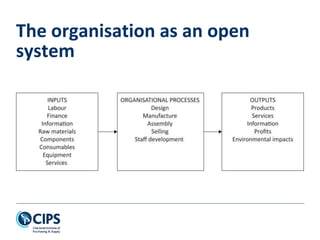
The organisation as an open
system
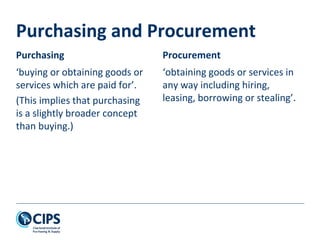
Purchasing and Procurement
Purchasing
‘buying or obtaining goods or
services which are paid for’.
(This implies that purchasing
is a slightly broader concept
than buying.)
Procurement
‘obtaining goods or services in
any way including hiring,
leasing, borrowing or stealing’.
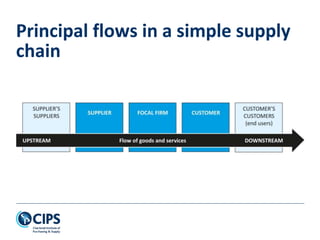
Principal flows in a simple supply
chain
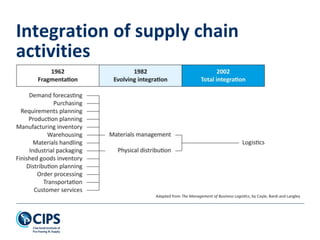
Integration of supply chain
activities
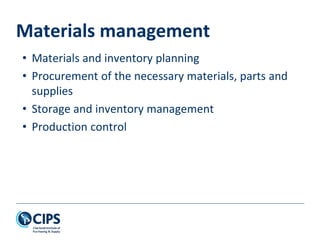
Materials management
• Materials and inventory planning
• Procurement of the necessary materials, parts and
supplies
• Storage and inventory management
• Production control
Contracts
A purchase contract is a statement of:
• Exactly what two or more parties have agreed to do or
exchange
• Conditions and contingencies which may alter the
arrangement
• The rights of each party if the other fails to do what it has
agreed to do
• How responsibility or ‘liability’ will be apportioned in the
event of problems
• How any disputes will be resolved
• Contract development
• Contract manager (or contract management team)
• Contract administration
• Managing contract performance
• Relationship management
• Contract renewal or termination
Key elements of contract
management
Purchasing in service
organisations
What items are bought from outside in a
typical service organisation?
• Office equipment and supplies such as stationery
• Computer hardware and software
• Motor vehicles
• Advertising and design services
• Maintenance services (for computers, vehicles and buildings)
• In some cases, capital goods
Trends in service supply chains
• Services are increasingly about the management and
supply of information
• Information can replace inventory
• Services are increasingly outsourced, as organisations
focus on core activities
• The combination of automation and outsourcing has
enabled the development of virtual service
organisations and networks
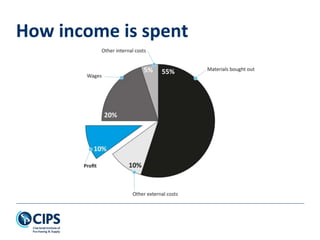
How income is spent
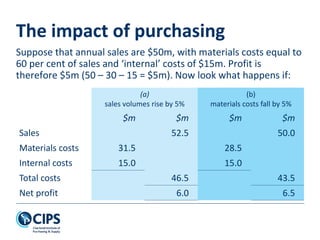
The impact of purchasing
(a)
sales volumes rise by 5%
(b)
materials costs fall by 5%
$m $m $m $m
Sales 52.5 50.0
Materials costs 31.5 28.5
Internal costs 15.0 15.0
Total costs 46.5 43.5
Net profit 6.0 6.5
Suppose that annual sales are $50m, with materials costs equal to
60 per cent of sales and ‘internal’ costs of $15m. Profit is
therefore $5m (50 – 30 – 15 = $5m). Now look what happens if:
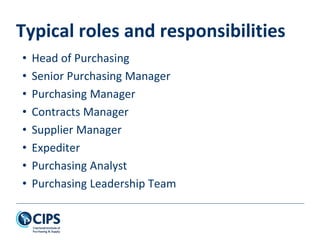
Typical roles and responsibilities
• Head of Purchasing
• Senior Purchasing Manager
• Purchasing Manager
• Contracts Manager
• Supplier Manager
• Expediter
• Purchasing Analyst
• Purchasing Leadership Team
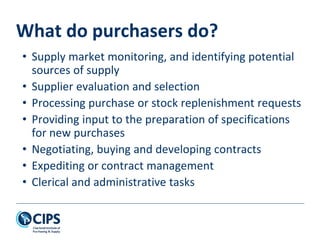
What do purchasers do?
• Supply market monitoring, and identifying potential
sources of supply
• Supplier evaluation and selection
• Processing purchase or stock replenishment requests
• Providing input to the preparation of specifications
for new purchases
• Negotiating, buying and developing contracts
• Expediting or contract management
• Clerical and administrative tasks
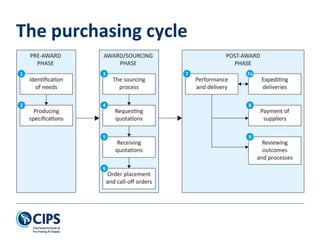
The purchasing cycle
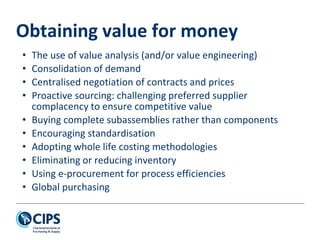
Obtaining value for money
• The use of value analysis (and/or value engineering)
• Consolidation of demand
• Centralised negotiation of contracts and prices
• Proactive sourcing: challenging preferred supplier
complacency to ensure competitive value
• Buying complete subassemblies rather than components
• Encouraging standardisation
• Adopting whole life costing methodologies
• Eliminating or reducing inventory
• Using e-procurement for process efficiencies
• Global purchasing
Defining sustainable procurement
• Economic considerations
• Environmental aspects, ie green procurement
• Social aspects
• The development and implementation of sustainable procurement
strategies and policies
• The design and development of sustainable products and services
• The definition of requirements to include sustainable materials,
components, supplies and services
• The sustainable and ethical sourcing of products and services
• The management of supply and logistics processes to minimise waste,
transport and other environmental impacts, and to support reverse
logistics, recycling, re-use and other measures
• The monitoring, management and development of suppliers
• Monitoring, measuring and reporting on the sustainability of procurement
The procurement function’s
contribution to sustainability
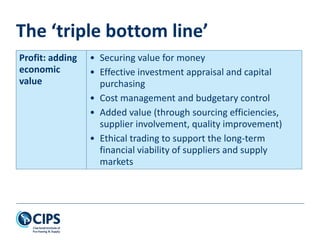
The ‘triple bottom line’
Profit: adding
economic
value
• Securing value for money
• Effective investment appraisal and capital
purchasing
• Cost management and budgetary control
• Added value (through sourcing efficiencies,
supplier involvement, quality improvement)
• Ethical trading to support the long-term
financial viability of suppliers and supply
markets
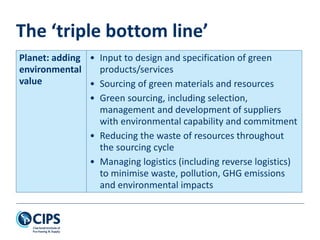
The ‘triple bottom line’
Planet: adding
environmental
value
• Input to design and specification of green
products/services
• Sourcing of green materials and resources
• Green sourcing, including selection,
management and development of suppliers
with environmental capability and commitment
• Reducing the waste of resources throughout
the sourcing cycle
• Managing logistics (including reverse logistics)
to minimise waste, pollution, GHG emissions
and environmental impacts
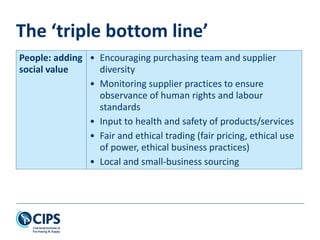
The ‘triple bottom line’
People: adding
social value
• Encouraging purchasing team and supplier
diversity
• Monitoring supplier practices to ensure
observance of human rights and labour
standards
• Input to health and safety of products/services
• Fair and ethical trading (fair pricing, ethical use
of power, ethical business practices)
• Local and small-business sourcing
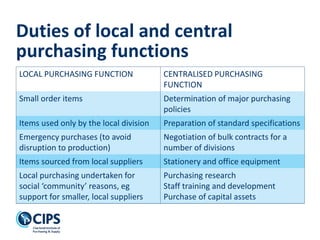
LOCAL PURCHASING FUNCTION CENTRALISED PURCHASING
FUNCTION
Small order items Determination of major purchasing
policies
Items used only by the local division Preparation of standard specifications
Emergency purchases (to avoid
disruption to production)
Negotiation of bulk contracts for a
number of divisions
Items sourced from local suppliers Stationery and office equipment
Local purchasing undertaken for
social ‘community’ reasons, eg
support for smaller, local suppliers
Purchasing research
Staff training and development
Purchase of capital assets
Duties of local and central
purchasing functions
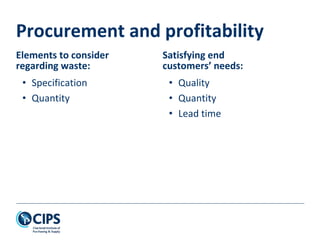
Procurement and profitability
Elements to consider
regarding waste:
• Specification
• Quantity
Satisfying end
customers’ needs:
• Quality
• Quantity
• Lead time
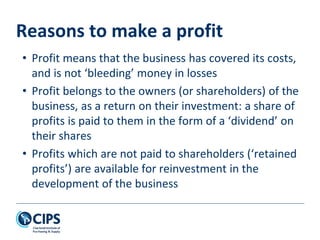
Reasons to make a profit
• Profit means that the business has covered its costs,
and is not ‘bleeding’ money in losses
• Profit belongs to the owners (or shareholders) of the
business, as a return on their investment: a share of
profits is paid to them in the form of a ‘dividend’ on
their shares
• Profits which are not paid to shareholders (‘retained
profits’) are available for reinvestment in the
development of the business
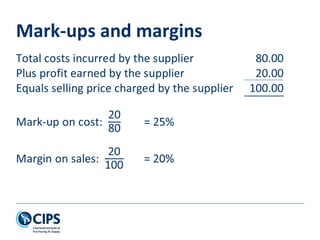
Mark-ups and margins
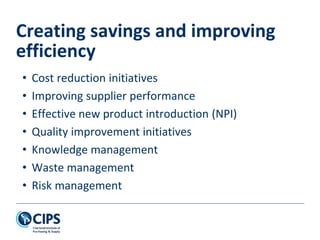
• Cost reduction initiatives
• Improving supplier performance
• Effective new product introduction (NPI)
• Quality improvement initiatives
• Knowledge management
• Waste management
• Risk management
Creating savings and improving
efficiency
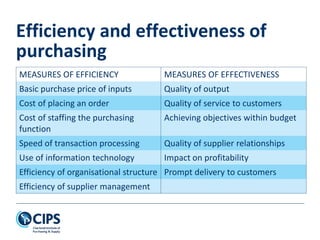
MEASURES OF EFFICIENCY MEASURES OF EFFECTIVENESS
Basic purchase price of inputs Quality of output
Cost of placing an order Quality of service to customers
Cost of staffing the purchasing
function
Achieving objectives within budget
Speed of transaction processing Quality of supplier relationships
Use of information technology Impact on profitability
Efficiency of organisational structure Prompt delivery to customers
Efficiency of supplier management
Efficiency and effectiveness of
purchasing
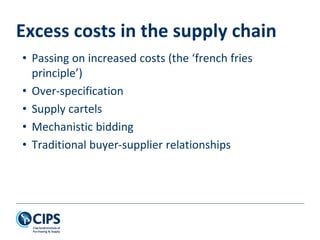
Excess costs in the supply chain
• Passing on increased costs (the ‘french fries
principle’)
• Over-specification
• Supply cartels
• Mechanistic bidding
• Traditional buyer-supplier relationships
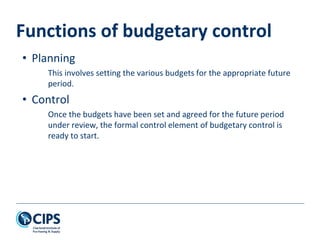
Functions of budgetary control
• Planning
This involves setting the various budgets for the appropriate future
period.
• Control
Once the budgets have been set and agreed for the future period
under review, the formal control element of budgetary control is
ready to start.
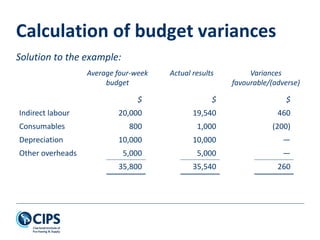
Calculation of budget variances
Solution to the example:
Average four-week
budget
Actual results Variances
favourable/(adverse)
$ $ $
Indirect labour 20,000 19,540 460
Consumables 800 1,000 (200)
Depreciation 10,000 10,000 —
Other overheads 5,000 5,000 —
35,800 35,540 260
Establishing budget targets
• Incremental budget
• Zero-based budget
• Priority based budget
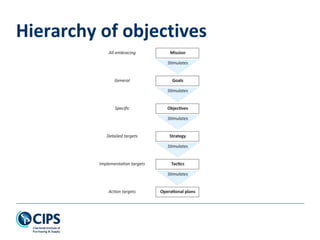
Hierarchy of objectives
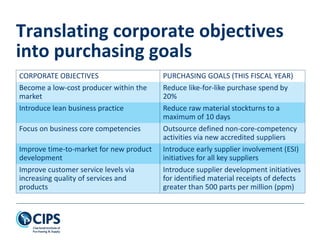
CORPORATE OBJECTIVES PURCHASING GOALS (THIS FISCAL YEAR)
Become a low-cost producer within the
market
Reduce like-for-like purchase spend by
20%
Introduce lean business practice Reduce raw material stockturns to a
maximum of 10 days
Focus on business core competencies Outsource defined non-core-competency
activities via new accredited suppliers
Improve time-to-market for new product
development
Introduce early supplier involvement (ESI)
initiatives for all key suppliers
Improve customer service levels via
increasing quality of services and
products
Introduce supplier development initiatives
for identified material receipts of defects
greater than 500 parts per million (ppm)
Translating corporate objectives
into purchasing goals
The five rights
• Inputs of the right quality
• Delivered in the right quantity
• To the right place
• At the right time
• For the right price
Additional objectives to consider
• Relationship development
• Innovation and development
• Ethics and corporate social responsibility
• Total costs of ownership of purchased items
The right selling price
• A price which ‘the market will bear’
• A price which allows the seller to win business,
in competition with other suppliers
• A price which allows the seller at least to cover
costs, and ideally to make a healthy profit
The right purchase price
• A price which the purchaser can afford
• A price which appears fair and reasonable, or
represents value for money
• A price which gives the purchaser a cost or quality
advantage over its competitors
• A price which reflects sound purchasing practices
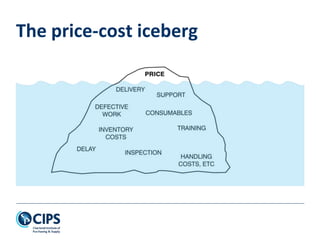
The price-cost iceberg
Dimensions of product quality
• Performance
• Features
• Reliability
• Durability
• Conformance
• Serviceability
• Aesthetics
• Perceived quality
Specifications and quality
• Conformance
The buyer details exactly what the required product, part or material
must consist of, and a ‘quality’ product is one which conforms to the
description provided by the buyer.
• Performance
The buyer describes what he expects the part or material to be able to
achieve, in terms of the functions it will perform and the level of
performance it should reach. A ‘quality’ product is then one which will
satisfy these requirements: the buyer specifies the ‘ends’ (purpose)
and the supplier has relative flexibility about the ‘means’ of achieving
them.
Supplier lead times
• The internal lead time is the lead time for the
processes carried out within the buying organisation
• The external lead time is the lead time for the
processes carried out within the supplying
organisation
• The total lead time is therefore a combination of
internal and external lead time
The right quantity
• Demand for the final product
• Demand for purchased finished items
• The inventory policy of the organisation
• The service level required
• Market conditions
• Supply-side factors
• Factors determining the economic order quantity (EOQ)
• Specific quantities notified to buyers by user
departments, according to identified needs
Specifying delivery
• A full and accurate delivery address
• The contact person at the delivery address
• Packaging instructions
• Delivery instructions
• Transport instructions
• The point at which ownership or title in the goods
‘pass’ from the supplier to the buyer
Categories of supply
• Direct supplies
• Indirect supplies
Or:
• Maintenance, repair and operations (MRO) supplies
• Services
• Capital equipment
GOODS SERVICES
Tangible Intangible
Can be inventoried Cannot be inventoried
Little customer contact Extensive customer contact
Standard customer contact Flexible customer contact
Long lead times Short lead times
Capital intensive Labour intensive
Quality easy to assess Quality very difficult to assess
Characteristics of goods and
services
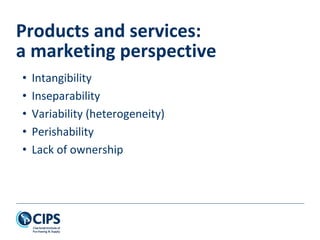
• Intangibility
• Inseparability
• Variability (heterogeneity)
• Perishability
• Lack of ownership
Products and services:
a marketing perspective
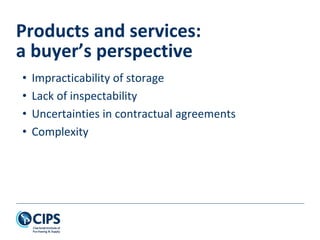
• Impracticability of storage
• Lack of inspectability
• Uncertainties in contractual agreements
• Complexity
Products and services:
a buyer’s perspective
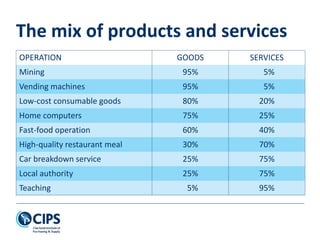
The mix of products and services
OPERATION GOODS SERVICES
Mining 95% 5%
Vending machines 95% 5%
Low-cost consumable goods 80% 20%
Home computers 75% 25%
Fast-food operation 60% 40%
High-quality restaurant meal 30% 70%
Car breakdown service 25% 75%
Local authority 25% 75%
Teaching 5% 95%
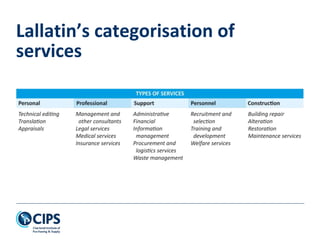
Lallatin’s categorisation of
services
Quality characteristics of services
• Reliability
• Responsiveness
• Competence
• Access
• Courtesy
• Communication
• Credibility
• Security
• Understanding
• Tangibles
External customers
• Wholesalers
• Distributors and dealers
• Agents
• Franchisees
• Retailers
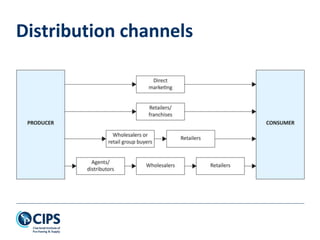
Distribution channels
Who are your internal customers?
• Senior management
• Related functions in the internal supply chain
• Managers in ‘user’ functions
• Staff in other functions who carry out some
purchasing for their own units
Organisational competencies
• Threshold competencies
The basic capabilities necessary to support a particular strategy or to
enable the organisation to compete in a given market.
• Core competencies
Distinctive value-creating skills, capabilities and resources.
• They are activities that add value in the eyes of the
customer
• They are scarce and difficult for competitors to
imitate
• They are flexible in light of the organisation’s future
needs
Three characteristics of core
competencies
Make/do or buy?
The decision is based on a number of factors
• Strategic planning
• Production capacity
• Suitable external suppliers
• Relationships with suppliers
• Effects on the internal workforce
• Labour market conditions
• Sales forecasts
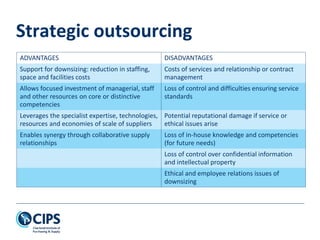
Strategic outsourcing
ADVANTAGES DISADVANTAGES
Support for downsizing: reduction in staffing,
space and facilities costs
Costs of services and relationship or contract
management
Allows focused investment of managerial, staff
and other resources on core or distinctive
competencies
Loss of control and difficulties ensuring service
standards
Leverages the specialist expertise, technologies,
resources and economies of scale of suppliers
Potential reputational damage if service or
ethical issues arise
Enables synergy through collaborative supply
relationships
Loss of in-house knowledge and competencies
(for future needs)
Loss of control over confidential information
and intellectual property
Ethical and employee relations issues of
downsizing
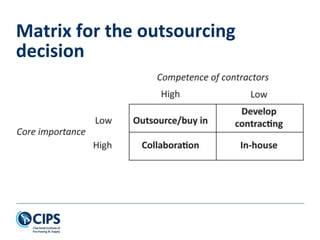
Matrix for the outsourcing
decision
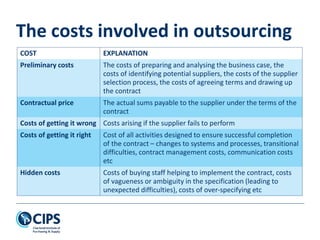
The costs involved in outsourcing
COST EXPLANATION
Preliminary costs The costs of preparing and analysing the business case, the
costs of identifying potential suppliers, the costs of the supplier
selection process, the costs of agreeing terms and drawing up
the contract
Contractual price The actual sums payable to the supplier under the terms of the
contract
Costs of getting it wrong Costs arising if the supplier fails to perform
Costs of getting it right Cost of all activities designed to ensure successful completion
of the contract – changes to systems and processes, transitional
difficulties, contract management costs, communication costs
etc
Hidden costs Costs of buying staff helping to implement the contract, costs
of vagueness or ambiguity in the specification (leading to
unexpected difficulties), costs of over-specifying etc
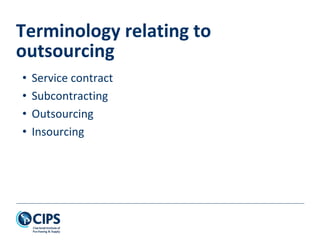
• Service contract
• Subcontracting
• Outsourcing
• Insourcing
Terminology relating to
outsourcing
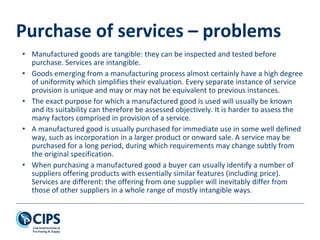
Purchase of services – problems
• Manufactured goods are tangible: they can be inspected and tested before
purchase. Services are intangible.
• Goods emerging from a manufacturing process almost certainly have a high degree
of uniformity which simplifies their evaluation. Every separate instance of service
provision is unique and may or may not be equivalent to previous instances.
• The exact purpose for which a manufactured good is used will usually be known
and its suitability can therefore be assessed objectively. It is harder to assess the
many factors comprised in provision of a service.
• A manufactured good is usually purchased for immediate use in some well defined
way, such as incorporation in a larger product or onward sale. A service may be
purchased for a long period, during which requirements may change subtly from
the original specification.
• When purchasing a manufactured good a buyer can usually identify a number of
suppliers offering products with essentially similar features (including price).
Services are different: the offering from one supplier will inevitably differ from
those of other suppliers in a whole range of mostly intangible ways.
Outsourcing the logistics function
Potential benefits that may be realised:
• Contracting out frees up resources
• Logistics specialists are well placed to recognise and respond
to rising customer expectations
• Contracting out gives greater flexibility in times of difficulty
• Buying firms gain access to specialist expertise which may
enable them to develop improved distribution systems,
offering better service than customers would otherwise have
received
• Costs may be cheaper if we do not pay a profit
margin to an outside supplier
• There may be no suitable provider externally
• There may be reasons of confidentiality
• By keeping the activity in-house we retain control
over quality
Reasons for keeping shared
services in-house
• Absence of competition can lead to complacency
within the internal department providing the service
• Similarly, there may be a lack of efficiency, innovation
and customer responsiveness
• There are no economies of scale, as the internal
provider has only one customer
Disadvantages of using internally
provided services
Identification of needs
• A description of the product or service required
• The quantity required
• The delivery or provision date
• The internal department code, or budgetary code
• The name and signature of the originator of the requisition,
and its date
A purchase requisition form will typically include the
following details:
Appraising suppliers
Carter’s 10 Cs:
• Competence
• Capacity
• Commitment
• Control systems
• Cash
• Consistency
• Cost
• Cultural compatibility
• Clean and compliant
• Communication
Requesting quotations
• Quantity and description of items required
• Required delivery date and address for delivery
• Special requirements relating to packaging and/or materials
handling
• Terms and conditions of purchase
• Terms of payment
• Contact details
The request for quotation (RFQ) will set out the details
of the requirement:
Evaluating supplier quotations
• Previous performance of the supplier (including financial stability,
reliability etc)
• Delivery lead time
• Add-on costs (freight, insurance, installation and training etc)
• Running costs (including energy efficiency)
• Warranty terms
• Availability of spares
• Availability of maintenance cover
• Ability to upgrade to higher specification
• Risk of obsolescence
• Payment terms
• Residual value and disposal costs
• In the case of overseas suppliers, exchange rates, taxes and import duties
Models of negotiation
KENNEDY GREENHALGH BAILY ET AL
• Prepare: what do
we want?
• Debate: what do
they want?
• Propose: what
wants might we
trade?
• Bargain: what
wants will we
trade?
• Preparation
• Relationship
building
• Information
gathering
• Information using
• Bidding
• Closing the deal
• Implementing the
agreement
• Pre-negotiation
phase
• Negotiation/inter
action phase
• Post-negotiation
follow-up
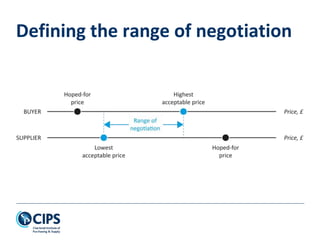
Defining the range of negotiation
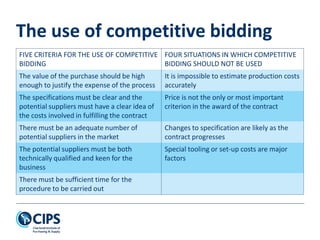
The use of competitive bidding
FIVE CRITERIA FOR THE USE OF COMPETITIVE
BIDDING
FOUR SITUATIONS IN WHICH COMPETITIVE
BIDDING SHOULD NOT BE USED
The value of the purchase should be high
enough to justify the expense of the process
It is impossible to estimate production costs
accurately
The specifications must be clear and the
potential suppliers must have a clear idea of
the costs involved in fulfilling the contract
Price is not the only or most important
criterion in the award of the contract
There must be an adequate number of
potential suppliers in the market
Changes to specification are likely as the
contract progresses
The potential suppliers must be both
technically qualified and keen for the
business
Special tooling or set-up costs are major
factors
There must be sufficient time for the
procedure to be carried out
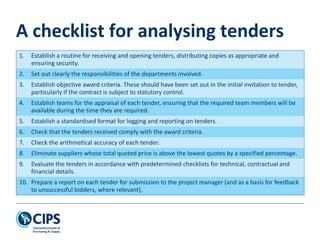
A checklist for analysing tenders
1. Establish a routine for receiving and opening tenders, distributing copies as appropriate and
ensuring security.
2. Set out clearly the responsibilities of the departments involved.
3. Establish objective award criteria. These should have been set out in the initial invitation to tender,
particularly if the contract is subject to statutory control.
4. Establish teams for the appraisal of each tender, ensuring that the required team members will be
available during the time they are required.
5. Establish a standardised format for logging and reporting on tenders.
6. Check that the tenders received comply with the award criteria.
7. Check the arithmetical accuracy of each tender.
8. Eliminate suppliers whose total quoted price is above the lowest quotes by a specified percentage.
9. Evaluate the tenders in accordance with predetermined checklists for technical, contractual and
financial details.
10. Prepare a report on each tender for submission to the project manager (and as a basis for feedback
to unsuccessful bidders, where relevant).
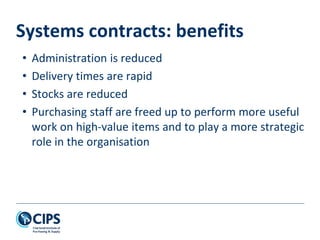
Systems contracts: benefits
• Administration is reduced
• Delivery times are rapid
• Stocks are reduced
• Purchasing staff are freed up to perform more useful
work on high-value items and to play a more strategic
role in the organisation
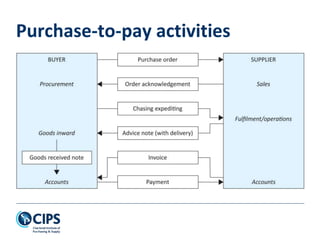
Purchase-to-pay activities
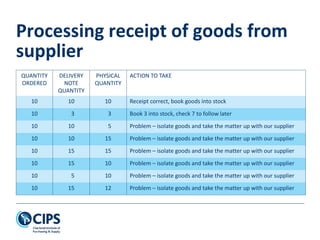
QUANTITY
ORDERED
DELIVERY
NOTE
QUANTITY
PHYSICAL
QUANTITY
ACTION TO TAKE
10 10 10 Receipt correct, book goods into stock
10 3 3 Book 3 into stock, check 7 to follow later
10 10 5 Problem – isolate goods and take the matter up with our supplier
10 10 15 Problem – isolate goods and take the matter up with our supplier
10 15 15 Problem – isolate goods and take the matter up with our supplier
10 15 10 Problem – isolate goods and take the matter up with our supplier
10 5 10 Problem – isolate goods and take the matter up with our supplier
10 15 12 Problem – isolate goods and take the matter up with our supplier
Processing receipt of goods from
supplier
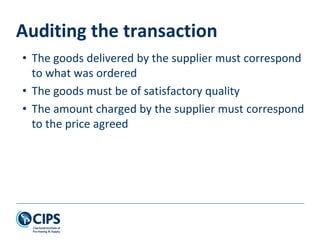
Auditing the transaction
• The goods delivered by the supplier must correspond
to what was ordered
• The goods must be of satisfactory quality
• The amount charged by the supplier must correspond
to the price agreed
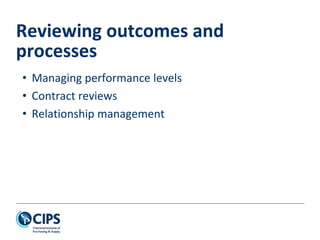
• Managing performance levels
• Contract reviews
• Relationship management
Reviewing outcomes and
processes
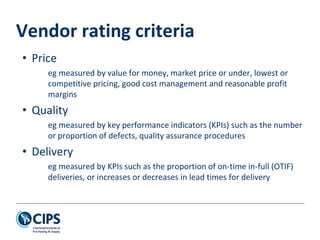
Vendor rating criteria
• Price
eg measured by value for money, market price or under, lowest or
competitive pricing, good cost management and reasonable profit
margins
• Quality
eg measured by key performance indicators (KPIs) such as the number
or proportion of defects, quality assurance procedures
• Delivery
eg measured by KPIs such as the proportion of on-time in-full (OTIF)
deliveries, or increases or decreases in lead times for delivery
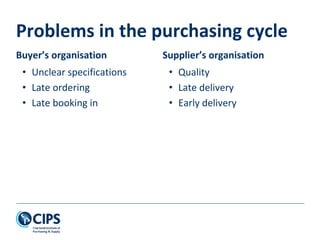
Problems in the purchasing cycle
Buyer’s organisation
• Unclear specifications
• Late ordering
• Late booking in
Supplier’s organisation
• Quality
• Late delivery
• Early delivery
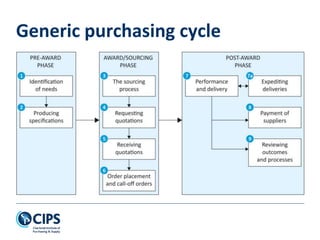
Generic purchasing cycle
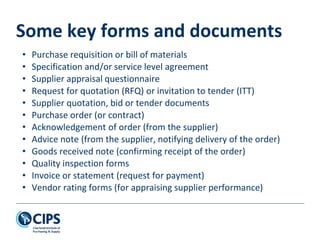
Some key forms and documents
• Purchase requisition or bill of materials
• Specification and/or service level agreement
• Supplier appraisal questionnaire
• Request for quotation (RFQ) or invitation to tender (ITT)
• Supplier quotation, bid or tender documents
• Purchase order (or contract)
• Acknowledgement of order (from the supplier)
• Advice note (from the supplier, notifying delivery of the order)
• Goods received note (confirming receipt of the order)
• Quality inspection forms
• Invoice or statement (request for payment)
• Vendor rating forms (for appraising supplier performance)
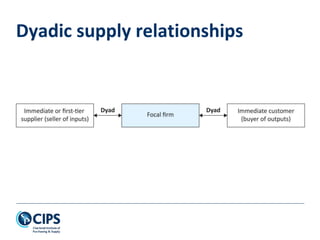
Dyadic supply relationships
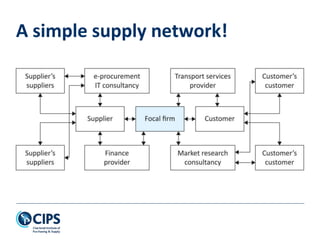
A simple supply network!
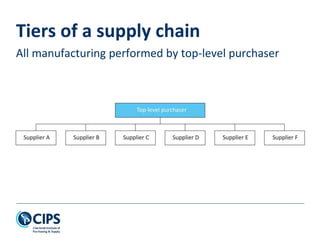
Tiers of a supply chain
All manufacturing performed by top-level purchaser
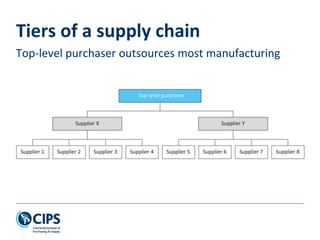
Tiers of a supply chain
Top-level purchaser outsources most manufacturing
Characteristics of a first-tier supplier
• It is a direct supplier to the OEM
• It is usually a supplier of a high-cost or complex subassembly
• Mutual inter-dependency
• There is a close and long-term buyer-supplier relationship
• It will often be involved in discussing new product ideas with the
OEM
• It is responsible for dealing with a number of second-tier suppliers
• It understands and shares the ‘mission’ of the OEM
• It disseminates the standards and working practices of the OEM
• It must be a competitive producer to justify selection by the OEM
• The supplier must also have the management capabilities to
manage the second-tier suppliers efficiently
• The relationship with the OEM is a long-term partnership
• Cost pressures
The need to reduce inventory and other wastes
• Time pressures
The need for faster, more customised deliveries
• Reliability pressures
The need to ensure that quality and delivery commitments to increasingly demanding
customers can be met
• Response pressures
The need to provide real-time information to increasingly demanding customers
• Transparency pressures
The need to make the status of orders visible, to support planning
• Globalisation pressure
The need to co-ordinate multiple, complex global supply networks
Drivers for supply chain
management (SCM)
• Market factors
• Cost factors
• Government factors
• Competitive factors
• Technology factors
Drivers for globalisation of an
industry
Arguments against globalisation
• It encourages the exploitation of labour in developing nations
• It encourages the exploitation of local markets
• It ‘exports’ pollution, deforestation, urbanisation and other
environmental damage to developing nations
• It undermines governments in the management of their own
domestic economies
• It causes unemployment in developed nations
• It squeezes small, local businesses out of markets
• It encourages the erosion of local cultures and the loss of local
languages
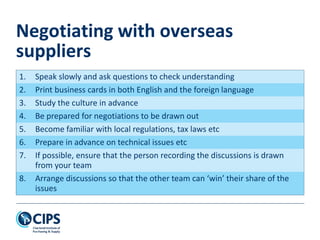
1. Speak slowly and ask questions to check understanding
2. Print business cards in both English and the foreign language
3. Study the culture in advance
4. Be prepared for negotiations to be drawn out
5. Become familiar with local regulations, tax laws etc
6. Prepare in advance on technical issues etc
7. If possible, ensure that the person recording the discussions is drawn
from your team
8. Arrange discussions so that the other team can ‘win’ their share of the
issues
Negotiating with overseas
suppliers
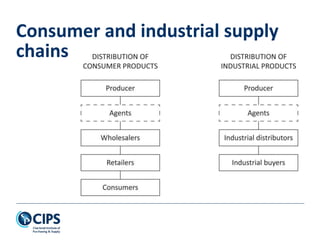
Consumer and industrial supply
chains
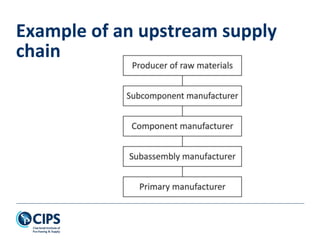
Example of an upstream supply
chain
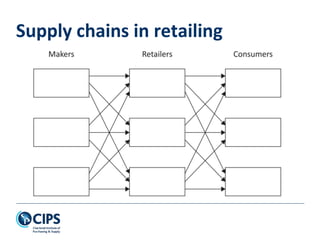
Supply chains in retailing

CIPS NC1.pptx

  • 1.
    Procurement and Supply Principles Certificatein Procurement and Supply Operations
  • 2.
    Organisational buying • Theuse of resources which belong to the owners of the organisation • The acquisition of items that will satisfy the requirements of other people and be suitable inputs for defined processes and systems • Working together with others in a complex network of relationships, work flows and accountabilities • Developing and maintaining constructive working relations with suppliers
  • 3.
    Purchasing as adiscipline • Responsible • Professional • Effective • Efficient
  • 4.
    The organisation asan open system
  • 5.
    Purchasing and Procurement Purchasing ‘buyingor obtaining goods or services which are paid for’. (This implies that purchasing is a slightly broader concept than buying.) Procurement ‘obtaining goods or services in any way including hiring, leasing, borrowing or stealing’.
  • 6.
    Principal flows ina simple supply chain
  • 7.
    Integration of supplychain activities
  • 8.
    Materials management • Materialsand inventory planning • Procurement of the necessary materials, parts and supplies • Storage and inventory management • Production control
  • 9.
    Contracts A purchase contractis a statement of: • Exactly what two or more parties have agreed to do or exchange • Conditions and contingencies which may alter the arrangement • The rights of each party if the other fails to do what it has agreed to do • How responsibility or ‘liability’ will be apportioned in the event of problems • How any disputes will be resolved
  • 10.
    • Contract development •Contract manager (or contract management team) • Contract administration • Managing contract performance • Relationship management • Contract renewal or termination Key elements of contract management
  • 11.
    Purchasing in service organisations Whatitems are bought from outside in a typical service organisation? • Office equipment and supplies such as stationery • Computer hardware and software • Motor vehicles • Advertising and design services • Maintenance services (for computers, vehicles and buildings) • In some cases, capital goods
  • 12.
    Trends in servicesupply chains • Services are increasingly about the management and supply of information • Information can replace inventory • Services are increasingly outsourced, as organisations focus on core activities • The combination of automation and outsourcing has enabled the development of virtual service organisations and networks
  • 13.
  • 14.
    The impact ofpurchasing (a) sales volumes rise by 5% (b) materials costs fall by 5% $m $m $m $m Sales 52.5 50.0 Materials costs 31.5 28.5 Internal costs 15.0 15.0 Total costs 46.5 43.5 Net profit 6.0 6.5 Suppose that annual sales are $50m, with materials costs equal to 60 per cent of sales and ‘internal’ costs of $15m. Profit is therefore $5m (50 – 30 – 15 = $5m). Now look what happens if:
  • 15.
    Typical roles andresponsibilities • Head of Purchasing • Senior Purchasing Manager • Purchasing Manager • Contracts Manager • Supplier Manager • Expediter • Purchasing Analyst • Purchasing Leadership Team
  • 16.
    What do purchasersdo? • Supply market monitoring, and identifying potential sources of supply • Supplier evaluation and selection • Processing purchase or stock replenishment requests • Providing input to the preparation of specifications for new purchases • Negotiating, buying and developing contracts • Expediting or contract management • Clerical and administrative tasks
  • 17.
  • 18.
    Obtaining value formoney • The use of value analysis (and/or value engineering) • Consolidation of demand • Centralised negotiation of contracts and prices • Proactive sourcing: challenging preferred supplier complacency to ensure competitive value • Buying complete subassemblies rather than components • Encouraging standardisation • Adopting whole life costing methodologies • Eliminating or reducing inventory • Using e-procurement for process efficiencies • Global purchasing
  • 19.
    Defining sustainable procurement •Economic considerations • Environmental aspects, ie green procurement • Social aspects
  • 20.
    • The developmentand implementation of sustainable procurement strategies and policies • The design and development of sustainable products and services • The definition of requirements to include sustainable materials, components, supplies and services • The sustainable and ethical sourcing of products and services • The management of supply and logistics processes to minimise waste, transport and other environmental impacts, and to support reverse logistics, recycling, re-use and other measures • The monitoring, management and development of suppliers • Monitoring, measuring and reporting on the sustainability of procurement The procurement function’s contribution to sustainability
  • 21.
    The ‘triple bottomline’ Profit: adding economic value • Securing value for money • Effective investment appraisal and capital purchasing • Cost management and budgetary control • Added value (through sourcing efficiencies, supplier involvement, quality improvement) • Ethical trading to support the long-term financial viability of suppliers and supply markets
  • 22.
    The ‘triple bottomline’ Planet: adding environmental value • Input to design and specification of green products/services • Sourcing of green materials and resources • Green sourcing, including selection, management and development of suppliers with environmental capability and commitment • Reducing the waste of resources throughout the sourcing cycle • Managing logistics (including reverse logistics) to minimise waste, pollution, GHG emissions and environmental impacts
  • 23.
    The ‘triple bottomline’ People: adding social value • Encouraging purchasing team and supplier diversity • Monitoring supplier practices to ensure observance of human rights and labour standards • Input to health and safety of products/services • Fair and ethical trading (fair pricing, ethical use of power, ethical business practices) • Local and small-business sourcing
  • 24.
    LOCAL PURCHASING FUNCTIONCENTRALISED PURCHASING FUNCTION Small order items Determination of major purchasing policies Items used only by the local division Preparation of standard specifications Emergency purchases (to avoid disruption to production) Negotiation of bulk contracts for a number of divisions Items sourced from local suppliers Stationery and office equipment Local purchasing undertaken for social ‘community’ reasons, eg support for smaller, local suppliers Purchasing research Staff training and development Purchase of capital assets Duties of local and central purchasing functions
  • 25.
    Procurement and profitability Elementsto consider regarding waste: • Specification • Quantity Satisfying end customers’ needs: • Quality • Quantity • Lead time
  • 26.
    Reasons to makea profit • Profit means that the business has covered its costs, and is not ‘bleeding’ money in losses • Profit belongs to the owners (or shareholders) of the business, as a return on their investment: a share of profits is paid to them in the form of a ‘dividend’ on their shares • Profits which are not paid to shareholders (‘retained profits’) are available for reinvestment in the development of the business
  • 27.
  • 28.
    • Cost reductioninitiatives • Improving supplier performance • Effective new product introduction (NPI) • Quality improvement initiatives • Knowledge management • Waste management • Risk management Creating savings and improving efficiency
  • 29.
    MEASURES OF EFFICIENCYMEASURES OF EFFECTIVENESS Basic purchase price of inputs Quality of output Cost of placing an order Quality of service to customers Cost of staffing the purchasing function Achieving objectives within budget Speed of transaction processing Quality of supplier relationships Use of information technology Impact on profitability Efficiency of organisational structure Prompt delivery to customers Efficiency of supplier management Efficiency and effectiveness of purchasing
  • 30.
    Excess costs inthe supply chain • Passing on increased costs (the ‘french fries principle’) • Over-specification • Supply cartels • Mechanistic bidding • Traditional buyer-supplier relationships
  • 31.
    Functions of budgetarycontrol • Planning This involves setting the various budgets for the appropriate future period. • Control Once the budgets have been set and agreed for the future period under review, the formal control element of budgetary control is ready to start.
  • 32.
    Calculation of budgetvariances Solution to the example: Average four-week budget Actual results Variances favourable/(adverse) $ $ $ Indirect labour 20,000 19,540 460 Consumables 800 1,000 (200) Depreciation 10,000 10,000 — Other overheads 5,000 5,000 — 35,800 35,540 260
  • 33.
    Establishing budget targets •Incremental budget • Zero-based budget • Priority based budget
  • 34.
  • 35.
    CORPORATE OBJECTIVES PURCHASINGGOALS (THIS FISCAL YEAR) Become a low-cost producer within the market Reduce like-for-like purchase spend by 20% Introduce lean business practice Reduce raw material stockturns to a maximum of 10 days Focus on business core competencies Outsource defined non-core-competency activities via new accredited suppliers Improve time-to-market for new product development Introduce early supplier involvement (ESI) initiatives for all key suppliers Improve customer service levels via increasing quality of services and products Introduce supplier development initiatives for identified material receipts of defects greater than 500 parts per million (ppm) Translating corporate objectives into purchasing goals
  • 36.
    The five rights •Inputs of the right quality • Delivered in the right quantity • To the right place • At the right time • For the right price
  • 37.
    Additional objectives toconsider • Relationship development • Innovation and development • Ethics and corporate social responsibility • Total costs of ownership of purchased items
  • 38.
    The right sellingprice • A price which ‘the market will bear’ • A price which allows the seller to win business, in competition with other suppliers • A price which allows the seller at least to cover costs, and ideally to make a healthy profit
  • 39.
    The right purchaseprice • A price which the purchaser can afford • A price which appears fair and reasonable, or represents value for money • A price which gives the purchaser a cost or quality advantage over its competitors • A price which reflects sound purchasing practices
  • 40.
  • 41.
    Dimensions of productquality • Performance • Features • Reliability • Durability • Conformance • Serviceability • Aesthetics • Perceived quality
  • 42.
    Specifications and quality •Conformance The buyer details exactly what the required product, part or material must consist of, and a ‘quality’ product is one which conforms to the description provided by the buyer. • Performance The buyer describes what he expects the part or material to be able to achieve, in terms of the functions it will perform and the level of performance it should reach. A ‘quality’ product is then one which will satisfy these requirements: the buyer specifies the ‘ends’ (purpose) and the supplier has relative flexibility about the ‘means’ of achieving them.
  • 43.
    Supplier lead times •The internal lead time is the lead time for the processes carried out within the buying organisation • The external lead time is the lead time for the processes carried out within the supplying organisation • The total lead time is therefore a combination of internal and external lead time
  • 44.
    The right quantity •Demand for the final product • Demand for purchased finished items • The inventory policy of the organisation • The service level required • Market conditions • Supply-side factors • Factors determining the economic order quantity (EOQ) • Specific quantities notified to buyers by user departments, according to identified needs
  • 45.
    Specifying delivery • Afull and accurate delivery address • The contact person at the delivery address • Packaging instructions • Delivery instructions • Transport instructions • The point at which ownership or title in the goods ‘pass’ from the supplier to the buyer
  • 46.
    Categories of supply •Direct supplies • Indirect supplies Or: • Maintenance, repair and operations (MRO) supplies • Services • Capital equipment
  • 47.
    GOODS SERVICES Tangible Intangible Canbe inventoried Cannot be inventoried Little customer contact Extensive customer contact Standard customer contact Flexible customer contact Long lead times Short lead times Capital intensive Labour intensive Quality easy to assess Quality very difficult to assess Characteristics of goods and services
  • 48.
    • Intangibility • Inseparability •Variability (heterogeneity) • Perishability • Lack of ownership Products and services: a marketing perspective
  • 49.
    • Impracticability ofstorage • Lack of inspectability • Uncertainties in contractual agreements • Complexity Products and services: a buyer’s perspective
  • 50.
    The mix ofproducts and services OPERATION GOODS SERVICES Mining 95% 5% Vending machines 95% 5% Low-cost consumable goods 80% 20% Home computers 75% 25% Fast-food operation 60% 40% High-quality restaurant meal 30% 70% Car breakdown service 25% 75% Local authority 25% 75% Teaching 5% 95%
  • 51.
  • 52.
    Quality characteristics ofservices • Reliability • Responsiveness • Competence • Access • Courtesy • Communication • Credibility • Security • Understanding • Tangibles
  • 53.
    External customers • Wholesalers •Distributors and dealers • Agents • Franchisees • Retailers
  • 54.
  • 55.
    Who are yourinternal customers? • Senior management • Related functions in the internal supply chain • Managers in ‘user’ functions • Staff in other functions who carry out some purchasing for their own units
  • 56.
    Organisational competencies • Thresholdcompetencies The basic capabilities necessary to support a particular strategy or to enable the organisation to compete in a given market. • Core competencies Distinctive value-creating skills, capabilities and resources.
  • 57.
    • They areactivities that add value in the eyes of the customer • They are scarce and difficult for competitors to imitate • They are flexible in light of the organisation’s future needs Three characteristics of core competencies
  • 58.
    Make/do or buy? Thedecision is based on a number of factors • Strategic planning • Production capacity • Suitable external suppliers • Relationships with suppliers • Effects on the internal workforce • Labour market conditions • Sales forecasts
  • 59.
    Strategic outsourcing ADVANTAGES DISADVANTAGES Supportfor downsizing: reduction in staffing, space and facilities costs Costs of services and relationship or contract management Allows focused investment of managerial, staff and other resources on core or distinctive competencies Loss of control and difficulties ensuring service standards Leverages the specialist expertise, technologies, resources and economies of scale of suppliers Potential reputational damage if service or ethical issues arise Enables synergy through collaborative supply relationships Loss of in-house knowledge and competencies (for future needs) Loss of control over confidential information and intellectual property Ethical and employee relations issues of downsizing
  • 60.
    Matrix for theoutsourcing decision
  • 61.
    The costs involvedin outsourcing COST EXPLANATION Preliminary costs The costs of preparing and analysing the business case, the costs of identifying potential suppliers, the costs of the supplier selection process, the costs of agreeing terms and drawing up the contract Contractual price The actual sums payable to the supplier under the terms of the contract Costs of getting it wrong Costs arising if the supplier fails to perform Costs of getting it right Cost of all activities designed to ensure successful completion of the contract – changes to systems and processes, transitional difficulties, contract management costs, communication costs etc Hidden costs Costs of buying staff helping to implement the contract, costs of vagueness or ambiguity in the specification (leading to unexpected difficulties), costs of over-specifying etc
  • 62.
    • Service contract •Subcontracting • Outsourcing • Insourcing Terminology relating to outsourcing
  • 63.
    Purchase of services– problems • Manufactured goods are tangible: they can be inspected and tested before purchase. Services are intangible. • Goods emerging from a manufacturing process almost certainly have a high degree of uniformity which simplifies their evaluation. Every separate instance of service provision is unique and may or may not be equivalent to previous instances. • The exact purpose for which a manufactured good is used will usually be known and its suitability can therefore be assessed objectively. It is harder to assess the many factors comprised in provision of a service. • A manufactured good is usually purchased for immediate use in some well defined way, such as incorporation in a larger product or onward sale. A service may be purchased for a long period, during which requirements may change subtly from the original specification. • When purchasing a manufactured good a buyer can usually identify a number of suppliers offering products with essentially similar features (including price). Services are different: the offering from one supplier will inevitably differ from those of other suppliers in a whole range of mostly intangible ways.
  • 64.
    Outsourcing the logisticsfunction Potential benefits that may be realised: • Contracting out frees up resources • Logistics specialists are well placed to recognise and respond to rising customer expectations • Contracting out gives greater flexibility in times of difficulty • Buying firms gain access to specialist expertise which may enable them to develop improved distribution systems, offering better service than customers would otherwise have received
  • 65.
    • Costs maybe cheaper if we do not pay a profit margin to an outside supplier • There may be no suitable provider externally • There may be reasons of confidentiality • By keeping the activity in-house we retain control over quality Reasons for keeping shared services in-house
  • 66.
    • Absence ofcompetition can lead to complacency within the internal department providing the service • Similarly, there may be a lack of efficiency, innovation and customer responsiveness • There are no economies of scale, as the internal provider has only one customer Disadvantages of using internally provided services
  • 67.
    Identification of needs •A description of the product or service required • The quantity required • The delivery or provision date • The internal department code, or budgetary code • The name and signature of the originator of the requisition, and its date A purchase requisition form will typically include the following details:
  • 68.
    Appraising suppliers Carter’s 10Cs: • Competence • Capacity • Commitment • Control systems • Cash • Consistency • Cost • Cultural compatibility • Clean and compliant • Communication
  • 69.
    Requesting quotations • Quantityand description of items required • Required delivery date and address for delivery • Special requirements relating to packaging and/or materials handling • Terms and conditions of purchase • Terms of payment • Contact details The request for quotation (RFQ) will set out the details of the requirement:
  • 70.
    Evaluating supplier quotations •Previous performance of the supplier (including financial stability, reliability etc) • Delivery lead time • Add-on costs (freight, insurance, installation and training etc) • Running costs (including energy efficiency) • Warranty terms • Availability of spares • Availability of maintenance cover • Ability to upgrade to higher specification • Risk of obsolescence • Payment terms • Residual value and disposal costs • In the case of overseas suppliers, exchange rates, taxes and import duties
  • 71.
    Models of negotiation KENNEDYGREENHALGH BAILY ET AL • Prepare: what do we want? • Debate: what do they want? • Propose: what wants might we trade? • Bargain: what wants will we trade? • Preparation • Relationship building • Information gathering • Information using • Bidding • Closing the deal • Implementing the agreement • Pre-negotiation phase • Negotiation/inter action phase • Post-negotiation follow-up
  • 72.
    Defining the rangeof negotiation
  • 73.
    The use ofcompetitive bidding FIVE CRITERIA FOR THE USE OF COMPETITIVE BIDDING FOUR SITUATIONS IN WHICH COMPETITIVE BIDDING SHOULD NOT BE USED The value of the purchase should be high enough to justify the expense of the process It is impossible to estimate production costs accurately The specifications must be clear and the potential suppliers must have a clear idea of the costs involved in fulfilling the contract Price is not the only or most important criterion in the award of the contract There must be an adequate number of potential suppliers in the market Changes to specification are likely as the contract progresses The potential suppliers must be both technically qualified and keen for the business Special tooling or set-up costs are major factors There must be sufficient time for the procedure to be carried out
  • 74.
    A checklist foranalysing tenders 1. Establish a routine for receiving and opening tenders, distributing copies as appropriate and ensuring security. 2. Set out clearly the responsibilities of the departments involved. 3. Establish objective award criteria. These should have been set out in the initial invitation to tender, particularly if the contract is subject to statutory control. 4. Establish teams for the appraisal of each tender, ensuring that the required team members will be available during the time they are required. 5. Establish a standardised format for logging and reporting on tenders. 6. Check that the tenders received comply with the award criteria. 7. Check the arithmetical accuracy of each tender. 8. Eliminate suppliers whose total quoted price is above the lowest quotes by a specified percentage. 9. Evaluate the tenders in accordance with predetermined checklists for technical, contractual and financial details. 10. Prepare a report on each tender for submission to the project manager (and as a basis for feedback to unsuccessful bidders, where relevant).
  • 75.
    Systems contracts: benefits •Administration is reduced • Delivery times are rapid • Stocks are reduced • Purchasing staff are freed up to perform more useful work on high-value items and to play a more strategic role in the organisation
  • 76.
  • 77.
    QUANTITY ORDERED DELIVERY NOTE QUANTITY PHYSICAL QUANTITY ACTION TO TAKE 1010 10 Receipt correct, book goods into stock 10 3 3 Book 3 into stock, check 7 to follow later 10 10 5 Problem – isolate goods and take the matter up with our supplier 10 10 15 Problem – isolate goods and take the matter up with our supplier 10 15 15 Problem – isolate goods and take the matter up with our supplier 10 15 10 Problem – isolate goods and take the matter up with our supplier 10 5 10 Problem – isolate goods and take the matter up with our supplier 10 15 12 Problem – isolate goods and take the matter up with our supplier Processing receipt of goods from supplier
  • 78.
    Auditing the transaction •The goods delivered by the supplier must correspond to what was ordered • The goods must be of satisfactory quality • The amount charged by the supplier must correspond to the price agreed
  • 79.
    • Managing performancelevels • Contract reviews • Relationship management Reviewing outcomes and processes
  • 80.
    Vendor rating criteria •Price eg measured by value for money, market price or under, lowest or competitive pricing, good cost management and reasonable profit margins • Quality eg measured by key performance indicators (KPIs) such as the number or proportion of defects, quality assurance procedures • Delivery eg measured by KPIs such as the proportion of on-time in-full (OTIF) deliveries, or increases or decreases in lead times for delivery
  • 81.
    Problems in thepurchasing cycle Buyer’s organisation • Unclear specifications • Late ordering • Late booking in Supplier’s organisation • Quality • Late delivery • Early delivery
  • 82.
  • 83.
    Some key formsand documents • Purchase requisition or bill of materials • Specification and/or service level agreement • Supplier appraisal questionnaire • Request for quotation (RFQ) or invitation to tender (ITT) • Supplier quotation, bid or tender documents • Purchase order (or contract) • Acknowledgement of order (from the supplier) • Advice note (from the supplier, notifying delivery of the order) • Goods received note (confirming receipt of the order) • Quality inspection forms • Invoice or statement (request for payment) • Vendor rating forms (for appraising supplier performance)
  • 84.
  • 85.
  • 86.
    Tiers of asupply chain All manufacturing performed by top-level purchaser
  • 87.
    Tiers of asupply chain Top-level purchaser outsources most manufacturing
  • 88.
    Characteristics of afirst-tier supplier • It is a direct supplier to the OEM • It is usually a supplier of a high-cost or complex subassembly • Mutual inter-dependency • There is a close and long-term buyer-supplier relationship • It will often be involved in discussing new product ideas with the OEM • It is responsible for dealing with a number of second-tier suppliers • It understands and shares the ‘mission’ of the OEM • It disseminates the standards and working practices of the OEM • It must be a competitive producer to justify selection by the OEM • The supplier must also have the management capabilities to manage the second-tier suppliers efficiently • The relationship with the OEM is a long-term partnership
  • 89.
    • Cost pressures Theneed to reduce inventory and other wastes • Time pressures The need for faster, more customised deliveries • Reliability pressures The need to ensure that quality and delivery commitments to increasingly demanding customers can be met • Response pressures The need to provide real-time information to increasingly demanding customers • Transparency pressures The need to make the status of orders visible, to support planning • Globalisation pressure The need to co-ordinate multiple, complex global supply networks Drivers for supply chain management (SCM)
  • 90.
    • Market factors •Cost factors • Government factors • Competitive factors • Technology factors Drivers for globalisation of an industry
  • 91.
    Arguments against globalisation •It encourages the exploitation of labour in developing nations • It encourages the exploitation of local markets • It ‘exports’ pollution, deforestation, urbanisation and other environmental damage to developing nations • It undermines governments in the management of their own domestic economies • It causes unemployment in developed nations • It squeezes small, local businesses out of markets • It encourages the erosion of local cultures and the loss of local languages
  • 92.
    1. Speak slowlyand ask questions to check understanding 2. Print business cards in both English and the foreign language 3. Study the culture in advance 4. Be prepared for negotiations to be drawn out 5. Become familiar with local regulations, tax laws etc 6. Prepare in advance on technical issues etc 7. If possible, ensure that the person recording the discussions is drawn from your team 8. Arrange discussions so that the other team can ‘win’ their share of the issues Negotiating with overseas suppliers
  • 93.
  • 94.
    Example of anupstream supply chain
  • 95.