Tim J. Smith
Pricing Strategy: Setting Price Levels,
Managing Price Discounts, &
Establishing Price Structures
PowerPoint by
Tim J. Smith, PhD
Managing Principal, Wiglaf Pricing
Adjunct Professor of Marketing & Economics, DePaul University
© 2012 Cengage Learning. All Rights Reserved. May not be scanned, copied or duplicated, or posted to a publicly accessible website, in whole or in part.
Chapter 2
Profit’s Sensitivity to Price
Conducting a Profit Sensitivity
Analysis to Identify volume Hurdles
and the Challenges Inherent in
Economic Price Optimization
© 2012 Cengage Learning. All Rights Reserved. May not be scanned, copied or duplicated, or posted to a publicly accessible website, in whole or in part.
Agenda
• How do price changes influence the ability to capture customers?
• How sensitive are profits to price changes when we include the
influence of price changes to sales volumes?
• When considering a price cut, what is the necessary increase in sale
volumes to improve the firm’s profits?
• When considering a price increase, what is the allowable decrease
in sale volumes that will leave the firm more profitable?
• How does elasticity of demand enable executives to optimize
prices?
• What are the limitations to using elasticity metrics alone for guiding
price setting decisions?
• Stretch Question: How is elasticity of demand related to exchange
value models for different customers?
© 2012 Cengage Learning. All Rights Reserved. May not be scanned, copied or duplicated, or posted to a publicly accessible website, in whole or in part.
Profit Sensitivity Analysis
• If we know that the best price lies within a range, what
is the effect of a small change in price?
• Profit Equation
p = Q (P – V) – F
p – Profit
Q – Quantity Sold (Volume)
P – Price
V – Variable Costs
F – Fixed Costs
© 2012 Cengage Learning. All Rights Reserved. May not be scanned, copied or duplicated, or posted to a publicly accessible website, in whole or in part.
Profit Sensitivity Analysis
p = Q (P – V) – F
• Effects of a price change
– Direct effect on profit through price
– Indirect effect on profits by moderating the quantity sold
– No effect on costs, variable nor fixed
– Laws of economics implies that for a normal good, as price
increases, volume decreases, fewer purchases are made
• Price Sensitivity Analysis analyzes the sensitivity of profits
to price changes
• Volume Hurdles are identified through the profit sensitivity
analysis. They define the required changes in volume to
justify a price change.
© 2012 Cengage Learning. All Rights Reserved. May not be scanned, copied or duplicated, or posted to a publicly accessible website, in whole or in part.
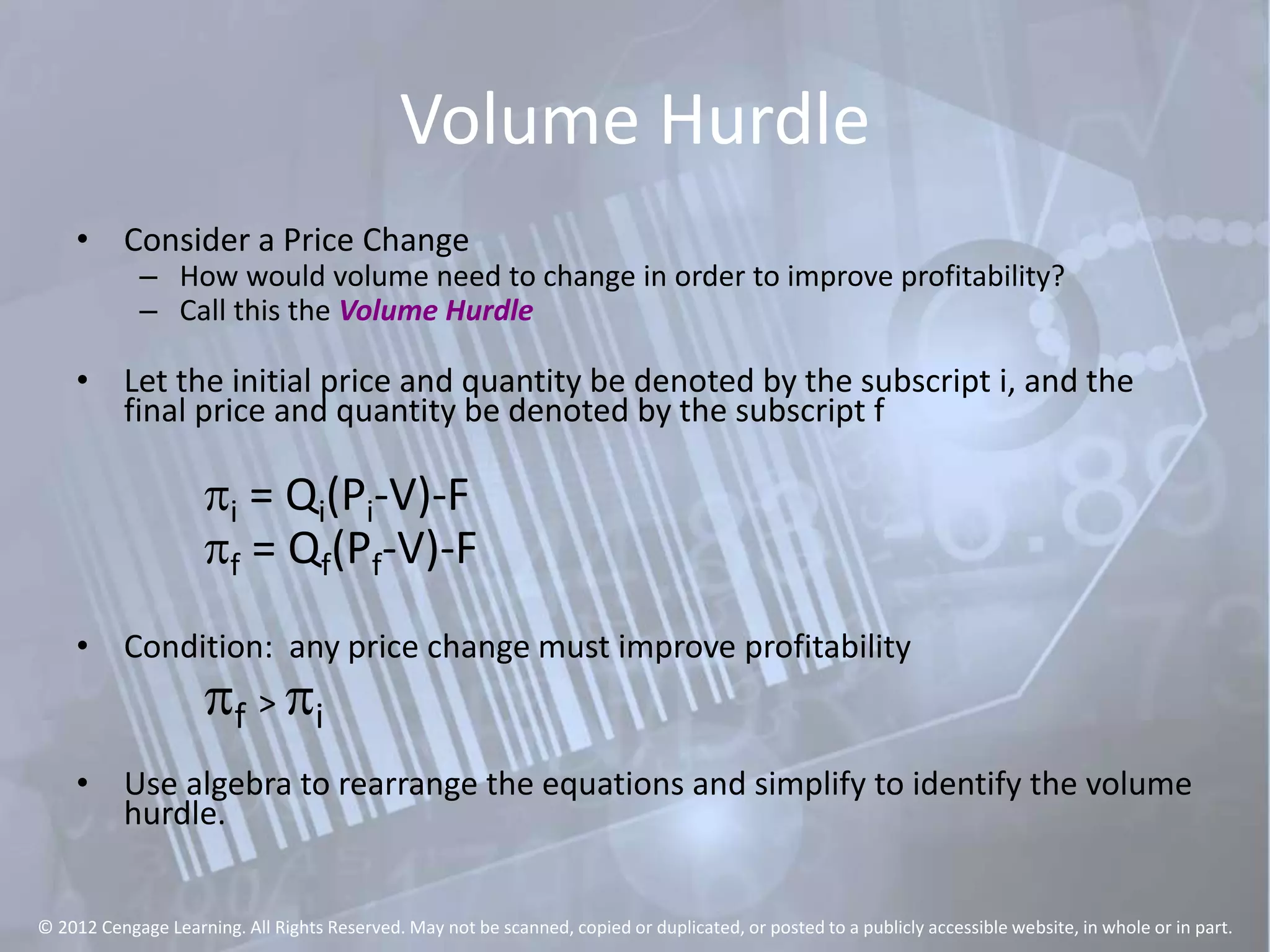
Volume Hurdle
• Consider a Price Change
– How would volume need to change in order to improve profitability?
– Call this the Volume Hurdle
• Let the initial price and quantity be denoted by the subscript i, and the
final price and quantity be denoted by the subscript f
pi = Qi(Pi-V)-F
pf = Qf(Pf-V)-F
• Condition: any price change must improve profitability
pf > pi
• Use algebra to rearrange the equations and simplify to identify the volume
hurdle.
© 2012 Cengage Learning. All Rights Reserved. May not be scanned, copied or duplicated, or posted to a publicly accessible website, in whole or in part.
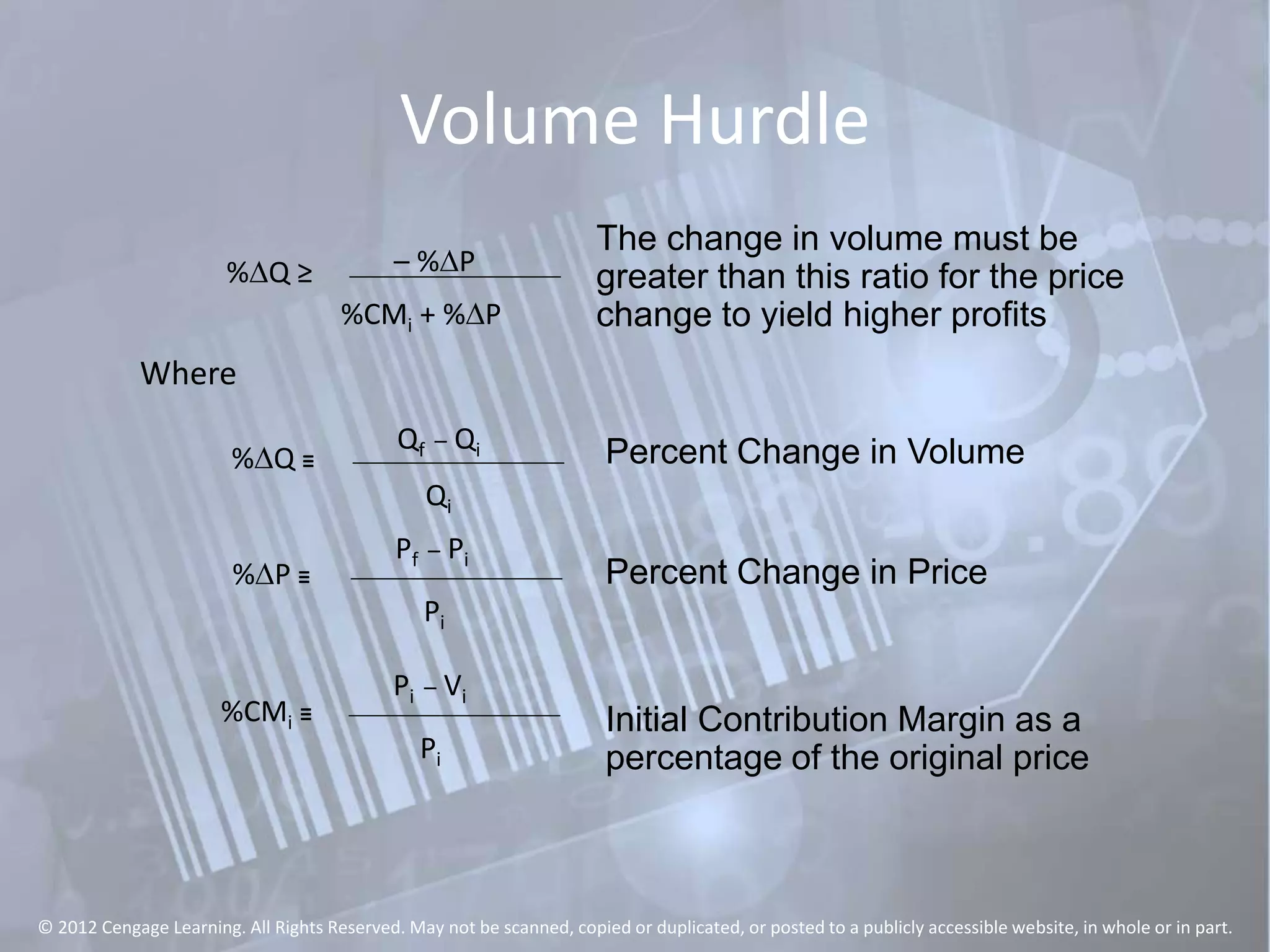
Volume Hurdle
Where
%DQ ≥ – %DP
%CMi + %DP
%DQ ≡
Qf – Qi
Qi
%DP ≡
Pf – Pi
Pi
%CMi ≡
Pi – Vi
Pi
Percent Change in Volume
Percent Change in Price
Initial Contribution Margin as a
percentage of the original price
The change in volume must be
greater than this ratio for the price
change to yield higher profits
© 2012 Cengage Learning. All Rights Reserved. May not be scanned, copied or duplicated, or posted to a publicly accessible website, in whole or in part.
Fixed Costs Don’t Matter, Variable Costs Do.
• Notice Fixed Costs have no effect on
a marginal price change decision
– Your overhead is your problem, not
the customers. From a value
perspective, customers never care
about your cost structure. Only you
do. They only care about value –
how much value do they get for how
high a price.
– Fixed costs are key in the decision to
enter or stay in the industry. Once in
the industry, they make no difference
to marginal profitability decisions.
– Fixed costs more of an investment or
strategy issue than a pricing issue.
%DQ ≥ – %DP
%CMi + %DP
What Variable Costs should
be considered for defining
the Volume Hurdle?
© 2012 Cengage Learning. All Rights Reserved. May not be scanned, copied or duplicated, or posted to a publicly accessible website, in whole or in part.
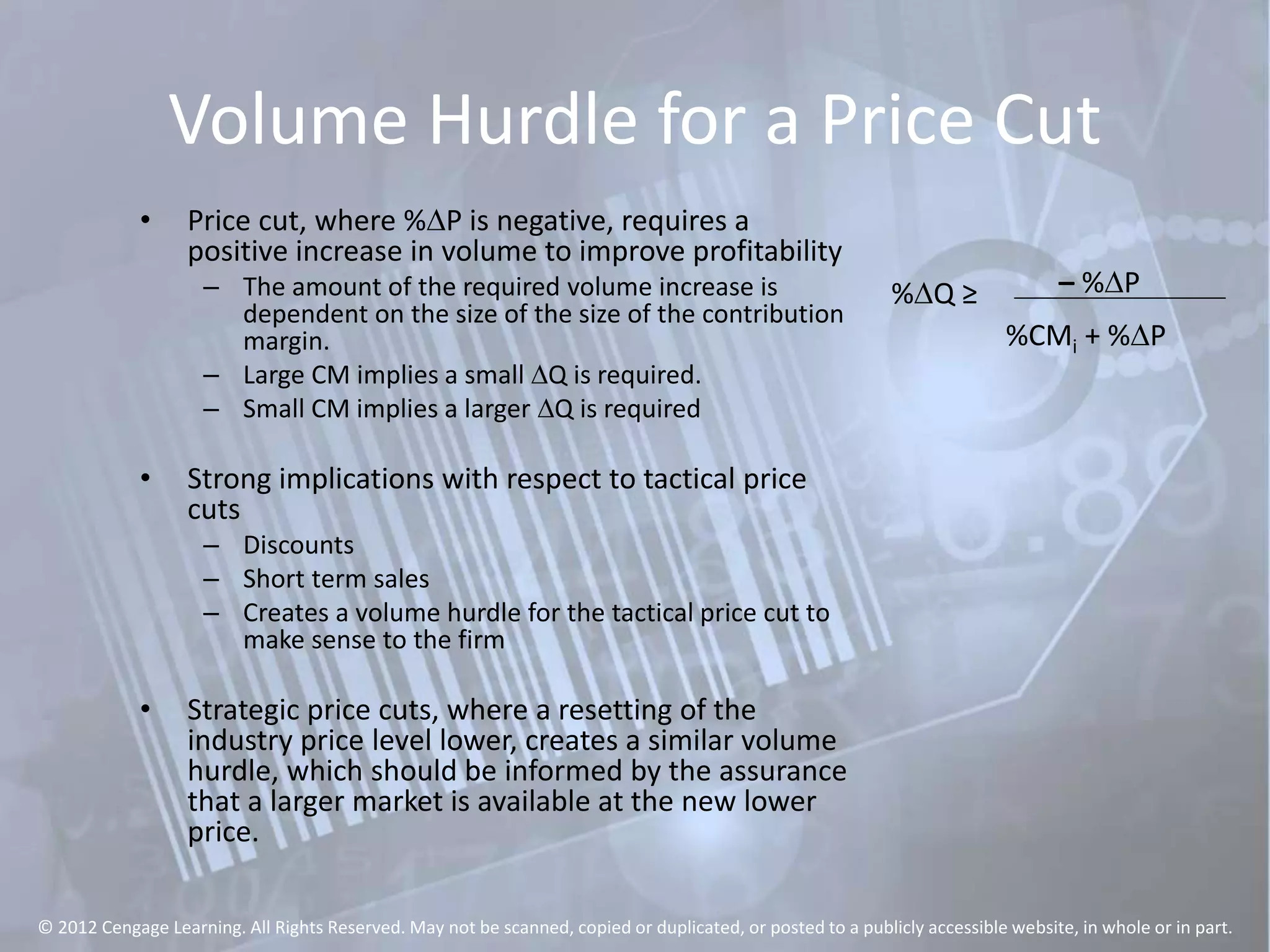
Volume Hurdle for a Price Cut
• Price cut, where %DP is negative, requires a
positive increase in volume to improve profitability
– The amount of the required volume increase is
dependent on the size of the size of the contribution
margin.
– Large CM implies a small DQ is required.
– Small CM implies a larger DQ is required
• Strong implications with respect to tactical price
cuts
– Discounts
– Short term sales
– Creates a volume hurdle for the tactical price cut to
make sense to the firm
• Strategic price cuts, where a resetting of the
industry price level lower, creates a similar volume
hurdle, which should be informed by the assurance
that a larger market is available at the new lower
price.
%DQ ≥ – %DP
%CMi + %DP
© 2012 Cengage Learning. All Rights Reserved. May not be scanned, copied or duplicated, or posted to a publicly accessible website, in whole or in part.
Volume Hurdle for a Price Hike
• Price Rise, where %DP is positive, will
allow for a reduction in volume, up to
a point.
– The amount of forfeited volume is
dependent on the contribution margin.
– Small CM can handle a large DQ
decrease
– Large CM needs a smaller DQ decrease
– Enter a new market or new distribution
channel, change in competitive
environment, or variable costs have
been creeping up industry wide and a
price rise is seen as possible.
%DQ ≥ – %DP
%CMi + %DP
© 2012 Cengage Learning. All Rights Reserved. May not be scanned, copied or duplicated, or posted to a publicly accessible website, in whole or in part.
Profit Sensitivity towards Price Cuts
Manufacturer
• 25% Contribution
Margin
• 5% Price Cut
• 25% Volume Growth
Required to Break
Even on the Decision
Broker
• 1% Contribution
Margin
• 0.1% Price Cut (10
bp)
• 11.1% Volume Growth
Required to Break
Even on the Decision
Retailer
• 50% Contribution
Margin
• 15% Price Cut
• 43% Volume Growth
Required to Break
Even on the Decision
© 2012 Cengage Learning. All Rights Reserved. May not be scanned, copied or duplicated, or posted to a publicly accessible website, in whole or in part.
Profit Sensitivity towards Price Increases
Manufacturer
• 25% Contribution
Margin
• 5% Price Rise
• 14% Volume Loss or
Less Decrease Would
Leave the Firm More
Profitable
Broker
• 1% Contribution
Margin
• 0.1% Price Rise (10
bp)
• 9.1% Volume Loss or
Less Decrease Would
Leave the Firm More
Profitable
Retailer
• 50% Contribution
Margin
• 15% Price Rise
• 23% Volume Loss or
Less Decrease Would
Leave the Firm More
Profitable
© 2012 Cengage Learning. All Rights Reserved. May not be scanned, copied or duplicated, or posted to a publicly accessible website, in whole or in part.
Price Increases and Decreases have Non-
Symmetrical Effects on Profit
• Price Cuts require Larger Changes in Volume than Price Rises to leave the firm equally
well off.
• 50% Contribution
Margin
• 15% Price Rise
• 23% Volume Loss or
Less Decrease Would
Leave the Firm More
Profitable
• 50% Contribution
Margin
• 15% Price Cut
• 43% Volume Growth
Required to Break
Even on the Decision
© 2012 Cengage Learning. All Rights Reserved. May not be scanned, copied or duplicated, or posted to a publicly accessible website, in whole or in part.
Volume Hurdle as a Function of DP Given a 25% CM
• Sticking with the convention of economists of using volume as the
horizontal axis, we have plotted the volume hurdle for varying price
changes
Volume Hurdle for Firm with a 25% Contribution Margin
-15%
-10%
-5%
0%
5%
10%
15%
-40% -20% 0% 20% 40% 60% 80% 100% 120%
Percent Change in Volume
PercentChangeinPrice
Increasing Profits
Decreasing Profits
Zone of
Not Economically
Possible Results
for Normal Goods
© 2012 Cengage Learning. All Rights Reserved. May not be scanned, copied or duplicated, or posted to
a publicly accessible website, in whole or in part.
Elasticity of Demand
• Elasticity of Demand is the ratio of the observed percent change in
volume to an executed percent change in price
• Sticking with economic conventions, we have used e (pronounced epsilon)
is used to denote the elasticity of demand with respect to price
• Numerically, elasticity of demand is usually negative, implying at a higher
price, fewer units are sold
• By convention, economists usually drop the sign in speaking of price
elasticity, thus a large price elasticity has a large absolute value yet is
negative, while a low elasticity of demand has a small absolute value and
is also negative.
P
Q
D
D

%
%
e
© 2012 Cengage Learning. All Rights Reserved. May not be scanned, copied or duplicated, or posted to a publicly accessible website, in whole or in part.
Highly Elastic Markets Favor Price Cuts
Elastic Demand Curve (e = -10) and
Volume Hurdle for Firm with a 25% Contribution Margin
-15%
-10%
-5%
0%
5%
10%
15%
-40% -20% 0% 20% 40% 60% 80% 100% 120%
Percent Change in Volume
PercentChangeinPrice
• Elastic markets mean a small price change
induces a large volume change
– |e| > 1
– Most brands face elastic markets
Increasing Profits
Decreasing Profits
© 2012 Cengage Learning. All Rights Reserved. May not be scanned, copied or duplicated, or posted to a publicly accessible website, in whole or in part.
Inelastic Markets Favor Price Increase
Inelastic Demand Curve (e = -0.5) and
Volume Hurdle for Firm with a 25% Contribution Margin
-15%
-10%
-5%
0%
5%
10%
15%
-40% -20% 0% 20% 40% 60% 80% 100% 120%
Percent Change in Volume
PercentChangeinPrice
• Inelastic markets mean that a large price change is required to induce
a noticeable volume change
– |e| < 1
– Many industries face inelastic markets
Increasing Profits
Decreasing Profits
© 2012 Cengage Learning. All Rights Reserved. May not be scanned, copied or duplicated, or posted to a publicly accessible website, in whole or in part.
Relevant Elasticities
• There is a difference between strategic price changes and tactical price
changes
– Short term, lock-in may enable a price rise to go through
• lock in can form from the purchase of complimentary products (autos and suburbs,
or software and OS)
– Long run, markets change in their makeup.
• New entrants, new substitutes.
• (switch to fuel efficient cars, switch to mass transit and bicycles.)
• For many consumer products, the category level demand is inelastic, but
the brand level demand is elastic.
– Implying, that while industry wide price increases would help the profitability
of the category, individual suppliers face elastic demand as consumers
demonstrate a willingness to switch brands.
© 2012 Cengage Learning. All Rights Reserved. May not be scanned, copied or duplicated, or posted to a publicly accessible website, in whole or in part.
Measured Elasticities
Category Brand Choice Category
Bacon -1.25 -0.32
Margarine -2.22 -0.12
Butter -1.24 -0.74
Ice Cream -1.89 -0.68
Paper Towels -4.00 -0.74
Sugar -4.03 -0.57
Liquid Detergents -3.95 -1.70
Coffee -1.65 -1.42
Soft Drinks -2.66 -0.42
Bath Tissue -3.85 -0.80
Potato Chips -2.50 -0.88
Dryer Softeners -4.08 -1.19
Yogurt -1.57 -0.35
© 2012 Cengage Learning. All Rights Reserved. May not be scanned, copied or duplicated, or posted to a publicly accessible website, in whole or in part.
Price Optimization
• The above analysis implies that optimal pricing can be found, one where in
increase or decrease in price leads to less profit than otherwise would be
found.
– Assuming a constant elasticity of demand over a wide range of price, through
integral calculus we find the Optimal Price for elastic markets at:
– At the optimal price, the quantity sold is
– Where Qi and Pi the current demand and price
e







i
i
P
P
QQ


e
e


1
V
P
 Note … this is a heroic, and
known to be false, assumption,
© 2012 Cengage Learning. All Rights Reserved. May not be scanned, copied or duplicated, or posted to a publicly accessible website, in whole or in part.
Optimal Price
Measure
Variable Cost V $5
Fixed Cost F $750,000
Elasticity of Demand e -1.8
Demand at $1 Qo 10,000,000
Under the conditions, find
Optimal Price P* $11.25
Contribution Margin CM $6.25
Resultant Demand Q 128,211
Resultant Profit p $51,319
© 2012 Cengage Learning. All Rights Reserved. May not be scanned, copied or duplicated, or posted to a publicly accessible website, in whole or in part.
Profit Optimization
Profit Optimization for a Firm
Variable Costs = $5, Fixed Costs = $750,000.
Elasticity of Demand = -1.8, Total Demand of 12.5 MM
$-
$5
$10
$15
$20
$25
$30
$35
$40
$45
$50
50
100
150
200
250
300
Quantity
(In Thousands)
Price
($100)
($80)
($60)
($40)
($20)
$0
$20
$40
$60
Profit
(Inthousands)
Price Profit
p = Q (P – V) – F
© 2012 Cengage Learning. All Rights Reserved. May not be scanned, copied or duplicated, or posted to a publicly accessible website, in whole or in part.
Key Challenge of Price Optimization
What is the relevant Elasticity of Demand?
• Always a “historic” number, not forward looking number.
– Dependent upon the economic conditions, competing alternatives, tastes of
the market, and other market factors, all of which are constantly changing.
– Can be influenced by the firm’s actions: Branding enables higher prices,
discounting can reset price expectations lower lowering the potential price
capture
• Non-measurable for revolutionary products
• Small versus large price changes may exhibit different a elasticity
• Upward versus downward price changes may exhibit different a elasticity
© 2012 Cengage Learning. All Rights Reserved. May not be scanned, copied or duplicated, or posted to a publicly accessible website, in whole or in part.
Pricing Strategy, NOT
ENGINEERING
There are many quantitative models.
The value added insight
is knowing when to use which quantitative model,
what information should be used to inform the model,
and which qualitative influences
can override purely quantitative arguments.
© 2012 Cengage Learning. All Rights Reserved. May not be scanned, copied or duplicated, or posted to a publicly accessible website, in whole or in part.
Summary
• A Profit Sensitivity Analysis should be used to identify Volume Hurdles for
tactical pricing actions (Discounts, Price Promotions, Specific Sales
Opportunities)
• Profit is asymmetrically sensitive to price cuts vs. price hikes
• Inelastic markets favor price increases
• Elastic Markets favor price decreases
• Given the elasticity of demand, one could identify “optimal prices”
• But beware of cautionary caveats in blindly using math, for which elasticity
should be used
© 2012 Cengage Learning. All Rights Reserved. May not be scanned, copied or duplicated, or posted to a publicly accessible website, in whole or in part.

Chpt 02 profit's sensitivity to price

  • 1.
    Tim J. Smith PricingStrategy: Setting Price Levels, Managing Price Discounts, & Establishing Price Structures PowerPoint by Tim J. Smith, PhD Managing Principal, Wiglaf Pricing Adjunct Professor of Marketing & Economics, DePaul University © 2012 Cengage Learning. All Rights Reserved. May not be scanned, copied or duplicated, or posted to a publicly accessible website, in whole or in part.
  • 2.
    Chapter 2 Profit’s Sensitivityto Price Conducting a Profit Sensitivity Analysis to Identify volume Hurdles and the Challenges Inherent in Economic Price Optimization © 2012 Cengage Learning. All Rights Reserved. May not be scanned, copied or duplicated, or posted to a publicly accessible website, in whole or in part.
  • 3.
    Agenda • How doprice changes influence the ability to capture customers? • How sensitive are profits to price changes when we include the influence of price changes to sales volumes? • When considering a price cut, what is the necessary increase in sale volumes to improve the firm’s profits? • When considering a price increase, what is the allowable decrease in sale volumes that will leave the firm more profitable? • How does elasticity of demand enable executives to optimize prices? • What are the limitations to using elasticity metrics alone for guiding price setting decisions? • Stretch Question: How is elasticity of demand related to exchange value models for different customers? © 2012 Cengage Learning. All Rights Reserved. May not be scanned, copied or duplicated, or posted to a publicly accessible website, in whole or in part.
  • 4.
    Profit Sensitivity Analysis •If we know that the best price lies within a range, what is the effect of a small change in price? • Profit Equation p = Q (P – V) – F p – Profit Q – Quantity Sold (Volume) P – Price V – Variable Costs F – Fixed Costs © 2012 Cengage Learning. All Rights Reserved. May not be scanned, copied or duplicated, or posted to a publicly accessible website, in whole or in part.
  • 5.
    Profit Sensitivity Analysis p= Q (P – V) – F • Effects of a price change – Direct effect on profit through price – Indirect effect on profits by moderating the quantity sold – No effect on costs, variable nor fixed – Laws of economics implies that for a normal good, as price increases, volume decreases, fewer purchases are made • Price Sensitivity Analysis analyzes the sensitivity of profits to price changes • Volume Hurdles are identified through the profit sensitivity analysis. They define the required changes in volume to justify a price change. © 2012 Cengage Learning. All Rights Reserved. May not be scanned, copied or duplicated, or posted to a publicly accessible website, in whole or in part.
  • 6.
    Volume Hurdle • Considera Price Change – How would volume need to change in order to improve profitability? – Call this the Volume Hurdle • Let the initial price and quantity be denoted by the subscript i, and the final price and quantity be denoted by the subscript f pi = Qi(Pi-V)-F pf = Qf(Pf-V)-F • Condition: any price change must improve profitability pf > pi • Use algebra to rearrange the equations and simplify to identify the volume hurdle. © 2012 Cengage Learning. All Rights Reserved. May not be scanned, copied or duplicated, or posted to a publicly accessible website, in whole or in part.
  • 7.
    Volume Hurdle Where %DQ ≥– %DP %CMi + %DP %DQ ≡ Qf – Qi Qi %DP ≡ Pf – Pi Pi %CMi ≡ Pi – Vi Pi Percent Change in Volume Percent Change in Price Initial Contribution Margin as a percentage of the original price The change in volume must be greater than this ratio for the price change to yield higher profits © 2012 Cengage Learning. All Rights Reserved. May not be scanned, copied or duplicated, or posted to a publicly accessible website, in whole or in part.
  • 8.
    Fixed Costs Don’tMatter, Variable Costs Do. • Notice Fixed Costs have no effect on a marginal price change decision – Your overhead is your problem, not the customers. From a value perspective, customers never care about your cost structure. Only you do. They only care about value – how much value do they get for how high a price. – Fixed costs are key in the decision to enter or stay in the industry. Once in the industry, they make no difference to marginal profitability decisions. – Fixed costs more of an investment or strategy issue than a pricing issue. %DQ ≥ – %DP %CMi + %DP What Variable Costs should be considered for defining the Volume Hurdle? © 2012 Cengage Learning. All Rights Reserved. May not be scanned, copied or duplicated, or posted to a publicly accessible website, in whole or in part.
  • 9.
    Volume Hurdle fora Price Cut • Price cut, where %DP is negative, requires a positive increase in volume to improve profitability – The amount of the required volume increase is dependent on the size of the size of the contribution margin. – Large CM implies a small DQ is required. – Small CM implies a larger DQ is required • Strong implications with respect to tactical price cuts – Discounts – Short term sales – Creates a volume hurdle for the tactical price cut to make sense to the firm • Strategic price cuts, where a resetting of the industry price level lower, creates a similar volume hurdle, which should be informed by the assurance that a larger market is available at the new lower price. %DQ ≥ – %DP %CMi + %DP © 2012 Cengage Learning. All Rights Reserved. May not be scanned, copied or duplicated, or posted to a publicly accessible website, in whole or in part.
  • 10.
    Volume Hurdle fora Price Hike • Price Rise, where %DP is positive, will allow for a reduction in volume, up to a point. – The amount of forfeited volume is dependent on the contribution margin. – Small CM can handle a large DQ decrease – Large CM needs a smaller DQ decrease – Enter a new market or new distribution channel, change in competitive environment, or variable costs have been creeping up industry wide and a price rise is seen as possible. %DQ ≥ – %DP %CMi + %DP © 2012 Cengage Learning. All Rights Reserved. May not be scanned, copied or duplicated, or posted to a publicly accessible website, in whole or in part.
  • 11.
    Profit Sensitivity towardsPrice Cuts Manufacturer • 25% Contribution Margin • 5% Price Cut • 25% Volume Growth Required to Break Even on the Decision Broker • 1% Contribution Margin • 0.1% Price Cut (10 bp) • 11.1% Volume Growth Required to Break Even on the Decision Retailer • 50% Contribution Margin • 15% Price Cut • 43% Volume Growth Required to Break Even on the Decision © 2012 Cengage Learning. All Rights Reserved. May not be scanned, copied or duplicated, or posted to a publicly accessible website, in whole or in part.
  • 12.
    Profit Sensitivity towardsPrice Increases Manufacturer • 25% Contribution Margin • 5% Price Rise • 14% Volume Loss or Less Decrease Would Leave the Firm More Profitable Broker • 1% Contribution Margin • 0.1% Price Rise (10 bp) • 9.1% Volume Loss or Less Decrease Would Leave the Firm More Profitable Retailer • 50% Contribution Margin • 15% Price Rise • 23% Volume Loss or Less Decrease Would Leave the Firm More Profitable © 2012 Cengage Learning. All Rights Reserved. May not be scanned, copied or duplicated, or posted to a publicly accessible website, in whole or in part.
  • 13.
    Price Increases andDecreases have Non- Symmetrical Effects on Profit • Price Cuts require Larger Changes in Volume than Price Rises to leave the firm equally well off. • 50% Contribution Margin • 15% Price Rise • 23% Volume Loss or Less Decrease Would Leave the Firm More Profitable • 50% Contribution Margin • 15% Price Cut • 43% Volume Growth Required to Break Even on the Decision © 2012 Cengage Learning. All Rights Reserved. May not be scanned, copied or duplicated, or posted to a publicly accessible website, in whole or in part.
  • 14.
    Volume Hurdle asa Function of DP Given a 25% CM • Sticking with the convention of economists of using volume as the horizontal axis, we have plotted the volume hurdle for varying price changes Volume Hurdle for Firm with a 25% Contribution Margin -15% -10% -5% 0% 5% 10% 15% -40% -20% 0% 20% 40% 60% 80% 100% 120% Percent Change in Volume PercentChangeinPrice Increasing Profits Decreasing Profits Zone of Not Economically Possible Results for Normal Goods © 2012 Cengage Learning. All Rights Reserved. May not be scanned, copied or duplicated, or posted to a publicly accessible website, in whole or in part.
  • 15.
    Elasticity of Demand •Elasticity of Demand is the ratio of the observed percent change in volume to an executed percent change in price • Sticking with economic conventions, we have used e (pronounced epsilon) is used to denote the elasticity of demand with respect to price • Numerically, elasticity of demand is usually negative, implying at a higher price, fewer units are sold • By convention, economists usually drop the sign in speaking of price elasticity, thus a large price elasticity has a large absolute value yet is negative, while a low elasticity of demand has a small absolute value and is also negative. P Q D D  % % e © 2012 Cengage Learning. All Rights Reserved. May not be scanned, copied or duplicated, or posted to a publicly accessible website, in whole or in part.
  • 16.
    Highly Elastic MarketsFavor Price Cuts Elastic Demand Curve (e = -10) and Volume Hurdle for Firm with a 25% Contribution Margin -15% -10% -5% 0% 5% 10% 15% -40% -20% 0% 20% 40% 60% 80% 100% 120% Percent Change in Volume PercentChangeinPrice • Elastic markets mean a small price change induces a large volume change – |e| > 1 – Most brands face elastic markets Increasing Profits Decreasing Profits © 2012 Cengage Learning. All Rights Reserved. May not be scanned, copied or duplicated, or posted to a publicly accessible website, in whole or in part.
  • 17.
    Inelastic Markets FavorPrice Increase Inelastic Demand Curve (e = -0.5) and Volume Hurdle for Firm with a 25% Contribution Margin -15% -10% -5% 0% 5% 10% 15% -40% -20% 0% 20% 40% 60% 80% 100% 120% Percent Change in Volume PercentChangeinPrice • Inelastic markets mean that a large price change is required to induce a noticeable volume change – |e| < 1 – Many industries face inelastic markets Increasing Profits Decreasing Profits © 2012 Cengage Learning. All Rights Reserved. May not be scanned, copied or duplicated, or posted to a publicly accessible website, in whole or in part.
  • 18.
    Relevant Elasticities • Thereis a difference between strategic price changes and tactical price changes – Short term, lock-in may enable a price rise to go through • lock in can form from the purchase of complimentary products (autos and suburbs, or software and OS) – Long run, markets change in their makeup. • New entrants, new substitutes. • (switch to fuel efficient cars, switch to mass transit and bicycles.) • For many consumer products, the category level demand is inelastic, but the brand level demand is elastic. – Implying, that while industry wide price increases would help the profitability of the category, individual suppliers face elastic demand as consumers demonstrate a willingness to switch brands. © 2012 Cengage Learning. All Rights Reserved. May not be scanned, copied or duplicated, or posted to a publicly accessible website, in whole or in part.
  • 19.
    Measured Elasticities Category BrandChoice Category Bacon -1.25 -0.32 Margarine -2.22 -0.12 Butter -1.24 -0.74 Ice Cream -1.89 -0.68 Paper Towels -4.00 -0.74 Sugar -4.03 -0.57 Liquid Detergents -3.95 -1.70 Coffee -1.65 -1.42 Soft Drinks -2.66 -0.42 Bath Tissue -3.85 -0.80 Potato Chips -2.50 -0.88 Dryer Softeners -4.08 -1.19 Yogurt -1.57 -0.35 © 2012 Cengage Learning. All Rights Reserved. May not be scanned, copied or duplicated, or posted to a publicly accessible website, in whole or in part.
  • 20.
    Price Optimization • Theabove analysis implies that optimal pricing can be found, one where in increase or decrease in price leads to less profit than otherwise would be found. – Assuming a constant elasticity of demand over a wide range of price, through integral calculus we find the Optimal Price for elastic markets at: – At the optimal price, the quantity sold is – Where Qi and Pi the current demand and price e        i i P P QQ   e e   1 V P  Note … this is a heroic, and known to be false, assumption, © 2012 Cengage Learning. All Rights Reserved. May not be scanned, copied or duplicated, or posted to a publicly accessible website, in whole or in part.
  • 21.
    Optimal Price Measure Variable CostV $5 Fixed Cost F $750,000 Elasticity of Demand e -1.8 Demand at $1 Qo 10,000,000 Under the conditions, find Optimal Price P* $11.25 Contribution Margin CM $6.25 Resultant Demand Q 128,211 Resultant Profit p $51,319 © 2012 Cengage Learning. All Rights Reserved. May not be scanned, copied or duplicated, or posted to a publicly accessible website, in whole or in part.
  • 22.
    Profit Optimization Profit Optimizationfor a Firm Variable Costs = $5, Fixed Costs = $750,000. Elasticity of Demand = -1.8, Total Demand of 12.5 MM $- $5 $10 $15 $20 $25 $30 $35 $40 $45 $50 50 100 150 200 250 300 Quantity (In Thousands) Price ($100) ($80) ($60) ($40) ($20) $0 $20 $40 $60 Profit (Inthousands) Price Profit p = Q (P – V) – F © 2012 Cengage Learning. All Rights Reserved. May not be scanned, copied or duplicated, or posted to a publicly accessible website, in whole or in part.
  • 23.
    Key Challenge ofPrice Optimization What is the relevant Elasticity of Demand? • Always a “historic” number, not forward looking number. – Dependent upon the economic conditions, competing alternatives, tastes of the market, and other market factors, all of which are constantly changing. – Can be influenced by the firm’s actions: Branding enables higher prices, discounting can reset price expectations lower lowering the potential price capture • Non-measurable for revolutionary products • Small versus large price changes may exhibit different a elasticity • Upward versus downward price changes may exhibit different a elasticity © 2012 Cengage Learning. All Rights Reserved. May not be scanned, copied or duplicated, or posted to a publicly accessible website, in whole or in part.
  • 24.
    Pricing Strategy, NOT ENGINEERING Thereare many quantitative models. The value added insight is knowing when to use which quantitative model, what information should be used to inform the model, and which qualitative influences can override purely quantitative arguments. © 2012 Cengage Learning. All Rights Reserved. May not be scanned, copied or duplicated, or posted to a publicly accessible website, in whole or in part.
  • 25.
    Summary • A ProfitSensitivity Analysis should be used to identify Volume Hurdles for tactical pricing actions (Discounts, Price Promotions, Specific Sales Opportunities) • Profit is asymmetrically sensitive to price cuts vs. price hikes • Inelastic markets favor price increases • Elastic Markets favor price decreases • Given the elasticity of demand, one could identify “optimal prices” • But beware of cautionary caveats in blindly using math, for which elasticity should be used © 2012 Cengage Learning. All Rights Reserved. May not be scanned, copied or duplicated, or posted to a publicly accessible website, in whole or in part.