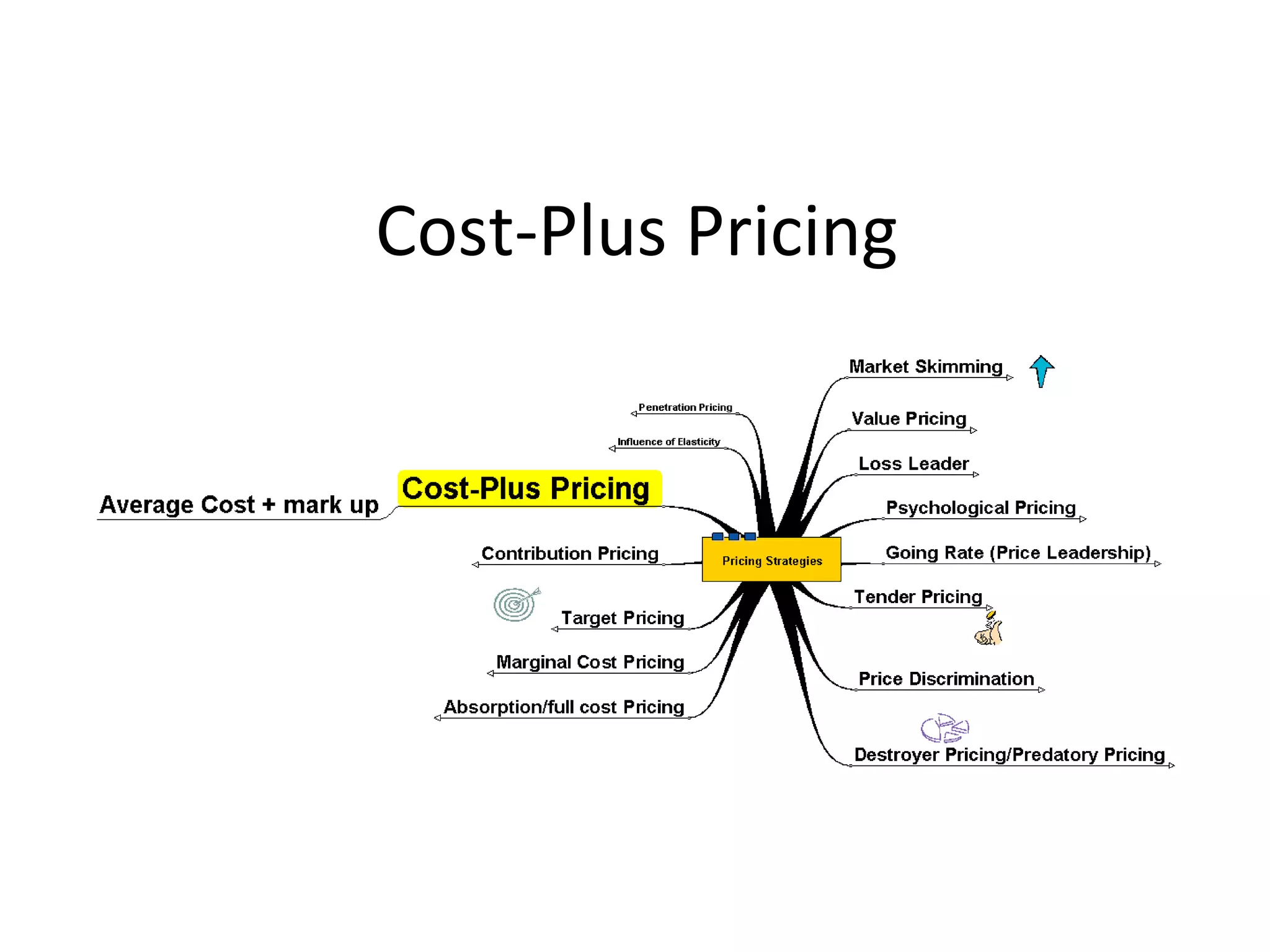
Pricing Strategies
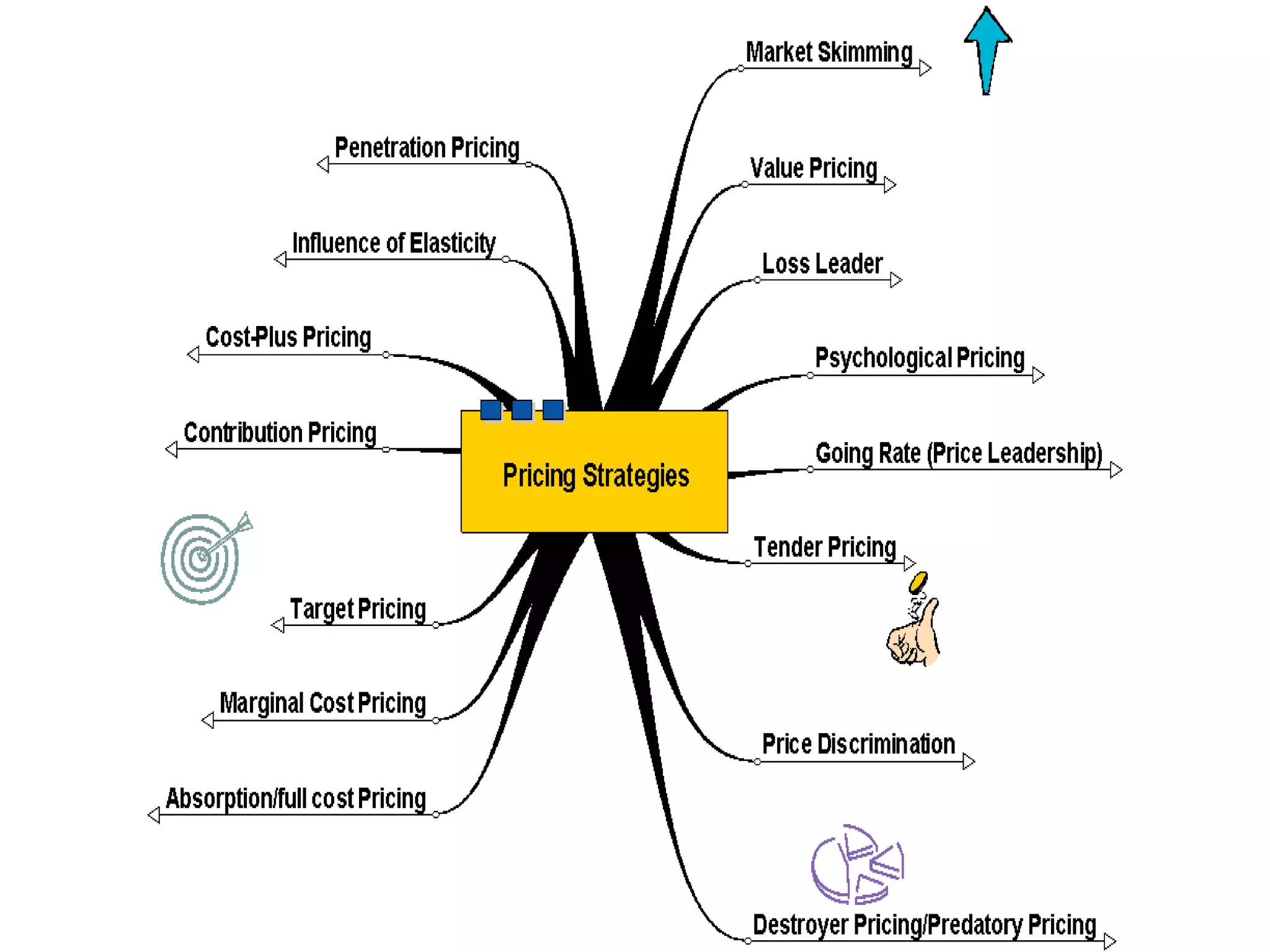
An Introduction…. What is Pricing? How companies price?
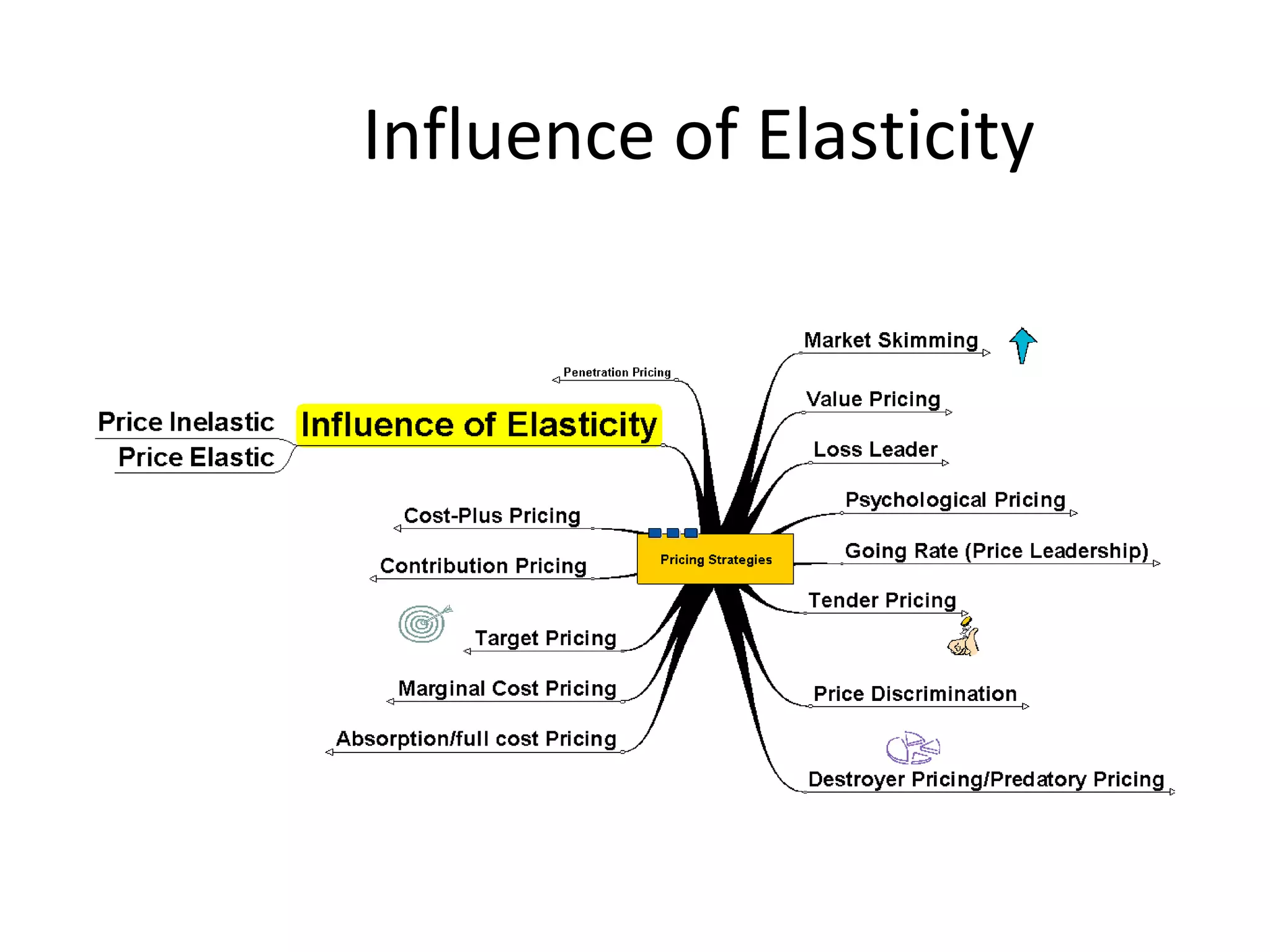
Influence of Elasticity
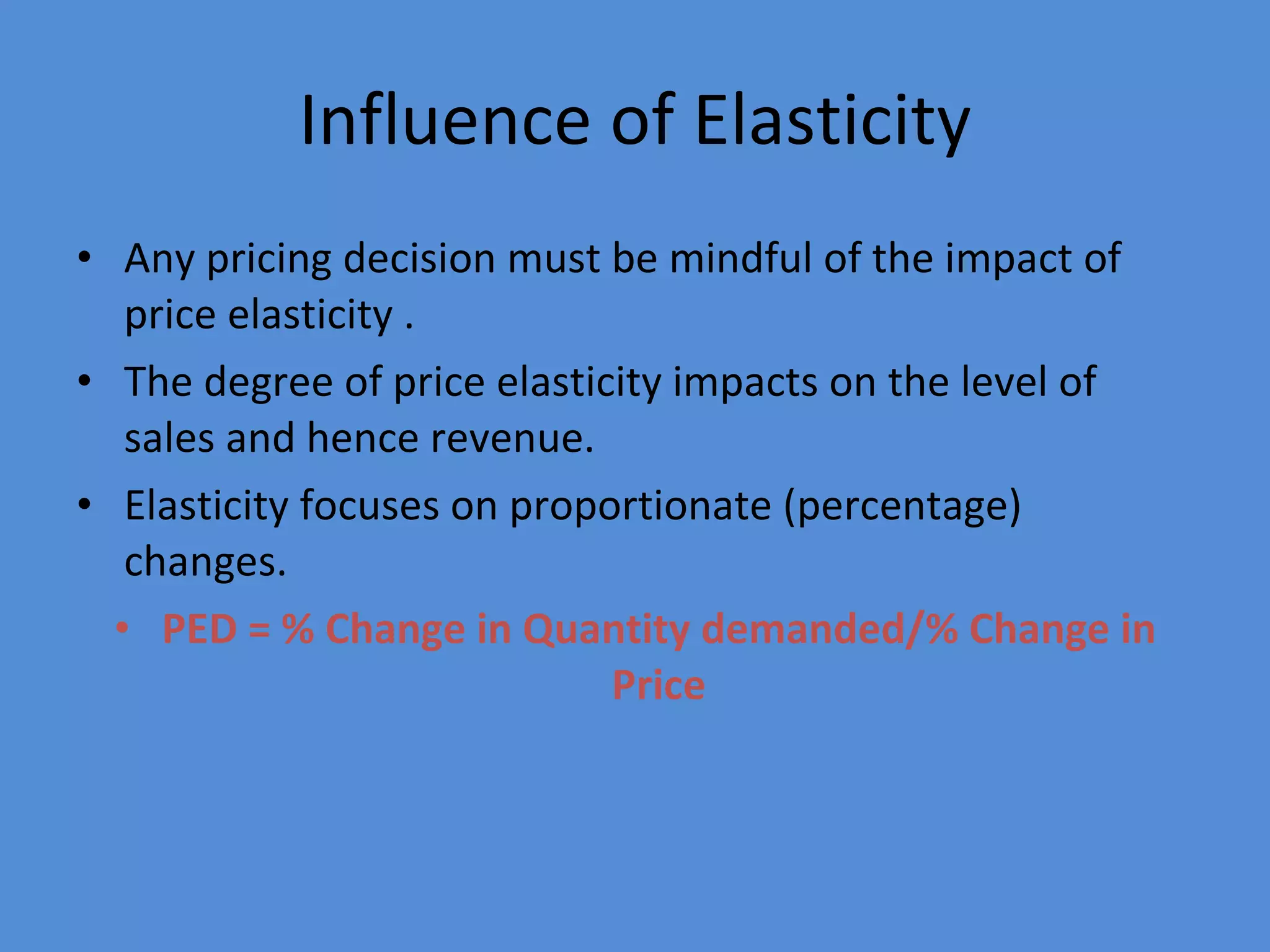
Influence of Elasticity Any pricing decision must be mindful of the impact of price elasticity . The degree of price elasticity impacts on the level of sales and hence revenue. Elasticity focuses on proportionate (percentage) changes. PED = % Change in Quantity demanded/% Change in Price
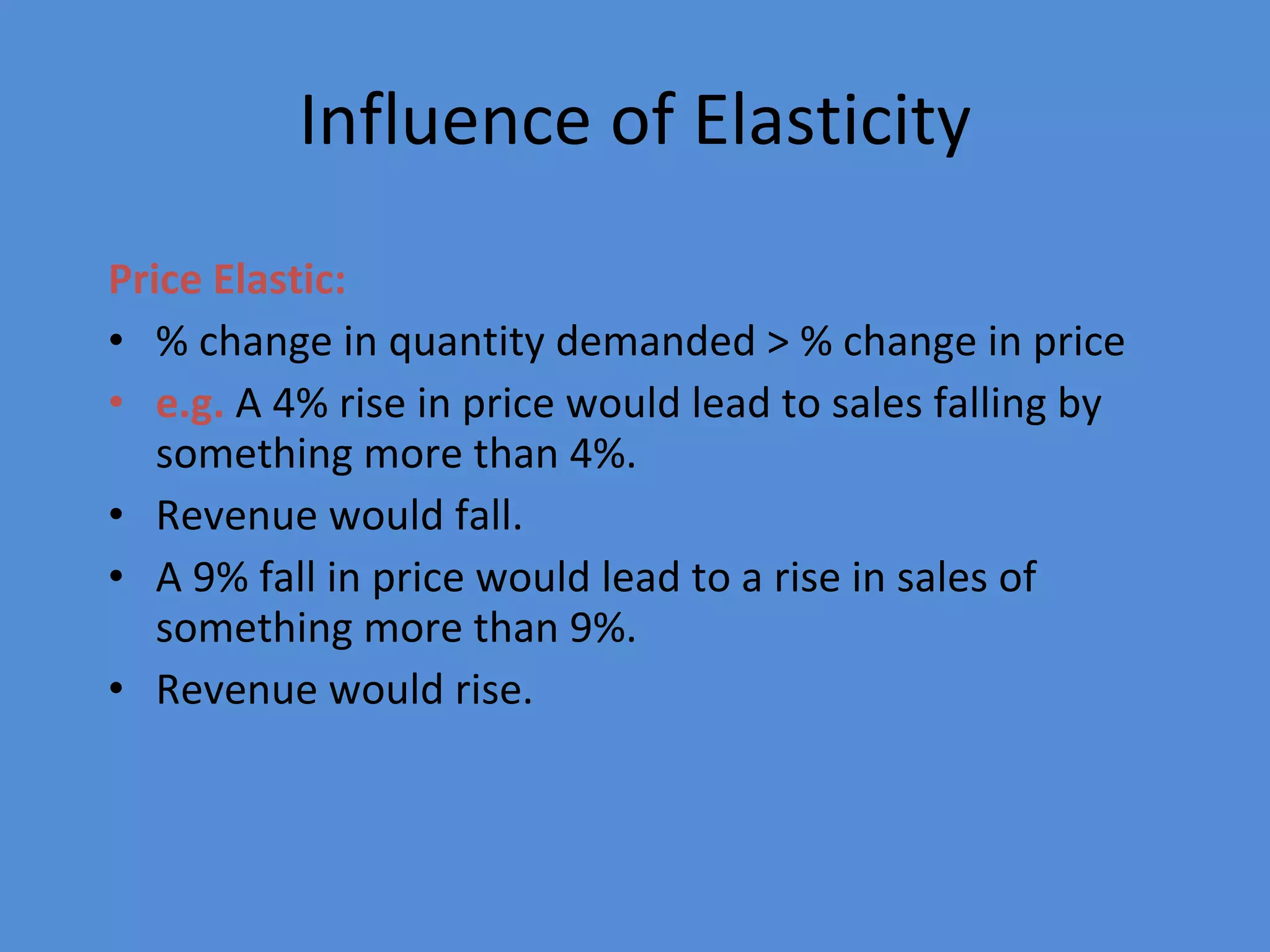
Influence of Elasticity Price Elastic: % change in quantity demanded > % change in price e.g.  A 4% rise in price would lead to sales falling by something more than 4%. Revenue would fall. A 9% fall in price would lead to a rise in sales of something more than 9%. Revenue would rise.
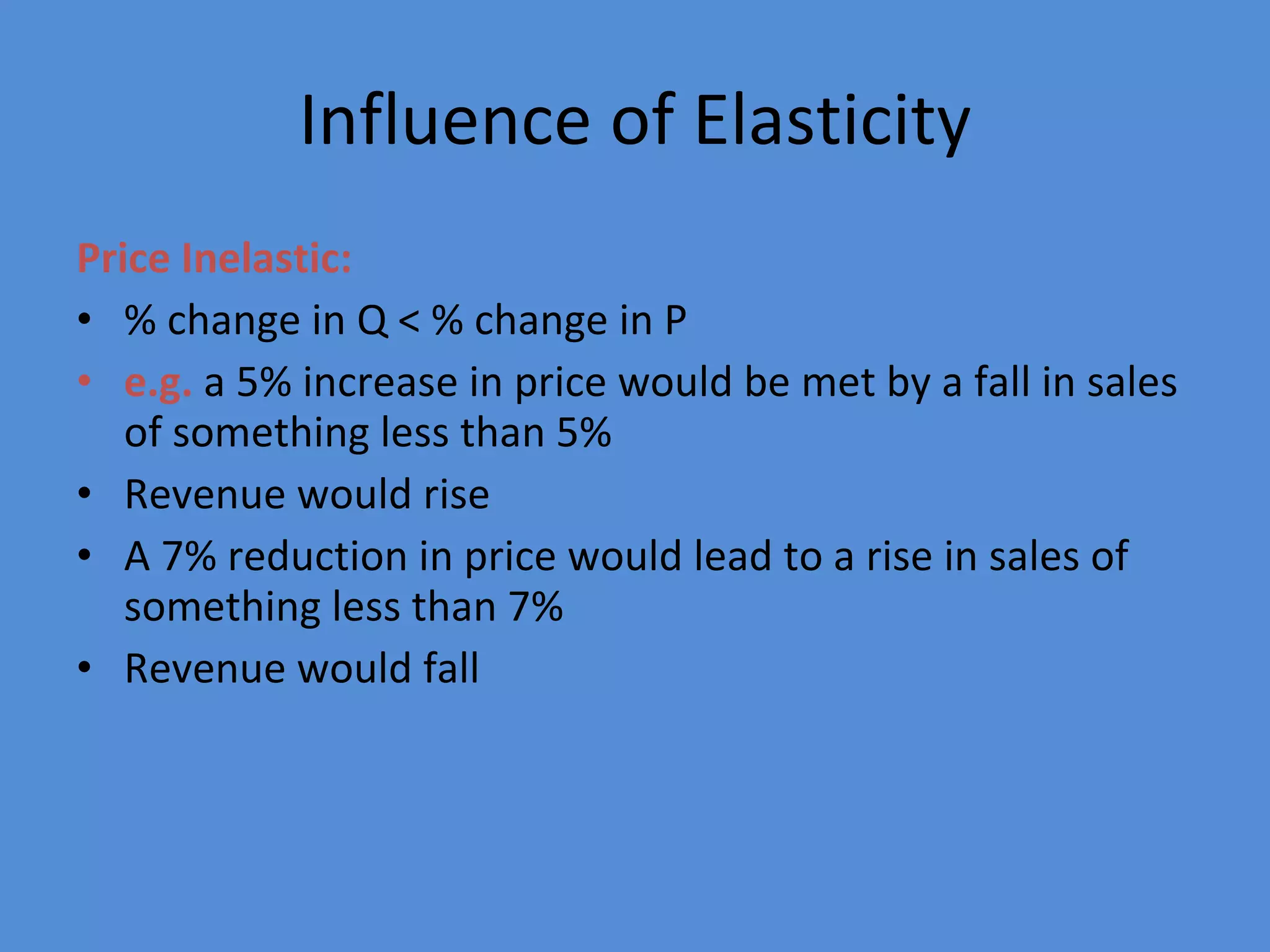
Influence of Elasticity Price Inelastic: % change in Q < % change in P e.g.  a 5% increase in price would be met by a fall in sales of something less than 5%  Revenue would rise A 7% reduction in price would lead to a rise in sales of something less than 7% Revenue would fall
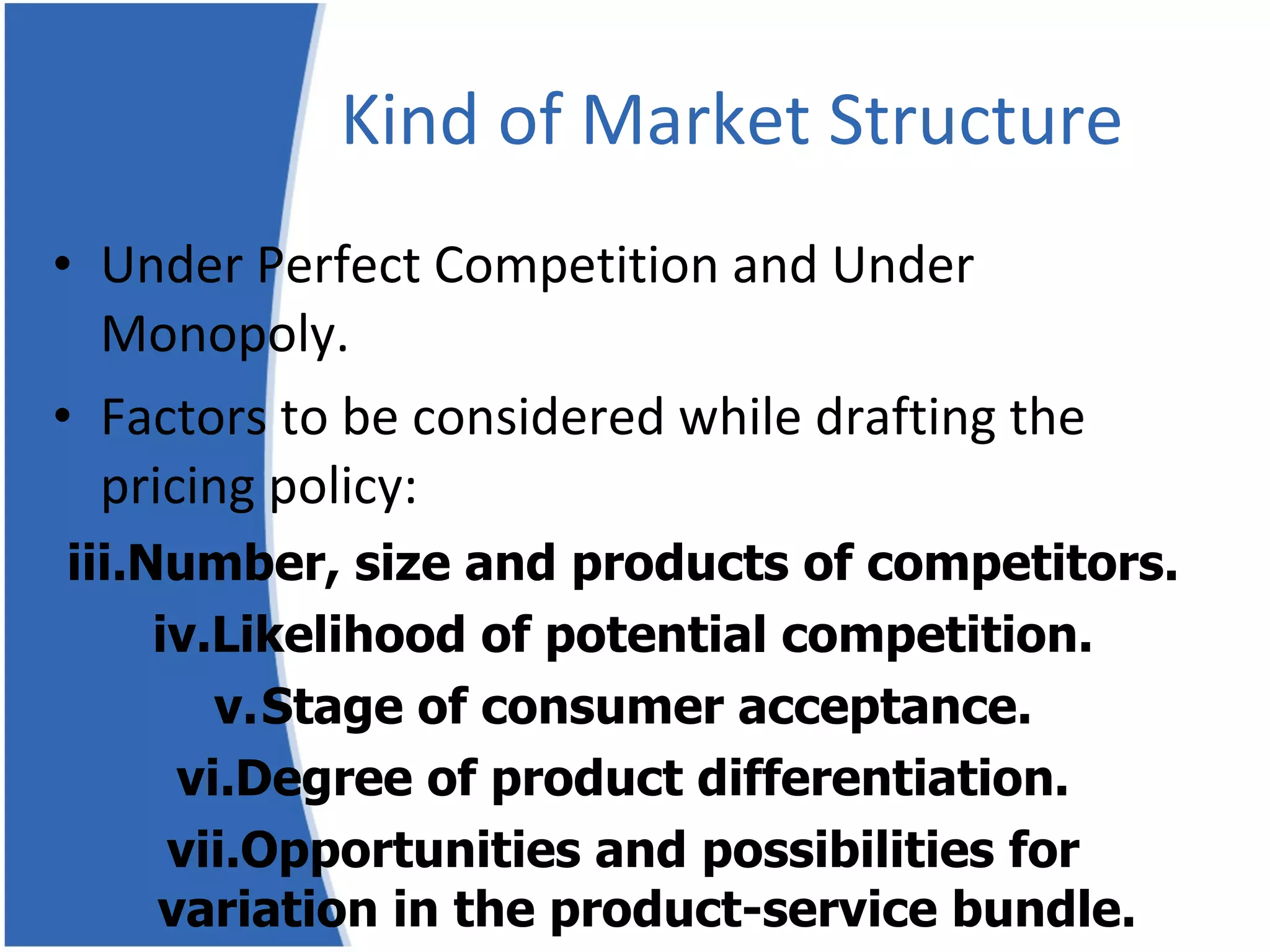
Kind of Market Structure Under Perfect Competition and Under Monopoly. Factors to be considered while drafting the pricing policy: Number, size and products of competitors. Likelihood of potential competition. Stage of consumer acceptance. Degree of product differentiation. Opportunities and possibilities for variation in the product-service bundle.
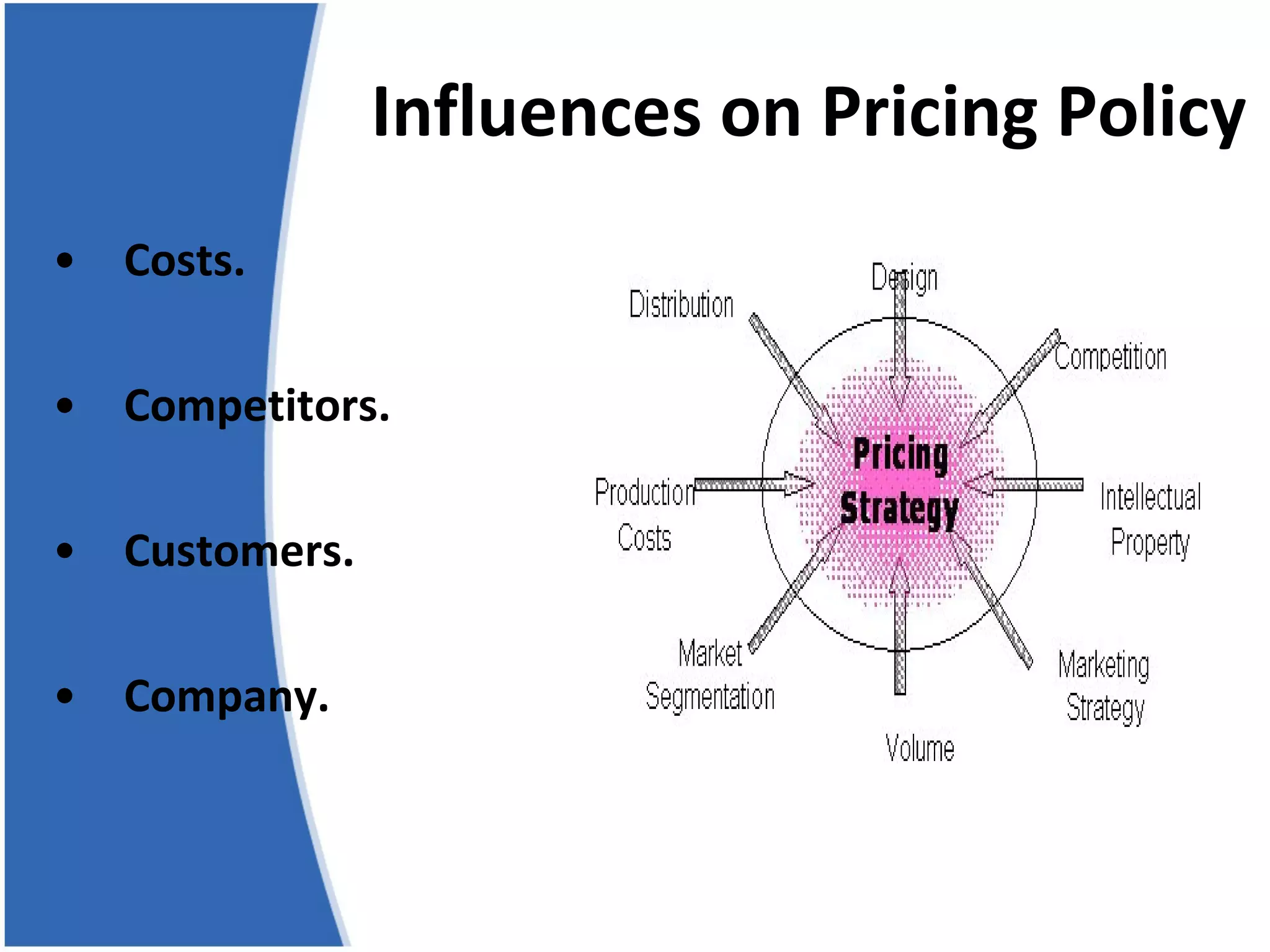
Influences on Pricing Policy Costs. Competitors. Customers. Company.
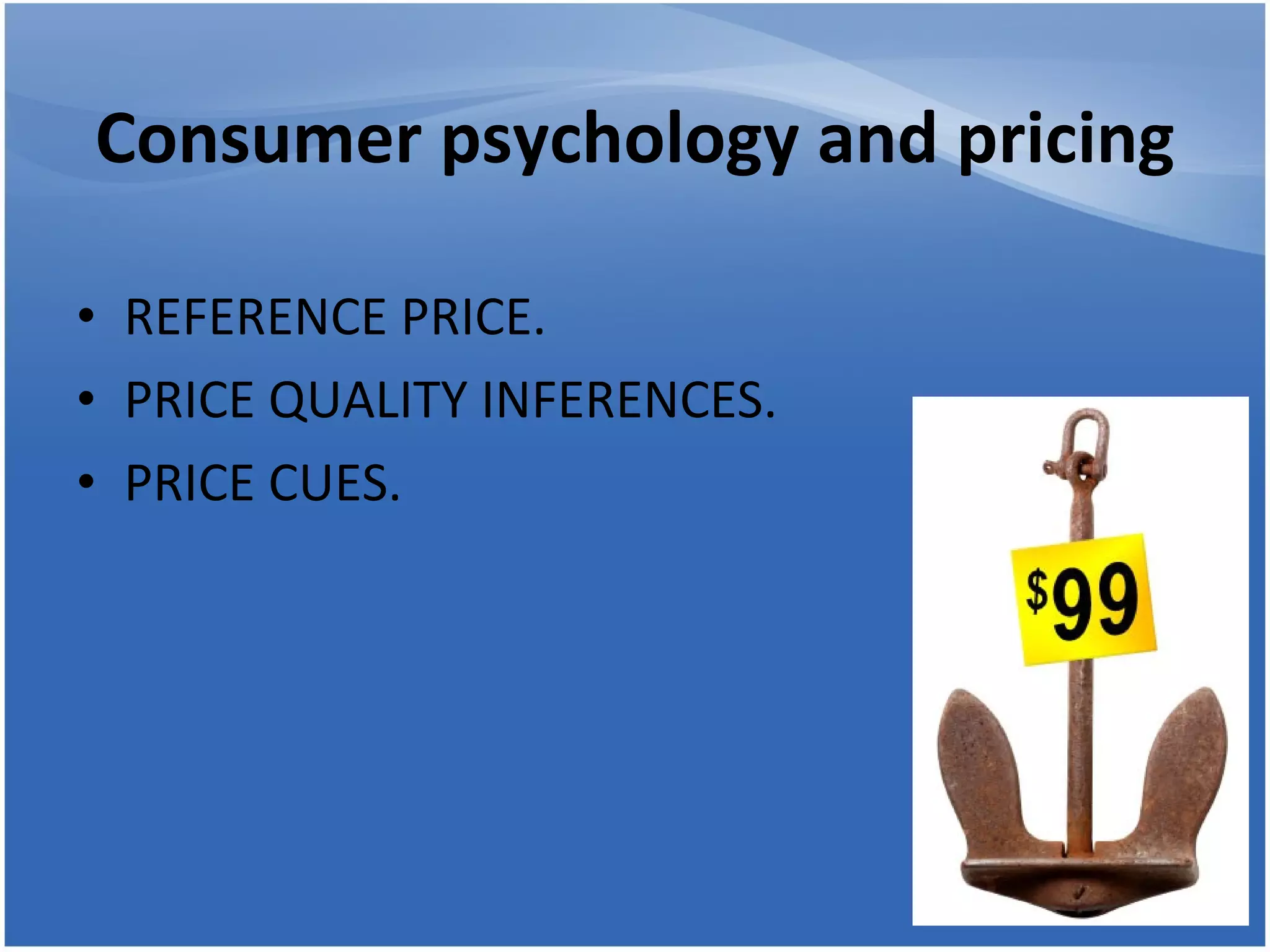
Consumer psychology and pricing REFERENCE PRICE. PRICE QUALITY INFERENCES. PRICE CUES.
Psychology in Pricing Which difference do you think is greater? Odd number pricing ($0.99 vs. $1.00).  Why Nike shoes are priced at $79.99, not $80! Theoretical underpinning: Mental categorization. Price quality perceptions  Toronto flea markets http://www.toronto.com/shopping/listing/000-211-237 Pricing and visibility Mark Laracy: “If you like Opium you will like Ninja”
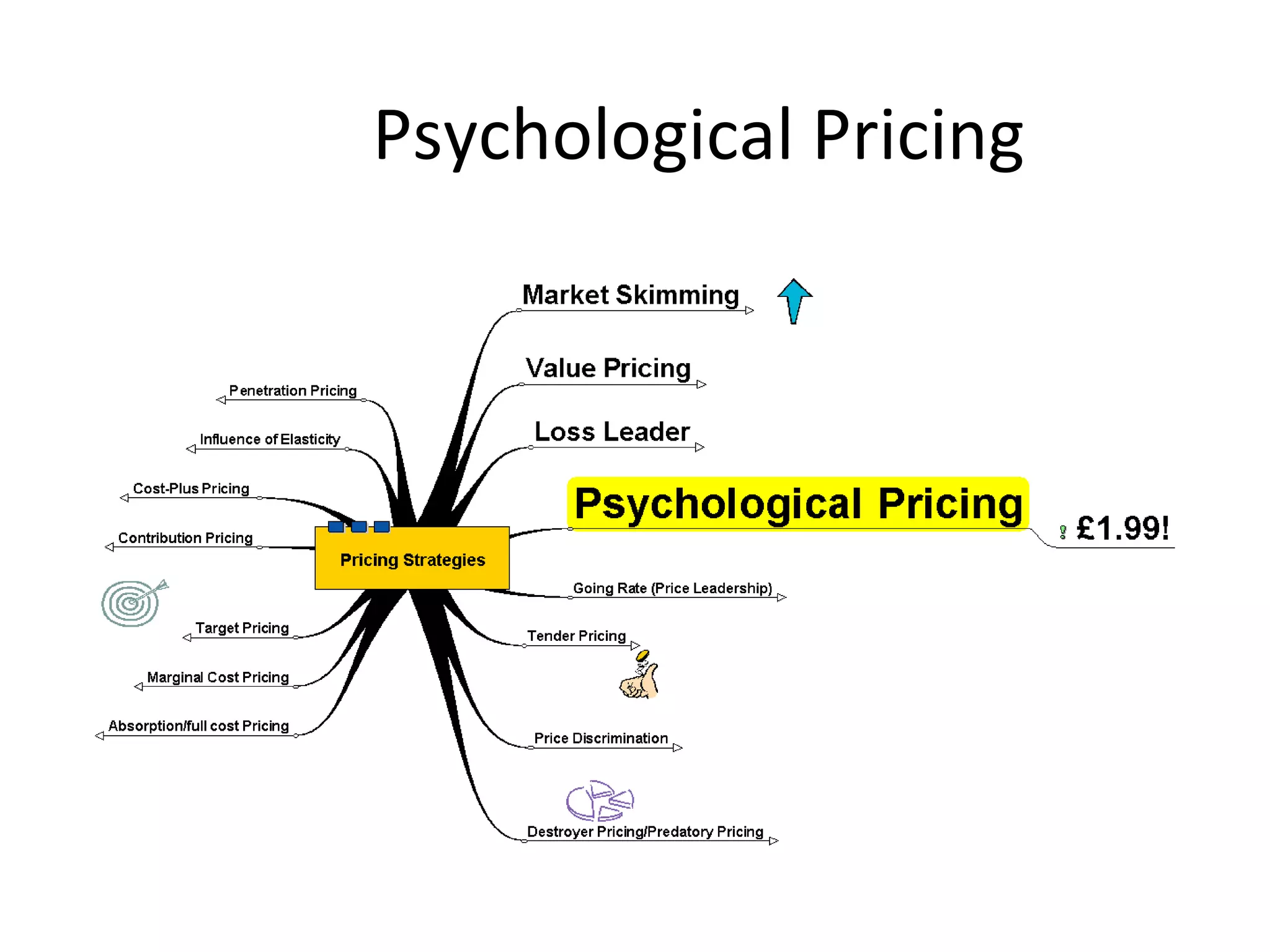
Psychological Pricing
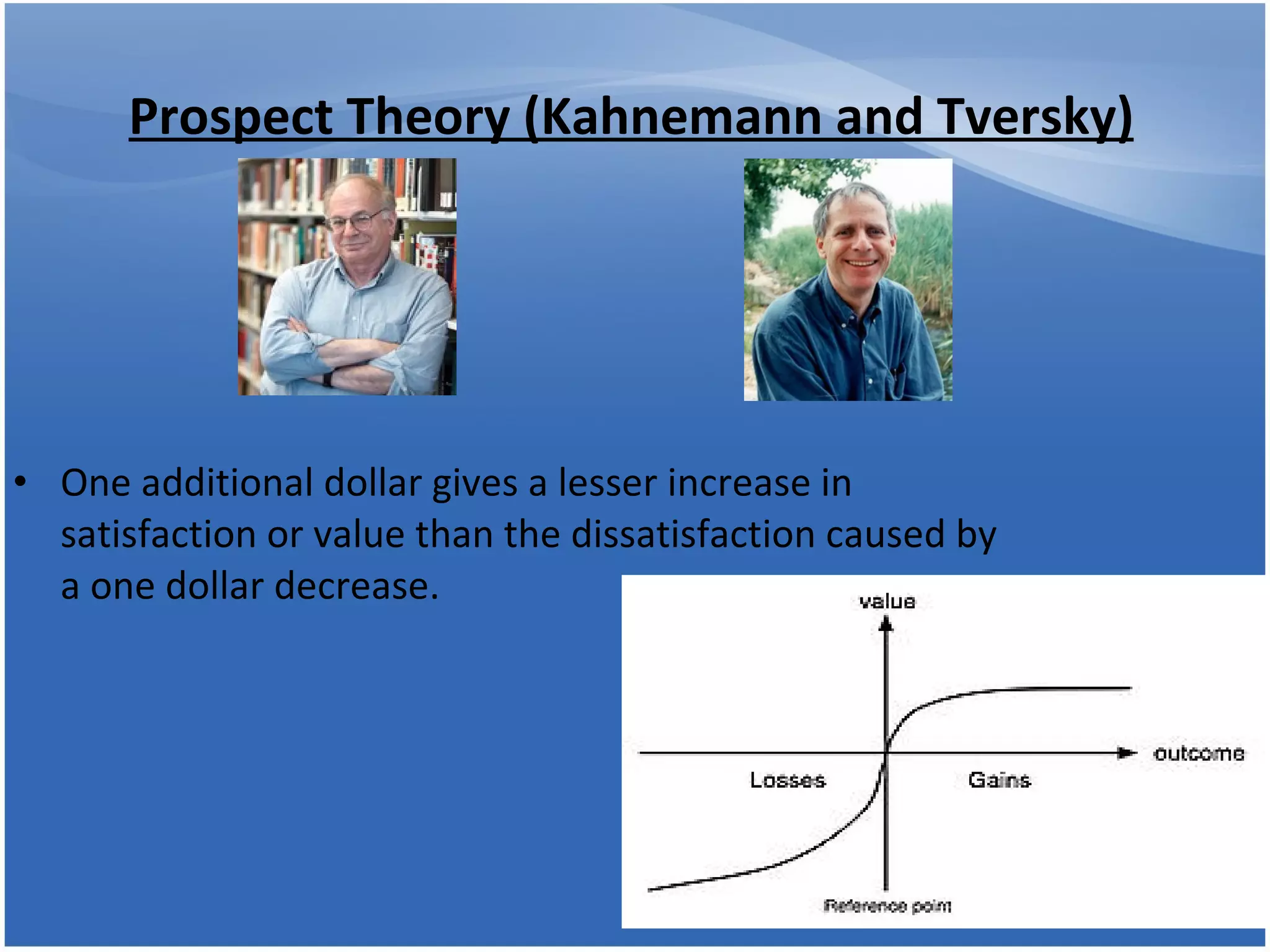
Prospect Theory (Kahnemann and Tversky) One additional dollar gives a lesser increase in satisfaction or value than the dissatisfaction caused by a one dollar decrease.
SETTING THE PRICE STEP 1: SELECTING THE PRICING OBJECTIVE. SURVIVAL. MAXIMUM CURRENT PROFIT. MAXIMUM MARKET SHARE.  MAXIMUM MARKET SKIMMING.
STEP 2: DETERMINING DEMAND Each price will lead to a different level of demand and therefore have a different impact on the company’s marketing objectives. If the prices is too high, the level of demand may fall. PRICE SENSITIVITY. ESTIMATING THE DEMAND CURVES. PRICE ELASTICITY OF DEMAND.
STEP 3: ESTIMATING COSTS The company wants to charge a price that covers its cost of producing, distributing, and selling the product, including a fair return for its effort and risk. • Fixed costs are the cost that do not vary with the production or sales revenue. • Variable costs vary directly with the level of production  • Total costs consist of the sum of the fixed and variable cost for any given level of production. • Average cost is the cost per unit at that level of production; it is equal to total costs divided by production.
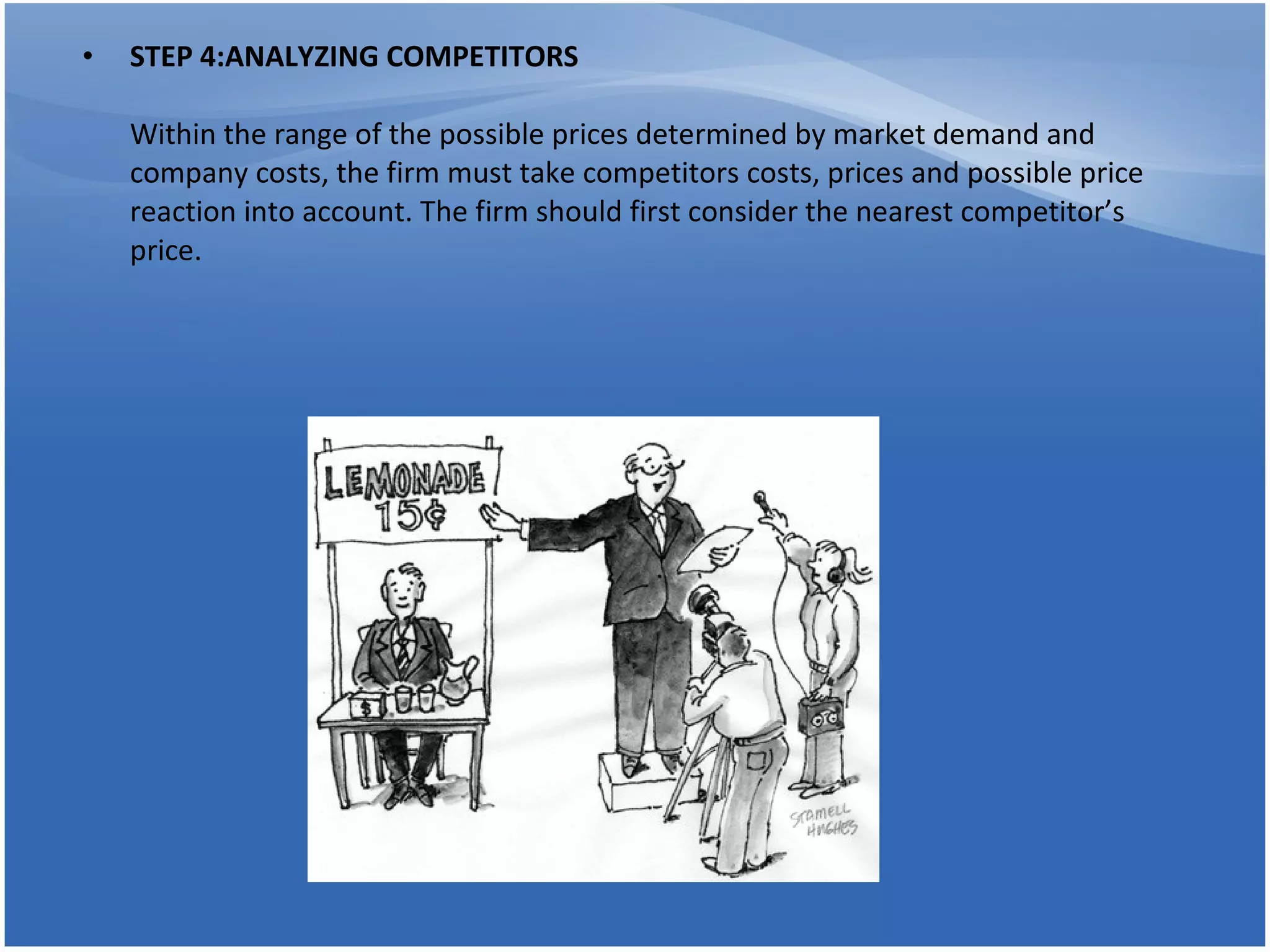
STEP 4:ANALYZING COMPETITORS  Within the range of the possible prices determined by market demand and company costs, the firm must take competitors costs, prices and possible price reaction into account. The firm should first consider the nearest competitor’s price.
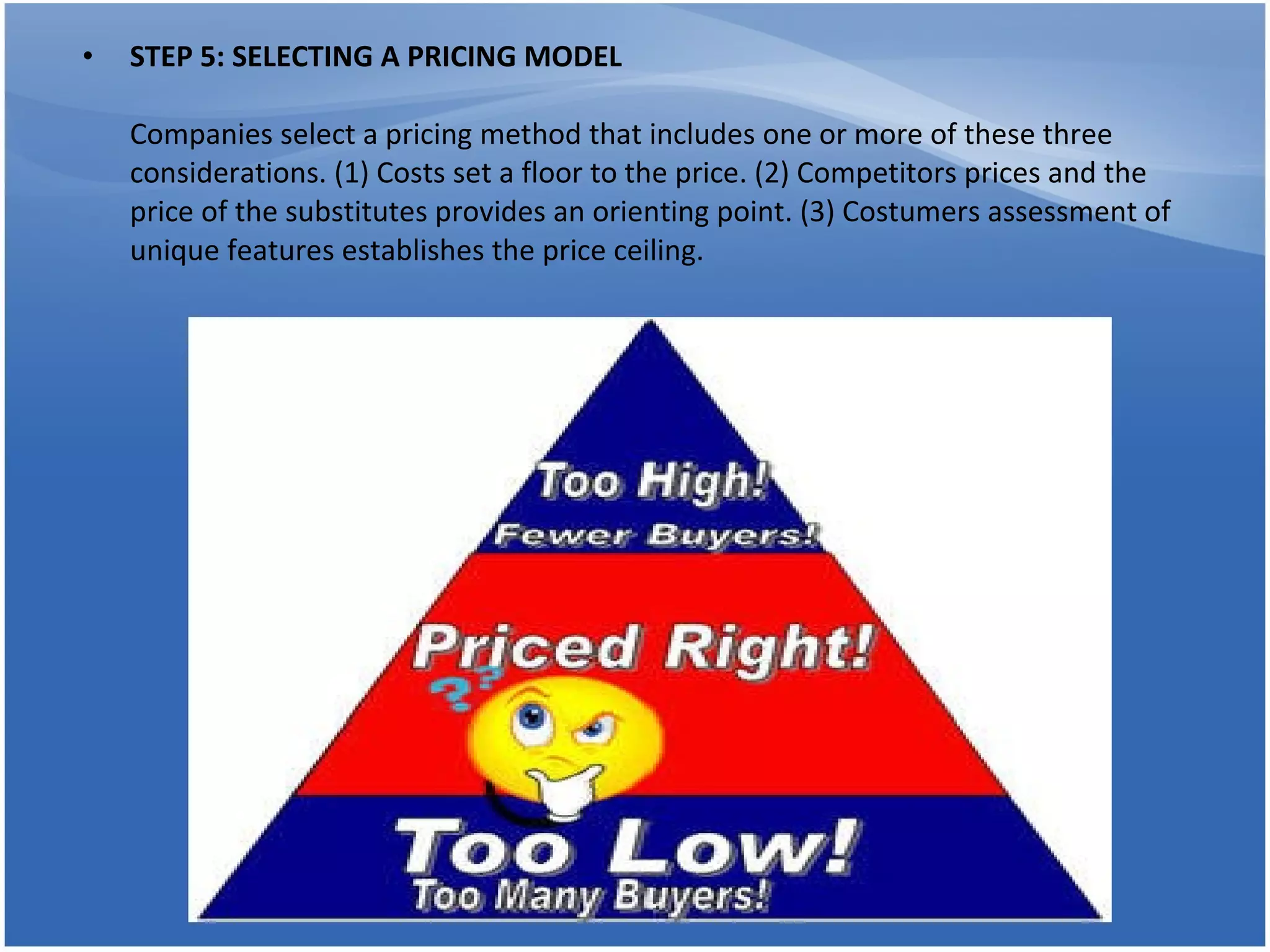
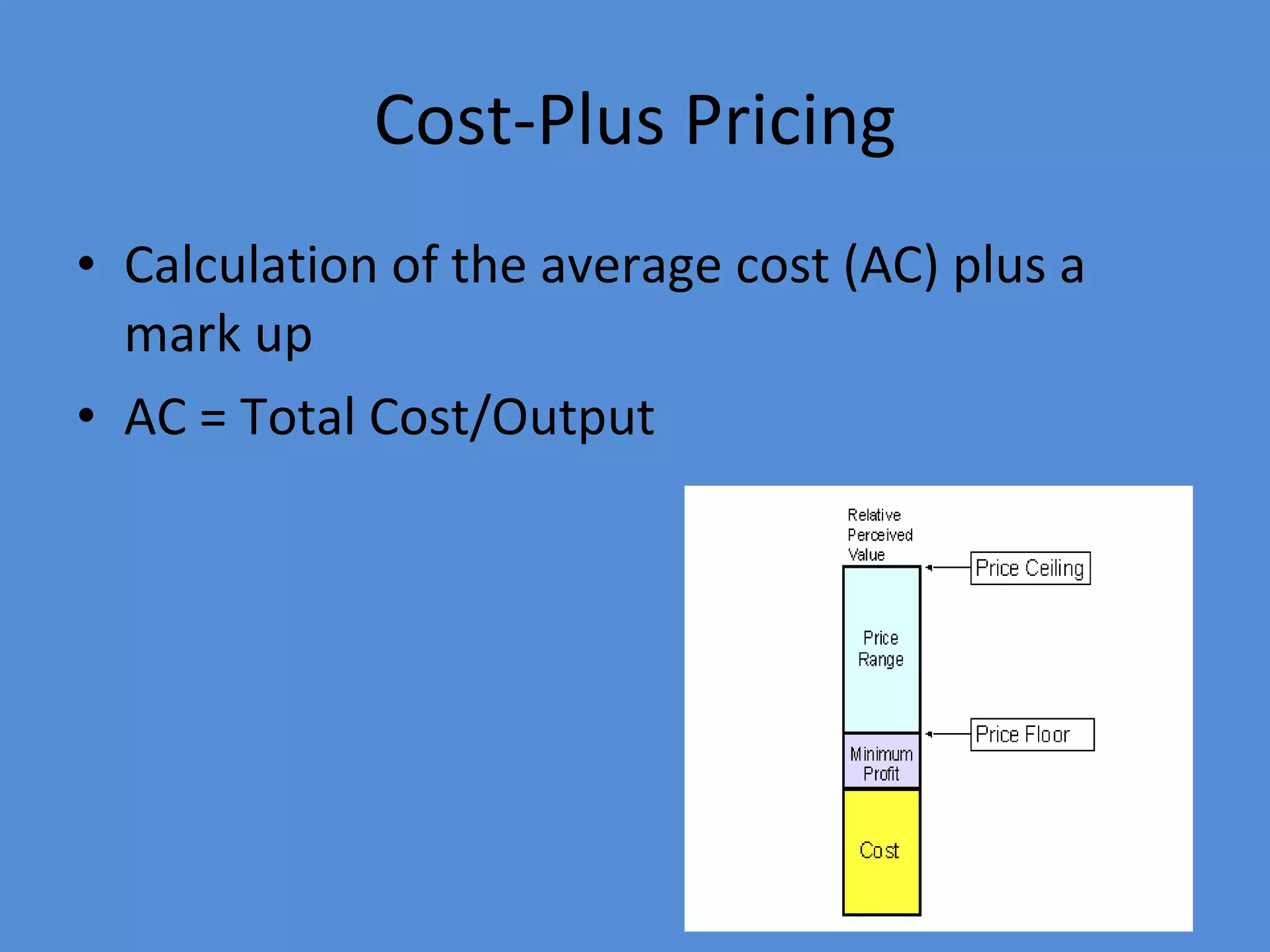
STEP 5: SELECTING A PRICING MODEL Companies select a pricing method that includes one or more of these three considerations. (1) Costs set a floor to the price. (2) Competitors prices and the price of the substitutes provides an orienting point. (3) Costumers assessment of unique features establishes the price ceiling.
 
 
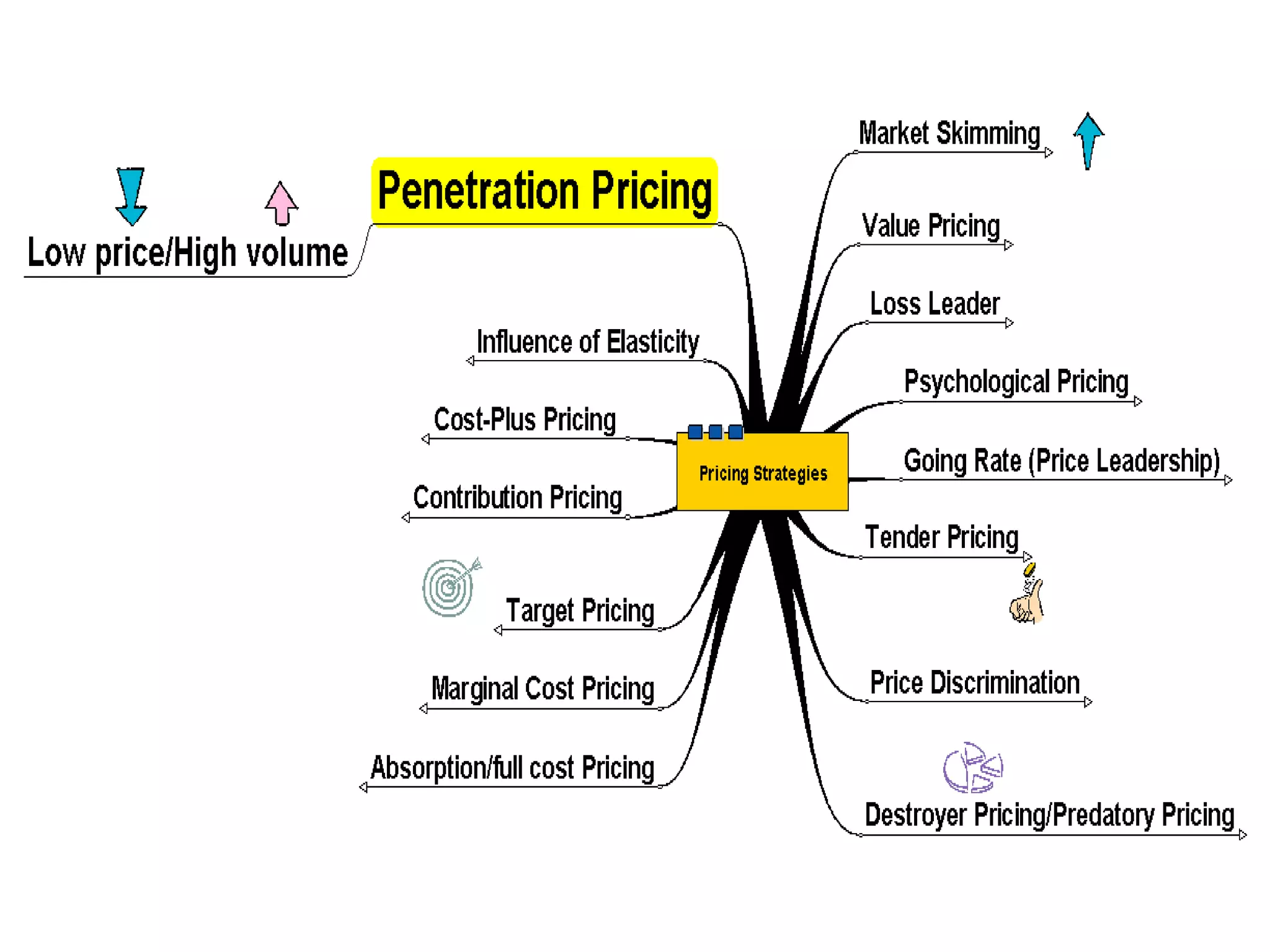
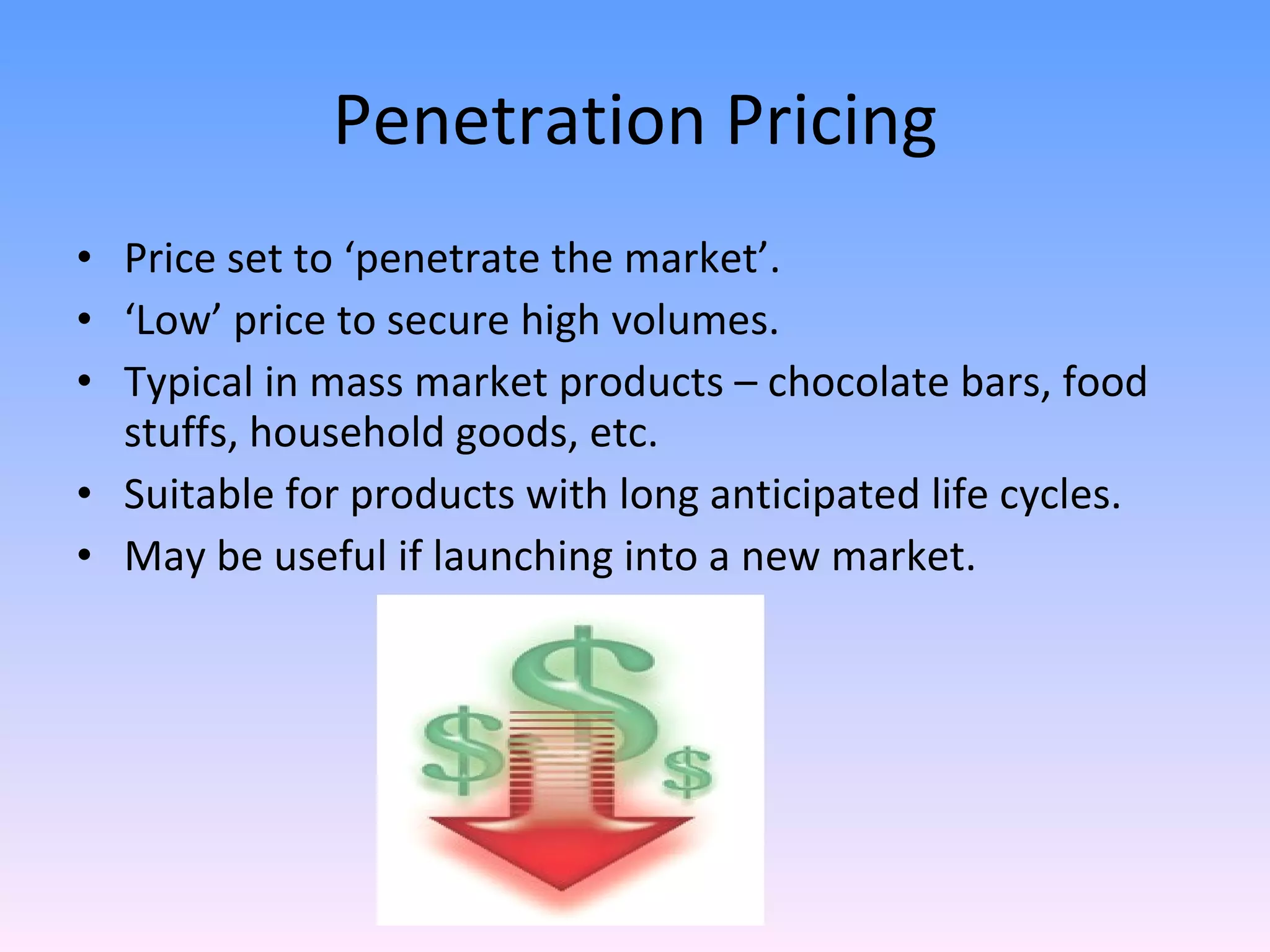
Penetration Pricing Price set to ‘penetrate the market’. ‘ Low’ price to secure high volumes. Typical in mass market products – chocolate bars, food stuffs, household goods, etc. Suitable for products with long anticipated life cycles. May be useful if launching into a new market.
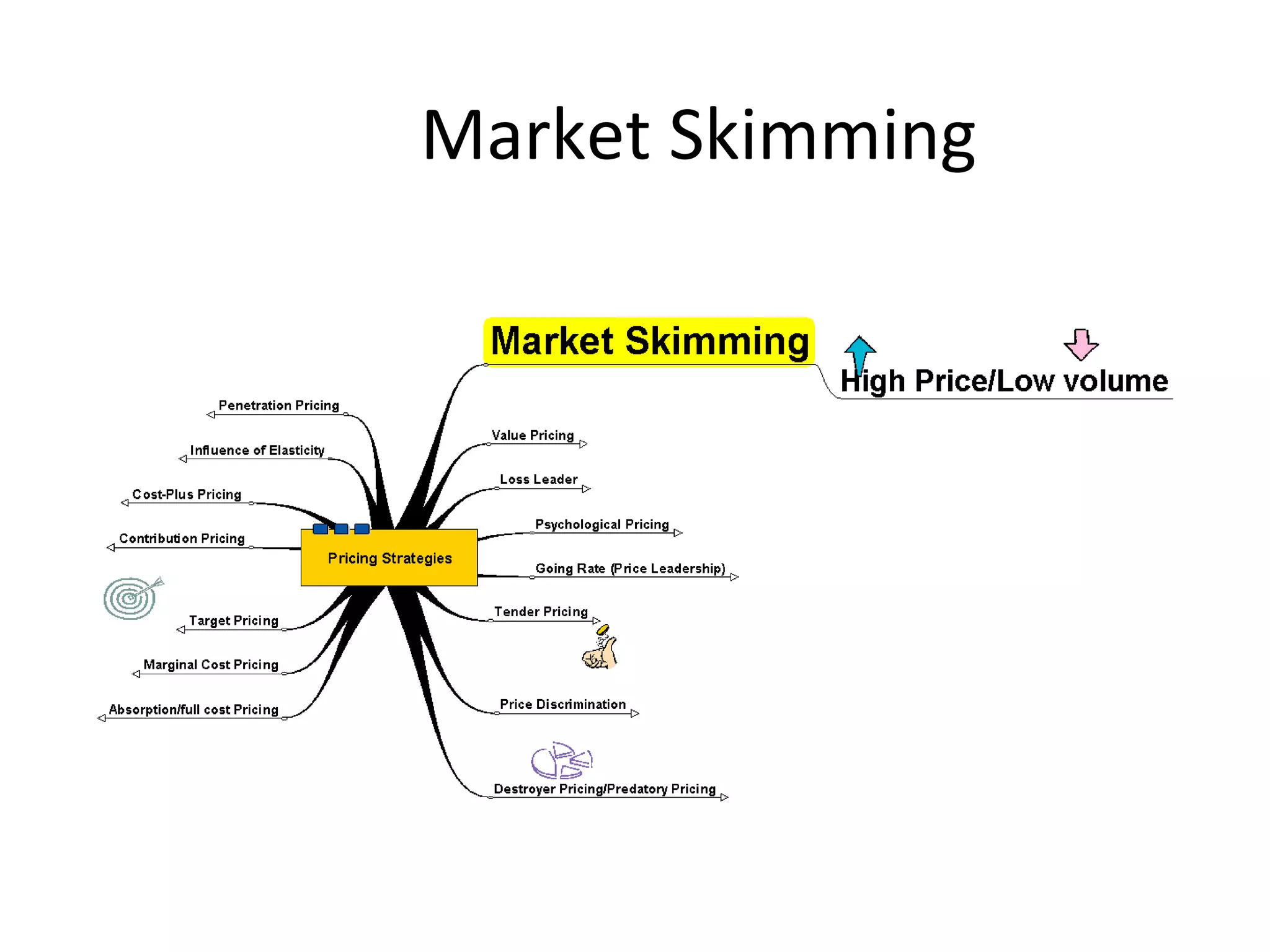
Market Skimming
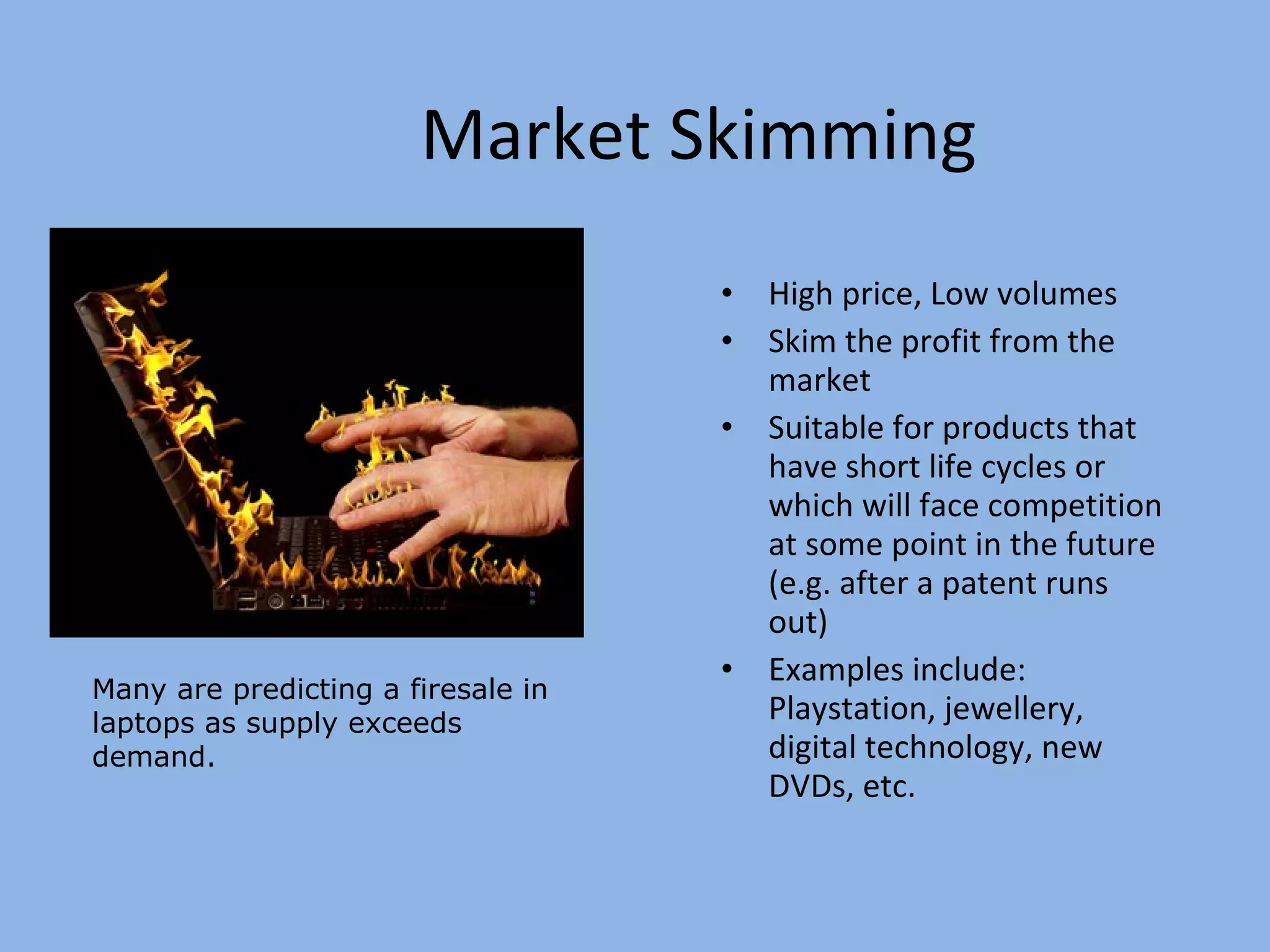
Market Skimming High price, Low volumes Skim the profit from the market Suitable for products that have short life cycles or which will face competition at some point in the future (e.g. after a patent runs out) Examples include: Playstation, jewellery, digital technology, new DVDs, etc. Many are predicting a firesale in laptops as supply exceeds demand.
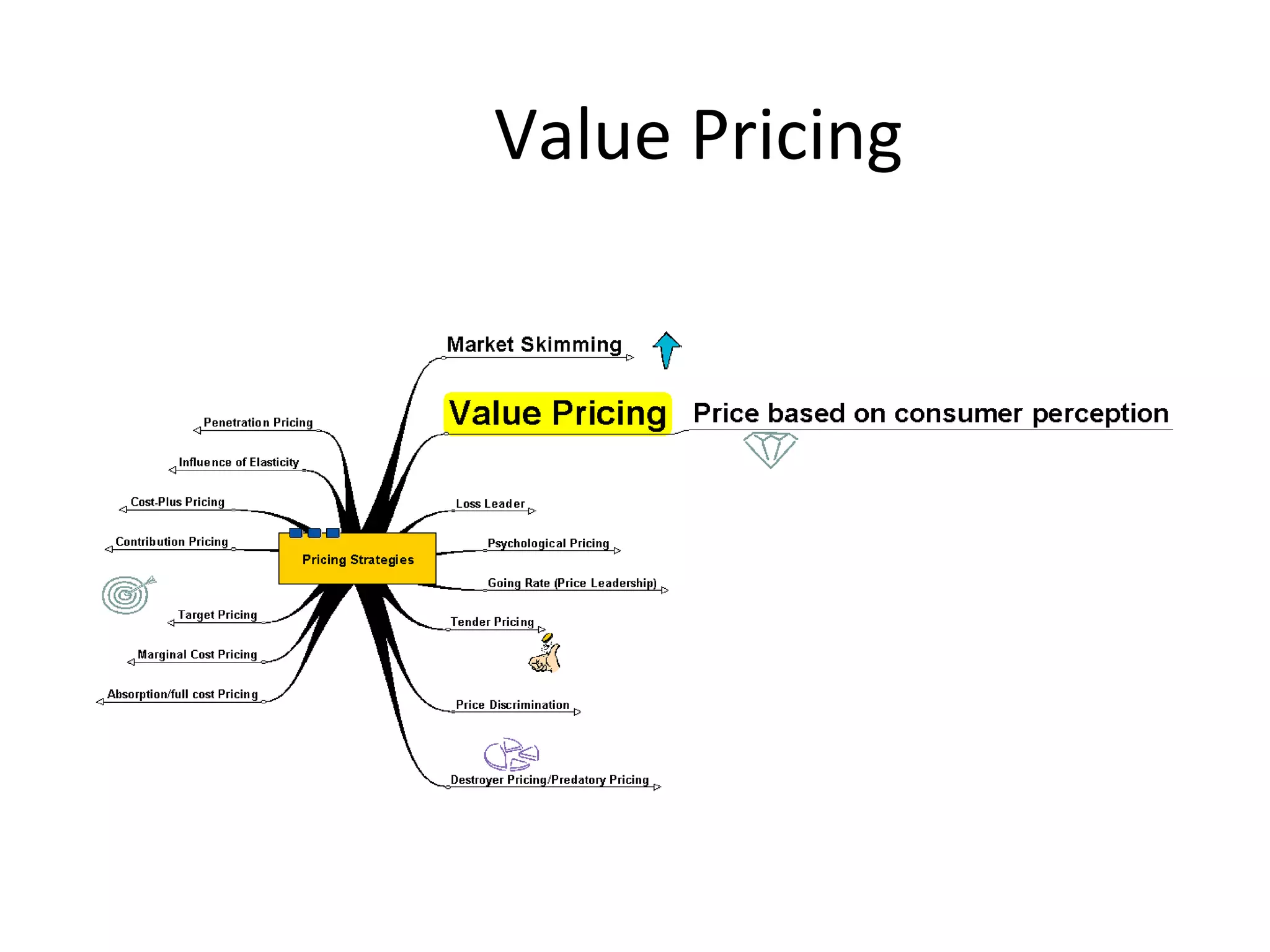
Value Pricing
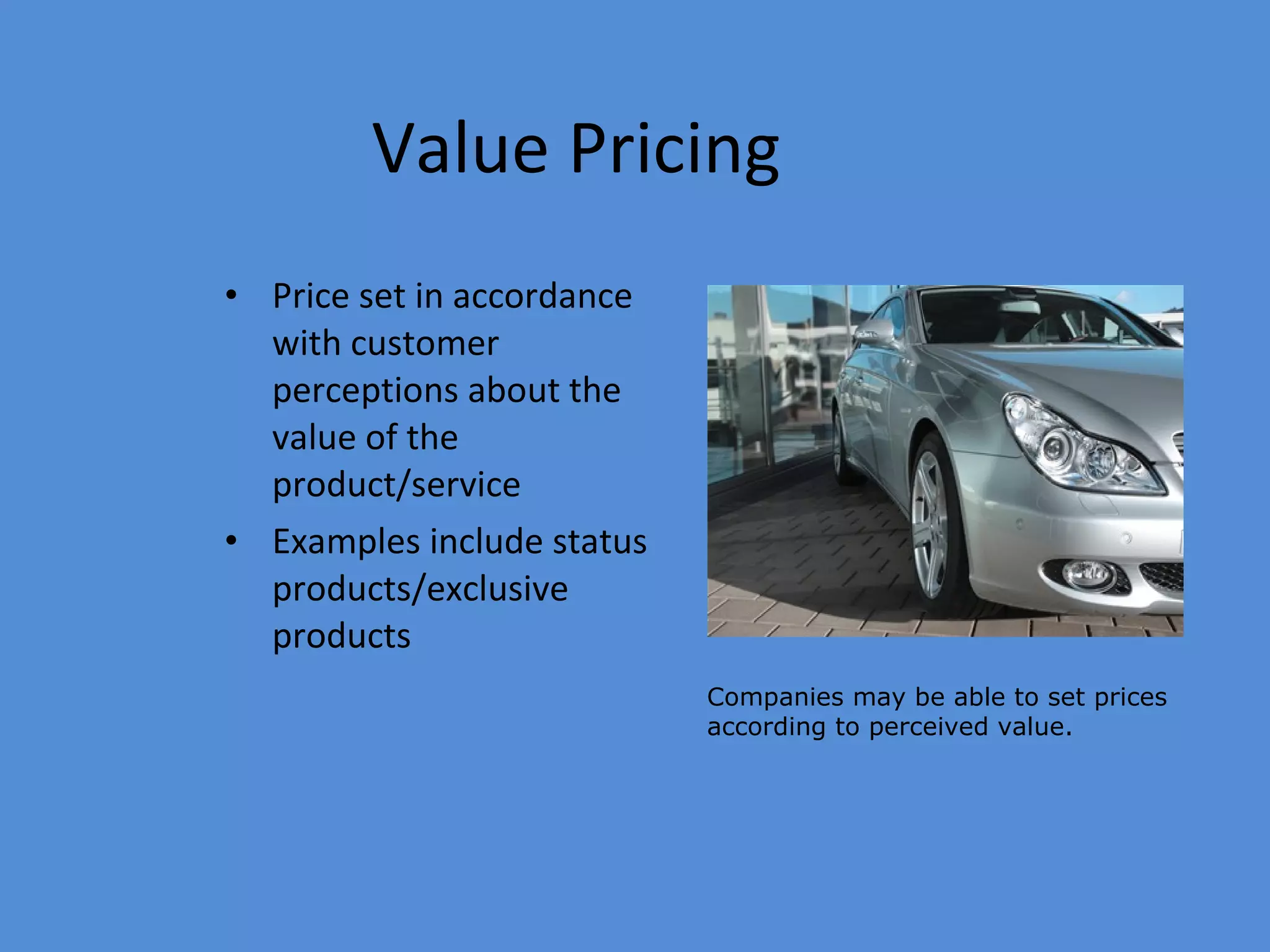
Value Pricing Price set in accordance with customer perceptions about the value of the product/service Examples include status products/exclusive products  Companies may be able to set prices according to perceived value.
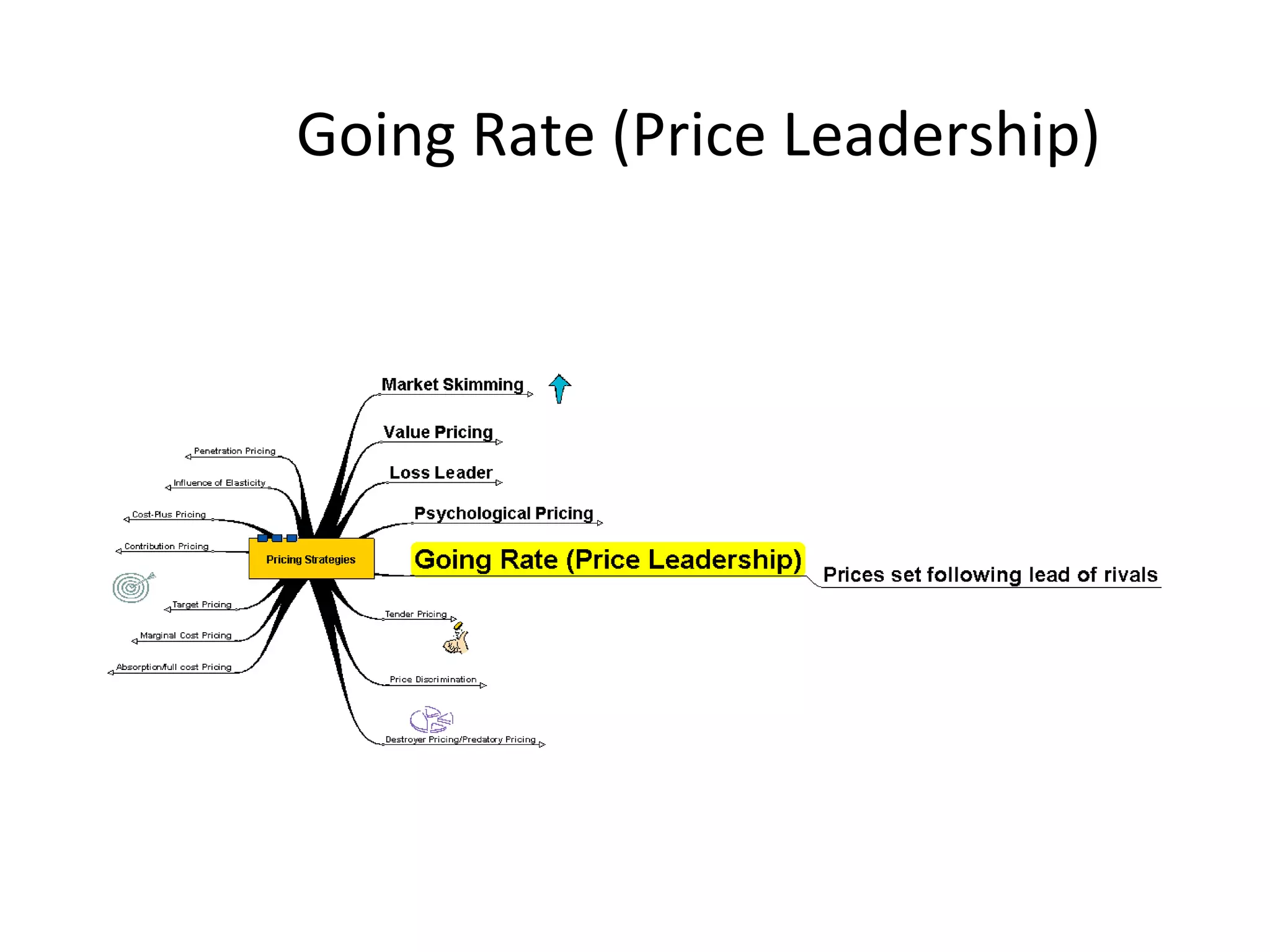
Going Rate (Price Leadership)
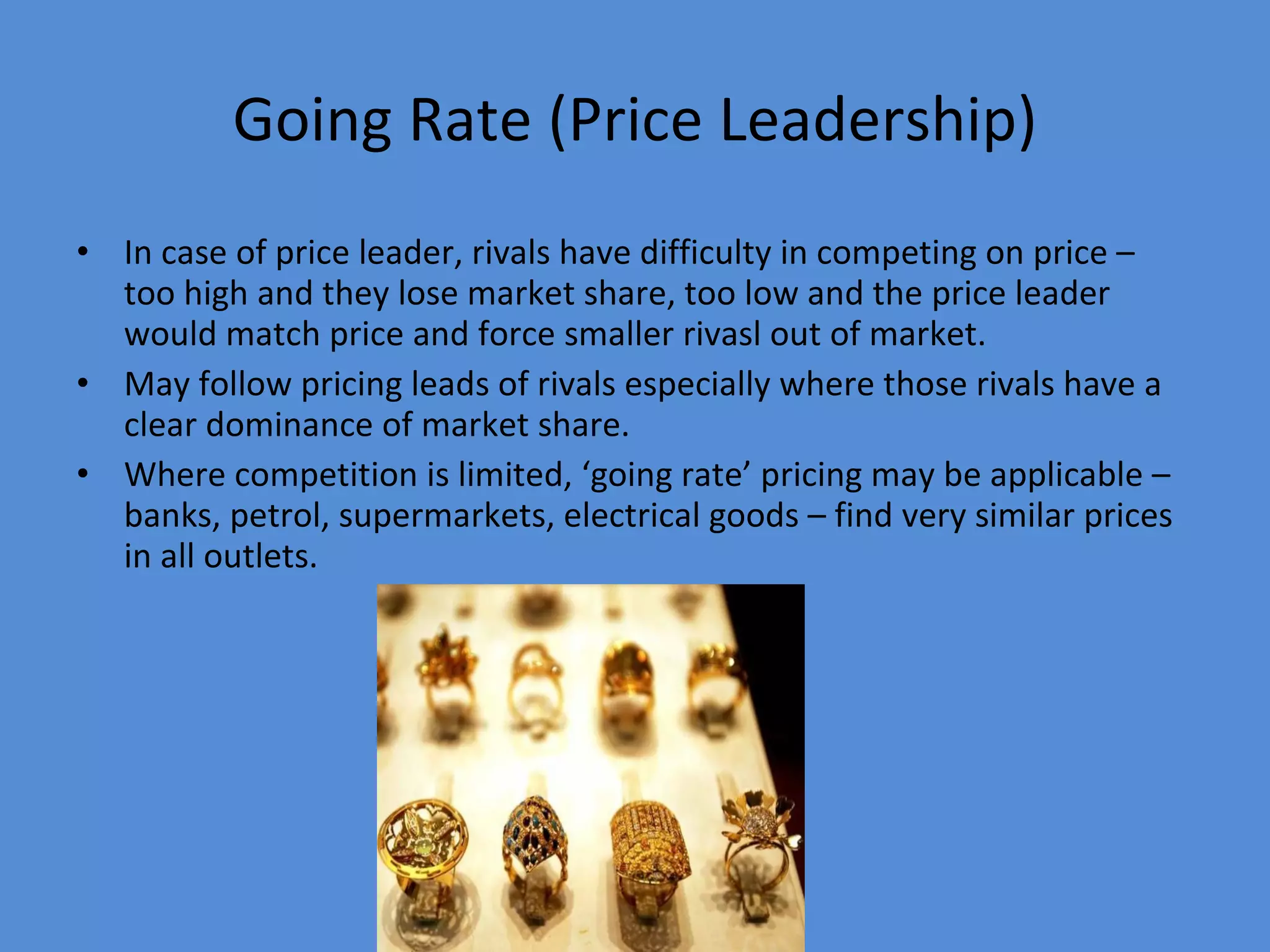
Going Rate (Price Leadership) In case of price leader, rivals have difficulty in competing on price – too high and they lose market share, too low and the price leader would match price and force smaller rivasl out of market. May follow pricing leads of rivals especially where those rivals have a clear dominance of market share. Where competition is limited, ‘going rate’ pricing may be applicable – banks, petrol, supermarkets, electrical goods – find very similar prices in all outlets.
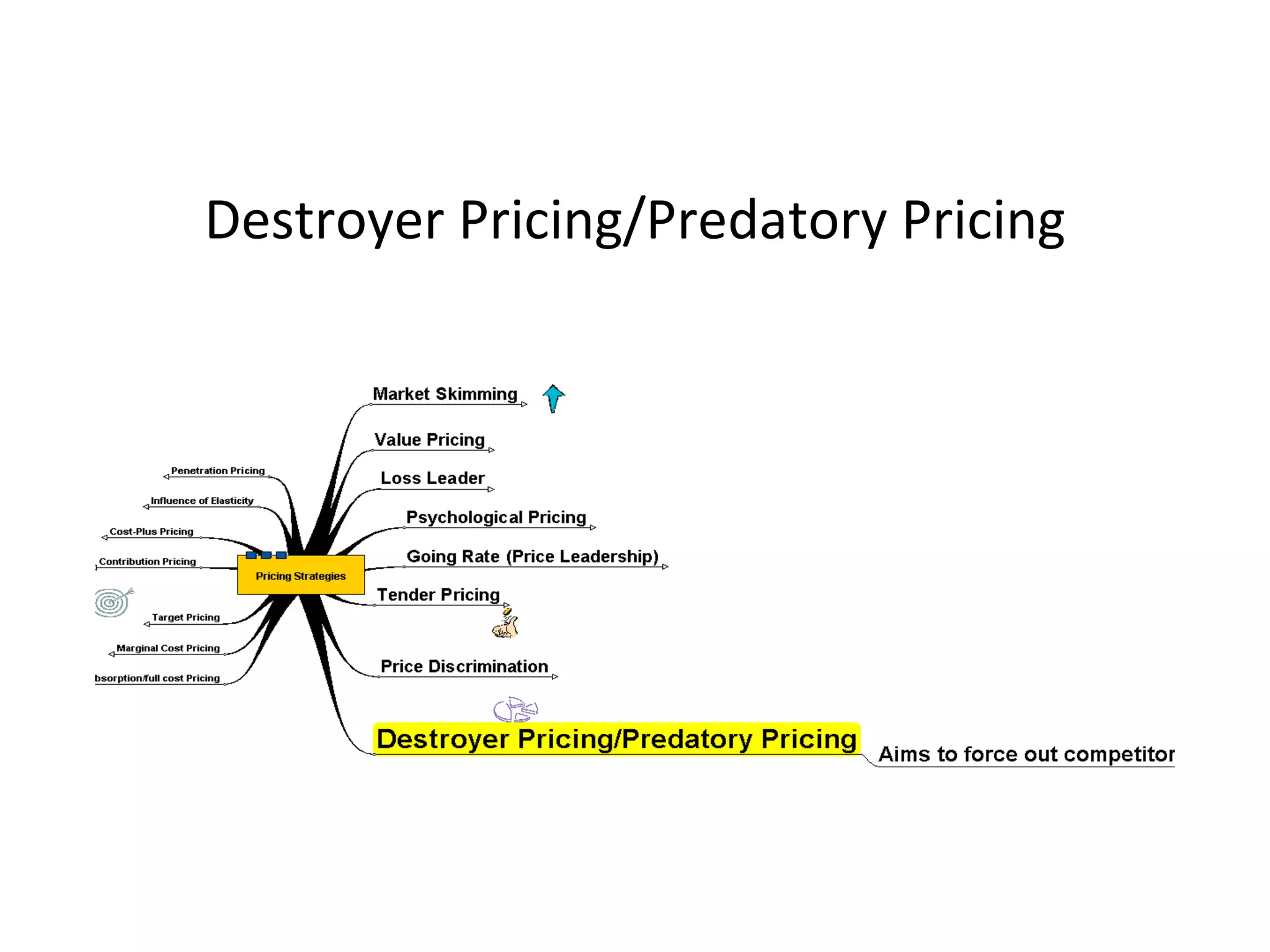
Destroyer Pricing/Predatory Pricing
Destroyer/Predatory Pricing Deliberate price cutting or offer of ‘free gifts/products’ to force rivals (normally smaller and weaker) out of business or prevent new entrants. Anti-competitive and illegal if it can be proved.
Absorption/Full Cost Pricing
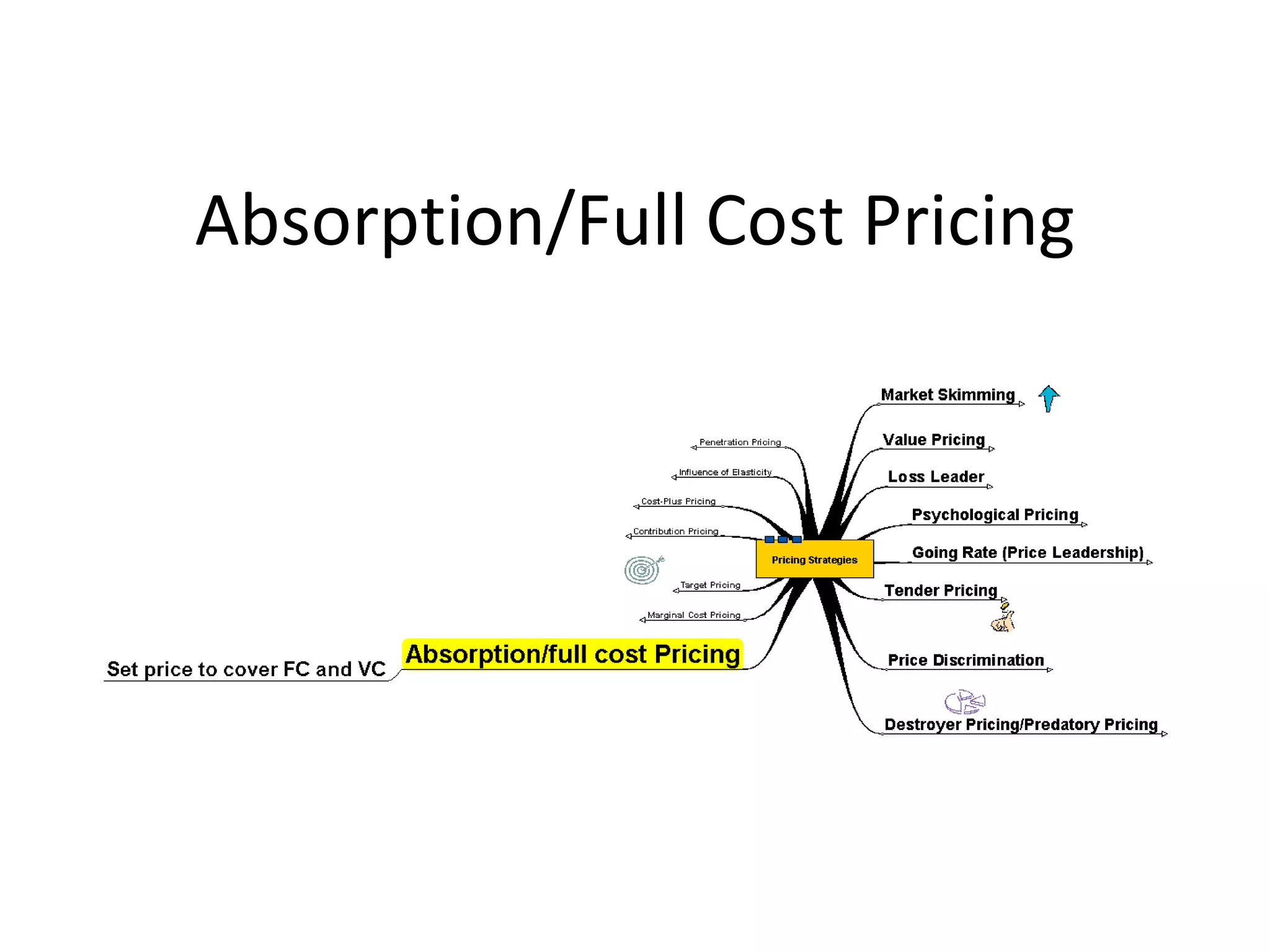
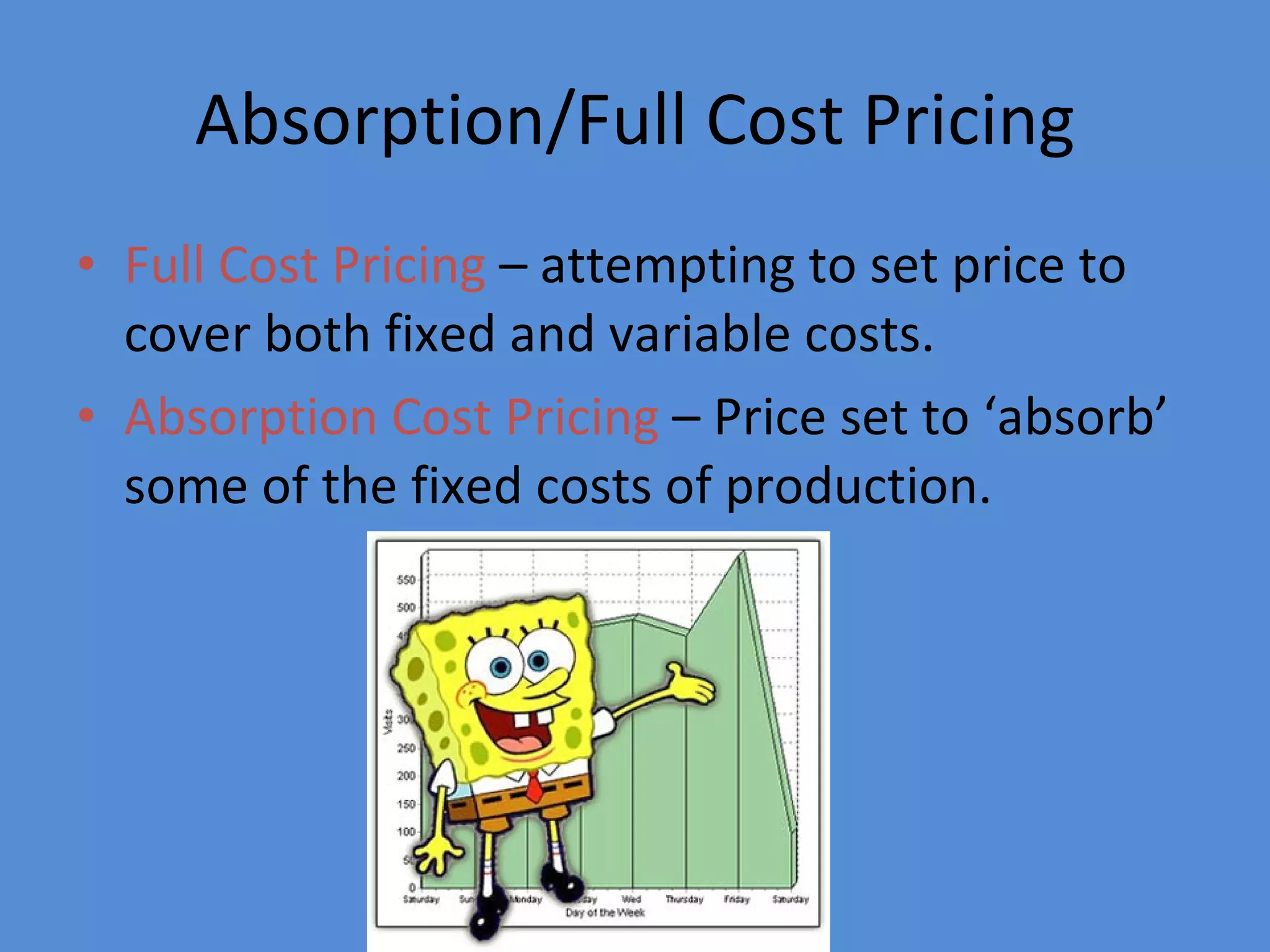
Absorption/Full Cost Pricing Full Cost Pricing  – attempting to set price to cover both fixed and variable costs. Absorption Cost Pricing  – Price set to ‘absorb’ some of the fixed costs of production.
Target Pricing
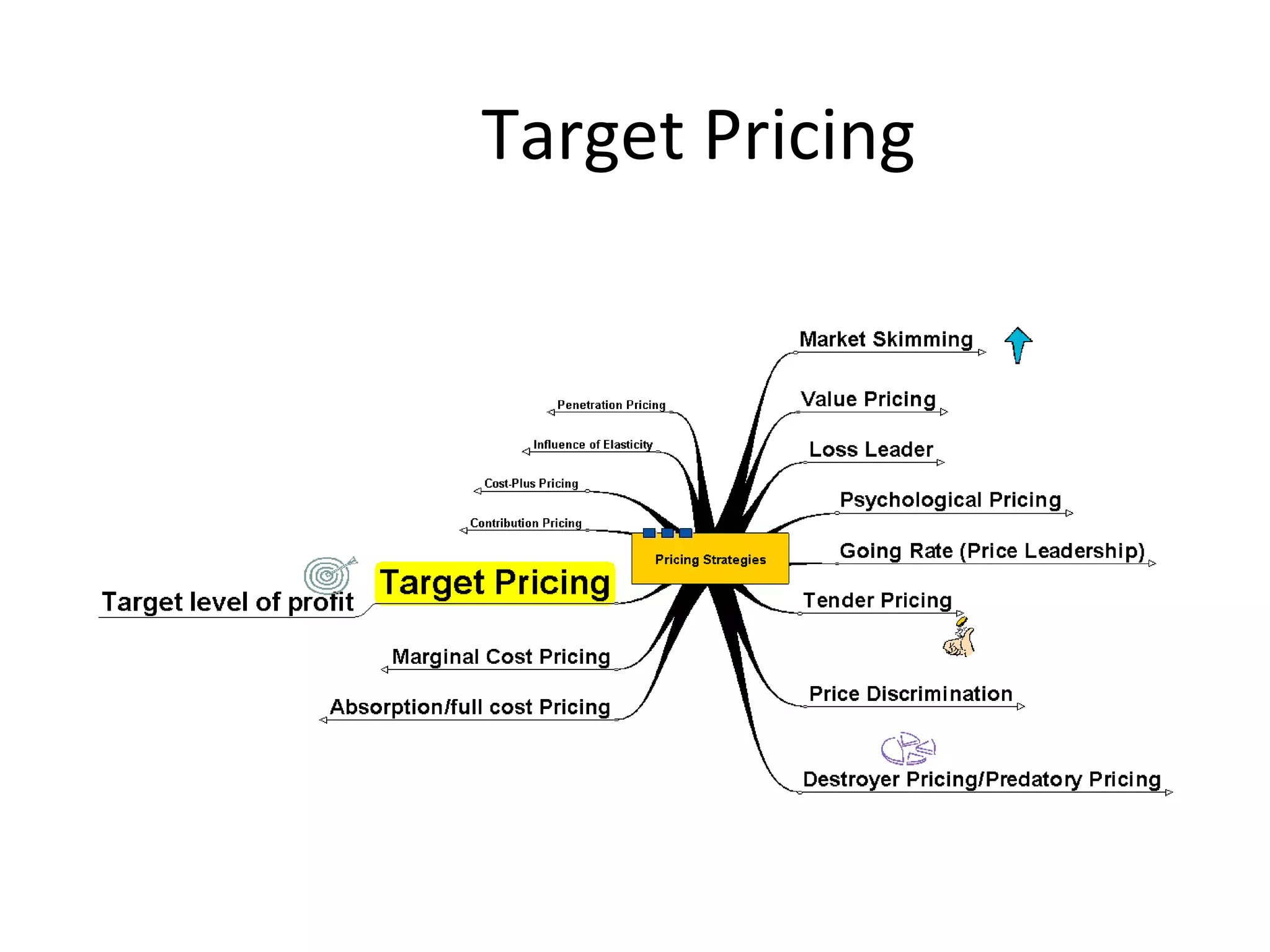
Target Pricing Setting price to ‘target’ a specified profit level. Estimates of the cost and potential revenue at different prices, and thus the break-even have to be made, to determine the mark-up. Mark-up = Profit/Cost x 100
Cost-Plus Pricing
Cost-Plus Pricing Calculation of the average cost (AC) plus a mark up AC = Total Cost/Output
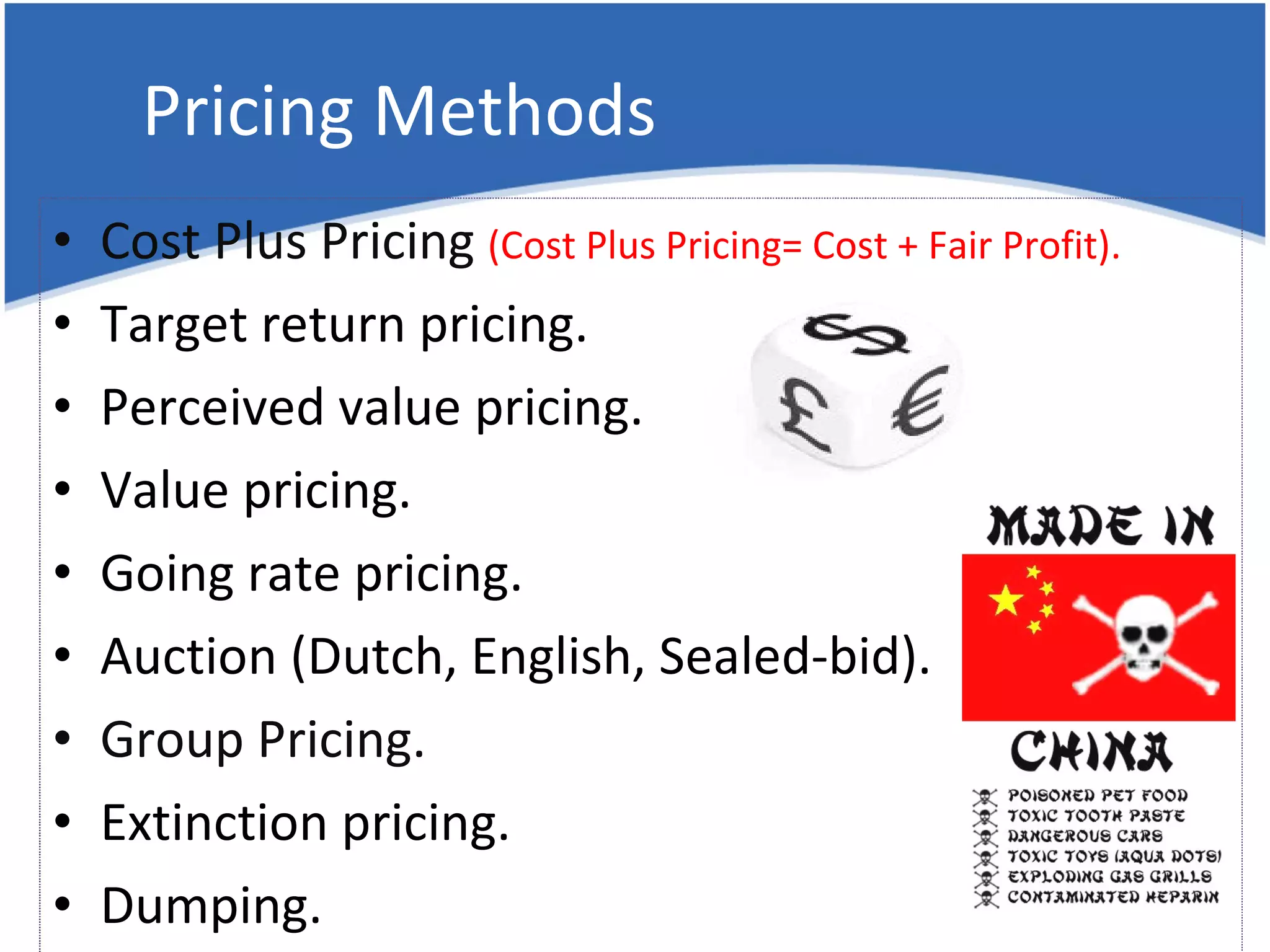
Pricing Methods Cost Plus Pricing  (Cost Plus Pricing= Cost + Fair Profit). Target return pricing. Perceived value pricing. Value pricing. Going rate pricing. Auction (Dutch, English, Sealed-bid). Group Pricing. Extinction pricing. Dumping.
STEP 6: SELECTING THE FINAL PRICE 1) IMPACT OF OTHER MARKETING ACTIVITIES. 2) COMPANY PRICING POLICIES. 3) GAIN AND RISK SHARING PRICING. 4) IMPACT OF PRICE ON THE OTHER PARTIES.
ADAPTING THE PRICE 1) Geographical pricing ( Cash, Countertrade, Barter ) Barter:- The direct exchange of goods, with no money and no third party involved. Compensational deal:- The seller receives some percentage of the payment in cash and the rest in products. Buy back arrangement:- The seller sells a plant, equipment, or technology to another country and agrees to accept as partial payment products manufactured with the supplied equipment. Offset:- The seller receives full payment in cash but agrees to spend the substantial amount of the money in that country within a stated time period.
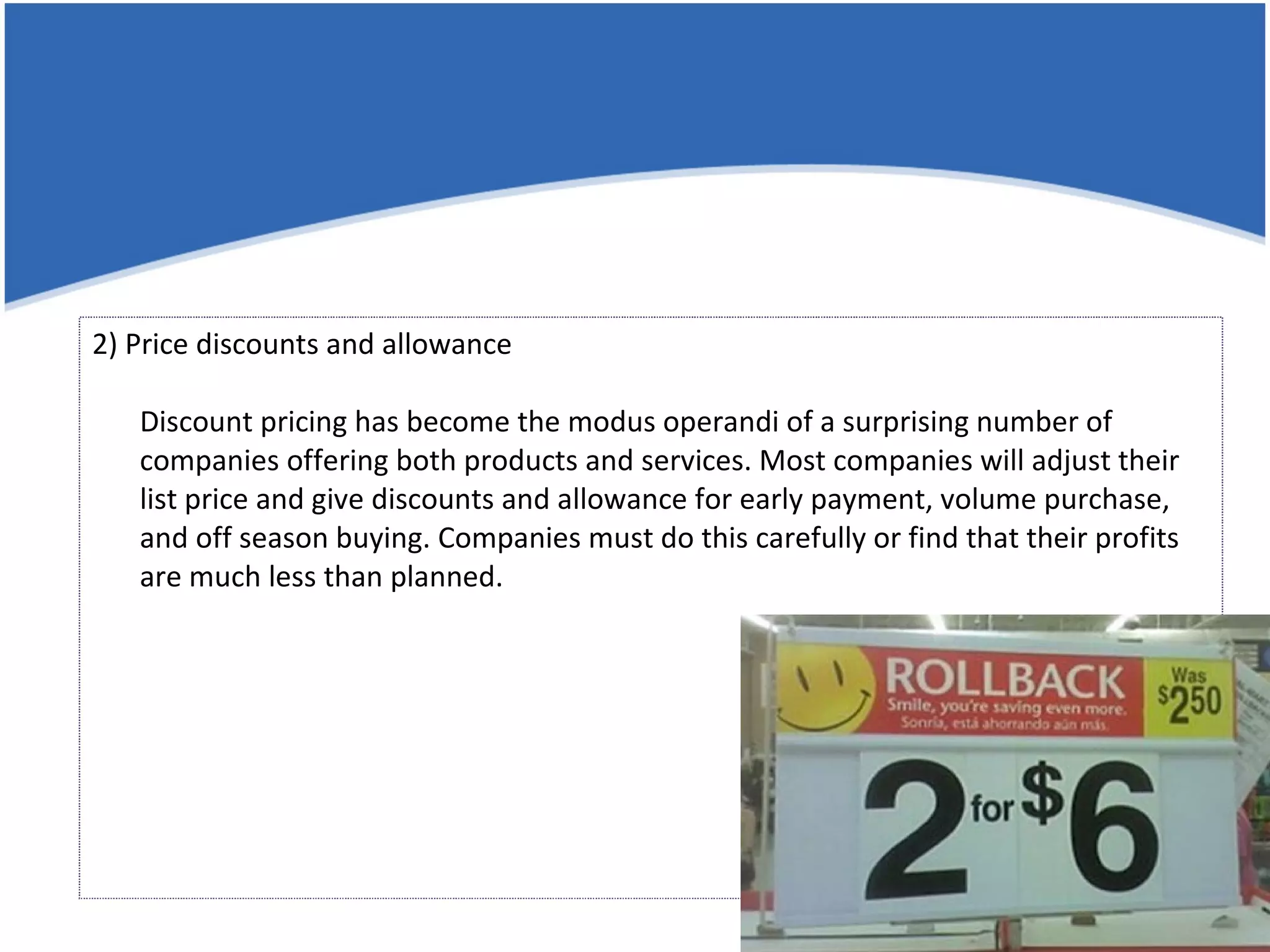
2) Price discounts and allowance Discount pricing has become the modus operandi of a surprising number of companies offering both products and services. Most companies will adjust their list price and give discounts and allowance for early payment, volume purchase, and off season buying. Companies must do this carefully or find that their profits are much less than planned.
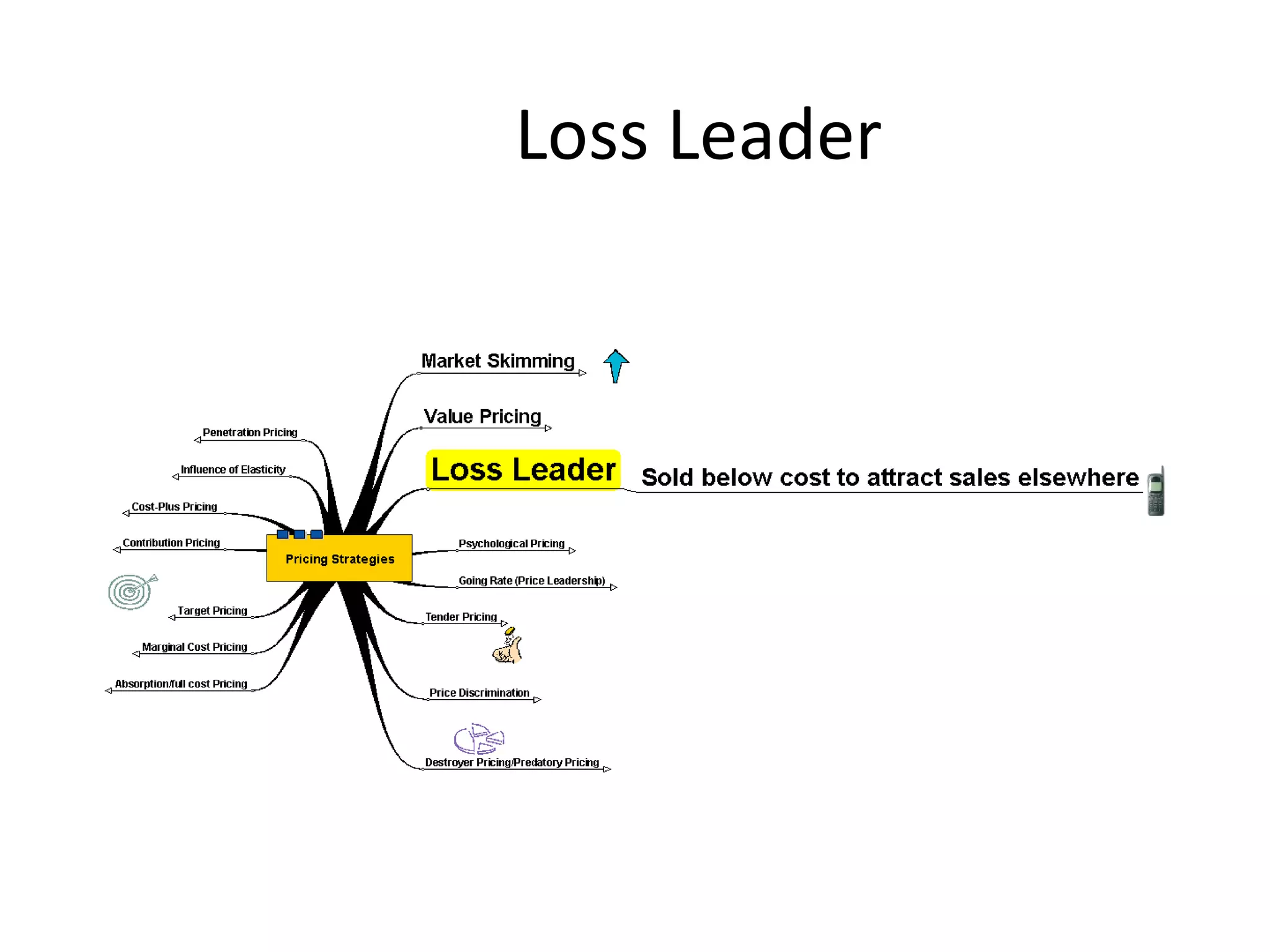
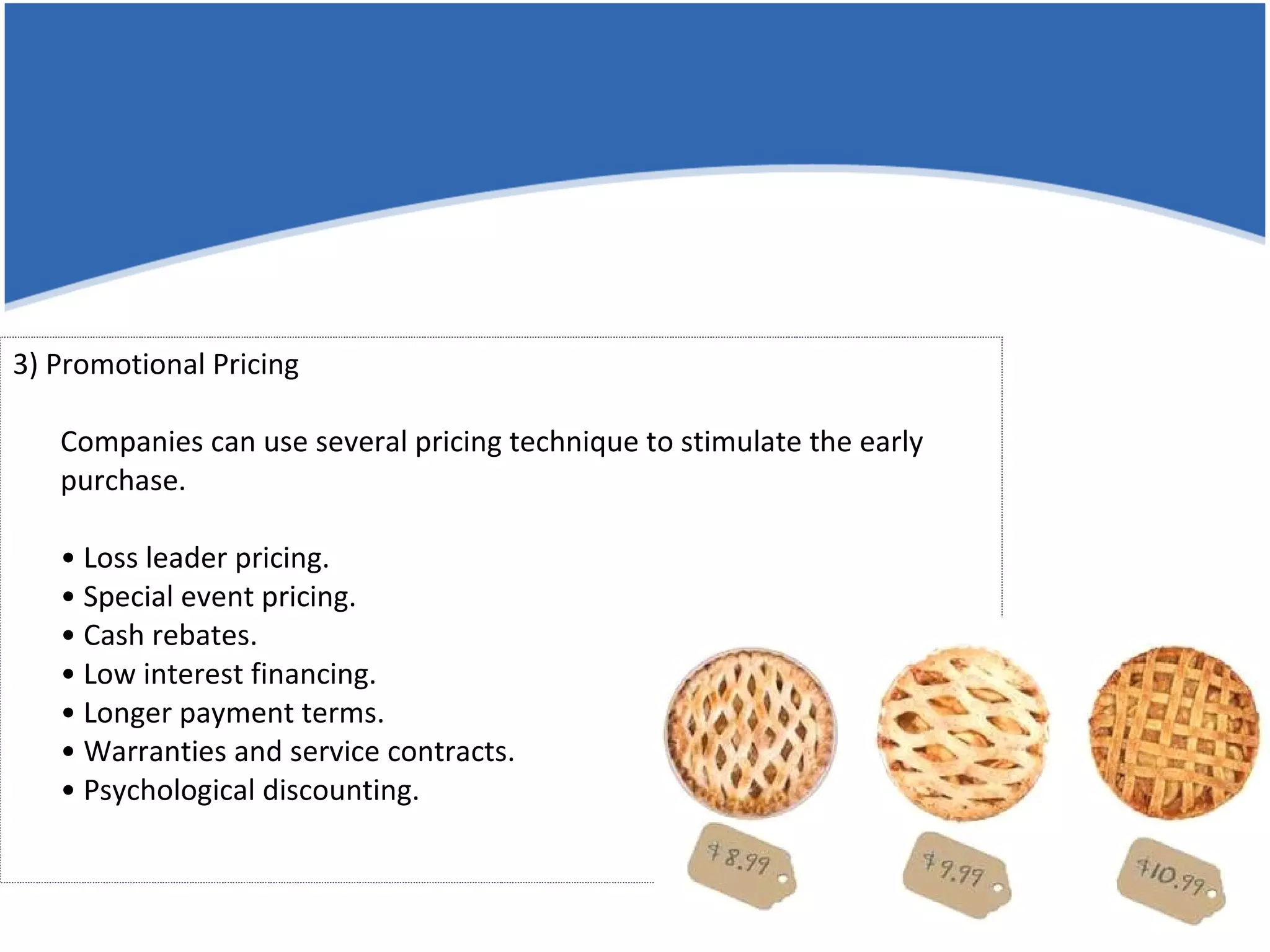
3) Promotional Pricing Companies can use several pricing technique to stimulate the early purchase. • Loss leader pricing. • Special event pricing. • Cash rebates. • Low interest financing. • Longer payment terms. • Warranties and service contracts. • Psychological discounting.
Loss Leader
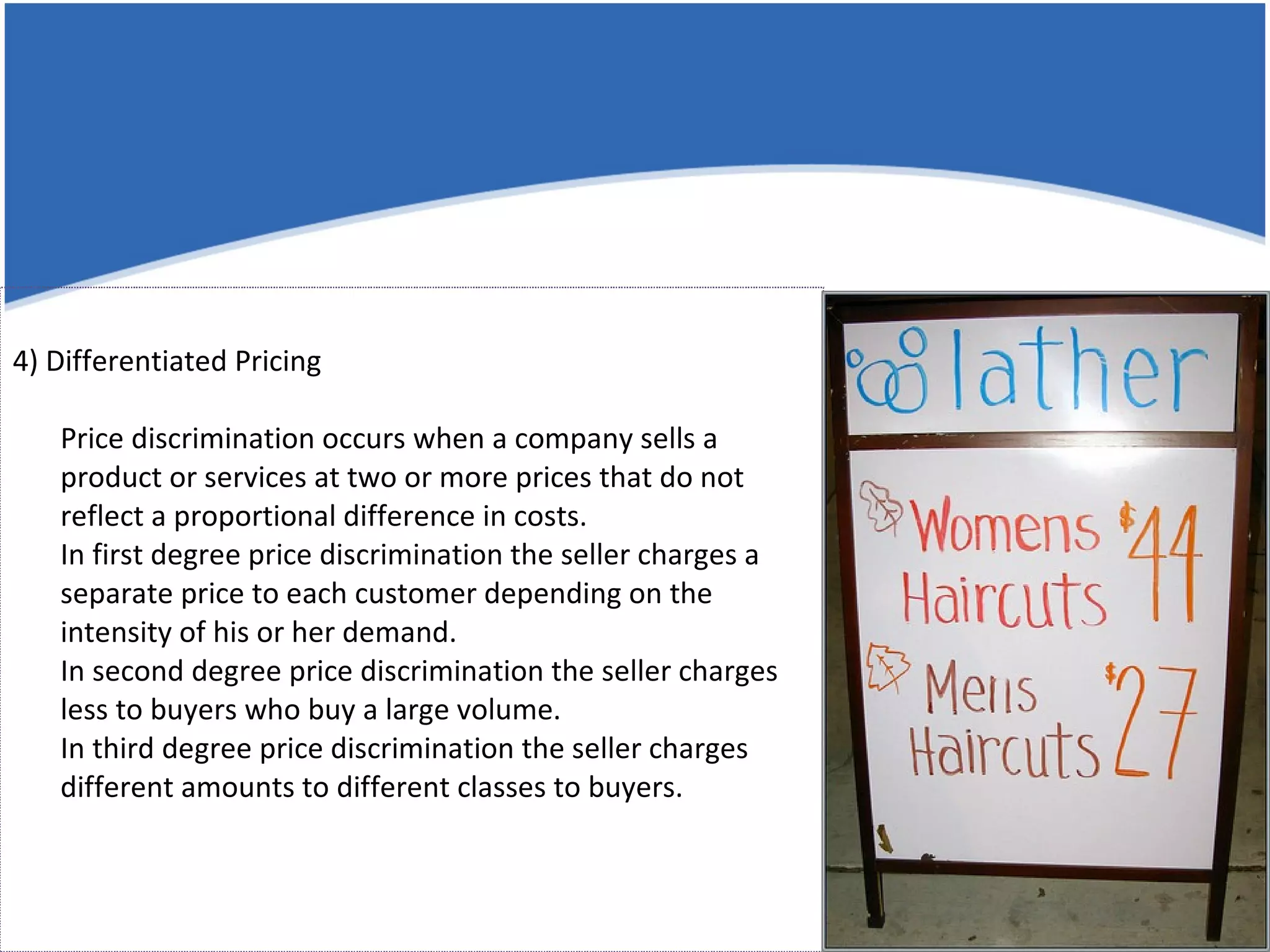
4) Differentiated Pricing Price discrimination occurs when a company sells a product or services at two or more prices that do not reflect a proportional difference in costs. In first degree price discrimination the seller charges a separate price to each customer depending on the intensity of his or her demand. In second degree price discrimination the seller charges less to buyers who buy a large volume. In third degree price discrimination the seller charges different amounts to different classes to buyers.
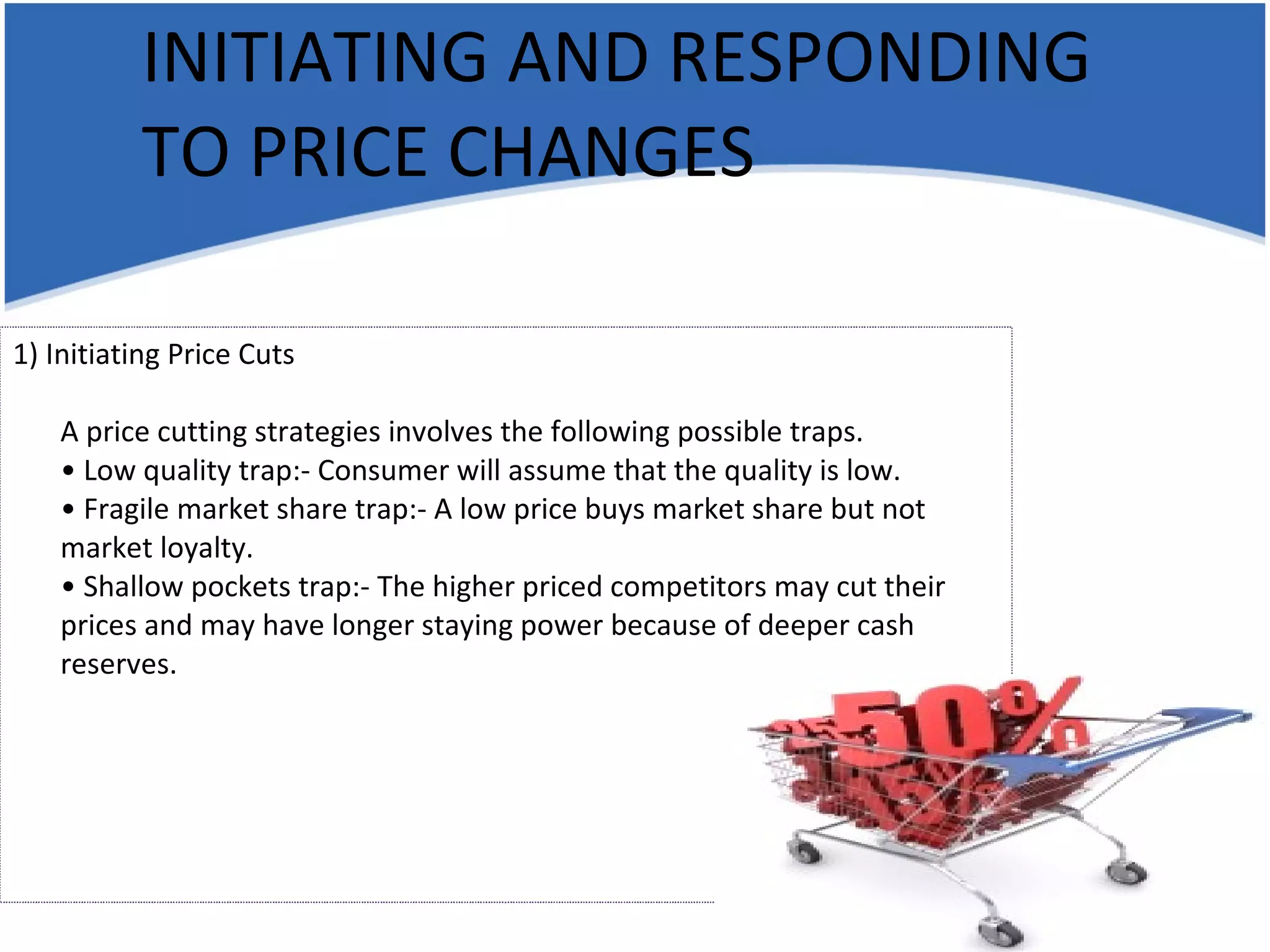
INITIATING AND RESPONDING TO PRICE CHANGES 1) Initiating Price Cuts A price cutting strategies involves the following possible traps. • Low quality trap:- Consumer will assume that the quality is low. • Fragile market share trap:- A low price buys market share but not market loyalty. • Shallow pockets trap:- The higher priced competitors may cut their prices and may have longer staying power because of deeper cash reserves.
2) Initiating price increases  The price can be increased in following ways. Each has a different impact on buyers. • Delayed quotation pricing:- the company does not sell a final price until the product is finished or delivered.  • Escalator clauses:- The company require the customer to pay today’s price and all or part of any inflation increases that take place before delivery. • Unbundling:- The company maintains its price but removes or prices separately one or more element that were part of the former offer, such as free delivery or installation. • Reduction of discounts:- The company instructs its sales force not to offer its normal cash and quantity discounts.
3) Reaction to price changes Any price change can provoke a response from customers, competitors, distributors, supplier, and even government. • Customers Reaction:- Price cut can be interpreted in many ways: the firm is in financial trouble; the item is to replace by the new model; the price will come down even further the quality has been reduced. •  Competitors Reactions:- Competitors are most likely to react when the numbers of firms are few, the product is homogeneous, the buyers are highly informed.
4) Responding to competitor’s price changes Brand leaders respond in several ways. • Maintain prices. • Maintain price and add value. • Reduce price. • Increase price and improve quality. • Launch a low price fighter line.
 
Presented By, Mandar Kulkarni. Parvez Hotagi. Masood Patwe. Faraaz Kazi.

Pricing strategies

  • 1.
  • 2.
    An Introduction…. Whatis Pricing? How companies price?
  • 3.
  • 4.
    Influence of ElasticityAny pricing decision must be mindful of the impact of price elasticity . The degree of price elasticity impacts on the level of sales and hence revenue. Elasticity focuses on proportionate (percentage) changes. PED = % Change in Quantity demanded/% Change in Price
  • 5.
    Influence of ElasticityPrice Elastic: % change in quantity demanded > % change in price e.g. A 4% rise in price would lead to sales falling by something more than 4%. Revenue would fall. A 9% fall in price would lead to a rise in sales of something more than 9%. Revenue would rise.
  • 6.
    Influence of ElasticityPrice Inelastic: % change in Q < % change in P e.g. a 5% increase in price would be met by a fall in sales of something less than 5% Revenue would rise A 7% reduction in price would lead to a rise in sales of something less than 7% Revenue would fall
  • 7.
    Kind of MarketStructure Under Perfect Competition and Under Monopoly. Factors to be considered while drafting the pricing policy: Number, size and products of competitors. Likelihood of potential competition. Stage of consumer acceptance. Degree of product differentiation. Opportunities and possibilities for variation in the product-service bundle.
  • 8.
    Influences on PricingPolicy Costs. Competitors. Customers. Company.
  • 9.
    Consumer psychology andpricing REFERENCE PRICE. PRICE QUALITY INFERENCES. PRICE CUES.
  • 10.
    Psychology in PricingWhich difference do you think is greater? Odd number pricing ($0.99 vs. $1.00). Why Nike shoes are priced at $79.99, not $80! Theoretical underpinning: Mental categorization. Price quality perceptions Toronto flea markets http://www.toronto.com/shopping/listing/000-211-237 Pricing and visibility Mark Laracy: “If you like Opium you will like Ninja”
  • 11.
  • 12.
    Prospect Theory (Kahnemannand Tversky) One additional dollar gives a lesser increase in satisfaction or value than the dissatisfaction caused by a one dollar decrease.
  • 13.
    SETTING THE PRICESTEP 1: SELECTING THE PRICING OBJECTIVE. SURVIVAL. MAXIMUM CURRENT PROFIT. MAXIMUM MARKET SHARE. MAXIMUM MARKET SKIMMING.
  • 14.
    STEP 2: DETERMININGDEMAND Each price will lead to a different level of demand and therefore have a different impact on the company’s marketing objectives. If the prices is too high, the level of demand may fall. PRICE SENSITIVITY. ESTIMATING THE DEMAND CURVES. PRICE ELASTICITY OF DEMAND.
  • 15.
    STEP 3: ESTIMATINGCOSTS The company wants to charge a price that covers its cost of producing, distributing, and selling the product, including a fair return for its effort and risk. • Fixed costs are the cost that do not vary with the production or sales revenue. • Variable costs vary directly with the level of production • Total costs consist of the sum of the fixed and variable cost for any given level of production. • Average cost is the cost per unit at that level of production; it is equal to total costs divided by production.
  • 16.
    STEP 4:ANALYZING COMPETITORS Within the range of the possible prices determined by market demand and company costs, the firm must take competitors costs, prices and possible price reaction into account. The firm should first consider the nearest competitor’s price.
  • 17.
    STEP 5: SELECTINGA PRICING MODEL Companies select a pricing method that includes one or more of these three considerations. (1) Costs set a floor to the price. (2) Competitors prices and the price of the substitutes provides an orienting point. (3) Costumers assessment of unique features establishes the price ceiling.
  • 18.
  • 19.
  • 20.
    Penetration Pricing Priceset to ‘penetrate the market’. ‘ Low’ price to secure high volumes. Typical in mass market products – chocolate bars, food stuffs, household goods, etc. Suitable for products with long anticipated life cycles. May be useful if launching into a new market.
  • 21.
  • 22.
    Market Skimming Highprice, Low volumes Skim the profit from the market Suitable for products that have short life cycles or which will face competition at some point in the future (e.g. after a patent runs out) Examples include: Playstation, jewellery, digital technology, new DVDs, etc. Many are predicting a firesale in laptops as supply exceeds demand.
  • 23.
  • 24.
    Value Pricing Priceset in accordance with customer perceptions about the value of the product/service Examples include status products/exclusive products Companies may be able to set prices according to perceived value.
  • 25.
    Going Rate (PriceLeadership)
  • 26.
    Going Rate (PriceLeadership) In case of price leader, rivals have difficulty in competing on price – too high and they lose market share, too low and the price leader would match price and force smaller rivasl out of market. May follow pricing leads of rivals especially where those rivals have a clear dominance of market share. Where competition is limited, ‘going rate’ pricing may be applicable – banks, petrol, supermarkets, electrical goods – find very similar prices in all outlets.
  • 27.
  • 28.
    Destroyer/Predatory Pricing Deliberateprice cutting or offer of ‘free gifts/products’ to force rivals (normally smaller and weaker) out of business or prevent new entrants. Anti-competitive and illegal if it can be proved.
  • 29.
  • 30.
    Absorption/Full Cost PricingFull Cost Pricing – attempting to set price to cover both fixed and variable costs. Absorption Cost Pricing – Price set to ‘absorb’ some of the fixed costs of production.
  • 31.
  • 32.
    Target Pricing Settingprice to ‘target’ a specified profit level. Estimates of the cost and potential revenue at different prices, and thus the break-even have to be made, to determine the mark-up. Mark-up = Profit/Cost x 100
  • 33.
  • 34.
    Cost-Plus Pricing Calculationof the average cost (AC) plus a mark up AC = Total Cost/Output
  • 35.
    Pricing Methods CostPlus Pricing (Cost Plus Pricing= Cost + Fair Profit). Target return pricing. Perceived value pricing. Value pricing. Going rate pricing. Auction (Dutch, English, Sealed-bid). Group Pricing. Extinction pricing. Dumping.
  • 36.
    STEP 6: SELECTINGTHE FINAL PRICE 1) IMPACT OF OTHER MARKETING ACTIVITIES. 2) COMPANY PRICING POLICIES. 3) GAIN AND RISK SHARING PRICING. 4) IMPACT OF PRICE ON THE OTHER PARTIES.
  • 37.
    ADAPTING THE PRICE1) Geographical pricing ( Cash, Countertrade, Barter ) Barter:- The direct exchange of goods, with no money and no third party involved. Compensational deal:- The seller receives some percentage of the payment in cash and the rest in products. Buy back arrangement:- The seller sells a plant, equipment, or technology to another country and agrees to accept as partial payment products manufactured with the supplied equipment. Offset:- The seller receives full payment in cash but agrees to spend the substantial amount of the money in that country within a stated time period.
  • 38.
    2) Price discountsand allowance Discount pricing has become the modus operandi of a surprising number of companies offering both products and services. Most companies will adjust their list price and give discounts and allowance for early payment, volume purchase, and off season buying. Companies must do this carefully or find that their profits are much less than planned.
  • 39.
    3) Promotional PricingCompanies can use several pricing technique to stimulate the early purchase. • Loss leader pricing. • Special event pricing. • Cash rebates. • Low interest financing. • Longer payment terms. • Warranties and service contracts. • Psychological discounting.
  • 40.
  • 41.
    4) Differentiated PricingPrice discrimination occurs when a company sells a product or services at two or more prices that do not reflect a proportional difference in costs. In first degree price discrimination the seller charges a separate price to each customer depending on the intensity of his or her demand. In second degree price discrimination the seller charges less to buyers who buy a large volume. In third degree price discrimination the seller charges different amounts to different classes to buyers.
  • 42.
    INITIATING AND RESPONDINGTO PRICE CHANGES 1) Initiating Price Cuts A price cutting strategies involves the following possible traps. • Low quality trap:- Consumer will assume that the quality is low. • Fragile market share trap:- A low price buys market share but not market loyalty. • Shallow pockets trap:- The higher priced competitors may cut their prices and may have longer staying power because of deeper cash reserves.
  • 43.
    2) Initiating priceincreases The price can be increased in following ways. Each has a different impact on buyers. • Delayed quotation pricing:- the company does not sell a final price until the product is finished or delivered. • Escalator clauses:- The company require the customer to pay today’s price and all or part of any inflation increases that take place before delivery. • Unbundling:- The company maintains its price but removes or prices separately one or more element that were part of the former offer, such as free delivery or installation. • Reduction of discounts:- The company instructs its sales force not to offer its normal cash and quantity discounts.
  • 44.
    3) Reaction toprice changes Any price change can provoke a response from customers, competitors, distributors, supplier, and even government. • Customers Reaction:- Price cut can be interpreted in many ways: the firm is in financial trouble; the item is to replace by the new model; the price will come down even further the quality has been reduced. • Competitors Reactions:- Competitors are most likely to react when the numbers of firms are few, the product is homogeneous, the buyers are highly informed.
  • 45.
    4) Responding tocompetitor’s price changes Brand leaders respond in several ways. • Maintain prices. • Maintain price and add value. • Reduce price. • Increase price and improve quality. • Launch a low price fighter line.
  • 46.
  • 47.
    Presented By, MandarKulkarni. Parvez Hotagi. Masood Patwe. Faraaz Kazi.