Download to read offline


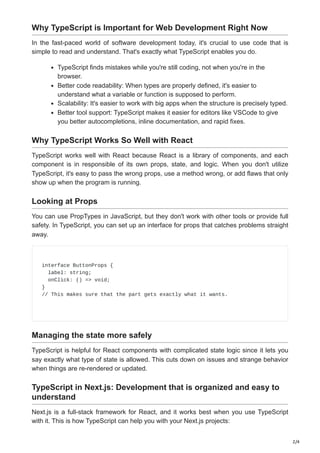
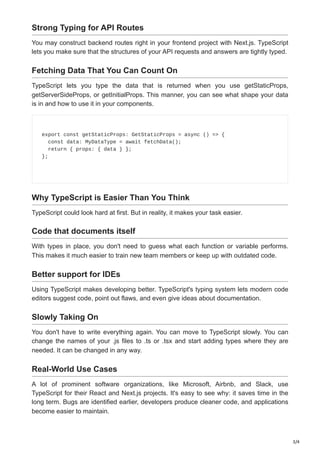


For a long time, JavaScript has been the major language used to make websites. But as apps got more intricate, developers started to have challenges like runtime errors, code inconsistencies, and problems with scaling massive codebases. Microsoft built TypeScript, a tightly typed superset of JavaScript, to solve these concerns. In the past several years, TypeScript has become a common tool in many modern frontend frameworks, such React and Next.js. This blog will talk about how TypeScript is superior than JavaScript and easier and wiser to use, especially when working with React and Next.js. What does TypeScript mean? TypeScript is a free programming language that adds static type declarations to JavaScript. JavaScript is dynamically typed, which means that the types are only known while the code is running. On the other side, TypeScript enables you set types for variables, functions, props, and more. This makes it easier to read your code and less likely to have bugs. Why TypeScript is Important for Web Development Right Now In the fast-paced world of software development today, it's crucial to use code that is simple to read and understand. That's exactly what TypeScript enables you do. TypeScript finds mistakes while you're still coding, not when you're in the browser. Better code readability: When types are properly defined, it's easier to understand what a variable or function is supposed to perform. Scalability: It's easier to work with big apps when the structure is precisely typed. Better tool support: TypeScript makes it easier for editors like VSCode to give you better autocompletions, inline documentation, and rapid fixes. Why TypeScript Works So Well with React TypeScript works well with React because React is a library of components, and each component is in responsible of its own props, state, and logic. When you don't utilize TypeScript, it's easy to pass the wrong props, use a method wrong, or add flaws that only show up when the program is running. Looking at Props You can use PropTypes in JavaScript, but they don't work with other tools or provide full safety. In TypeScript, you can set up an interface for props that catches problems straight away.


