www.codeandpeddle.com
communications@codeandpeddle.com
Choosing the Right Marketing
Automation Platform: A
Comprehensive Guide
01
02
Introduction
Definition of a Marketing
Automation Platform
03
04
05
Benefits of a Marketing
Automation System
Key Features to Evaluate in a
Marketing Automation Platform
Key Marketing Automation
Platform Comparison
Table of
Contents
06 Conclusion
In the rapidly evolving digital landscape, selecting the right marketing automation
platform is crucial for businesses aiming to streamline their marketing efforts and
enhance customer engagement. This whitepaper provides a detailed comparison of six
leading marketing automation platforms: HubSpot, Marketo, Pardot, Mailchimp,
ActiveCampaign, and Snov.io. By evaluating these platforms across various parameters,
we aim to guide marketers in making informed decisions that align with their
organizational goals and needs.
Introduction
Marketing automation platforms are software solutions designed to automate marketing
tasks, manage customer data, and execute targeted campaigns. These platforms
enable marketers to segment audiences, nurture leads, and measure campaign
performance, thereby improving marketing efficiency and effectiveness.
When selecting a marketing automation platform, it's crucial to align the platform's
features with your business needs and goals. Key aspects to consider include the
company's portfolio to ensure suitability for your size, budget, and marketing objectives,
as well as the platform's scalability to accommodate future growth. Integration with your
existing CRM system is essential for seamless data flow and enhanced lead
management, while understanding the pricing model helps gauge both initial and long-
term costs. Additionally, the complexity of the initial setup, access control features for
data security, and customizable tools for landing page and form creation are critical
factors that can influence the overall efficiency and effectiveness of your marketing
efforts.
Other important features to evaluate include social media integration for broader
audience engagement, lead lifecycle management to nurture prospects through the
sales funnel, and robust lead scoring mechanisms to prioritize high-quality leads.
Comprehensive reporting capabilities are necessary for measuring campaign
effectiveness, and support for third-party integrations and custom code can extend the
platform's functionality. Assessing the platform's suitability for account-based marketing
strategies, ease of use, availability of training resources, community support, and
innovative features such as AI-driven insights is also vital. Ultimately, choosing a platform
that offers scalability and aligns with your specific needs can significantly enhance your
marketing efforts and drive better business results.
Definition of a Marketing Automation Platform
In today's fast-paced and competitive business environment, marketers are constantly
seeking ways to not only streamline their operations but also to prove the return on
investment (ROI) of their efforts. This is where Marketing Automation Systems come into
play, offering a plethora of benefits that can significantly enhance marketing strategies
and outcomes.
Streamlining Marketing Operations: One of the primary advantages of Marketing
Automation is its ability to automate repetitive and time-consuming tasks. From
managing content across various platforms to personalizing messages for different
audience segments, scheduling campaigns, maintaining data accuracy, and
nurturing leads, Marketing Automation takes care of it all. This not only saves valuable
time but also allows marketing teams to redirect their focus toward more strategic
and creative tasks.
Boosting Marketing Performance: Marketing Automation Systems are adept at
combining a wealth of information, including demographic details and behavioral
data, with sophisticated lead-scoring mechanisms. This powerful combination helps
in identifying high-quality leads that are more likely to convert into paying customers.
By ensuring that marketing efforts are targeted toward the most promising prospects,
these systems significantly boost the overall performance of marketing campaigns.
Creating Richer Customer Personas: By leveraging data from multiple channels,
Marketing Automation Systems enable the creation of detailed and comprehensive
customer personas. This multichannel approach offers a 360-degree view of
customers, allowing marketers to craft highly personalized and effective marketing
strategies that resonate with each unique customer segment.
Sales and Marketing Collaboration: Another key benefit of Marketing Automation is
its role in aligning the objectives and efforts of sales and marketing teams. By working
together to define lead scoring criteria and identify what constitutes a qualified lead,
both teams can operate more cohesively. This synergy not only enhances the
efficiency of both departments but also ensures that sales representatives are
focusing their efforts on leads that have the highest potential for conversion.
Enhancing Return on Investment: The impact of Marketing Automation on ROI is
undeniable. According to research B2B marketers who implement Marketing
Automation Systems can see up to a 10% increase in their sales pipeline contribution.
This significant improvement in ROI highlights the importance of incorporating
Marketing Automation into comprehensive marketing strategies.
Benefits of a Marketing Automation System
When selecting a marketing automation platform, it's essential to consider a wide range
of features that align with your business needs and goals.
Here are some key features to evaluate:
Company Portfolio: Assess the platform's suitability based on your company's size,
budget, marketing goals, and technical expertise. It's crucial to choose a platform that
not only fits your current needs but also has the potential to scale as your business
grows.
Integration with CRM (Sales Tool): Evaluate the platform's ability to integrate with
your existing CRM system to ensure seamless data flow and campaign execution. A
tight integration between your marketing automation platform and CRM can
enhance lead management and improve sales and marketing alignment.
Pricing Model: Understand the cost structure, including implementation, support, and
additional features. Consider not only the initial investment but also the long-term
costs associated with the platform.
Initial Setup: Consider the complexity and time required for initial setup and
implementation. A platform that offers a straightforward setup process can
significantly reduce the time to value.
Access Control: Ensure the platform offers robust user role and access control
features. This is important for maintaining data security and ensuring that team
members have appropriate access to the platform's functionalities.
Landing Page and Form Setup: Look for customizable and user-friendly tools for
creating landing pages and forms. These features are critical for capturing leads and
gathering valuable customer information.
Social Media Integration: Assess the platform's capabilities for managing and
automating social media activities. Effective social media integration can help you
reach a wider audience and engage with customers across multiple channels.
Lead Lifecycle Management: Evaluate the platform's ability to track and nurture leads
throughout the sales funnel. This includes capabilities for lead segmentation,
targeting, and scoring mechanisms.
Scoring Mechanism: Consider the platform's lead scoring capabilities to prioritize
high-quality leads. A robust scoring mechanism can help you focus your efforts on
the most promising leads.
Key Features to Evaluate in a MA Platform
Reporting: Ensure the platform provides comprehensive and customizable reporting
features. Access to detailed analytics and insights can help you measure the
effectiveness of your marketing campaigns and make data-driven decisions.
Third-Party Integrations: Check the platform's ability to integrate with other
marketing tools and systems. This can extend the platform's capabilities and allow for
a more cohesive marketing technology stack.
API Calls/Custom Code: Evaluate the platform's support for custom code and API
integrations. This flexibility can be crucial for tailoring the platform to your specific
needs and integrating with custom or niche tools.
ABM Strategy: Assess the platform's support for account-based marketing strategies.
ABM capabilities can enable more targeted and personalized marketing efforts
towards key accounts.
Learning Curve: Consider the ease of use and the availability of training resources. A
platform with a steep learning curve may require more time and resources for your
team to become proficient.
Community Help and Customer Support: Evaluate the strength of the user
community and the quality of customer support. Strong community support and
responsive customer service can be invaluable resources for troubleshooting and
optimizing your use of the platform.
Innovative Features: Look for platforms that offer cutting-edge features such as AI-
driven insights, predictive analytics, and advanced personalization options. These
innovative features can provide a competitive edge by enabling more targeted and
effective marketing strategies.
Scalability: Ensure the platform can grow with your business. It should be able to
handle increased volumes of leads and campaigns without compromising
performance or requiring significant additional investment.
By carefully evaluating these features, businesses can choose a marketing automation
platform that enhances their marketing efforts, improves efficiency, and drives better
results.
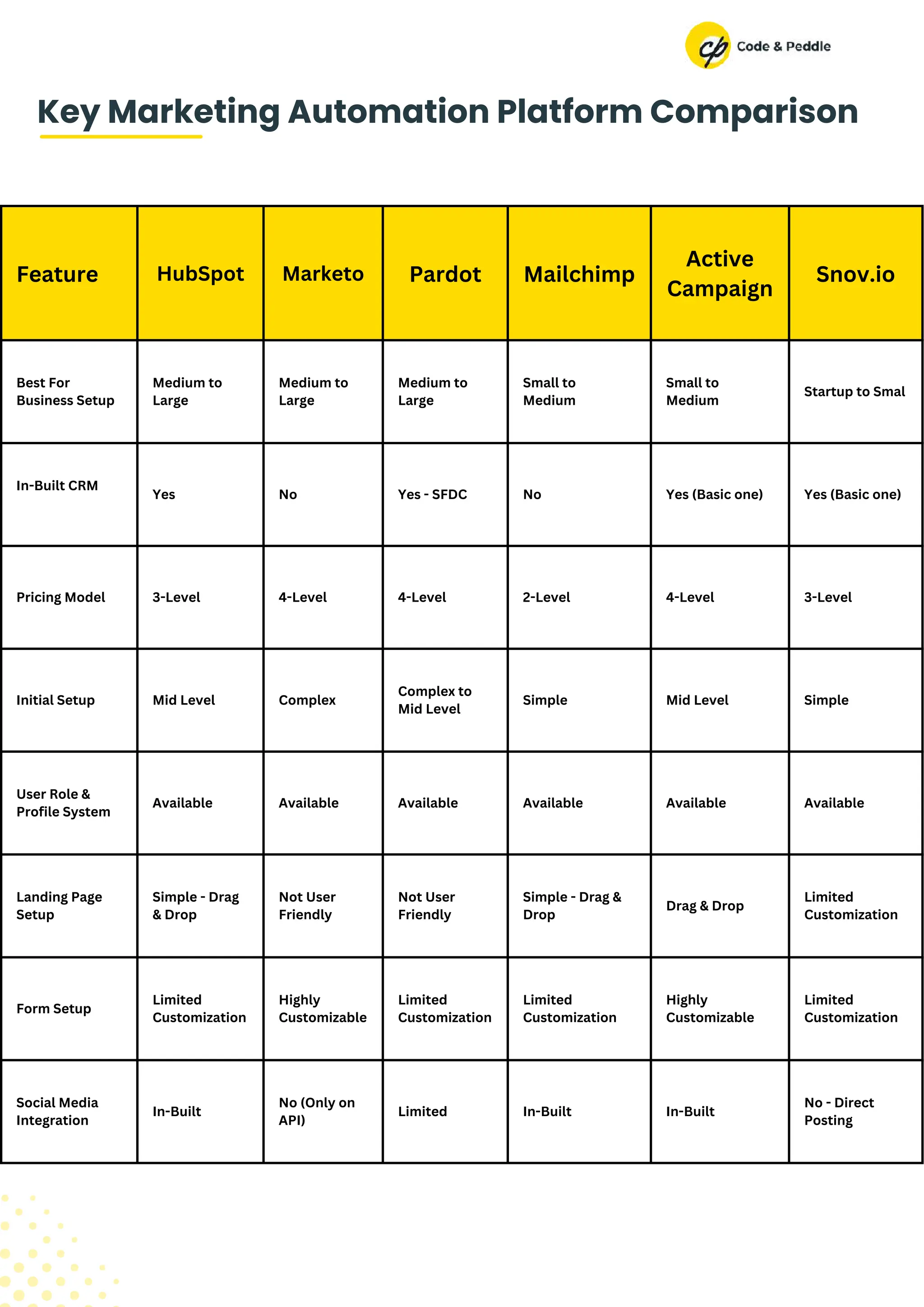
Feature HubSpot Marketo Pardot Mailchimp
Active
Campaign
Snov.io
Best For
Business Setup
Medium to
Large
Medium to
Large
Medium to
Large
Small to
Medium
Small to
Medium
Startup to Smal
In-Built CRM
Yes No Yes - SFDC No Yes (Basic one) Yes (Basic one)
Pricing Model 3-Level 4-Level 4-Level 2-Level 4-Level 3-Level
Initial Setup Mid Level Complex
Complex to
Mid Level
Simple Mid Level Simple
User Role &
Profile System
Available Available Available Available Available Available
Landing Page
Setup
Simple - Drag
& Drop
Not User
Friendly
Not User
Friendly
Simple - Drag &
Drop
Drag & Drop
Limited
Customization
Form Setup
Limited
Customization
Highly
Customizable
Limited
Customization
Limited
Customization
Highly
Customizable
Limited
Customization
Social Media
Integration
In-Built
No (Only on
API)
Limited In-Built In-Built
No - Direct
Posting
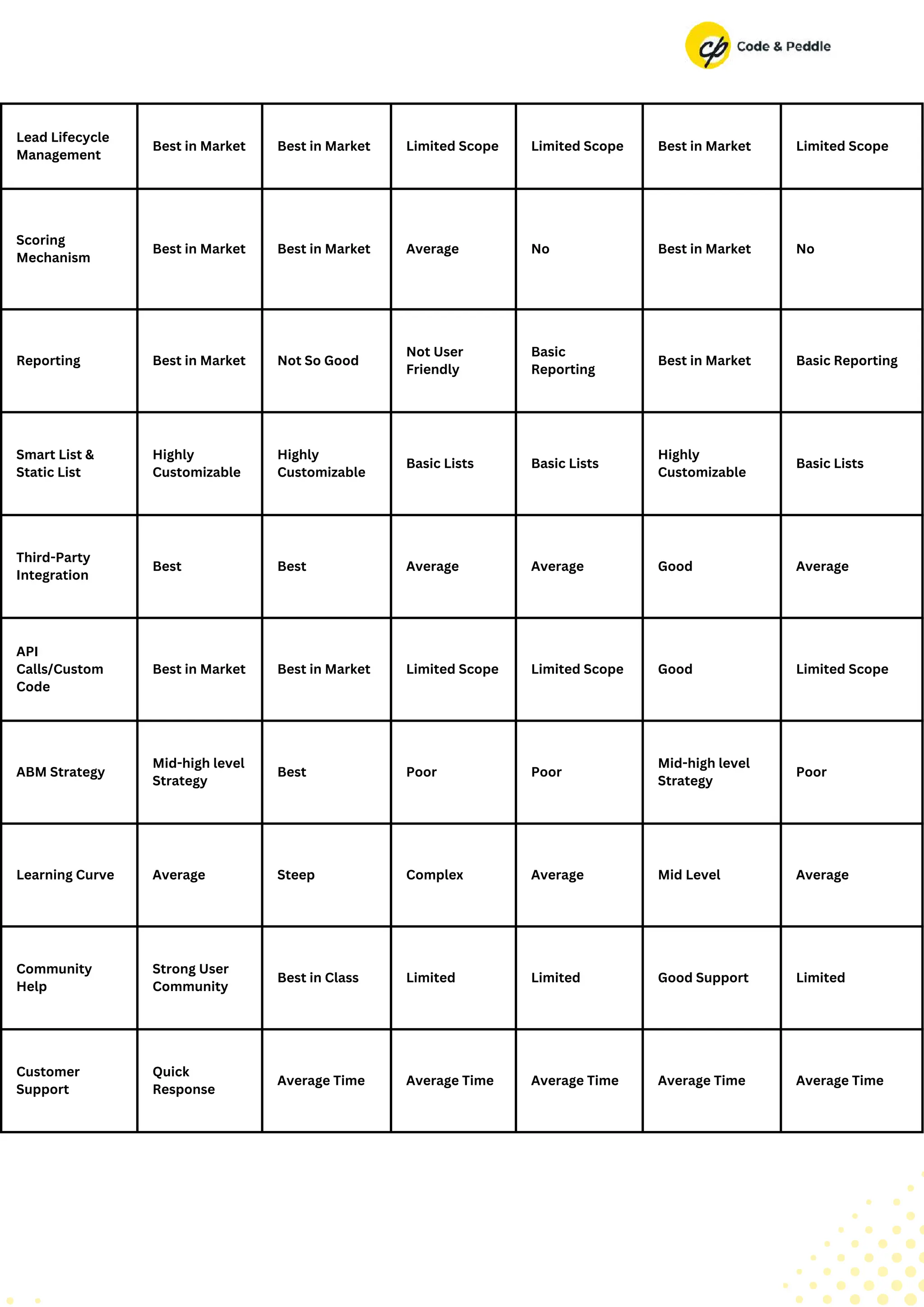
Key Marketing Automation Platform Comparison
Lead Lifecycle
Management
Best in Market Best in Market Limited Scope Limited Scope Best in Market Limited Scope
Scoring
Mechanism
Best in Market Best in Market Average No Best in Market No
Reporting Best in Market Not So Good
Not User
Friendly
Basic
Reporting
Best in Market Basic Reporting
Smart List &
Static List
Highly
Customizable
Highly
Customizable
Basic Lists Basic Lists
Highly
Customizable
Basic Lists
Third-Party
Integration
Best Best Average Average Good Average
API
Calls/Custom
Code
Best in Market Best in Market Limited Scope Limited Scope Good Limited Scope
ABM Strategy
Mid-high level
Strategy
Best Poor Poor
Mid-high level
Strategy
Poor
Learning Curve Average Steep Complex Average Mid Level Average
Community
Help
Strong User
Community
Best in Class Limited Limited Good Support Limited
Customer
Support
Quick
Response
Average Time Average Time Average Time Average Time Average Time
Selecting the right marketing automation platform requires a thorough assessment of
your company's needs and the platform's capabilities. Each platform discussed in this
whitepaper—HubSpot, Marketo, Pardot, Mailchimp, ActiveCampaign, and Snov.io—offers
unique features and benefits. By carefully evaluating these options, businesses can
choose a platform that enhances their marketing efforts, improves efficiency, and drives
better results.
Conclusion
communications@codeandpeddle.com
www.codeandpeddle.com
For more information

Choosing the Right Marketing Automation Platform: A Comprehensive Guide

  • 1.
    www.codeandpeddle.com communications@codeandpeddle.com Choosing the RightMarketing Automation Platform: A Comprehensive Guide
  • 2.
    01 02 Introduction Definition of aMarketing Automation Platform 03 04 05 Benefits of a Marketing Automation System Key Features to Evaluate in a Marketing Automation Platform Key Marketing Automation Platform Comparison Table of Contents 06 Conclusion
  • 3.
    In the rapidlyevolving digital landscape, selecting the right marketing automation platform is crucial for businesses aiming to streamline their marketing efforts and enhance customer engagement. This whitepaper provides a detailed comparison of six leading marketing automation platforms: HubSpot, Marketo, Pardot, Mailchimp, ActiveCampaign, and Snov.io. By evaluating these platforms across various parameters, we aim to guide marketers in making informed decisions that align with their organizational goals and needs. Introduction Marketing automation platforms are software solutions designed to automate marketing tasks, manage customer data, and execute targeted campaigns. These platforms enable marketers to segment audiences, nurture leads, and measure campaign performance, thereby improving marketing efficiency and effectiveness. When selecting a marketing automation platform, it's crucial to align the platform's features with your business needs and goals. Key aspects to consider include the company's portfolio to ensure suitability for your size, budget, and marketing objectives, as well as the platform's scalability to accommodate future growth. Integration with your existing CRM system is essential for seamless data flow and enhanced lead management, while understanding the pricing model helps gauge both initial and long- term costs. Additionally, the complexity of the initial setup, access control features for data security, and customizable tools for landing page and form creation are critical factors that can influence the overall efficiency and effectiveness of your marketing efforts. Other important features to evaluate include social media integration for broader audience engagement, lead lifecycle management to nurture prospects through the sales funnel, and robust lead scoring mechanisms to prioritize high-quality leads. Comprehensive reporting capabilities are necessary for measuring campaign effectiveness, and support for third-party integrations and custom code can extend the platform's functionality. Assessing the platform's suitability for account-based marketing strategies, ease of use, availability of training resources, community support, and innovative features such as AI-driven insights is also vital. Ultimately, choosing a platform that offers scalability and aligns with your specific needs can significantly enhance your marketing efforts and drive better business results. Definition of a Marketing Automation Platform
  • 4.
    In today's fast-pacedand competitive business environment, marketers are constantly seeking ways to not only streamline their operations but also to prove the return on investment (ROI) of their efforts. This is where Marketing Automation Systems come into play, offering a plethora of benefits that can significantly enhance marketing strategies and outcomes. Streamlining Marketing Operations: One of the primary advantages of Marketing Automation is its ability to automate repetitive and time-consuming tasks. From managing content across various platforms to personalizing messages for different audience segments, scheduling campaigns, maintaining data accuracy, and nurturing leads, Marketing Automation takes care of it all. This not only saves valuable time but also allows marketing teams to redirect their focus toward more strategic and creative tasks. Boosting Marketing Performance: Marketing Automation Systems are adept at combining a wealth of information, including demographic details and behavioral data, with sophisticated lead-scoring mechanisms. This powerful combination helps in identifying high-quality leads that are more likely to convert into paying customers. By ensuring that marketing efforts are targeted toward the most promising prospects, these systems significantly boost the overall performance of marketing campaigns. Creating Richer Customer Personas: By leveraging data from multiple channels, Marketing Automation Systems enable the creation of detailed and comprehensive customer personas. This multichannel approach offers a 360-degree view of customers, allowing marketers to craft highly personalized and effective marketing strategies that resonate with each unique customer segment. Sales and Marketing Collaboration: Another key benefit of Marketing Automation is its role in aligning the objectives and efforts of sales and marketing teams. By working together to define lead scoring criteria and identify what constitutes a qualified lead, both teams can operate more cohesively. This synergy not only enhances the efficiency of both departments but also ensures that sales representatives are focusing their efforts on leads that have the highest potential for conversion. Enhancing Return on Investment: The impact of Marketing Automation on ROI is undeniable. According to research B2B marketers who implement Marketing Automation Systems can see up to a 10% increase in their sales pipeline contribution. This significant improvement in ROI highlights the importance of incorporating Marketing Automation into comprehensive marketing strategies. Benefits of a Marketing Automation System
  • 5.
    When selecting amarketing automation platform, it's essential to consider a wide range of features that align with your business needs and goals. Here are some key features to evaluate: Company Portfolio: Assess the platform's suitability based on your company's size, budget, marketing goals, and technical expertise. It's crucial to choose a platform that not only fits your current needs but also has the potential to scale as your business grows. Integration with CRM (Sales Tool): Evaluate the platform's ability to integrate with your existing CRM system to ensure seamless data flow and campaign execution. A tight integration between your marketing automation platform and CRM can enhance lead management and improve sales and marketing alignment. Pricing Model: Understand the cost structure, including implementation, support, and additional features. Consider not only the initial investment but also the long-term costs associated with the platform. Initial Setup: Consider the complexity and time required for initial setup and implementation. A platform that offers a straightforward setup process can significantly reduce the time to value. Access Control: Ensure the platform offers robust user role and access control features. This is important for maintaining data security and ensuring that team members have appropriate access to the platform's functionalities. Landing Page and Form Setup: Look for customizable and user-friendly tools for creating landing pages and forms. These features are critical for capturing leads and gathering valuable customer information. Social Media Integration: Assess the platform's capabilities for managing and automating social media activities. Effective social media integration can help you reach a wider audience and engage with customers across multiple channels. Lead Lifecycle Management: Evaluate the platform's ability to track and nurture leads throughout the sales funnel. This includes capabilities for lead segmentation, targeting, and scoring mechanisms. Scoring Mechanism: Consider the platform's lead scoring capabilities to prioritize high-quality leads. A robust scoring mechanism can help you focus your efforts on the most promising leads. Key Features to Evaluate in a MA Platform
  • 6.
    Reporting: Ensure theplatform provides comprehensive and customizable reporting features. Access to detailed analytics and insights can help you measure the effectiveness of your marketing campaigns and make data-driven decisions. Third-Party Integrations: Check the platform's ability to integrate with other marketing tools and systems. This can extend the platform's capabilities and allow for a more cohesive marketing technology stack. API Calls/Custom Code: Evaluate the platform's support for custom code and API integrations. This flexibility can be crucial for tailoring the platform to your specific needs and integrating with custom or niche tools. ABM Strategy: Assess the platform's support for account-based marketing strategies. ABM capabilities can enable more targeted and personalized marketing efforts towards key accounts. Learning Curve: Consider the ease of use and the availability of training resources. A platform with a steep learning curve may require more time and resources for your team to become proficient. Community Help and Customer Support: Evaluate the strength of the user community and the quality of customer support. Strong community support and responsive customer service can be invaluable resources for troubleshooting and optimizing your use of the platform. Innovative Features: Look for platforms that offer cutting-edge features such as AI- driven insights, predictive analytics, and advanced personalization options. These innovative features can provide a competitive edge by enabling more targeted and effective marketing strategies. Scalability: Ensure the platform can grow with your business. It should be able to handle increased volumes of leads and campaigns without compromising performance or requiring significant additional investment. By carefully evaluating these features, businesses can choose a marketing automation platform that enhances their marketing efforts, improves efficiency, and drives better results.
  • 7.
    Feature HubSpot MarketoPardot Mailchimp Active Campaign Snov.io Best For Business Setup Medium to Large Medium to Large Medium to Large Small to Medium Small to Medium Startup to Smal In-Built CRM Yes No Yes - SFDC No Yes (Basic one) Yes (Basic one) Pricing Model 3-Level 4-Level 4-Level 2-Level 4-Level 3-Level Initial Setup Mid Level Complex Complex to Mid Level Simple Mid Level Simple User Role & Profile System Available Available Available Available Available Available Landing Page Setup Simple - Drag & Drop Not User Friendly Not User Friendly Simple - Drag & Drop Drag & Drop Limited Customization Form Setup Limited Customization Highly Customizable Limited Customization Limited Customization Highly Customizable Limited Customization Social Media Integration In-Built No (Only on API) Limited In-Built In-Built No - Direct Posting Key Marketing Automation Platform Comparison
  • 8.
    Lead Lifecycle Management Best inMarket Best in Market Limited Scope Limited Scope Best in Market Limited Scope Scoring Mechanism Best in Market Best in Market Average No Best in Market No Reporting Best in Market Not So Good Not User Friendly Basic Reporting Best in Market Basic Reporting Smart List & Static List Highly Customizable Highly Customizable Basic Lists Basic Lists Highly Customizable Basic Lists Third-Party Integration Best Best Average Average Good Average API Calls/Custom Code Best in Market Best in Market Limited Scope Limited Scope Good Limited Scope ABM Strategy Mid-high level Strategy Best Poor Poor Mid-high level Strategy Poor Learning Curve Average Steep Complex Average Mid Level Average Community Help Strong User Community Best in Class Limited Limited Good Support Limited Customer Support Quick Response Average Time Average Time Average Time Average Time Average Time
  • 9.
    Selecting the rightmarketing automation platform requires a thorough assessment of your company's needs and the platform's capabilities. Each platform discussed in this whitepaper—HubSpot, Marketo, Pardot, Mailchimp, ActiveCampaign, and Snov.io—offers unique features and benefits. By carefully evaluating these options, businesses can choose a platform that enhances their marketing efforts, improves efficiency, and drives better results. Conclusion communications@codeandpeddle.com www.codeandpeddle.com For more information