Advanced	
  Ear	
  Care	
  | (949)	
  777-­‐6521	
  | http://advancedearcare.com	


Discover more great content here:
http://twitter.com/hearingaidslwca	
  
http://www.facebook.com/AdvancedEarCar	
  
http://www.youtube.com/user/advancedearcare	
  
http://www.pinterest.com/advancedearcare	


CHOOSING BETWEEN REPLACEMENT OR REPAIR FOR A
BROKEN HEARING AID
One of our most frequently asked questions is, “My hearing aid is broken or is not working
as well as it used to – should I have it repaired, or get a new one?” Presented with only
that amount of information, we have to answer honestly, “It depends.” Deciding between
repair or replace doesn’t have a one right answer. It really depends upon the situation and
the preferences of the individual asking the question.
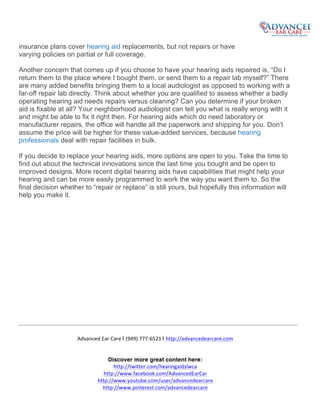
The first thing to consider is that all hearing aids – no matter how expensive they were or
how well they were made – will at times start to function less well, or break. The
surroundings that hearing aids inhabit –
your ear canals – is an inhospitable one for
advanced electronic devices, full of
moisture and ear wax. Both ear wax and
moisture are natural, but your hearing aids
dislike them both. Moisture can damage
the tiny electronics while wax can generally
‘gum up’ the inner workings. In addition,
there is always the possibility of breakage
due to an accident or dropping the hearing
aids, and the inner tubing and other parts
inevitably wear out over time, so after
several years you can count on your aids
needing repair or replacement.
One of the factors that should most influence your choice to “repair or replace” is whether
you like your present hearing aids. If you do, or you have become accustomed to the
sound they produce(as many wearers of older analog hearing aids do), it may make more
sense to have them fixed than to upgrade them with newer digital aids that may produce a
substantially different sound or wearing experience.
A further consideration, obviously, is cost – new hearing aids might cost thousands, but
fixing your present hearing aids might cost only a few hundred dollars dependent on what
is wrong with them. The part we cannot answer for you is the influence of insurance. A few


Advanced	
  Ear	
  Care	
  | (949)	
  777-­‐6521	
  | http://advancedearcare.com	


Discover more great content here:
http://twitter.com/hearingaidslwca	
  
http://www.facebook.com/AdvancedEarCar	
  
http://www.youtube.com/user/advancedearcare	
  
http://www.pinterest.com/advancedearcare	


insurance plans cover hearing aid replacements, but not repairs or have
varying policies on partial or full coverage.
Another concern that comes up if you choose to have your hearing aids repaired is, “Do I
return them to the place where I bought them, or send them to a repair lab myself?” There
are many added benefits bringing them to a local audiologist as opposed to working with a
far-off repair lab directly. Think about whether you are qualified to assess whether a badly
operating hearing aid needs repairs versus cleaning? Can you determine if your broken
aid is fixable at all? Your neighborhood audiologist can tell you what is really wrong with it
and might be able to fix it right then. For hearing aids which do need laboratory or
manufacturer repairs, the office will handle all the paperwork and shipping for you. Don’t
assume the price will be higher for these value-added services, because hearing
professionals deal with repair facilities in bulk.
If you decide to replace your hearing aids, more options are open to you. Take the time to
find out about the technical innovations since the last time you bought and be open to
improved designs. More recent digital hearing aids have capabilities that might help your
hearing and can be more easily programmed to work the way you want them to. So the
final decision whether to “repair or replace” is still yours, but hopefully this information will
help you make it.


Choosing Between Replacement or Repair for a Broken Hearing Aid

  • 1.
          Advanced  Ear  Care  | (949)  777-­‐6521  | http://advancedearcare.com     Discover more great content here: http://twitter.com/hearingaidslwca   http://www.facebook.com/AdvancedEarCar   http://www.youtube.com/user/advancedearcare   http://www.pinterest.com/advancedearcare     CHOOSING BETWEEN REPLACEMENT OR REPAIR FOR A BROKEN HEARING AID One of our most frequently asked questions is, “My hearing aid is broken or is not working as well as it used to – should I have it repaired, or get a new one?” Presented with only that amount of information, we have to answer honestly, “It depends.” Deciding between repair or replace doesn’t have a one right answer. It really depends upon the situation and the preferences of the individual asking the question. The first thing to consider is that all hearing aids – no matter how expensive they were or how well they were made – will at times start to function less well, or break. The surroundings that hearing aids inhabit – your ear canals – is an inhospitable one for advanced electronic devices, full of moisture and ear wax. Both ear wax and moisture are natural, but your hearing aids dislike them both. Moisture can damage the tiny electronics while wax can generally ‘gum up’ the inner workings. In addition, there is always the possibility of breakage due to an accident or dropping the hearing aids, and the inner tubing and other parts inevitably wear out over time, so after several years you can count on your aids needing repair or replacement. One of the factors that should most influence your choice to “repair or replace” is whether you like your present hearing aids. If you do, or you have become accustomed to the sound they produce(as many wearers of older analog hearing aids do), it may make more sense to have them fixed than to upgrade them with newer digital aids that may produce a substantially different sound or wearing experience. A further consideration, obviously, is cost – new hearing aids might cost thousands, but fixing your present hearing aids might cost only a few hundred dollars dependent on what is wrong with them. The part we cannot answer for you is the influence of insurance. A few
  • 2.
          Advanced  Ear  Care  | (949)  777-­‐6521  | http://advancedearcare.com     Discover more great content here: http://twitter.com/hearingaidslwca   http://www.facebook.com/AdvancedEarCar   http://www.youtube.com/user/advancedearcare   http://www.pinterest.com/advancedearcare     insurance plans cover hearing aid replacements, but not repairs or have varying policies on partial or full coverage. Another concern that comes up if you choose to have your hearing aids repaired is, “Do I return them to the place where I bought them, or send them to a repair lab myself?” There are many added benefits bringing them to a local audiologist as opposed to working with a far-off repair lab directly. Think about whether you are qualified to assess whether a badly operating hearing aid needs repairs versus cleaning? Can you determine if your broken aid is fixable at all? Your neighborhood audiologist can tell you what is really wrong with it and might be able to fix it right then. For hearing aids which do need laboratory or manufacturer repairs, the office will handle all the paperwork and shipping for you. Don’t assume the price will be higher for these value-added services, because hearing professionals deal with repair facilities in bulk. If you decide to replace your hearing aids, more options are open to you. Take the time to find out about the technical innovations since the last time you bought and be open to improved designs. More recent digital hearing aids have capabilities that might help your hearing and can be more easily programmed to work the way you want them to. So the final decision whether to “repair or replace” is still yours, but hopefully this information will help you make it.