sales@mechartes.com
www.mechartes.com
CHLORINE GAS DISPERSION ANALYSIS
sales@mechartes.com
www.mechartes.com
OBJECTIVE
To study the impact of accidental release of
1.6 tons of Chlorine gas in surrounding areas
from a horizontal cylindrical tank lasting for
one hour.
sales@mechartes.com
www.mechartes.com
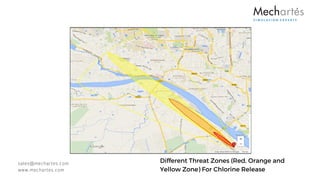
Different Threat Zones (Red, Orange and
Yellow Zone) For Chlorine Release
The impact is studied using standard dispersion modeling
techniques considering various locations with different surface
conditions in different seasons and meteorological conditions.
The affected areas which are harmful to human exposures at
different levels are detected. The affected areas are divided
into three level of concerns namely red zone, orange zone,
yellow zone.
DESIGN APPROACH
sales@mechartes.com
www.mechartes.com
sales@mechartes.com
www.mechartes.com
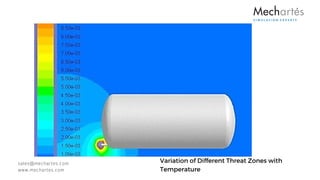
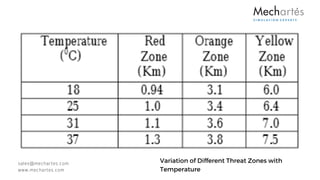
Variation of Different Threat Zones with
Temperature
sales@mechartes.com
www.mechartes.com
Variation of Different Threat Zones with
Temperature
The length of red zone (average chlorine concentration in 60
minutes is more than 20 ppm) has been estimated to be 1.1
kilometers, Orange zone (average chlorine concentration in 60
minutes is more than 2 ppm) 3.6 kilometers and yellow zone
(average chlorine concentration in 60 minutes is more than 0.5
ppm) 7 kilometers, respectively downwind from the source.
With all other conditions constant, a threat zone is likely to be
smaller with increasing ground roughness and wind velocity.
CONCLUSION
sales@mechartes.com
www.mechartes.com
The length of a threat zone is likely to rise with increasing
temperature as temperature affects atmospheric stability.
REACH US
WEBSITE
www.mechartes.com
PHONE NUMBER
+971 4 5542049
EMAIL ADDRESS
sales@mechartes.com

Chlorine Gas Dispersion Analysis