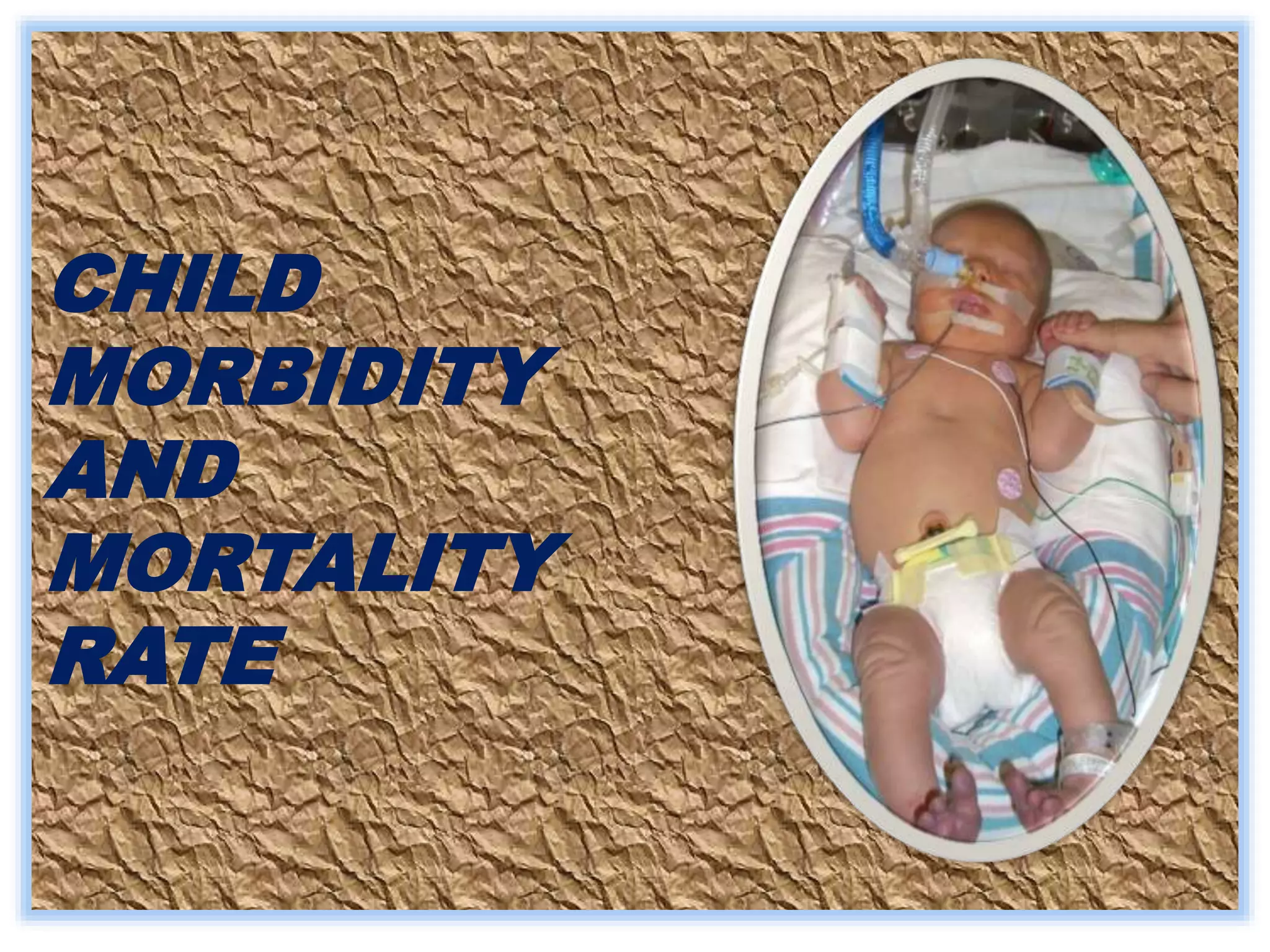
CHILD
MORBIDITY
AND
MORTALITY
RATE
A. CHILD MORBIDITY
• Deviation from a state of physical or
mental well-being as a result of disease,
injury or impairment.
• In a given population morbidity for a given
time, may be measured in terms of
incidence, in terms of prevalence.
Total no. of new cases of illness
during a defined period
Population exposed to risk
in the same period
Incidence rate =
prevalence
• Prevalence Indicates how common is an
event in a population.
• It is used to measure the frequency of an
illness in existence during a defined period.
• It includes all the cases in the defined
period, new and old case, during the same
period
Total no.of new and old cases
found during a specified period
Population exposed to risk
at the same period
Prevalence
rate =
B.MORTALITY RATE
• INFANT MORTALITY RATE: it is the
number of infant deaths under one year
of age per 1000live births in one year.
Number of deaths under
one year of age
Total live birth in the year
IMR = 1000
Neonatal mortality rate
NMR = 1000
No. Of deaths under 28
days of age
Total live births
Still
birth=
Fetal deaths weighing
over 1000gms at birth
Total live
+ still births weighing
over 1000gms at birth
1000
• globally the under-five child mortality
had reduced only by 48 per
cent…whereas in India by 2013 we had
reduced the under-five child mortality
by 61 per cent,”
• India has the highest number of child
deaths in the world, with an estimated
1.2 million deaths in 2015 — 20 per cent
of the 5.9 million global deaths.
The fourth Millennium Development Goal
(MDG-4) aimed to reduce mortality —
between 1990 and 2015 — among children
under five by two-thirds.
India tops child deaths
due to
#pneumonia
#Diarrhoea,
#congenital
Abnormalities
#Haemorrahgic Diseases
• POVERTY,CHILD MATERNAL DEATHS ARE
HIGH IN INDIA
• "The current Infant Mortality Rate (IMR)
of India, as per the Sample Registration
System (SRS) 2013, is 40 per 1,000 live
births
• while the Under-5 Mortality Rate
(U5MR) as per SRS 2012 is 52 per 1,000
live births.
• Dr Robert Black, Professor at the Johns Hopkins
Bloomberg School of Public Health in Baltimore
• USA, said: “In India, more than half of the child
deaths occur in the first month of life, with the
major clinical causes being complications of
prematurity and of delivery. Infectious diseases
remain important causes of death both in the
first month of life and up to five years of age.”
• He added that “vaccines to prevent
pneumococcal pneumonia and rotavirus
diarrhoea are now available and affordable for
universal implementation in India and should
receive priority”.
THANK YOU

Child morbidity

  • 1.
  • 2.
    A. CHILD MORBIDITY •Deviation from a state of physical or mental well-being as a result of disease, injury or impairment. • In a given population morbidity for a given time, may be measured in terms of incidence, in terms of prevalence.
  • 3.
    Total no. ofnew cases of illness during a defined period Population exposed to risk in the same period Incidence rate =
  • 4.
    prevalence • Prevalence Indicateshow common is an event in a population. • It is used to measure the frequency of an illness in existence during a defined period. • It includes all the cases in the defined period, new and old case, during the same period
  • 5.
    Total no.of newand old cases found during a specified period Population exposed to risk at the same period Prevalence rate =
  • 6.
    B.MORTALITY RATE • INFANTMORTALITY RATE: it is the number of infant deaths under one year of age per 1000live births in one year.
  • 7.
    Number of deathsunder one year of age Total live birth in the year IMR = 1000
  • 8.
    Neonatal mortality rate NMR= 1000 No. Of deaths under 28 days of age Total live births
  • 9.
    Still birth= Fetal deaths weighing over1000gms at birth Total live + still births weighing over 1000gms at birth 1000
  • 10.
    • globally theunder-five child mortality had reduced only by 48 per cent…whereas in India by 2013 we had reduced the under-five child mortality by 61 per cent,”
  • 11.
    • India hasthe highest number of child deaths in the world, with an estimated 1.2 million deaths in 2015 — 20 per cent of the 5.9 million global deaths.
  • 12.
    The fourth MillenniumDevelopment Goal (MDG-4) aimed to reduce mortality — between 1990 and 2015 — among children under five by two-thirds.
  • 13.
    India tops childdeaths due to #pneumonia #Diarrhoea, #congenital Abnormalities #Haemorrahgic Diseases
  • 14.
    • POVERTY,CHILD MATERNALDEATHS ARE HIGH IN INDIA
  • 15.
    • "The currentInfant Mortality Rate (IMR) of India, as per the Sample Registration System (SRS) 2013, is 40 per 1,000 live births • while the Under-5 Mortality Rate (U5MR) as per SRS 2012 is 52 per 1,000 live births.
  • 16.
    • Dr RobertBlack, Professor at the Johns Hopkins Bloomberg School of Public Health in Baltimore • USA, said: “In India, more than half of the child deaths occur in the first month of life, with the major clinical causes being complications of prematurity and of delivery. Infectious diseases remain important causes of death both in the first month of life and up to five years of age.” • He added that “vaccines to prevent pneumococcal pneumonia and rotavirus diarrhoea are now available and affordable for universal implementation in India and should receive priority”.
  • 17.