Download to read offline
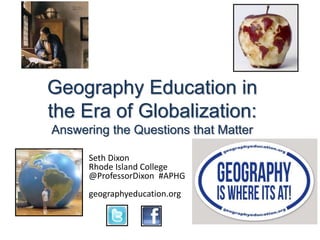


This document discusses geography education in the era of globalization and how to help students understand an increasingly interconnected world. It argues that teachers should (1) provide geographic information, (2) teach geographic concepts, (3) use data, maps and geospatial technology, and (4) ask questions that encourage spatial thinking in order to develop students' geographic literacy. The document emphasizes that while globalization has increased connections between people and places, geography still matters because place, location and spatial relationships help explain why things are where they are.


