Impact of implementing Enhanced Community Quarantine in preventing the
spread of COVID19 to the residents of Alion, Mariveles.
CHAPTER II
THEORETICAL FRAMEWORK
This chapter includes the relevant theories, related foreign and local studies and
literature which the researchers pursued to shed light and to attain clearer perspective and
to arrive an adequate background of the study. This will also present the conceptual
framework and the definition of terms for better comprehension of the study.
RELEVANT THEORY
However, Zhou et al (2020) the lockdown has also made some impacts on human
society such as negative psychological effects due to quarantine, loss in the economy of
the world. But there are also positive aspects like reduction in pollution due to less
movement of vehicles and closure of many industries.
Goh and Chew (2006) states that Quarantine was implemented successfully to halt
the transmission during SARS epidemic in 2003. It is one of the important steps in this
pandemic disease plan. The quarantine can be to an individual or the group level and
usually, it involves restriction to the home or a particular area. During the quarantine
period, all the persons should be monitored regularly for the occurrence of any symptoms.
By quarantining, the detection of cases becomes easier, so that contacts can be listed and
traced out within a short period of time frame.
(Lu et al., 2020) The virus spread rapidly in the city and showed strong infectivity
and pathogenicity. As this novel coronavirus shared over 79% of its genome sequence with
the coronavirus that causes severe acute respiratory syndrome (SARS-CoV), it was
subsequently named SARS-CoV-2. The pneumonia caused by SARS-CoV2 was
subsequently identified as a novel acute respiratory infectious disease and was named
coronavirus disease 2019 (COVID-19). Following outbreaks in China and Asia, COVID-
19 spread widely in Europe and the Americas.
(Lin et al., 2020) A strategy of community quarantine was also widely adopted in
urban populations for medical observation. The strategy, led by community committees
dominated by public servants, aimed to screen the densely populated urban population for
potential and latent infections and quarantine residents with definite exposure history.
REVIEW ON RELATED LITERATURE
Zhou et al (2020) An unprecedented outbreak of mysterious etiology pneumonia,
which occurred in December 2019, has taken the whole world to a state of sorrow and
worry about the future. The novel coronavirus (COVID-19) is a respiratory illness and its
outbreak primarily originated from Wuhan, China. The epidemic is found to be caused by
a zoonotic transmission event associated with a wide seafood market and soon became
transmission from human to human.
(World Health Organization 2020a) It is known that the main cause of this virus
has started from bats and the virus is mutated to affect the humans and it is identified that
there are six coronaviruses which affect the human body and some of them are α-CoVs
HCoV-229E and HCoV-NL63, which are of low pathogenicity and cause mild respiratory
symptoms. The COVID-19 is a respiratory disease that spreads at a maximum rate through
droplets of the infected people through the air.
Despite various efforts taken by every country like global containment, travel
restrictions, and treating the infected person, the incidence of COVID-19 continues to rise
at a tremendous rate.
This review shares the knowledge about the technologies that help out the industrialists,
students, and doctors to fight against and run the routine life even during the lockdown.
This review would also elucidate the environmental impacts that changed the world during
the quarantine of the people and the preventive measures taken by the governments for the
safety of the people in the world. (India’s COVID-19 RO value 2020)
On March 16, 2020, The Philippine government imposed a total lockdown in
Luzon, known as the Enhanced Community Quarantine (ECQ), as a preventive measure to
minimize the COVID-19 outbreak. This ECQ is widely known as one of the longest
lockdowns in the world. Under the ECQ, all modes of domestic travel, including ground,
air, and sea, were suspended. Residents were not allowed to leave their homes except in
case of emergencies. Border closures and entry bans were also enforced. Thousands of
police officers and military personnel were deployed at checkpoints to ensure that people
complied with the lockdown. The administration also implemented, through several
platforms as preventive measures, strict social distancing (Duddu, 2020, CSIS, 2020) and
educated the community on healthy lifestyles.
Statistics obtained from WHO and World meters is used for this review to
demonstrate the quarantine effect. The isolation of persons prone to reported cases will
avoid a large proportion of diseases and deaths relative to those without control. There was
little impact of quarantining travelers from a country with a reported epidemic to prevent
infection and death. In addition, the incorporation of lockdown with other treatment and
prevention measures such as school closures, travel restrictions, and social distancing has
had a greater impact on spread prevention, cases requiring critical care beds, and deaths
compared with quarantine alone.
(Wilder-Smith and Freedman 2020) So social distancing of people will effectively
reduce the transmission of this kind of infectious disease. This involves avoiding
unnecessary travel and social gatherings. There must always be a 2 m gap between people
in public, independent of viral transmission (Social distancing in UK 2020). Social
distancing is useful where community spread is suspected to have occurred, but where the
relationship between the infected persons is uncertain and restrictions imposed only on
individuals known to be exposed are considered inadequate to prevent further disease
transmission (Centers for Disease Control and Prevention 2005).
REVIEW ON RELATED STUDIES
Pandemics, like other disasters, have been a part of human history for centuries.
However, response to pandemics necessarily differs as it requires separation, isolation and
quarantine. Beyond the potential community protective effects attributed to quarantine, the
risk to quarantined individuals needs to be identified.
As outlined in Levine and McKibbin (2020), can be a low-cost and highly effective
response that can reduce the extent of contagion and therefore reduce the social and
economic cost. Experts have warned, and continue to warn, that zoonotic diseases will
continue to pose a threat to the lives of millions of people, with potentially major
disruption to an integrated world economy. The idea that any country can be an island
in an integrated global economy has been proven wrong by the latest outbreak of
COVID-19. Global cooperation, especially in the sphere of public health and economic
development, is essential. All major countries need to participate actively. It is too late
to act once the disease has taken hold in many other countries and to attempt to close
borders once a pandemic has started.
(Lauer et al., 2020) It is important to note that the implementation and
maintenance of this strategy are expensive. Community quarantine in a province containing
more than ten million people requires a large number of committee members and
volunteers, while no more than a thousand people were eventually diagnosed. Daily disease
screenings, contact with the CDC, and community services are costly in terms of human
effort and economically. The closure of work places, schools, and public areas; the
domiciliary of the urban population; and the shutdown of social services have had a huge
impact on the functioning of the society and the social economy. In addition, the possible
psychological effects on quarantined members of the community need to be evaluated in
the long term.
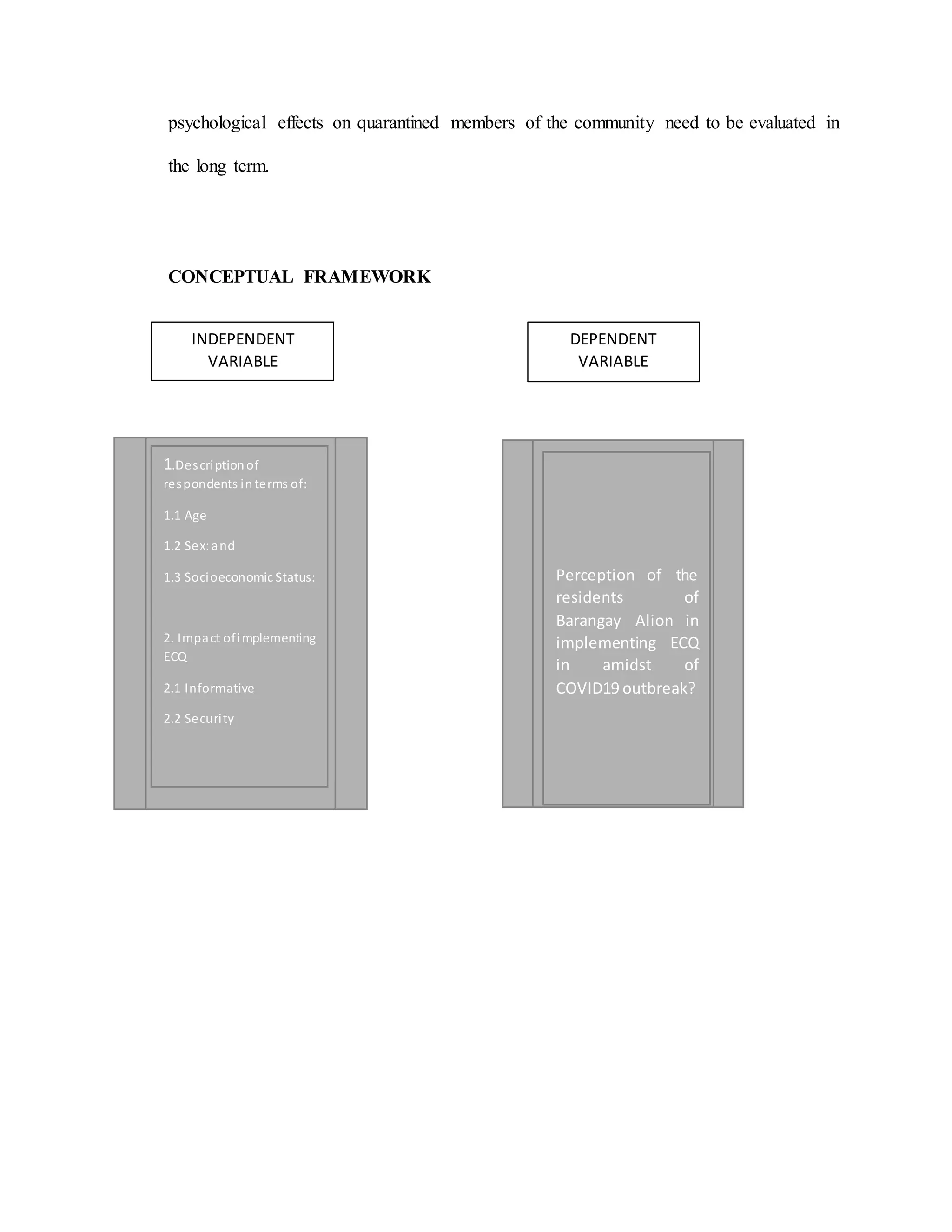
CONCEPTUAL FRAMEWORK
INDEPENDENT
VARIABLE
DEPENDENT
VARIABLE
1.Descriptionof
respondents interms of:
1.1 Age
1.2 Sex:and
1.3 Socioeconomic Status:
2. Impact ofimplementing
ECQ
2.1 Informative
2.2 Security
Perception of the
residents of
Barangay Alion in
implementing ECQ
in amidst of
COVID19 outbreak?
HYPOTHESIS OF THE STUDY
1.1 Age – related factors like the age limit of person allowed to go out.
1.2 Sex – related factors like who’s body is healthier looking for them to be allowed to
go out.
1.3 Socioeconomic status – related factors like the social standing or class of an
individual or group.
2.1 Informative – related factors of being aware of the policy and safe precautions.
2.2 Security – related factors of guiding or keeping everyone safe from virus.
DEFINITION OF TERMS
The following are used in the study and are defined conceptually and operationally.
1. Quarantine - period, or place of isolation in which people or animals that have
arrived from elsewhere or been exposed to infectious or contagious disease are
placed
2. Prevention - the action of stopping something from happening
3. Lockdown - state of isolation or restricted access instituted as a security measure
4. Pandemic - prevalent over a whole country or the world
5. Outbreak - the sudden or violent start of something unwelcome, such as war,
disease, etc.
NOTES IN CHAPTER II
Investigation on the impacts of COVID-19 quarantine on society and environment:
Preventive measures and supportive technologies
: https://link.springer.com/article/10.1007/s13205-020-02382-3
Factors affecting perceived effectiveness of COVID-19 prevention measures among
Filipinos during Enhanced Community Quarantine in Luzon, Philippines: Integrating
Protection Motivation Theory and extended Theory of Planned Behavior
: https://www.sciencedirect.com/science/article/pii/S1201971220306226
Implementing Quarantine to Reduce or Stop the Spread of a Contagious Disease
: https://www.nap.edu/read/25650/chapter/10
The epic battle against coronavirus misinformation and conspiracy theories
: https://www.nature.com/articles/d41586-020-01452-
z?fbclid=IwAR24LPmXHu0MoFzq33KNOeWxXwPXmAvQyTEd6TseqHGoZ9KWX1
goOKSfccA
The economic impact of COVID 19:
https://www.incae.edu/sites/default/files/covid-19.pdf#page=52
Community quarantine strategy against coronavirus disease 2019 in Anhui: An
evaluation based on trauma center patients :
https://www.ijidonline.com/article/S1201-9712(20)30232-
0/pdf?fbclid=IwAR3MCT7RQ-
eC8eVSyFY93mQrc21RZkUSd0GqISr_0qdVzdCPKmpOp1sOt8Q

CHAPTER-II-1.docx

  • 1.
    Impact of implementingEnhanced Community Quarantine in preventing the spread of COVID19 to the residents of Alion, Mariveles. CHAPTER II THEORETICAL FRAMEWORK This chapter includes the relevant theories, related foreign and local studies and literature which the researchers pursued to shed light and to attain clearer perspective and to arrive an adequate background of the study. This will also present the conceptual framework and the definition of terms for better comprehension of the study. RELEVANT THEORY However, Zhou et al (2020) the lockdown has also made some impacts on human society such as negative psychological effects due to quarantine, loss in the economy of the world. But there are also positive aspects like reduction in pollution due to less movement of vehicles and closure of many industries. Goh and Chew (2006) states that Quarantine was implemented successfully to halt the transmission during SARS epidemic in 2003. It is one of the important steps in this pandemic disease plan. The quarantine can be to an individual or the group level and usually, it involves restriction to the home or a particular area. During the quarantine period, all the persons should be monitored regularly for the occurrence of any symptoms.
  • 2.
    By quarantining, thedetection of cases becomes easier, so that contacts can be listed and traced out within a short period of time frame. (Lu et al., 2020) The virus spread rapidly in the city and showed strong infectivity and pathogenicity. As this novel coronavirus shared over 79% of its genome sequence with the coronavirus that causes severe acute respiratory syndrome (SARS-CoV), it was subsequently named SARS-CoV-2. The pneumonia caused by SARS-CoV2 was subsequently identified as a novel acute respiratory infectious disease and was named coronavirus disease 2019 (COVID-19). Following outbreaks in China and Asia, COVID- 19 spread widely in Europe and the Americas. (Lin et al., 2020) A strategy of community quarantine was also widely adopted in urban populations for medical observation. The strategy, led by community committees dominated by public servants, aimed to screen the densely populated urban population for potential and latent infections and quarantine residents with definite exposure history. REVIEW ON RELATED LITERATURE Zhou et al (2020) An unprecedented outbreak of mysterious etiology pneumonia, which occurred in December 2019, has taken the whole world to a state of sorrow and worry about the future. The novel coronavirus (COVID-19) is a respiratory illness and its outbreak primarily originated from Wuhan, China. The epidemic is found to be caused by a zoonotic transmission event associated with a wide seafood market and soon became transmission from human to human.
  • 3.
    (World Health Organization2020a) It is known that the main cause of this virus has started from bats and the virus is mutated to affect the humans and it is identified that there are six coronaviruses which affect the human body and some of them are α-CoVs HCoV-229E and HCoV-NL63, which are of low pathogenicity and cause mild respiratory symptoms. The COVID-19 is a respiratory disease that spreads at a maximum rate through droplets of the infected people through the air. Despite various efforts taken by every country like global containment, travel restrictions, and treating the infected person, the incidence of COVID-19 continues to rise at a tremendous rate. This review shares the knowledge about the technologies that help out the industrialists, students, and doctors to fight against and run the routine life even during the lockdown. This review would also elucidate the environmental impacts that changed the world during the quarantine of the people and the preventive measures taken by the governments for the safety of the people in the world. (India’s COVID-19 RO value 2020) On March 16, 2020, The Philippine government imposed a total lockdown in Luzon, known as the Enhanced Community Quarantine (ECQ), as a preventive measure to minimize the COVID-19 outbreak. This ECQ is widely known as one of the longest lockdowns in the world. Under the ECQ, all modes of domestic travel, including ground, air, and sea, were suspended. Residents were not allowed to leave their homes except in case of emergencies. Border closures and entry bans were also enforced. Thousands of police officers and military personnel were deployed at checkpoints to ensure that people complied with the lockdown. The administration also implemented, through several
  • 4.
    platforms as preventivemeasures, strict social distancing (Duddu, 2020, CSIS, 2020) and educated the community on healthy lifestyles. Statistics obtained from WHO and World meters is used for this review to demonstrate the quarantine effect. The isolation of persons prone to reported cases will avoid a large proportion of diseases and deaths relative to those without control. There was little impact of quarantining travelers from a country with a reported epidemic to prevent infection and death. In addition, the incorporation of lockdown with other treatment and prevention measures such as school closures, travel restrictions, and social distancing has had a greater impact on spread prevention, cases requiring critical care beds, and deaths compared with quarantine alone. (Wilder-Smith and Freedman 2020) So social distancing of people will effectively reduce the transmission of this kind of infectious disease. This involves avoiding unnecessary travel and social gatherings. There must always be a 2 m gap between people in public, independent of viral transmission (Social distancing in UK 2020). Social distancing is useful where community spread is suspected to have occurred, but where the relationship between the infected persons is uncertain and restrictions imposed only on individuals known to be exposed are considered inadequate to prevent further disease transmission (Centers for Disease Control and Prevention 2005). REVIEW ON RELATED STUDIES Pandemics, like other disasters, have been a part of human history for centuries. However, response to pandemics necessarily differs as it requires separation, isolation and
  • 5.
    quarantine. Beyond thepotential community protective effects attributed to quarantine, the risk to quarantined individuals needs to be identified. As outlined in Levine and McKibbin (2020), can be a low-cost and highly effective response that can reduce the extent of contagion and therefore reduce the social and economic cost. Experts have warned, and continue to warn, that zoonotic diseases will continue to pose a threat to the lives of millions of people, with potentially major disruption to an integrated world economy. The idea that any country can be an island in an integrated global economy has been proven wrong by the latest outbreak of COVID-19. Global cooperation, especially in the sphere of public health and economic development, is essential. All major countries need to participate actively. It is too late to act once the disease has taken hold in many other countries and to attempt to close borders once a pandemic has started. (Lauer et al., 2020) It is important to note that the implementation and maintenance of this strategy are expensive. Community quarantine in a province containing more than ten million people requires a large number of committee members and volunteers, while no more than a thousand people were eventually diagnosed. Daily disease screenings, contact with the CDC, and community services are costly in terms of human effort and economically. The closure of work places, schools, and public areas; the domiciliary of the urban population; and the shutdown of social services have had a huge impact on the functioning of the society and the social economy. In addition, the possible
  • 6.
    psychological effects onquarantined members of the community need to be evaluated in the long term. CONCEPTUAL FRAMEWORK INDEPENDENT VARIABLE DEPENDENT VARIABLE 1.Descriptionof respondents interms of: 1.1 Age 1.2 Sex:and 1.3 Socioeconomic Status: 2. Impact ofimplementing ECQ 2.1 Informative 2.2 Security Perception of the residents of Barangay Alion in implementing ECQ in amidst of COVID19 outbreak?
  • 7.
    HYPOTHESIS OF THESTUDY 1.1 Age – related factors like the age limit of person allowed to go out. 1.2 Sex – related factors like who’s body is healthier looking for them to be allowed to go out. 1.3 Socioeconomic status – related factors like the social standing or class of an individual or group. 2.1 Informative – related factors of being aware of the policy and safe precautions. 2.2 Security – related factors of guiding or keeping everyone safe from virus. DEFINITION OF TERMS The following are used in the study and are defined conceptually and operationally. 1. Quarantine - period, or place of isolation in which people or animals that have arrived from elsewhere or been exposed to infectious or contagious disease are placed 2. Prevention - the action of stopping something from happening 3. Lockdown - state of isolation or restricted access instituted as a security measure 4. Pandemic - prevalent over a whole country or the world 5. Outbreak - the sudden or violent start of something unwelcome, such as war, disease, etc.
  • 8.
    NOTES IN CHAPTERII Investigation on the impacts of COVID-19 quarantine on society and environment: Preventive measures and supportive technologies : https://link.springer.com/article/10.1007/s13205-020-02382-3 Factors affecting perceived effectiveness of COVID-19 prevention measures among Filipinos during Enhanced Community Quarantine in Luzon, Philippines: Integrating Protection Motivation Theory and extended Theory of Planned Behavior : https://www.sciencedirect.com/science/article/pii/S1201971220306226 Implementing Quarantine to Reduce or Stop the Spread of a Contagious Disease : https://www.nap.edu/read/25650/chapter/10 The epic battle against coronavirus misinformation and conspiracy theories : https://www.nature.com/articles/d41586-020-01452- z?fbclid=IwAR24LPmXHu0MoFzq33KNOeWxXwPXmAvQyTEd6TseqHGoZ9KWX1 goOKSfccA The economic impact of COVID 19:
  • 9.
    https://www.incae.edu/sites/default/files/covid-19.pdf#page=52 Community quarantine strategyagainst coronavirus disease 2019 in Anhui: An evaluation based on trauma center patients : https://www.ijidonline.com/article/S1201-9712(20)30232- 0/pdf?fbclid=IwAR3MCT7RQ- eC8eVSyFY93mQrc21RZkUSd0GqISr_0qdVzdCPKmpOp1sOt8Q