Chapter 16
The Coast and
Coral Reefs
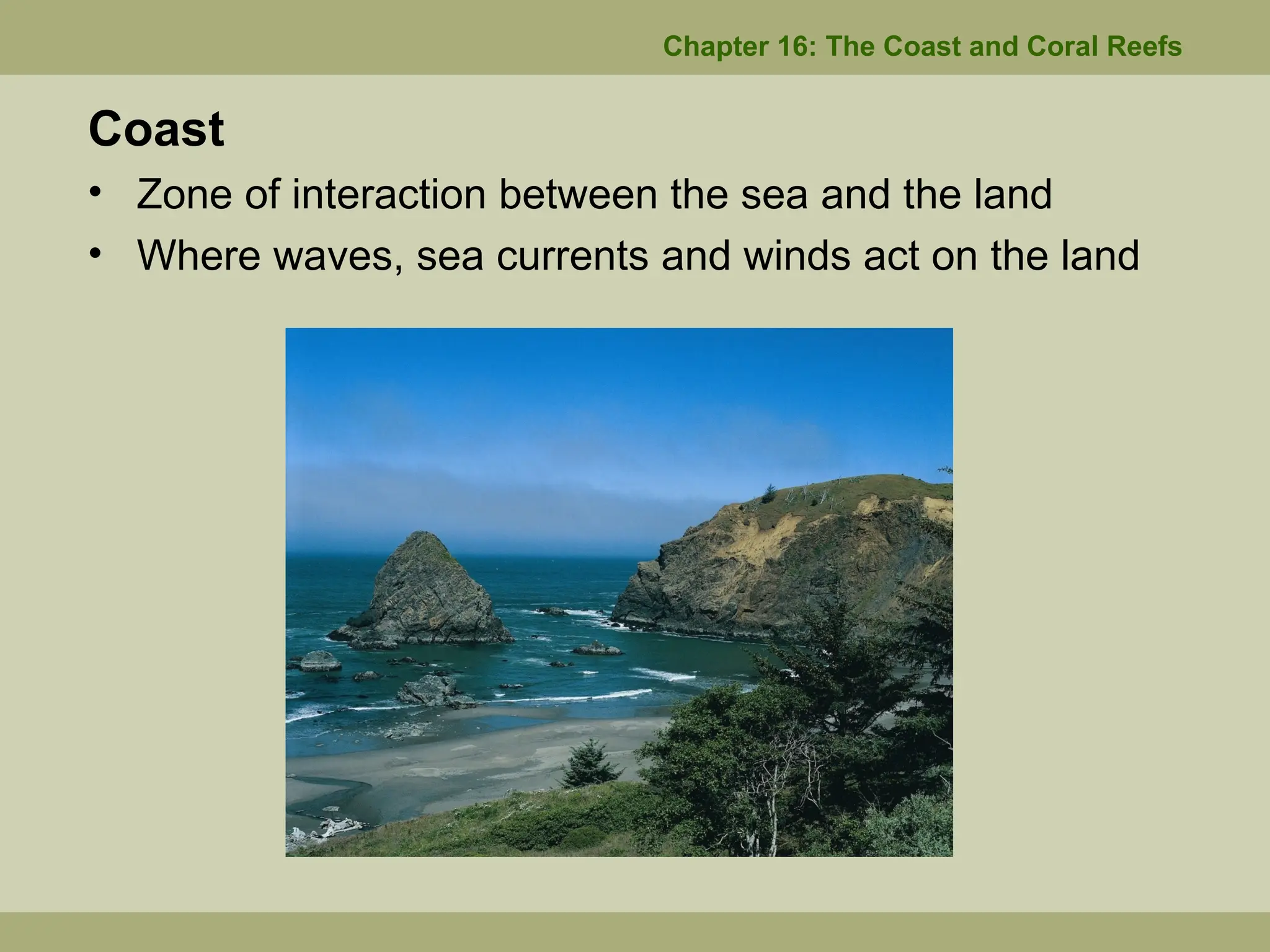
Coast
• Zone of interaction between the sea and the land
• Where waves, sea currents and winds act on the land
Chapter 16: The Coast and Coral Reefs
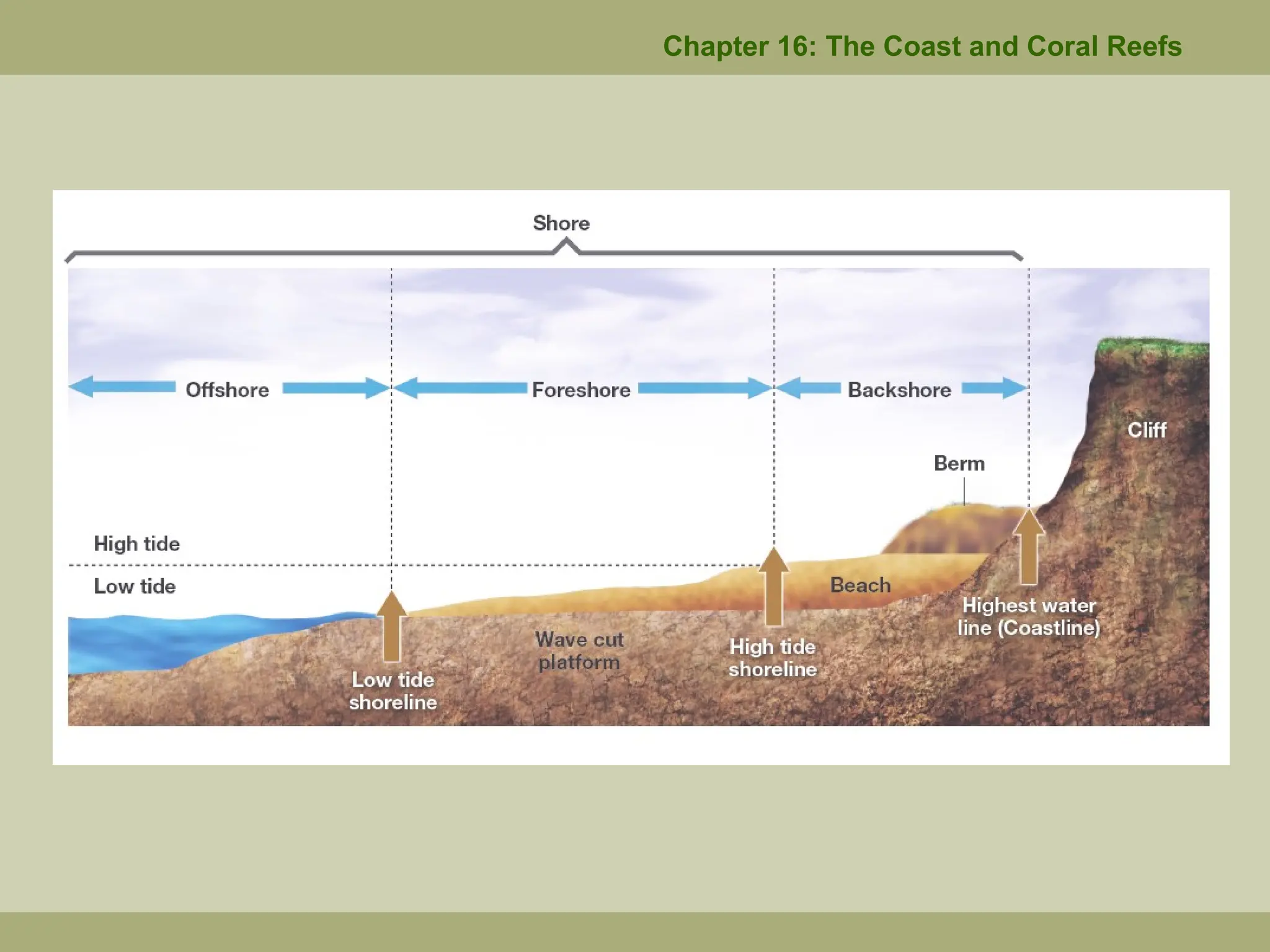
Zonation of the coast
1. High tide shoreline
• Level reached during high tide
2. Low tide shoreline
• Level reached during the lowest tide
3. Coastline
• Highest level reached by storm waves
• Beyond the high tide shoreline
4. Offshore
• Zone submerged below the low tide shoreline
Chapter 16: The Coast and Coral Reefs
5. Foreshore
• Zone between the low tide and high tide shorelines
6. Backshore
• Zone between the high tide shoreline and the coastline
7. Beach
• Feature formed by deposition of sand, gravel and pebbles on
a wave-cut platform
8. Berm
• Raised part of the beach on which vegetation often grows
Chapter 16: The Coast and Coral Reefs
Agents of coastal change
1. Winds
• Main agent of coastal change
• Transport sand and deposit it along the coast
• Generate waves as they blow across the water surface
2. Currents
• Bodies of water moving through the sea in a certain direction
either horizontally or vertically
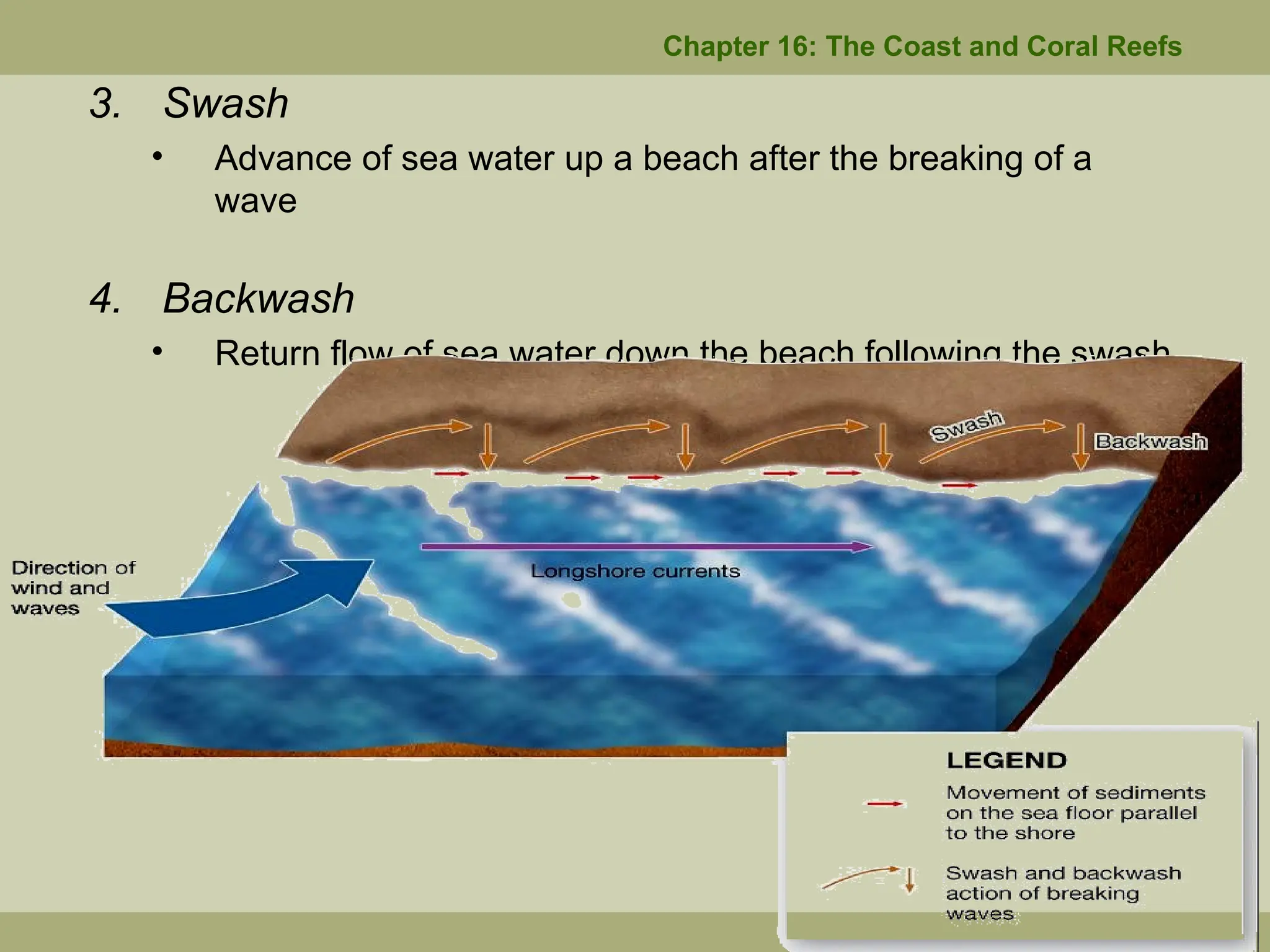
• Currents formed when waves approach the coast at an angle
and break obliquely against the coast are called longshore
currents
3. Swash
• Advance of sea water up a beach after the breaking of a
wave
4. Backwash
• Return flow of sea water down the beach following the swash
Chapter 16: The Coast and Coral Reefs
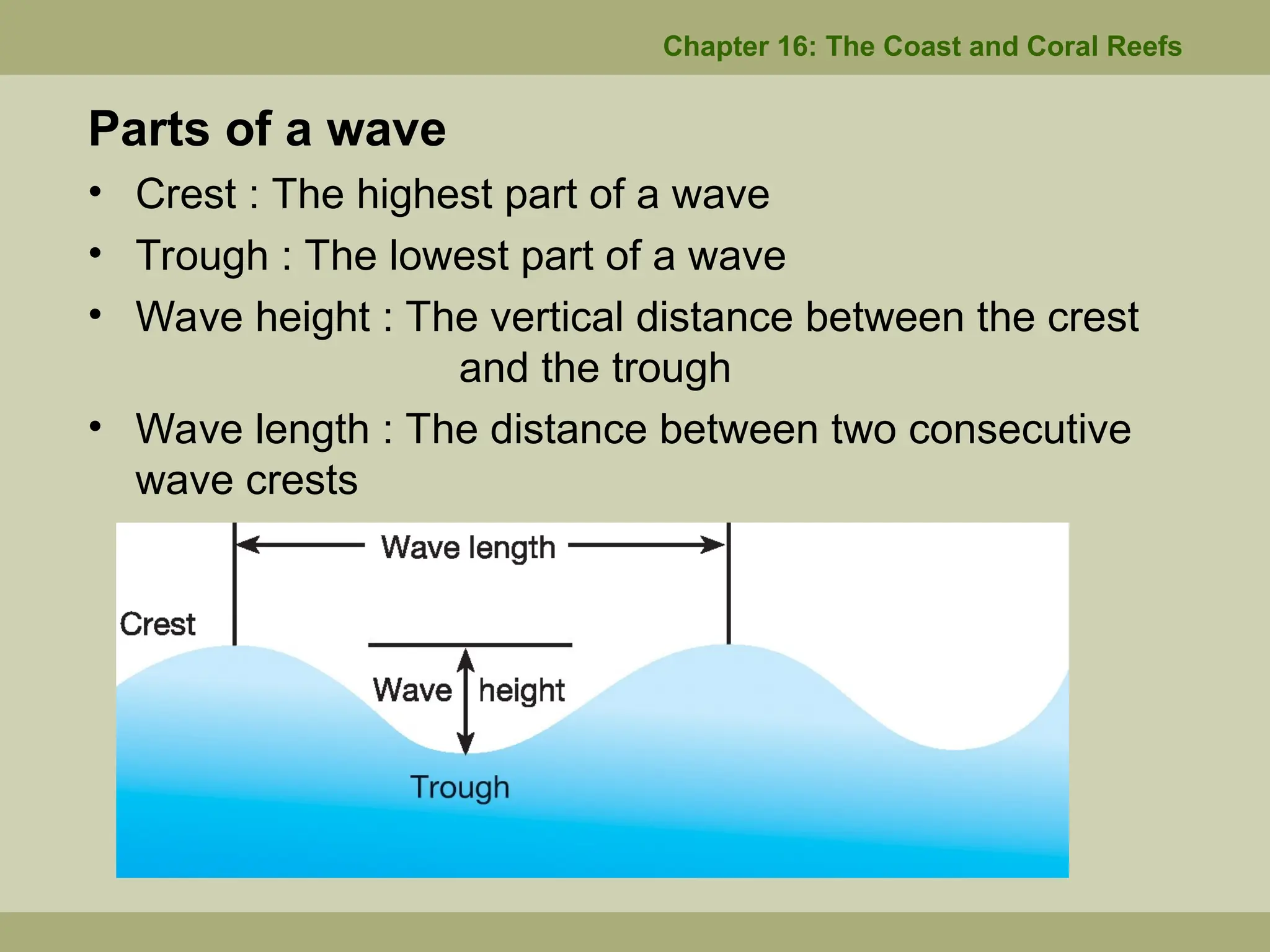
Parts of a wave
• Crest : The highest part of a wave
• Trough : The lowest part of a wave
• Wave height : The vertical distance between the crest
and the trough
• Wave length : The distance between two consecutive
wave crests
Chapter 16: The Coast and Coral Reefs
Wave energy
• Depends on the size of the wave
• The size of the wave increases as the speed of the
wind increases
• The greater the expanse of water over which the wind
blows (termed ‘fetch’), the larger the wave
Chapter 16: The Coast and Coral Reefs
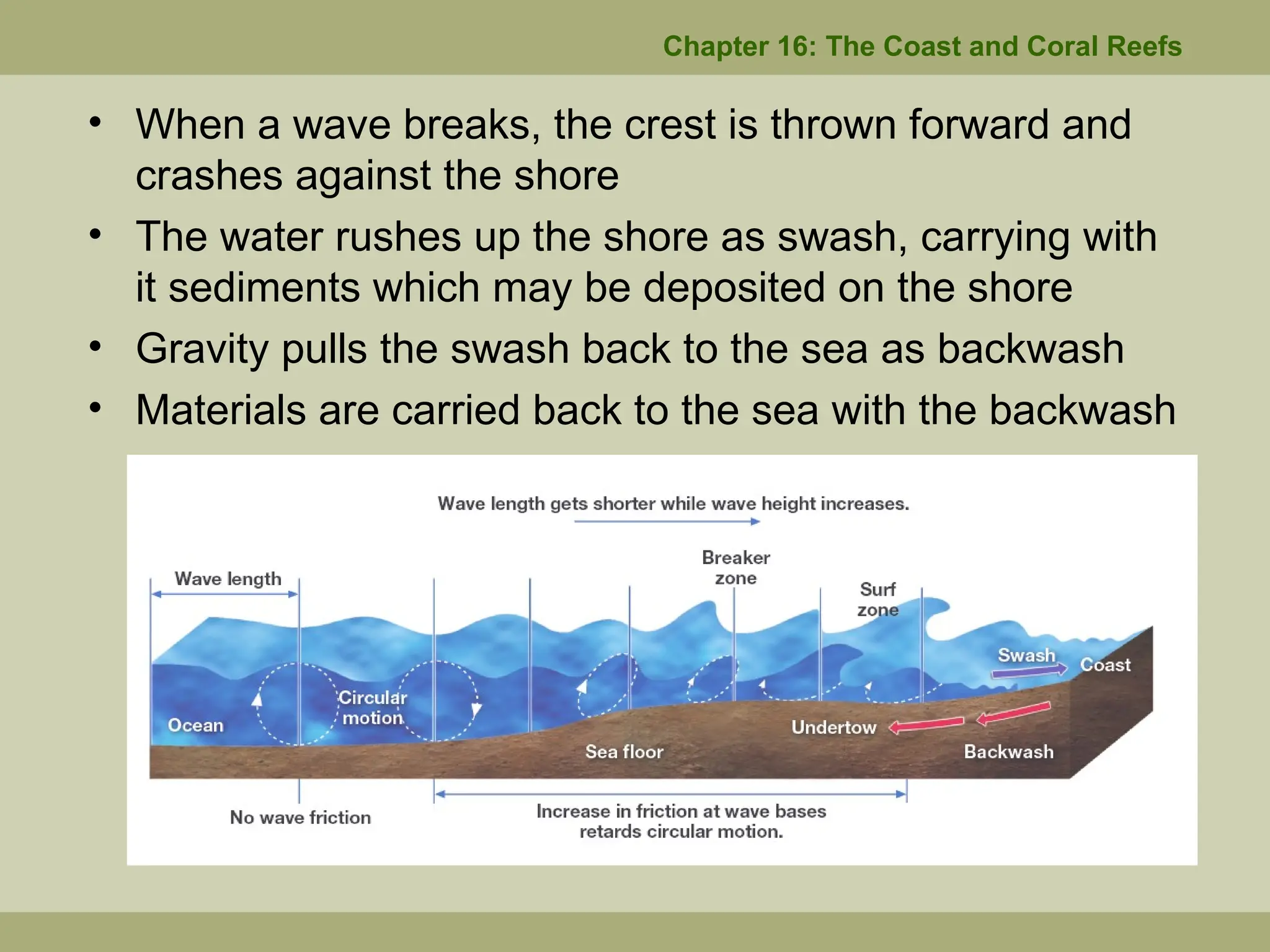
Wave action
• Water particles move in a circular path within a wave
• As a wave approaches the shallow waters near the
shore, the wave path becomes more oval-shaped and
the wave length decreases
• Due to friction between the wave and the sea bed, the
wave slows down
• The waves behind move at a faster speed and push
against the preceding wave
• As a result, the wave height increases while the wave
length decreases
• The waves eventually break
Chapter 16: The Coast and Coral Reefs
• When a wave breaks, the crest is thrown forward and
crashes against the shore
• The water rushes up the shore as swash, carrying with
it sediments which may be deposited on the shore
• Gravity pulls the swash back to the sea as backwash
• Materials are carried back to the sea with the backwash
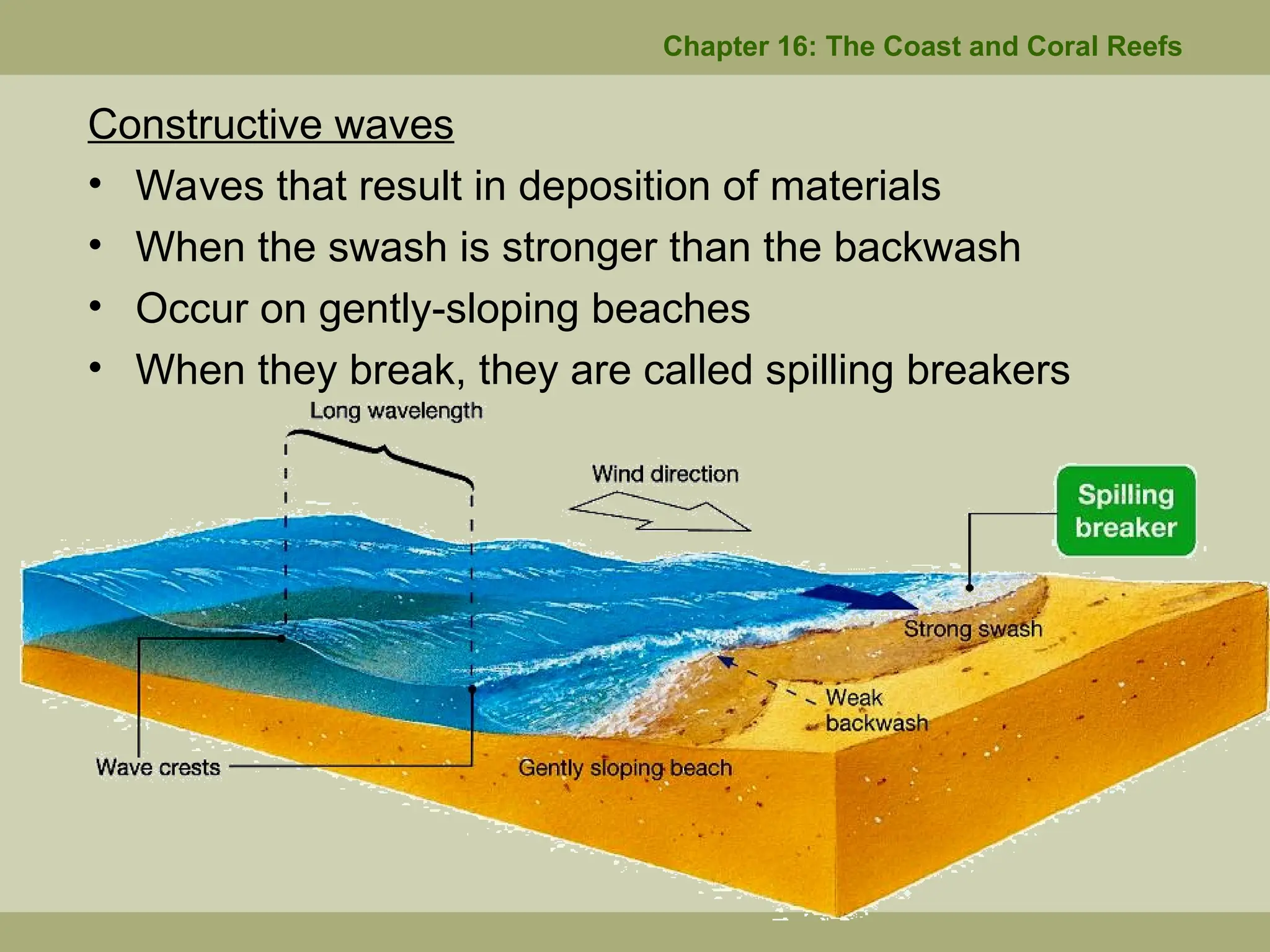
Constructive waves
• Waves that result in deposition of materials
• When the swash is stronger than the backwash
• Occur on gently-sloping beaches
• When they break, they are called spilling breakers
Chapter 16: The Coast and Coral Reefs
Destructive waves
• Waves that encourage erosion
• Materials on the beach are carried into the sea by the stronger
backwash
• Occur on beaches with steep slopes
• Waves break violently as plunging breakers
Chapter 16: The Coast and Coral Reefs
Constructive Waves Destructive Waves
Long wave length Short wave length
Low wave height High wave height
Spill over when breaking Plunge over when breaking
Common on gently-sloping shores Common on steep coastal slopes
Deposit on the coast Erode the coast
Less than ten waves breaking
per minute
More than ten waves breaking
per minute
Characteristics of constructive and destructive waves
Chapter 16: The Coast and Coral Reefs
Processes of wave erosion
1. Hydraulic action
• Repeated crashing of waves against the coast
• The rock structure weakens and the rocks break down
2. Cavitation
• Breaking waves enter the cracks and joints in the rocks
• The water traps and compresses the air within the joints
• The compressed air exerts pressure on the cracks and joints
• When the waves return to the sea, the pressure is released
and the air expands
• Repeated contraction and expansion of the air enlarges the
cracks and joints
• The rocks eventually break into smaller fragments
Chapter 16: The Coast and Coral Reefs
3. Solution
• Rocks may contain water-soluble minerals such as calcium
carbonate
• When these minerals dissolve upon contact with sea water,
pores are left in the rocks
• Over time, the rocks weaken and disintegrate
4. Abrasion
• Rock fragments carried by the water are thrown against the
coast, breaking up the coastal rocks
5. Attrition
• Rock particles carried by the water collide with each other,
becoming smaller, smoother and rounder particles
Chapter 16: The Coast and Coral Reefs
Factors affecting marine erosion
1. Hardness of the rocks
• Less resistant rocks are eroded faster
2. Structure of the rocks
• Rocks with more lines of weakness such as joints are eroded
more rapidly
3. Wave energy
• Stormy weather causes more erosion as the waves are
bigger due to the strong winds
• Larger waves usually have stronger backwash and more
erosive energy
Chapter 16: The Coast and Coral Reefs
4. Human action
• In some places, seawalls
and breakwaters have
been built to slow down
coastal erosion
5. Time
• Older rocks are more eroded since they have been exposed
to wave action longer than more recent rocks.
• The duration of a storm affect the amount of erosion
Structures to slow down
sea erosion
Chapter 16: The Coast and Coral Reefs
Landforms caused by marine erosion
1. Notches, cliffs and wave-cut platforms
• Waves act on a line of weakness on the rock surface through
the processes of hydraulic action and abrasion
• This line of weakness enlarges to become a notch
• Further erosion enlarges the notch into a cave
Chapter 16: The Coast and Coral Reefs
• The roof of the cave eventually collapses and a steep cliff is
formed
• At the cliff base is a flat terrace called a wave-cut platform
• The wave-cut platform will extend farther inland as the cliff
retreats
Chapter 16: The Coast and Coral Reefs
2. Blowholes and sea inlets
• Waves pounding on a sea cave trap air in the cracks and
joints of the rocks
• The compressed air exerts pressure on the cracks and joints
• When the waves retreat, the air expands
• Over time, the rocks are broken down and an opening called
a blowhole is formed at the roof of the cave
• The blowhole may
enlarge until the cave
collapses, resulting in a
deep, long and narrow
inlet called a geo
Chapter 16: The Coast and Coral Reefs
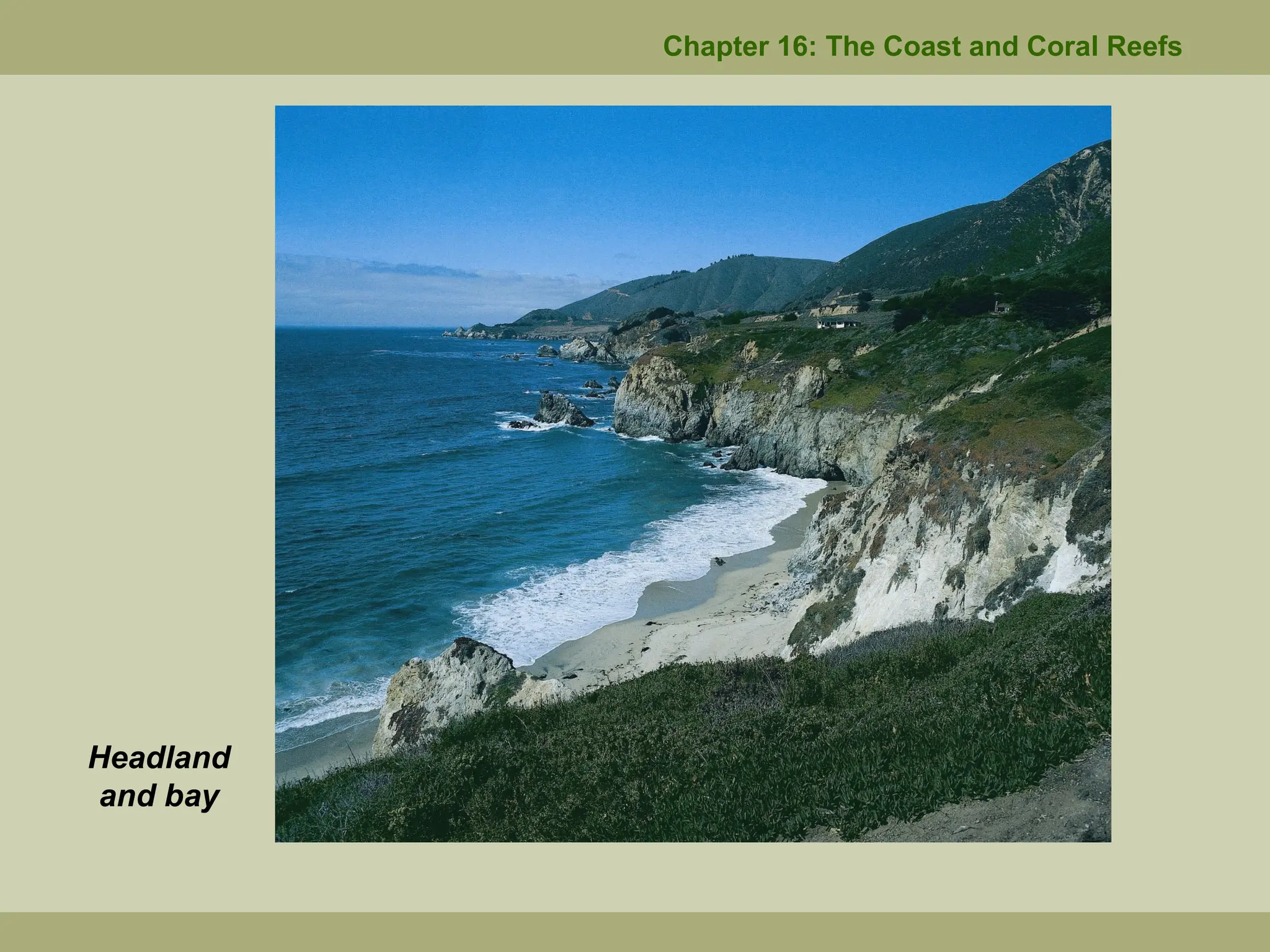
3. Headlands and bays
• Develop along coasts with alternate bands of resistant and
less resistant rocks
• The resistant rocks are eroded more slowly and protrude into
the sea to form headlands
• The less resistant rocks form bays between the headlands
• Can also develop when destructive waves erode along lines
of weakness in rocks to form bays
Chapter 16: The Coast and Coral Reefs
Headland
and bay
Chapter 16: The Coast and Coral Reefs
• At the bays, waves
curve out, resulting in
wave energy being
dispersed and thus
encouraging deposition
• Deposition in the
bay results in a
straighter shoreline
• Wave refraction occurs in areas where
there are headlands and
bays
• Waves concentrate their energy on the
headlands by curving in on
them
Chapter 16: The Coast and Coral Reefs
4. Caves, arches, stacks and stumps
• Waves attack lines of weakness in rocks along the base of
the headland cliff to form notches
• Over time, the notches enlarge to become caves
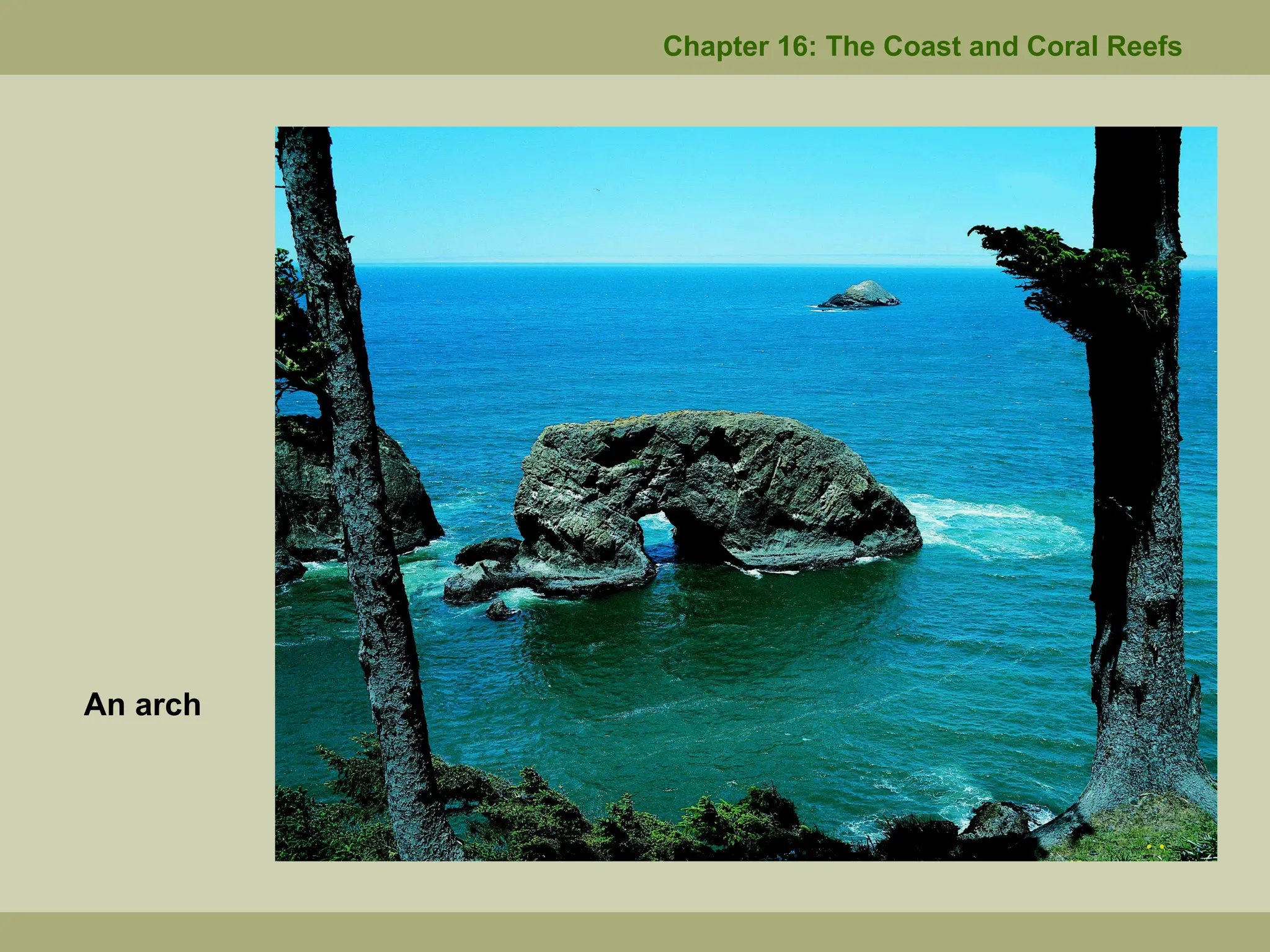
• Continued erosion of caves on two sides of the same
headland cuts through the headland, creating an arch
A B C
Chapter 16: The Coast and Coral Reefs
An arch
Chapter 16: The Coast and Coral Reefs
• The arch widens and the roof eventually collapses
• This leaves an isolated pillar known as a stack
• The stack is gradually eroded down into a stump
Arch collapses
Stack
Notch
Stump
Chapter 16: The Coast and Coral Reefs
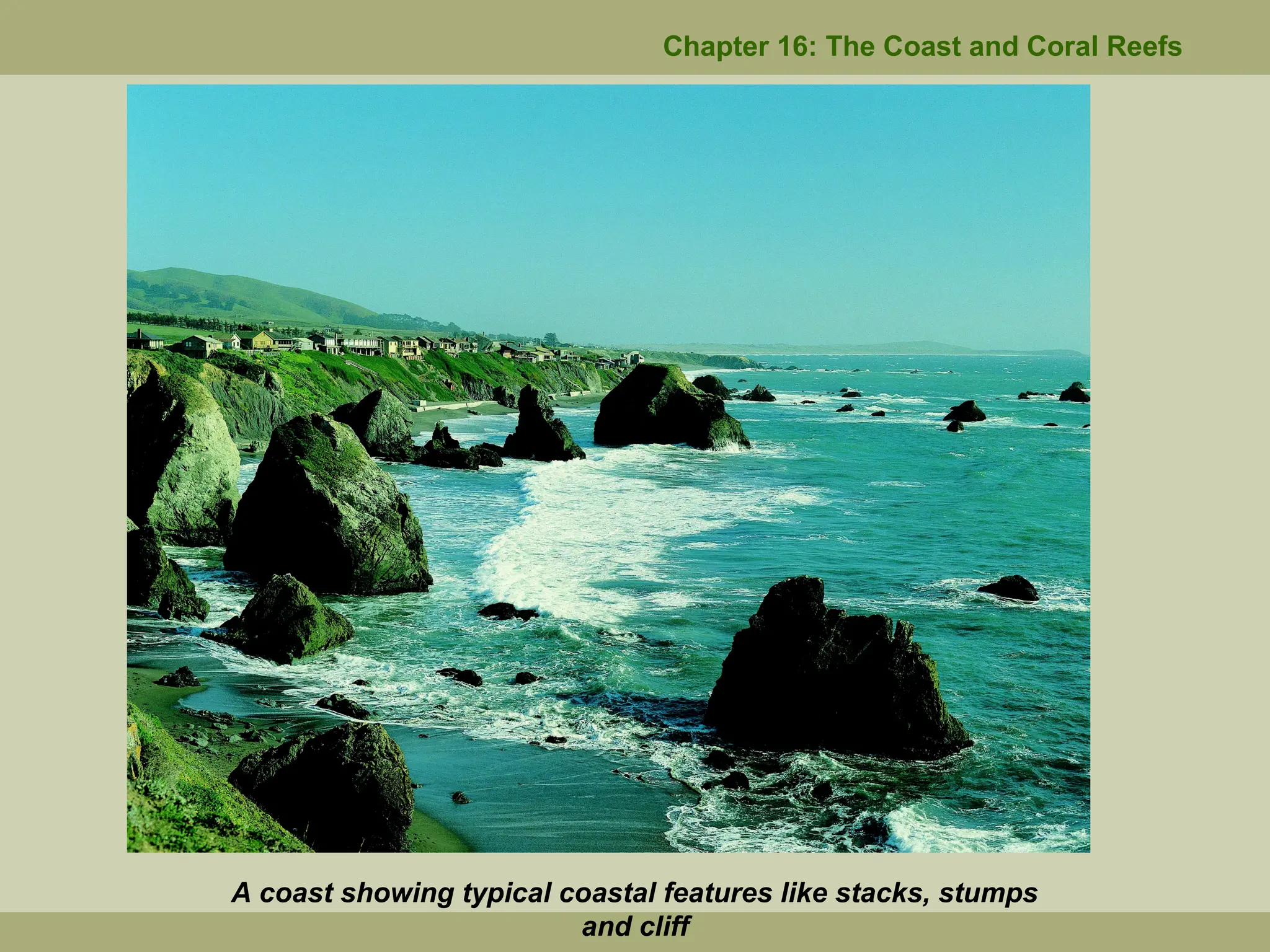
A coast showing typical coastal features like stacks, stumps
and cliff
Wave transportation and deposition
• Occurs mainly through longshore drift along the coast
• When waves approach the shore at an angle, the swash rushes up
the shore diagonally, carrying sediment up the shore
Chapter 16: The Coast and Coral Reefs
• The backwash brings
sediment back into the
sea
• As a result, sediment
is moved in a zig-zag
manner along the
shore
Longshore drift
Swash
zone
Breake
r zone
Swash
Backwash
Movement of material by
longshore current
Direction of wind
Beach
Chapter 16: The Coast and Coral Reefs
Landforms caused by wave deposition
1. Beaches
• Accumulation of rock debris and sediment on or along a
wave-cut platform
• Constructive waves deposit materials on the coast
• Coarser materials
are deposited
farther inland
while finer
materials are
found nearer
the sea
A cobblestone beach at
Georgetown, St. Vincent
Chapter 16: The Coast and Coral Reefs
2. Spits
• Long, narrow low-lying strips of sand and shingle
projecting from the shore towards the sea
Formation of a spit
Chapter 16: The Coast and Coral Reefs
3. Bars
• Narrow ridges of deposited material lying away from and
parallel to the coast (off-shore bar)
• A spit may grow across an estuary, a lagoon or a bay to
become a bar (bay-bar)
4. Tombolos
• Formed when a spit or
a bar extends to join
an offshore island
The Cocal Spit in Mayaro,
Trinidad
Recurved spit
Maria River
Chapter 16: The Coast and Coral Reefs
Causes of marine erosion
1. Wave action and longshore drift
• Erosion occurs when the amount of materials deposited is
less than the amount carried away
• Large storm waves cause coastal erosion which can lead to
long-term loss of sediments or temporary redistribution of
sediments
• Destructive waves erode the beach by carrying materials out
to sea, whereas constructive waves increase the size of the
beach by depositing materials on it
• Longshore drift moves sediments from one part of the coast
to another part farther down the coastline
Chapter 16: The Coast and Coral Reefs
2. Rock structure and strength
• Rocks with joints and fractures are eroded faster
• Less resistant rocks such as limestone are more vulnerable to erosion
3. Natural hazards
• Hurricanes, volcanic eruptions and earthquakes can cause dramatic
changes in coastlines
• They can destroy coastal features
Changes to Coconut Beach (Dominica) during the 1995 hurricane season
Chapter 16: The Coast and Coral Reefs
4. Atmospheric processes
• Onshore winds pick up sediments and move them up the
beach to form sand dunes
• Rain helps to carry sediments down to the beach
5. Human actions and interference
• Dam construction and river channelisation reduce the
amount of sand that reaches the shore
• Humans sometimes remove beach sand as raw material for
the construction industry
Building groynes is one way
humans can interfere in
coastal formation
Chapter 16: The Coast and Coral Reefs
Coastal management
1. Groynes
• Structures built out from the shore and into the sea
• Constructed at a right angle to the sea
• Effective in preventing longshore drift from moving sediments
from one point to another farther along the coastline
• While they protect one part of the coast from erosion, they
contribute to erosion of the beach behind them by cutting
off the supply of sediments to the beach
2. Replenishing the beach
 Sand is sometimes added artificially to badly
eroded beaches
 The sand is taken from external sources
Chapter 16: The Coast and Coral Reefs
3. Seawalls
• Walls constructed on the inland part of the coast to deflect
oncoming waves
• Built parallel to the coast
• Usually made of hard rocks or concrete
• Can be sloping or vertical
• May cause erosion in the long run
• The energy of the backwash is reflected from the wall and
erodes the beach materials beneath and in front of the
wall
• Scouring occurs at the base of the seawall, weakening it
Chapter 16: The Coast and Coral Reefs
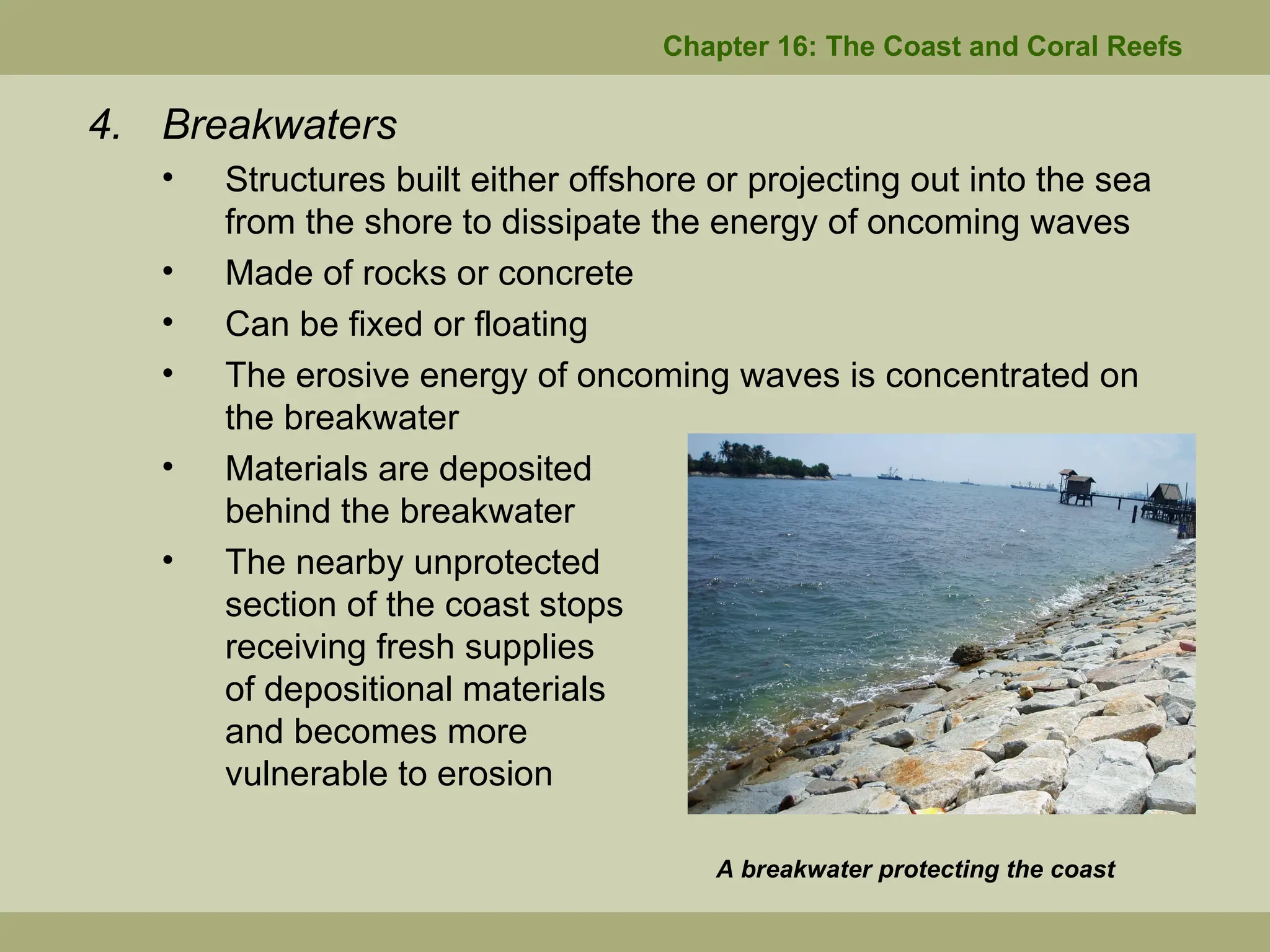
4. Breakwaters
• Structures built either offshore or projecting out into the sea
from the shore to dissipate the energy of oncoming waves
• Made of rocks or concrete
• Can be fixed or floating
• The erosive energy of oncoming waves is concentrated on
the breakwater
• Materials are deposited
behind the breakwater
• The nearby unprotected
section of the coast stops
receiving fresh supplies
of depositional materials
and becomes more
vulnerable to erosion
A breakwater protecting the coast
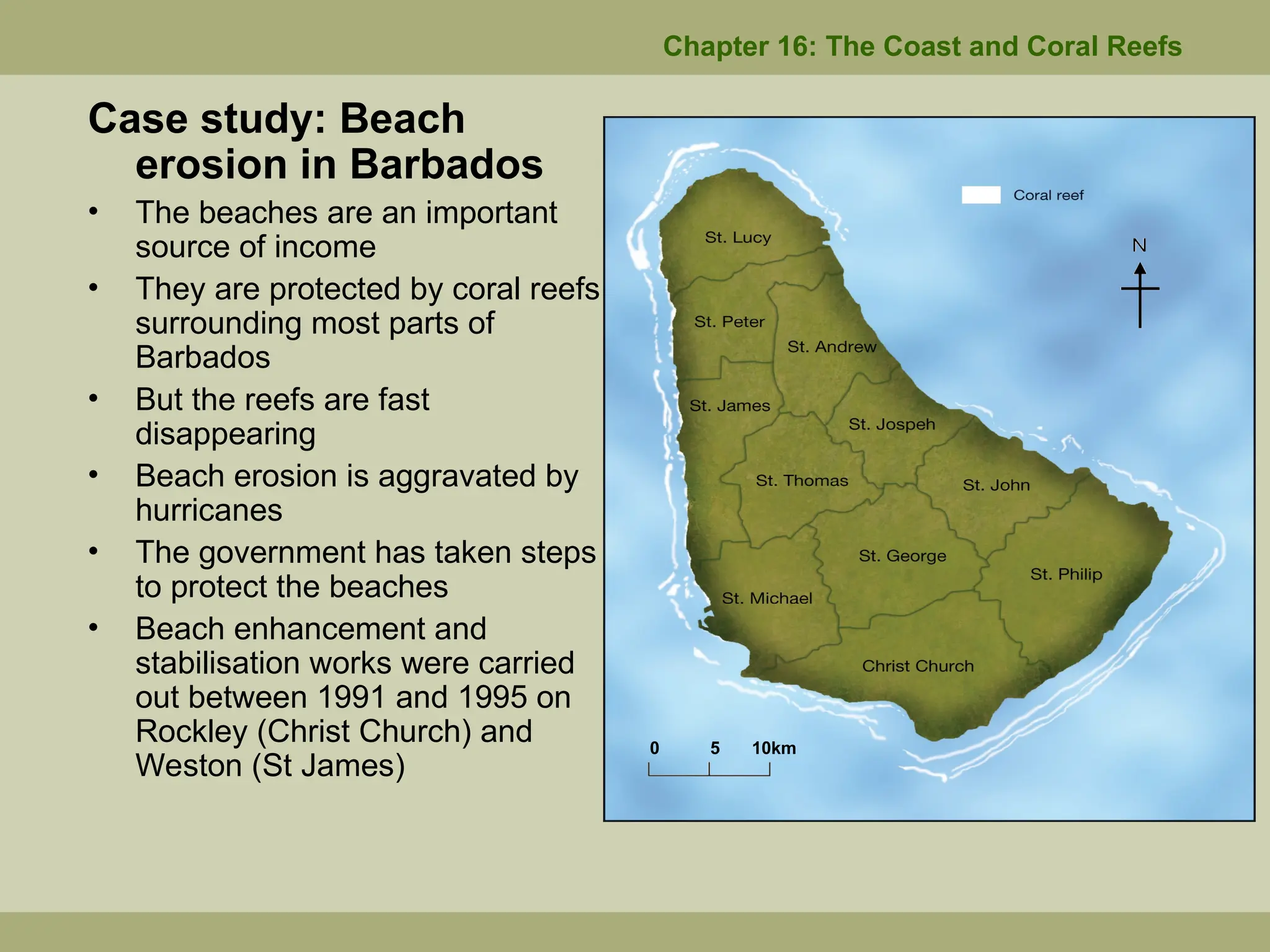
Case study: Beach
erosion in Barbados
• The beaches are an important
source of income
• They are protected by coral reefs
surrounding most parts of
Barbados
• But the reefs are fast
disappearing
• Beach erosion is aggravated by
hurricanes
• The government has taken steps
to protect the beaches
• Beach enhancement and
stabilisation works were carried
out between 1991 and 1995 on
Rockley (Christ Church) and
Weston (St James)
Chapter 16: The Coast and Coral Reefs
0 5 10km
Corals
• Made up of the limestone skeletons of tiny marine
organisms called coral polyps
Conditions for the growth of coral polyps
• Sea temperature between 20C and 30C
• Shallow sea water less than 70m deep
• Clear salt water
• Polyps thrive on the seaward side of coral reefs where
waves and currents bring an abundant supply of
oxygen and food
• Extensive coral formations develop between latitudes
30N and 30S, on the eastern side of land masses
where there are warm currents
Chapter 16: The Coast and Coral Reefs
Types of coral reefs
1. Fringing reef
• A narrow coral platform separated from the coast by a
shallow lagoon
2. Barrier reef
• A coral platform separated from the coast by a deep wide
lagoon
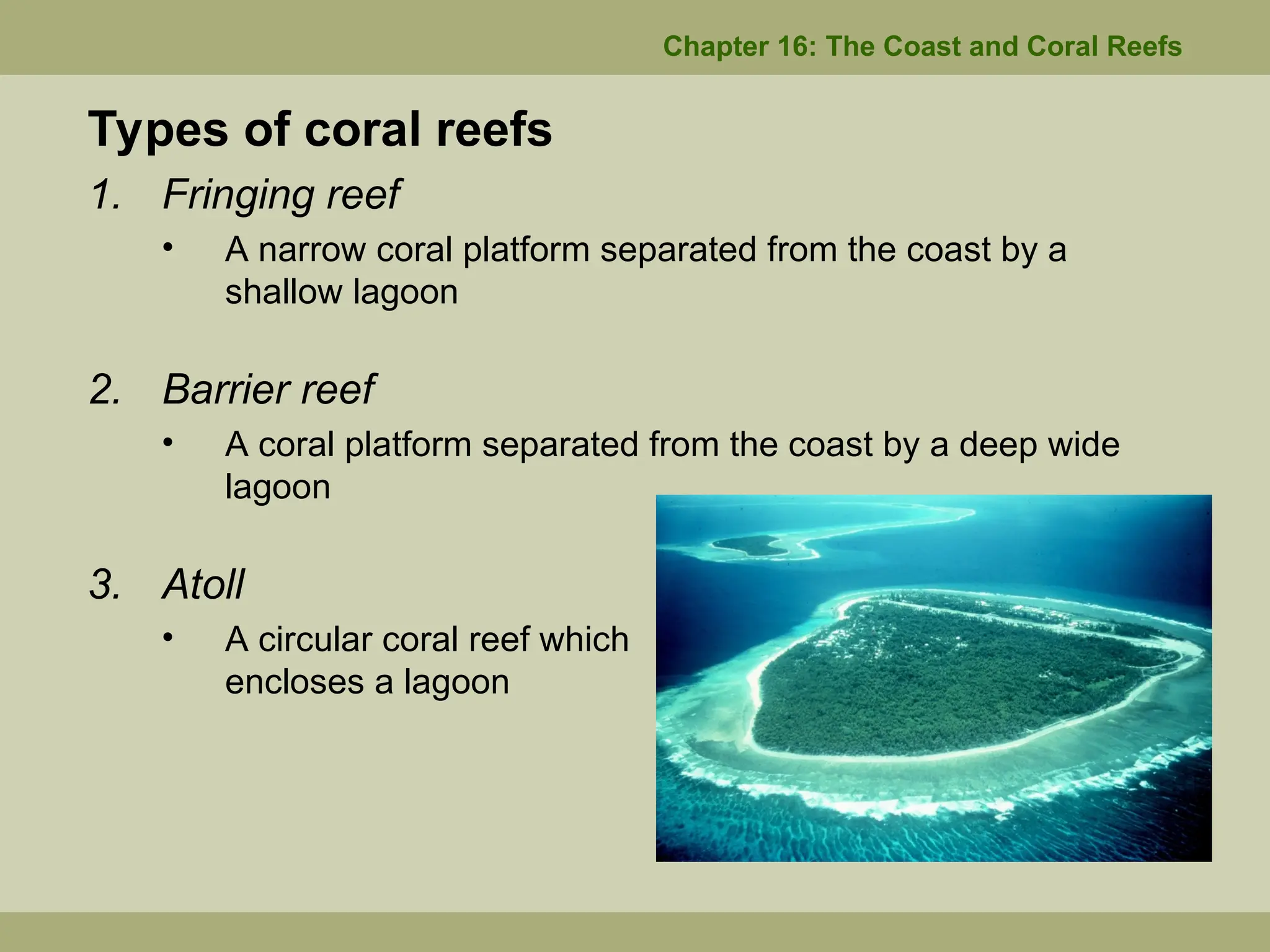
3. Atoll
• A circular coral reef which
encloses a lagoon
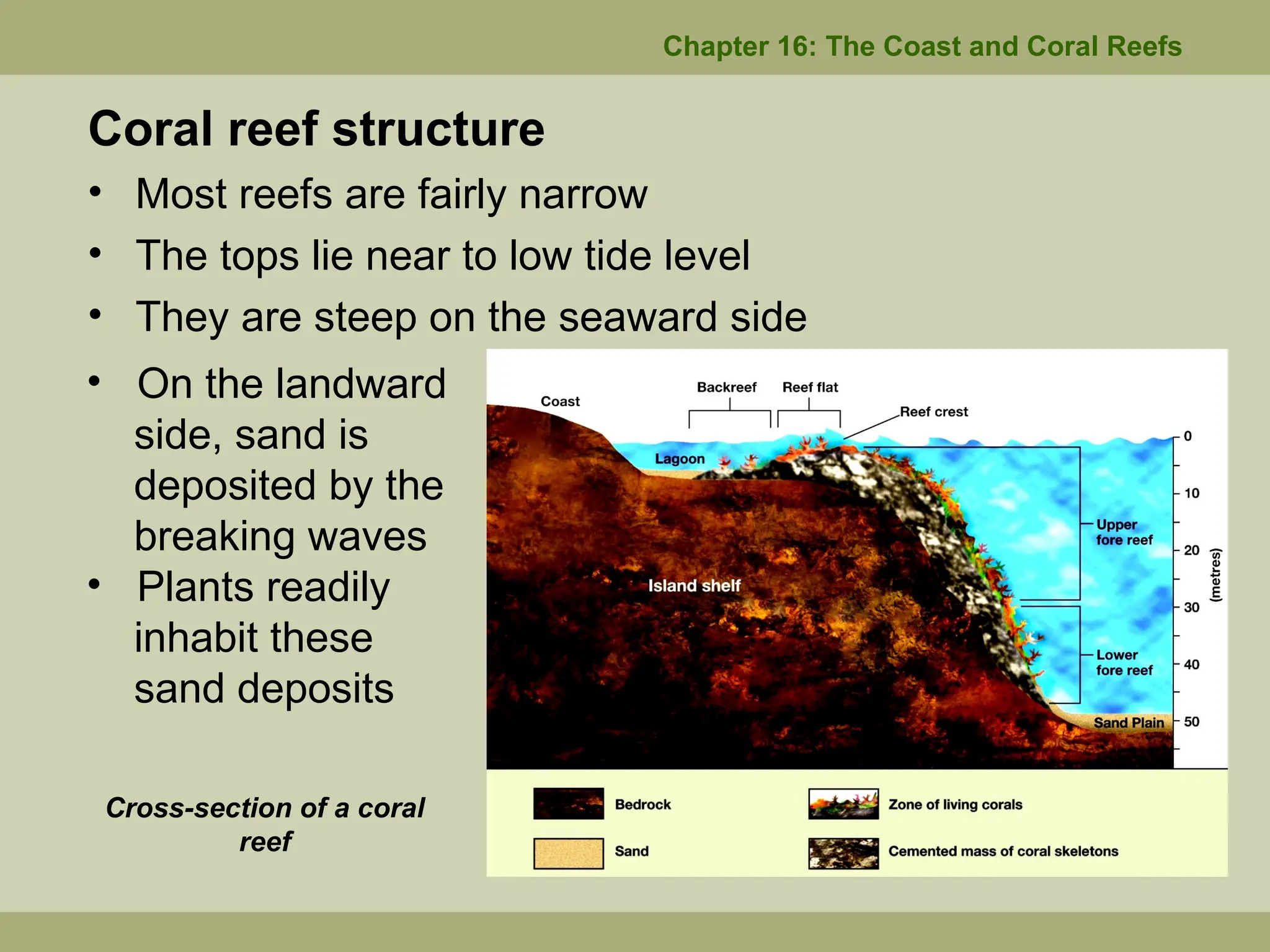
Coral reef structure
• Most reefs are fairly narrow
• The tops lie near to low tide level
• They are steep on the seaward side
Chapter 16: The Coast and Coral Reefs
• On the landward
side, sand is
deposited by the
breaking waves
• Plants readily
inhabit these
sand deposits
Cross-section of a coral
reef
Coral reefs in the Caribbean
• Coral reefs have declined significantly
• Coral cover decreased from more than 50% in 1977 to
10% in 2001, a total loss of 80%
• Reefs at Risk project (2004) found that 64% of
Caribbean reefs were being threatened by high levels
of human activities
• The reefs in eastern and southern Caribbean, the
Greater Antilles, Florida Keys, Yucatan and the
Mesoamerican Barrier Reef are under threat
• Though natural factors also influence reef development,
humans are the main culprit responsible for destroying
the coral reefs of the wider Caribbean
Chapter 16: The Coast and Coral Reefs
Natural factors
• Hurricanes destroy coral reefs and the organisms that
live there
• Natural predators such as the crown-of-thorns starfish
reduce the population of coral polyps
• Upwelling of warm water may raise sea water
temperatures and inhibit reef development
Chapter 16: The Coast and Coral Reefs
A Crown-of-Thorns starfish in
the midst of corals
Chapter 16: The Coast and Coral Reefs
Human factors
1. Pollution
• Land-based sources of pollution and sediments threaten
35% of the reefs
• Waste materials from factories and holiday resorts pollute
the sea water
• Pesticides washed off farms contaminate coral colonies
• Pollution from ships threatens 15% of the reefs
• Areas under threat are Jamaica, Hispaniola, Puerto Rico, the
high islands of the Lesser Antilles, Belize, Costa Rica and
Panama
Chapter 16: The Coast and Coral Reefs
2. Over-fishing
• As the world’s population increases, so does the demand for
food, including seafood
• Over-fishing in reefs may result in algae blooms which inhibit
the growth of corals
3. Coastal developments and activities
• Coastal developments disrupt currents and cause sediment
damage to the fragile corals
• These include the reclamation of reef areas to build airports
and the development of marinas, groynes and causeways
• Recreational activities such as boating, windsurfing,
waterskiing and diving in reef areas also damage corals by
stirring up sediments, thus blocking out sunlight

Chapter_16_The_Coast_and_Coral_Reefs[1].ppt

  • 1.
    Chapter 16 The Coastand Coral Reefs
  • 2.
    Coast • Zone ofinteraction between the sea and the land • Where waves, sea currents and winds act on the land Chapter 16: The Coast and Coral Reefs
  • 3.
    Chapter 16: TheCoast and Coral Reefs Zonation of the coast 1. High tide shoreline • Level reached during high tide 2. Low tide shoreline • Level reached during the lowest tide 3. Coastline • Highest level reached by storm waves • Beyond the high tide shoreline 4. Offshore • Zone submerged below the low tide shoreline
  • 4.
    Chapter 16: TheCoast and Coral Reefs 5. Foreshore • Zone between the low tide and high tide shorelines 6. Backshore • Zone between the high tide shoreline and the coastline 7. Beach • Feature formed by deposition of sand, gravel and pebbles on a wave-cut platform 8. Berm • Raised part of the beach on which vegetation often grows
  • 5.
    Chapter 16: TheCoast and Coral Reefs
  • 6.
    Chapter 16: TheCoast and Coral Reefs Agents of coastal change 1. Winds • Main agent of coastal change • Transport sand and deposit it along the coast • Generate waves as they blow across the water surface 2. Currents • Bodies of water moving through the sea in a certain direction either horizontally or vertically • Currents formed when waves approach the coast at an angle and break obliquely against the coast are called longshore currents
  • 7.
    3. Swash • Advanceof sea water up a beach after the breaking of a wave 4. Backwash • Return flow of sea water down the beach following the swash Chapter 16: The Coast and Coral Reefs
  • 8.
    Parts of awave • Crest : The highest part of a wave • Trough : The lowest part of a wave • Wave height : The vertical distance between the crest and the trough • Wave length : The distance between two consecutive wave crests Chapter 16: The Coast and Coral Reefs
  • 9.
    Wave energy • Dependson the size of the wave • The size of the wave increases as the speed of the wind increases • The greater the expanse of water over which the wind blows (termed ‘fetch’), the larger the wave Chapter 16: The Coast and Coral Reefs
  • 10.
    Wave action • Waterparticles move in a circular path within a wave • As a wave approaches the shallow waters near the shore, the wave path becomes more oval-shaped and the wave length decreases • Due to friction between the wave and the sea bed, the wave slows down • The waves behind move at a faster speed and push against the preceding wave • As a result, the wave height increases while the wave length decreases • The waves eventually break Chapter 16: The Coast and Coral Reefs
  • 11.
    Chapter 16: TheCoast and Coral Reefs • When a wave breaks, the crest is thrown forward and crashes against the shore • The water rushes up the shore as swash, carrying with it sediments which may be deposited on the shore • Gravity pulls the swash back to the sea as backwash • Materials are carried back to the sea with the backwash
  • 12.
    Constructive waves • Wavesthat result in deposition of materials • When the swash is stronger than the backwash • Occur on gently-sloping beaches • When they break, they are called spilling breakers Chapter 16: The Coast and Coral Reefs
  • 13.
    Destructive waves • Wavesthat encourage erosion • Materials on the beach are carried into the sea by the stronger backwash • Occur on beaches with steep slopes • Waves break violently as plunging breakers Chapter 16: The Coast and Coral Reefs
  • 14.
    Chapter 16: TheCoast and Coral Reefs Constructive Waves Destructive Waves Long wave length Short wave length Low wave height High wave height Spill over when breaking Plunge over when breaking Common on gently-sloping shores Common on steep coastal slopes Deposit on the coast Erode the coast Less than ten waves breaking per minute More than ten waves breaking per minute Characteristics of constructive and destructive waves
  • 15.
    Chapter 16: TheCoast and Coral Reefs Processes of wave erosion 1. Hydraulic action • Repeated crashing of waves against the coast • The rock structure weakens and the rocks break down 2. Cavitation • Breaking waves enter the cracks and joints in the rocks • The water traps and compresses the air within the joints • The compressed air exerts pressure on the cracks and joints • When the waves return to the sea, the pressure is released and the air expands • Repeated contraction and expansion of the air enlarges the cracks and joints • The rocks eventually break into smaller fragments
  • 16.
    Chapter 16: TheCoast and Coral Reefs 3. Solution • Rocks may contain water-soluble minerals such as calcium carbonate • When these minerals dissolve upon contact with sea water, pores are left in the rocks • Over time, the rocks weaken and disintegrate 4. Abrasion • Rock fragments carried by the water are thrown against the coast, breaking up the coastal rocks 5. Attrition • Rock particles carried by the water collide with each other, becoming smaller, smoother and rounder particles
  • 17.
    Chapter 16: TheCoast and Coral Reefs Factors affecting marine erosion 1. Hardness of the rocks • Less resistant rocks are eroded faster 2. Structure of the rocks • Rocks with more lines of weakness such as joints are eroded more rapidly 3. Wave energy • Stormy weather causes more erosion as the waves are bigger due to the strong winds • Larger waves usually have stronger backwash and more erosive energy
  • 18.
    Chapter 16: TheCoast and Coral Reefs 4. Human action • In some places, seawalls and breakwaters have been built to slow down coastal erosion 5. Time • Older rocks are more eroded since they have been exposed to wave action longer than more recent rocks. • The duration of a storm affect the amount of erosion Structures to slow down sea erosion
  • 19.
    Chapter 16: TheCoast and Coral Reefs Landforms caused by marine erosion 1. Notches, cliffs and wave-cut platforms • Waves act on a line of weakness on the rock surface through the processes of hydraulic action and abrasion • This line of weakness enlarges to become a notch • Further erosion enlarges the notch into a cave
  • 20.
    Chapter 16: TheCoast and Coral Reefs • The roof of the cave eventually collapses and a steep cliff is formed • At the cliff base is a flat terrace called a wave-cut platform • The wave-cut platform will extend farther inland as the cliff retreats
  • 21.
    Chapter 16: TheCoast and Coral Reefs 2. Blowholes and sea inlets • Waves pounding on a sea cave trap air in the cracks and joints of the rocks • The compressed air exerts pressure on the cracks and joints • When the waves retreat, the air expands • Over time, the rocks are broken down and an opening called a blowhole is formed at the roof of the cave • The blowhole may enlarge until the cave collapses, resulting in a deep, long and narrow inlet called a geo
  • 22.
    Chapter 16: TheCoast and Coral Reefs 3. Headlands and bays • Develop along coasts with alternate bands of resistant and less resistant rocks • The resistant rocks are eroded more slowly and protrude into the sea to form headlands • The less resistant rocks form bays between the headlands • Can also develop when destructive waves erode along lines of weakness in rocks to form bays
  • 23.
    Chapter 16: TheCoast and Coral Reefs Headland and bay
  • 24.
    Chapter 16: TheCoast and Coral Reefs • At the bays, waves curve out, resulting in wave energy being dispersed and thus encouraging deposition • Deposition in the bay results in a straighter shoreline • Wave refraction occurs in areas where there are headlands and bays • Waves concentrate their energy on the headlands by curving in on them
  • 25.
    Chapter 16: TheCoast and Coral Reefs 4. Caves, arches, stacks and stumps • Waves attack lines of weakness in rocks along the base of the headland cliff to form notches • Over time, the notches enlarge to become caves • Continued erosion of caves on two sides of the same headland cuts through the headland, creating an arch A B C
  • 26.
    Chapter 16: TheCoast and Coral Reefs An arch
  • 27.
    Chapter 16: TheCoast and Coral Reefs • The arch widens and the roof eventually collapses • This leaves an isolated pillar known as a stack • The stack is gradually eroded down into a stump Arch collapses Stack Notch Stump
  • 28.
    Chapter 16: TheCoast and Coral Reefs A coast showing typical coastal features like stacks, stumps and cliff
  • 29.
    Wave transportation anddeposition • Occurs mainly through longshore drift along the coast • When waves approach the shore at an angle, the swash rushes up the shore diagonally, carrying sediment up the shore Chapter 16: The Coast and Coral Reefs • The backwash brings sediment back into the sea • As a result, sediment is moved in a zig-zag manner along the shore Longshore drift Swash zone Breake r zone Swash Backwash Movement of material by longshore current Direction of wind Beach
  • 30.
    Chapter 16: TheCoast and Coral Reefs Landforms caused by wave deposition 1. Beaches • Accumulation of rock debris and sediment on or along a wave-cut platform • Constructive waves deposit materials on the coast • Coarser materials are deposited farther inland while finer materials are found nearer the sea A cobblestone beach at Georgetown, St. Vincent
  • 31.
    Chapter 16: TheCoast and Coral Reefs 2. Spits • Long, narrow low-lying strips of sand and shingle projecting from the shore towards the sea Formation of a spit
  • 32.
    Chapter 16: TheCoast and Coral Reefs 3. Bars • Narrow ridges of deposited material lying away from and parallel to the coast (off-shore bar) • A spit may grow across an estuary, a lagoon or a bay to become a bar (bay-bar) 4. Tombolos • Formed when a spit or a bar extends to join an offshore island The Cocal Spit in Mayaro, Trinidad Recurved spit Maria River
  • 33.
    Chapter 16: TheCoast and Coral Reefs Causes of marine erosion 1. Wave action and longshore drift • Erosion occurs when the amount of materials deposited is less than the amount carried away • Large storm waves cause coastal erosion which can lead to long-term loss of sediments or temporary redistribution of sediments • Destructive waves erode the beach by carrying materials out to sea, whereas constructive waves increase the size of the beach by depositing materials on it • Longshore drift moves sediments from one part of the coast to another part farther down the coastline
  • 34.
    Chapter 16: TheCoast and Coral Reefs 2. Rock structure and strength • Rocks with joints and fractures are eroded faster • Less resistant rocks such as limestone are more vulnerable to erosion 3. Natural hazards • Hurricanes, volcanic eruptions and earthquakes can cause dramatic changes in coastlines • They can destroy coastal features Changes to Coconut Beach (Dominica) during the 1995 hurricane season
  • 35.
    Chapter 16: TheCoast and Coral Reefs 4. Atmospheric processes • Onshore winds pick up sediments and move them up the beach to form sand dunes • Rain helps to carry sediments down to the beach 5. Human actions and interference • Dam construction and river channelisation reduce the amount of sand that reaches the shore • Humans sometimes remove beach sand as raw material for the construction industry Building groynes is one way humans can interfere in coastal formation
  • 36.
    Chapter 16: TheCoast and Coral Reefs Coastal management 1. Groynes • Structures built out from the shore and into the sea • Constructed at a right angle to the sea • Effective in preventing longshore drift from moving sediments from one point to another farther along the coastline • While they protect one part of the coast from erosion, they contribute to erosion of the beach behind them by cutting off the supply of sediments to the beach 2. Replenishing the beach  Sand is sometimes added artificially to badly eroded beaches  The sand is taken from external sources
  • 37.
    Chapter 16: TheCoast and Coral Reefs 3. Seawalls • Walls constructed on the inland part of the coast to deflect oncoming waves • Built parallel to the coast • Usually made of hard rocks or concrete • Can be sloping or vertical • May cause erosion in the long run • The energy of the backwash is reflected from the wall and erodes the beach materials beneath and in front of the wall • Scouring occurs at the base of the seawall, weakening it
  • 38.
    Chapter 16: TheCoast and Coral Reefs 4. Breakwaters • Structures built either offshore or projecting out into the sea from the shore to dissipate the energy of oncoming waves • Made of rocks or concrete • Can be fixed or floating • The erosive energy of oncoming waves is concentrated on the breakwater • Materials are deposited behind the breakwater • The nearby unprotected section of the coast stops receiving fresh supplies of depositional materials and becomes more vulnerable to erosion A breakwater protecting the coast
  • 39.
    Case study: Beach erosionin Barbados • The beaches are an important source of income • They are protected by coral reefs surrounding most parts of Barbados • But the reefs are fast disappearing • Beach erosion is aggravated by hurricanes • The government has taken steps to protect the beaches • Beach enhancement and stabilisation works were carried out between 1991 and 1995 on Rockley (Christ Church) and Weston (St James) Chapter 16: The Coast and Coral Reefs 0 5 10km
  • 40.
    Corals • Made upof the limestone skeletons of tiny marine organisms called coral polyps Conditions for the growth of coral polyps • Sea temperature between 20C and 30C • Shallow sea water less than 70m deep • Clear salt water • Polyps thrive on the seaward side of coral reefs where waves and currents bring an abundant supply of oxygen and food • Extensive coral formations develop between latitudes 30N and 30S, on the eastern side of land masses where there are warm currents Chapter 16: The Coast and Coral Reefs
  • 41.
    Chapter 16: TheCoast and Coral Reefs Types of coral reefs 1. Fringing reef • A narrow coral platform separated from the coast by a shallow lagoon 2. Barrier reef • A coral platform separated from the coast by a deep wide lagoon 3. Atoll • A circular coral reef which encloses a lagoon
  • 42.
    Coral reef structure •Most reefs are fairly narrow • The tops lie near to low tide level • They are steep on the seaward side Chapter 16: The Coast and Coral Reefs • On the landward side, sand is deposited by the breaking waves • Plants readily inhabit these sand deposits Cross-section of a coral reef
  • 43.
    Coral reefs inthe Caribbean • Coral reefs have declined significantly • Coral cover decreased from more than 50% in 1977 to 10% in 2001, a total loss of 80% • Reefs at Risk project (2004) found that 64% of Caribbean reefs were being threatened by high levels of human activities • The reefs in eastern and southern Caribbean, the Greater Antilles, Florida Keys, Yucatan and the Mesoamerican Barrier Reef are under threat • Though natural factors also influence reef development, humans are the main culprit responsible for destroying the coral reefs of the wider Caribbean Chapter 16: The Coast and Coral Reefs
  • 44.
    Natural factors • Hurricanesdestroy coral reefs and the organisms that live there • Natural predators such as the crown-of-thorns starfish reduce the population of coral polyps • Upwelling of warm water may raise sea water temperatures and inhibit reef development Chapter 16: The Coast and Coral Reefs A Crown-of-Thorns starfish in the midst of corals
  • 45.
    Chapter 16: TheCoast and Coral Reefs Human factors 1. Pollution • Land-based sources of pollution and sediments threaten 35% of the reefs • Waste materials from factories and holiday resorts pollute the sea water • Pesticides washed off farms contaminate coral colonies • Pollution from ships threatens 15% of the reefs • Areas under threat are Jamaica, Hispaniola, Puerto Rico, the high islands of the Lesser Antilles, Belize, Costa Rica and Panama
  • 46.
    Chapter 16: TheCoast and Coral Reefs 2. Over-fishing • As the world’s population increases, so does the demand for food, including seafood • Over-fishing in reefs may result in algae blooms which inhibit the growth of corals 3. Coastal developments and activities • Coastal developments disrupt currents and cause sediment damage to the fragile corals • These include the reclamation of reef areas to build airports and the development of marinas, groynes and causeways • Recreational activities such as boating, windsurfing, waterskiing and diving in reef areas also damage corals by stirring up sediments, thus blocking out sunlight