Department of Electricaland Computer Engineering
Chapter 7: Reduced Instruction Set
Computers
Computer Architecture
and Organization
2.
Major Advances inComputers
2
Computer Architecture and Organization
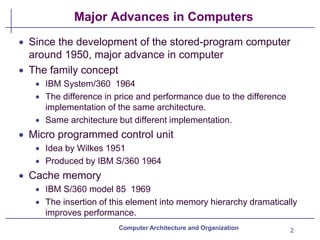
• Since the development of the stored-program computer
around 1950, major advance in computer
• The family concept
• IBM System/360 1964
• The difference in price and performance due to the difference
implementation of the same architecture.
• Same architecture but different implementation.
• Micro programmed control unit
• Idea by Wilkes 1951
• Produced by IBM S/360 1964
• Cache memory
• IBM S/360 model 85 1969
• The insertion of this element into memory hierarchy dramatically
improves performance.
3.
Major Advances inComputers …
3
Computer Architecture and Organization
• Solid State RAM
• Microprocessors
• Intel 4004 1971
• Pipelining
• Introduces parallelism into fetch execute cycle
• Multiple processors
4.
The Next Step- RISC
4
Computer Architecture and Organization
• Reduced Instruction Set Computer
• Key features
• Large number of general purpose registers
• Use of compiler technology to optimize register use
• Limited and simple instruction set
• Emphasis on optimising the instruction pipeline
Driving force forCISC
6
Computer Architecture and Organization
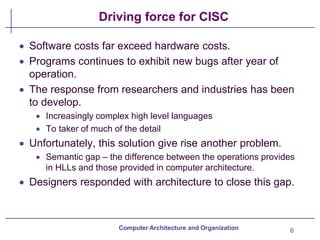
• Software costs far exceed hardware costs.
• Programs continues to exhibit new bugs after year of
operation.
• The response from researchers and industries has been
to develop.
• Increasingly complex high level languages
• To taker of much of the detail
• Unfortunately, this solution give rise another problem.
• Semantic gap – the difference between the operations provides
in HLLs and those provided in computer architecture.
• Designers responded with architecture to close this gap.
7.
Driving force forCISC
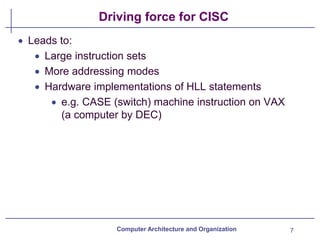
• Leads to:
• Large instruction sets
• More addressing modes
• Hardware implementations of HLL statements
• e.g. CASE (switch) machine instruction on VAX
(a computer by DEC)
Computer Architecture and Organization 7
8.
Intention of CISC
8
ComputerArchitecture and Organization
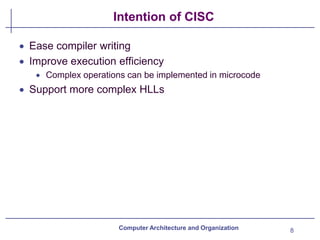
• Ease compiler writing
• Improve execution efficiency
• Complex operations can be implemented in microcode
• Support more complex HLLs
9.
Execution Characteristics
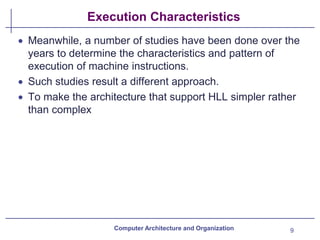
• Meanwhile,a number of studies have been done over the
years to determine the characteristics and pattern of
execution of machine instructions.
• Such studies result a different approach.
• To make the architecture that support HLL simpler rather
than complex
Computer Architecture and Organization 9
10.
Execution Characteristics
10
Computer Architectureand Organization
• Operations performed
• Determine the functions to be performed by the processor and
its interaction with memory.
• Operands used
• The type of operand and the frequency of their use determine
the memory organizations for storing them and addressing
mode for accessing them.
• Execution sequencing
• These determines the control and pipeline organization.
11.
Operations
11
Computer Architecture andOrganization
• A variety of study have been made to analyse the
behaviour of HLL programs.
• Assignment statement are predominate.
• Suggesting that simple movement of data is of high importance
• Conditional statements (IF, LOOP) are also high in number.
• Sequence control mechanism of instruction set is important.
• Such as compare and branch instructions.
• Procedure call-return is very time consuming.
• Some HLL instruction lead to many machine code
operations ( a compiled machine language program)
12.
Weighted Relative DynamicFrequency of HLL
Operations [PATT82a]
12
Computer Architecture and Organization
Dynamic Occurrence
Machine-Instruction
Weighted
Memory-Reference
Weighted
Pascal C Pascal C Pascal C
ASSIGN 45% 38% 13% 13% 14% 15%
LOOP 5% 3% 42% 32% 33% 26%
CALL 15% 12% 31% 33% 44% 45%
IF 29% 43% 11% 21% 7% 13%
GOTO — 3% — — — —
OTHER 6% 1% 3% 1% 2% 1%
13.
Operations
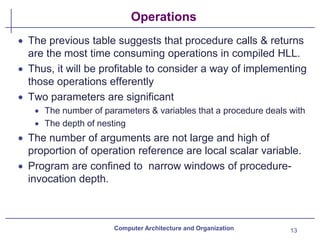
• The previoustable suggests that procedure calls & returns
are the most time consuming operations in compiled HLL.
• Thus, it will be profitable to consider a way of implementing
those operations efferently
• Two parameters are significant
• The number of parameters & variables that a procedure deals with
• The depth of nesting
• The number of arguments are not large and high of
proportion of operation reference are local scalar variable.
• Program are confined to narrow windows of procedure-
invocation depth.
Computer Architecture and Organization 13
14.
Operands
14
Computer Architecture andOrganization
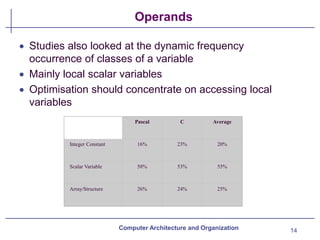
• Studies also looked at the dynamic frequency
occurrence of classes of a variable
• Mainly local scalar variables
• Optimisation should concentrate on accessing local
variables
Pascal C Average
Integer Constant 16% 23% 20%
Scalar Variable 58% 53% 55%
Array/Structure 26% 24% 25%
15.
Implications
15
Computer Architecture andOrganization
• The attempt to make the instruction set architecture
closer to HLLs is not the most effective design strategy.
• Rather HLLs can be supported by optimising most used
and most time consuming features
• Generalizing from researches three elements emerge
that characterize RISC architecture
• Large number of registers or Compiler to optimize
• Intended to optimize operand referencing
• Studies shows there are several reference per HLL statements.
• Careful design of pipelines
• Because of high proportion of conditional branch & procedure
call instruction, a straightforward pipeline will be inefficient.
• Simplified (reduced) instruction set
16.
Large Register File
16
ComputerArchitecture and Organization
• Software solution
• Require compiler to allocate registers
• Allocate based on most used variables in a given time
• Requires sophisticated program analysis
• Hardware solution
• Have more registers
• Thus more variables will be in registers
17.
The Hardware approach
•Most operand references are local scalars to procedure
• The problem is the definition of local changes with each
procedure call & return.
• Operations the occur frequently
• In every call, local variables must be saved from registers
into memory
• So that the registers can be used by the called programs.
• The solution is Register windows
• Use multiple small set of registers.
Computer Architecture and Organization
17
18.
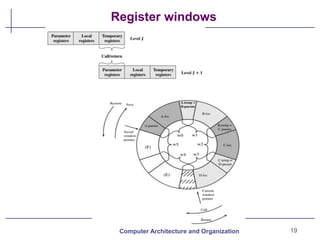
Register windows
• Thestudies show that procedures
• Employs only a few passed parameters & local variable
• The depth fluctuates within relatively narrow range
• To exploit these properties, multiple small sets of
registers are used, each assigned to a different procedure.
• So that a procedure call automatically switches the
processor to use a different fixed-size windows of register
rather than saving registers into memory
• Windows for adjacent procedure overlaps to allow
parameter passing without the actual movement of data
• Windows itself is divided into fixed-size areas
Computer Architecture and Organization 18
Global Variables
• Variablesaccessed by more than one procedure
• Two options
• Variables declared as global in HLL can be assigned
memory locations by the compiler
• For frequently accessed global variables this schema is inefficient
• To incorporate a set of global register in the processor
• Those registers would be fixed in number and available to all
procedures
• Compiler must decide which global variables should be assigned
to registers.
Computer Architecture and Organization 20
21.
Large Register FileVs Cache
Computer Architecture and Organization 21
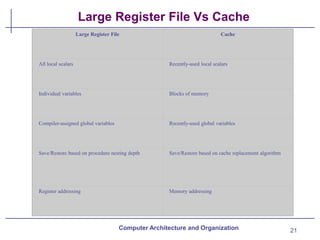
Large Register File Cache
All local scalars Recently-used local scalars
Individual variables Blocks of memory
Compiler-assigned global variables Recently-used global variables
Save/Restore based on procedure nesting depth Save/Restore based on cache replacement algorithm
Register addressing Memory addressing
22.
Compiler Based RegisterOptimization
22
Computer Architecture and Organization
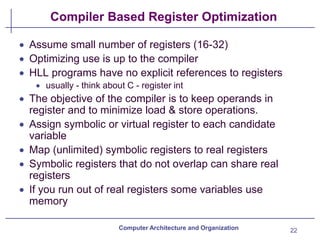
• Assume small number of registers (16-32)
• Optimizing use is up to the compiler
• HLL programs have no explicit references to registers
• usually - think about C - register int
• The objective of the compiler is to keep operands in
register and to minimize load & store operations.
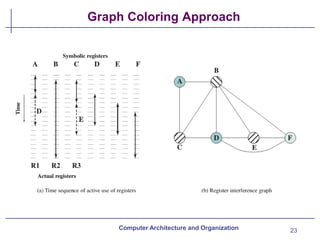
• Assign symbolic or virtual register to each candidate
variable
• Map (unlimited) symbolic registers to real registers
• Symbolic registers that do not overlap can share real
registers
• If you run out of real registers some variables use
memory
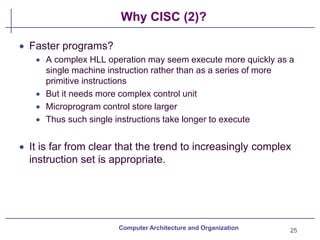
Why CISC (1)?
24
ComputerArchitecture and Organization
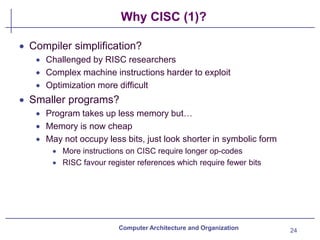
• Compiler simplification?
• Challenged by RISC researchers
• Complex machine instructions harder to exploit
• Optimization more difficult
• Smaller programs?
• Program takes up less memory but…
• Memory is now cheap
• May not occupy less bits, just look shorter in symbolic form
• More instructions on CISC require longer op-codes
• RISC favour register references which require fewer bits
25.
Why CISC (2)?
25
ComputerArchitecture and Organization
• Faster programs?
• A complex HLL operation may seem execute more quickly as a
single machine instruction rather than as a series of more
primitive instructions
• But it needs more complex control unit
• Microprogram control store larger
• Thus such single instructions take longer to execute
• It is far from clear that the trend to increasingly complex
instruction set is appropriate.
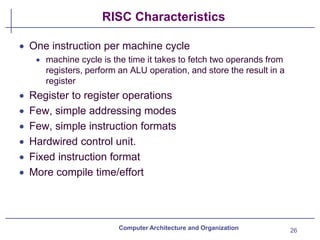
26.
RISC Characteristics
26
Computer Architectureand Organization
• One instruction per machine cycle
• machine cycle is the time it takes to fetch two operands from
registers, perform an ALU operation, and store the result in a
register
• Register to register operations
• Few, simple addressing modes
• Few, simple instruction formats
• Hardwired control unit.
• Fixed instruction format
• More compile time/effort
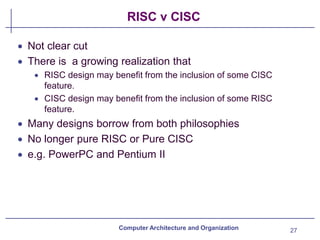
27.
RISC v CISC
27
ComputerArchitecture and Organization
• Not clear cut
• There is a growing realization that
• RISC design may benefit from the inclusion of some CISC
feature.
• CISC design may benefit from the inclusion of some RISC
feature.
• Many designs borrow from both philosophies
• No longer pure RISC or Pure CISC
• e.g. PowerPC and Pentium II
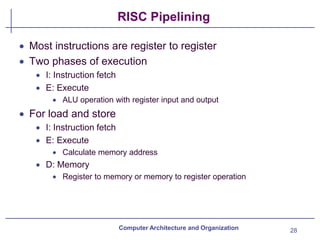
28.
RISC Pipelining
28
Computer Architectureand Organization
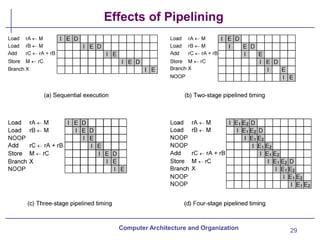
• Most instructions are register to register
• Two phases of execution
• I: Instruction fetch
• E: Execute
• ALU operation with register input and output
• For load and store
• I: Instruction fetch
• E: Execute
• Calculate memory address
• D: Memory
• Register to memory or memory to register operation
Problems in comparisonof RISC vs CISC
30
Computer Architecture and Organization
• No pair of RISC and CISC that are directly comparable
level of technology, gate complexity, OS support.
• No definitive set of test programs. Performance varies
with program.
• Difficult to separate hardware effects from effects due to
skills in complier writing
• Most comparisons has been done on “toy” rather than
production machines
• Most commercial devices are a mixture
31.
Department of Electricaland Computer Engineering
End of Chapter 7
Computer Architecture
and Organization

![Weighted Relative Dynamic Frequency of HLL
Operations [PATT82a]
12
Computer Architecture and Organization
Dynamic Occurrence
Machine-Instruction
Weighted
Memory-Reference
Weighted
Pascal C Pascal C Pascal C
ASSIGN 45% 38% 13% 13% 14% 15%
LOOP 5% 3% 42% 32% 33% 26%
CALL 15% 12% 31% 33% 44% 45%
IF 29% 43% 11% 21% 7% 13%
GOTO — 3% — — — —
OTHER 6% 1% 3% 1% 2% 1%](https://image.slidesharecdn.com/chapter07reducedinstructionsetcomputer1-260204124304-fe2e8a59/85/Chapter_07_Reduced_Instruction_Set_Computer-1-pdf-12-320.jpg)