2
Sorting algorithm
Sortingis an operation that segregates items into groups
according to specified criterion.
It is a process that organizes a collection of data into either
ascending or descending order.
Assume:
Array A = { 3 1 6 2 1 3 4 5 9 0 } is unsorted list
Array A = { 0 1 1 2 3 3 4 5 6 9 } is sorted list!
The operation of sorting is the most common task
performed by computers today.
3.
3
Cont’
Consider the followinglist:
Name mark
Zeyede 85.56
Kufa 33.35
Alemu 90.56
Asefa 33.45
Challa 77.67
Abebe 87.78
Jiregna 98.88
Melita 88.78
Abel 66.5
Please identify which mark is maximum &which name will be the first ?
4.
4
Why Sorting?
Imagine:
Findingthe phone number of your friend in your mobile phone,
but the phone book is not sorted.
Finding the name of student from database if it is not
alphabetically ordered
Finding bank account from the database if it is not ordered
Finding marks of student if it is not ordered
Finding Files from file directory of your computer if it is not
sorted
– Such and others task are tedious and expensive.
5.
5
Cont’
Currently,
More than 25%of computer CPU time spent in
sorting problems
It has wider application as we mentioned
Provides an excellent case study for algorithm design
and analysis
One of the most researched algorithm.
Therefore,sorting makes our work easier and
cheaper!!!
6.
6
Application of sorting
•Prerequisite for searching -Sorting done to make
searching easier
Internet search engines results
Word search from dictionary
Telephone books
...
• Data compression (DSP)
• To prepare a list of student ID, names, and scores in
a table.
7.
7
Cont’
• Database application
Schools
Banks
•To prepare a list of scores before letter grade
assignment
• Examples of Sorting:
Words in a dictionary are sorted
Files in a directory are often listed in sorted
order.
The index of a book is sorted etc.
8.
8
Types of sorting
•The following are some of the common types of sorting
algorithms:
Selection Sort
Insertion Sort
Bubble Sort
Merge Sort
Quick Sort
9.
9
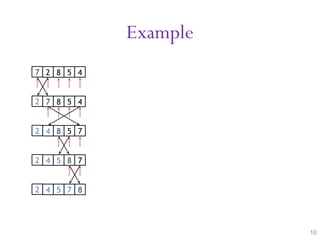
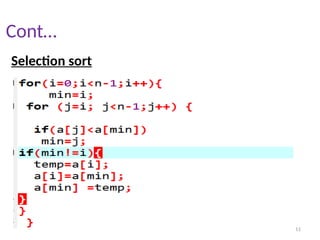
Selection sort
• Givenan array of length n,
Search elements 0 through n-1 and select the smallest
– Swap it with the element in location 0
Search elements 1 through n-1 and select the smallest
– Swap it with the element in location 1
Search elements 2 through n-1 and select the smallest
– Swap it with the element in location 2
Search elements 3 through n-1 and select the smallest
– Swap it with the element in location 3
Continue in this fashion until there’s nothing left to search
12
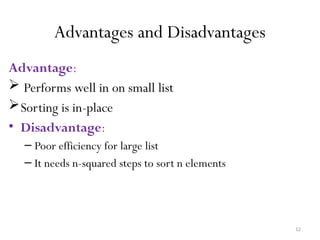
Advantages and Disadvantages
Advantage:
Performs well in on small list
Sorting is in-place
• Disadvantage:
– Poor efficiency for large list
– It needs n-squared steps to sort n elements
13.
13
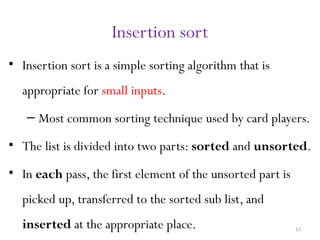
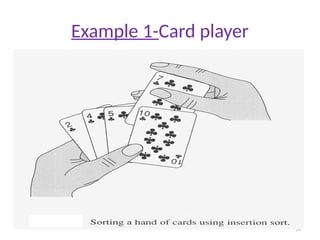
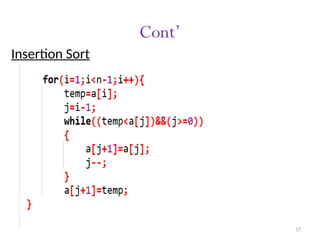
Insertion sort
• Insertionsort is a simple sorting algorithm that is
appropriate for small inputs.
– Most common sorting technique used by card players.
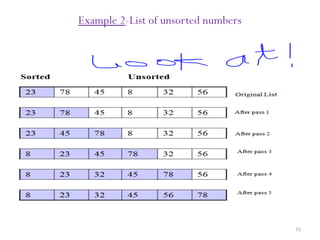
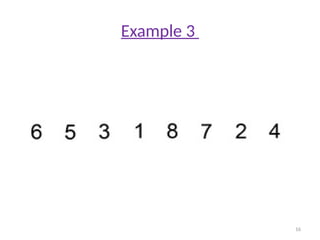
• The list is divided into two parts: sorted and unsorted.
• In each pass, the first element of the unsorted part is
picked up, transferred to the sorted sub list, and
inserted at the appropriate place.
19
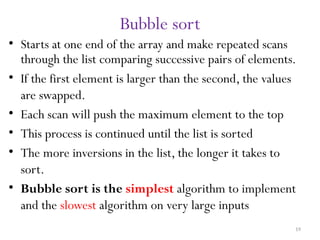
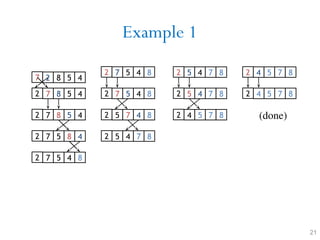
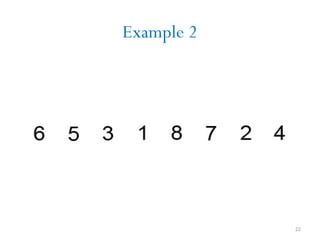
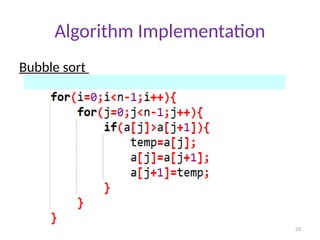
Bubble sort
• Startsat one end of the array and make repeated scans
through the list comparing successive pairs of elements.
• If the first element is larger than the second, the values
are swapped.
• Each scan will push the maximum element to the top
• This process is continued until the list is sorted
• The more inversions in the list, the longer it takes to
sort.
• Bubble sort is the simplest algorithm to implement
and the slowest algorithm on very large inputs
20.
20
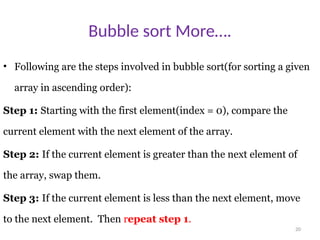
Bubble sort More….
•Following are the steps involved in bubble sort(for sorting a given
array in ascending order):
Step 1: Starting with the first element(index = 0), compare the
current element with the next element of the array.
Step 2: If the current element is greater than the next element of
the array, swap them.
Step 3: If the current element is less than the next element, move
to the next element. Then repeat step 1.
24
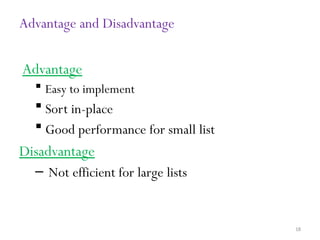
Advantage and Disadvantage
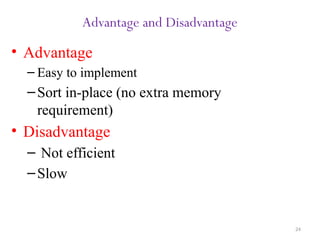
•Advantage
– Easy to implement
–Sort in-place (no extra memory
requirement)
• Disadvantage
– Not efficient
–Slow
25.
25
Merge sort
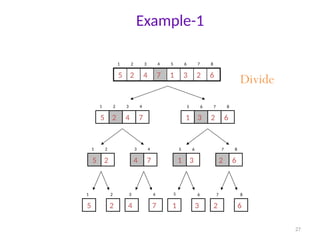
• Mergesort: Repeatedly divides the data in half, sorts
each half, and combines the sorted halves into a sorted
whole.
Divide the list into two roughly equal halves.
Sort the left half.
Sort the right half.
Merge the two sorted halves into one sorted list.
Often implemented recursively.
An example of a "divide and conquer" algorithm.
26.
26
Cont’
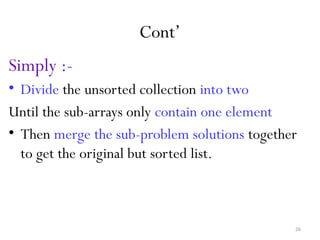
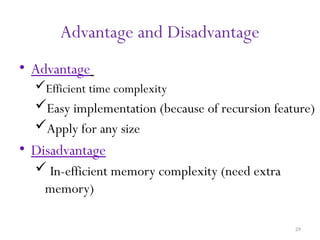
Simply :-
• Dividethe unsorted collection into two
Until the sub-arrays only contain one element
• Then merge the sub-problem solutions together
to get the original but sorted list.
29
Advantage and Disadvantage
•Advantage
Efficient time complexity
Easy implementation (because of recursion feature)
Apply for any size
• Disadvantage
In-efficient memory complexity (need extra
memory)
30.
30
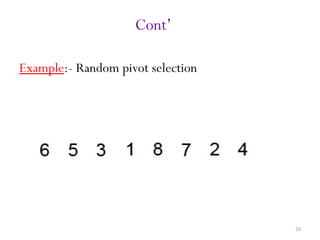
Quick sort
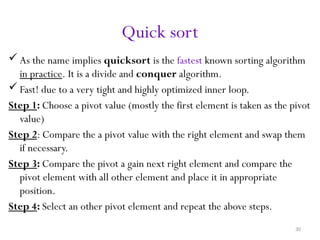
Asthe name implies quicksort is the fastest known sorting algorithm
in practice. It is a divide and conquer algorithm.
Fast! due to a very tight and highly optimized inner loop.
Step 1: Choose a pivot value (mostly the first element is taken as the pivot
value)
Step 2: Compare the a pivot value with the right element and swap them
if necessary.
Step 3: Compare the pivot a gain next right element and compare the
pivot element with all other element and place it in appropriate
position.
Step 4: Select an other pivot element and repeat the above steps.
31.
31
Cont’
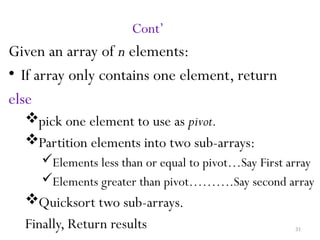
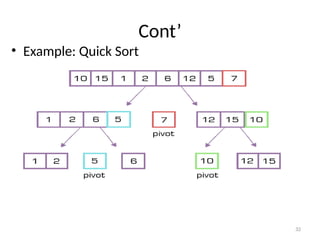
Given an arrayof n elements:
• If array only contains one element, return
else
pick one element to use as pivot.
Partition elements into two sub-arrays:
Elements less than or equal to pivot…Say First array
Elements greater than pivot……….Say second array
Quicksort two sub-arrays.
Finally, Return results
35
Cont’
Recursive QuickSort function
quickSort(a,lb, ub) {
if (lb < ub) {
/* loc is partitioning index, a[loc] is now at right place
*/
loc = Partition(a, lb, ub);
quickSort(a, lb, loc– 1); // Before loc
quickSort(a, loc + 1, ub); // After loc
}
}
36.
36
Advantage and Disadvantage
•Advantage
Sort in-place (no extra memory requirement)
• Disadvantage
Vary its time complexity based on input instance
difference
37.
37
Searching Algorithm
Searching isa process of looking for a specific element in a
list of items or determining that the item is not in the list. or
A search algorithm is a method of locating a specific item of
information in a larger collection of data.
There are two simple searching algorithms:
1. Sequential Search, and
2. Binary Search
38.
38
Linear Search
This isa very simple algorithm.
It uses a loop to sequentially step through an array,
starting with the first element.
It compares each element with the value being searched
for and stops when that value is found or the end of the
array is reached.
39.
39
Example:
Given the followingarray elements
int a[]={1,4,7,2,5,-3,9,2};
Imagine the key is -3
How linear search work?
-3 compares with all element
If the key match with one element, the index will be the result, if not
-1 will be display.
What if key=-2? result=-1
41
Advantage and disadvantage
•The advantage is its simplicity.
It is easy to understand
Easy to implement
Does not require the array to be in order
• The disadvantage is its inefficiency
If there are 20,000 items in the array and what you are
looking for is in the 19,999th
element, you need to
search through the entire list.
42.
42
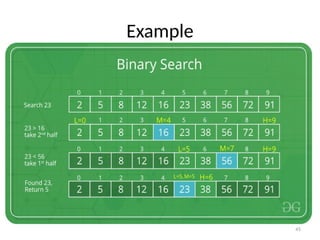
Binary Search
The binarysearch is much more efficient than the linear
search.
It requires the list to be in order.
The algorithm starts searching with the middle element.
If the item is less than the middle element, it starts
over searching the first half of the list.
If the item is greater than the middle element, the
search starts over starting with the middle element in
the second half of the list.
It then continues halving the list until the item is
found.
43.
43
Cont’
• The BinarySearch on List inAscending order
Start at middle of list
is that the item?
If not, is it less than or greater than the item?
less than, move to second half of list
greater than, move to first half of list
repeat until found or sub list size = 0
44.
44
Cont’
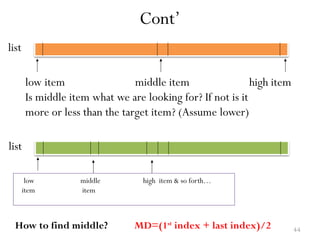
list
low item middleitem high item
Is middle item what we are looking for? If not is it
more or less than the target item? (Assume lower)
list
low middle high item & so forth…
item item
How to find middle? MD=(1st
index + last index)/2
47
Assignment 1( Maxmark=20% )
• Write a C++ program to implement all sorting
algorithms(selection, insertion, bubble, merge
and quick)
instructions:
1. Check each algorithm for sorted, random and inversed
input.
2. The code should be done all in one approach(Hint: use
function, conditional statements,…)
3. Do in group (5 members in one group)
4. Submission date: Dec, 20/2025
![34
Algorithm Implementation- Quick sort
Partition (a,lb,ub){
Pivot=a[lb];
start=lb;
end=ub;
while(a[start]<=pivot)
start++;
while(a[end]>pivot)
end--;
If(start<end)
Swap(a[strat],a[end]);
}](https://image.slidesharecdn.com/chapter5-sortingalgorithms-251104114457-2589ac12/85/Chapter-5-Sorting-Algorithms-selection-insertion-bubble-merge-and-quick-sort-pptx-34-320.jpg)
![35
Cont’
Recursive QuickSort function
quickSort(a, lb, ub) {
if (lb < ub) {
/* loc is partitioning index, a[loc] is now at right place
*/
loc = Partition(a, lb, ub);
quickSort(a, lb, loc– 1); // Before loc
quickSort(a, loc + 1, ub); // After loc
}
}](https://image.slidesharecdn.com/chapter5-sortingalgorithms-251104114457-2589ac12/85/Chapter-5-Sorting-Algorithms-selection-insertion-bubble-merge-and-quick-sort-pptx-35-320.jpg)
![39
Example:
Given the following array elements
int a[]={1,4,7,2,5,-3,9,2};
Imagine the key is -3
How linear search work?
-3 compares with all element
If the key match with one element, the index will be the result, if not
-1 will be display.
What if key=-2? result=-1](https://image.slidesharecdn.com/chapter5-sortingalgorithms-251104114457-2589ac12/85/Chapter-5-Sorting-Algorithms-selection-insertion-bubble-merge-and-quick-sort-pptx-39-320.jpg)
![40
Algorithm-Implementation
for(int i = 0; i < length; i++)
{
if( list[i] == target )
{
return i;
}
else{
return -1;
}
}](https://image.slidesharecdn.com/chapter5-sortingalgorithms-251104114457-2589ac12/85/Chapter-5-Sorting-Algorithms-selection-insertion-bubble-merge-and-quick-sort-pptx-40-320.jpg)