Chapter 3
IoT & M2M
Bahga & Madisetti, © 2015
Book website: http://www.internet-of-things-book.com
Outline
• M2M
• Differences and Similarities between M2M and IoT
• SDN and NFV for IoT
Bahga & Madisetti, © 2015
Book website: http://www.internet-of-things-book.com
Machine-to-Machine (M2M)
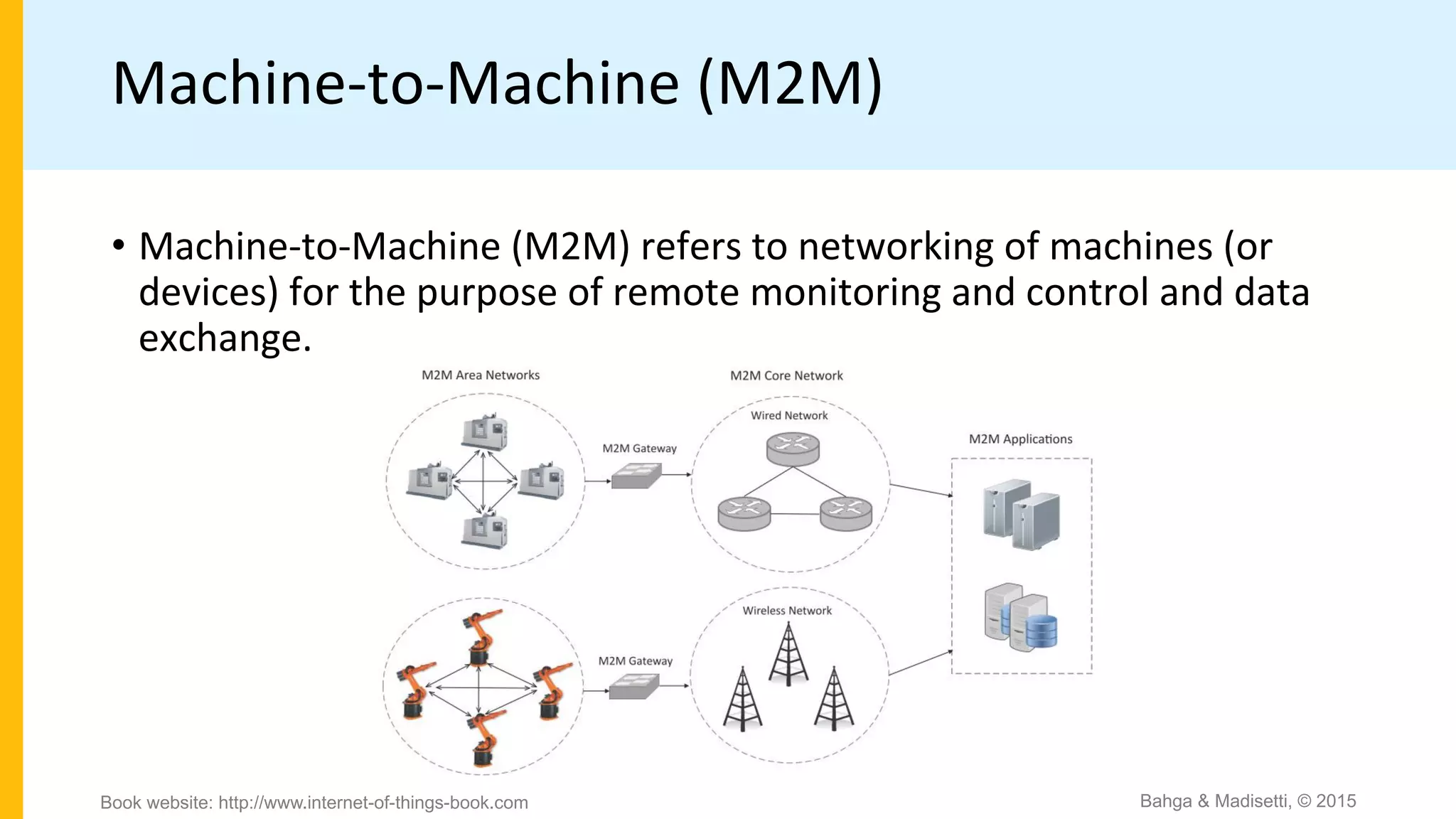
• Machine-to-Machine (M2M) refers to networking of machines (or
devices) for the purpose of remote monitoring and control and data
exchange.
Bahga & Madisetti, © 2015
Book website: http://www.internet-of-things-book.com
Machine-to-Machine (M2M)
• An M2M area network comprises of machines (or M2M nodes) which have
embedded hardware modules for sensing, actuation and communication.
• Various communication protocols can be used for M2M local area
networks such as ZigBee, Bluetooh, ModBus, M-Bus, Wirless M-Bus, Power
Line Communication (PLC), 6LoWPAN, IEEE 802.15.4, etc.
• The communication network provides connectivity to remote M2M area
networks.
• The communication network can use either wired or wireless networks (IP-
based).
• While the M2M area networks use either proprietary or non-IP based
communication protocols, the communication network uses IP-based
networks.
Bahga & Madisetti, © 2015
Book website: http://www.internet-of-things-book.com
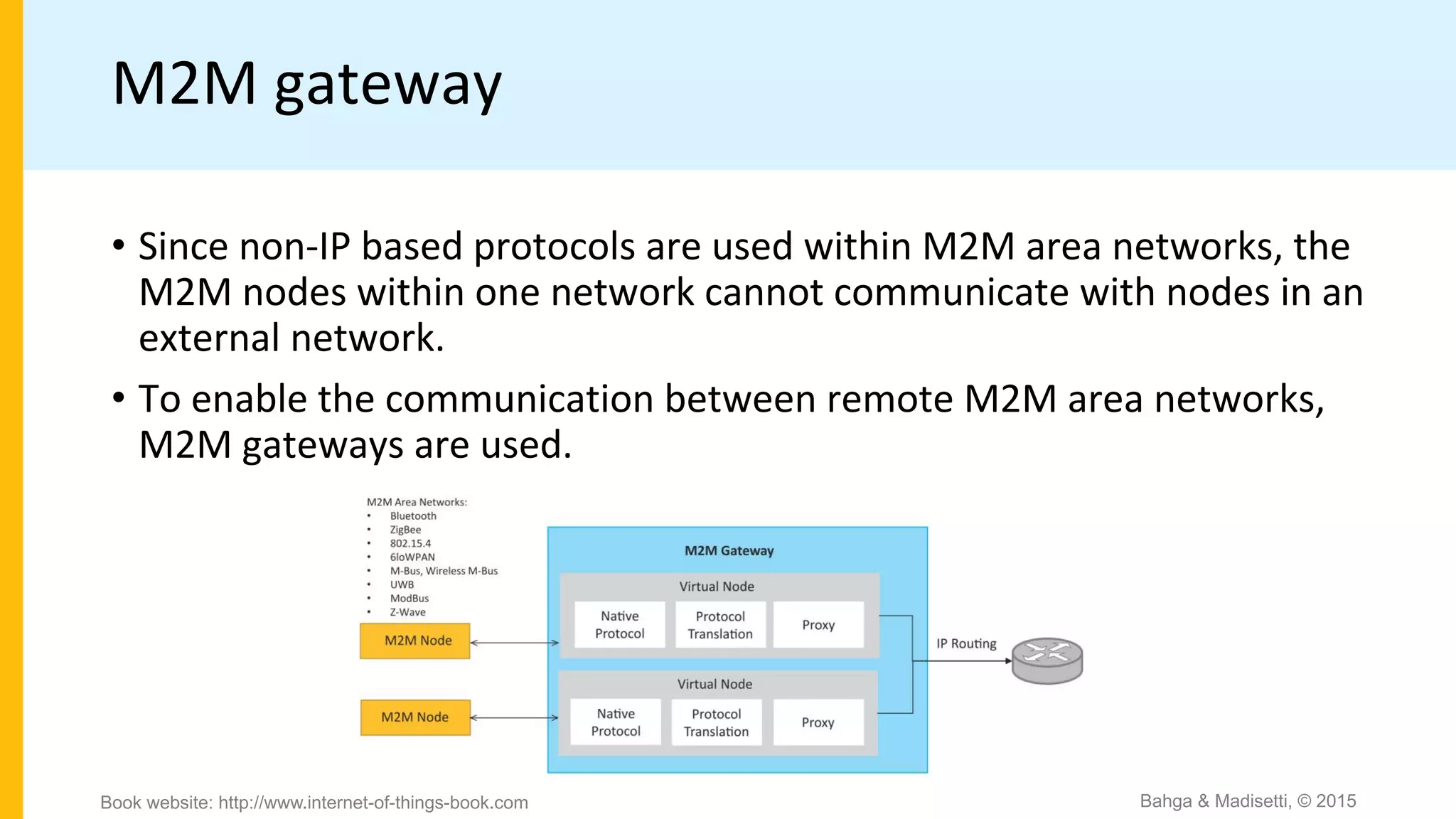
M2M gateway
• Since non-IP based protocols are used within M2M area networks, the
M2M nodes within one network cannot communicate with nodes in an
external network.
• To enable the communication between remote M2M area networks,
M2M gateways are used.
Bahga & Madisetti, © 2015
Book website: http://www.internet-of-things-book.com
Difference between IoT and M2M
• Communication Protocols
• M2M and IoT can differ in how the communication between the machines or
devices happens.
• M2M uses either proprietary or non-IP based communication protocols for
communication within the M2M area networks.
• Machines in M2M vs Things in IoT
• The "Things" in IoT refers to physical objects that have unique identifiers and
can sense and communicate with their external environment (and user
applications) or their internal physical states.
• M2M systems, in contrast to IoT, typically have homogeneous machine types
within an M2M area network.
Bahga & Madisetti, © 2015
Book website: http://www.internet-of-things-book.com
Difference between IoT and M2M
• Hardware vs Software Emphasis
• While the emphasis of M2M is more on hardware with embedded modules, the
emphasis of IoT is more on software.
• Data Collection & Analysis
• M2M data is collected in point solutions and often in on-premises storage
infrastructure.
• In contrast to M2M, the data in IoT is collected in the cloud (can be public, private or
hybrid cloud).
• Applications
• M2M data is collected in point solutions and can be accessed by on-premises
applications such as diagnosis applications, service management applications, and on-
premisis enterprise applications.
• IoT data is collected in the cloud and can be accessed by cloud applications such as
analytics applications, enterprise applications, remote diagnosis and management
applications, etc.
Bahga & Madisetti, © 2015
Book website: http://www.internet-of-things-book.com
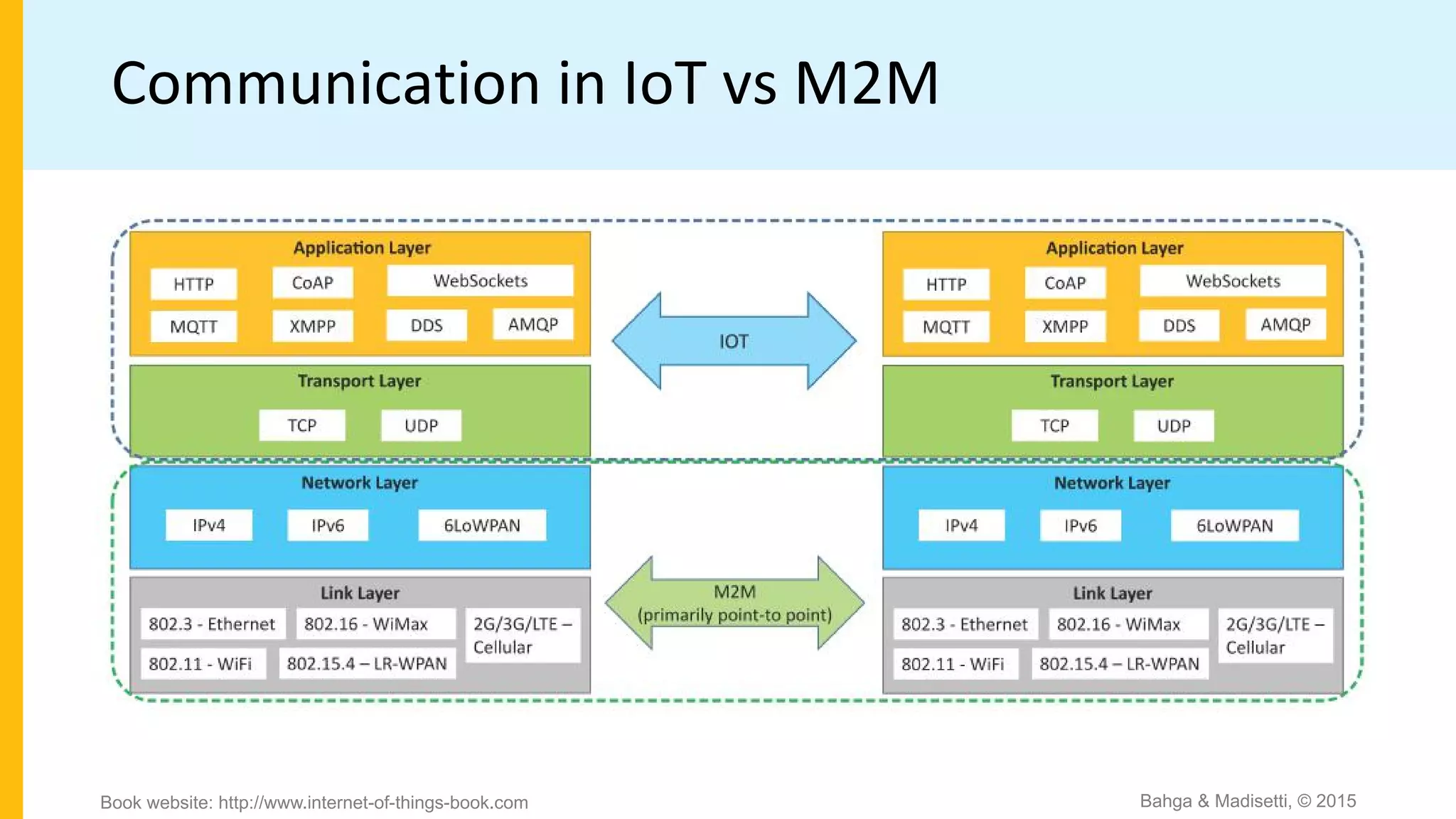
Communication in IoT vs M2M
Bahga & Madisetti, © 2015
Book website: http://www.internet-of-things-book.com
SDN
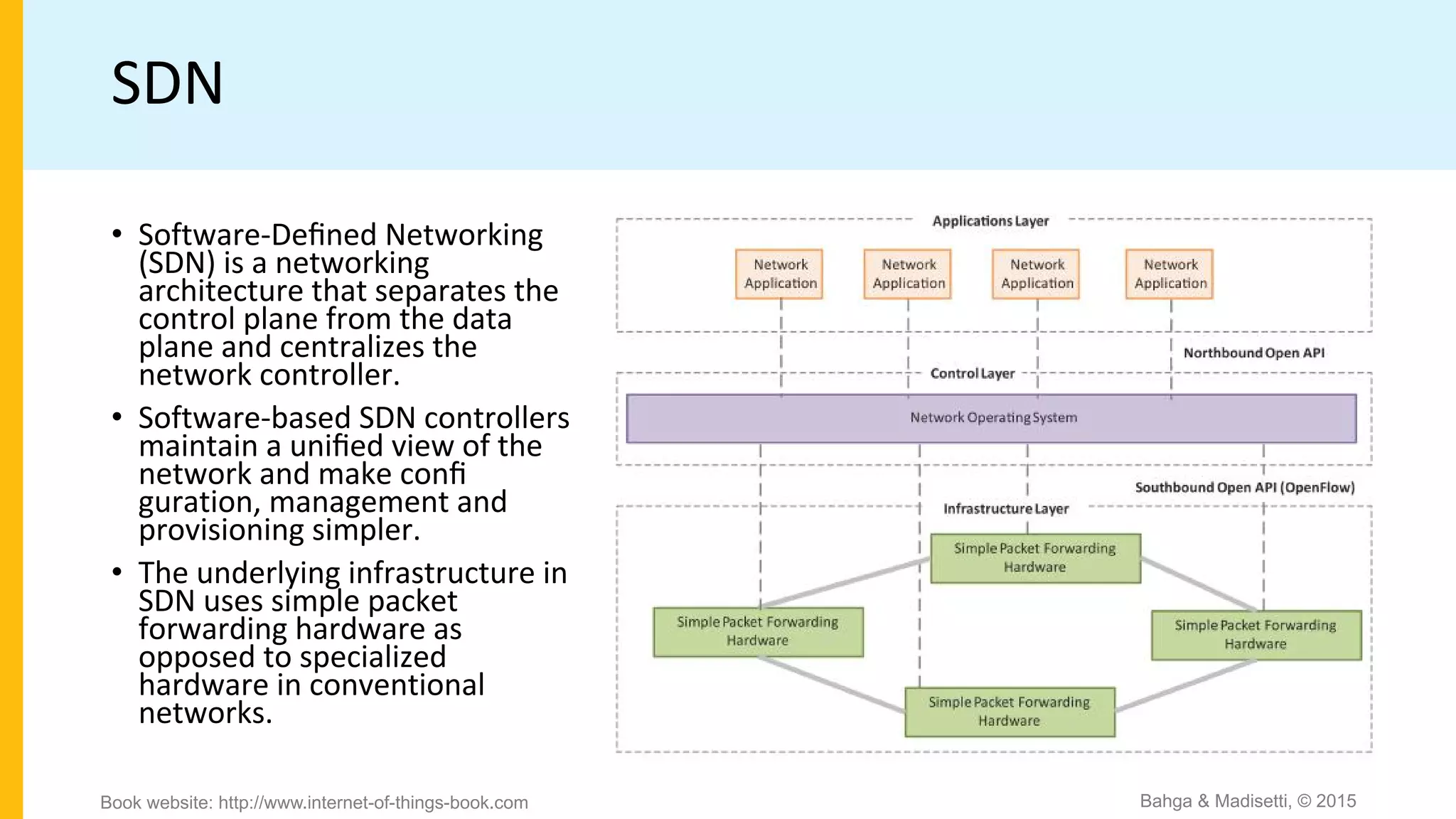
• Software-Defined Networking
(SDN) is a networking
architecture that separates the
control plane from the data
plane and centralizes the
network controller.
• Software-based SDN controllers
maintain a unified view of the
network and make confi
guration, management and
provisioning simpler.
• The underlying infrastructure in
SDN uses simple packet
forwarding hardware as
opposed to specialized
hardware in conventional
networks.
Bahga & Madisetti, © 2015
Book website: http://www.internet-of-things-book.com
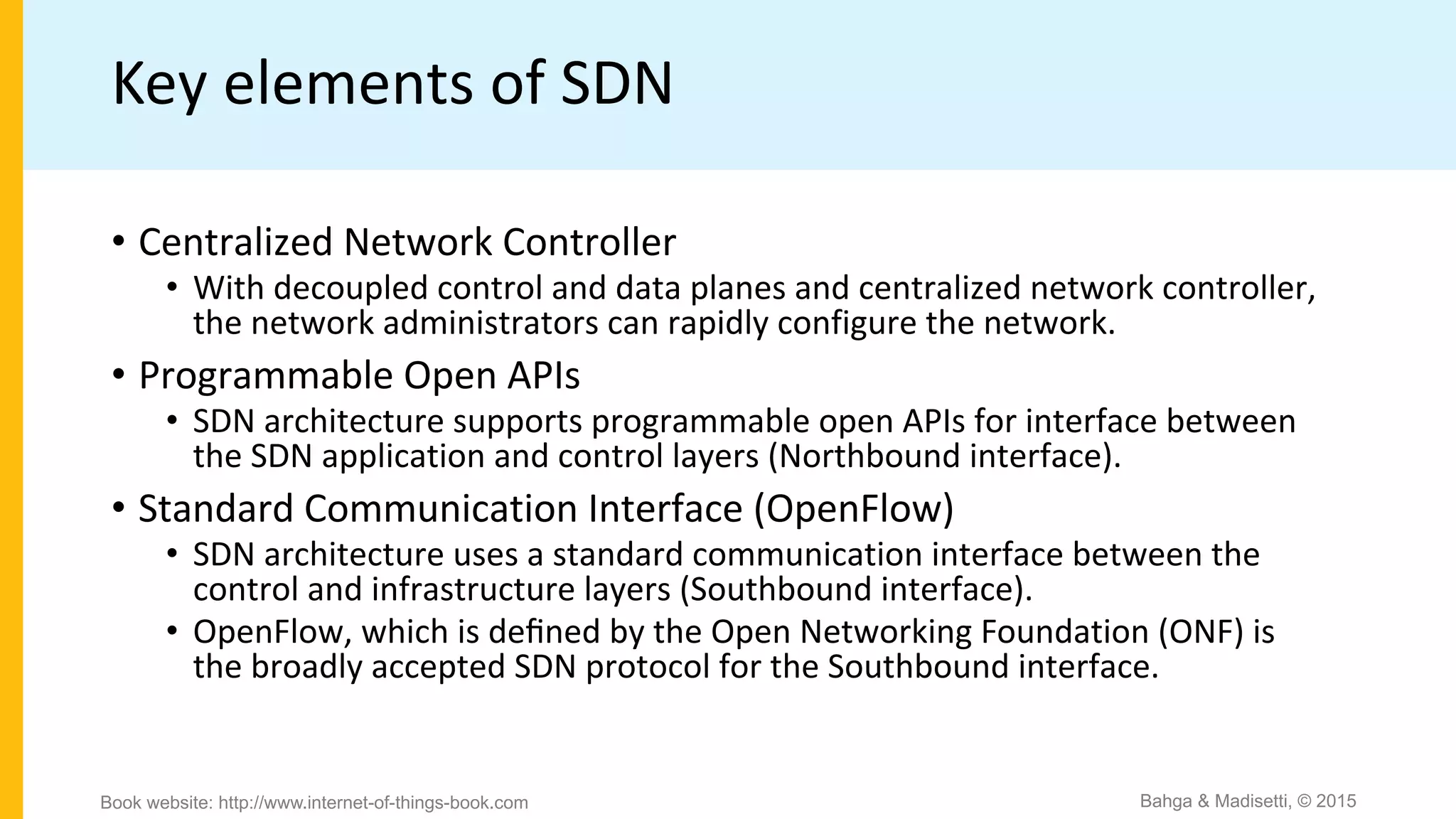
Key elements of SDN
• Centralized Network Controller
• With decoupled control and data planes and centralized network controller,
the network administrators can rapidly configure the network.
• Programmable Open APIs
• SDN architecture supports programmable open APIs for interface between
the SDN application and control layers (Northbound interface).
• Standard Communication Interface (OpenFlow)
• SDN architecture uses a standard communication interface between the
control and infrastructure layers (Southbound interface).
• OpenFlow, which is defined by the Open Networking Foundation (ONF) is
the broadly accepted SDN protocol for the Southbound interface.
Bahga & Madisetti, © 2015
Book website: http://www.internet-of-things-book.com
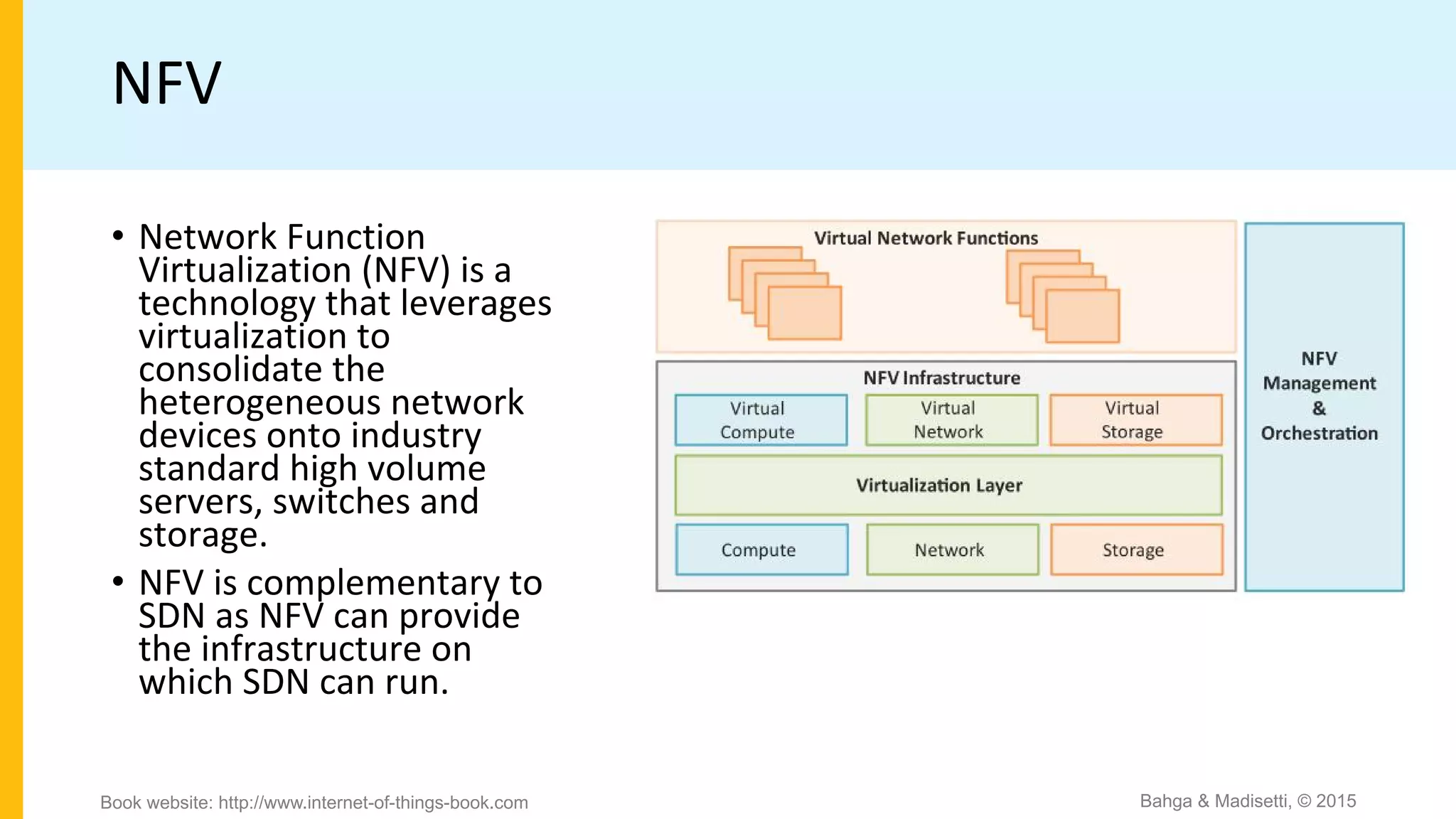
NFV
• Network Function
Virtualization (NFV) is a
technology that leverages
virtualization to
consolidate the
heterogeneous network
devices onto industry
standard high volume
servers, switches and
storage.
• NFV is complementary to
SDN as NFV can provide
the infrastructure on
which SDN can run.
Bahga & Madisetti, © 2015
Book website: http://www.internet-of-things-book.com
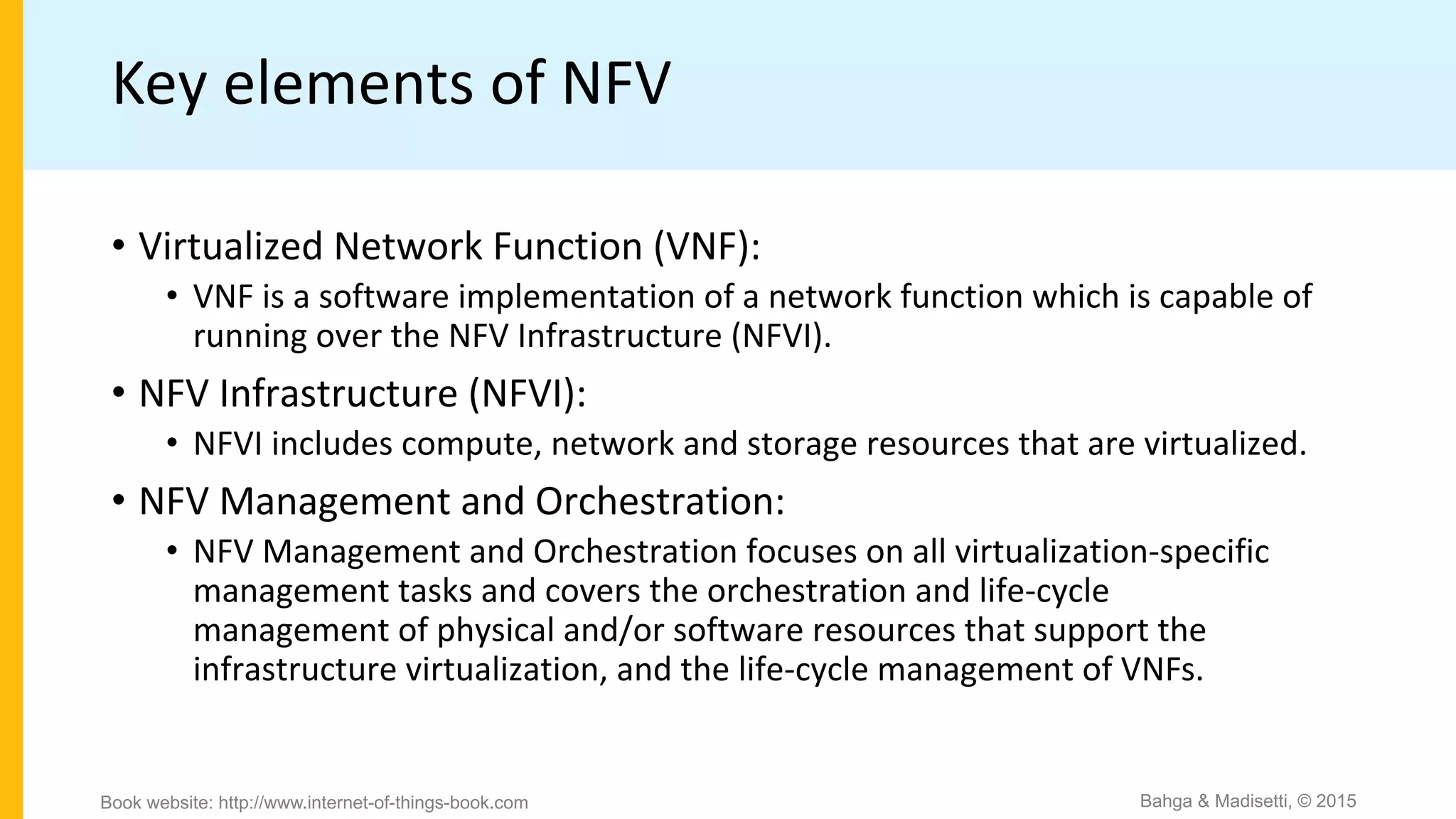
Key elements of NFV
• Virtualized Network Function (VNF):
• VNF is a software implementation of a network function which is capable of
running over the NFV Infrastructure (NFVI).
• NFV Infrastructure (NFVI):
• NFVI includes compute, network and storage resources that are virtualized.
• NFV Management and Orchestration:
• NFV Management and Orchestration focuses on all virtualization-specific
management tasks and covers the orchestration and life-cycle
management of physical and/or software resources that support the
infrastructure virtualization, and the life-cycle management of VNFs.
Bahga & Madisetti, © 2015
Book website: http://www.internet-of-things-book.com
NFV Use Case
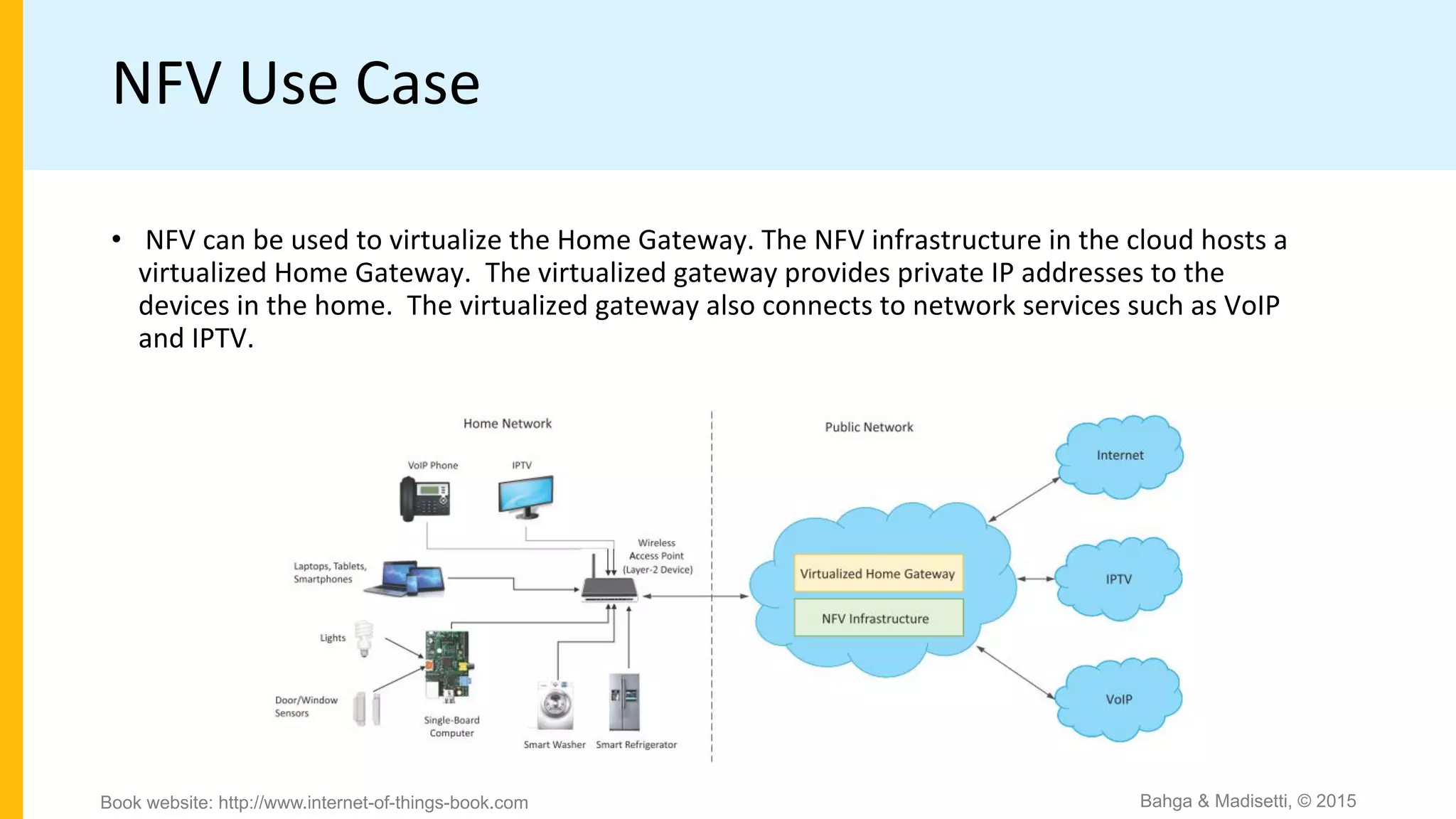
• NFV can be used to virtualize the Home Gateway. The NFV infrastructure in the cloud hosts a
virtualized Home Gateway. The virtualized gateway provides private IP addresses to the
devices in the home. The virtualized gateway also connects to network services such as VoIP
and IPTV.
Bahga & Madisetti, © 2015
Book website: http://www.internet-of-things-book.com

Chapter-3.pdf

  • 1.
    Chapter 3 IoT &M2M Bahga & Madisetti, © 2015 Book website: http://www.internet-of-things-book.com
  • 2.
    Outline • M2M • Differencesand Similarities between M2M and IoT • SDN and NFV for IoT Bahga & Madisetti, © 2015 Book website: http://www.internet-of-things-book.com
  • 3.
    Machine-to-Machine (M2M) • Machine-to-Machine(M2M) refers to networking of machines (or devices) for the purpose of remote monitoring and control and data exchange. Bahga & Madisetti, © 2015 Book website: http://www.internet-of-things-book.com
  • 4.
    Machine-to-Machine (M2M) • AnM2M area network comprises of machines (or M2M nodes) which have embedded hardware modules for sensing, actuation and communication. • Various communication protocols can be used for M2M local area networks such as ZigBee, Bluetooh, ModBus, M-Bus, Wirless M-Bus, Power Line Communication (PLC), 6LoWPAN, IEEE 802.15.4, etc. • The communication network provides connectivity to remote M2M area networks. • The communication network can use either wired or wireless networks (IP- based). • While the M2M area networks use either proprietary or non-IP based communication protocols, the communication network uses IP-based networks. Bahga & Madisetti, © 2015 Book website: http://www.internet-of-things-book.com
  • 5.
    M2M gateway • Sincenon-IP based protocols are used within M2M area networks, the M2M nodes within one network cannot communicate with nodes in an external network. • To enable the communication between remote M2M area networks, M2M gateways are used. Bahga & Madisetti, © 2015 Book website: http://www.internet-of-things-book.com
  • 6.
    Difference between IoTand M2M • Communication Protocols • M2M and IoT can differ in how the communication between the machines or devices happens. • M2M uses either proprietary or non-IP based communication protocols for communication within the M2M area networks. • Machines in M2M vs Things in IoT • The "Things" in IoT refers to physical objects that have unique identifiers and can sense and communicate with their external environment (and user applications) or their internal physical states. • M2M systems, in contrast to IoT, typically have homogeneous machine types within an M2M area network. Bahga & Madisetti, © 2015 Book website: http://www.internet-of-things-book.com
  • 7.
    Difference between IoTand M2M • Hardware vs Software Emphasis • While the emphasis of M2M is more on hardware with embedded modules, the emphasis of IoT is more on software. • Data Collection & Analysis • M2M data is collected in point solutions and often in on-premises storage infrastructure. • In contrast to M2M, the data in IoT is collected in the cloud (can be public, private or hybrid cloud). • Applications • M2M data is collected in point solutions and can be accessed by on-premises applications such as diagnosis applications, service management applications, and on- premisis enterprise applications. • IoT data is collected in the cloud and can be accessed by cloud applications such as analytics applications, enterprise applications, remote diagnosis and management applications, etc. Bahga & Madisetti, © 2015 Book website: http://www.internet-of-things-book.com
  • 8.
    Communication in IoTvs M2M Bahga & Madisetti, © 2015 Book website: http://www.internet-of-things-book.com
  • 9.
    SDN • Software-Defined Networking (SDN)is a networking architecture that separates the control plane from the data plane and centralizes the network controller. • Software-based SDN controllers maintain a unified view of the network and make confi guration, management and provisioning simpler. • The underlying infrastructure in SDN uses simple packet forwarding hardware as opposed to specialized hardware in conventional networks. Bahga & Madisetti, © 2015 Book website: http://www.internet-of-things-book.com
  • 10.
    Key elements ofSDN • Centralized Network Controller • With decoupled control and data planes and centralized network controller, the network administrators can rapidly configure the network. • Programmable Open APIs • SDN architecture supports programmable open APIs for interface between the SDN application and control layers (Northbound interface). • Standard Communication Interface (OpenFlow) • SDN architecture uses a standard communication interface between the control and infrastructure layers (Southbound interface). • OpenFlow, which is defined by the Open Networking Foundation (ONF) is the broadly accepted SDN protocol for the Southbound interface. Bahga & Madisetti, © 2015 Book website: http://www.internet-of-things-book.com
  • 11.
    NFV • Network Function Virtualization(NFV) is a technology that leverages virtualization to consolidate the heterogeneous network devices onto industry standard high volume servers, switches and storage. • NFV is complementary to SDN as NFV can provide the infrastructure on which SDN can run. Bahga & Madisetti, © 2015 Book website: http://www.internet-of-things-book.com
  • 12.
    Key elements ofNFV • Virtualized Network Function (VNF): • VNF is a software implementation of a network function which is capable of running over the NFV Infrastructure (NFVI). • NFV Infrastructure (NFVI): • NFVI includes compute, network and storage resources that are virtualized. • NFV Management and Orchestration: • NFV Management and Orchestration focuses on all virtualization-specific management tasks and covers the orchestration and life-cycle management of physical and/or software resources that support the infrastructure virtualization, and the life-cycle management of VNFs. Bahga & Madisetti, © 2015 Book website: http://www.internet-of-things-book.com
  • 13.
    NFV Use Case •NFV can be used to virtualize the Home Gateway. The NFV infrastructure in the cloud hosts a virtualized Home Gateway. The virtualized gateway provides private IP addresses to the devices in the home. The virtualized gateway also connects to network services such as VoIP and IPTV. Bahga & Madisetti, © 2015 Book website: http://www.internet-of-things-book.com